Warby Parker: The First Profit Came From the Bank, Not the Store
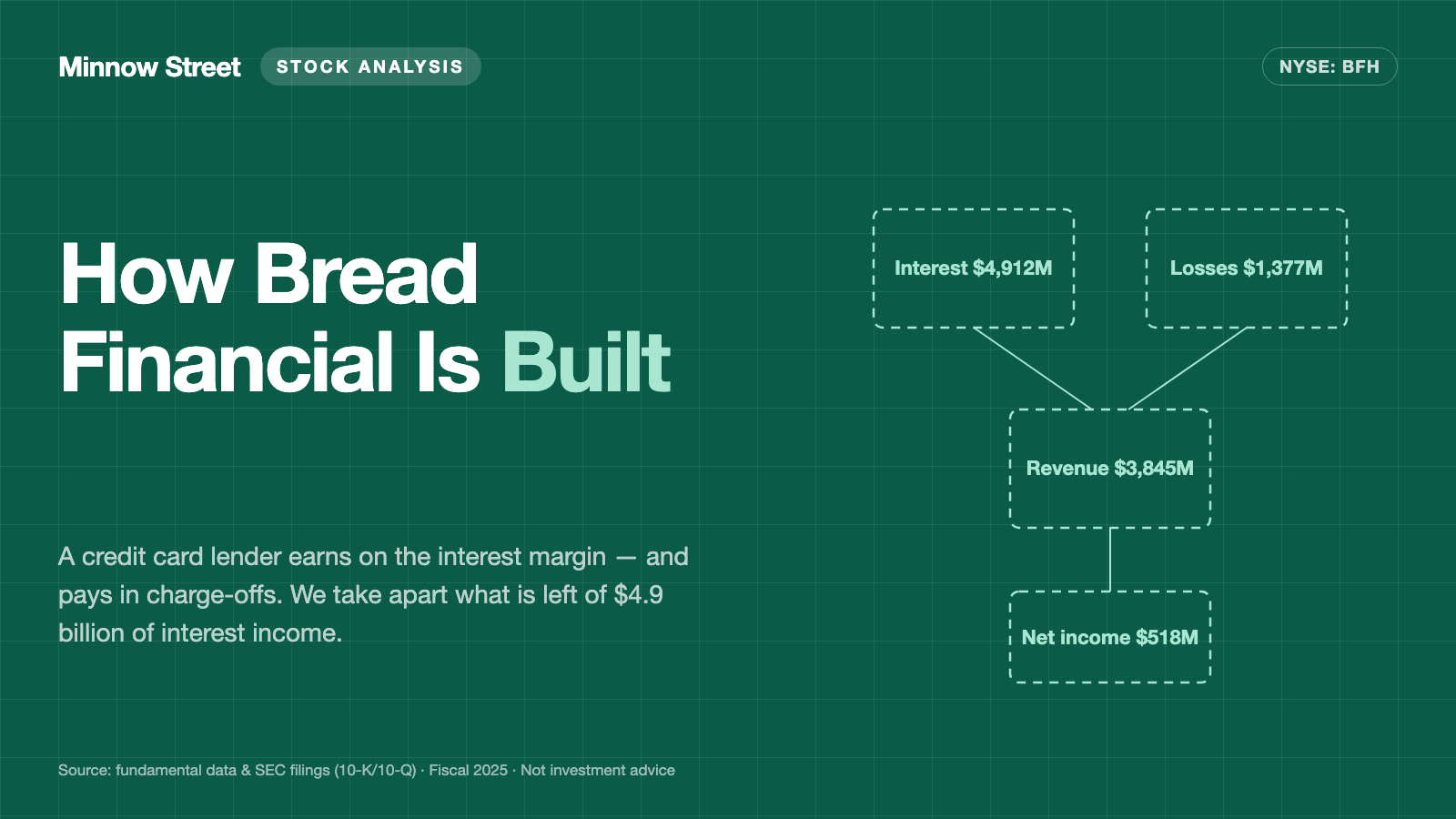
Warby Parker made money for the first time in 2025: $1.6 million after four straight years of losses. Operations still ran a $5.3 million loss — the profit came from interest on the company's own cash. Add a share count that sits an eighth too low in almost every published metric. We read the annual report and the quarterly report filed May 7, 2026, and check which lens actually brings this business into focus.
 Thomas Mücke
Founder & Publisher
Thomas Mücke
Founder & Publisher
Chart
Interactive price chart (TradingView).
Note: pure fact-based analysis, not investment advice and not a solicitation to buy or sell. All figures without guarantee.
One or two? The trap in the optician's chair
Anyone who has sat in an optician's chair knows the moment. The machine clicks, one lens after another swings in front of the eye, and the same question keeps coming: "One or two? Two or three?"
Eventually you say yes. Not necessarily to the lens that gives you the sharpest image — but to the one that feels most comfortable. That is exactly what we do with financial metrics. We click through until a number shows up that feels good, and then we declare it the truth.
With Warby Parker the temptation is unusually strong, because there are four bottom lines for one and the same year. For 2025 the company reports adjusted EBITDA of $95.2 million. Free cash flow came in at $43.7 million. Net income was $1.6 million. And operations ran a loss of $5.3 million.
All four numbers are correct. The largest and the smallest are 60 times apart. So: we read the 2025 annual report and the quarterly report filed May 7, 2026, and we check which lens actually brings this business into focus.
What this analysis covers
- What Warby Parker sells — and to whom
- How the stock landed on our desk
- The numbers over the years
- Uncomfortable truth no. 1: the profit came from the bank, not the store
- Uncomfortable truth no. 2: four bottom lines for one year
- Uncomfortable truth no. 3: the share count almost everyone gets wrong
- Uncomfortable truth no. 4: the survival test runs on the share price
- Where the margin is going
- Google's $150 million commitment
- What the stock costs
- Opportunities and risks at a glance
- A human conclusion
- Sources
What Warby Parker sells — and to whom
Warby Parker is based in New York and sells glasses. That sounds mundane, but there is a clear idea behind it: the company designs its own frames, has them manufactured, and sells them directly — cutting out the wholesaler who traditionally collects a large share of the price in optical retail.
It started as a pure online business. Today Warby Parker is above all a store network: 323 locations as of December 31, 2025, up from 276 a year earlier and 237 in 2023. By March 31, 2026 the count had reached 337. Add two in-house optical laboratories and two offices. At the end of 2025 the company employed 4,036 people, 2,275 of them full time.
What it sells goes well beyond frames. The four building blocks:
- Eyeglasses and sunglasses — the core, and the source of most revenue. Progressive lenses, the most expensive lens type, made up only 22.3 percent of prescription units as of December 31, 2025; industry-wide the figure is close to 40 percent.
- Contact lenses — a $10.4 billion market that contributed only 11.1 percent of 2025 revenue.
- Eye exams and vision care — an $11.4 billion market, contributing 6.4 percent of 2025 revenue.
- Accessories — cases, cloths, sun clip-ons.
The most interesting block does not appear in the revenue list at all yet: vision insurance. Roughly 60 percent of all US vision care purchases run through insurance. At Warby Parker, insurance-backed orders were 8.3 percent of revenue in 2025. The company is working to get into more insurance networks; an integration with Versant Health has taken in-network coverage above 30 million lives.
One more feature worth knowing: Warby Parker is a public benefit corporation. That is a US legal form in which the charter commits the company to a social purpose alongside profit. At Warby Parker it is called "Buy a Pair, Give a Pair": for every pair sold, a pair is distributed to someone in need. The company says more than 20 million pairs have been distributed across the US and more than 80 countries. For an investor this is not a footnote — the legal form obliges the board to weigh interests other than those of shareholders.
How the stock landed on our desk
We run roughly 3,500 stocks through our scanners every day. Warby Parker came in through the Turnaround Candidates list — with two caveats we disclose up front.
First: the stock is not on the page. On July 27, 2026, 60 US stocks met this scanner's criteria, but only the 25 strongest are displayed. Warby Parker is not among them.
Second: we deliberately do not claim an exact rank. The sort runs on the "Turn Check" column, and Warby Parker scores 6 of 8 points there. So do 43 other names: 44 of the 60 hits carry exactly the same score. When scores tie, the ordering is not fixed and can change with every recomputation. The only honest statement is a range: Warby Parker sits somewhere between rank 17 and rank 60. Our query returned rank 41; that is a snapshot, not a league table. To reproduce it: open the scanner and set the market filter to "US". These lists are recomputed daily.
And one more thing belongs to full disclosure: this is the only scanner Warby Parker appears in at all — checked on both our brands on July 27, 2026. No quality, growth or valuation filter catches this stock.
The list has two mandatory pillars. Miss either one and you are out, however good everything else looks:
- Pillar 1 — the crash: the stock must sit at least 50 percent below its all-time high. No real crash, no turnaround.
- Pillar 2 — survival: the Altman Z score must be at least 1.1. That score condenses several balance-sheet ratios into a single number and estimates how far a company is from insolvency. On top of that: no more than one balance-sheet warning flag and positive equity.
We checked pillar 1 against the price history. The highest closing price ever was $59.50 on November 17, 2021; the close on July 24, 2026 was $24.56. That is minus 58.7 percent. Our data set carries minus 54.87 percent — a figure that arithmetically references the first close after the direct listing ($54.49 on September 29, 2021) rather than the later November high. Both readings are comfortably below the threshold; the crash is real.
That also lets us put a number on when this hit disappears. At roughly $29.75 — half the all-time high — Warby Parker breaks pillar 1 and drops off the list. From the July 24, 2026 level that is a little over 21 percent higher. Curiously, the consensus target price of the 15 analysts covering the stock stood at $30.15 on July 26, 2026. If the professionals are right, the stock is no longer a turnaround candidate — it would simply have turned.
Pillar 2 holds, but it deserves its own section below. In short: the score reads 5.31 on our own calculation and 3.16 in the data set, both far above the 1.1 threshold. How it gets there is the more interesting question.
Only when both pillars stand does the scoring begin. The Turn Check awards eight points: four from the quarterly figures and four from market behavior. Warby Parker collects exactly six — the minimum, with no cushion. We counted which ones:
- Revenue direction — up 8.3 percent in the first quarter of 2026 against the prior-year quarter, so not declining. Point.
- Net margin — 1.3 percent in the first quarter of 2026 against minus 0.8 percent three quarters earlier and minus 2.8 percent in the prior quarter. Point.
- Operating cash flow — $24.5 million in the quarter, positive. Point.
- Balance sheet healing — the Altman Z came in above the level of three quarters earlier. Point.
- Price above the 50-day line — met. Point.
- Institutions adding — net positive. Point.
- Relative strength, three months against twelve — not met. No point.
- Insiders buying on net — not met, and not narrowly: in the twelve months to the July 26, 2026 data date there were zero insider purchases against 18 sales. No point.
What does that mean for you? A scanner calculates, it does not judge. Six of eight is the minimum, and two of the missing points say the same thing: the people who know this company best are not buying. How tight such a minimum score can be is something we showed in our Advance Auto Parts analysis — same scanner, same six points, an entirely different business.
The numbers over the years
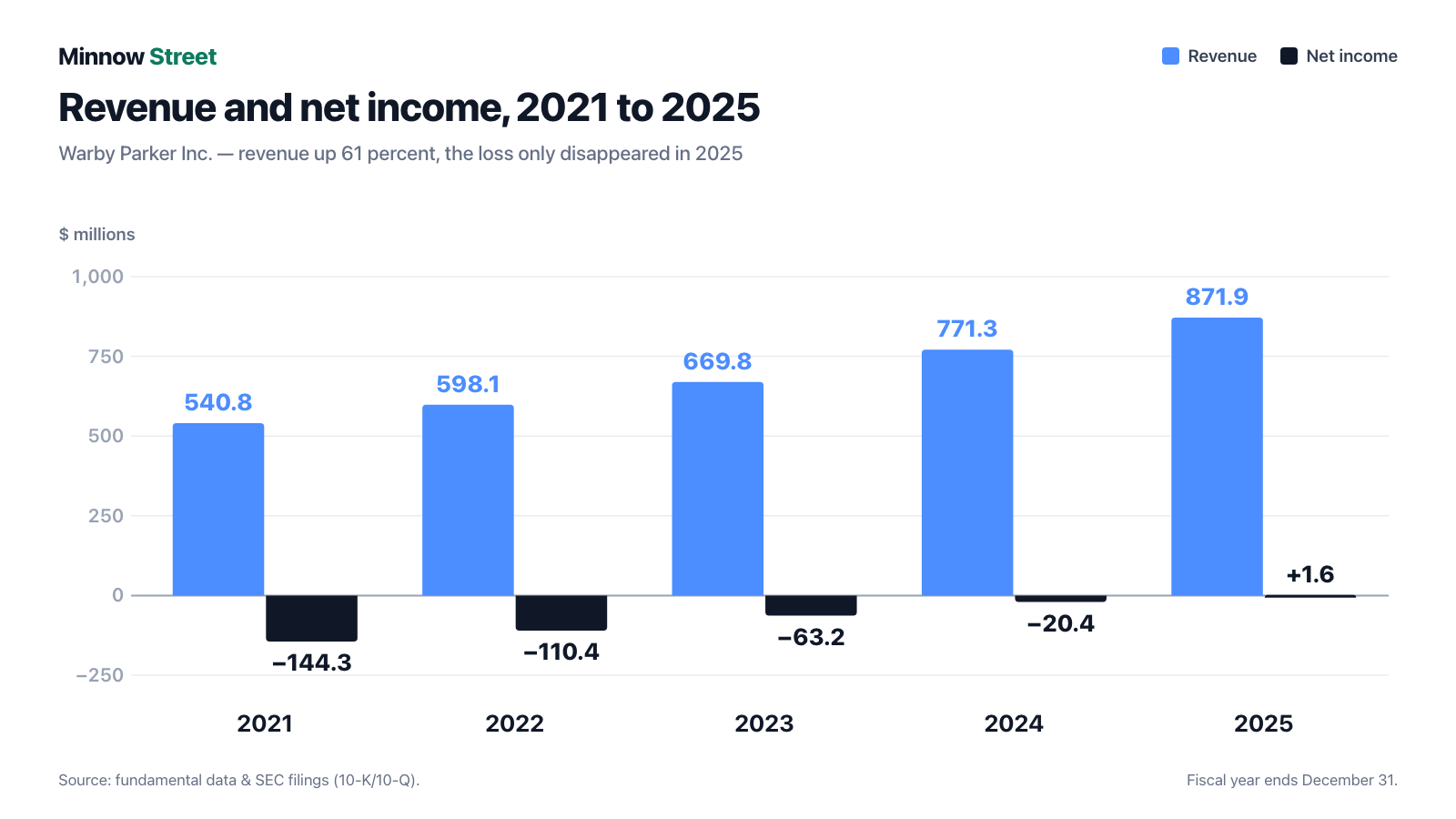
Start with what genuinely impresses: this company grew revenue by 61 percent in four years and worked off an annual loss of $144.3 million to zero — without a single capital raise and without a cent of bank debt.
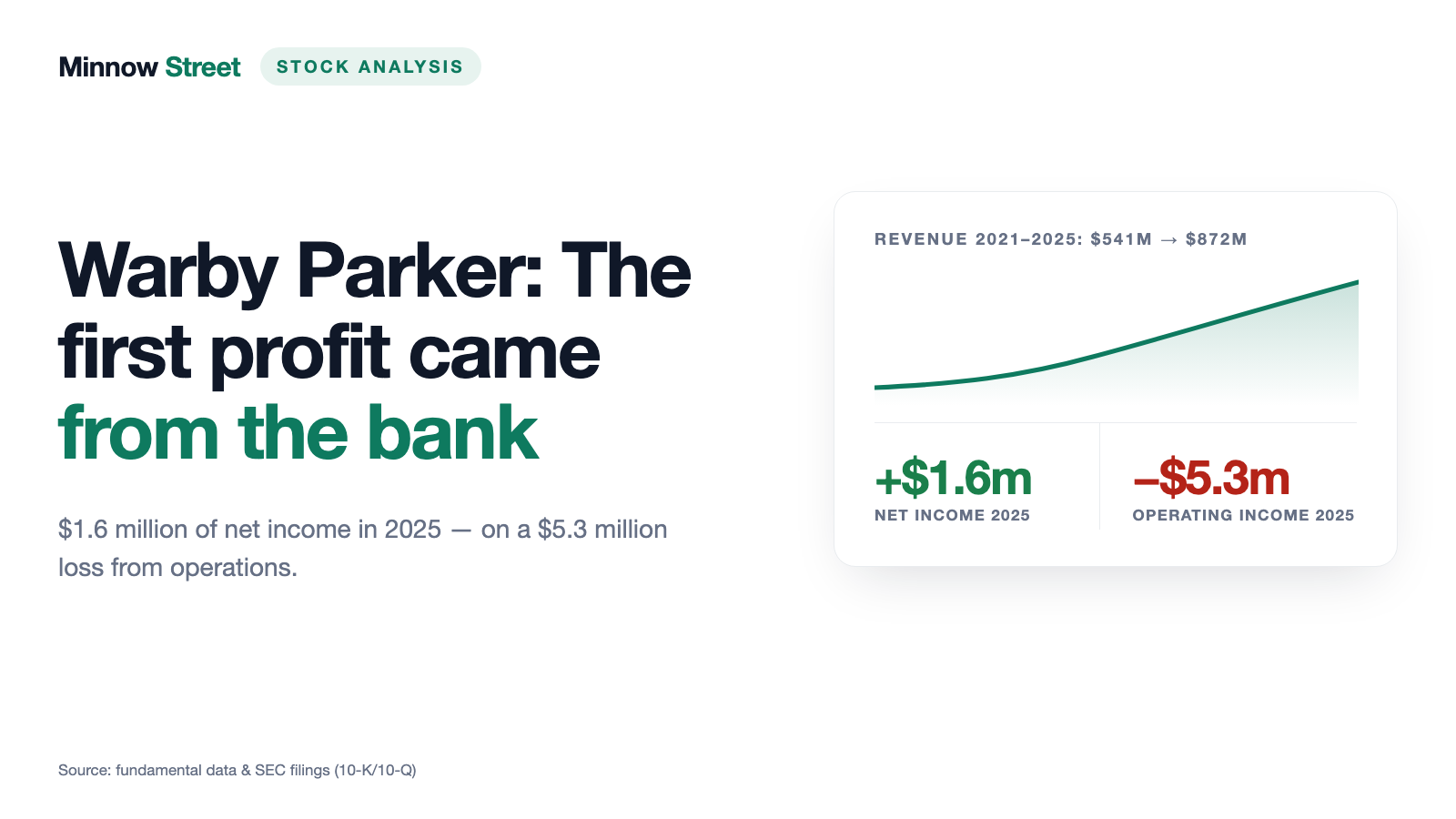
In 2021, the year of the listing, Warby Parker booked $540.8 million of revenue and lost $144.3 million. After that it went the same way year after year: $598.1 million of revenue and a $110.4 million loss (2022), $669.8 million and $63.2 million (2023), $771.3 million and $20.4 million (2024). And then, in fiscal 2025: $871.9 million of revenue and net income of $1.6 million.
Two forces carried that at once: more stores and more revenue per customer. Active customers — those who bought at least once in the trailing twelve months — rose from 2.332 million (2023) to 2.514 million (2024) and 2.689 million (2025). And each of them spent more: $287 in 2023, $307 in 2024, and $331 in the twelve months to March 31, 2026.
The cash picture looks orderly too. Free cash flow — what actually remains after all operating spending and investment — turned from minus $80.5 million (2021) through minus $49.8 million (2022) to plus $7.3 million (2023), plus $34.7 million (2024) and plus $43.7 million (2025). At March 31, 2026 the company held $288.2 million in cash and carried no bank debt.
The first quarter of 2026 continues the trend, but more slowly: revenue of $242.4 million, up 8.3 percent. After 13.0 percent growth in full-year 2025, that is a noticeable cooling.
Uncomfortable truth no. 1: the profit came from the bank, not the store
Here is the lens that brings the picture into focus. Read the 2025 income statement from top to bottom:
- Revenue $871.9 million
- less $401.3 million of cost of goods sold leaves gross profit of $470.6 million
- less $475.9 million of selling, general and administrative expenses leaves income from operations of minus $5.3 million
- plus $8.4 million of interest and other income gives pre-tax income of $3.0 million
- less $1.4 million of tax leaves net income of $1.6 million
Read the third line again. Warby Parker made no money selling glasses in fiscal 2025. Operations ran $5.3 million in the red. The black ink only appeared because the $286.4 million cash pile earned interest.
That is not an accusation — interest income is real money and the cash belongs to shareholders. But it is a very different story from "the company is earning again." And it depends on rates: if US policy rates fall, this line falls with them.
The first quarter of 2026 improved the picture slightly without flipping it: income from operations $1.7 million, interest and other income $2.3 million, pre-tax income $4.0 million. More than half of pre-tax profit still does not come from the business.
The annual report itself is remarkably candid here:
"We had net income of $1.6 million and net loss of $20.4 million for the years ended December 31, 2025 and 2024, respectively, and have in the past had net losses. As of December 31, 2025, we had an accumulated deficit of $685.6 million."
— Warby Parker Inc., Form 10-K for 2025, Item 1A Risk Factors
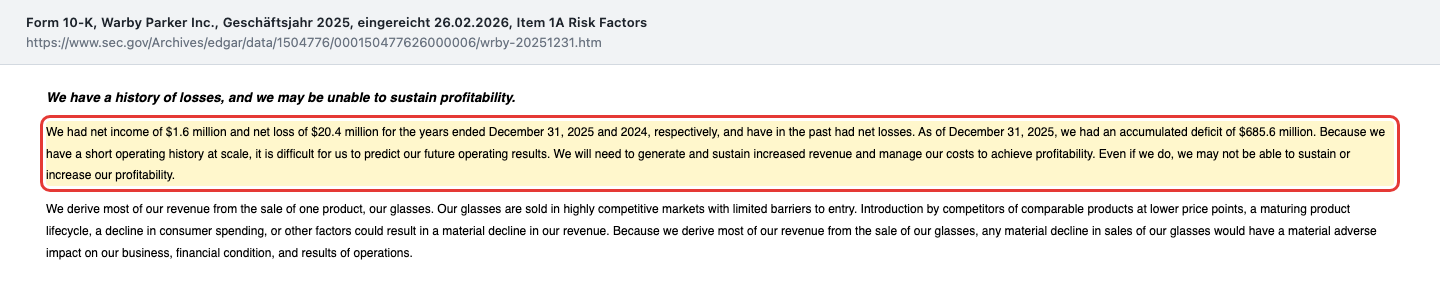
An accumulated deficit of $685.6 million. By March 31, 2026 it stood at $682.4 million. At the 2025 pace — $1.6 million of profit a year — Warby Parker would need more than 400 years to work that mountain off. The number is not a debt anyone can call in; it is the sum of the capital the company has burned since it was founded.
Uncomfortable truth no. 2: four bottom lines for one year
Back to the optician's machine. For fiscal 2025 there are four lenses, and each shows a different picture.
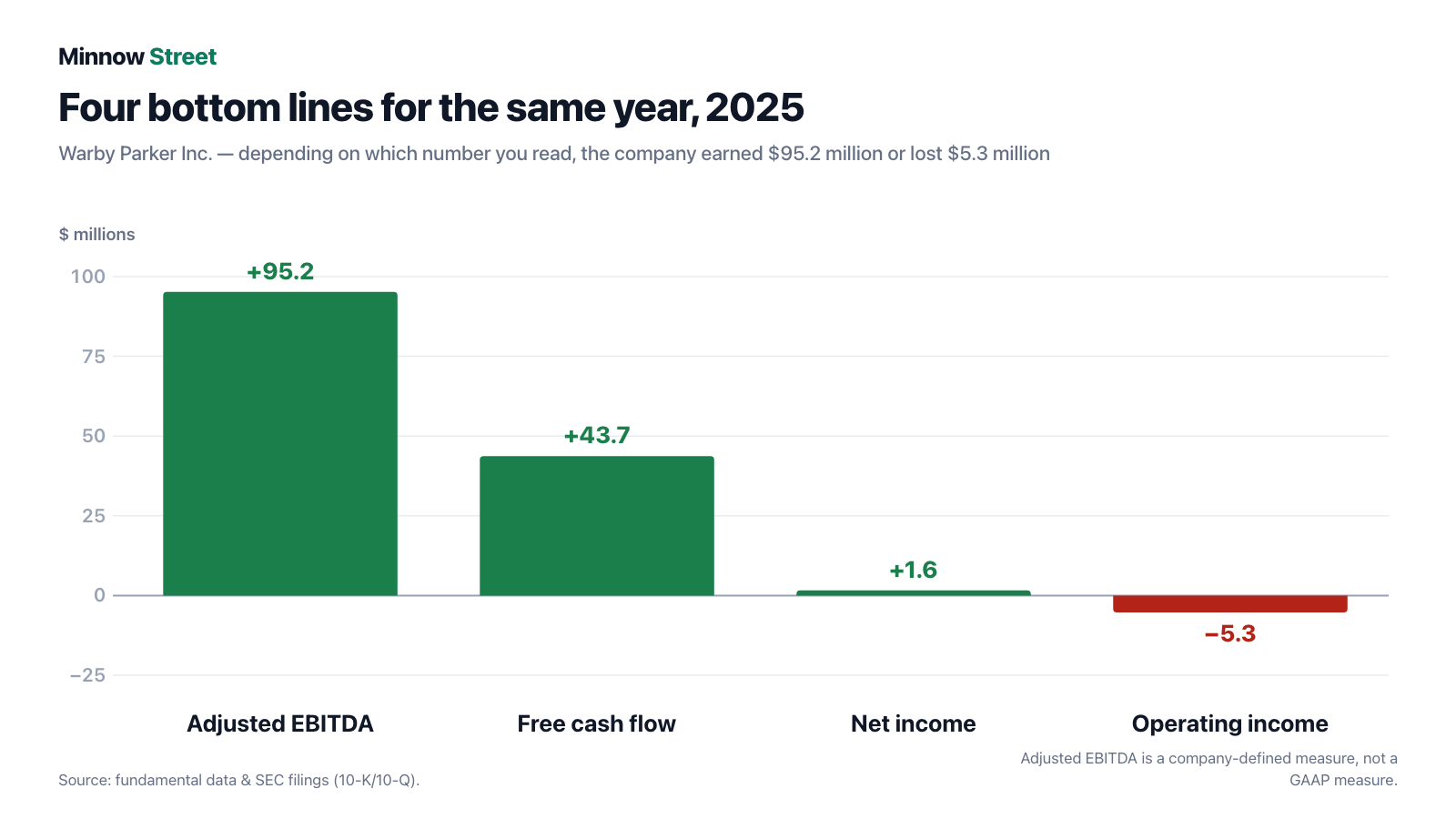
Adjusted EBITDA of $95.2 million is the number that goes into presentations. It is not a GAAP measure but a definition the company sets itself — and the annual report lists what gets stripped out: interest, taxes, depreciation and amortization, asset impairments, stock-based compensation, amortization of cloud software implementation costs, non-cash charitable donations and certain one-off legal costs.
So the leap from minus $5.3 million to plus $95.2 million comes out of $100.5 million of items that can be defined away. Two of them are big: $50.3 million of depreciation and amortization and $34.5 million of stock-based compensation.
On depreciation there is room to argue — it is not a cash outflow, but 337 stores will need refitting at some point. On stock-based compensation the case is clearer. It is not a cash outflow either, but it is not free: paying employees in shares rather than cash spreads the company across more and more people. Your slice of the pie gets smaller.
How big that item is shows up against the money actually left over: $34.5 million of stock-based compensation against $43.7 million of free cash flow — 79 percent. And 21 times reported net income.
To be fair, the number has been falling for years: $107.1 million (2021), $98.0 million (2022), $70.5 million (2023), $47.3 million (2024), $34.5 million (2025). The biggest chunk, a 2021 founders grant, is running off — it cost $44.1 million in 2023, $21.8 million in 2024 and only $4.3 million in 2025. New founders grants issued in 2025 have added $2.8 million so far. Stock-based compensation was $11.4 million in the first quarter of 2026 against $12.3 million a year earlier.
The five-year total is the real headline number: $357.5 million of stock-based compensation from 2021 through 2025 — against cumulative free cash flow of minus $44.5 million over the same span. Over those five years, employees took more out of the company than the company generated. That is normal for a young growth business. Normal does not mean free.
Uncomfortable truth no. 3: the share count almost everyone gets wrong
This part gets technical, but it is worth it — because it distorts practically every metric you will read about this stock anywhere.
Warby Parker has three classes of stock. Only one of them, Class A, trades on the New York Stock Exchange. Alongside it sit Class B with ten votes per share and Class C with none. The cover page of the quarterly report states in black and white how many there are:

And this is exactly where the error creeps in that haunts half the financial world: our own fundamental data set carries 107,094,174 shares outstanding. That is the Class A figure down to the last digit. The 15,621,062 Class B shares are missing — even though they convert one for one into Class A and share in earnings just the same.
Here is what that does. At the July 24, 2026 close of $24.56:
- Class A only: 107,094,174 × $24.56 = $2.63 billion
- full share count: 122,715,236 × $24.56 = $3.01 billion
That is $384 million of difference, or 14.6 percent. And because market capitalization sits in the numerator of almost every valuation ratio, the error travels: price to sales is not 2.95 but 3.38. Price to book is not 7.0 but 8.0. Whenever you read a Warby Parker metric somewhere, ask first which share count it used.
As a cross-check: the company itself uses the full figure. In the first quarter of 2026 the weighted average share count was 123,438,000 basic and 125,554,000 diluted. So the number in the feed is not mistyped — it is simply incomplete.
The second effect is not about money but about power. Run the votes and the 15.6 million Class B shares command 156.2 million votes, while the 107.1 million Class A shares carry 107.1 million. The result: 12.7 percent of the capital carries 59.3 percent of the votes. The 2025 annual report names the holders — the two co-founders and co-chief executives. Buying Class A buys a share of profits and virtually no say. You have seen the same construction in our FIGS analysis: direct-to-consumer brand, dual-class structure, founders at the wheel.
Uncomfortable truth no. 4: the survival test runs on the share price
Back to pillar 2 of the scanner. The Altman Z score is meant to say how far a company is from insolvency. Above 3 is generally read as safe, below 1.1 as the distress zone. Our data set carries 3.16 for Warby Parker. Our own recomputation using the original formula — the December 31, 2025 balance sheet and the July 24, 2026 market capitalization on the full share count — gives 5.31. Both are far above the threshold, so the pillar stands either way.
The interesting part is what the score is made of. The formula adds five building blocks. At Warby Parker they look like this:
- working capital to total assets: +0.34
- retained earnings to total assets: −1.33
- operating result to total assets: −0.02
- revenue to total assets: +1.21
- market capitalization to total liabilities: +5.12
That adds to 5.31 — and 96 percent of it comes from the last block. The four balance-sheet items together contribute all of 0.19. Put differently: the test certifies Warby Parker as safe mainly because the stock market values it highly. That is circular, and it is not our invention — it sits inside a 1968 formula built for heavily indebted industrial firms.
For an investor that means nothing dramatic, but something important: Warby Parker's balance sheet is not safe because it holds a lot of substance but because it carries almost no debt and pays no interest. If the share price falls, this score falls with it, and quickly. Halve the market capitalization and the Altman Z drops to roughly 2.75.
The second balance-sheet score deserves the same caution. The Piotroski score asks nine yes-or-no questions about financial condition. Our data set carries 5 of 9; our own recomputation from the annual reports gives 6 — the gap sits in the return-on-assets criterion, which the data set computes over twelve months. Five or six out of nine is mediocre: a genuinely healthy company sits at 8 or 9. What fails is the same in both calculations: the share count is rising rather than falling, gross margin is declining, and the current ratio has deteriorated.
Where the margin is going
For a retailer, gross margin is the single most important number. At Warby Parker it is moving the wrong way: 58.8 percent (2021), 57.0 (2022), 54.5 (2023), 55.3 (2024), 54.0 percent (2025). In the first quarter of 2026 it fell to 54.0 percent from 56.3 percent a year earlier — a 230 basis point decline in a single year.
The quarterly report names four reasons, and one of them is outside the company's control:
"The decrease was primarily driven by deleverage in the fixed expenses portion of gross margin, which includes doctor headcount and occupancy, the impact of tariff costs related to glasses, and increased optical laboratory and customer shipping costs."
— Warby Parker Inc., Form 10-Q for the quarter ended March 31, 2026, MD&A, "Gross margin"
The first three reasons are self-inflicted and essentially the bill for store growth: every new location brings rent and staff before it brings revenue. Going from 276 to 337 stores in fifteen months means a lot of them have not settled in yet.
The fourth reason is politics. Warby Parker uses a contract optical laboratory in China and sources inputs from China, Italy, Vietnam and Japan among others. The 2025 annual report describes how the company is broadening its supplier base to blunt tariffs. Then, in February 2026, came a twist:

The report gives no figure — the company says it is still estimating the impact. The order of magnitude can still be bracketed: 230 basis points of margin on $242.4 million of quarterly revenue is roughly $5.6 million. Tariffs are only one of four reasons for that decline, but even a fraction of that sum decides the sign on a $1.6 million annual profit.
Google's $150 million commitment
The one place in this story where something genuinely new is happening sits in a note to the quarterly report. Warby Parker is developing glasses with built-in artificial intelligence together with Google and Samsung — glasses you wear all day that register what you see and hear.

The structure is unusually generous. Google covers up to $75 million of product development and commercialization costs. And Google has committed to invest up to another $75 million in Warby Parker — at the company's option and subject to reaching certain milestones.
For scale: Warby Parker's entire stockholders' equity stood at $375.8 million on March 31, 2026. The equity commitment alone would be a fifth of that.
And now the sober part: almost nothing has been drawn. Reimbursable costs cut selling, general and administrative expenses by $3.3 million in fiscal 2025 and by $2.0 million in the first quarter of 2026 — $5.3 million in total, or 7 percent of the first pot. Nothing from the equity commitment appears in the statement of stockholders' equity through March 31, 2026.
None of that is good or bad; it is simply early. But it means this: anyone buying this stock for the AI glasses is buying a project that so far shows up in the numbers only as a $5.3 million cost reimbursement. As of the data date, there is no product.
What the stock costs
Let us add it up — consistently on the full count of 122,715,236 shares and the July 24, 2026 close of $24.56, so a market capitalization of roughly $3.01 billion.
- Price to sales: roughly 3.4. On $890.6 million of revenue for the twelve months to March 31, 2026. For a retailer that is a lot — this is paying for a brand, not for a store network.
- Price to free cash flow: roughly 69. On the $43.7 million from fiscal 2025.
- Price to book: roughly 8.0. On $375.8 million of equity at March 31, 2026.
- Enterprise value to adjusted EBITDA: roughly 31. Market capitalization plus $233.1 million of lease liabilities (December 31, 2025) less $288.2 million of cash (March 31, 2026), divided by $95.2 million of 2025 adjusted EBITDA.
- Price to earnings: not meaningful. Warby Parker earned $1.3 million in the twelve months to March 31, 2026. That would produce a ratio above 2,000 — a number that says nothing.
The professionals' view: on July 26, 2026 the consensus target price of 15 analysts stood at $30.15, roughly 23 percent above the July 24 close. That is not a heroic expectation for a growth story — the firms see upside, but not a doubling.
Against the stock stand the short sellers: 16.8 percent of the float was sold short as of the July 26, 2026 data date. That is a high ratio. It cuts both ways: it shows how many are betting on a decline, and it is fuel if things go unexpectedly well.
Opportunities and risks at a glance
Opportunities
- Four uninterrupted years of revenue growth, four consecutive years of smaller losses and, most recently, the first profit.
- Insurance business barely tapped: 8.3 percent of 2025 revenue against roughly 60 percent insurance penetration in the US market. More than 30 million lives are already in network.
- Progressive lenses, the most expensive lens type, were only 22.3 percent of prescription units at December 31, 2025, far below the industry level of roughly 40 percent.
- Contact lenses and eye exams contribute only 11.1 and 6.4 percent of revenue — in markets worth $10.4 billion and $11.4 billion.
- The Google and Samsung partnerships open a market beyond conventional glasses; Google has committed up to $150 million across two pots.
- No financial debt and $288.2 million of cash at March 31, 2026 — the company does not have to ask anyone for money.
Risks
- Income from operations was negative in 2025; the profit came from interest income. Falling rates hit it directly.
- Gross margin is declining: from 58.8 percent (2021) to 54.0 percent (2025), and down another 230 basis points in the first quarter of 2026 against the prior-year quarter.
- Revenue growth is slowing: 13.0 percent for full-year 2025, 8.3 percent in the first quarter of 2026.
- Stock-based compensation of $34.5 million (2025) consumes 79 percent of free cash flow; the total since 2021 is $357.5 million.
- Dual-class structure: 12.7 percent of the capital holds 59.3 percent of the votes. Class A holders have virtually no say.
- Zero insider purchases against 18 sales in the twelve months to July 26, 2026 (data date).
- Tariffs on glasses and inputs weigh on margin; the refund from the February 2026 ruling is still unquantified.
- Valuation: roughly 3.4 times revenue and 69 times free cash flow, on an operating result below zero.
- The annual report names the single-product dependency itself: most revenue comes from selling glasses, in a market with low barriers to entry.
A human conclusion
Back to the optician's chair. One or two? Two or three?
We tried four lenses on Warby Parker, and each shows something true. Through the first you see a company earning $95.2 million. Through the second, one generating $43.7 million of free cash. Through the third, one that after four loss years just barely keeps $1.6 million. And through the fourth, one still losing $5.3 million in day-to-day operations.
The sharpest image comes from laying all four side by side: here is a brand customers like, growing — 2.7 million active buyers, 337 stores, 61 percent more revenue in four years, no debt, a full cash box. And here at the same time is a company that has not yet turned that growth into an operating profit, whose gross margin is slipping and whose shareholders carry more than $685 million of accumulated losses behind them.
Both at once. That is not a contradiction; it is what a company halfway through the journey looks like.
What makes it demanding is the price. Roughly 3.4 times revenue is not paid for the current state but for the continuation: for 54 percent gross margin turning back into 57, for minus $5.3 million of operating income eventually becoming plus $50 million, for the AI glasses to arrive. All of it can happen. None of it is in the numbers yet.
And the trap in the optician's chair stays the same: the most comfortable image is rarely the sharpest.
What you make of it is your decision. And that is exactly how it should be.
Sources
- Form 10-K for 2025, Warby Parker Inc., filed February 26, 2026 (CIK 0001504776)
- Form 10-K for 2024, filed February 27, 2025 — supplies the comparative figures for 2022
- Form 10-Q for the quarter ended March 31, 2026, filed May 7, 2026
- Form 10-Q for the quarter ended September 30, 2025, filed November 6, 2025
- Form 10-Q for the quarter ended June 30, 2025, filed August 8, 2025
- Form 10-Q for the quarter ended March 31, 2025, filed May 8, 2025
- Current report on Form 8-K dated May 7, 2026 — quarterly results (Item 2.02)
- Screener and metrics data: our in-house stock scanner (data as of July 26 to 27, 2026), including the Turnaround Candidates scanner (US selection, 60 hits, Turn Check 6 of 8, measured July 27, 2026; the page shows only the 25 strongest hits) — the lists are recomputed daily
- Metrics, price history and analyst estimates: fundamental data, as of July 24 to 27, 2026
Journalistic analysis, not investment advice and not a solicitation to buy or sell securities. Stocks can move sharply; a total loss is possible. All figures come from the primary documents linked above and carry their own as-of date. The author holds no position in Warby Parker at the time of publication.
Our Bottom Line at a Glance
- Business model and market position positive
- Warby Parker sells its own designs without a wholesale middleman and has turned the store into an eye care practice: 323 locations at December 31, 2025, 337 at March 31, 2026, 4,036 employees, 2.689 million active customers. Revenue per customer rose to $331 in the twelve months to March 31, 2026 from $310 in the prior-year period. Contact lenses and eye exams contributed only 11.1 and 6.4 percent of 2025 revenue — barely scratched.
- Turn in the numbers positive
- The direction has held for four years without exception: revenue from $540.8 million in 2021 to $871.9 million in 2025, the loss from $144.3 million to zero, free cash flow from minus $80.5 million to plus $43.7 million, adjusted EBITDA from $52.4 million in 2023 to $95.2 million. Revenue grew 8.3 percent in the first quarter of 2026 and net income came in at $3.2 million.
- Earning power negative
- Income from operations in 2025 was still negative at minus $5.3 million. The $1.6 million of net income arithmetically came from $8.4 million of interest and other income on the company's own cash. In the first quarter of 2026, $2.3 million of $4.0 million pre-tax income came from the same source. Gross margin fell from 56.3 to 54.0 percent over the same period.
- Balance sheet and substance neutral
- At March 31, 2026, stockholders' equity of $375.8 million stood against total assets of $736.4 million — a 51.0 percent equity ratio, $288.2 million of cash and no financial debt. There is no sign of payment risk. Substance is thin, though: against $1,060.0 million of paid-in capital sits an accumulated deficit of $682.4 million. The Altman Z of 5.31 draws 96 percent of its value from the market-cap term; the pure balance-sheet terms add up to 0.19.
- Ownership and dilution negative
- Three share classes and a ten-to-one voting ratio for the untraded Class B: 12.7 percent of the capital carries 59.3 percent of the votes (cover page of the quarterly report filed May 7, 2026). On top of that, $34.5 million of stock-based compensation in 2025 — 79 percent of free cash flow and 21 times net income; $357.5 million since 2021 against cumulative free cash flow of minus $44.5 million.
- Valuation negative
- At the July 24, 2026 close of $24.56 and the full count of 122,715,236 shares, market capitalization is roughly $3.01 billion: 3.4 times revenue for the twelve months to March 31, 2026, 69 times 2025 free cash flow and 8.0 times equity. A price/earnings ratio cannot be formed meaningfully on $1.3 million of trailing twelve-month profit.
Warby Parker has climbed out of the hole: $871.9 million of revenue in fiscal 2025 against $540.8 million in 2021, net income of $1.6 million after four loss years, $43.7 million of free cash flow and no financial debt. The turn is real and broad. It is also wafer thin: income from operations is still below zero at minus $5.3 million, the profit came from interest on the company's own cash, and gross margin fell to 54.0 percent in the first quarter of 2026. And the price already assumes what is still to come: roughly 3.4 times revenue and 69 times free cash flow. Not investment advice.
What Our Rating Means
Open questions
The business works in principle, but one material question is open. As long as it stays open, our findings do not carry a quality verdict.
The company is healthy enough: a 51.0 percent equity ratio, $288.2 million of cash, no financial debt, $110.8 million of operating cash flow in 2025 against $1.6 million of reported profit, four uninterrupted years of revenue growth and a brand that reaches customers without a middleman. No sign of substance risk — hence no red. What is missing for green is earning power: income from operations was negative at minus $5.3 million in 2025, the profit came from interest income, gross margin fell 230 basis points to 54.0 percent in the first quarter of 2026, and stock-based compensation consumed 79 percent of free cash flow at $34.5 million. The accumulated deficit of $682.4 million sits against $1,060.0 million of paid-in capital. Whether growth turns into real earnings will be decided over the next few quarters. The decision is yours.
A journalistic assessment by our editorial team at the time of the deep dive, based on public sources — not investment advice and not a solicitation to buy or sell. Your personal circumstances (investment goals, risk capacity, taxes) cannot be taken into account. What our levels mean, how verdicts are formed, and what conflicts of interest exist →
Worth Noting
- Hook: our in-house stock scanner "Turnaround Candidates", 60 US hits, Turn Check 6 of 8, measured on both brands on July 27, 2026 (list computed July 27, 2026). Note on ordering: 44 of the 60 hits also score exactly 6 points — ties are not ordered deterministically. Warby Parker therefore sits between rank 17 and rank 60; the measured query returned rank 41 on minnowstreet.com and rank 43 on boersenlotse.de. The page shows only the 25 strongest hits, so the stock is not visible there. The lists are recomputed daily.
- Cross-check on the mandatory pillar "at least 50 percent below the all-time high": the highest closing price was $59.50 on November 17, 2021, against $24.56 on July 24, 2026 — minus 58.7 percent. The data set carries minus 54.87 percent, which arithmetically references the first close after the direct listing ($54.49 on September 29, 2021) rather than the later November high. Both are well below the threshold. Warby Parker drops off this list at roughly $29.75.
- Cross-check on the mandatory pillar "survival secured": the data set carries an Altman Z of 3.16; our own recomputation using the original formula with the December 31, 2025 balance sheet and the July 24, 2026 market capitalization gives 5.31. Both are far above the 1.1 threshold, and the article uses our own figure. More important than the gap is the composition: 5.12 of the 5.31 points come from the market-cap term, while the pure balance-sheet terms add up to 0.19. On Piotroski the data set carries 5 of 9 and our own recomputation from the annual reports 6 of 9 — the difference sits in the return-on-assets criterion, which the data set computes on a trailing twelve-month basis.
- Data artifact from the dual-class structure: the fundamental data feed carries 107,094,174 shares outstanding — exactly the Class A count from the quarterly report cover page dated May 5, 2026. The 15,621,062 Class B shares are missing. Every valuation metric in this analysis is therefore computed on the full count of 122,715,236.
- Takeover check before the analysis: no Form 25, no Form 15, no SC 14D9 and no DEFM14A in the filing history; the stock is listed on the NYSE as of the data date. Former name: JAND, Inc. until March 23, 2018.
- Data as of: 10-K for 2025 filed 2026-02-26, 10-K for 2024 filed 2025-02-27, 10-Q for the quarter ended 2026-03-31 filed 2026-05-07, 10-Q reports for 2025-09-30, 2025-06-30 and 2025-03-31, current reports 8-K dated 2026-05-07 and 2026-06-12; metrics and price history July 24 to 27, 2026.
- Possible confusion: Warby Parker is not the optical group EssilorLuxottica and not the contact lens maker Bausch + Lomb. The former corporate name JAND, Inc. still appears in older registers.
- The traffic light in this analysis judges the company, not the entry point. A scanner rank is an invitation to research, not a buy signal.
Frequently Asked Questions
Warby Parker sells eyeglasses, sunglasses and contact lenses, and also offers vision tests and eye exams. It sells through its own website and 323 company-operated stores as of December 31, 2025, a number that reached 337 by March 31, 2026. The frames are designed in house and sold without a wholesale middleman. Fiscal 2025 revenue was $871.9 million.
Yes, but not from glasses. Net income was $1.6 million — the first positive figure after four loss years. Income from operations, however, was still negative at minus $5.3 million. The bottom line only turned positive thanks to $8.4 million of interest and other income earned on the company's own cash pile of $286.4 million.
Because both mandatory conditions hold. First the crash: the highest closing price was $59.50 on November 17, 2021, against $24.56 on July 24, 2026 — about 58.7 percent lower. Second, survival: the Altman Z bankruptcy warning score sits well outside the distress zone and equity is positive at 51.0 percent of total assets. On the Turn Check, Warby Parker scores 6 of 8 — the minimum.
Because the page shows only the 25 strongest hits. On July 27, 2026, 60 US stocks met the criteria, and 44 of them scored exactly 6 of 8 points — Warby Parker among them. Ties are not ordered deterministically, so the stock sits somewhere between rank 17 and rank 60 and therefore outside the visible table. We reached it through the full hit list.
As of May 5, 2026 there were 107,094,174 Class A shares and 15,621,062 Class B shares, for a total of 122,715,236. Many data services carry only the Class A figure because that is the only class traded on the NYSE. Anyone using that number understates market capitalization by 14.6 percent — and every metric built on it too.
Voting power. Class A carries one vote per share, Class B carries ten, Class C none. The 15,621,062 Class B shares therefore command 156.2 million votes against 107.1 million for Class A. That means 12.7 percent of the capital carries 59.3 percent of the votes. The 2025 annual report names the holders as the two co-founders and co-chief executives.
More than most retailers. The 2025 annual report describes long-term partnerships with Google and Samsung to build AI-powered eyewear for all-day wear. Google has committed up to $75 million toward costs and up to another $75 million as an equity investment. Through March 31, 2026 only $5.3 million of reimbursable costs had been incurred. No AI glasses are on sale yet.
Solid, but not lavish. As of March 31, 2026, stockholders' equity of $375.8 million stood against total assets of $736.4 million, an equity ratio of 51.0 percent. Cash was $288.2 million and there is no financial debt — the $233.1 million shown at December 31, 2025 is lease liabilities on store rent. Against $1,060.0 million of paid-in capital sits an accumulated deficit of $682.4 million.
Found an error?
Did you spot a factual error, an outdated number, or a typo in this deep dive? Let us know briefly — your report goes straight to the editorial team.