Advance Auto Parts: The Profit Is Back — the Cash Is Not
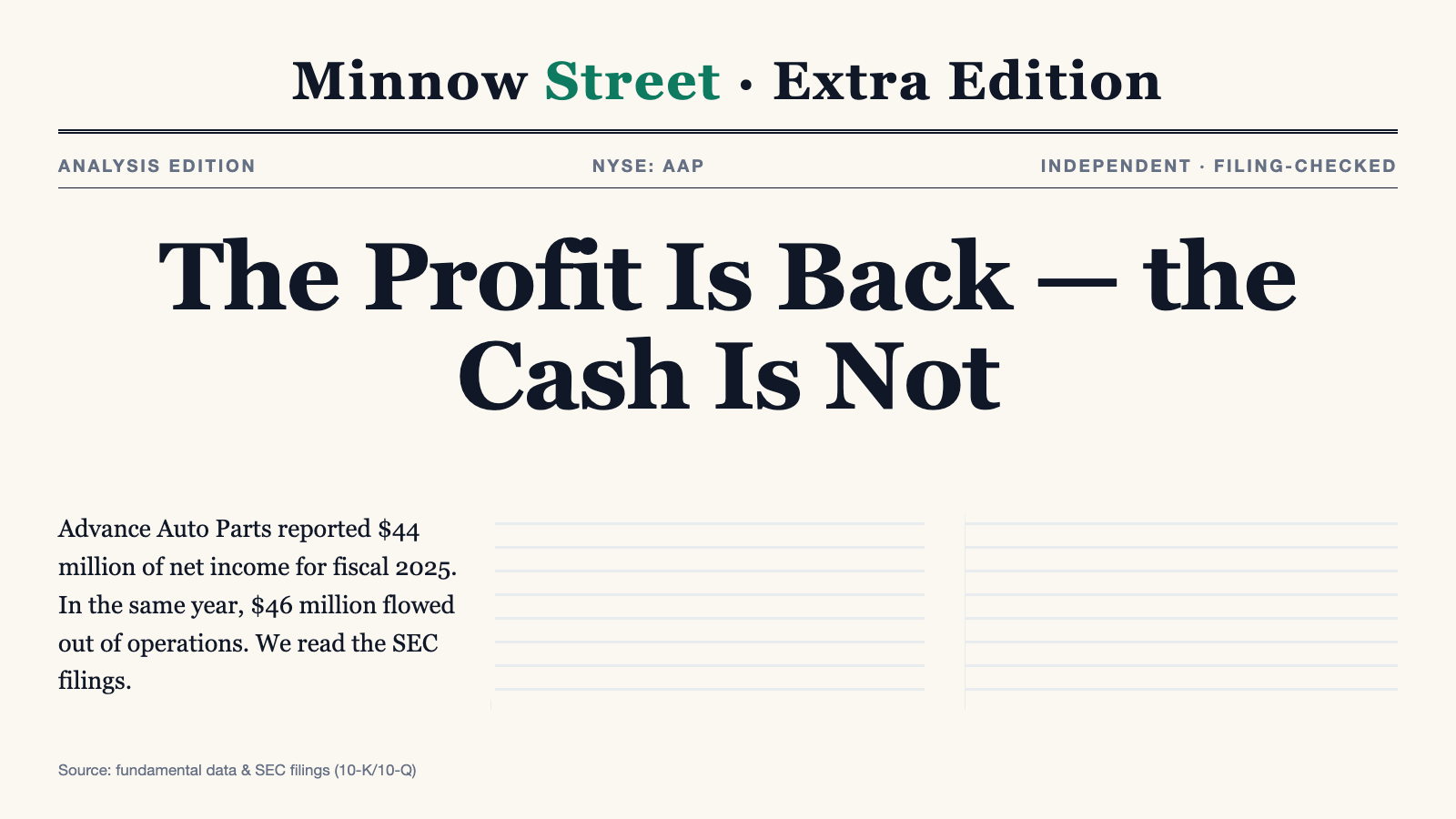
After the loss year of 2024, Advance Auto Parts reported $44 million of net income for fiscal 2025, and our turnaround scanner has listed the stock as a turnaround candidate ever since. The bank statement tells a different story: $46 million flowed out of operations in the same year, close to $300 million after capital spending. The bill is paid with a $1.95 billion note issue at seven percent — and with $2.5 billion of supplier invoices now advanced by banks. Not investment advice — simply the question of whether this turnaround hit delivers what the earnings line promises.
 Thomas Mücke
Founder & Publisher
Thomas Mücke
Founder & Publisher
Chart
Interactive price chart (TradingView).
Note: pure fact-based analysis, not investment advice and not a solicitation to buy or sell. All figures without guarantee.
There is a mental trap that catches us in daily life as reliably as it does on the stock market: the profit-equals-cash trap. We hear “net income” and picture banknotes. Yet earnings are, first of all, a calculation — full of valuations, accruals and assumptions. Whether money actually sits in the account at month end is written somewhere else entirely: in the cash flow statement. That gap is exactly what makes Advance Auto Parts, Inc. (NYSE: AAP) interesting. The stock reached our desk through our turnaround scanner because its earnings line has turned. So let us make a deal: we will not celebrate the earnings line, we will read the line below it. The sources are the reports Advance Auto Parts files with the U.S. securities regulator, the SEC — the annual report (Form 10-K) for fiscal 2025 and the quarterly report (Form 10-Q) for the period ended April 25, 2026. Those documents are honest under penalty of law. And they describe a company whose stores work again while its cash drains away. What you make of that is up to you.
Contents
- What Advance Auto Parts actually does
- How the stock reached our desk — 6 of 8 points, but not in the visible 25
- The numbers over the years — honestly appraised
- What the filings say — the uncomfortable truths
- What has happened since the last quarterly report
- Valuation: half a year of revenue, one whole question mark
- Opportunities and risks at a glance
- A human conclusion
- Sources
What Advance Auto Parts actually does
When your car refuses to start in the morning and the neighborhood repair shop has the right battery within the hour, a company like this one is the reason. Advance Auto Parts sells replacement parts for cars already on the road: batteries, brakes, belts, clutches, starters, radiators, plus oil, filters and antifreeze. It serves two customer groups — professional installers (repair shops that need the part immediately) and do-it-yourself customers.
As of January 3, 2026 the company operated 4,305 company stores, mostly in the United States, with additional locations in Canada, Puerto Rico and the U.S. Virgin Islands; 4,066 of them under the Advance Auto Parts name and 239 under Carquest. Another 809 independently owned Carquest stores are supplied without belonging to the group. By April 25, 2026 the company store count stood at 4,308. Employment at January 3, 2026 was 28,274 full-time and 25,733 part-time team members; 87.4 percent worked in store-level operations, 8.5 percent in distribution centers and 4.1 percent in corporate offices.
The fiscal calendar is a small trap, so let us deal with it up front. The fiscal year runs 52 or 53 weeks and ends on the Saturday closest to December 31. Fiscal 2025 ended on January 3, 2026 and contained 53 weeks, one more than the prior year. And the first quarter at Advance Auto Parts is sixteen weeks long, while the other three run twelve weeks each. Anyone comparing this company's quarters with those of other retailers is comparing periods of different length.
A second point belongs at the start because it distorts almost every multi-year series. On November 1, 2024 Advance Auto Parts sold its Worldpac wholesale business for net proceeds of roughly $1.44 billion. Since then all prior years are restated as continuing operations. Reported fiscal 2023 revenue fell in that presentation from $11.29 billion to $9.21 billion — same company, different scope. Every multi-year figure in this analysis comes from the restated continuing operations series; that is the only way to compare like with like.
And a third: on November 13, 2024 the board approved a restructuring plan. Roughly 500 company stores, roughly 200 independent locations and four distribution centers were closed, all of it completed in the first quarter of fiscal 2025. In fiscal 2025 alone, 522 stores closed and 39 opened. The expense appeared in the income statement as $309 million in fiscal 2024 and $204 million in fiscal 2025. That is why the revenue series declines — the company is short of stores, not necessarily of customers.
How the stock reached our desk — 6 of 8 points, but not in the visible 25
The hook is a snapshot, not a permanent state. Measured on July 27, 2026 — the underlying scanner run is dated July 26, 2026 — Advance Auto Parts registers as a hit in our in-house turnaround scanner with the U.S. market filter. And here is the honest part right away: you will not see AAP on the scanner page. The list shows only the 25 strongest of 60 hits. Advance Auto Parts scores 6 of 8 points on the turnaround checklist — precisely the minimum required to appear at all. And 44 of the 60 titles sit on those same 6 points; only one reaches 8, fifteen reach 7. Arithmetically that places AAP somewhere between rank 26 and rank 60 — in the back half, but inside the criteria. The lists are recalculated daily; tomorrow's score and hit count will differ from today's.
What does the scanner check? Four pillars. The first two are mandatory. First, the crash: at least 50 percent below the all-time high. Second, survival: an Altman Z-score outside the distress zone, no more than one balance sheet warning signal, positive equity. Pillars three and four form an eight-point checklist covering the operational turn (revenue stabilizes, net margin turns, operating cash flow improves, the balance sheet heals) and market confirmation (price back above the 50-day line, relative strength turns, insiders buy on net, large funds add). Six points make a stock a hit.
We measured the crash against the price history ourselves, because otherwise that mandatory pillar is only an assertion. The all-time closing high was $241.91 on November 15, 2021. Against the closing price of $55.80 on July 24, 2026, that is a gap of roughly 77 percent; our own data set carries −73.3 percent at the same point. On either calculation the 50 percent threshold is met not narrowly but comfortably: anyone who bought at the 2021 high has lost a good three quarters. The Altman Z-score — a bankruptcy early-warning measure built from several balance sheet ratios — stands at 6.56; above 3 counts as safe, below roughly 1.1 as the distress zone.
And now the contradiction that carries this analysis. The same data set assigns Advance Auto Parts a Piotroski F-score of 3 out of 9. The Piotroski score asks nine yes-or-no questions about profitability, cash flow, leverage and efficiency; 7 or more marks a solid company, below 3 is a warning sign. An Altman Z of 6.56 sitting next to a Piotroski of 3 translates roughly as: this company will not go bankrupt, but it is not earning anything either. The entire case lives in that gap.
At the same measurement AAP passes six of our scanner strategies in total — alongside the turnaround candidates, three trend and breakout lists and one quality list. That confluence describes the pattern well: a share price that is running on numbers that are not. As part of the market confirmation, the price as of July 26, 2026 stood a good 51 percent above its level six months earlier and roughly 41 percent higher year to date, while trading only about 15 percent below the twelve-month high of $64.62.
The numbers over the years — honestly appraised
Let us start with what genuinely impresses: the stores are selling again, and the margin is coming back.
Gross margin — what is left of revenue after purchasing and logistics — fell to 37.5 percent in fiscal 2024, because inventories were written down during the restructuring year. In fiscal 2025 it rose to 43.4 percent, a jump of 592 basis points, or almost six percentage points. In the first quarter of fiscal 2026 it reached 45.1 percent, up from 42.9 percent. At the same time selling, general and administrative expenses excluding restructuring fell from 43.4 percent to 41.3 percent of revenue. And comparable store sales — the sales of stores open for at least a year — rose 0.8 percent in fiscal 2025 and 3.5 percent in the first quarter of fiscal 2026. This is not cosmetics. This is a retailer serving customers again.
The continuing operations revenue series still looks like shrinkage: $9,149 million (2022), $9,209 million (2023), $9,094 million (2024), $8,601 million (2025). The annual report attributes the 5.4 percent decline in fiscal 2025 to the store closures under the restructuring plan, partly offset by the 53rd week. Close stores and you sell less — that was the plan, not a failure. In the first quarter of fiscal 2026 revenue rose for the first time again, by 1.2 percent to $2,614 million.
On earnings, the turn in the income statement is unambiguous. Income from continuing operations ran from plus $361 million (2022) through minus $30 million (2023) and minus $587 million (2024) back to plus $68 million (2025). Net income including the divested Worldpac business: $464 million, $30 million, minus $336 million and plus $44 million. Diluted earnings per share came to $0.73 in fiscal 2025 after minus $5.61 a year earlier.
And now the line below — the cash flow statement, which says how much money actually arrived:
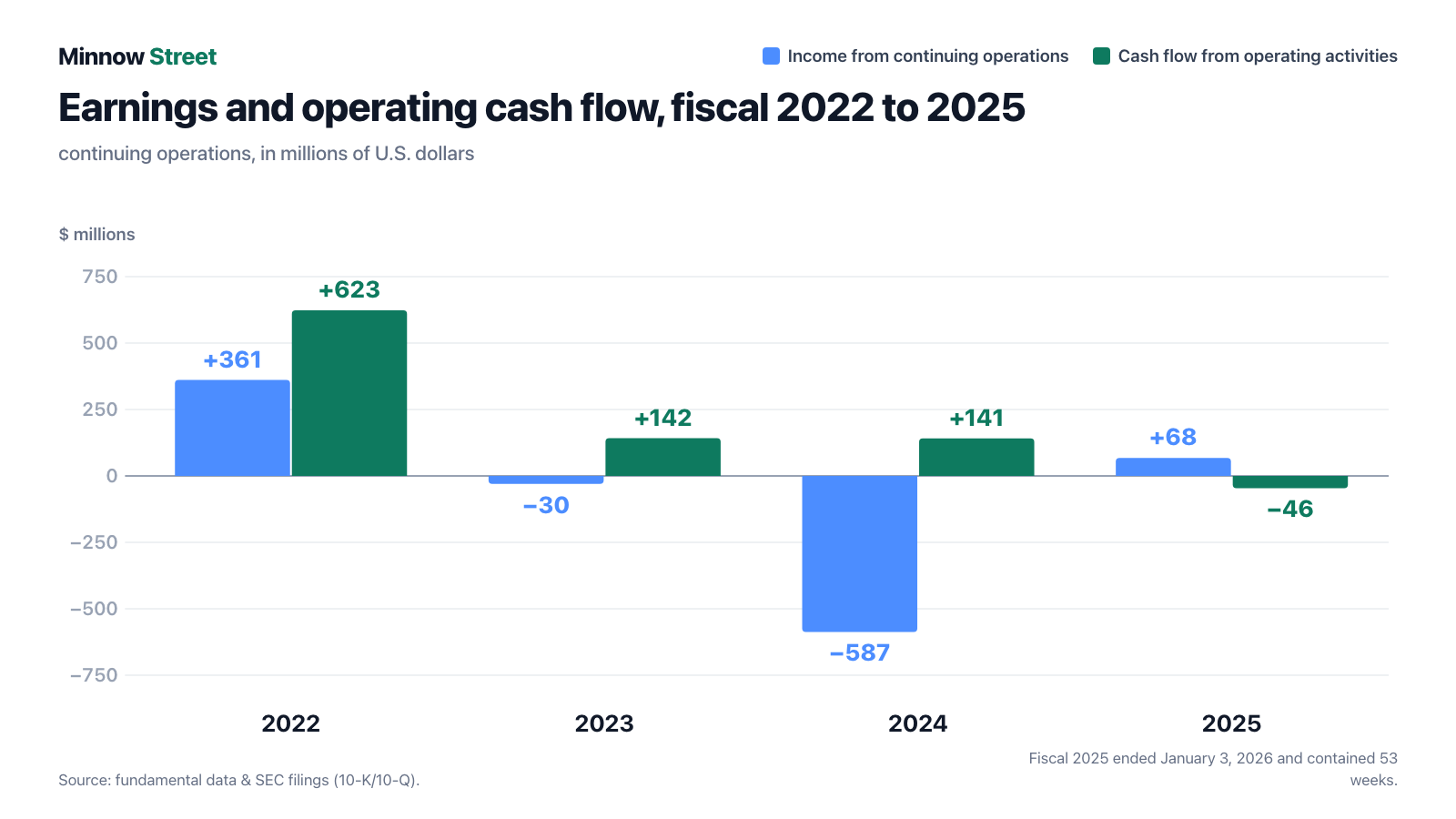
The series for cash flow from operating activities of continuing operations reads: $623 million (2022), $142 million (2023), $141 million (2024) and minus $46 million (2025). In the year the earnings line turned positive, the cash line turned negative. Set the $252 million of fiscal 2025 capital expenditures against it and what remains is a free cash outflow of roughly $298 million. A rule of thumb worth keeping: profit is an opinion, cash is a fact.
What the filings say — the uncomfortable truths
Uncomfortable truth no. 1: the profit is in the income statement, the cash has left
The annual report itself lists the figure among the headline results of the year — right next to the good news on margin:
“Cash flows used in operating activities from continuing operations was $46 million during fiscal 2025, a decrease of 132.6% compared with fiscal 2024, primarily attributable to a reduction in our accounts payable and cash charges related to the 2024 Restructuring Plan.”
— Advance Auto Parts, Inc., SEC annual report 10-K for fiscal 2025, Item 7 Management Overview

That sentence matters more than it sounds. “A reduction in our accounts payable” means Advance Auto Parts paid its suppliers faster than the year before. A retailer normally finances its inventory through exactly those payment terms — selling the brake disc before it has to pay for it. When that buffer shrinks, the difference has to come out of the till. And in the first quarter of fiscal 2026, another $19 million flowed out, although far less than the $156 million of the year-earlier quarter.
Uncomfortable truth no. 2: banks advance $2.5 billion of the supplier invoices
This brings us to the figure that overshadows everything else. It appears not in the balance sheet but in Note 8 of the quarterly report:
“All outstanding amounts due to third-party financial institutions related to suppliers participating in such financing arrangements are recorded within accounts payable […]. As of April 25, 2026, and January 3, 2026, the confirmed obligations outstanding under these supplier finance programs to third-party financial institutions were $2.5 billion.”
— Advance Auto Parts, Inc., SEC quarterly report 10-Q for the period ended April 25, 2026, Note 8 “Supplier Finance Programs”

Here is what that means in plain terms. A parts maker delivers and normally waits 90 days for payment. Under a supplier finance program it instead sells the invoice to a bank immediately, at a discount, and gets the money now. The bank collects from Advance Auto Parts later. Formally nothing changes for the retailer: the amount stays inside accounts payable and no assets are pledged. Practically, a great deal changes — the creditor is no longer the parts maker of thirty years' standing but a financial institution that can shrink the facility when the news turns bad.
The scale: $2,500 million of $3,054 million in accounts payable, roughly 82 percent. That exceeds total equity of $2,213 million and equals about three quarters of the market value. And it is falling: at December 28, 2024 confirmed obligations still stood at $3.2 billion. That $0.7 billion decline is no footnote — it is a material part of the explanation for why cash left the business in fiscal 2025.
Uncomfortable truth no. 3: repairing the balance sheet carries a permanent interest bill
On August 4, 2025 Advance Auto Parts issued two series of notes: $975 million at 7.000 percent due August 2030 and $975 million at 7.375 percent due August 2033. Part of the proceeds redeemed an older $300 million note at 5.90 percent that would have matured in March 2026. Roughly $1.6 billion of additional cash remained. At the same time, on August 12, 2025, the old unsecured revolving facility was replaced by a secured asset-based facility of $1,000 million with a five-year term, secured on receivables, inventory and cash.
That was a sensible move — and an expensive one. The first quarter of fiscal 2026 shows how expensive in a single calculation:
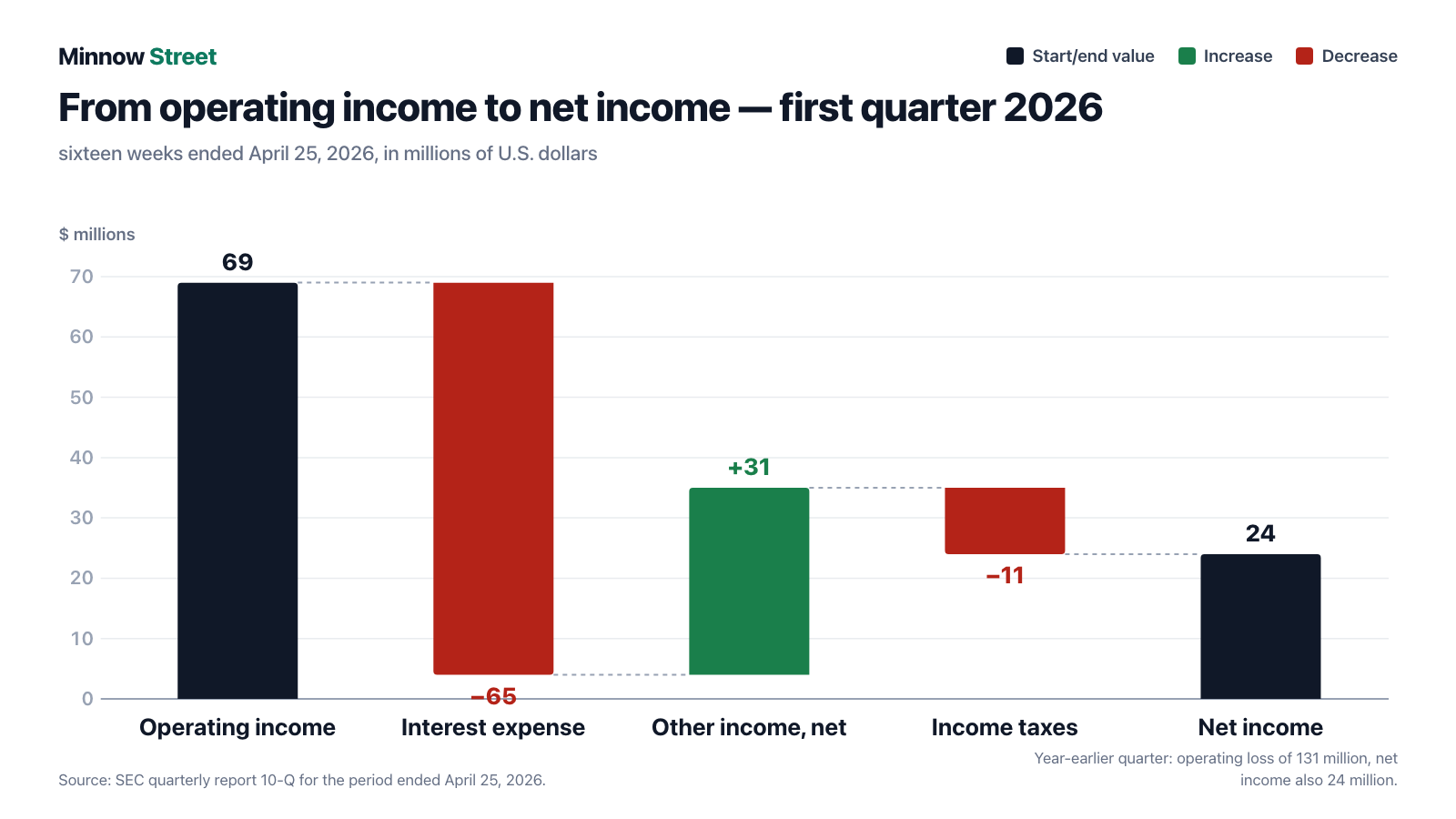
Now the comparison with the year-earlier quarter, which is what really makes the point. Operating income improved from minus $131 million to plus $69 million — a $200 million swing, driven by margin and by $86 million less restructuring expense. Yet both quarters ended with exactly $24 million of net income, and earnings per share even slipped from $0.40 to $0.39. Why? Because interest expense rose from $27 million to $65 million, and because the year-earlier quarter lived off a one-time tax benefit: it carried a $155 million tax benefit, including $126 million from a discrete item tied to capital loss deductions. This time there was $11 million of tax expense.
Do the arithmetic: $65 million of interest over sixteen weeks annualizes to roughly $210 million a year. Against that stand $31 million of other income for the quarter, essentially interest on the company's own cash — roughly $100 million annualized. So repairing the balance sheet costs something like $110 million a year net, measured against operating income that reached $69 million in the strongest quarter of the year. The $2,956 million of cash is not wealth; it is borrowed, and the rent keeps running.
One detail worth knowing: of the $2,956 million of cash at April 25, 2026, $2,300 million sat as so-called qualified cash in accounts held with the lenders. The quarterly report stresses that these funds are unrestricted and that the company has sole control over them — but only as long as two conditions hold: minimum availability under the ABL facility of at least 12.5 percent of the line cap or $125 million, and excess availability of at least $400 million. Breach either and springing control agreements take effect. At the balance sheet date, $896 million of the facility was available, nothing was drawn and $104 million was outstanding as letters of credit.
Uncomfortable truth no. 4: a supplier in bankruptcy — and an 18 percent reserve against receivables
In the third quarter of fiscal 2025 one supplier filed for Chapter 11. The annual report describes the supplier and the consequences:
“In the third quarter of fiscal 2025, one of the Company’s vendors, a leading auto parts supplier for the automotive aftermarket industry, filed voluntary petitions for Chapter 11 bankruptcy protection with the U.S. Bankruptcy Court for the Southern District of Texas. […] As a result of these events, the Company recorded a non-cash charge of $28 million to cost of sales in the third quarter of fiscal 2025, reflecting estimated future credit losses on certain vendor receivables due from the vendor.”
— Advance Auto Parts, Inc., SEC annual report 10-K for fiscal 2025, Note 6 “Receivables, net”

Why would a supplier owe money to a retailer in the first place? Because rebates are standard in parts distribution: advertising allowances, volume bonuses, warranty reimbursements. Those claims sit on the Advance Auto Parts balance sheet as vendor receivables — still $83 million at April 25, 2026. Gross receivables total $491 million, of which $392 million are trade receivables. Against that stands an allowance for credit losses of $89 million — a reserve ratio of roughly 18 percent. For a retailer whose customers are repair shops, that is a very high figure; the first quarter of fiscal 2026 added a further $9 million of provisions and wrote off $15 million.
Uncomfortable truth no. 5: and one that points the other way
For completeness, the one find that is friendly — and which, tellingly, also appears nowhere on the balance sheet:
“On February 20, 2026, the U.S. Supreme Court overturned certain U.S. tariffs imposed under the International Emergency Economic Powers (“IEEPA”) Act. During fiscal 2025, the Company incurred product costs directly related to the IEEPA tariffs. […] the Company has not recognized any amounts related to IEEPA tariff recoveries within its condensed consolidated financial statements as of April 25, 2026. The Company will continue to assess the recoverability of these tariffs, and will recognize any recoveries when realized or realizable, the amounts of which could be material to the Company’s condensed consolidated financial statements.”
— Advance Auto Parts, Inc., SEC quarterly report 10-Q for the period ended April 25, 2026, Note 4 “Receivables, net”

The company gives no number, so neither will we. But the word “material” is the company's own, and with net income of $44 million in fiscal 2025 the bar for materiality is quickly cleared. Anyone following this stock has a concrete catalyst to wait for.
What has happened since the last quarterly report
Between the quarterly report of May 21, 2026 and the editorial deadline of this analysis, Advance Auto Parts made two filings.
On July 14, 2026 a new shelf registration statement reached the SEC (Form S-3ASR). It allows the company to issue debt securities, common stock, preferred stock, warrants or combinations of them at any time, without further approval and in unlimited amounts. A word against alarm: the previous shelf dates from August 25, 2023 and would have expired after three years. This is routine, not an announcement. It matters nonetheless, because it keeps the door to an equity raise open without one being announced.
On June 26, 2026 the company reported the departure of its chief human resources officer, Kristen L. Soler, effective June 26, 2026, with an advisory role through July 10, 2026. Earlier, on March 9, 2026, Cynthia T. Jamison had been appointed to the board. Both are personnel items, not changes of direction.
What Advance Auto Parts did not file in that window matters just as much: no tender offer, no merger, no delisting, no equity raise. The stock trades on the New York Stock Exchange as before, and the complete filing history contains neither a Form 25 (delisting) nor a Form 15 (deregistration) nor any tender offer document.
Valuation: half a year of revenue, one whole question mark
Let us talk in orders of magnitude, not daily prices. As of July 26, 2026, Advance Auto Parts carries a market value of roughly $3.4 billion — 60.3 million shares per the cover page of the quarterly report dated May 18, 2026, times a closing price of $55.80 on July 24, 2026.
The multiples, each as an order of magnitude:
- Price to sales of roughly 0.4. You pay 40 cents for every dollar of annual revenue. That sounds cheap, and it is — but at a net margin of 0.5 percent you are mostly buying revenue, not earnings.
- Price to book of roughly 1.5. The market pays one and a half times the $2,213 million of book equity. For a retailer with an equity ratio of 18.8 percent, that is no asset bargain.
- Trailing price to earnings of roughly 50 — a figure that says little when earnings sit close to zero. Analyst estimates for the coming twelve months imply a forward multiple between roughly 21 and 24. The whole valuation therefore rests on an earnings recovery that has not arrived.
- Enterprise value to EBITDA of roughly 11 to 12. Add $3,414 million of debt and subtract $2,956 million of cash and enterprise value lands near $3.8 billion, just above the market value. The borrowed cash almost offsets the debt; the interest on it does not.
And the professionals' view? Of 28 analyst opinions on record (data as of July 26, 2026), one rates the stock a strong buy, 25 a hold and two a sell. The average price target sits at roughly $60, only marginally above the last close. Translated: the trade believes in neither the crash nor the rocket. Twenty-five holds are the politest way of saying that nobody is buying the turnaround yet.
Two retailers we have read through the same lens are worth a sideways glance. Our analysis of Dollar General describes a chain that also appears in this turnaround scanner — with the decisive difference that cash flows into the business there. And our analysis of Kohl’s shows how long a retail turnaround can take when the footprint shrinks before the margin arrives.
On shareholder returns: Advance Auto Parts has declared a quarterly dividend since 2006, most recently $1.00 per share over twelve months at a payout ratio of roughly 31 percent. The path there was steeply downhill, though — cash dividends paid fell from $336 million in fiscal 2022 through $209 million in 2023 to $60 million in both fiscal 2024 and fiscal 2025. Not a single share was repurchased in fiscal 2024 or 2025, even though $0.9 billion of authorization remains; the old credit agreement generally prohibited open market repurchases, and the new one permits them subject to conditions.
Opportunities and risks at a glance
What speaks for Advance Auto Parts:
- The margin is coming back. Gross margin of 43.4 percent in fiscal 2025 after 37.5 percent, and 45.1 percent in the first quarter of fiscal 2026 after 42.9 percent — with the expense ratio down 216 basis points at the same time.
- The stores are selling again. Comparable store sales up 0.8 percent in fiscal 2025 and 3.5 percent in the first quarter of fiscal 2026, with total revenue rising for the first time in years.
- The restructuring is finished. All planned closures were complete in the first quarter of fiscal 2025; restructuring expense fell from $309 million (2024) through $204 million (2025) to $32 million in the first quarter of fiscal 2026, with only $30 million to $40 million expected through the end of fiscal 2026.
- Time bought. $2,956 million of cash, $896 million of undrawn credit and no note maturity before October 2027 — and the financial covenant on the asset-based facility only springs into effect if availability falls below a threshold.
- A business that does not disappear. Cars age and need parts regardless of the economy or fashion; the parts and batteries category rose from 62 to 64 percent of revenue in the first quarter of fiscal 2026.
- An unrecorded opportunity. Possible tariff refunds after the ruling of February 20, 2026, which the company itself calls potentially material and has recognized at zero dollars.
What speaks against it:
- Cash is moving the wrong way. Minus $46 million of operating cash flow in fiscal 2025, minus $19 million in the first quarter of fiscal 2026, and a free cash outflow of roughly $298 million in fiscal 2025 after capital spending.
- The balance sheet leans on other people’s money. $2,500 million of the $3,054 million in accounts payable runs through banks; $2,300 million of the cash sits as qualified cash with the lenders; the equity ratio is 18.8 percent.
- The interest clock is running. $65 million of interest expense in the first quarter of fiscal 2026 after $27 million — roughly $210 million a year on a run-rate basis, against operating income of $69 million in the strongest quarter.
- Receivables quality. An $89 million allowance against $491 million of gross receivables, plus the $28 million write-down triggered by a supplier bankruptcy.
- Earnings power near zero. A net margin of 0.5 percent, a Piotroski score of 3 of 9 and an in-house fundamental rating of C — this company earns at the break-even line.
- Competitors with better numbers. The annual report names chains, internet retailers, discounters and car dealers as competitors; in parts distribution availability and delivery speed decide, and both cost inventory.
- The hook is weak. Six of eight points is the minimum; 44 of the 60 hits sit on the same score, and the two missing points concern the operational turn itself.
A human conclusion
Back to the profit-equals-cash trap. Advance Auto Parts reported earnings for fiscal 2025 — $44 million, after a loss of $336 million the year before. Read only that line and you see a turnaround. Read one line further and you see $46 million that left the business, and a cash balance that is full only because two notes were issued at seven percent in August 2025.
None of this makes Advance Auto Parts a bad company. On the contrary: the operational part of the story is real. The margin is returning, comparable store sales are rising again, the restructuring is done, and an operating loss of $131 million in the quarter became income of $69 million. That is craftsmanship that worked. Only there is a second calculation running in parallel, and it is called interest, supplier finance and credit loss allowance. As long as the operational improvement is smaller than that second calculation, the bottom line looks like the first quarter of fiscal 2026: the same $24 million as a year earlier.
The three things that matter now all appear in the next quarterly report: whether operating cash flow finally turns positive, whether the $2.5 billion of supplier finance holds or shrinks further, and whether a first tariff refund is recognized. Until then the rule from the beginning applies: profit is an opinion, cash is a fact. What you make of that is your decision. And that is exactly as it should be.
Sources
- Advance Auto Parts, Inc. — annual report 10-K for fiscal 2025 (fiscal year ended January 3, 2026, filed February 13, 2026, CIK 0001158449)
- Quarterly report 10-Q for the sixteen weeks ended April 25, 2026 (filed May 21, 2026)
- Annual report 10-K for fiscal 2024 (filed February 26, 2025)
- Quarterly report 10-Q for the period ended October 4, 2025 (filed October 30, 2025)
- Shelf registration statement S-3ASR dated July 14, 2026 — framework for future debt and equity issuance
- Form 8-K dated June 26, 2026 — departure of the chief human resources officer
- Form 8-K dated March 10, 2026 — appointment of Cynthia T. Jamison to the board
- SEC XBRL company facts (CIK 0001158449) — multi-year continuing operations series
- Complete filing history at SEC EDGAR (CIK 0001158449)
- Fundamental data: valuation multiples, analyst views, price history and share count, data as of July 26, 2026 (closing price July 24, 2026)
- In-house stock scanner: turnaround candidates, U.S. market filter — score and hit count measured on July 27, 2026, underlying scanner run July 26, 2026
This analysis is journalistic commentary on publicly available documents. It is not investment advice, not a solicitation to buy or sell securities and not a recommendation of any particular investment strategy. Shares can lose their entire value; losses up to the total amount invested are possible. All figures come from the sources named above with the stated reporting dates and may have changed since. The author holds no position in Advance Auto Parts, Inc. at the time of publication.
Our Bottom Line at a Glance
- Operational turn positive
- Gross margin rose to 43.4 percent in fiscal 2025 from 37.5 percent, and to 45.1 percent in the first quarter of fiscal 2026 from 42.9 percent. Comparable store sales gained 0.8 percent in fiscal 2025 and 3.5 percent in the first quarter of fiscal 2026. An operating loss of $131 million for the quarter became operating income of $69 million.
- Cash generation negative
- Cash flows used in operating activities of continuing operations were $46 million in fiscal 2025, after plus $141 million (2024), plus $142 million (2023) and plus $623 million (2022). After $252 million of capital expenditures, the free cash outflow came to roughly $298 million; a further $19 million left the business in the first quarter of fiscal 2026.
- Balance sheet and funding negative
- Equity of $2,213 million equals 18.8 percent of total assets of $11,799 million (April 25, 2026). Of $3,054 million in accounts payable, $2,500 million runs through supplier finance programs, and of $2,956 million in cash, $2,300 million sits as qualified cash with the lenders. The principal amount of notes outstanding rose from $1,800 million to $3,450 million.
- Interest burden negative
- Interest expense rose to $65 million in the first quarter of fiscal 2026 from $27 million a year earlier — roughly $210 million on an annualized basis, against other income of roughly $100 million. The cause is the August 2025 issuance of $975 million at 7.000 percent and $975 million at 7.375 percent.
- Strength of the hook neutral
- Measured on July 27, 2026 the turnaround checklist yields exactly 6 of 8 points — the minimum for inclusion; 44 of the 60 hits in the U.S. selection sit on the same score, and AAP is not among the 25 shown. The mandatory pillars are met without dispute: roughly 77 percent below the all-time closing high of $241.91 set on November 15, 2021, and an Altman Z-score of 6.56. Alongside that stands a Piotroski score of 3 of 9.
- Valuation neutral
- At a market value of roughly $3.4 billion (data as of July 26, 2026), price to sales is roughly 0.4 and price to book roughly 1.5. A trailing price to earnings ratio of roughly 50 says little at a net margin of 0.5 percent; analyst estimates imply a forward multiple between roughly 21 and 24. Of 28 opinions, 25 are holds, with a price target of roughly $60.
Advance Auto Parts has repaired the stores and not yet the balance sheet. Margin, comparable store sales and operating income are demonstrably turning upward, yet $46 million left the business through operations in fiscal 2025 and another $19 million in the first quarter of fiscal 2026. The full cash balance of $2,956 million comes from two note issues at 7.000 and 7.375 percent whose interest consumed the entire operational gain in the first quarter of fiscal 2026: $24 million of net income, exactly as a year earlier. On top of that sit $2,500 million of supplier invoices in bank hands and an $89 million allowance against $491 million of gross receivables. Not investment advice.
What Our Rating Means
Open questions
The business works in principle, but one material question is open. As long as it stays open, our findings do not carry a quality verdict.
Yellow here stands for an earnings and funding risk, not a solvency risk. Against red speaks the documented position: $2,956 million of cash and $896 million of undrawn credit at April 25, 2026, no note maturity before October 2027, a financial covenant that only springs into effect below a threshold, an Altman Z-score of 6.56, gross margin up to 45.1 percent and comparable store sales up 3.5 percent. Against green speaks equally documented evidence: $46 million of operating cash outflow in fiscal 2025 and $19 million in the first quarter of fiscal 2026, a net margin of 0.5 percent, a Piotroski score of 3 of 9, an equity ratio of 18.8 percent, $2,500 million of bank-financed accounts payable and quarterly interest expense up from $27 million to $65 million.
A journalistic assessment by our editorial team at the time of the deep dive, based on public sources — not investment advice and not a solicitation to buy or sell. Your personal circumstances (investment goals, risk capacity, taxes) cannot be taken into account. What our levels mean, how verdicts are formed, and what conflicts of interest exist →
Worth Noting
- Hook: a hit in our in-house turnaround scanner with the U.S. market filter, 6 of 8 points on the turnaround checklist, Altman Z-score 6.56. Of 60 hits, 44 sit on the same score; the scanner page shows only the 25 strongest and AAP is not among them. Measured July 27, 2026, underlying scanner run July 26, 2026; the lists are recalculated daily.
- Data basis: annual report 10-K for fiscal 2025 (fiscal year ended January 3, 2026, filed February 13, 2026), quarterly report 10-Q for the period ended April 25, 2026 (filed May 21, 2026), shelf registration S-3ASR dated July 14, 2026, Forms 8-K dated March 10, 2026 and June 26, 2026; multiples and analyst views as of July 26, 2026, closing price July 24, 2026.
- Comparability: all multi-year series are stated on continuing operations, that is, excluding the Worldpac wholesale business sold on November 1, 2024. Older data sets still show 2022 and 2023 including Worldpac ($11,155 million and $11,288 million of revenue instead of $9,149 million and $9,209 million).
- Mind the calendar: fiscal 2025 ended January 3, 2026 and contained 53 weeks instead of 52; the first quarter at Advance Auto Parts runs sixteen weeks while the other three run twelve weeks each. Quarterly comparisons with other retailers are therefore not like for like.
- On the distance from the all-time high: our data set carries −73.3 percent, while the unadjusted price history gives roughly −77 percent (all-time closing high $241.91 on November 15, 2021 against $55.80 on July 24, 2026). Both values clear the scanner threshold of at least 50 percent comfortably; the article uses our own measurement.
- On market value: it is calculated from 60.3 million shares per the quarterly report cover page dated May 18, 2026 and the closing price of $55.80 on July 24, 2026, and it matches the value in the fundamental data. Displays using a different share count may show higher figures.
Frequently Asked Questions
Advance Auto Parts sells replacement parts and maintenance items for cars already on the road: batteries, brakes, belts, starters, oil, filters and accessories. Its customers are professional repair shops and do-it-yourself drivers. As of April 25, 2026 the company operated 4,308 stores under the Advance Auto Parts and Carquest brands and supplied 809 independently owned Carquest locations.
The share price sits roughly 77 percent below the all-time closing high of $241.91 set on November 15, 2021 (closing price $55.80 on July 24, 2026), survival is secured with an Altman Z-score of 6.56 and positive equity, and the stock scores 6 of 8 points on the turnaround checklist. At the measurement on July 27, 2026 that made it one of 60 hits in the U.S. selection.
Because the scanner page displays only the 25 strongest of 60 hits. With 6 of 8 points Advance Auto Parts meets the minimum required for inclusion, and 44 of the 60 titles sit on exactly that score. Arithmetically the stock therefore ranks somewhere between 26 and 60. The lists are recalculated daily; the underlying run is dated July 26, 2026.
In the income statement, yes: net income of $44 million after a loss of $336 million in fiscal 2024, equal to $0.73 per diluted share. The cash flow statement looks different. Cash flows used in operating activities of continuing operations were $46 million, and after $252 million of capital expenditures the free cash outflow came to roughly $298 million.
A supplier sells its open invoice to a bank at a discount rather than waiting for the payment term to expire; the bank then collects from the retailer. At Advance Auto Parts, $2,500 million of the $3,054 million in accounts payable ran through such programs at April 25, 2026 — roughly 82 percent, and more than the entire $2,213 million of shareholders equity.
Because two items consumed the operational progress. Operating income improved from minus $131 million to plus $69 million, but interest expense rose from $27 million to $65 million, and the year-earlier quarter carried a $155 million tax benefit. Both quarters ended with $24 million of net income, or $0.39 per share after $0.40.
The fiscal year runs 52 or 53 weeks and ends on the Saturday closest to December 31. Fiscal 2025 therefore ended on January 3, 2026 and contained 53 weeks. In addition the first quarter runs sixteen weeks while the other three run twelve weeks each, so quarterly comparisons with other retailers are systematically uneven.
Yes. The board has declared a quarterly cash dividend since 2006; over the twelve months to July 2026 that came to $1.00 per share at a payout ratio of roughly 31 percent. The amount paid out has fallen sharply, though: from $336 million in fiscal 2022 through $209 million in fiscal 2023 to $60 million in each of fiscal 2024 and fiscal 2025.
Found an error?
Did you spot a factual error, an outdated number, or a typo in this deep dive? Let us know briefly — your report goes straight to the editorial team.