Walker & Dunlop: Revenue Is Almost Back at a Record — the Dividend Is Bigger Than the Profit
A good 5 percent dividend yield, seven years without a cut, a price about two thirds below the all-time high: Walker & Dunlop (NYSE: WD) looks like the kind of stock you simply buy and collect. The filings with the U.S. securities regulator, the SEC, tell a different story. In 2025 the commercial real estate lender paid out $2.68 per share and earned $1.64. At the same time it carries $14.2 billion of maximum liability from the Fannie Mae program off its balance sheet, defaulted loans climbed 54 percent in a single year, and two loan portfolios totaling $100.0 million were called for repurchase over falsified borrower documents. Not investment advice — just the question of what pays a dividend once the profit no longer covers it.
 Thomas Mücke
Founder & Publisher
Thomas Mücke
Founder & Publisher
Chart
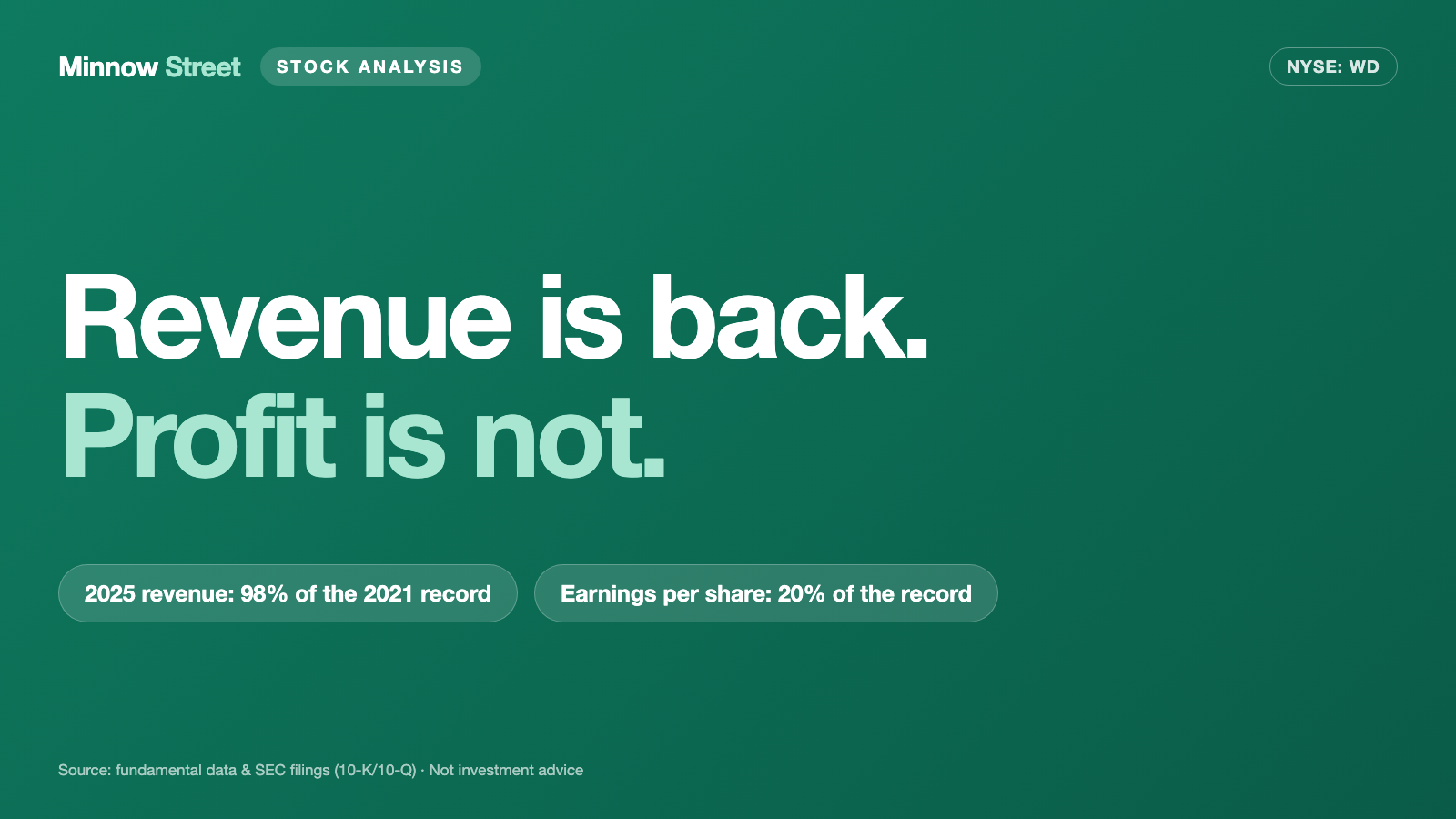
Interactive price chart (TradingView).
Note: pure fact-based analysis, not investment advice and not a solicitation to buy or sell. All figures without guarantee.
There is an investor trap that is not loud but comfortable: the savings-account reflex. It works like this. You see a dividend yield of a good 5 percent, backed by seven straight years without a cut — and your brain files the stock under "interest, safe, can just sit there." The payout feels like a coupon, and nobody audits a coupon. That is exactly where it gets expensive, because a dividend is not interest. It is a decision made by eight people in a boardroom, every single quarter. Walker & Dunlop, Inc. (NYSE: WD) of Bethesda, Maryland, is a case study. The company finances and services American commercial real estate, mostly multifamily; the stock trades roughly two thirds below its all-time high ($50.98 at the close on July 28, 2026 against $154.90 on November 23, 2021), and the dividend has risen for seven years. So let us make a deal: before you file that payout under savings account, we read together what the company itself reported, under penalty of law, to the U.S. securities regulator, the SEC — the quarterly report (10-Q) for March 31, 2026 and the annual report (10-K) for 2025. An SEC filing is honest by force of statute. And this one describes revenue that is almost back at a record, a profit that is not, and $14.2 billion of liability that appears on no balance sheet line. What you make of it is up to you.
What Walker & Dunlop actually does — broker, guarantor and property manager for loans
Walker & Dunlop is a capital markets platform for commercial real estate, and the business fits into three moves. First, it originates and brokers loans. Anyone buying or building an apartment property in the United States needs financing. Walker & Dunlop underwrites the borrower, writes the loan — and sells it on, usually to the government-sponsored enterprises Fannie Mae and Freddie Mac or through the housing agency HUD and Ginnie Mae. The company does not sit on the loan; it earns on the transaction. In the first quarter of 2026 that produced $88.5 million of loan origination and debt brokerage fees. Second, it keeps servicing the loan — this is the real core. On sale, Walker & Dunlop typically retains the right to service the loan: collect payments, run escrow accounts, deal with the owner. A fee flows every quarter for that, whether or not anybody is financing anything new. As of March 31, 2026 this servicing portfolio stood at $146.4 billion (prior year: $135.6 billion) and generated $85.4 million of servicing fees in the quarter. Third, it manages third-party capital: $18.5 billion of assets under management, mostly in funds for affordable housing tax credits. Together that is a managed portfolio of $164.9 billion. By its own account in the quarterly report, this makes Walker & Dunlop the sixth largest commercial real estate loan servicer in the United States.
Now comes the part that separates this model from ordinary brokerage — and that sets up the central tension of this analysis. Under its most important program, the Fannie Mae DUS program ("Delegated Underwriting and Servicing"), Walker & Dunlop may underwrite and approve loans on its own, without Fannie Mae reviewing each file. The price: the company shares in the loss if the borrower stops paying. In everyday terms: you arrange a loan for your neighbor, collect a fee every year — and simultaneously sign a guarantee in case he does not pay. As long as everyone pays, it is the best business in the world. Keep this tension in mind, because it runs through every chapter: Walker & Dunlop earns fees but guarantees with its equity — and the fees are on the balance sheet while the guarantee is not. If the property cycle behind all this interests you, the landlord side of the same coin is in our analysis of CTO Realty Growth, which looks at the buildings themselves rather than their financing.
How the stock landed on our desk
Walker & Dunlop did not arrive through a momentum or quality filter but through our own raw-data screen with exactly three conditions: a dividend yield above 4.5 percent, at least seven years without a dividend cut, and a price more than half below the all-time high. Walker & Dunlop meets all three — a good 5 percent yield, a seven-year streak, roughly 67 percent below the high ($50.98 at the close on July 28, 2026 against the record close of $154.90 on November 23, 2021). That combination is precisely the raw material for the savings-account reflex: it looks like a solid payer that happens to be out of favor. The lists produced by our in-house stock scanner are recalculated daily and are therefore deliberately not cited as evidence; the three conditions, on the other hand, you can check yourself at any time.
For scale, all based on the July 28, 2026 closing price: at $50.98 and the 34,331,241 shares outstanding that the quarterly report's cover page lists as of April 30, 2026, market capitalization works out to roughly $1.75 billion. The fundamental data show $1.69 billion — on the same share count, but on the closing price one trading day earlier ($49.28 on July 27, 2026); the gap of about 3 percent is pure price movement, not a different share basis. A second, lower figure does sit on the balance sheet itself: 33,249 thousand as of March 31, 2026, a month earlier and on the narrower accounting definition of "issued and outstanding" — which is why book value per share appears below as a range. The free float is roughly 96 percent, institutions hold roughly 85 percent, insiders roughly 4 percent. Five analysts carry an average price target of $67.33. Those are reference points, not arguments. The arguments are in the filings.
The numbers over the years — given their due
First, what genuinely impresses, and there is plenty. The first quarter of 2026 was strong: revenue rose 26.9 percent to $301.3 million and transaction volume nearly doubled — $13.66 billion against $7.04 billion in the prior-year quarter, up 94 percent. Debt financing volume alone climbed from $5.20 billion to $11.75 billion. Profit rose almost sixfold to $15.9 million (prior-year quarter: $2.8 million) and earnings per share from $0.08 to $0.46. After three dry years in American commercial real estate, that is a visible thaw. And the base holds: the servicing portfolio grew to $146.4 billion and servicing fees to $85.4 million for the quarter — money that arrives even when nobody finances a building for months.
Even so, one quarter does not make a summer. The five-year view shows a pattern you only see once revenue and profit sit side by side.
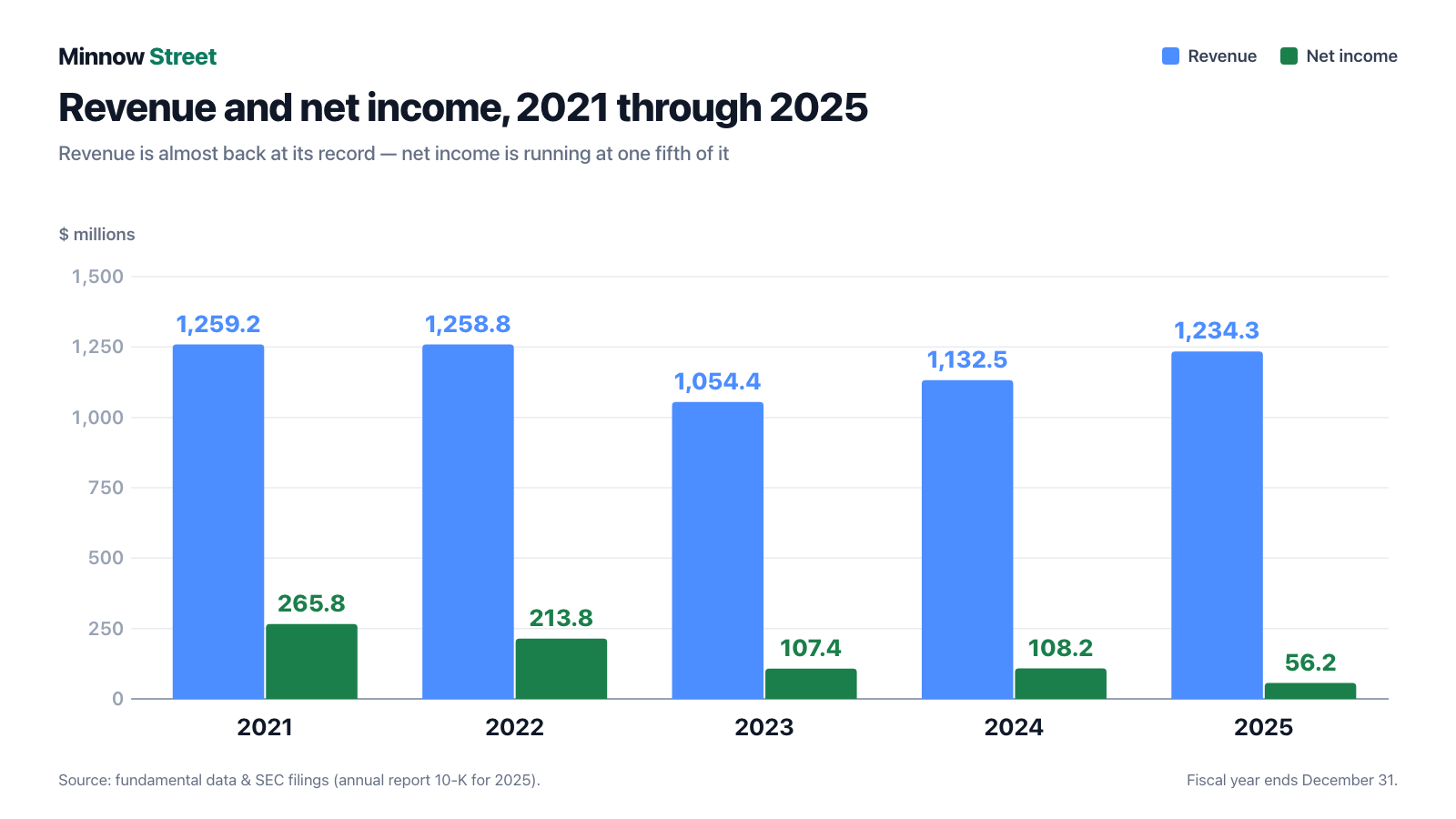
The blue bars are nearly level; the green ones shrink. Revenue of $1,234.3 million in 2025 equals 98 percent of the 2021 record ($1,259.2 million) — on net income it is $56.2 million against $265.8 million, or 21 percent. Per share, diluted earnings fell from $8.15 to $1.64. The reason sits on the expense side: personnel costs ate 52 percent of revenue in 2025 (2024: 49 percent; first quarter of 2026: 51 percent), amortization of servicing rights alone consumed $210.5 million in 2025, and interest on corporate debt cost $64.7 million (in the first quarter of 2026 the two came to $53.1 million and $14.9 million). Remember the sentence: at Walker & Dunlop, revenue is not profit — the cost base grew with it and the interest bill stayed.
A second figure confirms the picture, and it is remarkable because it comes from the company itself. In 2020 management set a five-year goal: $2 billion of revenue by the end of 2025, plus $60 billion of annual debt financing volume, $25 billion of property sales, a $160 billion servicing portfolio and $10 billion of assets under management. The annual report for 2025 settles the account in a single subordinate clause:
"While we remain committed to growing our operations and believe that macroeconomic and industry conditions will recover over the coming years, we did not meet most of these goals by the end of 2025."
— Walker & Dunlop, Inc., SEC annual report 10-K for 2025, Item 1 "Our Growth Strategy"
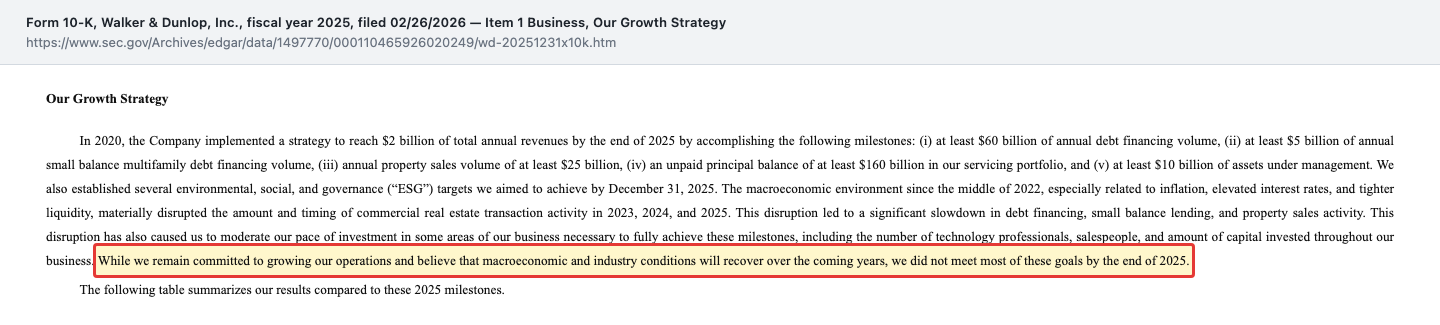
The accompanying table in the filing is unsparing: $1,234.3 million of revenue instead of $2,000 million (62 percent), $41.5 billion of debt financing volume instead of $60 billion (69 percent), $13.3 billion of property sales instead of $25 billion (53 percent), a $144.0 billion servicing portfolio instead of $160 billion (90 percent). The widest miss was small balance lending: $870 million instead of $5 billion — 17 percent of the target. Only assets under management beat the goal ($18.6 billion against $10 billion). This is not sleight of hand; quite the opposite. A company that carries its own missed targets in a table for five years is more honest than most. But it tells you how far the expectation of 2020 and the reality of 2025 have drifted apart.
And here is the part you need before closing the chapter: the company has set itself the very same target again. On March 10, 2026 management hosted an investor day and unveiled a new five-year plan, "Journey to '30"; the deck sits with the SEC as Exhibit 99.1 to a current report (8-K). The 2030 marks: more than $2 billion of revenue, earnings per share of $8.00 to $10.00, adjusted EBITDA of $400 million to $500 million, more than $80 billion of debt financing volume and more than $35 billion of property sales. For comparison, the 2025 actuals: $1,234.3 million of revenue, $1.64 of earnings per share and $315.9 million of adjusted EBITDA on that same presentation's own measure — the annual report does not strip out the cost of the repurchased loans and the asset impairments, and therefore arrives at just $262.6 million. The revenue mark is the same to the dollar as in the 2020 plan — just due five years later. And the $8.00 to $10.00 earnings range translates to: get back by 2030 to where earnings per share already stood in 2021 ($8.15). Chief Executive Willy Walker framed it in the May 7, 2026 earnings release as the pursuit of the annual and five-year goals only now beginning. For you that means: the recovery story priced into the stock is not a market guess — it is the company's stated plan. Except that the same company just missed the previous plan by 38 percent, landing at 62 percent attainment.
What the filings say — the uncomfortable truths
Uncomfortable truth No. 1: the dividend is bigger than the profit
This is where the savings-account reflex tips over. Walker & Dunlop has raised the dividend every year since 2018 — $2.00 per share paid in 2021, then $2.40 in 2022, $2.52 in 2023, $2.60 in 2024 and $2.68 in 2025. A fine streak. Except that over the same period earnings per share fell from $8.15 to $1.64. In 2025 the two lines crossed for the first time:
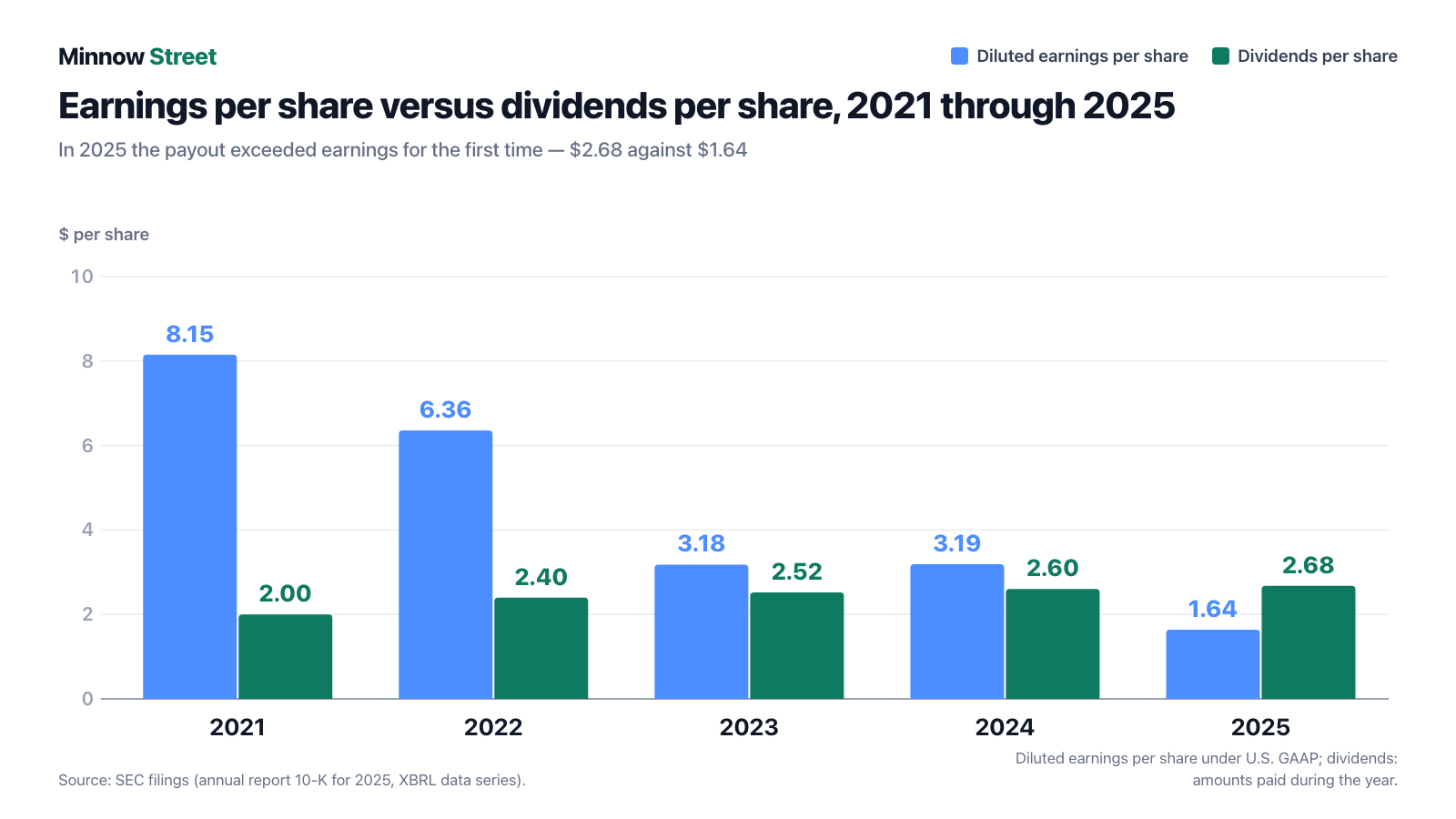
$2.68 paid out, $1.64 earned — that is 163 percent of earnings. And the trend continues: for 2026 the quarterly dividend was raised to $0.68 (up 1.5 percent), declared in February 2026 and again for the second quarter on May 6, 2026. In the first quarter of 2026 that put $0.46 of earnings per share against a $0.68 dividend. Over the past three years the annual report puts total dividend payments at $265.3 million.
Fairness requires the counter-calculation, because at a loan servicer the reported profit is not the whole truth. Inside the $56.2 million of 2025 profit sits a heavy non-cash amortization charge on servicing rights: $210.5 million for the 2025 full year, $53.1 million in the first quarter of 2026 alone, with a further $153.4 million expected for the remaining nine months of 2026. That is why management points to the adjusted measure "adjusted EBITDA" — $73.8 million in the first quarter of 2026 against $65.0 million a year earlier. On that basis the dividend is covered. Under U.S. accounting rules it has not been since 2025. Both calculations are legitimate — but you should know that the safety of the payout hangs on the second one, not the first. Remember: a dividend that is only covered on an adjusted basis is a decision, not an automatic mechanism.
Uncomfortable truth No. 2: $14.2 billion of liability that appears on no balance sheet line
Back to the guarantee from chapter two. Under the Fannie Mae DUS program with full risk sharing, Walker & Dunlop absorbs the first 5 percent of a loan’s unpaid principal balance as a loss alone and shares beyond that, up to a maximum of 20 percent of the original loan balance. Full risk sharing applies to loans up to $400 million — putting the maximum loss per loan at $80 million. Fannie Mae may even double or triple the exposure if a loan fails to meet specific underwriting criteria or defaults within twelve months of sale. As of March 31, 2026 the risk-sharing portfolio stood at $73.5 billion and the at-risk portfolio at $69.4 billion. And then there is this sentence:
"As of March 31, 2026 and December 31, 2025, the maximum quantifiable contingent liability associated with the Company's guaranties for the at-risk loans serviced under the Fannie Mae DUS agreement was $14.2 billion and $14.1 billion, respectively."
— Walker & Dunlop, Inc., SEC quarterly report 10-Q for 03/31/2026, NOTE 4 "Allowance for Risk-Sharing Obligations"

Let us place that in context, in both directions. The company itself writes that the amount is "not representative of the actual loss" — it would only fall due if every loan defaulted and every property behind it turned out to be worthless. That is a theoretical doomsday scenario, and practice looks entirely different: reserves stand at $38.7 million, or 0.06 percent of the at-risk portfolio and 0.27 percent of the maximum exposure. The loss history is correspondingly thin.
Even so, the size comparison is worth making: $14.2 billion of maximum liability against $1,720.2 million of equity — 8.3 times over. It would take no doomsday, only a loss rate in the low single-digit percentages, to bite seriously into equity. And the direction is currently wrong: defaulted loans in the at-risk portfolio rose from $108.5 million to $167.5 million within a year, up 54 percent; their share climbed from 0.17 percent to 0.24 percent. For the specific loans deemed probable of foreclosure — twelve Fannie Mae DUS loans and two Freddie Mac small balance loans — the company has booked collateral-based reserves of $13.3 million (December 31, 2025: $12.6 million); the total allowance for risk-sharing obligations is $38.7 million. In everyday terms: you guaranteed your neighbor's loan, the guarantee does not appear in your household budget, and the number of neighbors currently not paying has risen by half in a year — from a very low base. Both are true, and both belong in the same line.
Uncomfortable truth No. 3: falsified documents, $100 million — and the bill arrives in 2027
The notes to the quarterly report contain a paragraph that made no headline. It concerns loans Walker & Dunlop must buy back because the representations made at origination were breached:
"In 2025, the Company received requests to repurchase two portfolios of loans with an aggregate UPB of $100.0 million as a result of fraudulent documentation submitted by the borrowers in connection with the loans."
— Walker & Dunlop, Inc., SEC quarterly report 10-Q for 03/31/2026, NOTE 5 "Indemnified and Repurchased Loans"
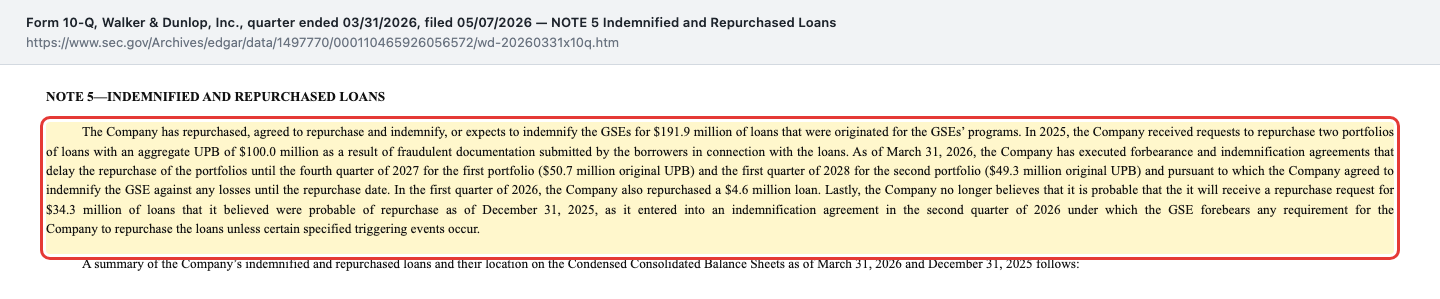
The bill is deferred, not waived. Walker & Dunlop signed forbearance and indemnification agreements with the government-sponsored buyer that push the repurchase of the first portfolio ($50.7 million of original unpaid principal balance) to the fourth quarter of 2027 and the second ($49.3 million) to the first quarter of 2028 — indemnifying the buyer against all losses until then. In total the company has repurchased, agreed to repurchase or assumed indemnification for $191.9 million of loans.
What that costs is already visible. The allowance on these loans rose from $5.4 million to $29.1 million in a single quarter. The total expense impact from indemnified and repurchased loans came to $13.0 million in the first quarter of 2026 — against $0.9 million a year earlier. Set that next to quarterly profit of $15.9 million: this one item cost 82 percent of the profit. The prior-year quarter confirms it is not a seasonal effect but a new line. There is relief as well: for $34.3 million the company no longer considers a repurchase probable as of the second quarter of 2026, having signed an indemnification agreement. But the underlying mechanic stands: whoever underwrites loans without anyone checking the work carries the fraud risk personally. That is exactly what the higher fee under the DUS program is meant to pay for — and exactly why it is not free margin.
Uncomfortable truth No. 4: three quarters of the credit tap is uncommitted — and Fannie Mae holds the key
To write a loan at all, Walker & Dunlop has to fund it itself until the buyer takes it off the books. That is what warehouse facilities are for — an interim warehouse bought on credit. As of March 31, 2026 those facilities carried $6.8 billion of capacity, of which $2.535 billion was drawn. Comfortable, at first glance. The notes show the structure: of the $6.8 billion, only $1.6 billion is committed; the remaining $5.2 billion is uncommitted and the banks can cut it at any time — including $1.5 billion from Fannie Mae itself, with open maturity. Put differently: the drawn amount of $2.535 billion already exceeds the committed $1.6 billion by a wide margin. How movable these lines are shows in one detail from the same filing: the uncommitted portion of one facility was temporarily raised to $1.8 billion in the first quarter of 2026 and reverted to $300 million on May 1, 2026. By exactly that $1.5 billion, total capacity fell from May 1, 2026 to $5.3 billion — the committed $1.6 billion and the $1.5 billion from Fannie Mae were untouched; all of the shrinkage came out of the uncommitted portion of that one facility.
On top of that sits the second dependency, which the filing states openly: Fannie Mae can withdraw the servicing authority if the financial condition no longer suffices.
"Fannie Mae has established benchmark standards for capital adequacy and reserves the right to terminate the Company's servicing authority for all or some of the portfolio if, at any time, it determines that the Company's financial condition is not adequate to support its obligations under the DUS agreement."
— Walker & Dunlop, Inc., SEC quarterly report 10-Q for 03/31/2026, NOTE 12 "Fannie Mae Commitments and Pledged Securities"
And here is the good news, which deserves equal weight: the cushion is currently comfortable. The required net worth stood at $356.8 million as of March 31, 2026, while the operating subsidiary's actual net worth was $1.0 billion — nearly three times over. Required operational liquidity was $71.0 million against $178.1 million on hand. Every financial covenant in the credit and warehouse agreements was met at the reporting date. Over the next 48 months the company must post a further $90.6 million of restricted liquidity — plannable and fundable out of operations. So this point is not an acute risk but a structural feature: a single counterparty can pull the ground from under this business model, and day-to-day funding rests mostly on commitments that bind nobody. You want to know that before treating the stock as a fixed income substitute.
Valuation: roughly at book — with a reserve you cannot see
How expensive is the stock? Let us run the orders of magnitude, all dated. At a closing price of $50.98 on July 28, 2026 and roughly $1.75 billion of market capitalization, the price-to-sales ratio is about 1.4 (2025 revenue: $1,234.3 million). The price-to-earnings ratio on 2025 is about 31 ($1.64 per share); extending the first quarter of 2026 linearly ($0.46 per share) gives about 28. Analyst estimates in the fundamental data run well above that at $4.61 per share for the current fiscal year — but most houses model mortgage lenders on an adjusted earnings measure that strips out servicing rights amortization, which is not comparable with profit under U.S. accounting rules. Putting both figures side by side shows one thing above all: the price contains the expectation that the profit comes back.
The most honest yardstick is therefore book value. Equity stood at $1,720.2 million as of March 31, 2026. Spread over the 34.33 million shares on the quarterly report's cover page that is $50.11 per share; spread over the 33.25 million on the balance sheet, $51.74. The $50.98 closing price of July 28, 2026 sits squarely in between — so the stock trades essentially at book. That is half the answer. The other half: $868.7 million of that book value is goodwill from acquisitions and $138.1 million other intangibles — together 58.5 percent of equity. Tangible equity is therefore only $713.4 million, or roughly $21 per share. For a sense of how hard the property transaction cycle hits balance sheets like these, our analysis of Fidelity National Financial covers the same weather from another window.
And now the counterweight you have to know about in this business model. The most valuable item is deliberately carried too low:
"The fair value of the mortgage servicing rights ("MSRs") was $1.4 billion as of both March 31, 2026 and December 31, 2025."
— Walker & Dunlop, Inc., SEC quarterly report 10-Q for 03/31/2026, NOTE 3 "Mortgage Servicing Rights"
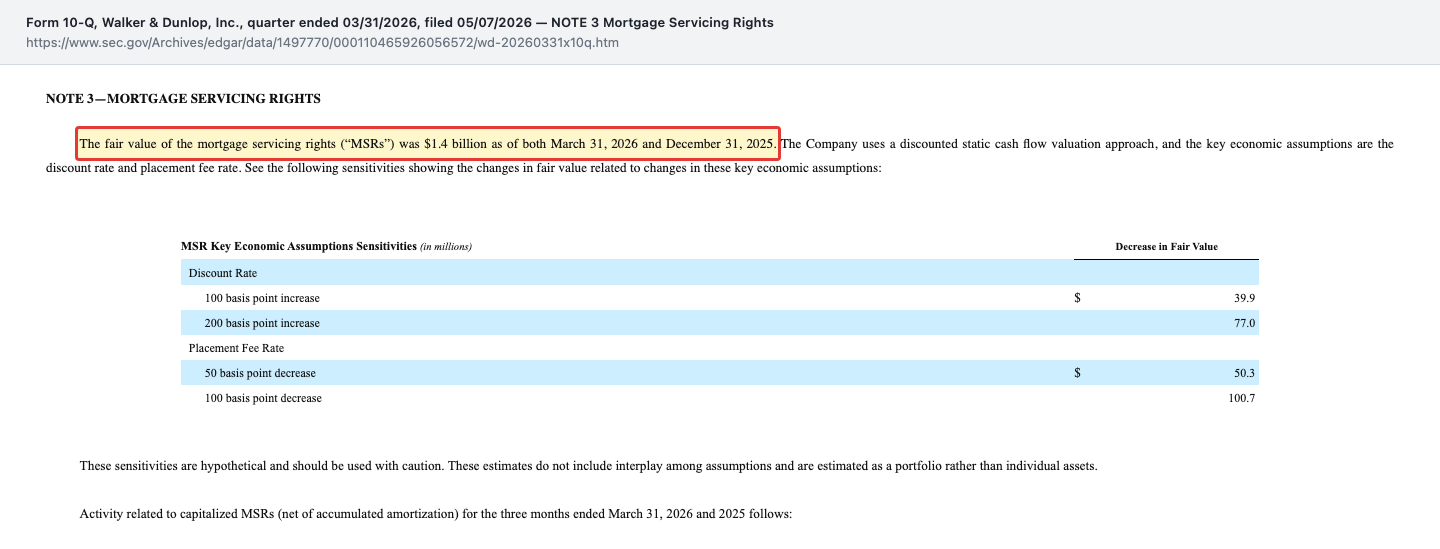
The servicing rights sit in the books at $795.8 million — $1,844.1 million gross less $1,048.3 million of accumulated amortization. Fair value is $1.4 billion. The difference of roughly $600 million equals a good third of the market capitalization and appears on no balance sheet line. Why? Because U.S. accounting carries these rights at amortized cost while their economic value rests on future fees. That is the flip side of the amortization that depresses reported profit: what the income statement shows as expense is in good part an asset worth more in the market than in the ledger. It is rate sensitive, though. The filing puts the fair value decline at $39.9 million for a 100 basis point rise in the discount rate and $77.0 million for 200 basis points; a 50 basis point drop in the rate earned on escrow deposits costs $50.3 million. The reserve is real — but it is a bet on the rate environment, not the contents of a vault.
One final valuation anchor, set by the company itself: in February 2026 the board approved a share repurchase program of up to $75.0 million running twelve months from February 26, 2026. In the first quarter of 2026 it bought back 283,000 shares at an average of $47.13 and retired them, leaving $61.7 million of capacity as of March 31, 2026. So the company judged its own stock worth buying at roughly $47 — while also paying $2.72 a year in dividends. Together that is a great deal of capital return for a company that earned $56.2 million in the year.
Opportunities and risks at a glance
What speaks for Walker & Dunlop:
- Recurring revenue from a growing base: the servicing portfolio rose to $146.4 billion as of March 31, 2026 (prior year $135.6 billion) and servicing fees to $85.4 million for the quarter — income that arrives even in a dead transaction market.
- A visible thaw: in the first quarter of 2026 transaction volume rose 94 percent to $13.66 billion, revenue 26.9 percent to $301.3 million, and profit from $2.8 million to $15.9 million.
- A hidden reserve in the servicing rights: fair value of $1.4 billion against $795.8 million of carrying value — roughly $600 million that never shows up in equity, a good third of the $1.75 billion market capitalization (July 28, 2026 close).
- Comfortable headroom against regulatory requirements: the operating subsidiary's net worth of $1.0 billion against a $356.8 million requirement, operational liquidity of $178.1 million against $71.0 million required; every financial covenant met as of March 31, 2026.
- Capital return on two tracks: $2.72 of annual dividends (roughly 5.3 percent on the July 28, 2026 closing price) plus a $75.0 million repurchase program under which 283,000 shares were retired at an average of $47.13 in the first quarter of 2026.
What speaks against it:
- The payout exceeds earnings: $2.68 of dividends against $1.64 of earnings per share (2025), and $0.68 against $0.46 in the first quarter of 2026 — covered only on an adjusted basis, not under U.S. accounting rules.
- Earnings power far below the old level: net income of $56.2 million (2025) after $265.8 million (2021), earnings per share of $1.64 after $8.15 — on essentially unchanged revenue.
- $14.2 billion of maximum contingent liability from the Fannie Mae DUS program against $1,720.2 million of equity, backed by $38.7 million of reserves; defaulted loans rose 54 percent within a year to $167.5 million.
- A fraud case with a tail: $100.0 million of loan balances called for repurchase over falsified documents, deferred to Q4 2027 and Q1 2028; the allowance on those loans went from $5.4 million to $29.1 million in one quarter, and the total expense impact in the first quarter of 2026 was $13.0 million — 82 percent of quarterly profit.
- Structural dependencies: of $6.8 billion of warehouse capacity only $1.6 billion is committed while $2.535 billion was drawn, and Fannie Mae can withdraw the servicing authority. On top of that, 58.5 percent of equity is goodwill and intangibles.
A human verdict
Back to the savings-account reflex. Its core is not that the dividend is bad — it is real, it has risen for seven years, it arrives on time. Its core is that the regularity of the payment spares you the question of what actually pays it. At Walker & Dunlop the answer for 2025 is: not the profit. $2.68 went out, $1.64 was earned. That is neither a scandal nor proof of a coming cut — there is a genuine hidden reserve of roughly $600 million in the servicing rights, a growing base of recurring fees, and a first quarter of 2026 that looks like recovery. But it is a decision the board has to take again every quarter, in a business that guarantees $14.2 billion, whose defaults have just risen by half, and in which $100 million has to be bought back over falsified documents. So the honest question for you is not "is the dividend safe?" but: would you sign a guarantee for eight times your own equity if a fee landed in your account every quarter — and the payout you receive for it is bigger than what you earn? If yes, you have a thesis and you know its risks. If no, you had a reflex. What you make of it is your decision. And that is exactly as it should be.
Sources
Every original document used in this analysis, so you can read it yourself:
- Walker & Dunlop, Inc. — SEC quarterly report 10-Q for March 31, 2026 (filed May 7, 2026)
- Walker & Dunlop, Inc. — SEC annual report 10-K for 2025 (filed February 26, 2026)
- Walker & Dunlop, Inc. — SEC annual report 10-K for 2024 (filed February 25, 2025)
- Walker & Dunlop, Inc. — SEC quarterly report 10-Q for September 30, 2025 (filed November 6, 2025)
- Walker & Dunlop, Inc. — SEC current report 8-K of May 7, 2026, Exhibit 99.1 (quarterly results and dividend declaration)
- Walker & Dunlop, Inc. — SEC current report 8-K of March 10, 2026, Exhibit 99.1 (investor day, five-year plan "Journey to '30")
- Walker & Dunlop, Inc. — SEC current report 8-K of March 4, 2026 (Items 1.01 and 2.03, amendment to the warehouse credit facility)
- Walker & Dunlop, Inc. — SEC current report 8-K of May 21, 2026 (Item 5.07, annual meeting of May 19, 2026)
- Full SEC filing history for Walker & Dunlop, Inc.: EDGAR overview (sec.gov)
- Fundamental data (price, market capitalization, valuation ratios, analyst estimates; as of July 28, 2026), reconciled with the SEC filings and the SEC XBRL data series.
Transparency & disclaimer: This analysis is journalistic commentary on publicly available information. It is not investment advice, not a financial analysis in any regulatory sense, and not a solicitation to buy or sell securities. Equity investments carry substantial risk up to the total loss of capital. All figures without warranty; the as-of date is noted in the text. The author holds no position in Walker & Dunlop shares at the time of publication.
Our Bottom Line at a Glance
- Recurring revenue positive
- The servicing portfolio grew to $146.4 billion as of March 31, 2026 (prior year $135.6 billion), servicing fees to $85.4 million for the quarter, and assets under management stand at $18.5 billion. This income is contractual and arrives even when the transaction market is frozen — it is the backbone of the business and the reason the 2023 to 2025 drought produced no losses.
- Earnings power negative
- Revenue of $1,234.3 million in 2025 was 98 percent of the 2021 record, but net income of $56.2 million was only 21 percent of $265.8 million; per share, profit fell from $8.15 to $1.64. The first quarter of 2026 shows recovery at $15.9 million after $2.8 million — one quarter is not proof, and the company's own five-year revenue goal of $2 billion was missed at 62 percent. On March 10, 2026 management restated the very same revenue mark, now for 2030 ("Journey to '30," alongside earnings per share of $8.00 to $10.00).
- Payout policy negative
- The dividend exceeded earnings for the first time in 2025: $2.68 against $1.64 per share, or 163 percent. For 2026 the quarterly rate was raised to $0.68, putting $0.68 of dividends against $0.46 of earnings in the first quarter. The payout is covered only on management's adjusted measure (adjusted EBITDA of $73.8 million in the first quarter of 2026), not under U.S. accounting rules — and a $75.0 million repurchase program runs alongside it.
- Risk sharing & credit quality negative
- Under the Fannie Mae DUS program the company faces maximum liability of $14.2 billion as of March 31, 2026 — 8.3 times its $1,720.2 million of equity — with $38.7 million reserved. Defaulted loans rose 54 percent within a year to $167.5 million (0.17 percent to 0.24 percent of the at-risk portfolio). On top sit $100.0 million of repurchase obligations over falsified documents, falling due in 2027 and 2028.
- Balance sheet & funding neutral
- The operating subsidiary's net worth of $1.0 billion as of March 31, 2026 was nearly three times the $356.8 million regulatory requirement, every financial covenant was met, and the servicing rights carry a hidden reserve of roughly $600 million (fair value $1.4 billion against $795.8 million of carrying value). Against that stand 58.5 percent goodwill and intangibles inside equity, and warehouse capacity of which only $1.6 billion out of $6.8 billion is committed.
Walker & Dunlop is the savings-account reflex in pure form: a good 5 percent dividend yield, seven years without a cut, a price about two thirds below the all-time high — and underneath it a business whose 2025 revenue of $1,234.3 million was almost back at a record while earnings per share fell from $8.15 to $1.64 and the payout of $2.68 exceeded them for the first time. The backbone is real: a $146.4 billion servicing portfolio, $85.4 million of fees per quarter and roughly $600 million of hidden reserve in the servicing rights. The price for it is $14.2 billion of maximum contingent liability against $1,720.2 million of equity, loan defaults up 54 percent, and $100.0 million of repurchase obligation out of a fraud case. Not investment advice.
What Our Rating Means
Open questions
The business works in principle, but one material question is open. As long as it stays open, our findings do not carry a quality verdict.
Red is off the table with no proven risk to substance: $1,720.2 million of equity, an operating subsidiary net worth of $1.0 billion against a $356.8 million regulatory requirement, operational liquidity of $178.1 million against $71.0 million required, every financial covenant in the credit and warehouse agreements met as of March 31, 2026, no going concern language, a profitable first quarter of 2026, and recurring servicing fees that prevented a loss through three lean years. Green is off the table because a material operating question is open: earnings power has fallen to one fifth of the 2021 level ($1.64 against $8.15 per share), the company's own five-year goal was missed at 62 percent attainment, the payout has exceeded reported profit under U.S. accounting rules since 2025, defaults in the at-risk portfolio rose 54 percent within a year, and a fraud case leaves $100.0 million of repurchase obligation outstanding with dates in 2027 and 2028, its allowance having more than quintupled from $5.4 million to $29.1 million in a single quarter. A company with a durable core, a sound regulatory position and an unproven return to its old earnings power — hence yellow. That the stock sits roughly two thirds below its high and carries a price-to-earnings ratio of about 31 on 2025 earnings are price questions, not quality questions; they belong in the text, not in the traffic light. The decision is yours.
A journalistic assessment by our editorial team at the time of the deep dive, based on public sources — not investment advice and not a solicitation to buy or sell. Your personal circumstances (investment goals, risk capacity, taxes) cannot be taken into account. What our levels mean, how verdicts are formed, and what conflicts of interest exist →
Worth Noting
- Walker & Dunlop reached our research list through our own raw-data screen with three conditions: a dividend yield above 4.5 percent, at least seven years without a dividend cut, and a price more than half below the all-time high (price and valuation data as of July 29, 2026; last closing price July 28, 2026). The lists produced by our in-house stock scanner are recalculated daily and are therefore deliberately not cited as evidence.
- The most recent periodic report is the quarterly report 10-Q for March 31, 2026 (filed May 7, 2026, accession 0001104659-26-056572); no report for the second quarter of 2026 existed as of July 29, 2026. Everything filed afterwards was reviewed in full, exhibits included: the 8-K of May 7, 2026 (Items 2.02 and 9.01, Exhibit 99.1 with quarterly figures, the $0.68 second-quarter dividend declaration and the five-quarter escrow deposit series), a Form S-8 registration of May 12, 2026, soliciting material DEFA14A of May 11, 2026, the 8-K of May 21, 2026 (Item 5.07, results of the May 19, 2026 annual meeting — eight directors elected, KPMG ratified as auditor for 2026, say-on-pay approved with roughly 71 percent support), seven insider filings (Form 4) of May 21, 2026 and five of June 8, 2026, plus two ownership filings (Schedule 13G) of April 29 and 30, 2026. For the statements on credit facilities the financing reports 8-K of February 2, 2026 and March 4, 2026 (Items 1.01/2.03, amendments to the PNC warehouse line including the increase that expired on May 1, 2026) were read with their exhibits, and for the targets Exhibit 99.1 to the 8-K of March 10, 2026 (investor day, "Journey to '30"). No delisting or deregistration form (25/15), no prospectus (424B*), no capital measure. Every present-tense statement about cash, equity, share count, credit lines, reserves, contingent liability, dividends and the repurchase program rests on that basis.
- On the market capitalization cross-check: the cover page of the 10-Q lists exactly 34,331,241 shares outstanding as of April 30, 2026. At the $50.98 closing price of July 28, 2026 that gives roughly $1.75 billion. The fundamental data report $1.69 billion — on the same share count (34,331,241), but on the July 27, 2026 closing price of $49.28; the gap of about 3 percent is pure price movement. The balance sheet separately shows 33,249 thousand shares issued and outstanding as of March 31, 2026. The article consistently uses the cover-page figure of April 30, 2026; both numbers appear because book value per share lands between $50.11 and $51.74 depending on the basis. The distance from the all-time high refers to the record closing price of $154.90 on November 23, 2021. Analyses are evergreen; a daily price is not a reason to buy.
- Easy to confuse: the ticker WD on the New York Stock Exchange belongs to Walker & Dunlop, Inc. — not to WD-40 Company (Nasdaq: WDFC) and not to Western Digital (Nasdaq: WDC). Nor is Walker & Dunlop a property owner or a REIT: the company finances and services other people's real estate loans; it does not own the buildings. Analyst estimates in the fundamental data ($4.61 per share for the current fiscal year, as of July 29, 2026) rest largely on an adjusted earnings measure common for mortgage lenders and are not comparable with profit under U.S. accounting rules. Equally non-comparable are total revenues ($1,234.3 million in 2025) and total transaction volume ($54.8 billion in 2025) — the first is what the company earns, the second is the loan volume it passes through.
Frequently Asked Questions
Walker & Dunlop, Inc. (NYSE: WD) of Bethesda, Maryland, is a capital markets platform for U.S. commercial real estate focused on multifamily. It originates and brokers loans, sells them to the government-sponsored buyers Fannie Mae and Freddie Mac or through HUD and Ginnie Mae, and usually retains the servicing. As of March 31, 2026 that servicing portfolio stood at $146.4 billion and the total managed portfolio at $164.9 billion.
Under U.S. accounting rules it was not covered by earnings in 2025: $2.68 of dividends per share against $1.64 of earnings per share, or 163 percent. For 2026 the quarterly rate was raised to $0.68, while first-quarter earnings came in at $0.46 per share. On management's adjusted measure (adjusted EBITDA of $73.8 million in the first quarter of 2026) it is covered. A dividend is never a guarantee in any case.
DUS stands for "Delegated Underwriting and Servicing." Walker & Dunlop may underwrite and approve loans on its own without Fannie Mae reviewing each file — but shares in the loss: under full risk sharing it absorbs the first 5 percent of the unpaid principal balance alone and shares beyond that, up to 20 percent of the original loan amount. As of March 31, 2026 the maximum quantifiable liability was $14.2 billion, with $38.7 million reserved.
Because the cost base grew with it and the interest bill stayed. Revenue of $1,234.3 million in 2025 was 98 percent of the 2021 record, while net income of $56.2 million was only 21 percent of $265.8 million. Personnel costs ate 52 percent of revenue in 2025 (2024: 49 percent), amortization of servicing rights cost $210.5 million in 2025 alone, and interest on corporate debt cost $64.7 million.
They are the rights to keep servicing loans after they are sold and to collect ongoing fees for it. U.S. accounting carries them at cost less scheduled amortization, while their economic value rests on future fees. As of March 31, 2026 they sat in the books at $795.8 million, while the quarterly report put their fair value at $1.4 billion — roughly $600 million that never shows up in equity.
At the $50.98 closing price of July 28, 2026 and roughly $1.75 billion of market capitalization, the price-to-sales ratio is about 1.4 and the price-to-earnings ratio on 2025 about 31. On book value the stock trades at roughly equity per share ($50.11 to $51.74 as of March 31, 2026). However, 58.5 percent of that equity is goodwill and intangibles, offset by roughly $600 million of hidden reserve in the servicing rights.
The government-sponsored buyers demanded in 2025 the repurchase of two loan portfolios with an aggregate unpaid principal balance of $100.0 million because borrowers had submitted fraudulent documentation. Walker & Dunlop deferred the repurchase to the fourth quarter of 2027 ($50.7 million) and the first quarter of 2028 ($49.3 million) and indemnifies against losses until then. The allowance rose from $5.4 million to $29.1 million in one quarter.
No, and the company says so itself. In 2020 management set targets for the end of 2025 including $2 billion of revenue, $60 billion of debt financing volume and a $160 billion servicing portfolio. It delivered $1,234.3 million of revenue (62 percent), $41.5 billion of debt financing volume (69 percent) and a $144.0 billion servicing portfolio (90 percent). Only assets under management beat the goal, at $18.6 billion against $10 billion. On March 10, 2026 management unveiled a new five-year plan at an investor day, "Journey to '30": more than $2 billion of revenue by 2030 — the same mark as in 2020 — plus earnings per share of $8.00 to $10.00.
Found an error?
Did you spot a factual error, an outdated number, or a typo in this deep dive? Let us know briefly — your report goes straight to the editorial team.