Tesla Stock: Record Deliveries, a 1.4 Percent Operating Margin — and a Quarterly Profit That Came From Outside the Car Business
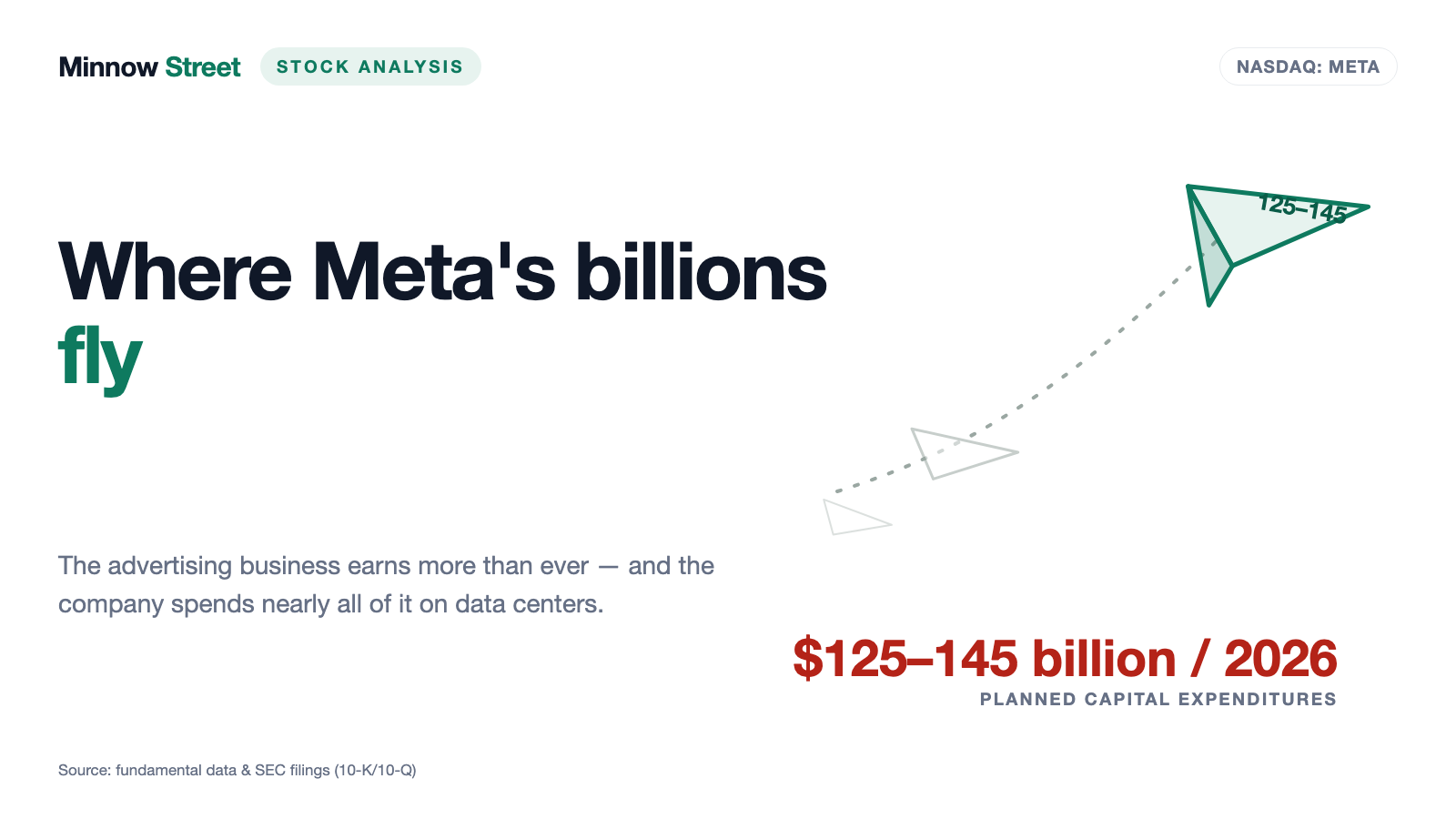
Tesla delivered 480,126 vehicles in the quarter ended June 30, 2026, more than in any second quarter before. Revenue rose 26 percent to $28,236 million. Operating income came to $398 million — 57 percent less than a year earlier. And of the $1,114 million in quarterly net income, $1,005 million came from remeasuring a stake the company had only bought in March 2026. We turn the package around and read the ingredient list.
 Thomas Mücke
Founder & Publisher
Thomas Mücke
Founder & Publisher
Chart
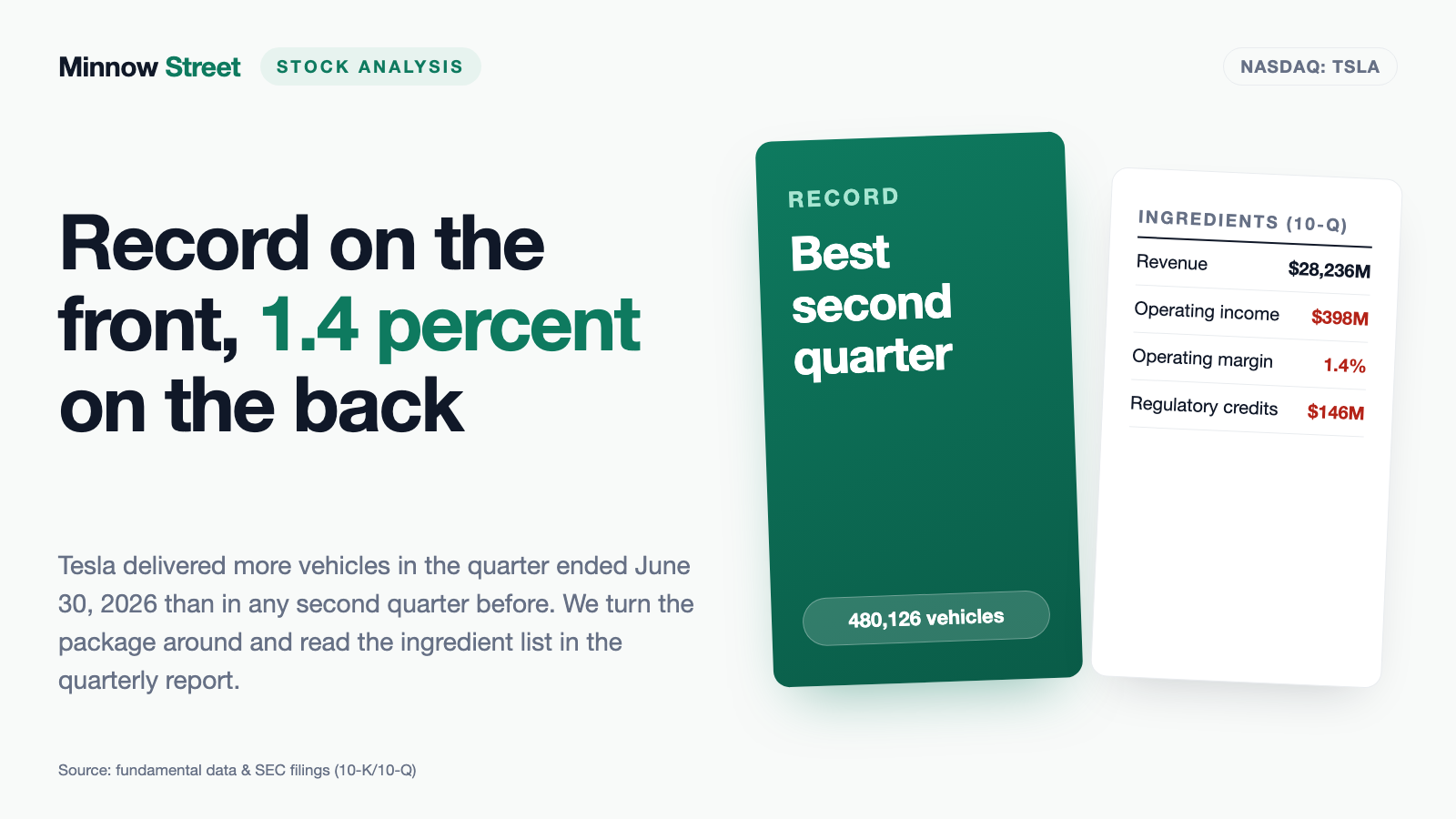
Interactive price chart (TradingView).
Note: pure fact-based analysis, not investment advice and not a solicitation to buy or sell. All figures without guarantee.
The trap is called the front of the package
Let us make a deal. Before we talk about Tesla, let me confess a mental trap both of us fall into at the supermarket every week. The front of the package says, in large letters, whatever sounds good: "made with real fruit." The back, small and grey, carries the ingredient list — and there the fruit shows up seventh, at 2 percent. Both are true. The front just tells a different story than the back.
At Tesla the front reads: 480,126 vehicles delivered in the quarter ended June 30, 2026, more than in any second quarter before, on $28,236 million of revenue, up 26 percent. All of that is accurate and all of it sits in the quarterly report.
The ingredient list is a few pages further in. It reads: $398 million of operating income, 57 percent less than a year earlier. On every $100 of revenue, $1.40 of operating profit remains.
Hold on to that tension, because it runs through every chapter: Tesla sells more than ever and earns less and less from the running business — and the reported quarterly profit most recently came from outside the car business. We are going to read that together now, line by line.
Contents
- What Tesla actually does
- How the stock landed on our desk
- The numbers over the years — honestly credited
- What the filings say — the uncomfortable truths
- Valuation: what you are paying for this company
- Opportunities and risks at a glance
- A human conclusion
- Sources
What Tesla actually does
Tesla builds and sells cars. That is the short answer, and it carries three quarters of the business. Of the $28,236 million of revenue in the quarter ended June 30, 2026, $20,006 million came from automotive sales and another $364 million from automotive leasing. The company runs two reportable segments: automotive and services with $25,097 million of revenue, and energy generation and storage with $3,139 million.
The second pillar is bigger than many assume, and it grows differently. Energy covers the large grid batteries (Megapack), the home batteries (Powerwall) and solar products. In the quarter ended June 30, 2026 Tesla deployed 13.5 gigawatt-hours of storage, up 41 percent year over year; across all of 2025 the figure was 46.7 gigawatt-hours.
Then there is a third block that has no revenue line of its own yet drives every headline: services and other, $4,581 million in the quarter, up 50 percent. That covers used-vehicle sales, repair work, collision service and paid Supercharging — not autonomous driving. Where Robotaxi and the FSD driver-assistance system leave their revenue, we will see shortly.
Two points that are easy to get wrong. First: Tesla's fiscal year is the calendar year and ends on December 31. "Fiscal 2025" really does mean January 1 through December 31, 2025 — unlike many technology companies, nothing needs converting.
Second: Tesla has been a Texas corporation since June 13, 2024, previously a Delaware one, with its headquarters in Austin. That sounds like a formality, but it is the reason several legacy cases still run before Delaware courts. And the company was named "Tesla Motors Inc" until January 27, 2017 — anyone hunting older filings will find them under that name.
How the stock landed on our desk
This time it was not a screener hit. Our in-house stock scanners filter on metrics — cheap valuation, high Piotroski score, momentum — and precisely for that reason the best-known heavyweights fall through systematically: they are rarely cheap. When we counted on July 28, 2026 how many of the 100 largest U.S. stocks by market capitalization already had a deep dive here, 88 did not. Tesla was the fifth largest of those, at rank 9 with a market capitalization of about $1,214 billion (as of July 29, 2026).
That is an honest statement about our own method: a scanner that hunts bargains does not find blue chips. So we are working the list from the top down. Tesla belongs to the same investment wave as two companies we have already examined: Amazon is building data centers at the same pace for the same reason, and the chips this money buys come in large part from Nvidia. Valuing any of them means valuing one shared question: when does compute turn into earnings?
The numbers over the years — honestly credited
Start with what genuinely impresses. Tesla delivered 480,126 vehicles in the quarter ended June 30, 2026 — 25 percent more than a year earlier and more than in any second quarter in company history. Since inception the total stands at 9.7 million vehicles. Revenue for the twelve months ended June 30, 2026 passed $100 billion for the first time. No carmaker manages that by accident.
The balance sheet is remarkable too. As of June 30, 2026 Tesla carried $43,524 million of cash and short-term investments against $9,342 million of debt and finance leases — $9,059 million of it non-recourse to the parent, meaning secured by individual vehicles, receivables and energy assets. The equity ratio was 58.5 percent. A $5,000 million revolving credit facility sat entirely undrawn.
Now the time series. And here the tension shows up for the first time:
| Fiscal year (calendar year) | Revenue | Operating income | Operating margin | Net income |
|---|---|---|---|---|
| 2023 | $96,773M | $8,891M | 9.2% | $14,997M |
| 2024 | $97,690M | $7,076M | 7.2% | $7,091M |
| 2025 | $94,827M | $4,355M | 4.6% | $3,794M |
Read the third column again. Revenue sat at roughly $95 billion for three straight years — operating income halved over the same span. One note on the second series: net income in 2023, at $14,997 million, exceeded operating income of $8,891 million. The difference came from the tax line, which was a benefit that year. Anyone treating 2023 as a normal year is measuring against a one-off.
And the quarters? They show the same thing in slow motion:
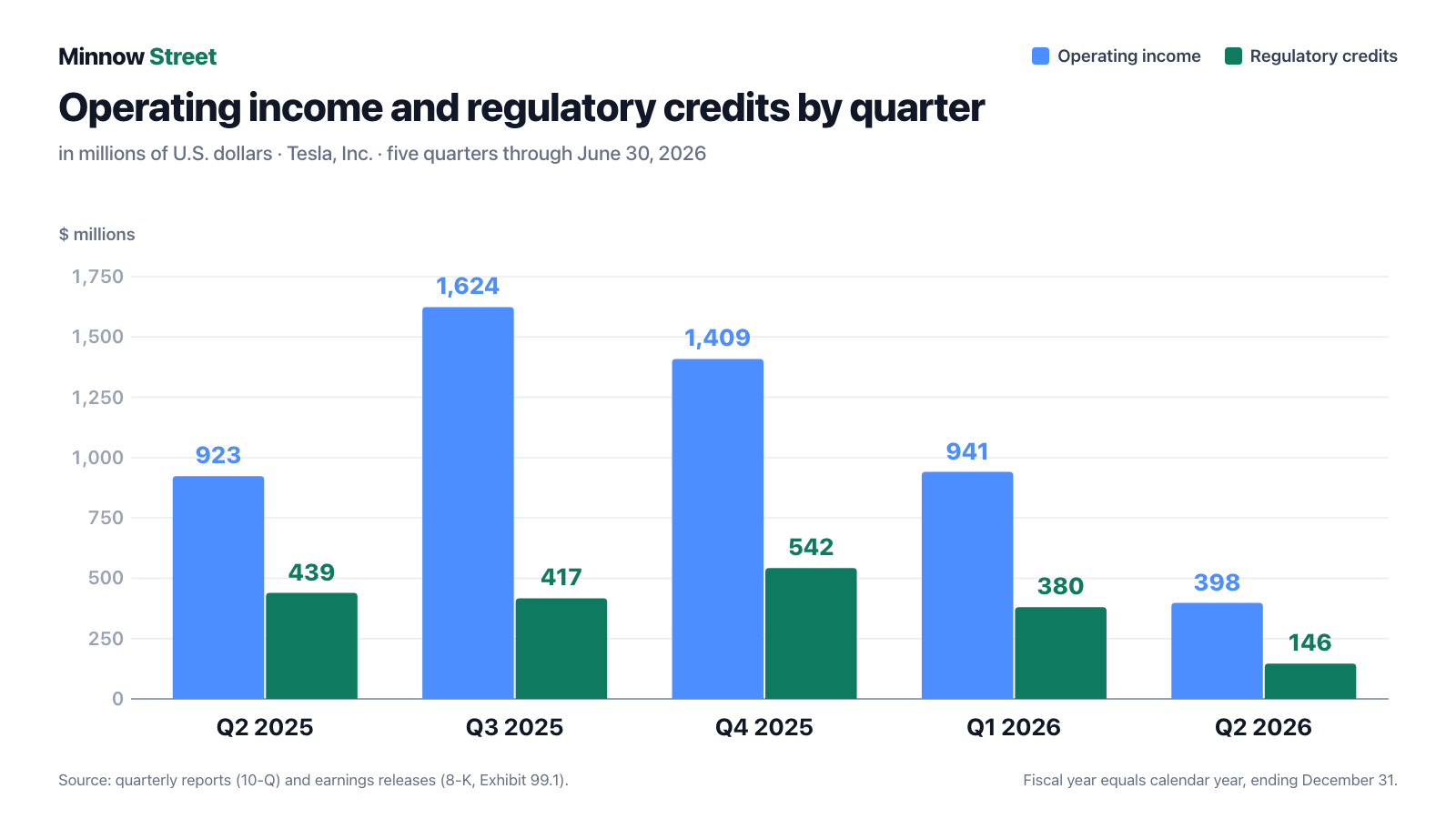
Two series, one pattern. The green bars are no footnote: in the quarter ended June 30, 2026 the $146 million from selling emissions credits equaled roughly 37 percent of total operating income of $398 million. A year earlier it was $439 million out of $923 million — 48 percent. What exactly those credits are and why they are disappearing comes next.
So you can check every figure yourself, here are all five quarters in full, in millions of U.S. dollars:
| Quarter | Revenue | Operating income | Regulatory credits | Capital expenditures | Free cash flow |
|---|---|---|---|---|---|
| Q2 2025 (ended 2025-06-30) | 22,496 | 923 | 439 | 2,394 | +146 |
| Q3 2025 (ended 2025-09-30) | 28,095 | 1,624 | 417 | 2,248 | +3,990 |
| Q4 2025 (ended 2025-12-31) | 24,901 | 1,409 | 542 | 2,393 | +1,420 |
| Q1 2026 (ended 2026-03-31) | 22,387 | 941 | 380 | 2,493 | +1,444 |
| Q2 2026 (ended 2026-06-30) | 28,236 | 398 | 146 | 5,789 | −1,092 |
Two columns deserve a second look. Fourth-quarter 2025 revenue of $24,901 million came in below the third quarter's $28,095 million — Tesla's volumes swing sharply with the season, which is why quarterly comparisons should always run against the same quarter a year earlier. And the last column crosses into negative territory exactly once: in the most recent quarter.
What the filings say — the uncomfortable truths
Uncomfortable truth no. 1: a quarter more revenue, more than half the operating income gone
In the quarter ended June 30, 2026 Tesla's revenue rose 26 percent to $28,236 million. In the same quarter operating income fell 57 percent to $398 million. The operating margin dropped from 4.1 to 1.4 percent. Tesla states this plainly in its own earnings release, without softening.
Where did the money go? Into three blocks, all of them in the quarterly report:
- Research and development: $2,371 million, up 49 percent. Tesla attributes it to AI programs and an expanded product roadmap.
- Selling, general and administrative: $1,982 million, up 45 percent. Of that, $283 million is stock-based compensation, mostly for the 2025 chief executive award.
- The energy business: segment gross margin fell from 30.3 to 20.4 percent and gross profit from $846 million to $640 million — despite 13 percent more revenue. Tesla names higher warranty-related charges caused by a vendor cell issue.
One figure cuts the other way, and honesty requires naming it: automotive gross margin excluding regulatory credits rose in the same quarter from 15.0 to 16.3 percent. Tesla is not building cars worse; it is building them cheaper. The earnings collapse happens below that line — in spending on things that generate no revenue yet.
Uncomfortable truth no. 2: the earnings component with no cost of goods is disappearing
Carmakers must meet emissions requirements in many markets. Those who exceed them — and a pure electric manufacturer necessarily does — may sell the surplus credits to other manufacturers. Tesla incurs no cost of revenue for them. The proceeds flow almost entirely into gross profit; Tesla itself strips them out in its earnings release as a clean 2.2 percentage points of automotive margin in the prior-year quarter and 0.6 points in the current one.
That line is shrinking. In the quarter ended June 30, 2026, $146 million remained, down from $439 million a year earlier. Tesla names the reason itself:
"Automotive regulatory credits revenue decreased $293 million, or 67%, in the three months ended June 30, 2026 as compared to the three months ended June 30, 2025. … Recent governmental and regulatory actions have restricted certain regulatory credit programs tied to our products."
— Tesla, Inc., Form 10-Q for the quarter ended June 30, 2026, Item 2 (MD&A), filed with the U.S. securities regulator, the SEC, on July 23, 2026

How much is still coming sits in Note 1: as of June 30, 2026 the unsatisfied transaction price on credit contracts with an original term of more than one year was $287 million, $220 million of which Tesla expects to recognize over the next twelve months. For scale: in fiscal 2025 the figure was $1,993 million — 46 percent of total operating income of $4,355 million.
In everyday terms: a contractor whose annual profit is half government subsidy is not badly run. He is simply dependent on a decision he does not make.
Uncomfortable truth no. 3: three quarters of pre-tax income came from an equity stake
In March 2026 Tesla invested $2.00 billion in SpaceX common stock. The position arose from a former preferred-share investment in xAI and represents an ownership interest below one percent. Because the chief executive runs both companies, Tesla presumes significant influence over the investee and carries the position at fair value — so swings run straight through the income statement.
In the quarter ended June 30, 2026 the swing went up:
"The investment is classified as Level 2 within the fair value hierarchy based on observable market inputs used to estimate the $238 million discount for lack of marketability due to regulatory restrictions expiring in September 2026. For the three months ended June 30, 2026, we recorded a $1.00 billion net gain on our SpaceX equity investment."
— Tesla, Inc., Form 10-Q for the quarter ended June 30, 2026, Note 2 (Fair Value of Financial Instruments)

Now the arithmetic. Pre-tax income for the quarter was $1,329 million. The unrealized remeasurement gain of $1,005 million equals 76 percent of it. A second line sits below: after a California tax statute took effect, Tesla released a valuation allowance on deferred tax assets, which added $274 million to earnings and pushed the effective tax rate from 23 to 15 percent.
Tesla lays both out in its own reconciliation: from $1,114 million of quarterly profit it subtracts $763 million of after-tax SpaceX gain and $274 million of tax items. What would be left without those two items — with every other cost, including stock-based compensation, still in place — is $77 million. On $28,236 million of revenue.
None of this is improper or hidden. It sits in Tesla's own table. The headline "$1.1 billion quarterly profit" simply tells the front of the package.
Uncomfortable truth no. 4: the compensation award sits in a footnote at up to $120 billion
On September 3, 2025 the board granted the chief executive a compensation award covering 423,743,904 performance-based shares; shareholders approved it on November 6, 2025. It consists of twelve tranches of roughly 35.3 million shares each. Every tranche requires two things: a market-capitalization milestone — from $2.0 trillion for the first to $8.5 trillion for the twelfth — and an increasing number of operational milestones.
Those milestones are specific and disclosed: 20 million vehicles delivered, 10 million active FSD subscriptions, 1 million bots delivered, 1 million Robotaxis in commercial operation, plus adjusted EBITDA tiers from $50 billion to $400 billion. For scale: adjusted EBITDA for the twelve months ended June 30, 2026 was $15,322 million.
In accounting terms, expense arises only once an operational milestone is deemed probable. So far exactly one is — the 20 million vehicles. The rest sits in a footnote:
"As of June 30, 2026, we had unrecognized stock-based compensation expense of $105.82 billion to $120.37 billion for the operational milestones that were considered not probable of achievement."
— Tesla, Inc., Form 10-Q for the quarter ended June 30, 2026, Note 9 (Equity Incentive Plans)

Two things follow. First: should those milestones become probable, an expense many times today's annual profit enters the income statement — stock-based compensation moves no cash, but it dilutes everyone else's stake. Dilution, in everyday terms: your slice of the cake gets smaller while the cake stays the same size.
Second, and this is the part many miss: the share count on the cover page and the one in earnings per share no longer match. As of July 16, 2026 there were 3,949,547,394 shares outstanding; the quarter's income statement used 3,237 million (3,540 million diluted). The gap of roughly 712 million shares consists mostly of restricted stock from the 2018 award, which the chief executive exercised in the second quarter of 2026 with about 304.0 million options. Those shares carry a service condition through January 19, 2028 and a five-year holding period thereafter.
Uncomfortable truth no. 5: for the first time in two years, more cash goes out than comes in
Tesla was for years the rare growth company that paid for its own growth. That changed in the quarter ended June 30, 2026. Capital expenditures jumped to $5,789 million, up 142 percent year over year. Operating cash flow rose sharply too, to $4,697 million — but no longer enough. Free cash flow came in at minus $1,092 million, the first negative quarter since the first quarter of 2024.
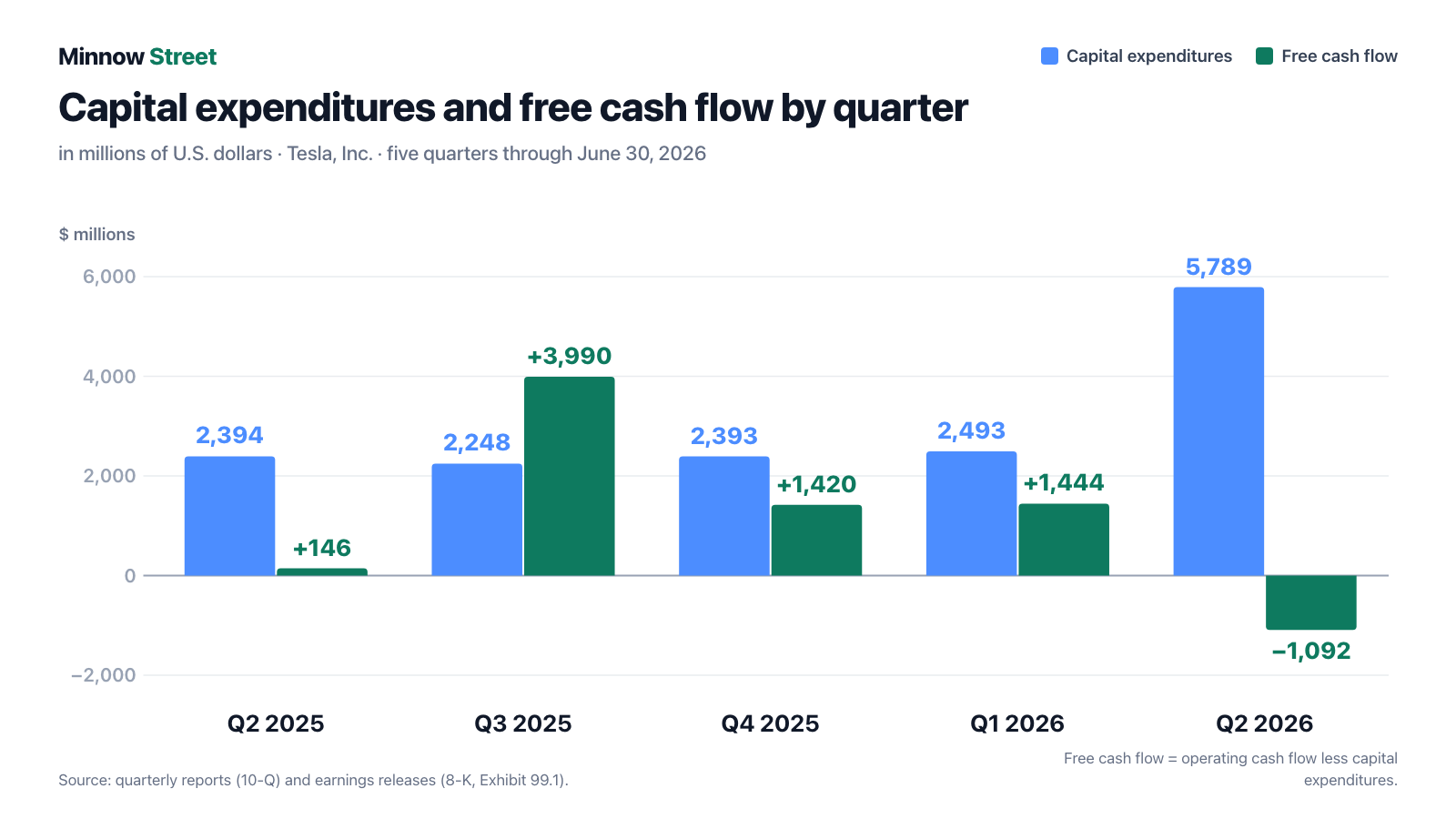
And that is only the start. The full-year plan sits in the quarterly report:
"We currently expect our capital expenditures to be in excess of $25 billion in 2026, driven by our AI initiatives, including investments in compute infrastructure and data centers, the expansion and ramp of our manufacturing and R&D production lines and facilities, and growth in our fleet of company-operated AI-enabled assets and our retail, service and charging footprint."
— Tesla, Inc., Form 10-Q for the quarter ended June 30, 2026, Item 2 (MD&A)

Do the arithmetic: Tesla invested $8.53 billion in 2025 and $11.34 billion in 2024. For 2026 the number is more than $25 billion — roughly triple the prior year. The balance sheet already shows it: the "AI infrastructure" line within property, plant and equipment rose from $6,816 million at December 31, 2025 to $10,823 million at June 30, 2026. In six months, up 59 percent.
It is affordable. $43,524 million of liquidity, $9,342 million of debt, an undrawn $5,000 million facility — Tesla can carry this. The company does write, though, that periods of heightened capital expenditure "will necessitate additional funding beyond our operating cash flow."
What you will not find in the filings
This may be the most important observation in this analysis. Tesla is discussed in the press as an AI, robotics and Robotaxi company. In the filings there is no separate revenue line for any of it. There are exactly two segments: automotive and services, and energy generation and storage. That is all.
Here is what is documented. As of June 30, 2026 Tesla counted 1.48 million active FSD subscriptions, up 56 percent year over year; in North America more than 55 percent of new deliveries included an FSD subscription. Deferred revenue for connectivity, FSD features and software updates stood at $4.05 billion, of which Tesla expects to recognize $962 million over the next twelve months. The Robotaxi service was live in seven U.S. metros, still with a safety driver in the San Francisco Bay Area. Production of the purpose-built Cybercab began during the quarter.
This is not a small business — $962 million is more than twice a full quarter of operating income. It is simply a business the filings do not yet allow you to value. Anyone buying Tesla as an AI company is buying an expectation, not a segment line.
Valuation: what you are paying for this company
As of July 29, 2026 Tesla's market capitalization stood at roughly $1,214 billion. Set against the trailing twelve months, that produces the following order of magnitude:
- Trailing price/earnings: about 285. For comparison, a broad U.S. index has long sat closer to 15 to 25. The forward multiple for the coming fiscal year is about 156.
- Price/sales: about 11.8. For a carmaker that is a level normally seen in software; traditional automakers often trade below 1.
- Price/book: about 14.2 on stockholders' equity of $86,858 million.
- Enterprise value to EBITDA: about 100.
These figures need a warning in both directions. A price/earnings ratio is a fraction — and Tesla's denominator is currently very small. Net income for the twelve months ended June 30, 2026 was $3,804 million, against $14,997 million in 2023. A multiple of 285 therefore says less about the price than about collapsed earnings. Conversely: part of that already small profit came, as shown, from an investment remeasurement.
Here a rule applies that we use on every cyclical: never extrapolate earnings from the peak — and not from the trough either. Tesla describes the automotive industry as cyclical in its own quarterly report and names interest rates, tariffs and government incentives as drivers. 2023 was an earnings peak with a tax one-off; 2026 so far is a trough with a capital-expenditure spike. Neither end works as a yardstick.
The professional view on Tesla is unusually split — and that is rare. Forty-seven estimates produced an average price target of about $399 as of July 29, 2026, spread across 14 "strong buy," 7 "buy," 16 "hold," 3 "sell" and 7 "strong sell" ratings. For most index heavyweights you find a closed ring of buy recommendations without a single dissent. Here ten explicit sell votes stand against 21 buy votes. Disagreement is not a forecast — but it is a hint that two entirely different companies are being valued: a carmaker with a 1.4 percent operating margin, and a robotics company that does not yet exist in the filings.
Opportunities and risks at a glance
Opportunities
- Record volumes. 480,126 vehicles delivered in the quarter ended June 30, 2026, up 25 percent; 9.7 million since inception. Trailing twelve-month revenue passed $100 billion for the first time.
- A balance sheet without worries. $43,524 million of liquidity against $9,342 million of debt, a 58.5 percent equity ratio, a $5,000 million undrawn facility (as of June 30, 2026).
- Cars are getting cheaper to build. Automotive gross margin excluding regulatory credits rose from 15.0 to 16.3 percent in the quarter.
- Energy storage is growing. 13.5 gigawatt-hours in the quarter, up 41 percent; 46.7 gigawatt-hours in 2025. Tesla explicitly names power demand from AI data centers as a driver.
- Recurring software revenue is forming. 1.48 million active FSD subscriptions, $4.05 billion of deferred revenue, $962 million of it to be recognized over the next twelve months.
Risks
- The running business barely earns. $398 million of operating income on $28,236 million of revenue is 1.4 percent; the annual figure fell from $8,891 million (2023) to $4,355 million (2025).
- Quality of earnings. $1,005 million of $1,329 million of pre-tax income came from an unrealized investment remeasurement, a further $274 million from a tax release.
- Regulatory credits are disappearing. Down 67 percent in the quarter, with $287 million of contracted amount left. In 2025 they equaled 46 percent of operating income.
- Capital-expenditure spike. More than $25 billion guided for 2026, with free cash flow already at minus $1,092 million in the quarter. Tesla does not rule out additional funding.
- Compensation and dilution. 423,743,904 performance-based shares with unrecognized expense of $105.82 billion to $120.37 billion; roughly 712 million shares are already outstanding without counting toward earnings per share.
- Legal risk around driver assistance. In a product-liability trial a jury awarded $129 million of compensatory damages on August 1, 2025 (33 percent attributed to Tesla) plus $200 million of punitive damages; Tesla filed its opening appellate brief on July 2, 2026 and recorded an accrual it describes as immaterial. Class actions over statements about Autopilot, FSD and Robotaxi are also pending.
- Tariffs and incentive policy. Tesla names tariffs as weighing especially on the energy business and the removal of electric-vehicle tax credits as a demand risk.
A human conclusion
Back to the package. The front of Tesla's reads: a record quarter — and that is not marketing, it is the truth. More vehicles delivered than in any second quarter before, more storage, trailing twelve-month revenue above $100 billion for the first time, and a balance sheet other carmakers envy.
The back carries the ingredient list, and it is just as true: on every $100 of revenue in the quarter ended June 30, 2026, $1.40 of operating profit remained. Three quarters of pre-tax income came from remeasuring a stake that was four months old. An earnings component with no cost of goods, still worth 46 percent of operating income in 2025, has shrunk by two thirds. And the compensation footnote carries a twelve-digit number.
None of this is a scandal or an accusation. It is a company in the middle of a rebuild, and it describes that rebuild in its own words: it is "investing heavily in research and development to accelerate our AI, software and fleet-based profits for further revenue growth, which will negatively impact our profitability during this phase." An honest sentence. It just does not say how long the phase lasts.
What you make of that is your decision. And that is exactly as it should be. We have shown you both sides of the package — the large print and the small.
Sources
- Tesla, Inc., Form 10-Q for the quarter ended June 30, 2026, filed July 23, 2026 (CIK 0001318605)
- Tesla, Inc., Form 10-K for fiscal year 2025, filed January 29, 2026
- Tesla, Inc., "Q2 2026 Update" earnings release (Form 8-K, Item 2.02, Exhibit 99.1) dated July 22, 2026
- Tesla, Inc., production, deliveries and deployments release (Form 8-K, Item 2.02, Exhibit 99.1) dated July 2, 2026
- SEC EDGAR filing index for Tesla, Inc. (CIK 0001318605) — review of every filing from July 22, 2026 onward
- Fundamental data (market capitalization, valuation metrics, analyst consensus), as of July 29, 2026
This analysis is journalistic commentary on publicly available corporate filings. It is not investment advice, not a buy or sell recommendation and not a solicitation to buy or sell securities. Stocks can lose substantial value, up to a total loss. All figures come from the primary sources named above and carry the as-of date stated there; they may have changed since. The author holds no position in Tesla, Inc. at the time of publication.
Our Bottom Line at a Glance
- Volume and market position positive
- In the quarter ended 2026-06-30 Tesla delivered 480,126 vehicles, up 25 percent year over year and more than in any second quarter before; 9.7 million have been delivered since inception. Trailing twelve-month revenue passed $100 billion for the first time. Energy storage deployments rose 41 percent to 13.5 GWh in the quarter (8-K dated 2026-07-22, Exhibit 99.1).
- Balance sheet and liquidity positive
- As of 2026-06-30 Tesla held $43,524M of cash and short-term investments against $9,342M of debt and finance leases, $9,059M of which is non-recourse to the parent. Stockholders' equity stood at $86,858M against $148,524M of total assets (58.5 percent). A $5,000M revolving facility was undrawn (10-Q for the quarter ended 2026-06-30).
- Earning power of the running business negative
- Operating income fell 57 percent to $398M in the quarter ended 2026-06-30, and the operating margin from 4.1 to 1.4 percent. Annually: $8,891M (2023), $7,076M (2024), $4,355M (2025). Revenue sat at roughly $95 billion in all three years — earnings halved while the top line stood still (Form 10-K 2025).
- Quality of earnings negative
- Of the $1,114M quarterly profit, Tesla's own reconciliation attributes $763M to the after-tax gain on the SpaceX stake and $274M to a tax valuation-allowance release — neither of which moved any cash. The $1,005M pre-tax remeasurement gain equals 76 percent of pre-tax income of $1,329M (10-Q for the quarter ended 2026-06-30, Note 2).
- An earnings component that is disappearing negative
- Automotive regulatory credits fell 67 percent to $146M in the quarter ended 2026-06-30; in 2025 they were still $1,993M and equal to 46 percent of total operating income. Tesla cites governmental and regulatory actions that have restricted certain programs. The remaining contracted amount is $287M (10-Q for the quarter ended 2026-06-30).
- Investment load and compensation neutral
- Tesla guides to capital expenditures above $25,000M for 2026, after $8,530M in 2025; free cash flow was negative at −$1,092M in the quarter ended 2026-06-30, the first negative quarter since the first quarter of 2024. In parallel runs a compensation award covering 423,743,904 shares with unrecognized expense of $105.82 billion to $120.37 billion (10-Q for the quarter ended 2026-06-30, Note 9).
Tesla sells more vehicles and more storage than ever: 480,126 deliveries and 13.5 GWh in the quarter ended 2026-06-30, trailing twelve-month revenue above $100 billion for the first time, $43,524M of liquidity against $9,342M of debt. The price sits in the same filings: $398M of operating income on $28,236M of revenue, a quarterly profit three quarters of which comes from an investment remeasurement and a tax release, 67 percent less in regulatory credits, free cash flow negative again, and more than $25 billion of capital expenditures announced for 2026. Not investment advice.
What Our Rating Means
Open questions
The business works in principle, but one material question is open. As long as it stays open, our findings do not carry a quality verdict.
Substance is not the problem: $43.5 billion of liquidity against $9.3 billion of debt, a 58.5 percent equity ratio, an undrawn credit facility and record volumes — Tesla is as far from a going-concern warning, over-indebtedness or interest-coverage trouble as any carmaker gets. What is open is an operating question, and it is the decisive one: the running business barely earns anything. $398 million of operating income on $28,236 million of revenue is 1.4 percent, and the 2023 to 2025 series shows earnings halving while revenue stood still. The reported quarterly profit hangs on an investment remeasurement and a tax release, a previously reliable earnings component is being regulated away, and capital expenditures are tripling before Robotaxi, driver assistance and robotics show up in any segment line. The stock is expensive on top of that — a trailing multiple around 285 on earnings that are themselves largely one-off leaves little room for disappointment. That is a price argument and does not set this rating; the operating question does. When the evidence sits between two levels, we take the more cautious one. The decision is yours.
A journalistic assessment by our editorial team at the time of the deep dive, based on public sources — not investment advice and not a solicitation to buy or sell. Your personal circumstances (investment goals, risk capacity, taxes) cannot be taken into account. What our levels mean, how verdicts are formed, and what conflicts of interest exist →
Worth Noting
- Hook: ranking of the 100 largest U.S. stocks by market capitalization (as of 2026-07-28); Tesla sat at rank 9 without an existing analysis.
- Data as of: annual figures from the Form 10-K for fiscal 2025 (filed 2026-01-29) and for 2024 (filed 2025-01-30), quarterly figures from the Form 10-Q for the quarter ended 2026-06-30 (filed 2026-07-23), delivery and metric series from the Form 8-K earnings release dated 2026-07-22 (Item 2.02, Exhibit 99.1) and the production release dated 2026-07-02. Every filing from 2026-07-22 onward was reviewed; none followed through 2026-07-29. Valuation metrics as of 2026-07-29.
- Cyclical caveat: Tesla is an automaker and describes its industry as cyclical in its own quarterly report. Neither the 2023 earnings peak nor the current trough works as an extrapolation. Net income in 2023 also contained a tax benefit, which is why it exceeded operating income ($14,997M against $8,891M).
- Not to be confused: Tesla, Inc. was named "Tesla Motors Inc" until 2017-01-27 and has been a Texas corporation since 2024-06-13, no longer a Delaware one. Older lawsuits therefore continue before Delaware courts.
- Analyses are evergreen; a daily share price is not a buy argument.
Frequently Asked Questions
By selling vehicles. Of the $28,236 million of revenue in the quarter ended June 30, 2026, automotive sales accounted for $20,006 million, services and other for $4,581 million, energy generation and storage for $3,139 million, automotive leasing for $364 million and regulatory credits for $146 million. The car business therefore represents roughly 73 percent of revenue.
Because costs rose faster. In the quarter ended June 30, 2026 revenue grew 26 percent, but research and development expense rose 49 percent to $2,371 million and selling, general and administrative expense rose 45 percent to $1,982 million. On top came $293 million less in regulatory credits and a margin collapse in the energy business. Operating income landed at $398 million, down from $923 million.
Carmakers must meet emissions rules in many markets. Those who exceed them may sell the surplus credits to other manufacturers. Tesla incurs no cost of revenue for them, so the proceeds flow almost entirely into gross profit. In 2025 they came to $1,993 million — 46 percent of total operating income. In the quarter ended June 30, 2026 only $146 million was left, a 67 percent decline.
Tesla discloses no separate revenue line for either. What the report for the quarter ended June 30, 2026 does document: 1.48 million active FSD subscriptions, up 56 percent year over year, and $4.05 billion of deferred revenue for connectivity, FSD features and software updates. Of that, Tesla expects to recognize $962 million over the next twelve months. The Robotaxi service was live in seven U.S. metros at the balance sheet date.
The Form 10-Q for the quarter ended June 30, 2026 guides to capital expenditures in excess of $25 billion for 2026, chiefly for data centers, AI compute, semiconductor and solar manufacturing. In 2025 the figure was $8.53 billion. It is funded from the balance sheet: $43,524 million of cash and short-term investments were on hand as of June 30, 2026, down $535 million since year-end. Tesla explicitly does not rule out additional funding.
The award granted on September 3, 2025 and approved by shareholders on November 6, 2025 covers 423,743,904 performance-based shares across twelve tranches. Each tranche requires a market-capitalization milestone — from $2.0 trillion to $8.5 trillion — plus operational milestones such as 20 million vehicles delivered or $400 billion of adjusted EBITDA. Unrecognized expense for the milestones deemed not probable of achievement runs from $105.82 billion to $120.37 billion.
Little, measured against the balance sheet. As of June 30, 2026 debt and finance leases totaled $9,342 million, of which $9,059 million was non-recourse to the parent — secured by vehicles, receivables and energy assets. Against that stand $43,524 million of liquidity and $86,858 million of stockholders' equity. A $5,000 million revolving credit facility was entirely undrawn at the balance sheet date.
As of June 30, 2026 Tesla held 11,509 bitcoin at an acquisition cost of $386 million. The carrying value was $674 million, down from $1,008 million at December 31, 2025. Under fair-value accounting these swings run straight through the income statement: they reduced earnings by $334 million in the first half of 2026, after adding $159 million in the prior-year period.
Found an error?
Did you spot a factual error, an outdated number, or a typo in this deep dive? Let us know briefly — your report goes straight to the editorial team.