Rocket Companies: $19.4 Billion Nobody Ever Paid For
Rocket Mortgage is the largest mortgage lender in the United States — and since the Mr. Cooper deal it is also the largest servicer of other people's home loans: $2.1 trillion in serviced unpaid principal balance across 9.4 million loans. Net revenue rose 31 percent to $6,695 million in 2025. The year still ended with a loss of $234 million. The reason sits one line above: the rights to service those loans lost $1,530 million in value — an asset nobody buys, nobody sells and nobody can touch. We read the annual report for 2025 and the quarterly report for March 31, 2026, and look at how those $19.4 billion come together, who actually votes at Rocket, and what quietly happened on June 30, 2026. What waits at the end is not a recommendation but a number you have to weigh yourself.
 Thomas Mücke
Founder & Publisher
Thomas Mücke
Founder & Publisher
Chart
Interactive price chart (TradingView).
Note: pure fact-based analysis, not investment advice and not a solicitation to buy or sell. All figures without guarantee.
There is a trap that catches almost everyone reading a balance sheet, and it is disarming precisely because it looks harmless: the estimate trap. It works like this. Numbers sit underneath one another in the same typeface, all with dollar signs in front of them. Your brain treats them as equals. But some of them are counted — cash in the bank, loans funded, buildings paid for — and some of them are estimated. At Rocket Companies, Inc. (NYSE: RKT) the single largest item is estimated: $19,377 million of mortgage servicing rights as of March 31, 2026, more than twice the value of cash, property and equipment combined. Nobody paid that amount. It is the output of a model.
So let us make a deal. Before we talk about the stock, we read together what the company itself told the U.S. securities regulator, the SEC — the annual report (10-K) for 2025 filed on March 2, 2026, and the quarterly report (10-Q) for March 31, 2026 filed on May 12, 2026. An SEC filing is honest under threat of prosecution. And this one tells the story of a record year that ended in a loss, of a valuation method that changed mid-year, and of a date in June 2026 that almost nobody noticed.
What this analysis covers
- What Rocket actually does — lending is only the first half
- How the stock landed on our desk
- The numbers over the years — what genuinely impresses
- What the filings say — five uncomfortable truths
- Valuation — what the market pays for this book value
- Opportunities and risks at a glance
- A human conclusion
- Sources
What Rocket actually does — lending is only the first half
Rocket is a Detroit-based group with roughly 23,500 team members (as of December 31, 2025) across the United States, Canada and India. Its best-known piece is Rocket Mortgage, described in the annual report as the nation\'s largest mortgage lender by loan units. Alongside it sit Redfin (home search portal and brokerage, acquired July 1, 2025), Rocket Close (title, closing and appraisal services), Rocket Money (a subscription budgeting app), Rocket Loans (personal lending) and, since October 1, 2025, Mr. Cooper, until then the largest servicer of U.S. residential mortgages.
The business has two halves, and the second one is the heart of this analysis. The first half is origination: Rocket writes a home loan, sells it into the secondary market shortly afterwards — usually to the government-sponsored enterprises Fannie Mae and Freddie Mac — and earns the spread. That amounted to $130,352 million in closed loan volume in 2025. The second half is servicing: Rocket retains the right to keep administering the loan — collecting the payment, forwarding property taxes and insurance, chasing arrears, foreclosing if it comes to that. In exchange it receives a small annual fee, typically a fraction of one percent of the outstanding balance. That right is a tradable asset and appears in the filings as a mortgage servicing right, or MSR.
An everyday picture: imagine you broker an apartment and sell it on immediately — but keep the building management contract. It pays you a small fee every month for as long as the apartment stays occupied. The value of that contract depends on how long the residents stay. Rocket works the same way. When rates fall, borrowers refinance, the loan disappears and the servicing right dies with it. When rates rise, everyone stays put in their cheap old loan — and the servicing right becomes more valuable. The annual report says so itself:
"Historically, the value of MSRs has increased when interest rates rise, as higher interest rates lead to decreased prepayment rates; the value of MSRs has decreased when interest rates decline, as lower interest rates lead to increased prepayment rates."
— Rocket Companies, Inc., Form 10-K for 2025, Item 1A (Risk Factors)
That is the seesaw built into this company: when rates fall, new lending booms and the back book loses value; when rates rise, new lending dries up and the back book gains. Rocket calls it a natural hedge. The catch is that one side is cash and the other is a journal entry.
For scale: as of December 31, 2025 Rocket serviced $2.1 trillion in unpaid principal balance — $2,121,883 million, against $593,261 million a year earlier. That is three and a half times larger in twelve months, and almost all of it was bought. Which gives us the central tension of this analysis, and it runs through every chapter that follows: Rocket became the largest mortgage servicer in the United States overnight. The price was a balance sheet whose most valuable item is not a contract with a buyer but a model with assumptions.
How the stock landed on our desk
We run roughly 3,200 stocks through our scanners every day. Rocket reached our research list through our in-house stock scanner "Turnaround Candidates": rank 27 of 60 U.S. hits, turn check 6 of 8, as of July 26, 2026 on our German sister site, and rank 26 of the same 60 on this one — the small difference arises when scores are tied. To reproduce it: open the scanner, set the country filter to U.S., sort by the turn check column. These lists are recalculated every day, so the rank and the score are a dated snapshot, not a permanent state.
The model rests on two mandatory pillars. Break either one and the stock drops out immediately, regardless of how the business is doing:
- Pillar 1 — the crash: the stock has to trade at least 50 percent below its all-time high. No crash, no turnaround. This is the pillar a stock loses as soon as it recovers — the better the price runs, the closer the exit.
- Pillar 2 — survival: the Altman Z score (an insolvency early-warning measure built from several balance sheet ratios) has to exceed 1.1, equity has to be positive, and no more than one balance sheet warning flag may be present. Plus tradability: price above $3 and average daily dollar volume above $2 million.
Both pillars were met on July 26, 2026 — but the second one deserves a warning we are not going to skip: the Altman Z score is meaningless for a mortgage lender. The formula was designed for manufacturers and retailers and measures, among other things, working capital against total assets. On a balance sheet that is one third servicing rights and another quarter loans in transit to the secondary market, those ratios carry no economic meaning. Our data show an Altman Z of 3.98 for Rocket as of July 26, 2026. We report the figure because it explains the scanner hit — we deliberately do not use it as a quality verdict, and neither should you. The rule of thumb: a ratio is only as good as the balance sheet it was built for.
Pillar 1 is the more interesting one, because that is where this hook has an expiry date. Our data record an all-time-high distance for RKT of negative 57.9 percent, measured at a price of $14.78 in the same data set. We cross-checked that against the price history, because roughly 60 titles in our data carry an all-time high that is off by a factor of 1,000. The result: the highest dividend-adjusted closing price since the initial public offering is $34.95 on March 2, 2021 (raw close $41.60, intraday high $43.00 — the gap comes from the special dividend paid in April 2025). At $14.78 that implies a distance of negative 57.7 percent. The deviation is under 0.2 percentage points; for Rocket the stored value is clean.
Which lets us compute the exit threshold: 50 percent of $34.95 is about $17.50. If the price rises from $13.10 (data as of July 26, 2026) by roughly a third to that level, Rocket drops out of the turnaround list — without anything changing in the business. One easy mix-up here: the table column showing negative 39.3 percent is the distance to the 52-week high, not to the all-time high. For a worked example of how far a chart can drift from an operating recovery, see our analysis of First BanCorp.
Only after the mandatory pillars does the turn check itself apply: eight points, four from the quarterly numbers (revenue direction, net margin, operating cash flow, balance sheet healing) and four from market behavior (price back above the 50-day line, relative strength of the last three months against the last twelve, net insider buying, net institutional accumulation). A stock is listed once it reaches at least 6 of 8; Rocket stood at 6 on July 26, 2026. In fairness, one more thing belongs here: on the same day RKT was also a hit in our "Beneish M-Score" warning scanner, an indicator for possible earnings cosmetics. That proves nothing on its own. It is exactly what the scanner page says it is: a reason to read the balance sheet carefully. So let us do that.
The numbers over the years — what genuinely impresses
Start with what deserves credit. Rocket is growing, and not only by acquisition. Closed loan origination volume rose from $78,712 million (2023) through $101,152 million (2024) to $130,352 million (2025) — 66 percent in two years, in a market where mortgage rates hovered around six and a half percent. Loan quality did not slip in the process; it improved. The weighted average loan-to-value ratio fell from 74.86 percent to 72.36 percent and the weighted average credit score rose from 733 to 741. Net client retention in the serviced portfolio stood at 97 percent at the end of 2025.
Revenue tells the same good story. Earnings do not:
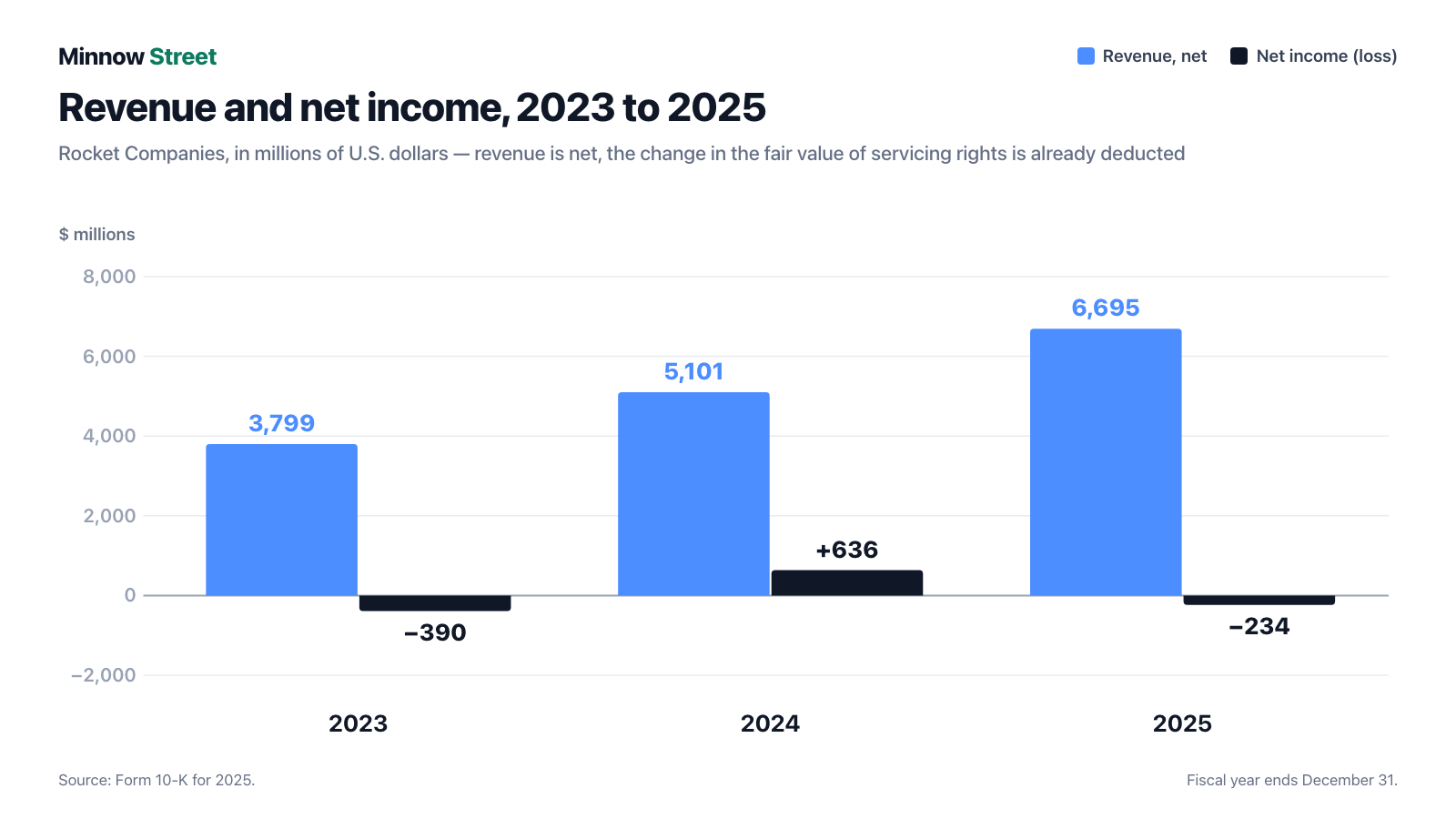
The series reads as follows. Net revenue: $3,799 million (2023), $5,101 million (2024), $6,695 million (2025). Net income: negative $390 million, positive $636 million, negative $234 million. Two loss years out of three, with one good vintage in between. One point matters for reading this: Rocket\'s reported revenue is net — the change in the fair value of servicing rights is already deducted. That is why revenue itself can swing without a single loan going unwritten.
The first quarter of 2026 changed direction: $2,941 million of net revenue against $1,101 million a year earlier, $297 million of net income against a loss of $212 million, and $0.11 of earnings per share. Closed loan volume doubled to $44,653 million. Before you extrapolate, two honest caveats. First, the prior-year quarter does not contain Mr. Cooper at all — a large share of the comparison measures the acquisition, not the company\'s own performance. Second, the gain on sale margin fell from 2.89 percent to 2.74 percent in the same quarter. More volume at a thinner margin is a different story from more volume at the same margin.
What the filings say — five uncomfortable truths
No. 1: The record year ended in the red because of a line that moves no cash
2025 was the largest year in the company\'s history: $130,352 million of closed loan volume, $6,695 million of net revenue, a $2.1 trillion serviced portfolio. And a pre-tax loss of $214 million, a net loss of $234 million. The path there is in the income statement: against $3,807 million of gain on sale of loans and $2,317 million of servicing fee income sits a line of negative $1,530 million — "Change in fair value of MSRs, net". The year before it was negative $579 million.
Two thirds of that is economically unsurprising: when loans amortize on schedule, the right to service them shrinks. The filing calls that "collection/realization of cash flows" and puts it at $1,398 million for 2025. The remainder — $274 million — came purely from changes in model inputs and assumptions. The lesson: a company whose earnings hang on a valuation model can post a loss in its best year.
No. 2: $19.4 billion nobody ever paid for
This is how the item that gave this analysis its title came together:
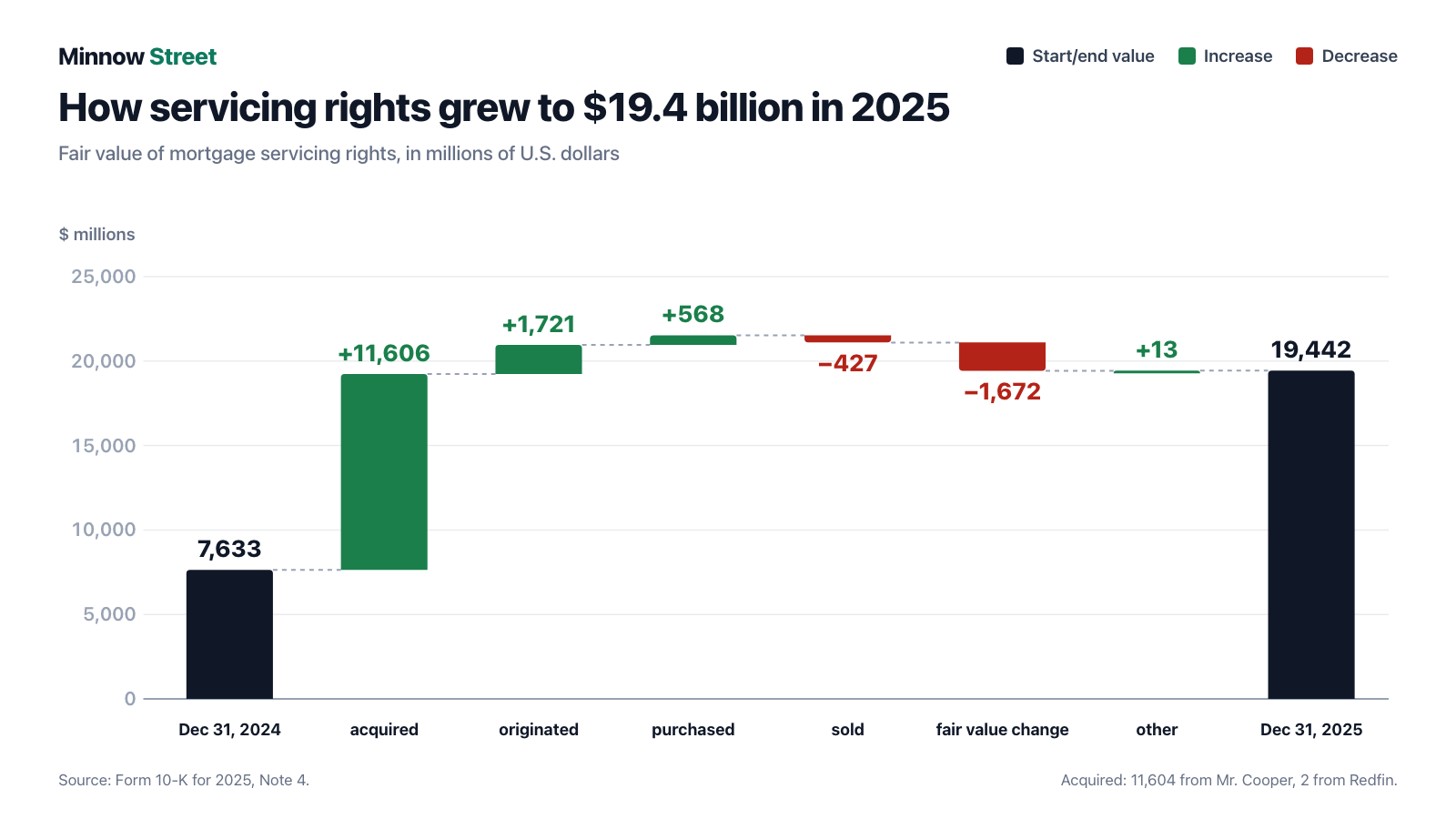
As of March 31, 2026 the servicing rights stand at $19,377 million. For context — and this is the most important arithmetic in this analysis — total equity is $23,230 million. The item therefore equals 83 percent of all equity. Strip out goodwill ($10,611 million) and other intangibles ($2,109 million) and roughly $10,510 million of tangible equity remains, which makes the servicing rights nearly twice the size of the hard substance of the firm.
How reliable is the estimate? The filing does the arithmetic itself. A 100 basis point adverse move in the option-adjusted spread costs $718 million, 200 basis points cost $1,384 million. Prepayment speeds 10 percent faster cost $504 million, 20 percent faster $972 million. And a 10 percent increase in the cost to service each loan costs $122 million:
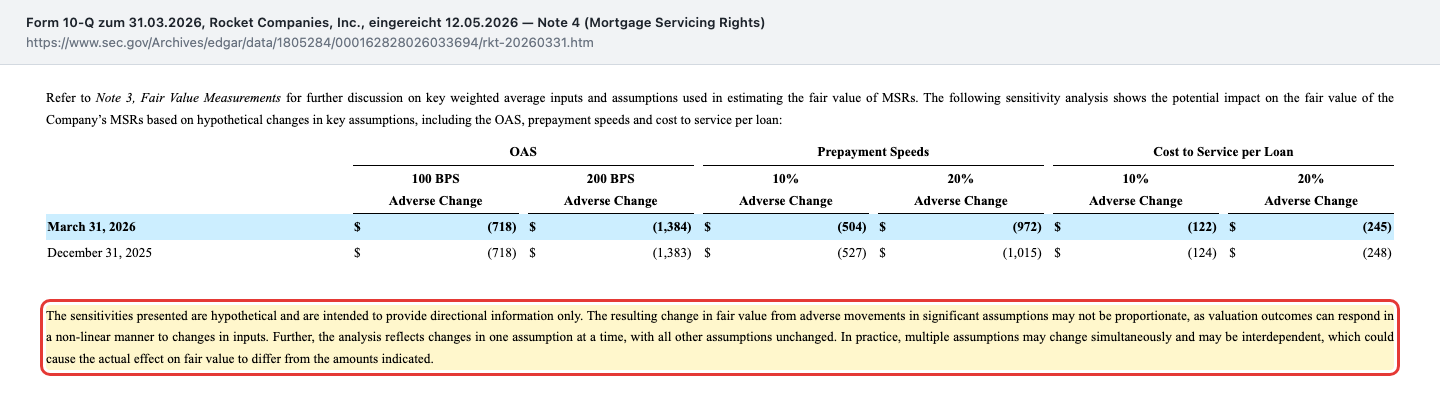
"The sensitivities presented are hypothetical and are intended to provide directional information only. The resulting change in fair value from adverse movements in significant assumptions may not be proportionate, as valuation outcomes can respond in a non-linear manner to changes in inputs. Further, the analysis reflects changes in one assumption at a time, with all other assumptions unchanged. In practice, multiple assumptions may change simultaneously and may be interdependent, which could cause the actual effect on fair value to differ from the amounts indicated."
— Rocket Companies, Inc., Form 10-Q for March 31, 2026, Note 4 (Mortgage Servicing Rights)
That is unusually candid and deserves credit. It also means the company is telling you that any single number in the table is not the end of the story. The everyday version: it is the difference between "my car is worth $20,000" and "I sold my car for $20,000". One is an opinion, the other is a receipt.
No. 3: The valuation method changed in the middle of the growth year
In the same quarter in which the portfolio nearly tripled through the Mr. Cooper acquisition, Rocket changed the method by which its largest asset is valued. Note 4 of the annual report explains it in two footnotes:
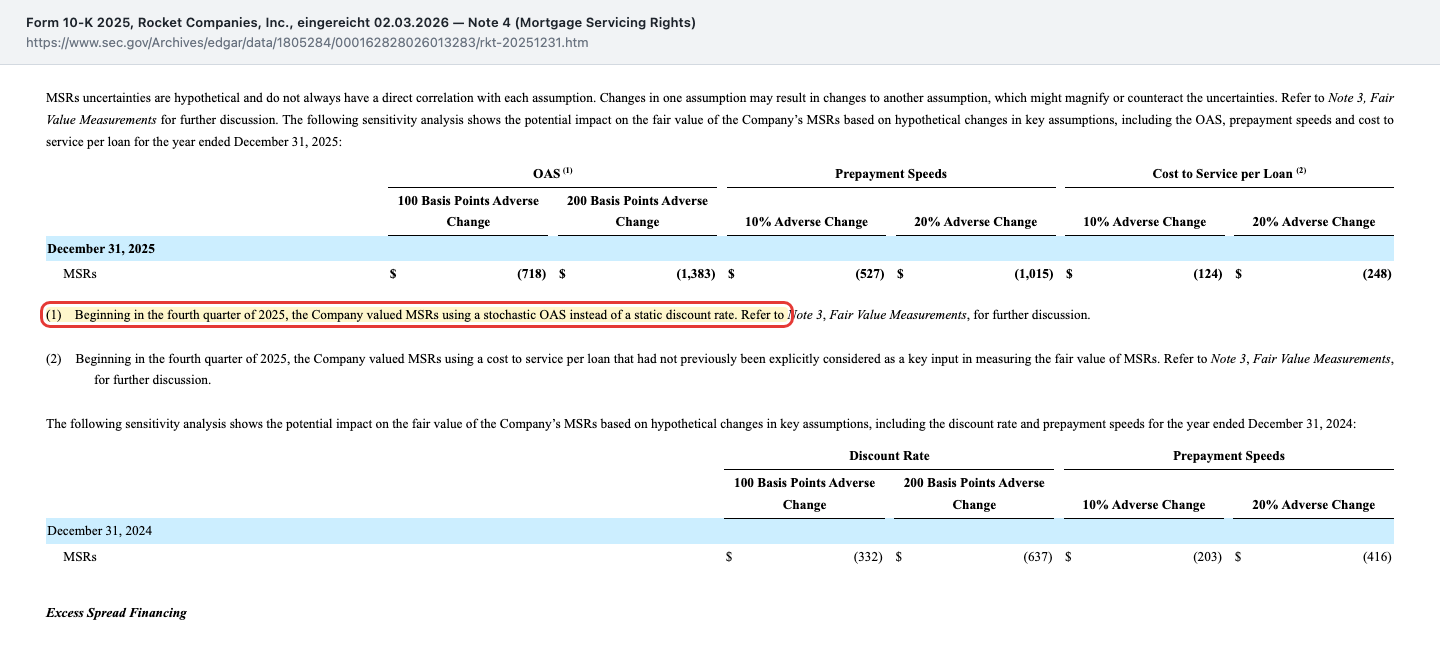
"Beginning in the fourth quarter of 2025, the Company valued MSRs using a stochastic OAS instead of a static discount rate."
— Rocket Companies, Inc., Form 10-K for 2025, Note 4 (Mortgage Servicing Rights and Related Liabilities)
In plain language: the old approach discounted with a single fixed rate, the new one runs many possible interest rate paths and derives a value from the distribution. Technically it is the more sophisticated and more common industry method — an upgrade, not a trick. For a reader it has two consequences. First, the time series breaks. The 2024 table measures a discount rate (100 basis points adverse: negative $332 million), the 2025 table an option-adjusted spread (negative $718 million). Those are two different quantities, even though they are printed one above the other. Second, the cost to service per loan only became an explicit key input from that same quarter. The lesson: when the yardstick and the thing being measured change at once, a year-over-year comparison stops being a statement and becomes an arrangement of numbers.
No. 4: The voting majority is not listed
Rocket has two classes of stock. Only Class A trades on the New York Stock Exchange: 980,550,267 shares as of May 4, 2026, after 970,935,922 on the cover page of the annual report dated February 23, 2026. Alongside it sit 1,848,879,455 Class L shares for which there is no public market. Both carry one vote per share and identical rights to earnings, which puts roughly 65 percent of all votes in the untraded class. It is held by founder and chairman Dan Gilbert together with 70 other holders of record. The annual report states the consequence bluntly:
"Mr. Gilbert holds more than a majority of the combined voting power of our common stock. So long as Mr. Gilbert continues to directly or indirectly own a significant amount of our equity, even if such amount is less than a majority of the combined voting power of our common stock, Mr. Gilbert will continue to be able to substantially influence the outcome of votes on all matters requiring approval by the stockholders, including our ability to enter into certain corporate transactions."
— Rocket Companies, Inc., Form 10-K for 2025, Item 1A (Risk Factors)
Because of that, Rocket qualifies as a controlled company under New York Stock Exchange rules. The filing spells out which protections fall away: the board does not have to consist of a majority of independent directors, and neither the nominating and corporate governance committee nor the compensation committee has to be composed entirely of independent directors. Whether you consider that a problem is a matter of taste — at founder-led companies it is common and often has advantages. You should still know it before you buy.
And in the same chapter sits a calendar that many readers have skipped past:
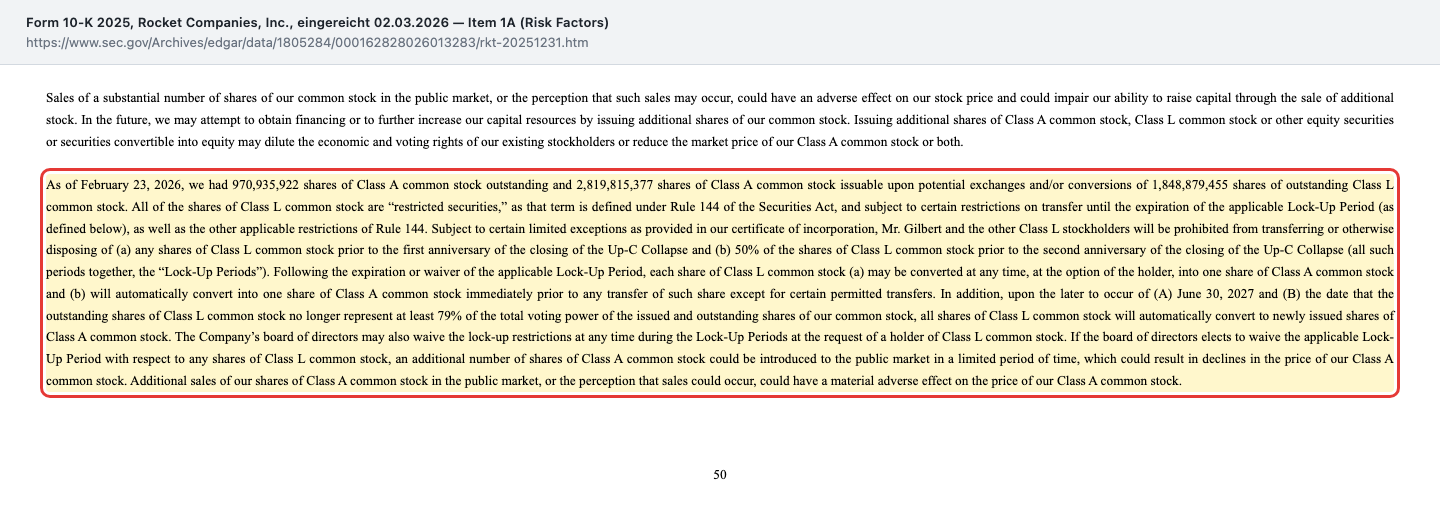
The restructuring those deadlines refer to closed on June 30, 2025. Item 5 of the annual report names the dates directly: Class L-1 automatically converts one for one into Class A on June 30, 2026, and Class L-2 on June 30, 2027. The first of those dates has passed, and no filing through July 26, 2026 says otherwise. That is roughly 924 million shares per tranche, which means the listed class roughly doubles. One point is essential: this is not dilution. The Class L shares already sit inside earnings per share and inside market capitalization; nobody\'s slice of the pie gets smaller. What changes is the supply of tradable stock. Whether and how much of it actually gets sold appears in no filing — the new Class A count will first show up on the cover page of the next quarterly report.
No. 5: The new size costs interest — and, since July 16, 2026, covenants
Mr. Cooper was paid for in stock (total consideration of $16,973 million, of which $13,667 million in Class A shares), and so was Redfin ($1,742 million). Cash of $3,113 million and $252 million respectively went mostly to retire the acquired debt. What remains is goodwill of $10,611 million against total assets of $59,439 million, and a considerably larger pile of debt: $10,430 million of unsecured and $15,882 million of secured financing as of March 31, 2026. A year earlier the senior notes alone stood at $4,039 million.
Then it continued. On June 9, 2026 Rocket announced a notes offering and upsized it the same day: $900 million of 6.125 percent notes due 2031 and $600 million of 6.500 percent notes due 2034. The proceeds retired the old Rocket Mortgage notes at 2.875 percent (redeemed June 19, 2026) and 5.250 percent (July 9, 2026). The new coupons sit visibly above the old ones — the price of the fact that rates are no longer where they were in 2021.
And on July 16, 2026, ten days before our data cut-off, a new unsecured revolving credit facility of $2.5 billion arrived with JPMorgan Chase as administrative agent, maturing July 16, 2029:
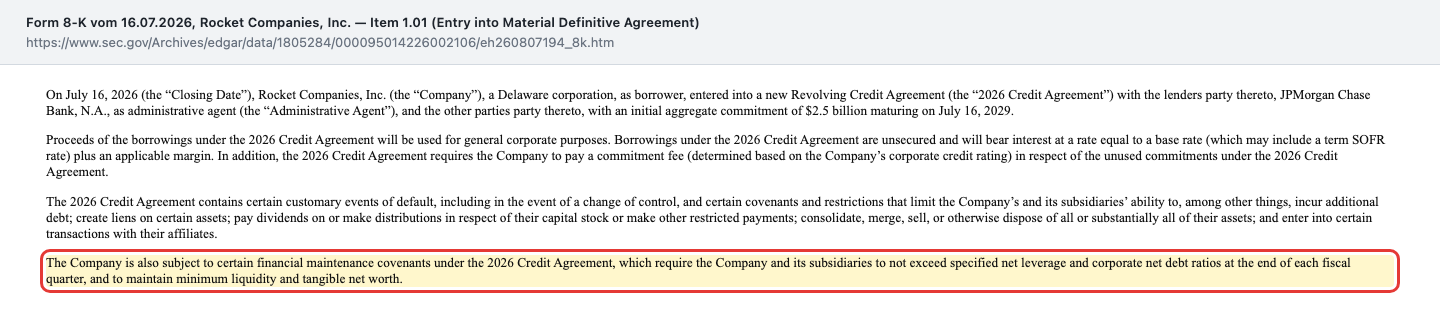
"The Company is also subject to certain financial maintenance covenants under the 2026 Credit Agreement, which require the Company and its subsidiaries to not exceed specified net leverage and corporate net debt ratios at the end of each fiscal quarter, and to maintain minimum liquidity and tangible net worth."
— Rocket Companies, Inc., Form 8-K filed July 16, 2026, Item 1.01
Why that is more than contract boilerplate: tangible net worth is precisely the measure that is smallest at this company. Equity of $23,230 million less goodwill of $10,611 million less intangibles of $2,109 million leaves roughly $10,510 million. A goodwill write-down would not touch that figure — it is already deducted. A bad quarter in the servicing rights model would. How high the floor sits is not disclosed in the filing; the next quarterly report will have to say. For a worked example of how quickly a billion-dollar acquisition turns into an interest bill, see our analysis of CBIZ.
Valuation — what the market pays for this book value
At a mortgage company the price-earnings ratio misleads: there were no earnings in 2025, plenty in 2024, none again in 2023. Book value is the more useful anchor. At a price of $13.10 (data as of July 26, 2026) and 2,829,429,722 shares across both classes (as of May 4, 2026), market capitalization is roughly $37 billion. Against reported equity of $23,230 million that is about 1.6 times book.
Strip out goodwill and intangibles and the picture shifts: against roughly $10,510 million of tangible equity the market is paying about 3.5 times. Both numbers are correct; they simply measure different things. The first says the market pays a moderate premium to the books. The second says a substantial part of those books consists of what Rocket paid for Redfin and Mr. Cooper, plus a model output.
The professional view is strikingly unexcited. Our data hold twelve analyst estimates as of July 26, 2026: one outright buy, eleven holds, no sells. The consensus target price is roughly $19. Estimates point to earnings of about $0.69 per share for 2026 and $0.99 for 2027, which implies price-earnings ratios of roughly 19 and 13. That is neither a bargain nor a growth multiple. Eleven holds, in plain English, means nobody is quite sure which way this goes.
One word on the share count, because it trips people up regularly. Data providers frequently show roughly 981 million shares for RKT. That is the listed Class A only. For valuation both classes count, so roughly 2.83 billion shares. Anyone using the smaller number arrives at a market capitalization near $13 billion — and at a completely wrong picture.
Opportunities and risks at a glance
What argues for Rocket:
- Market position: the largest U.S. mortgage lender by loan units and, after the Mr. Cooper acquisition, the largest servicer of residential mortgages — $2,109,774 million of serviced unpaid principal balance across 9.44 million loans as of March 31, 2026.
- The back book is a sales channel: 97 percent net client retention in the serviced portfolio as of December 31, 2025. Whoever already pays their mortgage to Rocket gets asked first when refinancing.
- The built-in hedge: when rates fall, new lending booms and cushions the fall in servicing values; when they rise, it works the other way. Two businesses designed to support each other.
- The turn is visible: $297 million of net income in the first quarter of 2026 after a loss of $212 million a year earlier, on closed loan volume that doubled to $44,653 million.
- Credit quality: loan-to-value of 72.36 percent, weighted average credit score of 741 and a 60-plus-day delinquency rate of 1.45 percent as of March 31, 2026.
What argues against Rocket:
- Model risk at the core of the balance sheet: $19,377 million of servicing rights, 83 percent of equity, valued with a method that changed in the fourth quarter of 2025. A 200 basis point adverse spread move costs $1,384 million by the company\'s own arithmetic.
- Rate dependence without a steering wheel: neither mortgage rates nor prepayment speeds are within management\'s control. Both drive the result more than any decision made in Detroit.
- Integration risk: goodwill of $10,611 million. Management\'s 2025 assessment of internal control over financial reporting explicitly excluded Redfin and Mr. Cooper, which represented 26 percent of total assets (excluding acquired goodwill and intangibles) and 16 percent of net revenue.
- Higher interest cost: 6.125 and 6.500 percent on the $1.5 billion issued in June 2026, against 2.875 percent on the retired notes. Plus, since July 16, 2026, ongoing financial maintenance covenants including a floor for tangible net worth.
- Governance: a controlled company relying on exemptions from the New York Stock Exchange independence rules, with the voting majority in an untraded class.
- Supply overhang: Class L-1 automatically converted into tradable Class A shares on June 30, 2026 and Class L-2 follows on June 30, 2027 — roughly 924 million shares per tranche.
A human conclusion
Back to the estimate trap. Rocket is not a dubious company. It is the largest player in its industry, it writes more loans than ever, it made money again in the first quarter of 2026, and it describes its own uncertainties in the filings more openly than most. A company that prints the sensitivity table together with its caveat is not hiding anything.
And still the one number remains that carries all the others: $19,377 million that nobody ever paid a price for. It is properly derived, under recognized rules, audited. It just is not cash. Anyone buying this stock buys an excellent distribution machine and a model output — and should be clear that the two come together.
The second thing we would leave you with is a date: June 30, 2026. On that day half the founder block turned into ordinary, tradable stock. Economically it changes nothing about your share — but it changes how many shares somebody could sell without asking anyone. What you make of that is your decision. And that is exactly as it should be.
Sources
- Rocket Companies, Inc. — Annual Report on Form 10-K for fiscal 2025, filed March 2, 2026 (SEC EDGAR, CIK 0001805284)
- Rocket Companies, Inc. — Quarterly Report on Form 10-Q for the quarter ended March 31, 2026, filed May 12, 2026
- Current Report on Form 8-K filed July 16, 2026 — new $2.5 billion unsecured revolving credit facility (Items 1.01, 1.02, 2.03)
- Current Report on Form 8-K filed June 16, 2026 — closing of the offering of $900 million of 6.125 percent notes due 2031 and $600 million of 6.500 percent notes due 2034
- Current Report on Form 8-K filed June 10, 2026 — upsizing and pricing of the offering, conditional notices of redemption
- Notification of Late Filing on Form 12b-25 (NT 10-Q) filed May 12, 2026 — technical transmission delay; the quarterly report was accepted by the SEC at 5:39 p.m. on May 11, 2026
- Fundamental data (ratios, price and valuation data), as of July 26, 2026
- Our in-house stock scanner "Turnaround Candidates", as of July 26, 2026 (60 U.S. hits, RKT at rank 26, turn check 6 of 8)
This analysis is journalistic commentary based on public filings and is not investment advice. It is not a solicitation to buy or sell securities. Equity investments can result in a total loss. Every figure carries the as-of date of its source; price and valuation data are dated anchors, not buy arguments. The author holds no position in Rocket Companies, Inc. at the time of publication.
Our Bottom Line at a Glance
- Market position and business model positive
- Rocket Mortgage is the largest U.S. mortgage lender by loan units and, since the Mr. Cooper acquisition on October 1, 2025, also the largest servicer of residential mortgages: $2,109,774 million of serviced unpaid principal balance across 9.44 million loans as of March 31, 2026. Net client retention stood at 97 percent as of December 31, 2025 — the back book is simultaneously the most important sales channel for new loans.
- Balance sheet quality and model risk negative
- The largest asset is an estimate: $19,377 million of servicing rights as of March 31, 2026 equals 83 percent of $23,230 million in equity and roughly 1.8 times tangible equity of about $10,510 million. The filing quantifies it itself: a 200 basis point adverse move in the option-adjusted spread would cost $1,384 million. On top of that sits goodwill of $10,611 million from the two acquisitions.
- Earnings power and volatility neutral
- Two loss years out of three: negative $390 million (2023), positive $636 million (2024), negative $234 million (2025) — on steadily rising net revenue of $3,799 million, $5,101 million and $6,695 million. The first quarter of 2026 turned with net income of $297 million after a loss of $212 million, although Mr. Cooper is absent from the comparative period and the gain on sale margin fell from 2.89 percent to 2.74 percent.
- Valuation transparency neutral
- Rocket discloses the sensitivities of its servicing rights and states expressly in the quarterly report for March 31, 2026 that they are hypothetical and directional only. That is more candor than most. At the same time the valuation method moved from a static discount rate to a stochastic option-adjusted spread in the fourth quarter of 2025, with cost to service per loan added as a new key input — so the year-over-year sensitivity comparison measures two different quantities.
- Leverage and covenants negative
- As of March 31, 2026 the balance sheet carried $10,430 million of unsecured and $15,882 million of secured financing. In June 2026 Rocket placed $900 million of 6.125 percent notes due 2031 and $600 million of 6.500 percent notes due 2034, retiring notes at 2.875 and 5.250 percent. Since July 16, 2026 a new $2.5 billion revolving credit facility imposes ongoing financial maintenance covenants, including a floor for tangible net worth.
- Ownership and share supply negative
- As of May 4, 2026 there were 980,550,267 listed Class A shares against 1,848,879,455 untraded Class L shares — one vote each, which places roughly 65 percent of the votes outside the exchange. Rocket is a controlled company and relies on exemptions from the New York Stock Exchange independence rules. Class L-1 automatically converted into tradable Class A shares on June 30, 2026 and Class L-2 follows on June 30, 2027 — roughly 924 million shares per tranche.
Two acquisitions in twelve months turned Rocket Companies into the largest mortgage house in the United States: $130,352 million of closed loan volume in 2025, a $2.1 trillion serviced portfolio, 9.44 million loans. Net revenue rose 31.3 percent to $6,695 million in 2025 — and the year still ended with a $234 million loss, because servicing rights lost $1,530 million in value. That is exactly where this stock lives: at $19,377 million as of March 31, 2026 those rights equal 83 percent of equity and roughly 1.8 times tangible substance, valued with a model whose method changed in the fourth quarter of 2025. The first quarter of 2026 shows, with $297 million of net income, that the business works when rates cooperate. It also shows how much the result depends on a variable nobody inside the company can steer. Not investment advice.
What Our Rating Means
Open questions
The business works in principle, but one material question is open. As long as it stays open, our findings do not carry a quality verdict.
This rating judges the company, not the share price. There is no documented substance finding: equity is positive at $23,230 million, the equity ratio is about 39 percent, there is no going concern warning, no listing risk, and the first quarter of 2026 produced $297 million of net income. What is open is the decisive operating question — twice over. First, the result hangs on an asset nobody trades: $19,377 million of servicing rights, 83 percent of equity and roughly 1.8 times tangible substance, valued with a model whose method moved from a static discount rate to a stochastic spread in the fourth quarter of 2025. Second, the combination of Rocket, Redfin and Mr. Cooper is unproven: $10,611 million of goodwill sits on the books, and the 2025 assessment of internal control over financial reporting explicitly excluded both acquisitions — 26 percent of total assets and 16 percent of net revenue. Price, valuation, free float and volatility deliberately played no part in this color. Neither did the Altman Z score of 3.98 in our data: the formula was built for manufacturers and retailers and carries no meaning for a mortgage lender. The decision is yours.
A journalistic assessment by our editorial team at the time of the deep dive, based on public sources — not investment advice and not a solicitation to buy or sell. Your personal circumstances (investment goals, risk capacity, taxes) cannot be taken into account. What our levels mean, how verdicts are formed, and what conflicts of interest exist →
Worth Noting
- Rocket Companies reached our research list through our in-house stock scanner "Turnaround Candidates": rank 26 of 60 U.S. hits on minnowstreet.com and rank 27 of 60 on our German sister site, turn check 6 of 8 on both, both lists dated July 26, 2026. These lists are recalculated daily — rank and score are a dated snapshot. On the same day RKT was also a hit in the "Beneish M-Score" warning scanner, an indicator for possible earnings cosmetics; that proves nothing, it is a reason to read the balance sheet carefully.
- The scanner rests on two mandatory pillars: at least 50 percent below the all-time high, and an Altman Z score of at least 1.1 with positive equity and no more than one balance sheet warning flag. Pillar 2 is met arithmetically (Altman Z 3.98, equity ratio 39.1 percent) but is not usable as a quality verdict for a mortgage lender. Pillar 1 decides whether the stock stays: the stored distance to the all-time high is negative 57.86 percent, measured at a price of $14.78 in the same data set. Cross-check against the price history since the IPO: the highest dividend-adjusted closing price is $34.95 on March 2, 2021 (raw close $41.60, intraday high $43.00), which implies negative 57.7 percent at $14.78. The deviation is under 0.2 percentage points — the factor-1,000 all-time-high error known for roughly 60 titles in this data set does not apply to RKT. Exit threshold: about $17.50, roughly a third above $13.10.
- Do not confuse the two: the "v. Hoch" column in the scanner table shows negative 39.3 percent and measures the distance to the 52-week high, not to the all-time high. Both values sit side by side in the data set and are regularly mixed up.
- Price and valuation figures are dated anchors, not buy arguments: $13.10 as of July 26, 2026. Market capitalization of roughly $37 billion is computed from the 2,829,429,722 shares across both classes shown on the cover page of the quarterly report dated May 4, 2026. The fundamental data set itself shows $36.9 billion at the July 24, 2026 closing price of $13.05, and the scanner table shows $42.4 billion from an older pull — all three sit within the usual range of data vintage differences. Data providers that count only the 981 million Class A shares arrive at a materially wrong picture.
- The most recent periodic report is the Form 10-Q for March 31, 2026, filed May 12, 2026. Filed after that, through the July 26, 2026 data cut-off: current reports on Form 8-K dated June 9, 2026 (notes offering, conditional redemptions and Mr. Cooper financial information), June 10, 2026 (upsizing and pricing, plus annual meeting results under Item 5.07), June 16, 2026 (closing of the offering) and July 16, 2026 (new $2.5 billion credit facility), together with insider filings on Form 4. The Form NT 10-Q filed May 12, 2026 concerns nothing but a technical transmission delay: the filing states that the quarterly report was accepted by the SEC at 5:39 p.m. on May 11, 2026, shortly after the 5:30 p.m. cut-off. It involves neither the numbers nor the audit.
- As of July 26, 2026 no takeover, merger or take-private process is pending. Rocket was itself the buyer most recently: Redfin Corporation on July 1, 2025 and Mr. Cooper Group Inc. on October 1, 2025. Both are complete; the most recent Form 425 is dated August 1, 2025 and the most recent Form S-4/A July 25, 2025. There is no new S-4, no SC 13E3, no Form 25 and no Form 15 on file.
- Not to be confused: Rocket Companies, Inc. (RKT) is neither Rocket Lab (RKLB) nor Rocket Pharmaceuticals (RCKT). Mr. Cooper Group Inc. traded under the ticker COOP through September 30, 2025 and has been part of Rocket since October 1, 2025; Redfin Corporation traded under RDFN through June 30, 2025.
Frequently Asked Questions
Rocket Companies is the parent of Rocket Mortgage, the largest U.S. mortgage lender by loan units. It originates home loans, sells them into the secondary market and usually retains the right to keep servicing them. Alongside that sit the home search portal Redfin, the servicer Mr. Cooper, title and closing services, a budgeting app and personal lending. About 23,500 people worked for the group as of December 31, 2025.
Because the value of its mortgage servicing rights fell. The line "Change in fair value of MSRs, net" cost $1,530 million in 2025, after $579 million in 2024. Net revenue rose 31.3 percent to $6,695 million, yet the year ended with a net loss of $234 million. About $1,398 million of the fair value change came from scheduled amortization and $274 million from changes in model inputs and assumptions.
The right to administer a home loan: collect the payment, forward property taxes and insurance, chase arrears and foreclose if necessary. In exchange the servicer earns a small annual fee. The right is tradable and stood at $19,377 million on Rocket's balance sheet as of March 31, 2026. Its value rises when interest rates rise, because fewer borrowers refinance, and falls when rates decline.
It is a model estimate, not a market quote. The quarterly report for March 31, 2026 quantifies the exposure itself: a 100 basis point adverse move in the option-adjusted spread costs $718 million, 200 basis points cost $1,384 million and prepayment speeds 10 percent faster cost $504 million. The company states expressly that these figures are hypothetical and intended to provide directional information only.
Voting control sits with founder Dan Gilbert. As of May 4, 2026 there were 980,550,267 listed Class A shares against 1,848,879,455 untraded Class L shares; both carry one vote per share, which puts roughly 65 percent of the votes in the untraded class. Rocket therefore qualifies as a controlled company and relies on exemptions from the New York Stock Exchange independence requirements.
Class L-1 automatically converted one for one into Class A shares, according to the annual report; Class L-2 follows on June 30, 2027. That is roughly 924 million shares per tranche. It dilutes nobody economically — Class L already sits inside earnings per share and market capitalization. It does materially increase the number of tradable shares. The new Class A count will first appear on the cover page of the next quarterly report.
Because both mandatory criteria were met on July 26, 2026: at least 50 percent below the all-time high and an Altman Z score above 1.1 with positive equity. RKT ranked 26 of 60 U.S. hits that day with 6 of 8 points in the turn check. The Altman Z of 3.98 carries no meaning for a mortgage lender, though. What matters is the crash: about 57.9 percent below an all-time high of roughly $34.95. Above about $17.50 the stock drops out of the list.
No. As of July 26, 2026 there is no pending takeover, merger or take-private process. Rocket was itself the buyer most recently: Redfin closed on July 1, 2025 and Mr. Cooper Group on October 1, 2025. Both are complete; the most recent Form 425 is dated August 1, 2025. There is no new Form S-4, no SC 13E3, no Form 25 and no Form 15 on file.
Found an error?
Did you spot a factual error, an outdated number, or a typo in this deep dive? Let us know briefly — your report goes straight to the editorial team.