Vistance Networks: Half the company is sold, the debt is gone — and what is left barely earns anything
CommScope became Vistance Networks on January 14, 2026, and the ticker COMM became VISN. In between sit two divestitures worth roughly $12.3 billion, the full repayment of $7.26 billion of debt and a special distribution of $10.00 per share. The stock ranks 10th of 82 in our big-earnings-surprise ranking (U.S. selection, as of July 26, 2026). We read the 2025 annual report (10-K), the quarterly report (10-Q) for March 31, 2026 and the pro forma exhibit filed July 8, 2026 — and they show that the remaining company would have posted a $29.8 million operating loss in 2025. Not investment advice — just the question of how much company is left after the sell-off.
 Thomas Mücke
Founder & Publisher
Thomas Mücke
Founder & Publisher
Chart
Interactive price chart (TradingView).
Note: pure fact-based analysis, not investment advice and not a solicitation to buy or sell. All figures without guarantee.
The continuity trap
There is a mental habit that costs investors more than any fee: we assume that the company we are looking at today is the continuation of the one whose price chart we are studying. The line runs on. The ticker sits at the top. The name in the data sheet is the one we know. So, the brain concludes, it must be the same story, a few chapters later.
With Vistance Networks, Inc. (Nasdaq: VISN) that assumption is wrong twice over. The company was called CommScope Holding Company, Inc. until January 13, 2026 and traded as COMM. The ticker VISN, meanwhile, belonged until 2017 to an entirely different business, the Chinese advertising company VisionChina Media. And even once both mix-ups are cleared away, a third remains: between the CommScope of 2023 and today’s Vistance sit two divestitures that moved roughly two thirds of the company to new owners.
So we do what we always do here: we read together what the company itself told the U.S. securities regulator, the SEC — the annual report (10-K) for 2025, the quarterly report (10-Q) for March 31, 2026 and the current reports (Form 8-K) from January, April and July 2026. An SEC filing is honest under penalty of law. And this one describes a balance sheet that flips from deeply negative to spotless in a single quarter — and a remaining business that earns almost nothing at the operating line. A full vault and a small shop: that is the tension running through every chapter here.
What you will find here
- What Vistance Networks still does
- How the stock reached our desk
- The numbers over the years — given their due
- Uncomfortable truth no. 1: the time series compares three companies
- Uncomfortable truth no. 2: the profit comes from the tax line
- Uncomfortable truth no. 3: one customer carries a third of it
- Uncomfortable truth no. 4: the cash box is smaller than it looks
- Valuation: what is the market actually paying for?
- Opportunities and risks at a glance
- A human conclusion
- Sources
What Vistance Networks still does
Let us start with what is in the box today, not with what the label says.
For decades CommScope supplied networks of every kind: cables and connectors for data centers and buildings, wireless equipment for enterprises, gear for cable operators, mobile antennas. One single segment of that group is left: Aurora Networks. It was called Access Network Solutions, or ANS, until January 9, 2026, when it was renamed — with no change, the annual report notes, to the segment structure or to historical segment results.
What Aurora sells is described plainly in the filings: cable modem termination systems, video infrastructure, distribution and transmission equipment and cloud solutions that let operators build residential and metro networks. In everyday terms, when your cable provider upgrades the network outside your door for more bandwidth, there is a fair chance that equipment from this company sits inside the gray cabinets by the roadside. It is a supplier business with few, very large customers and an investment rhythm that follows operators’ build plans rather than the calendar.
The head office has been in Richardson, Texas since November 1, 2025. As of December 31, 2025 the group employed 4,500 people, about 22 percent of them in manufacturing, mostly in Mexico, with roughly 1,700 employees in the United States. One caveat matters: that number comes from a period when RUCKUS still belonged to the group. How many people work for Aurora alone appears in no published filing yet — the first report without RUCKUS is expected for June 30, 2026.
How the stock reached our desk
We run roughly 3,500 stocks through our scanners every day. VISN arrived through a single, tightly defined filter: the big-earnings-surprise ranking, where it stood at rank 10 of 82 U.S. names on July 26, 2026. These lists are recalculated daily, so tomorrow’s rank may differ.
The filter looks for companies whose reported earnings clearly beat analyst estimates. At Vistance the run is striking: five straight quarters above the estimate, most recently on April 30, 2026 with $0.34 against $0.22 per share, a beat of 54.5 percent. Before that the gaps were 192.9 percent (reported February 26, 2026), 169.6, 83.3 and 100 percent (fundamental data as of July 25, 2026).
Now the part a ranking cannot deliver and does not try to: a surprise filter measures the distance from expectations, not where that distance came from. And with this particular stock the usual companion metrics are no help either, because they are calculated from annual accounts that end before the transformation. Equity ratio, debt-to-equity, Altman Z: build them on 2025 and you are measuring a company with negative equity and seven billion dollars of debt — neither of which has existed since March 31, 2026. So we worked strictly from the original filings for this analysis and put a date on every figure. For a look at what a stock hitting the same filter through its own operating strength looks like, see our analysis of Vicor, currently top of the same list.
The numbers over the years — given their due
Let us start with what genuinely impresses, and there is plenty of it.
First, the price for CCS. On January 9, 2026 the company sold its Connectivity and Cable Solutions segment to Amphenol on a cash-free, debt-free basis for approximately $10.5 billion in cash. The purchase agreement is dated August 3, 2025 and shareholders approved it on October 16, 2025.
Second, what happened to the money. On the same day the company terminated a revolving facility of up to $750 million and a term loan of $3,150 million, and it called every outstanding note for redemption on January 26, 2026: $1,000.0 million at 9.500 percent due 2031, $951.0 million at 4.750 percent due 2029, $641.58 million at 7.125 percent due 2028, $866.929 million at 8.250 percent due 2027 and $750.0 million at 5.000 percent due 2027. On top of that, the preferred stock held by private-equity firm Carlyle since 2018 was fully redeemed; two directors it had appointed resigned, taking the board down to eight members.
Third, the effect on the balance sheet. It is drastic enough to need reading twice:
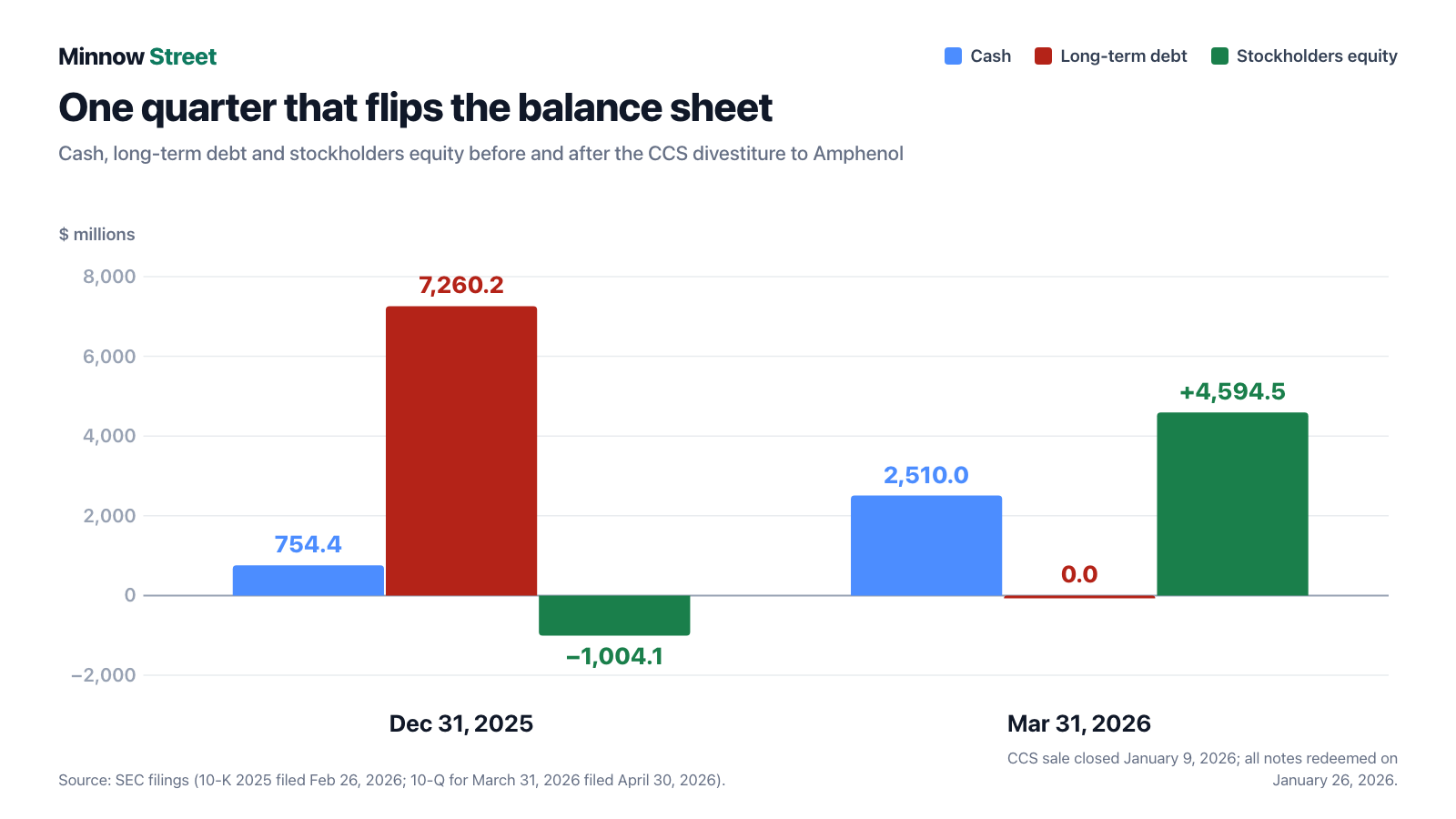
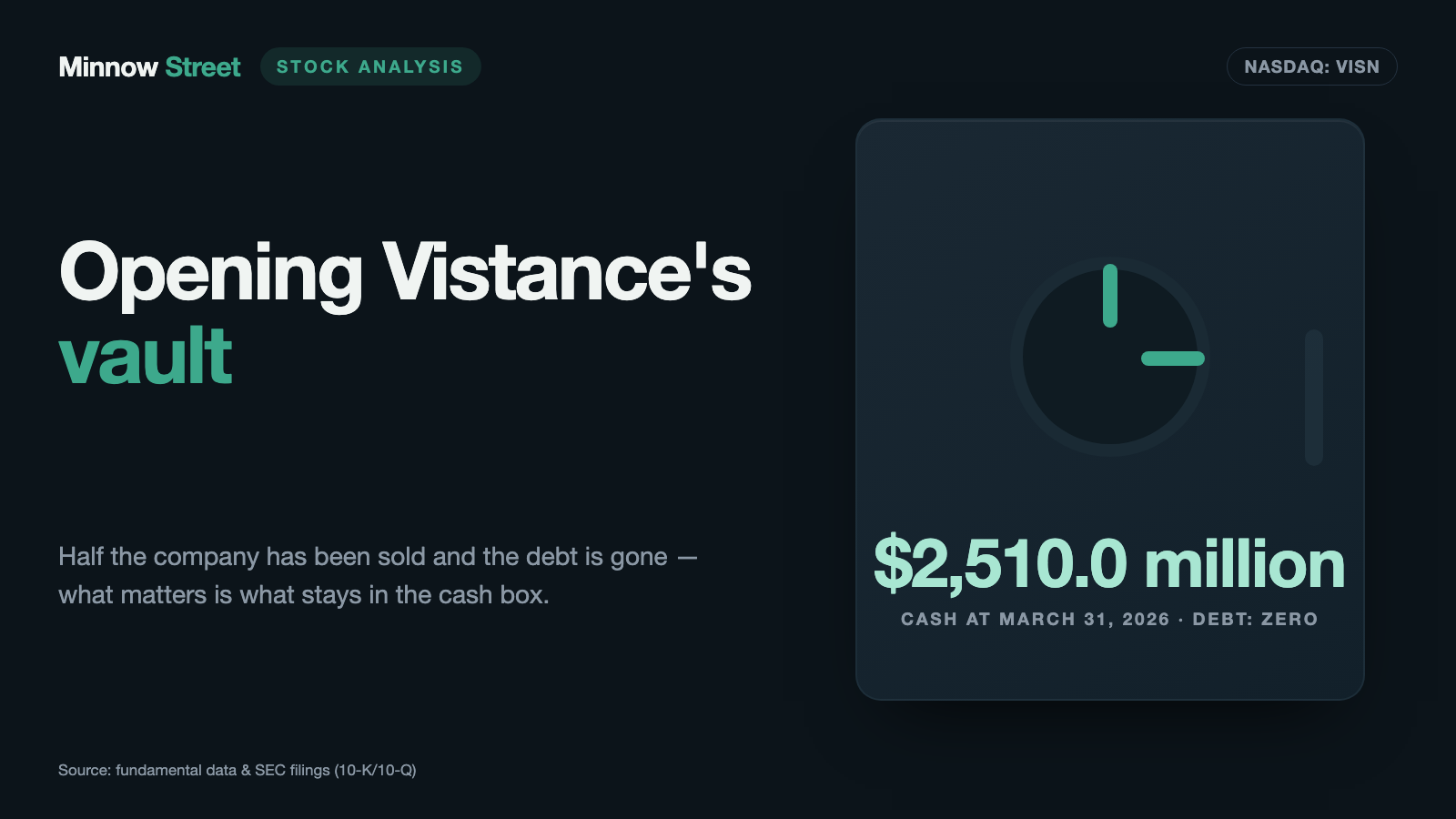
At December 31, 2025 the books carried $7,260.2 million of long-term debt and equity of minus $1,004.1 million. CommScope had run negative equity for years; at the end of 2024 it was minus $3,456.1 million. At March 31, 2026 the same three lines read: zero debt, $2,510.0 million of cash, plus $4,594.5 million of equity. Total liabilities fell from $9,096.4 million to $848.5 million. This is not an operational turnaround — it is a balance sheet swapped out through a divestiture. But it is real, and it removes every ounce of interest pressure.
Fourth, the remaining segment. Aurora Networks lifted segment revenue by $396.9 million to $1,232.7 million in 2025 and adjusted segment EBITDA from $106.0 million to $251.9 million, with the margin moving from 12.7 to 20.4 percent. In the first quarter of 2026 the segment added another $73.4 million, driven by higher volumes in access technologies. The cable operators’ investment cycle is running and Aurora is earning from it. For how the same demand shows up at a direct competitor, see our analysis of Harmonic.
Fifth, the return to owners. On April 7, 2026 the board declared a one-time special distribution, paid on April 27, 2026.

With roughly 225.5 million shares outstanding that is on the order of $2.26 billion that has left the company. Keep that number in mind — it matters again shortly.
Uncomfortable truth no. 1: the time series compares three companies
Now we turn the picture around. The first uncomfortable truth is not a number but a reasoning error that almost every screen of this stock makes.
Reported group revenue ran like this: $9,228.1 million (2022), $5,789.2 million (2023), $4,205.8 million (2024) and finally $1,931.6 million of continuing revenue for 2025. That looks like a catastrophic collapse — but it is mostly accounting. At every step, sold or held-for-sale segments moved into discontinued operations and disappeared retroactively from the revenue line.
There is exactly one clean view of today’s company, and Vistance supplied it itself: the pro forma statements filed July 8, 2026, which strip out RUCKUS as if the sale had happened on January 1, 2023.
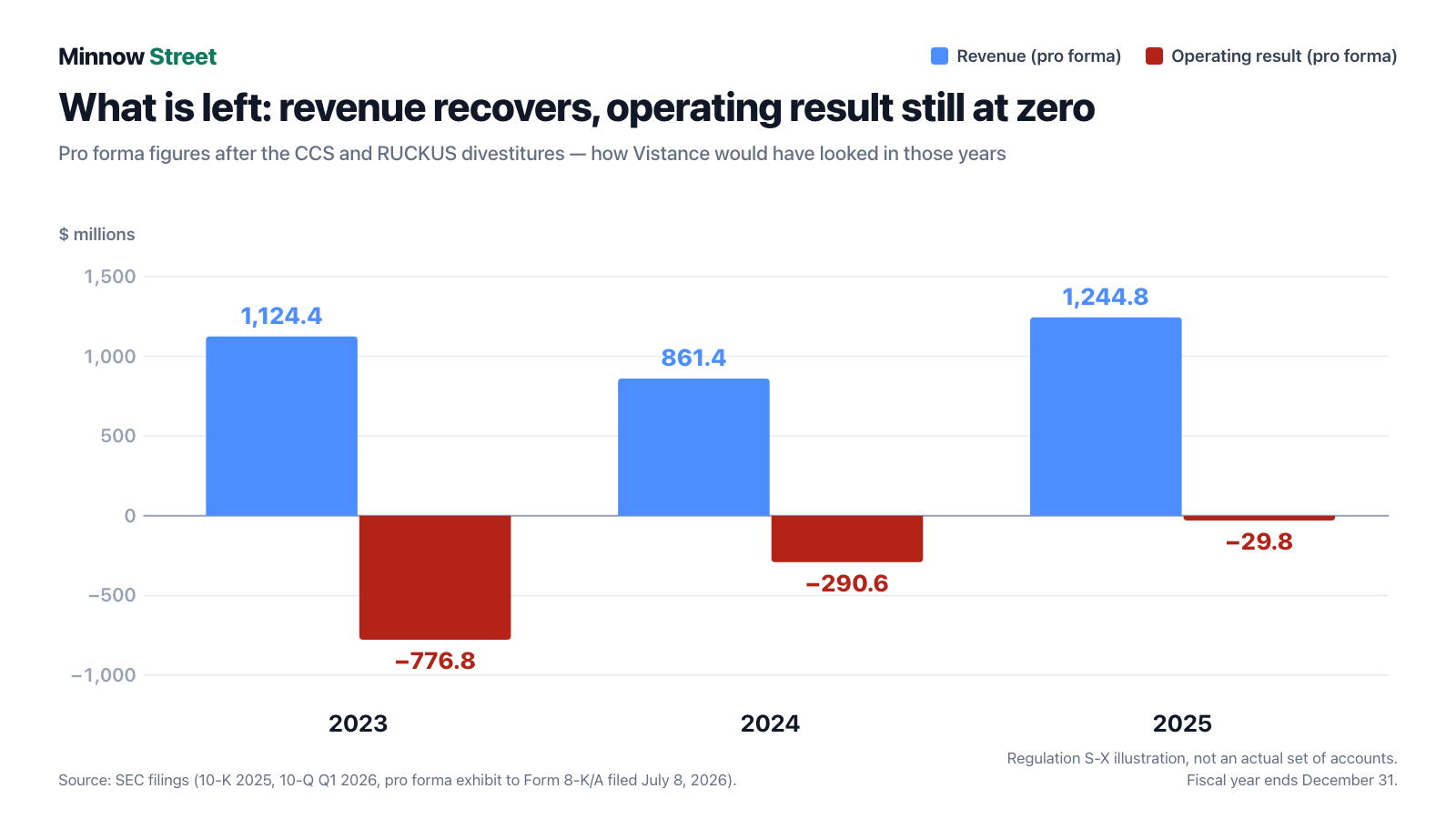
On that basis revenue was $1,124.4 million (2023), $861.4 million (2024) and $1,244.8 million (2025), and $298.4 million in the first quarter of 2026. That is not a collapse, it is a cycle: cable operators cut spending in 2024 and invested again in 2025. But it is also a business about one fifth the size that the chart and many data sheets still suggest.
The exhibit states plainly what it is and is not: an illustration under Article 11 of Regulation S-X, explicitly not intended to represent future results. It is still the most honest approximation available — until the quarterly report for June 30, 2026 arrives, which was not on file when this analysis was written.
Uncomfortable truth no. 2: the profit comes from the tax line
And now the number the whole case turns on.
Reported net income for 2025 was $2,283.7 million and for the first quarter of 2026 $5,508.0 million. Read those two lines alone and Vistance looks wildly profitable. Both figures are overwhelmingly book gains from the divestitures — money that arrives once and never again.
The more interesting line sits above: operating income from continuing operations. On a pro forma basis, without RUCKUS, it reads minus $29.8 million for 2025 and plus $0.6 million for the first quarter of 2026 — a margin of 0.2 percent on $298.4 million of revenue. Reported income from continuing operations of $207.9 million (2025) and $211.6 million (Q1 2026) only appears after an income tax benefit of $297.5 million and $190.3 million respectively.
A tax benefit is neither revenue nor a customer. It arises when a company revalues loss carryforwards or deferred tax positions — at Vistance, triggered by the divestitures. That is entirely legal, entirely ordinary and in no way suspect. But it also answers the question of how a company can post five straight earnings beats when the operating line does not support them: the profits are real — the business simply did not produce them.
In fairness: Aurora Networks generated adjusted segment EBITDA of $251.9 million in 2025. The gap between that $251.9 million and the pro forma operating loss of $29.8 million consists of amortization of purchased intangibles ($88.5 million pro forma), restructuring costs ($16.3 million) and the corporate costs previously shared with CCS and RUCKUS, which are reallocated to the remaining segments from the first quarter of 2026. Whether a profit survives that new load is precisely the open question.
Uncomfortable truth no. 3: one customer carries a third of it
The notes to the annual report contain a sentence that is easy to skip:
"Net sales to Comcast Corporation and affiliates (Comcast) accounted for approximately 35%, 21% and 20% for the years ended December 31, 2025, 2024 and 2023, respectively."
— Vistance Networks, SEC annual report 10-K for 2025, Note 21

The share has almost doubled in two years. And the same passage carries a second figure: roughly 42 percent of receivables at December 31, 2025 were owed by Comcast. Receivables are invoices written but not yet paid — when nearly half of them sit with one name, the cash flow hangs on that name too.
The report states explicitly that Comcast was a customer of both remaining segments, Aurora and RUCKUS. RUCKUS has belonged to Belden since July 1, 2026. What that does to the Comcast share of the remainder cannot be derived from the numbers published so far — it will only appear in the quarterly report for June 30, 2026. A company with no debt and billions in the bank does not die of this. But it is the difference between being a supplier and being a partner whose order book somebody else writes.
Uncomfortable truth no. 4: the cash box is smaller than it looks
This truth is aimed less at the company than at the data sheets most investors work from.
The pro forma balance sheet at March 31, 2026 shows cash of $4,148.3 million and equity of $5,546.0 million. Those figures are correct — but they answer a different question from the one people ask of them. They show what the balance sheet at March 31, 2026 would have looked like if RUCKUS had already been sold. What they do not include, the exhibit says itself, is the special distribution. The $10.00 per share went out on April 27, 2026, after the balance-sheet date — on the order of $2.26 billion. And the exhibit already announces the next one:

That has an awkward consequence for screeners. One widely used data sheet showed an enterprise value of roughly $166 million as of July 25, 2026 — market value less net cash. That calculation uses the cash balance of March 31, 2026, most of which was paid out in April. The same data set still carried the company under the name "CommScope Holding Company, Inc." and reported a book value per share of $20.37 — again the figure before the distribution. Take such metrics at face value and you are counting money that is no longer there.
On the plus side there is room to maneuver: since April 7, 2026 Vistance has a new secured revolving facility of up to $300 million with Citibank, expandable by a further $150 million and maturing April 7, 2031. On April 29, 2026 the board doubled the share buyback authorization from $50 million to $100 million.
Valuation: what is the market actually paying for?
An honest valuation is harder here than usual, for exactly the reason set out in truth no. 1: almost every trailing metric mixes periods with and without the divested segments.
The frame, as a dated anchor: on July 24, 2026 the stock closed at $11.80. With 225,569,631 shares outstanding (10-Q cover page, April 20, 2026), that gives a market value of roughly $2,661.7 million — a cross-check against market data that matches to the decimal.
What can sensibly be done with that? A price-to-sales ratio on trailing twelve-month revenue of about $2,015 million would be useless, because RUCKUS sits inside that number. Measured instead against pro forma 2025 revenue of $1,244.8 million, the ratio is roughly 2.1. For a supplier business with an operating margin near zero that is no bargain — unless one views the stock primarily as a claim on the cash.
And that is the valuation question in this case. A market value of about $2.66 billion sits opposite a company with no debt, a cash position that has not been published anywhere since two divestitures and a distribution, and a second payout already announced. The professionals’ view — the analyst consensus stood at a mean price target of $17.33 as of July 25, 2026 — largely reflects expectations about that deployment, not about an earnings turnaround. Anyone modeling a valuation here should wait for the next quarterly report: it will show the first balance sheet after the distribution and after the RUCKUS sale.
Opportunities and risks at a glance
Opportunities
- A balance sheet with no debt and a large cash position: zero interest pressure, full freedom of action, plus an undrawn $300 million credit line running to 2031.
- Aurora Networks is growing: segment revenue up $396.9 million in 2025 and adjusted segment EBITDA of $251.9 million after $106.0 million — the cable operators’ investment cycle is carrying it.
- A second special distribution announced from the $1.846 billion RUCKUS proceeds, less roughly $150 million of expected costs and taxes.
- A buyback program of up to $100 million, doubled on April 29, 2026.
- A far simpler company: one segment instead of four, one market instead of four, and therefore easier to value — once the first clean numbers arrive.
Risks
- What is left earns nothing so far at the operating line: minus $29.8 million pro forma operating result for 2025, plus $0.6 million in the first quarter of 2026.
- Reported profit rests on tax benefits of $297.5 million and $190.3 million — they do not repeat.
- Customer concentration: roughly 35 percent of 2025 revenue and roughly 42 percent of receivables sat with Comcast; a spending pause at that customer feeds straight through.
- A cyclical business: pro forma revenue fell by $263 million in 2024 versus 2023 as network operators trimmed build budgets.
- Data quality: the first quarterly report without RUCKUS was not on file when this analysis was written, so every statement about today’s business rests on a pro forma exhibit that is explicitly not a forecast.
- Corporate costs previously shared with CCS and RUCKUS are reallocated to the remaining segments from the first quarter of 2026 — Aurora’s margin has yet to be tested under that load.
A human conclusion
Back to the continuity trap. It is stubborn because it feels reasonable: a company that has existed for decades, whose price draws a long line and whose ticker sits in your portfolio, feels like a known quantity. At Vistance Networks that is precisely the illusion. What trades on Nasdaq today is not the late chapter of CommScope. It is a new, far smaller company that happens to have inherited the same legal shell, the same SEC identifier and part of the old workforce — plus an unusually full vault.
And honestly, that is not a bad starting position. Debt free, with billions in the bank, with a growing segment in a market that is currently investing: there are worse places to begin. You just need to know what you are betting on. You are not betting on a proven profit engine — that one runs at an operating margin near zero. You are betting that a board deploys the money well and that Aurora Networks writes black numbers under its new cost load.
The next two quarterly reports will show that, with no tax benefit and no special items. Until then: anyone buying VISN should close the chart before January 2026 and watch two lines instead — operating income and the Comcast share. What you make of that is your decision. And that is exactly as it should be.
Sources
- Annual report 10-K for 2025, Vistance Networks, Inc., filed February 26, 2026 (segments, customer concentration in Note 21, headcount, intent to pay a special distribution)
- Quarterly report 10-Q for March 31, 2026, filed April 30, 2026 (balance sheet, segment revenue, Note 8 "Subsequent Events" covering the special distribution, the credit facility, the buyback and the Belden agreement)
- Form 8-K filed January 15, 2026 (Items 1.02, 2.01, 5.02, 5.03): completion of the CCS sale to Amphenol, repayment of all loans and notes, redemption of the Carlyle preferred stock, name and ticker change
- Form 8-K filed April 8, 2026 (Items 1.01, 2.03): new secured revolving credit facility of up to $300 million with Citibank, N.A.
- Form 8-K filed April 30, 2026 (Items 2.02, 8.01): quarterly results and the increase of the buyback authorization to $100 million
- Form 8-K filed July 1, 2026 (Item 2.01): completion of the RUCKUS sale to Belden Inc. for $1.846 billion
- Form 8-K/A filed July 8, 2026, Exhibit 99.1: pro forma statements after the RUCKUS sale (balance sheet at March 31, 2026, statements of operations for Q1 2026 and for 2025, 2024 and 2023)
- EDGAR entity data for CIK 0001517228 (former name CommScope Holding Company, Inc. from April 4, 2011 to January 13, 2026; ticker VISN, Nasdaq)
- Fundamental data & our in-house stock scanner, as of July 25, 2026; ranking measured July 26, 2026; closing price of July 24, 2026
This analysis is journalism, not investment advice, and not a solicitation to buy or sell securities. Stocks can lose their entire value; a total loss is possible. All figures come from the original documents linked above and carry the dates stated there. The author held no position in Vistance Networks, Inc. at the time of publication.
Our Bottom Line at a Glance
- Balance sheet positive
- Within a single quarter, from negative equity of $1,004.1 million (December 31, 2025) to positive $4,594.5 million (March 31, 2026), from $7,260.2 million of long-term debt to zero and from $754.4 million to $2,510.0 million of cash. All notes were redeemed on January 26, 2026 and the Carlyle preferred stock was fully redeemed. The new $300 million revolver with Citibank (since April 7, 2026, maturing April 7, 2031) is a reserve tank, not a burden.
- Earning power of what is left negative
- Without RUCKUS the group would have reported a $29.8 million operating loss on $1,244.8 million of revenue in 2025; the first quarter of 2026 left $0.6 million of operating income on $298.4 million of revenue. Reported income from continuing operations rests on tax benefits of $297.5 million (2025) and $190.3 million (Q1 2026), not on operations (Form 8-K/A filed July 8, 2026, Exhibit 99.1).
- Growth of the remaining segment positive
- Aurora Networks grew segment revenue by $396.9 million to $1,232.7 million in 2025 and lifted adjusted segment EBITDA from $106.0 million to $251.9 million, a margin move from 12.7 to 20.4 percent. The first quarter of 2026 added another $73.4 million — the cable operators' investment cycle is running (10-K 2025 and 10-Q for March 31, 2026).
- Customer concentration negative
- Comcast accounted for roughly 35 percent of group revenue in 2025 — after 21 percent in 2024 and 20 percent in 2023 — and for roughly 42 percent of receivables at December 31, 2025. Comcast was a customer of both Aurora and RUCKUS; after the RUCKUS sale the remainder stands on fewer legs (10-K 2025, Note 21).
- Comparability of the numbers negative
- Reported group revenue fell from $9,228.1 million (2022) through $5,789.2 million (2023) to $1,931.6 million of continuing revenue (2025), because at every step segments moved into discontinued operations. Any metric carried across January 9, 2026 blends three different companies. Even the data vendor still carried the stock under its old name as of July 25, 2026.
- Returns to shareholders neutral
- $10.00 per share flowed back on April 27, 2026, and the buyback authorization was doubled from $50 million to $100 million on April 29, 2026. The pro forma exhibit announces a second special distribution within 60 days of the July 1, 2026 RUCKUS closing, with the board to set amount and timing. Cash returns are welcome, but they do not substitute for operating earnings.
As of July 26, 2026 Vistance Networks is above all one thing: a very well-filled cash box with no debt, attached to a mid-sized business selling equipment to cable operators. The balance-sheet rebuild is documented and impressive, and Aurora Networks is growing for real — but the remaining group earned nothing operationally in 2025 on a pro forma basis, and a single customer supplies a good third of revenue. Buying here means betting on how the money gets used and on the cable operators' capital-spending cycle, not on a proven profit engine. Not investment advice.
What Our Rating Means
Open questions
The business works in principle, but one material question is open. As long as it stays open, our findings do not carry a quality verdict.
After repaying $7.26 billion of debt the balance sheet is genuinely sound, there is no going-concern language, no listing risk and no hole in the substance — that rules out red. What is missing for green is proof that the remaining business earns on its own: a pro forma operating loss of $29.8 million for 2025 and $0.6 million of operating income for the first quarter of 2026, while one customer supplies roughly 35 percent of revenue. That is the classic open operating question — yellow until two or three quarterly reports free of divestiture and tax effects show what Aurora Networks can carry alone. The decision is yours.
A journalistic assessment by our editorial team at the time of the deep dive, based on public sources — not investment advice and not a solicitation to buy or sell. Your personal circumstances (investment goals, risk capacity, taxes) cannot be taken into account. What our levels mean, how verdicts are formed, and what conflicts of interest exist →
Worth Noting
- VISN reached our research list at rank 10 of 82 in our in-house big-earnings-surprise ranking (U.S. selection, measured July 26, 2026). The lists are recalculated daily, so rank and composition change.
- Two ways to get the identity wrong: the data vendor still carried the stock as "CommScope Holding Company, Inc." as of July 25, 2026, and the ticker VISN belonged to VisionChina Media, with its own SEC identifier, until 2017. What counts is CIK 0001517228 with the former name CommScope Holding Company, Inc. (April 4, 2011 to January 13, 2026).
- Price series need an adjustment: $10.00 per share was distributed on April 27, 2026. Price and valuation figures in this analysis are dated to the closing price of July 24, 2026; analyses are evergreen and daily prices are not a buy argument.
- The quarterly report for June 30, 2026 was not yet on file as of July 26, 2026 (expected August 6, 2026). It will present RUCKUS as a discontinued operation for the first time. Until then the pro forma exhibit of July 8, 2026 is the best available view of today's company — explicitly an illustration under Article 11 of Regulation S-X, not a set of actual accounts.
Frequently Asked Questions
Legally, yes. CommScope Holding Company, Inc. amended its Delaware charter on January 13, 2026 to change its name to Vistance Networks, Inc., effective January 14, 2026. The SEC identifier CIK 0001517228 stayed the same and the Nasdaq ticker moved from COMM to VISN on the same day. Economically it is a different business: two of the three segments have since been sold.
Because tickers get recycled. "VISN" belonged to VisionChina Media, an advertising company with its own SEC identifier, until 2017. It has nothing to do with today's Vistance Networks. Price and fundamental data before January 14, 2026 belong to CommScope, and anything under "VISN" before 2018 belongs to VisionChina.
After the CCS and RUCKUS divestitures, one segment remains: Aurora Networks, called Access Network Solutions until January 9, 2026. It supplies cable operators with cable modem termination systems, video infrastructure, distribution and transmission equipment and cloud solutions. Its customers are the operators building residential and metro networks — Comcast above all.
The pro forma exhibit filed July 8, 2026 strips out RUCKUS and arrives at revenue of $1,244.8 million for 2025, $861.4 million for 2024 and $1,124.4 million for 2023. The first quarter of 2026 came to $298.4 million. For comparison, reported group revenue in 2023 was still $5,789.2 million — any time series that crosses that line compares three different companies.
On paper yes, operationally barely. On a pro forma basis 2025 shows an operating loss of $29.8 million and the first quarter of 2026 an operating profit of $0.6 million. The reported income from continuing operations of $207.9 million (2025) and $211.6 million (Q1 2026) comes mostly from an income tax benefit of $297.5 million and $190.3 million respectively — from accounting, not from the business.
The board declared it on April 7, 2026. Vistance paid $10.00 per share on April 27, 2026 to holders of record at the close of business on April 17, 2026. With roughly 225.5 million shares outstanding that is on the order of $2.26 billion. The quoted price was adjusted accordingly, so price series that cross April 27, 2026 are misleading without that adjustment.
No. As of July 26, 2026 the EDGAR filing history shows no Form 25 delisting, no Form 15 deregistration, no tender offer documents and no going-private filings. The merger proxy of September 16, 2025 covered only the shareholder vote on the CCS sale. Parts of the group were sold, not the group itself.
Because reported earnings beat estimates five quarters in a row: by 100 percent (Q1 2025), 83.3 percent (Q2 2025), 169.6 percent (Q3 2025), 192.9 percent (Q4 2025) and most recently 54.5 percent on April 30, 2026, with $0.34 against $0.22 expected. The filter measures the gap to expectations, not where the beat came from — and a large part of it came from tax and divestiture effects.
Found an error?
Did you spot a factual error, an outdated number, or a typo in this deep dive? Let us know briefly — your report goes straight to the editorial team.