Vicor Stock: The Debt-Free Power Champion of the AI Boom — and a Record Profit With an Asterisk
Vicor builds the high-density power modules that feed GPUs and AI chips in the data centers — debt-free, with its own U.S. fab, celebrated in 21 of our scanners. In 2025, net income jumped from $6 million to $118 million. We read the annual report and did the arithmetic the cheering tends to skip: a one-time patent settlement and a tax benefit make up more than half of that record, the founder controls 79 percent of the votes, and the stock costs about 90 times earnings. Not investment advice — just a close reading of why one shining number is rarely the whole story.
 Thomas Mücke
Founder & Publisher
Thomas Mücke
Founder & Publisher
Chart
Interactive price chart (TradingView).
Note: pure fact-based analysis, not investment advice and not a solicitation to buy or sell. All figures without guarantee.
The Nobel laureate Daniel Kahneman gave one of the most stubborn thinking errors a clunky name: "What You See Is All There Is." He meant our tendency to build a complete picture out of the one piece of information lying in front of us — and never to ask what is not in the picture. With a stock, that one gleaming piece of information is often a single number. With Vicor (Nasdaq: VICR), it is this one: net income jumped in 2025 from $6 million to $118 million. Add the perfect story — debt-free, its own factory, and right in the middle of the hottest topic in the world, powering AI chips. Our scanners light up green. So let's make a deal: before you trust that one number, we read together what Vicor reported to the U.S. securities regulator, the SEC — and look for what the shining picture does not show. An SEC filing is honest under penalty of law. In the end, you decide for yourself.
So you know where this is headed, here is the central tension of this analysis right away: Vicor is a genuinely good company — the quality is no facade. The question is not whether the business is any good, but whether the price and the record profit hold up to what they appear to be. Remember this sentence: one shining number is rarely the whole story.
What Vicor actually does
Every modern high-performance chip has a luxury problem: it needs an enormous amount of electricity, but dosed with extreme precision and with furiously fast swings — an AI processor can multiply its power draw within fractions of a second. The "raw" electricity from the power supply is useless for that. This is exactly where Vicor comes in: the company builds power modules that turn coarse energy into the finely dosed, very high currents a chip can tolerate right at its package. Picture it as a gourmet power outlet that sits directly next to the processor and serves it electricity bite-sized — in the right amount, at the right moment, without losses along the way.
Vicor splits its business into two worlds: the older "Brick Products" (the classic, brick-shaped converter modules) and the forward-looking "Advanced Products" — the modern "Factorized Power" architecture and above all "Power-on-Package", where the power delivery moves onto the same substrate as the processor itself. These Advanced Products made up about 61 percent of revenue in 2025, and their most important end market is the one everyone is talking about: AI data centers. Vicor says it in the annual report itself — its solutions deliver "unprecedented current levels" to GPUs and AI ASICs, and its customers include "the leading innovators in processor and accelerator design" (think of the ecosystem around chip designers like Nvidia). Important for perspective: Vicor does not sell AI. Vicor sells the power outlet for it. A fine extra building block is the patent business: Vicor licenses its technology for recurring fees, and this licensing revenue has rocketed from 3.9 percent of revenue (2023) to 14.1 percent (2025, about $57 million) — a high-margin second leg that many overlook.
Where the stock shows up in our scanner
Every day we run thousands of stocks through our in-house stock scanner — and Vicor is one of the few names that stand near the top of the quality and the momentum categories at the same time. 21 filters fire at once (data as of July 10, 2026). The notable part: these are not just trend filters, but genuine fundamental sieves:
- "Buffett criteria" and "quality & growth" — filters that target balance-sheet strength, return on capital and steady growth. Vicor's debt-free balance sheet and a return on equity of about 20 percent carry it here.
- "Levermann" and "fundamental rank" — point-based rating systems that condense metrics into an overall grade.
- "Stage 2" and "Stan Weinstein: Stage 2" — technically, the stock is in its advancing phase, above its rising moving averages.
- Plus a bundle of momentum and strength filters: "RS-Leader 90", "Mark Minervini trend criteria", "EPS acceleration" and "pros 80".
To replicate it yourself: on minnowstreet.com, open the "Scanner" menu, pick "quality & growth" and look for the VICR row. This confluence of quality and strength is honestly impressive — it is the reason Vicor landed on our radar in the first place. But now comes the part that "What You See Is All There Is" likes to skip: no filter in the world knows the price, and no filter asks where a record profit comes from. That is exactly what we do next.
The numbers over the years
Let's start with what genuinely impresses — and at Vicor that is, above all, the balance sheet. The company is practically debt-free: at the end of 2025, about $403 million in cash stood against just $13 million in financial liabilities (essentially leases), leaving about $390 million in net cash. There is no goodwill, and the equity ratio sits at 94 percent. And after Vicor spent years building out its own chip fab in Andover, Massachusetts (capital spending peaked at $64 million in 2022), those outlays fell to $20 million in 2025 — free cash flow jumped to about $119 million. That is real substance, not a paper gain.
But look at revenue over the years — it does not run in a line, it runs in waves:
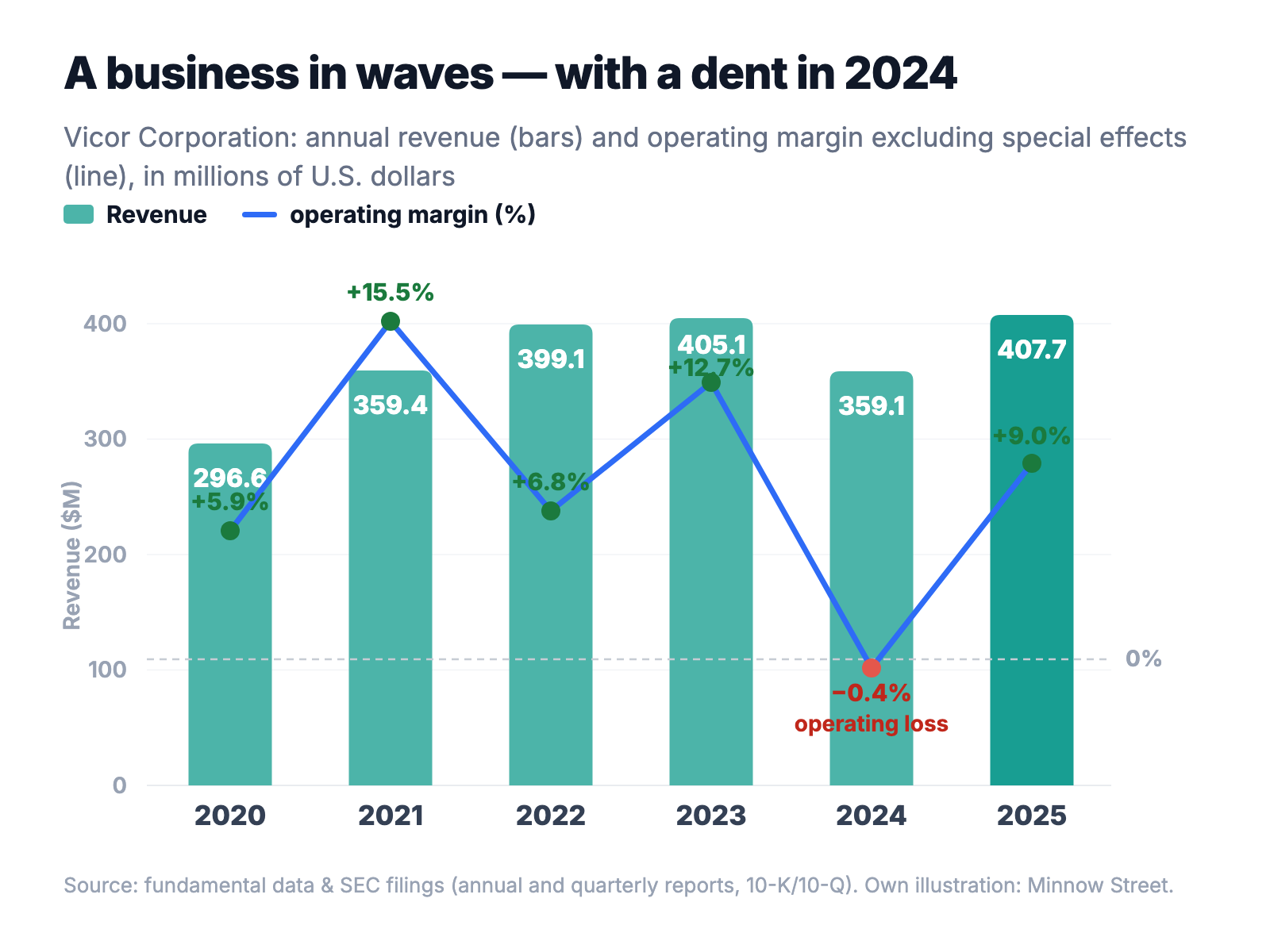
2024 was a weak year: revenue fell about 11 percent to $359 million, and at minus $1.3 million Vicor even slipped just below the operating break-even line. 2025 brought the recovery — revenue of $407.7 million (+13.5 percent), and the operating margin climbed back to about 9 percent. The first quarter of 2026 confirms the upward trend: revenue of $113.0 million (+20 percent versus the prior-year quarter), backlog up to $176.9 million. But remember the wave shape — it is the reason a single annual figure says little about the normal state of a cyclical supplier. And the record 2025 profit? That one has a story of its own, which we open now.
The uncomfortable truths
With a loss-making company, the uncomfortable truths are obvious. With a celebrated winner, they are quieter — and precisely for that reason more important. They are the three things "What You See Is All There Is" blanks out: where the record profit really comes from, who owns the company, and how few customers the growth hangs on.
Uncomfortable truth no. 1: more than half of the record profit is one-time
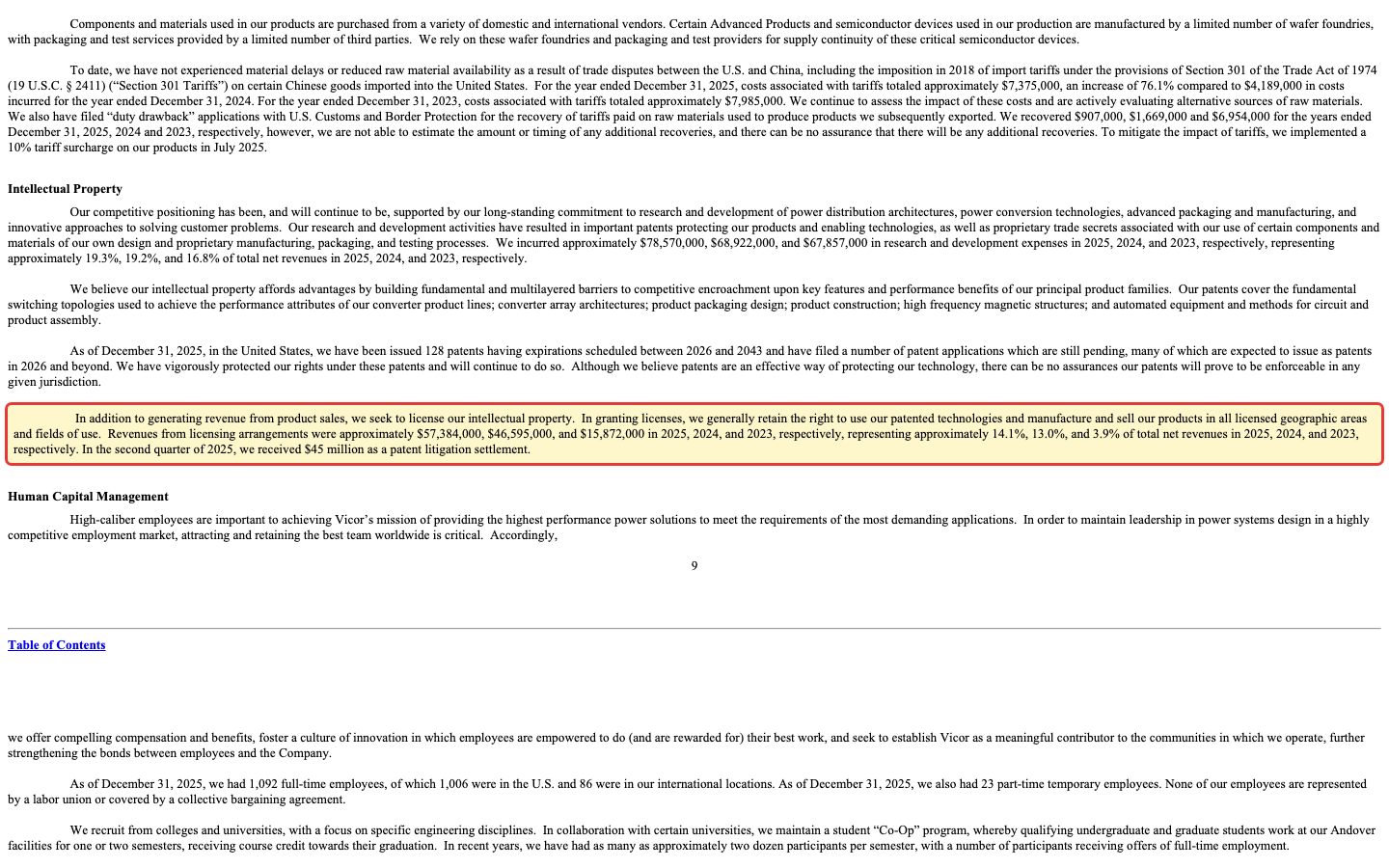
The profit jump from $6 million to $118 million looks breathtaking — until you ask what it is made of. Two large chunks are one-time effects that will be missing next year. The first is a patent settlement, which Vicor itself notes soberly in the annual report:
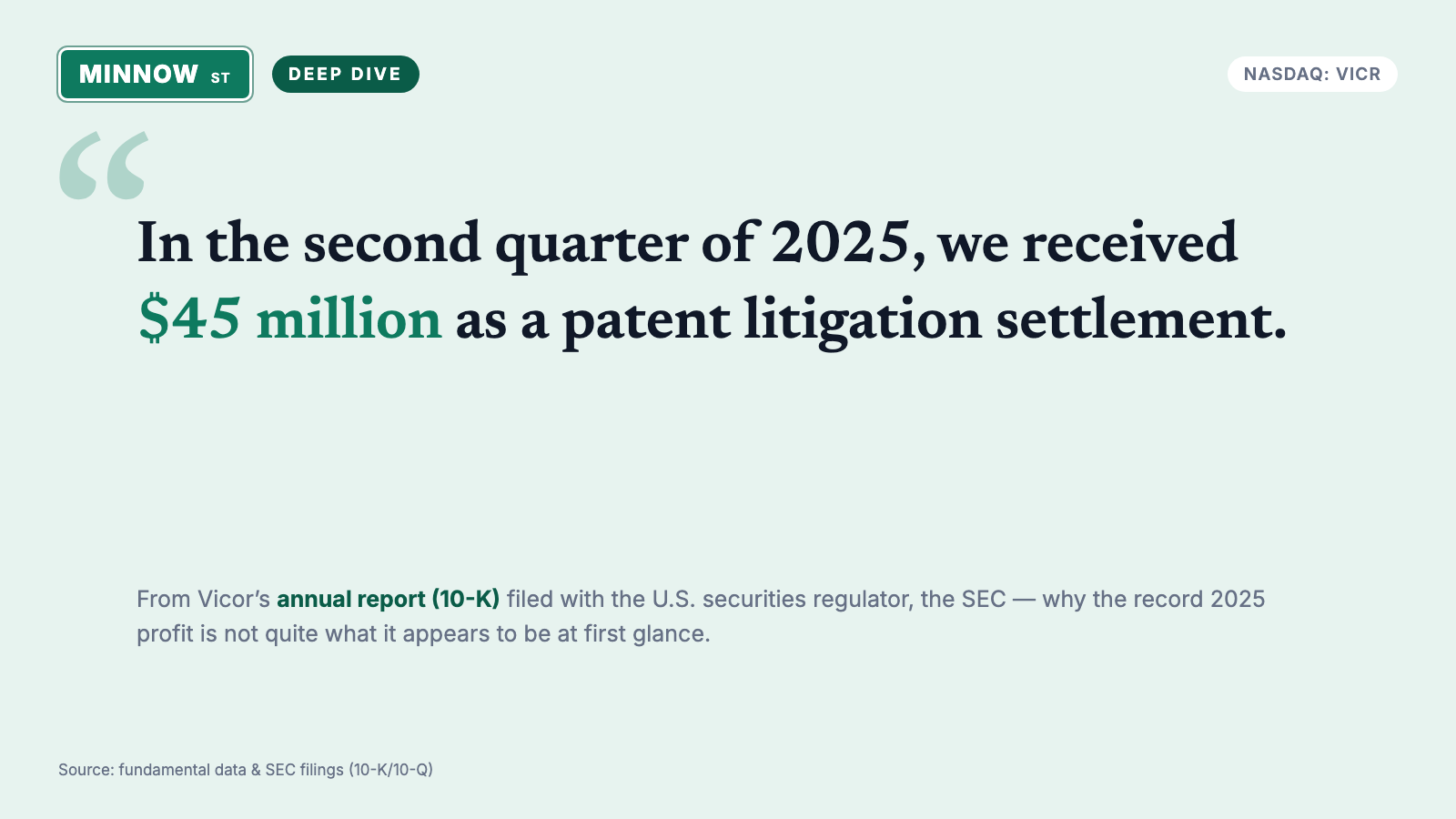
"In the second quarter of 2025, we received $45 million as a patent litigation settlement. … The Company incurred $5,100,000 in legal fees in connection with the patent litigation settlement."
— Vicor Corporation, SEC annual report 10-K for fiscal year 2025, Item 1 Business
The second chunk is even harder to see, because it is not cash but an accounting entry: for years, Vicor carried a valuation allowance against its deferred tax assets — simplified: the company did not trust itself to earn enough profit to ever use its old tax credits. At the end of 2025 it reversed that judgment and released $43.6 million of the allowance — which flowed straight into the profit as a tax benefit. Add the two one-time effects together, and a sobering picture of the "record" emerges:
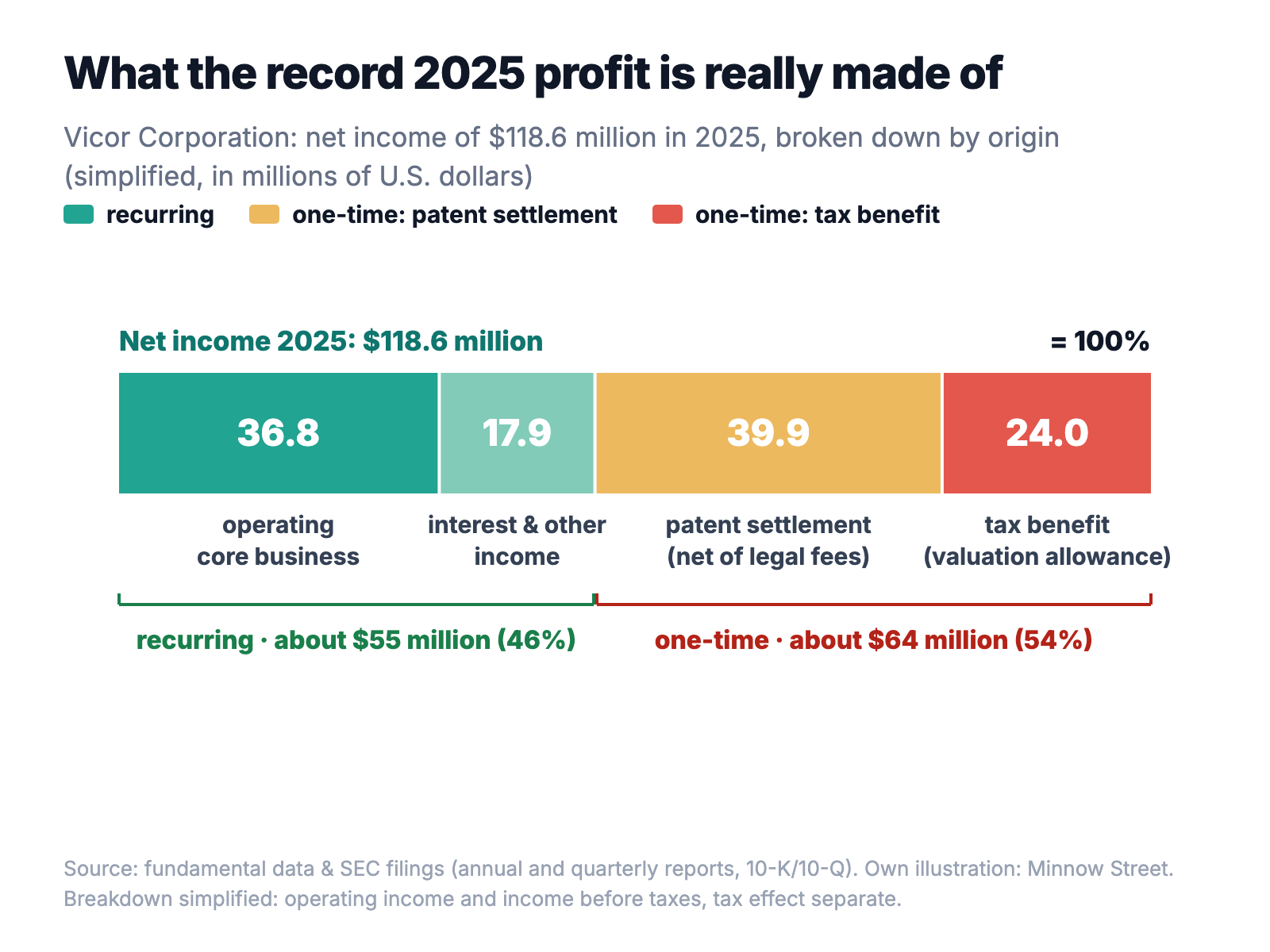
The operating core business chipped in only about $37 million — an operating margin of roughly 9 percent, decent, but a far cry from the 29 percent net margin the $118 million suggests. To be fair: the patent settlement shows Vicor's patents are worth something, and the tax release is a vote of confidence by management in its own future business. But whoever takes the record profit for the normal state of affairs walks straight into the very trap this analysis is about.
Uncomfortable truth no. 2: you buy along, but you have no say
Now to the quietest find — and it concerns the question of power. Vicor has two share classes: the listed Common Stock (ticker VICR, one vote per share) and an unlisted Class B share carrying ten votes each. Almost all Class B shares belong to one man: founder Dr. Patrizio Vinciarelli, who is at the same time Chairman of the Board, Chief Executive Officer and President. The proxy statement for the annual meeting does the math:
"As of March 31, 2026, Dr. Vinciarelli beneficially owned 27.1% of our Common Stock and 94.1% of our Class B Common Stock, which together represent 79.1% of total voting power, giving him effective control of our governance."
— Vicor Corporation, SEC proxy statement DEF 14A dated April 30, 2026, Corporate Governance
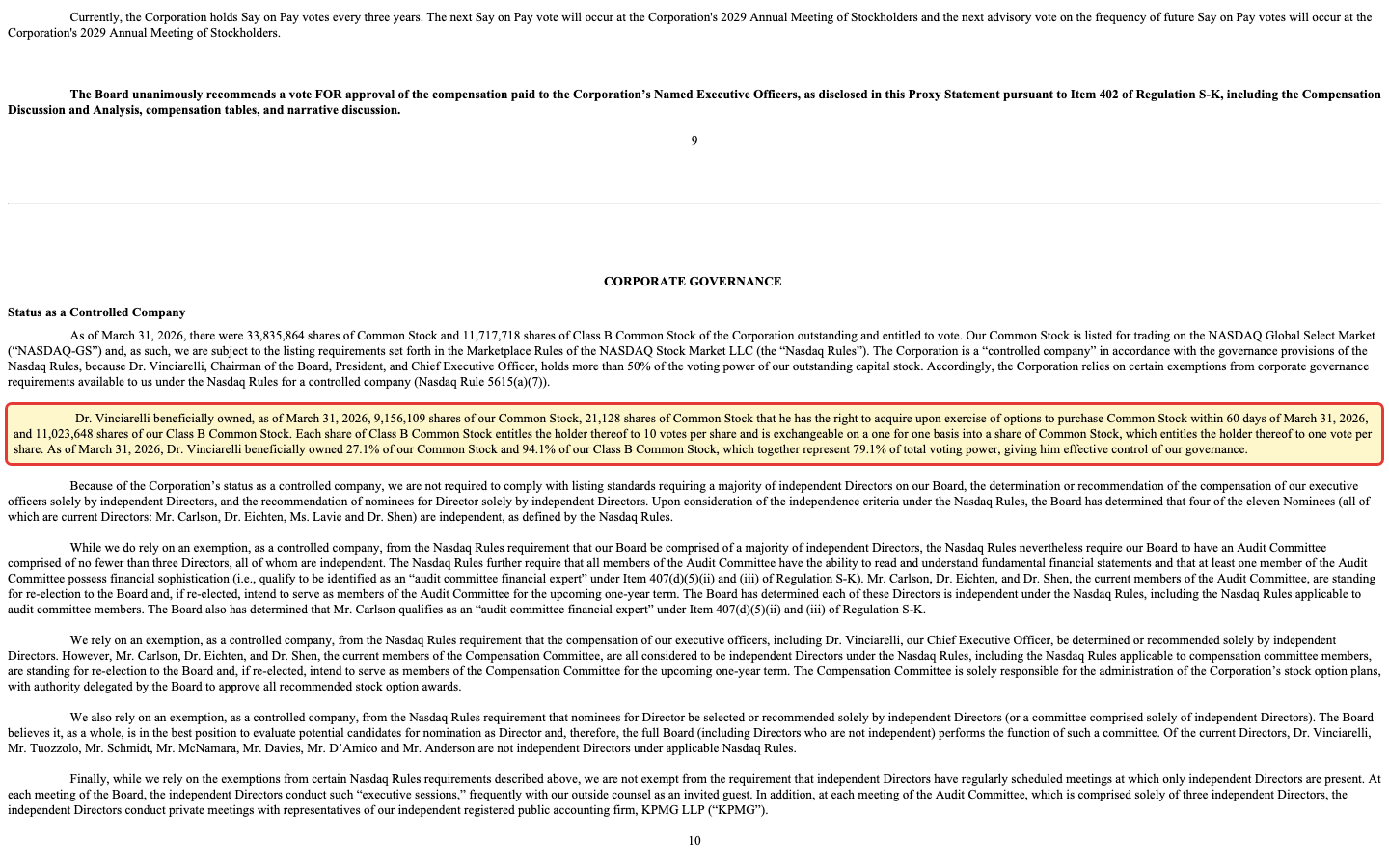
The consequence is in the document too: Vicor is a "controlled company" under Nasdaq rules and may therefore waive protections other companies must observe — such as a majority-independent board of directors or an independent compensation committee. For you as a buyer of the VICR share, that means: you get your slice of the profit, but at the company you are buying into, you have practically no say. As long as the founder manages wisely — and the balance sheet argues he does — that is not a problem. It is one of those details that only becomes expensive once the interests of founder and minority shareholders diverge. And it explains why no activist and no acquirer could ever "clean up" at Vicor.
Uncomfortable truth no. 3: the growth hangs on a handful of customers
The pretty narrative goes: AI data centers, endless demand. The uncomfortable addendum sits in the fine print — the high-margin Advanced Products business that carries Vicor's future rests on very few shoulders. The annual report is unusually candid about it:
"Since the introduction of our Advanced Products, the Company has derived the majority of its revenue from Advanced Products in any given year from either one customer or a limited number of customers, whether through sales directly to the customer(s), indirectly to the customers' contract manufacturers, or through royalties."
— Vicor Corporation, SEC annual report 10-K for fiscal year 2025, Item 1A Risk Factors
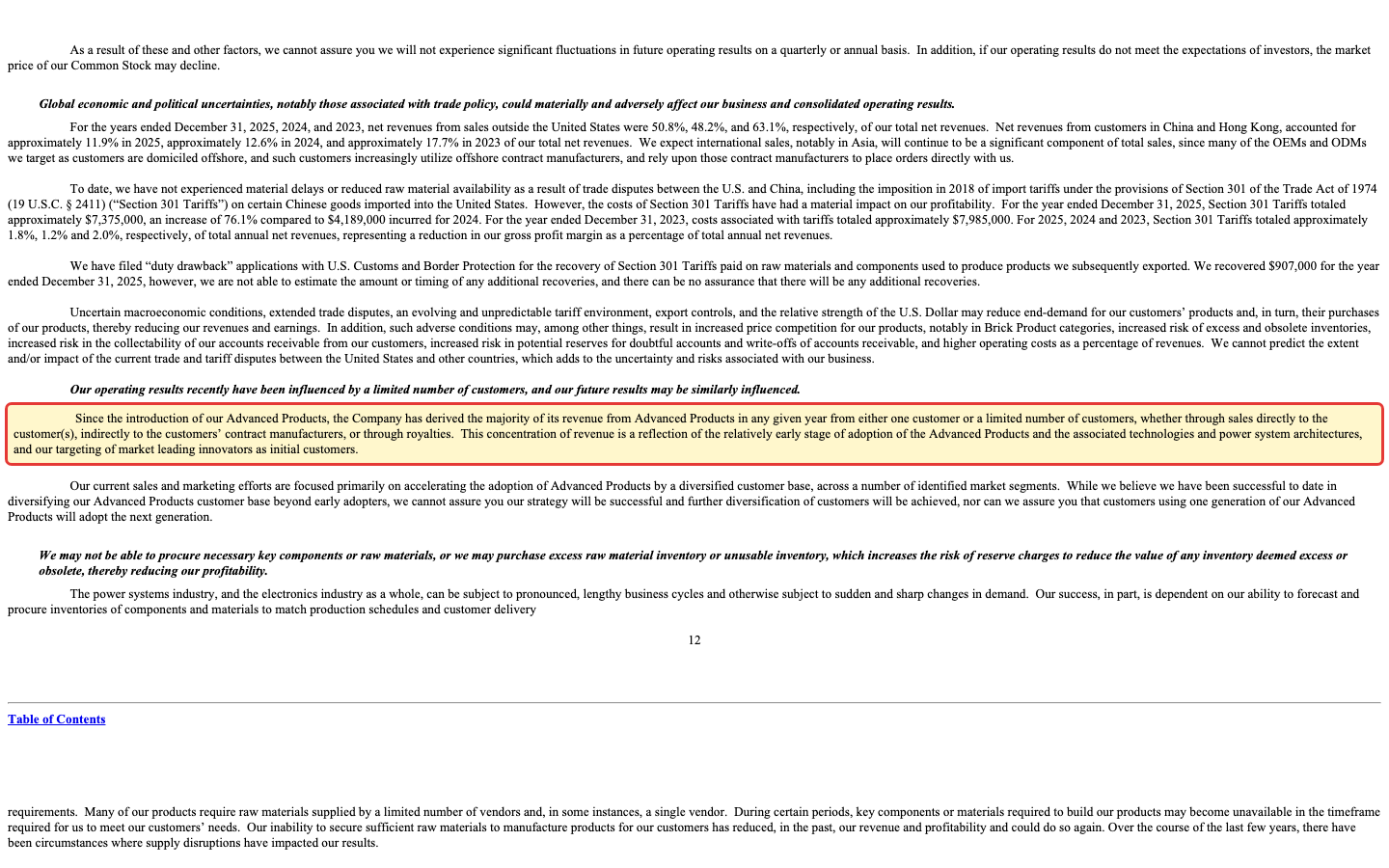
In numbers: in 2025, a single customer accounted for about 11.1 percent of total revenue, and the Advanced Products customers are, per the report, concentrated in the data-center and hyperscaler segments. There is geographic concentration too: about half of revenue comes from outside the United States, 11.9 percent from China and Hong Kong alone — right in the middle of the tariff and trade conflict (Vicor introduced a 10 percent tariff surcharge in July 2025). A concentration of 11 percent is not an existential question — unlike at a company that hangs 60 percent of its revenue on one partner. But if a single hyperscaler reshuffles its orders, you will feel it clearly in the next quarter. And the 2024 cycle showed how fast demand can tip.
Valuation — what perfection costs
Now to the core question that "What You See Is All There Is" prefers to skip: what does this champion cost? The short answer: almost everything that can go right is already priced in. As of mid-2026, Vicor weighs in at about $12.5 billion in market value. Measured against the reported 2025 profit, that makes a price-to-earnings ratio of about 90 — and that profit, remember, was more than half one-time. Strip out the special effects, and the adjusted price-to-earnings ratio lands beyond 200. The price-to-sales ratio of about 30 and the price-to-book ratio of about 18 tell the same story: this is a valuation you would expect from a software wonder, not from a hardware supplier with a single-digit operating margin and a cyclical business.
How to place that? Part of the premium is understandable — Vicor is debt-free, technologically leading in one of the most important fields of the future, and the market pays for the expectation that the AI wave lifts the operating business into entirely new dimensions. Growth imagination is allowed to cost something. But only a handful of analysts cover the stock at all, and the bet embedded in the price is enormous: that about $37 million of operating core profit becomes a multiple of that within a few years — reliably, despite cyclicality and customer concentration. Remember: with a quality stock, the company is rarely the problem. The entry price often is. We saw the same pattern at Lattice Semiconductor — only Vicor's price rests on an even thinner profit base, because it is inflated by one-time gains.
Opportunities and risks at a glance
What speaks for Vicor:
- A fortress balance sheet: practically debt-free, about $390 million in net cash, no goodwill, equity ratio of 94 percent — and about $119 million in free cash flow in 2025, now that the expensive fab investment phase is complete.
- Genuine technological leadership in a key market: "Power-on-Package" feeds GPUs and AI ASICs with very high currents; the Advanced Products (61 percent of revenue) grow with the AI build-out.
- A high-margin second leg: licensing revenue has risen to about $57 million (14.1 percent of revenue), and the $45 million patent settlement shows the patents are enforceable.
- A clean quality-and-momentum cluster (21 scanners), backlog up to $176.9 million, Q1 2026 revenue up 20 percent — the operating recovery is under way.
What speaks against it:
- The record 2025 profit is about 54 percent one-time (patent settlement of $45 million, tax benefit of $43.6 million); the operating core contributed only about $37 million — the reported net margin of 29 percent massively overstates the earnings power.
- Extreme valuation: price-to-earnings ratio of about 90 (adjusted beyond 200), price-to-sales about 30 — there is practically no room for disappointment built in.
- Cyclical end markets: in 2024, revenue fell 11 percent and Vicor slid into an operating loss; data-center demand can tip as fast as it came. Add tariff and trade risk (11.9 percent of revenue from China/Hong Kong).
- Customer and governance concentration: the Advanced Products revenue hangs on one or a few customers; founder Vinciarelli controls 79.1 percent of the votes via the 10-vote Class B — minority shareholders have effectively no influence.
A human conclusion
Remember Kahneman's "What You See Is All There Is" from the opening? After the look into the filings, you now know why that reflex is especially seductive at Vicor — not because the company is weak, but because it is strong in so many ways. The balance sheet is a fortress, the technology sits in the middle of the most important field of the future, the free cash flow is real. All of that is true, and it is the one shining half of the picture.
The other half, drowned out by the cheering: more than half of the record 2025 profit is one-time, the operating core earns far more modestly at about a 9 percent margin, the end markets run in waves, the Advanced Products growth hangs on a few customers — and you are buying a share with no vote at a price that assumes perfection. An excellent company and an excellent stock are simply not the same thing: the first depends on the business, the second also on the entry price.
What you make of it is your decision. And that is exactly as it should be. What matters is that you know what you are betting on: not on whether Vicor is good — but on a solid operating core turning into a multiple of itself within a few years, reliably enough to justify a price already set to perfection. The one shining number tells you what happened in 2025. It does not tell you what comes next — and least of all, how much of that you are already paying for today.
Sources
- Vicor Corporation — SEC annual report 10-K, fiscal year 2025 (as of December 31, 2025, filed March 2, 2026)
- Vicor Corporation — SEC quarterly report 10-Q (as of March 31, 2026, filed April 30, 2026)
- Vicor Corporation — SEC proxy statement DEF 14A dated April 30, 2026 (share classes/voting rights, beneficial ownership, "controlled company"); additionally the 10-K for fiscal year 2024 (filed March 3, 2025).
- Fundamental data (metrics, valuation, annual and quarterly series); in-house stock scanner, data as of July 10, 2026.
Transparency & disclaimer: This analysis is a journalistic contextualization of publicly available information and is not investment advice, not a financial analysis in the regulatory sense, and not a solicitation to buy or sell securities. Stocks are subject to price swings; a total loss is possible. Make your investment decisions on your own responsibility and, when in doubt, seek independent advice. All information without guarantee; the data cut-off is noted in the text in each case.
Our Bottom Line at a Glance
- Balance sheet & cash flow positive
- A fortress balance sheet: practically debt-free, about $390 million in net cash, no goodwill, equity ratio of 94 percent. With the expensive fab investment phase behind it, Vicor threw off about $119 million in free cash flow in 2025 — real substance, not a paper gain.
- Technology & AI end market positive
- Genuine leadership in a key field: "Power-on-Package" feeds GPUs and AI ASICs with very high currents, and the Advanced Products (61 percent of revenue) grow with the AI build-out. Add a high-margin licensing business (about $57 million, 14 percent of revenue). But Vicor sells the power delivery for AI, not AI itself.
- Earnings quality negative
- The record 2025 profit ($118.6 million) is about 54 percent one-time: a $45 million patent settlement and the release of a $43.6 million tax valuation allowance. The operating core business contributed only about $37 million (operating margin about 9 percent). The reported net margin of 29 percent considerably overstates the earnings power.
- Cyclicality & customer concentration neutral
- The business runs in waves: in 2024, revenue fell 11 percent and Vicor slid into an operating loss. The high-margin Advanced Products revenue hangs on one or a few customers (one customer about 11.1 percent of total revenue), concentrated in data centers/hyperscalers; add tariff and trade risk (11.9 percent of revenue from China/Hong Kong).
- Valuation & governance negative
- The valuation assumes perfection: a price-to-earnings ratio of about 90 on the one-time-inflated profit (adjusted beyond 200), price-to-sales about 30. Add the governance detail: founder Vinciarelli controls 79.1 percent of the votes via the 10-vote Class B with about a quarter of the capital; Vicor is a "controlled company", minority shareholders have effectively no influence.
Vicor is a genuinely good company: debt-free, with about $390 million in net cash, its own manufacturing and real technological leadership in powering AI chips — rightly a cluster of 21 quality and momentum scanners. The other half of the truth: more than half of the record 2025 profit is one-time (patent settlement, tax benefit), the operating core earns more modestly at about a 9 percent margin, the end markets are cyclical, the growth hangs on a few customers — and the stock costs about 90 times earnings (adjusted beyond 200) while the founder holds 79 percent of the votes. An excellent company; the question is the entry price. Not investment advice.
What Our Rating Means
- If you don't own the stock
- At the current price level, we don't see a sufficient margin of safety for an entry.
- If you hold it in your portfolio
- Our findings offer no reason to sell.
A journalistic assessment by our editorial team at the time of the deep dive, based on public sources — not investment advice and not a solicitation to buy or sell. Your personal circumstances (investment goals, risk capacity, taxes) cannot be taken into account. What our categories mean, how verdicts are formed, and what conflicts of interest exist →
Worth Noting
- Price, valuation and market-value figures are dated mid-2026; figures for fiscal year 2025 (as of December 31, 2025) and the first quarter of 2026. Analyses are evergreen; daily prices are not a buy argument.
- Materiality gate: the dominant negative find is a price find — the record 2025 profit is about 54 percent one-time (patent settlement of $45 million + tax benefit of $43.6 million = about $64 million of $118.6 million in net income), which makes the valuation (P/E about 90, adjusted beyond 200) even more expensive. The customer concentration (one customer about 11.1 percent of revenue) and the cyclicality (2024 operating loss) are price/cycle finds (a dent, not an existential threat). The founder control (79.1 percent of votes on about 27 percent of the capital) is a governance blemish without a vote in the verdict, solidly run. No existential find: debt-free, ~$390 million net cash, no going-concern risk, no dilution. Since all substantiated negative finds are of the price/governance type and the company is operationally strong, the classification is "hold" (quality real, but no margin of safety for a new purchase).
- Adjusted earnings: subtracting the patent settlement (net about $40 million) and the one-time tax benefit ($43.6 million) from 2025 net income leaves an operationally carried profit in the order of about $35 million to $55 million — which yields the adjusted price-to-earnings ratio beyond 200. The breakdown in the chart is simplified (operating income and pre-tax income, tax effect separate) and sums exactly to $118.6 million.
- AI classification: Neutral. Vicor's products deliver the power for GPUs and AI ASICs — a strong AI end-market narrative, but no sale of own AI products and no substantiated operational AI use beyond a generic risk-factor phrase. Under our criteria catalog, end-market exposure alone does not justify a "sells AI" rating.
Frequently Asked Questions
Vicor (Nasdaq: VICR) builds high-density power modules that turn coarse electricity into precisely dosed, very high currents right at the chip — a kind of "gourmet power outlet" for high-performance processors. Its "Power-on-Package" solutions feed GPUs and AI ASICs in data centers; alongside that, Vicor sells classic "Brick" modules and licenses its technology for fees. Everything is manufactured in its own fab in Andover, Massachusetts.
Net income jumped from $6.1 million to $118.6 million — but about 54 percent of that is one-time. A patent settlement brought in a net amount of about $40 million in the second quarter of 2025, and the release of a tax valuation allowance in the fourth quarter added another $43.6 million as a tax benefit. The operating core business contributed only about $37 million (operating margin about 9 percent). Without the special effects, the "record" looks considerably more modest.
It is very richly valued. The price-to-earnings ratio of about 90 refers to the reported profit, which is inflated by one-time effects; adjusted for those, it sits beyond 200. Price-to-sales (about 30) and price-to-book (about 18) are extreme as well. The market is pricing in that the operating business grows into entirely new dimensions thanks to AI. That is a statement about the price, not about the quality of the company.
Vicor has two share classes. The listed Common Stock (VICR) carries one vote per share, the unlisted Class B ten votes each. Founder Dr. Patrizio Vinciarelli (Chairman, CEO and President) holds 27.1 percent of the Common and 94.1 percent of the Class B shares, reaching 79.1 percent of the voting power. Vicor is therefore a "controlled company" under Nasdaq rules; minority shareholders have effectively no influence on governance.
Very. At the end of 2025, about $403 million in cash stood against just $13 million in financial liabilities (essentially leases), leaving about $390 million in net cash. There is no goodwill, and the equity ratio sits at 94 percent. With the expensive investment in its own chip fab in Andover complete, Vicor threw off about $119 million in free cash flow in 2025. The balance-sheet strength is one of the company's genuine qualities.
As an end market yes, as a product no. Vicor's Advanced Products deliver the power for GPUs and AI ASICs in data centers; its customers include, per the annual report, "the leading innovators in processor and accelerator design". But Vicor does not sell AI — it sells the power delivery for it: an AI-adjacent end-market narrative, not an AI revenue source of its own. In our AI classification, Vicor is therefore rated "Neutral".
Found an error?
Did you spot a factual error, an outdated number, or a typo in this deep dive? Let us know briefly — your report goes straight to the editorial team.