Harmonic Stock: Eight Straight Beats — and a Quarter Less Revenue
Harmonic builds the gear cable operators use to push gigabit internet through existing coax — and it sits at rank 22 of 81 U.S. hits in our Big Earnings Surprise scanner (data as of July 25, 2026), because adjusted earnings per share have come in above the analyst estimate for eight quarters straight. We read the annual report on Form 10-K for 2025, the quarterly report for the period ended April 3, 2026 and seven current reports on Form 8-K: on June 16, 2026 the company sold half its house — the Video business, for $145 million in cash — and has been a pure-play broadband vendor since. What is left is a backlog that has nearly doubled, revenue that fell 26 percent in 2025, and a single customer who supplied 54 percent of it. Not investment advice — just the question of what remains when a company sells half its house.
 Thomas Mücke
Founder & Publisher
Thomas Mücke
Founder & Publisher
Chart
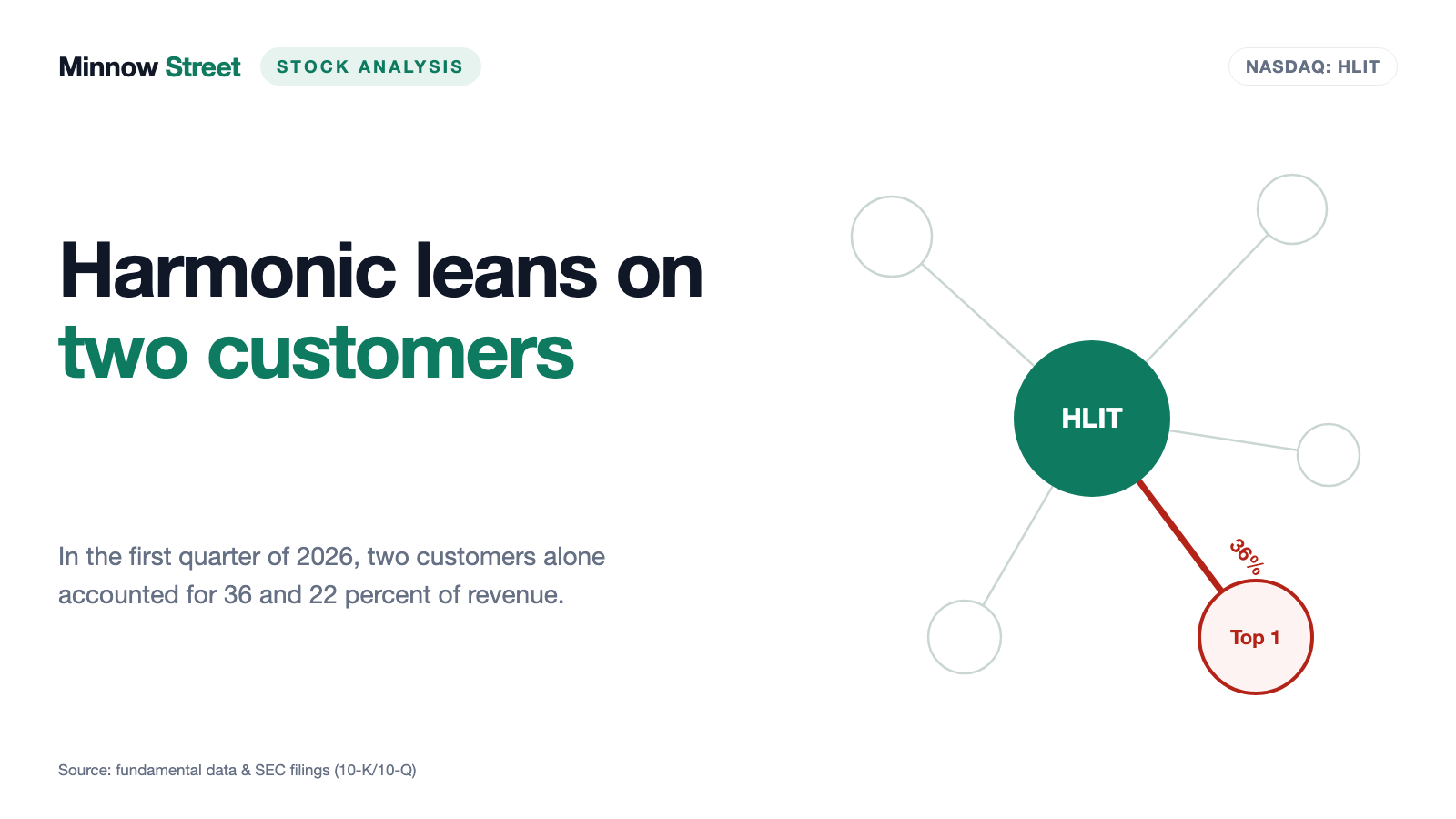
Interactive price chart (TradingView).
Note: pure fact-based analysis, not investment advice and not a solicitation to buy or sell. All figures without guarantee.
There is a trap that looks smarter than it is: the streak trap. When a company earns more than analysts expected eight times in a row, our brain files it as a pattern — and patterns feel like safety. That streak is exactly why Harmonic Inc. (Nasdaq: HLIT) sits at rank 22 of 81 U.S. hits in our Big Earnings Surprise scanner (data as of July 25, 2026). Before the streak blocks the view, let us make a deal: we read the primary documents together — the annual report on Form 10-K for 2025, the quarterly report on Form 10-Q for the period ended April 3, 2026, and seven current reports on Form 8-K filed with the U.S. securities regulator, the SEC, between December 2025 and June 2026. They explain the streak. They also show that since June 16, 2026 this company is only half the size it was a year earlier. Remember: a beat measures the distance to the estimate, not the distance to last year.
What Harmonic actually does — the engine behind your cable connection
Harmonic was incorporated in California in 1988, reincorporated in Delaware in 1995, sits in San Jose and employed 534 full-time people as of December 31, 2025, including 236 in research and development. The company does not sell to you; it sells to your provider — to cable operators and telcos that want to deliver gigabit internet over existing television coax or over fiber. Put in everyday terms: Harmonic builds neither the road nor the car, but the traffic lights and the distribution cabinet — the equipment that decides how many data packets fit through a cable that is already in the ground.
The heart of it is called cOS, and it is software rather than a box. Traditionally a cabinet-sized appliance in the cable headend (a “CMTS”) distributed the data streams. Harmonic replaces it with programs running on commercial off-the-shelf servers — less space, less power, upgradable by software release. Around it sit outdoor devices with maritime names (Oyster, Ripple, SeaStar, Pebble, Pearl) that push the signal closer to households, plus fiber modules. Two terms keep coming up: DOCSIS is the standard that carries internet over TV cable, and the new DOCSIS 4.0 step delivers far more speed but demands new equipment in the field. DAA, distributed access architecture, moves processing out of the headend into street-side nodes. Per the company statement of June 17, 2026, the cOS platform serves nearly 46 million customer devices worldwide and is deployed at 150 customers.
That brings us to the central tension of this analysis, which runs through every chapter: the earnings beats are real — but they sit on a revenue base that collapsed by a quarter in 2025, inside a company that has just sold 37 percent of its business, with one customer supplying more than half of what remains.
How the stock reached our desk
We run several thousand stocks through our scanners every day. As of July 25, 2026 Harmonic shows up at rank 22 among the 81 U.S. hits in the Big Earnings Surprise scanner. To repeat it yourself: open the scanner, set the country filter to “US” and scroll to rank 22. The filter demands one thing: reported earnings per share must have exceeded the analyst estimate by at least 20 percent in every one of the four most recently completed quarters. Harmonic clears that comfortably — and not for four quarters, but for eight:
- Quarter ended April 3, 2026 (reported May 11, 2026): $0.17 adjusted against $0.12 expected — up 41.7 percent
- Quarter ended December 31, 2025 (reported February 19, 2026): $0.14 against $0.11 — up 27.3 percent
- Quarter ended September 26, 2025 (reported November 3, 2025): $0.12 against $0.05 — up 140 percent
- Quarter ended June 27, 2025 (reported July 28, 2025): $0.09 against $0.02 — up 350 percent
Add an RS rating of 86: over the past twelve months the stock outperformed 86 percent of all names we track. Both are decent readings — 86 is good, but not a top rank; genuine relative strength usually starts at 90. The framing matters more. A 350 percent beat sounds enormous, but here it describes $0.02 versus $0.09 per share. When the numbers are small, big percentages are cheap. And every beat streak has an uncomfortable flip side: a company that beats eight times has been estimated too low eight times — which says as much about the forecasts as about the business. Note also that the scanner lists are recomputed daily; today\'s rank is not tomorrow\'s.
The break: on June 16, 2026, Harmonic sold half its house
Anyone comparing this company\'s numbers with those of two years ago is comparing two different businesses. On December 8, 2025 Harmonic signed a put option agreement with Leone Media Inc., which does business as MediaKind, covering the sale of the entire Video business. On March 12, 2026 the mandatory consultation with the French works council was completed, on March 20, 2026 the asset purchase agreement was signed — and on June 16, 2026 the sale closed:
“On June 16, 2026, Harmonic Inc. (the “Company”) completed the previously disclosed sale of its Video Business (the “Business”) pursuant to that certain Asset Purchase Agreement, dated March 20, 2026, (the “APA”) with Leone Media Inc. (d/b/a MediaKind) (the “Buyer”) for a purchase price of $145 million in cash (the “Acquisition”).”
— Harmonic Inc., Form 8-K filed June 17, 2026, Item 2.01

How deep the cut runs is spelled out in the annual report itself, under a risk heading stating that future results will depend solely on the broadband business:
“The Video business generated approximately 37% of our aggregate revenue for fiscal 2025, approximately 28% of our aggregate revenue for fiscal 2024, and approximately 36% of our aggregate revenue for fiscal 2023.”
— Harmonic Inc., Annual report on Form 10-K for 2025, Item 1A “Risk Factors”

Three details are easy to miss. First, Harmonic agreed not to compete with the divested business for three years — the route back into video is contractually closed. Second, the price is not fixed: it is adjusted for net working capital, cash, indebtedness and specified selling expenses of the transferred business, and the company itself flags the risk that post-closing adjustments “could reduce the net proceeds of the transaction.” Third, the exit was expensive. When Harmonic classified the Video business as held for sale in the fourth quarter of 2025, it had to test the goodwill carried against it — and wrote off $57.5 million. That is the main reason the group posted a $43.3 million net loss for 2025 even though continuing operations were profitable.
The numbers over the years — given their due
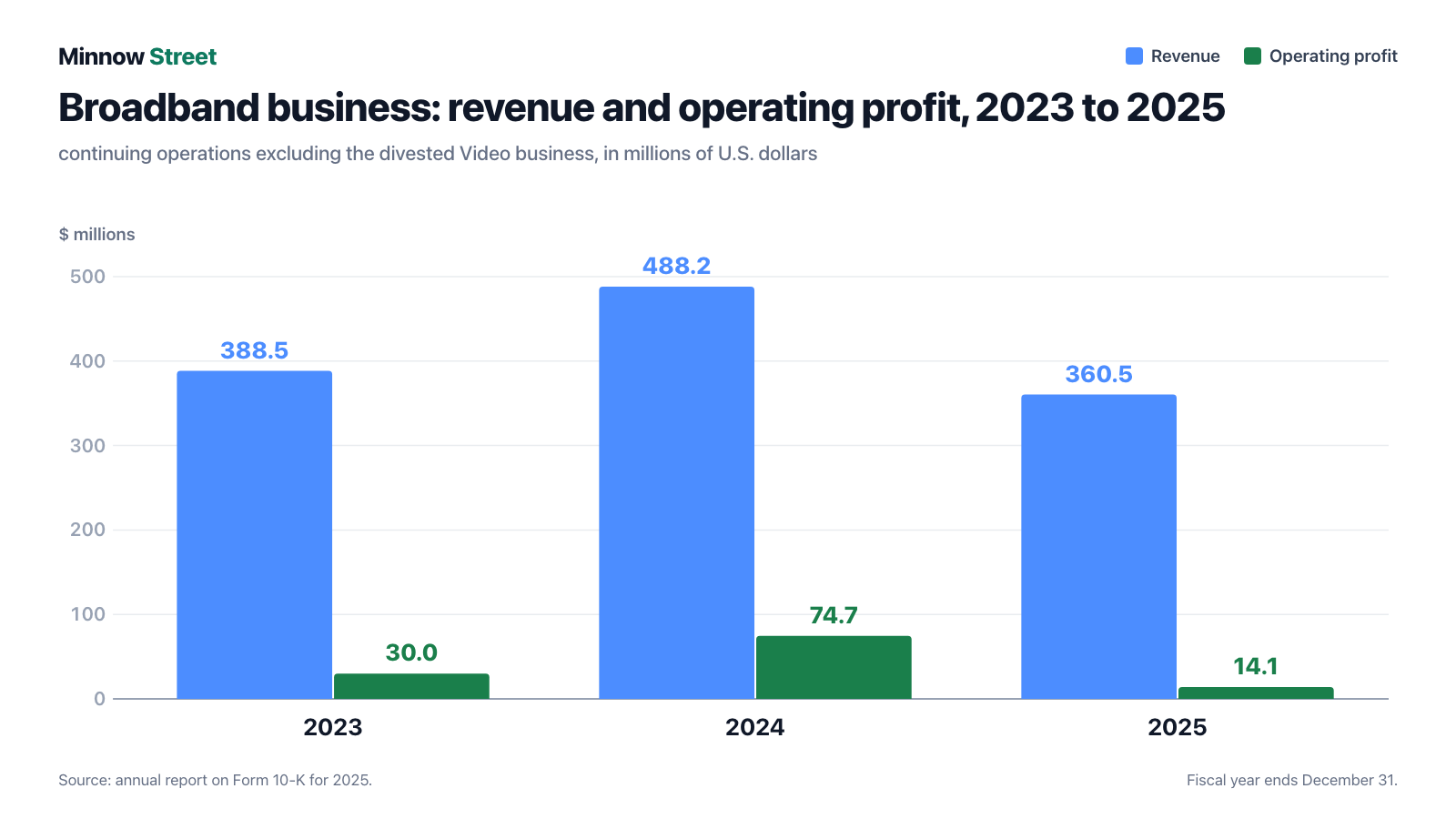
First the part that genuinely impresses. The broadband business, now the whole company, was a powerhouse in 2024: $488.2 million of revenue and $74.7 million of operating profit, up 26 percent on 2023, driven by two large accounts that together added $110.4 million of revenue. The first quarter of 2026 picked up the thread: $121.7 million of revenue, up 43 percent year over year, with operating profit of $20.4 million against $7.0 million. Operating cash flow reached $108.0 million in 2025 — a consolidated figure that still included the Video business — after $61.9 million in 2024 and $7.1 million in 2023.
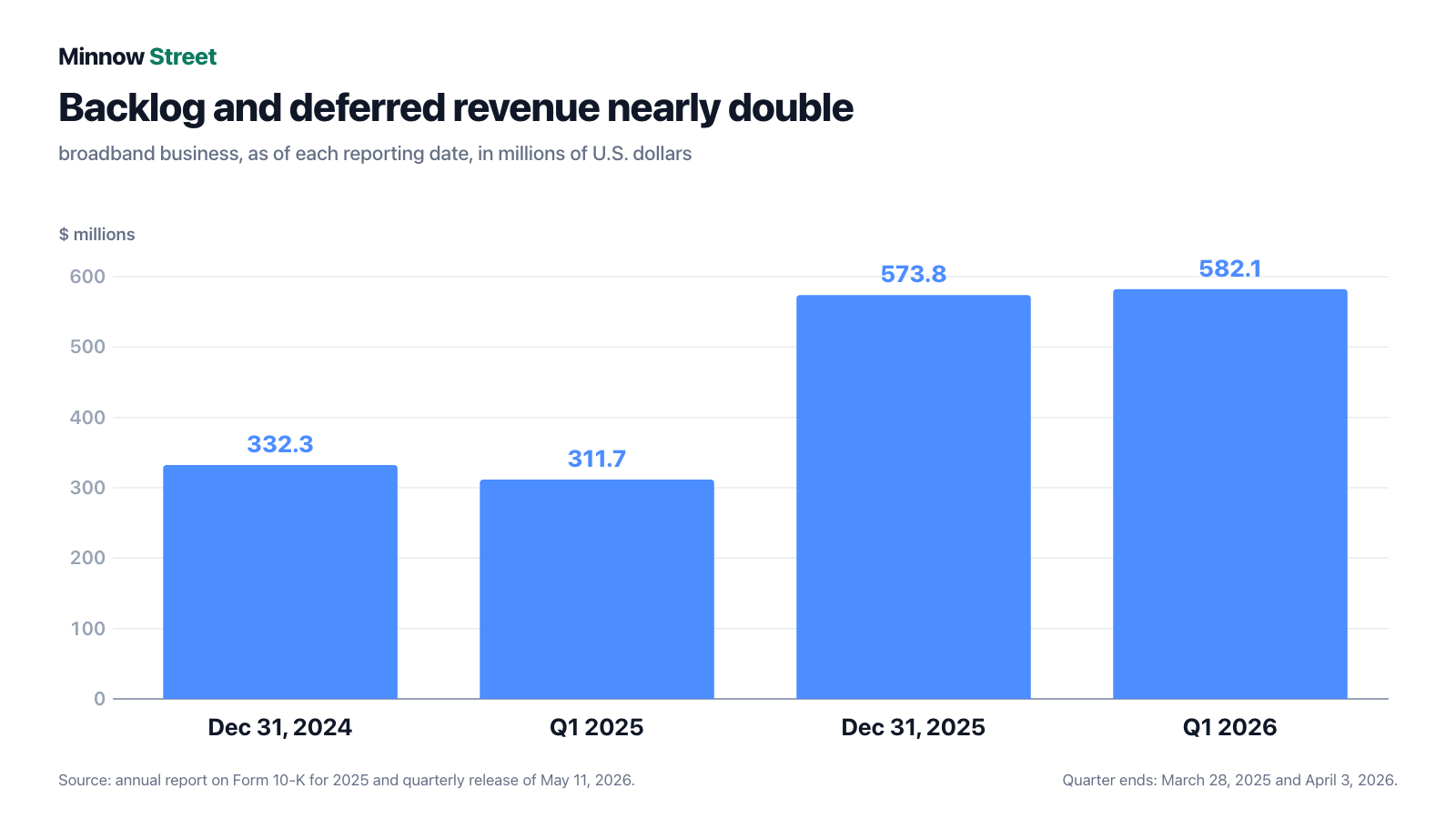
And one more figure that rarely comes out this clearly: backlog including deferred revenue — firm orders plus services already paid for but not yet delivered — climbed from $332.3 million (December 31, 2024) to $573.8 million (December 31, 2025) and on to $582.1 million at April 3, 2026. Against the prior-year quarter ($311.7 million) that is a gain of 87 percent. In the fourth quarter of 2025 alone, bookings of $346.9 million came in.
So much for the sunny side. Now the filings.
What the filings say — the uncomfortable truths
Uncomfortable truth no. 1: one customer supplied more than half of 2025 revenue
Some risks a company has to hide; others it writes down in black and white. Harmonic belongs to the second kind:
“During the fiscal year ended December 31, 2025, one customer accounted for 54% of our net revenue. During the fiscal year ended December 31, 2024, two of our customers accounted for 57% and 24% of our net revenue, respectively. During the fiscal year ended December 31, 2023, one customer accounted for 64% of our net revenue.”
— Harmonic Inc., Annual report on Form 10-K for 2025, Item 1A “Risk Factors”

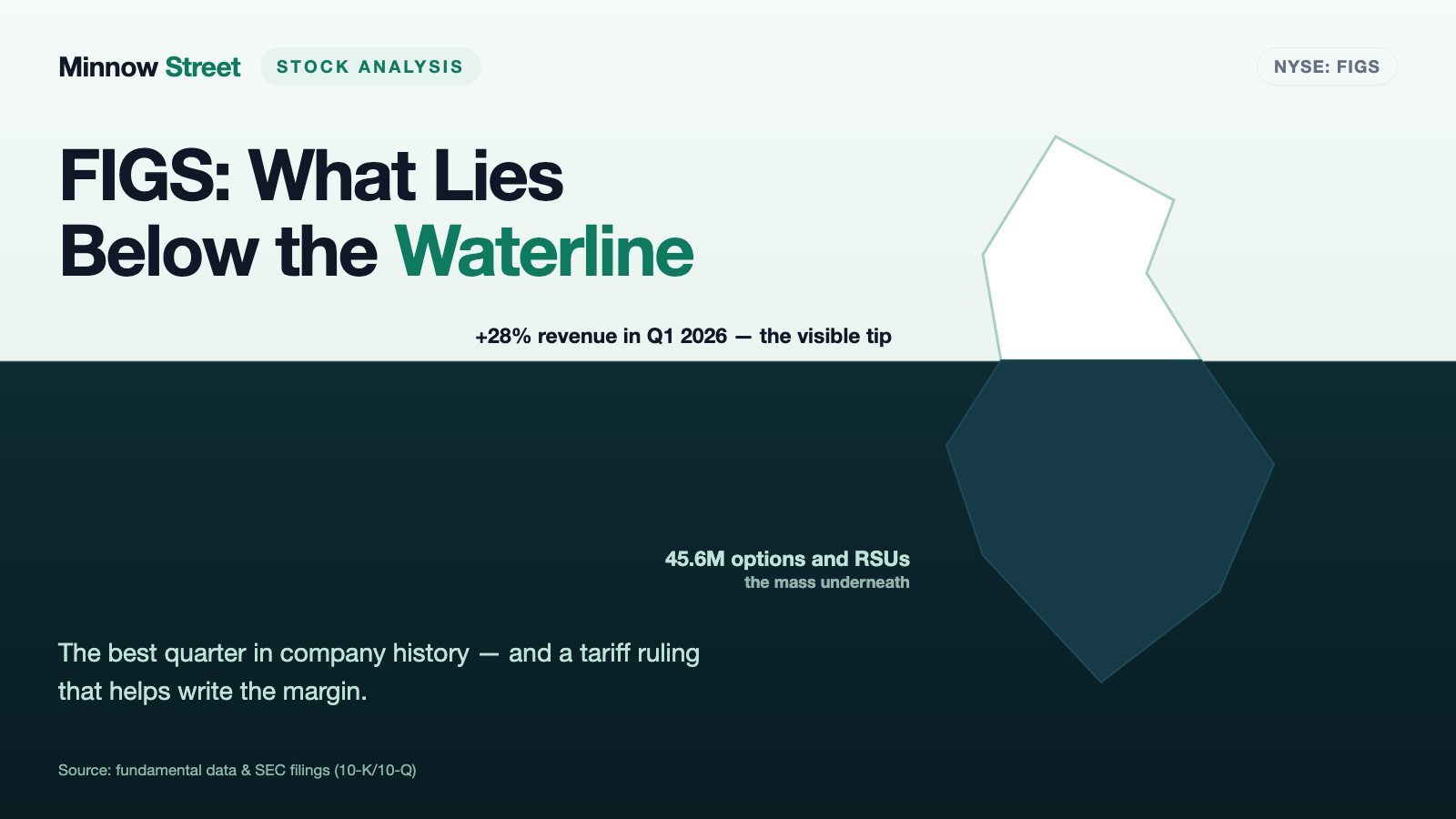
The ten largest customers together reached 84 percent of revenue in 2025 and 88 percent in the first quarter of 2026. In the quarter ended April 3, 2026 two customers supplied 36 and 22 percent — against 48 and 19 percent a year earlier. Anyone wondering why this company\'s revenue behaves like a roller coaster has the answer here: a single operator postponing a deployment program by six months postpones half of Harmonic\'s year. The company itself writes that further consolidation among cable operators and telcos could lead to additional revenue concentration. Keep the image: a customer at 54 percent of revenue is not a customer but a partner with a veto over your annual numbers. There is at least a counter-movement: for the first quarter of 2026 Harmonic reported that Rest-of-Market bookings exceeded half of all quarterly bookings for the first time.
Uncomfortable truth no. 2: the beat streak runs on revenue that fell 26 percent in 2025
This is where the scanner view parts ways with the balance-sheet view. While adjusted earnings per share topped the estimate quarter after quarter, revenue from continuing operations fell from $488.2 million to $360.5 million in 2025 — down $127.7 million, or 26 percent. Operating profit slid from $74.7 million to $14.1 million, a drop of 81 percent. The annual report names the cause plainly: appliance and integration revenue in the United States fell by $148.0 million because customers delayed DOCSIS 4.0 deployments and network readiness work. Only a small part was offset by $19.2 million of additional revenue from fiber-to-the-home projects in Latin America.
That is the core of the streak trap: a beat only tells you the analysts were wrong, not that the business is doing well. After the 2025 collapse, estimates went looking for the floor; from that low base it is easier to clear the bar. An honest comparison uses 2024 as the yardstick — and even the optimistic 2026 guidance of $475 million to $495 million (issued May 11, 2026) would merely bring Harmonic back to where it stood in 2024: two years without progress in the revenue line.
Uncomfortable truth no. 3: a backlog is not revenue
The jump in the order book from $332.3 million to $582.1 million is the strongest number in this analysis — and the easiest to misread. The annual report supplies the brake itself:
“Approximately 53% of our backlog and deferred revenue is projected to be converted to revenue within a rolling one-year period. […] Delivery schedules on such orders may be deferred or canceled for a number of reasons, including reductions in spending by our customers or changes in specific customer requirements.”
— Harmonic Inc., Annual report on Form 10-K for 2025, Item 1 “Backlog”

Run the math: 53 percent of $582.1 million is roughly $309 million expected to convert in the year after April 3, 2026. Guidance calls for $475 million to $495 million. The rest has to come from new bookings — and bookings have been swinging hard: $115.9 million in the first quarter of 2026 against $346.9 million in the quarter before. The annual report says it outright: the amount of backlog at any given time is “not necessarily indicative of actual revenues for any succeeding period.”
Uncomfortable truth no. 4: leaving video cost $57.5 million of goodwill
Goodwill arises when a company pays more for an acquisition than its identifiable parts are worth — the premium for brand, customers and expectations. When Harmonic put the Video business in the shop window in the fourth quarter of 2025, it had to test whether that premium still held. It did not: $57.5 million was written off to bring the carrying amount down to estimated fair value. The charge sits in the line “loss from discontinued operations” and pushed the group to a net loss of $43.3 million for 2025, even though continuing operations earned $1.2 million.
For scale: at December 31, 2025 the balance sheet showed $223.96 million of assets held for sale against $85.67 million of related liabilities — roughly $138 million net. The $145 million purchase price sits just above that. In other words: after the write-down, the business was sold at about book value. Anyone dismissing the charge as “one-time and non-cash” should remember that it corrects the price of an earlier acquisition — money that did leave the building at the time. The balance sheet still carries an accumulated deficit of $2,112.3 million (April 3, 2026), the inheritance of two decades of telecom cycles.
Uncomfortable truth no. 5: of all things, AI is making Harmonic\'s purchasing more expensive
For a network equipment vendor you would expect artificial intelligence to be a tailwind — more traffic, more bandwidth demand, more gear. That is exactly how Harmonic lists it among industry trends. The risk factors of the same report show the other side: the company buys key components from sole or limited sources, has its products built by contract manufacturers — and competes for supply with the AI boom.
“As AI-driven demand for chips and other components increases, the price of components may increase, or the components may not be available at all, and we may not be able to secure an adequate supply of components at reasonable prices or of acceptable quality to build and deliver products in a timely manner in the qualities needed.”
— Harmonic Inc., Annual report on Form 10-K for 2025, Item 1A “Risk Factors”
That reading matches what we described in our Nvidia analysis: the data-center appetite for chips pulls capacity out of every other electronics niche. And it carries a visible price. Broadband gross margin fell to 52.3 percent in the first quarter of 2026 from 54.8 percent a year earlier, and on May 11, 2026 the company guided full-year 2026 gross margin to only 49.9 to 51.3 percent. Readers who want to see how suppliers and chip cycles hit companies like this will find the semiconductor side of the same value chain in our MaxLinear analysis.
What the stock costs — valuation in orders of magnitude
On July 24, 2026 the market value stood at roughly $1.21 billion — derived from the 108,496,436 shares on the cover page of the quarterly report (as of May 4, 2026) and that day\'s closing price. As a cross-check: Harmonic itself repurchased stock in the first quarter of 2026 at average prices between $10.06 and $10.59 — the orders of magnitude line up.
From that follow these anchors, all with a data date of July 25, 2026:
- Price-to-sales: about 3.4 times 2025 continuing-operations revenue ($360.5 million) — or about 2.5 times the midpoint of 2026 guidance ($485 million). For a network vendor with roughly 50 percent gross margin that is no bargain, but no bubble either.
- Price-to-earnings: about 25 to 31 times guided earnings per share of $0.36 to $0.45 (guidance issued May 11, 2026). Against actual 2025 continuing-operations earnings of $0.01 per share no meaningful multiple exists — which is why any valuation here is a bet on the guidance.
- Balance sheet: $109.0 million of cash against $111.3 million of debt at April 3, 2026 — effectively debt-free. On top of that come the $145 million from the Video sale, received since June 16, 2026. On paper the company now sits on a net cash position.
- The professional view: seven analyst opinions split into two strong buy, two buy, two hold and one strong sell, with a mean price target of $15.29 (data as of July 25, 2026). That is not a consensus but an argument — and the range between the 52-week low of $7.80 and the high of $17.68 shows how much this stock rides on expectations.
Opportunities and risks at a glance
Opportunities
- A pure-play broadband business with no cross-subsidy: since June 16, 2026 capital and management attention flow into the segment guided to grow by roughly a third in 2026.
- Backlog including deferred revenue of $582.1 million (April 3, 2026) versus $332.3 million at the end of 2024 — 87 percent above the prior-year quarter.
- $145 million of sale proceeds on a balance sheet that was already close to debt-free: room for acquisitions, buybacks or pre-financing.
- Technology transition as a demand driver: DOCSIS 4.0 and fiber build-outs force operators to invest, and Harmonic serves both from the same software platform.
- Visible customer diversification: Rest-of-Market bookings exceeded half of all first-quarter 2026 bookings, and fiber products represented more than 14 percent of appliance and integration revenue over the past year.
Risks
- Concentration: one customer at 54 percent of 2025 revenue, the ten largest at 84 percent — and the company expects concentration to increase further.
- Cyclicality at full force: up 26 percent in 2024, down 26 percent in 2025 — deferred deployment programs hit revenue and profit immediately.
- Margin pressure on purchasing: gross margin of 52.3 percent in the first quarter of 2026 against 54.8 percent a year earlier; 2026 guidance of only 49.9 to 51.3 percent.
- Dependence on sole-source suppliers and on one primary contract manufacturer whose agreement runs to October 2026 and renews only if neither side terminates it.
- Purchase-price adjustment: the $145 million can still shrink through working capital, cash and debt adjustments — a risk the company names itself.
- Dilution: the annual meeting on June 4, 2026 approved 3,000,000 additional shares for the employee plan — down from the 7,000,000 originally requested. Together with the shares already available in the plan and the outstanding awards, roughly 11.5 million shares, or about 11 percent of the share count, are in play.
A human bottom line
Back to the streak trap. Eight quarters above the estimate is not luck; it is a pattern. But the pattern does not describe a company getting better — it describes a company that is different from what the market models: a business whose revenue depends on a handful of deployment programs at a handful of customers and therefore arrives in waves that no quarterly model captures cleanly. Whoever buys this stock is not buying the streak. They are buying a $582 million order book, an almost debt-free balance sheet with $145 million freshly added — and dependence on two operators who together supplied 58 percent of last quarter\'s revenue.
The honest thing about this company is that it writes both down without makeup: the 54 percent customer as plainly as the 53 percent conversion rate of the order book. That candor is not safety, but it makes the arithmetic checkable. What you do with it is your decision. And that is exactly as it should be.
Sources
- Harmonic Inc., annual report on Form 10-K for fiscal 2025 (filed February 24, 2026; CIK 0000851310)
- Harmonic Inc., quarterly report on Form 10-Q for the period ended April 3, 2026 (filed May 13, 2026)
- Form 8-K filed June 17, 2026 (Item 2.01, completion of the Video divestiture; Exhibit 99.1: press release of June 16, 2026)
- Form 8-K filed March 23, 2026 (Item 1.01, asset purchase agreement with Leone Media Inc.)
- Form 8-K filed December 9, 2025 (Item 1.01, put option agreement)
- Form 8-K filed March 11, 2026 (Item 7.01, move to a single reportable segment)
- Form 8-K filed May 11, 2026 (Item 2.02, quarterly results and 2026 guidance)
- Form 8-K filed June 5, 2026 (Item 5.07, results of the annual meeting held June 4, 2026)
- Revised proxy statement on Form DEFR14A filed May 15, 2026 (Proposal 4: the 2025 Equity Incentive Plan increase cut from 7,000,000 to 3,000,000 shares)
- Fundamental data & our in-house stock scanner (data as of July 25, 2026): rank 22 of 81 U.S. hits in the Big Earnings Surprise scanner, RS rating 86, earnings surprises, analyst opinions and price target
This analysis is journalism, not investment advice, not a recommendation to buy or sell, and not a solicitation to buy or sell securities. Stocks can lose their entire value; a total loss is possible. All figures come from the primary documents linked above and carry the reporting date stated there. The author holds no position in Harmonic Inc. at the time of publication.
Our Bottom Line at a Glance
- Order book and bookings positive
- Backlog including deferred revenue of $582.1 million at April 3, 2026 versus $311.7 million in the prior-year quarter (up 87 percent) and $332.3 million at December 31, 2024; bookings of $346.9 million came in during the fourth quarter of 2025 alone (Form 10-K for 2025, Item 1 “Backlog”; quarterly release of May 11, 2026).
- Focus after the Video sale positive
- The sale of the Video business to Leone Media Inc. (MediaKind) for $145 million in cash closed on June 16, 2026; that business accounted for roughly 37 percent of consolidated 2025 revenue. Harmonic is now a pure-play broadband vendor with a single reportable segment (Form 8-K filed June 17, 2026, Item 2.01; Form 8-K filed March 11, 2026, Item 7.01).
- Customer concentration negative
- One customer supplied about 54 percent of net revenue in 2025 and the ten largest supplied 84 percent; in the first quarter of 2026 two customers accounted for 36 and 22 percent, with the ten largest at 88 percent. The company expects concentration to rise further as cable operators consolidate (Form 10-K for 2025, Items 1 and 1A; Form 10-Q for the period ended April 3, 2026).
- Revenue trajectory and cyclicality negative
- Continuing-operations revenue fell 26 percent to $360.5 million in 2025 and operating profit dropped from $74.7 million to $14.1 million — the annual report cites deferred DOCSIS 4.0 deployments and $148.0 million less appliance revenue in the United States. Even the 2026 guidance of $475 million to $495 million only returns the company to its 2024 level (Form 10-K for 2025, Item 7; guidance of May 11, 2026).
- Margins and purchasing neutral
- Broadband gross margin fell to 52.3 percent in the first quarter of 2026 from 54.8 percent a year earlier, and the company guides to 49.9 to 51.3 percent for 2026. The annual report names AI-driven chip demand, sole-source suppliers and a primary contract manufacturer agreement running only to October 2026 as pressure points (Form 10-K for 2025, Items 1 and 1A).
- Balance sheet and capital allocation positive
- $109.0 million of cash against $111.3 million of debt at April 3, 2026, plus the $145 million from the Video sale received since June 16, 2026; 4,220,739 shares repurchased for $43.0 million in the first quarter of 2026 with $78.0 million left on the authorization. Netted against that are roughly 11.5 million shares from the employee plan and outstanding awards — about 11 percent of the share count — after stockholders approved another 3,000,000 plan shares on June 4, 2026 (Form 10-Q for the period ended April 3, 2026; DEFR14A filed May 15, 2026; Form 8-K filed June 5, 2026).
Harmonic is the rare case where a streak of earnings beats says less about the company than about the estimates: eight consecutive quarters above expectations sit next to a 26 percent revenue collapse in 2025. Since June 16, 2026 the company has been a pure-play broadband vendor with an almost debt-free balance sheet, $145 million of fresh sale proceeds and a $582 million order book — and, at the same time, a business whose largest customer supplied more than half of 2025 revenue and whose order book, by its own account, converts to revenue only about 53 percent within a year. Whoever invests here is not buying a streak but the bet that ordered equipment becomes delivered equipment — with two buyers setting the pace. Not investment advice.
What Our Rating Means
Open questions
The business works in principle, but one material question is open. As long as it stays open, our findings do not carry a quality verdict.
The decisive test sits in the next quarterly report (10-Q) and boils down to three lines: how much of the $582.1 million backlog actually landed in the revenue line, where the largest customer stands after the 36 percent of the first quarter of 2026 — and whether gross margin holds the 49.9 to 51.3 percent guided for 2026. Buying today means paying for guidance that merely returns the company to a level it already reached in 2024. Waiting means getting the answer in a document rather than a headline. The decision is yours.
A journalistic assessment by our editorial team at the time of the deep dive, based on public sources — not investment advice and not a solicitation to buy or sell. Your personal circumstances (investment goals, risk capacity, taxes) cannot be taken into account. What our levels mean, how verdicts are formed, and what conflicts of interest exist →
Worth Noting
- HLIT reached our research list as rank 22 of 81 U.S. hits in our in-house Big Earnings Surprise scanner (data as of July 25, 2026, RS rating 86) — part of our series on the hits from this scanner. The lists are recomputed daily.
- All figures labelled “continuing operations” refer to the broadband business excluding the divested Video segment; Harmonic restated all prior-year figures accordingly. The $108.0 million of operating cash flow for 2025, by contrast, is a consolidated figure that still includes Video.
- Price and market-value figures (about $1.21 billion) are based on the 108,496,436 shares shown on the cover page of the quarterly report for the period ended April 3, 2026 (as of May 4, 2026) and the closing price of July 24, 2026; they are cross-checked against the $10.06 to $10.59 buyback prices from the first quarter of 2026. Analyses are evergreen; daily prices are not an argument.
- Not to be confused: the buyer of the Video business is Leone Media Inc., doing business as MediaKind — not the listed Ericsson group from which MediaKind originally emerged.
Frequently Asked Questions
Harmonic supplies broadband access technology: the cOS software platform that cable operators use to deliver internet over existing television coax, plus outdoor nodes and fiber modules. Its customers are network operators such as Comcast, Charter, Vodafone and Millicom. Per the company statement of June 17, 2026, the platform powers nearly 46 million customer devices worldwide.
Because adjusted earnings per share beat the analyst estimate in eight consecutive quarters — most recently by 41.7 percent in the quarter ended April 3, 2026, preceded by 27.3, 140 and 350 percent. Our in-house Big Earnings Surprise scanner requires at least a 20 percent gap in each of the last four quarters. As of July 25, 2026 that is good for rank 22 of 81 U.S. hits.
On June 16, 2026 Harmonic completed the sale of its entire Video business to Leone Media Inc., which does business as MediaKind, for $145 million in cash. The price can still change through adjustments for net working capital, cash and debt. Harmonic also agreed not to compete with the divested business for three years after closing.
Highly, and the filings say so plainly: one customer supplied about 54 percent of net revenue in 2025 and the ten largest supplied 84 percent. In the first quarter of 2026 two customers accounted for 36 and 22 percent, with the ten largest at 88 percent. Harmonic expects concentration to increase further as cable operators and telcos consolidate.
Revenue from continuing operations dropped from $488.2 million to $360.5 million. According to the annual report, appliance and integration revenue in the United States fell by $148.0 million because customers delayed DOCSIS 4.0 deployments and network readiness work. That was partly offset by $19.2 million of additional fiber-to-the-home revenue in Latin America.
It covers firm orders plus deferred revenue as of April 3, 2026, against $332.3 million at the end of 2024. The annual report adds a caveat, though: only about 53 percent is projected to convert to revenue within a rolling one-year period, and delivery schedules may be deferred or canceled. A backlog is an indicator, not a revenue guarantee.
At April 3, 2026 the company held $109.0 million of cash against $111.3 million of debt, with stockholders equity of $355.2 million. Since June 16, 2026 the $145 million from the Video sale has been added. The credit agreement signed in December 2023 runs to December 21, 2028. The balance sheet also carries an accumulated deficit of $2,112.3 million.
A double-edged one. Among industry trends the annual report names AI-driven traffic as a demand driver for bandwidth. Among risk factors it names the other side: AI-driven demand for chips and components can raise prices, extend lead times and limit availability. Harmonic does not describe AI products of its own as a revenue source in its 10-K or 10-Q filings.
Found an error?
Did you spot a factual error, an outdated number, or a typo in this deep dive? Let us know briefly — your report goes straight to the editorial team.