Vishay Stock: Tripled in Three Months — Then the Company Sold $830 Million of Its Own Shares at the Top
Vishay Intertechnology builds the most inconspicuous parts in electronics: resistors, capacitors, MOSFETs — penny-priced components without which no AI server and no electric car runs. In our in-house Qullamaggie Top Gainers 3M scanner, the stock ranks no. 2 in the U.S. selection: up 231 percent in three months (as of July 18, 2026). We read the annual reports (10-K), the quarterly report (10-Q) as of April 4, 2026, and the latest current reports: an order book that is genuinely turning (book-to-bill 1.34, backlog $1.6 billion) — but also a loss year in 2025, still-falling selling prices, and a company that promptly used the rally to sell new shares at $50. Not investment advice — just the question of who is buying into whom here: you into Vishay, or Vishay into your euphoria.
 Thomas Mücke
Founder & Publisher
Thomas Mücke
Founder & Publisher
Chart
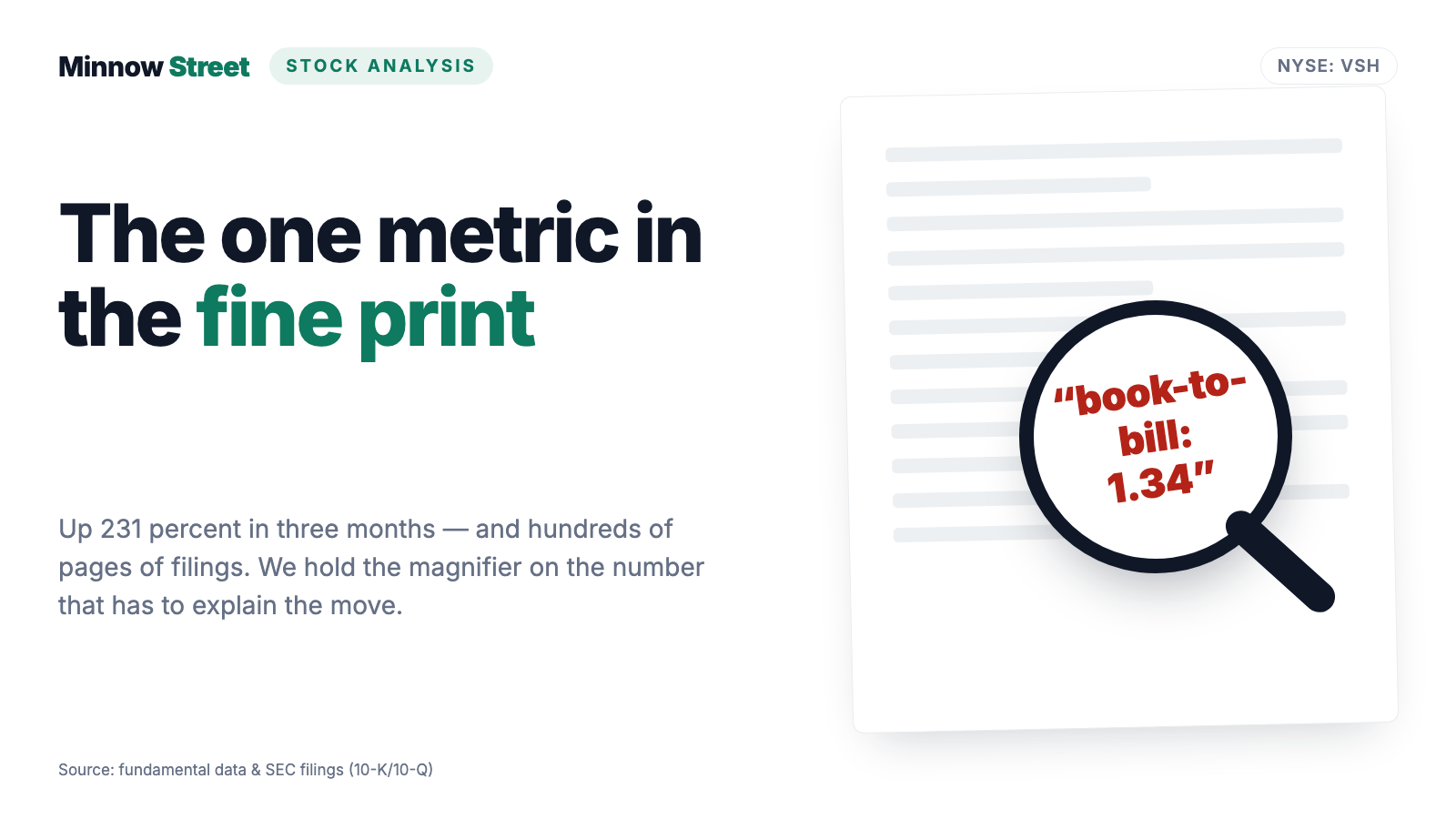
Interactive price chart (TradingView).
Note: pure fact-based analysis, not investment advice and not a solicitation to buy or sell. All figures without guarantee.
There is a moment when an investor turns into a chaser: you open your watchlist, see a stock up 231 percent in three months — and feel your reasoning quietly leave the room while another organ takes over. Behavioral economists call it FOMO, the fear of missing the departing train. In this case the train is called Vishay Intertechnology, Inc. (NYSE: VSH), and it sits at rank 2 of our in-house Qullamaggie Top Gainers 3M scanner (U.S. selection, as of July 18, 2026). So let\'s make a deal before you jump aboard: we read together what the company itself filed, under penalty of law, with the U.S. securities regulator, the SEC — the annual report (10-K) for 2025, the quarterly report (10-Q) as of April 4, 2026, and the current reports from the summer of 2026. Both things are in there: an order book that is genuinely turning, measured by a metric called book-to-bill, now at 1.34. And a company that lost 7 cents per share in its last full year — and promptly used the rally to sell $830 million of its own shares. In the end you decide whether to get on. But with your reasoning back on board.
What Vishay actually does — the grains of rice of electronics
Vishay, incorporated in Delaware in 1962 and headquartered in Malvern, Pennsylvania, is one of the world\'s largest makers of discrete semiconductors and passive components — with about 22,600 employees in plants from Germany and Israel to China and Mexico. In an everyday image: Vishay builds the grains of rice of electronics. Resistors, capacitors, inductors, diodes, MOSFETs (electronic power switches) — parts that often cost cents, but of which every electric car, every industrial robot and every AI server contains hundreds to thousands. Without them, electricity does not flow in orderly paths. The company reports in six segments (MOSFETs, diodes, optoelectronic components, resistors, inductors, capacitors) and sells across virtually every industry: in 2025, $1,088 million of revenue came from automotive, $1,064 million from industrial customers, $314 million from military and aerospace, $152 million from medical — the rest from power supplies, telecommunications, consumer and computing. The whole thing was founded by Dr. Felix Zandman, a Holocaust survivor and materials scientist; today his son Marc Zandman chairs the board as Executive Chairman, and Joel Smejkal has been CEO since 2023.
The growth story is spelled out in the annual report: electrification everywhere — factory automation, electric vehicles, 5G, artificial intelligence, smart grids. The 10-K puts it like this:
"Over the next few years, we expect to experience higher growth rates than over the last decade. This expectation is based upon accelerated electrification, such as factory automation, electrical vehicles, A.I., and 5G infrastructure. We are investing in additional capital expenditures to expand key product lines to increase internal capacity and meet customers' needs."
— Vishay Intertechnology, Inc., SEC annual report 10-K for 2025, Item 7 "Management's Discussion and Analysis"
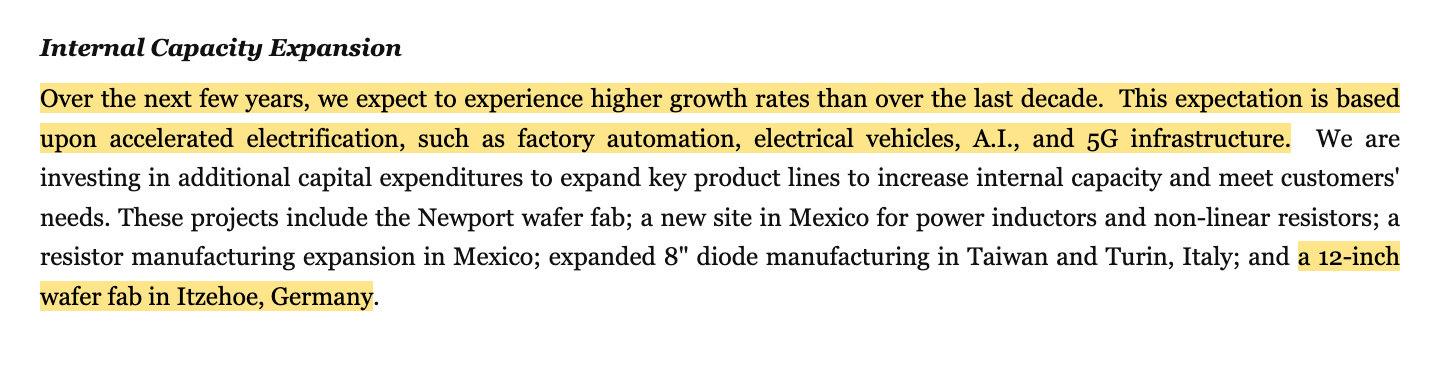
Sounds like the usual megatrend prose? Partly. But Vishay backs it with concrete: a new 12-inch wafer fab in Itzehoe, Germany, the Newport fab in Wales acquired in 2021, new sites in Mexico, expanded diode capacity in Taiwan and Turin. Which brings us to the central tension of this analysis, and it runs through every chapter: the demand turn is real and documented — but the stock has already paid for it three times over, while the income statement has only just reached the zero line.
Where the stock shows up in our scanner
We run roughly 3,500 stocks through our scanners every day. As of July 18, 2026, Vishay ranks no. 2 in the Qullamaggie Top Gainers 3M scanner (U.S. selection). The scanner hunts for what the Swedish trader "Qullamaggie" calls momentum: stocks that rose more in three months than nearly the whole market (relative strength above 98), that move noticeably every day (average daily range of at least 3.5 percent), and in which real money changes hands. Vishay checks those boxes emphatically: up 231 percent in three months, up 278 percent in six, an average daily range around 10 percent and about $386 million of dollar volume per day (all as of July 18, 2026). To replicate it: open the scanner, set the country filter to "US" — Vishay sits near the top. But let\'s also translate the fundamental lens of the same scanner: the Piotroski F-Score (a nine-point test of whether the balance sheet is improving) stands at 7 of 9 for the first quarter of 2026 — a solid direction, not a picture book. The Altman Z-Score around 6.8 (an early-warning gauge for insolvency; historically, trouble starts below 1.8) signals all-clear. And then the price-earnings ratio: it nominally reads above 5,000 — not because the stock costs 5,000 years of profit in any meaningful sense, but because trailing twelve-month earnings are practically zero. Remember the principle: a momentum scanner measures the enthusiasm of buyers — not the quality of the company. Which is exactly why we now read the filings.
The numbers over the years — honestly appraised
First, what genuinely impresses — and this time it is not the past but the turn. Vishay is a cyclical in its purest form: in 2023 the post-Covid boom ran out ($3,402 million of revenue, $323.8 million of net earnings, $2.31 per share), 2024 brought the downswing ($2,938 million of revenue, a $31.2 million net loss), and in 2025 revenue bottomed out at $3,069 million — still with a $9.0 million loss. Since then, revenue has grown four quarters in a row: $715.2M → $762.2M → $790.6M → $800.9M → $839.2 million in the first quarter of 2026 (up 17 percent year over year), gross margin climbed from 19.0 to 21.0 percent, and the bottom line showed $7.2 million of net earnings again ($0.05 per share). That sounds modest — but it is the first genuine earnings upturn in two years. The real signal sits in a metric hardly anyone outside the industry knows:
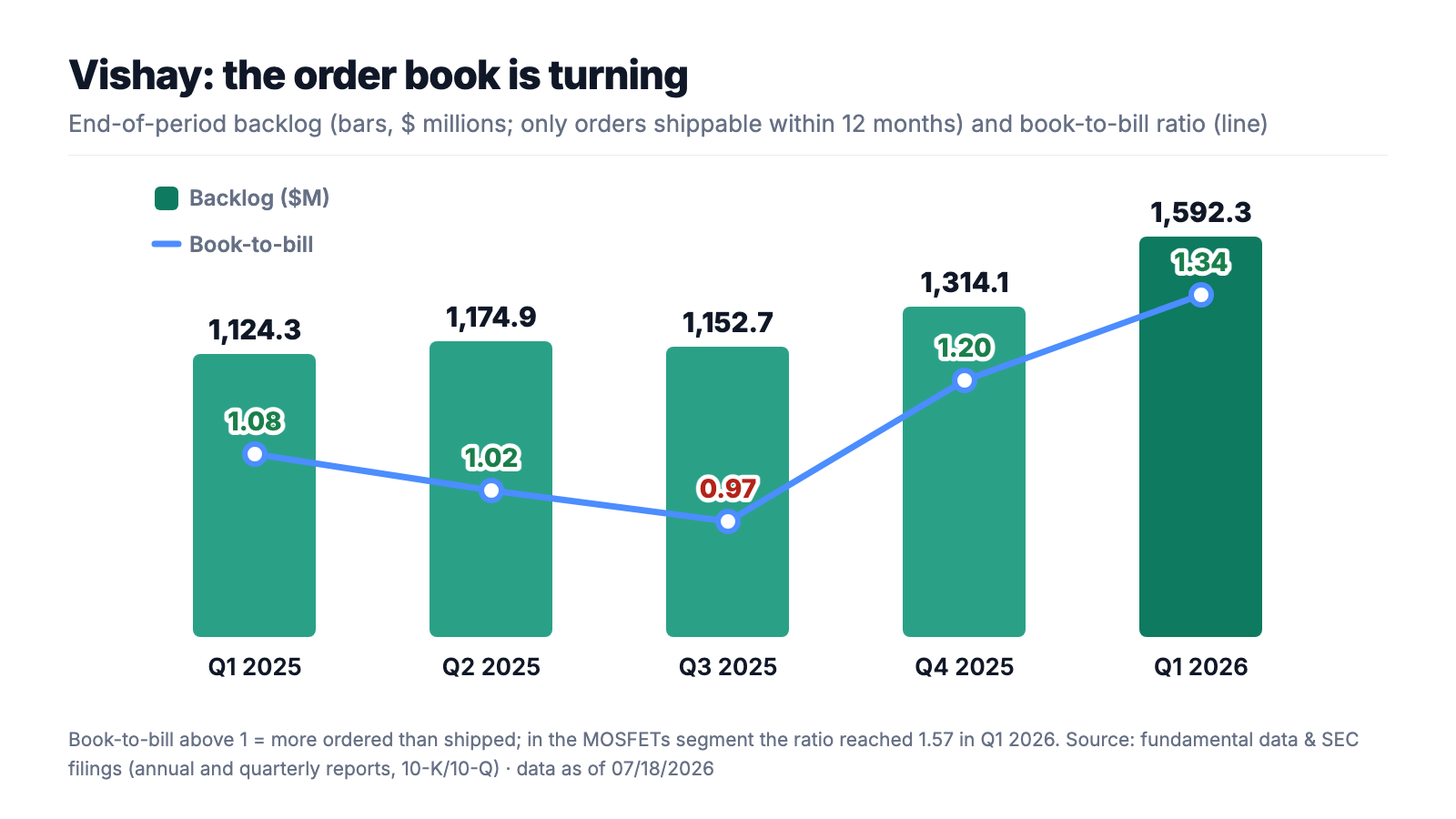
The book-to-bill ratio compares what customers order in a quarter with what the company ships — if more is ordered than shipped, the book fills up. The quarterly report explains the metric best itself:
"An important indicator of demand in our industry is the book-to-bill ratio, which is the ratio of the amount of product ordered during a period as compared with the product that we ship during that period. A book-to-bill ratio that is greater than one indicates that our backlog is building and that we are likely to see increasing revenues in future periods."
— Vishay Intertechnology, Inc., SEC quarterly report 10-Q as of April 4, 2026, Item 2 "Management's Discussion and Analysis" (Financial Metrics)
And this metric tells a clean turnaround story: 1.08 → 1.02 → 0.97 → 1.20 → 1.34 over the last five quarters — in the MOSFETs segment, the heart of power electronics, most recently 1.57. The backlog (Vishay counts only orders scheduled to ship within twelve months) grew in parallel from $1,124.3 million to $1,592.3 million. That is not a story; that is an order book. But pause before the number rush takes over — the annual accounts look like this:
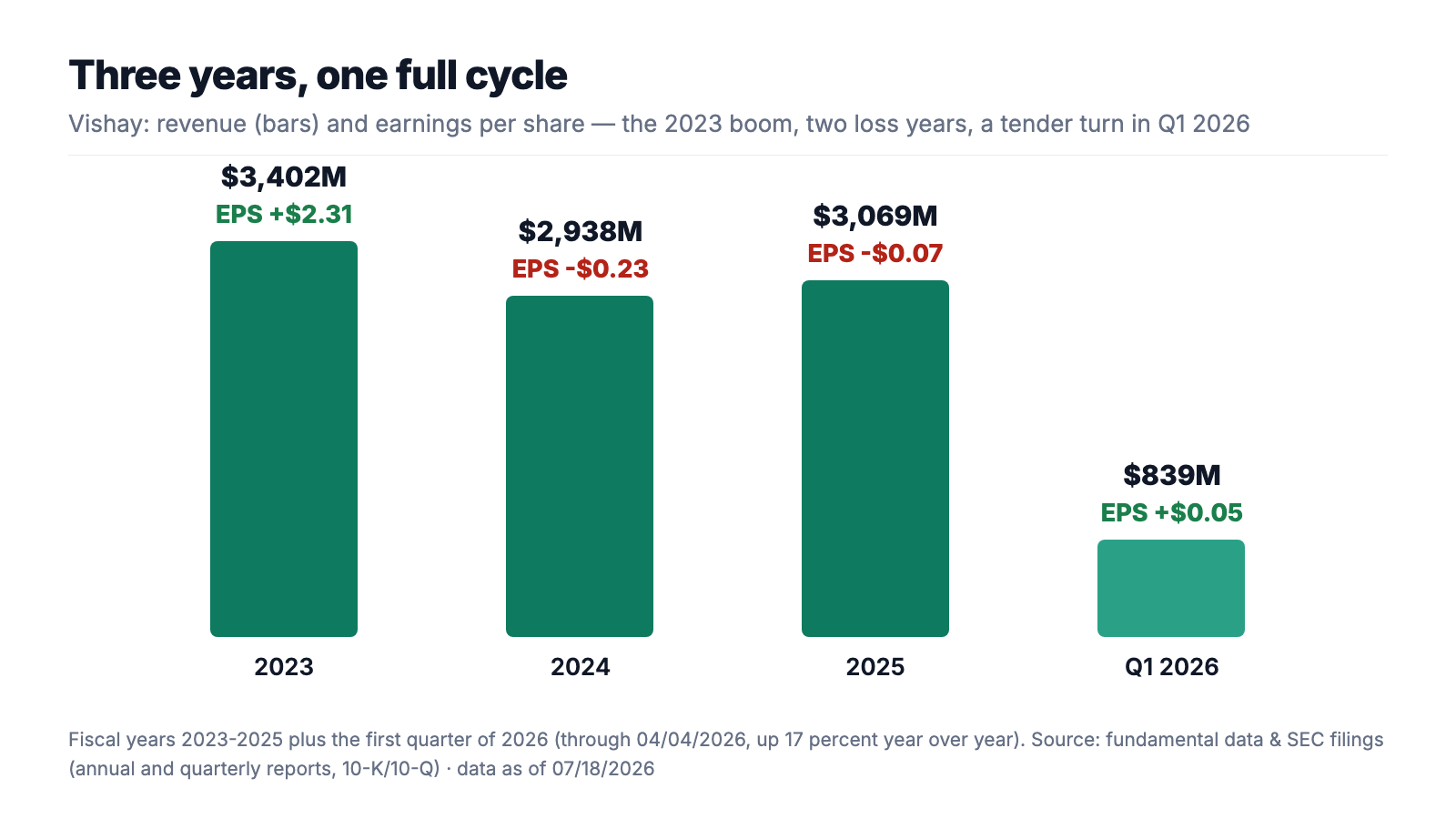
What the filings say — the uncomfortable truths
Uncomfortable truth no. 1: the last full year was a loss year — in the report\'s own words
If you only know the chart, you would assume an earnings explosion behind a 231 percent move. The annual report says otherwise — soberly, and honest under penalty of law:
"Net revenues for the year ended December 31, 2025 were $3.069 billion, compared to net revenues of $2.938 billion and $3.402 billion for the years ended December 31, 2024 and 2023, respectively. The net loss attributable to Vishay stockholders for the year ended December 31, 2025 was $(9.0) million, or $(0.07) per share, compared to a net loss of $(31.2) million, or $(0.23) per share, and net earnings of $323.8 million, or $2.31 per diluted share, for the years ended December 31, 2024 and 2023, respectively."
— Vishay Intertechnology, Inc., SEC annual report 10-K for 2025, Item 7 "Management's Discussion and Analysis" (Financial Overview)
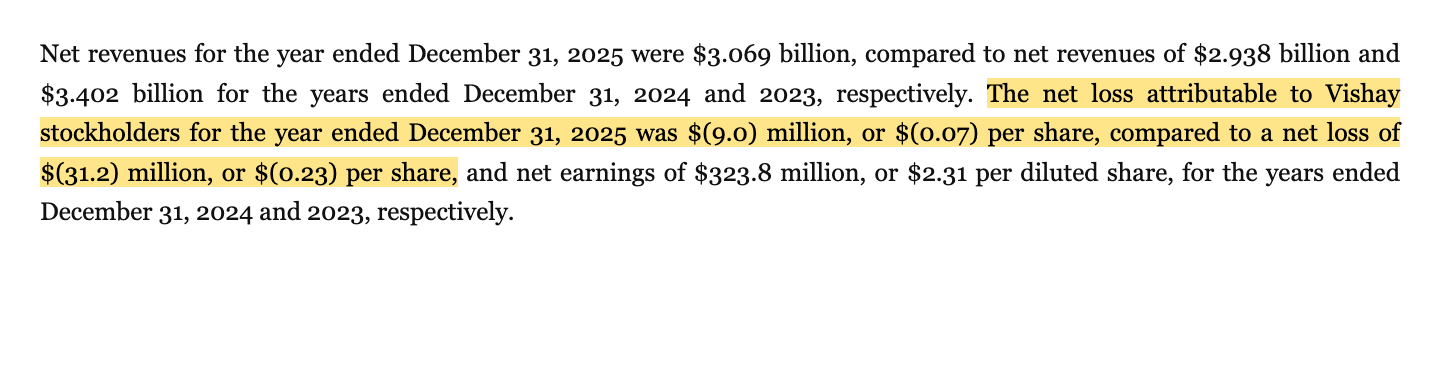
To be fair: the 2025 loss was small (0.3 percent of revenue), the first quarter of 2026 turned positive, and a cyclical will always look loss-ridden at the trough — betting on the turn means buying exactly this picture. But remember the orders of magnitude: between the stock (tripled) and the profit ($7.2 million in a quarter) lies an expectation that still has to be earned.
Uncomfortable truth no. 2: selling prices keep falling — so far this is a volume recovery
In the ideal picture of a semiconductor upturn, volumes and prices rise. At Vishay, only volumes are rising so far. The quarterly report sums up the quarter like this:
"Nearly all key financial metrics increased versus the prior fiscal quarter and the prior year quarter. Net revenues increased versus the prior fiscal quarter and the prior year quarter primarily due to higher sales volume. Margins were positively impacted by higher sales volume and associated manufacturing efficiencies, which offset higher metals and materials costs. Backlog and book-to-bill increased due to higher order volume."
— Vishay Intertechnology, Inc., SEC quarterly report 10-Q as of April 4, 2026, Item 2 "Management's Discussion and Analysis"
What is missing from that list sits two pages further down in the metrics table: average selling prices (including "tariff adders," the tariff surcharges passed on to customers) fell 1.1 percent sequentially in the first quarter of 2026 — and they fell in four of the last five quarters. Translated: Vishay is selling more grains of rice, not more expensive ones. That is typical for the early phase of a cycle (first the fabs fill up, then prices firm) — but it also means the margin lever that is supposed to carry future earnings comes from utilization so far, not from pricing power. Operating margin in the first quarter of 2026: 2.6 percent — for comparison, in the boom year 2023 Vishay earned double digits. A turn in volumes is documented; a turn in prices is, for now, hope.
Uncomfortable truth no. 3: at the top, the company itself sold — 17.25 million new shares at $50
Now to the current report every momentum buyer should know. On June 29, 2026 — the stock had tripled within three months — Vishay signed an underwriting agreement with J.P. Morgan for 15 million new shares at $50.00; the option for another 2.25 million shares was exercised in full a day later. The 8-K quantifies proceeds and purpose:
"The net proceeds from the Offering are expected to be approximately $830.3 million, after deducting underwriting discounts and commissions and estimated offering expenses payable by the Company. The Company intends to use the net proceeds from the Offering to accelerate its growth initiatives and for general corporate purposes, including to reduce current borrowings under its senior secured credit facility."
— Vishay Intertechnology, Inc., SEC current report 8-K dated July 1, 2026, Item 1.01 (Underwriting Agreement)
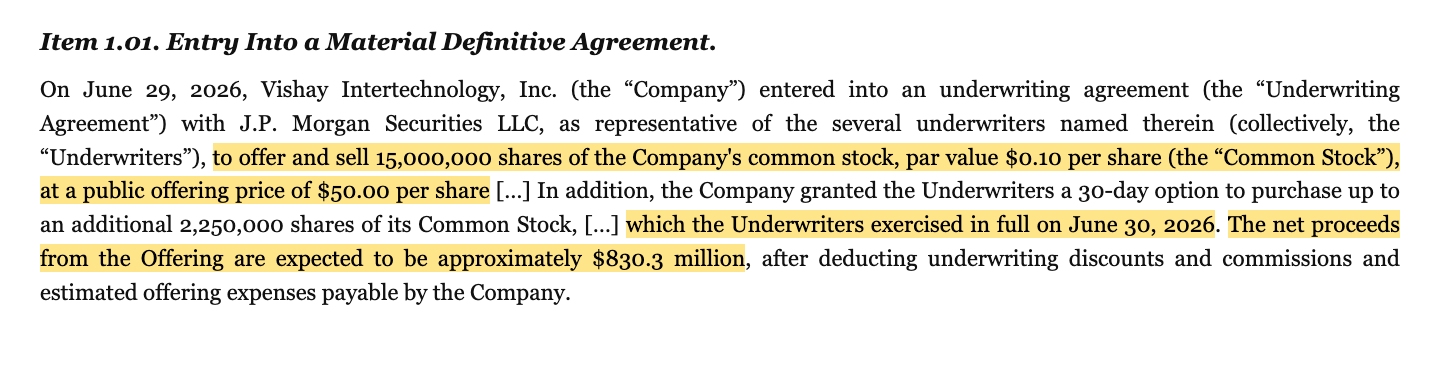
Let\'s file this twice. As corporate finance, it is smart: a company coming off two loss years with a $400 million capex program receives $830 million of equity almost as a gift — at a price unthinkable a year earlier (June 28, 2025: $15.96, documented on the 10-K cover page). For you as a (prospective) shareholder it also means: the share count rose about 13 percent (from roughly 135.8 million to roughly 153 million shares) — your future slice of the pie gets cut correspondingly smaller. And a second source of dilution has joined: because the stock crossed the $39.21 threshold (130 percent of the $30.16 conversion price), the $750 million of 2.25% convertible notes have been convertible at the holders\' option since July 6, 2026. Vishay must settle the principal in cash, and capped call transactions dampen part of the effect — but the value above par can be settled in shares, and it grows with every further price increase.
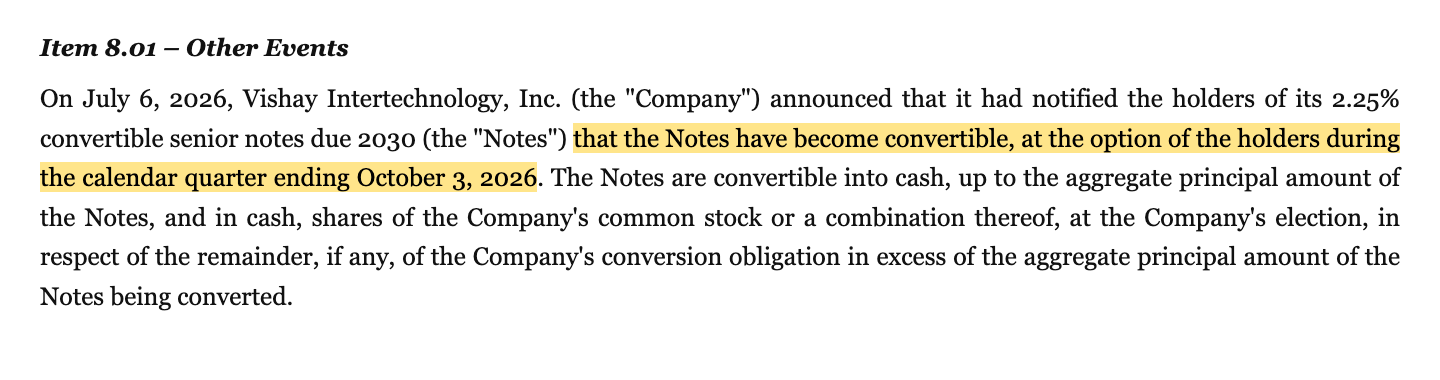
Remember the sentence: growth paid for with fresh shares is never entirely free — and a management that sells at this scale at $50 has told you its opinion of the price without ever naming a target.
Uncomfortable truth no. 4: the factory bet — $400 to $440 million of capex on negative free cash flow
Where the fresh money goes is also in the quarterly report:
"For 2026, we plan to spend between $400 million to $440 million for capital expenditures, approximately half of which will be invested in our 12-inch wafer fab we are building in Itzehoe, Germany."
— Vishay Intertechnology, Inc., SEC quarterly report 10-Q as of April 4, 2026, Item 2 "Management's Discussion and Analysis" (Liquidity)
A 12-inch fab in northern Germany, expansions in Mexico, Taiwan and Italy — Vishay is building capacity for the electrification decade, counter-cyclically, straight out of the downturn. That is entrepreneurially bold and explains the offering. But you should know the financing math: in the first quarter of 2026 Vishay generated $63.7 million of operating cash flow — and invested more than $110 million; free cash flow came to roughly negative $47 million. Cash melted from $515.0 million to $479.4 million in three months, the revolver was drawn by another $31 million (all before the offering), and long-term debt stood at $969 million at the end of 2025. At the same time Vishay keeps paying a $0.10 quarterly dividend (about $13.6 million per quarter) and commits to returning at least 70 percent of free cash flow to shareholders. Add a concentration no chart shows: Vishay has manufactured in Israel for 55 years — with about 2,000 employees and key plants in Dimona, Migdal Ha\'Emek and Be\'er Sheva; the annual report names the risk openly: "our financial condition and results of operations might be adversely affected if events were to occur in the Middle East that interfered with our operations in Israel" (10-K 2025, Item 1A). The bet reads: first the concrete, then the margin — and in between lies the cycle.
Valuation: what the market pays for the turn
Now to the price tag — deliberately in orders of magnitude, never day-sharp. As of July 18, 2026, the market values Vishay at about $8.9 billion — after the offering, roughly 2.8 times 2025 revenue and about 3.7 times book value. A trailing price-earnings ratio cannot seriously be computed (nominally above 5,000, because trailing earnings hover around zero). So let\'s price the expectation instead: the four analysts covered by our data provider credit Vishay with about $0.75 of earnings per share for the current year and about $1.54 for the following year — at the $50.00 offering price that equals 66 and 32 times, respectively; at the current valuation, more. For calibration: in the last boom year, 2023, Vishay earned $2.31 per share — on that, the valuation would be a 25 multiple, albeit on a share count now 13 percent larger. Translated: the market is already paying for the next boom — including the assumption that it will be bigger than the last one. How capital-hungry the AI build-out is that Vishay is supposed to benefit from, we dissected from the other side in our Nvidia analysis — and from the power-supply angle in our Caterpillar analysis; Vishay is the penny-part supplier at the end of that chain, not the price setter. One governance footnote for the price tag: the founding Zandman family\'s Class B shares carry ten votes each, giving the family about 35 percent of the voting power. A takeover premium of the kind semiconductor shareholders sometimes enjoy elsewhere is effectively off the table against the family\'s will.
Opportunities and risks at a glance
What speaks for Vishay:
- A documented demand turn: book-to-bill of 1.34 (MOSFETs 1.57) in the first quarter of 2026, backlog up 42 percent within five quarters to $1,592.3 million, revenue rising four quarters in a row (up 17 percent in Q1 2026).
- Structural tailwind: electrification, factory automation, AI and 5G infrastructure drive demand for power electronics — per the 10-K, Vishay expects "higher growth rates than over the last decade" and is genuinely adding capacity in Itzehoe (12-inch), Newport, Mexico, Taiwan and Turin.
- Breadth instead of concentration: six product segments, end markets from automotive ($1,088 million in 2025) and industrial ($1,064 million) to military/aerospace and medical — no single customer dominates.
- A freshly filled war chest: about $830.3 million of net offering proceeds (July 2026) on top of $479.4 million of cash (April 4, 2026) — the capex program is funded; Piotroski F-Score 7 of 9, Altman Z around 6.8.
What speaks against it:
- The stock paid for the turn three times over before it reached the income statement: 2025 was a loss year (-$0.07 per share), Q1 2026 earned just $0.05 — the roughly $8.9 billion valuation (July 18, 2026) already assumes the next boom.
- Dilution from two sides: 17.25 million new shares at $50.00 (share count up about 13 percent) plus the $750 million convertible note, convertible since July 6, 2026 (conversion price $30.16).
- Falling selling prices: ASPs down 1.1 percent sequentially in Q1 2026 — a volume recovery so far; operating margin only 2.6 percent (double digits in the 2023 boom).
- A capital-intensive bet against the cycle: $400-440 million of 2026 capex on negative free cash flow (Q1: about -$47 million); plus $969 million of long-term debt (December 31, 2025).
- Concentrations beyond the customer list: 55 years of manufacturing in Israel (about 2,000 employees, three key plants) as a geopolitical risk per the 10-K; Class B shares with ten votes each give the founding family about 35 percent of the votes.
- Momentum is not a one-way street: an average daily range around 10 percent — the same volatility that earned the scanner rank works just as hard on the way down.
A human conclusion
Back to the departing train. The treacherous thing about FOMO is not that it is always wrong — sometimes the train really does travel far. At Vishay the freight is even real: a book-to-bill of 1.34 is not an opinion but an order book; the electrification demand sits in the filings, not just the headlines; and a company that raises $830 million of equity at record prices right out of a cyclical trough is doing sound work. But the SEC file also shows the other half: a loss in the last full year, falling selling prices, a 2.6 percent operating margin, a share count 13 percent larger, and a convertible note whose claims grow with every further rally. The train is moving — the question is how much fare you pay for the remaining distance. At the $50 offering price, institutional buyers accepted 66 times the earnings expected for 2026; the seller was the company itself. If you board, do it not because the platform is shaking, but because you will check three numbers yourself from now on: the book-to-bill ratio (does it stay above one?), average selling prices (do they finally turn?), and the operating margin on its way back toward double digits. All three appear in every quarterly report, four times a year, free of charge. What you make of it is your decision. And that is exactly as it should be.
Sources
All original documents used in this analysis — for your own reading:
- Vishay Intertechnology, Inc. — SEC annual report 10-K for 2025 (filed February 13, 2026)
- Vishay Intertechnology, Inc. — SEC annual report 10-K for 2024 (filed February 14, 2025)
- Vishay Intertechnology, Inc. — SEC quarterly report 10-Q as of April 4, 2026 (filed May 13, 2026)
- Vishay Intertechnology, Inc. — SEC current report 8-K dated July 1, 2026 (equity offering: 15.0 + 2.25 million shares at $50.00, net proceeds ~$830.3 million)
- Vishay Intertechnology, Inc. — SEC current report 8-K dated July 6, 2026 (2.25% convertible notes due 2030 convertible)
- Vishay Intertechnology, Inc. — SEC current report 8-K dated January 9, 2026 (auditor change: Deloitte succeeds Ernst & Young)
- Vishay\'s complete SEC filing history: EDGAR overview (sec.gov)
- Fundamental data (metrics, quarterly series, valuation; data as of July 18, 2026), cross-checked against the SEC filings.
- Screener and rating data: our in-house stock scanner (data as of July 18, 2026), including the Qullamaggie Top Gainers 3M scanner (U.S. selection, rank 2).
Transparency & disclaimer: This analysis is a journalistic contextualization of publicly available information and is not investment advice, not a financial analysis in the regulatory sense, and not a solicitation to buy or sell securities. Stock investments carry substantial risks up to and including total loss. All information without guarantee; the data cut-off is noted in the text. The author holds no position in Vishay shares at the time of publication.
Our Bottom Line at a Glance
- Order book & demand turn positive
- Book-to-bill from 0.97 (Q3 2025) through 1.20 (Q4 2025) to 1.34 in Q1 2026, 1.57 in the MOSFETs segment; backlog up from $1,124.3 million to $1,592.3 million within five quarters (+42 percent); revenue rising four quarters in a row, up 17 percent in Q1 2026 (10-Q as of 04/04/2026).
- Structural growth & capacity build-out positive
- The 10-K 2025 expects "higher growth rates than over the last decade" on electrification, factory automation, AI and 5G infrastructure; backed in concrete by $400-440 million of 2026 capex, about half for the 12-inch wafer fab in Itzehoe, plus expansions in Newport, Mexico, Taiwan and Turin.
- Profitability negative
- 2025 was a loss year (-$9.0 million or -$0.07 per share, after -$31.2 million in 2024); Q1 2026 earned just $7.2 million ($0.05) at a 2.6 percent operating margin; selling prices kept falling (ASP -1.1 percent sequentially) — a volume recovery so far (10-K 2025; 10-Q as of 04/04/2026).
- Dilution & capital measures negative
- 17.25 million new shares sold at $50.00 (net ~$830.3 million; share count +13 percent, 8-K dated 07/01/2026); the $750 million convertible note (conversion price $30.16) has been convertible since 07/06/2026 — cash settlement of principal and capped calls dampen, but do not remove, the overhang (8-K dated 07/06/2026).
- Balance sheet & funding neutral
- Cash of $479.4 million (04/04/2026) plus ~$830.3 million of offering proceeds against $969 million of long-term debt (12/31/2025) and negative Q1 free cash flow (~-$47 million on the capex program); Piotroski 7 of 9, Altman Z around 6.8 — solid, but in investment mode.
- Valuation & governance negative
- About $8.9 billion of market value (07/18/2026) at ~2.8 times revenue with earnings near zero; even the $50.00 offering price equaled 66 times the 2026 and 32 times the 2027 analyst estimate (n=4); Class B shares with ten votes each give the founding family ~35 percent of the votes — a takeover premium is effectively off the table (10-K 2025).
Vishay is the rare momentum case in which the fundamentals genuinely turn: book-to-bill of 1.34, an order book up 42 percent, four growth quarters in a row, and a counter-cyclical investment program funded with $830 million of fresh equity. Against that stand a 2025 loss year, falling selling prices, a 2.6 percent operating margin, a share count diluted by 13 percent plus an armed convertible — and a valuation that already prices the next boom in full. Whoever buys here buys the continuation of the turn at the price of its completion. Not investment advice.
What Our Rating Means
- If you don't own the stock
- As long as the question raised in the bottom line stays open, we see no basis for an entry.
- If you hold it in your portfolio
- Our findings offer no acute reason to sell — the checkpoints named remain decisive.
A journalistic assessment by our editorial team at the time of the deep dive, based on public sources — not investment advice and not a solicitation to buy or sell. Your personal circumstances (investment goals, risk capacity, taxes) cannot be taken into account. What our categories mean, how verdicts are formed, and what conflicts of interest exist →
Worth Noting
- VSH reached our research list as rank 2 of our in-house Qullamaggie Top Gainers 3M scanner (U.S. selection, as of July 18, 2026) — part of our series on the hits of this momentum scanner.
- Scanner metrics (including +231 percent in three months, average daily range ~10 percent, ~$386 million of daily dollar volume, Piotroski 7/9) carry the July 18, 2026 data cut-off; price anchors are exclusively SEC-documented ($15.96 on June 28, 2025 per the 10-K cover; $50.00 offering price per the 8-K dated July 1, 2026).
- The market value figure (~$8.9 billion) comes from the July 18, 2026 data feed, sanity-checked against ~153 million shares after the offering; analyses are evergreen, daily prices are not a buy argument.
Frequently Asked Questions
Vishay Intertechnology, Inc. (NYSE: VSH, Malvern, Pennsylvania, about 22,600 employees) manufactures discrete semiconductors (MOSFETs, diodes, optoelectronics) and passive components (resistors, inductors, capacitors). In 2025 the company generated $3,069 million of revenue — the largest end markets were automotive ($1,088 million) and industrial ($1,064 million), followed by military/aerospace, medical, power supplies, telecommunications and computing.
As of July 18, 2026, the stock ranked no. 2 in our Qullamaggie Top Gainers 3M scanner with a gain of 231 percent in three months. The fundamental backdrop per the SEC filings: the book-to-bill ratio jumped from 0.97 (Q3 2025) to 1.34 in the first quarter of 2026, the backlog grew from $1,124.3 million to $1,592.3 million within five quarters, and revenue rose four quarters in a row — carried by electrification, industrial demand and AI infrastructure.
The book-to-bill ratio compares products ordered in a quarter with products shipped. A value above one means customers are ordering more than the company delivers — the order book fills, and future revenues are likely to rise. Vishay reported 1.34 company-wide for the first quarter of 2026, 1.57 in the MOSFETs segment — after 0.97 in the third quarter of 2025. Note that the metric measures volumes, not prices.
Barely, and only again as of recently: 2025 closed with a net loss of $9.0 million (-$0.07 per share), 2024 with a loss of $31.2 million. In the first quarter of 2026 the bottom line turned to $7.2 million of net earnings ($0.05 per share) on $839.2 million of revenue and a 21.0 percent gross margin. For comparison: in the boom year 2023, Vishay earned $323.8 million ($2.31 per share) — the cycle swings through in full here.
On June 29-30, 2026, Vishay sold a total of 17.25 million new shares at $50.00 and collected about $830.3 million net — for growth investments and to pay down its credit facility. The share count rose about 13 percent to roughly 153 million shares, diluting existing holders accordingly. In addition, the $750 million convertible note (conversion price $30.16) has been convertible at the holders' option since July 6, 2026.
As of July 18, 2026, the market value stood around $8.9 billion — roughly 2.8 times 2025 revenue and 3.7 times book value. A trailing P/E is meaningless (earnings near zero). Priced on analyst estimates ($0.75 of earnings per share for 2026, $1.54 for 2027, four analysts), even the $50.00 offering price equaled 66 and 32 times, respectively — the market is paying for the next boom before it has arrived.
Found an error?
Did you spot a factual error, an outdated number, or a typo in this deep dive? Let us know briefly — your report goes straight to the editorial team.