Lattice Stock: A $21 Billion Market Cap on $3 Million of Profit — Anatomy of an AI Comeback
Lattice Semiconductor builds small, low-power FPGA logic chips that can be reprogrammed after they ship — and lights up 22 filters across the momentum and stage-2 screens of our in-house stock scanner (data as of July 17, 2026). We read the annual reports (10-K) for fiscal years 2024 and 2025, the quarterly report (10-Q) as of April 4, 2026, and the latest current reports (8-K): minus 31 percent in the 2024 inventory hangover, plus 42 percent in the latest quarter, 64 percent of revenue shipped to Greater China, two distributors carrying 69 percent — and a $1.65 billion acquisition for which a debt-free balance sheet taps a $950 million loan. Not investment advice — just the bill for a comeback the market has already declared complete.
 Thomas Mücke
Founder & Publisher
Thomas Mücke
Founder & Publisher
Chart
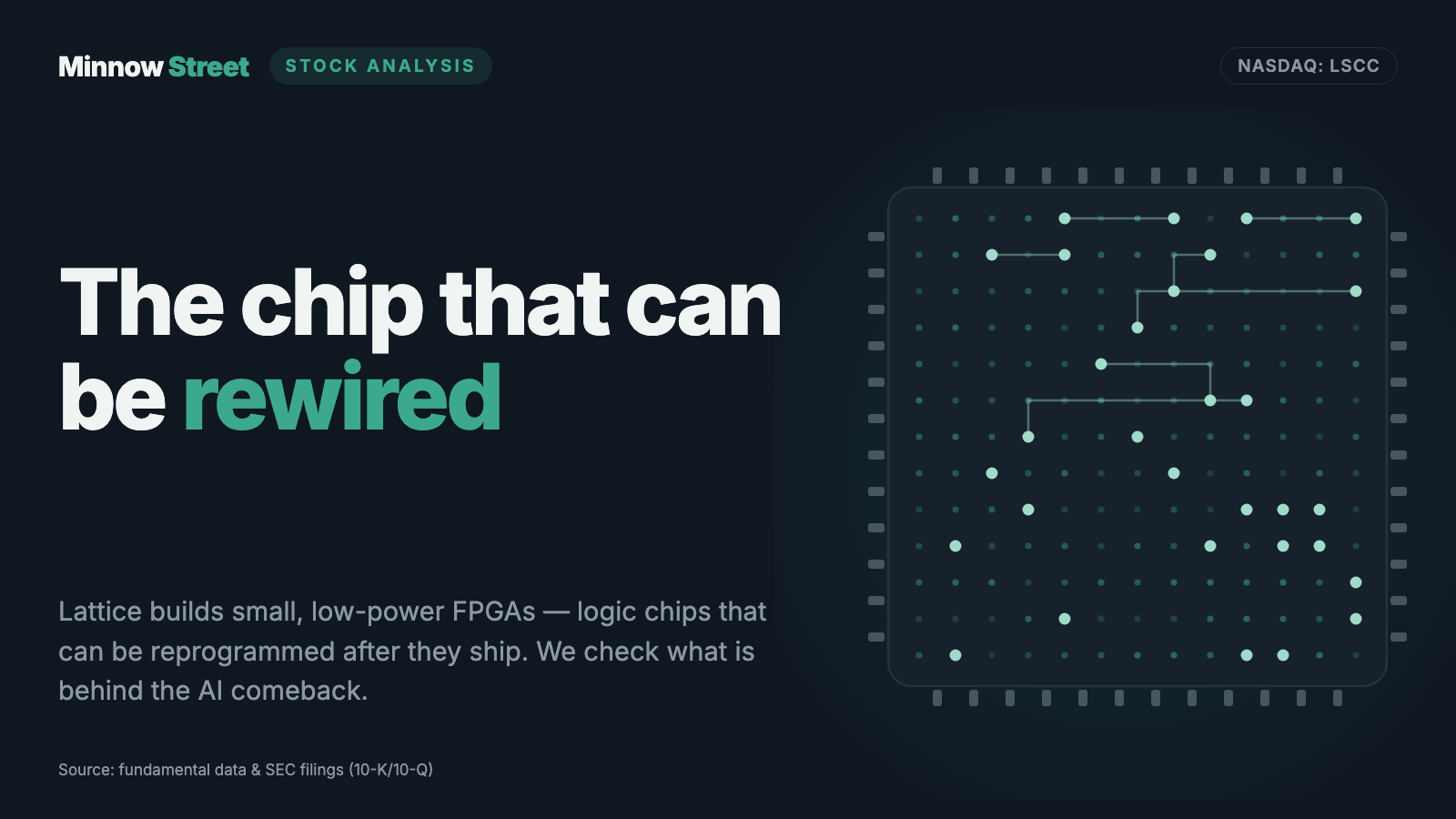
Interactive price chart (TradingView).
Note: pure fact-based analysis, not investment advice and not a solicitation to buy or sell. All figures without guarantee.
There is a moment when a watcher becomes a buyer — and it rarely has anything to do with numbers. You keep a stock on your list for months, it drifts, you wait for the perfect entry. Then it doubles without you. And suddenly a voice whispers: "Jump on before the train is gone for good." Psychologists call this loss aversion in its meanest form — the fear of missing a gain hurts more than an actual loss. In the summer of 2026, hardly any semiconductor stock triggers that platform moment as reliably as Lattice Semiconductor (Nasdaq: LSCC): up 96 percent year to date, just about 7 percent below its all-time high, and lighting up 22 filters in the momentum run of our in-house stock scanner on July 17, 2026 — from the Stan Weinstein stage-2 trend to a relative strength rating of 94. So let’s make a deal: before you jump, we read together what the company itself reported, under penalty of law, to the U.S. securities regulator, the SEC — the annual reports (10-K) for fiscal years 2024 and 2025, the quarterly report (10-Q) as of April 4, 2026, and the latest current reports (8-K). And these filings tell two stories at once: one of a genuine AI comeback — and one of a price that already books that comeback as complete. In the end, you decide for yourself.
What Lattice actually does — and why "rewiring" is meant literally
Lattice builds FPGAs — "field programmable gate arrays." Behind the clunky term sits a charming idea: an ordinary chip is like a circuit printed in concrete — whatever leaves the factory can never become anything else. An FPGA, by contrast, is a patch board with millions of movable wires: the customer can rewire the logic in software after the chip has shipped, as often as they like. That makes FPGAs the tool of choice for everything that changes faster than custom chips can be designed — and Lattice has specialized in the small, low-power corner of the market: its chips are rarely the star of the server, but the companion chip beside it, supervising power delivery, securing firmware, translating signals and making sure nothing tampered-with boots at startup. Per the annual report (10-K) for fiscal 2025, customers sit in two large end-market groups: Compute and Communications (data centers, servers, networking) and Industrial and Embedded — from robots to automotive electronics; an IP licensing business rides along. Lattice is fabless, manufacturing through contract foundries in Asia; as of January 3, 2026, the company had 1,174 employees, headquartered in Hillsboro, Oregon, and led by CEO Ford Tamer. One calendar warning up front, because it trips up every casual reader: Lattice’s fiscal year ends in early January — "fiscal 2025" ran 53 weeks through January 3, 2026, and the "first quarter of fiscal 2026" ended April 4, 2026. Which brings us to the central tension of this analysis, and it runs through every chapter: the AI comeback is real and accelerating — but the market already prices it as finished, and it hangs on Greater China, two middlemen and a loan-funded acquisition. How an inventory hangover can send a whole supplier industry into the basement is something we dissected at Clearfield (fiber connectivity hardware) — and what customer concentration does to a hot AI story, in our Nvidia analysis.
Where the stock shows up in our scanner
Every day we run about 3,500 stocks through our scanners. Lattice did not reach the research list through headlines but through sheer mass: 22 hits in the run of July 17, 2026 — one of the broadest confluences the scanner currently shows. The momentum side is unanimously bullish: a Stan Weinstein stage-2 uptrend, stage-2 leader, RS leader with a relative strength rating of 94 (the stock beat 94 percent of all others), price above the 50- and 200-day lines, Minervini trend criteria met, CANSLIM-type RS — backed by plus 62 percent in three months, plus 92 percent in six and plus 96 percent year to date (data as of July 17, 2026). Notably, the quality screens fire too — quality growth, EPS acceleration, EPS and revenue power — because the earnings growth of recent quarters is genuine. The fundamental lens of the very same scanner assigns a grade of B, a Piotroski F-score of 6 of 9 (a nine-point test of the direction of the books — 6 means more metrics improving than deteriorating) and an Altman Z-score around 11 (an early-warning gauge of insolvency risk; the danger zone starts below 1.8 — far away here). So far, so solid. The catch sits in the valuation row of the same table: a price-to-sales ratio around 37 and a trailing GAAP price-to-earnings ratio that is four digits long, because there is barely any GAAP profit in the trailing twelve months. Remember this contrast: the scanner measures how well a stock is running — not how much of the future its price has already consumed.
The numbers over the years — honestly appraised
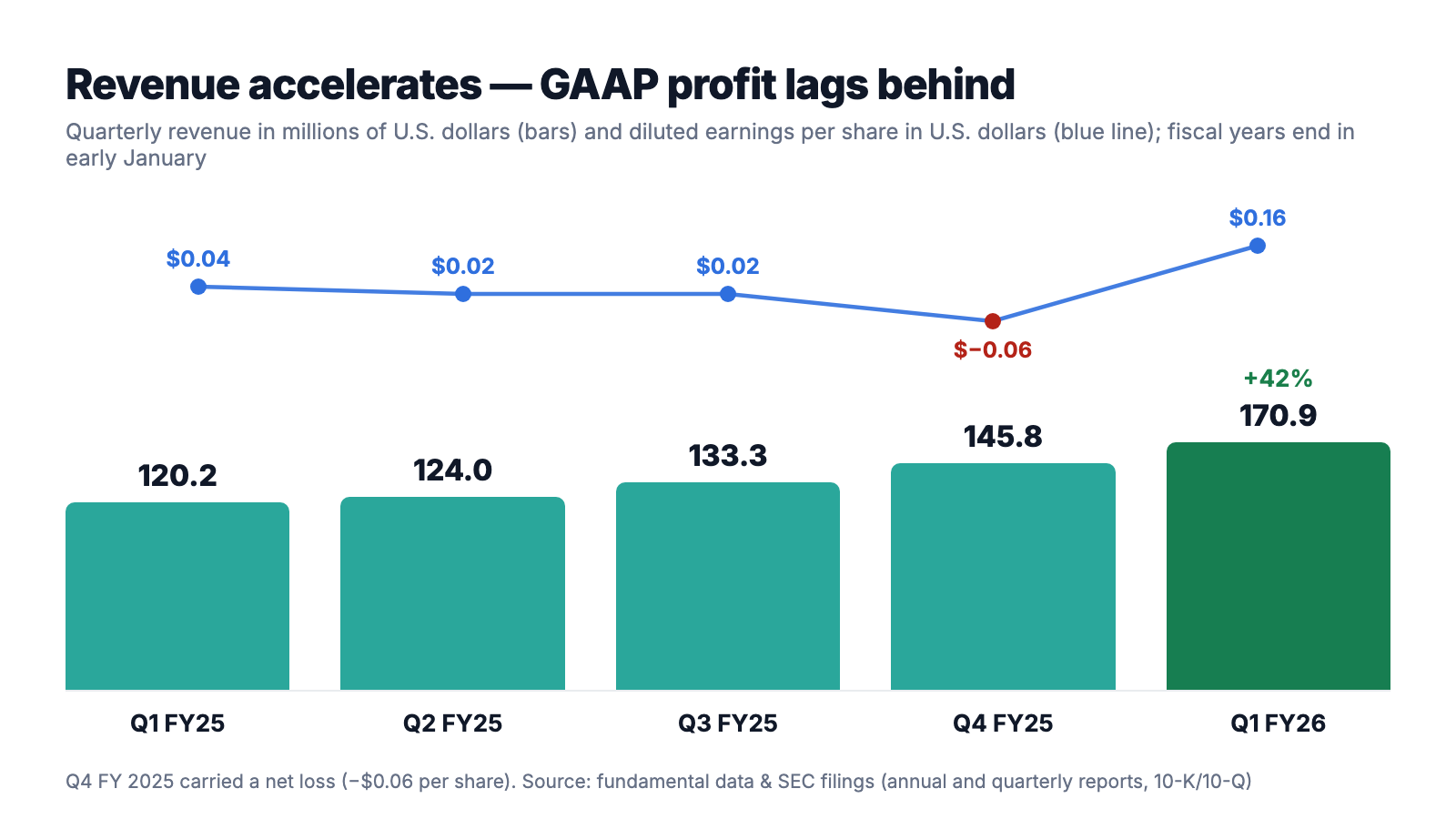
First, what genuinely impresses. Between 2020 and 2023, Lattice showed how to refine a niche business: revenue climbed from $515.3 million in fiscal 2021 through $660.4 million (plus 28 percent) to a record $737.2 million in fiscal 2023, gross margin pushed toward 70 percent — an exclamation mark for a chip maker without its own fabs — and the record year left $259.1 million in net income, a 35.1 percent margin. The present delivers highlights too: in the first quarter of fiscal 2026, revenue jumped 42 percent to $170.9 million, the Compute and Communications end market grew 86 percent, gross margin came in at 68.8 percent, operating income nearly quadrupled to $26.1 million (15.3 percent of revenue), and operating cash flow reached $50.3 million. If you read only these paragraphs, you see a growth company in top form. Now look at the whole mountain:
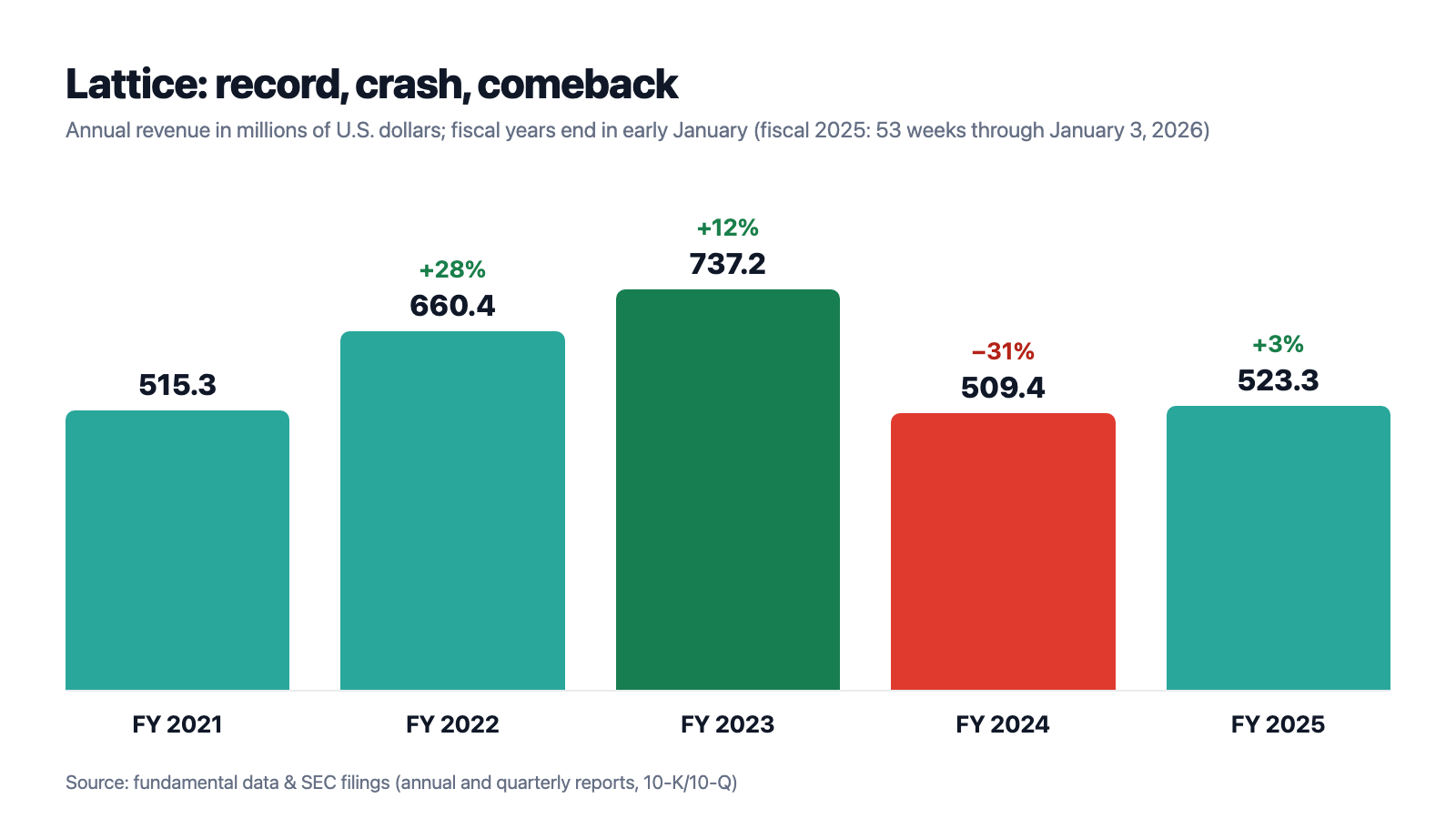
The cut in between was brutal: in fiscal 2024, revenue collapsed 31 percent to $509.4 million, and net income melted from $259.1 million to $61.1 million. Fiscal 2025 brought revenue only 3 percent higher — and the GAAP bottom line kept a meager $3.1 million, a net margin of 0.6 percent. How does that square with a 68 percent gross margin? Lattice raised spending through the downturn instead of cutting: $188.0 million for research and development (35.9 percent of revenue), $153.6 million for selling, general and administrative, restructuring on top — and $116.3 million of stock-based compensation, almost 38 times net income (more on that below). Remember the rhythm: at Lattice, the pace is set by the inventories of customers and distributors — not by the company’s own factory, because there is no own factory. Which brings us to the uncomfortable truths.
What the filings say — the uncomfortable truths
Uncomfortable truth no. 1: The 2024 crash did not come from the demand front — it came out of the customers’ shelves
Why does a chip maker lose nearly a third of its revenue in the middle of the chip decade? The annual report for fiscal 2024 answers with a sentence investors should frame:
"Revenue decreased $227.8 million, or 31%, in fiscal 2024 compared to fiscal 2023, primarily due to softer demand in industrial and automotive applications, telecommunications infrastructure deployments, and from continued inventory normalization by customers."
— Lattice Semiconductor, SEC annual report 10-K for fiscal year 2024, Item 7 "Management’s Discussion and Analysis"

"Inventory normalization" is the semiconductor word for a mechanism every baker knows: in the shortage of 2021/2022, customers and distributors ordered double and triple — once for production, twice for the shelf. When the shortage ended, they lived off those shelves for two years, and the manufacturer watched orders collapse even though end demand never fell 31 percent. Important for your judgment of the present: the same bullwhip that snapped downward in 2024 is now amplifying the upswing — when empty distributor shelves get restocked, the manufacturer’s revenue grows faster than the end market. The latest quarter’s plus 42 percent therefore contains both: genuine AI demand and the refilling of shelves. Notably, the 10-K for fiscal 2025 still cites "continued inventory normalization by customers" as a drag — the correction was not even fully over then.
Uncomfortable truth no. 2: The AI growth has an address — 64 percent of revenue ships to Greater China
The growth engine of the first quarter of fiscal 2026 is described precisely in the quarterly report:
"For the first quarter of fiscal 2026 compared to the first quarter of fiscal 2025, revenue from Asia increased by 71% primarily due to hyperscaler demand, while revenue from the Americas decreased by 37% primarily due to the non-recurrence of certain one-time sales in the prior year period, and revenue from Europe increased by 57% primarily due to broad market recovery in this region."
— Lattice Semiconductor, SEC quarterly report 10-Q as of April 4, 2026, Item 2 "Management’s Discussion and Analysis"
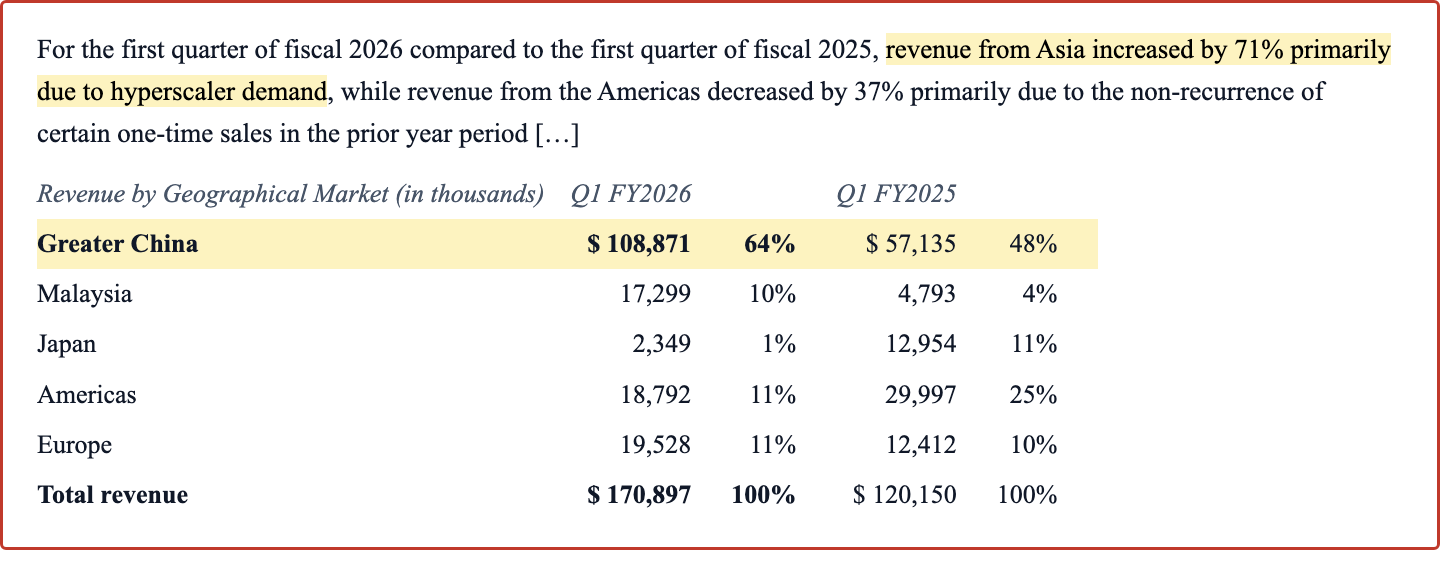
The table beneath the sentence makes the geography of the comeback visible: Greater China at $108.9 million — 64 percent of quarterly revenue, up from 48 percent in the prior-year quarter; for full fiscal 2025 it was 52 percent, and in fiscal 2023 still 32 percent. The share has doubled within two years, while the Americas share shrank to 11 percent. Two qualifications belong here. First: attribution follows the ship-to location — the filing itself notes that goods shipped to Hong Kong may travel onward; part of the "China revenue" is simply the address of contract manufacturers and distributor warehouses whose end customers sit worldwide. Second, though: exactly this supply chain is geopolitics’ point of entry. The risk section of the fiscal 2025 annual report describes the tightened U.S. export controls and adds drily: "In many cases, specific export licensing will be required and these licenses are subject to a policy of denial. China has responded by implementing additional export controls on products exported from China" (10-K for fiscal year 2025, Item 1A "Risk Factors"). Translated into investor language: the growth that carries this stock runs mostly through the most regulation-threatened trade route in the world. A single new licensing regime — in Washington or Beijing — would not hit some sideshow, but two thirds of revenue.
Uncomfortable truth no. 3: Two middlemen carry 69 percent of revenue — and lately 94 percent ran through distribution
The risk section of the annual report names the second concentration with unusual bluntness:
"We depend on a highly concentrated distribution model to sell our products to end customers, complete order fulfillment, maintain sufficient inventory of our products and provide services to our end customers. In fiscal 2025, revenue attributable to sales to distributors accounted for 84% of our total revenue, and two distributors accounted for approximately 69% of total revenue."
— Lattice Semiconductor, SEC annual report 10-K for fiscal year 2025, Item 1A "Risk Factors"
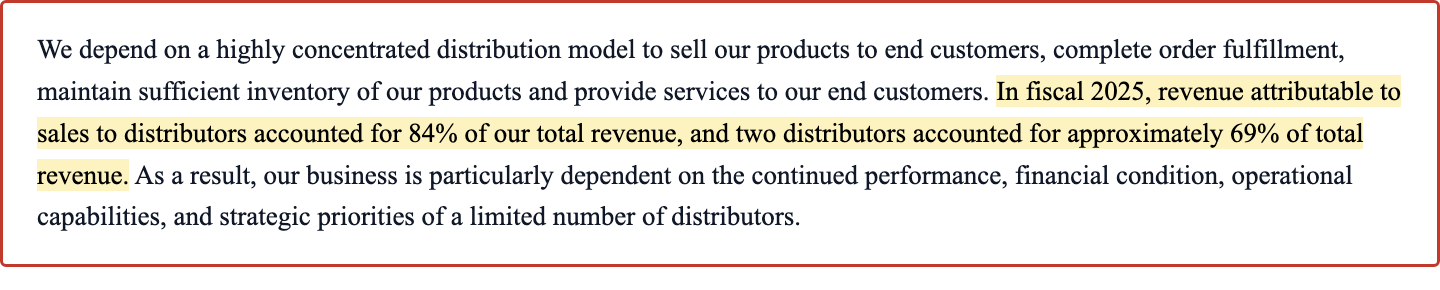
Picture a bakery selling more than two thirds of its rolls through two kiosks — kiosks that maintain enormous shelves of their own. Exactly this construction links truth no. 3 back to no. 1: distributors do not order what end customers buy today, but what they want on the shelf tomorrow. In the first quarter of fiscal 2026, 94 percent of revenue ran through distributors (prior-year quarter: 79 percent) — direct business shrank to 6 percent. You can read efficiency into this: through two large houses, Lattice serves thousands of small end customers it could never reach directly, and concentration is industry-standard in semiconductor distribution. But for the readability of the numbers it means: between Lattice and true end demand stand two balance sheets with their own inventory and ordering cycles. If one of the two distributors rebuilds its shelves — out of caution, because of tariffs, over a terms dispute — you will see it immediately in Lattice’s quarterly numbers and may never learn the reason. The 31 percent crash of 2024 was exactly this mechanism in action.
Uncomfortable truth no. 4: The AMI deal ends the debt-free balance sheet — $1.65 billion for a firmware company, paid with a loan and new shares
On May 4, 2026 — the same day the quarterly report was filed — Lattice announced the largest acquisition in its history. The subsequent-events footnote summarizes the terms:
"[…] the Company will acquire AMI on a cash-free/debt-free basis (the ‘Acquisition’) for total consideration of $1 billion in cash and $650 million in the Company’s common stock, subject to customary adjustments […] the Commitment Parties have committed to provide a senior secured 364-day term loan facility in an aggregate principal amount of up to $950.0 million and a senior secured revolving credit facility in an aggregate principal amount of up to $200.0 million."
— Lattice Semiconductor, SEC quarterly report 10-Q as of April 4, 2026, Note 14 "Subsequent Event"
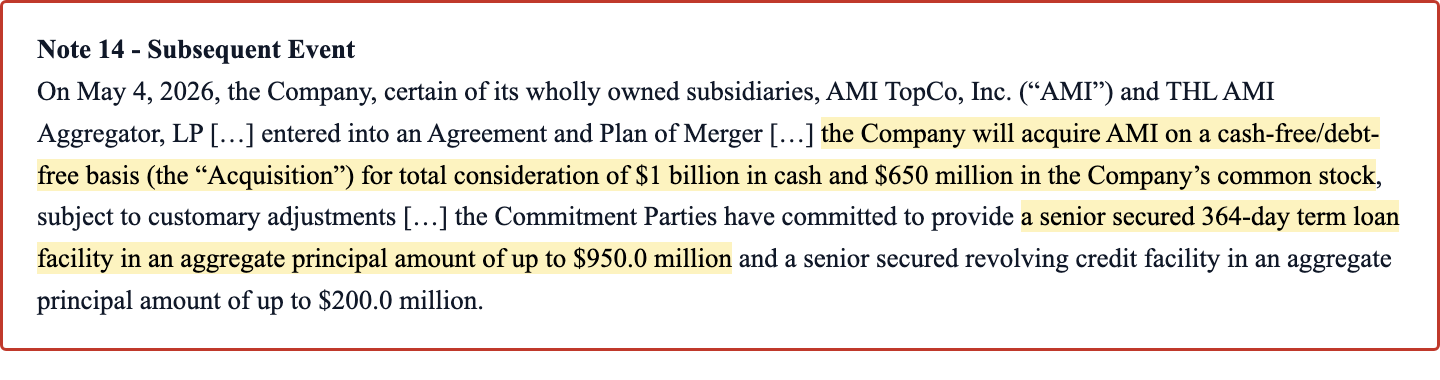
What is Lattice buying? Per the accompanying press release, AMI is "the leader in platform firmware and infrastructure manageability for cloud and AI" — the company behind the software layer that runs beneath the operating system in servers: the code that starts first at power-on, initializes hardware and makes data centers remotely manageable. Strategically, that is coherent: Lattice’s control FPGAs and AMI’s firmware often sit side by side in the same server; together they promise a "complete secure management and control platform," and per the release the deal is expected to double the addressable market and lift the revenue run rate past $1 billion by the fourth quarter of 2026. But the bill deserves a second look. First, the price: AMI is expected to generate "over $200 million in revenue in 2026" — so $1.65 billion is roughly eight times revenue, and the earnings promise ("immediately accretive") explicitly holds only on a non-GAAP basis. Second, the financing: the balance sheet held exactly $140.0 million of cash as of April 4, 2026 — for the billion in cash, a credit agreement followed on June 30, 2026: a term loan of $950 million (drawable until November 9, 2026, maturing June 30, 2031) plus a $200 million revolver; the 364-day bridge from the commitment letter became a five-year amortizing loan. A balance sheet that was debt-free for years takes on a nearly billion-dollar block of debt. Third, the stock component: 5.2 to 6.1 million new shares go mostly to private equity firm THL — with registration rights for two underwritten block trades and transfer restrictions that melt away in 25 percent steps every 90 days. Translated: from closing onward, a parcel becomes free to sell on schedule every three months. No scandal, all disclosed — but a supply overhang with a calendar.
Valuation: The market pays for the comeback as if it were already finished
As of the July 17, 2026 data cut-off, Lattice stock cost about $144, for a market value of roughly $21 billion — just about 7 percent below the all-time high. Put that in proportion: that is about 37 times trailing revenue, roughly 26 times book value, and — because the trailing twelve months hold only a mini-profit — a trailing GAAP price-to-earnings ratio in the four digits. Even a generous advance on the future lands at athletic numbers: if the company reaches the promised $1 billion revenue run rate after the AMI closing, the market still pays about 20 times that revenue today. The 14 analyst estimates see (adjusted) earnings rising by about a quarter next year — even then the valuation stays in a zone where years of flawless growth are already priced in. Add the quiet arithmetic of stock-based compensation: $116.3 million went to employees as equity pay in fiscal 2025 — more than 37 times GAAP net income; the "adjusted" earnings the story runs on book exactly this item away. The counterweight exists: a $250 million buyback program launched in December 2025, of which $15.0 million was spent in the first quarter (165,913 shares at an average of $90.41) — it dampens dilution but does not reverse it, especially with 5.2 to 6.1 million new shares coming for AMI. And the people with the best view inside? 20 insider sales stand against zero purchases, and institutional investors trimmed on balance (6 adding, 12 reducing; data as of July 17, 2026). That proves nothing — profit-taking after a doubling is human. But it fits the picture of a stock whose price runs far ahead of its story.
Opportunities and risks at a glance
What speaks for Lattice:
- The comeback is measurable and accelerating: revenue up 42 percent to $170.9 million in the first quarter of fiscal 2026, Compute and Communications up 86 percent, operating income of $26.1 million (a 15.3 percent margin), $50.3 million in operating cash flow — per the quarterly report, carried by data center demand "including general-purpose and AI-specific servers."
- A structurally attractive business model: fabless, gross margin around 68 percent, niche leadership in small, low-power FPGAs — and AI applications "are pervasive across our end markets" (10-Q), with a growing pipeline of design wins.
- The balance sheet before the AMI closing: $140.0 million in cash, no borrowings, $740.2 million in equity (April 4, 2026), an Altman Z-score around 11, a Piotroski F-score of 6 of 9, a fundamental grade of B (data as of July 17, 2026).
- AMI can enlarge the story: firmware plus control FPGAs from one hand, per the press release a doubling of the addressable market, a revenue run rate above $1 billion targeted by the fourth quarter of 2026, "immediately accretive" on a non-GAAP basis.
- The technicals are flawless: a Stan Weinstein stage-2 trend, an RS rating of 94, price above the 50- and 200-day lines, 22 scanner hits, up 96 percent year to date (data as of July 17, 2026) — plus a $250 million buyback program.
What speaks against it:
- The valuation prepays success: roughly 37 times trailing revenue, a four-digit trailing GAAP price-to-earnings ratio, about 26 times book value (data as of July 17, 2026) — and still about 20 times revenue even on the post-AMI billion-dollar run rate.
- A double concentration: Greater China carried 64 percent of revenue in the latest quarter (and rising), and two distributors combined for roughly 69 percent of fiscal 2025 revenue — both documented in the 10-K/10-Q, both outside Lattice’s control, export-control risk in both directions included.
- The GAAP profit is still missing: $3.1 million of net income in fiscal 2025 against $116.3 million of stock-based compensation; the loss quarter was only two quarters ago (fourth quarter of fiscal 2025: −$0.06 per share).
- The AMI deal brings new burdens: a price of roughly eight times AMI’s revenue, a $950 million term loan on a previously debt-free balance sheet (credit agreement of June 30, 2026), 5.2 to 6.1 million new shares to THL with staggered lock-up releases and two committed block trades — plus integration and approval risk (closing expected in the third quarter of 2026).
- Boom-bust is a system property: minus 31 percent in fiscal 2024 from inventory normalization — the same bullwhip that amplifies the current upswing will snap back at the next overstock; add 20 insider sales against zero purchases (data as of July 17, 2026).
A human conclusion
Back to the platform. The train you see leaving is real — that may be the most important message of this analysis. Lattice is no empty AI label: the growth stands in audited numbers, the margin is first-class, the niche is defended, and the AMI acquisition is no castle in the air but a plausible extension of the very server corner the company already occupies. But the platform question is never "Is the train running?" — it is "What does the ticket cost, and where exactly does it go?" The ticket costs 37 times the revenue of a company whose GAAP profit last fiscal year was $3.1 million. And the route passes through three chokepoints no timetable can argue away: two thirds of revenue shipping through Greater China in an era of wandering export controls, two distributors as the bottleneck between company and end demand, and — from autumn — a block of debt plus THL share parcels that become free to sell quarter by quarter. Whoever buys now is not betting that the comeback arrives — it is here. They are betting that it keeps running flawlessly for years, through every chokepoint. Maybe it will. But the FOMO whisperer on your shoulder should please take note of one thing: the insiders who know this company from the inside sold 20 times into the rally — and bought exactly zero times. You are allowed to be smarter than your impulse — in both directions. What you make of it is your decision. And that is exactly as it should be.
Sources
All original documents used in this analysis — for your own reading:
- Lattice Semiconductor Corporation — SEC annual report 10-K for fiscal year 2025 (53 weeks, ended January 3, 2026; filed February 13, 2026)
- Lattice Semiconductor Corporation — SEC annual report 10-K for fiscal year 2024 (ended December 28, 2024; filed February 14, 2025)
- Lattice Semiconductor Corporation — SEC quarterly report 10-Q as of April 4, 2026 (filed May 4, 2026; Note 14 "Subsequent Event" on the AMI acquisition)
- Lattice Semiconductor Corporation — SEC current report 8-K dated May 4, 2026 (AMI merger agreement, financing commitment, registration rights) including the press release (Exhibit 99.2)
- Lattice Semiconductor Corporation — SEC current report 8-K dated June 30, 2026 (credit agreement: $950 million term loan and $200 million revolver)
- Complete SEC filing history of Lattice Semiconductor: EDGAR overview (sec.gov)
- Fundamental data (metrics, quarterly series, valuation, insider/institutional balances; data as of July 17, 2026), reconciled against the SEC filings.
- Screener and rating data: in-house stock scanner (momentum/stage-2 run of July 17, 2026).
Transparency & disclaimer: This analysis is a journalistic contextualization of publicly available information and is not investment advice, not a financial analysis in the regulatory sense, and not a solicitation to buy or sell securities. Stock investments carry substantial risks up to and including total loss. All information without guarantee; the data cut-off is noted in the text. The author holds no position in Lattice shares at the time of publication.
Our Bottom Line at a Glance
- Growth & comeback positive
- Revenue up 42 percent to $170.9 million in the first quarter of fiscal 2026, Compute and Communications up 86 percent — per the quarterly report (10-Q as of 04/04/2026) carried by data center demand "including general-purpose and AI-specific servers"; operating income $26.1 million (15.3 percent), operating cash flow $50.3 million.
- Quality & balance sheet (pre-AMI) positive
- Fabless with a 68.8 percent gross margin, $140.0 million in cash with no borrowings, $740.2 million in equity (04/04/2026), an Altman Z-score around 11, a Piotroski F-score of 6 of 9, a fundamental grade of B (data as of July 17, 2026) — the substance behind the momentum is real.
- Valuation negative
- Roughly $21 billion of market value for $523.3 million of annual revenue and $3.1 million of GAAP profit: a price-to-sales ratio around 37, a four-digit trailing GAAP P/E, about 26 times book value (data as of July 17, 2026); even on the post-AMI billion-dollar run rate, about 20 times revenue remains — little tolerance for error is priced in, on top of $116.3 million of stock-based compensation in fiscal 2025.
- Concentrations: China & distribution negative
- Greater China at 64 percent of revenue in the first quarter of fiscal 2026 (by ship-to location; fiscal 2023: 32 percent), two distributors at roughly 69 percent in fiscal 2025, distribution share lately 94 percent — the annual report itself warns of export controls in both directions (10-K fiscal 2025, Item 1A; 10-Q Note 3).
- AMI deal & capital structure neutral
- Strategically coherent (firmware plus control FPGAs, per the press release a doubling of the addressable market and a $1 billion+ run rate by Q4 2026), but dearly paid: $1.65 billion for over $200 million of AMI revenue, a $950 million term loan on a previously debt-free balance sheet (credit agreement 06/30/2026), 5.2 to 6.1 million new shares with staggered THL lock-up releases; "immediately accretive" holds only non-GAAP.
Lattice delivers a rare double: a genuinely audited AI comeback (revenue up 42 percent, a 68.8 percent gross margin, cash instead of debt) and, at the same time, a valuation that already books that comeback as complete — 37 times revenue for a company whose fiscal 2025 GAAP profit was $3.1 million. In between lie three chokepoints: 64 percent Greater China, two distributors at 69 percent, and a loan-funded $1.65 billion acquisition with new shares for a private equity firm. Whoever holds the stock holds a strong business at the price of perfection. Not investment advice.
What Our Rating Means
- If you don't own the stock
- As long as the question raised in the bottom line stays open, we see no basis for an entry.
- If you hold it in your portfolio
- Our findings offer no acute reason to sell — the checkpoints named remain decisive.
A journalistic assessment by our editorial team at the time of the deep dive, based on public sources — not investment advice and not a solicitation to buy or sell. Your personal circumstances (investment goals, risk capacity, taxes) cannot be taken into account. What our categories mean, how verdicts are formed, and what conflicts of interest exist →
Worth Noting
- LSCC reached the research list through the momentum/stage-2 run of our in-house stock scanner on July 17, 2026 (22 hits, including Stan Weinstein stage 2, RS leader, Minervini trend criteria) — no Reddit angle; the attention here comes from the price strength itself.
- Scanner metrics (P/S, P/E, Piotroski, Altman Z, fundamental grade) use trailing twelve-month figures; the loss quarter (Q4 fiscal 2025) is included, the hoped-for AMI run rate naturally is not. The eight-times-revenue framing of the AMI price rests on the company’s own forecast of over $200 million of AMI revenue for 2026 (press release of May 4, 2026).
- Price and valuation figures are dated July 17, 2026 (about $144, roughly $21 billion of market value); analyses are evergreen, daily prices are not a buy argument. Lattice’s fiscal year ends in early January — all quarterly figures carry that offset, and fiscal 2025 had 53 weeks.
Frequently Asked Questions
Lattice Semiconductor (Nasdaq: LSCC) of Hillsboro, Oregon, develops small, low-power FPGAs — programmable logic chips that can be reconfigured in software after they ship. They ride along as "companion chips" in servers, networking gear, industrial and automotive electronics, handling control, security and interface tasks. Revenue in fiscal 2025 (53 weeks through January 3, 2026): $523.3 million; the company is fabless and manufactures through contract foundries.
An FPGA ("field programmable gate array") is a logic chip whose circuitry is not burned in: like a patch board with millions of movable wires, it can be "rewired" in software as often as needed after shipping. That makes it ideal for tasks that change faster than custom chips can be designed — such as control, security and signal translation in servers and AI data centers. Lattice is the specialist for small, low-power FPGAs.
Because the business is accelerating again after two crisis years: in the first quarter of fiscal 2026 (through April 4, 2026), revenue grew 42 percent to $170.9 million; the Compute and Communications end market grew 86 percent — per the quarterly report (10-Q), carried by data center demand including AI-specific servers. On top came the AMI acquisition announced May 4, 2026. As of July 17, 2026, the stock stood about 96 percent above its level at the start of the year.
Per the press release of May 4, 2026, AMI is the leader in platform firmware and infrastructure manageability for cloud and AI — software that runs beneath the operating system in servers. Lattice is paying $1.65 billion ($1.0 billion in cash plus roughly $650 million in stock); AMI is expected to generate over $200 million in revenue in 2026. For the cash portion, a credit agreement for a term loan of up to $950 million was signed on June 30, 2026. Closing is expected in the third quarter of 2026.
Heavily, and increasingly: Greater China accounted for 64 percent of revenue in the first quarter of fiscal 2026 (prior-year quarter: 48 percent; full fiscal 2025: 52 percent; fiscal 2023: 32 percent). Attribution follows the ship-to location — part of it is transshipment through distributors and contract manufacturers. At the same time, the annual report (10-K) explicitly warns of U.S. and Chinese export controls as a risk to exactly this supply chain.
By classic yardsticks, very: a market value around $21 billion on $523.3 million of fiscal 2025 revenue — a price-to-sales ratio around 37; the trailing GAAP price-to-earnings ratio is in the four digits because fiscal 2025 net income was only $3.1 million (data as of July 17, 2026). Even against the $1 billion revenue run rate targeted after the AMI acquisition, about 20 times revenue would remain.
Lattice’s fiscal year ends on a Saturday in early January: fiscal 2025 ran 53 weeks through January 3, 2026, and fiscal 2024 ended December 28, 2024. The "first quarter of fiscal 2026" ran through April 4, 2026. Anyone comparing Lattice numbers with calendar-year figures should keep this offset — and the 53rd week in fiscal 2025 — in mind.
Found an error?
Did you spot a factual error, an outdated number, or a typo in this deep dive? Let us know briefly — your report goes straight to the editorial team.