Viasat: The First Operating Profit in Years — and It Covers Less Than a Third of the Interest
Viasat runs 23 satellites, keeps 4,580 commercial aircraft online and sits 11th in our weekly momentum screen. The fiscal 2026 annual report shows the first operating profit in years: $108.1 million. Interest expense in the same year: $360.3 million. And $320.6 million of the $104.8 million in pre-tax income came from two events that will not repeat. We read the filings to see what the business earns once the one-time items are stripped out — and who took a seat at the table in May 2026.
 Thomas Mücke
Founder & Publisher
Thomas Mücke
Founder & Publisher
Chart
Interactive price chart (TradingView).
Note: pure fact-based analysis, not investment advice and not a solicitation to buy or sell. All figures without guarantee.
There is an investor trap that feels exactly like common sense: the "it can only get better" trap. It springs when a stock has fallen for years and then a number appears that is less bad than the last one. Your mind quietly upgrades "less bad" to "good," and "good" becomes a thesis. Viasat (Nasdaq: VSAT) of Carlsbad, California, is that case right now: 23 satellites in orbit, internet on 4,580 commercial aircraft, and a loss per share that has shrunk from $9.12 to $0.25 in two years. So let us make a deal. Before you buy the turnaround, we read together what the company itself told the U.S. securities regulator, the SEC — the annual report (10-K) for fiscal 2026, the quarterly report (10-Q) for the quarter ended December 31, 2025, and everything filed since. An SEC filing is honest under penalty of law. And this one describes an operating profit that does not cover the interest, two one-time items that rescued the year, and an activist investor who has been sitting at the table since May 2026. The decision at the end is yours.
What Viasat actually does — 23 satellites, two very unequal businesses
Viasat is a satellite operator — in everyday terms, a company that puts cell towers in space. A geostationary satellite sits 22,000 miles above the equator, appears motionless in the sky and illuminates an enormous slice of the earth. Anyone underneath with a terminal — on a rooftop, a ship, an aircraft — gets internet, including in places where a cable will never be laid. As of March 31, 2026 the fleet consisted of 23 satellites in service or operational: 13 in Ka-band, eight in L-band (three of them contingency spares), one in S-band and one hybrid. Eight further geostationary satellites were under development or in preparation for launch.
The money comes from two segments, and they are very unequal. Communication services generated $3,299.7 million of revenue in fiscal 2026 — in-flight connectivity for airlines and business jets, government satellite communications, maritime services and fixed broadband for households. The smaller defense and advanced technologies segment produced $1,340.6 million — encryption hardware, tactical networking, cyber defense and satellite work for third parties. A large share goes to the U.S. Department of Defense; the U.S. government accounted for roughly 16 percent of consolidated revenue in fiscal 2026.
One point matters for everything that follows: half of the company you see today was bought. In May 2023 Viasat acquired the British satellite operator Inmarsat — the source of the L-band business, the maritime safety services and a substantial part of the debt. The company is run by Mark Dankberg, co-founder, chairman of the board and chief executive officer. As of March 31, 2026 Viasat employed roughly 7,000 people, 66 percent of them in the United States, including about 3,400 engineers. And here is the central tension of this analysis, which runs through every chapter: the company has turned the corner operationally — but the interest burden from the acquisition, a core business standing still, and two one-time gains sit between the operating profit and a real profit.
How the stock reached our desk — rank 11 in the weekly screen
Viasat did not surface through a press release but through one run of our in-house stock scanner, as of July 25, 2026. In the list Richard Moglen: 1 Week Top Performers (U.S. selection) the stock sat at rank 11 of 28 hits. That list is recomputed daily, so the placement is a snapshot of that day, not a standing state. To repeat the exercise yourself: the screen is open in the scanner overview and sorts by relative strength.
What does the filter actually measure? Three things, all mechanical: a price gain of at least 15 percent over four trading days, average dollar volume of at least 10 million dollars a day and a relative strength rating of at least 70 out of 100. Viasat cleared all three comfortably: average dollar volume ran to roughly $206.9 million (data as of July 24, 2026) and the strength rating stood at 96. Translated and judged: the stock was among the strongest liquid names of that trading week — a rating of 96 means only about 4 percent of all measured stocks moved more over the same period. That is a strong statement about the price. It says nothing about the company. Take the principle with you from the start: a momentum screen is a door opener, not an appraisal.
The numbers across the years — credit where it is due
First the part that genuinely speaks for Viasat, and it is more than the loss line suggests. The slide has stopped. Operating income was minus $889.8 million in fiscal 2024, minus $97.5 million in fiscal 2025 — and plus $108.1 million in fiscal 2026. Revenue grew over the same span from $4,283.8 million through $4,519.6 million to $4,640.3 million. The loss per share shrank from $9.12 through $4.48 to $0.25. And on the cash side it looks better still: operating cash flow rose from $688.2 million (fiscal 2024) through $908.2 million (2025) to $1,589.9 million, while purchases of property, equipment and satellites fell from $1,539.4 million to $992.8 million. That left roughly $597.1 million of free cash flow in fiscal 2026, after minus $122.0 million the year before and minus $851.2 million the year before that.
Debt and interest are falling too. The principal amount of debt dropped from $7.2 billion at March 31, 2025 to $6.6 billion at March 31, 2026, and interest expense from $421.9 million to $360.3 million. Firm backlog stood at $4,072.9 million at March 31, 2026, and new awards for the year came to roughly $4.9 billion after $4.7 billion the year before. This is a company that works — and that has put two very bad years behind it.
What it is not is a company where the profit sits where the revenue sits. The chart below shows segment operating profit across three fiscal years:
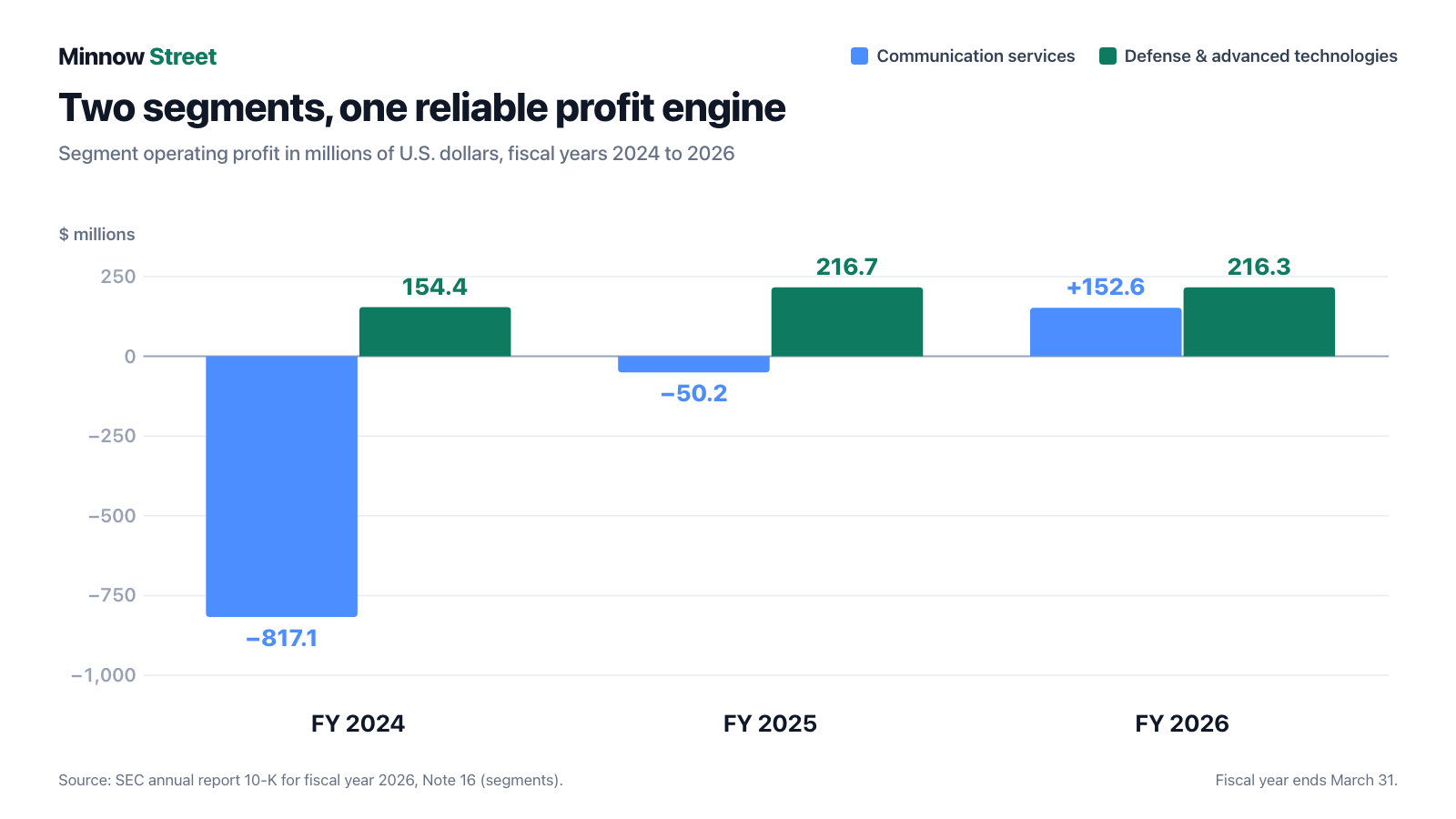
Defense contributes $216.3 million of segment operating profit on 29 percent of consolidated revenue; communication services contributes only $152.6 million on 71 percent of revenue. If you want to know what Viasat reliably earns, look at the smaller half. Which brings us to the uncomfortable truths.
What the filings say — the uncomfortable truths
Uncomfortable truth no. 1: operating income covers 30 percent of the interest
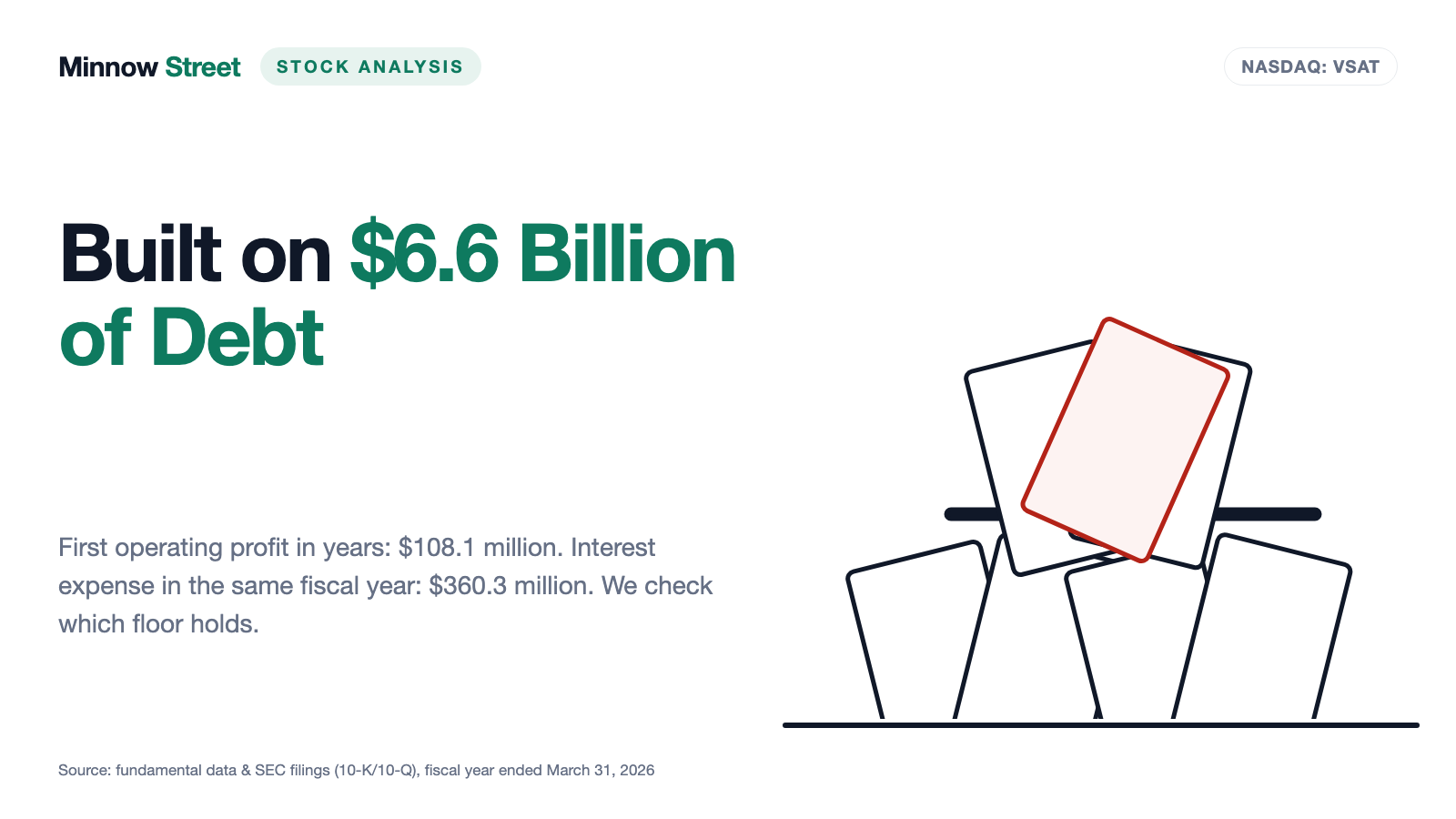
This is the number everything turns on. Against operating income of $108.1 million, fiscal 2026 carried interest expense of $360.3 million. The metric for that is interest coverage, and it answers a simple question: how many times over does the business earn its interest? At Viasat the answer is 0.3 times. In everyday terms: your rent is $1,000 and you earn $300. A genuinely healthy company sits at 5 or above; below 1 a company lives off its cash, off asset sales or off new borrowing. The annual report states the scale itself:
"We have a significant amount of indebtedness. As of March 31, 2026, the aggregate principal amount of our total outstanding indebtedness was $6.6 billion."
— Viasat, Inc., Form 10-K for fiscal 2026, Item 1A Risk Factors

How expensive that money is appears in Note 7. The largest single item is $1.975 billion of secured Inmarsat notes carrying a 9.000 percent coupon, due 2029; the Inmarsat term loan carried an effective rate of 9.11 percent at March 31, 2026. Add $733.4 million at 7.500 percent (2031), $600.0 million at 5.625 percent (2027), $400.0 million at 6.500 percent (2028) and several term loans. The next larger maturity falls in 2027. On liquidity there is relief: $1,746.8 million of cash at March 31, 2026, plus $598.2 million of undrawn Viasat revolver and $550.0 million of undrawn Inmarsat revolver, and all covenants were met at the balance sheet date. An acute liquidity problem looks different. An interest problem looks exactly like this.
Uncomfortable truth no. 2: $320.6 million of pre-tax income came from two events that will not repeat
Pre-tax income for fiscal 2026 was plus $104.8 million, after minus $545.3 million the year before. Now look at what it consists of. First, interest income jumped from $83.9 million to $205.8 million. The reason is in the management discussion — $152.5 million of it comes from the allocation of a $420 million lump sum that Viasat subsidiary Inmarsat received from Ligado Networks in October 2025; the remaining $267.5 million was booked as deferred revenue. Second, the line "other income (expense), net" shows $163.0 million after minus $10.0 million a year earlier. Behind it sits a $168.1 million gain on the sale of the Navarino UK equity stake to a subsidiary of the investment firm ICG, completed in March 2026 for proceeds of $203.0 million.
Run the arithmetic: $152.5 million plus $168.1 million is $320.6 million, against pre-tax income of $104.8 million. Strip both out and the line reads a pre-tax loss of roughly $215.8 million. Both items are real money, both are properly booked, and both are non-recurring: you can sell Navarino only once, and the $420 million from Ligado has landed. What remains is the running Ligado quarterly payment of roughly $16 million with a 3 percent annual escalator — contractually through 2107. In everyday terms: this year you sold your grandmother's car and collected an old debt. Both count. Neither is your salary. And even with those items, Viasat shareholders were left with a loss of $34.1 million — because $38.0 million of the $3.9 million of consolidated net income belonged to the minority holders of a subsidiary.
Uncomfortable truth no. 3: the core business is not growing — it is swapping customers
Communication services generated $3,299.7 million of revenue in fiscal 2026. In fiscal 2025 it was $3,298.5 million. That is a gain of $1.2 million, or 0.04 percent, in a segment that is 71 percent of the company. Underneath that still surface, however, a shift is running that you should see:
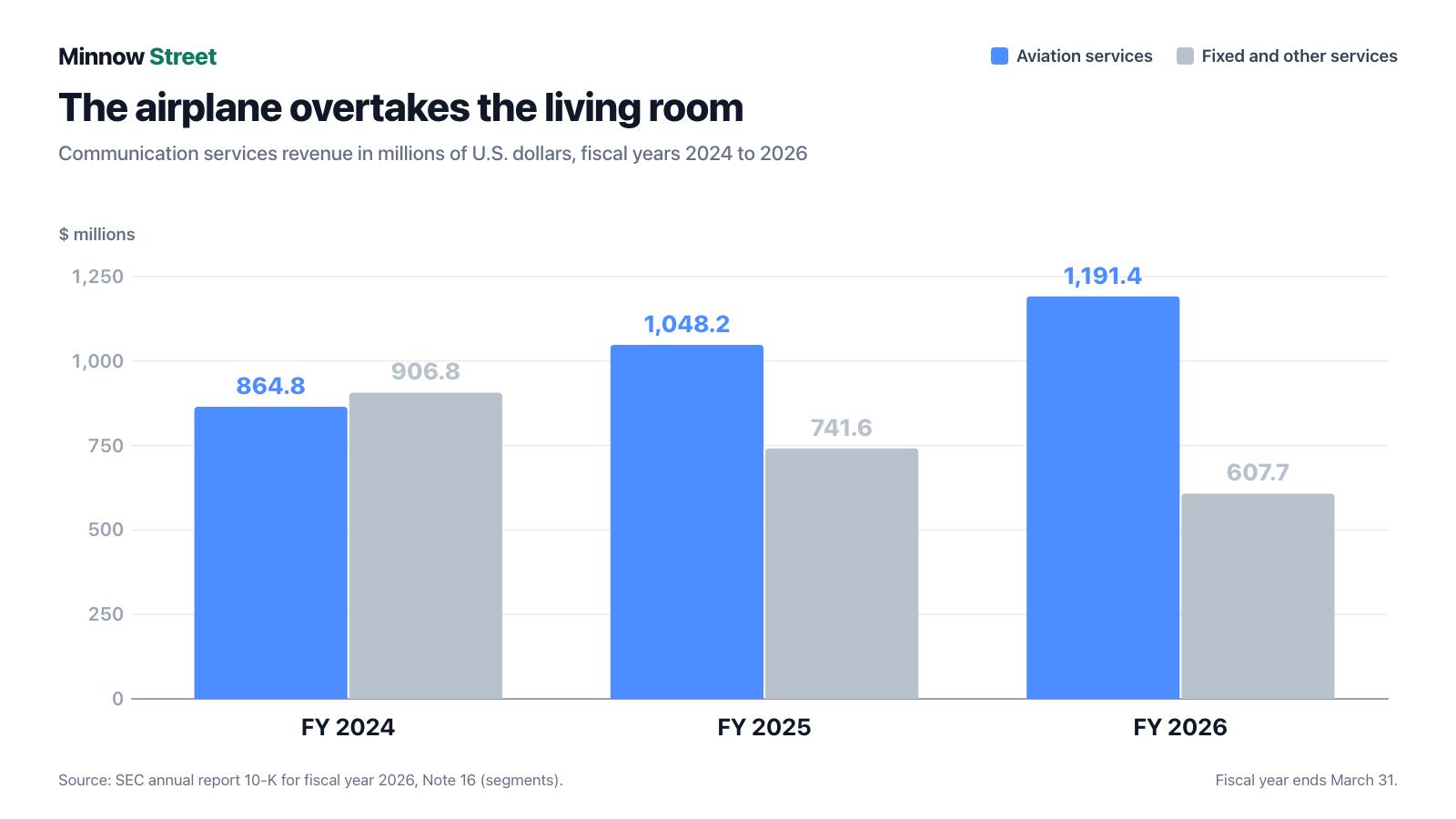
Aviation services grew in two years from $864.8 million through $1,048.2 million to $1,191.4 million, because more and more aircraft fly with Viasat terminals: roughly 4,580 commercial aircraft (about 130 of them temporarily inactive for maintenance) and roughly 2,100 business jets as of March 31, 2026, plus existing commitments for about 1,000 more airframes. Fixed and other services fell over the same period from $906.8 million through $741.6 million to $607.7 million — a decline of 33 percent. In fiscal 2026 alone the drop was $133.9 million, and management attributes it to allocating a greater share of available bandwidth to in-flight connectivity in preference to the U.S. fixed business. As of March 31, 2026 that business still counted roughly 130,000 subscribers at an average monthly revenue per user of $113.
So it is not purely displacement by competitors; part of it is a deliberate reallocation of scarce capacity. That does not change the competitive pressure itself, which the filing lists without decoration:

The risk factors put it even more plainly, and with a name attached:
"For example, the traditional GEO satellite communications industry is experiencing significant disruption from customers' increasing adoption of LEO services, including Starlink, as well as increased reliance on other forms of data transmission, including Wi-Fi and cellular data services."
— Viasat, Inc., Form 10-K for fiscal 2026, Item 1A Risk Factors
The difference in one sentence: geostationary satellites sit high and far, low-earth-orbit satellites fly low and fast and therefore need hundreds or thousands of units — in exchange for lower latency. Viasat argues in its own filing that a fleet made up exclusively of low-orbit satellites "typically suffers from a surplus of capacity in low-demand areas, and unreliable or insufficient capacity at times and places of high demand." That is a serious argument. It does not change the fact that the fixed broadband business, the one directly exposed, has been shrinking for two years.
Uncomfortable truth no. 4: a billion-dollar satellite delivers less than a tenth of its capacity
This story is two fiscal years old and still shapes the present. In fiscal 2024 the reflector on the ViaSat-3 F1 satellite failed to deploy properly — that is the large antenna that focuses the radio signal. Without it a satellite is about as useful as a radio telescope with its dish folded shut. Note 1 of the current annual report states the outcome plainly: Viasat recovers less than 10 percent of the throughput originally expected from that satellite. Almost simultaneously the power subsystem of the Inmarsat-6 F2 satellite failed during orbit raising.
"During fiscal year 2024, we reported a reflector deployment issue with the ViaSat-3 F1 satellite that materially impacted its performance, and a power subsystem anomaly with the Inmarsat-6 F2 satellite during its orbit raising phase that caused the satellite to not operate as intended."
— Viasat, Inc., Form 10-K for fiscal 2026, Item 2 Properties

The arithmetic sits in the same note. In fiscal 2024 Viasat wrote down the carrying value of satellites under construction by roughly $1.67 billion, partly offset by insurance claim receivables of roughly $770.0 million; the net charge of roughly $905.5 million landed in selling, general and administrative expenses of the communication services segment. The insurance money has since been collected in full: $508.6 million in fiscal 2024, $251.5 million in 2025 and $10.0 million in 2026. Why this matters today: it is the reminder that in this business a single launch failure can destroy a billion dollars. The second satellite of the series, ViaSat-3 F2, launched in November 2025; the third, ViaSat-3 F3, followed in April 2026, with commercial service expected by late summer 2026 according to the annual report. Whether those two deliver what the first could not is the operating question of the next filings.
Uncomfortable truth no. 5: an activist has been at the table since May 2026 — and a Strategic Review Committee is working
On May 6, 2026 Viasat entered into a cooperation agreement with the investor Carronade Capital Management, LP. The board expanded to ten members, eight of them independent, and two new directors were appointed: Shekar Ayyar, chief executive of the networking software company Arrcus and formerly a VMware executive, and Jinhy Yoon, previously a credit analyst at PIMCO for 14 years and a director of Intelsat, where she helped guide the sale to SES in July 2025. Both were simultaneously placed on the board's Strategic Review Committee.

What does that mean? A committee of this kind examines whether parts of a company should be separated, sold or financed differently. As of the date of this analysis no merger or acquisition agreement existed, and none of the reviewed filings names a pending process — so there is nothing to value beyond the structure itself. The agreement does contain one line worth knowing, though: it terminates, among other triggers, upon "the announcement of the execution of definitive transaction documents with respect to an Extraordinary Transaction that requires shareholder approval." Translated: the investor's standstill lasts exactly until a major transaction is signed. Three weeks later, on May 29, 2026, Viasat also filed an unlimited universal shelf registration statement (Form S-3ASR) — the standard tool for placing shares or bonds at short notice. With 136,568,953 shares outstanding against 200,000,000 authorized, there is room for 63.4 million additional shares. Dilution, in plain terms: your slice of the cake gets smaller even though the cake stays the same size. No offering has been announced — but the registration is the line where one would show up first.
Valuation — what the market has already priced in
At an anchor price of $71.70 (data as of July 24, 2026) and 136,568,953 shares outstanding, market capitalization is roughly $9.8 billion and enterprise value — market capitalization plus debt minus cash — roughly $15.3 billion. Measured against annual revenue of $4.64 billion that is about 2.1 times sales for the equity alone and 3.3 times including debt. On earnings before interest, taxes, depreciation and amortization of roughly $1.42 billion, enterprise value sits at about 8.4 times. A price-to-earnings ratio cannot be formed, because the bottom line is a loss; book value per share was roughly $34.13, putting the price-to-book ratio at about 2.2.
The professional view is friendly: nine analyst votes (four strong buy, three buy, two hold) produced an average target price of $94.56 as of July 24, 2026, well above the anchor price. The same consensus expects $1.09 per share for the current fiscal year and only $0.30 for the following one. Those two estimates contradict each other so sharply that they read more as a measure of uncertainty than as a forecast. Also notable is the bet on the other side: as of July 24, 2026, 11.8 million shares were sold short, roughly 11.3 percent of the float. Judged: this is no longer a cheap stock — the valuation assumes that ViaSat-3 F2 and F3 deliver, that the interest burden keeps falling and that operating profit turns into real profit. Whether that price is right is not for this analysis to decide.
Opportunities and risks at a glance
What speaks in favor:
- The operating turn is documented: operating income moved from minus $889.8 million (fiscal 2024) through minus $97.5 million to plus $108.1 million (fiscal 2026); operating cash flow of $1,589.9 million against reduced capital spending of $992.8 million left roughly $597.1 million of free cash flow after two negative years.
- A reliably profitable defense business: $216.3 million of segment operating profit in fiscal 2026 on $1,340.6 million of revenue, with growth in information security and cyber defense (from $302.1 million to $414.5 million in two years) and tactical networking (from $202.1 million to $329.4 million).
- A growing in-flight connectivity business with high barriers to entry: roughly 4,580 commercial aircraft and 2,100 business jets in service as of March 31, 2026, plus commitments for about 1,000 more airframes; aviation revenue of $1,191.4 million against $864.8 million two years earlier.
- Debt and interest are falling: principal down from $7.2 billion to $6.6 billion within a year, interest expense from $421.9 million to $360.3 million; $1,746.8 million of cash plus $1,148.2 million of undrawn facilities, with all covenants met at March 31, 2026.
- Two new ViaSat-3 satellites are in orbit: F2 since November 2025 and F3 since April 2026, with commercial service expected by late summer 2026 — the capacity the first satellite failed to deliver could finally arrive.
What speaks against:
- Operating income does not cover the interest: $108.1 million against $360.3 million, an interest coverage ratio of 0.3. The Altman Z-score, a common balance sheet gauge, stood at 1.0 as of July 24, 2026 — inside the critical zone below 1.8.
- Pre-tax income of $104.8 million contains $320.6 million from two one-time events ($152.5 million of Ligado interest income and a $168.1 million gain on the Navarino sale); without them the year would have shown a pre-tax loss of roughly $215.8 million.
- The core segment is flat at $3,299.7 million against $3,298.5 million, and the fixed business fell from $906.8 million to $607.7 million in two years; the company's own risk factors name Starlink as a cause of the industry disruption.
- Operating risk in orbit is real and expensive: ViaSat-3 F1 delivers less than 10 percent of expected throughput, and the fiscal 2024 write-down came to roughly $1.67 billion gross and $905.5 million net of insurance.
- Valuation and dilution headroom: roughly $9.8 billion of market capitalization and $15.3 billion of enterprise value against a loss of $0.25 per share, plus an unlimited shelf registration effective since May 29, 2026 and room for 63.4 million authorized but unissued shares.
A human conclusion
Back to the "it can only get better" trap from the opening. Its core is not that nothing improved at Viasat — a great deal improved: the business is back in the black operationally, capital spending is down, debt is down, in-flight connectivity is growing, and defense earns reliably. Its core is that "better than before" and "good" are two different things, and at Viasat the distance between them is $252 million: the gap between operating income of $108.1 million and interest expense of $360.3 million. Buying today therefore means buying three very concrete things: a balance sheet carrying $6.6 billion of debt whose most expensive piece costs 9 percent; a core business that has stood still for two years while reshuffling internally; and a bet that two freshly launched satellites deliver the capacity the first one never did. Plus a board where, since May 2026, a committee has been thinking about strategy with an open outcome. For a comparison of how far story and numbers can drift apart in this sector, look at our analysis of Mercury Systems, a defense electronics maker with a very similar pattern of strong narrative and thin earnings; for what it looks like when a space company doubts its own survival in its filings, see our analysis of Virgin Galactic — a case Viasat is expressly not: the financial statements carry no going concern warning, and equity stands clearly positive at $4,729.3 million. So the honest question is not "has the turnaround arrived?" but this: would you buy a company at this price when its best year in a long time would have been a loss year without two one-time gains? If yes, you have a thesis. If no, you had a screen hit. What you make of it is your decision. And that is exactly how it should be.
Sources
Every original document used in this analysis — read it yourself:
- Viasat, Inc. — SEC Form 10-K for the fiscal year ended March 31, 2026 (filed May 29, 2026)
- Viasat, Inc. — SEC Form 10-Q for the quarter ended December 31, 2025 (filed February 6, 2026)
- Viasat, Inc. — SEC Form 8-K of May 7, 2026 (cooperation agreement with Carronade Capital Management and two new directors, Items 1.01 and 5.02)
- Viasat, Inc. — SEC Form 8-K of May 28, 2026 (fourth quarter and fiscal 2026 results, Item 2.02)
- Viasat, Inc. — SEC Form S-3ASR of May 29, 2026 (universal shelf registration)
- Complete SEC filing history of Viasat, Inc.: EDGAR overview (sec.gov)
- Fundamental data (metrics, analyst consensus, valuation, short interest; data as of July 24, 2026), reconciled with the SEC filings.
- Screen of our in-house stock scanner: Richard Moglen: 1 Week Top Performers (U.S. selection, rank 11 of 28, as of July 25, 2026); the list is recomputed daily.
Transparency & disclaimer: this analysis is journalistic commentary on publicly available information. It is not investment advice, not a regulated financial analysis and not a solicitation to buy or sell securities. Equity investments carry substantial risk up to total loss. All information without warranty; the date of each figure is noted in the text. The author holds no position in Viasat shares at the time of publication.
Our Bottom Line at a Glance
- Operating turnaround positive
- Operating income moved from minus $889.8 million in fiscal 2024 through minus $97.5 million in 2025 to plus $108.1 million in fiscal 2026. Operating cash flow rose to $1,589.9 million while purchases of property, equipment and satellites fell to $992.8 million, leaving roughly $597.1 million of free cash flow after two negative years. Revenue grew to $4,640.3 million.
- Interest burden and balance sheet negative
- Against operating income of $108.1 million, fiscal 2026 carried interest expense of $360.3 million — an interest coverage ratio of 0.3. The principal amount of debt stood at $6.6 billion on March 31, 2026, the most expensive piece being $1.975 billion of Inmarsat notes at 9.000 percent. The Altman Z-score stood at 1.0 as of July 24, 2026.
- Earnings quality negative
- Pre-tax income of $104.8 million includes $152.5 million of interest income from the Ligado settlement and a $168.1 million gain on the sale of the Navarino UK stake — $320.6 million combined. Without those two events the year would have produced a pre-tax loss of roughly $215.8 million. Even with them, the loss attributable to Viasat shareholders was $34.1 million.
- Core business and competition negative
- Communication services was flat in fiscal 2026 at $3,299.7 million against $3,298.5 million. Inside the segment aviation grew from $864.8 million in fiscal 2024 to $1,191.4 million, while fixed and other services fell from $906.8 million to $607.7 million. The company's own risk factors name increasing adoption of low-orbit services including Starlink as a cause of significant industry disruption.
- Defense business positive
- The smaller segment is the reliable earner: $216.3 million of segment operating profit in fiscal 2026 on $1,340.6 million of revenue (2025: $216.7 on $1,221.1; 2024: $154.4 on $1,142.2). Information security and cyber defense grew from $302.1 million to $414.5 million, tactical networking from $202.1 million to $329.4 million. Segment firm backlog stood at $1,211.9 million.
- Valuation and dilution neutral
- At an anchor price of $71.70 (July 24, 2026) and 136,568,953 shares, market capitalization is roughly $9.8 billion and enterprise value roughly $15.3 billion — 2.1 times sales and 8.4 times earnings before interest, taxes, depreciation and amortization. Nine analyst votes averaged a $94.56 target. Since May 29, 2026 an unlimited shelf registration has been effective, with room for 63.4 million authorized but unissued shares.
Viasat has turned the corner operationally. After two disastrous years, fiscal 2026 produced an operating profit of $108.1 million, operating cash flow reached $1,589.9 million, and debt fell from $7.2 billion to $6.6 billion. The company's own filings also show the limits: interest expense of $360.3 million is more than three times operating income, and $320.6 million of the $104.8 million of pre-tax income came from two one-time events — the Ligado settlement and the sale of the Navarino UK stake. The core segment is flat at $3,299.7 million and the fixed broadband business has shrunk by a third in two years. Only the defense segment earns reliably, at $216.3 million. Not investment advice.
What Our Rating Means
Substance risk
We found at least one documented issue that threatens the company itself — regardless of how the stock is currently valued.
The business itself works: 23 satellites in service, roughly 4,580 commercial aircraft connected, firm backlog of $4,072.9 million and a defense segment that earns reliably at $216.3 million of segment operating profit. The balance sheet carries no going concern warning either: equity stood at $4,729.3 million on March 31, 2026, cash at $1,746.8 million alongside $1,148.2 million of undrawn credit facilities, and all covenants were met at the balance sheet date. What decides the level is nonetheless a single line: against operating income of $108.1 million, fiscal 2026 carried interest expense of $360.3 million — interest coverage of 0.3, so the business does not earn its own interest. It is made sharper by the fact that the $104.8 million of pre-tax income contains two one-time events worth $320.6 million combined; without the Ligado settlement and the sale of the Navarino UK stake the line would read a pre-tax loss of roughly $215.8 million. With $6.6 billion of debt whose most expensive piece costs 9 percent and an Altman Z-score of 1.0 as of July 24, 2026, that finding touches the substance and not merely the earnings power — hence red. The decision is yours.
A journalistic assessment by our editorial team at the time of the deep dive, based on public sources — not investment advice and not a solicitation to buy or sell. Your personal circumstances (investment goals, risk capacity, taxes) cannot be taken into account. What our levels mean, how verdicts are formed, and what conflicts of interest exist →
Worth Noting
- Viasat reached our research list through one screen of our in-house stock scanner as of July 25, 2026: rank 11 of 28 in "Richard Moglen: 1 Week Top Performers" (U.S. selection), relative strength rating 96. The screen requires at least a 15 percent price gain over four trading days, at least $10 million of average daily dollar volume and a strength rating of 70 or higher; it is recomputed daily, so the placement is a snapshot.
- On the fiscal year: Viasat closes its books on March 31. The fiscal 2026 year reviewed here covers April 1, 2025 through March 31, 2026, and the annual report was filed on May 29, 2026. Since that filing, only Forms 4 and 144 and the shelf registration of May 29, 2026 have been added through the data date.
- On identity: the company is registered with the SEC as Viasat, Inc., CIK 0000797721, and EDGAR lists no former names. Not to be confused with the British Inmarsat group acquired in 2023, which continues as a subsidiary and whose notes and term loans make up a substantial share of consolidated debt. No merger or acquisition agreement existed as of the date of this analysis.
Frequently Asked Questions
Viasat operates communications satellites and sells the connectivity they carry. As of March 31, 2026, 23 satellites were in service or operational. Revenue comes from two segments: communication services ($3,299.7 million in fiscal 2026) covering in-flight connectivity, maritime, government satcom and fixed broadband, and defense and advanced technologies ($1,340.6 million) covering encryption, tactical networking and satellite work for third parties.
Viasat does not report on calendar years. Fiscal 2026 runs from April 1, 2025 through March 31, 2026, and the annual report for it was filed on May 29, 2026. Anyone comparing Viasat with a calendar-year company is comparing slightly offset periods; the first fiscal quarter covers April through June.
Operationally yes, on the bottom line no. Operating income was plus $108.1 million after minus $97.5 million a year earlier. After interest and taxes, consolidated net income came to $3.9 million, of which $38.0 million belonged to minority holders of a subsidiary. That left a loss attributable to Viasat shareholders of $34.1 million, or $0.25 per share.
The principal amount of debt stood at $6.6 billion on March 31, 2026, down from $7.2 billion a year earlier. The largest single piece is $1.975 billion of secured Inmarsat notes at a 9.000 percent coupon due 2029. Interest expense for the year was $360.3 million, against $1,746.8 million of cash and $1,148.2 million of undrawn credit facilities.
Viasat's own annual report names Starlink as a cause of significant disruption in the geostationary satellite industry. It shows up in the fixed business: fixed and other services fell from $906.8 million in fiscal 2024 to $607.7 million in fiscal 2026. As of March 31, 2026 the U.S. fixed broadband business still counted roughly 130,000 subscribers at an average monthly revenue per user of $113.
The reflector on ViaSat-3 F1 failed to deploy properly in fiscal 2024. According to Note 1 of the annual report, Viasat recovers less than 10 percent of the expected throughput from it. Together with a failure on the Inmarsat-6 F2 satellite, that led to a write-down of roughly $1.67 billion, partly offset by insurance claim receivables of roughly $770.0 million.
No merger or acquisition agreement existed as of the date of this analysis. On May 6, 2026, however, Viasat agreed with the investor Carronade Capital Management to appoint two new independent directors, both of whom joined a Strategic Review Committee. The agreement terminates, among other triggers, upon the announcement of signed definitive documents for a shareholder-approved extraordinary transaction.
At an anchor price of $71.70 (data as of July 24, 2026) and 136,568,953 shares, market capitalization is roughly $9.8 billion and enterprise value roughly $15.3 billion — about 2.1 times annual revenue and 8.4 times earnings before interest, taxes, depreciation and amortization. There is no price-to-earnings ratio, because the bottom line is a loss.
Found an error?
Did you spot a factual error, an outdated number, or a typo in this deep dive? Let us know briefly — your report goes straight to the editorial team.