Mercury Systems Stock: The Beat That Is Not a Profit
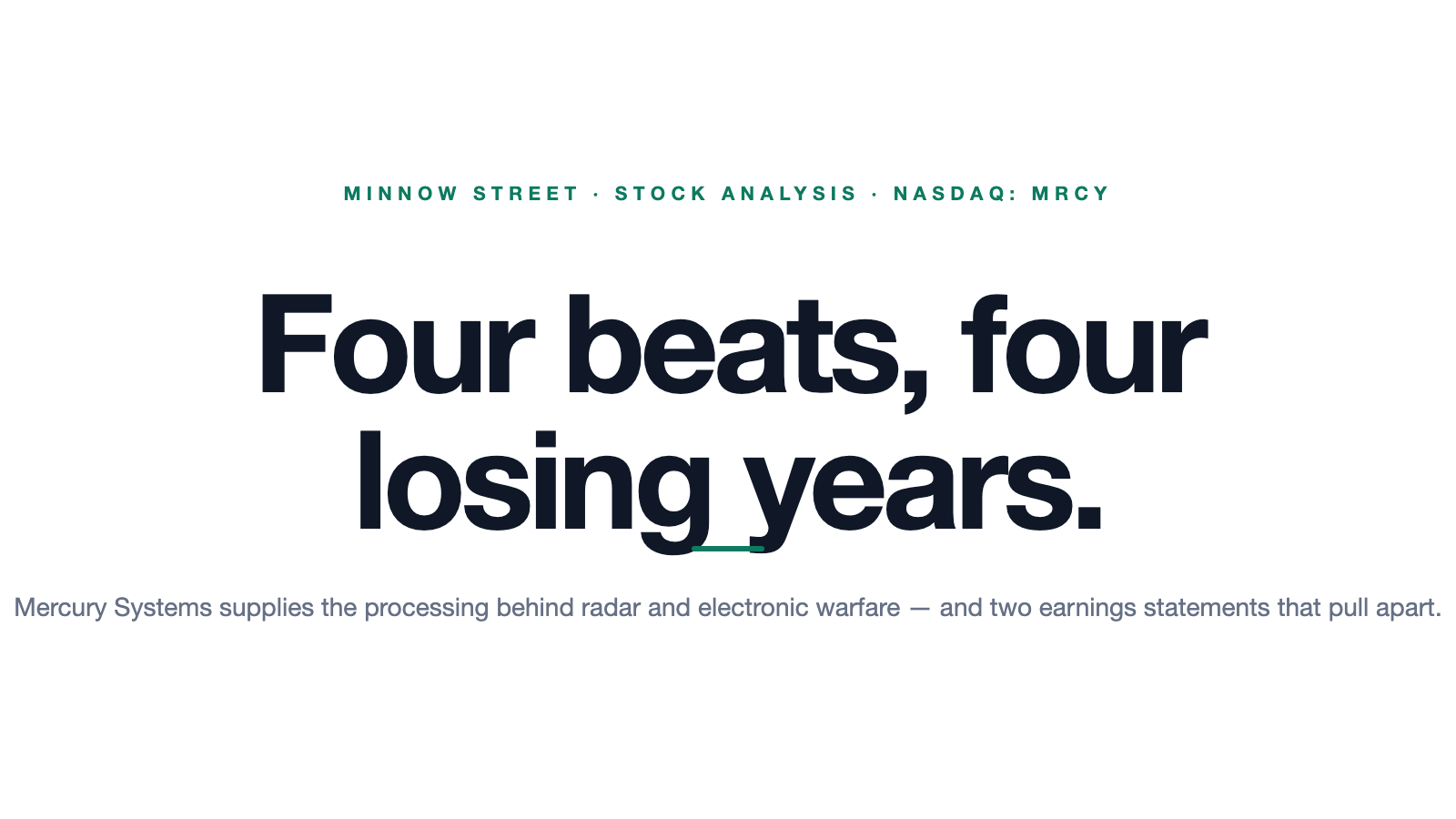
Mercury Systems ranks 16th in our in-house Big Earnings Surprise screen (U.S. selection, data as of July 25, 2026): four quarters in a row of reported earnings per share well above the analyst estimate, most recently $0.27 against $0.07. Under U.S. GAAP the same quarter shows a loss of $0.04 per share — and that is not a one-off but the fourth straight losing year. We read the annual report (10-K) for fiscal 2025, the quarterly report (10-Q) as of March 27, 2026 and everything filed with the U.S. securities regulator, the SEC, since: a bridge item worth $42.4 million in stock compensation, an internal investigation covering twenty years of test reports, and a large investor who walked out of a $32.5 million settlement. Not a recommendation — just the question of which of the two numbers you are actually buying.
 Thomas Mücke
Founder & Publisher
Thomas Mücke
Founder & Publisher
Chart
Interactive price chart (TradingView).
Note: pure fact-based analysis, not investment advice and not a solicitation to buy or sell. All figures without guarantee.
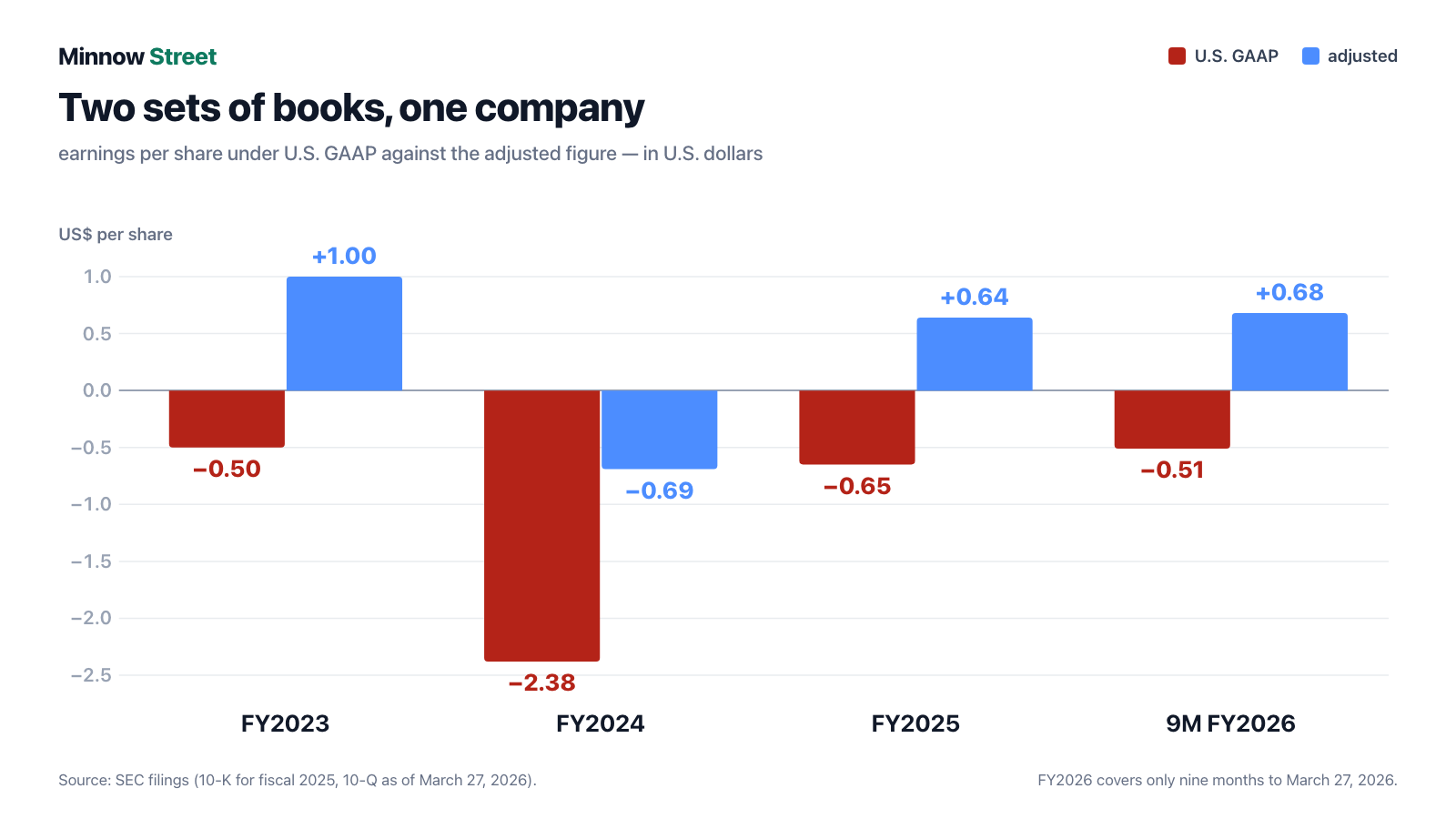
There is an investor trap so ordinary that we no longer notice it: the asterisk trap. Every billboard shows one big number and, beside it, a tiny asterisk. We read the number; we never read the asterisk. In quarterly reporting the asterisk is spelled adjusted — and at Mercury Systems, Inc. (Nasdaq: MRCY) it turns a loss of $0.04 per share into earnings of $0.27 per share. Both figures appear in the same quarterly report, two pages apart.
The company ranks 16th out of 81 U.S. hits in our in-house Big Earnings Surprise screen (data as of July 25, 2026) after four consecutive quarters well above the estimate. Before we trust the signal, let us make a deal: we read together what the company itself filed under penalty of law with the U.S. securities regulator, the SEC — the annual report (10-K) for fiscal 2025, this year\'s quarterly reports (10-Q) and everything filed since. Four sentences from those filings appear in no press release.
What Mercury Systems actually does — the computer inside the radar
Mercury Systems is based in Andover, Massachusetts, employed 2,117 people as of March 27, 2026 (June 27, 2025: 2,162) and operates more than twenty locations worldwide. Until November 13, 2012 the company was called Mercury Computer Systems — the old name describes the business more honestly than the new one.
The product is easy to picture. A modern radar is an ear that hears more per second than a data link could ever carry home. Analyzing it on the ground means analyzing it too late. So the computer has to travel with the sensor — into an aircraft, a drone, a ship, a satellite. That is what Mercury builds: components, modules, subsystems and complete systems that process sensor data where it is collected. The company calls this its Processing Platform and describes it in the annual report as spanning the full breadth of signal processing, from the radio frequency front end to the human-machine interface.
Almost everything is sold to somebody else: to the large defense primes, to the U.S. government and to commercial aerospace manufacturers. The applications are radar and sensor processing, electronic warfare, avionics, weapons and C4I — command, control, communications, computers and intelligence. By the company\'s own account the products sit in more than 300 programs and ship to 35 countries. Split by platform, the nine months to March 27, 2026 brought $262.7 million from airborne, $154.8 million from land, $73.3 million from naval, $55.8 million from space and $147.2 million from everything else.
A company that only supplies the basement has a structural problem: it never sees the end customer yet carries that customer\'s risk. We looked at a related pattern in our analysis of Astronics, where a supplier likewise hangs on a handful of very large programs. Which brings us to the central tension of this analysis, running through every chapter: Mercury Systems supplies processing for systems where every decimal matters — and publishes two sets of earnings that have pointed in opposite directions for four years.
Where the stock landed on our desk
We run roughly 3,500 stocks through our screens every day. As of July 25, 2026 Mercury Systems sits 16th in the U.S. selection of our Big Earnings Surprise screen (81 hits). To reproduce it: open the screen, set the country filter to U.S., and the list shows the serial beaters in screen order. The lists are recalculated daily, so the rank can move. The criterion is strict: reported earnings per share must have come in well above the analyst estimate in each of the last four completed quarters.
At Mercury Systems the streak looked like this (fundamental data, as of July 25, 2026; the fiscal year ends in late June or early July):
- Q4 FY2025 (quarter to June 27, 2025, reported August 11, 2025): $0.47 against $0.22 expected — up 113.6 percent.
- Q1 FY2026 (to September 26, 2025, reported November 4, 2025): $0.26 against $0.09 — up 188.9 percent.
- Q2 FY2026 (to December 26, 2025, reported February 3, 2026): $0.16 against $0.06 — up 166.7 percent.
- Q3 FY2026 (to March 27, 2026, reported May 5, 2026): $0.27 against $0.07 — up 285.7 percent.
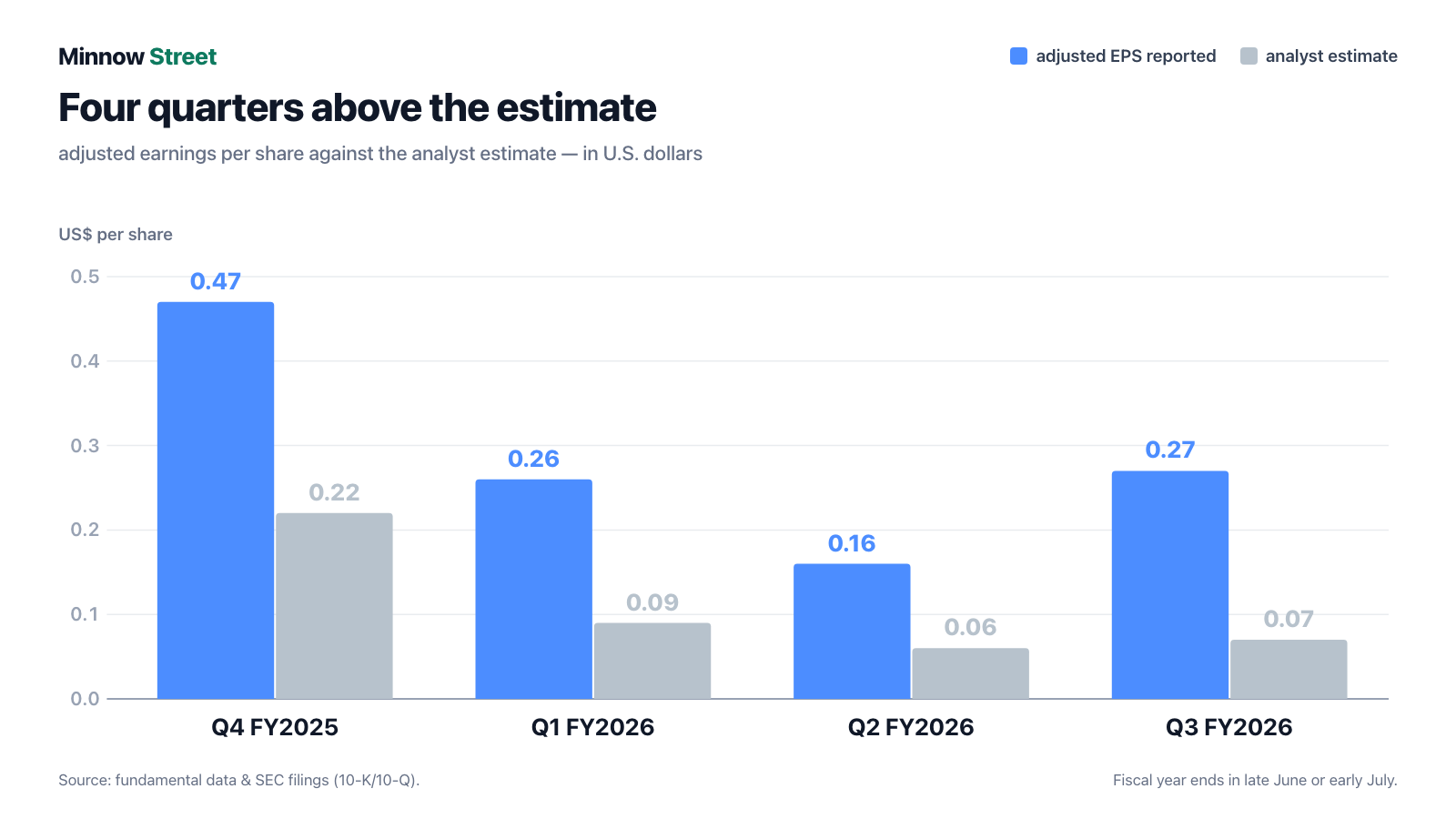
Now for the asterisk. All four figures are adjusted numbers, which the company labels adjusted EPS. The quarterly report says so itself, in the overview section of management\'s discussion:
“Our consolidated revenues, net loss, diluted net loss per share, adjusted earnings per share (‘adjusted EPS’), and adjusted EBITDA for the third quarter ended March 27, 2026 were $235.8 million, $2.9 million, $0.04, $0.27, and $36.1 million, respectively.”
— Mercury Systems, Inc., Form 10-Q for the quarter ended March 27, 2026, Item 2

The fundamental lens on the same data set shows a mixed picture (as of July 25, 2026): a relative strength rating of 88 — the price momentum is beyond dispute, with the stock 99 percent above its twelve-month low. A Piotroski F-score of 6 out of 9: the Piotroski is a nine-point test of the direction of a balance sheet — are returns, leverage, liquidity and margins improving? Six out of nine is decent, not good; a genuinely healthy company scores 8 or 9. And an Altman Z-score of 4.7, a bankruptcy early-warning gauge whose danger zone historically starts below 1.8 — Mercury is far from it. Keep the principle in mind: a surprise ranking measures how wrong the estimate was, not how good the business is.
The numbers over the years — what genuinely impresses
Start with what is good, because there is more of it than the loss line suggests. Fiscal 2024 was a disaster: revenue of $835.3 million after $973.9 million, a gross margin of just 23.5 percent, an operating loss of $147.8 million and a bottom-line loss of $137.6 million. Every important line has improved since.
- Revenue: $912.0 million in fiscal 2025, up 9.2 percent; $693.8 million in the nine months to March 27, 2026, up 8.6 percent; $235.8 million in the third quarter, up 11.5 percent.
- Gross margin: from 23.5 percent (FY2024) to 27.9 percent (FY2025) and 29.3 percent in the third quarter of fiscal 2026.
- Adjusted EBITDA: from $9.4 million (FY2024) to $119.4 million (FY2025) and $101.7 million in just nine months of fiscal 2026.
- Operating income: positive again in the third quarter of fiscal 2026 for the first time in a long while — $5.2 million, after a loss of $17.3 million a year earlier.
- Cash: $331.8 million as of March 27, 2026, up from $71.6 million as of June 30, 2023.
The foundation holds up too: backlog stood at roughly $1.4 billion as of June 27, 2025, after roughly $1.3 billion a year earlier, of which $807.8 million was expected to convert into revenue within twelve months. That is more than a full year of sales in accepted orders. The nine-month growth drivers are LTAMDS (an Army radar), PWSA (a Space Force satellite layer), SEWIP (Navy electronic warfare) and KC-46 (a tanker aircraft) — programs with long lives.
Free cash flow, meaning what is left after capital spending, is back as well: $119.0 million in fiscal 2025 ($138.9 million from operations less $19.8 million of property and equipment), after $26.1 million in fiscal 2024 and negative $60.1 million in fiscal 2023. The nine months to March 27, 2026 delivered $39.5 million — well below the $85.1 million of the prior-year period, and more on that below.
Uncomfortable truth No. 1: the bridge between the two results is stock compensation
The question is not whether an adjusted figure is allowed — it is, it is disclosed, and almost every U.S. company publishes one. The question is: what exactly is being taken out? The quarterly report answers in a table. Between the third-quarter net loss of $2.861 million and adjusted income of $16.419 million lie exactly $19.3 million, and the largest single item is this:
- stock-based and other non-cash compensation: $10.768 million
- amortization of acquired intangible assets: $9.561 million
- litigation and settlement expense: $2.120 million
- other non-operating adjustments: $2.445 million
- acquisition, financing and other third-party costs: $0.581 million
- tax effect of the adjustments: minus $6.279 million
Stock compensation costs no cash, which is why it gets removed. It costs something else: your slice of the cake gets thinner. Paying employees in shares means paying them with ownership that used to belong to existing holders. Over nine months of fiscal 2026 that came to $42.381 million, up from $34.108 million a year earlier — a 24 percent increase while revenue grew 8.6 percent.
In fiscal 2025 the arithmetic becomes almost painfully vivid: adjusted income for the year was $37.866 million, while the stock-based and other non-cash compensation removed in the same year was $38.273 million. Put that one item back and you land almost exactly at zero.
A second look at the same table is worth the time. The $29.514 million of amortization of acquired intangible assets over nine months is the spread-out invoice for earlier acquisitions. It genuinely involves no cash — but it is a reminder that the March 27, 2026 balance sheet carries $942.6 million of goodwill and $185.2 million of intangible assets. Together that is $1,127.8 million against shareholders\' equity of $1,477.7 million. Translated: roughly 76 cents of every dollar of book value stands for an expectation, not a thing. Tangible book value works out to about $5.88 per share. We saw how an adjusted earnings line can obscure a genuine growth story in our analysis of PDF Solutions from the same screen.
Uncomfortable truth No. 2: four years of writing down its own program estimates
Just under half of Mercury\'s revenue is recognized over time: on multi-year development contracts, revenue is booked as the work proceeds, based on estimated total costs. Estimate too optimistically and you must correct later. That has been happening for years, always in the same direction:
- Fiscal 2024: a net hit of $73.245 million to operating income.
- Fiscal 2025: a net hit of $21.070 million ($26.642 million favorable against $47.712 million unfavorable).
- Nine months FY2026: a net hit of $9.624 million ($23.443 million favorable against $33.067 million unfavorable), after $16.354 million a year earlier.
- Third quarter FY2026: a net hit of $2.095 million, after $3.653 million.
The good news is the sequence: the damage shrinks year after year — 73, then 21, then 9.6 million. Part of the margin improvement Mercury is celebrating in fiscal 2026 comes from exactly there: the report attributes all 120 basis points of nine-month margin expansion to the smaller drag from changes in estimates. The bad news: even shrunk, the item is still negative. Over nine months it cost $0.12 per share of earnings against adjusted nine-month earnings of $0.68 per share. A useful rule: a company that underestimates its own costs four years running does not have an accounting problem, it has a bidding problem.
A second figure from the same balance sheet belongs beside it. Unbilled receivables and costs in excess of billings — work performed but not yet invoiced — stood at $269.5 million as of March 27, 2026, after $278.5 million at fiscal year end. That is more than a full quarter of revenue in work for which no invoice has yet been written.
Uncomfortable truth No. 3: a large investor walks out of the settlement
Since December 2023 Mercury Systems and several current and former officers have faced a securities class action alleging false or misleading disclosure. In February 2025 the court dismissed 14 of 17 challenged statements and let three proceed. After a mediation in September 2025 all parties agreed in principle on $32.5 million; a receivable and a payable of that size sit on the March 27, 2026 balance sheet because insurance is expected to fund it. The matter looked closed. Then came April 21, 2026:
“On April 21, 2026, five funds associated with Starboard Value LP (‘Starboard’), representing approximately 14% of the class, requested exclusion from the class by sending notice to the settlement administrator. Starboard has indicated that it is planning to pursue a separate legal action against the Company. … In connection with Starboard’s potential claims, the Company may incur substantial legal fees and liabilities which may not be covered by the Company’s applicable directors’ and officers’ liability insurance.”
— Mercury Systems, Inc., Form 10-Q for the quarter ended March 27, 2026, Note M
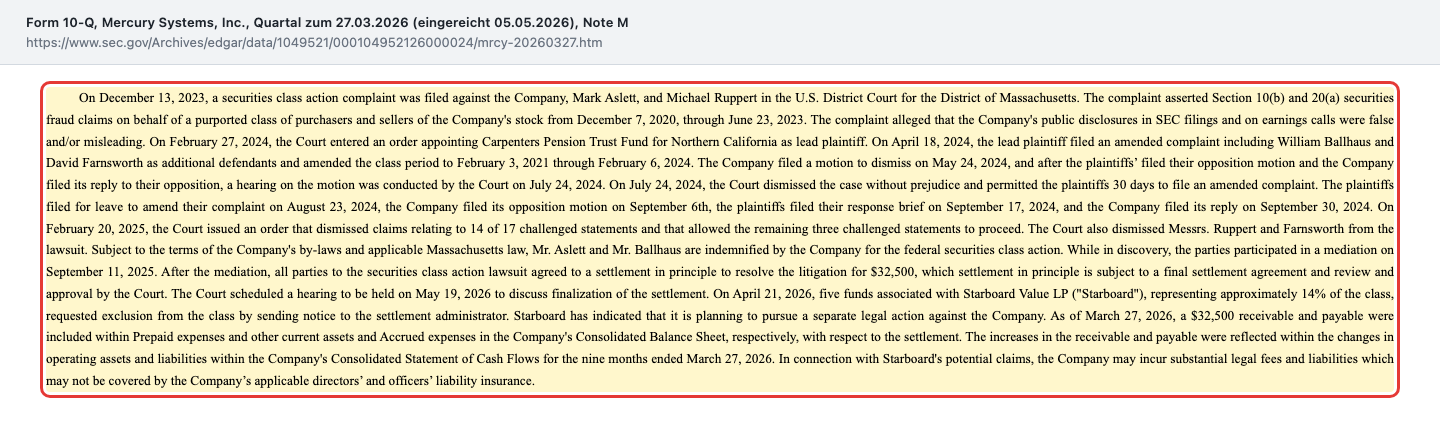
Why this is more than a footnote: opting out of a settlement means giving up your share of the $32.5 million because you expect more elsewhere. And in the same sentence the company says its directors\' and officers\' insurance may not cover those costs — unlike the settlement itself, which sits on the balance sheet as a pass-through. For scale: the net loss for the first nine months of fiscal 2026 was $30.5 million. The settlement alone is larger than the year-to-date loss.
A second front runs in parallel: three shareholders have asserted claims against officers and directors, one complaint has been pending in Massachusetts Superior Court since June 2025, and on May 20, 2025 the board formed a special investigation committee of independent directors to look into the allegations. One old dispute is finished: on December 30, 2025 the company settled with its former chief executive for $5.0 million, paid the same day.
Uncomfortable truth No. 4: twenty years of test reports under review
The following paragraph appeared for the first time in this year\'s quarterly reports, and it is the least comfortable passage in the entire filing:
“In September 2025, an internal investigation was initiated, with the assistance of outside counsel, in connection with what the Company preliminarily believes may be inaccurately reported test results and certifications of conformance with certain product performance specifications under subcontracts involving approximately $15,000 in total revenue over approximately 20 years in support of a government program. … Any determination that the Company’s previous operations were not in compliance with laws or regulations such as the False Claims Act could result in the imposition of civil or criminal fines, penalties, disgorgement, restitution, equitable relief, or other losses or conduct restrictions, and could be material to the Company’s financial results or business operations.”
— Mercury Systems, Inc., Form 10-Q for the quarter ended March 27, 2026, Note M (amounts in thousands, so approximately $15.0 million)

Let us be fair: the revenue is small — $15.0 million over twenty years is less than one percent of a single year\'s sales. The company says there is no evidence the product failed to perform and no reported safety issues; the customer has confirmed the deviations fall within tolerances and will modify the specifications.
Even so, the paragraph belongs in any honest assessment, for a reason that has nothing to do with the amount. The False Claims Act is the U.S. statute against false billing of the federal government — it carries treble damages and, in the extreme, exclusion from public contracts. For a supplier that drew 38 percent of its nine-month fiscal 2026 revenue from RTX (16 percent), Lockheed Martin (12 percent) and Northrop Grumman (10 percent), qualification as an approved supplier is the capital. The company says it cannot currently estimate an amount, which is why no accrual appears on the balance sheet.
Uncomfortable truth No. 5: the hedge expires before the loan does
Mercury Systems had $591.5 million drawn under its revolving credit facility as of March 27, 2026. On November 4, 2025 the company renegotiated that facility: $850.0 million of commitments, maturity extended to November 4, 2030, with Wells Fargo replacing Bank of America as administrative agent. On April 30, 2026 it repaid $150.0 million:

That is good news with an expiry date. Of the debt, $300.0 million is hedged by an interest rate swap fixing the rate at 4.66 percent. That hedge matures on February 28, 2027, while the loan runs to November 2030. From March 2027 the entire drawn balance floats unless a new hedge is put in place. For scale: interest expense over the nine months to March 27, 2026 was $23.066 million against an operating loss of $14.185 million in the same period. The interest bill alone flips the sign.
A second item belongs beside it because it changes how cash flow reads. Mercury sells receivables to a financing counterparty: a committed facility of $60.0 million signed on August 13, 2024 was raised to $75.0 million on December 10, 2025 — and as of March 27, 2026 the full $75.0 million was used. Fees came to $1.4 million over nine months. Sold receivables show up as cash from operations even though the customer has not paid. Even so, nine-month operating cash flow fell from $100.8 million to $60.2 million, mainly because customer advances did not help this time (an outflow of $6.5 million against an inflow of $67.9 million a year earlier) and inventory grew by $36.3 million.
What the stock costs — valuation in orders of magnitude
Start with what is fixed. The cover page of the latest quarterly report shows 60,043,283 shares as of April 30, 2026. Multiplied by the last closing price before our data cut-off ($103.27 on July 24, 2026), that gives a market capitalization of roughly $6.2 billion — the same order of magnitude the fundamental data shows as of July 25, 2026. We work from there, in ranges rather than decimals.
- Price-to-sales: roughly 6.4 times trailing twelve-month revenue of $966.9 million (fiscal 2025 plus nine months of 2026 less nine months of 2025). For a hardware supplier running a 27.8 percent gross margin that is sporty; it is a software multiple on a metal business.
- Price-to-earnings: there is none under U.S. GAAP — the company is loss-making. On the trailing adjusted figure of roughly $1.15 per share it works out near 90. On the analyst estimate for fiscal 2026 ($1.08) it is about 95, and on the estimate for fiscal 2027 ($1.55) about 67. All three say the same thing: what is being paid for is the future.
- Enterprise value to adjusted EBITDA: market capitalization plus $591.5 million of debt less $331.8 million of cash gives roughly $6.46 billion; against $152.9 million of trailing adjusted EBITDA that is about 42.
- Price-to-book: roughly 4.2 (book value $24.84 per share, as of July 25, 2026). Strip out goodwill and intangibles and about $5.88 per share of tangible book remains — roughly 18 times over.
- The professional view: nine analyst opinions with an average rating of 3.6 on a five-point scale — three strong buys, one buy, three holds and two sells. The average price target stood at $103.75 (as of July 25, 2026), roughly at the market price. Translated: the professionals see the stock as fairly paid — an unusually divided picture.
- Pressure from the other side: roughly 9.0 percent of the float was sold short at the same data cut-off, worth a good five average trading days. The twelve-month range ran from $50.13 to $128.45 — the stock more than doubled at its peak over that span.
There is no dividend; the last stock split dates from December 21, 1999. The balance sheet is not the problem: equity funds 60 percent of assets, and net debt of $259.7 million is less than twice trailing adjusted EBITDA of $152.9 million. The problem is the earnings line that is supposed to carry this valuation.
Opportunities and risks at a glance
What speaks for Mercury Systems:
- The recovery is real and multi-year: gross margin from 23.5 percent (FY2024) through 27.9 percent (FY2025) to 29.3 percent in the third quarter of fiscal 2026; adjusted EBITDA from $9.4 million to $119.4 million and then $101.7 million in only nine months.
- Revenue is growing again: up 9.2 percent in fiscal 2025, up 8.6 percent over nine months of fiscal 2026 and up 11.5 percent in the third quarter.
- Backlog of roughly $1.4 billion (June 27, 2025), of which $807.8 million was expected to become revenue within twelve months — more than a full year of sales.
- Market tailwind: land, space and naval platforms added $41.9 million, $17.1 million and $12.7 million over nine months, driven by programs such as LTAMDS, PWSA and SEWIP.
- The balance sheet holds: $331.8 million of cash, equity funding 60 percent of assets, a credit facility extended to November 2030 and $150.0 million of debt repaid after quarter end.
- A $200.0 million repurchase program with $185.0 million still available (March 27, 2026) — ammunition against the company\'s own dilution, if it is used.
What speaks against it:
- Under U.S. GAAP there has been a loss in every period since fiscal 2023: $28.3 million, $137.6 million, $37.9 million and $30.5 million over nine months of fiscal 2026.
- Adjusted income for fiscal 2025 ($37.9 million) almost exactly matches the stock-based and other non-cash compensation removed to get there ($38.3 million).
- The share count keeps rising despite buybacks: from 59.003 million (June 27, 2025) to 59.499 million (March 27, 2026) and 60.043 million as of April 30, 2026.
- Changes in estimates on the company\'s own programs have hurt operating income for a fourth straight year — most recently $9.6 million over nine months.
- Customer concentration: three customers accounted for 38 percent of nine-month fiscal 2026 revenue (RTX 16 percent, Lockheed Martin 12 percent, Northrop Grumman 10 percent).
- Two open legal fronts with no quantifiable end: the announced Starboard action after the opt-out from the $32.5 million settlement, and the internal investigation into test reports with its explicit reference to the False Claims Act.
- The $300.0 million interest rate hedge at 4.66 percent ends on February 28, 2027 while the loan runs to 2030; nine-month interest expense of $23.1 million exceeds the operating loss of $14.2 million.
- Valuation with no cushion: roughly 6.4 times sales, roughly 42 times enterprise value to adjusted EBITDA, roughly 18 times tangible book — for a company that still earns nothing on the bottom line.
A human bottom line
Back to the asterisk. Mercury Systems has pulled off a remarkable repair job in two years: an operating loss of $147.8 million turned into a quarter with positive operating income, adjusted EBITDA went from $9.4 million to $119.4 million a year, and free cash flow is back. Anyone who dismisses that has not been paying attention.
But the path from the asterisk to the big number runs through the same item every quarter: the shares the company uses to pay its people. And beside it sit two sentences nobody enjoys signing — one about an investor who would rather sue than take 14 percent of a settlement, and one about twenty years of test reports whose accuracy is now being examined.
None of this is a scandal. All of it is disclosed in the filings — you simply have to read the notes rather than the headlines. What it changes is the yardstick: buying Mercury Systems is not buying "four quarters above the estimate". It is buying a company on the way back that has not finished the journey, at roughly 6.4 times sales. Whether that fits your portfolio depends on whether you trust the repair more than the loss line. What you make of it is your decision. And that is exactly as it should be.
Sources
- Form 10-Q for the quarter ended March 27, 2026, Mercury Systems, Inc. (CIK 0001049521), filed May 5, 2026 — balance sheet, statement of operations, statement of shareholders\' equity, statement of cash flows, Note B (factoring, revenue recognition, changes in estimates), Note I (revolving credit facility), Note L (customer concentration, platforms), Note M (legal proceedings, internal investigation, purchase commitments), Note N (interest rate swap), Note O (share repurchases), Note P (subsequent events), Item 2 (management\'s discussion, non-GAAP reconciliations).
- Form 10-K for fiscal 2025, filed August 11, 2025 — Item 1 (business, backlog, customers, employees), Item 7 (management\'s discussion, changes in estimates, non-GAAP reconciliations), financial statements and notes (customer concentration, interest rate swap, credit facility), report of KPMG LLP.
- Form 10-K for fiscal 2024, filed August 13, 2024 — comparative figures and prior-year changes in estimates.
- Form 8-K of November 4, 2025, Items 1.01, 2.03 and 8.01 — Amendment No. 7 to the credit agreement ($850.0 million, maturing November 4, 2030, Wells Fargo as administrative agent) and the $200.0 million repurchase authorization of November 3, 2025.
- Form 10-Q for the quarter ended December 26, 2025, filed February 3, 2026, and Form 10-Q for the quarter ended September 26, 2025, filed November 4, 2025 — the current fiscal year\'s quarterly figures.
- Schedule 13D/A No. 4 of March 4, 2026 — JANA Partners Management, LP holding 4,114,618 shares, or 6.9 percent, as of March 3, 2026.
- Screening and valuation data: our in-house stock scanner and fundamental data (as of July 25, 2026), including the Big Earnings Surprise screen (U.S. selection, 16th of 81).
This article is journalistic analysis of publicly available company filings. It is not investment advice, not a recommendation to buy or sell, and not a solicitation to buy or sell securities. Stocks can lose their entire value at any time. All figures are taken from the SEC filings named above and from fundamental data with the stated reference dates; price and valuation figures carry a data cut-off of July 25, 2026 and will age. The author holds no position in Mercury Systems, Inc. at the time of publication. Please make your own investment decisions — or take them with an adviser you trust.
Our Bottom Line at a Glance
- Operating recovery positive
- An operating loss of $147.754 million in fiscal 2024 became $19.627 million in fiscal 2025 and positive operating income of $5.230 million in the third quarter of fiscal 2026. Gross margin rose from 23.5 through 27.9 to 29.3 percent, and adjusted EBITDA went from $9.4 million to $119.4 million (FY2025) and $101.7 million in nine months of fiscal 2026.
- Quality of the earnings beat negative
- All four beats rest on an adjusted measure. In the third quarter of fiscal 2026, adjusted earnings of $0.27 per share sat against a GAAP loss of $0.04 per share, and the largest bridge item was $10.768 million of stock-based and other non-cash compensation. In fiscal 2025 that item, at $38.273 million, almost exactly matched adjusted income of $37.866 million.
- Program estimates negative
- Changes in estimates on the company's own programs have hurt operating income for a fourth straight year: $73.245 million (FY2024), $21.070 million (FY2025) and $9.624 million in the nine months to March 27, 2026 — $0.12 per share against adjusted nine-month earnings of $0.68 per share. The drag is shrinking but still negative.
- Legal exposure negative
- Five Starboard Value funds representing roughly 14 percent of the class opted out of the $32.5 million securities class action settlement on April 21, 2026 and announced a separate suit; the company itself notes that resulting costs may not be covered by its directors' and officers' insurance. An internal investigation opened in September 2025 covers test reports on subcontracts worth about $15.0 million of revenue over twenty years, with an explicit reference to the False Claims Act.
- Balance sheet & financing neutral
- A solid base: $331.800 million of cash, equity funding 60 percent of assets, a credit facility upsized to $850.0 million and extended to 2030 on November 4, 2025, and $150.0 million repaid on April 30, 2026 (leaving $441.5 million drawn). Open items: the $300.0 million swap at 4.66 percent matures on February 28, 2027, the $75.0 million receivables facility is fully drawn, and nine-month interest expense of $23.066 million exceeds the operating loss of $14.185 million.
- Valuation negative
- A market capitalization of roughly $6.2 billion equals about 6.4 times trailing twelve-month revenue of $966.9 million, roughly 42 times enterprise value to adjusted EBITDA and roughly 18 times tangible book value (as of July 25, 2026) — for a company that has reported a loss under U.S. GAAP in every period since fiscal 2023. The average price target of $103.75 sits roughly at the market price.
Mercury Systems supplies the processing that turns sensor data into decisions on board radars, electronic warfare systems and command-and-control platforms — and it has recovered remarkably well from the disaster of fiscal 2024: higher margins, growing revenue, positive operating income in the third quarter of fiscal 2026 and free cash flow of $119.0 million in fiscal 2025. The four consecutive earnings beats that put the stock 16th in our Big Earnings Surprise screen only partly survive a close look: they are adjusted figures, and half the bridge to the GAAP numbers is stock compensation — $38.3 million in fiscal 2025 against $37.9 million of adjusted income. Add four years of negative program revisions, a large investor who would rather sue on his own, and an investigation covering twenty years of test reports. Not investment advice.
What Our Rating Means
Open questions
The business works in principle, but one material question is open. As long as it stays open, our findings do not carry a quality verdict.
Buying today means paying roughly 6.4 times sales for a company that has reported a loss under U.S. GAAP for four straight years. Waiting means checking four lines in the fiscal 2026 annual report (10-K): the GAAP result (nine months: −$30.471 million), stock compensation against the share count (60,043,283 as of April 30, 2026), the net impact of changes in program estimates (most recently −$9.624 million) and the status of both legal fronts. If the adjusted profit becomes a real one, the valuation carries itself. The decision is yours.
A journalistic assessment by our editorial team at the time of the deep dive, based on public sources — not investment advice and not a solicitation to buy or sell. Your personal circumstances (investment goals, risk capacity, taxes) cannot be taken into account. What our levels mean, how verdicts are formed, and what conflicts of interest exist →
Worth Noting
- MRCY came onto the research list as the 16th of 81 U.S. hits in our in-house Big Earnings Surprise screen (as of July 25, 2026, relative strength rating 88) — part of our series filling the top 50 of that screen with analyses. The screen lists are recalculated daily.
- The screen evaluates reported earnings surprises over the last four quarters. It measures an adjusted earnings figure against the estimate for that same adjusted figure — not the result under U.S. GAAP. In the third quarter of fiscal 2026 that meant $0.27 adjusted against a GAAP loss of $0.04 per share in the quarterly report.
- Recency note: the most recent periodic report is the Form 10-Q for the quarter ended March 27, 2026, filed May 5, 2026. Everything filed afterwards was reviewed (Schedule 13G of May 12, 2026, Form SD of June 1, 2026) and does not change the picture. Fiscal 2026 ends on July 3, 2026; the company filed its fiscal 2025 annual report on August 11, 2025.
- Do not confuse the names: Mercury Systems, Inc. (Nasdaq: MRCY) is not Mercury General Corporation (NYSE: MCY), a California insurer, and not Mercury Computer Systems — that was the same company's name until November 13, 2012.
Frequently Asked Questions
Mercury Systems, Inc. (Nasdaq: MRCY, Andover, Massachusetts) builds computing hardware that processes sensor data on board — components, modules, subsystems and complete systems for radar and sensor processing, electronic warfare, avionics, weapons and command-and-control applications. Customers are mainly the large defense primes, the U.S. government and commercial aerospace manufacturers. Revenue was $912.0 million in fiscal 2025.
Because reported earnings per share came in well above the analyst estimate in four consecutive quarters: $0.47 against $0.22 (quarter to June 27, 2025), $0.26 against $0.09, $0.16 against $0.06 and most recently $0.27 against $0.07 (quarter to March 27, 2026). That puts the stock 16th out of 81 U.S. hits as of July 25, 2026, with a relative strength rating of 88.
It depends which set of books you read. Under U.S. GAAP the company has posted a loss in every period since fiscal 2023: $28.3 million (FY2023), $137.6 million (FY2024), $37.9 million (FY2025) and $30.5 million for the nine months to March 27, 2026. Its own adjusted measure shows earnings of $0.68 per share for those same nine months against a GAAP loss of $0.51 per share.
The largest single item is stock-based and other non-cash compensation: $10.768 million in the third quarter of fiscal 2026 alone and $38.273 million in fiscal 2025 — against adjusted income of $37.866 million for that year. Amortization of acquired intangible assets, restructuring, litigation and financing costs and the related tax effect make up the rest.
Heavily. In the nine months to March 27, 2026 three customers accounted for 38 percent of revenue: RTX Corporation at 16 percent, Lockheed Martin at 12 percent and Northrop Grumman at 10 percent. In fiscal 2025 the figure was 33 percent (RTX 13 percent, Lockheed Martin 10 percent, U.S. Navy 10 percent). No single program reached the 10 percent threshold in either period.
In late June or early July. Fiscal 2025 ended on June 27, 2025 and fiscal 2026 ends on July 3, 2026 according to the quarterly report. Quarter labels therefore shift against the calendar: the third quarter of fiscal 2026 ran to March 27, 2026. The company filed its fiscal 2025 annual report on August 11, 2025.
Two material ones. First, the securities class action: the $32.5 million settlement sits on the balance sheet, but five Starboard Value funds representing roughly 14 percent of the class opted out on April 21, 2026 and announced a separate suit. Second, an internal investigation opened in September 2025 into possibly inaccurate test results on subcontracts worth about $15.0 million of revenue over twenty years.
That a valuation of roughly 6.4 times sales and roughly 42 times enterprise value to adjusted EBITDA meets an earnings line that has been negative under U.S. GAAP for four years. Add unexpected costs from the legal fronts or fresh downward revisions to program estimates, and both the result and the valuation yardstick take the hit at the same time.
Found an error?
Did you spot a factual error, an outdated number, or a typo in this deep dive? Let us know briefly — your report goes straight to the editorial team.