Veeva Systems: the turnaround candidate that needs no turnaround
Veeva sells software to pharmaceutical companies — regulatory dossiers, clinical trials, field sales. In the fiscal year ended January 31, 2026, that came to $3.195 billion in revenue and $908.9 million in profit, without a dollar of financial debt. Yet the stock ranks 25 of 61 in our turnaround-candidates screen (measured July 26, 2026). We show which single criterion puts it there, the price above which it drops out — and what the filings actually say: the move of its most important application off a competitor's platform with a deadline of New Year's Eve 2029, an eight-year lawsuit that ended without a winner, and $472.7 million of pay in the company's own shares. In the end the label on the list matters less than the balance sheet behind it.
 Thomas Mücke
Founder & Publisher
Thomas Mücke
Founder & Publisher
Chart
Interactive price chart (TradingView).
Note: pure fact-based analysis, not investment advice and not a solicitation to buy or sell. All figures without guarantee.
We trust labels. If the drawer says "cutlery", we reach in without looking. We read stock lists the same way: a list is called "turnaround candidates", so the company on it must be a restructuring case — damaged, with holes in its balance sheet, on its way back from the bottom. Call it the sorting trap: we adopt the order somebody else imposed, along with the reasoning behind it. It is treacherous because it works in both directions — we underrate what sits in the wrong drawer and overrate what sits in the right one.
Veeva Systems Inc. (NYSE: VEEV) ranks 25 of 61 in our turnaround-candidates screen (U.S. selection, measured by us on the live page on July 26, 2026), with a turnaround check of 6 of 8. The same row also shows an equity ratio of 80.0 percent and an Altman Z of 14.6 — that is not a company in intensive care, that is a company with a very full bank account. So here is the deal: we read together which criterion actually puts this stock on the list, and then we read the real numbers — the annual report (10-K) for the fiscal year ended January 31, 2026, the quarterly report (10-Q) as of April 30, 2026, and the current reports (8-K) in between.
That sets the central tension of this analysis: the turnaround this screen is looking for is, at Veeva, not a restructuring but a share-price decline. The real risk lies somewhere else — and it has a date.
What this analysis covers
- What Veeva actually does
- Where the stock landed on our desk — and how thin that spot is
- The numbers over the years, fairly credited
- The war nobody won
- Uncomfortable truth no. 1: the move with a deadline
- Uncomfortable truth no. 2: half the profit paid in its own shares
- Uncomfortable truth no. 3: a subscription company without a backlog
- Valuation: what the market is paying here
- Opportunities and risks at a glance
- A human conclusion
- Sources and disclosures
What Veeva actually does — the filing cabinet of the pharmaceutical industry
Developing a drug mostly means managing paper. Study protocols, patient data, inspection reports, marketing applications, package inserts in thirty languages, training records for the sales force, sign-offs for every single promotional claim. Every document has to be findable, versioned and defensible before regulators — for decades. Veeva is the filing cabinet where all of that lives, and it is also the address book pharmaceutical representatives use to manage the physicians they call on.
Technically the company consists of four product families: Veeva Development Cloud (clinical trials, regulatory affairs, drug safety), Veeva Quality Cloud (manufacturing quality), Veeva Commercial Cloud (sales, marketing, medical affairs) and Veeva Data Cloud (data and analytics). All of it runs on a proprietary platform called Veeva Vault. Since fiscal 2026 an AI layer has been added, which the company describes in the annual report as a product in its own right:
"Veeva AI adds agentic artificial intelligence ("AI") to our proprietary Veeva Vault platform and deep, industry-specific agents for Veeva applications. Veeva AI Agents work seamlessly within Veeva applications and have direct, secure access to data, documents, and workflows."
— Veeva Systems Inc., annual report on Form 10-K for the fiscal year ended January 31, 2026, Item 1 (Business), filed with the U.S. securities regulator, the SEC
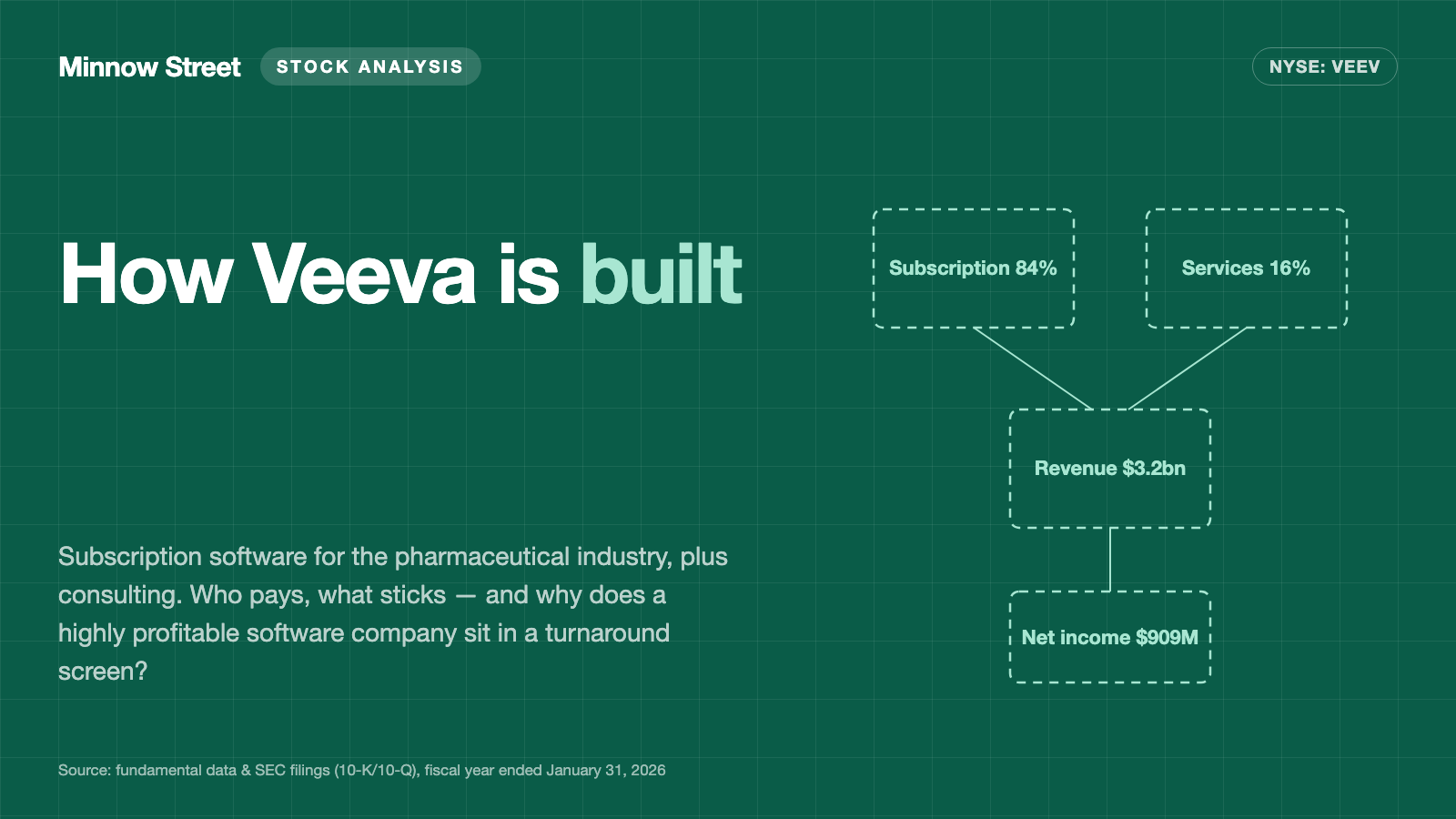
Customers pay by subscription: $2.684 billion, or 84 percent of revenue in fiscal 2026, was subscription revenue; the remaining $511.1 million (16 percent) came from consulting and implementation work. Customers are pharmaceutical groups, biotech firms and medical device makers; roughly 40 percent of fiscal 2026 revenue came from customers outside North America. The ten largest customers account for 28 percent of revenue — and did so in each of fiscal 2024, 2025 and 2026, at exactly the same level. No single customer exceeded 10 percent of revenue.
One structural feature is worth knowing: Veeva is a Delaware public benefit corporation — a for-profit company whose certificate of incorporation also fixes a public benefit purpose, and whose directors must balance the interests of stockholders, customers, employees and communities. The annual report states the purpose as providing products and services intended to make the industries it serves more productive and to create high-quality employment. Veeva says it was the first publicly traded company to convert, and is the largest company operating as one. For investors that is not a footnote: it is a legally anchored permission for the board not to maximize shareholder returns when the two conflict.
As of January 31, 2026, 7,928 people worked for Veeva, 637 more than a year earlier. The patent portfolio comprises 111 issued U.S. patents, 11 issued international patents and 164 pending applications. In March 2026 Veeva acquired Ostro for $90 million ($70 million net of cash acquired), an AI-driven chat platform for communicating with patients and physicians.

Where the stock landed on our desk — and how thin that spot is
To repeat it yourself: on minnowstreet.com open "Stocks", then "Scanner", choose the turnaround candidates list and search the "Symbol" column for VEEV. When we did that on July 26, 2026, Veeva stood at 25 of 61 hits in the U.S. selection, with a turnaround check of 6 of 8 points. One caveat matters: these lists are recalculated daily. The rank and the number of hits are a dated snapshot, not a state of affairs.
The screen works in two stages. First two mandatory pillars, both of which must hold:
- Pillar 1 — the crash: the price must sit at least 50 percent below the all-time high. No crash, no turnaround, so the logic goes.
- Pillar 2 — survival: the Altman Z score must be at least 1.1. The Altman Z combines five balance sheet ratios into an estimate of how far a company is from insolvency — below 1.1 is the distress zone. Positive equity and no more than one balance sheet warning flag are required as well.
Only then does the turnaround check count eight points: four for the operating turn (revenue stabilizing, margin turning, cash flow turning, balance sheet healing) and four for market confirmation (price back above the 50-day line, relative strength turning, net insider buying, net institutional accumulation). Six of eight is the entry threshold — Veeva sits exactly on it.
Now the honest reading. Pillar 2 is a formality here: the same table puts the Altman Z at 14.6, more than thirteen times the required 1.1, and the equity ratio at 80.0 percent. That leaves pillar 1 — the crash. And that is the thin spot. The "off high" column showed −49.1 percent for Veeva on July 26, 2026. The mandatory threshold is −50 percent. The stock is sitting on the edge, on the wrong side of it.
Let us check it against the price history so anybody can verify it. The highest closing price Veeva shares ever reached was $341.00 on August 5, 2021. Half of that is $170.50. That is the line: trade above it and pillar 1 breaks. The last close recorded in our price history was $186.24 on July 24, 2026 — 45.4 percent below the all-time high, and clearly above the line. Several weeks of rising prices therefore sit between the screen column and the price history; the data behind the list is older than the last quote at this particular point.
What does that mean for you? Rank 25 is real, but it is not a property of the company. It is a snapshot that may vanish at the next recalculation — not because the business got worse, but because the stock went up. The takeaway: a screen calculates, it does not judge. The judgment stays with whoever reads the filings.
The numbers over the years — first what genuinely impresses
Let us start with what is good, and there is plenty of it. Veeva grew revenue and earned a profit in every one of the six fiscal years from 2021 through 2026 — through a pandemic, through a rate shock, and through a funding drought in biotech.
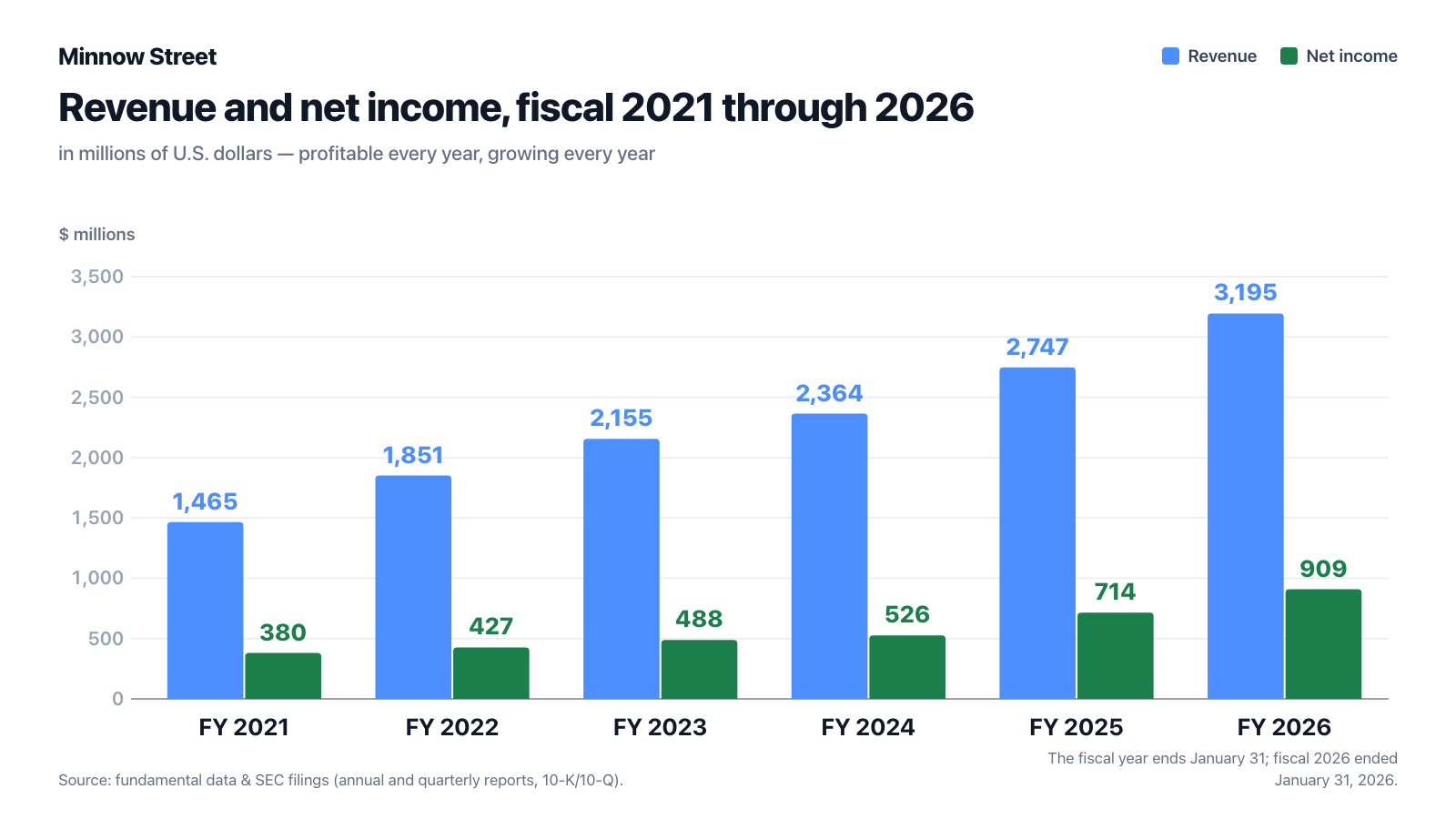
The series in detail (fiscal 2021 through 2026, each ending January 31): revenue of $1,465, $1,851, $2,155, $2,364, $2,747 and $3,195 million; net income of $380, $427, $488, $526, $714 and $909 million. Revenue has therefore more than doubled in five years.
More important than the level is the direction of the margin: operating income was $429.3 million in fiscal 2024 (18.2 percent of revenue), $691.4 million in fiscal 2025 (25.2 percent) and $916.4 million, or 28.7 percent, in fiscal 2026. Gross margin most recently stood at 75.5 percent.
The cash tells the story even better, because profit is an opinion and cash flow is a fact. Net cash provided by operating activities was $1,415.2 million in fiscal 2026 — more than the reported profit of $908.9 million. After just $29.1 million of capital expenditure, $1,386.1 million of free cash flow remains. A software business without factories: what comes in mostly stays in.
The latest quarter confirms the picture. In the three months ended April 30, 2026, Veeva booked $882.9 million in revenue (up 16 percent year over year), earned $260.9 million net and reported diluted earnings per share of $1.57. Subscription revenue grew 15 percent to $730.2 million, professional services even 23 percent to $152.8 million. One caution about the $1,127.1 million of operating cash flow in that single quarter: Veeva bills most annual subscriptions at the start of the year, which makes the first quarter the collection quarter. Anyone extrapolating that to four billion a year is doing it wrong — the same seasonal pattern shows in the prior-year quarter ($877.2 million), while the full year came in at $1,415.2 million.
The balance sheet as of April 30, 2026 is quickly told: $9.130 billion of total assets, of which $7.304 billion is equity — a ratio of 80.0 percent. Cash and short-term investments together come to $7.313 billion. There is no financial debt; the only interest-bearing obligations are lease liabilities of $103.1 million. Goodwill from acquisitions stands at $488.2 million — a small item against $9.1 billion of assets, so little impairment risk from past deals.
The war nobody won
Anyone who followed Veeva in recent years ran into five letters: IQVIA. The data giant from North Carolina and Veeva had been in litigation since 2017 — Veeva accused IQVIA of anticompetitively blocking access to industry data, IQVIA accused Veeva of misappropriating trade secrets. Two cases in the federal district court in New Jersey, eight years of briefs, billion-dollar claims in both directions.
That story is over — and anyone still carrying it as an open risk is working from a stale picture. The annual report records the outcome in Note 13:
"On August 13, 2025, Veeva and IQVIA entered into a settlement agreement that resolved all ongoing litigations between Veeva and IQVIA. […] Under the terms of the settlement agreement, neither party paid damages to the other party and both parties agreed to dismiss with prejudice all claims and counterclaims currently pending."
— Veeva Systems Inc., annual report on Form 10-K for the fiscal year ended January 31, 2026, Note 13 (Commitments and Contingencies)
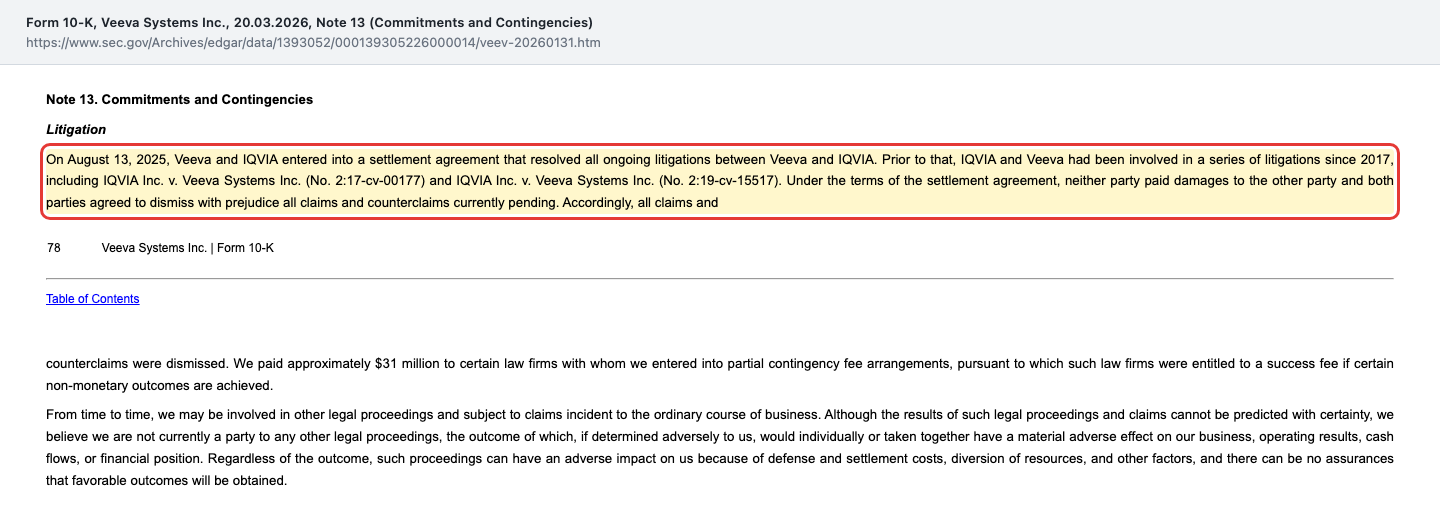
Peace was not free, though. Immediately afterwards Veeva notes that it paid approximately $31 million to law firms with which it had entered partial contingency fee arrangements — the firms collected because certain non-monetary outcomes were achieved. Eight years of litigation, no damages in either direction, $31 million in fees. And the competitive position afterwards? The annual report puts it plainly: IQVIA, which historically offered a competing CRM product, has licensed its CRM software to Salesforce. Veeva's two large adversaries in the core business are now on the same side — and one of them happens to operate the platform on which Veeva's legacy CRM application still runs. Which brings us straight to the first uncomfortable truth.
Uncomfortable truth no. 1: the move has a deadline — New Year's Eve 2029
Veeva's most successful early product was "Veeva CRM", the address book for pharmaceutical field sales. It was never built on the company's own technology but on the platform of Salesforce. That was smart at first — no infrastructure to build — and it is a problem today, because Salesforce now sells its own life sciences industry application. Veeva is therefore moving every CRM customer onto its own Vault platform. The annual report names both the deadline and the risk in one paragraph:
"We use the Salesforce platform to deliver our Veeva CRM application, but we have begun to migrate our CRM customers to our Vault CRM solutions, which are built on our Veeva Vault platform. Veeva CRM will be supported until December 31, 2029. The migration of our Veeva CRM customers will require time and expense, which may be significant. These migration processes are complex and we cannot be certain that we will be successful."
— Veeva Systems Inc., annual report on Form 10-K for the fiscal year ended January 31, 2026, Item 1A (Risk Factors)
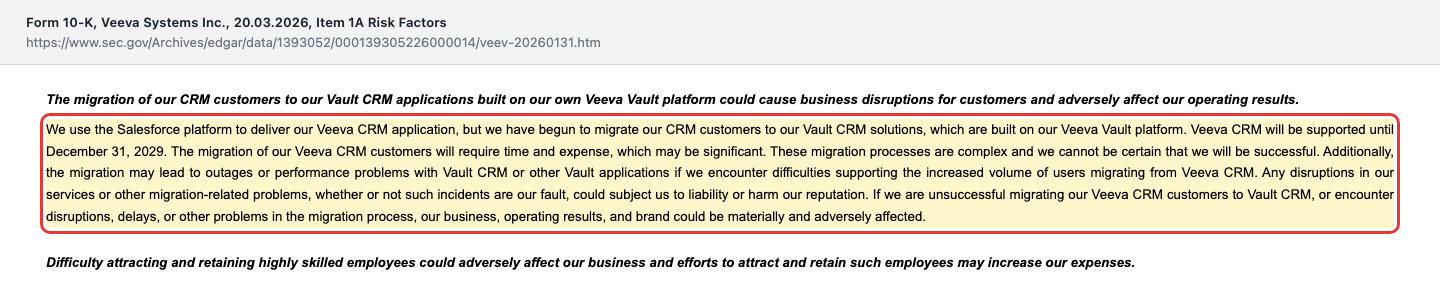
Put in everyday terms: Veeva is moving out of a rented apartment with all its furniture, the landlord has meanwhile opened a competing furniture store, and the lease runs out on December 31, 2029. The move has to be finished by then, for every single customer, with training, data transfer and regulatory validation. Veeva does not break out how much revenue depends on it. Only the order of magnitude is clear: Commercial Solutions, which include CRM, are one of the company's two revenue halves.
The good news is that the move has broken nothing so far. In the quarter ended April 30, 2026, subscription revenue grew by $95 million, of which $32 million came from Commercial Solutions and $63 million from R&D and Quality Solutions. The core business keeps growing while the move runs. But the deadline stands, and with it the risk that a customer, once packing, decides to switch furniture stores altogether.
Uncomfortable truth no. 2: more than half the profit is paid in the company's own shares
Software companies like to pay their people in stock. It preserves the bank account but costs existing shareholders something — their share. Think of a cake: the company does not bake a bigger one, it simply cuts more slices out of it. Your slice gets smaller without you doing anything wrong. Accountants call this item stock-based compensation.
At Veeva it came to $472.7 million in fiscal 2026, against net income of $908.9 million. Put differently: for every dollar of reported profit, 52 cents were handed to employees in the company's own shares. The two prior years saw $437.4 million (fiscal 2025) and $393.7 million (fiscal 2024).
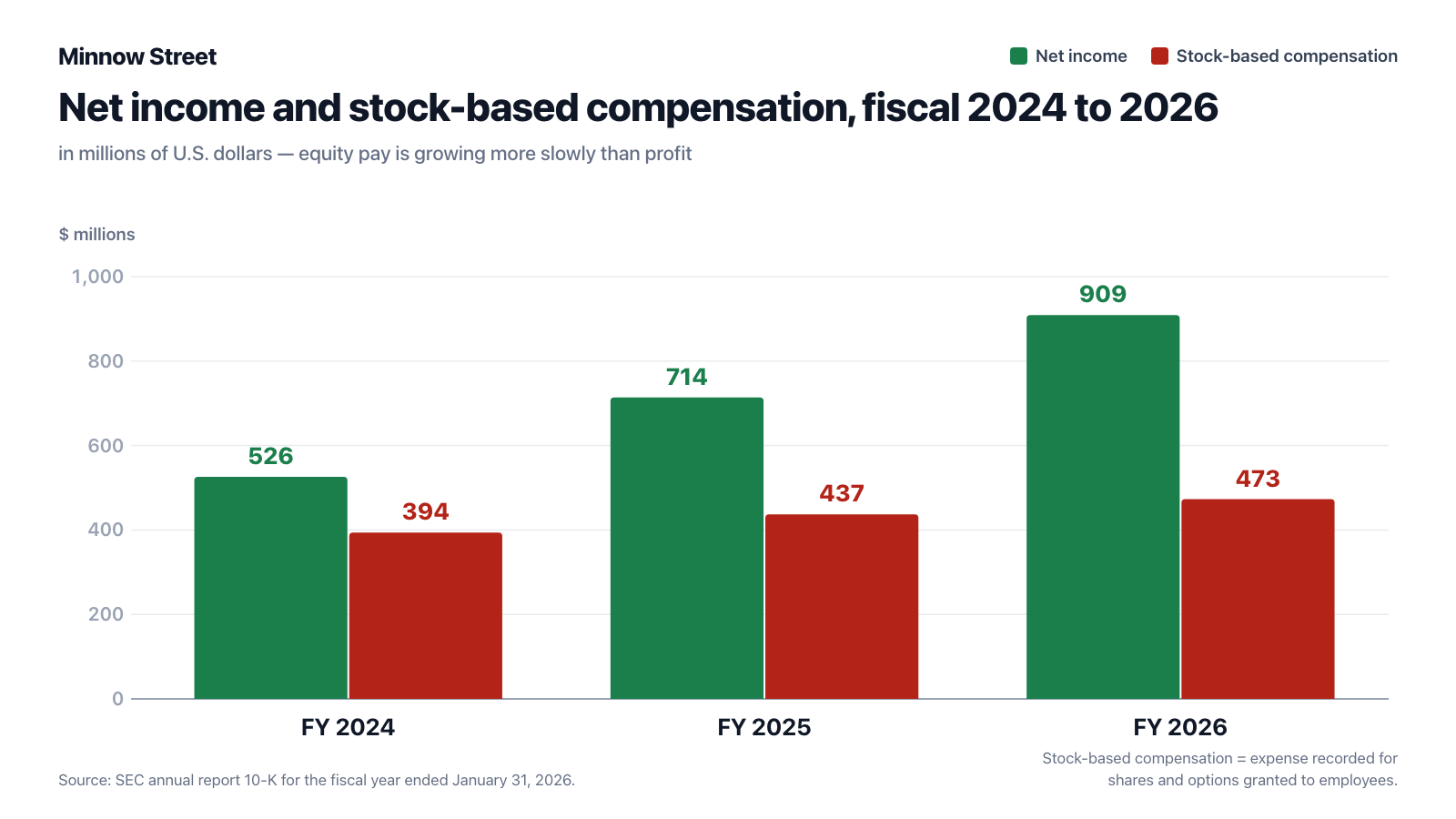
The fair reading: the item is growing much more slowly than profit — up 20 percent in three years against 73 percent for net income. And since January 2026 it faces a counterweight for the first time. On January 5, 2026, the board authorized a share repurchase program of up to $2 billion with a two-year term; repurchased shares are retired. In the quarter ended April 30, 2026, Veeva bought back 1,255,029 shares at an average of $176.17, for $221.1 million in total. That left $1.6 billion available.
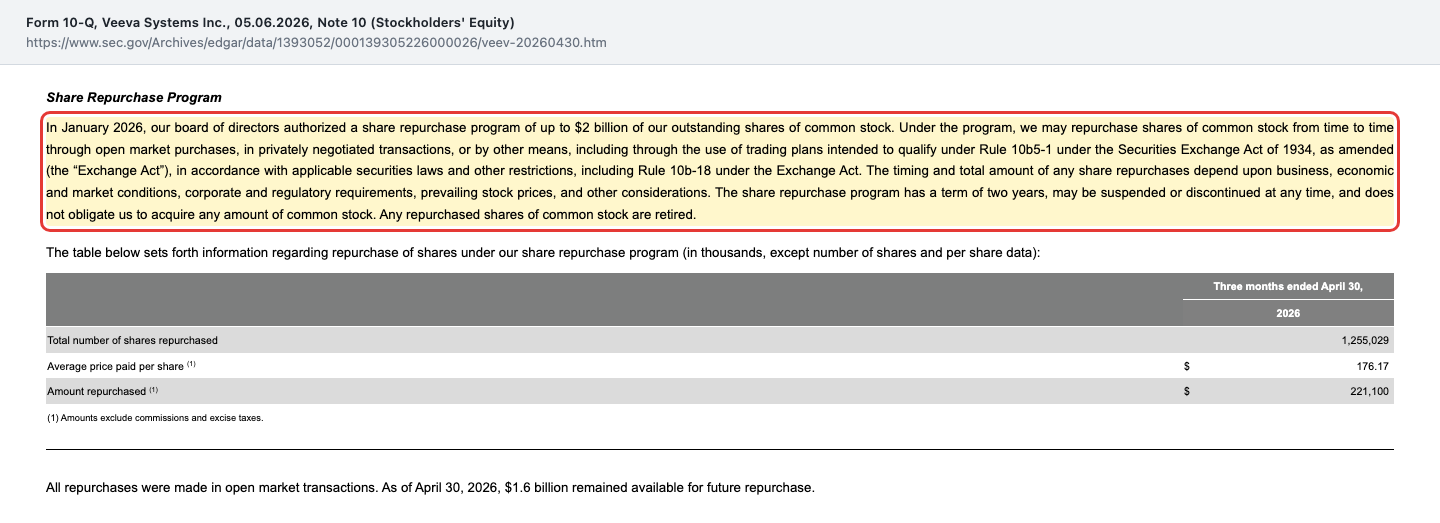
And it is working: shares outstanding fell from 162,942,747 on April 30, 2026 to 162,443,291 as of June 1, 2026. One sour note remains in the filing, though. The number of options and share awards excluded from the diluted share count solely because including them would raise earnings per share rose to 11.158 million in the quarter ended April 30, 2026, from 7.078 million a year earlier. That is roughly 6.9 percent of all shares that could still come. Part of the jump is self-made: in April 2026 Veeva shifted long-term employee compensation from annual option grants to restricted share awards that cliff-vest after four years and are expressly not expected to recur annually.
Uncomfortable truth no. 3: a subscription company without a backlog
In subscription businesses the most interesting number is rarely revenue — it is the backlog: how much money is contractually committed beyond the current year? The technical term is remaining performance obligations. Whoever knows that figure knows how far a company can see. Veeva's annual report answers it in Note 8 with a single sentence, and the answer is a shrug:
"As of January 31, 2026 and January 31, 2025, the amount of the transaction price allocated to remaining performance obligations for noncancellable subscription services contracts greater than one year was not significant with the substantial majority of such allocated transaction price included in deferred revenue and expected to be recognized over the next 12 months."
— Veeva Systems Inc., annual report on Form 10-K for the fiscal year ended January 31, 2026, Note 8

In plain terms: Veeva essentially sells annual contracts. There is no multi-year cushion to absorb a demand shock — the revenue base is re-confirmed in full every year. So far that speaks for Veeva, because it is re-confirmed every year, most recently with 16 percent growth. But the buffer a software house with three-year contracts would enjoy is simply absent here. Out of the deferred revenue balance at the start of the year, Veeva recognized exactly $1,226 million in fiscal 2026 — visibility runs about twelve months, not beyond.
Valuation: what the market is paying here
At the closing price of $186.24 on July 24, 2026 and 162,443,291 shares (as of June 1, 2026), Veeva is worth roughly $30.25 billion. We cross-checked that calculation against the fundamental data — it matches to the dollar.
- Price/earnings: roughly 33, measured against trailing four-quarter earnings per share of $5.64. On the estimates for the current fiscal year the multiple falls to about 21.
- Price/sales: roughly 9 (trailing four-quarter revenue of $3.319 billion).
- Enterprise value: deducting the $7.313 billion of cash and short-term investments leaves roughly $23 billion — about seven times annual revenue and 23 times earnings before interest, taxes, depreciation and amortization.
- Price/free cash flow: roughly 22, based on the $1,386.1 million of fiscal 2026.
That is no bargain — it is the price for a business with a 75 percent gross margin, almost no capital needs and a customer base that does not switch software casually. Two other names from our own coverage are worth a look for comparison: ServiceNow is the closest case of a subscription vendor with a similarly high margin, and Oracle is named in the annual report as one of the competitors whose legacy systems Veeva replaces.
The professionals' view: 32 analyst estimates average a price target of roughly $244 (as of July 26, 2026) — about 31 percent above the July 24, 2026 close. They are far from unanimous, though: 12 strong buy and 7 buy ratings sit against 11 hold ratings and one sell plus one strong sell.
Opportunities and risks at a glance
What speaks for Veeva:
- Six consecutive fiscal years of growth and profit; revenue from $1.465 billion to $3.195 billion (fiscal 2021 to 2026), operating margin from 18.2 to 28.7 percent (fiscal 2024 to 2026).
- A rock-solid balance sheet: an equity ratio of 80.0 percent, no financial debt, $7.313 billion of cash and short-term investments (April 30, 2026). A stumble would be affordable.
- Profit is backed by cash: $1,415.2 million of operating cash flow against $908.9 million of reported net income in fiscal 2026.
- The IQVIA litigation ended on August 13, 2025 — with no payment in either direction. An eight-year uncertainty is off the table.
- Capital is flowing back to shareholders for the first time: a $2 billion repurchase authorization since January 2026, and the share count is already falling.
- Very high switching costs: a company running its regulatory documentation in a validated system does not swap it out over a better offer.
What speaks against it:
- The CRM migration carries a hard deadline (December 31, 2029) and a failure risk the company itself concedes; the platform being left behind belongs to a competitor.
- No backlog beyond twelve months — the revenue base has to be re-won every year.
- $472.7 million of stock-based compensation in fiscal 2026 and 11.158 million potentially dilutive instruments in the quarter ended April 30, 2026 (roughly 6.9 percent of shares).
- Concentration: the ten largest customers account for 28 percent of revenue, and the industry itself is condensed into a handful of large groups.
- The public benefit corporation structure obliges directors to weigh interests other than those of stockholders.
- The price: roughly 33 times earnings and 9 times revenue leave little room for disappointment.
A human conclusion
Back to the sorting trap from the beginning. The label "turnaround candidate" has exactly one cause at Veeva: the stock trades far below its record from the summer of 2021, then $341.00. The rest of the story — damaged company, restructuring case, comeback narrative — does not come out of the numbers. What the numbers show is a company that grows every year, earns every year, carries no debt and holds $7.3 billion in reserve.
That does not automatically make the stock a buy. It is expensive, it has a move with a deadline ahead of it, and it operates in an industry currently recalculating its own research budgets. But it pays to know the difference between "this company has a problem" and "this stock has had a bad run". The first is a statement about a business, the second about a price. They get confused constantly — by lists, by headlines and, if we are honest, by us as well.
What you make of it is your decision. And that is exactly how it should be.
Sources and disclosures
- Veeva Systems Inc., SEC annual report on Form 10-K for the fiscal year ended January 31, 2026 (filed March 20, 2026)
- Veeva Systems Inc., SEC quarterly report on Form 10-Q as of April 30, 2026 (filed June 5, 2026)
- Veeva Systems Inc., SEC annual report on Form 10-K for the fiscal year ended January 31, 2025 (filed March 24, 2025)
- Veeva Systems Inc., SEC current report on Form 8-K of January 5, 2026, Item 8.01 ($2 billion share repurchase program)
- Overview of SEC current reports (8-K), CIK 0001393052
- Fundamental data and price history as of July 26, 2026; screen values measured on the live page on July 26, 2026
Disclosure: This article is journalistic commentary on publicly available corporate filings and is not investment advice. It is not a solicitation to buy or sell securities, nor is it a personal recommendation. Equity investments can lead to a total loss. All figures are taken from the primary documents linked above and carry the as-of dates stated there; price and valuation figures are explicitly dated and will age. The author holds no position in the stock discussed at the time of publication.
Our Bottom Line at a Glance
- Earnings power and growth positive
- Six consecutive fiscal years of growth and profit: revenue rose from $1.465 billion (FY 2021) to $3.195 billion (FY 2026), net income from $380 million to $908.9 million. The operating margin climbed from 18.2 to 28.7 percent within three years. In the quarter ended April 30, 2026, revenue grew another 16 percent.
- Balance sheet and substance positive
- As of April 30, 2026, $7.304 billion of equity stood against $9.130 billion of total assets — a ratio of 80.0 percent. Cash and short-term investments add up to $7.313 billion, there is no financial debt, only $103.1 million of lease liabilities. The Altman Z stood at 14.6 on July 26, 2026, against a distress threshold of 1.1.
- The CRM migration deadline negative
- The legacy Veeva CRM application runs on the Salesforce platform and, per the annual report, is supported only until December 31, 2029. Every CRM customer must be moved to the company's own Vault platform by then. Veeva itself writes that the migration is complex, the expense may be significant and success is not certain. It does not help that Salesforce now sells its own life sciences application and has licensed IQVIA's CRM software for it.
- Dilution and capital returns neutral
- $472.7 million of stock-based compensation in fiscal 2026 sits against $908.9 million of net income. The item is growing more slowly than profit, though (up 20 percent versus 73 percent over three years), and since January 5, 2026 a $2 billion repurchase program has been running: 1,255,029 shares at an average of $176.17 in the first quarter, and the share count is already falling.
- Visibility of the subscription business neutral
- The annual report calls remaining performance obligations from subscription contracts longer than twelve months "not significant" as of both January 31, 2026 and January 31, 2025. Veeva essentially sells annual contracts; the revenue base is re-confirmed every year. It has managed that consistently so far, but a multi-year cushion against a demand shock is missing.
- Valuation and market view neutral
- Roughly $30.25 billion of market value (162,443,291 shares, closing price $186.24 on July 24, 2026) equals about 33 times trailing four-quarter earnings and 9 times revenue. 32 analyst estimates average a price target of roughly $244 (as of July 26, 2026), but they disagree: 12 strong buy and 7 buy ratings against 11 hold and two sell ratings.
Veeva is an unusually profitable software company sitting in a turnaround screen without needing a turnaround: $3.195 billion of revenue and a 28.4 percent net margin in the fiscal year ended January 31, 2026, $1.415 billion of operating cash flow, an 80.0 percent equity ratio and no financial debt. What put the stock on the list is purely the price gap to its August 2021 record of $341.00 — a price finding, not a company finding, and on July 26, 2026 it stood at 49.1 percent, right at the 50 percent threshold. The genuinely open questions sit elsewhere in the filings: moving every CRM customer off the Salesforce platform onto its own by December 31, 2029, the absence of visibility beyond twelve months, and $472.7 million of pay in the company's own shares. Not investment advice.
What Our Rating Means
Quality confirmed
Business model, numbers and balance sheet hold up to our review. Whether the current price supports an entry is a separate question — it hangs on the price, not on the company.
The quality of this company is documented, and not narrowly so: the business model has carried for six consecutive fiscal years, gross margin stands at 75.5 percent, reported profit is backed by cash ($1,415.2 million of operating cash flow against $908.9 million of net income in fiscal 2026), and the balance sheet carries no financial debt at an 80.0 percent equity ratio with $7.313 billion of cash. What remains open is a project question, not a substance question: the CRM migration has to be done by December 31, 2029, and stumbling would be expensive — but affordable. The stock is expensive on top of that, and its place in the turnaround screen is a snapshot of the price, not a verdict on the company. Both are price arguments and do not change the color of this light. The decision is yours.
A journalistic assessment by our editorial team at the time of the deep dive, based on public sources — not investment advice and not a solicitation to buy or sell. Your personal circumstances (investment goals, risk capacity, taxes) cannot be taken into account. What our levels mean, how verdicts are formed, and what conflicts of interest exist →
Worth Noting
- Hook: ranked 25 of 61 in our in-house turnaround-candidates screen (U.S. selection), turnaround check 6 of 8 — measured on the live page on July 26, 2026. The lists are recalculated daily, so the ranking is a dated snapshot.
- Hook risk: the mandatory pillar "at least 50 percent below the all-time high" showed −49.1 percent on July 26, 2026. Measured against the highest closing price of $341.00 (August 5, 2021), the threshold runs at $170.50; the last recorded close of $186.24 (July 24, 2026) sits above it. The stock may drop out of the list at the next recalculation.
- Data as of: SEC filings through the quarterly report as of April 30, 2026 (filed June 5, 2026); every later filing through July 26, 2026 was reviewed (8-K of June 18, 2026 on the annual meeting, Forms 4, Form 144) — none of it changes the picture. Fundamental data and price history as of July 26, 2026.
- No takeover, no take-private, no merger: since January 1, 2025 there has been no current report with Item 1.01 or 2.01 relating to a business combination. The only acquisition is Ostro on March 9, 2026 for $90 million.
- Risk of confusion: Veeva Systems (VEEV) is not IQVIA Holdings (IQV) — both serve the pharmaceutical industry, were in litigation until August 2025 and are regularly mixed up. Nor is Veeva part of Salesforce, even though its legacy CRM application runs on that platform until the end of 2029.
Frequently Asked Questions
Veeva sells cloud software to pharmaceutical, biotech and medical device companies. Its applications manage clinical trials, regulatory dossiers, quality records, promotional approvals and the field sales relationship with physicians. Everything runs on its own Veeva Vault platform. In the fiscal year ended January 31, 2026 the company generated $3.195 billion in revenue, 84 percent of it from subscriptions.
Because a screen calculates and does not judge. The list requires two mandatory items: at least 50 percent distance from the all-time high, and secured survival (Altman Z of at least 1.1, positive equity). Veeva clears the second easily with an Altman Z of 14.6. Only the price gap puts it on the list — and on July 26, 2026 that gap stood at 49.1 percent, right at the threshold.
The highest closing price the stock ever reached was $341.00 on August 5, 2021. The mandatory pillar requires at least a 50 percent gap, so the line runs at $170.50. Trading above that breaks the criterion. The last recorded close, $186.24 on July 24, 2026, sits above it — which makes the ranking dependent on the next daily recalculation.
No. On August 13, 2025, Veeva and IQVIA entered a settlement that resolved all cases running since 2017. Neither side paid damages, and all claims and counterclaims were dismissed with prejudice. Veeva paid roughly $31 million in success fees to law firms under partial contingency arrangements.
That is the last day the legacy Veeva CRM application, which runs on the Salesforce platform, will be supported. Every CRM customer must be moved to Veeva's own Vault platform by then. The annual report calls the migration complex and concedes that success is not certain.
Veeva reports on a fiscal year that ends every January 31. Fiscal 2026 therefore ran from February 1, 2025 through January 31, 2026 and largely covers calendar 2025. Anyone comparing Veeva figures with those of other software companies has to keep that one-month shift in mind.
The annual report states that Veeva is a Delaware public benefit corporation. Its certificate of incorporation fixes a public benefit purpose alongside the profit motive, and directors must balance the interests of stockholders, customers, employees and communities. In practice: the board may choose against the most shareholder-friendly short-term option without breaching its duties.
In the fiscal year ended January 31, 2026, Veeva recorded $472.7 million of stock-based compensation, slightly more than half its $908.9 million of net income. In the quarter ended April 30, 2026, 11.158 million options and share awards sat outside the diluted count — roughly 6.9 percent of shares. The counterweight is the $2 billion repurchase program running since January 2026.
Found an error?
Did you spot a factual error, an outdated number, or a typo in this deep dive? Let us know briefly — your report goes straight to the editorial team.