Vail Resorts: The season pass made them weather-proof — now they are selling fewer of them for the first time
Vail Resorts took the weather risk out of the ski business: buy your pass in spring and you pay even if January brings no snow. That is exactly what happened in the 2025/2026 winter — revenue fell only 4.9 percent although 12.5 percent fewer people showed up on the mountain. The catch sits one page later in the same quarterly report: for the 2026/2027 season, the company had sold roughly 10 percent fewer passes through May 26, 2026 than a year earlier. Add equity that has melted from $1,594.6 million to $424.5 million in four fiscal years while dividends and buybacks exceed profit. No recommendation — just the question of what a subscription is worth once it starts losing subscribers.
 Thomas Mücke
Founder & Publisher
Thomas Mücke
Founder & Publisher
Chart
Interactive price chart (TradingView).
Note: pure fact-based analysis, not investment advice and not a solicitation to buy or sell. All figures without guarantee.
There is an investor trap that feels unusually solid because it sounds like predictability: the subscription illusion. It works like this — a company sells in advance, the money comes back every year, and your brain files the whole thing under "reliable". After that you only watch revenue. Whether the number of subscribers is rising or falling, you no longer check, because the till keeps ringing. Vail Resorts (NYSE: MTN) is the textbook case. The company from Broomfield, Colorado, pulled off something the ski industry had considered impossible: it took the weather risk out of a mountain holiday by selling the season before the first snow falls. So let us make a deal: before we think "subscription equals safety", we read together what the company itself filed with the U.S. securities regulator, the SEC — the quarterly report (10-Q) for the quarter ended April 30, 2026 and the annual report (10-K) for the fiscal year ended July 31, 2025. An SEC filing is honest under threat of prosecution. And this one tells a less comfortable story than "bad winter, it will come back": the model held the revenue. It did not hold the guests. And now, for the first time, it is not holding the subscribers either.
What Vail Resorts actually does — winter sold as a season ticket
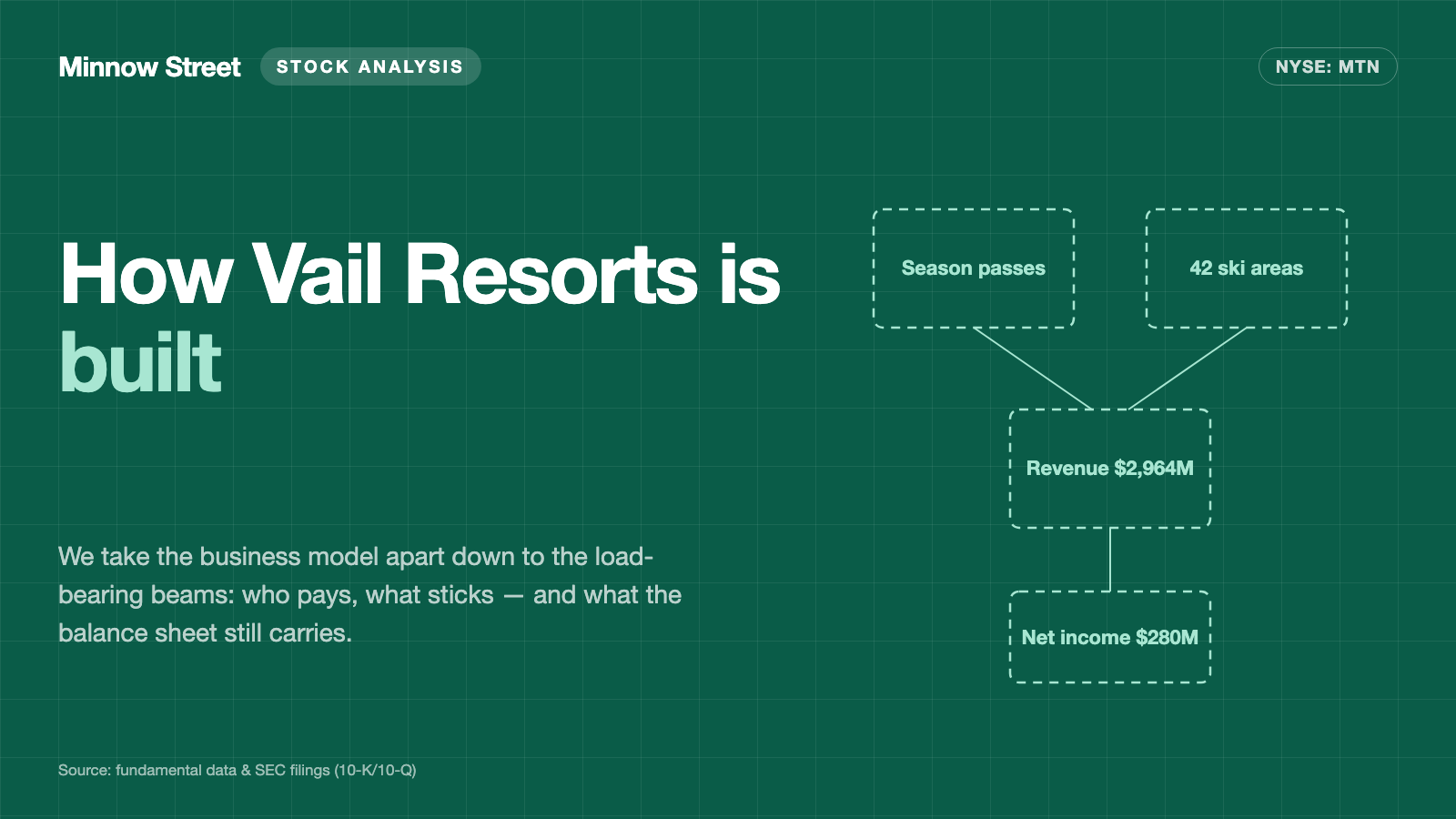
Vail Resorts runs mountains. According to the fiscal 2025 annual report that means 42 ski areas — from the marquee names in the Rocky Mountains (Vail, Beaver Creek, Breckenridge, Keystone, Park City) through Whistler Blackcomb in Canada and the Tahoe region to eight small areas in the U.S. Northeast, eight in the Mid-Atlantic, ten in the Midwest, three in Australia and two in Switzerland. On top of that sit a hotel and condominium business, a Colorado ground transportation company and the National Park Service concession for lodging in Grand Teton National Park. In fiscal 2025 the company employed roughly 6,800 people year-round and roughly 39,800 seasonal staff across its operating seasons.
The actual product, though, is not a mountain but a promise paid up front. Buy the Epic Pass in spring or summer and you ski the whole network without limits all winter. There are tiers — the Epic Day Pass covers one to seven days of your choosing. Translated into everyday terms: Vail does not sell skiing, it sells the annual gym membership. And as with a gym, the trick is not the individual visit but the payment in advance. If January brings no snow, the money has long since arrived. How well that works shows up in one number from the quarterly report: in the nine months ended April 30, 2026, 70 percent of lift revenue came from pass products, up from 66 percent a year earlier.
That names the central tension of this analysis, and it runs through every chapter that follows: the pre-sale protects the revenue of one winter — but it does not protect the willingness to sign again next year. What the pre-sale absorbs, it merely postpones by a season.
Where this stock landed on our desk
We run roughly 3,500 stocks through our scanners every day. As of July 25, 2026, Vail Resorts sits at rank 9 in the U.S. selection of our turnaround candidates scanner — one of 62 U.S. hits, with a turnaround check of 7 out of 8. To reproduce it: open the scanner, set the country filter to "US"; the turnaround check column sorts the list. These lists are recalculated daily — today's rank is not the rank of the day after tomorrow.
The scanner follows a fixed pattern. Two mandatory conditions come first: a genuine collapse — the stock must trade at least 50 percent below its all-time high. Vail clears that comfortably: from a record closing price of $372.51 on November 5, 2021 it fell to $145.72 on July 24, 2026, a decline of 60.9 percent. And survival secured — the Altman Z-score, an early warning gauge for insolvency built from several balance sheet ratios, must sit outside the danger zone. This is where a second look pays. The value stands at 1.5 as of July 25, 2026. That satisfies the scanner, whose danger zone begins below 1.1 — but the classic textbook threshold runs at 1.81. Vail therefore sits in the grey area, not the green one. Remember: a filter a stock barely passes is not a seal of quality, it is a pointer to where you should look harder.
After that comes the turnaround check itself: eight points, four from the quarterly numbers (revenue direction, net margin, operating cash flow, balance sheet healing) and four from market behaviour (price above the 50-day line, relative strength, insider buying, institutional accumulation). Seven out of eight means something is turning on paper. The fundamental test known as the Piotroski F-score, a nine-point checklist for the direction of the balance sheet, stands at 8 out of 9 (as of July 25, 2026) — a strong reading. And yet, and this is the point of this chapter, revenue is falling. A scanner measures directions and ratios. It does not measure whether the core of the business is getting smaller.
The numbers over the years — honestly credited
First the part that genuinely impresses. Vail Resorts turned a weather business into a cash machine. Across fiscal 2021 to 2025 — each ending July 31 — revenue rose from $1,909.7 million to $2,964.3 million. Operating cash flow came to $554.9 million in fiscal 2025; even in the nine months ended April 30, 2026, a distinctly poor winter, it still reached $582.7 million. This is a business that produces cash, and it does so reliably.
It is also a business with real pricing power. The effective ticket price per skier visit — the company calls it ETP and calculates it as lift revenue divided by visits — climbed from $73.20 in fiscal 2023 to $85.09 in fiscal 2025, a gain of 16.2 percent in two years. A company that can do that owns a brand.
Only the same period shows a second line running the other way. And it does not sit in the income statement but in the balance sheet:
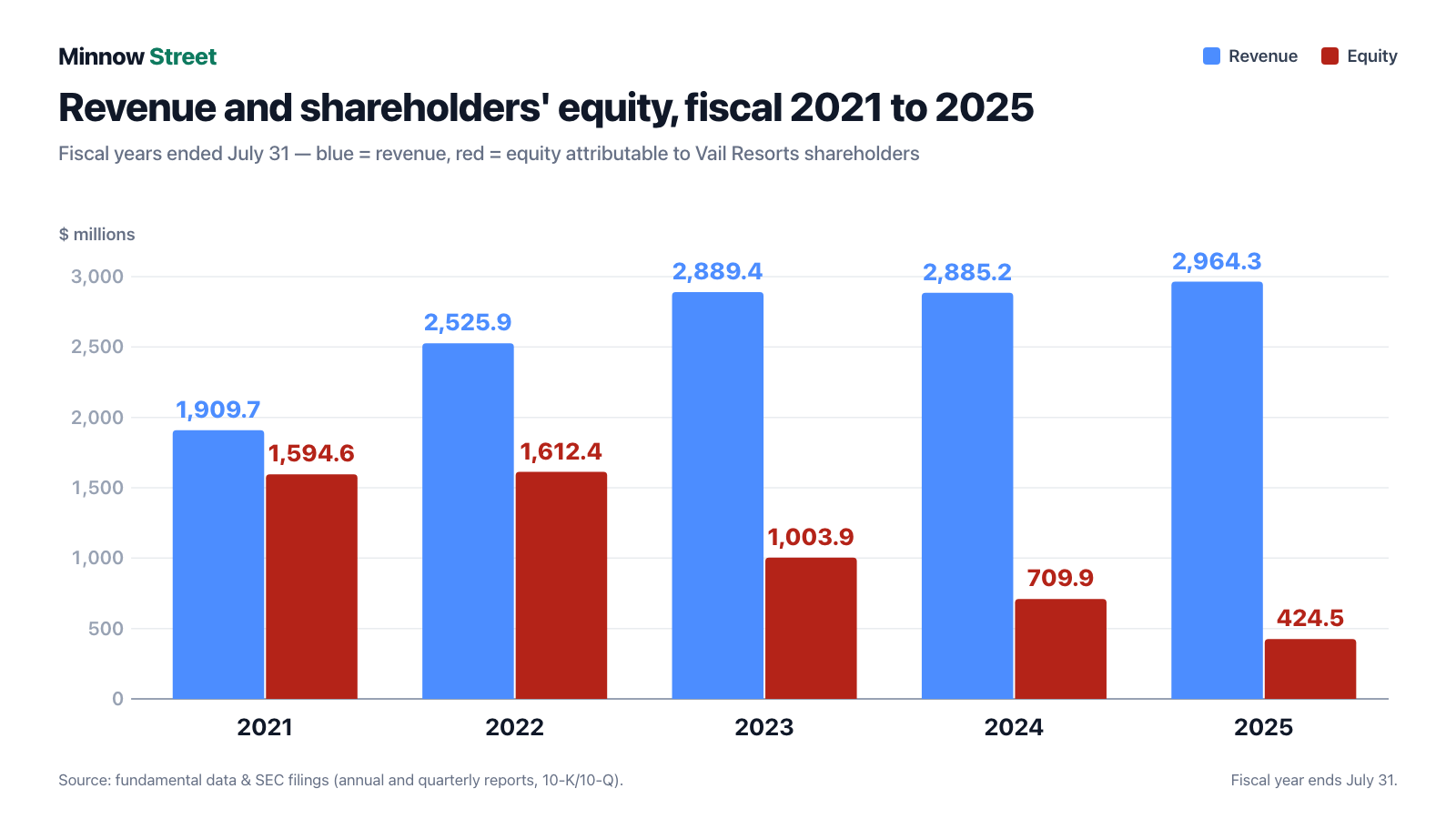
A quarter of the equity is left. How that happens while the company earns a profit every year is what the next sections explain.
What the filings say — the uncomfortable truths
Uncomfortable truth no. 1: for the first time the pre-sale itself is shrinking
This is the sentence it all turns on. In the quarterly report for the period ended April 30, 2026, Vail Resorts reports on the state of the sales campaign for the coming season:
"Pass product unit sales through May 26, 2026 for the upcoming 2026/2027 North American ski season decreased approximately 10%, days sold decreased approximately 8% and sales dollars decreased approximately 5%, including sales and admissions taxes, as compared to the prior year period through May 27, 2025."
— Vail Resorts, Inc., Form 10-Q for the quarter ended April 30, 2026, Part I Item 2 (MD&A)

Why is this different from a bad winter? Because it is the opposite of last year. For the 2025/2026 season Vail sold more passes — the quarterly report explicitly cites a $34.0 million increase in pass revenue over nine months as the counterweight to the missing guests. That counterweight disappears for the 2026/2027 season. And the three figures together say one more thing: units down 10 percent, dollars down only 5 percent. The difference is price. So fewer customers are paying more each — which adds up for now. The question is how many times you can repeat that trick.
Uncomfortable truth no. 2: the mountain is emptier, the ticket dearer
The quarter ended April 30, 2026 brought 7.276 million skier visits, down from 8.609 million a year earlier — a fall of 15.5 percent. The effective ticket price in the same quarter rose 12.0 percent to $100.24. Over nine months the same pattern: 14.797 million visits (down 12.5 percent) at $94.95 (up 10.3 percent). The company names the reason itself, and it is uncomfortably concrete:

Record low snowfall and historically warm temperatures across the western United States, plus earlier closures in the Rockies and Tahoe. That is bad luck to begin with, not a management error. But the model only catches half of it. Revenue over nine months fell 4.9 percent to $2,560.1 million — the pass delivered what it promises. Everything the guest buys on site did not: ski school lost 11.5 percent in the quarter, dining 10.7 percent, retail and rental 8.3 percent. In the Lodging segment, reported EBITDA collapsed 52.8 percent over nine months. Because a pass sitting in a drawer at home does not order lunch.
And this is not a one-year event. Skier visits stood at 19.410 million in fiscal 2023 and at 17.665 million in fiscal 2025 — 9.0 percent fewer in two years, at a price per visit 16.2 percent higher. The mountain has been getting emptier and dearer for years. If you want to see how the same arithmetic plays out in another leisure business, the comparison sits in our analysis of MGM Resorts.
Uncomfortable truth no. 3: the payout exceeds the profit — and the balance sheet foots the bill
Here is why equity is melting although the company earns money. Vail Resorts has for years returned more to shareholders than it keeps:
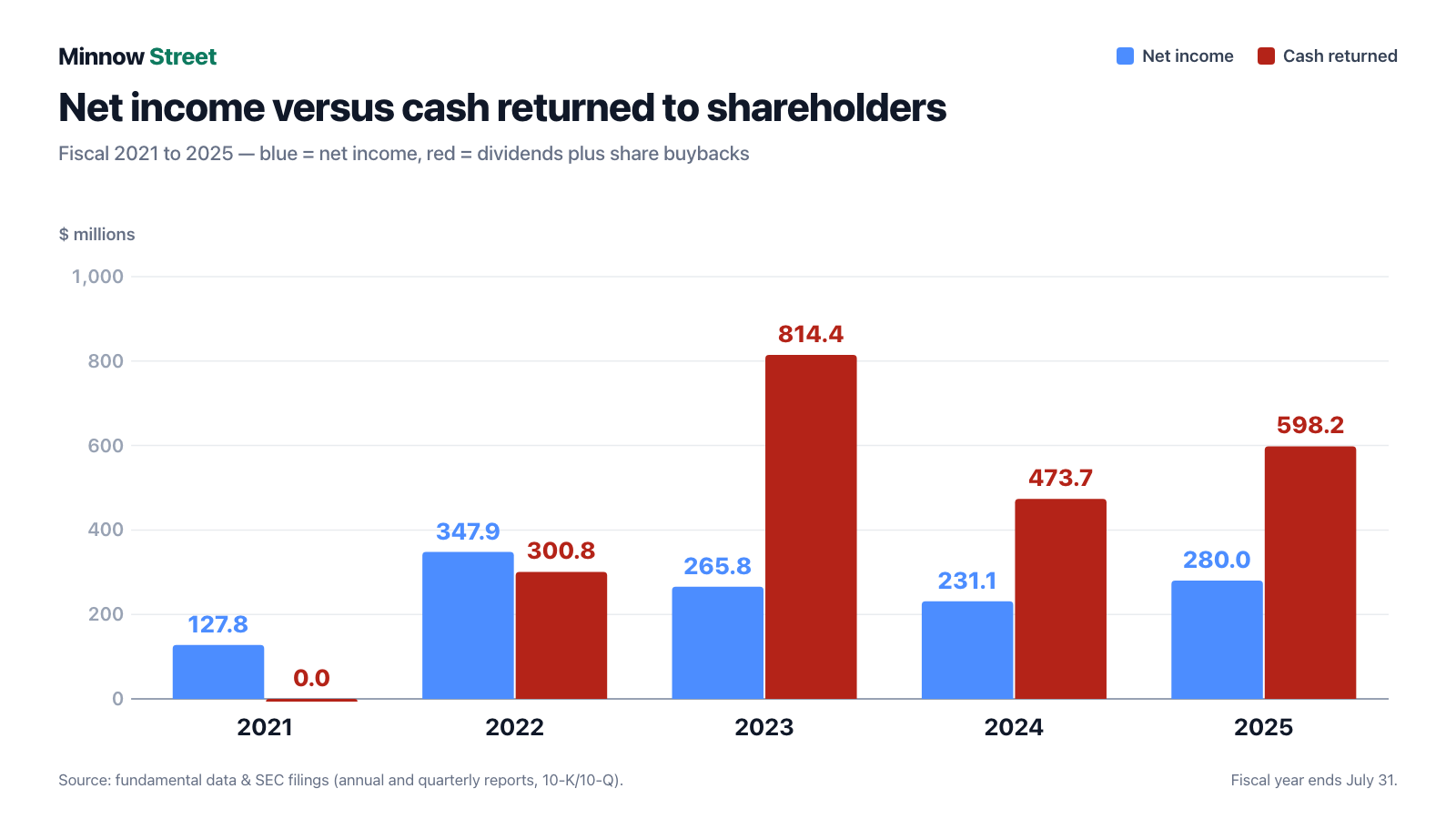
This is not accounting pedantry, it is the core of the balance sheet story. Equity attributable to Vail Resorts shareholders stood at $551.7 million on April 30, 2026 — down from $877.2 million a year earlier, a fall of 37.1 percent in twelve months. Against total assets of $5,686.0 million that is an equity ratio of 9.7 percent. On the other side sit long-term debt of $2,949.6 million plus $73.5 million due within one year, a combined $3,023.1 million, against cash of $371.4 million. Net interest expense rose 19.4 percent over nine months to $152.1 million.
Now the calculation that shows how tight this has become. Take the four most recently reported quarters — fiscal 2025 less the first nine months of 2025 plus the first nine months of 2026 — and you get diluted earnings of $4.63 per share. The dividend is $8.88 a year, most recently confirmed on June 4, 2026 with $2.22 payable July 9, 2026. That is roughly 1.9 times earnings. Translated into everyday terms: the household transfers more every month than lands in the account by month-end, and the difference comes from the overdraft. There is one sign that somebody noticed, though: in the quarter ended April 30, 2026, not a single share was repurchased, after 186,815 shares for $30.0 million in the prior-year quarter.
Fairness requires the other side. On February 9, 2026, Vail Resorts amended and restated its credit agreement. The term loan facility was replaced by a new $1,275.0 million facility, the maturity was extended and the interest rate reduced; the convertible notes with $525.0 million outstanding were repaid in cash on January 2, 2026. As of April 30, 2026, another $517.8 million was available under the revolver. This is not a company on the edge. It is a company that has just narrowed its own room to manoeuvre.
And there is a second lever being pulled — with a number and a date attached, which is rare enough in annual reports:
"By the end of fiscal year 2026, the resource efficiency transformation plan is expected to generate $100 million in annualized cost efficiencies."
— Vail Resorts, Inc., Form 10-K for fiscal 2025, Item 1 "Business"

After the first of the two years, the same report names $37 million of realized savings, before one-time costs of $15 million for the program itself and $8 million for the CEO transition. Roughly two thirds are therefore still missing — in a year that ends on July 31, 2026. The risk factors in the same document state explicitly that there can be no assurance the anticipated savings will be achieved. Remember: a cost program with a date attached is more honest than one without — but it is also checkable, and that is what turns it into a deadline.
Uncomfortable truth no. 4: the company had to revise its own numbers
This paragraph is easy to skim past because it hides in the small print of the accounting policies. In the fourth quarter of fiscal 2025, Vail Resorts found errors in its own books:
"During the fourth quarter of fiscal 2025, the Company identified an immaterial error in its accounting for the EPR Secured Notes, which resulted in an understatement of non-cash interest expense, long-term debt due within one year and long-term debt, net as of and for the years ended July 31, 2024 and July 31, 2023."
— Vail Resorts, Inc., Form 10-Q for the quarter ended April 30, 2026, Note 2 "Summary of Significant Accounting Policies"

What does that mean? The company explicitly classifies the errors as immaterial — there was no obligation to correct them, it elected to do so. Fiscal 2023 and 2024 were affected, as were the interim figures as of April 30, 2025. The amounts are manageable: retained earnings as of April 30, 2025 fell by $18.2 million, from $997.4 million to $979.2 million, total assets by $13.1 million and nine-month net income by $4.6 million. The opening balance as of August 1, 2022 was off by $12.0 million, of which $6.9 million was non-cash interest expense belonging to earlier periods.
For the valuation that changes little — for trust it changes something. A group that misapplies interest accretion for years and books depreciation on finished projects too late is correcting exactly the items that flattered its results. And because the prior-year comparatives now read differently than when first published, one rule applies to every comparison: take the figures from the latest report, not the old one. How quickly stale comparatives can mislead also shows in our analysis of Jack in the Box.
Valuation — what the market is pricing in
Let us work in orders of magnitude, not daily prices. As of June 3, 2026, the cover page of the quarterly report showed 35,633,526 shares outstanding. At the closing price of $145.72 on July 24, 2026 that gives a market capitalization of roughly $5.19 billion. Revenue over the four most recently reported quarters comes to roughly $2,831 million and diluted earnings to $4.63 per share. That works out to a price-to-sales ratio of roughly 1.8 and a price-to-earnings ratio of roughly 31. Add the debt and subtract the cash and enterprise value lands at roughly $7.8 billion.
A price-to-earnings ratio of 31 for a business with falling revenue sounds expensive, and it is worth saying why the number looks that way: the fourth fiscal quarter is traditionally a loss quarter at Vail because nothing is running in North America or Europe. A single weak winter therefore hits earnings disproportionately. The more honest anchor is the payout: at $8.88 of annual dividend, the yield on the price anker above is roughly 6.1 percent. That is precisely what is being traded here — the market is no longer paying Vail Resorts for growth but for a cash stream, and it demands a yield otherwise offered by second-tier bonds. Anyone attracted by a 6 percent dividend yield should read the payout-ratio paragraph again.
The professional view is correspondingly split: of 12 analyst ratings on file, three say strong buy, one buy, seven hold and one sell; the average price target is $148.50 (as of July 25, 2026), roughly 2 percent above the price anchor. The other side of the market is notable: as of the same date, roughly 6.8 million shares were sold short, equal to a good fifth of the free float of roughly 33 million shares, and it would take an average of about 8 trading days to cover that position. Translated: a meaningful part of the market is actively betting on lower prices.
Opportunities and risks at a glance
What speaks for Vail Resorts:
- The pre-sale still works: despite 12.5 percent fewer visits, revenue in the nine months ended April 30, 2026 fell only 4.9 percent to $2,560.1 million; 70 percent of lift revenue came from pass products.
- Genuine pricing power: the effective ticket price rose 12.0 percent to $100.24 in the quarter ended April 30, 2026 and 10.3 percent to $94.95 over nine months — with demand falling.
- Cash generation holds up: $582.7 million of operating cash flow in nine months of a distinctly poor winter, $554.9 million in fiscal 2025.
- Financing defused: on February 9, 2026 the term loan was replaced by a new $1,275.0 million facility with a longer maturity and a lower interest rate; $517.8 million of the revolver was available as of April 30, 2026.
- A quantified cost program with a deadline: $100 million of annualized savings by July 31, 2026, of which $37 million was already realized in fiscal 2025.
- Irreplaceable locations: 42 ski areas, including five of the ten most visited U.S. resorts in the 2024/2025 season — ski mountains in Colorado and Utah cannot be rebuilt somewhere else.
What speaks against it:
- The pre-sale is turning: for the 2026/2027 season, roughly 10 percent fewer passes, 8 percent fewer skier days and 5 percent fewer dollars through May 26, 2026 than in the prior-year period.
- Guests are staying away: 17.665 million skier visits in fiscal 2025 after 19.410 million in fiscal 2023; another 15.5 percent decline in the quarter ended April 30, 2026.
- The ancillary business falls with it: in the quarter ended April 30, 2026, ski school down 11.5 percent, dining down 10.7 percent, retail and rental down 8.3 percent; Lodging segment reported EBITDA down 52.8 percent over nine months.
- The payout exceeds the profit: $8.88 of annual dividend against $4.63 of earnings per share over the four most recently reported quarters; in fiscal 2025, $598.2 million went to shareholders against $280.0 million of profit.
- The balance sheet has thinned out: equity attributable to Vail Resorts shareholders of $551.7 million as of April 30, 2026 (9.7 percent of total assets) against $3,023.1 million of debt; net interest expense up 19.4 percent over nine months to $152.1 million.
- Weather remains the business risk: the quarterly report names record low snowfall and historically warm temperatures across the western United States as the cause — a risk climate change does not make smaller.
- Prior financial statements had to be revised: retained earnings as of April 30, 2025 down $18.2 million, total assets down $13.1 million.
A human conclusion
Back to the subscription illusion. It is not stupidity but a very human shortcut: recurring revenue feels like a law of nature when it is only a habit. Vail Resorts built that habit better than almost anyone — the 2025/2026 winter was one of the worst in recent memory and revenue still fell only 4.9 percent. That is a real achievement and it belongs at the start of any honest assessment.
The second half of the sentence sits three pages later in the same filing. The pass caught the winter; the people who buy it, it did not hold. For the coming season roughly 10 percent fewer are signing up. At the same time more money flows to shareholders than the company earns, and equity has shrunk to a quarter in four fiscal years. Put together, the honest summary reads: Vail Resorts is losing customers and gaining revenue anyway — because it serves the remaining ones at a higher price and takes the difference out of the balance sheet. That can work for a while. But it is a postponement, not a turnaround.
Whether it becomes a turnaround after all will not be decided by a headline but on two dates. The first is July 31, 2026: the fiscal year ends and the deadline for the $100 million cost program runs out. The second follows a few weeks later with the annual report, which will state the final result of the 2026/2027 pass campaign — the one number that shows whether those 10 percent were a stumble or a beginning. What you make of that is your decision. And that is exactly as it should be.
Sources
- Vail Resorts, Inc. — Form 10-Q for the quarter ended April 30, 2026 (filed June 8, 2026)
- Vail Resorts, Inc. — Form 10-K for fiscal 2025 (filed September 29, 2025)
- Vail Resorts, Inc. — Form 10-K for fiscal 2024 (filed September 26, 2024)
- Vail Resorts, Inc. — Form 8-K of February 12, 2026 (Items 1.01 and 2.03, amended and restated credit agreement)
- Vail Resorts, Inc. — Form 8-K of June 24, 2026 (Item 7.01)
- Complete SEC filing history of Vail Resorts, Inc.: EDGAR overview (sec.gov)
- Fundamental data (metrics, price history, analyst view, short interest; as of July 25, 2026), reconciled against the SEC filings.
- Hook: our in-house stock scanner "Turnaround-Kandidaten" — rank 9 of 62 U.S. hits, turnaround check 7 of 8, as of July 25, 2026; the lists are recalculated daily.
Transparency & disclaimer: this analysis is journalistic commentary on publicly available information. It is not investment advice, not a regulated financial analysis and not a solicitation to buy or sell securities. Equity investments carry substantial risk up to total loss. All figures without warranty; the as-of date of the data is noted in the text. The author holds no position in Vail Resorts shares at the time of publication.
Our Bottom Line at a Glance
- Business model & pricing power positive
- The pass sold before the season decouples revenue from the weather: in the nine months ended April 30, 2026, pass products generated 70 percent of lift revenue (prior year 66 percent), which is why revenue fell only 4.9 percent to $2,560.1 million despite 12.5 percent fewer visits. The effective ticket price rose 12.0 percent to $100.24 in the quarter ended April 30, 2026. Forty-two ski areas in irreplaceable locations underpin that pricing power.
- Demand & pre-sale negative
- The pre-sale itself is shrinking for the first time: for the 2026/2027 season, pass sales through May 26, 2026 were down roughly 10 percent in units, 8 percent in skier days and 5 percent in dollars versus the prior-year period. Skier visits fell from 19.410 million in fiscal 2023 to 17.665 million in fiscal 2025, and by another 15.5 percent to 7.276 million in the quarter ended April 30, 2026.
- Capital allocation negative
- The payout exceeds the profit: in fiscal 2025, $328.2 million of dividends and $270.0 million of buybacks flowed out — a combined $598.2 million against net income of $280.0 million and operating cash flow of $554.9 million. The annual dividend of $8.88 stands against $4.63 of diluted earnings per share over the four most recently reported quarters. In the quarter ended April 30, 2026 the company repurchased no shares at all for the first time.
- Balance sheet & financing negative
- Equity attributable to Vail Resorts shareholders fell from $1,594.6 million (fiscal 2021) to $424.5 million (fiscal 2025) and stood at $551.7 million on April 30, 2026 — 9.7 percent of total assets of $5,686.0 million — against $3,023.1 million of debt and $371.4 million of cash. Net interest expense rose 19.4 percent over nine months to $152.1 million. On the relief side: the amended and restated credit agreement of February 9, 2026 extended the maturity and reduced the interest rate.
- Reporting quality neutral
- In the fourth quarter of fiscal 2025 Vail Resorts found errors in interest accretion on the EPR Secured Notes and in depreciation of completed capital projects, classified them as immaterial and nonetheless revised the fiscal 2023 and 2024 statements and the interim figures as of April 30, 2025 voluntarily. Retained earnings as of April 30, 2025 fell by $18.2 million and nine-month net income by $4.6 million. Comparatives from older reports are therefore superseded.
- Valuation neutral
- A market capitalization of roughly $5.19 billion (35,633,526 shares at the $145.72 closing price of July 24, 2026) equals roughly 1.8 times revenue over the four most recently reported quarters and roughly 31 times earnings per share of $4.63; enterprise value is roughly $7.8 billion. The dividend yield of roughly 6.1 percent is the real price anchor. Of 12 analyst ratings, seven sit on hold and the average price target is $148.50 (as of July 25, 2026); roughly 6.79 million shares are sold short.
Vail Resorts took the weather risk out of the ski business — and that is exactly what worked in the poor 2025/2026 winter: despite 12.5 percent fewer skier visits, revenue in the nine months ended April 30, 2026 fell only 4.9 percent to $2,560.1 million. The price for it appears in two places in the same quarterly report: roughly 10 percent fewer passes were sold for the 2026/2027 season through May 26, 2026, and equity attributable to Vail Resorts shareholders has shrunk from $1,594.6 million in fiscal 2021 to $551.7 million as of April 30, 2026 because dividends and buybacks exceed profit — $8.88 of annual dividend against $4.63 of earnings per share over the four most recently reported quarters. Not investment advice.
What Our Rating Means
Open questions
The business works in principle, but one material question is open. As long as it stays open, our findings do not carry a quality verdict.
Buying here mainly buys a dividend yield of roughly 6.1 percent — and on the most recently reported numbers that yield is not covered by earnings: $8.88 of annual payout per share stands against $4.63 of earnings per share. The difference is funded from the balance sheet, whose equity ratio had fallen to 9.7 percent by April 30, 2026. At the same time the business model is reaching into thin air for the first time: pre-sales for the 2026/2027 season are running roughly 10 percent below the prior year in units. Three things are measurable and will appear in the annual report for the year ending July 31, 2026: the final result of the pass campaign against the interim reading of minus 10 percent, whether the $37 million of savings from fiscal 2025 has become the promised $100 million, and whether the quarterly dividend of $2.22 stays unchanged. The decision is yours.
A journalistic assessment by our editorial team at the time of the deep dive, based on public sources — not investment advice and not a solicitation to buy or sell. Your personal circumstances (investment goals, risk capacity, taxes) cannot be taken into account. What our levels mean, how verdicts are formed, and what conflicts of interest exist →
Worth Noting
- Vail Resorts landed on our research list through our in-house stock scanner "Turnaround-Kandidaten": rank 9 of 62 U.S. hits, turnaround check 7 of 8, as of July 25, 2026. These lists are recalculated daily, so the ranking is a dated snapshot.
- The fiscal year ends July 31. References to the "third quarter of 2026" cover February 1 to April 30, 2026 (reported June 8, 2026); references to "fiscal 2025" cover the year to July 31, 2025. The fourth fiscal quarter is seasonally a loss quarter, so annual and nine-month figures cannot be extrapolated linearly.
- Earnings per share over the four most recently reported quarters ($4.63) is our own calculation: fiscal 2025 (7.53) less the nine months ended April 30, 2025 (12.33) plus the nine months ended April 30, 2026 (9.43). The prior-year figures come from the latest quarterly report and already include the voluntary revision of earlier statements.
- Prices are dated valuation anchors, not buy arguments: closing price $145.72 on July 24, 2026, all-time closing high $372.51 on November 5, 2021. The share count of 35,633,526 comes from the cover page of the quarterly report (as of June 3, 2026); market capitalization and share count were cross-checked against each other.
- Risk of confusion: on the New York Stock Exchange the ticker MTN stands for Vail Resorts, not for the similarly named African telecoms group MTN Group, which is listed in Johannesburg. The company was named Gillett Holdings, Inc. until 1996.
- No merger and no take-private is underway: the SEC filing history through July 25, 2026 shows no DEFM14A/PREM14A, no SC 13E-3, no SC 13D and no Form 25 or Form 15. The most recent filing after the quarterly report is an Item 7.01 disclosure dated June 24, 2026.
Frequently Asked Questions
Vail Resorts, Inc. (NYSE: MTN) of Broomfield, Colorado, operated 42 ski areas across North America, Australia and Switzerland according to its fiscal 2025 annual report, including Vail, Breckenridge, Park City and Whistler Blackcomb. It also runs hotels, condominiums and a real estate business. The heart of the model is the Epic Pass — a season pass sold before winter that gives access to the entire network.
On July 31. Fiscal 2026 therefore runs from August 1, 2025 to July 31, 2026. The winter falls into the second and third quarters: the third quarter of fiscal 2026 covers February 1 to April 30, 2026. The fourth quarter is seasonally a loss quarter because nothing is running in North America or Europe. Anyone comparing Vail with calendar-year reporters has to allow for that shift.
Because most lift revenue is paid before the season. In the nine months ended April 30, 2026, pass products accounted for 70 percent of lift revenue, up from 66 percent a year earlier. That is why revenue fell only 4.9 percent to $2,560.1 million although skier visits dropped 12.5 percent. What the guest buys on site — ski school, dining, rental — falls away in full.
There is no final figure yet. The quarterly report for the period ended April 30, 2026 gives an interim reading: through May 26, 2026, sales for the 2026/2027 North American season were down roughly 10 percent in units, 8 percent in skier days sold and 5 percent in dollars versus the prior-year period through May 27, 2025. The company itself writes that it cannot predict whether the trend will continue.
On the most recently reported numbers, no. The annual dividend is $8.88 per share, most recently confirmed on June 4, 2026 with $2.22 payable July 9, 2026. Diluted earnings over the four most recently reported quarters come to $4.63 per share — the payout is therefore roughly 1.9 times earnings. In fiscal 2025, $328.2 million of dividends and $270.0 million of buybacks flowed out against net income of $280.0 million.
Because more has gone to shareholders than the company earns, for years. Equity attributable to Vail Resorts shareholders fell from $1,594.6 million in fiscal 2021 to $424.5 million in fiscal 2025 and stood at $551.7 million on April 30, 2026 — 9.7 percent of total assets of $5,686.0 million. In fiscal 2023 alone the payout of $814.4 million exceeded profit of $265.8 million by more than three times.
It revised them voluntarily. In the fourth quarter of fiscal 2025 the company found errors in interest accretion on the EPR Secured Notes and in depreciation of completed capital projects. It classified them as immaterial but revised the fiscal 2023 and 2024 statements and the interim figures as of April 30, 2025 anyway. Retained earnings as of April 30, 2025 fell by $18.2 million and total assets by $13.1 million.
No. The SEC filing history through July 25, 2026 shows no merger proxy (DEFM14A or PREM14A), no going-private disclosure (SC 13E-3), no Schedule 13D ownership filing and no delisting or deregistration notice (Form 25 or Form 15). The most recent filing after the quarterly report is an Item 7.01 disclosure dated June 24, 2026 unrelated to any transaction.
Found an error?
Did you spot a factual error, an outdated number, or a typo in this deep dive? Let us know briefly — your report goes straight to the editorial team.