Jack in the Box Stock: The Familiar Drive-Thru Brand Runs on $1.6 Billion of Wall Street Debt — and Minus $922 Million in Equity
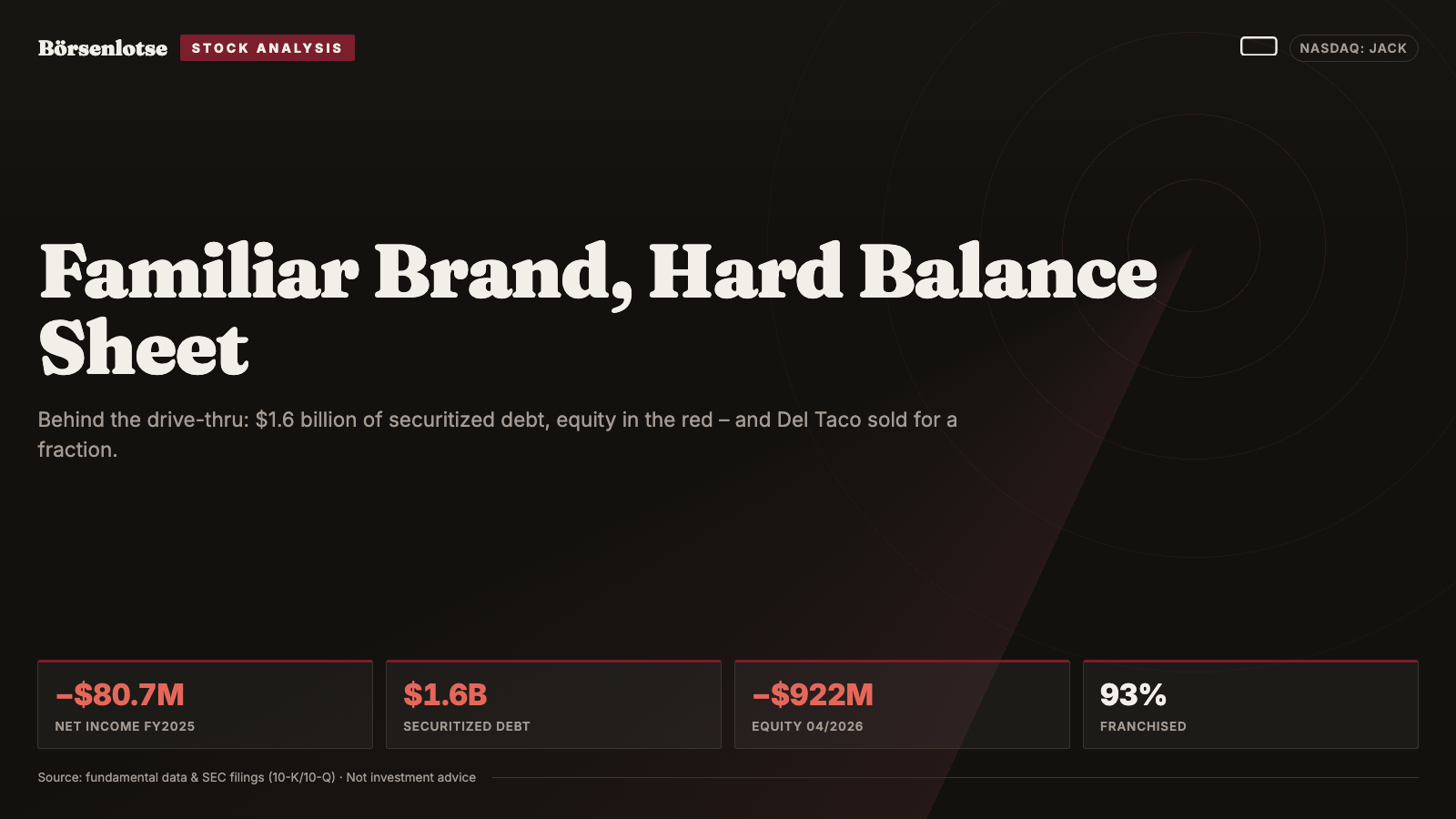
Jack in the Box (Nasdaq: JACK) out of San Diego is the burger chain everyone in the western U.S. has pulled up to: 2,136 restaurants, 93 percent of them franchised, an asset-light royalty business. But behind the everyday brand sits a Wall Street construction — about $1.6 billion of securitized debt and negative equity of $922 million that comes entirely from $3.2 billion of share buybacks, not from losses. Del Taco, acquired in 2022, was offloaded again in December 2025 for $115 million after roughly $372 million of write-downs. On Reddit the stock is only a whisper: 2 mentions in 24 hours (ApeWisdom, as of July 23, 2026). We read the annual reports (10-K) and the quarterly report (10-Q). Not investment advice — just a tape measure held against the gap between a familiar brand and a hard balance sheet.
 Thomas Mücke
Founder & Publisher
Thomas Mücke
Founder & Publisher
Chart
Interactive price chart (TradingView).
Note: pure fact-based analysis, not investment advice and not a solicitation to buy or sell. All figures without guarantee.
There is an investor trap so cozy it does not feel like a trap at all: the familiarity trap. It works like this. You have known a brand since you were a teenager. You have rolled through its drive-thru, you know the smell of the curly fries, the round-headed mascot. And because your brain confuses familiarity with safety (psychologists call it the mere-exposure effect: the more often we see something, the safer we assume it is), you think, "A chain this well known can't be a risky stock." Jack in the Box (Nasdaq: JACK) out of San Diego is exactly that kind of brand — 2,136 restaurants, founded in 1951, a household name across the western and southern U.S. On Reddit the stock is no storm, more of a background noise: 2 mentions in 24 hours (ApeWisdom, as of July 23, 2026). So let's make a deal: before you trust the familiar brand, we read together what the company itself reported, under penalty of law, to the U.S. securities regulator, the SEC — the annual reports (10-K) for fiscal years 2024 and 2025 and the quarterly report (10-Q) as of April 12, 2026. A filing to the SEC is honest under penalty of law. And this one tells a story that has little to do with the friendliness of the drive-thru: of $1.6 billion in Wall Street debt, of equity deep in the red, of a billion-dollar acquisition written down to scrap in three years — and of revenue that has fallen three years running. In the end, the decision is yours.
What Jack in the Box actually does — burgers up front, financial engineering out back
Jack in the Box sells what the name promises: burgers, curly fries, tacos, all-day breakfast, mostly through the drive-thru. Founded in 1951 in San Diego, the chain operated and franchised 2,136 restaurants across 22 states at the end of fiscal year 2025 (September 28, 2025). What matters, though, is not the menu but the operating form: 1,986 of those restaurants — 93 percent — belong to franchisees, not to the corporation. Put in everyday terms, Jack in the Box today is less a burger cook than a licensor that collects rents and fees: independent operators pay royalties on their sales, rent on the real estate the company holds, and contributions to the shared advertising fund. That is called an "asset-light" model — little of the company own capital tied up, predictable fee income. Sounds like a comfortable money printer? In part it is. But those same reliable franchise cash streams are the raw material for the second, invisible half of the company: a whole-business securitization — in plain terms, a bond secured by essentially all of the brand future income. The tension of this analysis is now on the table, and it runs through every chapter: a familiar everyday brand up front, a highly leveraged financial construction out back — and the question of who the cash flow ultimately belongs to, the shareholder or the bondholders. If you like the mechanics, you will find them in even purer form at Wendy's; and the restaurant world beyond burgers, such as The Cheesecake Factory, is fighting the same headwind of falling traffic and rising costs.
Where the stock shows up in our scanner
We run about 3,500 stocks through our scanners every day. Jack in the Box paints a picture that does not fit the Reddit whisper — or the usual momentum darling of this Reddit-hype series: the stock is a value/turnaround case, not a rally horse. The price sits far below its multi-year high, the price-to-sales ratio is low single digits, and no price-to-earnings ratio can be formed for the two loss years. Where the other names in this series light up ten momentum rankings, JACK shows up more in the valuation and "fallen angel" filters — stocks that look optically cheap because the market has priced in a problem. This is where the familiarity trap bites hardest: a well-known brand that looks "cheap" is the classic bait for the anchoring effect — the mind fixes on the old, higher price and whispers "bargain," even though the business underneath has changed. Remember the finding before we go to the numbers: cheap is a price, not an argument. Whether cheap is also good value is decided by the balance sheet — and at Jack in the Box that balance sheet is a handful.
The numbers over the years — honestly appraised
First, what genuinely speaks for Jack in the Box. The franchise model throws off real money: of $1.465 billion in total revenue at the end of fiscal year 2025, about $838 million came from franchise rents, royalties and contributions — income that ties up almost no capital of its own. The brand has reach, recognition and, in FY2023, still earned $130.8 million of net income ($6.35 per share). And the most recent news is good: since the sale of Del Taco in December 2025, the continuing core business is profitable again — the first half of FY2026 showed net income of about $26.9 million from continuing operations. So much for the sunny side. Now the full curve over the years:
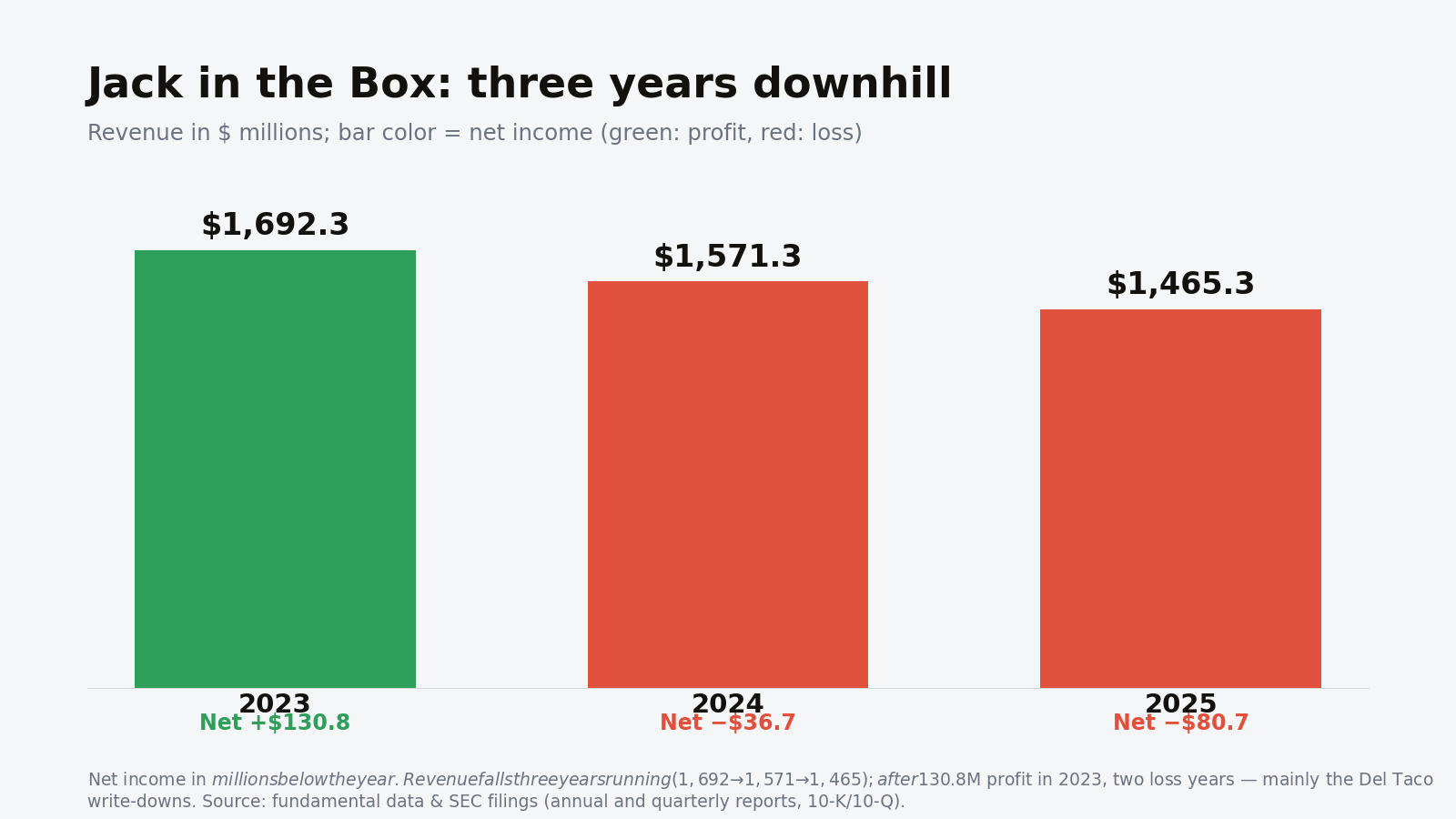
The curve tells an uncomfortable truth about the business: it is shrinking. $1.692 billion of revenue in FY2023, $1.571 billion in FY2024, $1.465 billion in FY2025 — three years running, downward. Company restaurant sales fell from $846 million through $709 million to $627 million, partly because the company handed its own restaurants to franchisees. And the single most important leading indicator in the restaurant business is flashing red: same-restaurant sales, the revenue per restaurant open at least a year. At Jack in the Box company restaurants they dropped 3.7 percent in FY2025 and a further 2.8 percent in the second quarter of FY2026. The line below is even more uncomfortable: the decline comes not from discounting but from lost traffic — transactions fell 4.3 percent in the second quarter of FY2026 while the average check rose only 1.5 percent. Translated: noticeably fewer people come in, and the ones who remain pay a little more — a pattern familiar across the industry, but one that eventually exhausts pricing power. Remember the rhythm: fewer guests, higher prices, falling revenue — that is a managing regime, not a growth regime. Which brings us to the uncomfortable truths.
What the filings say — the uncomfortable truths
Uncomfortable truth no. 1: Del Taco — bought in 2022, written to scrap by 2025 and sold for a fraction
In 2022, Jack in the Box bought the California chain Del Taco to build a second growth leg. On the books the purchase price showed up as goodwill and trademark: roughly $194 million of Del Taco goodwill and a $283.5 million trademark. Three years later, none of it is left. The annual report (10-K) for 2025 records impairments to goodwill and intangibles of $209.6 million — after $162.6 million the year before. Del Taco goodwill now stands at zero, and the trademark was cut from $283.5 million to $105.6 million. All told, the company wrote off about $372 million in two years — the main reason for the two net-loss years. In April 2025, management pulled the ripcord:
"In April, 2025, the Company announced a multi-faceted plan, which included exploring strategic alternatives for the Del Taco brand and the possible divestiture of that business. On October 15, 2025, the Company entered into a Stock Purchase Agreement … for an aggregate purchase price of $115 million in cash …"
— Jack in the Box Inc., SEC annual report 10-K for fiscal year 2025, Item 1 "Business"
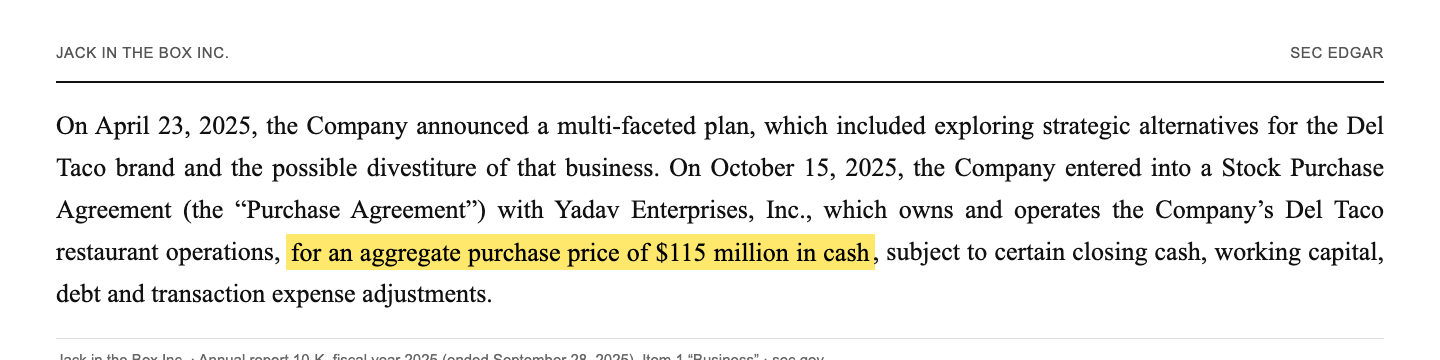
The sale to Yadav Enterprises, Inc. closed on December 22, 2025; Del Taco has since been reported as discontinued operations. And even the exit cost more: the quarterly report shows a pretax loss on the sale of $47.4 million — on top of the $372 million of impairments. Picture it: you buy a car for the price of a new one, drive it three years while writing off most of its value — and finally sell it for scrap, with the delivery charge on top. To be fair: the exit was the right consequence of a mistake, and the core business is rid of it. But remember the lesson about the management now meant to steward your shareholder interests: this team last big capital allocation was a value destruction in the hundreds of millions.
Uncomfortable truth no. 2: $1.6 billion of securitized debt — and the cash flow is pledged
Here the familiar brand turns into a financial construction. Jack in the Box has taken on the bulk of its debt not as a classic bank loan but as a whole-business securitization: notes (Class A-2 Notes, Series 2019-1 and 2022-1) issued by purpose-built subsidiaries and secured by essentially all of the brand future income — royalties, franchise fees, real estate. As of April 12, 2026 this debt totaled about $1.586 billion, with interest expense around $79 million a year. The annual report spells out what that means:
"The securitized debt instruments issued by certain of our wholly-owned subsidiaries have restrictive terms, and any failure to comply with such terms could result in default, which could harm the value of our brand and adversely affect our business."
— Jack in the Box Inc., SEC annual report 10-K for fiscal year 2025, Item 1A "Risk Factors"
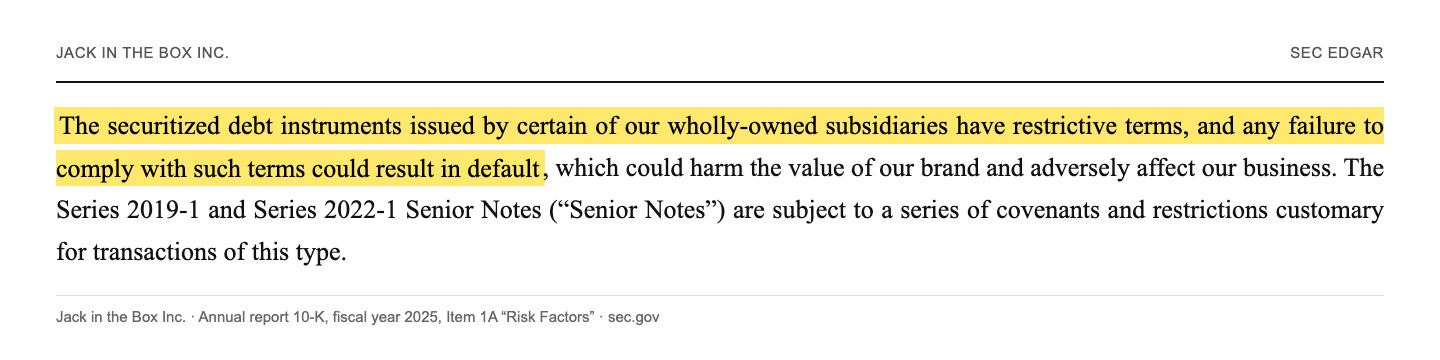
The report is blunter still: the transaction documents pledge to the creditors "substantially all of the assets held within the securitization entities," and the covenants can restrict the payment of dividends and share buybacks. Exactly that became visible in spring 2025: as part of the cash-preservation plan, the company cut the dividend and collapsed buybacks from $90.7 million (FY2023) through $70.6 million (FY2024) to just $5.0 million (FY2025). In everyday terms: the franchise cash flow is there, but it runs first through the bondholders hands; what finally reaches the shareholder depends on how much the coverage covenants leave behind. Remember the mechanism: high leverage amplifies every move — the one upward and the one downward. With same-restaurant sales falling, that is not a reassuring property.
Uncomfortable truth no. 3: minus $922 million in equity — buybacks flipped the balance sheet
Now the line item that makes the whole construction visible. As of April 12, 2026, Jack in the Box reports negative stockholders equity of $922 million (September 28, 2025: minus $938 million). "Negative equity" sounds like a company that has traded itself toward bankruptcy — here the opposite is the case, and that is the point. Retained earnings are deeply positive at plus $1.777 billion; over the years the company has earned a great deal on a cumulative basis. The deficit sits beside it, in a single line: $3.2 billion of the company own stock in treasury (64.1 million shares), bought back over the years — often with borrowed money. The company has thus poured more than all the equity it ever retained into repurchasing its own shares and filled the gap with debt.
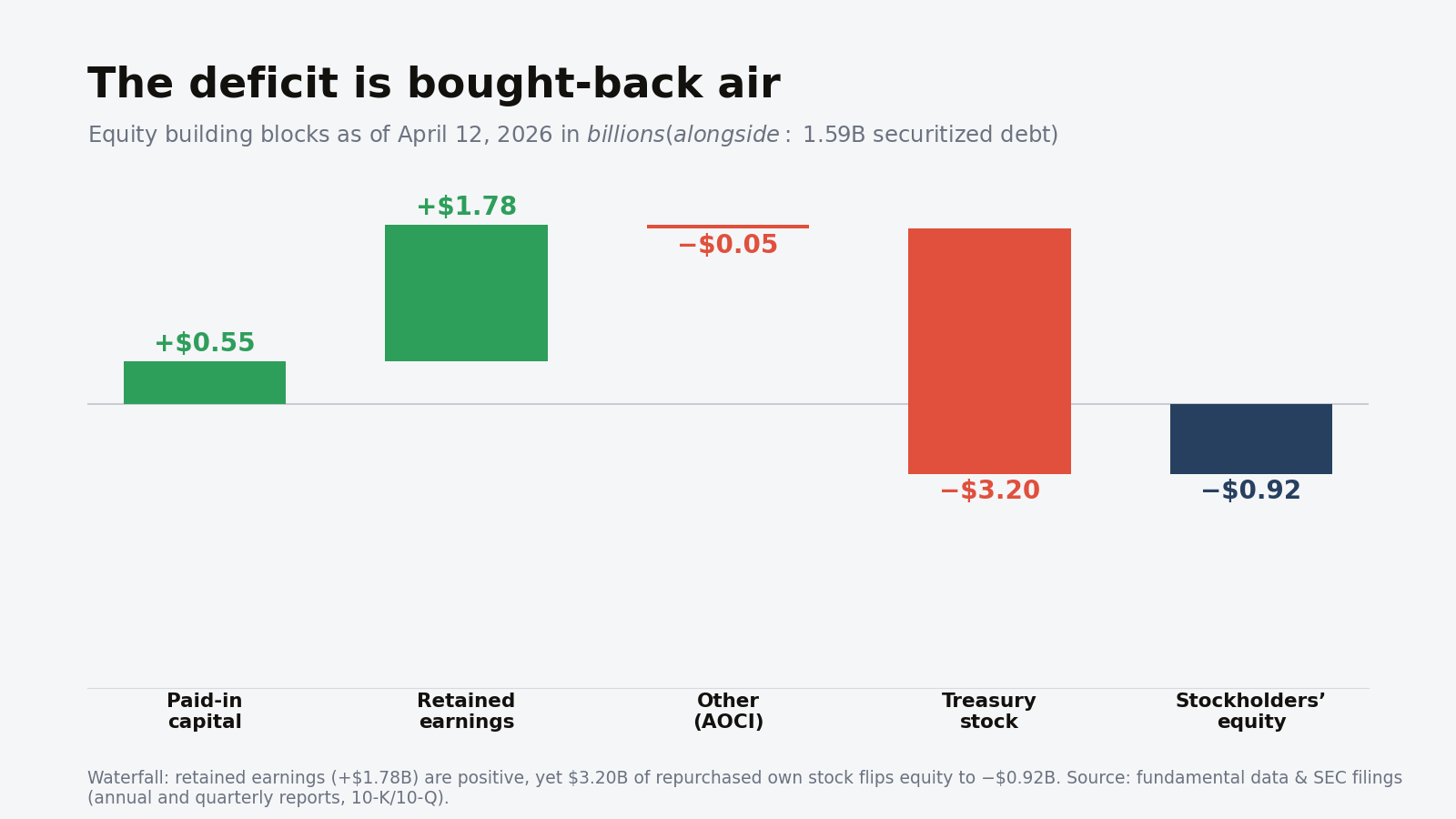
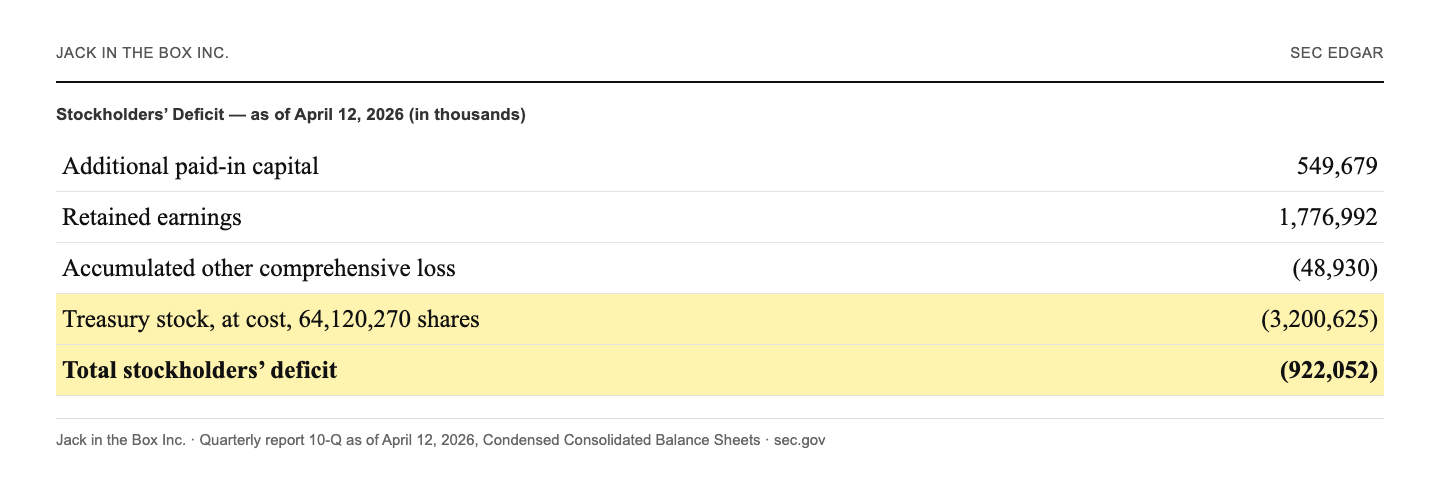
Is that bad? It depends, and here honesty runs both ways. As long as the franchise cash flow comfortably carries the debt service, negative equity from buybacks is not an insolvency signal but a deliberate capital structure — many securitized restaurant companies look like this. The flip side: there is no equity cushion left. If same-restaurant sales keep falling and cash flow shrinks, every dent hits a balance sheet with no safety net and bond covenants that then tighten. The repurchased shares were also mostly bought at prices well above what the stock is worth today — an expensive rearview mirror. Remember the distinction: negative equity from losses is a symptom of disease; negative equity from buybacks is a bet on your own cash flow — and bets can be lost.
Uncomfortable truth no. 4: a franchise model is only as strong as its franchisees
The 93 percent franchise rate is both a blessing and a risk. The report says so itself:
"As of September 28, 2025, approximately 93% of our Jack in the Box restaurants … were franchised; therefore, our success increasingly relies on the financial success and cooperation of our franchisees, yet we have limited influence …"
— Jack in the Box Inc., SEC annual report 10-K for fiscal year 2025, Item 1A "Risk Factors"
Translated: the company collects fees on the operators sales — but rising wages, food costs and interest hit the franchisees first. If they come under pressure, it is not only royalties that fall; in the extreme, restaurants close. That is exactly why the April 2025 plan includes a "block closure program" to shut weak locations and a pullback in company-owned new builds. That is healthy housekeeping — but it is also the admission that parts of the network no longer carry their weight. For a chain whose guest counts are already falling 4 to 6 percent, the health of the franchisees is not a footnote but the actual engine.
Valuation: optically cheap — but the leverage sets the price
How expensive is the familiar brand? Measured against revenue, Jack in the Box looks cheap: the market capitalization is in the low hundreds of millions, putting price-to-sales in the low single digits — no price-to-earnings ratio can be formed for the two loss years, and a moderate one emerges for the profitable continuing business. But for a highly leveraged company, looking at market cap alone is misleading. What matters is enterprise value — market cap plus roughly $1.6 billion of net debt. On that basis the "cheap" stock is suddenly normally valued: the lion share of the firm value belongs to the bondholders, not the shareholders. That is the mechanics of any leverage — it makes the equity larger in good times and smaller in bad. The analyst expectations circulating in the market price in a cautious turnaround: stabilized margins in the continuing business, but no revenue jump as long as guests do not return. What supports the valuation: the real, capital-light franchise cash flow and the removal of the Del Taco millstone. What caps it: the debt load, the lack of growth and the missing equity net. How quickly the market re-prices a leveraged turnaround story we saw at Wendy's — the same securitization logic, the same headwind of falling traffic.
Opportunities and risks at a glance
What speaks for Jack in the Box:
- Capital-light franchise model: 93 percent of the 2,136 restaurants in franchisee hands, reliable royalty, rent and advertising income (about $838 million in FY2025) that ties up almost no capital of its own.
- A well-known, defended brand with reach across the western and southern U.S. — still $130.8 million of net income ($6.35 per share) in FY2023.
- Del Taco is cleaned up: the millstone was sold on December 22, 2025; the continuing core business is profitable again in the first half of FY2026 (net income of about plus $26.9 million).
- Disciplined housekeeping: a cash-preservation plan with a dividend stop, throttled new builds and closures of weak locations — focus on digital and debt reduction.
- Optically low revenue multiple; whoever believes in a successful turnaround buys an established cash flow at a discount.
What speaks against it:
- A shrinking business: revenue down three years running (1.69 → 1.57 → 1.47 billion), same-restaurant sales negative (JITB company minus 3.7 percent FY2025, minus 2.8 percent Q2 FY2026) on 4 to 6 percent fewer guests.
- High leverage: about $1.6 billion of securitized debt (Class A-2 Notes) with restrictive covenants, roughly $79 million of interest a year, no equity cushion (minus $922 million).
- Questionable capital allocation: Del Taco (bought 2022) written down by about $372 million and sold for $115 million with a further $47.4 million loss on the sale; $3.2 billion poured into often expensively bought own shares.
- Two consecutive net-loss years (FY2024 minus $36.7 million, FY2025 minus $80.7 million); dividend cut, buybacks nearly halted.
- Dependence on franchisee health amid cost and interest pressure; "limited influence" over the operators per the company own report.
A human conclusion
Back to the familiarity trap from the opening. Its core is not that the brand is bad — Jack in the Box is a real, well-known chain with a genuine franchise cash flow, and exiting Del Taco was the right consequence. Its core is that familiarity spares you the scrutiny an investment thesis demands. Whoever buys "the burger chain from around the corner" is really buying three very concrete bets: that guests return before falling same-restaurant sales catch up with the leveraged cash flow; that a management whose last big decision was a value destruction in the hundreds of millions now steers the capital structure wisely; and that equity which sits in the red only because $3.2 billion flowed into its own shares proves to be a smart, not an expensive, bet. All of it is possible — the continuing business is profitable again, and debt is no crime as long as cash flow carries it. So the honest question is not "Do I know this brand?" but: Would you buy this balance sheet even if you did not know the brand? If yes, you have a thesis. If no, you had a memory. What you make of it is your decision. And that is exactly as it should be.
Sources
All original documents used in this analysis — to read for yourself:
- Jack in the Box Inc. — SEC annual report 10-K for fiscal year 2025 (ended 09/28/2025, filed November 19, 2025)
- Jack in the Box Inc. — SEC annual report 10-K for fiscal year 2024 (ended 09/29/2024, filed November 21, 2024)
- Jack in the Box Inc. — SEC quarterly report 10-Q as of 04/12/2026 (Q2 FY2026, filed May 13, 2026)
- Jack in the Box Inc. — SEC quarterly report 10-Q as of 01/18/2026 (Q1 FY2026, filed February 18, 2026)
- Full SEC filing history of Jack in the Box Inc.: EDGAR overview (sec.gov)
- Fundamental data (metrics, quarterly series, valuation; reconciled with the SEC filings and the SEC XBRL data series).
- Screener and rating data: in-house stock scanner; Reddit mentions: ApeWisdom (as of July 23, 2026).
Transparency & disclaimer: This analysis is a journalistic contextualization of publicly available information and is not investment advice, not a financial analysis in the regulatory sense, and not a solicitation to buy or sell securities. Stock investments carry substantial risks up to and including total loss. All information without guarantee; the data cut-off is noted in the text. The author holds no position in Jack in the Box shares at the time of publication.
Our Bottom Line at a Glance
- Business model & brand positive
- A well-known burger chain with 2,136 restaurants (93 percent franchised) and a capital-light royalty, rent and advertising cash flow of about $838 million (FY2025). In FY2023 the company still earned $130.8 million of net income — the brand earnings power is real.
- Operating trend negative
- Revenue down three years running (1.69 → 1.57 → 1.47 billion), same-restaurant sales negative (JITB company minus 3.7 percent FY2025, minus 2.8 percent Q2 FY2026) — driven by 4 to 6 percent fewer guests at higher prices. That is a managing regime, not a growth one.
- Balance sheet & leverage negative
- About $1.6 billion of securitized debt (Class A-2 Notes) with restrictive covenants and roughly $79 million of interest a year; negative equity of $922 million (04/12/2026). The deficit stems from $3.2 billion of buybacks (retained earnings plus $1.78 billion), but there is no equity cushion left.
- Capital allocation negative
- Del Taco (bought 2022) written down by about $372 million and sold on 12/22/2025 for $115 million (a further $47.4 million loss on the sale); at the same time $3.2 billion poured into often expensively bought own shares. Two net-loss years, dividend cut, buybacks nearly halted.
- Turnaround approach neutral
- After exiting Del Taco, the continuing business is profitable again in the first half of FY2026 (net income plus $26.9 million); the cash-preservation plan (dividend stop, throttled new builds, location cleanup) targets debt reduction. Whether it works depends on guests returning — open.
Jack in the Box is the familiarity trap in its purest form: a well-known everyday brand up front with a real, capital-light franchise cash flow — a highly leveraged financial construction out back, with about $1.6 billion of securitized debt and negative equity of $922 million that stems entirely from $3.2 billion of share buybacks. Revenue has fallen three years running, same-restaurant sales are negative, and the last big capital decision — the 2022 Del Taco acquisition — ended, after about $372 million of write-downs, in a sale for $115 million. On the plus side: the cleaned-up core business is profitable again, the dividend is cut, and the focus is on debt reduction. Whoever buys is betting on guests returning before the leveraged cash flow shrinks. Not investment advice.
What Our Rating Means
Substance risk
We found at least one documented issue that threatens the company itself — regardless of how the stock is currently valued.
Whoever buys today is betting that guests return before falling same-restaurant sales catch up with the leveraged cash flow — and pays for an optically cheap stock whose firm value belongs mostly to the bondholders, not the shareholders. Whoever is in checks four things in every quarterly report (10-Q): do systemwide same-restaurant sales turn positive, or do guest counts keep falling? How does the remaining Class A-2 Notes balance develop (last $1.586 billion)? Does the continuing business stay profitable? And do the dividend or buybacks return — a signal that the coverage covenants leave room again? Until then this is a heavily indebted turnaround without an equity net, not a defensive consumer bet. The decision is yours.
A journalistic assessment by our editorial team at the time of the deep dive, based on public sources — not investment advice and not a solicitation to buy or sell. Your personal circumstances (investment goals, risk capacity, taxes) cannot be taken into account. What our levels mean, how verdicts are formed, and what conflicts of interest exist →
Worth Noting
- JACK reached our research list via the Reddit hype scanner (2 mentions in 24 hours, ApeWisdom, as of July 23, 2026) — unlike the momentum darlings of this series, Jack in the Box is an optically cheap, heavily indebted turnaround case, not a rally name.
- Fiscal-year note: a 52/53-week year ending in late September (FY2025 ended 09/28/2025); the first quarter is 16 weeks, the others 12 each. Del Taco has been reported as discontinued operations since the sale on 12/22/2025 — revenue and earnings series are delineated accordingly.
- Valuation figures are deliberately given as orders of magnitude and evergreen: metrics carry an annual, quarterly or data cut-off reference; daily prices are not a buy argument. Not to be confused: "JACK" (Jack in the Box) is not the Del Taco buyer Yadav Enterprises and is not the same as other QSR securitization issuers.
Frequently Asked Questions
Jack in the Box Inc. (Nasdaq: JACK) out of San Diego operates and franchises the Jack in the Box quick-service burger chain — about 2,136 restaurants across 22 U.S. states as of September 28, 2025, 93 percent of them franchised. The business is asset-light: most revenue comes from franchise rents, royalties and advertising contributions. In fiscal year 2025 the company generated $1.465 billion in revenue; the Del Taco chain it acquired in 2022 was sold again in December 2025.
As of April 12, 2026, Jack in the Box reported negative equity of $922 million — but not because of losses: retained earnings are positive at plus $1.777 billion. The deficit comes entirely from $3.2 billion of the company own stock held in treasury (64.1 million shares), bought back over the years, often with borrowed money. Negative equity from buybacks is not an insolvency signal, but it removes any safety cushion.
Del Taco, acquired in 2022, became a failure: Jack in the Box wrote down goodwill and the trademark by a combined $372 million in 2024 and 2025 (Del Taco goodwill to zero, the trademark from $283.5 to $105.6 million). In April 2025 the company announced a review of strategic alternatives, sold Del Taco for $115 million to Yadav Enterprises, and closed the sale on December 22, 2025 — with a further $47.4 million loss on the sale.
In a whole-business securitization a company raises debt secured by essentially all of a brand future income — royalties, franchise fees, real estate. Jack in the Box has raised about $1.6 billion this way through Class A-2 Notes (Series 2019-1 and 2022-1). The covenants are restrictive and can limit dividends and share buybacks; a breach could, per the annual report, trigger a default. The franchise cash flow thus runs first through the bondholders hands.
It depends on the period. In fiscal years 2024 and 2025 the company posted net losses (minus $36.7 and minus $80.7 million), largely because of the Del Taco write-downs. After selling Del Taco, the continuing Jack in the Box business is profitable again in the first half of FY2026 (net income of about plus $26.9 million). The operating trend remains weak, though: revenue fell three years running and same-restaurant sales are negative.
Downward. At Jack in the Box company restaurants, same-restaurant sales fell 3.7 percent in fiscal year 2025 and a further 2.8 percent in the second quarter of FY2026. The decline is driven by lost traffic: transactions fell 4.3 percent in the second quarter of FY2026 while the average check rose only 1.5 percent — fewer guests come in, and the ones who remain pay a little more.
Jack in the Box uses a 52/53-week fiscal year ending on the Sunday nearest September 30 — fiscal year 2025 ended on September 28, 2025. The first quarter is 16 weeks, the others 12 weeks each. "Fiscal year 2025" therefore essentially covers October 2024 through September 2025; all quarterly comparisons in this analysis follow that week logic.
Found an error?
Did you spot a factual error, an outdated number, or a typo in this deep dive? Let us know briefly — your report goes straight to the editorial team.