Lamb Weston: They sell more french fries than ever — and keep earning less from them
Roughly one in four servings of french fries in an American restaurant comes out of this company's plants. In fiscal 2026 sales volume rose 7 percent, and 9 percent in North America — yet net income still fell from $357.2 million to $290.0 million. The reason sits one line down in the annual report filed on July 24, 2026: price and product mix gave up 6 percent company-wide, and outside North America segment earnings collapsed by 55 percent. Meanwhile something many people miss is happening: with the big plants finished, $540.2 million in free cash was left over last year, after minus $131.3 million two years earlier. We read the filings to see who this rebuild ultimately serves.
 Thomas Mücke
Founder & Publisher
Thomas Mücke
Founder & Publisher
Chart
Interactive price chart (TradingView).
Note: pure fact-based analysis, not investment advice and not a solicitation to buy or sell. All figures without guarantee.
There is an investor trap that feels especially comfortable because it sounds like common sense: the volume trap. It works like this — a company reports it sold more units than ever before, and your brain quietly files away the question of profit. More goods, more money, surely. Lamb Weston Holdings (NYSE: LW) is the teaching film for this. In fiscal 2026 the company shipped 7 percent more volume than the year before, 9 percent more in North America — and profit still fell from $357.2 million to $290.0 million. So let us make a deal: before we celebrate volume records, we read together what the company itself told the U.S. securities regulator, the SEC — the annual report (Form 10-K) for fiscal 2026, filed on July 24, 2026. An SEC filing is honest under penalty of law. And this one tells a story in two halves, one of them considerably less pleasant than the other.
Contents
- What Lamb Weston actually does — the fries behind the counter
- How the stock landed on our desk
- The numbers over the years — honestly credited
- What the filings say — the uncomfortable truths
- What the company costs on the market
- Opportunities and risks at a glance
- A human conclusion
- Sources
What Lamb Weston actually does — the fries behind the counter
Lamb Weston does not sell a brand you look for in the supermarket. It sells what ends up on your plate before anyone puts a name on it. Translated into everyday terms: if a fast-food chain is the innkeeper, Lamb Weston is the kitchen behind it — potatoes get peeled, cut, blanched, par-fried, frozen and shipped in cartons to restaurants, cafeterias, gas stations and retailers. The annual report describes the company as a leading global producer of value-added frozen potato products and the number one supplier in North America, with customers in more than 100 countries. French fries make up most of the portfolio.
The business runs in two segments: North America (all customers in the United States, Canada and Mexico) and International (everything else). In fiscal 2026 North America contributed $4,395.2 million of net sales and the rest of the world $2,217.1 million. As of May 31, 2026 the company employed roughly 10,000 people, about 3,000 outside the United States; roughly 30 percent of the workforce is covered by collective bargaining agreements. Lamb Weston was spun off from Conagra in November 2016 and has traded independently on the New York Stock Exchange since.
Two peculiarities matter, or every number reads wrong. First, the fiscal year ends in late May. Fiscal 2026 ran from May 26, 2025 to May 31, 2026 and exceptionally comprised 53 weeks instead of 52 — an extra week that alone added $127.1 million of net sales. Second, the raw material is bought under grower contracts. Farmers deliver the crop from the contracted acreage, and the price is only set after delivery based on size and quality. In fiscal 2026 the company bought $1,307.3 million of potatoes this way — close to a fifth of net sales.
And that names the central tension of this analysis, running through every chapter that follows: Lamb Weston is buying market share with price concessions — and has to prove that the volume it wins eventually earns more than the price it gave up. In fiscal 2026 it did not.
How the stock landed on our desk
Lamb Weston reached our research list through our in-house stock scanner "Turnaround Candidates": rank 35 of 62 U.S. hits, turnaround check 6 of 8, as of July 25, 2026. These lists are recalculated daily — the ranking is a dated snapshot, not a permanent state. The scanner looks for a fixed pattern: the stock must have genuinely crashed, the company must be able to survive the dry spell, and only then does the actual turnaround check count — eight points, four from the quarterly figures (sales direction, net margin, operating cash flow, balance sheet repair) and four from market behavior (price above the 50-day line, relative strength, insider buying, institutional accumulation). Six of eight is also the threshold at which the scanner lists a stock at all: on paper something is turning here — but two of the eight boxes stay unticked.
The crash is not in dispute. The stock closed at $49.58 on July 24, 2026; over the preceding twelve months the range ran from $37.29 to $65.54 (data date July 25, 2026). For comparison, and this is the more telling figure: the company itself repurchased its own shares at an average price of $57.94 in fiscal 2025, at $48.28 in fiscal 2026 and at $41.04 in the final quarter of that year. Its own treasury has been buying cheaper every year. A price is never a reason to buy, but it is a dated valuation anchor — and we need one for the math later.
The second half of the pattern, the turn itself, is the actual reason for this analysis. It is not happening in the income statement but one floor below, in the cash flow statement. We get there in a moment.
The numbers over the years — honestly credited
First what genuinely impresses. Lamb Weston sells goods people keep eating even when money gets tight. Across the four fiscal years 2023 to 2026 net sales rose from $5,350.6 million to $6,612.3 million. No year with a meaningful decline, no loss year. In fiscal 2026 sales grew 2 percent, with currency effects adding $123.1 million and the 53rd week $127.1 million.
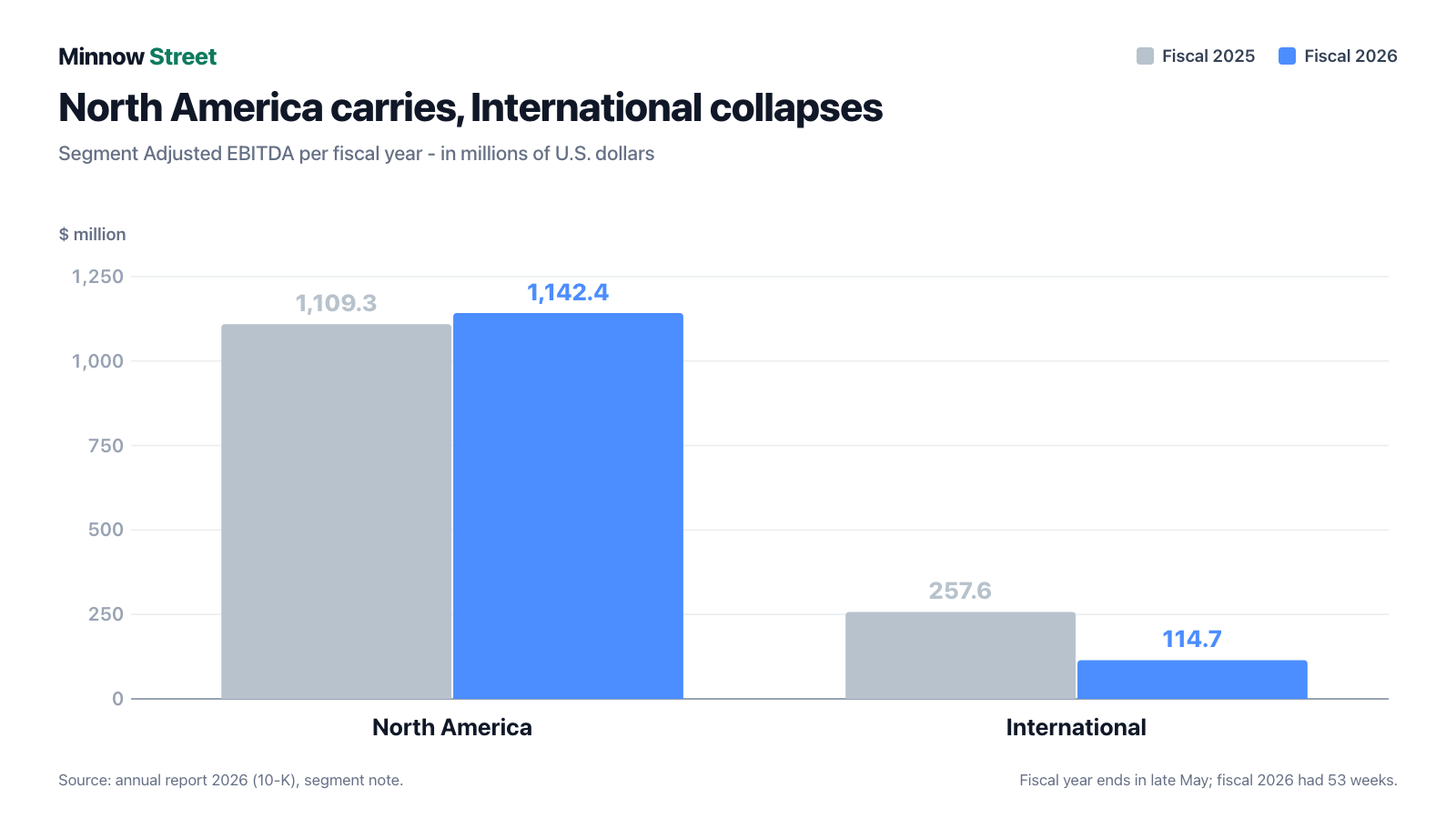
North America, the larger and more important segment, is running well: net sales rose 3 percent to $4,395.2 million and volume climbed 9 percent. The annual report attributes this to "strong customer retention and contract wins" — the company kept customers and won new contracts. Segment Adjusted EBITDA there rose $32.9 million to $1,142.4 million (the accompanying narrative in the report rounds it to $1,142.3 million).
More impressive than the sales line, though, is what happens to the money. Cash from operations — the money the running business actually puts in the till — rose from $798.2 million (fiscal 2024) through $868.3 million to $942.9 million. At the same time the company stopped building new plants: additions to property, plant and equipment fell from $929.5 million through $638.2 million to $402.7 million. Net the two against each other and you get free cash flow — which swung from minus $131.3 million through plus $230.1 million to plus $540.2 million.
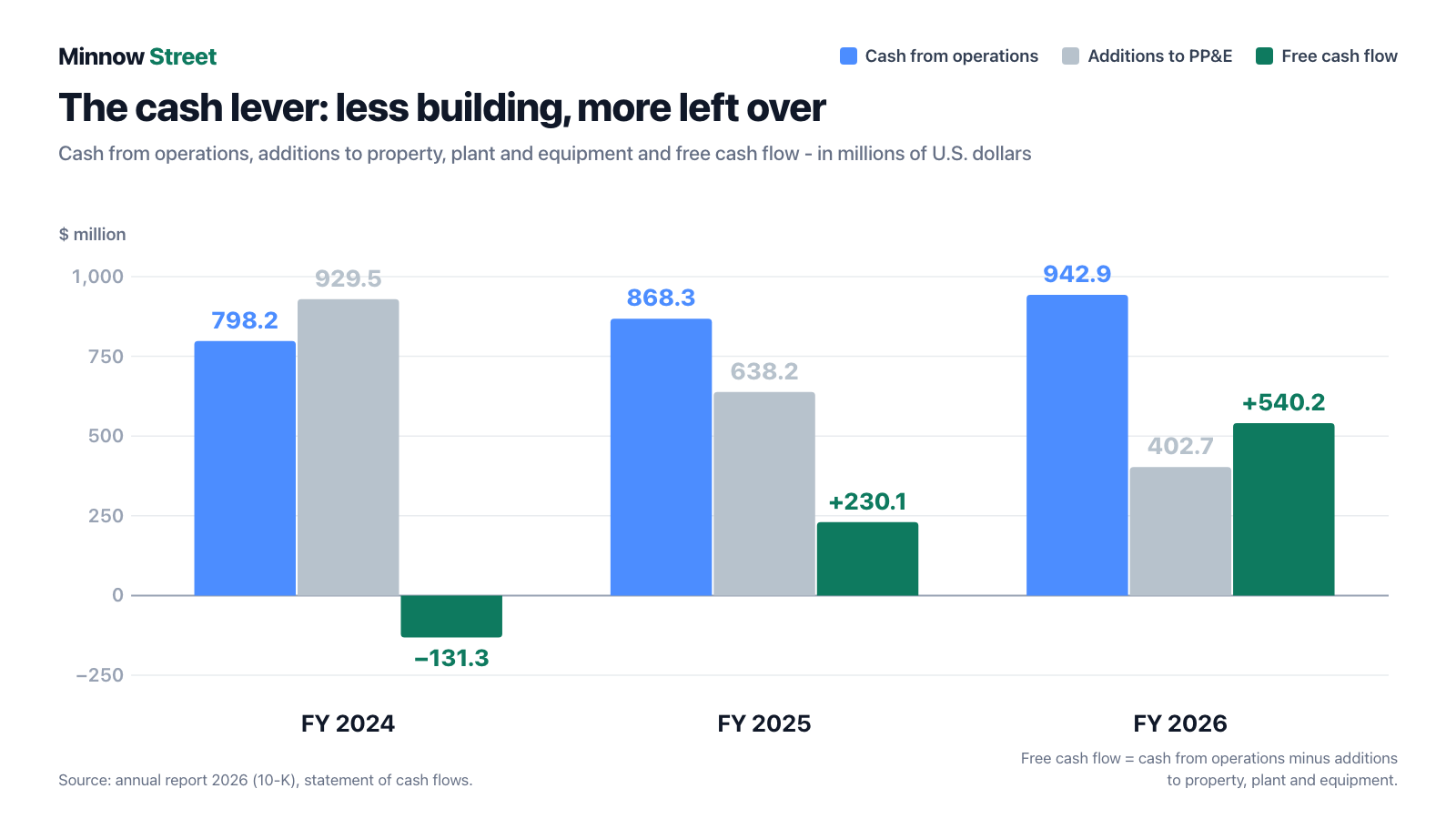
That $540.2 million is the most important number in this whole analysis. It explains how the company was able to return $320.7 million to shareholders in fiscal 2026 — $207.5 million in dividends and $113.2 million in buybacks — and still cut debt from $4,148.2 million to $3,928.7 million. Free cash flow covers that return 1.7 times. Two years earlier the same payout was still financed out of substance and borrowings.
Read only these paragraphs and you see a clean turnaround. So let us go one line deeper.
What the filings say — the uncomfortable truths
Uncomfortable truth no. 1: the international business has more than halved
North America carries — outside North America it is falling away. International Segment Adjusted EBITDA dropped $142.9 million, or 55 percent, to $114.7 million in fiscal 2026. For scale: that same segment booked $2,217.1 million of net sales. Every sales dollar outside North America therefore left barely five cents of adjusted earnings, down from nearly twelve cents a year earlier.
"International Segment Adjusted EBITDA declined $142.9 million to $114.7 million. The decrease primarily reflects lower sales excluding FX, price/mix and higher manufacturing costs per pound, driven by a an incremental $33.1 million charge related to the write-offs of excess raw potatoes, lower utilization of our international production facilities, and start-up expenses for our new plant in Argentina."
— Lamb Weston Holdings, Form 10-K, fiscal 2026, "Results of Operations"

The causes are partly self-inflicted, partly not: tougher competition and softer demand in Europe, the Middle East and Africa, disrupted shipments in the Middle East because of the conflict with Iran, start-up costs for the new Argentine plant — and those $33.1 million for potatoes bought but no longer needed. In volume terms the segment actually grew 2 percent, as Asia Pacific and Latin America offset losses in EMEA. Just at prices 6 percent lower.
Uncomfortable truth no. 2: a single customer accounts for 15 percent of sales
Anyone selling fries to foodservice sells them above all to very few, very large chains. Lamb Weston says so plainly: its ten largest customers accounted for roughly 50 percent of net sales in fiscal 2026, the single largest customer for roughly 15 percent.
"In fiscal 2026, our ten largest customers accounted for approximately 50% of our net sales. Our largest customer, McDonald’s Corporation, accounted for approximately 15%, 15%, and 14% of our consolidated net sales in fiscal 2026, 2025, and 2024, respectively."
— Lamb Weston Holdings, Form 10-K, fiscal 2026, Item 1 "Business"

Translated into everyday terms: picture a baker who makes half his revenue from ten regulars and a sixth from a single one. As long as that one stays, all is well. If he renegotiates, the baker has no choice. That explains the second half of the sales line: volume grew 9 percent in North America because contracts were won — and price/mix fell 6 percent because that is what it cost. The annual report cites "continued price and trade support for our customers and volume wins in lower priced, highly competitive channels". In plain English: discounts and cheaper channels.
Uncomfortable truth no. 3: two class actions run in parallel — one of them over price fixing
The fiscal 2026 annual report describes two legal matters worth knowing. The first is a securities class action in Idaho: investors accuse the company and executives of misleading statements about the rollout of a new enterprise resource planning system and about pricing practices. On May 12, 2026 the court granted the motion to dismiss in part — all pricing-related claims fell away and the potential class period was shortened. Plaintiffs filed a second amended complaint on June 11, 2026; defendants must respond by August 10, 2026.
The second weighs heavier. Since November 2024 an antitrust class action has been pending in federal court in Illinois against Lamb Weston and other producers of frozen potato products.
"The consolidated complaints allege, among other things, that beginning at least as early as January 1, 2021, the defendants conspired to raise the price of frozen potato products above competitive levels in violation of U.S. antitrust laws by coordinating prices of frozen potato products and imposing lockstep price increases, allegedly facilitated by the exchange of non-public information about prices and production."
— Lamb Weston Holdings, Form 10-K, fiscal 2026, Note 14 "Legal Proceedings"

The relief sought includes treble damages, injunctive relief and costs. Defendants filed their motion to dismiss on December 5, 2025; briefing is complete but the motion remains pending. Similar proceedings run in Canada; the Quebec action was terminated on December 15, 2025 for lack of service. Lamb Weston considers both suits meritless and says it can estimate neither outcome nor potential loss. For us that means: no accrual on the balance sheet covers this case — and in an antitrust matter seeking treble damages, that is an open flank, not a reassuring finding.
Uncomfortable truth no. 4: the debt stays large, the cash box stays small
As of May 31, 2026 the balance sheet carried $3,928.7 million of debt and financing obligations against $68.2 million of cash. Net debt of roughly $3,860 million equals about 3.4 times Adjusted EBITDA of $1,147.2 million. For a food manufacturer that is not dramatic, but it leaves little room. Net interest expense ran to $180.5 million in fiscal 2026; the company estimates $691.1 million of future interest payments, $174.7 million of which fall due within twelve months.
Still, the direction is right. Debt fell $219.5 million over the year, and the expensive part got cheaper. Drawings on the revolving credit facility fell from $333.2 million at 5.940 percent to $215.7 million at 3.830 percent. In May 2026 a Chinese subsidiary repaid a facility maturing in 2027 in full and replaced it with a new RMB 700 million term loan (roughly $102.94 million) running to May 2031. Undrawn revolver capacity at the balance sheet date: roughly $1.3 billion. All credit agreement covenants were met.
Uncomfortable truth no. 5: three plant closures in eighteen months — and the priciest is still ahead
In July 2025 Lamb Weston announced a cost savings program, embedded in a strategy called "Focus to Win" with four pillars. The first-year milestone of $100 million in savings was, by the company's own account, exceeded. The price shows up in the same report: $111.6 million of program charges in fiscal 2026 (prior year $185.8 million), including $53.1 million for retiring assets and $15.8 million for severance.
Concretely: January 2026 brought the decision to close the Argentine plant in Munro (charges of $50 million to $60 million), February 2026 the permanent curtailment of Australian production at Hallam South — and on June 1, 2026, one day after the balance sheet date, the decision to close the Dutch plant at Broekhuizenvorst. That third one is the most expensive: $80 million to $110 million of pre-tax charges, substantially all in fiscal 2027, at least 20 percent of them in cash. It appears in no fiscal 2026 figure — only in the subsequent events note.
Uncomfortable truth no. 6: the man at the top only gets paid above $60
This sixth truth is the only one that also reads as a good sign — depending on how you take it. Since February 6, 2026 Jan Eli B. Craps has served as Executive Chair, previously chief executive of Anheuser-Busch InBev's Asia Pacific business. The terms of his contract appear in the personnel filing dated February 4, 2026, and they are unusually hard.
"… stock options having exercise prices significantly higher than the current fair market value as follows: 128,571 shares with an exercise price of $60.00 per share, 128,571 shares with an exercise price of $75.00 per share and 110,204 shares with an exercise price of $85.00 per share."
— Lamb Weston Holdings, Form 8-K dated February 4, 2026, Item 5.02
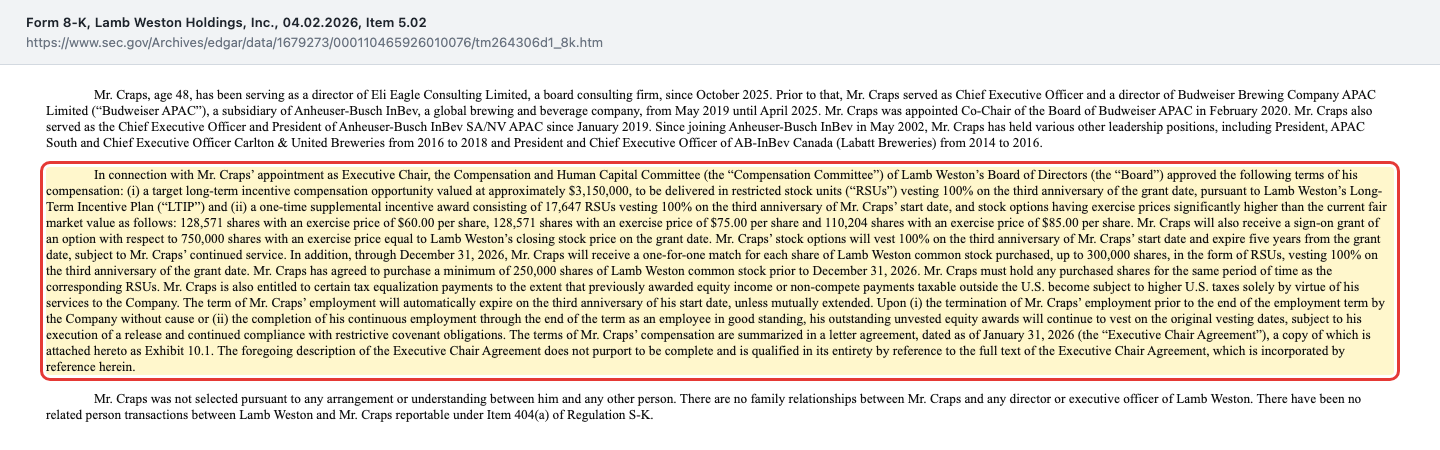
Against the July 24, 2026 close of $49.58, the cheapest step is 21 percent and the most expensive 71 percent out of the money. All three tranches vest only on the third anniversary. On top comes an obligation you rarely see: Craps must buy at least 250,000 shares of his own before December 31, 2026 and receives a one-for-one match in restricted stock units on up to 300,000 purchased shares. At a price near $50 that is a personal outlay in the low eight figures. His employment term expires automatically after three years unless both sides extend it.
Why this is uncomfortable: nobody structures a package like that expecting a quiet job. It is a contractual bet that the share price has to rise at least a fifth within three years before anyone at the top sees money. Read it as a vote of confidence and you are right. Conclude that the board itself expects a long, difficult road and you are right too.
What the company costs on the market
Let us think in orders of magnitude, not day prices. At the July 25, 2026 data date the market capitalization stood at roughly $6.8 billion — 137,455,441 shares against the July 24, 2026 close of $49.58. As a cross-check: the annual report cover page lists 137,481,011 shares outstanding as of July 17, 2026, essentially the same figure. The same report put the public float at $8.0 billion as of November 21, 2025.
That works out to roughly 1.0 times annual sales, 23.8 times reported earnings and — the more telling metric for a borrower — an enterprise value near $10.7 billion, or about 10.5 times earnings before interest, taxes, depreciation and amortization. Price to book stands at 3.7. For a manufacturer running a 4.4 percent net margin, a 23.8 multiple is not cheap; measured against free cash flow of $540.2 million, the same company trades at 12.6 times and looks considerably better. Which of those two numbers proves right depends on whether the price erosion stops.
The professional view is visibly non-committal: 14 voices split into 2 strong buy, 3 buy, 9 hold and no sell, with an average target price of $47.92 — slightly below the July 24, 2026 close (data date July 25, 2026). An analyst target below the current price says plainly: we see no near-term lever. Anyone wanting a cross-reference will find the same scanner hook in a completely different industry in our FactSet analysis — and a third example of how differently a "turnaround candidate" can look in our Bio-Techne analysis.
The dividend provides one more anchor. For fiscal 2026 the company declared $1.50 per share, after $1.46 and $1.28 in the two prior years. On July 23, 2026 the board declared a further $0.38 per share, payable September 4, 2026 to holders of record on August 7, 2026. At 137.5 million shares that costs roughly $52 million a quarter — a little over a tenth of the free cash flow last generated.
Opportunities and risks at a glance
What speaks for the company:
- Free cash flow swung from minus $131.3 million to plus $540.2 million within two years, as additions to property, plant and equipment fell from $929.5 million to $402.7 million. Company guidance for fiscal 2027 calls for $380 million to $410 million of capital spending against $750 million to $800 million of cash from operations.
- North America, roughly two thirds of sales, is taking share: volume up 9 percent and Segment Adjusted EBITDA up $32.9 million in fiscal 2026.
- The cost savings program beat its first-year milestone of $100 million; for fiscal 2027 the company expects only $20 million to $30 million of program charges.
- Debt fell $219.5 million, and the revolver rate dropped from 5.940 to 3.830 percent. Undrawn revolver capacity: roughly $1.3 billion.
- The new Executive Chair holds options that only pay above $60.00 and has committed to buying at least 250,000 shares himself before December 31, 2026.
What speaks against it:
- Price and product mix fell 6 percent company-wide. As long as that persists, every share gain costs margin — gross margin fell to 20.6 percent in fiscal 2026, after 21.7 percent and 27.3 percent in the two years before.
- The international segment barely earns anything: $114.7 million of adjusted earnings on $2,217.1 million of sales, a 55 percent collapse.
- Ten customers account for roughly 50 percent of sales, a single one for roughly 15 percent.
- The antitrust class action seeks treble damages; no quantified accrual exists, because the company cannot estimate the outcome.
- Closing the Dutch plant will burden fiscal 2027 with $80 million to $110 million — on top of losing the 53rd week, which in 2026 still added $127.1 million of sales and $28.9 million of Adjusted EBITDA.
A human conclusion
Remember the volume trap from the start? Lamb Weston is its perfect antidote. In fiscal 2026 the company did everything you expect from a market leader — held customers, won contracts, sold 7 percent more volume. And still ended the year with a fifth less profit than the year before, because prices gave way and the international business fell apart.
At the same time the same filings contain a second, quieter story. The expensive building phase is over. The plants stand, the invoices are paid, and what the business earns is genuinely left over for the first time in years. That $540.2 million of free cash flow is not an accounting trick but money you can distribute, repay or put into your own shares — and the company did all three last year.
Both stories are true, and neither cancels the other. Whether the math works out hangs on a single question nobody can answer today: does the price erosion stop before the volume gained makes up for it? The people who ought to know have already given their answer — the new Executive Chair took options that are only worth anything above $60.00. What you make of that is your decision. And that is exactly as it should be.
Sources
- Form 10-K for fiscal 2026 (filed July 24, 2026) — sales, segments, balance sheet, cash flows, cost savings program, legal proceedings, subsequent events
- Form 10-K for fiscal 2025 (filed July 23, 2025) — prior-year comparison
- Form 10-Q for the quarter ended February 22, 2026 (filed April 1, 2026) — interim status of fiscal 2026
- Form 8-K dated July 24, 2026 (Item 2.02) — fourth-quarter fiscal 2026 results
- Form 8-K dated June 30, 2025 (Items 1.01 and 5.02) — cooperation agreement with JANA Partners and Continental Grain, board reconstitution
- Form 8-K dated February 4, 2026 (Item 5.02) — appointment of Jan Eli B. Craps as Executive Chair and his compensation terms
- Form 8-K dated January 8, 2026 and Form 8-K dated June 4, 2026 (each Item 2.05) — closures of the Munro (Argentina) and Broekhuizenvorst (Netherlands) plants
- Form 8-K dated May 26, 2026 (Items 1.01 and 2.03) — new RMB 700 million term loan facility
- SCHEDULE 13D/A filed July 1, 2025 — ownership report by JANA Partners Management, LP
- Fundamental data (metrics, price history, analyst view; data date July 25, 2026)
This analysis is journalism, not investment advice. It contains no buy or sell recommendation and is not a solicitation to buy or sell securities. Stocks can lose their entire value; a total loss is possible. All figures come from the original sources linked above and carry the dates stated there. The author holds no position in Lamb Weston Holdings, Inc. at the time of publication.
Our Bottom Line at a Glance
- Market position & volume positive
- Market leader in value-added frozen potato products in North America, shipping to more than 100 countries. In fiscal 2026 volume rose 7 percent company-wide and 9 percent in North America — attributed in the annual report to customer retention and contract wins. North America Segment Adjusted EBITDA gained $32.9 million to $1,142.4 million.
- Price and margin negative
- Price and product mix fell 6 percent company-wide in fiscal 2026, equally in both segments. Gross margin dropped to 20.6 percent from 21.7 percent (2025) and 27.3 percent (2024), and net income to $290.0 million from $357.2 million and $725.5 million. Company guidance for fiscal 2027 again assumes a slight decline in price/mix.
- International business negative
- International Segment Adjusted EBITDA collapsed by $142.9 million, or 55 percent, to $114.7 million in fiscal 2026 — on $2,217.1 million of segment net sales. The report cites tougher competition, softer demand, disrupted shipments in the Middle East, start-up costs in Argentina and an incremental $33.1 million write-off of excess raw potatoes.
- Cash flow & balance sheet positive
- Free cash flow swung from minus $131.3 million (fiscal 2024) through plus $230.1 million to plus $540.2 million, as additions to property, plant and equipment fell from $929.5 million to $402.7 million. Debt declined $219.5 million to $3,928.7 million and the revolver rate fell from 5.940 to 3.830 percent. Cash remains thin at $68.2 million; undrawn revolver capacity is roughly $1.3 billion.
- Concentration & litigation negative
- Ten customers account for roughly 50 percent of net sales and McDonald’s alone for roughly 15 percent (fiscal 2026). In parallel run a securities class action in Idaho — defendants must respond by August 10, 2026 — and an antitrust class action in Illinois over allegedly coordinated prices since January 1, 2021, seeking treble damages. Neither carries a quantified accrual.
- Valuation neutral
- A market capitalization of roughly $6.8 billion (137,455,441 shares, $49.58 close on July 24, 2026) equals 23.8 times reported earnings, 1.0 times sales and 12.6 times the $540.2 million of free cash flow. The spread between those two multiples is the valuation question for this stock. The average analyst target of $47.92 sits slightly below the price, with 9 of 14 voices on hold (data date July 25, 2026).
Lamb Weston is neither a restructuring case nor a sure thing. In fiscal 2026 the company sold 7 percent more volume and still earned $67.2 million less, because price and product mix gave up 6 percent and the international business collapsed by 55 percent. At the same time the expensive building phase is over: free cash flow swung from minus $131.3 million to plus $540.2 million within two years and covered the $320.7 million returned to shareholders 1.7 times. Two class actions remain open without any quantified accrual — one of them an antitrust matter seeking treble damages — along with the question of whether price erosion stops before the volume gained makes up for it. Not investment advice.
What Our Rating Means
Open questions
The business works in principle, but one material question is open. As long as it stays open, our findings do not carry a quality verdict.
Anyone buying here is not betting that the company loses customers — it is winning them. They are betting it can eventually push prices through again. Three things will show that in the coming filings: the price/mix effect (last reported at minus 6 percent), International Segment Adjusted EBITDA (last at $114.7 million after $257.6 million) and whether cash generation really holds the guided $750 million to $800 million of cash from operations against $380 million to $410 million of capital spending. Add two dates: the response deadline in the securities case on August 10, 2026 and the still pending ruling on the motion to dismiss in the antitrust case. The decision is yours.
A journalistic assessment by our editorial team at the time of the deep dive, based on public sources — not investment advice and not a solicitation to buy or sell. Your personal circumstances (investment goals, risk capacity, taxes) cannot be taken into account. What our levels mean, how verdicts are formed, and what conflicts of interest exist →
Worth Noting
- Lamb Weston reached our research list through the in-house stock scanner "Turnaround Candidates": rank 35 of 62 U.S. hits, turnaround check 6 of 8, as of July 25, 2026. These lists are recalculated daily, so the ranking is a dated snapshot.
- The fiscal year ends in late May. References to "fiscal 2026" cover May 26, 2025 through May 31, 2026 — exceptionally 53 weeks instead of 52, which lifted net sales by $127.1 million and Adjusted EBITDA by $28.9 million on a one-off basis. Fiscal 2027 ends May 30, 2027 and has 52 weeks again.
- Price figures are dated valuation anchors, not reasons to buy: close $49.58 on July 24, 2026, 52-week range $37.29 to $65.54 (data date July 25, 2026). The share count of 137,481,011 comes from the annual report cover page (as of July 17, 2026). More telling than the day price are the company's own buyback prices: an average $57.94 in fiscal 2025, $48.28 in fiscal 2026 and $41.04 in the fourth quarter of 2026.
- A merger, take-private or acquisition was checked and is not happening: as of July 25, 2026 the filing index contains neither DEFM14A or PREM14A nor SC 13E-3. The two Item 1.01 reports concern the JANA Partners cooperation agreement (June 30, 2025) and a Chinese term loan facility (May 19, 2026).
- Watch for confusion: on the New York Stock Exchange, LW stands for Lamb Weston Holdings, not for the former "LW EV Holdings" or any of the identically abbreviated funds and certificates on other venues.
Frequently Asked Questions
Lamb Weston Holdings, Inc. (NYSE: LW), based in Eagle, Idaho, makes value-added frozen potato products — above all french fries — and ships them to restaurants, fast-food chains, cafeterias and retailers in more than 100 countries. In North America the company describes itself as the number one supplier. It was created in November 2016 through a spin-off from Conagra and employed roughly 10,000 people as of May 31, 2026.
Because the volume was won on price. In fiscal 2026 volume rose 7 percent while price and product mix fell 6 percent. Net sales therefore grew only 2 percent, to $6,612.3 million, while net income dropped from $357.2 million to $290.0 million. The annual report cites continued price and trade support for customers plus volume wins in lower priced, highly competitive channels.
In late May. Fiscal 2026 ran from May 26, 2025 to May 31, 2026 and exceptionally comprised 53 weeks instead of 52; that extra week added $127.1 million of net sales and $28.9 million of Adjusted EBITDA. Fiscal 2027 ends on May 30, 2027 and has 52 weeks again. Anyone comparing Lamb Weston with calendar-year reporters has to allow for that shift.
In fiscal 2026 cash from operations came to $942.9 million and additions to property, plant and equipment to $402.7 million, leaving free cash flow of $540.2 million — after $230.1 million in fiscal 2025 and minus $131.3 million in fiscal 2024. For fiscal 2027 the company guides to $750 million to $800 million of cash from operations against $380 million to $410 million of capital spending.
Very. According to the fiscal 2026 annual report, McDonald's Corporation accounted for roughly 15 percent of consolidated net sales, after 15 percent the prior year and 14 percent in fiscal 2024. The ten largest customers together accounted for roughly 50 percent of net sales. No other customer crossed the 10 percent threshold in any of the three years.
Two material ones. First, a securities class action in Idaho over statements about a new enterprise resource planning system; the court dismissed parts of it on May 12, 2026, and defendants must respond to the second amended complaint by August 10, 2026. Second, an antitrust class action in Illinois over allegedly coordinated prices since January 1, 2021, seeking treble damages. The company considers both meritless and cannot estimate any loss.
Yes. For fiscal 2026 the company declared $1.50 per share, after $1.46 in fiscal 2025 and $1.28 in fiscal 2024. Cash dividends paid in fiscal 2026 came to $207.5 million. On July 23, 2026 the board declared a further $0.38 per share, payable September 4, 2026 to shareholders of record as of August 7, 2026.
No. As of July 25, 2026 the company's filing index with the U.S. securities regulator contains neither a merger proxy (DEFM14A or PREM14A) nor a going-private filing (SC 13E-3). The two reports of material definitive agreements concern the cooperation agreement with activist JANA Partners dated June 30, 2025 and a Chinese term loan facility dated May 19, 2026. The stock continues to trade on the New York Stock Exchange.
Found an error?
Did you spot a factual error, an outdated number, or a typo in this deep dive? Let us know briefly — your report goes straight to the editorial team.