Global Self Storage: The Fullest Stores in the Sector — and a Dividend That Uses Up 96 Percent of the Cash Flow
Global Self Storage is a minnow among self storage landlords: 13 stores, 36 employees, a market value of roughly $58 million. And it still reports the highest occupancy in its sector — 93.1 percent as of March 31, 2026, with tenants staying an average of 3.6 years. The other side of the ledger sits in the quarterly report to the U.S. securities regulator, the SEC: funds from operations (FFO) fell 12.6 percent to $852,563, the dividend paid in the same quarter cost $820,470 — and the cash balance shrank by $48,180. On top of that, stockholders approved one million new shares for the equity incentive plan on June 16, 2026; the company itself puts the resulting potential dilution at "approximately 8.8%." If you buy the yield here, know which till it comes out of.
 Thomas Mücke
Founder & Publisher
Thomas Mücke
Founder & Publisher
Chart
Interactive price chart (TradingView).
Note: pure fact-based analysis, not investment advice and not a solicitation to buy or sell. All figures without guarantee.
There is a reflex that catches even level-headed investors off guard — and it is not triggered by greed but by a single percentage. Call it the yield reflex: you read "a little over 5 percent dividend yield," and your brain has already bought the stock before it asks the question that actually matters — which till does that come out of? With Global Self Storage, Inc. (Nasdaq: SELF) the question is especially worth asking, because at first glance the company looks like a textbook holding: 13 storage properties, 93.1 percent occupied, tenants who stay 3.6 years on average, and a quarterly dividend that has sat unchanged at $0.0725 per share for years. So let us make a deal: before you buy the yield, we read together what the company itself filed with the U.S. securities regulator, the SEC — the annual report (10-K) for 2025, the quarterly report (10-Q) as of March 31, 2026, the earnings release of May 8, 2026, and three early-summer 2026 documents almost nobody reads: the proxy statement for the annual meeting, the June 16 voting results and a share registration dated June 29. An SEC filing is honest under threat of penalty. And this one tells of very full storage buildings, of costs rising faster than rents, of a dividend that now uses up almost the entire cash flow — and of one million new shares. In the end, you decide.
What Global Self Storage actually does — 13 storage properties and a closed-end fund past
Global Self Storage rents out storage space. The everyday picture needs no translation: these are the buildings out on the arterial road where people park whatever no longer fits in the apartment — moving boxes, tools, motorcycles, an RV, the shelf stock of a small contractor. As of December 31, 2025 the company owned and operated, or managed, 13 stores in Connecticut, Illinois, Indiana, New York, Ohio, Pennsylvania, South Carolina and Oklahoma, totaling 966,567 net leasable square feet and 7,044 storage units. Headquarters sits in Millbrook, a town in the Hudson Valley north of New York City, and the entire company has 36 employees. Leases run month to month, which sounds like a weakness and is in fact the sector\'s greatest pricing lever: a tenant who can leave every month can also be repriced every month. That is exactly what the company does through an in-house rate management program that, per the annual report, scrapes competitors\' move-in rates from the internet.
Legally, Global Self Storage is a REIT — a real estate investment vehicle that pays almost no corporate income tax as long as it distributes essentially all of its taxable income. Translated: the government gives up the tax, and shareholders get the cash. REIT status has applied since the 2013 tax year. And here comes the history you need in order to understand the company: Global Self Storage started life as a listed fund, not as a property business. Incorporated on December 12, 1996 in Maryland, the entity first traded as Bull & Bear Global Income Fund, then as Global Income Fund and from 2013 as Self Storage Group — a closed-end investment company under the U.S. Investment Company Act of 1940. Only on January 19, 2016 did the SEC allow it to deregister as an investment company; on the same day the firm took its current name and listed its stock on Nasdaq under the symbol "SELF." The annual report describes the conversion matter-of-factly:
"The Company was formerly registered under the Investment Company Act of 1940, as amended (the “1940 Act”) as a non-diversified, closed end management investment company. The Securities and Exchange Commission’s (“SEC”) order approving the Company’s application to deregister from the 1940 Act was granted on January 19, 2016."
— Global Self Storage, Inc., SEC annual report 10-K for 2025, Item 1 “Business”
That heritage explains two quirks we will meet again. First, the REIT still holds a small securities portfolio — $2,288,437 as of March 31, 2026 — whose price swings run straight through the income statement; the annual report explicitly keeps open the option of liquidating this remnant to help fund acquisitions and redevelopments, putting the proceeds into storage properties. Second, the administration is closely entangled with the fund family the company came from — more on that in the last uncomfortable truth. That sets up the central tension of this analysis, and it runs through every chapter: the operation is about as good as anything in the sector — but it is no longer growing, costs are outrunning rents, and the dividend that makes the stock attractive now consumes almost the entire distributable cash flow.
How the stock reached our desk
Global Self Storage did not come onto the research list through one of our stock scanner result lists but through Reddit mentions: our in-house Reddit hype scanner tracks daily which tickers investors are discussing in the forums, and SELF was on that list as of July 30, 2026. Fairness demands the cross-check, and we ran it the same day: SELF does not appear in any of our own scanner result lists — no momentum filter, no quality filter, no valuation filter picked the stock up as of July 30, 2026. Those lists are recalculated every day, so the finding holds for that date and may look different tomorrow.
Honestly, that is no surprise, and it should be read as description rather than verdict. A stock with a market value of roughly $58 million (data as of July 30, 2026) falls through almost every size and liquidity screen; according to the fundamental data, exactly one analyst follows it, rates it a buy and names a $6.25 price target. And because our scanners mostly react to price strength, valuation shifts or balance sheet momentum, a company whose revenue grows 1.4 percent a year gives them nothing to latch onto. Remember the principle: where no scanner fires, you have to read for yourself. So let us read.
One size check belongs here so the valuation numbers hold up later. The market value from the fundamental data (roughly $58.1 million, data as of July 30, 2026) can be checked against the filings: the cover page of the quarterly report gives 11,421,732 shares outstanding as of May 7, 2026, and the proxy statement gives a closing price of $5.10 on December 31, 2025. Eleven point four million shares at $5.10 comes to $58.25 million — the two figures are 0.2 percent apart. The market value is therefore reliable, and so is everything we derive from it.
The numbers over the years — given their due
First the part that genuinely impresses, and at Global Self Storage that is the operating work. Occupancy across the twelve same-store properties stood at 93.1 percent on March 31, 2026 — up 100 basis points from 92.1 percent a year earlier. In a sector where 90 percent counts as full, that is the top of the field; the company says so itself in its earnings release, calling it "the highest same-store occupancy and occupancy growth in the sector." The second number says even more: the average tenant duration of stay rose to a record of roughly 3.6 years (prior year: roughly 3.5). Translated into an everyday picture: whoever puts their belongings into one of these buildings does not come back for them for three and a half years on average — and pays every rate increase along the way. For a landlord that is the best news there is, because every move-out costs vacancy, cleaning and marketing.
The annual series is quiet and orderly too: revenue rose from $8.67 million in 2019 through $9.20 million (2020), $10.51 million (2021), $11.94 million (2022), $12.19 million (2023) and $12.53 million (2024) to $12,705,245 in 2025. The company was profitable in every one of those years. And the balance sheet is pleasingly lean for a property owner: as of March 31, 2026, total assets of $63,703,755 carried only $17,408,885 of liabilities, of which $15,638,994 was long-term debt — equity stood at $46,294,870, or $4.053 per share. The loan itself is a gift from a different interest rate era: $20 million drawn on June 24, 2016, fixed at 4.192 percent until maturity on July 1, 2036. Anyone financing a storage building today pays considerably more.
Now to the number that actually matters at a REIT — and the one you have to understand to judge this stock: FFO.
A short detour: why a REIT\'s reported earnings say little
A storage building does not really lose value when it gets a year older — but the accounting says it does. It depreciates the structure on a schedule, and that depreciation reduces reported earnings without a single dollar leaving the building. That is precisely why the real estate industry invented its own measure: funds from operations, or FFO. The everyday picture: reported earnings are the accountant\'s receipt, FFO is a look inside the wallet. The official definition sits in the annual report itself:
"NAREIT defines FFO as a REIT’s net income, excluding gains or losses from sales of property, and adding back real estate depreciation and amortization. The Company also excludes unrealized gains on marketable equity securities and gains relating to PPP loan forgiveness."
— Global Self Storage, Inc., SEC annual report 10-K for 2025, Item 7 “Non-GAAP Financial Measures”
Remember the sentence: at a REIT, reported earnings measure the accounting and FFO measures the business — and the dividend is paid out of FFO, not out of earnings. This is exactly where the picture gets interesting. The chart below shows three bars per year: the book profit, FFO, and the dividend declared in that year.
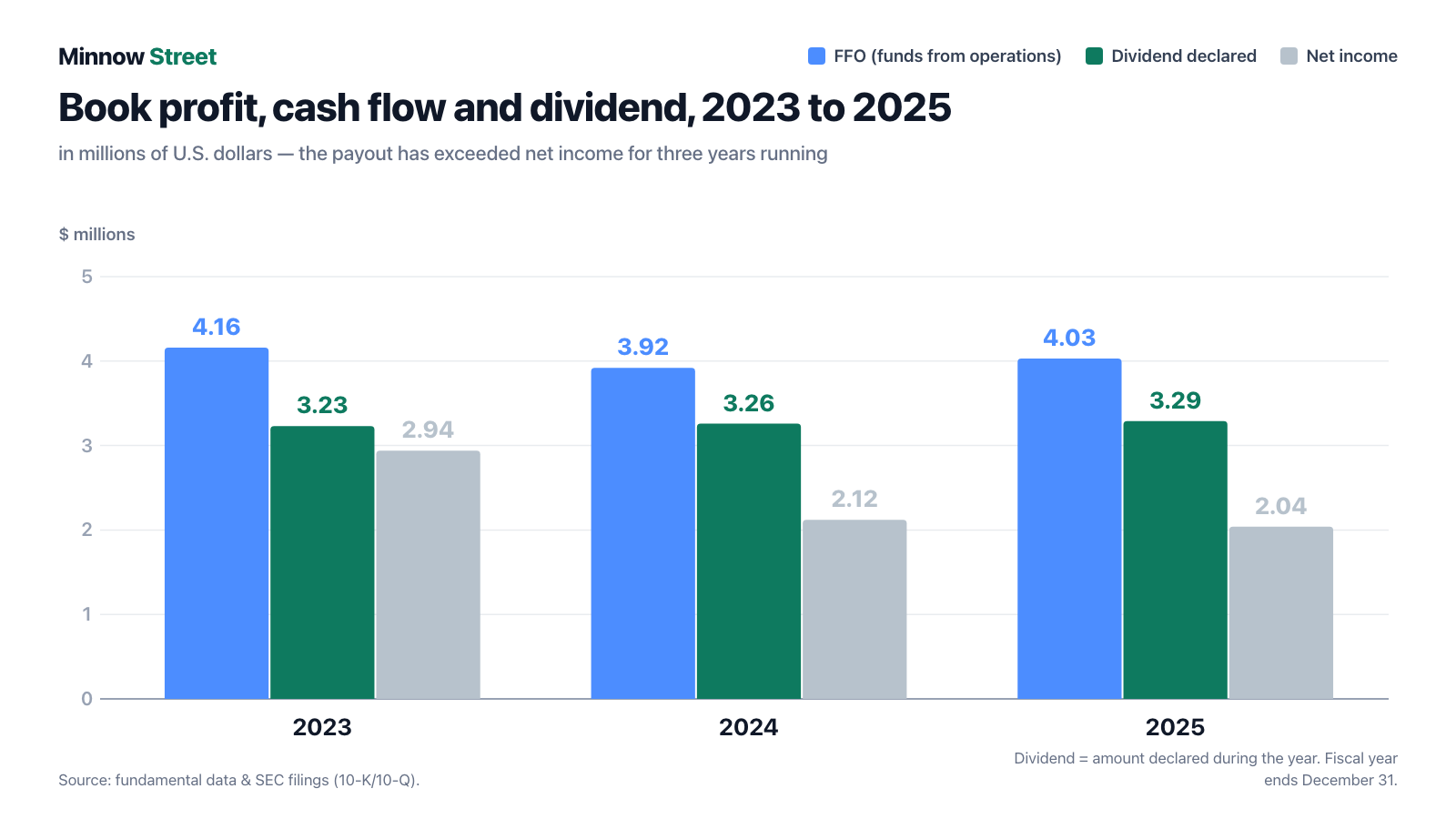
The precise figures: 2023 brought $4,163,937 of FFO against $3,231,608 of declared dividends and $2,938,769 of net income; 2024 brought $3,923,932 against $3,264,451 and $2,123,743; 2025 brought $4,030,352 against $3,290,071 and $2,038,451. Adjusted FFO, which also strips out stock-based compensation and business development costs, came to $4,402,971 in 2025. Two honest readings follow. The dividend is covered out of FFO — in 2025 it took 82 percent of it. And it was covered out of earnings in none of the three years; that is why the accumulated deficit grew from $2,235,236 at the end of 2024 to $3,486,856 at the end of 2025. At a REIT that is normal and no alarm bell. It becomes an alarm bell only when FFO gives way. Which is exactly what is happening now.
What the filings say — the uncomfortable truths
Uncomfortable truth no. 1: the dividend took 96 percent of the cash flow in the first quarter of 2026
In the first quarter of 2026 FFO fell 12.6 percent to $852,563 (prior-year quarter: $975,343) and adjusted FFO fell 11.0 percent to $957,934 (prior year: $1,076,079). Dividends paid in the same quarter came to $820,470. That is 96 percent of FFO — a year earlier it was 84 percent. And because a storage building demands not only dividends but also maintenance and debt amortization, the quarter\'s cash arithmetic looks like this: $979,931 provided by operating activities, less $52,298 of improvements, less $155,343 of principal payments, less $820,470 of dividends — the balance of cash, cash equivalents and restricted cash fell by $48,180. In the prior-year quarter it had risen by $59,997. That is no catastrophe against $7.4 million of cash, but it is a change of sign, and a change of sign is news.
The company describes this position in its own annual report with striking candor — in a sentence worth reading twice:
"Capital resources derived from retained cash flow have been and are currently expected to continue to be negligible."
— Global Self Storage, Inc., SEC annual report 10-K for 2025, Item 7 MD&A
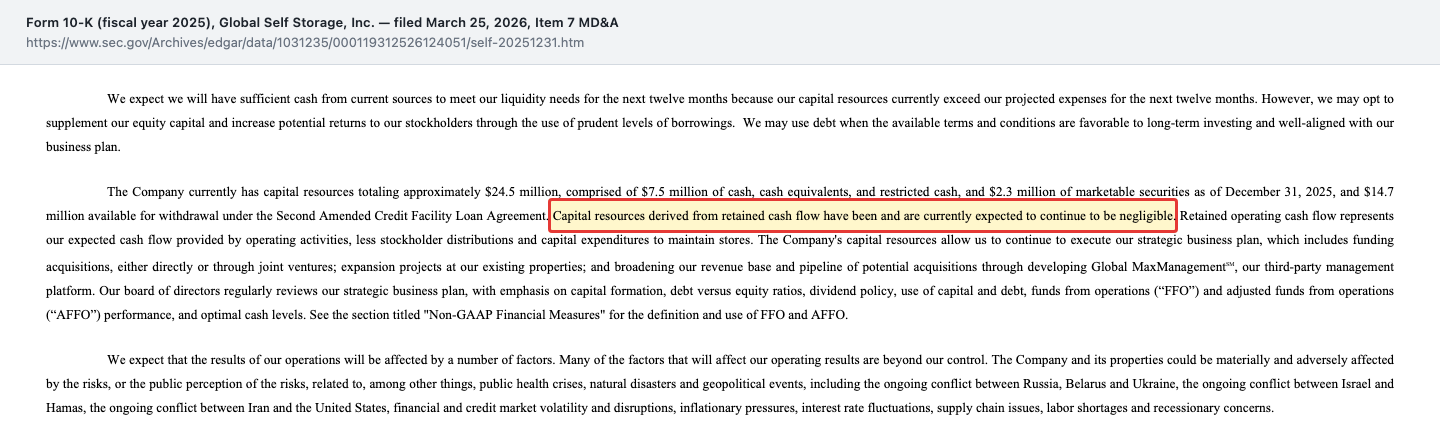
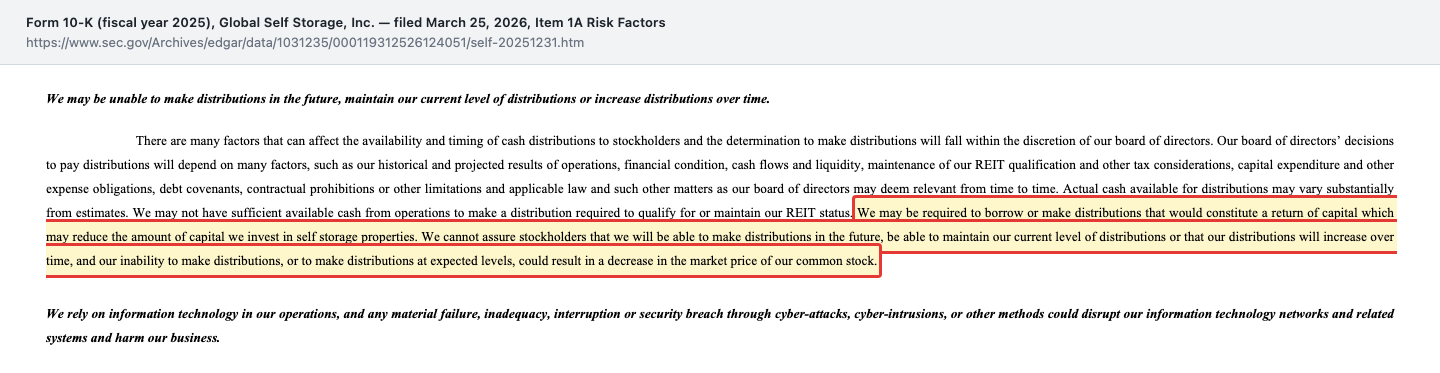
What that means in practice: every dollar of growth has to come from outside — from debt, from new shares or from selling the remaining securities portfolio. Nothing sticks from the operating business once the payout is made. That the dividend is nevertheless not a given is something the annual report also spells out in its risk factors:
"We may be required to borrow or make distributions that would constitute a return of capital which may reduce the amount of capital we invest in self storage properties. We cannot assure stockholders that we will be able to make distributions in the future, be able to maintain our current level of distributions or that our distributions will increase over time …"
— Global Self Storage, Inc., SEC annual report 10-K for 2025, Item 1A “Risk Factors”
Uncomfortable truth no. 2: costs are outrunning rents
Why FFO is falling even as the buildings fill up shows in the same-store table of the quarterly report — "same-store" meaning only the twelve properties operated throughout both comparison periods, a comparison free of acquisitions and disposals.
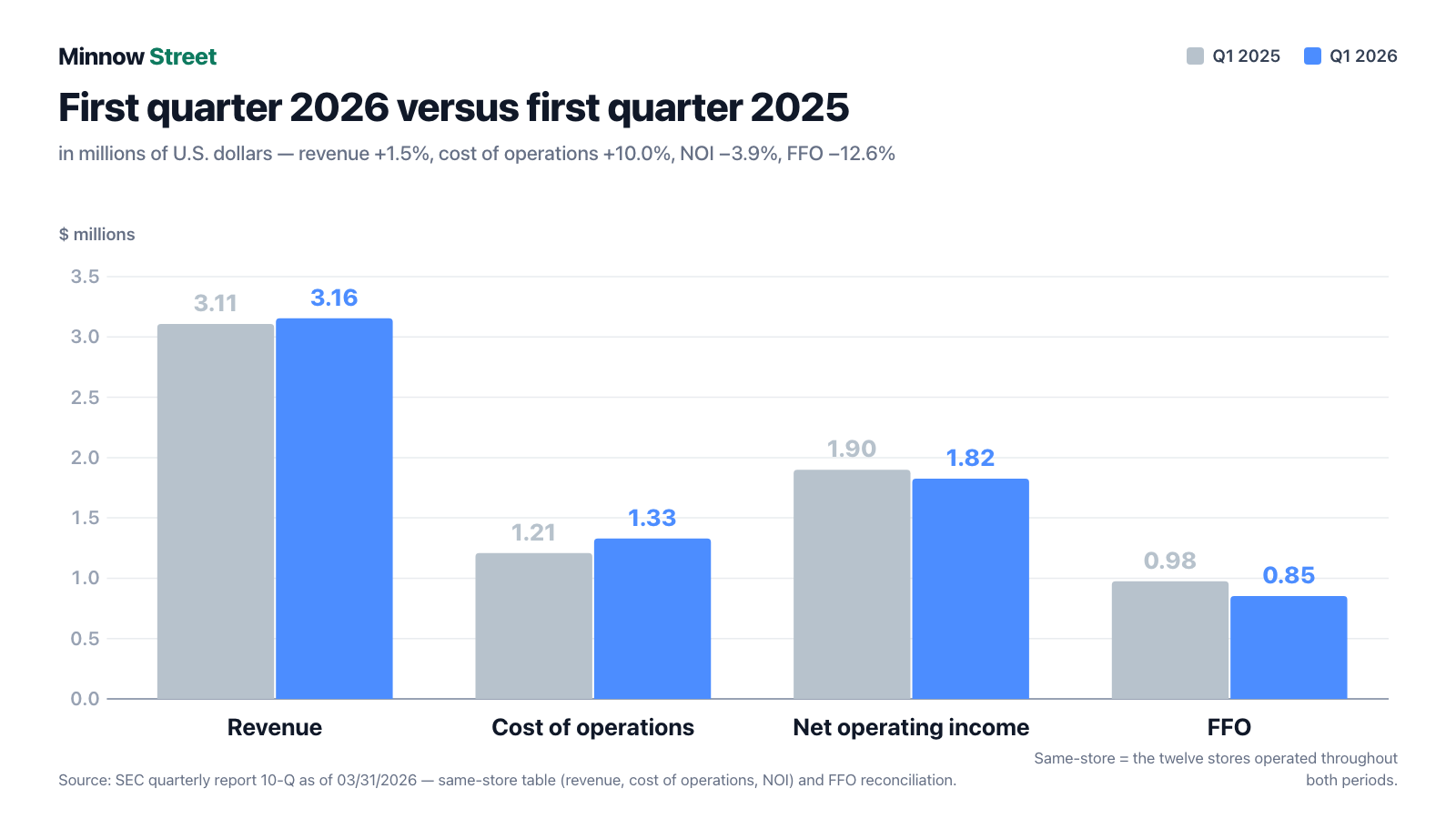
In detail: same-store revenue rose 1.5 percent to $3,155,135 in the first quarter of 2026, but the stores\' cost of operations climbed 10.0 percent to $1,330,343. Same-store net operating income (NOI) therefore fell 3.9 percent to $1,824,792. On top of that came higher general and administrative expenses — $859,220 versus $786,893 in the prior-year quarter, in part because of one-time professional fees related to the amendment and restatement of the equity incentive plan, which matters again in a moment. All in, operating income slumped 21.0 percent to $571,776 and net income fell to $477,019 ($0.04 per share) from $555,152 ($0.05) a year earlier.
The company names two reasons, and they deserve different weight. The first is employment costs, which management attributes mainly to the timing of routine hiring and departures; it expects a return to historically lower growth rates here. That may well be true — with 36 employees, every single personnel decision shows up. The second reason is more serious: rising property taxes. Self storage tax assessments are increasing industry-wide, the company appeals them, "but there is no guarantee that these increased assessments will be reduced." Property taxes cannot simply be passed on under month-to-month leases, and the risk factors state expressly that increases in taxes "generally are not passed through to tenants." Remember the picture: a building can be 100 percent full and still earn less if the county rewrites its assessment.
Uncomfortable truth no. 3: the growth engine is idle
A REIT this size has exactly two ways to get bigger: buy stores or manage other people\'s stores. Both are stalled. On the first, the annual report is blunt: "We did not make any acquisitions in the year ended December 31, 2025" — not a single store was bought in 2025. It is not for lack of money: the revolving credit facility with Huntington National Bank — originally $15 million, stepping down by contract to $14.75 million on the first anniversary and $14.5 million on the second — was completely undrawn as of December 31, 2025, with $14.7 million available; the at-market share offering program of up to $15 million, set up on April 4, 2025, went through 2025 without a single share sold. Together with cash and securities the company reports roughly $24.5 million of capital resources (March 31, 2026). The money is there — the asking prices apparently are not right. That is a defensive stance one can credit to a disciplined buyer. It just does not produce growth.
The second route is third-party management, for which Global Self Storage even created its own brand. The first contract was signed on October 23, 2019. And as of December 31, 2025, more than six years later, the tally reads: one single client — a store in Edmond, Oklahoma with 137,318 net leasable square feet and 619 units. The related management fees and other income came to $18,619 in the first quarter of 2026, less than 1 percent of quarterly revenue. A platform with one client is not a platform, it is a contract. And a growth promise that has read "one" for six years is a finding, not an outlook.
Uncomfortable truth no. 4: one million new shares — 8.8 percent dilution, calculated by the company itself
Dilution is the term for your slice of the cake getting smaller because new slices are being cut — your claim on earnings, dividends and votes shrinks without you doing anything. At Global Self Storage the subject was on the agenda of the June 16, 2026 annual meeting: stockholders approved a restatement of the 2017 equity incentive plan that reserves one million additional shares for employee and director compensation. On June 29, 2026 the company registered those shares with the SEC (Form S-8). You do not have to estimate how big that is — the proxy statement does the math:
"If stockholders approve the A&R Plan, the authorization of an additional 1,000,000 shares would increase the Company's total potential dilution to approximately 8.8%."
— Global Self Storage, Inc., SEC proxy statement DEF 14A (filed April 29, 2026), Proposal 2

For context: the old 2017 plan was capped at 760,000 shares and would have expired on October 16, 2027; the new one runs ten years from the vote. After the approval, 1,393,661 shares in total are reserved for compensation — 12.2 percent of the 11,431,732 shares outstanding as of April 9, 2026. And stockholders were anything but unanimous: the plan drew 3,717,027 votes in favor, but 1,298,704 against and 69,240 abstentions; the advisory vote on executive compensation stood at 3,710,166 for and 1,303,882 against. Roughly a quarter of the votes cast went against each item — at a meeting where 8,070,898 shares, or 70.7 percent of the capital, were represented. Set against the rest of the arithmetic: stock-based compensation already cost $350,333 in 2025, with 73,194 shares granted; another 52,476 followed on March 24, 2026. Growth paid for with fresh shares is never entirely free.
Uncomfortable truth no. 5: the entire payroll runs through the chief executive\'s family holding company
Now the part that requires reading the notes. Global Self Storage has 36 employees — and no payroll department. An outside professional employer organization handles the administration, and Midas Management Corporation, a subsidiary of Winmill & Co. Incorporated, acts as the pass-through payer. The annual report puts it this way:
"Pursuant to an arrangement between a professional employer organization (“PEO”) and the Affiliates, the PEO provides payroll, benefits, compliance, and related services for employees of the Affiliates … and, in connection therewith, Midas Management Corporation (“MMC”), a subsidiary of Winco, acts as a conduit payer of compensation and benefits to the Affiliates’ employees including those who are concurrently employed by the Company and its Affiliates."
— Global Self Storage, Inc., SEC annual report 10-K for 2025, Note 10 “Related Party Transactions”
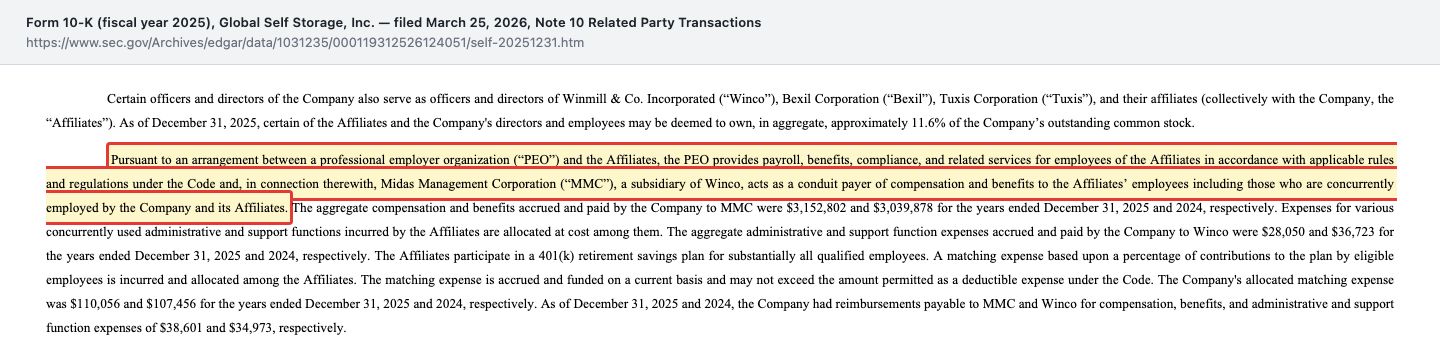
The amount that flowed to Midas Management in 2025 stands right beside it: $3,152,802 (2024: $3,039,878). That is 24.8 percent of annual revenue. Add $28,050 of administrative and support cost allocations to Winmill & Co. and $110,056 of employer retirement plan matching. And the link is personal: Mark C. Winmill, 68, has been chief executive officer, president and chairman of the board of Global Self Storage since 2012 — and is at the same time executive vice president and a director of Winmill & Co. as well as a trustee of the Winmill Family Trust, which owns all of that holding company\'s voting stock. As of April 9, 2026 he is listed with 973,079 shares, or 8.52 percent, directors and officers as a group with 1,225,743 shares (10.73 percent), and affiliates including directors and employees with roughly 12.2 percent — the annual report the highlighted passage above comes from puts that figure at roughly 11.6 percent as of December 31, 2025. His total compensation for 2025 was $693,476 (2024: $813,323).
To be fair: all of this is disclosed, it is not unusual for a company that grew out of a fund manager, and a chief executive holding nearly 9 percent of the stock is an argument for alignment rather than against it. But the finding stands: the single largest cost block of this REIT runs through a company attributable to the same family as the chief executive. If you invest here, you should know that — and find the line again in the next annual report.
Valuation: expensive for standstill, cheap for substance
How expensive is the stock? At a REIT the price-to-earnings ratio is the wrong yardstick — it stood at just under 30 as of July 30, 2026, but that only reflects depreciation. The useful yardstick is the price per dollar of FFO: at a market value of roughly $58.1 million and FFO of $4,030,352 (2025), you are paying about fourteen times cash flow. For a self storage REIT that is no excess, but no bargain either — it is roughly the price you would expect for a solid, non-growing portfolio. Measured against book value it looks cheaper: equity of $46,294,870 works out to $4.053 per share (March 31, 2026), while the stock traded in the region of $5.10 (the last closing price documented in a filing, December 31, 2025), about a quarter above book. As for the price-to-sales ratio of roughly 4.6, it says little at a property company, because rental income is not comparable to industrial revenue.
Two dated valuation anchors from the company\'s own history help place the price — and both are sobering: in December 2019 the company issued 1,601,291 shares in a rights offering at $4.18; on June 25, 2021 it placed 1,289,720 shares in a follow-on at $5.35. The price at which the company sold new shares five years ago is therefore above the last documented closing price. Anyone who subscribed in 2021 has been paid by the dividend over five years, not by the share price. The professional view, by the way, is thin: exactly one analyst follows the stock according to the fundamental data (data as of July 30, 2026), rates it a buy and names a $6.25 price target. At a company this size, one analyst rating is a data point, not a consensus. How differently dividend stories can end at small property companies is something we looked at in our analysis of CTO Realty Growth — there, a short seller argued the payout was unearned.
Opportunities and risks at a glance
What speaks for Global Self Storage:
- Best-in-sector operations: 93.1 percent occupancy across the twelve same-store properties as of March 31, 2026 (92.1 percent a year earlier) and a record average tenant stay of roughly 3.6 years — a portfolio that can exercise its pricing power month after month.
- A very lean balance sheet: $63,703,755 of total assets against $17,408,885 of liabilities and equity of $46,294,870 (March 31, 2026); the main loan is fixed at 4.192 percent until July 1, 2036, and 2025 operating income covered interest expense 3.5 times over.
- Unused firepower for acquisitions: roughly $24.5 million of capital resources (March 31, 2026), including a $15 million credit facility that was undrawn as of December 31, 2025 and a $15 million share offering program that went unused in 2025.
- A dividend covered out of cash flow: $3,290,071 declared in 2025 against $4,030,352 of FFO — 82 percent; the quarterly dividend of $0.0725 per share has been unchanged for years.
- A disciplined buyer rather than a forced one: no store was bought in 2025 even though the money was available; the company deliberately targets secondary and tertiary cities with strict zoning laws and attentive planning boards, which makes new local competition harder to build.
What speaks against it:
- The dividend consumed roughly 96 percent of FFO in the first quarter of 2026 ($820,470 out of $852,563); after maintenance and amortization the cash balance fell by $48,180, against a $59,997 increase in the prior-year quarter.
- The cost squeeze: same-store revenue up 1.5 percent, cost of operations up 10.0 percent, net operating income down 3.9 percent and operating income down 21.0 percent (all first quarter of 2026); property tax reassessments are hard to pass on under month-to-month leases.
- Dilution: one million new shares for the pay plan (stockholder vote June 16, 2026, registration June 29, 2026), with potential dilution of "approximately 8.8%" by the company\'s own reckoning; roughly a quarter of the votes cast were against.
- No growth: no acquisitions in 2025, and the third-party management platform has had exactly one client since October 2019 ($18,619 of management fees and other income in the first quarter of 2026).
- Entanglement and size: $3,152,802 of 2025 personnel costs routed through the chief executive\'s family holding company, 36 employees, a market value of roughly $58 million and a single analyst — a thinly traded stock in which any sizable order can move the price.
A human bottom line
Back to the yield reflex from the opening. Its problem is not that it points at something false — the Global Self Storage payout is real, it has been unchanged for years, and it is covered out of cash flow. Its problem is that it stops you asking the second question: how much room is left? At this company the documented answer for the first quarter of 2026 is four percent. $852,563 of cash flow, $820,470 of dividends. Everything beyond that — maintenance, amortization, acquisitions, absorbing a property tax reassessment — has to come out of the cash box, the credit line or new shares. The company writes that into its own report, using the word "negligible" for what is left at the end.
That can be perfectly fine for you. Buying 93 percent occupied storage buildings financed at a fixed 4.192 percent, with a stable quarterly dividend, means buying a very quiet business — and quiet is rare. But that is exactly what you are buying: quiet, not growth-driven returns. So the honest question is not "is a little over 5 percent attractive?" but this: would you settle for a payout whose coverage depends on a single property tax notice and the next round of hiring — at a company that has bought nothing for a year and has just reserved a million of its own shares for compensation? If yes, you have a thesis. If no, you had a reflex. What you do with it is your decision. And that is exactly as it should be.
Sources
Every original document used in this analysis — for reading yourself:
- Global Self Storage, Inc. — SEC annual report 10-K for 2025 (filed March 25, 2026)
- Global Self Storage, Inc. — SEC quarterly report 10-Q as of 03/31/2026 (filed May 8, 2026)
- Global Self Storage, Inc. — SEC current report 8-K of May 8, 2026, exhibit 99.1 (first-quarter 2026 earnings release)
- Global Self Storage, Inc. — SEC current report 8-K of June 16, 2026, Item 5.07 (annual meeting voting results)
- Global Self Storage, Inc. — SEC registration statement S-8 of June 29, 2026 (1,000,000 shares for the amended and restated equity incentive plan)
- Global Self Storage, Inc. — SEC proxy statement DEF 14A for the 2026 annual meeting (filed April 29, 2026)
- Global Self Storage, Inc. — SEC annual report 10-K for 2024 (filed March 26, 2025)
- Complete SEC filing history of Global Self Storage, Inc.: EDGAR overview (sec.gov)
- Fundamental data (market value, share count, valuation multiples, analyst coverage; data as of July 30, 2026), reconciled with the SEC filings.
- Reddit mentions: our in-house Reddit hype scanner, as of July 30, 2026; cross-check of our own scanner result lists the same day returned no hit for SELF.
Transparency & disclaimer: This analysis is journalistic commentary on publicly available information. It is not investment advice, not a regulated financial analysis and not a solicitation to buy or sell securities. Equity investments carry substantial risk up to the total loss of capital. All information is provided without warranty; the date of each data point is noted in the text. The author holds no position in Global Self Storage shares at the time of publication.
Our Bottom Line at a Glance
- Operating quality positive
- The twelve same-store properties were 93.1 percent occupied as of March 31, 2026 (92.1 percent in the prior-year quarter) and the average tenant duration of stay reached a record of roughly 3.6 years. In its May 8, 2026 earnings release the company calls this the highest occupancy and occupancy growth in the sector — under month-to-month leases that make every rate increase effective immediately.
- Balance sheet and financing positive
- As of March 31, 2026, total assets of $63,703,755 carried only $17,408,885 of liabilities, with equity of $46,294,870. The main loan, originally $20 million, is fixed at 4.192 percent until July 1, 2036, 2025 operating income covered interest expense 3.5 times over, and the $15 million credit facility was undrawn as of December 31, 2025.
- Dividend coverage negative
- In the first quarter of 2026 the $820,470 of dividends paid consumed roughly 96 percent of the $852,563 of FFO (prior-year quarter: 84 percent). After maintenance capital spending and amortization the cash balance fell by $48,180, having risen $59,997 a year earlier. The 2025 annual report itself calls capital resources derived from retained cash flow "negligible."
- Cost trend negative
- In the first quarter of 2026 same-store revenue rose 1.5 percent to $3,155,135 while the stores' cost of operations climbed 10.0 percent to $1,330,343. Net operating income fell 3.9 percent to $1,824,792 and operating income dropped 21.0 percent to $571,776. Property tax reassessments are hard to pass on under month-to-month leases — the annual report states expressly that tax increases generally are not passed through to tenants.
- Growth and capital deployment negative
- No store was acquired in 2025 even though roughly $24.5 million of capital resources stands ready (March 31, 2026), including an undrawn $15 million credit facility and a $15 million share offering program that went unused in 2025. The third-party management platform has had exactly one client since its first contract on October 23, 2019; management fees and other income came to $18,619 in the first quarter of 2026.
- Dilution and entanglement negative
- Stockholders approved one million new shares for the pay plan on June 16, 2026 (S-8 registration June 29, 2026); potential dilution rises from 3.34 to roughly 8.8 percent per the proxy statement, and 1,298,704 shares were voted against. At the same time, $3,152,802 of 2025 personnel costs — 24.8 percent of revenue — flowed through Midas Management Corporation, a subsidiary of Winmill & Co. Incorporated, whose voting stock is held by the Winmill Family Trust.
Global Self Storage runs its 13 storage properties about as well as anyone in the sector: 93.1 percent occupancy and a record average tenant stay of roughly 3.6 years as of March 31, 2026, on top of a lean balance sheet with debt fixed at 4.192 percent until 2036. The price of that quiet sits in the quarterly report: cash flow (FFO) fell 12.6 percent to $852,563, the dividend paid cost $820,470 — 96 percent — the cash balance dropped by $48,180, nothing was bought in 2025, and in June 2026 stockholders released one million new shares for compensation, lifting potential dilution to roughly 8.8 percent by the company's own calculation. Buying here means buying a very quiet business and a payout with four percent of room. Not investment advice.
What Our Rating Means
Open questions
The business works in principle, but one material question is open. As long as it stays open, our findings do not carry a quality verdict.
Yellow because a material operating question is open — not because the balance sheet is shaky. The substance is there: $46,294,870 of equity against $17,408,885 of liabilities, debt fixed at 4.192 percent until 2036, interest covered 3.5 times, and a profit in every one of the last seven years. What is open is whether the company can close the cost squeeze: in the first quarter of 2026 the stores' cost of operations grew 10.0 percent, nearly seven times as fast as the 1.5 percent revenue increase, net operating income fell 3.9 percent and FFO fell 12.6 percent — which left the unchanged dividend consuming 96 percent of cash flow and the cash balance shrinking for the first time in years. Add an idle growth engine (no acquisitions in 2025, one single third-party management client since 2019) and the roughly 8.8 percent of dilution approved in June 2026. On the stock itself: about fourteen times FFO is no bargain for a portfolio that is not growing, and the price sits below what the company charged for new shares in 2021 — but that remains a price argument and does not set the light. The decision is yours.
A journalistic assessment by our editorial team at the time of the deep dive, based on public sources — not investment advice and not a solicitation to buy or sell. Your personal circumstances (investment goals, risk capacity, taxes) cannot be taken into account. What our levels mean, how verdicts are formed, and what conflicts of interest exist →
Worth Noting
- Global Self Storage reached the research list through our in-house Reddit hype scanner (Reddit mentions, as of July 30, 2026). The live cross-check the same day showed that SELF appears in none of our scanner result lists — those lists are recalculated daily, so the finding holds for that date.
- The market value of roughly $58.1 million (data as of July 30, 2026) was checked against the filings: 11,421,732 shares outstanding (quarterly report cover page, May 7, 2026) times the $5.10 closing price of December 31, 2025 (from the proxy statement) equals $58.25 million — a 0.2 percent deviation. All valuation multiples rest on that basis; the analysis is evergreen and daily prices are not a reason to buy.
- Not to be confused: Global Self Storage was a closed-end investment fund until January 2016; the names Bull & Bear Global Income Fund, Global Income Fund and Self Storage Group belong to the prehistory of the same entity. The Form 25 filed with the SEC in 2008 relates solely to that old fund structure: on March 27, 2008 the then Global Income Fund, Inc. gave notice of the voluntary withdrawal of its shares from listing on the American Stock Exchange, while remaining registered as an investment company. It has nothing to do with today's listing — the stock has been listed on Nasdaq since January 19, 2016.
Frequently Asked Questions
Global Self Storage, Inc. (Nasdaq: SELF) is a real estate investment trust (REIT) based in Millbrook, New York, that rents out storage space. As of December 31, 2025 it owned and operated, or managed, 13 stores in Connecticut, Illinois, Indiana, New York, Ohio, Pennsylvania, South Carolina and Oklahoma, totaling 966,567 net leasable square feet and 7,044 storage units. The company has 36 employees and generated $12,705,245 of revenue in 2025.
FFO stands for funds from operations. The annual report defines it, following the industry body NAREIT, as net income excluding gains or losses from property sales and adding back real estate depreciation and amortization. The reason: a storage building does not really lose value as it ages, but the accounting depreciates it anyway. In 2025 Global Self Storage reported net income of $2,038,451 and FFO of $4,030,352 — and the dividend is paid out of FFO.
Out of cash flow yes, out of earnings no — and the margin is shrinking. In 2025 the company declared $3,290,071 of dividends against $4,030,352 of FFO and only $2,038,451 of net income. In the first quarter of 2026 FFO fell 12.6 percent to $852,563 while $820,470 of dividends were paid — 96 percent. After maintenance capital spending and debt amortization the cash balance fell by $48,180.
The company has paid an unchanged $0.0725 per share per quarter for years. The most recent declaration documented in the annual report is dated March 2, 2026, payable March 31, 2026 to stockholders of record as of March 16, 2026. Annualized that is $0.29 per share. Measured against the last closing price documented in a filing, $5.10 on December 31, 2025, that works out to a little over 5 percent.
The entity was incorporated on December 12, 1996 in Maryland as a listed investment fund and traded first as Bull & Bear Global Income Fund, then as Global Income Fund and from 2013 as Self Storage Group. It was registered as a closed-end investment company under the U.S. Investment Company Act of 1940. The SEC approved deregistration on January 19, 2016; the same day the firm became Global Self Storage and listed its stock on Nasdaq.
Stockholders approved one million additional shares for the amended and restated plan on June 16, 2026; the shares were registered on June 29, 2026 (Form S-8). The proxy statement calculates that potential dilution rises from 3.34 percent to "approximately 8.8%." A total of 1,393,661 shares are reserved afterwards — 12.2 percent of the 11,431,732 shares outstanding as of April 9, 2026. Some 1,298,704 shares were voted against the plan.
Barely. Revenue rose 1.4 percent in 2025 to $12,705,245 and 1.5 percent in the first quarter of 2026. There were no acquisitions in 2025 even though the $15 million credit facility was undrawn as of December 31, 2025 and the $15 million share offering program went unused. The third-party management platform has had exactly one client since its first contract on October 23, 2019 — a 619-unit store in Edmond, Oklahoma.
Measured against cash flow it is priced about average: at roughly $58.1 million of market value (data as of July 30, 2026) and $4,030,352 of FFO (2025) you pay about fourteen times. Book value stood at $4.053 per share on March 31, 2026, while the last closing price documented in a filing was $5.10 (December 31, 2025). For comparison: the company itself placed new shares at $5.35 in 2021.
Found an error?
Did you spot a factual error, an outdated number, or a typo in this deep dive? Let us know briefly — your report goes straight to the editorial team.