Ategrity Specialty (ASIC): Record Quarter After Record Quarter — and $106.5 Million Sits as a Loan With the Majority Owner
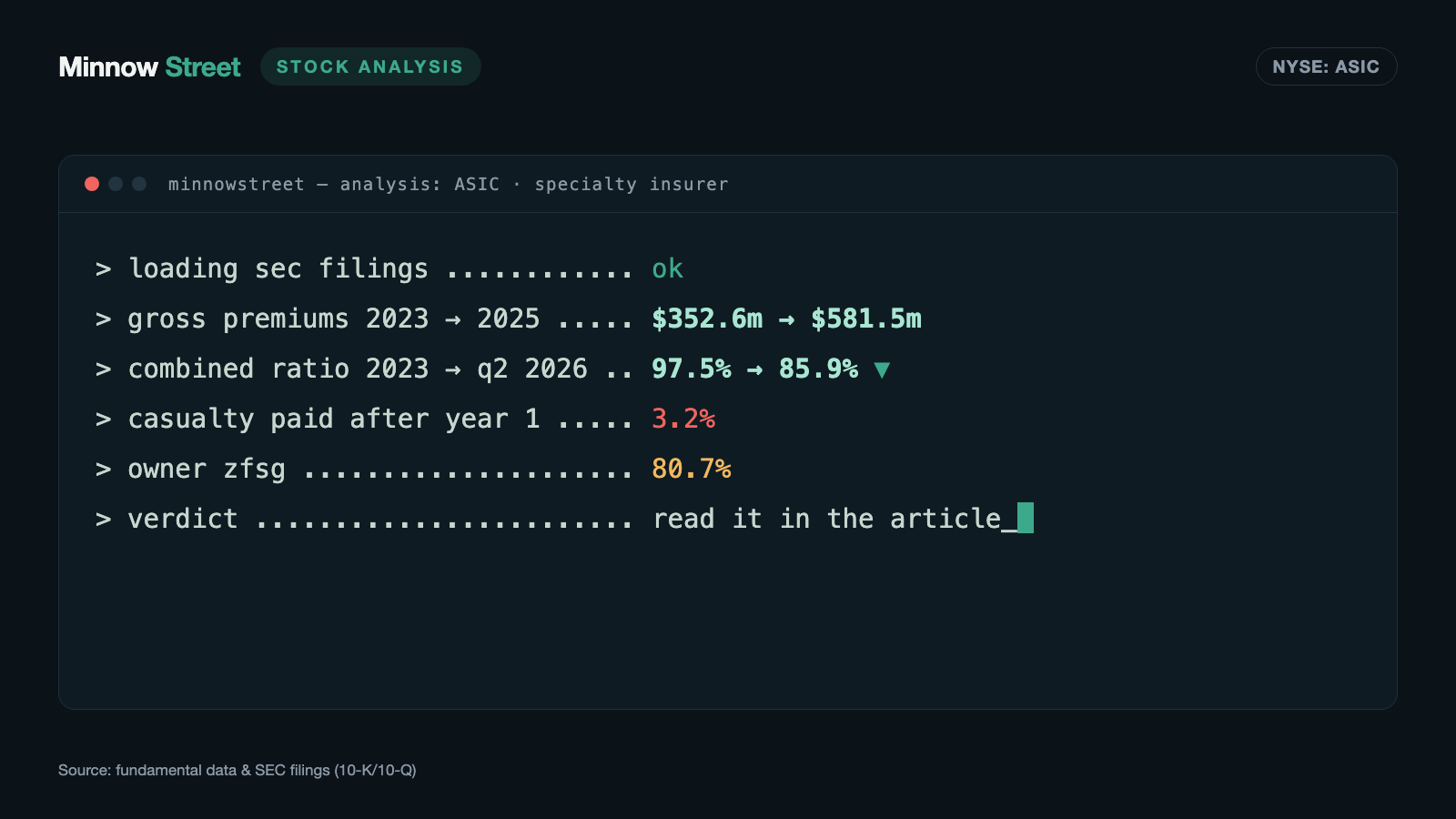
Four letters, three meanings: "ASIC" is a chip-industry term, the abbreviation of the Australian securities regulator — and, on the New York Stock Exchange, a young U.S. specialty insurer writing policies for roofers, restaurant owners and small landlords. This insurer's numbers are unusually good and keep getting better: the combined ratio, the industry's core measure, fell from 97.5 percent in 2023 to 85.9 percent in the second quarter of 2026, while premiums in that same quarter rose 23.4 percent to $206.8 million. But the company has only been public since June 2025, just 3.2 percent of its casualty claims are paid after the first year, and $106.5 million of its investment portfolio sits as a loan with subsidiaries of the majority owner, who holds 80.7 percent of the stock. We read the filings to see what is earnings and what is still a promise.
 Thomas Mücke
Founder & Publisher
Thomas Mücke
Founder & Publisher
Chart
Interactive price chart (TradingView).
Note: pure fact-based analysis, not investment advice and not a solicitation to buy or sell. All figures without guarantee.
There is an investor trap that closes before you have read a single number: the ticker trap. Our minds hate blank fields. Four letters are enough, and the brain supplies a story on its own. ASIC — anyone who has ever read about semiconductors reflexively thinks of an application-specific integrated circuit; anyone from the regulatory world thinks of the Australian securities regulator, which goes by the same acronym. Both are wrong here. Behind the ticker ASIC on the New York Stock Exchange sits Ategrity Specialty Insurance Company Holdings, a young U.S. specialty insurer that sells policies to roofers, restaurant owners, small landlords and construction firms — the kind of risk a standard carrier will not write. No chips, no regulator: paper and claims. So let us make a deal. We will set the label aside and read what the company itself filed with the U.S. securities regulator, the SEC — the annual report (10-K) for 2025, the quarterly report (10-Q) as of March 31, 2026, the IPO prospectus, and the Form 8-K dated July 29, 2026 carrying the second-quarter 2026 results. An SEC filing is honest under penalty of law. And this one describes earnings power that improves quarter after quarter — plus three things worth knowing before calling that a trend.
What Ategrity Specialty actually does — the insurer for the risks nobody wants
Ategrity works exclusively in the market for excess and surplus lines, or E&S. Think of it as the emergency room of the insurance market. When a business is turned away by the large standard carriers — the welding shop with fire exposure, the nightclub, the scaffolding contractor, the apartment building in Florida — it ends up with an E&S insurer. That carrier is largely free to set price and terms because it is not bound by state rate approval; in exchange it takes on risks that are harder to model. Ategrity writes these policies through its subsidiary Ategrity Specialty Insurance Company (Delaware) and reinsures most of them with its own Bermuda subsidiary, Ategrity Specialty Insurance Limited — as of December 31, 2025, roughly 80 percent of net written premium was ceded internally under a quota share arrangement.
The target market is deliberately small and medium-sized businesses: many policies, small amounts. How small? The 10-K says the average closed claim from 2022 through 2025 was roughly $48 thousand. The book spans 48 states and the District of Columbia; in 2025 the largest were California (18.9 percent of gross written premiums), Florida (16.1), Texas (10.1), New York (8.3) and Georgia (5.4). Two thirds of premiums (67.2 percent) are casualty risks, one third (32.8) property. With 203 employees as of December 31, 2025, that is a very small team for $581.5 million of premium — and that is exactly the business idea Ategrity calls productionized underwriting: risk selection organized like a production line. Submissions are standardized, sorted into micro-segments, screened and priced automatically; only what falls outside the grid reaches a human. The core system is AtegrityOne, an in-house cloud-based policy administration platform.
That also names the central tension of this analysis, and it runs through every chapter: the present is unusually well documented — the past is too short to verify, and the owner is simultaneously the borrower, the service provider and the employer of the company’s own executives.
Three terms you cannot read an insurer without
Before the numbers, three translations. They matter more here than any standard screening metric:
- Combined ratio — the one number the industry really watches. It says how much of every $100 of premium flows back out for claims and expenses. The base matters: it is calculated on net earned premiums, meaning what is left with Ategrity after reinsurance and after the premium has been earned over time — in 2025 that was $361.7 million out of $581.5 million of gross written premiums. At 85.9, $14.10 stays as underwriting profit; above 100 the insurance business itself is a loss that must be carried by the investment portfolio. It is the sum of the loss ratio (what claims cost) and the expense ratio (what administration and broker commissions cost).
- Reserves — the money an insurer sets aside for claims that have happened but have not been paid. Picture an invoice in a drawer where the amount written on it is an estimate. Estimate too low and the truth catches up years later; the filings call that development.
- What does not help here: price-to-sales and gross margin. At an insurer, "revenue" mixes premiums with capital market swings, and a gross margin does not meaningfully exist. The load-bearing anchors are book value per share and return on equity. Remember it now: with insurers you do not measure the margin, you measure the ratio — and the book value.
How the stock landed on our desk
Not through one of our momentum or valuation scanners. Ategrity came onto the research list through Reddit mentions, as of July 30, 2026 — the same source that regularly hands us candidates nobody is watching yet. In fairness: the company has only been in our data set for a few weeks, and our scanner lists are recalculated every night. As of the date of this analysis it does not appear in any of our screens; that can change with any recalculation and is no judgment on the business.
What matters most about that origin is this: for an insurer listed only since June 12, 2025 there are no long time series for a filter to work with — and the usual screening metrics mislead, as shown above. So the only route left is the slow one: the filings themselves. One more word on the ticker. If you find this stock through a search engine or a forum, check the full company name. "ASIC" really is a semiconductor term, and this kind of mix-up is not an academic worry — it is the classic route into a position you never intended to own.
The numbers over the years — honestly credited
First what genuinely impresses, and there is plenty. Gross written premiums — the top-line measure at an insurer — grew from $352.6 million in 2023 through $437.0 million in 2024 to $581.5 million in 2025. The second quarter of 2026 brought $206.8 million, up 23.4 percent year over year; the first half of 2026 totaled $349.7 million. More important, though, is how that growth is earned — and that is where the real story sits:
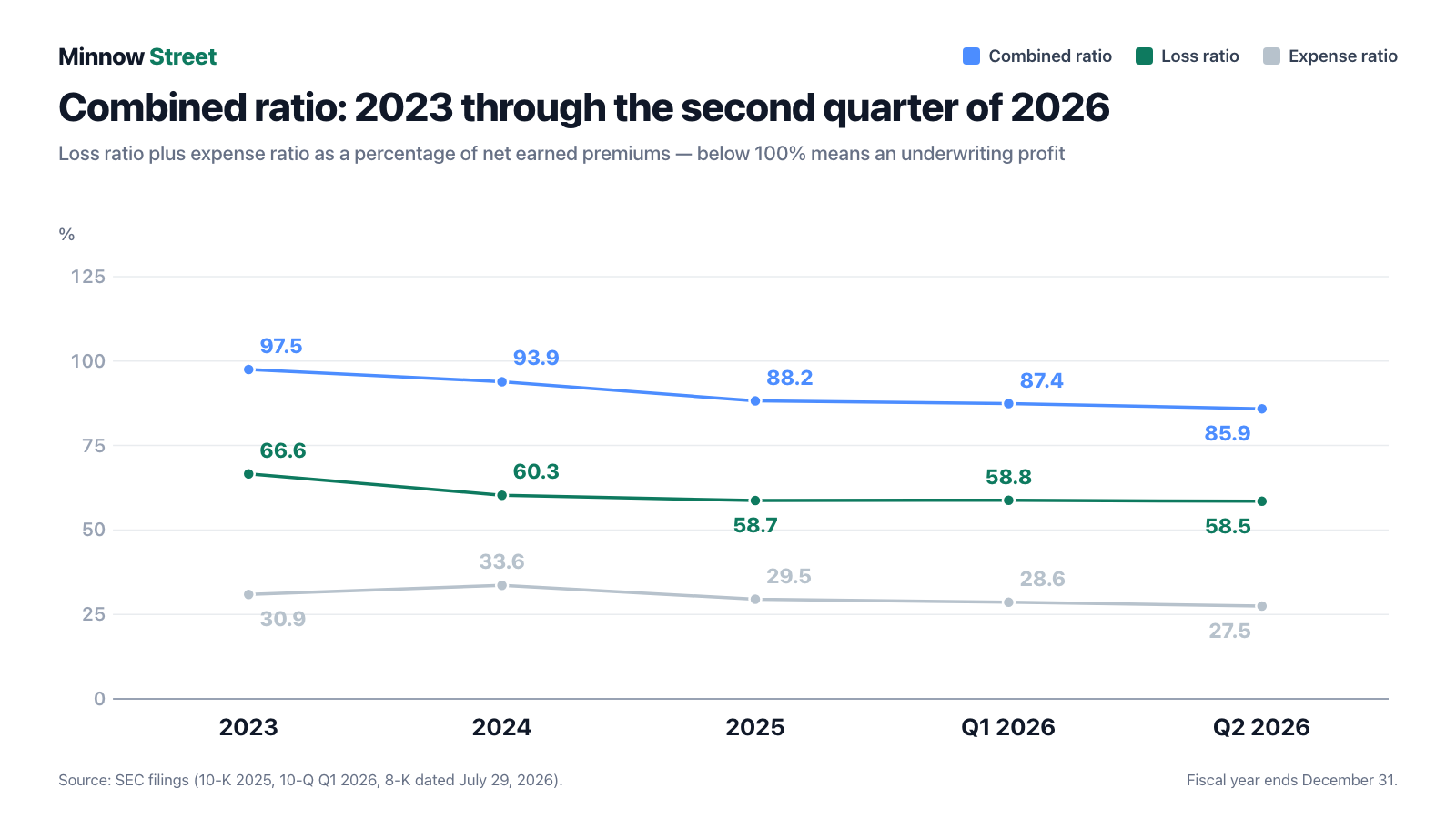
This curve is the core of the investment case. In 2023 Ategrity earned essentially nothing from insurance: at a combined ratio of 97.5 percent, $2.50 of every $100 in premium was left, barely covering costs after tax — and return on equity for 2023 came to a thin 3.4 percent. By 2025 it reached 14.6 percent, and in the second quarter of 2026 20.7 percent (annualized, adjusted). The driver has changed: through 2024 the improvement came mostly from the loss ratio (66.6 down to 60.3 percent, chiefly in property, according to the filing); since then it has come from the expense ratio — the remarkably unglamorous and therefore credible half of the story. It fell from 33.6 percent in 2024 to 27.5 percent in the second quarter of 2026 because premiums grow faster than the administrative base — 203 employees now carry close to $600 million of premium. Chief Executive Officer Justin Cohen described it in the earnings release:
"The scalability of our model was evident this quarter, as our expense ratio improved 350 basis points to 27.5%, contributing to a 66.9% increase in underwriting income."
— Ategrity Specialty Insurance Company Holdings, Form 8-K dated July 29, 2026, Exhibit 99.1 (second quarter 2026 results)
The rest of the balance sheet fits. Stockholders’ equity grew from $321.7 million at the end of 2023 through $398.3 million (end of 2024) and $614.3 million (end of 2025) to $664.4 million as of June 30, 2026 — the 2025 jump partly from the IPO ($114.8 million net). Book value per share rose from $12.78 to $13.86 in the first half of 2026 alone, up 8.5 percent in six months. There is no financial debt: the two $35 million letter-of-credit facilities with JPMorgan Chase and Barclays were terminated in September and October 2025, nothing had ever been drawn on them, and no replacement exists. Catastrophe exposure is kept strikingly small — the estimated net probable maximum loss for a 1-in-250-year event was just $12 million, or 2.0 percent of stockholders’ equity, as of December 31, 2025. And both insurance subsidiaries carry an "A-" (Excellent) rating with a positive outlook from A.M. Best. For an insurer that rating is not decoration but a license to trade: without at least "A-", many brokers will not place business.
A word on the pre-history, because it shows up in the numbers. Ategrity was formed in 2017, began operations in 2018, and was an LLC — a company with membership interests rather than shares — until immediately before the IPO. The 10-K describes the change plainly:
"On June 10, 2025, in connection with its IPO, Ategrity Specialty Holdings LLC converted from a Delaware limited liability company to a Nevada corporation."
— Ategrity Specialty Insurance Company Holdings, Form 10-K for 2025, Note 16 "Stockholders’ Equity"
Shortly before that came a 1-for-10.66 reverse split of the member units. That is why the filings say "share" where they used to say "unit," and why all prior-period per-share figures are restated. In practice: per-share numbers from before June 2025 are arithmetic, not market data. On June 12, 2025, Ategrity then sold 7,666,667 new shares at $17.00 for gross proceeds of $130.3 million.
What the filings say — the uncomfortable truths
Uncomfortable truth No. 1: this insurer’s reserves are still almost entirely unpaid
The single most important number in this analysis sits in an unremarkable table in the notes. Ategrity discloses how quickly claims in each line are actually paid. For property, 47.3 percent of incurred claims are settled after the first year — fire, wind, water, all reasonably quick to close. For the casualty lines, which make up two thirds of the book, the figure after year one is 3.2 percent. The bulk arrives only in years three, four and five (21.8, 22.5 and 19.5 percent). Translated: of the casualty claims Ategrity reserved for in 2025, the company currently knows almost nothing. Whether its estimate holds will be decided between 2027 and 2031.
How has Ategrity handled that uncertainty so far? Respectably, as far as such a short record allows. For 2025 the annual report shows no strengthening of prior-year reserves:
"For the year ended December 31, 2025, the net development on prior accident years was nil."
— Ategrity Specialty Insurance Company Holdings, Form 10-K for 2025, Note 11 "Reserves for Unpaid Losses and Loss Adjustment Expenses"
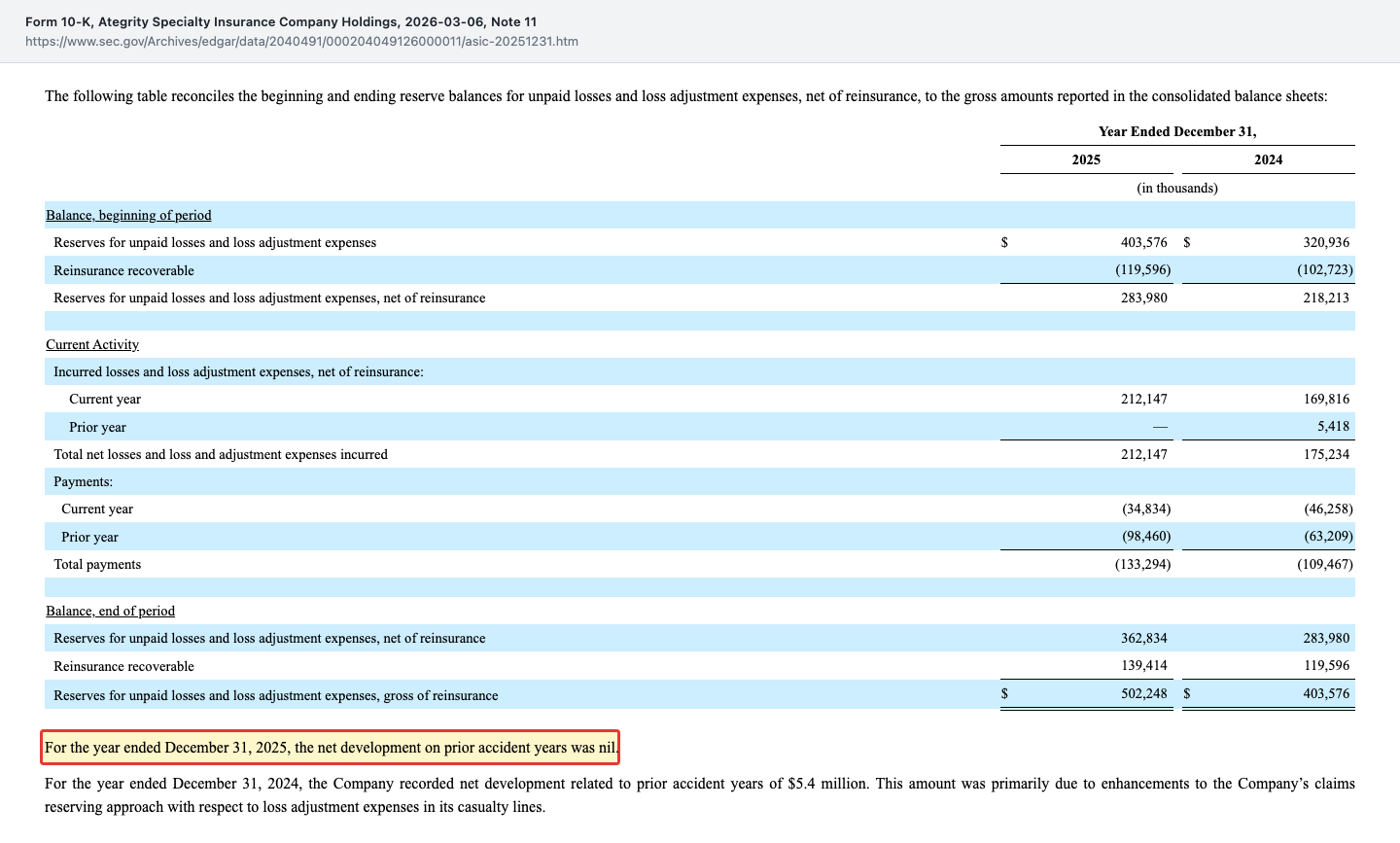
A year earlier the picture differed: in 2024 Ategrity had to add $5.4 million, "primarily due to enhancements to the Company’s claims reserving approach with respect to loss adjustment expenses in its casualty lines" — that is, because it changed its own estimation method for casualty claim-handling costs. And working through the accident-year triangles in the notes shows that the 2025 zero is a net zero: casualty accident year 2022 was written up from an original $64.9 million to $75.5 million (up 16.3 percent in three years), while accident year 2023 came down from $78.4 million to $74.8 million. The movements offset — but they exist.
How much of the result rides on this? Ategrity does the arithmetic itself. As of December 31, 2025 net reserves stood at $297.6 million (casualty) and $65.2 million (property). A deviation of just 7.5 percent to the upside would reduce pre-tax income by $27.2 million and equity by $21.5 million. Against 2025 pre-tax income of $95.9 million that is 28 percent. Remember the sentence: at a casualty insurer with seven years of history, the combined ratio is a claim until the losses are paid. The safeguards are an in-house reserve committee meeting quarterly, the statutory annual Statement of Actuarial Opinion from the appointed actuary and — in the filing's own word — an independent actuarial firm engaged "periodically" for supplementary analysis and benchmarking. That is industry practice; a standing third-party audit of the booked reserves it is not.
Uncomfortable truth No. 2: nearly half of premiums come through three brokers
Ategrity sells nothing itself. Every policy runs through licensed surplus lines brokers and wholesale agents — and that channel is tightening:
"The industry’s three largest wholesale distribution corporations represented 46.5% of gross written premiums for the year ended December 31, 2025."
— Ategrity Specialty Insurance Company Holdings, Form 10-K for 2025, Item 1 "Business — Distribution"

The trend is the troubling part, not the level: in 2024 it was exactly one partner, at $105.3 million or 24.1 percent — in 2025 it is three partners at $270.4 million, or 46.5 percent. The dependency almost doubled, and it did so precisely during the growth phase that carries the stock. Put it in everyday terms: if a neighbor tells you business is booming and then mentions that three agents bring in nearly half the orders, would you pause? At an insurer this is not simple customer concentration but channel concentration: the three houses — the filing does not name them — are wholesale groups in their own right that decide which carrier gets which business. If one moves its portfolio, Ategrity does not lose a customer — it loses a source of flow. In fairness, E&S wholesale distribution genuinely is concentrated and every competitor faces some version of this. But "industry-standard risk" is an explanation, not a protection.
Uncomfortable truth No. 3: the owner is also the borrower — and the employer of the company’s own executives
Ategrity is not a widely held company in the usual sense. The 10-K is explicit:
"ZFSG and its affiliates own, in the aggregate, approximately 80.7% of our outstanding common stock."
— Ategrity Specialty Insurance Company Holdings, Form 10-K for 2025, Item 1A "Risk Factors"

The owner is Zimmer Financial Services Group LLC (ZFSG), a financial holding company with insurance and asset management operations; Ategrity’s chairperson is Stuart J. Zimmer. Because ZFSG holds more than half the votes, Ategrity qualifies as a "controlled company" under NYSE rules — and it uses the governance exemptions that come with that status:
"We are and intend to continue utilizing these exemptions. As a result, we do not have a compensation and nominating, or corporate governance committees."
— Ategrity Specialty Insurance Company Holdings, Form 10-K for 2025, Item 1A "Risk Factors"
What that means in practice shows up in the investment portfolio. The balance sheet carries a line you do not expect at a property and casualty insurer: "Loans to affiliates" — $106.5 million as of December 31, 2025, unchanged as of June 30, 2026, up from just $13.5 million a year earlier. These are two loans to the majority owner’s group:
"The ZIS Loan provides for a fixed interest rate of 5.5%, payable annually in cash and matures on April 30, 2032."
— Ategrity Specialty Insurance Company Holdings, Form 10-K for 2025, Note 4 "Loans to Affiliates"
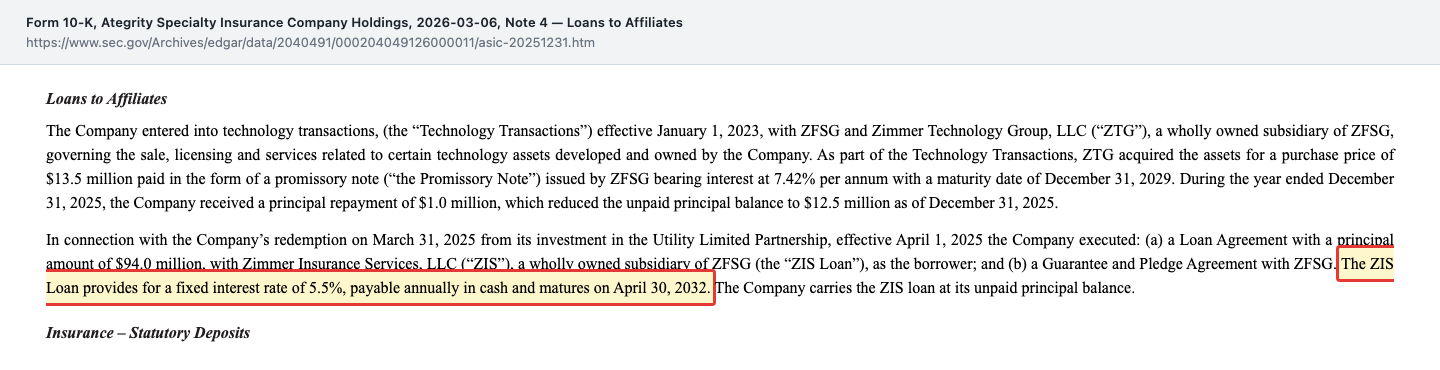
Together that is 16.0 percent of stockholders’ equity as of June 30, 2026 — money that must ultimately pay claims, yet sits with the owner’s subsidiaries until 2032 and 2029 respectively rather than in tradable bonds. The larger loan was funded by a $97.2 million redemption from an affiliated partnership on March 31, 2025. And that partnership is the second half of the entanglement: $227.3 million sat in "Utility & Infrastructure Investments" as of June 30, 2026 — a Cayman Islands fund for utility and infrastructure assets whose investment manager is Zimmer Partners, LP, a related party. For scale: that is more than a third of stockholders’ equity in a single fund that is not exchange-traded.
The personnel side matches. Chief Executive Officer Justin Cohen sits on three payrolls inside the owner’s orbit: he is a board observer at ZFSG ($0.1 million a year), a director at the ZFSG subsidiary Zimmer Insurance Services (another $0.1 million), received a $0.7 million consulting fee from ZFSG in May 2025 with a further $0.3 million due in 2026, and took a $0.7 million severance payment in July 2025 from the affiliated investment manager whose employee he had been until the IPO. Then came July 2026: on July 6, Ategrity decided not to renew the employment agreement of Chief Financial Officer Neelam Patel; she stepped down immediately and her employment ends September 16, 2026. On July 9, Neil Adler was appointed Chief Financial Officer — while remaining Chief Financial Officer of ZFSG and of Zimmer Partners, LP. His base salary at Ategrity: $200,000. All of it is disclosed, pre-approved by the audit committee and entirely lawful. But it leaves open whose interests prevail in a close call — and the answer is not obviously yours. For the extreme version of this kind of entanglement, see our analysis of Biglari Holdings.
Uncomfortable truth No. 4: only slightly more than a third of the profit comes from insurance
The second quarter of 2026 was the best in the company’s short history: $46.4 million of pre-tax income, $33.5 million of net income attributable to stockholders, $0.67 of diluted earnings per share. But look at where the profit came from:
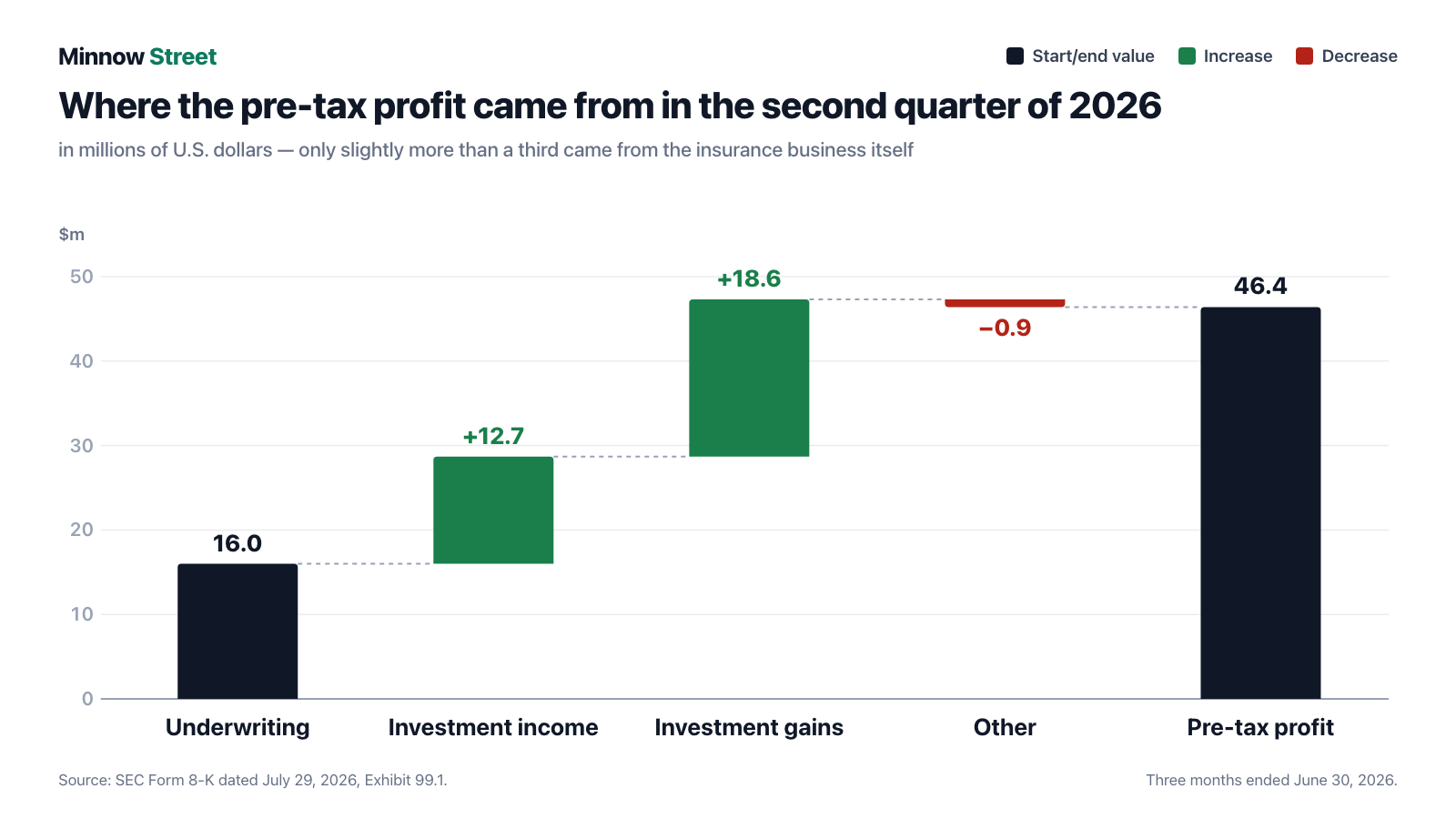
$16.0 million of $46.4 million — slightly more than a third — came from underwriting, the business the company exists to run. $12.7 million is recurring investment income: dependable because it comes from interest, but rate-driven and no credit to the underwriters. The third pillar is the wobbly one: $18.6 million of realized and unrealized investment gains, 40 percent of pre-tax income. In the prior-year quarter that line was $1.4 million; in the first quarter of 2025 it was negative $4.6 million. It can swing either way in any quarter, and a good part of it arises inside the Cayman fund run by the affiliated investment manager, whose valuation is not set on an exchange.
None of this cancels the success story — underwriting income did rise from $9.6 million to $16.0 million, up 66.9 percent, and that is real work. But it puts the record headlines in perspective: extend $0.67 of quarterly earnings per share into the future and you are extending market moves for 40 percent of it. We have seen this pattern before at insurers whose results hinge on an investment vehicle — see our analysis of Hamilton Insurance Group, where the investment side carried the profit almost single-handedly for a while. Remember: at an insurer, underwriting income is the line you may extrapolate. Everything else is weather.
To be fair about expectations, too: earnings beat the market by a wide margin. In its preliminary announcement of July 10, 2026, Ategrity itself put the then-current analyst consensus for the second quarter of 2026 at $0.47 of diluted earnings per share — it delivered $0.67. Surprises like that move share prices. They say nothing about whether the 2025 loss estimate will still hold in five years.
Valuation: no bargain, but no fantasy either
At an insurer you value the book and ask what return is earned on it. Both are well documented here. Book value per share stood at $13.86 as of June 30, 2026 ($12.78 as of December 31, 2025). For the share price there are two dated anchors. The first is in the annual report itself: the stock closed at $21.01 on December 31, 2025 — 1.64 times the book value at that date. The second comes from fundamental data: $24.64 as of July 30, 2026, roughly 1.8 times the June 30, 2026 book value, at a market capitalization of about $1.2 billion. On the last four quarters (roughly $0.98 in the second half of 2025 — the remainder of the full-year $1.58 after $0.60 in the first half — plus $1.18 in the first half of 2026) that puts the price-to-earnings ratio in the range of eleven to thirteen.
Is that expensive? For a specialty insurer running an 85.9 percent combined ratio and a 20.7 percent adjusted return on equity for the quarter, 1.8 times book is not unusual — companies like this trade above book precisely because of the return. But the arithmetic carries a condition: it assumes the 20.7 percent recurs. Two thirds of it currently does not come from insurance, and the combined ratio stands or falls with reserves whose truth is still outstanding. Fundamental data put the analyst price target at roughly $28 (as of July 30, 2026), so the professionals are friendly — yet they were 43 percent too cautious on quarterly earnings per share. That is information too: this company is not yet well understood.
One technical point to close, and it matters at small new listings: of the 48,032,652 shares outstanding (as of May 6, 2026), 80.7 percent sit with the majority owner. The cover page of the annual report puts the market value of the non-affiliate holding at roughly $200.2 million (as of June 30, 2025). On top come dilutive instruments, as of December 31, 2025: 4,245,335 employee options at a weighted average exercise price of $12.01 and 1,454,752 warrants held by the majority owner (1,079,605 at $31.99 and 375,147 at $21.32, ten-year term from October 21, 2024). It is already visible in the numbers: the second quarter of 2026 counted 48.0 million basic but 49.9 million diluted shares. The everyday image for dilution: your slice of the cake gets smaller when new slices keep being cut. Here the knives are drawn but not yet used.
Opportunities and risks at a glance
What speaks for Ategrity Specialty:
- Earnings power has improved without exception for three years: combined ratio 97.5 percent (2023), 93.9 (2024), 88.2 (2025), 87.4 (Q1 2026), 85.9 (Q2 2026) — through 2024 driven by the loss ratio (66.6 down to 60.3 percent), since then by an expense ratio that fell from 33.6 percent (2024) to 27.5 percent, meaning real scaling.
- Organic growth: gross written premiums from $352.6 million (2023) to $581.5 million (2025), and up 23.4 percent to $206.8 million in the second quarter of 2026 — in both lines and without acquisitions.
- A balance sheet with no financial debt: $664.4 million of stockholders’ equity and $1,175.8 million of invested assets as of June 30, 2026, book value per share up 8.5 percent in six months, and the two $35 million letter-of-credit facilities terminated in 2025 without replacement.
- Deliberately small catastrophe exposure: estimated net probable maximum loss for a 1-in-250-year event of $12 million, or 2.0 percent of equity; reinsurance recoverables exclusively from carriers rated "A-" or better by A.M. Best or fully collateralized (December 31, 2025).
- An "A-" (Excellent) rating with positive outlook for both insurance subsidiaries — effectively a license to trade in E&S wholesale — plus an authorized $50 million repurchase program that was still entirely untouched as of March 31, 2026.
What speaks against it:
- The reserve track record is too short for a verdict: only 3.2 percent of casualty claims are paid after the first year, 2024 required $5.4 million of strengthening, and a 7.5 percent deviation would cost $27.2 million of pre-tax income — 28 percent of 2025 pre-tax income.
- Rising distribution concentration: three wholesale brokers accounted for 46.5 percent of gross written premiums in 2025, up from one partner at 24.1 percent in 2024.
- Owner, borrower, fund manager and employer of the executives are the same group: ZFSG holds 80.7 percent, Ategrity uses the NYSE "controlled company" exemptions and maintains neither a compensation nor a nominating committee, $106.5 million of invested assets sits as a loan with ZFSG subsidiaries, and $227.3 million sits in a Cayman fund run by the affiliated investment manager.
- Earnings quality: in the second quarter of 2026 only $16.0 million of $46.4 million in pre-tax income came from underwriting, while $18.6 million came from realized and unrealized investment gains — a line that stood at negative $4.6 million in the first quarter of 2025.
- A very thin public float (market value of non-affiliate shares roughly $200.2 million as of June 30, 2025), dilution potential from 4.2 million options and 1.5 million warrants, no auditor attestation on internal control (emerging growth company exemption), no dividend — and a change of chief financial officer in the middle of the growth phase.
A human bottom line
Back to the ticker trap. It is not dangerous because someone might mistake a chipmaker for an insurer — you notice that within two minutes. It is dangerous because it shows how quickly our minds build a label into an investment thesis. And that same reflex keeps working at Ategrity in the other direction: "combined ratio 85.9 percent, premiums up 23 percent, record quarter" is also just a label unless you add that 40 percent of that profit came from investment gains, that only 3.2 percent of casualty claims are paid after the first year, and that $106.5 million of the assets is parked with the majority owner until 2032.
There is a great deal of good in these filings: a company that administers close to $600 million of premium with 203 people, has cut its expense ratio for three straight years, carries no debt and caps its catastrophe exposure at 2 percent of equity. That is strong craftsmanship. So the honest question is not "is this a good insurer?" but: are you buying an income statement whose most important assumption — that the casualty reserves are sufficient — cannot be tested before 2027 to 2031, from a company that has been public for 13 months and whose owner is also its borrower? If you can live with those three uncertainties and are happy to be paid for the scaling, you have a thesis. If you want a discount for them, and 1.8 times book does not offer one, you have a good watchlist candidate. The decision is yours.
Sources
Every original document used in this analysis, for your own reading:
- Ategrity Specialty Insurance Company Holdings — Form 10-K for 2025 (filed March 6, 2026)
- Ategrity Specialty Insurance Company Holdings — Form 10-Q as of March 31, 2026 (filed May 7, 2026)
- Ategrity Specialty Insurance Company Holdings — Form 8-K dated July 29, 2026, Exhibit 99.1: second quarter 2026 results
- Ategrity Specialty Insurance Company Holdings — Form 8-K dated July 10, 2026 (preliminary figures, CFO transition)
- Ategrity Specialty Insurance Company Holdings — Form 8-K dated June 11, 2026 (annual meeting voting results)
- Ategrity Specialty Insurance Company Holdings — Form 424B4 IPO prospectus dated June 11, 2025 (2023 and 2024 figures, lock-up, pre-history)
- Complete SEC filing history: EDGAR overview for CIK 0002040491 (sec.gov)
- Fundamental data (price, market capitalization, share count, analyst price target; data as of July 30, 2026), reconciled with the SEC filings.
- Origin of the candidate: Reddit mentions, as of July 30, 2026; valuation and metrics subsequently checked with our in-house stock scanner.
Transparency & disclaimer: this analysis is journalistic commentary on publicly available information. It is not investment advice, not a regulated financial analysis and not a solicitation to buy or sell securities. Equity investments carry substantial risk up to and including total loss. All figures are provided without warranty; the as-of date for each data point is noted in the text. The author holds no position in Ategrity shares at the time of publication.
Our Bottom Line at a Glance
- Underwriting earnings power positive
- The combined ratio fell without interruption from 97.5 percent (2023) through 93.9 (2024) and 88.2 (2025) to 85.9 percent in the second quarter of 2026 — through 2024 driven by the loss ratio (66.6 down to 60.3 percent), since then by an expense ratio that dropped from 33.6 percent (2024) to 27.5 percent. Underwriting income rose 66.9 percent to $16.0 million in the second quarter of 2026 and gross written premiums 23.4 percent to $206.8 million. That is real scaling with 203 employees.
- Balance sheet & capital strength positive
- As of June 30, 2026 the books show $664.4 million of stockholders' equity and $1,175.8 million of invested assets with no financial debt whatsoever; the two $35 million letter-of-credit facilities were terminated in 2025 without replacement. Book value per share rose 8.5 percent in six months to $13.86, the estimated net probable maximum loss for a 1-in-250-year event is 2.0 percent of equity, and the A.M. Best rating is "A-" (Excellent) with a positive outlook.
- Reserves & track record neutral
- The annual report shows no prior-year development for 2025, but $5.4 million for 2024. None of this can be properly tested yet: only 3.2 percent of casualty claims are paid after the first year, and a 7.5 percent deviation in net reserves would move pre-tax income by $27.2 million — 28 percent of 2025 pre-tax income. An in-house reserve committee, the statutory annual actuarial opinion and an independent actuarial firm engaged "periodically" back up the estimates, but the company has only been public since June 12, 2025.
- Distribution concentration negative
- Three wholesale brokers accounted for $270.4 million, or 46.5 percent, of gross written premiums in 2025; a year earlier it was one partner at $105.3 million, or 24.1 percent. The dependency almost doubled during the growth phase, and Ategrity sells exclusively through such intermediaries. That is industry practice — it is not protection.
- Owner & related-party business negative
- Zimmer Financial Services Group holds 80.7 percent (10-K 2025); as a "controlled company" Ategrity maintains neither a compensation nor a nominating committee. $106.5 million of invested assets sits as a loan with ZFSG subsidiaries ($94.0 million at 5.5 percent through 2032) and $227.3 million in a Cayman fund run by the affiliated manager. The CEO sits on three payrolls inside the owner's orbit, and the chief financial officer appointed on July 9, 2026 is simultaneously chief financial officer of the majority owner.
- Earnings quality neutral
- Of second-quarter 2026 pre-tax income of $46.4 million, only $16.0 million came from underwriting; $12.7 million was recurring investment income and $18.6 million realized and unrealized investment gains — a line that stood at negative $4.6 million in the first quarter of 2025. Extrapolate $0.67 of quarterly earnings per share and 40 percent of what you are extrapolating is market movement.
Ategrity Specialty is the ticker trap with a pleasant surprise: behind the chip-sounding ASIC sits a U.S. specialty insurer whose combined ratio has fallen for three years (97.5 to 85.9 percent) and whose premiums grew 23.4 percent to $206.8 million in the second quarter of 2026 — on a debt-free balance sheet with $664.4 million of equity and catastrophe exposure of only 2 percent of equity. Three things stand against that in the filings: only 3.2 percent of casualty claims are paid after the first year, three brokers bring in 46.5 percent of premiums, and $106.5 million of the assets sits as a loan with subsidiaries of the majority owner, who holds 80.7 percent. In the second quarter of 2026 just $16.0 million of $46.4 million in pre-tax income came from insurance itself. Not investment advice.
What Our Rating Means
Open questions
The business works in principle, but one material question is open. As long as it stays open, our findings do not carry a quality verdict.
The business model visibly works: an expense ratio falling from 33.6 to 27.5 percent since 2024 is not a lucky streak but scaling — and a debt-free balance sheet with $664.4 million of equity, an "A-" rating and catastrophe exposure of 2 percent of equity leaves no room for a substance finding. A red light would require things that simply are not there: no going-concern issue, no breached covenant, no negative cash flow, no listing risk. A green light lacks two proofs. First the reserves: in casualty — two thirds of the book — 3.2 percent of claims are paid after one year, so the 85.9 percent combined ratio is a well-founded estimate until 2031, not a result. Second the closeness to the owner: 80.7 percent held by ZFSG, no compensation or nominating committees, $106.5 million lent to ZFSG subsidiaries, $227.3 million in a fund run by the affiliated manager, and a chief financial officer who is simultaneously chief financial officer of the majority owner. Add distribution concentration of 46.5 percent across three brokers. At 1.8 times book you are already paying for the scaling — it only becomes verifiable with the 2027 to 2031 accident years. The decision is yours.
A journalistic assessment by our editorial team at the time of the deep dive, based on public sources — not investment advice and not a solicitation to buy or sell. Your personal circumstances (investment goals, risk capacity, taxes) cannot be taken into account. What our levels mean, how verdicts are formed, and what conflicts of interest exist →
Worth Noting
- Ticker confusion warning: "ASIC" is a semiconductor term (application-specific integrated circuit) and also the abbreviation of the Australian Securities and Investments Commission. This stock is neither — it is Ategrity Specialty Insurance Company Holdings, a U.S. excess and surplus lines insurer (NYSE, CIK 0002040491).
- Ategrity reached our research list through Reddit mentions as of July 30, 2026 — not through one of our momentum or valuation scanners. The company has only been in our data set for a few weeks; our scanner lists are recalculated nightly and showed no hit at the time of this analysis. Classic screening metrics such as price-to-sales or gross margin carry no meaning at an insurer anyway; the load-bearing anchors are the combined ratio, book value per share and return on equity.
- Data basis and as-of dates: annual and quarterly figures come from the Form 10-K for 2025 (filed 03/06/2026), the Form 10-Q as of 03/31/2026 and the Form 8-K dated 07/29/2026 (Exhibit 99.1, second quarter 2026 results); the 2023 figures come from the 424B4 IPO prospectus dated 06/11/2025. Price, market capitalization and share count carry a data date of July 30, 2026; the only share price documented in a filing is the closing price of $21.01 on 12/31/2025. Because of the LLC-to-corporation conversion and the 1-for-10.66 reverse split, all per-share figures before June 2025 are restated.
Frequently Asked Questions
No. On the New York Stock Exchange, the ticker ASIC belongs to Ategrity Specialty Insurance Company Holdings, a U.S. specialty insurer headquartered in New York. "ASIC" is also a semiconductor term (application-specific integrated circuit) and the abbreviation of the Australian securities regulator, but neither has anything to do with this stock. Ategrity writes excess and surplus lines coverage for small and medium-sized U.S. businesses and employed 203 people as of December 31, 2025.
Through its subsidiary Ategrity Specialty Insurance Company, Ategrity insures risks that standard carriers decline — excess and surplus lines business. Its customers are small and medium-sized businesses in retail, real estate, hospitality and construction across 48 states and the District of Columbia. In 2025, 67.2 percent of gross written premiums were casualty and 32.8 percent property risks; the average closed claim from 2022 through 2025 was roughly $48 thousand.
The combined ratio is the sum of the loss ratio and the expense ratio, and it shows how much of every $100 of premium flows back out for claims and administration — calculated on net earned premiums, that is, on the share that stays with Ategrity after reinsurance. At 85.9 percent — the figure for the second quarter of 2026 — $14.10 remains as underwriting profit. Above 100 percent the insurance business itself is a loss. Ategrity improved the ratio from 97.5 percent (2023) through 93.9 (2024) and 88.2 (2025) to 85.9 percent: through 2024 via the loss ratio (66.6 down to 60.3 percent), since then via an expense ratio that fell from 33.6 percent (2024) to 27.5 percent.
Zimmer Financial Services Group LLC (ZFSG) and its affiliates own roughly 80.7 percent of the shares according to the Form 10-K for 2025; the chairperson is Stuart J. Zimmer. Ategrity therefore qualifies as a "controlled company" under NYSE rules and uses the associated exemptions: it has neither a compensation nor a nominating or corporate governance committee. The market value of shares held by non-affiliates was roughly $200.2 million as of June 30, 2025.
They can barely be tested yet. According to the Form 10-K for 2025, only 3.2 percent of casualty claims are paid after the first year, against 47.3 percent for property. Ategrity reports no development on prior accident years for 2025, but $5.4 million for 2024. A 7.5 percent deviation in net reserves would move pre-tax income by $27.2 million — 28 percent of 2025 pre-tax income of $95.9 million. The safeguards are an in-house reserve committee, the statutory annual actuarial opinion from the appointed actuary and an independent actuarial firm engaged "periodically" per the filing — not a standing outside audit of the reserves.
Of $46.4 million in pre-tax income, $16.0 million came from insurance underwriting, $12.7 million from recurring investment income and $18.6 million from realized and unrealized investment gains, with $0.9 million of other items deducted. Net income attributable to stockholders was $33.5 million, or $0.67 per diluted share. Analyst consensus had stood at $0.47 according to the company's July 10, 2026 Form 8-K.
Ategrity was formed in 2017, began operations in 2018 and was a Delaware LLC — a company with membership interests rather than shares — until June 2025. On June 10, 2025 it converted into a Nevada corporation, completed a 1-for-10.66 reverse split of its member units, and went public on June 12, 2025 with 7,666,667 new shares at $17.00. All per-share figures from before that date are restated arithmetic, not market data.
Book value per share was $13.86 as of June 30, 2026. The Form 10-K reports a closing price of $21.01 on December 31, 2025, or 1.64 times book value at that date; fundamental data show roughly $24.64 as of July 30, 2026, about 1.8 times book. On the last four quarters the price-to-earnings ratio sits in the range of eleven to thirteen. For a 20.7 percent return on equity that is not expensive — provided the return repeats.
Found an error?
Did you spot a factual error, an outdated number, or a typo in this deep dive? Let us know briefly — your report goes straight to the editorial team.