Digital Turbine stock: $34 million operating profit — and $58.6 million of interest
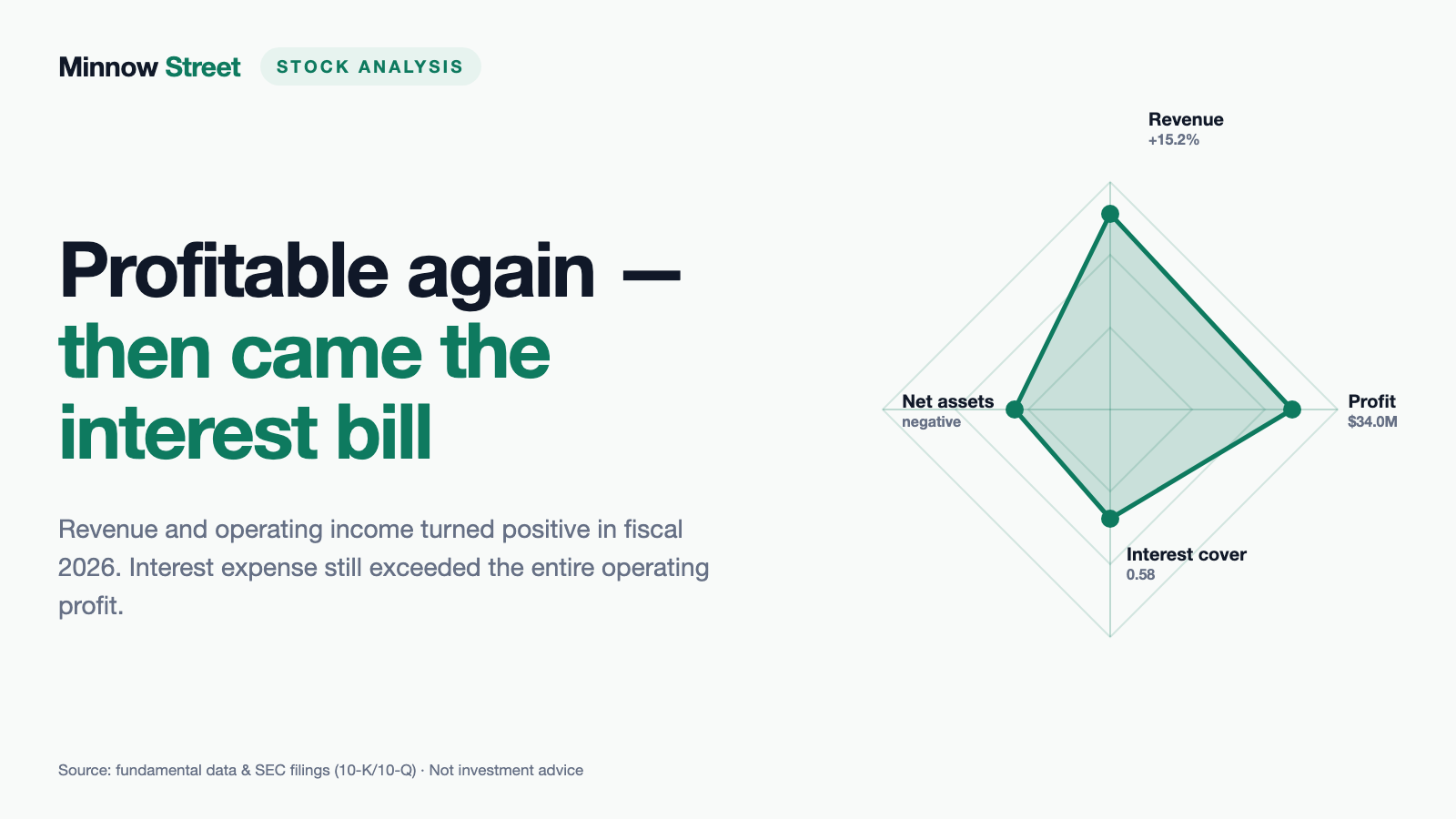
Digital Turbine puts apps on new Android phones before the buyer ever unlocks them, and sells advertising space inside other companies' apps. In fiscal 2026, ended March 31, 2026, revenue rose 15.2 percent to $565.3 million and the operating line turned positive for the first time in three years, at $34.0 million. The same year cost $58.6 million in interest, and on April 20, 2026 lender Blue Torch cut the liquidity covenant from $20 million to $15 million. We read the filings to see what survives the interest bill.
 Thomas Mücke
Founder & Publisher
Thomas Mücke
Founder & Publisher
Chart
Interactive price chart (TradingView).
Note: pure fact-based analysis, not investment advice and not a solicitation to buy or sell. All figures without guarantee.
There is an investor trap that loves turnaround stories, and it feels like a reward for patience: the inflection trap. It works like this — a number that has fallen for years finally rises again, and your mind closes the file: „Done. The corner has been turned.“ At Digital Turbine, Inc. (Nasdaq: APPS) of Austin, Texas, that corner is genuinely there. Revenue in fiscal 2026 rose 15.2 percent to $565.3 million, and for the first time in three years the books show an operating profit of $34.0 million. The arithmetic simply does not stop there. In the same fiscal year, servicing the debt cost $58.6 million in interest. So let us make a deal: before we trust the corner, we read together what Digital Turbine told the U.S. securities regulator, the SEC — the annual report (10-K) for fiscal 2026, the current report (8-K) of April 23, 2026, and the proxy statement (DEF 14A) of July 13, 2026. An SEC filing is honest under threat of prosecution. And this one describes a business that is growing again, a lender that had to loosen a covenant eight months after signing, and equity with nothing tangible behind it.
What Digital Turbine actually does — the software in your phone's factory state
Digital Turbine is not an app publisher, whatever the ticker suggests. What the company sells is far less visible: the space on your phone before you ever use it. Picture the moment: you buy a new Android handset, unlock it for the first time, and during setup apps appear that you never downloaded. That process is what Digital Turbine runs — on behalf of the wireless carrier or the device maker, who take a cut of the advertising money. App publishers pay for the install, the carrier shares in it, and Digital Turbine keeps the difference.
The company reports in two segments. On Device Solutions is the on-handset business just described: app delivery through carriers and device makers, plus content tiles such as news and weather on the browser start page or the lock screen, and the in-house tool SingleTap, which installs an app with a single touch. That segment brought in $382.4 million of revenue in fiscal 2026. App Growth Platform is the advertising side: an exchange where ad slots inside other companies' apps are auctioned in real time, plus tools for advertisers and publishers. It contributed $185.7 million. Strip out $2.9 million of intersegment revenue and the total is $565.3 million.
One line item decides almost everything at Digital Turbine: revenue share, the money passed through to carriers, device makers and app publishers. It is by far the largest cost block — $243.6 million in fiscal 2026, or 43.1 percent of total revenue, down from 48.0 percent a year earlier. In plain terms: of every dollar collected, roughly 43 cents leaves immediately for a partner, before a single employee is paid. That the ratio dropped by almost five percentage points is one of the honestly good pieces of news in this fiscal year.
Which frames the central tension of this analysis, and it runs through every chapter: the operating business really did turn the corner in 2026 — but the capital structure left over from the acquisition spree of 2021 and 2022 consumes the profit faster than the business produces it.
How the stock reached our desk — rank 16 in the weekly list
Digital Turbine did not come to us through a press release but through a ranking produced by our in-house stock scanner. In the list Richard Moglen: 1 Week Top Performers (U.S. selection) the stock sits at rank 16 of 28, with a relative strength rating of 95 out of 100, as of July 25, 2026. The list is recalculated every day — the placement is a snapshot of that day, not a standing fact. To reproduce it: the ranking is open in the scanner overview and sorts by relative strength.
The three conditions of that list, translated and judged. At least 15 percent price gain over four trading days — pure momentum; it says nothing about the company, only about demand for its shares that week. Average dollar volume of at least $10 million a day — this filter keeps out names you cannot get back out of when it matters. A relative strength rating of at least 70 — the measure compares a stock's performance with the broad market on a scale to 100. A reading of 95 means only five percent of tracked stocks did better.
It is not the only list the stock appears in. As of July 26, 2026 Digital Turbine met 18 of our scanner strategies — among them Mark Minervini: Power Play, Stan Weinstein: Stage 2, RS Leader (90 and above), Power Trend, Qullamaggie: Top Gainers 1M and Institutional Accumulation. That confluence is notable, but it shares one denominator worth knowing: these are almost exclusively momentum and trend filters. They measure the same phenomenon from different angles — that plenty of people are buying this stock. Not one of them checks whether the interest is affordable. So keep this line from the start: a momentum scanner finds movement, not quality. Which means we open the books. For comparison, rank 5 in the same weekly list belongs to Bandwidth, a company with a strikingly similar mix of growth and debt.
The numbers over the years — credit where it is due
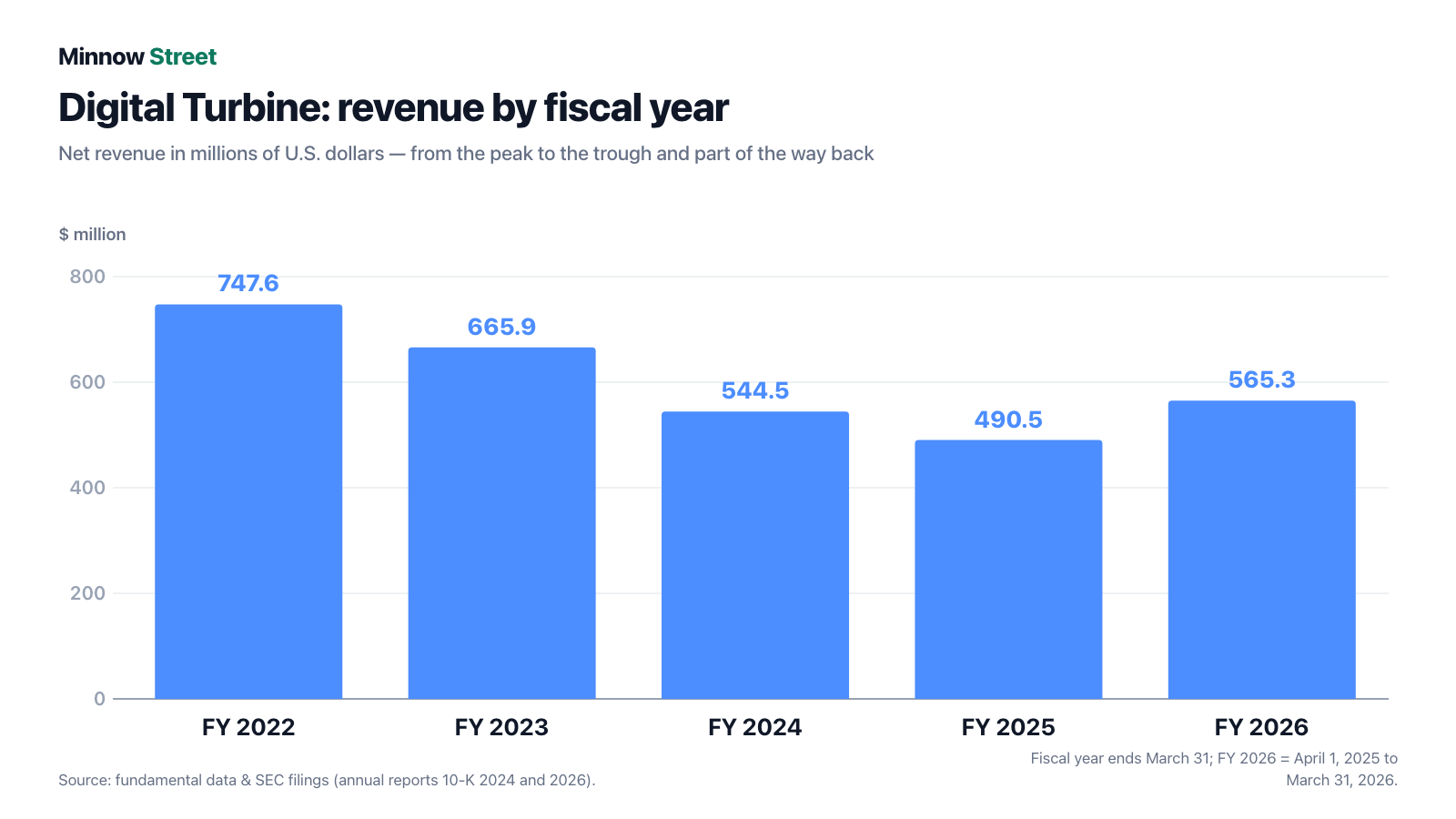
First what genuinely impresses, and it is more than the headline "fifth loss-making year" suggests. Digital Turbine peaked in 2022 and then fell hard: from a revenue high of $747.6 million in fiscal 2022 through $665.9 million and $544.5 million down to $490.5 million in fiscal 2025 — a decline of 34 percent in three years. In fiscal 2026 revenue rose for the first time since, by 15.2 percent to $565.3 million.
More important than the total is where the growth came from — and here any story about a broad recovery gets uncomfortable. By region, fiscal 2026 against the prior year looks like this: United States and Canada $227.7 million against $232.1 million — slightly down. Europe, the Middle East and Africa $162.5 million against $163.1 million — effectively flat. Asia Pacific and China $174.4 million against $95.5 million — up 82.6 percent. The entire group increase of $74.7 million therefore came from a single region, while both established markets stalled or shrank. The annual report attributes the gain to higher device volumes internationally.
Operationally, real things moved too. The biggest cost block, pass-through revenue share, rose only 3.5 percent while revenue rose 15.2 percent — the ratio fell from 48.0 percent to 43.1 percent. General and administrative expense dropped 18.2 percent to $142.1 million, partly because stock-based compensation was halved from $33.5 million to $16.4 million and amortization of old acquisitions ran off. Headcount fell from 647 to 620 full-time employees. The transformation program that began in October 2024 and included two rounds of layoffs was completed in the fourth quarter of fiscal 2025; in fiscal 2026 it cost only $0.6 million more. The savings plan delivered. It did not solve the interest problem.
One quarter deserves particular mention, because it is what made the inflection story plausible in the first place. In the third quarter of fiscal 2026 — the holiday quarter ended December 31, 2025 — Digital Turbine made money again: $151.4 million of revenue (up 12.4 percent), $21.7 million of operating income and $5.1 million of net income. Keep doing the arithmetic, though, and the fourth quarter appears as well: between the nine-month loss of $30.4 million and the full-year loss of $37.7 million lies an additional $7.3 million of loss in the January-to-March 2026 quarter. One good quarter is not yet a good year.
What the filings say — the uncomfortable truths
Uncomfortable truth No. 1: the operating profit does not cover the interest
Interest coverage is one of the few ratios that needs no background: divide operating income by interest expense and you learn how many times a company could pay its interest out of the running business. A healthy reading is 3 or more; below 1 means simply that the business does not earn its interest. Digital Turbine in fiscal 2026: 34.0 divided by 58.6 — that is 0.58.
The route from operating profit to full-year loss is therefore short and instructive:
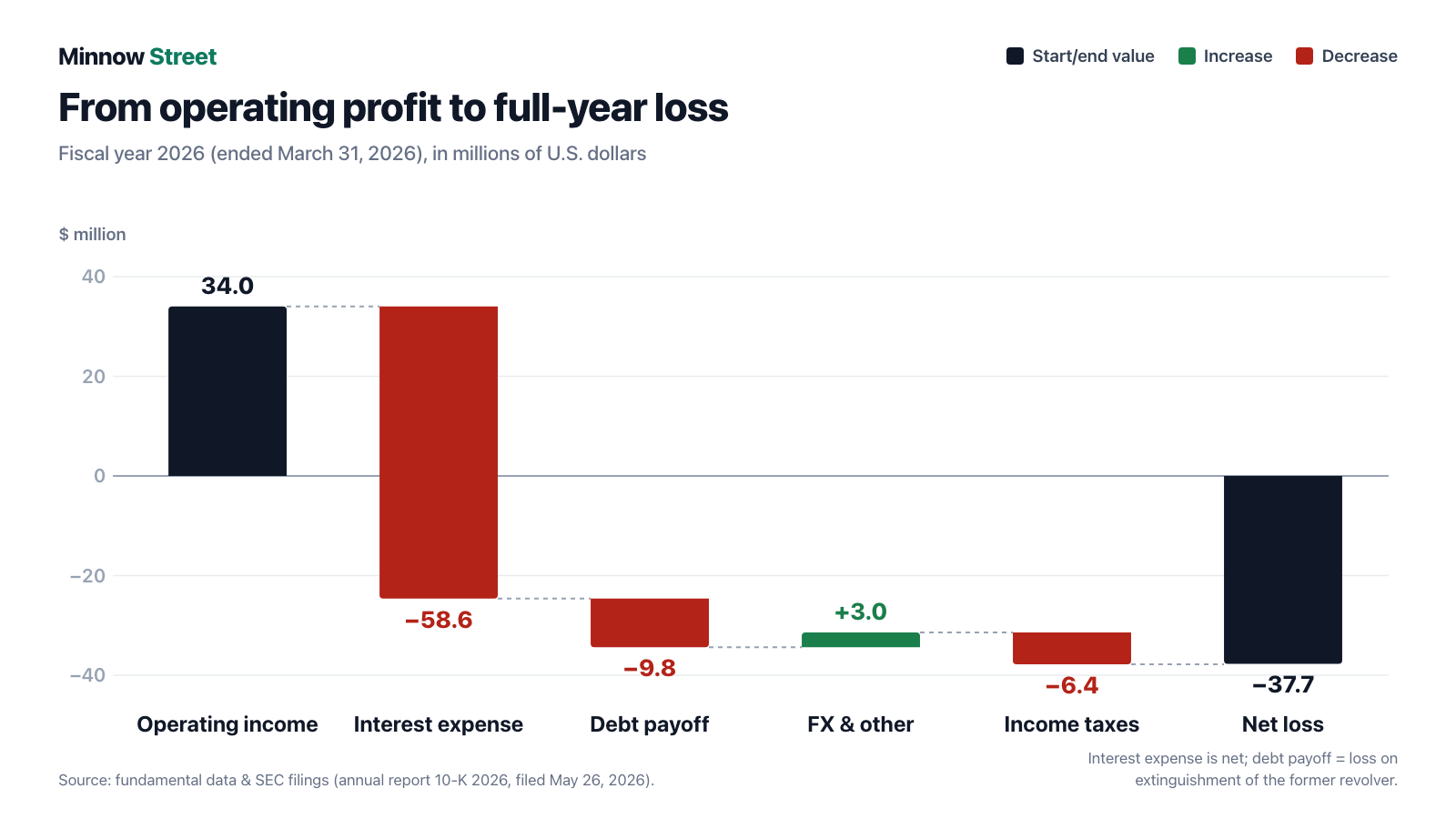
Interest expense rose 68.4 percent in a single year, from $34.8 million to $58.6 million. The annual report gives the reason: the weighted average interest rate on the company's debt climbed from 8.4 percent to 11.3 percent. That is not a market move, it is a decision — in August 2025 Digital Turbine swapped a bank revolver for a markedly more expensive term loan. Why, and at what price, is the next truth.
Uncomfortable truth No. 2: the new lender charges up to 20.62 percent
On August 29, 2025 Digital Turbine repaid its revolving credit facility with Bank of America and a syndicate of lenders and took on a term loan from Blue Torch Finance LLC instead — a specialist lender that finances companies traditional banks no longer serve. The terms: three tranches totaling $430.0 million, a four-year term to August 29, 2029, a margin of 7.50 to 8.00 percentage points over the SOFR benchmark rate, secured by substantially all of the company's assets. As of March 31, 2026, $391.2 million was still outstanding at an effective rate of 11.7 percent.
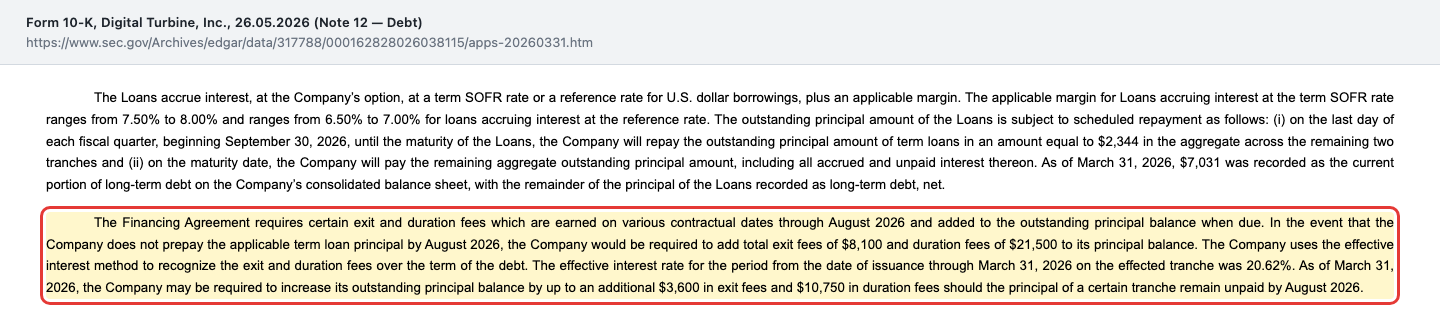
The real price, however, is not in the coupon but in the fees. The agreement provides for exit and duration fees that fall due if a particular tranche is not repaid by August 2026 — and are then simply added to the principal:
„In the event that the Company does not prepay the applicable term loan principal by August 2026, the Company would be required to add total exit fees of $8,100 and duration fees of $21,500 to its principal balance. The Company uses the effective interest method to recognize the exit and duration fees over the term of the debt. The effective interest rate for the period from the date of issuance through March 31, 2026 on the effected tranche was 20.62%.“
— Digital Turbine, Inc., SEC annual report on Form 10-K for fiscal 2026, Note 12 „Debt“ (amounts in thousands)
To bring the balance down, Digital Turbine sold shares into the market at the same time. On August 5, 2025 it signed an agreement with two banks for up to $150 million; it sold 9,945,136 shares at an average of $5.89, raising $58.6 million gross. Under the credit agreement the proceeds had to go straight into repayment — $55.0 million went back to Blue Torch during fiscal 2026. On February 2, 2026 Digital Turbine terminated that sales agreement of its own accord. Shares outstanding still rose during the fiscal year from 105,977,642 to 120,315,203 — a good 13.5 percent more pieces of the same company.
Uncomfortable truth No. 3: eight months later the covenant had to be loosened
Credit agreements contain covenants — promises by the borrower to keep certain metrics inside agreed limits. Break one and the whole loan can be called. Blue Torch required two: a maximum leverage ratio and minimum liquidity of $10 million until March 31, 2026 and $20 million thereafter, of which at least $10 million had to sit in the United States.
On April 20, 2026, three weeks after the higher threshold took effect, the agreement was amended:
„On April 20, 2026, Digital Turbine, Inc. (the ‚Company‘) amended its Financing Agreement (the ‚Financing Amendment‘) among the Company, certain other wholly owned subsidiaries of the Company, as guarantors, Blue Torch Finance LLC, as administrative agent and as collateral agent, and the lenders from time to time party thereto to, among other things, amend the liquidity covenant to reduce the liquidity requirement for the period between April 1, 2026 and December 31, 2026 to $15,000,000.“
— Digital Turbine, Inc., SEC current report on Form 8-K filed April 23, 2026, Item 1.01

The relief was not free. The notes to the annual report name the price: a $5.0 million amendment fee, capitalized as additional debt issuance cost and amortized over the remaining term. In exchange, remaining exit fees were limited to $1.35 million and future duration fees capped at $5.0 million — the latter waived entirely if a certain tranche is repaid by December 31, 2026. On the same day the company also suspended its obligation to register the shares underlying the lenders' warrants for resale until October 1, 2026. As of March 31, 2026 Digital Turbine was in compliance with all covenants, and cash of $37.7 million sat above both thresholds. Still: nobody lowers a covenant out of generosity.
Uncomfortable truth No. 4: the twelve-month statement comes with a condition
Every U.S. annual report contains a paragraph experienced readers look for first: management's statement on whether the money lasts twelve months. Digital Turbine's is there — but it opens with an "if":
„If we successfully refinance such loans on acceptable terms, we believe our existing cash and cash equivalents, cash flow from operations, and ability to access debt financing arrangements would be sufficient to meet our working capital and other business requirements for at least 12 months from the filing date of this Annual Report.“
— Digital Turbine, Inc., SEC annual report on Form 10-K for fiscal 2026, Item 7 „Liquidity and Capital Resources“
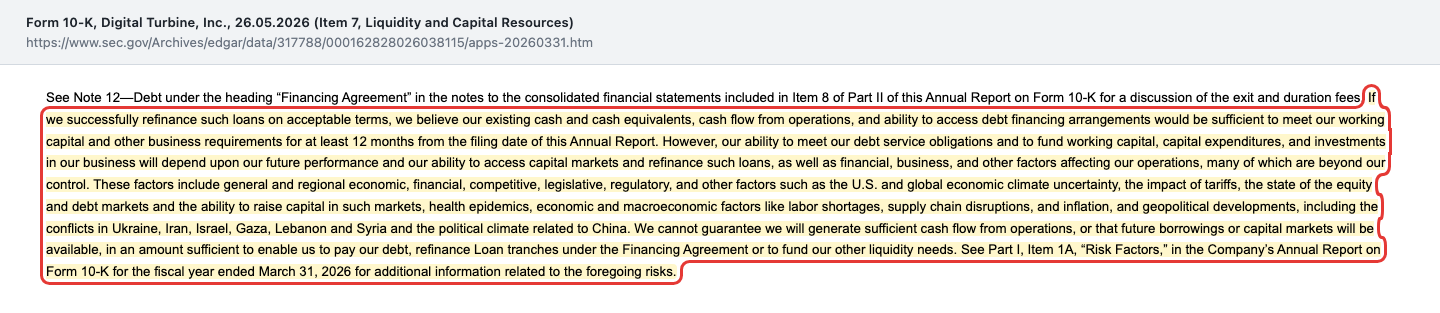
To be clear and undramatic: this is not a formal going-concern doubt — the auditor would have to flag that separately, and Grant Thornton did not. On the contrary, the auditor also certified internal control over financial reporting as effective. But it is not the usual unconditional formula either. In the same section the company writes plainly that it is currently seeking to refinance certain loan tranches and exploring ways to raise additional capital through equity or equity-linked securities. An "if" in that paragraph is news.
Uncomfortable truth No. 5: there is nothing tangible behind the equity
As of March 31, 2026 Digital Turbine reported equity of $192.2 million, up from $154.0 million a year earlier. The asset side explains what that equity consists of: $223.1 million of goodwill and $217.4 million of other intangible assets — together $440.5 million out of a $841.7 million balance sheet. Goodwill, in plain terms, is the premium a buyer paid above the value of the individual things acquired; it cannot be sold and cannot be pledged. Deduct goodwill and intangibles from equity and tangible book value is minus $248.3 million.
That these carrying values are no security is something the company has already demonstrated: in fiscal 2024 Digital Turbine wrote off $336.6 million of goodwill in a single year. Equity fell from $605.2 million to $213.9 million, and the annual loss came to $420.4 million, or $4.16 per share. Accumulated deficit today stands at $725.2 million. What that means for shareholders is stated unusually plainly in the annual report: because substantially all assets are pledged to the lender, a foreclosure or forced sale would leave "little, if any" value for common stockholders.
Uncomfortable truth No. 6: few carriers, one customer at 20.6 percent of receivables — and an interim finance chief
The on-device business works only as long as carriers and device makers play along. The annual report is blunt about it:
„In our ODS business, we rely on wireless carriers and OEMs to distribute our products and services. A significant portion of our ODS business is derived from a limited number of wireless carriers. Our failure to maintain our relationships with these carriers, establish relationships with new carriers, or a loss or change of terms could materially reduce our revenue and thus harm our business, operating results, and financial condition.“
— Digital Turbine, Inc., SEC annual report on Form 10-K for fiscal 2026, Item 1A „Risk Factors“

How tight that dependence has become shows in a figure in the notes that did not exist a year earlier: as of March 31, 2026 one single customer accounted for 20.6 percent of receivables — as of March 31, 2025 no customer exceeded 10 percent. On the revenue side no single partner crossed the ten percent mark in any of the three reported years, but the receivables picture has concentrated sharply within twelve months. A related detail sharpens the competitive question: the annual report names as its main competition not other ad networks but solutions built in house by the carriers and device makers — precisely the partners the revenue depends on.
And one personnel matter still open as this analysis is written: chief financial officer Steve Lasher resigned on May 22, 2026, effective May 31. Chief accounting officer Josh Kinsell has run the finance function on an interim basis since June 1, 2026, and the company has engaged an executive search firm. The proxy statement of July 13, 2026 still lists Kinsell as interim chief financial officer — so the post has been unfilled on a permanent basis for roughly two months, in the middle of a live refinancing.
Valuation — what the market pays for this business today
A word on honesty first: prices change daily, so what follows is a dated anchor for scale, not a buy argument. On July 24, 2026 the stock closed at $8.45. With 120,936,038 shares outstanding — the figure from the proxy statement, record date July 1, 2026 — that gives a market capitalization of roughly $1.02 billion. The 52-week range ran from $2.74 to $13.60 (data as of July 26, 2026); the stock swings hard, with a beta of about 2.8.
Four orders of magnitude follow. First, price to sales: roughly 1.8 times the $565.3 million of revenue. For an advertising technology company with single-digit growth expectations that is neither cheap nor expensive — it is a price that assumes the recovery continues. Second, enterprise value: market capitalization plus net debt of $353.4 million ($391.2 million of debt less $37.7 million of cash) gives roughly $1.38 billion. Anyone buying the whole company would have to find a good third more than the market capitalization suggests — the buyer takes on the debt. Third, leverage: operating income before depreciation and amortization was roughly $105.5 million ($34.0 million of operating income plus $71.5 million of depreciation and amortization). Net debt is therefore about 3.4 times that figure — a high reading for a company without a reliable profit. Fourth, there is no price-earnings ratio, because there is no annual profit.
Two further numbers complete the picture. Free cash flow — cash from operations less capital expenditure — came to $11.2 million in fiscal 2026 ($41.8 million less $30.6 million). On that basis the stock costs roughly 91 times free cash flow; a year earlier free cash flow was negative. And the Altman Z-score, a bankruptcy early-warning measure built from balance sheet ratios, sits below 1.0 for Digital Turbine (data as of July 26, 2026); Altman's danger zone begins at 1.8. That score punishes companies with heavy debt and accumulated losses — exactly the case here.
The professionals are split accordingly: of the houses tracked, one rates the stock a buy and one a sell, with a consensus target price of $11 (data as of July 26, 2026). The positioning is striking: 10.7 million shares are sold short, roughly 9.1 percent of the float. Short sellers bet on falling prices and must buy back when prices rise. A ratio like that explains part of the violent moves that swept Digital Turbine into the momentum lists in the first place. How fast such a setup can flip we saw at Roku, another advertising business with a wide valuation swing.
Opportunities and risks at a glance
What speaks for Digital Turbine:
- The business is growing again. Revenue up 15.2 percent in fiscal 2026, both segments positive (On Device Solutions up 11.9 percent, App Growth Platform up 21.2 percent).
- The cost base has been cleaned up. General and administrative expense down 18.2 percent, pass-through revenue share down from 48.0 to 43.1 percent of revenue, transformation program complete.
- Operating income is positive again — $34.0 million after two loss-making years; the third quarter of fiscal 2026 even produced $5.1 million of net income.
- Operating cash flow rose to $41.8 million from $11.9 million, and free cash flow turned positive at $11.2 million.
- The position on the device is hard to replicate. Delivering apps during first-time setup requires contracts with carriers and manufacturers — Digital Turbine built those over years.
What speaks against it:
- Interest is larger than operating profit. Interest coverage of 0.58 in fiscal 2026; interest paid of $47.1 million against $41.8 million of operating cash flow.
- $391.2 million of debt with a specialist lender, secured by substantially all assets, at an effective rate of 11.7 percent and 20.62 percent on one tranche. The refinancing is still in progress.
- The liquidity covenant had to be cut after eight months — from $20 million to $15 million, against a $5.0 million fee.
- Tangible equity is negative. Reported equity of $192.2 million faces $440.5 million of goodwill and intangibles; $336.6 million of that was written off in a single year in fiscal 2024.
- Growth rests on one region. The entire increase came from Asia Pacific and China; the United States, Canada and Europe stalled or slipped.
- Concentration and a vacant post. One customer represents 20.6 percent of receivables, the most important competitors are also the most important partners, and the finance chief has been interim since June 1, 2026.
A human conclusion
Back to the inflection trap. It is so persistent because it starts from a correct observation: Digital Turbine really did turn the corner in 2026. Revenue is growing again, the biggest cost block is shrinking as a share of it, administration costs almost a fifth less, and the operating line is positive after two years below zero. That is not a story; it is audited and available to read.
The mistake is not the observation but the point at which we stop reading. Two lines further down sits interest expense, and at $58.6 million it is larger than the entire operating profit. Two lines beyond that stands a lender that had to loosen a covenant eight months after signing, and a little further on an "if" in front of the statement that the money lasts twelve months. Digital Turbine is therefore neither a wreck nor a completed turnaround — it is a company whose operational recovery is real and whose balance sheet currently consumes that recovery in full. One can catch up with the other. It can also go the other way: if the refinancing does not come on acceptable terms, the outcome is decided by the credit agreement rather than the business.
What you make of that is your decision. And that is exactly as it should be.
Sources
- Digital Turbine, Inc. — annual report on Form 10-K for the fiscal year ended March 31, 2026 (filed May 26, 2026)
- Digital Turbine, Inc. — quarterly report on Form 10-Q for the period ended December 31, 2025 (filed February 3, 2026)
- Digital Turbine, Inc. — current report on Form 8-K filed April 23, 2026, Item 1.01 (amendment to the financing agreement)
- Digital Turbine, Inc. — current report on Form 8-K filed May 26, 2026, Item 2.02 (full-year results)
- Digital Turbine, Inc. — proxy statement on Form DEF 14A filed July 13, 2026
- Digital Turbine, Inc. — annual report on Form 10-K for the fiscal year ended March 31, 2024 (filed May 28, 2024, source of the fiscal 2022 and 2023 revenue figures)
- SEC EDGAR — filing history for Digital Turbine, Inc. (CIK 0000317788)
- Fundamental data (metrics, price series, analyst estimates), data as of July 26, 2026, closing price of July 24, 2026
Disclaimer: This article is journalistic analysis of publicly available corporate filings. It is not investment advice, not a solicitation to buy or sell securities and not a personal recommendation. Shares can lose substantial value; a total loss of invested capital is possible. All figures come from the primary sources linked above and carry their respective as-of dates; we accept no liability for the completeness or accuracy of the underlying reports. The author holds no position in Digital Turbine, Inc. at the time of publication.
Our Bottom Line at a Glance
- Business model and competitive position neutral
- The slot on the handset before first use is hard to replicate and rests on years of contract work. The fiscal 2026 annual report, however, names as its main competition the in-house solutions of carriers and device makers — precisely the partners the revenue depends on.
- Earnings power neutral
- Operating income swung to a positive $34.0 million in fiscal 2026 from minus $54.1 million, driven by 15.2 percent revenue growth and 18.2 percent lower administrative costs. The bottom line was still a loss of $37.7 million — the fifth consecutive loss-making year.
- Interest burden and financing negative
- Interest expense rose 68.4 percent to $58.6 million in fiscal 2026, exceeding the entire operating profit (interest coverage 0.58). The average rate climbed from 8.4 percent to 11.3 percent, and one tranche of the Blue Torch loan carried an effective rate of 20.62 percent. The refinancing of certain tranches is still under way.
- Balance sheet and substance negative
- Reported equity of $192.2 million as of March 31, 2026 sits against $223.1 million of goodwill and $217.4 million of other intangibles; tangible book value is minus $248.3 million. In fiscal 2024 the company wrote off $336.6 million of goodwill in a single year. On April 20, 2026 Blue Torch cut the liquidity covenant from $20 million to $15 million in return for a $5.0 million fee.
- Cash flow neutral
- Operating cash flow rose to $41.8 million in fiscal 2026 from $11.9 million, and free cash flow turned positive at $11.2 million. The increase, however, rested on $51.8 million of additional unpaid revenue share — and interest paid, at $47.1 million, was higher still.
- Concentration and leadership negative
- As of March 31, 2026 one single customer accounted for 20.6 percent of receivables (a year earlier none exceeded 10 percent), and the entire revenue increase came from Asia Pacific and China. The chief financial officer resigned on May 22, 2026, and the proxy statement of July 13, 2026 still shows the post filled only on an interim basis.
Digital Turbine is the inflection trap in pure form: everything measured at the operating level pointed up in 2026 — 15.2 percent revenue growth, $34.0 million of operating income after two loss-making years, a fifth less administrative cost, $41.8 million of operating cash flow. Everything attached to the capital structure points down: $58.6 million of interest expense, interest coverage of 0.58, $391.2 million of debt with a specialist lender, a liquidity covenant loosened eight months after signing, and equity with minus $248.3 million of tangible value behind it. The twelve-month statement in the annual report begins with an "if". Not investment advice.
What Our Rating Means
Substance risk
We found at least one documented issue that threatens the company itself — regardless of how the stock is currently valued.
Red here is not a verdict on the business but on the substance behind it, and the findings are documented. Fiscal 2026 operating income does not cover the same year's interest expense ($34.0 million against $58.6 million, coverage of 0.58); interest paid exceeds operating cash flow ($47.1 million against $41.8 million); equity after deducting goodwill and intangibles is negative at minus $248.3 million; and the lender had to cut the liquidity covenant eight months after signing. That the twelve-month statement in the annual report is conditional on a successful refinancing is not a formal going-concern doubt — the auditor flagged none — but it is not the usual unconditional formula either. None of this takes anything away from the visible operational recovery, which is the reason this stock is interesting at all. The decision is yours.
A journalistic assessment by our editorial team at the time of the deep dive, based on public sources — not investment advice and not a solicitation to buy or sell. Your personal circumstances (investment goals, risk capacity, taxes) cannot be taken into account. What our levels mean, how verdicts are formed, and what conflicts of interest exist →
Worth Noting
- Digital Turbine reached our research list through our in-house stock scanner: rank 16 of 28 in the list „Richard Moglen: 1 Week Top Performers“ (U.S. selection) with a relative strength rating of 95, as of July 25, 2026. As of July 26, 2026 the stock met 18 scanner strategies, nearly all of them momentum and trend filters. These lists are recalculated daily; they measure demand for the stock, not the quality of the company.
- Every figure carries its own as-of date: annual figures from the Form 10-K for fiscal 2026 (filed May 26, 2026), quarterly figures from the Form 10-Q for December 31, 2025 (filed February 3, 2026), the credit amendment from the Form 8-K filed April 23, 2026, share count and equity plan from the DEF 14A proxy statement filed July 13, 2026. Valuation metrics as of July 26, 2026, based on the closing price of July 24, 2026 — meant to be evergreen, with no daily price used as an argument.
- Risk of confusion: the ticker APPS belongs to Digital Turbine, Inc. of Austin (CIK 0000317788), not to an app store operator. The company was named Mandalay Digital Group until 2015, and NeuMedia and Mandalay Media before that; its SEC registration runs back to 1995 under changing names. One Store International Holding B.V., acquired in 2024, is a small holding (purchase price $1.9 million), not the Korean One Store app marketplace itself.
Frequently Asked Questions
Digital Turbine supplies software that places apps on new Android devices during first-time setup, on behalf of wireless carriers and device makers who share in the proceeds (On Device Solutions segment, $382.4 million of revenue in fiscal 2026). It also runs an advertising marketplace for app publishers with real-time auctions (App Growth Platform, $185.7 million).
Digital Turbine has long reported on a fiscal year ending March 31. Fiscal 2026 therefore covers April 1, 2025 through March 31, 2026 and largely corresponds to calendar year 2025. The related annual report on Form 10-K was filed with the U.S. securities regulator, the SEC, on May 26, 2026.
Operationally yes, on the bottom line no. Operating income was a positive $34.0 million against minus $54.1 million a year earlier. After $58.6 million of interest expense, a $9.8 million loss on extinguishing the old revolver and $6.4 million of income taxes, the year ended with a net loss of $37.7 million, or $0.33 per share — the fifth consecutive loss.
As of March 31, 2026, $391.2 million of term loans from Blue Torch Finance LLC were outstanding, maturing August 29, 2029 and secured by substantially all of the company's assets. The effective rate was 11.7 percent and 20.62 percent on one tranche because of exit and duration fees. Cash stood at $37.7 million.
Digital Turbine and Blue Torch cut the minimum liquidity requirement for April 1 through December 31, 2026 from $20 million to $15 million. The company paid a $5.0 million amendment fee for the change. In return, remaining exit fees were limited to $1.35 million and future duration fees capped at $5.0 million.
Almost entirely from Asia Pacific and China: $174.4 million against $95.5 million a year earlier, an increase of 82.6 percent. Revenue in the United States and Canada fell to $227.7 million from $232.1 million, and in Europe, the Middle East and Africa it was roughly flat at $162.5 million against $163.1 million.
Shares outstanding rose during fiscal 2026 from 105,977,642 to 120,315,203 — a good 13.5 percent more. The main cause was the sale of 9,945,136 shares into the market at an average of $5.89, the proceeds of which had to go into debt repayment under the credit agreement. The sales agreement was terminated on February 2, 2026.
By its own filings, Digital Turbine uses artificial intelligence but does not sell it as a product. The fiscal 2026 annual report says the company is increasingly building AI into certain offerings and depends on third-party AI partners for core data and infrastructure. The prior year's annual report did not mention the term at all.
Found an error?
Did you spot a factual error, an outdated number, or a typo in this deep dive? Let us know briefly — your report goes straight to the editorial team.