United Fire Group: The Combined Ratio Falls to 95.6 Percent — and 3.0 of the 3.8 Points Came From Expenses
An insurer lives or dies by a single number: the combined ratio. At United Fire Group it fell from 99.4 to 95.6 percent in the first quarter of 2026 — the fifth straight quarter of earnings well above expectations. But the quarterly report filed with the U.S. securities regulator, the SEC, breaks that number apart itself: 3.0 of the 3.8 points came from the expense ratio, 1.3 from lower catastrophe losses — and the underlying loss ratio, which measures the current-year insurance business, got 0.5 points worse. Add a higher retention, 33.4 percent less ceded premium, and a 2 million share repurchase authorization that has not bought a single share since 2023. Not investment advice — just the question of which part of a ratio actually moved.
 Thomas Mücke
Founder & Publisher
Thomas Mücke
Founder & Publisher
Chart
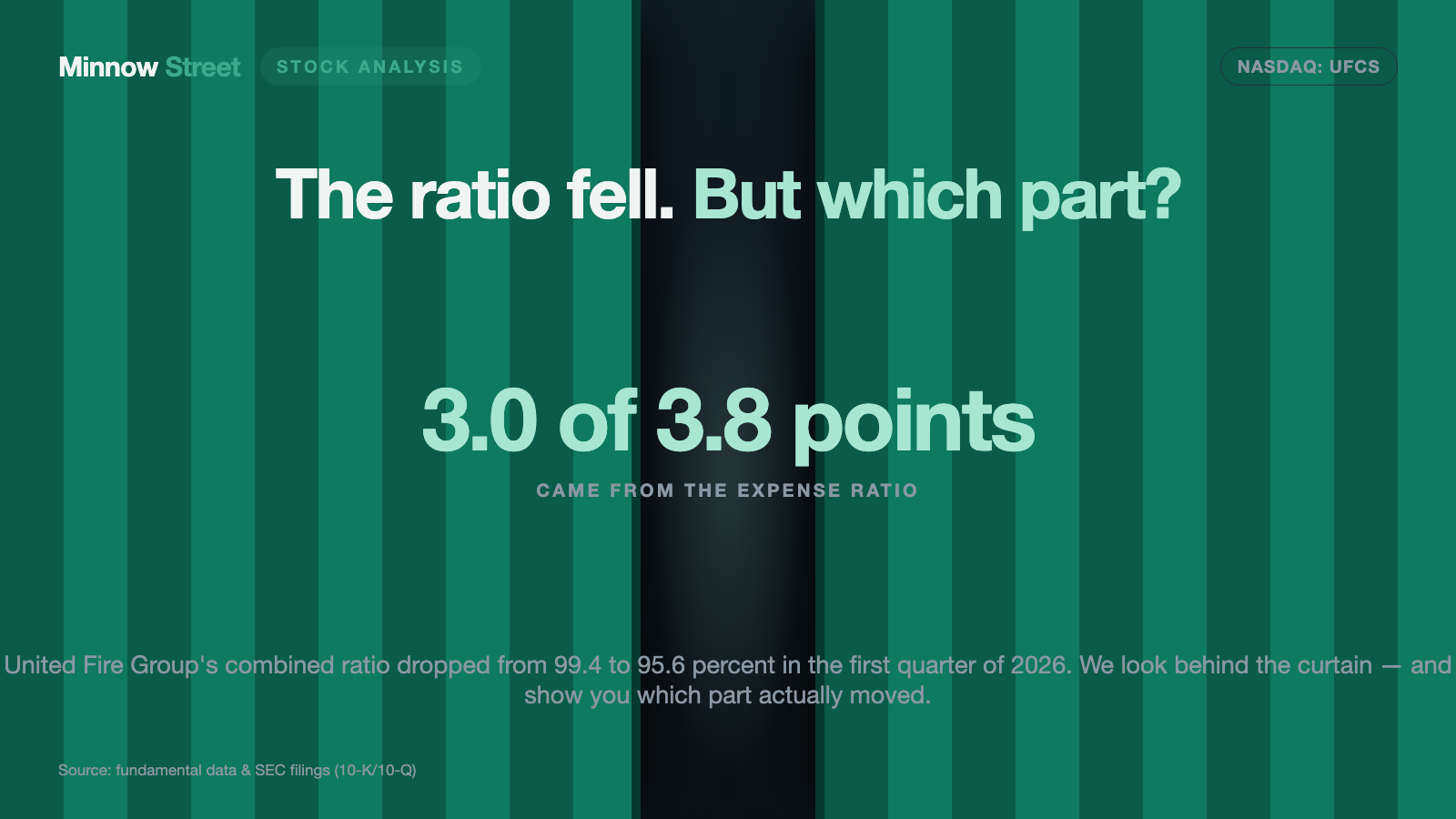
Interactive price chart (TradingView).
Note: pure fact-based analysis, not investment advice and not a solicitation to buy or sell. All figures without guarantee.
There is an investor trap that needs neither greed nor panic — only one well-built metric. Call it the sum trap. It works like this: a single number bundles four different things, the number falls, and your brain quietly adds "the company is doing its job better." What it does not add is the question of which of the four parts actually moved. For insurers that number is the combined ratio. It says how much of every 100 dollars of premium goes out again for claims and administration. Below 100, the company earns money from insuring; above 100, it earns money only in the capital markets. At United Fire Group (NASDAQ: UFCS), a property and casualty insurer from Cedar Rapids, Iowa, that ratio fell from 99.4 to 95.6 percent in the first quarter of 2026. That put the stock at rank 24 in our in-house Big Earnings Surprise ranking (U.S. selection with 81 hits, as of July 25, 2026). So here is the deal: before you file 3.8 points of improvement under better underwriting, we take the number apart together — using the Form 10-Q as of March 31, 2026 and the Form 10-K for 2025, both filed with the U.S. securities regulator, the SEC, and both honest under penalty of law. At the end, you decide.
What United Fire Group actually does — contractors, fire, liability
United Fire Group insures businesses. In everyday terms: the building contractor with twelve employees, the machine shop, the beverage wholesaler, the mid-sized metal fabricator. All of them need a policy that covers the workshop fire, the company truck rear-ending someone, the injured employee and the customer lawsuit. That package is what UFG sells — never directly, always through roughly 850 independent insurance agencies that also carry competitors' products. The filings name the lines: fire and allied lines, other liability, automobile, workers' compensation and surety. On top sit specialty programs written through managing general agents, an assumed reinsurance operation and a membership in the Lloyd's of London market through the subsidiary McIntyre Cedar Corporate Member.
The company is old: founded in 1946, listed on Nasdaq, and known as United Fire & Casualty Company until February 2012. Its insurance subsidiaries are licensed in all 50 states plus the District of Columbia; on December 31, 2025 they employed 846 people with an average tenure of 7.6 years. One clause explains a lot: in 2020 UFG announced it would withdraw as a direct writer of personal lines, and by December 31, 2025 no direct personal lines exposure remained. What still shows up under personal lines today is assumed reinsurance on other carriers' homeowners business. The fiscal year is the calendar year — no shift, no trap.
That sets the central tension of this analysis, and it runs through every chapter: the combined ratio has improved for three straight years — but the parts that moved the most are not the parts anyone would call better underwriting.
Where the stock landed on our desk
United Fire Group sits at rank 24 in the U.S. selection of our in-house stock scanner for large earnings surprises (81 hits, as of July 25, 2026), with a relative strength rating of 84 out of 100. To repeat it yourself: open the Big Earnings Surprise list, filter to the U.S. selection and read the ranking from the top — the lists are recomputed daily, so today's rank is not tomorrow's.
What does this filter measure? It looks for companies whose reported earnings per share came in well above the analyst estimate. At UFG the streak is unusually long and unusually large: five straight quarters above expectations. On May 6, 2025 it was $0.70 per share against an estimate of $0.61 (up 14.8 percent); on August 5, 2025, $0.90 against $0.56 (up 60.7 percent); on November 4, 2025, $1.50 against $0.72 (up 108.3 percent); on February 10, 2026, $1.50 against $0.91 (up 64.8 percent); and on May 5, 2026, $1.15 against $0.79 (up 45.6 percent). Data as of July 24, 2026.
Now the translation, because naming a metric is not judging it: an earnings surprise measures the distance to the estimate, not the quality of the business. For an insurer it regularly measures something else entirely — weather. Analysts assume an average catastrophe load for a quarter; if the hail stays away, earnings beat the estimate without a single policy having been priced better. Remember this one: for an insurer, a streak of earnings surprises is also a streak of mild quarters. Which is exactly why the filings are worth reading.
The numbers over the years — credit where it is due
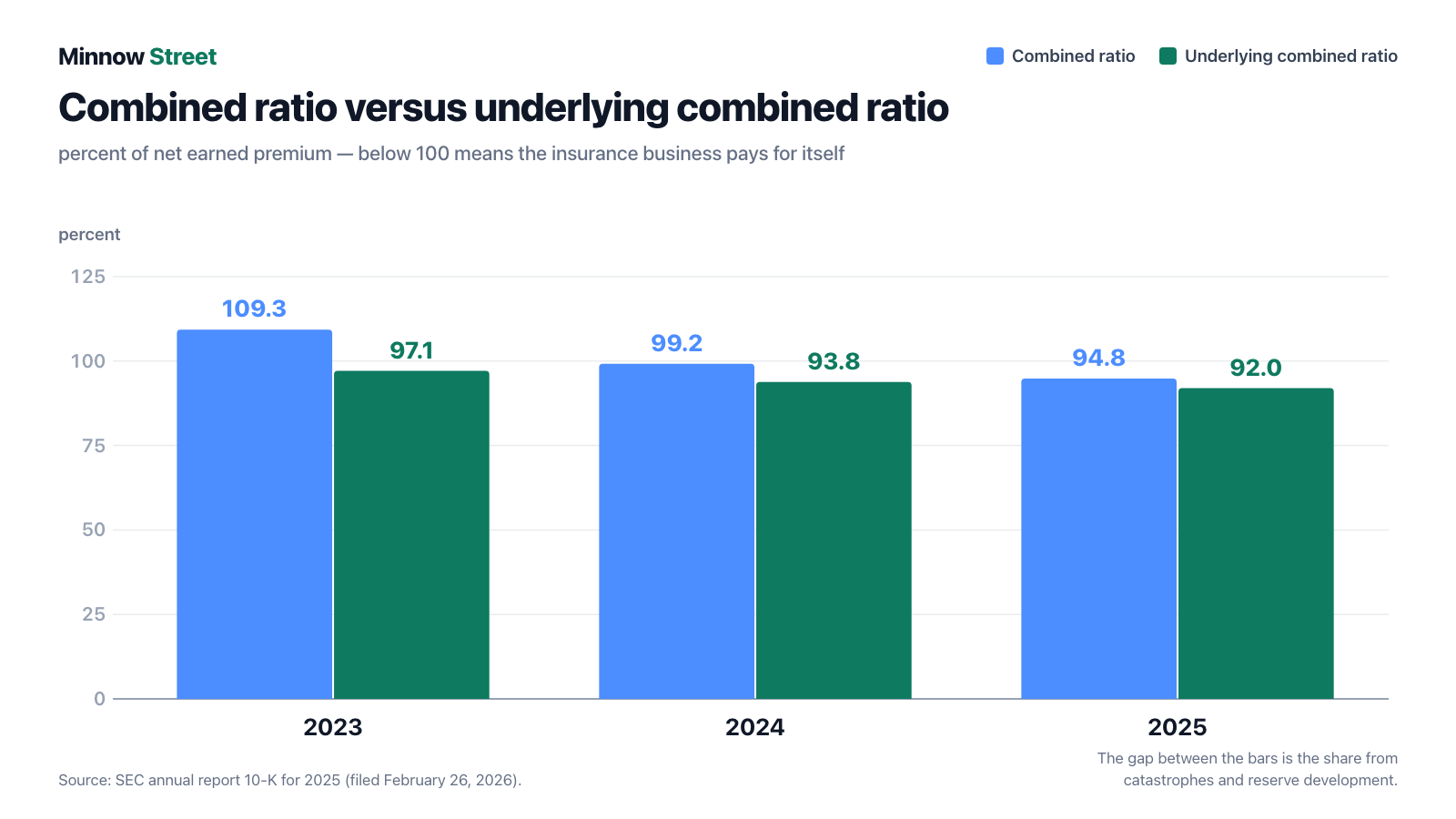
First the part that genuinely impresses, and there is plenty of it. UFG came out of a real hole. In 2023 the books showed a combined ratio of 109.3 percent — for every dollar of premium taken in, $1.09 went back out — and a full-year loss of $29.7 million. In 2024 the ratio was 99.2 percent and the profit $62.0 million. In 2025 it was 94.8 percent and $118.2 million of net income. That is not cosmetics; that is a turnaround: three years, two changes of sign, and a bottom line that nearly doubled year over year.
Premium grew alongside it: net earned premium of $1,034.6 million (2023), $1,176.8 million (2024) and $1,292.7 million (2025). And the second earnings engine of any insurer picked up sharply — investment income. An insurer collects premium today and pays claims over years; the money in between sits in the capital markets. At UFG that was $2.49 billion of invested assets on March 31, 2026. Net investment income rose from $59.6 million (2023) through $82.0 million (2024) to $97.5 million (2025), and the average pre-tax yield on fixed income securities went from 3.28 through 3.73 to 4.29 percent — and on to 4.43 percent in the first quarter of 2026. Anyone holding bonds bought after 2022 simply earns more interest than before, without doing anything differently.
Book value per share — for an insurer the most honest progress meter, because it shows how much substance stands behind each share — climbed as well: $30.80 on December 31, 2024, $36.88 on December 31, 2025 and $37.06 on March 31, 2026. Equity rose over the same period from $781.5 million to $950.6 million. In the first quarter of 2026 UFG earned $30.1 million against $17.7 million a year earlier, or $1.15 per diluted share against $0.67. All of it real, audited and readable in an SEC filing.
What the filings say — the uncomfortable parts
Now we turn each of those numbers over.
Uncomfortable truth No. 1: 3.0 of the 3.8 points came from expenses — and the insurance business got worse
The combined ratio has two halves: the loss ratio (what flows out for claims) and the expense ratio (what distribution and administration cost). The loss ratio in turn splits into three parts: catastrophes, revaluation of older accident years — the filing calls it prior period reserve development — and the remainder, the underlying loss ratio. That remainder is the craft itself: how well did the company price the risks it wrote this year?
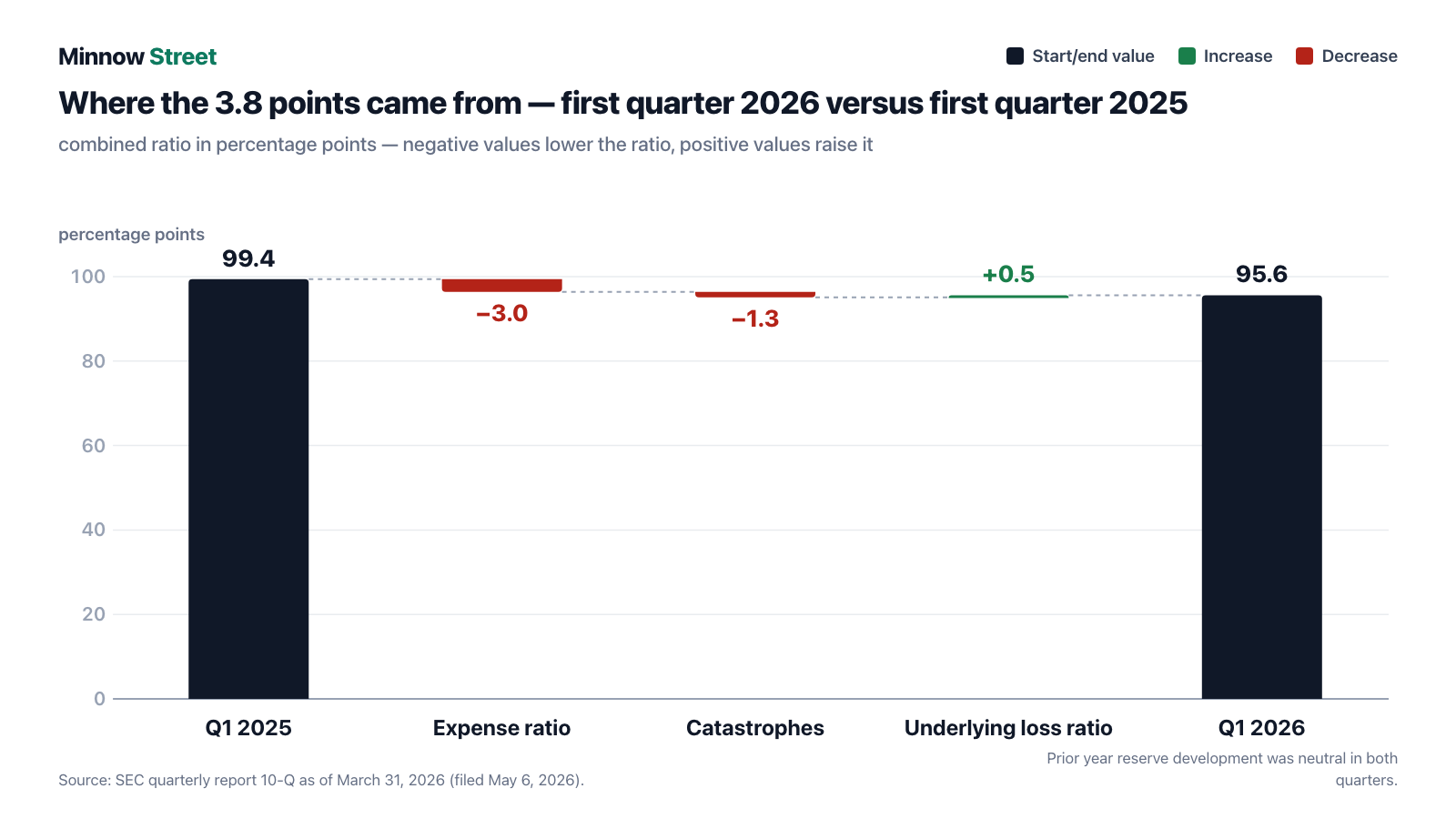
The quarterly report gives all four numbers. First quarter of 2026 versus the prior-year quarter: expense ratio 34.9 versus 37.9 percent (down 3.0 points), catastrophes 3.7 versus 5.0 points (down 1.3), reserve development neutral in both quarters (zero), underlying loss ratio 57.0 versus 56.5 percent (up 0.5). That sums to 3.8 points of improvement — and exactly one component points the wrong way: the one that measures the current insurance business.
That leaves the question of where those 3.0 points of expense savings came from. The filing answers that too — and the answer has a catch:
"The expense ratio improved 3.0 points in the three-month period ended March 31, 2026 as compared to the same period in 2025. The decrease in expense ratio was driven by business growth and non-recurring expenses in the prior period associated with the final stages of development of a new policy administration system."
— United Fire Group, Inc., SEC Form 10-Q as of March 31, 2026, Underwriting Expenses
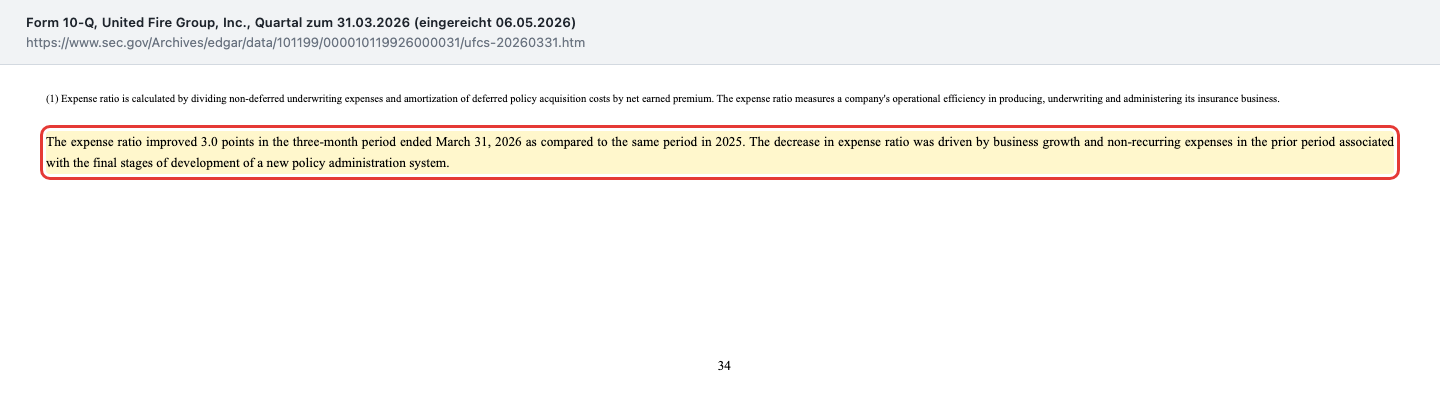
Part of those 3.0 points, then, is not thrift in 2026 but higher spending in 2025 — project costs for a new policy administration system that do not repeat. How large that part is, the filing does not say. What it does say: absolute underwriting expenses rose from $116.9 million to $119.6 million. They did not fall; they simply grew more slowly than premium. On a full-year view the picture is flatter than in the quarter: the expense ratio was 34.9 percent in 2023, 35.9 percent in 2024 and 35.7 percent in 2025. The 34.9 percent of the first quarter of 2026 is good — but it is not a new efficiency high, it is the 2023 level.
Uncomfortable truth No. 2: part of the premium growth is a reinsurance decision
Net written premium up 12.4 percent sounds like new business. It is that only half the way. Reinsurance works like insurance for the insurer: UFG passes on part of every policy to a reinsurer and pays premium for it. What remains is net premium. Buy less reinsurance and net premium rises — without a single new customer.
That is exactly what happened. In the first quarter of 2026 direct written premium rose 5.7 percent to $350.8 million and assumed written premium 10.8 percent to $59.8 million — together a gain of 6.4 percent. Ceded written premium fell 33.4 percent, from $50.5 million to $33.7 million. Those $16.9 million of forgone reinsurance premium are the whole difference between 6.4 and 12.4 percent. For scale: quarterly net income was $30.1 million.
The reason is in the annual report. Effective January 1, 2026, UFG raised the retention on its core treaty from $3.0 million to $4.0 million per occurrence and eliminated the annual aggregate deductible. Historically that is a doubling over a decade: $2.0 million from 2012 through 2015, $2.5 million from 2016 through 2021, $3.0 million from 2022 through 2025. For catastrophes, a program of $130.0 million of cover in excess of a $20.0 million retention has been in force since January 1, 2026 — the limit was raised, the retention stayed. This is a legitimate decision, and in a hard reinsurance market an obvious one. It is simply not an improvement in the insurance business; it is a shift of risk onto the company's own balance sheet. In mild quarters it pays. In a quarter with three severe individual losses it costs exactly one million more — per loss.
Uncomfortable truth No. 3: liability reserves keep running late — masked by the automobile book
An insurer sets aside reserves for reported claims and for claims incurred but not yet reported. If it turns out that too little was set aside, the top-up burdens a later year — the filing calls it adverse development. On March 31, 2026 UFG carried $1.97 billion of such reserves, more than twice its equity of $950.6 million. At that leverage, reserve quality decides everything else.
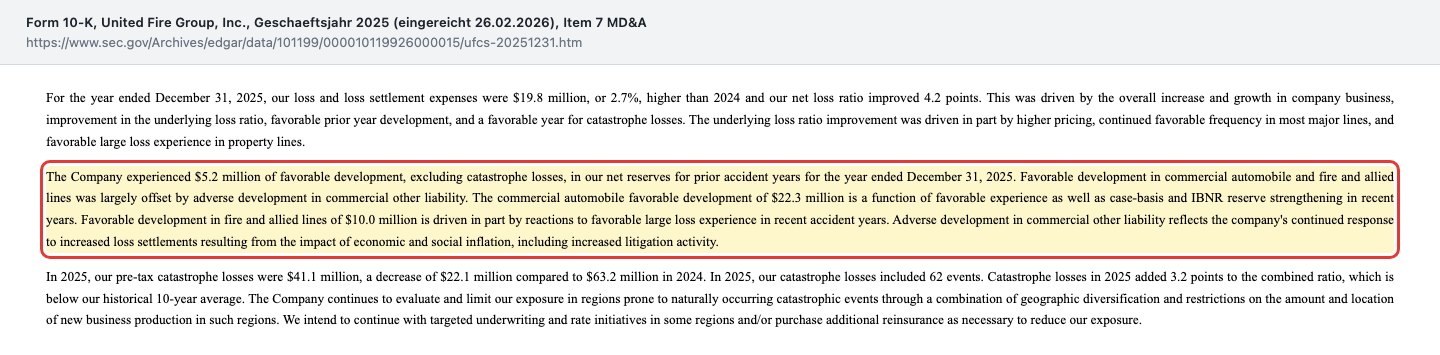
The headline number for 2025 looks good: $5.2 million of favorable development. The breakdown underneath reads differently — automobile contributed $22.3 million favorable, fire and allied lines $10.0 million favorable, and against that stood adverse development in commercial other liability. Arithmetically that means: without the good news from two short-tail lines, 2025 would have carried a top-up in the double-digit millions. And this is not a one-off year:
"Adverse development in commercial other liability reflects the company's continued response to increased loss settlements resulting from the impact of economic and social inflation, including increased litigation activity."
— United Fire Group, Inc., SEC Form 10-K for 2025, Losses and Loss Settlement Expenses
The same sentence appears word for word in the Form 10-K for 2024. And 2023 was the year the dam broke: $62.3 million of adverse development, of which $52.9 million came from commercial other liability alone, concentrated in accident years 2016 through 2019. That was the main reason for the 109.3 percent ratio and the annual loss. How seriously UFG takes the theme shows in its risk factors:
"But more recent trends such as litigation financing have led to an unprecedented number of large liability losses for us as well as our competitors."
— United Fire Group, Inc., SEC Form 10-K for 2025, Item 1A Risk Factors

The first quarter of 2026 added a detail worth not skipping. In surety the loss ratio jumped from 27.8 to 44.3 percent, which the company attributes to adverse development on large losses from accident year 2023. And in assumed reinsurance — $51.8 million of earned premium in the quarter — the loss ratio rose from 65.1 to 73.1 percent. Both lines are small enough not to turn the overall picture, and large enough to show that the corrections are not finished.
Uncomfortable truth No. 4: the growth capital costs 9 percent, the investments yield 4.43
An insurer that wants to write more premium needs more capital behind it; regulators do the math. UFG borrowed that capital. In May 2024 the company placed senior unsecured notes of $70 million with an investor group led by Ares Management, and in July 2025 another $30 million followed. In the quarterly report these papers appear as the 9 percent UFG Notes, Series A and B; on top sits $50 million from a December 2020 private placement maturing in 2040. Carrying value of all long-term debt on March 31, 2026: $146.3 million.
The price shows up in the income statement. Interest expense rose from $3.3 million (2023) through $7.3 million (2024) to $11.3 million (2025), and in the first quarter of 2026 to $3.2 million from $2.5 million — of which $2.3 million belongs to the 9 percent notes. Annualized, that part alone costs roughly $9.3 million of interest. For comparison: the $2.49 billion investment portfolio yielded an average 4.43 percent in the first quarter of 2026. The money is well over twice as expensive as what the portfolio returns — the difference has to come out of the insurance business that the additional premium creates. As long as the combined ratio stays below 100, that arithmetic works. At 109.3 percent, as in 2023, it does not.
Two further conditions belong here. The notes require an investment grade rating for each series and impose operating and financial covenants; as of March 31, 2026 the company reported compliance with all of them. And as a liquidity reserve, the main subsidiary has a borrowing facility with the Federal Home Loan Bank of Des Moines of up to $517.2 million, unused as of March 31, 2026.
Uncomfortable truth No. 5: the in-house actuary signs off on the in-house reserves
A short but notable paragraph in the annual report: UFG terminated its engagement with the outside actuarial firm Regnier Consulting Group for the year ended December 31, 2024. Since then the company's own Vice President of Actuarial Reserving has served as the appointed actuary, approved by the board. An outside firm still provides an independent assessment — but, in the filing's own words, the company does not rely on that assessment in determining its recorded reserves; it reviews and discusses the observations. That is industry practice and entirely lawful. It still means that for the metric which triggered this company's 2023 annual loss, the final word has been in-house since 2024.
Valuation — what the market is asking today
Market capitalization stood at roughly $1.32 billion as of July 24, 2026. The cross-check holds: 25,652,596 shares outstanding per the Form 10-Q as of March 31, 2026 multiplied by the closing price of July 24, 2026 gives the same figure. Against book value of $37.06 per share that is a price-to-book ratio of about 1.3, and against trailing twelve-month earnings of $4.96 per share a price-to-earnings ratio of about 10. For a property and casualty insurer both are within the normal band: a company that consistently runs below a 100 percent combined ratio usually trades above book, and one that lands at 105 trades below. The market here is paying for the continuation of what has been achieved, and not for a story.
For context on the other side of the same industry: how a considerably larger property insurer absorbed an exceptional loss is written up in our Mercury General analysis — that one was about California's once-in-a-century wildfire and what a catastrophe does to a balance sheet. At UFG the situation is reversed: the weather has recently been kind, with 3.2 catastrophe points in 2025 against 5.4 the year before and 6.2 the year before that — below the company's own ten-year average, as it notes.
Two screening scores from the fundamental data belong here, with a clear warning attached. The Piotroski score of 6 out of 9 is middling — a genuinely healthy company sits at 8 or 9. The Altman Z-score of 0.86 looks dramatic but is simply unusable here: the formula was built for manufacturers and relates working capital and sales to total assets. An insurance balance sheet made up three-quarters of loss reserves and investments fails that formula automatically. We name the number because it is in the data, and we do not use it.
Professional coverage is thin: two analyst firms follow the stock, one at strong buy and one at hold, with a mean price target of $51 as of July 24, 2026. The 52-week range over that period ran from $25.29 to $54.42 — the price has therefore roughly doubled within a year, which answers part of the question of how much of the turnaround has already been paid for. A beta of 0.50 marks the stock as comparatively low-volatility, and short interest stood at 2.35 percent of the float. The dividend has been $0.20 per share per quarter since May 20, 2026, after $0.64 per share in each of 2023, 2024 and 2025.
The thing about the repurchase program
One item from May 2026 deserves its own section, because it shows how fast a filing can age. The quarterly report of May 6, 2026 still said: repurchase program of one million shares, deadline August 2026, no shares repurchased in the first quarter of 2026. Two weeks later the world looked different:
"Additionally, the directors extended the current Share Repurchase Program to August 31, 2028, and increased the number of shares of its common stock the Company is authorized to purchase under the Share Repurchase Program to 2 million shares."
— United Fire Group, Inc., SEC Form 8-K of May 20, 2026, Item 8.01
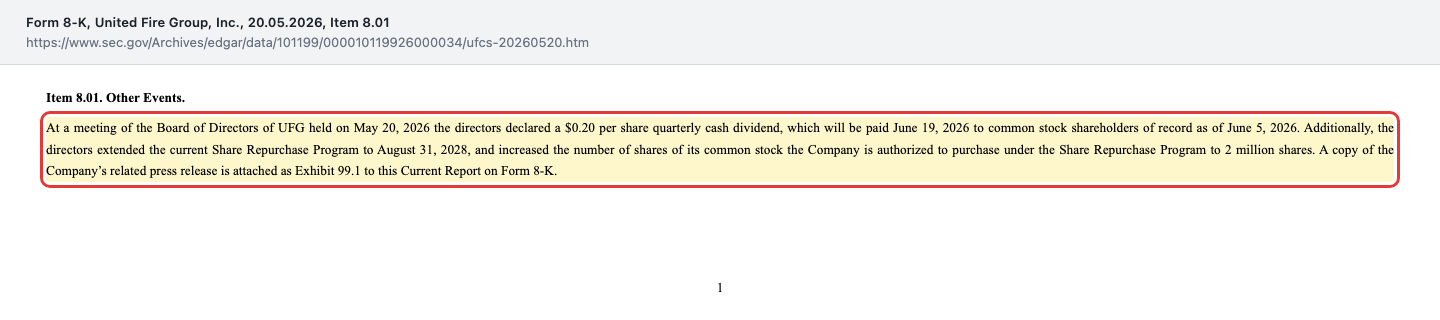
Two million shares are 7.8 percent of the 25,652,596 shares outstanding. At book value that would be roughly $74 million. Except: not a single share was repurchased in 2023, 2024, 2025 or the first quarter of 2026. An authorization is a permission, not an intention — it costs nothing and commits to nothing. The proof of whether permission turns into action sits in one table of the next quarterly report. UFG announced on July 17, 2026 that second quarter 2026 results will be released on August 3, 2026.
Opportunities and risks at a glance
What speaks for United Fire Group:
- The turnaround is documented and three years long. Combined ratio from 109.3 through 99.2 to 94.8 percent, bottom line from a $29.7 million loss to a $118.2 million profit, book value per share from $30.80 to $37.06 (December 31, 2024 to March 31, 2026).
- The underlying ratio also falls on a full-year view — 97.1 (2023), 93.8 (2024), 92.0 percent (2025). The step back in the first quarter of 2026 is one quarter, not a trend.
- Prices keep rising: in the first quarter of 2026 average renewal premiums were up 6.0 percent, of which 4.3 points came from pure rate; excluding workers' compensation it was 6.5 and 4.8 percent respectively.
- The interest rate tailwind is still blowing. The average yield on fixed income securities went from 3.28 percent (2023) to 4.43 percent (first quarter of 2026); every maturing legacy bond is reinvested at higher rates.
- Capital and liquidity are in place: $950.6 million of equity, $2.49 billion of invested assets, an unused $517.2 million facility, and compliance with all note covenants as of March 31, 2026.
What speaks against it:
- The first-quarter improvement comes from the side items. 3.0 of 3.8 points from the expense ratio — including a prior-year one-off the company names itself — and 1.3 points from lower catastrophes; the underlying loss ratio rose 0.5 points.
- More risk on its own balance sheet: retention raised from $3.0 million to $4.0 million per occurrence, ceded written premium down 33.4 percent in the first quarter of 2026.
- Liability reserves keep running late. The favorable 2025 net figure of $5.2 million is built from $22.3 million favorable in automobile and $10.0 million in fire and allied lines against adverse development in commercial other liability — the same line that triggered the 2023 annual loss with $52.9 million.
- Weather concentration: catastrophe losses of $64.2 million (2023), $63.2 million (2024) and $41.1 million (2025) are not a controllable item. One severe year costs more than the entire progress of two good ones.
- Expensive debt: $100 million principal in papers the filing labels the 9 percent UFG Notes, with rating and financial covenants; interest expense rose from $3.3 million to $11.3 million between 2023 and 2025.
- Thin coverage, narrow market: two analyst firms and roughly $1.32 billion of market capitalization — a small cap with the corresponding liquidity risk.
A human conclusion
Back to the sum trap. The 95.6 percent are neither invention nor trick — they are written into the SEC filing, they are audited, and they describe an insurer that stands clearly better today than in 2023. They simply do not describe what you read into them at first glance. The single largest contribution to the improvement came from administration, another from the weather, and the one component that measures the current insurance business moved the other way. On top of that, a good share of the premium growth was negotiated with reinsurers, not won from customers.
This is not a story about smoke and mirrors. It is the perfectly ordinary story of an insurer in a friendly year — run by a management that uses friendly years to keep more risk itself. Whether that was smart is decided not by intent but by the next hailstorm. The good news: the date of the next interim exam is set. On August 3, 2026 UFG reports second quarter 2026 results — the quarter in which the catastrophe season reaches the numbers and the higher retention has to work for the first time.
Buying here, then, does not mean buying a finished turnaround; it means betting that an insurer knows its craft when the weather stops helping. Waiting may cost you the cheap entry, but it buys a real number instead of an extrapolation. Both are defensible. What you make of it is your decision. And that is exactly as it should be.
Sources
- United Fire Group, Inc. — SEC Form 10-Q as of March 31, 2026 (filed May 6, 2026)
- United Fire Group, Inc. — SEC Form 10-K for 2025 (filed February 26, 2026)
- United Fire Group, Inc. — SEC Form 10-K for 2024 (filed February 26, 2025)
- United Fire Group, Inc. — SEC Form 8-K of May 20, 2026 (annual meeting, quarterly dividend, repurchase program)
- United Fire Group, Inc. — SEC Form 8-K of May 26, 2026 (non-employee director stock plan)
- United Fire Group, Inc. — SEC Form 8-K of May 5, 2026 (first quarter 2026 results)
- United Fire Group, Inc. — SEC Form 8-K of July 17, 2026 (second quarter 2026 reporting date)
- United Fire Group, Inc. — SEC Form 8-K of July 10, 2025 ($30 million add-on to the senior notes)
- SEC EDGAR — all filings by United Fire Group, Inc. (CIK 0000101199)
- Source: fundamental data & SEC filings (annual and quarterly reports, 10-K/10-Q) — ratios, earnings surprises and analyst coverage, data as of July 24, 2026
This analysis is journalistic interpretation of publicly available mandatory disclosures. It is not investment advice and not a solicitation to buy or sell securities. Shares can fall to zero; with roughly 22.1 million shares in the float, a small cap also carries elevated liquidity risk. At a property and casualty insurer, a single catastrophe event can consume the earnings of several years. All figures come from the primary sources named above and carry the reporting dates stated there. The author holds no position in United Fire Group, Inc. at the time of publication.
Our Bottom Line at a Glance
- Three-year turnaround positive
- The combined ratio fell from 109.3 percent (2023) through 99.2 (2024) to 94.8 percent (2025), and the bottom line swung from a $29.7 million loss to $118.2 million of net income. Book value per share rose from $30.80 (December 31, 2024) to $37.06 (March 31, 2026). The underlying ratio also improved on a full-year basis, from 97.1 to 92.0 percent.
- Quality of the quarterly improvement negative
- Of the 3.8 points of improvement in the first quarter of 2026, 3.0 came from the expense ratio (34.9 versus 37.9 percent) and 1.3 from lower catastrophes (3.7 versus 5.0 points). The underlying loss ratio rose from 56.5 to 57.0 percent. The filing attributes part of the expense decline to non-recurring prior-period costs for a new policy administration system.
- Reserves and social inflation negative
- Reserves of $1.97 billion (March 31, 2026) stand against equity of $950.6 million. The favorable 2025 net figure of $5.2 million is built from $22.3 million favorable in automobile and $10.0 million in fire and allied lines against adverse development in commercial other liability — the same line that produced the 2023 annual loss with $52.9 million. The annual report names litigation financing as a risk factor in its own right.
- Retention and premium quality neutral
- Effective January 1, 2026 the core treaty retention rose from $3.0 million to $4.0 million per occurrence and the annual aggregate deductible was eliminated. Ceded written premium fell 33.4 percent to $33.7 million in the first quarter of 2026, which accounts for roughly half the 12.4 percent growth in net written premium, while direct and assumed written premium together grew only 6.4 percent.
- Capital and funding neutral
- Equity of $950.6 million, invested assets of $2.49 billion yielding an average 4.43 percent, and an unused $517.2 million facility at FHLB Des Moines (all as of March 31, 2026). Against that sit $146.3 million of long-term debt, including $100 million principal in papers the filing labels the 9 percent UFG Notes; interest expense rose from $3.3 million (2023) to $11.3 million (2025).
- Valuation neutral
- Roughly $1.32 billion of market capitalization (data as of July 24, 2026) equates to a price-to-book ratio of about 1.3 and a price-to-earnings ratio of about 10 on trailing twelve-month earnings of $4.96 per share. For an insurer running below a 100 percent combined ratio that is within the normal band — the market is paying for continuation, not for a story. The 52-week range of $25.29 to $54.42 shows how much has already been priced in.
United Fire Group has worked its way from a 109.3 percent combined ratio to 94.8 percent in three years and turned a $29.7 million loss into $118.2 million of net income — that part is real and audited. But of the 3.8 points of improvement in the first quarter of 2026, 3.0 came from the expense ratio, where the company itself names a prior-year one-off, and 1.3 from lower catastrophes; the underlying loss ratio rose 0.5 points. Roughly half the 12.4 percent growth in net written premium comes from the fact that UFG has run a $4.0 million retention instead of $3.0 million since January 1, 2026 and cedes 33.4 percent less premium. Not investment advice.
What Our Rating Means
Open questions
The business works in principle, but one material question is open. As long as it stays open, our findings do not carry a quality verdict.
The decisive test has a date: on August 3, 2026 United Fire Group reports second quarter 2026 results — the first quarter with a full catastrophe season under the retention raised to $4.0 million. Three lines will settle the thesis: the underlying loss ratio (Q1 2026: 57.0 percent), ceded written premium (Q1 2026: $33.7 million) and the table of the company's own share repurchases, which has read zero since 2023. The decision is yours.
A journalistic assessment by our editorial team at the time of the deep dive, based on public sources — not investment advice and not a solicitation to buy or sell. Your personal circumstances (investment goals, risk capacity, taxes) cannot be taken into account. What our levels mean, how verdicts are formed, and what conflicts of interest exist →
Worth Noting
- Hook: rank 24 in our in-house Big Earnings Surprise ranking (U.S. selection with 81 hits), relative strength rating 84 out of 100, as of July 25, 2026. The lists are recomputed daily.
- Data basis: SEC figures as of December 31, 2025 (Form 10-K, filed February 26, 2026) and March 31, 2026 (Form 10-Q, filed May 6, 2026); ratios and earnings surprises as of July 24, 2026. Filings after the quarterly report — the Forms 8-K of May 20, 2026, May 26, 2026 and July 17, 2026 — were reviewed.
- Risk of confusion: United Fire Group, Inc. (UFCS, CIK 0000101199) was called United Fire & Casualty Company until February 2012 and should not be confused with fire equipment manufacturers or with similarly named regional insurers. The subsidiary United Fire Lloyds is a Texas Lloyds plan and has nothing to do with the London market — in which UFG participates separately through McIntyre Cedar Corporate Member.
- The Altman Z-score in the fundamental data (0.86) is meaningless for insurers because the formula was built for manufacturers; it is named in this analysis but not used.
Frequently Asked Questions
United Fire Group, Inc. is a U.S. property and casualty insurer based in Cedar Rapids, Iowa, founded in 1946. It writes mostly commercial cover — fire and property damage, liability, automobile, workers' compensation and surety. Distribution runs exclusively through roughly 850 independent agencies. Its subsidiaries are licensed in all 50 states, and headcount was 846 on December 31, 2025.
The combined ratio shows how much of every 100 dollars of premium goes back out for claims and administration. Below 100 an insurer earns money from underwriting; above 100 it earns money only from its investments. At United Fire Group it was 109.3 percent in 2023, 99.2 percent in 2024 and 94.8 percent in 2025. In the first quarter of 2026 it stood at 95.6 percent against 99.4 percent a year earlier.
The quarterly report breaks the 3.8 points down itself: 3.0 points came from the expense ratio (34.9 versus 37.9 percent) and 1.3 points from lower catastrophe losses (3.7 versus 5.0 points), while reserve development was neutral in both quarters. The underlying loss ratio — the current-year insurance business — rose from 56.5 to 57.0 percent. The company attributes part of the expense decline to non-recurring project costs in the prior-year quarter.
Yes, again since 2024. After a $29.7 million loss in 2023, the company posted $62.0 million of net income in 2024 and $118.2 million in 2025 on total revenues of $1.39 billion. The first quarter of 2026 brought $30.1 million of net income against $17.7 million a year earlier, equal to $1.15 per diluted share.
On March 31, 2026 reserves for losses and loss settlement expenses stood at $1.97 billion — more than twice the equity of $950.6 million. In 2025 the revaluation of older accident years produced a favorable net figure of $5.2 million, but that came from $22.3 million favorable in automobile and $10.0 million in fire and allied lines against adverse development in commercial other liability. In 2023 adverse development ran to $62.3 million.
Effective January 1, 2026, United Fire Group raised the retention on its core reinsurance treaty from $3.0 million to $4.0 million per occurrence and eliminated the annual aggregate deductible. The company therefore carries more risk itself and pays less reinsurance premium: ceded written premium fell 33.4 percent to $33.7 million in the first quarter of 2026. In mild quarters that improves the combined ratio; in loss-heavy ones it does the opposite.
A dividend, yes: on May 20, 2026 the board declared $0.20 per share per quarter, payable June 19, 2026. In 2023, 2024 and 2025 the company paid $0.64 per share each year. Buybacks, no: in all three years and in the first quarter of 2026 it repurchased no shares at all — even though the authorization was doubled to 2 million shares and extended to August 31, 2028 on May 20, 2026.
By the usual industry yardsticks it sits within the normal band. Market capitalization of roughly $1.32 billion (data as of July 24, 2026) works out to a price-to-book ratio of about 1.3 against book value of $37.06 per share, and a price-to-earnings ratio of about 10 against trailing twelve-month earnings of $4.96 per share. Two analyst firms cover the stock with a mean target of $51. The Altman Z-score is meaningless for insurers.
Found an error?
Did you spot a factual error, an outdated number, or a typo in this deep dive? Let us know briefly — your report goes straight to the editorial team.