Mercury General Stock: The California Auto Insurer That Answered the Historic Wildfires With a Record Profit
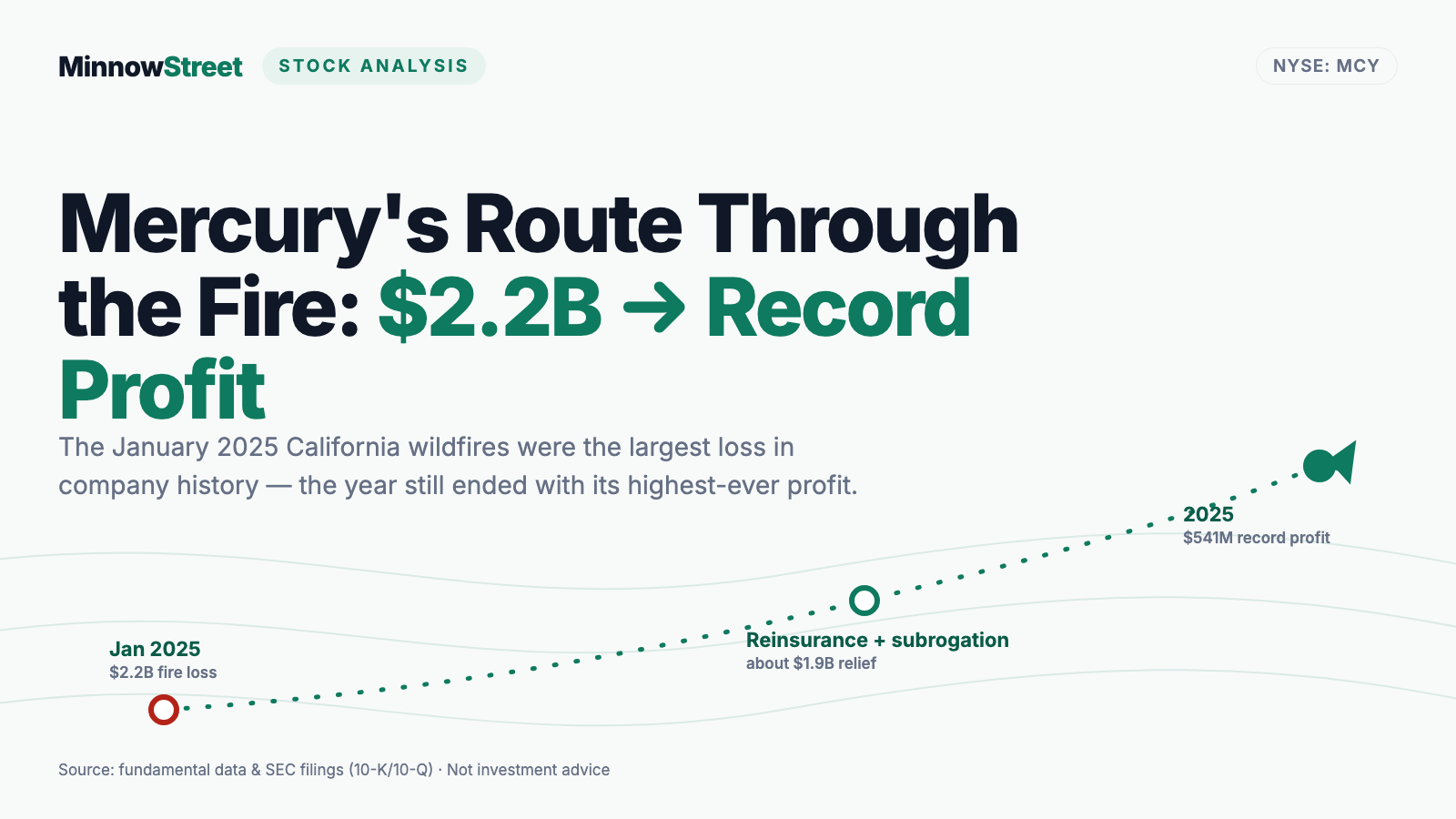
Mercury General insures cars and homes mostly in California — and in January 2025 it was hit by the largest loss in its history: the Palisades and Eaton wildfires, roughly $2.2 billion in gross losses. The company still closed the year with a record net income of $541.1 million. We read the annual report (10-K) for fiscal year 2025: reinsurance, about $586 million of subrogation and a 96.3 percent combined ratio turned the catastrophe into a profit year — while the stock shows up at a trailing P/E around 10 and a return on equity near 25 percent in our Joshua growth scanner (data as of July 17, 2026). Not investment advice — just the question of how much of a record profit survives once a subrogation promise and a spent reinsurance airbag are counted in.
 Thomas Mücke
Founder & Publisher
Thomas Mücke
Founder & Publisher
Chart
Interactive price chart (TradingView).
Note: pure fact-based analysis, not investment advice and not a solicitation to buy or sell. All figures without guarantee.
There is an investor trap that fires faster than any ticker: the headline reflex. It works like this: you read "California auto insurer" and "the worst wildfires in the history of Los Angeles" in the same sentence — and your gut decides in half a second: stay away, this can only be a bottomless pit. The reflex is understandable; the images from Pacific Palisades and Altadena in January 2025 went around the world. But it is also a bet placed without opening the books. Because it was precisely Mercury General Corporation (NYSE: MCY), the insurer in the middle of the fire, that reported the highest profit in its history for that same year. So let's make a deal: before you follow the reflex, we read together what the company reported, under penalty of law, to the U.S. securities regulator, the SEC — the annual report (10-K) for fiscal year 2025 (filed February 17, 2026) and the latest quarterly report (10-Q) as of March 31, 2026. A filing to the SEC is honest under penalty of law. And this one tells a story in which the largest catastrophe in company history and the largest profit in company history happen in the same calendar year. In the end, you decide for yourself.
What Mercury actually does — and for whom
Mercury General is an insurance holding company from Los Angeles whose core is Mercury Casualty Company, founded in 1961 by George Joseph. The group writes policies through twelve insurance subsidiaries in eleven U.S. states (Arizona, California, Florida, Georgia, Illinois, Nevada, New Jersey, New York, Oklahoma, Texas and Virginia), but the weight sits firmly in the West: roughly 60 percent of the $6.0 billion in direct premiums come from private passenger auto insurance, and about 86 percent of those auto premiums are written in California (annual report 10-K for fiscal year 2025). Add homeowners, commercial auto, commercial property, mechanical protection and umbrella policies. Almost everything is sold through roughly 8,510 independent agents — no direct-to-consumer giant, but the classic agency model that brings in 88 percent of direct premiums. In short, Mercury is something like the down-to-earth family auto insurer of California: not a tech disruptor, not a national advertising machine, but a house that has insured cars and homes in the Golden State for more than sixty years, controlled by the founding family — George and Gloria Joseph together own more than 50 percent of the shares. One calendar note belongs at the start: Mercury's fiscal year ends December 31, so the numbers follow the ordinary calendar year.
Which brings us to the central tension of this analysis, and it runs through every chapter: the largest loss in company history collided, in the same year, with the largest profit in company history — and the decisive question is how much of that profit is genuine substance and how much is a one-off. How quickly a sound business model can slip into a cost squeeze is something we dissected at auto supplier Garrett Motion — and how natural disasters hit physical assets, at hotel owner Host Hotels & Resorts.
Where the stock shows up in our scanner
Every day we run about 3,500 stocks through our scanners. Mercury reached the research list through the Joshua growth scanner — motto "let your winners run, avoid the losers," with a hard precondition of an intact price trend (price above the 50- and 200-day averages, positive six-month performance). MCY sits there at rank 18 of 74 hits (data as of July 17, 2026). The remarkable part is the confluence: the very same stock appears in trend filters and in value/quality filters at once — a rare double. On the trend side the scanner reports a Stan Weinstein stage-2 uptrend, price above the 50- and 200-day lines, a Power Trend signal, proximity to the 52-week high and institutional accumulation. On the fundamental side MCY shows up in the P/E ranking, in the Buffett owner-earnings yield, in QARP ("quality at a reasonable price") and in the German Levermann scoring system. Translated: the stock is cheap and in an uptrend — the combination that value investors and momentum traders both hunt for. Over twelve months the price rose about 66 percent, over three months about 25 percent (data as of July 17, 2026). Remember this fingerprint: when a stock stands out as both "cheap" and "in a trend," it is worth asking why the market has not priced it up despite the rise. For an insurer the answer rarely sits in the price chart — it sits in the combined ratio, the capital cushion and a word you have to learn the hard way: subrogation.
The numbers over the years — honestly appraised
First, what genuinely impresses. For an insurer you do not look at revenue alone but at three things: the combined ratio (of $100 of premium, how much goes back out for losses and expenses; below 100 the insurer earns on the business itself, above 100 it pays out more than it takes in), the investment result and the book value (the accounting substance per share). Mercury delivered on all three in 2025: net premiums earned rose 8.5 percent to $5,505.6 million, the investment portfolio threw off $328.7 million of net income (after $280.0 million in 2024) on a $6.6 billion book of investments, and the bottom line was a record net income of $541.1 million ($9.77 per diluted share) after $468.0 million ($8.45) the year before. Equity grew 24 percent to $2.42 billion, book value per share from about $35 to about $43.60. Read only these lines and you see a rock-solid insurer in top form. Now look at the whole road there:
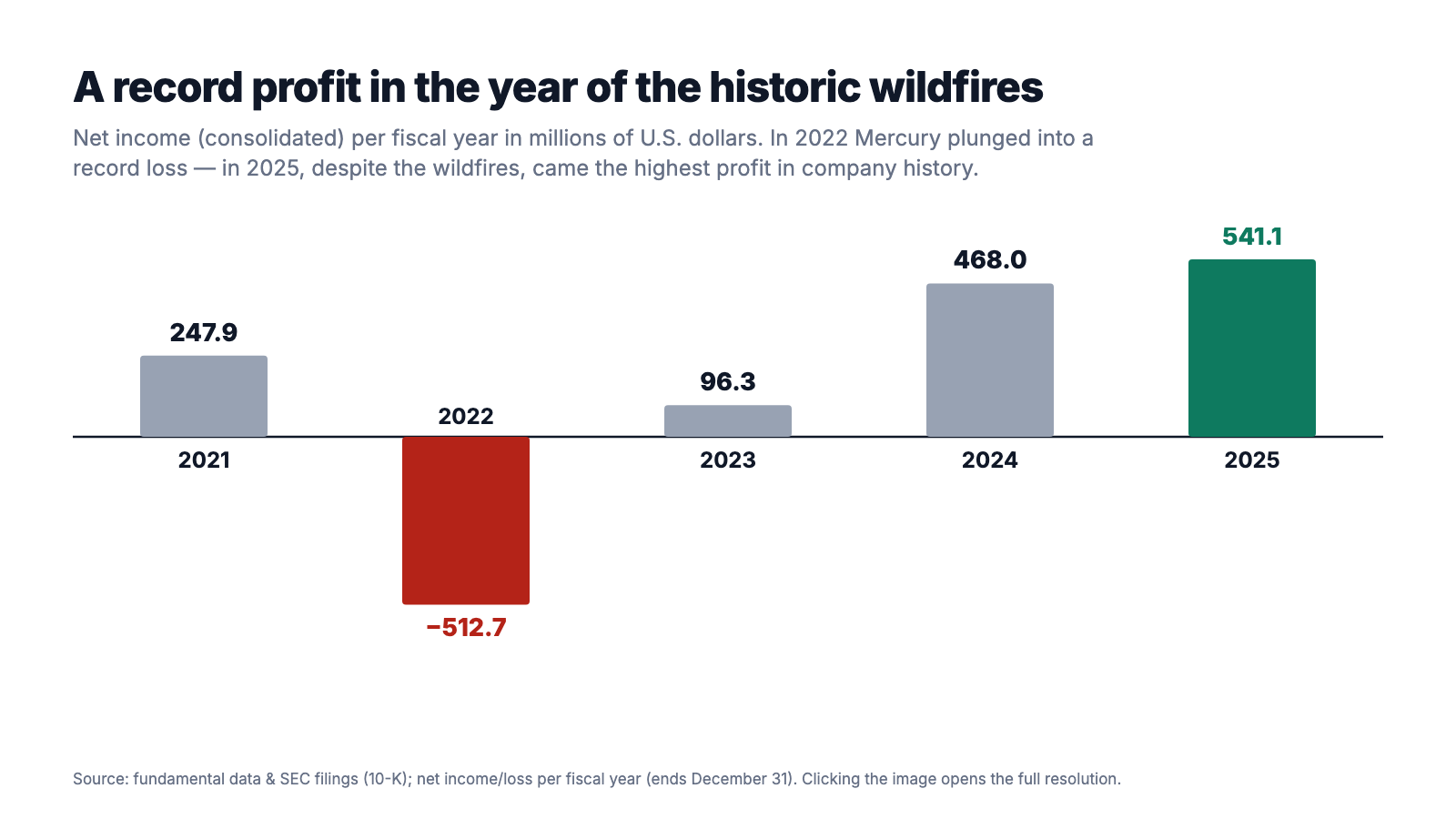
Two years before the record, the company stood at the edge. In fiscal year 2022 Mercury plunged into a record loss of $512.7 million: the prices of auto repairs, parts and used cars exploded after the pandemic faster than the California insurance regulator (California DOI) approved higher premiums — the gap between costs and permitted prices tore wide open. The combined ratio climbed to 109.5 percent (company-wide, statutory), well above the profit threshold; and the company cut its dividend in 2022 for the first time since 1985. What came next is a lesson in the power of regulation in the insurance business:
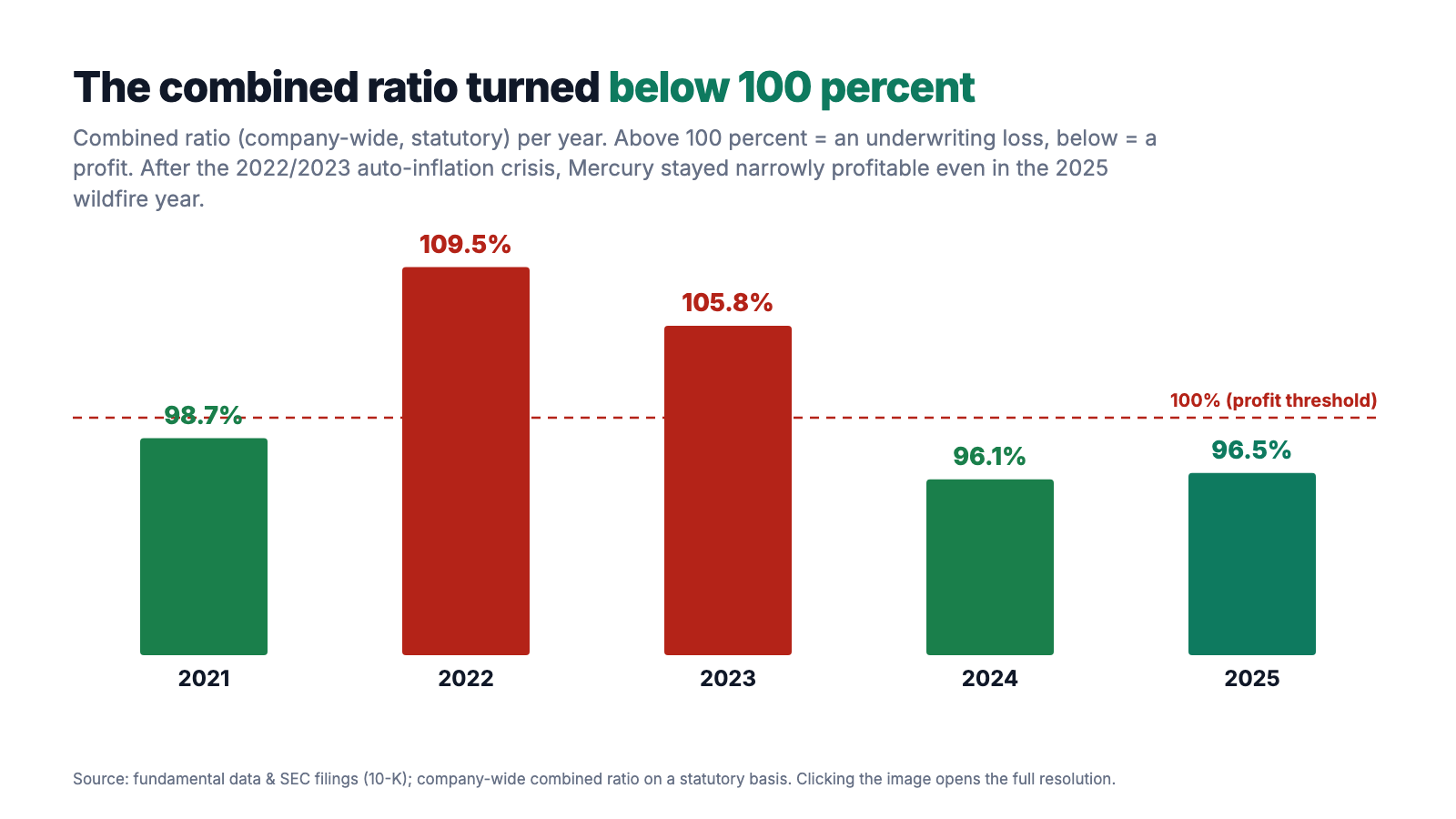
From 2024 the California regulator approved sharp rate increases — among them 22.5 percent on the main subsidiary's private passenger auto line (February 2024) and several rounds on homeowners (plus 6.99 percent in May 2024, plus 12 percent in March 2025). The result: the combined ratio fell from 109.5 percent (2022) through 105.8 percent (2023) to 96.1 and 96.5 percent (2024/2025). Stripping out catastrophes and reserve development, the pure loss ratio in 2025 was even 64.0 percent (after 66.8 percent in 2024) — the operating core was as profitable as it had been in a long time. Remember the mechanism: at a regulated insurer it is not the market that sets prices but an agency — and the lag between rising costs and approved premiums is the real risk. Which brings us to the uncomfortable truths — and to the fire.
The Los Angeles fires — what the books actually say
In January 2025, wind-driven wildfires swept through Southern California, mainly through Pacific Palisades and Altadena. The two largest are called the Palisades and Eaton fires in the filing. For Mercury it was the largest loss event in company history — and the annual report puts it soberly:
"In January 2025, extreme wind-driven wildfires caused widespread damage across parts of Southern California, primarily in the communities of Pacific Palisades and Altadena. … The Company recorded net catastrophe losses and loss adjustment expenses before taxes from the Palisades and Eaton wildfires of approximately $380 million in its consolidated statement of operations for the year ended December 31, 2025."
— Mercury General Corporation, SEC annual report 10-K for fiscal year 2025, Note 12 "Loss and Loss Adjustment Expense Reserves"
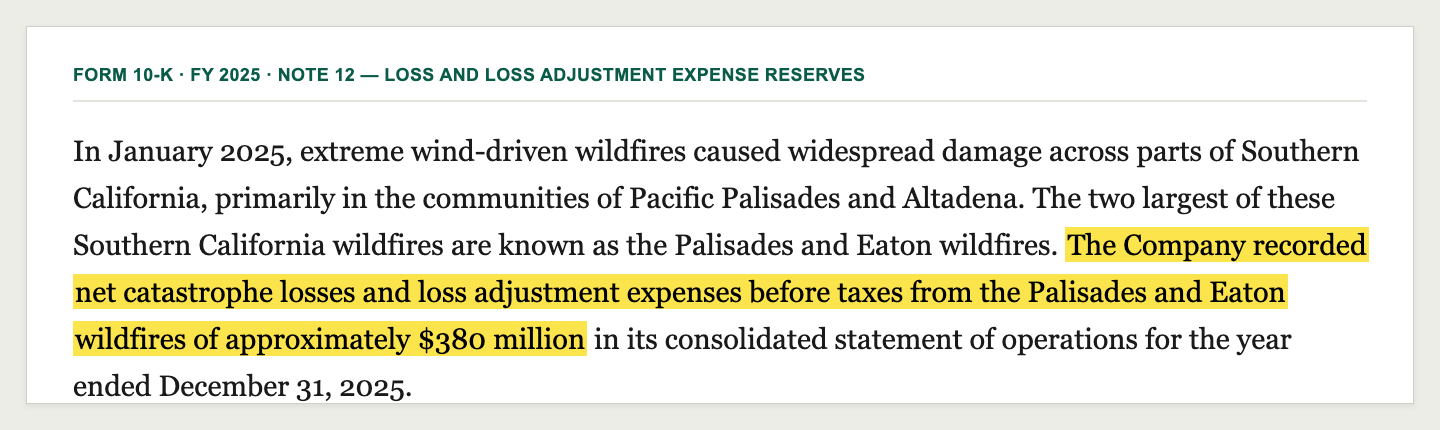
The trick in this figure sits in the word "net." Gross, before reinsurance and subrogation, the two fires caused roughly $2.2 billion in losses, per the filing. That this became just $380 million net is the real story of the year — and it rests on two levers, each with a downside. Those are the uncomfortable truths.
What the filings say — the uncomfortable truths
Uncomfortable truth no. 1: The record profit partly rests on an estimate — $538 million of subrogation against a utility
The first lever is subrogation: whoever caused the loss should pay in the end — the insurer compensates its customers first and then recovers the money from the responsible party. On the Eaton fire, per the filing, "significant evidence" points to the equipment of utility Southern California Edison (SCE) as the cause. Mercury booked a large subrogation claim and used it to push down its reported loss:
"The Company recorded approximately $538 million in estimated subrogation recoveries, or approximately 55% of its estimated ultimate losses on the Eaton fire, as an offset against loss and loss adjustment expense reserves … Although SCE has not admitted that its equipment caused the Eaton fire, significant evidence indicates that SCE's equipment was the cause of the Eaton fire."
— Mercury General Corporation, SEC annual report 10-K for fiscal year 2025, Note 12 "Palisades and Eaton Wildfires"
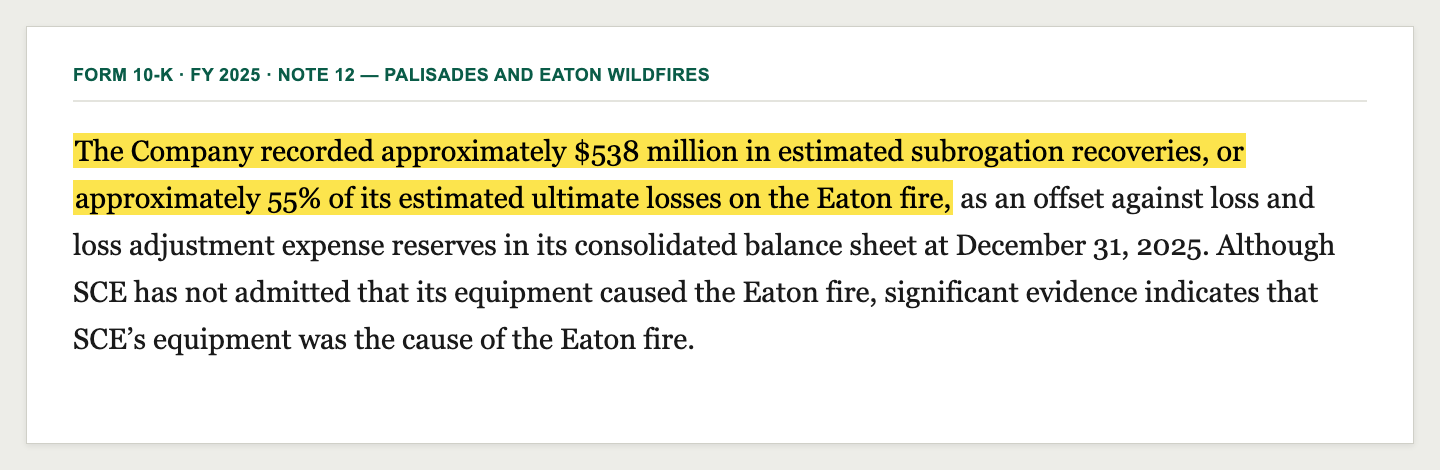
This is the kind of number you should read twice. Those $538 million are not money in the bank but an assumption — namely that SCE covers roughly 55 percent of the losses. Mercury reasons it cleanly (in similar California utility fires since 2017 the utilities paid an average of over 60 percent, in a range from 55 to over 70 percent), and SCE has access to the California Wildfire Fund. But the report itself warns unmistakably elsewhere: if the amount ultimately recoverable turns out to be less than the amount booked, "the Company may incur a significant loss during the period in which that determination is made" (Item 1A "Risk Factors"). Translated into investor language: a meaningful part of the 2025 record profit rests on a court-and-negotiation outcome that is still pending. In fairness: even without a cent of subrogation, Mercury would not have slipped into the red in 2025 — the core business and investment income carried enough. But the record character of the year hangs on this estimate.
Uncomfortable truth no. 2: The reinsurance airbag was fully deployed in 2025
The second lever is reinsurance — the insurer's insurance. For large losses Mercury passes part of the risk to even bigger reinsurers; that protection is like an airbag that deploys in a severe crash. On the Palisades and Eaton fires it deployed completely:
"All of the reinsurance benefits available for the 12 months ending June 30, 2025 under the Treaty, approximately $1,290 million, were used for losses from the Palisades and Eaton wildfires in the first quarter of 2025, and limits totaling $1,238 million were reinstated."
— Mercury General Corporation, SEC annual report 10-K for fiscal year 2025, Item 7 "Management's Discussion and Analysis"
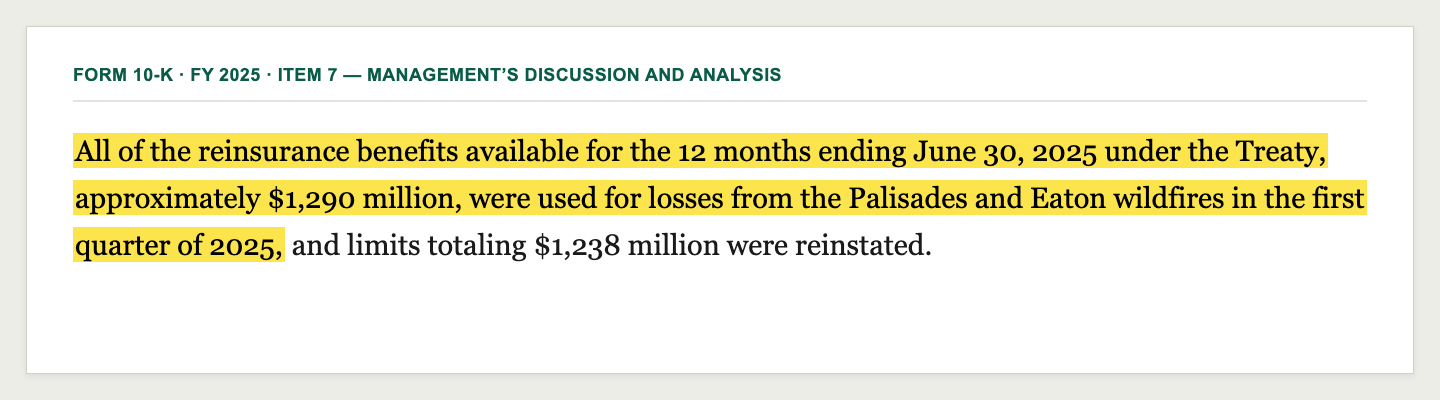
Two things sit in that sentence. First: the airbag worked — that is exactly what reinsurance is for, and Mercury had sized it wisely. Second, and this is the uncomfortable side: an airbag once deployed has to be reloaded. The $1,238 million were "reinstated" — and that costs extra: the reinstatement premiums alone came to roughly $101 million, one reason ceded premiums jumped from $137 million to $287 million in 2025. For the current treaty year the protection is back in place — but a second historic fire in the same region, in quick succession, would make the bill far more expensive. And retentions are rising: Mercury's per-occurrence retention climbed to $200 million for the twelve months ending June 2026. Remember the image: reinsurance takes the peak off a loss — but it does not make catastrophes free, it spreads them over time.
Uncomfortable truth no. 3: To be allowed to price fire adequately, Mercury has to insure more fire
California's insurance market has been stuck in a bind for years: insurers want higher premiums or fewer policies in risk zones because of wildfire exposure — the state wants homeowners to be able to get coverage at all. The regulator's answer, the "Sustainable Insurance Strategy" of late 2024, is a trade with a catch. Insurers may now build catastrophe models and reinsurance costs into their prices — but only if they take on more risk in return:
"… with a requirement for them to align their share of insured properties in distressed wildfire-prone areas of the state to at least 85% of their state-wide market share, which may be increased by 5% per year, if necessary, until that level is reached."
— Mercury General Corporation, SEC annual report 10-K for fiscal year 2025, Item 7 "Management's Discussion and Analysis"
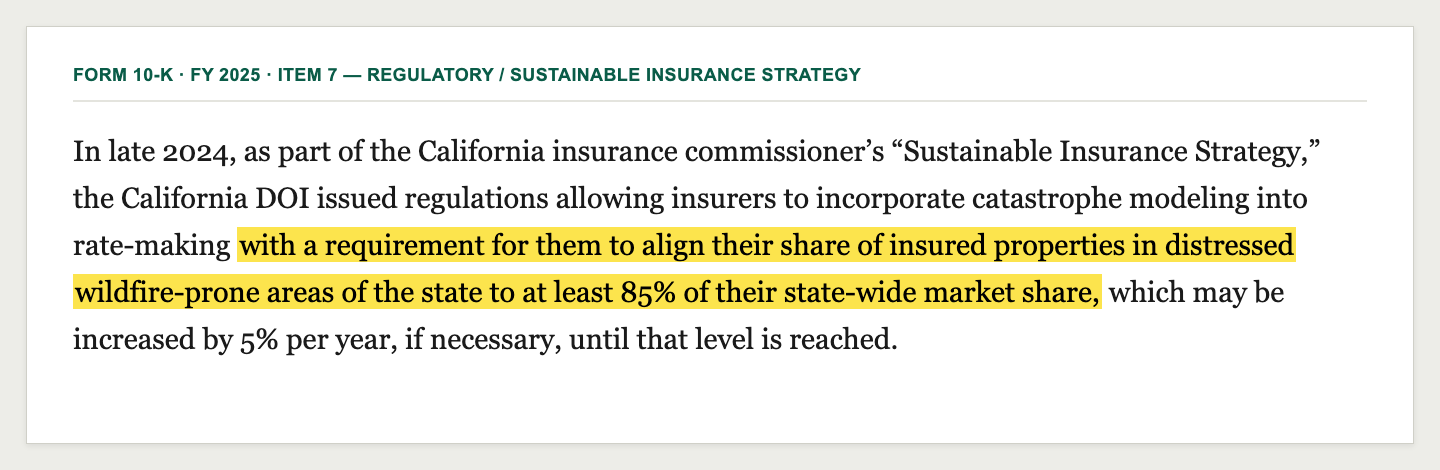
In December 2025 the California regulator approved Mercury's application under the new rules; the new rate plan is expected to take effect in July 2026, and the market-share requirement kicks in then too. That cuts both ways: on one hand, Mercury may finally build reinsurance costs and model calculations into prices — a real step forward from the 2022 squeeze. On the other, the price for it is that the company may not exit precisely the most dangerous corners of California but must stay present. On top came a special charge in 2025: as a member of the California FAIR Plan (the state's insurer of last resort for homeowners who can no longer get a fire policy elsewhere), Mercury was assessed $50 million after the fires to strengthen the plan's capital; it may recoup $25 million through surcharges on its own customers. Translated: Mercury's fate hangs not only on the weather but on an agency in Sacramento — and that agency demands a payment in risk for every pricing freedom.
Uncomfortable truth no. 4: California concentration — and a company controlled by one family
The first three truths lead to a fourth, more structural one. Mercury is not a broadly diversified U.S. insurer but a bet on California: roughly 86 percent of auto premiums and the lion's share of the homeowners book sit in a single state — the one with the highest concentration of wildfire, earthquake and regulatory risk in the country. Whoever buys Mercury buys California in concentrated form. Add the ownership question, which the filing states unusually plainly:
"George Joseph and Gloria Joseph collectively own more than 50% of the Company's common stock. Accordingly, George Joseph and Gloria Joseph have the ability to exert significant influence on the actions the Company may take in the future, including change of control transactions."
— Mercury General Corporation, SEC annual report 10-K for fiscal year 2025, Item 1A "Risk Factors"
Founder George Joseph, chairman since 1961 and for 45 years (until 2006) also chief executive, still controls the house with his wife. His son Victor Joseph is president and chief operating officer, a nephew is chief actuary. That has two sides: family control often means long-term thinking, no short-winded quarterly panic and an owner with skin in the game — Mercury is a textbook example. But it also means that minority shareholders can be outvoted on any important decision and that a takeover premium, which some value investors speculate on, only materializes if the family wants it. Whoever invests here becomes a silent partner in a family business — with all the pros and cons.
Valuation: $5.4 billion in market value — cheap because the market distrusts the substance
In mid-July 2026 the Mercury stock cost about $97, putting the market value at roughly $5.4 billion across 55.4 million shares (fundamental data, data as of July 17, 2026). For an insurer that has just absorbed the largest fire loss in its history, the valuation is remarkably sober: the trailing price-to-earnings ratio stands around 10 (on the 2025 profit of $9.77 per share); if analysts credit the current year with another jump in earnings, the forward P/E falls to about 7 (data as of July 17, 2026). The price-to-book ratio is about 2.2 — for a house with a return on equity near 25 percent (net income of $541 million on average equity of roughly $2.2 billion), that is not an expensive but an almost modest valuation. For insurers, balance-sheet quality also matters, and it is solid: $6.58 billion in investments (82.5 percent fixed maturity, 10.3 percent equities), $1.32 billion in cash, a debt-to-total-capital ratio of only 19.2 percent and operating cash flow of $1,087 million. So why so cheap? Because the market prices in exactly the four truths: the subrogation estimate, the spent airbag, the California concentration and the family control. And because it knows the record profit of 2025 includes $131 million of realized investment gains from selling low-yielding securities — funds Mercury freed up in January 2025 to pay the fire claims. Remember the tension: a low valuation at an insurer is rarely a gift — it is usually the price the market charges for uncertainty it cannot model.
Opportunities and risks at a glance
What speaks for Mercury:
- A proven turnaround: combined ratio from 109.5 percent (2022) back to 96.3–96.5 percent (2025), pure loss ratio ex-catastrophes 64.0 percent, record net income of $541.1 million ($9.77 per share) — the core business earns again (annual report 10-K for fiscal year 2025).
- A capital cushion like a fortress: $6.58 billion in investments, $1.32 billion in cash, $2.42 billion in equity (book value about $43.60 per share, up 24 percent year over year), debt of only 19.2 percent of total capital, $1,087 million in operating cash flow.
- Risk management that held under fire: $2.2 billion of gross losses became roughly $380 million net thanks to reinsurance and subrogation — the worst fire in company history cost, on the bottom line, less than a quarter's profit.
- A cheap valuation with high profitability: trailing P/E around 10, price-to-book about 2.2, return on equity near 25 percent; in our in-house stock scanner both trend hits (Joshua, Stan Weinstein stage 2, Power Trend) and value/quality hits (P/E ranking, Buffett owner-earnings, QARP), data as of July 17, 2026.
- An owner in the boat: the founding Joseph family owns more than 50 percent — long-term thinking instead of quarterly panic.
What speaks against it:
- The record rests on an estimate: $538 million of Eaton subrogation against Southern California Edison is booked but not yet collected — if the ratio comes in lower, the report warns of "a significant loss" in the relevant period.
- The reinsurance airbag was fully deployed in 2025 (roughly $1.29 billion) and reloaded for about $101 million of reinstatement premium; a second major fire soon after would meet higher retentions and costlier protection.
- California concentration: roughly 86 percent of auto premiums in a single, especially catastrophe- and regulation-prone state; results hang on California DOI approvals and on the 85 percent market-share requirement in wildfire zones (from July 2026).
- One-off effects in the record year: $131 million of realized investment gains and the subrogation flatter the reported profit — the sustainable earnings power sits below that.
- Family control as a double-edged sword: George and Gloria Joseph own more than 50 percent — minority shareholders can be outvoted on any important decision, and a takeover premium is off the table without the family.
A human conclusion
Back to the headline reflex from the opening. Its core is not that headlines lie — the Los Angeles fires were real and terrible, and for Mercury the most expensive event in its history. Its core is that the headline answers the question before you have asked it. Whoever reads only "insurer plus historic wildfire" misses that this very insurer closed the year with a record profit, equity up 24 percent and a loss-and-expense ratio below 100 percent — because reinsurance, subrogation and approved rate increases worked together. But the honest look runs the other way too: whoever reads only "record profit, P/E 10, return on equity 25 percent" misses that a meaningful part of that record rests on an estimate against a utility, that the reinsurance airbag was spent for that year, and that the whole bet hangs on a single fire-prone state and one regulatory agency. Mercury is no house of cards — it is a rock-solidly financed, family-run insurer that has passed a real stress test. Whether the low valuation is an opportunity or a fair price for very real risks depends on three questions no filing answers today: Does Southern California Edison pay? Does the next fire season stay mild? And does Sacramento allow prices that cover the risk? If you have a confident answer to all three, you find a cheap, profitable quality insurer here. If not, you wait — and check every quarterly report for whether the subrogation estimate turns into cash. What you make of it is your decision. And that is exactly as it should be.
Sources
All original documents used in this analysis — to read for yourself:
- Mercury General Corporation — SEC annual report 10-K for fiscal year 2025 (ended December 31, 2025; filed February 17, 2026)
- Mercury General Corporation — SEC annual report 10-K for fiscal year 2024 (ended December 31, 2024; filed February 11, 2025)
- Mercury General Corporation — SEC quarterly report 10-Q as of March 31, 2026 (filed May 5, 2026)
- Mercury General Corporation — SEC quarterly report 10-Q as of September 30, 2025 (filed November 4, 2025)
- Mercury General's complete SEC filing history: EDGAR overview (sec.gov)
- Fundamental data (metrics, valuation, scanner hits; data as of July 17, 2026), reconciled with the SEC filings.
- Screener and rating data: in-house stock scanner (data as of July 17, 2026); Joshua growth scanner, rank 18 of 74.
Transparency & disclaimer: This analysis is a journalistic contextualization of publicly available information and is not investment advice, not a financial analysis in the regulatory sense, and not a solicitation to buy or sell securities. Stock investments carry substantial risks up to total loss. All information without guarantee; the data cut-off is noted in the text in each case. The author holds no position in Mercury General stock at the time of publication.
Our Bottom Line at a Glance
- Balance sheet & investments positive
- $6.58 billion in investments (82.5% fixed maturity), $1.32 billion in cash, $2.42 billion in equity (up 24 percent year over year, book value about $43.60 per share), debt of only 19.2 percent of total capital and $1,087 million in operating cash flow (12/31/2025) — a capital cushion that carried the largest fire loss in company history with ease.
- Underwriting turnaround positive
- The combined ratio turned from 109.5 percent (2022, record loss) through 105.8 percent (2023) to 96.3–96.5 percent (2024/2025); the pure loss ratio ex-catastrophes was 64.0 percent in 2025. Approved rate increases (auto +22.5 percent, homeowners repeatedly) made the core business clearly profitable again (10-K FY 2025).
- Wildfire handling & reinsurance neutral
- $2.2 billion of gross losses became roughly $380 million net thanks to reinsurance and subrogation — risk management that held. But the reinsurance airbag (roughly $1.29 billion) was fully deployed in 2025 and reloaded for about $101 million of reinstatement premium; a second major fire soon after would meet higher retentions (10-K FY 2025, Item 7 / Note 12).
- California concentration & regulation negative
- Roughly 86 percent of auto premiums in a single, especially catastrophe- and regulation-prone state; results hang on California DOI approvals. The new "Sustainable Insurance Strategy" allows adequate prices only in exchange for the requirement to hold at least 85 percent of market share in wildfire zones (from July 2026) — pricing freedom traded for more fire risk.
- Valuation & ownership structure neutral
- A trailing P/E around 10, price-to-book about 2.2 and a return on equity near 25 percent sound cheap — but the 2025 record profit includes $131 million of realized investment gains and a $538 million subrogation that is still pending. On top, the Joseph family controls more than 50 percent, so minority shareholders can be outvoted (data as of July 17, 2026; 10-K FY 2025, Item 1A).
Mercury General is a rock-solidly financed, family-controlled auto and property insurer that passed a real stress test in 2025: $2.2 billion of wildfire gross losses became roughly $380 million net thanks to reinsurance and subrogation, and the year ended with a record net income of $541.1 million and a combined ratio below 100 percent. But the record character hangs on a $538 million subrogation estimate against Southern California Edison, the reinsurance cover was spent for 2025, and the whole bet sits in a single fire-prone state. At a trailing P/E around 10 and a return on equity near 25 percent, the market is paying quality at a reasonable price — including those four question marks. Not investment advice.
What Our Rating Means
- If you don't own the stock
- As long as the question raised in the bottom line stays open, we see no basis for an entry.
- If you hold it in your portfolio
- Our findings offer no acute reason to sell — the checkpoints named remain decisive.
A journalistic assessment by our editorial team at the time of the deep dive, based on public sources — not investment advice and not a solicitation to buy or sell. Your personal circumstances (investment goals, risk capacity, taxes) cannot be taken into account. What our categories mean, how verdicts are formed, and what conflicts of interest exist →
Worth Noting
- MCY reached our research list via the Joshua growth scanner (rank 18 of 74, data as of July 17, 2026); the confluence of trend hits (Stan Weinstein stage 2, Power Trend) and value/quality hits (P/E ranking, Buffett owner-earnings, QARP) is rare for a stock up about 66 percent over twelve months.
- Insurer metrics follow their own logic: what matters is the combined ratio (below 100 percent = an underwriting profit), book value and the investment result, not the classic P/E alone. The reported 2025 record profit includes one-off effects ($531 million of catastrophe losses, $586 million of subrogation, $131 million of realized gains).
- Price and valuation figures are dated to July 17, 2026 (price about $97, market value roughly $5.4 billion); analyses are evergreen, daily prices are not a buy argument. Mercury's fiscal year ends December 31.
Frequently Asked Questions
Mercury General Corporation (NYSE: MCY) of Los Angeles is an auto and property insurer concentrated in California. About 60 percent of its $6.0 billion in direct premiums come from private passenger auto insurance, roughly 86 percent of that in California; it also writes homeowners, commercial and liability policies. Almost everything is sold through about 8,510 independent agents. Net premiums earned in 2025: $5,505.6 million.
The Palisades and Eaton fires in January 2025 were, at roughly $2.2 billion in gross losses (before reinsurance and subrogation), the largest loss event in company history. After reinsurance (roughly $1.29 billion of cover was fully deployed) and about $586 million of subrogation, that left, per the annual report (10-K), a net catastrophe loss of roughly $380 million from the two fires.
Because the roughly $2.2 billion in gross losses was cushioned by three levers: reinsurance, about $586 million of subrogation against the presumed causes, and sharp regulator-approved rate increases that pushed the combined ratio to 96.3 percent. Add $328.7 million of investment income and $131 million of realized gains. On the bottom line, net income rose to a record $541.1 million ($9.77 per diluted share) in 2025.
The combined ratio measures how much of $100 of premium goes back out for losses and expenses — below 100 percent the insurer earns on the business itself, above it pays out more than it takes in. Mercury came in at 96.3 percent (GAAP) in 2025, after a crisis reading of 109.5 percent (company-wide, statutory) in 2022. Stripping out catastrophes, the pure loss ratio in 2025 was even just 64.0 percent.
Subrogation is recovery: Mercury compensates its customers first and then recovers the money from the party that caused the loss. On the Eaton fire, per the annual report, significant evidence points to the equipment of utility Southern California Edison. Mercury booked roughly $538 million of estimated subrogation (about 55 percent of the losses) as an offset. Importantly, that is an estimate, not collected cash — if it comes in lower, the report warns of a significant loss in the relevant period.
In mid-July 2026 the market value stood at roughly $5.4 billion (price about $97, 55.4 million shares). The trailing price-to-earnings ratio is around 10 (on $9.77 of earnings per share), the price-to-book ratio about 2.2, at a return on equity near 25 percent (data as of July 17, 2026). For a profitable insurer that is a sober valuation — the market is pricing in the subrogation estimate, the California concentration and the family control.
The founding family controls the company: George Joseph (chairman since 1961, CEO until 2006) and his wife Gloria Joseph together own more than 50 percent of the shares, per the annual report (10-K). Son Victor Joseph is president and chief operating officer, a nephew is chief actuary. That means long-term thinking, but also that minority shareholders can be outvoted on important decisions.
Found an error?
Did you spot a factual error, an outdated number, or a typo in this deep dive? Let us know briefly — your report goes straight to the editorial team.