Ultra Clean Stock: When Its Own Share Price Erased $151.1 Million of Goodwill
Ultra Clean Holdings ranks 3rd in our in-house Moglen one-week screen (U.S. selection, data as of July 25, 2026): the company builds the internals of the machines that make chips — and collects 58.7 percent of its revenue from exactly two customers. We read the Form 10-Q for the quarter ended March 27, 2026, the Form 10-K for fiscal 2025 and everything filed with the U.S. securities regulator, the SEC, since. Three numbers stand out that no momentum list will show you: $151.1 million of written-off goodwill, a $600 million convertible note at zero percent, and a buyback of 672,608 shares that ran outside the company's own program. Read along before you trust the tape more than the balance sheet.
 Thomas Mücke
Founder & Publisher
Thomas Mücke
Founder & Publisher
Chart
Interactive price chart (TradingView).
Note: pure fact-based analysis, not investment advice and not a solicitation to buy or sell. All figures without guarantee.
There is an investor trap as old as the market itself: the price as proof. It works like this — a stock goes up, and our brain quietly translates that into "the company got better." It falls, and something must be broken. At Ultra Clean Holdings, Inc. (NASDAQ: UCTT) that confusion is not just a feeling. It is a line item in the annual report.
In the second quarter of 2025 the company's own share price fell far enough that its market capitalization slipped below the carrying value of its net assets. Under U.S. accounting rules that is a trigger: the company had to test its goodwill — and write off $151.1 million of it. The price, not the business, decided what the books would say. A little over a year later the same price is why the stock ranks 3rd in our Moglen one-week screen. In between, revenue moved 2.1 percent.
Before we turn that into a verdict, let us make a deal: we read together what the company itself filed under penalty of law with the U.S. securities regulator, the SEC — the Form 10-Q for the quarter ended March 27, 2026, the Form 10-K for fiscal 2025, and everything filed since.
What Ultra Clean actually does — the workbench behind the chip fab
A modern chip is made inside machines the size of a small car and the price of a house. Those machines are built by a handful of companies — Applied Materials, Lam Research, ASML and a few others. Ultra Clean builds the internals: subassemblies, welded frames, machined precision parts, and above all gas delivery systems that dose ultra-pure process gases to within a thousandth of a millimeter. The everyday image: Ultra Clean is the contract kitchen of a Michelin-starred restaurant — it cooks somebody else's recipe, under somebody else's name, and the guest never learns who it was.
There is a second, smaller leg: the Services segment. Components that spent months in aggressive chemistries and plasmas are cleaned, analyzed and re-coated so they can go back into the tool. In fiscal 2025, Products revenue came to $1,799.3 million (87.6 percent of the total) and Services to $254.7 million (12.4 percent). The difference lies in margin: in Products, cost of revenue absorbed 86.0 percent of segment revenue; in Services only 72.3 percent.
The single most important sentence about this business model sits in the risk section of the annual report, and it is uncomfortable:
"Because most of these customers are not contractually obligated to place any orders with us, the success of our Products business largely depends on these OEMs’ own discretion, which discretion is buttressed by the fact that the OEMs generally own, and are therefore free to license as they see fit, the designs and other intellectual property to the products we manufacture for them."
— Ultra Clean Holdings, Inc., Form 10-K for fiscal 2025, Item 1A (SEC)
Once you have read that, the research budget looks different. Ultra Clean spent $32.0 million on research and development in fiscal 2025 — 1.6 percent of revenue. That is not negligence, that is the business model. The customer supplies the invention; Ultra Clean supplies precision and capacity. We took apart the same division of labor at another semiconductor supplier — our MagnaChip analysis shows how quickly a business like that turns when one large customer changes direction.
And that brings us to the central tension of this analysis, which runs through every chapter: Ultra Clean is an indispensable supplier in a market that should grow for years — and at the same time a company whose prices, plans and order book are set by somebody else. Both readings come from the same document.
Where the stock landed on our desk
We run roughly 3,500 stocks through our screens every day. As of July 25, 2026 Ultra Clean sits at number 3 in the U.S. selection of our Moglen one-week screen (28 hits). To reproduce it: open the screen and set the country filter to "US" — the list shows the weekly outliers in screen order. It is recalculated daily, so the rank can move.
What the list looks for is quickly explained. Three conditions have to line up: a gain of at least 15 percent over four trading days, an average daily dollar volume of at least $10 million — so that micro caps, where a single order moves the price, cannot slip through — and a relative strength rating of at least 70. That rating compares a stock's price performance against every other stock and expresses it as a rank from 1 to 99. Ultra Clean scores 98: only two stocks in a hundred performed better over the comparison window.
The price series (data as of July 24, 2026) makes the reason obvious: over twelve months, the low of $21.28 and the high of $144.22 are a factor of seven apart. The close on July 24, 2026 was $92.75 — roughly 35 percent below the high and well above the 200-day moving average of $59.48. Average daily dollar volume over the last 50 sessions was about $125 million, twelve times the minimum threshold. Remember this: a momentum screen measures how far a stock has run, not whether the company behind it makes money.
The fundamental lens on the same data set says exactly that (data as of July 25, 2026): a Piotroski F-Score of 5 out of 9 — a nine-point test for the direction of a balance sheet, where a genuinely healthy company scores 8 or 9; five is middling, not an alarm. An Altman Z-Score of 4.52, far above the historical danger zone below 1.8 — insolvency is not the issue here. An equity ratio of 41.1 percent as of the December 26, 2025 balance sheet date. And an interest coverage ratio of 1.14: operating income of $43.7 million in fiscal 2025 was barely enough to cover $38.3 million of interest. That one number has changed decisively since — the third uncomfortable truth explains why.
The numbers over the years — what genuinely impresses
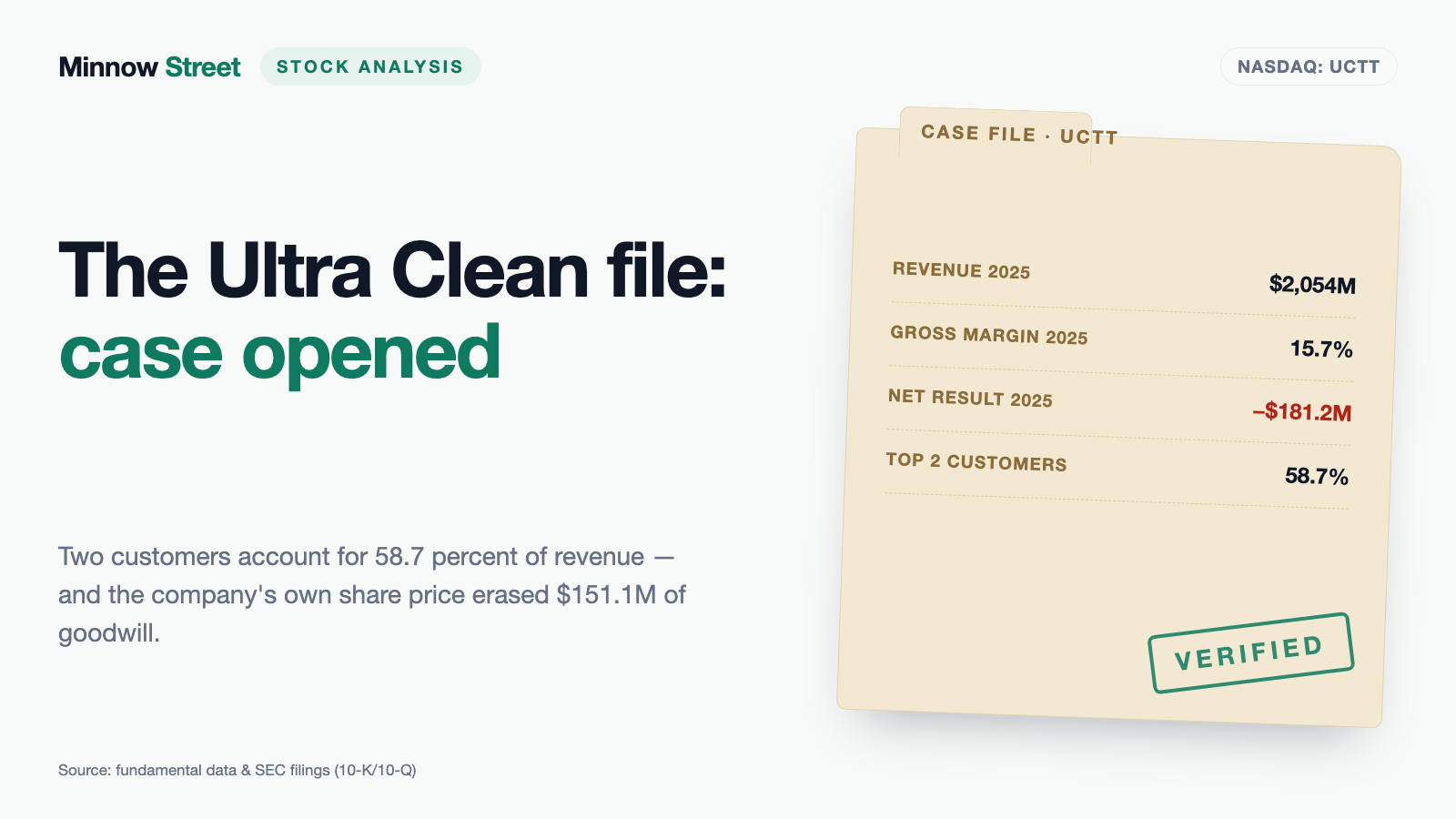
Start with what is good. Ultra Clean has reached a scale in a brutally cyclical market that would have been unthinkable a few years ago. Revenue rose from $1,066.2 million in 2019 to $2,101.6 million in 2021 and $2,374.3 million in 2022 — more than a doubling in three years. Then the chip capital spending downturn hit: $1,734.5 million in 2023, down 26.9 percent. Then the recovery to $2,097.6 million in 2024 and $2,054.0 million in 2025.
That series is the real story of the company: it does not run its own cycle, it rides the chip industry's cycle with a bigger amplitude. When Applied Materials and Lam Research defer orders, Ultra Clean's halls go quiet immediately. When they expand, Ultra Clean can barely keep up.
The Services business, by contrast, runs steadier: $232.9 million in 2023, $243.9 million in 2024 and $254.7 million in 2025 — three straight years of growth, independent of the investment cycle, because parts have to be cleaned even when nobody is buying new tools. In the first quarter of 2026 that segment grew 10.4 percent to $68.0 million, while Products gained only 1.9 percent.
The geographic footprint is remarkably broad for a supplier: in fiscal 2025, $754.0 million of revenue came from Singapore, $495.4 million from the United States, $221.5 million from Austria, $143.1 million from China, $112.6 million from South Korea, $78.2 million from Malaysia and $58.7 million from Taiwan. Manufacturing sites include California, Texas, Arizona, Oregon, Israel, China, Malaysia, Singapore, the United Kingdom, Thailand, the Philippines and Czechia.
And now the bottom line — where it gets difficult.
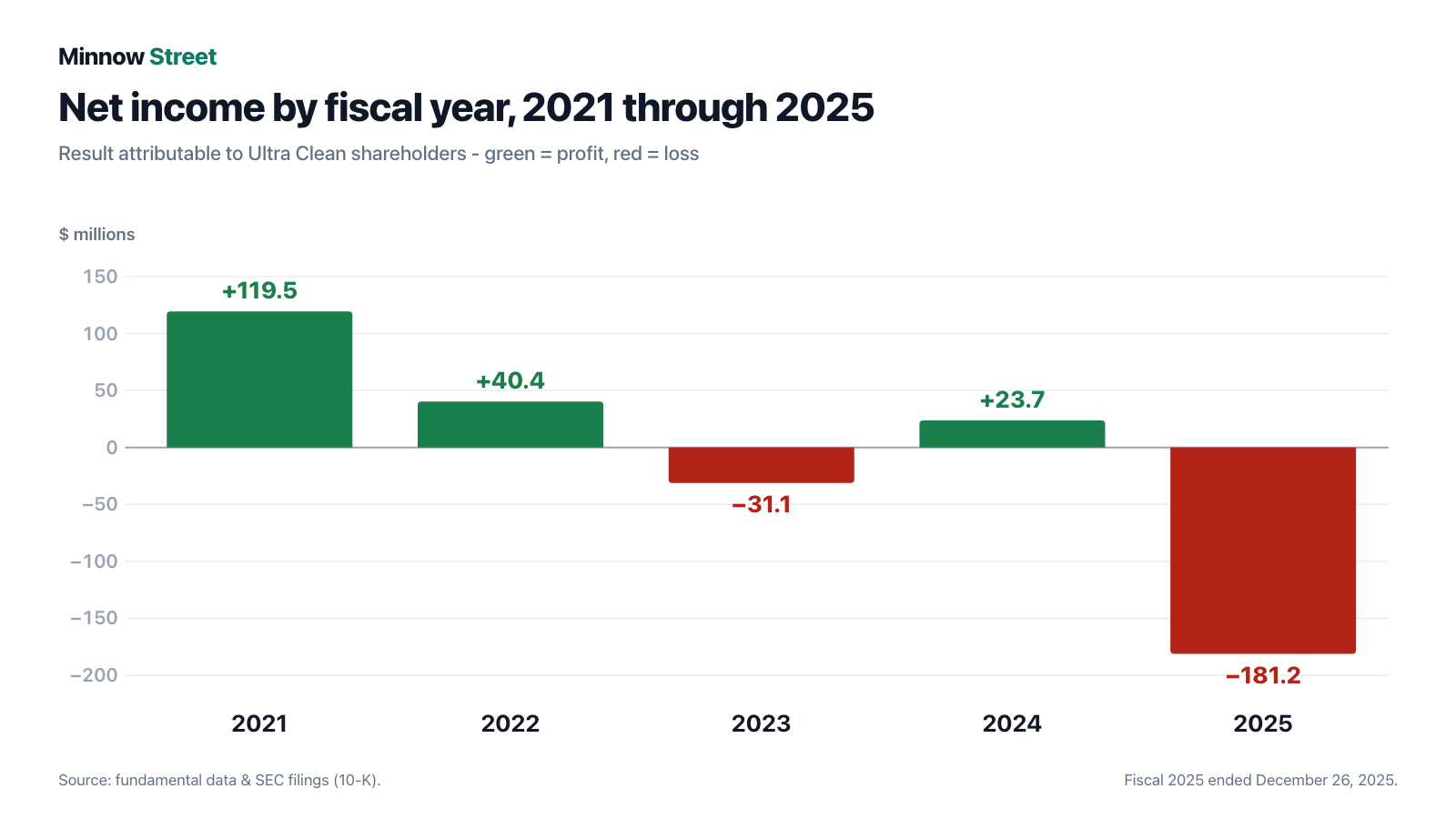
In per-share terms: earnings came to negative $4.00 per share in 2025, positive $0.53 in 2024 and negative $0.70 in 2023. Gross margin fell from 17.0 percent in 2024 to 15.7 percent in 2025 — the report gives a simple reason: fixed costs that do not shrink with volume. The balance sheet, on the other hand, is solid. As of March 27, 2026, total assets of $1,855.2 million faced liabilities of $1,153.1 million, including $601.9 million of long-term debt. Equity attributable to Ultra Clean shareholders stood at $627.9 million, with a further $74.2 million of noncontrolling interests. Cash amounted to $323.5 million.
Uncomfortable truth No. 1: two customers, 58.7 percent — and they own the blueprints
The annual report names the dependency itself, with a bluntness you rarely see.
"Our two largest revenue customers in fiscal years 2025, 2024 and 2023 were Applied Materials, Inc. and Lam Research Corporation, each of which accounted for more than 10% of our total revenues in those three years. As a group, our respective year’s top two customers accounted for 58.7%, 54.5% and 57.4% of the Company’s revenues for fiscal years 2025, 2024 and 2023, respectively."
— Ultra Clean Holdings, Inc., Form 10-K for fiscal 2025, Item 1 (SEC)

More important than the total is the shift underneath it. Lam Research alone grew from 31.9 percent of total revenue in 2024 to 37.0 percent in 2025, while Applied Materials slipped from 22.6 to 21.7 percent. In the first quarter of 2026 the figures were 36.7 and 21.8 percent. The dependency is not broadening — it is narrowing: a single customer accounts for more than a third of the business.
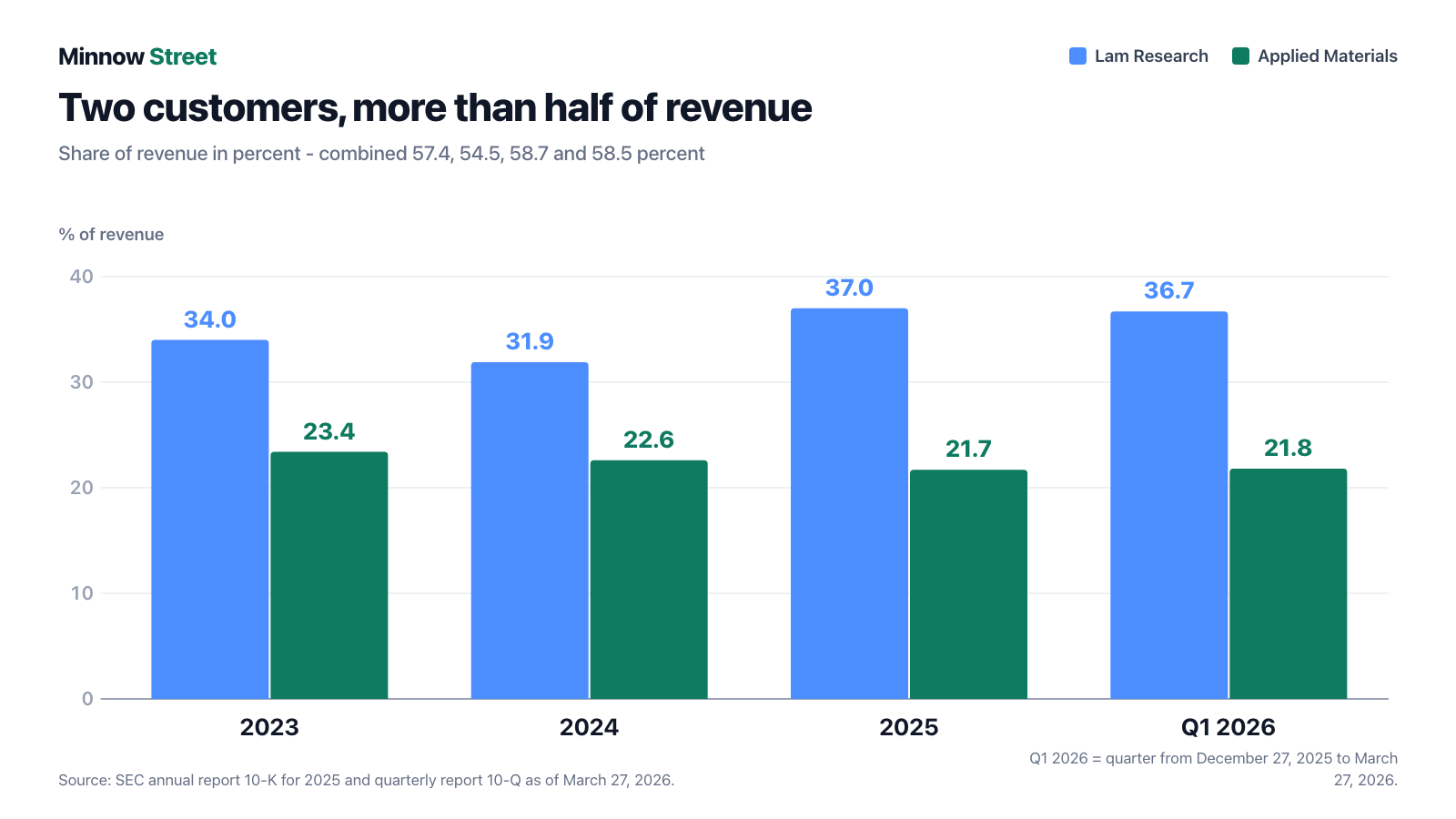
The same concentration shows up in receivables. As of March 27, 2026, three customers — Lam Research, Applied Materials and ASM International — together held roughly 39.0 percent of gross accounts receivable. As of December 26, 2025, Lam Research alone accounted for 17.1 percent. And the filing spells out what that size means: customers demand price reductions, commitments on quality and delivery, and they can even stop Ultra Clean from moving manufacturing to lower-cost regions while asking for lower prices at the same time.
A footnote worth noting: the leadership now comes largely from the biggest customer. Chief Executive James Xiao was a corporate vice president at Applied Materials until September 2025, and Chief Operating Officer Robert Wunar joined from the same company in March 2026. That can mean closeness to the customer — or dependency with a name badge. The filing does not judge it; neither will we.
Uncomfortable truth No. 2: the company's own share price erased $151.1 million
Goodwill is the amount a buyer paid above the substance value of an acquired business. The everyday image: you buy a bakery for 500,000 dollars even though the oven, the stock and the shop are worth only 300,000. The 200,000 difference is goodwill — paid for the customers, the reputation, the recipes. As long as the bakery does well, that amount sits on the balance sheet. If it does worse, it has to be written down.
For a listed company there is one additional trigger: its own share price. That is exactly what happened in 2025.
"During the second quarter of 2025, the Company experienced a sustained decline in the market price of its common stock. As a result, the Company’s market capitalization became much closer to, and at times fell below, the carrying value of its net assets."
— Ultra Clean Holdings, Inc., Form 10-K for fiscal 2025, Note 1 (SEC)
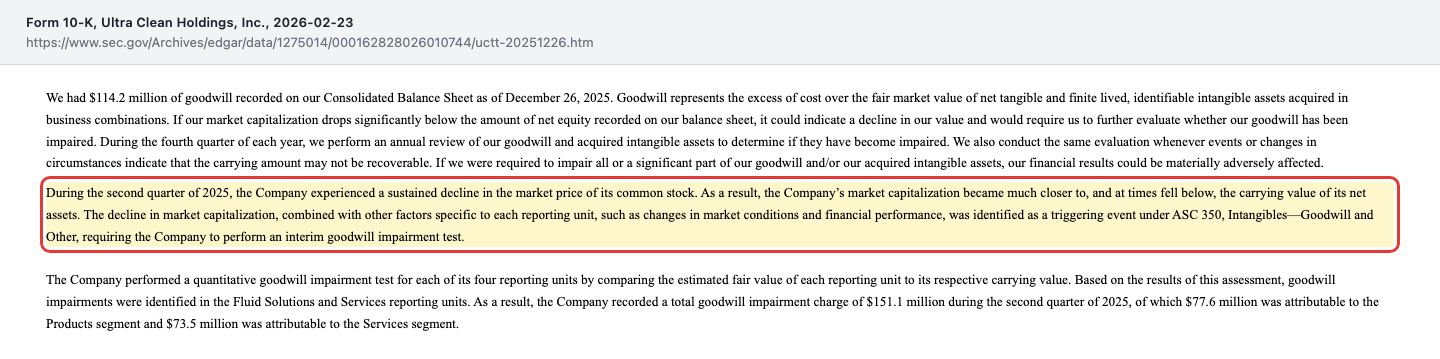
Goodwill on the balance sheet fell from $265.3 million to $114.2 million. Two of the four reporting units — Fluid Solutions and Services — now carry no goodwill at all. Second-quarter 2025 operating income swung to negative $141.8 million, and the full year to negative $181.2 million.
Two things need to be kept apart here. First: the impairment costs no cash. Operating activities still generated $65.0 million in 2025. Second — and this is the actual news: the trigger was not a lost order, it was the tape. At the routine annual test in the fourth quarter of 2025 the company concluded that no further impairment was required. Remember this: when the market values a company low enough, it forces that company's accountants to agree — and the next annual result then looks the way the price already said it would.
Uncomfortable truth No. 3: $600 million for free — and a buyback that was not one
On March 3, 2026 Ultra Clean borrowed $600.0 million without paying a cent of interest. The convertible senior notes run to March 15, 2031, the coupon is 0.00 percent, and net proceeds came to roughly $583.3 million. The price is not interest but an option: holders may, under certain conditions, convert into stock.
"The initial conversion price represents a premium of approximately 42.5 % to the $ 59.47 per share closing price of the Company’s common stock on February 26, 2026."
— Ultra Clean Holdings, Inc., Form 10-Q for the quarter ended March 27, 2026, Note 5 (SEC)
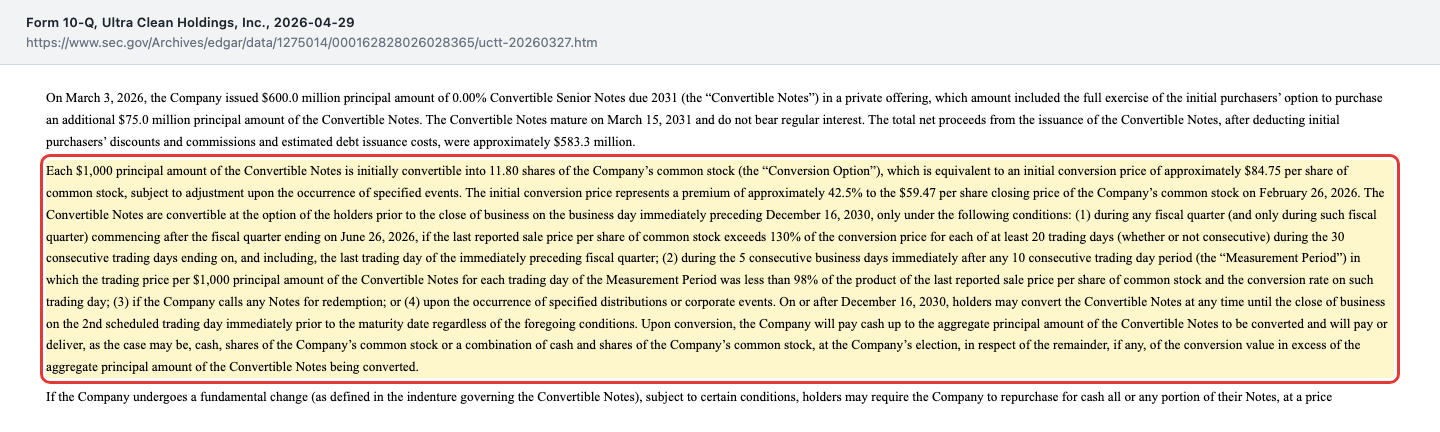
What does that mean for you as a shareholder? Dilution means the cake stays the same size but is cut into more slices — your slice shrinks without you doing anything. Each $1,000 of principal is initially convertible into 11.80 shares; at the maximum conversion rate, up to 10,089,120 shares could be issued. Against the 44,828,352 shares outstanding as of April 23, 2026 that is roughly 22.5 percent. Of those, 7.1 million shares appear in the anti-dilution table of the quarterly report, excluded because of the net loss.
To blunt part of that dilution the company spent $25.1 million on capped call transactions — offsetting trades with banks that work up to a cap price of $104.07 per share and stop above it. And the money did not go into growth: $462.0 million of the $600 million repaid bank borrowings. The effect is real nonetheless — interest expense fell to $7.3 million in the first quarter of 2026 from $9.9 million a year earlier, and the convertible itself costs only $0.2 million of amortized issuance cost. The weak interest coverage ratio of 1.14 from fiscal 2025 is therefore history.
A second transaction ran on the same day, and it is the real footnote:
"All of the 672,608 shares repurchased during the period were purchased outside of the Company’s publicly announced share repurchase program in a privately negotiated transaction with one of the initial purchasers of the Company’s convertible notes. The purchase price per share was $59.47, for an aggregate purchase price of approximately $40.0 million, plus $0.3 million excise tax."
— Ultra Clean Holdings, Inc., Form 10-Q for the quarter ended March 27, 2026, Part II Item 2 (SEC)
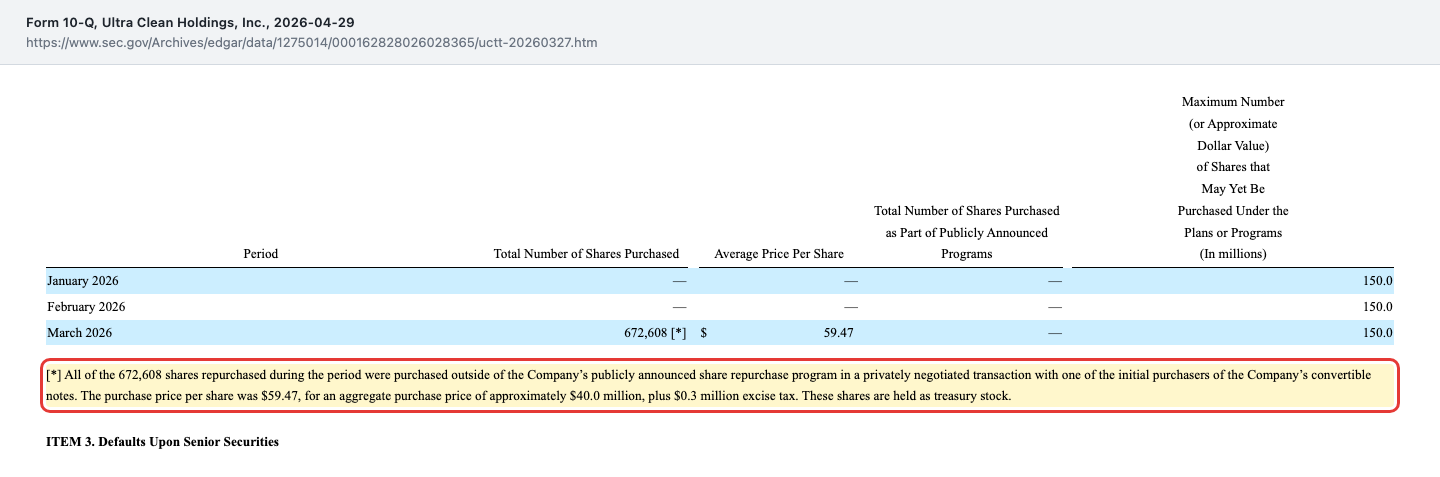
Repurchases like this are standard practice around convertible offerings: the note buyers hedge by shorting the stock, and the company takes a block off their hands at the pricing level so the shares do not break under the hedging pressure. Nothing about it is illegal or hidden. But it is not a signal that management thinks its own stock is cheap — and that is exactly how such headlines tend to be read.
Uncomfortable truth No. 4: inventories grow faster than revenue
First-quarter 2026 revenue rose 2.9 percent to $533.7 million. Inventories in the same quarter rose $91.0 million to $481.9 million — up 23.3 percent in three months. That leaves the inventory balance at roughly 90 percent of one quarter of revenue.
The cash flow statement feels it immediately. Operating activities consumed $33.3 million in the first quarter of 2026, after providing $28.2 million a year earlier. That is a change of sign, not noise. It was cushioned by $68.0 million more in accounts payable ($263.4 million after $194.9 million). In plain English: part of the inventory build was financed by Ultra Clean's own suppliers.
To be fair, there are two defensible readings. The friendly one: the company expects demand to accelerate — the annual report explicitly anticipates a period of historically elevated demand driven by artificial intelligence — and in semiconductors, whoever cannot deliver loses the order to a competitor. The unfriendly one: material was built to a forecast that never turned into call-offs. Which is right will be in the next quarterly report. Remember this: inventories are the most honest early warning a supplier's balance sheet offers — they report a change in demand a quarter before revenue does.
The investment side belongs in the picture too. Ultra Clean spent only $9.6 million on property, plant and equipment in the first quarter of 2026, after $12.4 million a year earlier. For the full fiscal year 2025 it was $50.3 million, after $63.5 million in 2024, $75.8 million in 2023 and $100.1 million in 2022. The company is holding its asset base, not expanding it. Anyone reading the inventory build as preparation for a boom should put that number next to it.
Uncomfortable truth No. 5: taxes on a loss
This line is easy to miss, and it is one of the most revealing in the whole report. In fiscal 2025 the company reported a pre-tax loss of $145.7 million. The tax line below it nonetheless shows an expense of $25.9 million. With a loss you would expect a credit, not a bill.
The report explains it. First, the goodwill impairment is largely not deductible for tax purposes. Second, the company recorded a valuation allowance against its U.S. deferred tax assets — meaning it no longer expects to use those accumulated loss carryforwards against profits any time soon. Third, foreign jurisdictions keep taxing normally: $25.4 million of the $25.9 million provision was foreign income tax in 2025. Fourth, U.S. rules on foreign earnings apply on top.
The result of that machinery: Ultra Clean earns most of its money in Singapore, Austria, China, South Korea and Malaysia — and pays tax there, while the loss stays with the U.S. parent. For an investor the takeaway is simple: reported after-tax profit will come in weaker than the pre-tax number suggests, even in good years.
What the stock costs
Every price in this chapter is a dated anchor, not a recommendation — and they age quickly. On July 24, 2026 the stock closed at $92.75. Multiplied by the 44,828,352 shares shown on the cover page of the quarterly report as of April 23, 2026, that is a market capitalization of roughly $4.16 billion — about twice fiscal 2025 revenue of $2,054.0 million.
Three further anchors are worth putting next to it, because all of them come from original documents:
- $58.87 — the last price the company itself records in a filing (the close on March 27, 2026). That would be roughly $2.64 billion, or 1.3 times annual revenue.
- $84.75 — the conversion price institutional note buyers accepted as a fair ceiling in February 2026. That would be roughly $3.80 billion, or 1.85 times.
- $104.07 — the cap up to which the banks were willing to hedge the dilution; above it they would not carry the risk. That would be roughly $4.67 billion.
There is no price-to-earnings ratio, because there are no earnings. Against the analyst estimate of $2.35 per share for the current fiscal year the multiple would be roughly 39 times, and against the $3.94 estimate for the following year roughly 24 times (data as of July 25, 2026). The professional view is unanimous but thinly staffed: four estimates, three at the highest rating and one at the second highest, with a mean price target of $113.40. Four voices is very little for a company with two billion dollars of revenue — the verdict carries correspondingly little weight.
Two more figures round out the picture. Price to book stood at roughly 7.2 (data as of July 25, 2026) — punchy for a contract manufacturer running a 15.7 percent gross margin. And the stock is volatile: a beta of 1.83 means it has historically moved almost twice as much as the broad market. Short interest was last reported at 3.56 million shares, after 3.22 million the month before. For the same exercise applied to a semiconductor software house with a completely different margin structure, see our PDF Solutions analysis.
Opportunities and risks at a glance
What speaks for it:
- Ultra Clean is indispensable in a market the annual report itself expects to grow for years — driven by new device architectures, memory for artificial intelligence and advanced packaging.
- The balance sheet carries: an equity ratio of 41.1 percent as of December 26, 2025, $323.5 million of cash and an Altman Z-Score of 4.52 as of July 25, 2026.
- The spring 2026 refinancing nearly eliminated the interest burden: $600 million at 0.00 percent to 2031, the remaining term loan repaid, and the revolving facility raised from $150.0 million to $250.0 million and extended to 2031.
- Services grows independently of the capital spending cycle — $232.9 million, $243.9 million and $254.7 million over three years, plus 10.4 percent growth in the first quarter of 2026 — and carries the higher margin.
- The operating business was profitable in 2025: $43.7 million of operating income and $65.0 million of operating cash flow, despite the loss below the line.
What speaks against it:
- Two customers account for 58.7 percent of fiscal 2025 revenue and one of them for 37.0 percent on its own — customers under no obligation to place orders, who own the designs.
- The margin is structurally thin: a 15.7 percent gross margin and a 2.1 percent operating margin in fiscal 2025, alongside a net loss of $181.2 million.
- Up to 10,089,120 new shares can arise from the convertible — roughly 22.5 percent of shares outstanding; the hedge only works up to $104.07.
- Inventories rose $91.0 million in the first quarter of 2026 while operating activities consumed $33.3 million of cash.
- U.S. export controls toward China remain unresolved: license requirements have expanded significantly since December 2024 and more than 140 Chinese entities were added to the Entity List; the partial suspension agreed in October 2025 does not, by the company's own account, remove the underlying restrictions. China revenue fell from $214.7 million to $143.1 million in 2025.
- Leadership is in flux: a new chief executive since September 2025, a new chief operating officer since March 2026, and a new chief financial officer effective August 5, 2026.
A human conclusion
Back to the trap from the opening — the price as proof. At Ultra Clean you can read in a single document where that confusion leads. In 2025 the falling price forced the accountants to erase $151.1 million of goodwill. The business had not suddenly deteriorated by $151 million that quarter; it had barely changed at all. In 2026 the same mechanism speaks the other way: the price sits at the top of a momentum screen — and the gross margin is still just under 16 percent.
What actually matters is not on the tape. It is in four lines: Lam Research's revenue share, last at 36.7 percent. Inventories, last at $481.9 million. Operating cash flow, last at negative $33.3 million. And the $110.17 threshold above which the note buyers may convert. Those four lines decide whether a strong price move turns into a strong company.
Plenty speaks for Ultra Clean: a healthy balance sheet, a market with a tailwind, a refinancing other companies would envy. And plenty speaks against confusing it with an equipment maker: whoever manufactures to somebody else's blueprint earns a manufacturer's margin, not an inventor's. What you make of that is your decision. And that is exactly how it should be.
Sources
- Form 10-Q for the quarter ended March 27, 2026 (filed April 29, 2026) — balance sheet, income statement, cash flows, segments, customer concentration, convertible notes, capped call, share repurchase, credit agreement
- Form 10-K for fiscal 2025 (February 23, 2026) — business model, segments, customers, geographies, employees, goodwill impairment, taxes, risk factors
- Form 8-K dated March 3, 2026 — issuance of the $600 million convertible notes, capped call transactions, maximum conversion shares
- Form 8-K dated February 27, 2026 — Ninth Amendment to the credit agreement and pricing of the notes
- Form 8-K dated April 24, 2026 — Tenth Amendment: $250 million revolving facility, maturity 2031, revised financial covenants
- Form 8-K dated July 8, 2026 — Michael Keogh becomes chief financial officer effective August 5, 2026
- Form 8-K dated January 28, 2026 — change of chief operating officer
- SEC EDGAR filing index, CIK 0001275014 — recency gate: Form 10-Q/A of May 1, 2026, Form 8-K of May 26, 2026, Form S-8 of July 10, 2026, Forms 4
- Fundamental data and our in-house stock scanner, data as of July 25, 2026 (price series through the July 24, 2026 close) — Moglen one-week screen, relative strength rating, Piotroski, Altman Z, market capitalization, analyst view
Journalistic analysis, not investment advice and not a solicitation to buy or sell securities. Stocks can lose their entire value; a total loss is possible. All figures come from the original documents linked above and carry the reporting date stated there. The author holds no position in Ultra Clean Holdings, Inc. at the time of publication.
Our Bottom Line at a Glance
- Market position & demand positive
- Ultra Clean is a fixed part of the supply chain for chip fabrication equipment and generated roughly 95.7 percent of fiscal 2025 revenue within the semiconductor industry. The annual report filed February 23, 2026 anticipates a period of historically elevated demand driven by new device architectures, memory for artificial intelligence and advanced packaging.
- Customer dependency negative
- Lam Research and Applied Materials accounted for 58.7 percent of fiscal 2025 revenue, at 37.0 and 21.7 percent, and 58.5 percent in the first quarter of 2026. None of these customers is obligated to place orders, and the annual report states that the designs and intellectual property belong to them.
- Earnings power & margin negative
- Gross margin fell to 15.7 percent in fiscal 2025 from 17.0 percent, and the operating margin was 2.1 percent. The bottom line showed a $181.2 million loss, with a further $17.9 million in the first quarter of 2026. A research budget of 1.6 percent of revenue reflects the role of a contract manufacturer, not a developer.
- Balance sheet & financing positive
- Cash stood at $323.5 million on March 27, 2026, the equity ratio at 41.1 percent as of the December 26, 2025 balance sheet date and the Altman Z-Score at 4.52 (data as of July 25, 2026). The spring 2026 refinancing replaced interest-bearing bank debt with $600 million at 0.00 percent to 2031 and extended a revolving facility, raised to $250 million, to April 2031.
- Dilution negative
- The convertible can create up to 10,089,120 shares, roughly 22.5 percent of the 44,828,352 outstanding as of April 23, 2026. It first becomes convertible in a quarter commencing after June 26, 2026 if the price exceeds $110.17 on 20 out of 30 trading days. The capped call only works up to $104.07.
- Valuation neutral
- Roughly $4.16 billion of market capitalization ($92.75 on July 24, 2026 times 44,828,352 shares) is about twice fiscal 2025 revenue of $2,054.0 million. There is no price-to-earnings ratio for lack of earnings; against the $2.35 per share estimate for the current year the multiple would be roughly 39 times. Four analyst ratings carry a mean price target of $113.40 (data as of July 25, 2026).
Ultra Clean Holdings builds the internals of the machines that make chips — subassemblies, gas delivery systems, precision components — and cleans used parts. Fiscal 2025 revenue was $2,054.0 million, 2.1 percent below the prior year, at a gross margin of 15.7 percent. The bottom line showed a loss of $181.2 million, driven mainly by a $151.1 million goodwill impairment whose trigger was the company's own falling share price. Two customers deliver 58.7 percent of revenue, one of them 37.0 percent alone. In March 2026 the company raised $600 million at 0.00 percent, repaid its bank debt with it, and in the process created up to 10,089,120 potential new shares. Not investment advice.
What Our Rating Means
Open questions
The business works in principle, but one material question is open. As long as it stays open, our findings do not carry a quality verdict.
The business carries itself and the balance sheet is solid: an equity ratio of 41.1 percent as of December 26, 2025, $323.5 million of cash, an Altman Z-Score of 4.52 and a refinancing that has all but removed the interest burden. Two operating questions remain open, neither of which has anything to do with the share price. First, the margin: 15.7 percent gross and 2.1 percent operating is structurally thin, because the designs belong to the customers and research spending runs at 1.6 percent of revenue. Second, concentration: a single customer accounts for 37.0 percent of revenue, and its share has risen over two years, not fallen. None of this threatens the company's existence — but proven quality looks different. The decision is yours.
A journalistic assessment by our editorial team at the time of the deep dive, based on public sources — not investment advice and not a solicitation to buy or sell. Your personal circumstances (investment goals, risk capacity, taxes) cannot be taken into account. What our levels mean, how verdicts are formed, and what conflicts of interest exist →
Worth Noting
- UCTT reached our research list as number 3 of 28 U.S. hits in our in-house Moglen one-week screen (data as of July 25, 2026, relative strength rating 98) — part of our series filling the top 50 of that screen with analyses. The screen lists are recalculated daily.
- Fiscal-year trap: the fiscal year ends on the Friday nearest December 31. Fiscal 2025 ran from December 28, 2024 to December 26, 2025, and the first quarter of 2026 from December 27, 2025 to March 27, 2026. Individual fiscal years can therefore contain 53 weeks instead of 52.
- Four fifths of the fiscal 2025 loss of $181.2 million is an accounting figure: the $151.1 million goodwill impairment costs no cash, and operating activities still generated $65.0 million in 2025. The reverse also holds: the $25.9 million tax provision was incurred despite a pre-tax loss, and it is payable in cash.
- Recency note: the latest quarterly report (10-Q) is dated April 29, 2026 and covers the quarter through March 27, 2026. Every filing after it was reviewed — the Form 10-Q/A of May 1, 2026 (adding two omitted Rule 10b5-1 trading arrangements, not a restatement), the Form 8-K of May 26, 2026 on the annual meeting, the Form S-8 of July 10, 2026 and the Form 8-K of July 8, 2026 on the chief financial officer transition effective August 5, 2026. There is no merger, acquisition, take-private or delisting under way.
- Important for the credit agreement: the temporary leverage relief to 6.00:1.00 from the Ninth Amendment of February 26, 2026 applied only to the periods ending on or about March 31 and June 30, 2026. The Tenth Amendment of April 23, 2026 reset the covenants: consolidated secured net leverage of no more than 3.25:1.00 and cash interest coverage of no less than 3.00:1.00. As of March 27, 2026 all covenants were met and the revolver was undrawn.
- Easy to confuse: Ultra Clean Holdings (UCTT) is a supplier to the equipment makers, not an equipment maker itself and not a chip manufacturer. Comparing its metrics with Applied Materials or Lam Research is misleading — the business model and margin structure are fundamentally different.
Frequently Asked Questions
Ultra Clean builds the internals of the machines that make chips: subassemblies, welded frames, precision parts and gas delivery systems for equipment makers such as Applied Materials and Lam Research. A second segment cleans, analyzes and re-coats used components. In fiscal 2025, Products revenue was $1,799.3 million and Services revenue $254.7 million.
Because the stock meets the three conditions of that list: a gain of at least 15 percent over four trading days, average daily dollar volume above $10 million, and a relative strength rating of at least 70. Ultra Clean scores 98 and ranks 3rd of 28 U.S. hits as of July 25, 2026. The lists are recalculated daily.
The main reason is a $151.1 million goodwill impairment in the second quarter of 2025. Its trigger was the company's own share price: it fell far enough that market capitalization slipped below the carrying value of net assets. The charge costs no cash — operating activities still generated $65.0 million in 2025.
Very. Lam Research and Applied Materials together delivered 58.7 percent of fiscal 2025 revenue, at 37.0 and 21.7 percent, and 36.7 and 21.8 percent in the first quarter of 2026. As of March 27, 2026, three customers accounted for roughly 39.0 percent of gross accounts receivable. None of those customers is contractually obligated to place orders.
It costs no interest but can cost ownership. The conversion price is $84.75 per share and the notes mature March 15, 2031. Full conversion at the maximum rate could create up to 10,089,120 new shares, roughly 22.5 percent of the 44,828,352 shares outstanding. A $25.1 million capped call cushions the dilution up to $104.07.
On the Friday nearest December 31. Fiscal 2025 therefore ended December 26, 2025, and the first quarter of 2026 ran from December 27, 2025 to March 27, 2026. The figures broadly cover the calendar year, but individual fiscal years can contain 53 weeks instead of 52.
China revenue fell from $214.7 million to $143.1 million in fiscal 2025, roughly 7 percent of group revenue. The annual report cites expanded U.S. license requirements since December 2024 and more than 140 Chinese entities added to the Entity List. The partial suspension agreed in October 2025 does not, by the company's own account, resolve the underlying restrictions.
No. The company pays no dividend and states it does not intend to for the foreseeable future; its credit agreement also limits its ability to do so. A $150.0 million share repurchase program was renewed on October 23, 2025 for three years but was still entirely untouched as of March 27, 2026. The 672,608 shares bought back in the first quarter of 2026 ran outside that program.
Found an error?
Did you spot a factual error, an outdated number, or a typo in this deep dive? Let us know briefly — your report goes straight to the editorial team.