Magnachip: The Word "AI" Appears Only Where New Shares Are Sold
Magnachip Semiconductor (NYSE: MX) builds chips in South Korea that switch electricity — power semiconductors for chargers, televisions, e-bikes and server boards. In its annual report for 2025 and in its two most recent quarterly reports to the U.S. securities regulator, the SEC, the terms "artificial intelligence", "AI", "data center" and "robotics" appear a combined zero times. On June 17, 2026 the company set up a program to sell up to $50 million of newly issued stock — and there the stated use of proceeds suddenly includes "technologies that support AI data centers and robotics." The same company previously took 21.8 million of its own shares into treasury for $229.9 million. Not investment advice — just the question of whether a word can stand in for a business model.
 Thomas Mücke
Founder & Publisher
Thomas Mücke
Founder & Publisher
Chart
Interactive price chart (TradingView).
Note: pure fact-based analysis, not investment advice and not a solicitation to buy or sell. All figures without guarantee.
There is an investor trap that needs no arithmetic, only a word. Call it the buzzword trap. It works like this: you read about a company that has been losing money for years, and your head stays cool. Then some document drops the phrase "AI data centers" — and suddenly the same company feels different. Not better calculated. Just different. That is what buzzwords are for. Magnachip Semiconductor (NYSE: MX) is an unusually clean case to practice on, because you can pin down to the day when the word appeared and in which document. The stock reached our desk through our in-house Reddit hype scanner: 2 mentions in 24 hours, first recorded on July 25, 2026 at 7:00 a.m. Not a storm, more a throat-clearing. So let us make a deal: before you decide whether the word interests you, we read together what the company itself has told the U.S. securities regulator, the SEC — the annual report (10-K) for 2025, the quarterly report (10-Q) as of March 31, 2026, and everything filed since. An SEC filing is honest under penalty of law. What you make of it is your call.
What Magnachip actually does — chips that switch electricity
Magnachip builds power semiconductors. In everyday terms: not the chips that compute, but the ones that switch — tiny valves for electricity. They sit in your laptop power supply, your phone charger, the motor controller of an e-bike, the inverter of a solar array, the power stage of a television. Concretely, that means MOSFETs and IGBTs — switches that pass or block large currents quickly and with little loss — plus power ICs, small control chips for voltage conversion, LED driving and power management. The company calls the two lines Power Analog Solutions and Power IC, and reports a single segment: Power Solutions.
The legal home is Delaware; the operating heart is Korea. Headquarters are in Cheongju-si, the only owned fab is in Gumi. As of December 31, 2025 the company employed 711 people, of whom 411 worked in manufacturing and 108 in research and development; it points to roughly 45 years of operating history and more than 950 granted or pending patents. 99.8 percent of property, plant and equipment sat in Korea on the same date. Remember that sentence.
Then there is the backstory. Until 2025 Magnachip had a second leg: display chips, driver components for screens. On March 7, 2025 the board approved the pivot to a pure-play power company; on April 6, 2025 it approved the shutdown of the Display business after a sale, a merger, a joint venture and licensing had all been explored without result. Liquidating the subsidiary cost roughly $13 million in cash — $6.5 million of statutory severance in the second quarter of 2025 and $6.0 million of contract termination charges spread over the remaining contract terms. End-of-life display product sales still brought in $5.8 million in the second half of 2025; over two years the company expects more than $10 million.
That sets the central tension of this analysis, and it runs through every chapter: a company that cut itself back to its core business is still losing money in exactly that core business — and is now funding the future by selling new shares, after years of buying its own back.
How the stock reached our desk
Magnachip reached our desk through our in-house Reddit hype scanner: 2 mentions in 24 hours, first recorded on July 25, 2026 at 7:00 a.m. Two mentions are not a hype cycle, they are a footnote — and still the right occasion, because the timing lines up. Five weeks earlier, on June 17, 2026, Magnachip had disclosed two things at once that generate attention. First, a program to sell up to $50 million of newly issued stock. Second — in the same document — the statement that proceeds might go into "technologies that support AI data centers and robotics." Anyone screening for chip stocks with an AI angle finds a hit from that day on that did not exist before.
The hype list is not our only handle on this stock, though. As of July 25, 2026 Magnachip also sits in three of our screens: the P/S Ranking (price-to-sales ratio of at most 0.7 — cheap measured against revenue), EPS Acceleration (earnings-per-share growth higher in the latest quarter than in the one before) and "Below the 50- & 200-SMA" (price under both the 50- and the 200-day line). Cheap and in a downtrend at the same time — that is exactly the combination the rest of this analysis takes apart. And because the lists are recomputed daily, this too is a snapshot from the day of the analysis.
A note on method before we start doing arithmetic. The market value supplied by our fundamental data on July 25, 2026 deviates by more than a fifth from the cross-check "share count times the last price documented in a filing." We therefore do not use it, nor any metric derived from it. The only valuation anchor in this piece is the price the company itself put on the record: $5.50 per share as of June 16, 2026. Remember the principle: a price inside a mandatory filing is evidence. A price found somewhere online is a snapshot.
The numbers over the years — honestly credited
Start with what genuinely speaks for Magnachip, because there is something. The balance sheet is sturdier than at most loss-making companies this size. As of March 31, 2026 the company held $94.6 million in cash against $42.3 million of borrowings — roughly $52 million of net cash. Stockholders equity was $232.8 million against total assets of $335.5 million, an equity ratio of about 69 percent. Book value per share: $6.39. The debt is modest and named: a working capital term loan from the Korea Development Bank, originally 40 billion won, with $26.4 million outstanding as of March 31, 2026 at a variable rate of 4.06 percent, maturing on March 26, 2027 and secured by the land and buildings in Gumi. On top of that, $15.9 million of equipment loans from the same bank.
There are operational bright spots too. In the first quarter of 2026 revenue rose 13.9 percent sequentially to $46.2 million, the gross margin recovered from a dismal 9.3 percent in the fourth quarter of 2025 to 15.6 percent, and the operating loss narrowed from $12.4 million to $7.2 million. Operating cash flow turned positive: plus $1.6 million, after minus $4.7 million a year earlier. The company says it launched fifty-five new-generation products in 2025 and plans the same number for 2026.
Now the chart that condenses the restructuring into two groups of bars — and that has to be read honestly:
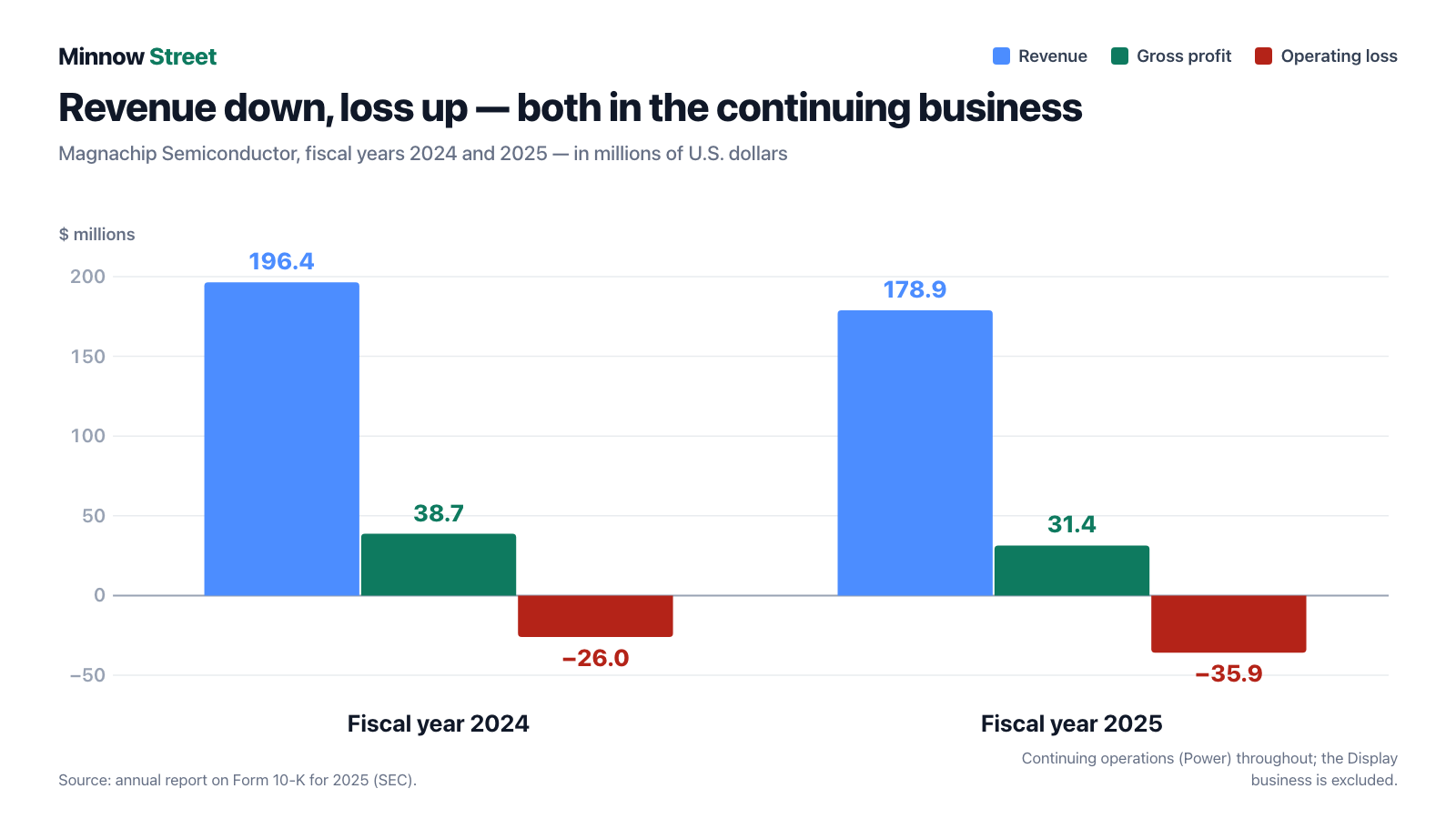
A word on comparability, because this is where many write-ups go wrong. Both annual bars show continuing operations only, meaning Power without Display. The annual report for 2025 restated the prior-year figures accordingly. Anyone who instead sets the old consolidated 2024 against the 2025 power business is comparing two different companies. Inside the $196.4 million of 2024 there was also $10.6 million from a transitional foundry service tied to the Cheongju fab sold in 2020 — that business ended entirely at the close of 2024. Adjusted for it, power revenue fell "only" 3.7 percent, from $185.8 million to $178.9 million.
And the cash? It is melting. In 2025, $24.2 million flowed out of operations, alongside $30.0 million of capital expenditure; $17.0 million of new borrowings came in. The net effect: cash fell from $138.6 million to $103.8 million — and further to $94.6 million by March 31, 2026. Remember the relationship: net cash is not a state, it is a supply. And this supply is shrinking.
What the filings say — the uncomfortable truths
Uncomfortable truth no. 1: the restructuring is done, the losses are not
The logic behind exiting Display was intuitive: the business lost money, so cut it, and the healthy power business remains. Except the power business is not healthy. In fiscal 2025 the continuing business alone lost $35.9 million at the operating line — after $26.0 million the year before. And that despite $31.4 million of gross profit: selling, general and administrative costs ($35.1 million) and research and development ($27.3 million) came to $62.4 million together, nearly twice the entire gross profit; with another $4.8 million of charges for a voluntary resignation program and executive separations.
The reason for the margin erosion sits plainly in the annual report: pricing pressure on older product generations, especially in China, an unfavorable product mix, and a one-time incentive program for Chinese distributors in the fourth quarter of 2025. That is why the gross margin sank to 9.3 percent in that quarter. For the first quarter of 2026 it was 15.6 percent against 20.9 percent a year earlier; for the second quarter of 2026 the company guided on April 28, 2026 to revenue of $44.5 million to $48.5 million and a gross margin of 17 to 19 percent — at the midpoint a 2.3 percent decline in revenue year over year. One quarter does not make a summer, but four quarters make a trend, and the trend reads: revenue flat, margin below where it was a year ago.
Fairness requires a note on taxes. The reported loss from continuing operations in 2025, at $14.2 million, came in far below the operating loss because a $17.9 million tax benefit worked in the other direction. Such benefits are not cash in the bank but a balance sheet item — as of March 31, 2026 the balance sheet carries $61.2 million of deferred income tax assets, a good 18 percent of total assets. They are only worth something if profits eventually arrive to offset them against.
Uncomfortable truth no. 2: the word "AI" appears only where shares are sold
Now the core finding. We searched three mandatory filings for five terms: "artificial intelligence", "AI", "data center", "robotics" and "machine learning". The documents were the annual report on Form 10-K for 2025 (filed March 16, 2026), the quarterly report on Form 10-Q as of September 30, 2025, and the quarterly report on Form 10-Q as of March 31, 2026. The result is the same in all three: zero hits. Not few. None. The only mention in the wider vicinity sits in the boilerplate risk list of the quarterly press release of April 28, 2026, where "artificial intelligence" appears exactly once as a generic industry uncertainty — in the same enumeration as supply chain disruption and regulation.
On June 17, 2026 that changes. On that day Magnachip files a prospectus supplement (Form 424B5) launching a program to sell up to $50 million of newly issued stock. And there it reads:
"We currently intend to use the net proceeds from this offering, if any, after deducting commissions and offering expenses payable by us, for general corporate purposes, which may include investments in strategic growth initiatives and technologies that support AI data centers and robotics."
— Magnachip Semiconductor Corporation, SEC prospectus supplement on Form 424B5, June 17, 2026, "Use of Proceeds"

Read the sentence again slowly. It says "currently intend", "if any", "general corporate purposes", "may include". Four hedges in one sentence. There is no product, no named customer, no revenue and, per the same document, no agreement: "We have not entered into any agreements or commitments with respect to any material acquisitions or investments at this time." This is not a false statement — it is a correctly drafted statement of intent. It just happens to carry the two words that command attention in 2026, and it sits in the one document that lets the company sell new shares.
For balance: none of this is illegal, unusual or necessarily insincere. Power semiconductors are used in server power supplies, so a link to data centers is technically plausible. But a plausible link is not a revenue line. And the same chipmaker who saw no reason to use the word even once across a 300-page annual report found the occasion three months later in a selling prospectus. Remember the ordering: raise the money first, build the business second — not the other way around. If you want a semiconductor company where the growth area already shows up in the revenue line, our analysis of Lattice Semiconductor offers a counterexample from the same industry.
Uncomfortable truth no. 3: $229.9 million spent on its own shares — now new ones are for sale
The balance sheet as of March 31, 2026 carries a number that tells the story of the past few years: 21,808,596 treasury shares, acquired for $229.9 million. That is an average of roughly $10.54 per share. Shares issued on that date: 58,249,450, of which 36,440,854 were outstanding. Put differently, Magnachip has taken more than a third of its present share base off the market with its own money. The most recent buyback authorization, $50 million, dates from July 19, 2023 and went unused in the first quarter of 2026.
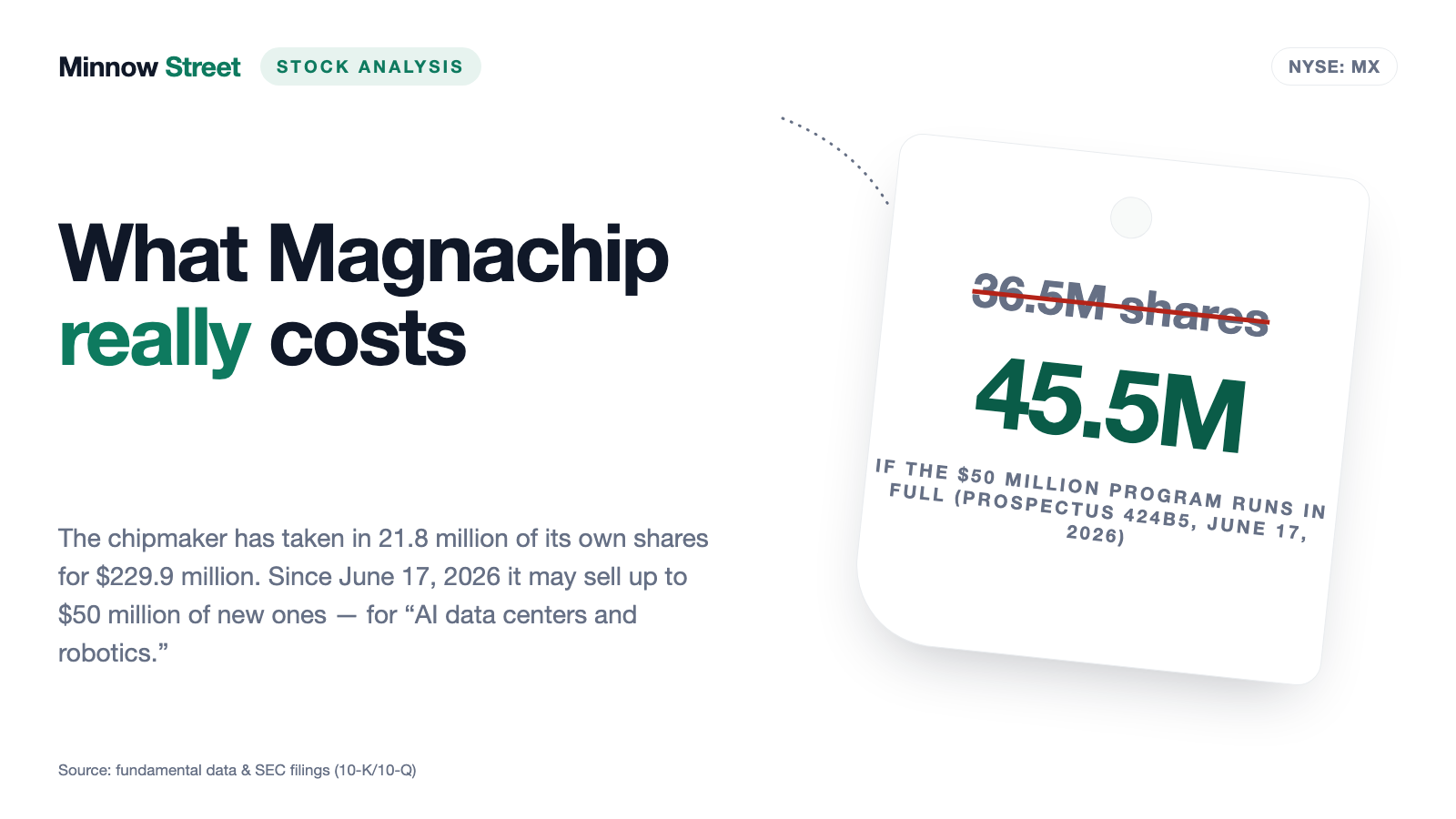
On June 17, 2026 the direction reverses. The company signs an At Market Issuance Sales Agreement with B. Riley Securities — in plain English, share sales on call: the bank sells new stock into the market piece by piece, whenever and in whatever size the company instructs. Size: up to $50 million, commission up to 3.0 percent. What that means for you as a shareholder is spelled out in the prospectus itself, anchored on the price the company documents there:

At that price, $50 million equals exactly 9,090,909 new shares — almost 25 percent more than the 36,499,302 shares outstanding as of June 15, 2026. The prospectus puts the resulting count at up to 45,490,211 shares; that is 100,000 fewer than its own two input figures would produce, a transposition in the document that does not change the order of magnitude. Dilution is the technical term; in everyday terms, the cake stays the same size but is cut into a quarter more slices, and your slice gets smaller. Nor is that the end of what might come. As of June 15, 2026 the prospectus also lists 149,211 stock options (weighted average exercise price $8.10), 2,183,926 restricted stock units and 4,457,622 shares reserved under the equity plan. On July 10, 2026 the company registered a further 3,000,000 shares for the same plan on Form S-8; stockholders had approved that on June 11, 2026 with 13,328,072 votes for against 4,058,795 votes against — the weakest support of the four agenda items.
The symmetry is striking and, as far as the record shows, unintended: a $50 million buyback authorization from 2023 now sits beside a $50 million selling program from 2026 — same amount, opposite sign, and the selling price is roughly half the average buyback cost. Growth paid for with fresh shares is never entirely free.
Uncomfortable truth no. 4: one customer, one country, one fab
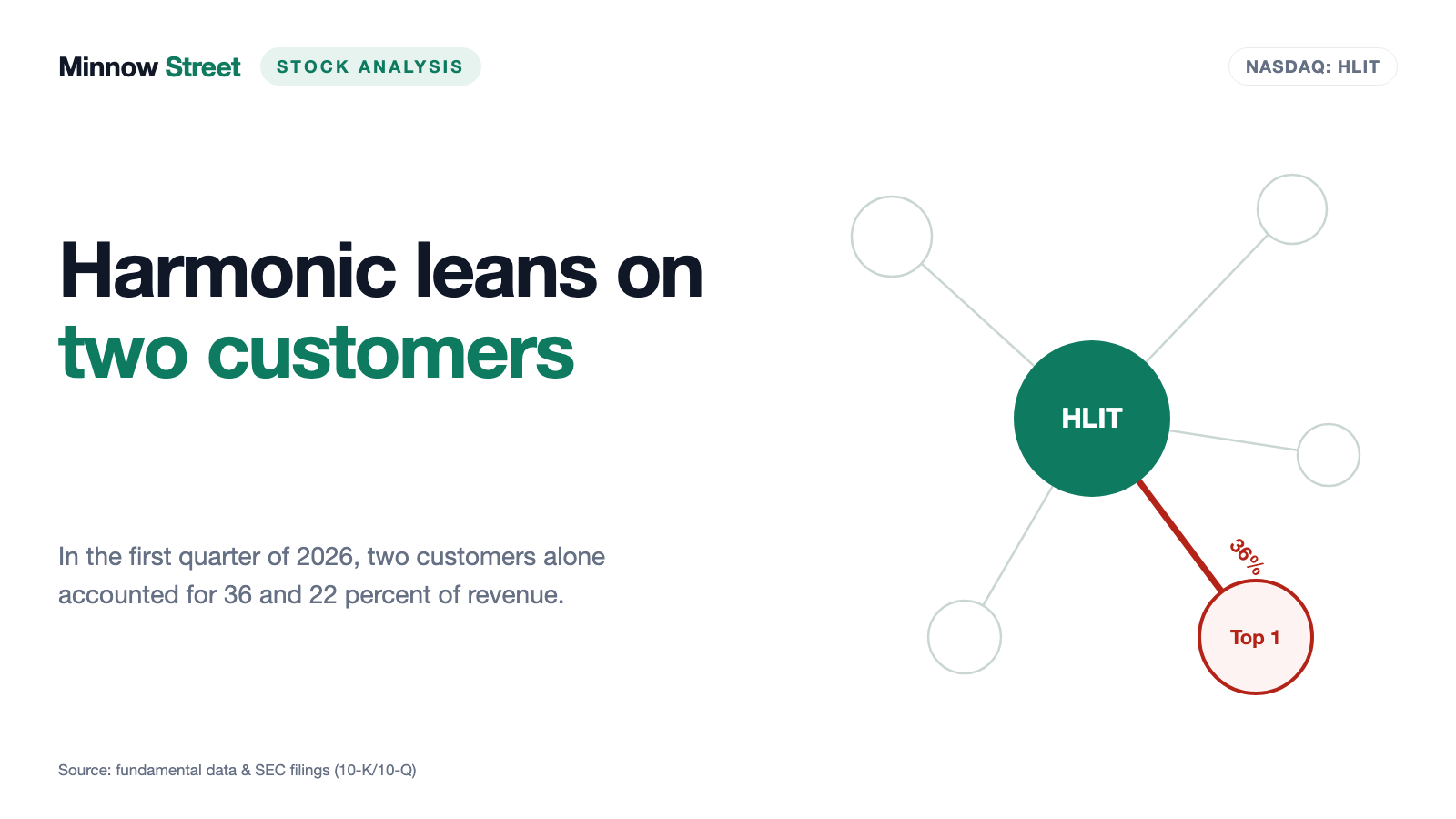
Customer concentration sounds harmless until you picture it as a neighbor: he tells you his business is thriving — and then you learn that almost a third of his revenue comes from a single buyer. That is exactly Magnachip's position:

The ten largest customers accounted for 73.4 percent of revenue in the first quarter of 2026, out of 143 end customers in total. On the receivables side it is tighter still: as of March 31, 2026, 40.6 percent of outstanding receivables sat with a single customer and another 14.6 percent with a second. Geographically the pattern repeats: China and Hong Kong together made up 83.8 percent of Asia-Pacific revenue outside Korea. A chipmaker with Korean production, a Chinese customer base and an American listing sits in an uncomfortable geopolitical spot — the company explicitly names U.S. export controls toward China and trade conflicts among its risks.
That leaves the third level: the fab. There is exactly one. And its power connection is about to be rebuilt — by a third party who owns the substation:

Magnachip is countering by building inventory in the second quarter and part of the third quarter of 2026. The accounting behind it is elegant and economically unpleasant: producing more spreads the fab's fixed costs over more units and lifts the gross margin — until the inventory is later sold down and the effect reverses. The company forecasts precisely that: higher utilization and a better margin in the second quarter, lower utilization in the third, and pressured margins in the third and fourth quarters of 2026. So if you see a good second-quarter margin in the coming filings, you now know where part of it comes from.
Uncomfortable truth no. 5: the won costs more equity than the loss does
Magnachip reports in U.S. dollars. It pays in Korean won: wages, the fab, most of its operating costs. The company says itself that this distorts the numbers:
"In particular, because of the difference in the amount of our consolidated revenues and expenses that are in U.S. dollars relative to Korean won, depreciation in the U.S. dollar relative to the Korean won could result in a material increase in reported costs relative to revenues, and therefore could cause our profit margins and operating income to appear to decline materially, particularly relative to prior periods."
— Magnachip Semiconductor Corporation, SEC quarterly report on Form 10-Q as of March 31, 2026, "Impact of Foreign Currency Exchange Rates"
In the first quarter of 2026 the exchange rate worked against the company: the won weakened from 1,434.9 to 1 (December 31, 2025) to 1,513.4 to 1 (March 31, 2026), a good five and a half percent. What that did to equity is shown in this bridge:
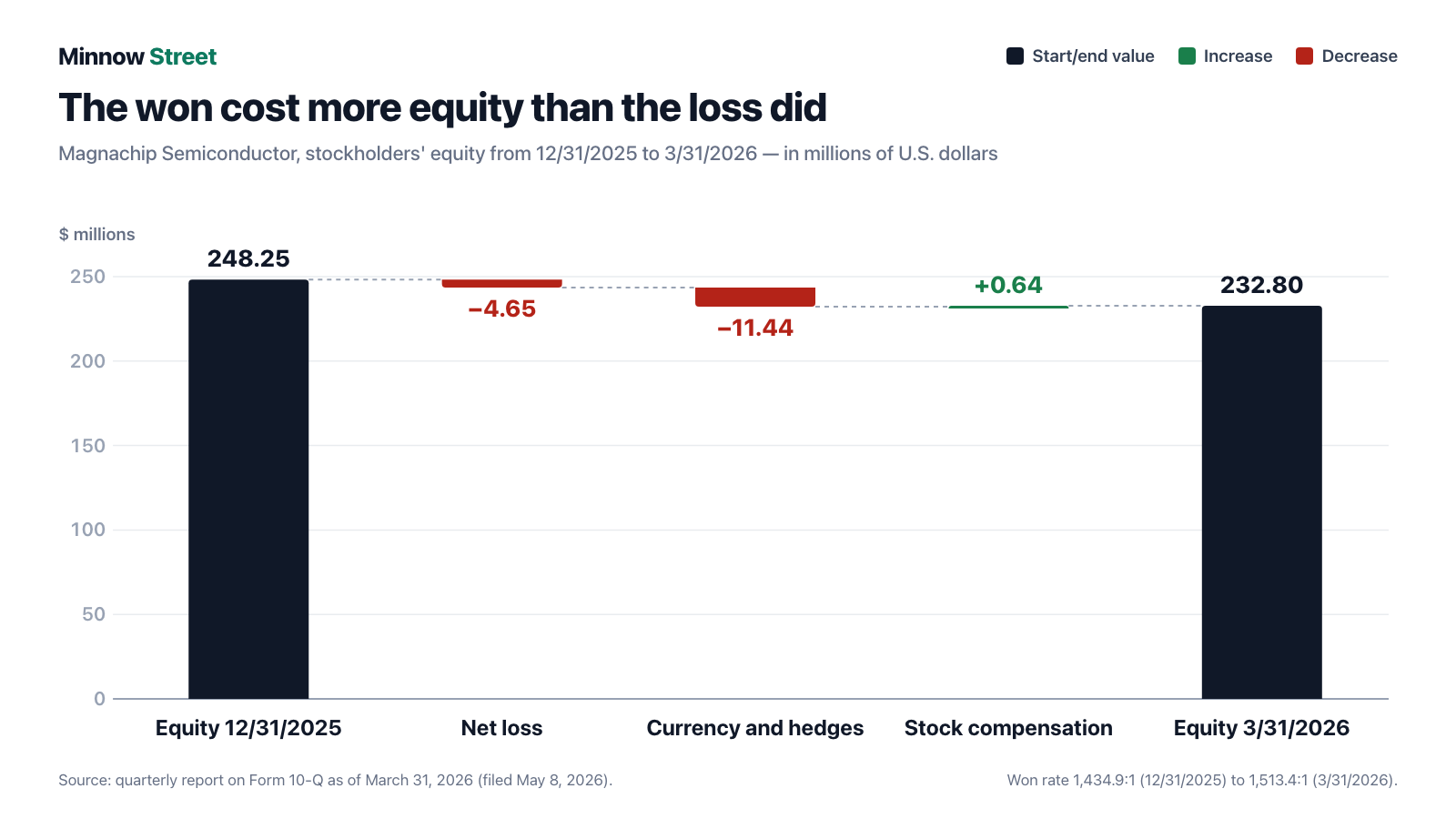
Of the $11.44 million, $7.98 million came from pure currency translation and $3.47 million from hedging instruments. Only one item pushed the other way: $0.64 million of stock-based compensation. On balance, equity fell from $248.25 million on December 31, 2025 to $232.80 million on March 31, 2026. Cash was hit as well: the exchange rate effect cost $4.5 million of the cash balance in the first quarter of 2026 — nearly three times what the operating business brought in over the same period ($1.6 million). One detail on the side shows how closely the company watches this: its foreign currency zero cost collar contracts contain a clause allowing the counterparty to terminate if total cash falls below $30.0 million at the end of a fiscal quarter. At $94.6 million that is far away — but it is a threshold that exists.
Valuation — what $5.50 per share meant
We deliberately calculate with the only price the company itself put into a mandatory filing: $5.50 on June 16, 2026, against 36,499,302 shares outstanding as of June 15, 2026. That gives a market value of roughly $201 million. Set against it, as of March 31, 2026:
- $232.8 million of stockholders equity — the market was paying about 86 cents for every dollar of book value.
- roughly $52 million of net cash ($94.6 million of cash less $42.3 million of borrowings) — stripping out the cash, enterprise value was about $149 million.
- $180.3 million of revenue across the last four reported quarters of continuing operations — a price-to-sales ratio of about 1.1, or about 0.8 on an enterprise value basis.
A price-to-earnings ratio cannot be formed: there are no earnings. How should one read this? A discount to book value at a company losing money at the operating line is not an anomaly, it is the logical reaction — the market doubts that the assets will earn their carrying value in this configuration. Note, too, that $61.2 million of that book value consists of deferred income tax assets, that is, the promise of future tax savings — an item that only becomes real with future profits. Strip it out and the market value already exceeds the remaining book value.
The most instructive comparison, though, comes not from analysts but from an investor who put money down. Activist Byreforge LLC disclosed a stake of 3,072,779 shares — 8.5 percent — on November 20, 2025 and put the aggregate purchase price including commissions at roughly $8,404,195. That is about $2.74 per share. His cost basis is therefore roughly half the price documented in the prospectus. On January 14, 2026 managing partner Cristiano Amoruso joined the board — and all three committees. At the annual meeting on June 11, 2026 he received 17,050,708 votes for, the best result of the four nominees. He is not alone: as of March 20, 2026, Toro 18 Holdings LLC — backed by Immersion Corporation and the known activists Eric Singer and William C. Martin — reported 1,500,135 shares, or 4.1 percent. More than one investor pushing for change sits on the register. If you want a comparable setup of analog chips, restructuring and a valuation discount, you will find it in our analysis of MaxLinear.
One more thing has changed that fits no ratio. Since July 1, 2026 Magnachip has a new chief executive. Chae Lee, 61, ran Tagore Technology, before that Insyte Systems, before that the Secure Interface and Power Solutions business unit at NXP Semiconductors, and spent more than fifteen years as a senior vice president at Maxim Integrated. Camillo Martino, who had led the company as interim chief executive, remains chairman; the board grew from four to five members. Lee's initial equity award covers 875,000 shares in three forms — and the 148,750 options inside it carry an exercise price of no less than $5.50. Below that price he earns nothing on them.
Opportunities and risks at a glance
What speaks for Magnachip:
- A solid balance sheet for a loss-making company: $94.6 million of cash against $42.3 million of borrowings, $232.8 million of equity, an equity ratio near 69 percent (March 31, 2026). No acute funding pressure.
- The pivot to a pure-play power supplier is complete; the loss-making Display business now weighs only as a wind-down that should still deliver more than $10 million of cash through 2027.
- Owned manufacturing in Gumi rather than pure outsourcing — that gives control over cost, schedule and quality, and spares heavy investment in leading-edge nodes because power semiconductors run longer on mature processes.
- Sequential recovery in the first quarter of 2026: revenue up 13.9 percent, gross margin up from 9.3 percent to 15.6 percent, operating cash flow positive again (plus $1.6 million).
- An active large shareholder with 8.5 percent and a seat on all three committees, plus a new chief executive with a semiconductor career since July 1, 2026 — both have an interest in change.
- Valuation discount: at the documented price of $5.50 (June 16, 2026) the market value sat below book equity.
What speaks against it:
- The core loses money: a $35.9 million operating loss from continuing operations in 2025 after $26.0 million in 2024, plus another $7.2 million in the first quarter of 2026. The turn is announced, not demonstrated.
- Pricing pressure on older products, especially in China, is squeezing the margin — gross profit fell 18.9 percent in 2025 while revenue fell only 8.9 percent.
- Dilution of up to almost 25 percent from the $50 million selling program alone, plus options, restricted stock units and a further 3,000,000 plan shares registered in July 2026.
- Concentration risk: one customer at 31.0 percent of revenue, the top ten at 73.4 percent (Q1 2026), China and Hong Kong at 83.8 percent of Asia-Pacific revenue outside Korea, 99.8 percent of fixed assets in Korea.
- Currency risk with real effects: $11.44 million of equity and $4.5 million of cash in the first quarter of 2026 alone.
- The substation upgrade at the Gumi fab is expected, per the company, to weigh on gross margins in the third and fourth quarters of 2026 — on a schedule set by a third party.
- The AI angle so far exists only in a selling prospectus — not in a mandatory filing, not in a product announcement, and not in the revenue line.
A human conclusion
Remember the buzzword trap from the opening? Magnachip is a fine place to observe it, because the birth date and birthplace of the word can be pinned down precisely: June 17, 2026, prospectus supplement on Form 424B5, section "Use of Proceeds." Before that, across one complete annual report and two quarterly reports: not once. That does not make the company dishonest — but it does make the AI story exactly what it is: a statement of intent inside a selling document.
What lies underneath is an ordinary, rather difficult turnaround. A 45-year-old chip operation in Korea that builds switches for chargers and inverters, has been fighting Chinese price pressure for years, amputated its second leg and now has to prove that the first can carry the weight alone. The balance sheet buys time for that — roughly $52 million of net cash is a cushion, not a life raft. An activist in at half the price and a new chief executive with an industry résumé are real changes. And if the selling program truly flows into production and products rather than merely into the bank account, something could come of it.
Just do not confuse the ordering. First comes a gross margin back above twenty percent. Then a quarter without an operating loss. Then, perhaps, a customer whose chips end up in a data center. And at some point the word will appear in a report nobody wrote in order to sell something. Until then: a word in the right document is not a business model. What you make of it is your decision. And that is exactly as it should be.
Sources
- Quarterly report on Form 10-Q as of March 31, 2026, Magnachip Semiconductor Corporation, filed May 8, 2026 (SEC EDGAR, CIK 0001325702)
- Annual report on Form 10-K for 2025, filed March 16, 2026
- Quarterly report on Form 10-Q as of September 30, 2025, filed November 10, 2025
- 8-K with first quarter 2026 results and second quarter guidance, filed April 28, 2026
- Prospectus supplement on Form 424B5 for the at-the-market program, filed June 17, 2026
- 8-K, Item 1.01: sales agreement with B. Riley Securities, filed June 17, 2026
- 8-K on the annual meeting of June 11, 2026 (voting results, equity plan, auditor), filed June 17, 2026
- 8-K on the appointment of Chae Lee as chief executive officer, filed June 30, 2026
- Form S-8 registering 3,000,000 additional plan shares, filed July 10, 2026
- Schedule 13D by Byreforge LLC / Cristiano Amoruso, filed November 20, 2025, and the amendment on Schedule 13D/A, filed January 20, 2026
- Schedule 13G/A by Toro 18 Holdings LLC / Immersion Corporation / Eric Singer / William C. Martin, filed March 20, 2026
- Source: fundamental data & SEC filings (annual and quarterly reports, 10-K/10-Q) — metrics and quarterly series, data as of July 25, 2026
- In-house Reddit hype scanner: 2 mentions in 24 hours, first recorded on July 25, 2026 at 7:00 a.m.
Disclaimer: This article is a journalistic analysis based on publicly available mandatory filings. It is not investment advice and not a solicitation to buy or sell securities. Shares of small, loss-making semiconductor companies are volatile; a total loss is possible. Every figure carries the as-of date of its source and may have changed since — the original filings with the SEC always govern. The author holds no position in the stock discussed at the time of publication.
Our Bottom Line at a Glance
- Balance sheet and funding pressure positive
- As of March 31, 2026 the company held $94.6 million of cash against $42.3 million of borrowings — roughly $52 million of net cash, with $232.8 million of equity and an equity ratio near 69 percent. The only sizeable loan ($26.4 million at 4.06 percent) runs to March 26, 2027. There is no acute funding pressure, but the cushion is shrinking: $24.2 million flowed out of operations in 2025 alongside $30.0 million of capital expenditure.
- Earning power of the core business negative
- The continuing power business lost $35.9 million at the operating line in 2025 after $26.0 million the year before — the restructuring did not end the losses, it concentrated them. Gross profit fell 18.9 percent to $31.4 million (margin 17.6 percent versus 19.7 percent), while sales, administration and research together cost $62.4 million. In the first quarter of 2026 the margin was 15.6 percent against 20.9 percent a year earlier.
- Dilution and capital policy negative
- Over the years the company took 21,808,596 of its own shares into treasury for $229.9 million (roughly $10.54 each) and then, on June 17, 2026, set up a program to sell up to $50 million of new stock. At the documented $5.50 price that is 9,090,909 shares, almost 25 percent more than the 36,499,302 shares outstanding; the prospectus puts the resulting count at up to 45,490,211 shares. Options, restricted stock units and 3,000,000 plan shares registered in July 2026 come on top.
- AI story versus evidence negative
- The annual report on Form 10-K for 2025 (March 16, 2026) and the quarterly reports on Form 10-Q as of September 30, 2025 and March 31, 2026 contain a combined zero occurrences of "AI", "artificial intelligence", "data center", "robotics" and "machine learning". The only substantive reference is the use-of-proceeds intention in the 424B5 prospectus of June 17, 2026 — with no product, customer, revenue or agreement, as the document itself confirms.
- Concentration and currency negative
- One customer accounted for 31.0 percent of revenue in the first quarter of 2026 and one for 40.6 percent of receivables; China and Hong Kong made up 83.8 percent of Asia-Pacific revenue outside Korea, and 99.8 percent of fixed assets sit in Korea. The won moving from 1,434.9 to 1,513.4 to the dollar cost $11.44 million of equity and $4.5 million of cash in the first quarter of 2026. The Gumi substation upgrade is expected to weigh on margins in Q3 and Q4 2026.
- Shareholder pressure and new leadership neutral
- Byreforge LLC has held 8.5 percent since its Schedule 13D of November 20, 2025 at a cost of roughly $2.74 per share; managing partner Cristiano Amoruso has sat on the board and all three committees since January 14, 2026 and drew the best vote on June 11, 2026. Chae Lee has run the company since July 1, 2026, with initial options carrying a minimum exercise price of $5.50. Both create pressure for change — results are not in yet.
Magnachip Semiconductor cut itself back to its core business in 2025 and is still losing money there: a $35.9 million operating loss in 2025 and another $7.2 million in the first quarter of 2026, on a gross margin of 15.6 percent. The balance sheet carries that for now — roughly $52 million of net cash and $232.8 million of equity as of March 31, 2026. What is remarkable is the story around it: three consecutive mandatory filings contain not a single AI term; only the selling prospectus of June 17, 2026, which allows up to $50 million of new stock to be placed, mentions "technologies that support AI data centers and robotics" — with no product, customer or revenue behind it. The same company previously took 21.8 million of its own shares into treasury for $229.9 million. Not investment advice.
What Our Rating Means
Open questions
The business works in principle, but one material question is open. As long as it stays open, our findings do not carry a quality verdict.
Buying here means buying a turnaround bet with a tailwind from the balance sheet and headwinds from four directions at once: a core business losing money at the operating line, dilution of up to almost 25 percent from the running selling program, concentration risk in customer, country and fab, and a currency that cost more equity in the first quarter of 2026 than the loss itself. The AI angle currently drawing attention to the stock exists so far only in a selling document. If you wait, check three things in the coming filings: is the gross margin climbing back toward twenty percent? How many of the up to 9,090,909 new shares have actually been placed? And does "AI" finally appear in a mandatory filing, with a product and revenue behind it? The unresolved earnings picture is the reason for caution. The decision is yours.
A journalistic assessment by our editorial team at the time of the deep dive, based on public sources — not investment advice and not a solicitation to buy or sell. Your personal circumstances (investment goals, risk capacity, taxes) cannot be taken into account. What our levels mean, how verdicts are formed, and what conflicts of interest exist →
Worth Noting
- The stock reached our research list through our in-house Reddit hype scanner: 2 mentions in 24 hours, first recorded on July 25, 2026 at 7:00 a.m. That is a footnote rather than a hype cycle, but the occasion is plausible, because on June 17, 2026 the company disclosed a share selling program whose use of proceeds carries an AI reference.
- On market value: the figure supplied by the fundamental data feed (as of July 25, 2026) deviates by more than a fifth from the cross-check "36,499,302 shares × $5.50" (the last price documented in the 424B5 prospectus, June 16, 2026) and was therefore neither used nor relied upon for derived metrics. Every valuation figure in this analysis rests on the documented prospectus price.
- On comparability of the time series: all annual and quarterly figures here show continuing operations (Power). The annual report for 2025 restated the prior-year figures accordingly after the Display business was wound down at the end of the second quarter of 2025. The exception is the cash flow data: per the company, the statements of cash flows are not adjusted to separate continuing from discontinued operations.
- Do not confuse the spellings: the company writes itself "Magnachip" (lowercase c) in its current filings. The older "MagnaChip" spelling still appears in legacy documents and some databases. The SEC registry entry was refreshed on July 10, 2026 with the name unchanged — there was no renaming.
Frequently Asked Questions
Magnachip Semiconductor Corporation (NYSE: MX) designs and manufactures power semiconductors — chips that switch and control electricity rather than compute. These include MOSFETs and IGBTs (the Power Analog Solutions line) plus voltage converters, LED drivers and power management chips (the Power IC line). They sit in power supplies, chargers, televisions, notebooks, e-bikes, solar inverters and servers. The only owned fab is in Gumi, South Korea; the company had 711 employees as of December 31, 2025.
Because the second leg was wound down. On March 7, 2025 the board approved the pivot to a pure-play power company, and on April 6, 2025 it approved shutting down the Display business after a sale, merger, joint venture and licensing had all failed to produce a deal. Liquidating the responsible subsidiary cost roughly $13 million in cash. Selling remaining end-of-life inventory still brought in $5.8 million in the second half of 2025; over two years the company expects more than $10 million.
It states the possible use of proceeds from the share selling program verbatim as "general corporate purposes, which may include investments in strategic growth initiatives and technologies that support AI data centers and robotics." By contrast, the annual report on Form 10-K for 2025 and the quarterly reports on Form 10-Q as of September 30, 2025 and March 31, 2026 contain zero occurrences of "AI", "artificial intelligence", "data center", "robotics" and "machine learning."
The prospectus does the math itself. At the $5.50 per share price documented there (June 16, 2026), $50 million equals 9,090,909 new shares. The count would rise from 36,499,302 (as of June 15, 2026) by almost 25 percent; the prospectus puts the resulting count at up to 45,490,211 shares. On top of that come 149,211 options, 2,183,926 restricted stock units, 4,457,622 shares reserved under the equity plan, and 3,000,000 additional shares registered on July 10, 2026.
As of March 31, 2026 the company held $94.6 million in cash against $42.3 million of borrowings — roughly $52 million of net cash. Stockholders equity was $232.8 million against $335.5 million of total assets. Operationally, however, it loses money: a $35.9 million operating loss from continuing operations in 2025 and another $7.2 million in the first quarter of 2026. Cash fell from $138.6 million at the end of 2024 to $94.6 million.
Byreforge LLC is a New York investment firm that disclosed a stake of 3,072,779 Magnachip shares on Schedule 13D on November 20, 2025 — 8.5 percent, bought for roughly $8,404,195, or about $2.74 per share. A 13D signals an intent to influence. On January 14, 2026 managing partner Cristiano Amoruso was appointed to the board and to all three committees; at the annual meeting on June 11, 2026 he received the best result of the four nominees.
Because the company reports in U.S. dollars while its fab, wages and most operating costs are denominated in Korean won. When the won weakens, the dollar value of the Korean asset base shrinks. In the first quarter of 2026 the rate moved from 1,434.9 to 1 to 1,513.4 to 1. The result: $11.44 million less equity from currency translation and hedging — more than two and a half times the $4.65 million net loss in the same quarter.
The owner of the electrical substation that powers the only Magnachip fab in Gumi plans an upgrade. According to the quarterly report as of March 31, 2026, this is expected to temporarily disrupt fabrication in the third quarter of 2026. The company is therefore building inventory in the second quarter, which supports the gross margin there; afterwards it expects lower utilization and pressured gross margins in the third and fourth quarters of 2026.
Found an error?
Did you spot a factual error, an outdated number, or a typo in this deep dive? Let us know briefly — your report goes straight to the editorial team.