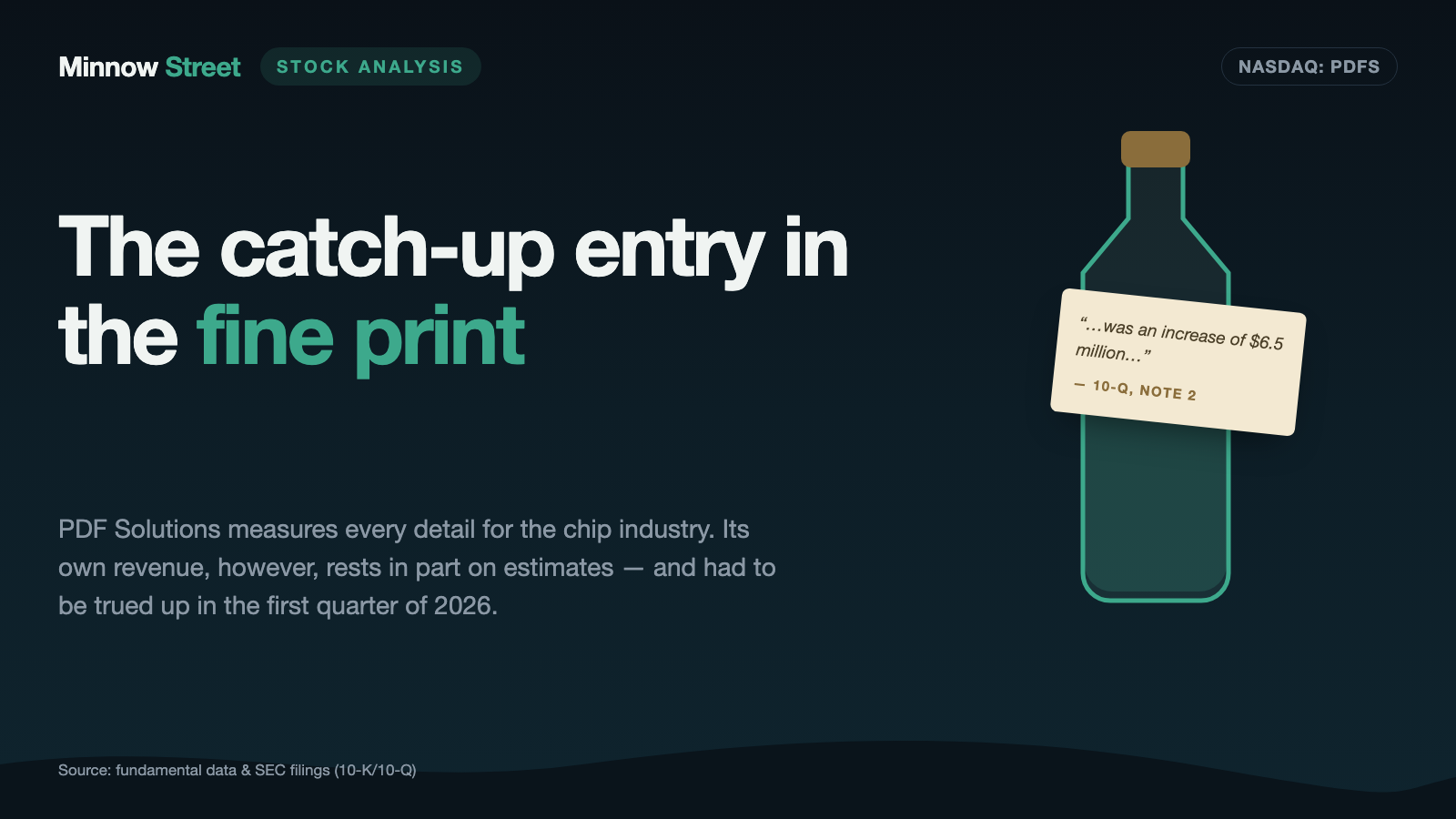
PDF Solutions Stock: The Catch-Up Entry Behind the Earnings Beat
PDF Solutions ranks no. 8 in our in-house Big Earnings Surprise ranking (U.S. selection, as of July 25, 2026): four straight quarters with earnings per share at least 20 percent above the analyst estimate. We read the annual report (10-K) for 2025, the quarterly report (10-Q) as of March 31, 2026, and everything filed with the U.S. securities regulator, the SEC, after that — and found three sentences that shift the picture: $6.5 million of quarterly revenue was a catch-up adjustment for prior periods, interest on the first credit facility in company history turned 2025 operating income into a net loss, and strategic partner Advantest sold its entire stake in May 2026. Not investment advice — only the question of how much of a beat is really this quarter's, once the notes are read.
 Thomas Mücke
Founder & Publisher
Thomas Mücke
Founder & Publisher
Chart
Interactive price chart (TradingView).
Note: pure fact-based analysis, not investment advice and not a solicitation to buy or sell. All figures without guarantee.
There is an investor trap that springs shut whenever a company sells an unusually precise product: the spirit-level trap. It works like this — if a firm builds the most accurate measuring instruments in an industry, surely its own shelves hang straight too. We quietly transfer the precision of the product onto the bookkeeping of its maker. PDF Solutions, Inc. (Nasdaq: PDFS) builds the spirit level of the chip industry: software and measurement hardware that tell semiconductor fabs why only eight hundred out of every thousand chips work. And the stock ranks no. 8 of 81 U.S. hits in our in-house Big Earnings Surprise ranking (as of July 25, 2026) — four straight quarters well above the analyst estimate.
Before we trust that signal, let us make a deal: we read together what the company itself filed under penalty of law with the U.S. securities regulator, the SEC — the annual report (10-K) for 2025, the quarterly report (10-Q) as of March 31, 2026, and everything filed afterwards. And there, in Note 2 of the quarterly report, sits a sentence no press release mentions.
What PDF Solutions actually does — the yield doctor of chip fabs
PDF Solutions was founded in 1991, sits in Santa Clara, California, and employed 600 people as of December 31, 2025 — 225 in research and development, 180 as field application engineers stationed with customers, 135 in sales and marketing, 60 in general and administrative roles; 364 work in the United States and Canada, 197 in Asia, 39 in Europe. The company went public in July 2001.
The product is easiest to explain with a picture. A chip fab is a bakery with five hundred process steps in which nobody can see the dough. A thousand loaves come out and eight hundred are edible — and the decisive question is: what went wrong with the other two hundred? That is the question PDF Solutions answers. The company collects, connects and reads data from design, equipment, manufacturing and test. Five building blocks carry the business:
- Exensio — the analytics software where data from every process step converges, either installed on premises or licensed as software as a service.
- CV systems (Characterization Vehicle) — purpose-built test chips plus an electrical tester that measure a new process before real products run on it.
- DirectScan with the eProbe electron-beam tool — contactless measurement of structures far too small for an optical microscope.
- Cimetrix — the software equipment makers use to connect their machines to factory control systems. In 2025, nearly 8,000 pieces of manufacturing equipment shipped with Cimetrix products, per the company.
- secureWISE — a closed, encrypted network that lets equipment makers service their machines inside third-party fabs without the fab opening its plant network. As of December 31, 2025, more than 300 manufacturing sites and more than 100 equipment makers were connected to it.
Beginning with the 2025 annual report, the company presents revenue in two new categories: Platform (software licenses, maintenance, SaaS, engineering services, fixed fees for CV and DirectScan systems) and Volume-based (Cimetrix runtime licenses, secureWISE data usage and the volume-linked Gainshare fee). That reclassification is not a detail: it shifts the comparison base against every older figure, and it explains why the second category swings so hard. We looked at an adjacent business model in our Cohu analysis, the chip-test equipment specialist — there a company sells the machine; here it sells the understanding of the data the machine produces.
That brings us to the central tension of this analysis, which runs through every chapter: PDF Solutions sells accuracy to the chip industry — and has to estimate a meaningful share of its own revenue. The growth is real. The question is how much of it was actually earned in the quarter it was booked.
Where the stock landed on our desk
We run roughly 3,500 stocks through our scanners every day. As of July 25, 2026, PDF Solutions ranks no. 8 in the U.S. selection of our Big Earnings Surprise ranking (81 hits). To reproduce it: open the scanner, set the country filter to "US" — the list shows the serial beaters in scanner order; the lists are recalculated daily, so the rank can move. The criterion is strict: reported earnings per share must have exceeded the analyst estimate by at least 20 percent in every one of the last four completed quarters.
For PDF Solutions the run looked like this (fundamental data, as of July 25, 2026):
- Q2 2025: $0.06 against $0.05 expected — up 20.0 percent.
- Q3 2025: $0.64 against $0.22 expected — up 190.9 percent.
- Q4 2025: $0.30 against $0.24 expected — up 25.0 percent.
- Q1 2026: $0.31 against $0.23 expected — up 34.8 percent.
Look at the first quarter of that run again. Six cents against five cents expected — a single cent keeps the streak alive and the stock in this ranking. And one more thing belongs to an honest reading: the $0.31 in the first quarter of 2026 is an adjusted figure. The quarterly report puts diluted earnings per share under U.S. accounting rules at $0.12 — less than half. The difference is mainly stock-based compensation ($6.4 million in the quarter) and amortization of acquired intangibles. So the scanner measures the gap between an adjusted number and an expectation for that same adjusted number — neither of which appears in the audited accounts.
The fundamental lens on the same data set shows a mixed picture (as of July 25, 2026): a relative strength rating of 95 (the price momentum is undeniable) and an Altman Z-score of 9.2 (a bankruptcy early-warning gauge; the danger zone historically begins below 1.8, so PDF Solutions is nowhere near it) — but a Piotroski F-score of only 3 out of 9. The Piotroski is a nine-point test for the direction of a balance sheet: are returns, leverage, liquidity and margins improving? Three out of nine means mostly no. That sits awkwardly next to four consecutive earnings beats — and contradictions like that are exactly why we read the filings. Remember the principle: a surprise ranking measures how wrong the expectation was, not how good the business is.
The numbers over the years — what genuinely impresses
Start with what is good, because there is plenty. Revenue at PDF Solutions has nearly doubled in five years: from $111.1 million (2021) through $148.5 million (2022), $165.8 million (2023) and $179.5 million (2024) to $219.0 million (2025) — above the $200 million mark for the first time, and a 22 percent gain in the latest year alone. That is a series, not a spike.
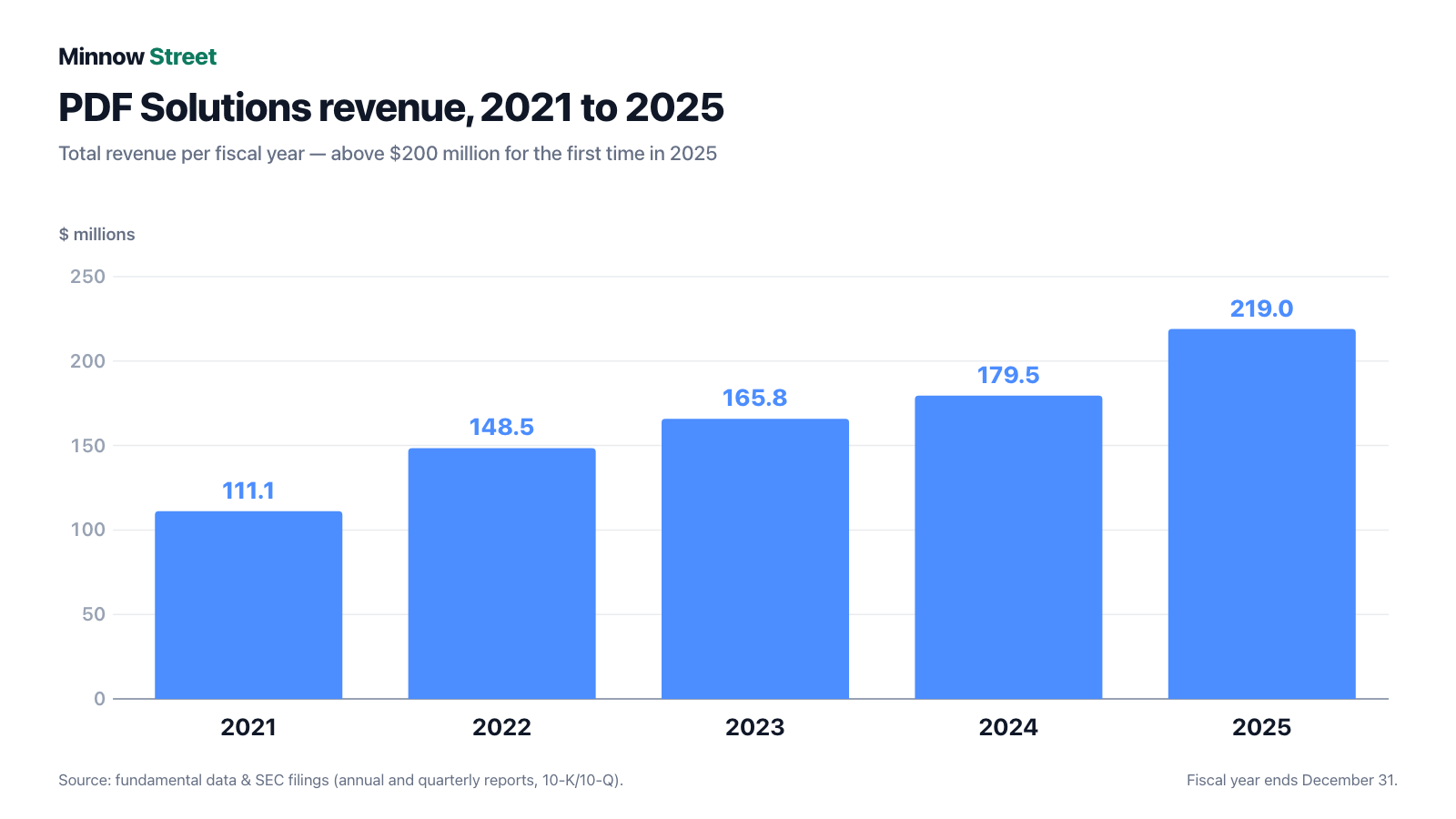
The structure is sound as well: gross margin was roughly 72 percent in 2025 ($158.4 million of gross profit on $219.0 million of revenue) and again 72 percent in the first quarter of 2026. That is software territory. Remaining performance obligations — work already sold but not yet delivered — stood at $246.4 million as of March 31, 2026, with the majority expected to convert to revenue over the next two years per the quarterly report. That is more than a full year of contracted work in hand.
And the first quarter of 2026 was operationally the best in a long time: $60.1 million of revenue (up 26 percent), $50.9 million of it Platform (up 36 percent). Income from operations swung from a $3.6 million loss to a $6.3 million profit, and the bottom line showed $4.8 million of net income after a $3.0 million loss a year earlier. Read only that line and you see a company on the rise. Which is exactly why we keep reading.
Uncomfortable truth no. 1: $6.5 million of quarterly revenue came from earlier periods
Note 2 of the quarterly report as of March 31, 2026 contains the sentence at the heart of this analysis:
“The adjustment to revenue recognized from performance obligations satisfied (or partially satisfied) in previous periods was an increase of $6.5 million and $0.2 million during the three months ended March 31, 2026 and 2025, respectively. These amounts primarily represent changes in estimated percentage-of-completion based contracts and changes in actual versus estimated Gainshare revenue.”
— PDF Solutions, Inc., quarterly report on Form 10-Q for the quarter ended March 31, 2026, Note 2

Translate that into plain numbers. Of the $60.1 million in quarterly revenue, $6.5 million — roughly 11 percent — is money for work performed in earlier quarters and booked too low back then. Total quarterly net income was $4.8 million, so the catch-up is larger than the result. And of the increase versus the year-ago quarter (up $12.4 million), about $6.3 million comes from the difference between this catch-up and last year's ($6.5 million against $0.2 million). Put plainly: roughly half of the celebrated growth is a correction of old estimates.
None of this is an accusation. It is permitted, it is disclosed, and with volume-linked contracts it is unavoidable. PDF Solutions explains why itself: customers do not deliver their acknowledgment reports on actual production volumes in time for quarter-end, so the company must estimate and correct in the following quarter. But it has a consequence for the scanner hit: a surprise that stems from correcting the prior quarter says little about the current business.
How weighty that judgment call is, the auditor recorded. BPM LLP designated revenue recognition as a critical audit matter in the 2025 annual report — the one item that in its own judgment required "especially challenging, subjective, or complex judgments". Named explicitly: allocating contract prices across performance obligations, estimating total costs on fixed-price contracts, and estimating Gainshare revenue. A rule of thumb worth keeping: where the auditor says the math took longest is where you should look too.
Uncomfortable truth no. 2: 2025 operating income arrived — and vanished on the way down
PDF Solutions earned money operationally in 2025: $5.847 million of income from operations after $0.935 million (2024) and a $0.151 million loss (2023). The bottom line still showed a net loss of $0.640 million — after $4.057 million of net income the year before. Three items sit in between.
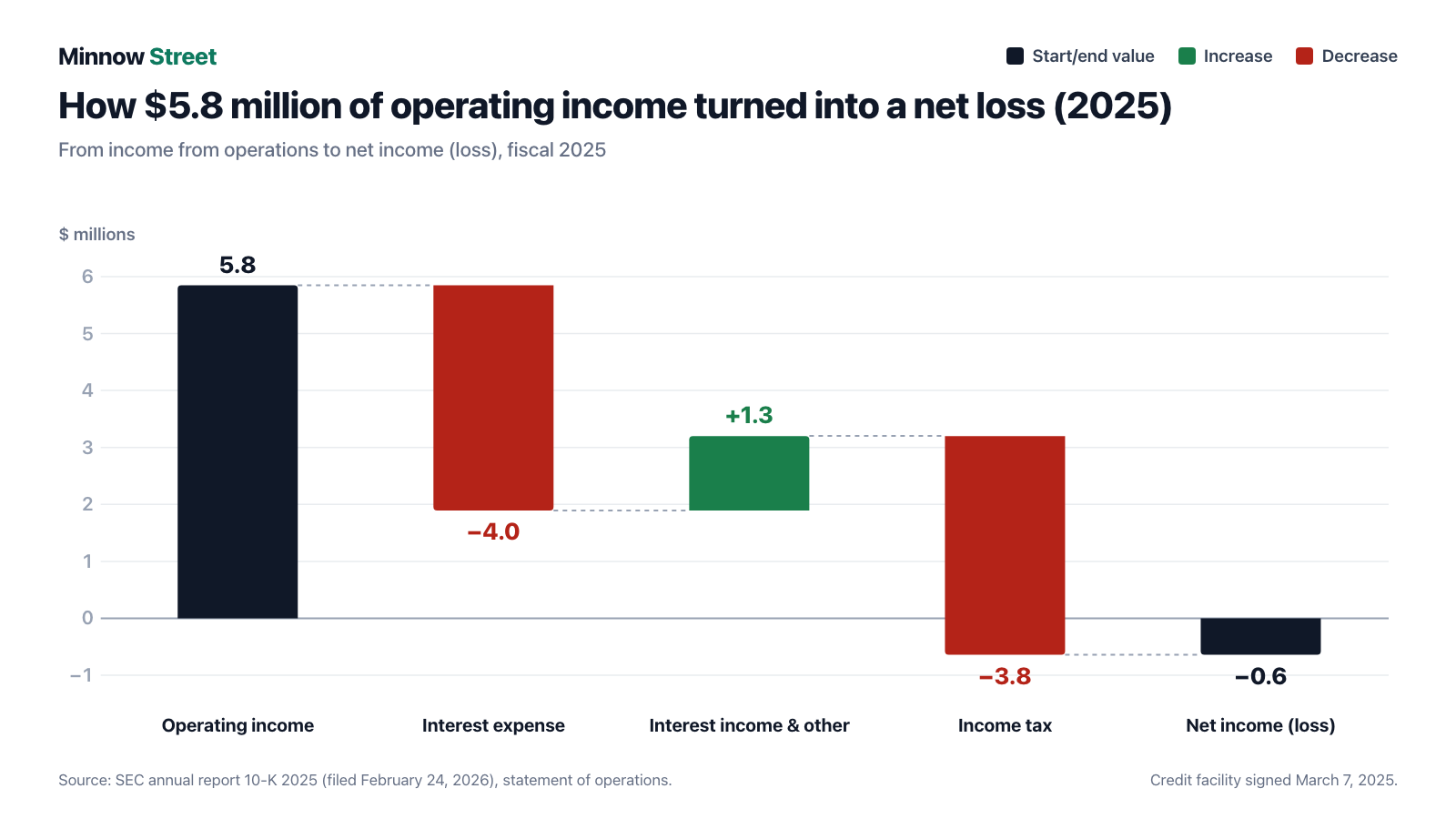
The first item is new: $3.955 million of interest expense — roughly $4.0 million — after zero in 2024. The second is its flip side: interest income fell from $5.644 million to $1.309 million, because the cash is no longer in the bank but in the acquisition. The third is tax, which rose from $2.522 million to $3.841 million despite lower pre-tax income. Added up: $5.8 million of operating profit became a $0.6 million loss.
The annual report explains how it happened. On March 7, 2025, PDF Solutions acquired SecureWise LLC from seller Telit IOT Solutions for a cash purchase price of roughly $130.0 million — bringing the secureWISE remote-service network in house. The same day, the company signed the first credit agreement in its history: a $45 million revolving facility and a $25 million term loan, with Wells Fargo as administrative agent, both maturing in March 2030. The weighted average interest rate on outstanding debt in 2025 was 6.47 percent. The facility is secured — by the equity of the subsidiaries and substantially all personal property of the credit parties — and it binds the company to two covenants: a total net leverage ratio of no more than 3.00 and a fixed charge coverage ratio of at least 1.25. Both were met as of December 31, 2025.
How the purchase price was allocated is the real story: of the $130.767 million in the allocation, $80.008 million went to goodwill — 61 percent to the residual line that appears when a buyer pays more than the separately identifiable assets are worth. Alongside it: $28.9 million of customer relationships (amortized over 13 years), $11.6 million of developed technology (7 years) and $6.6 million of trademark (5 years). Group goodwill jumped from $15.0 million to $95.0 million as a result. As of March 31, 2026, goodwill and intangibles together account for $145.1 million — a good half of the $280.5 million of shareholders' equity. Translated: every second dollar of book equity stands for an expectation, not a thing.
Uncomfortable truth no. 3: the strategic partner sold its shares — all of them
In July 2020 it was the big news: Advantest, one of the two largest makers of chip test equipment worldwide, took a stake in PDF Solutions. 3,306,924 shares for $65.2 million in gross proceeds, plus a development agreement, a commercial agreement and a five-year subscription for the Exensio software. It read like an endorsement: the test-equipment giant betting on its smaller neighbor's analytics.
On May 13, 2026, that story ended:
“On May 13, 2026, PDF Solutions, Inc. (the “Company”) entered into an underwriting agreement … with Morgan Stanley & Co. LLC … and Advantest America, Inc. (the “Selling Stockholder”) in connection with (i) the offering, issuance and sale by the Company of 1,946,630 shares of the Company’s common stock … and (ii) the offering and sale by the Selling Stockholder of 3,306,924 shares of the Company’s Common Stock, at an offering price of $44.00 per share …”
— PDF Solutions, Inc., current report on Form 8-K filed May 15, 2026, Item 8.01

The prospectus supplement of May 14, 2026 leaves no ambiguity: the selling stockholder table shows an 8.29 percent stake before the offering — and a dash after it. Advantest is fully out.
Three observations, without drama. First, the price: the last reported sale price before the offering was $50.95 on May 12, 2026, per the prospectus; the shares priced at $44.00 — roughly 13.6 percent below. The final pricing decision rested with the selling stockholder, that is, with Advantest. Second, the business: revenue from Advantest fell from $12.7 million (2024) to $8.8 million (2025); in the first quarter of 2026 it was $0.5 million after $3.6 million a year earlier. The five-year cloud subscription expired in July 2025, and deferred revenue from the relationship dropped from $8.3 million to $0.7 million. Third, the role: the 2025 annual report also lists Advantest Corporation among competitors in equipment connectivity software. Partner and rival at once — normal in semiconductors, but it explains why a strategic stake need not be permanent.
For PDF Solutions itself the offering was, incidentally, good business: the company issued 1,946,630 of its own shares (including the fully exercised 685,246-share option) and took in roughly $85.7 million in gross proceeds and about $81.8 million net — earmarked, per the prospectus, for general corporate purposes, possibly including debt repayment. After the offering, 41,857,623 shares were outstanding. One footnote the prospectus discloses itself: because an affiliate of Wells Fargo Securities is both an underwriter and the administrative agent of the credit facility and could receive at least 5 percent of the proceeds, the deal ran under conflict-of-interest Rule 5121 of the U.S. regulator FINRA.
Uncomfortable truth no. 4: three customers, 53 percent — two customers, 64 percent of receivables
The PDF Solutions customer list is short, and it is getting shorter:
“As of December 31, 2025, two customers accounted for 64% of the Company’s gross accounts receivable and three customers accounted for 53% of the Company’s total revenues for 2025.”
— PDF Solutions, Inc., annual report on Form 10-K for fiscal 2025, Note 1

In detail: customer A accounted for 30 percent of 2025 revenue (2024: 19 percent, 2023: 35 percent), customer B for 13 percent, customer C for 10 percent. In the first quarter of 2026, customer A rose to 28 percent of revenue (year-ago quarter: 15 percent) — and to 40 percent of receivables. Together with customer C (23 percent), two addresses owe the company 63 percent of all open invoices. If one of them pauses spending, that does not move a decimal place; it moves the year.
A second figure from the same balance sheet fits alongside. Accounts receivable rose to $96.0 million as of March 31, 2026, from $82.9 million at year-end 2025. That is roughly 1.6 times quarterly revenue. In plain terms: for every dollar PDF Solutions books in a quarter, about $1.60 is still sitting in the books as an unpaid invoice. For project work with large customers that is not unusual — but it explains why the profit is in the report while the cash is not yet in the bank: in the first quarter of 2026, operations generated just $1.7 million of cash while $10.5 million went into property and equipment, leaving free cash flow of negative $8.8 million. Full-year 2025 was negative too: $24.1 million from operations against $32.8 million of investment.
Geographically, 2025 revenue split into the United States (48 percent), Japan (18 percent), China (15 percent) and the rest of the world (19 percent). International revenue accounted for 52 percent, down from 59 percent a year earlier. The China share matters because the annual report explicitly warns about export controls, tariffs and the dependence of Chinese fab build-outs on government funding.
Uncomfortable truth no. 5: an arbitration won, but not yet paid
PDF Solutions has been fighting a Chinese customer since 2020 — and won, without being paid:
“On November 12, 2025, the Tribunal issued a confidential arbitration award (the “Award”), which is in favor of the Company. … No payments under the Award have been received by the Company to date and in February 2026, SMIC filed an application with the High Court of Hong Kong seeking to set the Award aside. … Accordingly, no amounts have been recognized in connection with the Award as of March 31, 2026.”
— PDF Solutions, Inc., quarterly report on Form 10-Q for the quarter ended March 31, 2026, Note 12

The opponent is the Shanghai research and development arm of Chinese foundry SMIC; the case has run before the Hong Kong International Arbitration Centre since May 6, 2020, with a hearing in February 2023. The size of the award is confidential and appears in no filing — so the potential income cannot be quantified, and we will not guess at it. What can be quantified is the cost: legal fees for this proceeding rose by $2.7 million in 2025 versus 2024. Against operating income of $5.847 million that is nearly half — and without that increase the year would likely have looked different from a $0.640 million net loss.
For you as a reader the lesson is simpler than the case: a case won is a gain only once the money arrives. Until then it is an opportunity with an open outcome — and the legal bill has already been paid.
What the stock costs — valuation in orders of magnitude
Start with what is fixed. After the May 2026 offering, 41,857,623 shares are outstanding. Multiplied by the last price documented in a filing ($50.95 on May 12, 2026), that puts market capitalization in the region of $2.1 billion — the same order of magnitude fundamental data show as of July 25, 2026. We work from there, in ranges rather than decimals.
- Price-to-sales: roughly 9 times trailing twelve-month revenue of $231.4 million. For comparison: using 2025 full-year revenue of $219.0 million gets you to roughly 10. That is a software multiple, not a hardware multiple.
- Price-to-earnings: triple digits on trailing earnings of $0.17 per share — effectively meaningless. On the 2026 analyst estimate of $1.25 per share it falls to roughly 70. Both numbers say the same thing: the future is being paid for, not the present.
- Price-to-book: roughly 8 times (book value of $7.03 per share, as of July 25, 2026) — with about half of that book value made up of goodwill and intangibles.
- The professionals' view: four analyst opinions, all in buy territory, average target price $62.13 (as of July 25, 2026). With only four voices, that is a mood reading rather than a consensus.
- Pressure from the other side: roughly 7.9 percent of the float was sold short at the same data cut-off, so a visible group is positioned for a decline. The twelve-month price range ran from $18.12 to $71.69 — that is the cost of imagination in this name.
Context helps: the industry's large equipment makers, such as Applied Materials, traditionally trade far lower — they sell machines with a bill of materials. PDF Solutions sells software and data and is priced accordingly. The question is not whether 9 times sales is too much for software; it is not automatically. The question is whether the earnings line ever catches up: 2025 delivered $5.8 million of operating income on $219.0 million of revenue — an operating margin of 2.7 percent. At a 72 percent gross margin, the rest goes into research ($64.2 million) and selling and administration ($84.7 million), including $25.9 million of stock-based compensation — more than four times operating income.
Opportunities and risks at a glance
What speaks for PDF Solutions:
- Five years of revenue growth without a setback: from $111.1 million (2021) to $219.0 million (2025), up 22 percent in the latest year and 26 percent in the first quarter of 2026.
- Software margins: 72 percent gross margin in 2025 and in the first quarter of 2026 — the operating leverage exists in principle.
- Remaining performance obligations of $246.4 million as of March 31, 2026, mostly due within two years.
- The SecureWise acquisition embeds the company deep inside manufacturing: more than 300 connected sites and more than 100 equipment makers as of December 31, 2025. That position is not quickly replicated.
- Fresh capital: roughly $81.8 million of net proceeds from the May 2026 offering — enough to shrink the credit facility materially or fund the next acquisition.
- Industry tailwind: more fabs, more complex processes and more expensive wafers make every additional point of yield more valuable.
What speaks against it:
- The earnings beat feeding this ranking is measured on adjusted figures ($0.31 versus $0.12 per share under U.S. accounting rules in the first quarter of 2026) and included $6.5 million of catch-up revenue from prior periods.
- The bottom line in 2025 was a $0.640 million net loss; the $3.955 million of interest expense recurs every year the facility is outstanding.
- Concentration risk: three customers, 53 percent of 2025 revenue; two customers, 64 percent of receivables as of December 31, 2025.
- Free cash flow was negative in 2025 and in the first quarter of 2026 (negative $8.7 million and negative $8.8 million) — growth consumes capital, mostly for DirectScan systems.
- Strategic partner Advantest has exited entirely, and revenue from the relationship is running off ($0.5 million in the first quarter of 2026 after $3.6 million a year earlier).
- Balance-sheet structure: $145.1 million of goodwill and intangibles against $280.5 million of equity (March 31, 2026); one failed impairment test hits equity directly.
- Valuation with little cushion: roughly 9 times sales and roughly 70 times the 2026 earnings estimate — on a 2.7 percent operating margin in 2025.
A human bottom line
Back to the spirit level. PDF Solutions builds an excellent measuring instrument — the company knows more about the yield of other people's chip fabs than almost anyone, and customers have paid growing invoices for five years running. But its own shelf hangs less straight than the product suggests: quarterly revenue contains catch-up entries from earlier quarters, the earnings surprise is an adjusted figure, 2025 operating income was consumed by interest and taxes, and the most prominent shareholder sold at a discount.
None of that is a scandal. All of it sits openly in the filings — you just have to read the notes rather than the headlines. And none of it changes the fact that this is a company with a genuine technological position, $246.4 million of contracted work and fresh cash in the bank.
What it does change is the yardstick. Buying PDF Solutions is not buying "four straight quarters above expectations". It is buying a company that has nearly doubled in five years, borrowed to do it, and whose earnings line does not yet carry the valuation. Whether that fits your portfolio depends on how long you can wait — and how much it bothers you that the most precise firm in the industry has to estimate for itself. The decision is yours.
Sources
- Annual report on Form 10-K for fiscal 2025, PDF Solutions, Inc. (CIK 0001120914), filed February 24, 2026 — Item 1 (business, employees, customers), Item 7 (management discussion, credit facility, segment figures), Note 1 (customer concentration), Note 13 (customers and regions), Note 15 (Advantest), Note 16 (SecureWise purchase price allocation), report of independent registered public accounting firm BPM LLP (critical audit matter).
- Quarterly report on Form 10-Q for the quarter ended March 31, 2026, filed May 7, 2026 — balance sheet, statement of operations, statement of cash flows, Note 2 (revenue recognition, catch-up adjustment, remaining performance obligations), Note 9 (earnings per share), Note 10 (customer concentration), Note 12 (SMIC arbitration), Note 13 (Advantest).
- Annual report on Form 10-K for fiscal 2024, filed February 27, 2025 — comparative figures and the prior revenue presentation.
- Current report on Form 8-K filed May 15, 2026, Item 8.01 — underwriting agreement of May 13, 2026, offering at $44.00 per share, gross proceeds of $85.7 million, closing on May 15, 2026.
- Prospectus supplement on Form 424B5 dated May 14, 2026 — "Selling Stockholder" (Advantest, 8.29 percent before and none after the offering), "Use of Proceeds", share count, May 12, 2026 price, FINRA Rule 5121 conflict of interest.
- Current report on Form 8-K filed June 18, 2026, Item 5.07 — results of the annual meeting of June 16, 2026, ratification of BPM LLP as auditor for 2026.
- Screener and valuation data: our in-house stock scanner and fundamental data (as of July 25, 2026), including the Big Earnings Surprise ranking (U.S. selection, rank 8 of 81).
This article is journalistic analysis of publicly available company filings. It is not investment advice, not a buy or sell recommendation, and not a solicitation to buy or sell securities. Stocks can lose their entire value at any time. All figures come from the SEC filings named above and from fundamental data with the stated cut-off dates; price and valuation figures carry a data cut-off of July 25, 2026 and will age. The author holds no position in PDF Solutions, Inc. at the time of publication. Please make your own investment decisions — or consult an adviser you trust.
Our Bottom Line at a Glance
- Growth & market position positive
- Five years of revenue growth without a setback: from $111.1 million (2021) to $219.0 million (2025), and another 26 percent to $60.1 million in the first quarter of 2026. As of December 31, 2025, the secureWISE network linked more than 300 manufacturing sites with more than 100 equipment makers — a position that is not quickly replicated.
- Quality of the earnings beat negative
- The four beats rest on an adjusted earnings figure (Q1 2026: $0.31 versus $0.12 per share under U.S. accounting rules), and $6.5 million of the quarter's $60.1 million in revenue was a catch-up adjustment for prior periods (year-ago quarter: $0.2 million). Auditor BPM LLP flagged revenue recognition as a critical audit matter in 2025.
- Earnings power & balance sheet negative
- In 2025, $5.847 million of operating income turned into a $0.640 million net loss after $3.955 million of interest expense and $3.841 million of tax. Free cash flow was negative in 2025 (negative $8.7 million) and in the first quarter of 2026 (negative $8.8 million); goodwill and intangibles tie up $145.1 million of the $280.5 million of equity (03/31/2026).
- Owners & partners negative
- Advantest America sold its entire 3,306,924-share stake (8.29 percent) on May 13, 2026 at $44.00, against a last reported sale price of $50.95 on May 12, 2026. Revenue from Advantest fell from $12.7 million (2024) to $8.8 million (2025) to $0.5 million in the first quarter of 2026, after $3.6 million a year earlier.
- Concentration risk negative
- Three customers accounted for 53 percent of 2025 revenue and two customers for 64 percent of gross receivables (12/31/2025); in the first quarter of 2026, customer A alone supplied 28 percent of revenue and 40 percent of open invoices. China contributed 15 percent of 2025 revenue, with export and tariff risks named explicitly in the annual report.
- Valuation neutral
- A market capitalization of roughly $2.1 billion equals about 9 times trailing revenue, about 8 times book value and roughly 70 times the 2026 earnings estimate (as of 07/25/2026) — on a 2.7 percent operating margin in 2025. Roughly $81.8 million of fresh equity from the May offering takes pressure off the balance sheet.
PDF Solutions supplies the chip industry with the tools it uses to measure its own yield, and has grown for five straight years, from $111.1 million to $219.0 million in revenue. The four consecutive earnings beats that carry the stock to rank 8 in our Big Earnings Surprise ranking hold up only partially under close reading: they are measured on adjusted figures, and $6.5 million of first-quarter 2026 revenue was a catch-up entry from prior periods. Add interest expense that consumed all of 2025 operating income, three customers accounting for 53 percent of revenue, and a strategic partner that sold its whole stake at a discount in May 2026. Buying here is a bet that a 72 percent gross margin eventually becomes a visible net margin. Not investment advice.
What Our Rating Means
Open questions
The business works in principle, but one material question is open. As long as it stays open, our findings do not carry a quality verdict.
Buying today means paying roughly 9 times sales for a company that reported a $0.640 million net loss in 2025 and had negative free cash flow most recently. Waiting means checking four lines in the next quarterly report (10-Q): the catch-up adjustment for prior periods in Note 2 (last reading: plus $6.5 million), volume-based revenue (Q1 2026: $9.2 million, down 12 percent), revenue from Advantest (last reading: $0.5 million) and free cash flow. If growth arrives without catch-up entries and with cash, the valuation is explainable. The decision is yours.
A journalistic assessment by our editorial team at the time of the deep dive, based on public sources — not investment advice and not a solicitation to buy or sell. Your personal circumstances (investment goals, risk capacity, taxes) cannot be taken into account. What our levels mean, how verdicts are formed, and what conflicts of interest exist →
Worth Noting
- PDFS reached our research list as rank 8 of 81 U.S. hits in the in-house Big Earnings Surprise ranking (as of July 25, 2026, relative strength rating 95) — part of our series filling the top 50 of that ranking with analyses. The scanner lists are recalculated daily.
- The ranking evaluates reported earnings surprises over the last four quarters. It measures an adjusted earnings figure against the estimate for that same adjusted figure — not earnings under U.S. accounting rules. In the first quarter of 2026 that was $0.31 adjusted against $0.12 diluted in the quarterly report.
- Recency note: the latest quarterly report (10-Q) is dated May 7, 2026. Filings made after that have been reviewed — in particular the share offering of May 13 to 15, 2026 (S-3ASR, 424B5, 8-K) and the annual meeting of June 16, 2026 (8-K filed June 18, 2026). Balance sheet effects of the offering will first appear in the second-quarter 2026 report; fundamental data list August 6, 2026 as the expected reporting date (as of July 25, 2026).
- Easily confused: "PDF" here stands for the company name PDF Solutions (process design for manufacturability) and has nothing to do with the PDF file format.
Frequently Asked Questions
PDF Solutions, Inc. (Nasdaq: PDFS, Santa Clara, California) sells the semiconductor industry software and measurement hardware that raise manufacturing yield: the Exensio analytics software, CV test-chip systems, DirectScan e-beam tools, Cimetrix equipment connectivity and the secureWISE remote-service network. Revenue reached $219.0 million in 2025 — $181.0 million of it Platform revenue and $38.0 million volume-based.
Because reported earnings per share exceeded the analyst estimate by at least 20 percent in each of the last four quarters: 20.0 percent (Q2 2025), 190.9 percent (Q3 2025), 25.0 percent (Q4 2025) and 34.8 percent (Q1 2026). As of July 25, 2026 that is good for rank 8 of 81 U.S. hits. Note that the measure is an adjusted earnings figure, not earnings under U.S. accounting rules.
It means $6.5 million of the quarter's $60.1 million in revenue related to work already performed in earlier periods and booked too low back then. A year earlier the figure was $0.2 million. The quarterly report attributes it to changes in estimates on percentage-of-completion contracts and to the gap between estimated and actual Gainshare revenue.
Operationally yes, on the bottom line not consistently. In 2025 PDF Solutions earned $5.847 million of operating income but reported a $0.640 million net loss after $3.955 million of interest expense and $3.841 million of tax. The first quarter of 2026 showed $4.791 million of net income, or $0.12 per diluted share.
To fund the acquisition of SecureWise LLC. On March 7, 2025, PDF Solutions paid roughly $130.0 million in cash to seller Telit IOT Solutions and signed a credit agreement the same day for a $45 million revolving facility and a $25 million term loan, both maturing in March 2030. The weighted average interest rate in 2025 was 6.47 percent.
The filings give no reason. What is documented is the transaction: on May 13, 2026, Advantest America sold all 3,306,924 shares — 8.29 percent before the offering — at $44.00 per share, while the last reported sale price on May 12, 2026 was $50.95. In parallel the joint business is running off: $0.5 million of revenue in the first quarter of 2026 after $3.6 million a year earlier.
Very. Per the 2025 annual report, three customers accounted for 53 percent of full-year revenue and two customers for 64 percent of gross accounts receivable. In the first quarter of 2026, customer A alone represented 28 percent of revenue and 40 percent of open invoices. Regionally, 2025 revenue came 48 percent from the United States, 18 percent from Japan and 15 percent from China.
That a valuation of roughly 9 times sales meets an earnings line that is still very thin: a 2.7 percent operating margin in 2025, negative free cash flow in 2025 and in the first quarter of 2026, plus $145.1 million of goodwill and intangibles against $280.5 million of equity (March 31, 2026). If a major customer disappoints, revenue and valuation take the hit at the same time.
Found an error?
Did you spot a factual error, an outdated number, or a typo in this deep dive? Let us know briefly — your report goes straight to the editorial team.