Twist Bioscience: $376 Million in Revenue, $191 Million in Gross Profit — and $247 Million Just for Selling and Admin
Twist Bioscience prints synthetic DNA onto a silicon chip, has grown at double-digit rates for years and has never posted a profitable fiscal year. In fiscal 2025 revenue rose 20 percent to $376.6 million and the gross margin climbed to 50.7 percent — yet the company still reported a $136.3 million operating loss, because selling and administrative expenses alone consumed $247.0 million. The net loss that shrank to $77.7 million contains a $48.8 million one-time gain from selling the data storage business, and in the first half of fiscal 2026 the loss grew again. We read the filings to the U.S. securities regulator, the SEC, line by line and work out where the money actually goes.
 Thomas Mücke
Founder & Publisher
Thomas Mücke
Founder & Publisher
Chart
Interactive price chart (TradingView).
Note: pure fact-based analysis, not investment advice and not a solicitation to buy or sell. All figures without guarantee.
There is an investing trap that catches the curious in particular — the people who follow technology and can read a chart. Call it growth-curve hypnosis. It works like this: you see a revenue series climbing year after year — $203 million, $245 million, $313 million, $376 million — and your mind switches into storytelling mode. It fills in the rest automatically: "the profit will follow." Scale, operating leverage, at some point it tips into the black. Sometimes that is exactly what happens. With Twist Bioscience (NASDAQ: TWST) of South San Francisco, it is worth looking closer. The company writes synthetic DNA onto a silicon chip — a genuinely impressive process with real customers and real demand behind it. The stock landed on our desk through a momentum list produced by our in-house stock scanner: rank 12 of 28 U.S. hits in the weekly ranking, as of July 25, 2026. So let us make a deal. Before you trust the curve, we read together what Twist itself has filed with the U.S. securities regulator, the SEC — the annual report on Form 10-K for fiscal 2025, the quarterly report on Form 10-Q for the period ended March 31, 2026 and the shelf registration of June 18, 2026. Those documents are honest under penalty of law. And they describe a product that earns money, sitting inside a company that does not.
What Twist Bioscience actually does — DNA as a printing job
Genetic information is, at bottom, a text written in four letters. A lab that wants to study a particular gene first has to obtain it — and because you cannot always cut it out of a living organism, it gets built instead. That is Twist’s business: synthetic DNA made to order. What sets it apart is manufacturing. Conventionally, DNA is synthesised in individual small vessels, one reaction per vessel. Twist works more like an inkjet printer: the company "writes" DNA onto a silicon chip, packing very many reactions into very little space. The annual report describes it as "a proprietary technology that pioneers a new method of manufacturing synthetic DNA by ‘writing’ DNA on a silicon chip." Put in everyday terms: competitors write each letter by hand, Twist prints a whole newspaper page at once. Hence the scale advantage, hence the lower unit cost.
The output sells in four baskets. The largest is next-generation sequencing tools, or NGS applications: $208.1 million, 55 percent of fiscal 2025 revenue — the building blocks labs use to prepare samples for sequencing. Then come synthetic genes at $113.6 million, 30 percent; antibody discovery services for pharmaceutical customers at $23.5 million, 6 percent; oligo pools at $20.2 million, 6 percent; and DNA libraries at $11.2 million, 3 percent. Geographically, 60 percent of revenue comes from the Americas, 33 percent from Europe, the Middle East and Africa, and 7 percent from Asia-Pacific. Customers stay: 99 percent of fiscal 2025 revenue came from repeat customers, and more than 3,800 customers bought during the year. That is the good news, and the reason the company is worth studying at all.
One point is often misremembered. The much-discussed business of DNA as a data storage medium no longer belongs to Twist. On May 2, 2025 the company transferred that unit to newly formed Atlas Data Storage, Inc., which outside investors funded with $155.0 million of seed capital. Twist received preferred shares valued at $53.9 million, $2.5 million in cash, a $2.0 million promissory note and potential later milestone payments of up to $75.0 million — and today holds a minority stake plus one of seven seats on the Atlas board. That also names the central tension of this analysis, and it runs through every chapter: Twist’s product earns money — every dollar sold now yields more than fifty cents of gross profit. The company still earns nothing, because the apparatus around the product costs more than the product brings in.
Where the stock landed on our desk — rank 12 in the weekly ranking
Twist Bioscience did not come to our attention through a press release but through a run of our in-house stock scanner dated July 25, 2026: in the list Richard Moglen: 1 Week Top Performers (U.S. selection) the stock stood at rank 12 of 28 hits. That list is recalculated every day — the placement is a snapshot of that date, not a permanent state. To replicate it: the ranking is openly available in the scanner overview and can be clicked through there.
What does the filter actually measure? Three things, all mechanical: a gain of at least 15 percent over four trading days, average daily dollar volume of at least $10 million, and a relative strength rating of at least 70 out of 100. Twist cleared all three comfortably: average dollar volume ran at about $160.2 million (data as of July 24, 2026) and the strength rating stood at 96. Translated and assessed, that means the stock was among the strongest liquid names of that trading week — a rating of 96 implies only about four percent of all measured stocks ran harder over the same period. That is a strong finding about the share price. It says nothing about the company. Keep the principle in mind from the start: a momentum filter is a door opener, not an appraisal. Which is why the rest of this piece counts rather than cheers.
The numbers over the years — given their due
First the part that genuinely impresses, and it is more than one line. Revenue has nearly doubled in three years: from $203.6 million in fiscal 2022 through $245.1 million and $313.0 million to $376.6 million in fiscal 2025 — up 20 percent in the last year alone, carried by sequencing tools, up $39.0 million, and synthetic genes, up $20.9 million. Volume grew with it: 938,000 genes shipped in fiscal 2025 against 772,000 the year before, a 22 percent increase. The quarter ended March 31, 2026 continued the pattern — $110.7 million of revenue, up 19.3 percent, and roughly 300,000 genes shipped, up 32 percent.
The second curve matters more, and it is the real evidence that the chip process works: gross margin rose from 36.6 percent in fiscal 2023 through 42.6 percent in 2024 to 50.7 percent in 2025 — and to 51.8 percent in the half year ended March 31, 2026. The reason is stated in the filing and is exactly what you want to see from a factory that scales: revenue rose 20 percent while cost of revenues rose only 3 percent. Put in everyday terms: the bakery bakes a fifth more loaves without buying a second oven. Add a balance sheet without ballast — as of March 31, 2026, total assets of $676.2 million faced only $221.1 million of liabilities, most of that lease obligations. Twist carries effectively no interest-bearing bank debt. For anyone who usually trips over interest coverage: there is simply no interest burden here.
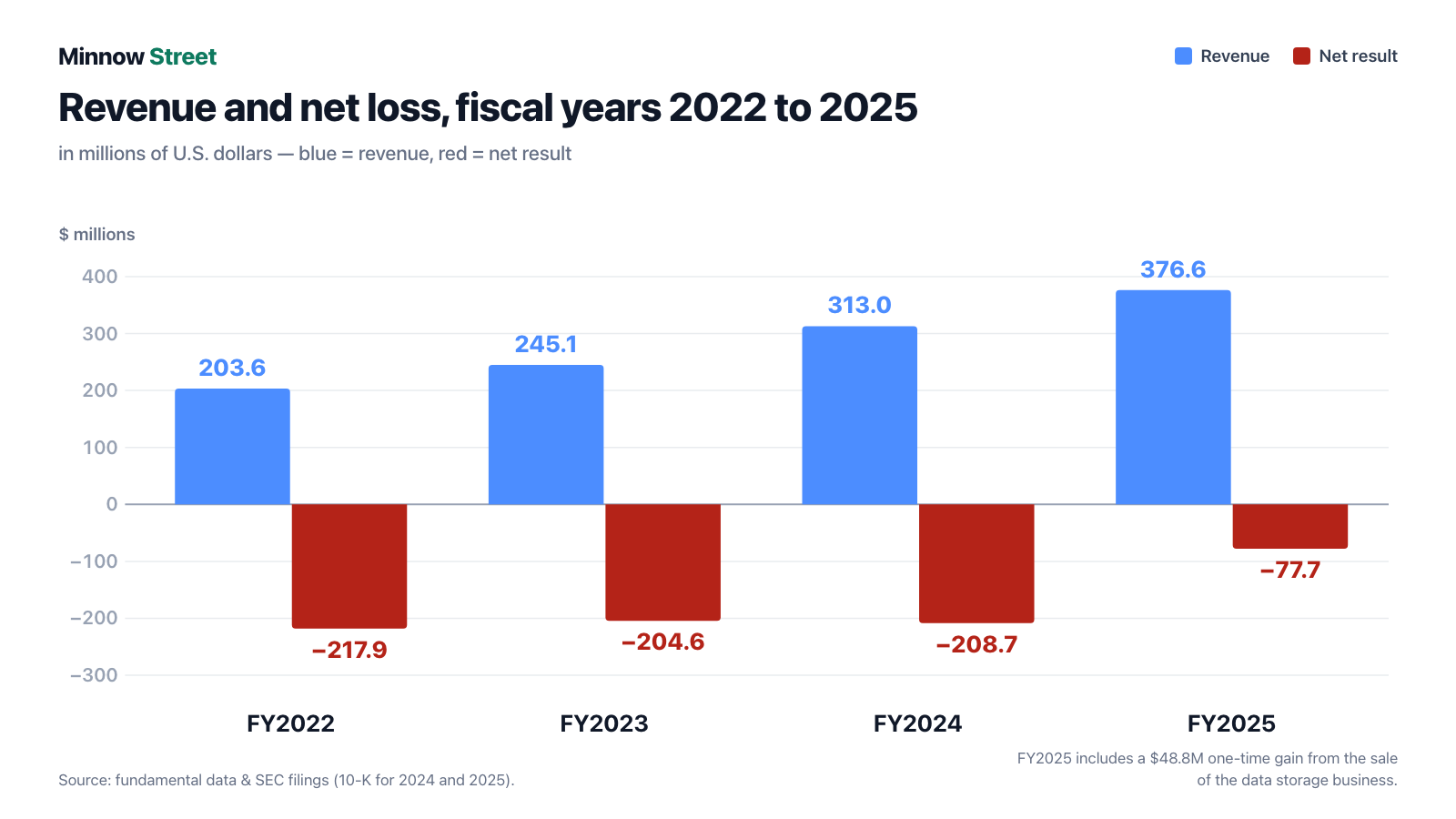
And now the chart that explains everything — revenue and net result side by side across four fiscal years. The loss series reads: $217.9 million in fiscal 2022, $204.6 million in 2023, $208.7 million in 2024 and $77.7 million in 2025 — four years, not one of them profitable:
The quarterly report puts it in a single sentence, and it is worth reading verbatim:
"The Company has recognized annual losses from operations since inception and has an accumulated deficit of $1,394.1 million as of March 31, 2026."
— Twist Bioscience Corporation, Form 10-Q for the quarter ended March 31, 2026, Note 1 (SEC EDGAR)
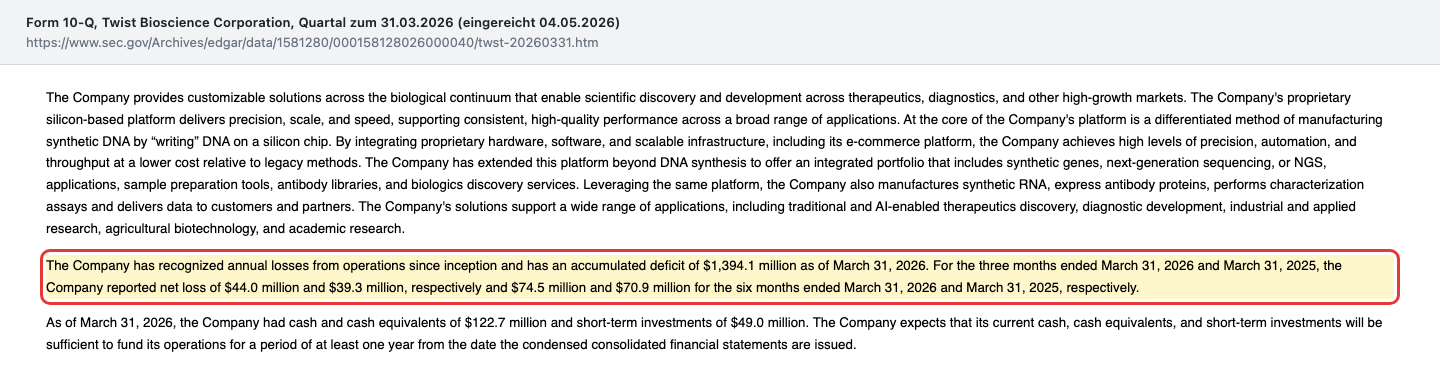
Remember that figure, it anchors this analysis: $1.39 billion has been consumed since 2013. Shareholders paid in $1.85 billion over the same period — three quarters of it is gone. Which brings us to the uncomfortable truths.
What the filings say — the uncomfortable truths
Uncomfortable truth No. 1: selling and administration cost more than the entire gross profit
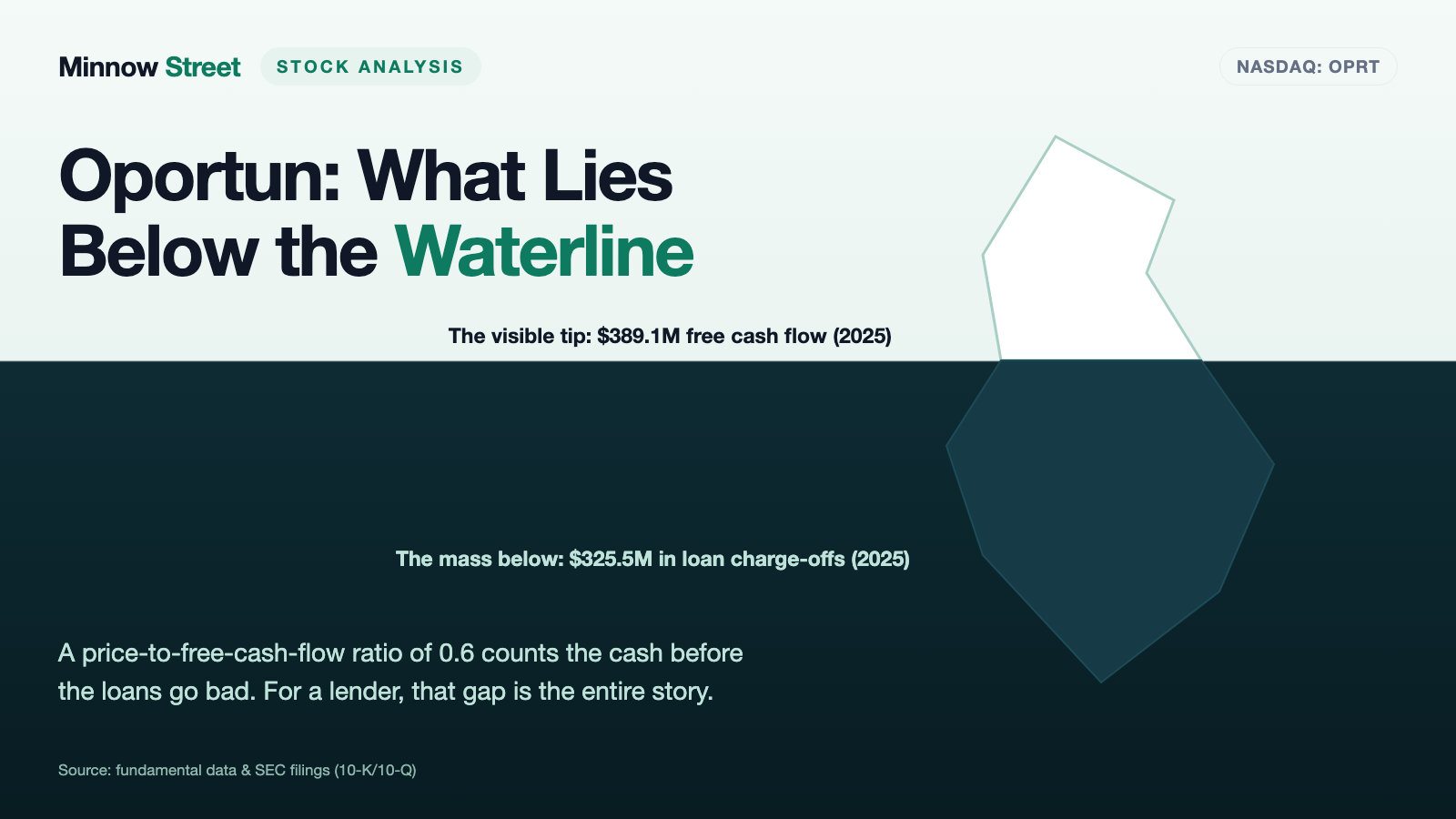
This is the number everything at Twist hangs on. In fiscal 2025, $376.6 million of revenue less $185.6 million of cost of revenues left $191.0 million of gross profit. In the same year, selling, general and administrative expenses came to $247.0 million — $56.0 million more than the product delivered in the first place. And that is before a single dollar of research: R&D added a further $80.3 million. The chart below traces the path from revenue to operating result in four steps:
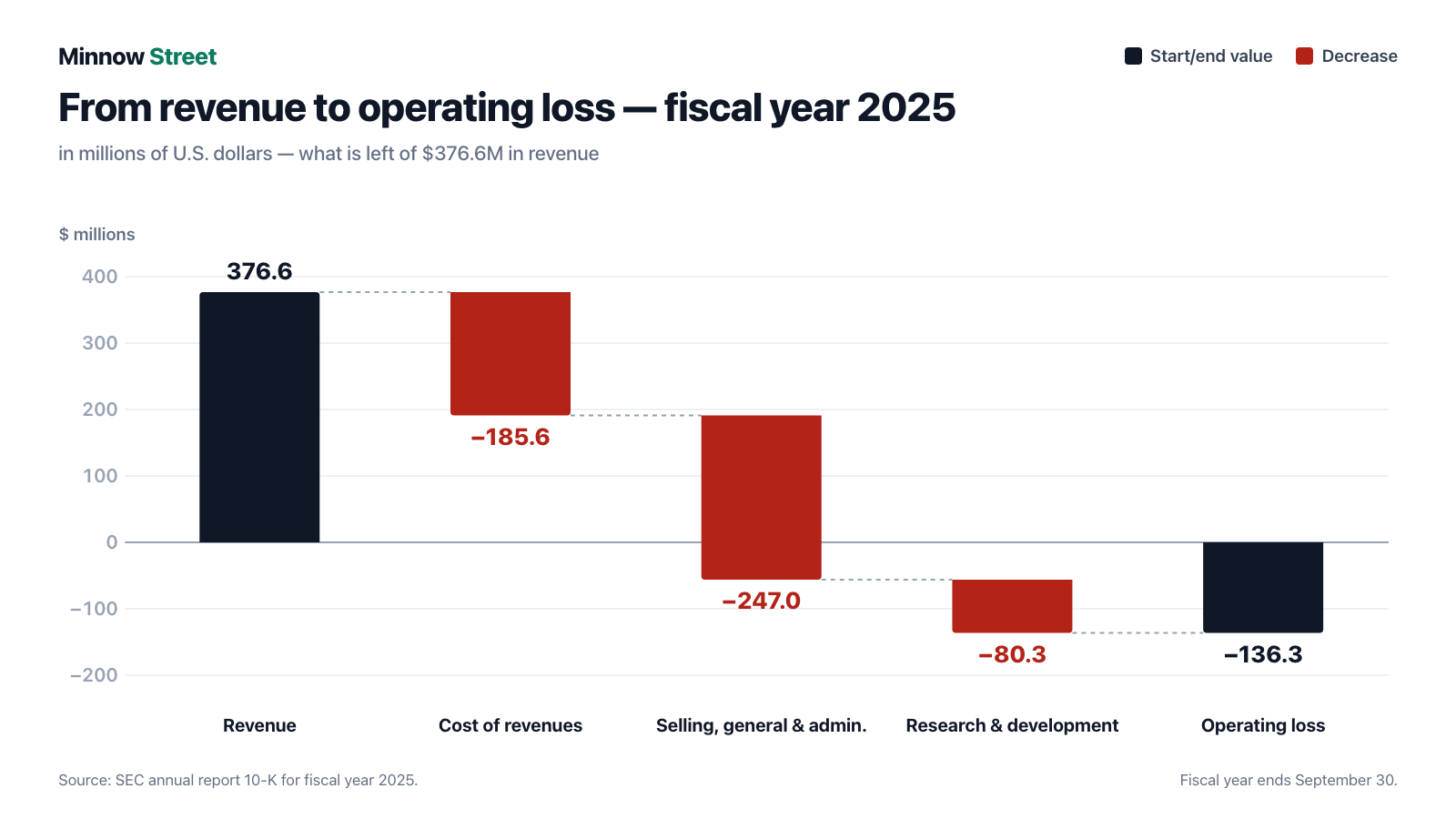
The direction matters as much as the level. In the quarter ended March 31, 2026, gross profit rose $11.1 million to $57.1 million — while selling, general and administrative expenses rose $12.4 million to $76.1 million. The entire gain from growth was swallowed by the apparatus, and then some. Put in everyday terms: you get a $200 raise and your rent goes up by $220. That is precisely why the operating loss widens despite record revenue — up 10.4 percent in the quarter, to $45.9 million.
In fairness: management sees the problem and writes it down. The quarterly report contains a testable promise:
"We expect selling, general and administrative expense to moderate in the second half of fiscal 2026 resulting from a number of cost saving initiatives."
— Twist Bioscience Corporation, Form 10-Q for the quarter ended March 31, 2026, Item 2 MD&A (SEC EDGAR)
That statement carries a due date: the second half of fiscal 2026 covers the quarters ending June 30 and September 30, 2026. Whether the costs actually fall will be visible in the next filing — and it will read more honestly there than in any presentation. For contrast, what a life-science tools supplier looks like once it has broken its own cost curve is laid out in our analysis of Bio-Techne — the same customer base, an entirely different cost picture.
Uncomfortable truth No. 2: the halved loss is a sale price, not progress
At first glance fiscal 2025 looks like the breakthrough: the net loss fell from $208.7 million to $77.7 million. Read only that line and you see a company on the verge of profit. The income statement tells it differently. It contains a line that did not exist the year before: "Gain on sale of business" — $48.8 million, the book gain on selling the DNA data storage unit to Atlas Data Storage on May 2, 2025. Strip out that one-time item and the loss was roughly $126.5 million — still better than the prior year, but a reduction of about a third rather than a halving. A further slice of the year-over-year improvement came from a write-down that simply did not recur: $44.9 million of impairment on the biopharma asset group weighed on fiscal 2024.
How much of that was real progress shows up in the current year, and the answer is uncomfortable. In the half year ended March 31, 2026 the net loss rose again — to $74.5 million from $70.9 million a year earlier. The operating loss grew from $76.2 million to $78.8 million. And the money left faster: operating cash burn rose 23.1 percent, from $34.4 million to $42.4 million. Remember the distinction, it is among the most useful there is: a one-time gain improves the result exactly once — a broken cost curve improves it every year. At Twist, so far, it has been the former.
Uncomfortable truth No. 3: a third of gross profit is paid in the company’s own shares
Stock-based compensation is the most elegant way to make costs invisible: it appears in the income statement but consumes no cash — payment is made in new shares, which is to say with a slice of your cake. At Twist that slice is large and growing fast. Stock-based compensation rose from $30.3 million in fiscal 2023 through $50.9 million in 2024 to $64.5 million in 2025 — more than a doubling in two years. That equals 17 percent of revenue and one third of the entire gross profit. Where it lands is the striking part: the share booked in selling and administration grew from $11.8 million in fiscal 2023 to $48.5 million in fiscal 2025 — a fourfold increase in two years — while the research share fell from $13.9 million to $9.0 million.
What that means for you as a part-owner shows in the share count. As of September 30, 2025 there were 60.632 million shares outstanding; by March 31, 2026 the figure was 62.154 million — up 2.5 percent in six months. And the stock of promises not yet issued is substantial: the earnings-per-share footnote lists 6.502 million potentially dilutive shares (1.181 million from options, 5.257 million from unvested stock awards, 64,000 from the employee stock purchase plan) — a good 10 percent of today’s count. Put in everyday terms: your slice of the cake shrinks a little every year without anyone taking anything from you — the cake is simply cut into more pieces.
Twist also prefers paper to cash when buying. In February 2026 the company acquired a licence to Invenra Inc.’s "B-Body" antibody platform together with a 6.24 percent stake — total commitment $33.8 million, of which only $5.0 million was cash. The remaining $28.8 million was settled in the company’s own shares; the related Form 8-K of February 17, 2026 names up to 632,328 new shares. The filing states the benefit plainly: the structure limits "the cash impact on liquidity." True for the treasury. Not for your stake.
Uncomfortable truth No. 4: a $200 million switch has been open since June 18, 2026
This filing arrived without a headline. On June 18, 2026 Twist filed an automatic shelf registration on Form S-3ASR with the SEC — a framework that lets a company issue securities at any later date without a fresh approval process each time. The attached prospectus supplement is the interesting part: it describes an ongoing at-the-market program of up to $200 million.
"In accordance with the terms of the Sales Agreement, we may offer and sell shares of our common stock having an aggregate offering price of up to $200,000,000 from time to time through or to TD Cowen, acting as sales agent or principal."
— Twist Bioscience Corporation, Form S-3ASR of June 18, 2026, sales agreement prospectus (SEC EDGAR)
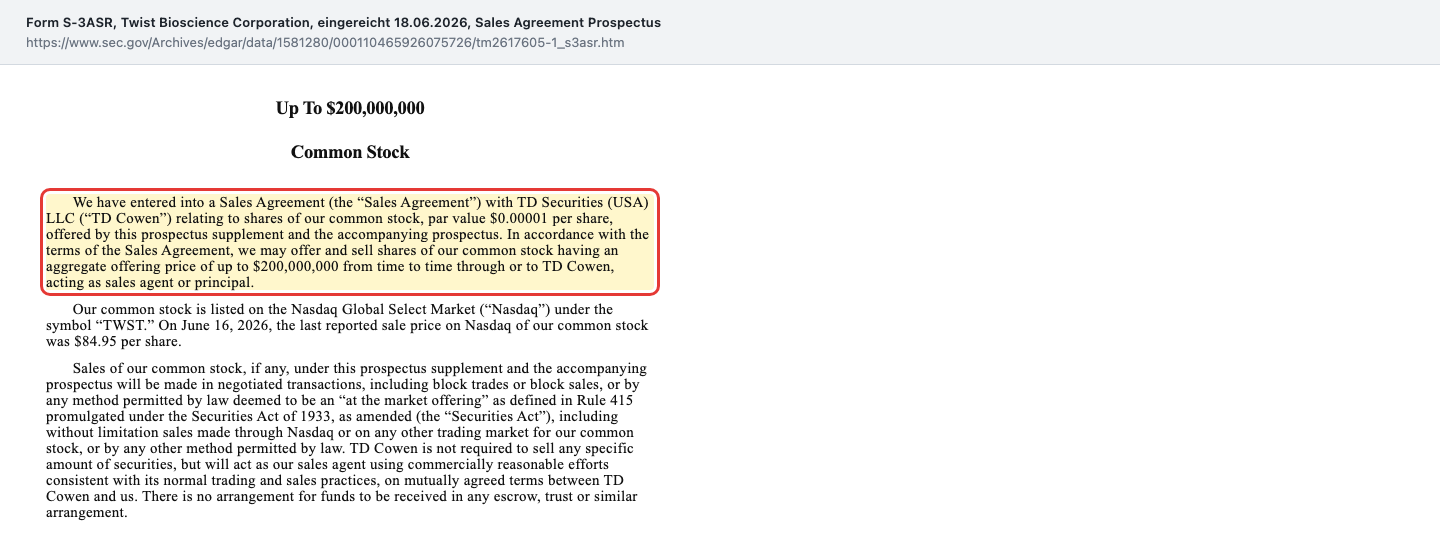
There is no need to dramatise this: such a program is an option, not an obligation — Twist need not sell a single share, and the filing says so explicitly. But the scale is notable. At the $84.95 price named in the same document, a full drawdown would mean 2,354,326 new shares, roughly 3.8 percent of the outstanding count. The filing also spells out what a buyer receives: tangible book value stood at $5.79 per share as of March 31, 2026, so anyone paying $84.95 acquires $5.79 of substance and pays $76.37 of premium for the future. That is not an accusation — for a growth company it is the norm. It is simply better to have seen the number before paying it.
Uncomfortable truth No. 5: a class action from 2022 costs $17.1 million — and is not finished
On December 12, 2022 investors filed a putative securities class action in the federal court for the Northern District of California against Twist Bioscience, its chief executive officer and its chief financial officer, alleging violations of federal securities laws. Three and a half years later there is a result:
"On March 31, 2026, the parties engaged in mediation and reached a settlement in principle under which the Company would pay, or cause its insurance carriers to pay, a settlement payment of approximately $17.1 million."
— Twist Bioscience Corporation, Form 10-Q for the quarter ended March 31, 2026, Note 11 Commitments and Contingencies (SEC EDGAR)

The good news is in the split: Twist has recorded $14.9 million as a probable recovery from its liability insurers, and the quarterly income statement carries $7.2 million under the new line "Litigation settlement costs, net of recoveries." The bulk is therefore not paid out of the company treasury. The matter is not closed, however: the motion for preliminary court approval was only filed on April 30, 2026, and two shareholder derivative suits against the board (Shumacher, filed September 25, 2023, and Sell, filed November 13, 2025) were consolidated on December 2, 2025 and merely stayed until the class action concludes. They can revive.
Uncomfortable truth No. 6: Twist itself writes that AI could reduce demand for gene synthesis
Finally, the truth that fits the current market narrative least. Many investors view Twist as a supplier to the AI age — after all, AI-driven drug developers need exactly the data and antibodies Twist provides. That much is true: the annual report describes customers with AI-enabled antibody discovery platforms buying not only antibodies but also "comprehensive high quality characterization data" to train their algorithms. Yet the same report, a few dozen pages later, also contains this sentence:
"Further, while the impact that AI may have on the synthetic biology industry is still uncertain, recent advances in AI capabilities may indicate that it could be a significant disruptor in the synthetic biology industry. For example, AI may reduce customer demand for certain types of gene synthesis."
— Twist Bioscience Corporation, Form 10-K for fiscal 2025, Item 1A Risk Factors (SEC EDGAR)
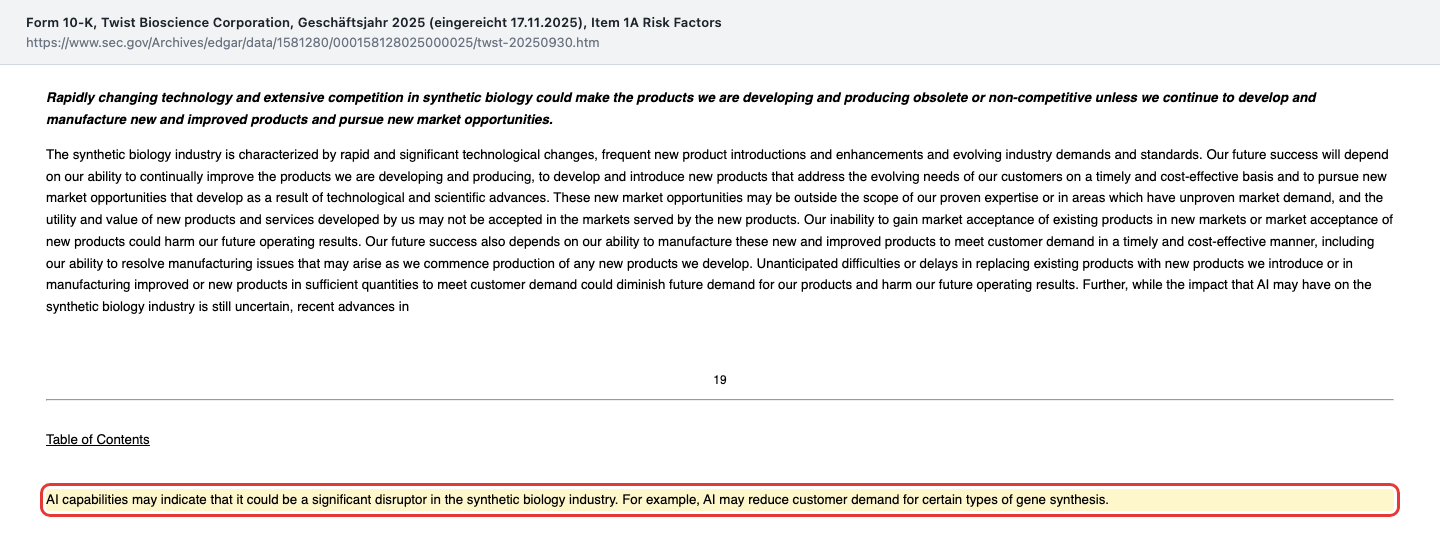
This is not boilerplate from a risk-factor template; it is a statement about the core product: if an algorithm can predict which gene variants work, a lab needs fewer variants physically built. Twist uses AI internally for efficiency and supplies AI-driven customers — but sells no AI product of its own. In our own classification we therefore list the company as threatened by AI, resting on exactly this paragraph from its own risk factors. That is not a forecast. It is a restatement of what the company writes to its own shareholders.
Valuation: what the market is actually paying for
A price-to-earnings ratio does not exist at Twist — the earnings are missing. That leaves two yardsticks. The first is revenue: at a market value of about $5.62 billion (data as of July 26, 2026) and trailing twelve-month revenue of $409.5 million, the market pays roughly 13 times one year of sales. For context, that is a multiple profitable software companies carry — applied to a manufacturer that produces physical goods in its own plants and loses money at the operating line. The second yardstick is substance: strip goodwill of $82.2 million and intangible assets of $13.0 million out of equity and $359.9 million of tangible book value remains — the price embeds 15 times that. Per share, that is $5.79 of substance; the last price documented in an SEC filing is named in the prospectus supplement of June 18, 2026 at $84.95, as of June 16, 2026.
Professional opinion is split but friendly: of twelve recorded analyst ratings, nine advise buying, two holding and one selling, with an average price target of $92.50 (data as of July 26, 2026). At the same time the stock is a favourite target of short sellers: about 14.1 million shares — close to a quarter of all shares outstanding — were sold short as of the same date, with a notional cover period of just under seven trading days. Both camps are betting on the same question with opposite signs: does the cost curve break before the cash does? Anyone who wants to see how differently the market values companies in the same industry will find the counterexample in our analysis of Biogen — a biotechnology group with earnings but no growth story. Twist is its mirror image, and between the two lies the full range of what "expensive" can mean in this sector.
Opportunities and risks at a glance
What speaks for Twist Bioscience:
- A real, growing product business: fiscal 2025 revenue of $376.6 million, up 20 percent, 938,000 genes shipped, up 22 percent, more than 3,800 customers and 99 percent of revenue from repeat customers — plus another 19.3 percent gain in the quarter ended March 31, 2026.
- Manufacturing demonstrably scales: gross margin of 36.6 percent in fiscal 2023, 42.6 percent in 2024, 50.7 percent in 2025 and 51.8 percent for the half year ended March 31, 2026, with production fixed costs held broadly flat.
- A debt-free balance sheet: total assets of $676.2 million against $221.1 million of liabilities, equity of $455.1 million and no meaningful interest burden, plus $171.7 million of cash and short-term investments as of March 31, 2026.
- Funding access is open: the shelf registration of June 18, 2026 makes up to $200 million available — a company that can finance itself at will is far better placed during a loss-making phase than one that cannot.
- Divested side businesses retain option value: from the data storage unit Twist holds a stake in Atlas Data Storage, valued at $53.9 million on transfer, plus potential milestone payments of up to $75.0 million and a revenue share.
What speaks against it:
- The apparatus costs more than the product: $247.0 million of selling and administrative expenses against $191.0 million of gross profit in fiscal 2025; in the quarter ended March 31, 2026 those costs grew faster, up $12.4 million, than gross profit, up $11.1 million.
- Progress on the loss line was a one-time event: $48.8 million of the drop from $208.7 million to $77.7 million came from selling the data storage unit; in the half year ended March 31, 2026 the loss rose again to $74.5 million and cash burn by 23.1 percent.
- Continuous dilution: $64.5 million of stock-based compensation in fiscal 2025, 17 percent of revenue, 6.502 million potentially dilutive shares as of March 31, 2026, the Invenra licence settled with $28.8 million of the $33.8 million in stock, and the $200 million program on top.
- Limited runway without fresh capital: $171.7 million of cash and short-term investments against roughly $30 million of quarterly outflow in the first half of fiscal 2026 — about five quarters on paper, after which the capital market has a say.
- The valuation leaves no room for error: roughly 13 times annual revenue and 15 times tangible book value, without earnings — and the company’s own annual report warns that artificial intelligence may reduce demand for certain types of gene synthesis.
A human conclusion
Back to the growth-curve hypnosis from the opening. Its core is not that the curve lies — it does not: Twist Bioscience really is growing, really is selling more genes to more customers and really is producing them ever more cheaply. Its core is that a rising curve relieves you of the arithmetic an investment thesis requires. Anyone buying Twist is buying three very concrete things: a technically convincing product with a gross margin that has risen for three years; a selling and administrative apparatus that in fiscal 2025 cost more than that product delivered in gross profit; and the wager that the second number falls faster than the cash does. It can work — management has itself guided to relief in the second half of fiscal 2026 and will be measured against it. So the honest question for you is not "is the company growing?" but: how many years do you grant a business that has grown for twelve of them and made a profit in none — and how much are you willing to pay for that wait? If you have a number for that, you have a thesis. If not, you had a curve. What you make of it is your decision. And that is exactly as it should be.
Sources
Every original document used in this analysis — to read for yourself:
- Twist Bioscience Corporation — SEC annual report on Form 10-K for fiscal 2025 (filed November 17, 2025)
- Twist Bioscience Corporation — SEC annual report on Form 10-K for fiscal 2024 (filed November 18, 2024)
- Twist Bioscience Corporation — SEC quarterly report on Form 10-Q for the quarter ended March 31, 2026 (filed May 4, 2026)
- Twist Bioscience Corporation — SEC quarterly report on Form 10-Q for the quarter ended December 31, 2025 (filed February 2, 2026)
- Twist Bioscience Corporation — SEC current report on Form 8-K of February 17, 2026 (Invenra licence and share issuance)
- Twist Bioscience Corporation — SEC registration statement on Form S-3ASR of June 18, 2026 ($200 million sales agreement)
- Ranking from our in-house stock scanner: Richard Moglen: 1 Week Top Performers (U.S. selection, rank 12 of 28, RS rating 96, as of July 25, 2026); the list is recalculated daily.
- Fundamental data (market value, valuation multiples, analyst ratings, short interest; data as of July 26, 2026, closing price July 24, 2026)
A note on our own behalf: this analysis is journalistic interpretation of publicly available corporate filings. It is expressly not investment advice, not a recommendation and not a solicitation to buy or sell securities. Share prices can move sharply and a total loss of invested capital is possible — particularly so at a company that has reported losses since its founding. All figures come from the primary sources linked above and carry the as-of dates stated there; they may have changed since publication. The author holds no position in Twist Bioscience at the time of publication.
Our Bottom Line at a Glance
- Product and market position positive
- The core business works: fiscal 2025 revenue of $376.6 million, up 20 percent, 938,000 genes shipped, up 22 percent, more than 3,800 customers and 99 percent of revenue from repeat customers. In the quarter ended March 31, 2026 revenue grew 19.3 percent to $110.7 million and genes shipped rose 32 percent.
- Gross margin positive
- Manufacturing is measurably improving: gross margin of 36.6 percent in fiscal 2023, 42.6 percent in 2024, 50.7 percent in 2025 and 51.8 percent for the half year ended March 31, 2026 — with production fixed costs held broadly flat. This is the strongest evidence that the silicon-chip process scales.
- Cost structure negative
- Selling and administrative expenses exceed gross profit: $247.0 million against $191.0 million in fiscal 2025, and $76.1 million against $57.1 million in the quarter ended March 31, 2026. In that same quarter gross profit rose $11.1 million while selling and administrative expenses rose $12.4 million. The relief management has guided to for the second half of fiscal 2026 is still unproven.
- Quality of earnings negative
- The fall in net loss from $208.7 million in fiscal 2024 to $77.7 million in fiscal 2025 rests on a $48.8 million book gain from the May 2, 2025 sale of the data storage unit. Without that item the loss was about $126.5 million. In the half year ended March 31, 2026 the loss rose again to $74.5 million from $70.9 million.
- Balance sheet and funding neutral
- No meaningful financial debt (debt-to-equity 0.03), equity of $455.1 million and $171.7 million of cash and short-term investments as of March 31, 2026 — set against roughly $30 million of cash outflow per quarter and an at-the-market program of up to $200 million available since June 18, 2026.
- Valuation negative
- About $5.62 billion of market value (data as of July 26, 2026) stands against $409.5 million of annual revenue and $359.9 million of tangible book value — roughly 13 times revenue and 15 times tangible substance, without earnings. The price assumes the cost curve breaks before the cash does.
Twist Bioscience has a technically convincing product, a gross margin that has risen for three straight years and a debt-free balance sheet — but not yet a business model that turns 20 percent growth into profit: selling and administrative expenses alone cost more in fiscal 2025 than the entire gross profit delivered, and the seemingly halved loss owes itself to a one-time sale. Not investment advice.
What Our Rating Means
Open questions
The business works in principle, but one material question is open. As long as it stays open, our findings do not carry a quality verdict.
The business works, the balance sheet carries no debt and the gross margin demonstrably climbed from 36.6 to 50.7 percent — there is no substance finding that threatens the company itself: no going concern warning, no negative equity, no interest burden. What remains open is the decisive operating question, and after twelve years it is still open: whether this revenue ever turns into profit. As long as selling and administration cost more than gross profit delivers, and the only progress on the loss line comes from a one-time sale, the turnaround is unproven — that is yellow, not green. Our view that the stock is expensive at 13 times revenue does not change the colour: price is not a quality attribute. The decision is yours.
A journalistic assessment by our editorial team at the time of the deep dive, based on public sources — not investment advice and not a solicitation to buy or sell. Your personal circumstances (investment goals, risk capacity, taxes) cannot be taken into account. What our levels mean, how verdicts are formed, and what conflicts of interest exist →
Worth Noting
- Origin: our in-house stock scanner, list "Richard Moglen: 1 Week Top Performers" (U.S. selection), rank 12 of 28 hits, RS rating 96, as of July 25, 2026. The list is recalculated daily.
- Data as of: SEC filings through the Form 10-Q for the quarter ended March 31, 2026 (filed May 4, 2026) plus the Form S-3ASR of June 18, 2026; market data as of July 26, 2026 (closing price July 24, 2026). The next quarterly report, for the quarter ended June 30, 2026, was not available at the time of writing.
- Easily confused: the DNA data storage business has not belonged to Twist since May 2, 2025 — it is now the standalone Atlas Data Storage, Inc., in which Twist holds only a minority stake. The earlier patent dispute with Agilent Technologies has been settled; the fiscal 2025 annual report lists Agilent only as a competitor.
Frequently Asked Questions
Twist manufactures synthetic DNA — artificially built genetic information that researchers and drug companies use as a tool. The distinctive part is production: Twist "writes" DNA onto a silicon chip instead of into individual reaction vessels, packing very many reactions into very little space. Its main products are next-generation sequencing tools, 55 percent of fiscal 2025 revenue, and synthetic genes, 30 percent.
Because the apparatus costs more than the goods. In fiscal 2025, $376.6 million of revenue left $191.0 million of gross profit — but selling and administrative expenses alone came to $247.0 million and research and development to a further $80.3 million. The result was a $136.3 million operating loss. Since inception the losses add up to $1,394.1 million as of March 31, 2026.
On September 30. Fiscal 2025 therefore runs from October 1, 2024 to September 30, 2025 and does not line up with the calendar year. The quarterly report for the period ended March 31, 2026 is consequently the second quarter of fiscal 2026 — worth remembering when comparing Twist with companies whose year ends on December 31.
Twist sold it. On May 2, 2025 the company transferred the unit to newly formed Atlas Data Storage, which third-party investors funded with $155.0 million of seed capital. Twist received preferred shares valued at $53.9 million, $2.5 million in cash, a $2.0 million promissory note and potential milestone payments of up to $75.0 million. The book gain was $48.8 million.
As of March 31, 2026 the company held $122.7 million in cash and $49.0 million in short-term investments, $171.7 million in total. In the first half of fiscal 2026 that balance fell by $60.7 million, roughly $30 million per quarter. At that pace the cash lasts a little over five quarters. The company itself states the funds are sufficient for at least twelve months; an at-the-market program of up to $200 million has also been available since June 18, 2026.
Effectively none. As of March 31, 2026 total assets of $676.2 million stood against $221.1 million of liabilities, leaving equity of $455.1 million. The largest items on the liability side are lease obligations for labs and offices, $95.8 million, and $15.0 million from the sale of future royalty streams to XOMA. The balance sheet shows no conventional interest-bearing bank debt.
At a market value of about $5.62 billion (data as of July 26, 2026) and trailing twelve-month revenue of $409.5 million, the market pays roughly 13 times annual revenue. A price-to-earnings ratio cannot be formed because there are no earnings. Tangible book value stood at $5.79 per share on March 31, 2026 — while the last price documented in an SEC filing, on June 16, 2026, was $84.95.
As both — and the threat is written into its own annual report. Among the risk factors in the fiscal 2025 filing, Twist states that artificial intelligence could become a significant disruptor of the industry and "may reduce customer demand for certain types of gene synthesis." At the same time Twist uses AI internally for efficiency and supplies customers who run AI-enabled antibody discovery platforms.
Found an error?
Did you spot a factual error, an outdated number, or a typo in this deep dive? Let us know briefly — your report goes straight to the editorial team.