Bio-Techne: A Turnaround Candidate Whose Price Has Already Been Signed — $73.00 a Share
Bio-Techne sells the reagents and instruments laboratories around the world run on — and ranks 6th in our turnaround scanner (U.S. selection, turnaround check 7 of 8, data as of July 25, 2026). We read the annual report on Form 10-K for the fiscal year ended June 30, 2025, the quarterly report on Form 10-Q as of March 31, 2026 and the merger agreement with Merck KGaA, Darmstadt, Germany: operating income for the first nine months rose 41 percent — yet on the company's own adjusted basis earnings fell, and organic revenue is shrinking. Add a $1 billion purchase obligation buried in a footnote and $37.2 million spent on a dispute with the former chief executive. Not investment advice — just the question of what a turnaround is still worth once its price has been signed.
 Thomas Mücke
Founder & Publisher
Thomas Mücke
Founder & Publisher
Chart
Interactive price chart (TradingView).
Note: pure fact-based analysis, not investment advice and not a solicitation to buy or sell. All figures without guarantee.
There is an investor trap that springs precisely when everything finally looks good: the finish-line trap. A stock has fallen for years, then suddenly jumps — and the mind reads the jump as new strength. Sometimes it is a full stop instead: someone has bought the company and written the price into a contract. Bio-Techne Corporation (Nasdaq: TECH) ranks 6th in our turnaround candidates scanner (U.S. selection, turnaround check 7 of 8, data as of July 25, 2026). On June 25, 2026 the company signed a merger agreement with Merck KGaA, Darmstadt, Germany: $73.00 per share in cash. Before the reflex takes over, here is the deal we offer: we read together what sits behind the jump — the annual report on Form 10-K for the fiscal year ended June 30, 2025, the quarterly report on Form 10-Q as of March 31, 2026, and the current reports filed in June and July 2026. They contain a real earnings recovery. They also show how much of it is simply the absence of a one-time charge. And they contain a billion dollars waiting in a footnote. Remember: a scanner measures the direction of the numbers, not who ends up owning the result.
What Bio-Techne actually does — the toolbox of biology
Bio-Techne was founded in 1976 as Research and Diagnostic Systems, went public in 1985 through a merger with Techne Corporation, and is still headquartered in Minneapolis, Minnesota. Its roughly 3,100 employees (as of June 30, 2025), about 2,300 of them in the United States, make nothing a patient ever holds. They make what everyone else researches with: purified proteins, antibodies, growth factors, cell culture reagents, immunoassays, and the instruments that measure all of it. Put plainly: Bio-Techne does not sell the gold, it sells the shovels — to nearly everyone in the valley.
The business rests on two segments. Protein Sciences (fiscal 2025 revenue of $870.2 million) covers the classic reagents under brands such as R&D Systems plus the protein analysis instruments of ProteinSimple. Diagnostics and Spatial Biology ($346.3 million) bundles regulated diagnostics products, controls and calibrators together with spatial biology: the RNAscope assays of Advanced Cell Diagnostics and the COMET instrument from Lunaphore, acquired in 2023, which detects protein and RNA markers on the same tissue slide. One calendar note that matters with this company: the fiscal year ends June 30. Fiscal 2025 therefore covers roughly the second half of calendar 2024 and the first half of calendar 2025.
That brings us to the central tension of this analysis, which runs through every chapter: the scanner sees a turnaround in the earnings line — but that turnaround consists largely of one-time costs falling away, organic revenue is shrinking, and the price at which all of it trades has been written into a contract since June 25, 2026.
How this stock reached our desk
We run roughly 3,500 stocks through our scanners every day. As of July 25, 2026 Bio-Techne sits at rank 6 of the U.S. selection in the turnaround candidates scanner — one of 62 U.S. hits, with a turnaround check of 7 out of 8. To reproduce it: open the scanner, set the country filter to "US"; the "turnaround check" column sorts the list. These lists are recomputed daily — today's rank is not the rank of the day after tomorrow.
The model behind it has four pillars. Pillar one, the crash: at least 50 percent below the all-time high, otherwise the screen catches ordinary growth stocks rather than turnarounds. For Bio-Techne that condition held comfortably for years. The all-time closing high was $131.32 on September 24, 2021 (split-adjusted; the stock was split four for one in November 2022), and on June 23, 2026 — the last trading day before the merger announcement — it closed at $56.26, roughly 57 percent lower (price history, data as of July 25, 2026). Pillar two, survival: the Altman Z-score, a bankruptcy early-warning metric built from several balance sheet ratios, stands around 11.9, where the distress zone only begins below 1.1; the equity ratio is roughly 75 percent, the debt-to-equity ratio 0.19, interest coverage 12.0 (all figures: fundamental data, as of July 25, 2026). This pillar is not a bottleneck here — it is a fortress.
Pillars three and four form the eight-point checklist: four criteria for the operational turn (revenue no longer declining, rising net margin, positive or improving operating cash flow, a healing balance sheet) and four for market confirmation (price back above the 50-day line, three-month relative strength above the twelve-month reading, net insider buying, institutions adding). Bio-Techne scores seven of them. Which point is missing is not broken out in the list — but the obvious candidate sits in the quarterly numbers: revenue is still declining in the most recent quarter, down 1.5 percent year over year, and the decline is not shrinking steadily. For context within the same series: Tenable was the only name at a full 8 of 8 in July 2026, while Okta sat at 7 of 8 like Bio-Techne. A Piotroski F-score of 5 out of 9 — a nine-point test of the direction of the balance sheet — completes the picture: acceptable rather than good, since genuinely healthy starts at 8. Keep the principle in mind: a turnaround check measures the movement, not its price.
The numbers across the years — given their due
First the part that genuinely impresses. Bio-Techne revenue has grown steadily for years: from $931.0 million in fiscal 2021 through $1,105.6 million and $1,136.7 million to $1,159.1 million in fiscal 2024 and $1,219.6 million in fiscal 2025 — up 5 percent in the last year, all of it organic. Gross margin was 64.8 percent in fiscal 2025 and 66.9 percent in the quarter ended March 31, 2026. That is the signature of a supplier with pricing power, not a commodity manufacturer.
The cash picture is even more convincing. Fiscal 2025 produced $287.6 million of operating cash flow (fiscal 2024: $299.0 million; fiscal 2023: $254.4 million); after $31.0 million of property and equipment additions, roughly $256.6 million of free cash flow remained — more than three times reported net earnings. Of that, $50.4 million went out as dividends ($0.32 per share, unchanged since fiscal 2023) and $275.7 million into buybacks: 4,550,195 shares at an average price of $60.60. In hindsight the timing was good — Merck KGaA is now paying $73.00, roughly 20 percent more.
And then there is the line that makes a turnaround scanner light up in the first place:
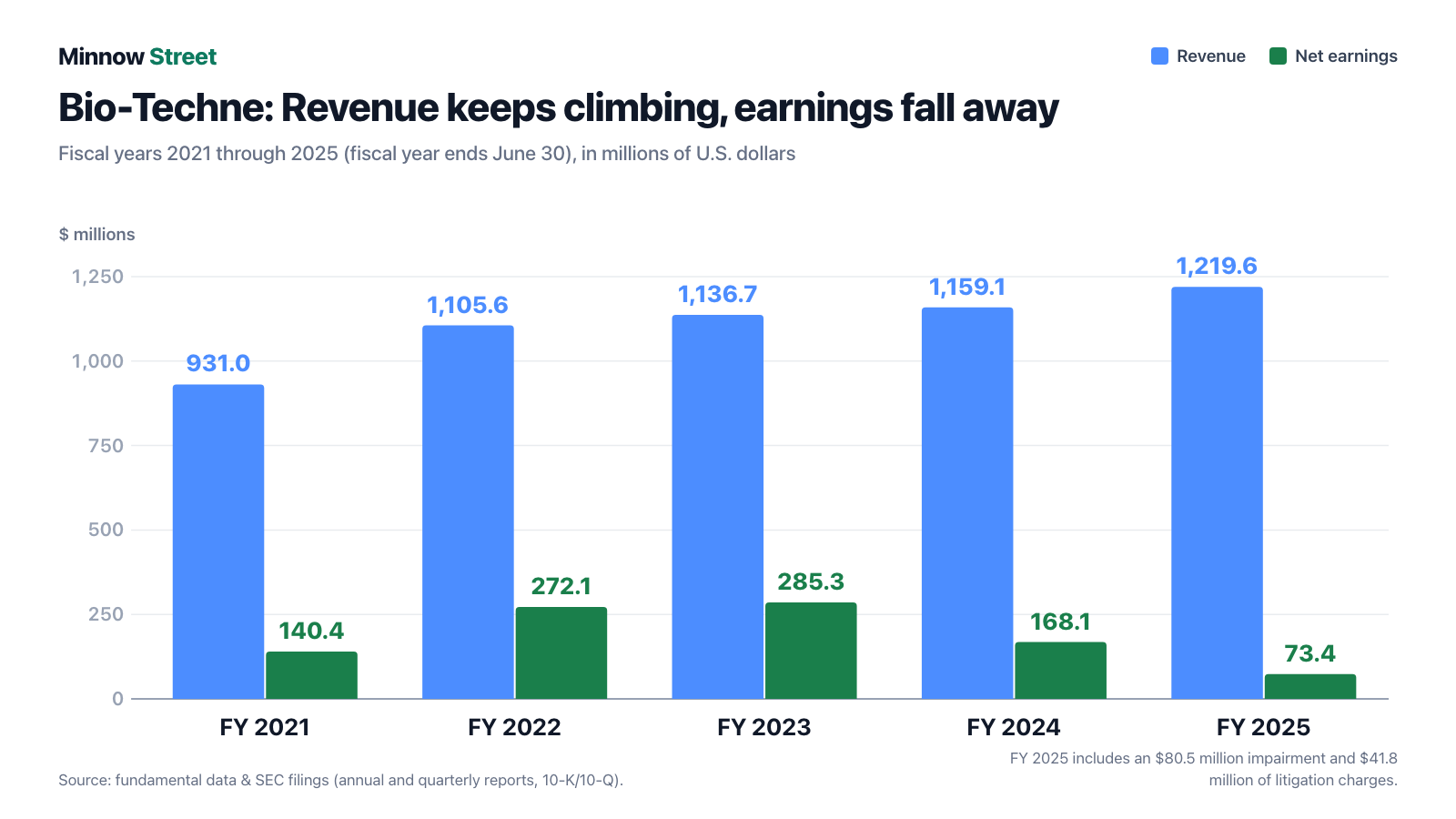
Net earnings climbed from $140.4 million in fiscal 2021 to $285.3 million in fiscal 2023 — and then broke down: $168.1 million in fiscal 2024 and $73.4 million in fiscal 2025, a drop of 56 percent. Operating income fell over the same span from $298.9 million through $206.7 million to $102.3 million. That collapse is precisely why the stock could land in a turnaround scanner at all — and the question carrying the rest of this analysis is what caused it and how much of it comes back.
What the filings say — the uncomfortable truths
Uncomfortable truth no. 1: the turnaround is largely a base effect
At first glance the recovery looks spectacular. In the first nine months of fiscal 2026 (through March 31, 2026) operating income rose 41 percent to $177.6 million (prior-year period: $126.1 million) and net earnings rose 40 percent to $127.2 million (from $91.1 million). In the quarter ended March 31, 2026 operating income nearly doubled, to $75.5 million from $38.7 million. The report itself names the reason, in sober language.
"Selling, general and administrative expenses decreased 28% to $109.3 million and decreased 13% to $339.2 million for the quarter and nine months ended March 31, 2026, respectively, from the same prior year periods. The decrease in expense for the quarter and nine months ended March 31, 2026 was primarily due to non-recurring arbitration award in the prior year and ongoing cost management initiatives."
— Bio-Techne Corporation, quarterly report on Form 10-Q as of March 31, 2026, Item 2 (Management's Discussion and Analysis), filed with the U.S. securities regulator, the SEC

The cleanest cross-check comes from the company itself. In its own reconciliation Bio-Techne strips out amortization of intangibles, litigation charges, stock-based compensation, restructuring and similar items. The result of that adjusted arithmetic:
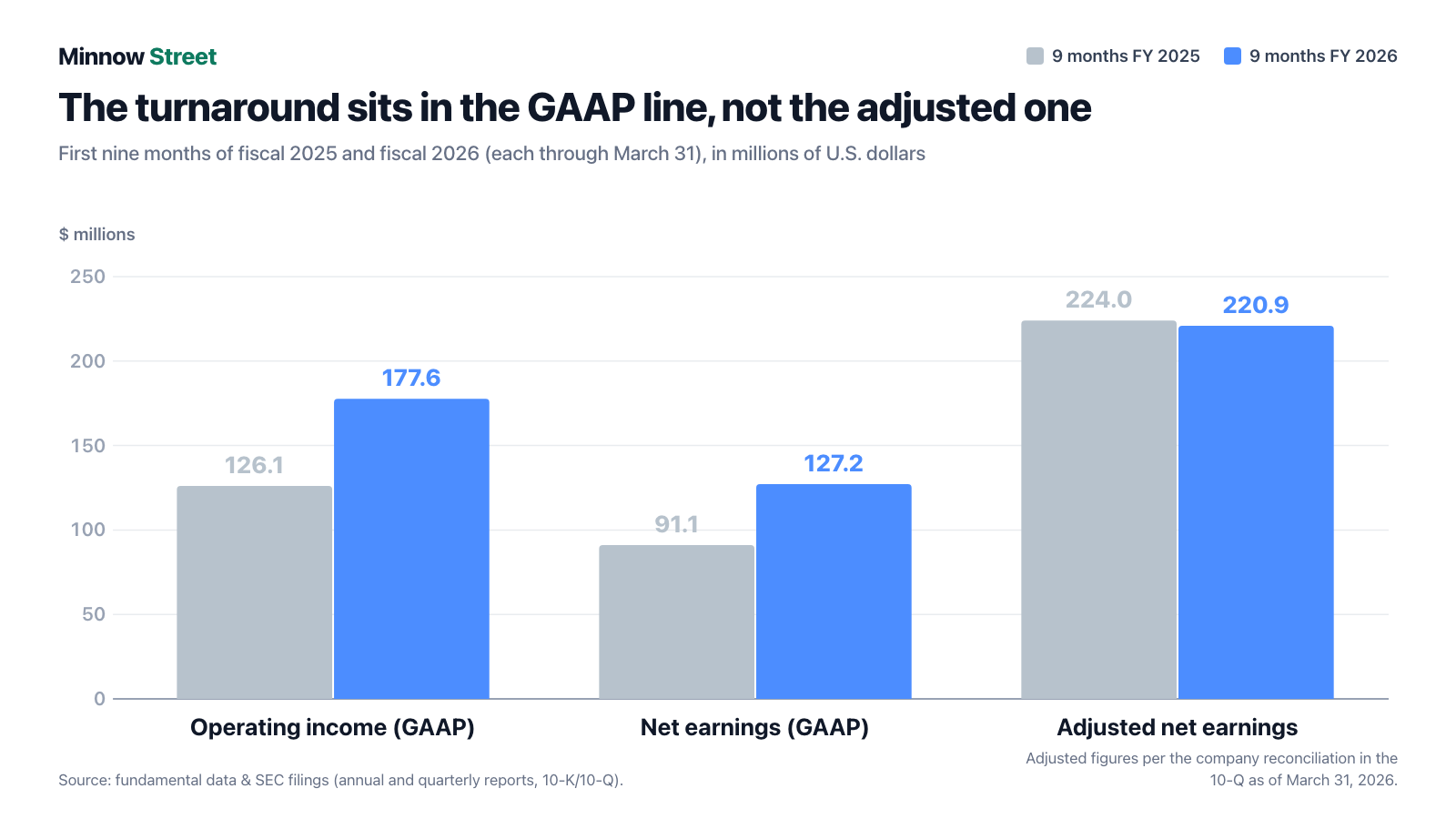
Adjusted net earnings for the first nine months came to $220.9 million against $224.0 million a year earlier — down 1 percent. In the quarter ended March 31, 2026 they fell from $88.3 million to $82.8 million, down 6 percent, with adjusted diluted earnings per share slipping from $0.56 to $0.53. Put differently: the turnaround the scanner measures is mostly the absence of a one-time charge. That is not accounting sleight of hand — the prior year really was worse. But it is not new earning power either. Remember the rule: when a year-over-year comparison jumps, first check whether the prior year stumbled.
Uncomfortable truth no. 2: revenue is shrinking, organically, in the larger segment
There is no demand surge behind the earnings recovery. In the quarter ended March 31, 2026 consolidated revenue fell 2 percent to $311.4 million, and over nine months by 1 percent to $893.8 million. Organically — excluding currency and the divested business — revenue was down 2 percent in the quarter and 1 percent over nine months. A favorable exchange rate contributed 2 percentage points; without it the decline would have been steeper.
The distribution is the uncomfortable part. The larger segment, Protein Sciences, roughly 72 percent of consolidated revenue, shrank 4 percent organically in the quarter, and its operating margin fell from 45.6 percent to 44.2 percent (nine months: from 42.2 percent to 40.8 percent). The report attributes it to unfavorable volume and product mix. The smaller Diagnostics and Spatial Biology segment grew 3 percent organically and lifted its operating margin from 9.4 percent to 12.1 percent — though largely because the loss-making Exosome Diagnostics unit was sold to MDxHealth in September 2025. Adjusted gross margin points the same way: 70.4 percent in the quarter against 71.6 percent a year earlier.
Translated: earnings are rising because costs are falling and a money-loser is gone, not because more is being sold. For a turnaround thesis that is the hardest kind of progress, because cost cuts can only be made once.
Uncomfortable truth no. 3: $37.2 million for an argument about stock options
The one-time item everything revolves around has a name, and it sits in the annual report:
"The dispute with the former CEO was resolved through a binding arbitration award during the quarter ended March 31, 2025 for which the Company paid $37.2 million inclusive of interest and legal fees."
— Bio-Techne Corporation, annual report on Form 10-K for the fiscal year ended June 30, 2025, Note 1 (Legal Matters)
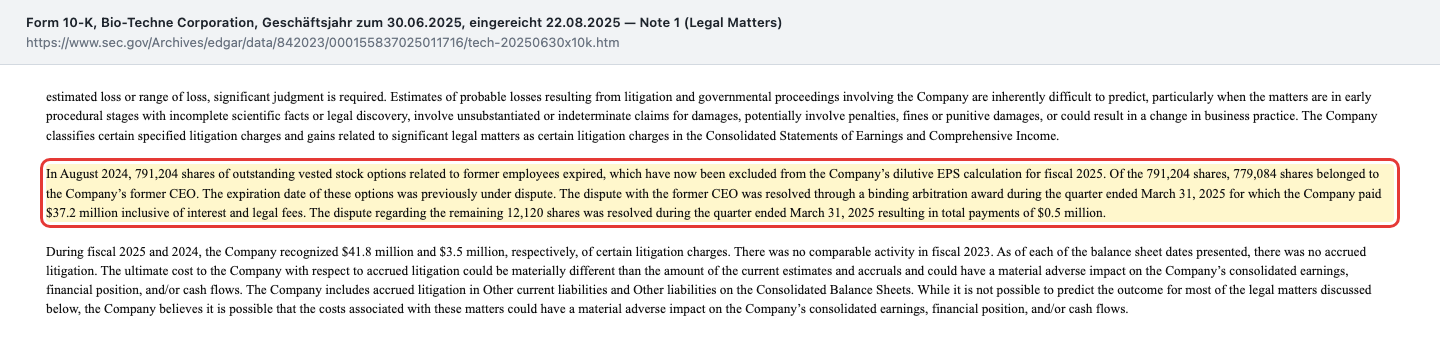
In August 2024, 791,204 outstanding vested options held by former employees expired — 779,084 of them belonging to the former chief executive. The expiration date was disputed; the arbitration award cost $37.2 million. In total, Bio-Techne booked $41.8 million of "certain litigation charges" in fiscal 2025, against $3.5 million a year earlier. The tax authorities added a second helping: because part of the award was not deductible, the effective tax rate rose by 7.9 percentage points on that item alone — from 9.5 percent in fiscal 2024 to 25.5 percent in fiscal 2025.
The second large item of the same year was an $80.5 million impairment of assets held for sale (total impairment charge including allocated goodwill: $83.1 million), covering the Exosome Diagnostics unit that was later divested. Taken together, the arbitration award, the litigation charges and the impairment account for the bulk of the fiscal 2025 earnings collapse. That is the good news of this analysis: the crash was largely self-inflicted and non-recurring. The bad news sits in truth no. 2.
Uncomfortable truth no. 4: a billion dollars waiting in a footnote
On the balance sheet Bio-Techne looks robust: $2,550.6 million of total assets, $2,085.3 million of shareholders' equity, $209.8 million of cash and only $200.0 million drawn on the credit facility (June 30, 2025: $346.0 million) out of a $1 billion revolver maturing on August 31, 2027 — all as of March 31, 2026. Two items still deserve attention. The first is $977.8 million of goodwill (March 31, 2026); as of June 30, 2025 it stood at $980.9 million and represented about 38 percent of total assets: the purchase price of past acquisitions, not amortized but tested for impairment each year. The second sits in Note 1 of the quarterly report:
"Since the first part of the forward contract has been triggered, the second part of the forward contract will automatically trigger, which requires the Company to acquire the remaining equity interest in Wilson Wolf on December 31, 2027 based on a revenue multiple of approximately 4.4 times trailing twelve month revenue. … If the second milestone is achieved, the forward contract requires the Company to pay approximately $1 billion plus potential consideration for revenue in excess of the revenue milestone."
— Bio-Techne Corporation, quarterly report on Form 10-Q as of March 31, 2026, Note 1 (Investments)

The backstory: in December 2021 Bio-Techne paid $25 million for this two-part forward contract on Wilson Wolf, the maker of G-Rex cell culture devices used in cell and gene therapy. When Wilson Wolf hit the first threshold, a further $232 million fell due on March 31, 2023 for 19.9 percent. The rest follows automatically — by the end of 2027 at the latest, earlier if Wilson Wolf reaches roughly $226 million of annual revenue or $136 million of EBITDA. A billion dollars is close to half of Bio-Techne's current shareholders' equity. For Merck KGaA as buyer it is an obligation acquired along with the company; for a shareholder cashed out at a fixed price, it is merely a footnote in someone else's balance sheet.
What the merger agreement says — $73.00, in cash, on a clock
On June 25, 2026 Bio-Techne signed a merger agreement with Merck KGaA, Darmstadt, Germany and its subsidiary EMD Holdings NewCo, Inc. One clarification matters, because the name is contested in the United States: this is the Darmstadt-based science and technology group, which operates in the U.S. and Canada as MilliporeSigma, EMD Serono and EMD Electronics — not the U.S. company Merck & Co. The heart of the agreement is a single sentence:
"At the effective time of the Merger (the "Effective Time"), each share of the Company's common stock … issued and outstanding immediately prior to the Effective Time (other than Excluded Shares …) will automatically be converted into the right to receive $73.00 in cash (the "Merger Consideration"), without any interest thereon and less any required tax withholdings …"
— Bio-Techne Corporation, current report on Form 8-K dated June 26, 2026, Item 1.01 (Agreement and Plan of Merger)

What still has to happen before the money moves: approval by Bio-Techne shareholders holding a majority of the voting power, expiration of the U.S. waiting period under the Hart-Scott-Rodino Act and the remaining antitrust and investment screening clearances — and none of them carrying a "Burdensome Condition" the buyer would have to accept. The outside date is March 25, 2027, extending automatically twice by three months each (to June 25 and then September 25, 2027) if only antitrust clearances remain outstanding. The company itself told employees on July 9, 2026 that it expects closing in late 2026 or early 2027. Until then a no-shop covenant applies, with the customary carve-out for an unsolicited superior proposal.
The price tags for failure show where the parties see the risk: Bio-Techne pays $230,455,000 if it walks away or the shareholder vote fails; Merck KGaA pays $576,140,000 if the merger dies on the regulators' desks. Two and a half times as much on the buyer's side is the most candid risk assessment in the whole contract. No definitive merger proxy had been filed as of July 25, 2026; only there will the meeting date, the fairness opinion and the full executive compensation table become visible.
Valuation: what $73.00 actually means
Convert the price into a company. On 156,568,751 shares outstanding (cover page of the quarterly report, as of April 29, 2026), $73.00 per share implies an equity value of roughly $11.4 billion. Measured against the trailing twelve months to March 31, 2026 — fiscal 2025 minus its first nine months plus the first nine months of fiscal 2026 — that equals:
- roughly 9.4 times revenue of $1,210.8 million,
- more than 100 times GAAP net earnings of $109.6 million,
- roughly 38 times adjusted earnings of $303.4 million, or $1.94 per share.
This is not a bargain price. A multiple of 38 times adjusted earnings is usually paid for growth — and this business is currently shrinking organically. For Merck KGaA the math works through other levers: distribution reach, procurement, shared manufacturing and the chance to fold spatial biology into its own life science franchise. For a shareholder it means something simpler: the price is the ceiling, not the starting point.
For market context as of July 25, 2026: market capitalization stood at roughly $11.2 billion, roughly 2 percent below the agreed transaction value. That gap is not a valuation opinion but the price of time and completion risk — the market is betting heavily on a close while demanding a small payment for the fact that antitrust authorities and a shareholder meeting still stand between today and the payout. And one date worth sitting with: on June 23, 2026, the last trading day before the announcement, the stock closed at $56.26. Anyone who bought the turnaround thesis back then did not get to see it through — they got bought out of it.
Opportunities and risks at a glance
What speaks for Bio-Techne:
- A signed all-cash merger agreement at $73.00 per share with a financially strong strategic buyer (8-K dated June 26, 2026) — no stock component, no financing condition.
- A quality business with a 64.8 percent gross margin in fiscal 2025 and $287.6 million of operating cash flow against only $31.0 million of property and equipment additions.
- A fortress balance sheet: roughly 75 percent equity ratio, an Altman Z-score around 11.9, and the drawn credit line cut from $346.0 million to $200.0 million within nine months (fundamental data as of July 25, 2026; balance sheet figures as of March 31, 2026).
- The one-time nature of the earnings collapse is documented: a $37.2 million arbitration award, $41.8 million of total litigation charges and an $80.5 million impairment — all in fiscal 2025, all non-recurring.
- A $576.14 million reverse termination fee as a cushion if the merger fails on antitrust grounds.
What speaks against it:
- The share price has nearly caught the contract price: upside stops at $73.00, while a collapse would likely send the stock back toward the pre-announcement level of $56.26 (June 23, 2026).
- Organic revenue is shrinking: down 2 percent in the quarter ended March 31, 2026 and down 4 percent in Protein Sciences, whose operating margin slipped from 45.6 percent to 44.2 percent.
- On an adjusted basis there is no earnings turnaround at all: $220.9 million versus $224.0 million over nine months, $82.8 million versus $88.3 million in the quarter.
- An automatically triggering obligation to buy the remaining Wilson Wolf equity by December 31, 2027 — roughly $1 billion if the second milestone is met.
- Completion risk: antitrust and investment screening reviews across multiple jurisdictions, the shareholder vote, an outside date of March 25, 2027 extendable to September 25, 2027 — with capital tied up until then.
A human conclusion
Back to the finish-line trap. The jump a turnaround scanner registers at Bio-Techne is real — but it measures two different things at once, and only one of them is a turnaround. The first is a prior year weighed down by a $37.2 million arbitration award and an $80.5 million impairment; that burden is gone now, and the earnings line breathes again. The second is June 25, 2026, the day a buyer from Darmstadt wrote a price into a contract. What the scanner cannot see: on the company's own adjusted basis there is no turn at all, just a small decline — and organic revenue in the larger segment is falling.
Looking at this stock today therefore means looking at a schedule rather than a company: $73.00 at the end, a few percent of distance to it, a calendar running to September 25, 2027 at the latest, and a handful of regulators in between. That can be a quiet, short piece of arithmetic. It can also be arithmetic whose answer is already known while the capital stays locked up. Anyone who wants to follow the story should read three things: the definitive merger proxy (with the meeting date and the fairness opinion), the current reports on the expiration of the antitrust waiting periods — and the next quarterly report, where organic revenue lives. What you make of it is your decision. And that is exactly as it should be.
Sources
All original documents used in this analysis, for your own reading:
- Bio-Techne Corporation — annual report on Form 10-K for the fiscal year ended June 30, 2025 (filed August 22, 2025)
- Bio-Techne Corporation — annual report on Form 10-K for the fiscal year ended June 30, 2024 (filed August 22, 2024)
- Bio-Techne Corporation — quarterly report on Form 10-Q as of March 31, 2026 (filed May 6, 2026)
- Bio-Techne Corporation — quarterly report on Form 10-Q as of December 31, 2025 (filed February 4, 2026)
- Bio-Techne Corporation — quarterly report on Form 10-Q as of September 30, 2025 (filed November 5, 2025)
- Bio-Techne Corporation — current report on Form 8-K dated June 26, 2026 (Item 1.01 merger agreement with Merck KGaA, Item 5.02 retention agreements)
- Bio-Techne Corporation — current report on Form 8-K dated June 25, 2026 (Item 7.01, joint press release)
- Bio-Techne Corporation — additional proxy soliciting material DEFA14A dated July 9, 2026 (employee questions and answers on the merger)
- Complete SEC filing history for Bio-Techne: EDGAR overview (sec.gov)
- Fundamental data (metrics, quarterly series, price history, valuation; data as of July 25, 2026), reconciled with the SEC filings.
- Screening and rating data: our in-house stock scanner (data as of July 25, 2026), including the turnaround candidates scanner (U.S. selection, rank 6, turnaround check 7 of 8).
Transparency & disclaimer: this analysis is journalistic commentary on publicly available information. It is not investment advice, not a regulated financial analysis and not a solicitation to buy or sell securities. Equity investments carry substantial risk up to and including total loss. All information without warranty; the as-of date of each figure is stated in the text. The author holds no position in Bio-Techne stock at the time of publication.
Our Bottom Line at a Glance
- Merger agreement positive
- A signed all-cash agreement dated 06/25/2026 with Merck KGaA, Darmstadt, Germany: $73.00 per share, no financing condition, and a $576,140,000 reverse termination fee if the deal fails on antitrust grounds (8-K dated 06/26/2026, Item 1.01).
- Business quality & balance sheet positive
- A 64.8 percent gross margin in fiscal 2025 and $287.6 million of operating cash flow against $31.0 million of property and equipment additions; as of 03/31/2026 shareholders' equity of $2,085.3 million, cash of $209.8 million and the drawn credit line cut from $346.0 million to $200.0 million.
- Earnings turnaround neutral
- Under U.S. accounting rules operating income for the first nine months of fiscal 2026 rose 41 percent to $177.6 million — yet adjusted net earnings on the company's own reconciliation fell from $224.0 million to $220.9 million, and in the quarter ended 03/31/2026 from $88.3 million to $82.8 million (10-Q as of 03/31/2026).
- Organic growth negative
- Organic revenue fell 2 percent in the quarter ended 03/31/2026 and 1 percent over nine months; in the larger Protein Sciences segment the organic decline was 4 percent, with the segment operating margin down from 45.6 percent to 44.2 percent.
- Wilson Wolf obligation negative
- A contractual duty to acquire the remaining Wilson Wolf equity on 12/31/2027 at roughly 4.4 times trailing twelve month revenue; if the second milestone (about $226 million of revenue or $136 million of EBITDA) is met, roughly $1 billion — close to half of shareholders' equity as of 03/31/2026 (10-Q, Note 1).
- Valuation & upside negative
- At the offer price roughly 9.4 times revenue and 38 times adjusted earnings for the twelve months to 03/31/2026; market capitalization on 07/25/2026 sat roughly 2 percent below the contract value — upside ends at $73.00 while downside runs to the 06/23/2026 level of $56.26.
Bio-Techne is a quality supplier to the life sciences with a 64.8 percent gross margin and a fortress balance sheet — and at the same time a turnaround candidate whose recovery consists largely of a $37.2 million arbitration award dropping out of the comparison while organic revenue shrinks. Since June 25, 2026 the stock is no longer a company case but a calendar case: Merck KGaA is paying $73.00 per share in cash, closing is expected in late 2026 or early 2027, and the last extension runs to September 25, 2027. Whoever buys today is buying the gap between the market price and the contract price, not the turnaround. Not investment advice.
What Our Rating Means
Open questions
The business works in principle, but one material question is open. As long as it stays open, our findings do not carry a quality verdict.
Upside is capped by contract: more than $73.00 per share only arrives if a superior proposal appears, and a no-shop covenant with a narrow carve-out stands in the way. Downside runs to the June 23, 2026 level of $56.26 should regulators or shareholders stop the merger. That ratio — a few percent of upside against materially larger downside — is the reason for caution, not the quality of the business. Anyone who wants to own the company rather than the calendar will find the counterarguments in the adjusted numbers ($220.9 million versus $224.0 million over nine months) and in the 2 percent organic revenue decline that the turnaround check does not show. The decision is yours.
A journalistic assessment by our editorial team at the time of the deep dive, based on public sources — not investment advice and not a solicitation to buy or sell. Your personal circumstances (investment goals, risk capacity, taxes) cannot be taken into account. What our levels mean, how verdicts are formed, and what conflicts of interest exist →
Worth Noting
- TECH reached the research list as rank 6 of our in-house turnaround candidates scanner (U.S. selection, 62 hits, turnaround check 7 of 8, data as of July 25, 2026); the scanner lists are recomputed daily.
- Name confusion on the buyer side: Merck KGaA, Darmstadt, Germany is not the U.S. company Merck & Co. (which trades as MSD outside the United States and Canada). In the U.S. and Canada the Darmstadt group operates as MilliporeSigma, EMD Serono and EMD Electronics (DEFA14A dated 07/09/2026).
- Recency: the most recent periodic report is the 10-Q as of 03/31/2026, and every filing after it was reviewed. No definitive merger proxy (DEFM14A) with a meeting date and fairness opinion had been filed as of July 25, 2026, and neither had the annual report for the fiscal year ended June 30, 2026.
- Price and market capitalization figures (roughly $11.2 billion, closing prices of $56.26 on 06/23/2026 and $70.70 on 06/25/2026) come from the price history as of July 25, 2026 and were cross-checked against 156,568,751 shares outstanding per the cover page of the 10-Q as of 03/31/2026; these analyses are evergreen, and daily prices are not a reason to buy.
Frequently Asked Questions
Bio-Techne Corporation (Nasdaq: TECH, Minneapolis, Minnesota, roughly 3,100 employees as of 06/30/2025) supplies reagents, antibodies, proteins and analytical instruments to research laboratories, diagnostics companies and bioprocessing customers. Two segments: Protein Sciences (fiscal 2025: $870.2 million) and Diagnostics and Spatial Biology ($346.3 million). Consolidated fiscal 2025 revenue: $1,219.6 million.
Yes. On June 25, 2026 Bio-Techne signed a merger agreement with Merck KGaA, Darmstadt, Germany and its subsidiary EMD Holdings NewCo. At closing each share converts into the right to receive $73.00 in cash (8-K dated 06/26/2026). This is the Darmstadt group that operates in the United States as MilliporeSigma and EMD Serono, not Merck & Co. Closing is expected in late 2026 or early 2027.
Net earnings fell 56 percent in fiscal 2025, to $73.4 million. The annual report names the causes: a $37.2 million arbitration award from a stock option dispute with the former chief executive, $41.8 million of total litigation charges, an $80.5 million impairment of assets held for sale and restructuring costs. Revenue rose 5 percent in the same year.
Under U.S. accounting rules yes, on an adjusted basis no. Operating income for the first nine months of fiscal 2026 rose 41 percent to $177.6 million. Adjusted net earnings, on the company's own reconciliation, fell from $224.0 million to $220.9 million, and in the quarter ended March 31, 2026 from $88.3 million to $82.8 million. The jump comes mainly from the prior-year arbitration award dropping out.
On June 30. Fiscal 2025 ran from July 1, 2024 through June 30, 2025 and therefore covers roughly the second half of calendar 2024 and the first half of calendar 2025. The third quarter of fiscal 2026 ended March 31, 2026. The annual report for fiscal 2026 had not been filed as of July 25, 2026.
Bio-Techne has held 19.9 percent of Wilson Wolf (maker of G-Rex cell culture devices) since March 31, 2023 and is contractually required to buy the remaining equity by December 31, 2027, valued at roughly 4.4 times trailing twelve month revenue. If Wilson Wolf reaches about $226 million of revenue or $136 million of EBITDA, the purchase accelerates and costs approximately $1 billion per the 10-Q.
On 156,568,751 shares (as of 04/29/2026), $73.00 implies an equity value of roughly $11.4 billion. Measured against the twelve months to March 31, 2026 that is about 9.4 times revenue ($1,210.8 million), more than 100 times GAAP earnings ($109.6 million) and roughly 38 times adjusted earnings ($303.4 million, or $1.94 per share).
Termination fees apply: Bio-Techne pays $230,455,000 if it accepts a superior proposal or the shareholder vote fails; Merck KGaA pays $576,140,000 if the merger fails on antitrust or investment screening grounds. The outside date is March 25, 2027 and extends automatically twice by three months each (8-K dated 06/26/2026).
Found an error?
Did you spot a factual error, an outdated number, or a typo in this deep dive? Let us know briefly — your report goes straight to the editorial team.