Twin Disc Stock: Record Revenue at a Marine-Gear Maker Since 1918 — and a Multimillion-Dollar Profit That Comes Almost Entirely From the Tax Line
Twin Disc has built marine and heavy-duty industrial transmissions since 1918 and shows up in our in-house "Joshua" growth scanner (data as of July 17, 2026), while the stock is up roughly 164 percent in a year. We read the annual report (10-K) for fiscal year 2025 and the three quarterly reports (10-Q) of fiscal year 2026: record revenue of $340.7 million, yet a net loss at the bottom line — and then nine-month net income of $25.2 million, of which $19.0 million is a one-time tax benefit. Not investment advice — just the question of what a profit is worth when the factory did not earn it, the accounting did.
 Thomas Mücke
Founder & Publisher
Thomas Mücke
Founder & Publisher
Chart
Interactive price chart (TradingView).
Note: pure fact-based analysis, not investment advice and not a solicitation to buy or sell. All figures without guarantee.
There is an investor trap that catches the thorough ones in particular — call it the single-number trap. It works like this: you find a stock with one metric so appealing you never think to question it. A price-to-earnings ratio of 13 while the stock is up 164 percent in a year. An earnings surprise of plus 1,450 percent in the latest quarter. "Cheap and growing," whispers the brain, and the one number has already taken over the thinking. Hardly any small cap feeds that trap in the summer of 2026 as textbook-perfectly as Twin Disc, Incorporated (Nasdaq: TWIN) from Wisconsin: a 108-year-old maker of marine and heavy-duty transmissions that just reported its highest revenue ever, and whose stock shows up in nearly every trend filter of our scanner. So let's make a deal: before you get swept up by the one pretty number, we read together what the company itself reported, under penalty of law, to the U.S. securities regulator, the SEC — the annual report (10-K) for fiscal year 2025 and the three quarterly reports (10-Q) of fiscal year 2026. And these filings tell a story in which the pretty P/E was not earned by the factory but by the tax line. In the end, you decide for yourself.
What Twin Disc actually does — and for whom
Twin Disc was founded in Wisconsin in 1918 and has built the heavy, invisible gear that turns power into motion ever since: marine transmissions, azimuth and surface drives, propellers and boat management systems on one side; power-shift transmissions, hydraulic torque converters, power take-offs, industrial clutches, control and braking systems on the other. Translated, Twin Disc is something like the transmission-and-clutch specialist for anything that moves on the water or works hard off the road — from the luxury yacht and the patrol boat to the airport fire truck and oilfield equipment. It sells to customers in pleasure-craft, commercial and military marine markets as well as energy, natural-resources, government, military and industrial markets; it manufactures in the United States, Belgium, Canada, Finland, Italy, the Netherlands and Switzerland. The company runs two segments — manufacturing (the plants) and distribution (its own dealer network in Asia, Australia and North America) — and employed roughly 980 people as of June 30, 2025. One quirk belongs right at the start because it trips up every casual reader of the numbers: Twin Disc's fiscal year ends on June 30. When this analysis says "fiscal year 2025," it means July 2024 through June 2025 — and the "first nine months of fiscal year 2026" run from July 2025 through the end of March 2026. Which brings us to the central tension of this analysis, and it runs through every chapter: up top, revenue is climbing to a record — but down at the bottom of the income statement it is not the factory that decides profit or loss, it is the tax line. How quickly a clean growth story turns into a question of earnings quality is something we saw at specialty-materials maker Materion — and why an order book alone is not a margin, at electronics contract manufacturer Plexus.
Where the stock shows up in our scanner
Every day we run about 3,500 stocks through our scanners. Twin Disc reached the research list through the "Joshua" growth scanner (data as of July 17, 2026) — and it does not stand there alone but in a striking confluence: the stock appears in 16 of our trend filters at once. It sits in a Stan Weinstein stage-2 uptrend (price above a rising 200-day average), trades above both the 50- and the 200-day lines, ranks as a relative-strength leader (RS reading 94 on a weekly, 97 on a monthly basis), fired a Pradeep Bonde breakout signal and also meets the momentum criteria of Mark Minervini and Mike Webster. Behind that stand hard price figures: plus 164 percent over twelve months, plus 55 percent over three — and still about 44 percent below the all-time high (data as of July 17, 2026). So much for the trend lens. The fundamental lens of the same scanner delivers the telltale numbers: a trailing price-to-earnings ratio around 13, a price-to-sales ratio of 0.9, price-to-book of 1.8, a return on equity of 16 percent — and an earnings surprise of plus 1,450 percent in the latest quarter. That last figure is the catch. A 1,450 percent earnings surprise does not happen because a factory suddenly earns four times as much — it happens when a one-time accounting item inflates the result. Remember this fingerprint: when an earnings surprise jumps into four digits, it is almost never the business that delivered but the accounting. Where the jump comes from is in the filings — and that is where we go now.
The numbers over the years — honestly appraised
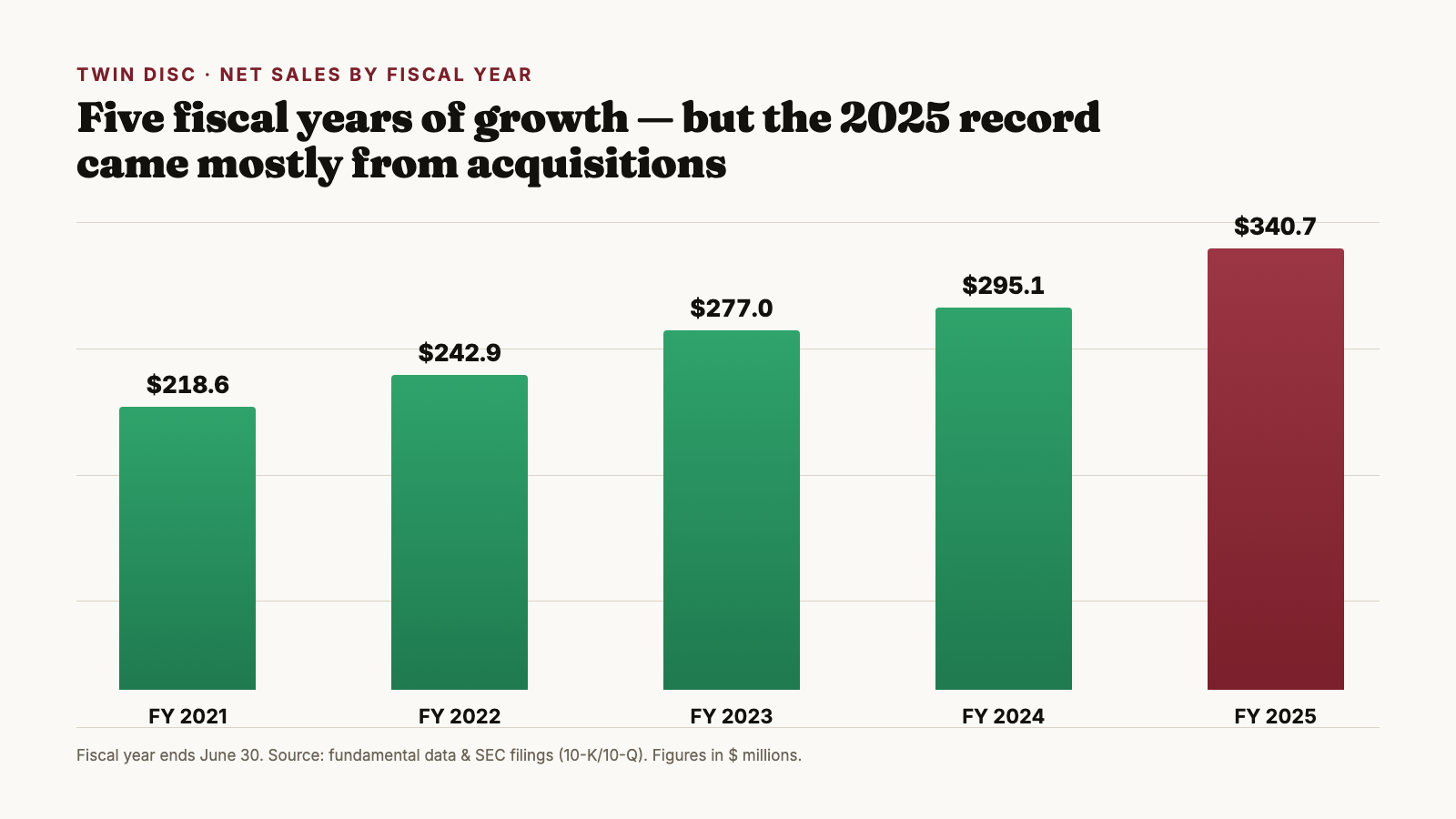
First, what genuinely impresses, because it is real. Twin Disc has grown revenue over five fiscal years without a single setback — a rarity for a cyclical industrial: from $218.6 million in fiscal year 2021 to $242.9 million (2022), $277.0 million (2023), $295.1 million (2024) and finally $340.7 million in fiscal year 2025 — up 15.5 percent year over year and the highest figure in company history. The operating recovery is real too: gross profit rose 11.3 percent to $92.7 million in fiscal 2025, the six-month order backlog stood at $150.5 million as of June 30, 2025, up 13 percent year over year, and the individual quarters of fiscal 2026 keep climbing: $80.0 million (Q1), $90.2 million (Q2), $96.7 million (Q3). The strongest driver is the Dutch Veth propulsion business, which grew 12.3 percent in fiscal 2025. Read only these paragraphs and you see a rock-solid growth stock.
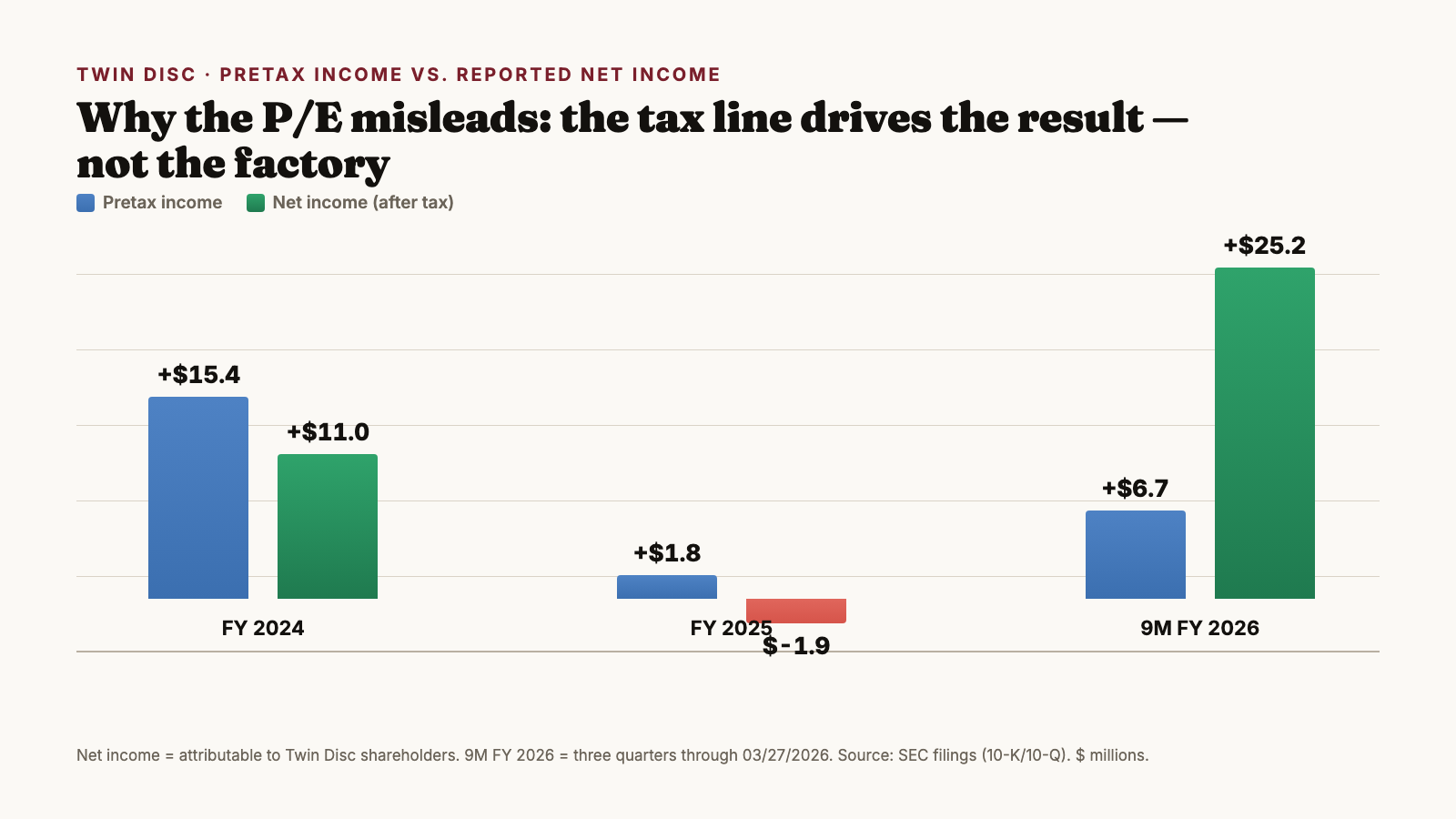
Now flip the income statement over and look all the way down. In the record year 2025, pretax income was $1.8 million — thin already for $340.7 million of revenue. And then came the tax line: a tax charge of $3.4 million, more than the entire pretax result. The outcome: a net loss of $1.9 million, an effective tax rate of 190.4 percent and a loss per share of 14 cents — after a profit of 80 cents in fiscal year 2024. A company that posts its highest revenue ever and still turns red because the tax chapter says so — that is the opposite of what a P/E of 13 promises. Remember the rhythm: at Twin Disc it is not the factory that decides the bottom line, it is the deferred tax. Just how much shows in the leap into fiscal 2026 — and that brings us to the uncomfortable truths.
What the filings say — the uncomfortable truths
Uncomfortable truth no. 1: the $25 million profit is three-quarters a one-time tax benefit
In the first nine months of fiscal year 2026, Twin Disc reported net income of $25.2 million ($1.79 per share) — after a loss of $3.3 million in the prior-year period. Sounds like a spectacular turnaround. But pretax income for those same nine months was only $6.7 million. How do you get from $6.7 million pretax to $25.2 million after tax? Through a tax benefit of $19.0 million — the opposite of a tax charge. The reason sits in the income-tax note of the quarterly report: Twin Disc had for years carried a full valuation allowance against its U.S. deferred tax assets — $24.0 million as of June 30, 2025. Translated: the company was not allowed to recognize its accumulated U.S. tax benefits on the books because it could not be confident enough about future U.S. profits. On December 26, 2025, it reversed that judgment:
"The Company has evaluated the realizability of deferred tax assets and concluded that the U.S. and state valuation allowance is no longer required and was released December 26, 2025. The Company is expected to be in a cumulative three year income position at the end of the year, and expects to be profitable in future periods."
— Twin Disc, Incorporated, SEC quarterly report 10-Q as of March 27, 2026, Note I "Income Taxes"
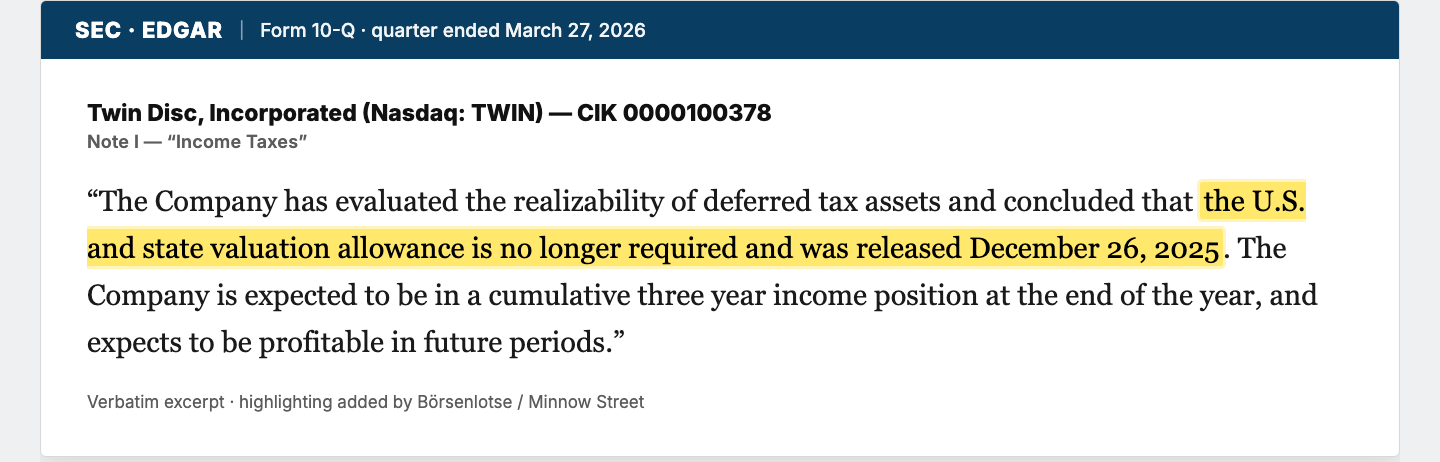
Such a release is a non-cash one-off: not a dollar flows into the bank, and the event cannot recur — you can only release a valuation allowance once. Strip out the tax benefit and about $6 million of pretax operating result is what remains of the $25.2 million profit. That is exactly why the 1,450 percent earnings surprise from the scanner chapter is not a seal of quality but a warning light: it measures the accounting jump, not the business. A year earlier, incidentally, the same mechanism ran the other way — there the valuation allowance pushed the result into a loss.
Uncomfortable truth no. 2: the U.S. business loses money — the entire profit comes from abroad
Why would a company carry a full valuation allowance against its U.S. tax assets for years in the first place? Because it does not reliably make money at home. The income-tax note of the quarterly report splits pretax income by origin — and the picture is unambiguous:
"Foreign earnings (loss), before income taxes … $13,960 [thousand]. Domestic earnings (loss), before income taxes … ($7,296) [thousand]. Income (loss) before income taxes and noncontrolling interest … $6,664 [thousand]." (three quarters ended March 27, 2026)
— Twin Disc, Incorporated, SEC quarterly report 10-Q as of March 27, 2026, Note I "Income Taxes"
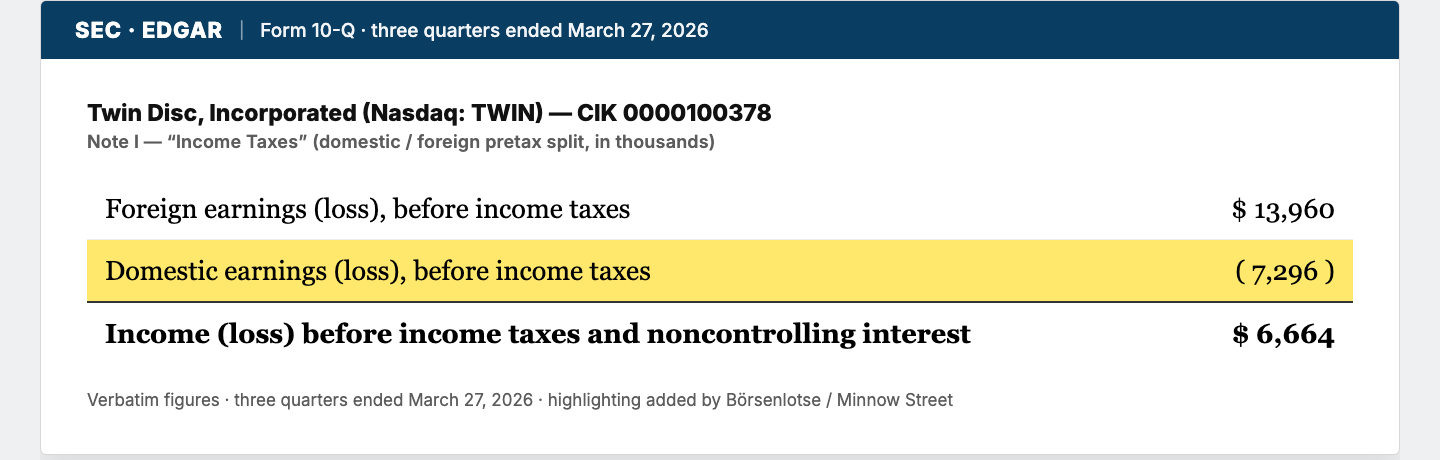
That is the truly uncomfortable part of truth no. 1: in the very year the U.S. business loses $7.3 million over nine months, management decides the U.S. tax assets are now worth recognizing, and books a $19 million gain for it. You can read that optimistically — as a reasoned bet that the U.S. will soon turn profitable. You can also read it as what it is in accounting terms: a judgment call that makes the profit look good today and has to prove itself only in the future. In fairness: the accounting rules (a "cumulative three-year income position") all but force such releases past a certain point, and the foreign business — Veth in the Netherlands, the Swiss propellers, Finnish Katsa — genuinely earns. But whoever buys the stock for the low P/E should know: that P/E stands or falls with a U.S. business that is currently losing money.
Uncomfortable truth no. 3: the revenue growth is bought — organically, Twin Disc shrank
The record revenue of $340.7 million looks like a demand boom. The annual report soberly explains where it really came from — mostly from two acquisitions. Strip out Katsa and Kobelt and the sign flips:
"Excluding the impact of the Katsa and Kobelt acquisitions, sales for our manufacturing segment decreased 2.5%, or $7.5 million, versus the same period last year. … Sales for our distribution segment were down 8.6%, or $12.4 million, compared to fiscal 2024."
— Twin Disc, Incorporated, SEC annual report 10-K for fiscal year 2025, Item 7 "Management's Discussion and Analysis"
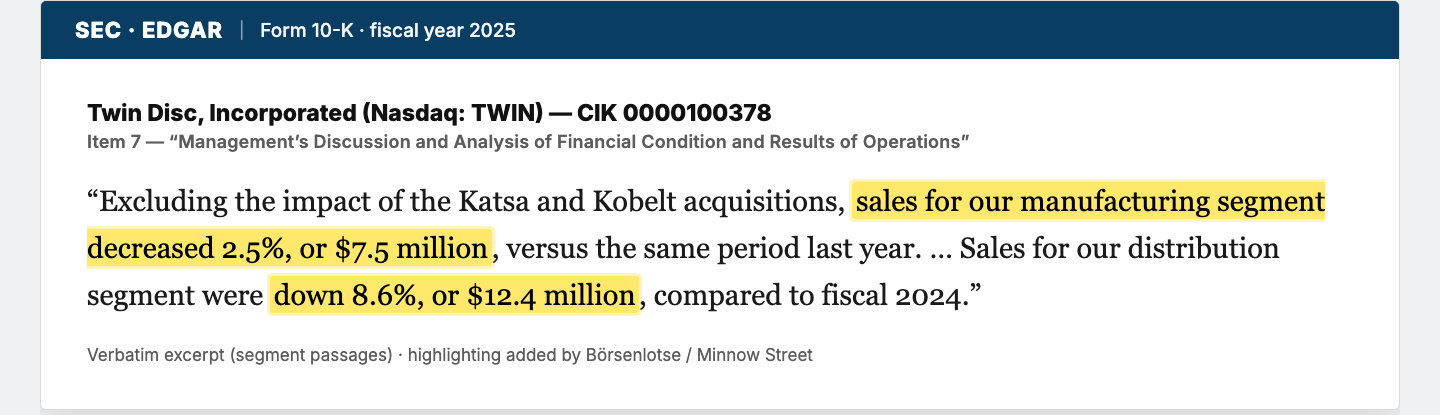
Acquisitions are nothing shameful — Katsa (a Finnish gearbox maker, bought in May 2024) and Kobelt (a Canadian controls-and-propulsion specialist, bought in February 2025 for roughly $17.5 million) fit the portfolio strategically, and the Veth drive really does grow organically. But the accounting of growth deserves honesty: a large part of the "record" is bought, not earned, and buying creates new expense — purchase-accounting amortization and the higher overhead of the two new subsidiaries alone ($8.6 million of additional marketing, engineering and administrative costs) weigh on the margin. When a cyclical industrial grows only through acquisitions while the core business shrinks, the investor is not buying demand — they are buying a bigger balance sheet.
Uncomfortable truth no. 4: the money sits in inventory, not in the bank — and the debt is rising
A look at the balance sheet as of June 30, 2025, explains why growth is hard work at Twin Disc. On the asset side, inventory dominates at $152.0 million — more than 40 percent of total assets and up $21.5 million from the year before. Against that stand only $16.1 million of cash. Exactly this inventory build (partly due to year-end shipping delays, partly to support the growing backlog) cut operating cash flow from $33.7 million to $24.0 million. A company that reports record revenue but generates less cash is tying up its growth on the shelf — and has to fill the gap with credit. Twin Disc does: about $31.4 million of financial debt sat on the books as of June 30, 2025, and on June 30, 2026, the company signed a new, larger credit agreement — a $30 million term loan plus a revolving line of up to $60 million, now jointly with JPMorgan Chase, secured by substantially all personal property and 65 percent of its foreign subsidiaries. This is not an alarm — leverage is modest against $164 million of equity, and the covenants (debt no more than 3.5 times operating profit) are met. But the direction is clear: Twin Disc is increasingly financing its makeover from U.S. niche supplier to broader-based group through debt and inventory — not through its own cash flow.
Valuation: a P/E of 13 that isn't one
In mid-July 2026, Twin Disc carried a market value of roughly $330 to $345 million (data as of July 17, 2026). At first glance that looks cheap: a trailing price-to-earnings ratio around 13, a price-to-sales ratio of 0.9, a price-to-book of 1.8. But this is exactly where the single-number trap from the opening snaps shut. The P/E of 13 uses a trailing profit in which the $19 million tax benefit is fully baked in. Strip out that non-cash one-off and apply a normal tax rate, and Twin Disc has earned only a few million over the trailing twelve months — the adjusted P/E then sits not at 13 but north of 50. The price-to-sales ratio of 0.9 is likewise no bargain for a thin-margin gear maker (operating margin in fiscal 2025: barely 3 percent), but a fair-to-sporty valuation. Translated: the market is not paying for cheap growth today, but for a hope — that the record revenue eventually turns into a record profit. There are anchors of substance: $164 million of equity, a $150.5 million order backlog, a dividend reinstated in fiscal 2024 (most recently 16 cents per share) and roughly 22 percent insider ownership. But a buyback program lies practically idle (not a single repurchase in fiscal 2025), because the money is needed for acquisitions and inventory.
Opportunities and risks at a glance
What speaks for Twin Disc:
- Five fiscal years of revenue growth without a setback, from $218.6 million to $340.7 million; a record in fiscal 2025 (+15.5 percent), gross profit up 11.3 percent to $92.7 million, a six-month order backlog of $150.5 million (+13 percent).
- The foreign business genuinely earns: the Dutch Veth drive grew 12.3 percent in 2025, the Swiss mega-yacht propellers 3.9 percent; the Katsa (Finland) and Kobelt (Canada) acquisitions broaden the portfolio and regions.
- A solid, understandable balance sheet: $164.0 million of equity, modest leverage (about $31.4 million of financial debt, covenants met), a current ratio of 2.0; the tax release itself signals that management considers future profits likely.
- Capital returns reactivated: a dividend paid again since fiscal 2024 (most recently 16 cents per share), roughly 22 percent insider ownership.
- Strong technicals: a Stan Weinstein stage-2 uptrend, plus 164 percent over twelve months, an RS leader, hits in 16 of our trend filters (data as of July 17, 2026).
What speaks against it:
- The profit is largely a tax line: of $25.2 million of nine-month profit (FY 2026), $19.0 million is a one-time, non-cash tax benefit; pretax income was only $6.7 million. In record year 2025, despite peak revenue, the bottom line was a net loss (190.4 percent tax rate).
- The U.S. business loses money: a $7.3 million domestic pretax loss over nine months (FY 2026) against $14.0 million of foreign profit — the entire group profit comes from abroad, and the U.S. tax release is a judgment-call bet.
- Growth is bought: without Katsa and Kobelt, revenue shrank in 2025 (manufacturing −2.5 percent, distribution −8.6 percent); purchase-accounting amortization and higher acquisition overhead weigh on the margin.
- Little cash, heavy inventory: $152.0 million of inventory against $16.1 million of cash, operating cash flow down from $33.7 million to $24.0 million; a new, larger credit line ($30 million plus $60 million) of June 30, 2026, secured by nearly all assets and 65 percent of foreign subsidiaries.
- Valuation only seemingly cheap: adjusted for the tax benefit the P/E sits north of 50; a thin-margin, cyclical end market (operating margin barely 3 percent) and currency risk (large euro share).
A human conclusion
Back to the single-number trap from the opening. Its core is not that metrics lie — a P/E of 13 is arithmetically correct, and the 1,450 percent earnings surprise really did happen. Its core is that a single number takes over the thinking before you have asked where it comes from. At Twin Disc, the profit that makes the P/E so pretty comes mostly from a one-time tax entry — and behind it stands a business that grows up top (through acquisitions), earns only thinly in the middle, and is currently losing money at home. The good news: this is no house of cards. Twin Disc has built real, sought-after machines for 108 years, the equity is solid, the foreign business earns, the order book is full, and if the U.S. does turn profitable, the tax release will have been justified in hindsight. So the honest question for you is not "Is Twin Disc growing?" (revenue is), but: are you buying a business — or are you buying a metric? Whoever takes the $25 million profit at face value buys a metric. Whoever places the $6.7 million pretax result, the shrinking core and the U.S. loss beside it sees a solid but thin-margin industrial at a price that already anticipates a good deal of future improvement. Both can pay off — but only the second knows what it is paying for. What you make of it is your decision. And that is exactly as it should be.
Sources
All original documents used in this analysis — to read for yourself:
- Twin Disc, Incorporated — SEC annual report 10-K for fiscal year 2025 (ended June 30, 2025; filed September 5, 2025)
- Twin Disc, Incorporated — SEC annual report 10-K for fiscal year 2024 (ended June 30, 2024; filed September 6, 2024)
- Twin Disc, Incorporated — SEC quarterly report 10-Q as of March 27, 2026 (third quarter FY 2026; filed May 6, 2026)
- Twin Disc, Incorporated — SEC quarterly report 10-Q as of December 26, 2025 (second quarter FY 2026; filed February 4, 2026)
- Twin Disc, Incorporated — SEC quarterly report 10-Q as of September 26, 2025 (first quarter FY 2026; filed November 5, 2025)
- Twin Disc, Incorporated — SEC report 8-K of July 6, 2026 (new credit agreement of June 30, 2026)
- Twin Disc, Incorporated's complete SEC filing history: EDGAR overview (sec.gov)
- Fundamental data (metrics, quarterly series, valuation; data as of July 17, 2026), reconciled with the SEC filings.
- Screener and rating data: in-house stock scanner (data as of July 17, 2026), including the "Joshua" growth scanner.
Transparency & disclaimer: This analysis is a journalistic contextualization of publicly available information and is not investment advice, not a financial analysis in the regulatory sense, and not a solicitation to buy or sell securities. Stock investments carry substantial risks up to total loss. All information without guarantee; the data cut-off is noted in the text in each case. The author holds no position in Twin Disc stock at the time of publication.
Our Bottom Line at a Glance
- Revenue & order intake positive
- Five fiscal years of revenue growth without a setback to a record $340.7 million (FY 2025, +15.5 percent), gross profit up 11.3 percent to $92.7 million, a six-month backlog of $150.5 million (+13 percent as of 06/30/2025); the FY 2026 quarters keep rising ($80.0 → $90.2 → $96.7 million).
- Earnings quality & the tax line negative
- Of $25.2 million of nine-month profit (FY 2026), $19.0 million is a one-time, non-cash tax benefit (release of the U.S. valuation allowance on 12/26/2025); pretax income was only $6.7 million. In record year 2025, despite peak revenue, the bottom line was a net loss at a 190.4 percent tax rate (10-Q as of 03/27/2026, Note I; 10-K FY 2025).
- U.S. business & growth quality negative
- The domestic business lost $7.3 million pretax over nine months (FY 2026) while abroad earned $14.0 million; the revenue record is bought — without Katsa and Kobelt, revenue shrank in 2025 (manufacturing −2.5 percent, distribution −8.6 percent). The entire profit comes from abroad (10-Q as of 03/27/2026; 10-K FY 2025, Item 7).
- Balance sheet & financing neutral
- $164.0 million of equity and modest debt (~$31.4 million) stand against heavy inventory ($152.0 million) and thin cash ($16.1 million); operating cash flow fell to $24.0 million, and the new credit line ($30M + $60M, 06/30/2026) is secured by nearly all assets and 65 percent of foreign subsidiaries.
- Valuation & technicals neutral
- A Stan Weinstein stage-2 uptrend, plus 164 percent over twelve months and hits in 16 trend filters meet a trailing P/E around 13 that includes the tax benefit — adjusted it sits north of 50; P/S of 0.9 is fair-to-sporty at a barely 3 percent operating margin (data as of July 17, 2026).
Twin Disc is a 108-year-old, solid gear maker with record revenue, a full order book and a foreign business that genuinely earns — but earnings quality lags revenue quality. The nine-month profit of $25.2 million (FY 2026) is three-quarters a one-time tax benefit, pretax income was only $6.7 million, the U.S. business loses money, and the revenue record is bought. The low P/E of 13 is therefore optical — adjusted it sits north of 50. Whoever invests here is buying the bet that the record revenue turns into a record profit. Not investment advice.
What Our Rating Means
- If you don't own the stock
- In our view, the documented risks clearly outweigh — we see no basis for an entry.
- If you hold it in your portfolio
- In our view, the findings carry enough weight to warrant a critical look at your own position.
A journalistic assessment by our editorial team at the time of the deep dive, based on public sources — not investment advice and not a solicitation to buy or sell. Your personal circumstances (investment goals, risk capacity, taxes) cannot be taken into account. What our categories mean, how verdicts are formed, and what conflicts of interest exist →
Worth Noting
- TWIN reached our research list via the "Joshua" growth scanner and a confluence of 16 trend filters in our in-house stock scanner (data as of July 17, 2026); the striking earnings surprise of plus 1,450 percent is an effect of the one-time tax benefit, not of the operating business.
- Scanner metrics (P/E, P/S, ROE, earnings surprise) are computed from trailing twelve-month figures; the release of the U.S. valuation allowance (Q2 FY 2026) is baked in and distorts the P/E downward — an adjusted P/E sits north of 50.
- Price and valuation figures are dated to July 17, 2026 (market value roughly $330 to $345 million); analyses are evergreen, daily prices are not a buy argument. Twin Disc's fiscal year ends June 30 — all quarterly references carry that fiscal-year offset.
Frequently Asked Questions
Twin Disc, Incorporated (Nasdaq: TWIN) of Milwaukee, Wisconsin, has built marine and heavy off-highway power transmission gear since 1918 — marine transmissions, azimuth and surface drives, propellers, plus power-shift transmissions, torque converters, power take-offs, industrial clutches and braking systems. Customers span pleasure-craft, commercial and military marine as well as energy, natural-resources and industrial markets. Revenue in fiscal year 2025 (ended June 30, 2025): $340.7 million.
Twin Disc's fiscal year ends June 30. "Fiscal year 2025" therefore covers July 2024 through June 2025, and the "first nine months of fiscal year 2026" run from July 2025 through the end of March 2026. Anyone comparing Twin Disc figures with calendar-year numbers of other companies should keep that half-year offset in mind.
In fiscal year 2025 Twin Disc achieved record revenue of $340.7 million but only $1.8 million of pretax income. The tax charge of $3.4 million exceeded pretax income, so the bottom line was a net loss of $1.9 million — a 190.4 percent effective tax rate. The cause is a full valuation allowance against U.S. deferred tax assets that still existed in 2025.
Of the $25.2 million of net income in the first nine months of fiscal year 2026 (through March 27, 2026), $19.0 million is a one-time, non-cash tax benefit: Twin Disc released its U.S. deferred-tax valuation allowance on December 26, 2025. Pretax income for the same nine months was only $6.7 million. The operating core therefore earns far less than the headline profit suggests.
In the first nine months of fiscal year 2026, the U.S. business lost $7.3 million pretax, while the foreign business earned $14.0 million. The entire group profit therefore came from abroad (including Veth in the Netherlands, Swiss propellers, Katsa in Finland). Even so, Twin Disc released the U.S. valuation allowance, betting on future U.S. profits.
Only partly. The revenue jump in fiscal year 2025 came mostly from the Katsa (Finland, May 2024) and Kobelt (Canada, February 2025) acquisitions. Excluding those deals, manufacturing-segment sales fell 2.5 percent and distribution-segment sales fell 8.6 percent. Organically, Twin Disc shrank — with the exception of the Dutch Veth drive, which grew 12.3 percent.
Only at first glance. The trailing price-to-earnings ratio of about 13 (data as of July 17, 2026) includes the one-time $19 million tax benefit. Strip out that non-cash one-off and apply a normal tax rate, and the adjusted P/E sits north of 50. Against a market value of roughly $330 to $345 million and an operating margin of barely 3 percent, the stock is therefore not cheap but fairly-to-sportily valued.
Found an error?
Did you spot a factual error, an outdated number, or a typo in this deep dive? Let us know briefly — your report goes straight to the editorial team.