Plexus Stock: Four Billion in Revenue — and Why Only a Twentieth of It Survives as Profit
Plexus builds complex electronics for other companies’ brands — ventilators, defense electronics, industrial gear — and shows up in our "Joshua" growth scanner while the stock has more than doubled in twelve months (data as of July 17, 2026). We read the annual reports (10-K) for fiscal years 2024 and 2025 and the quarterly report (10-Q) as of April 4, 2026: a good $4 billion in revenue, of which only about five cents on the dollar survives as operating profit — a record profit, a re-accelerating top line (plus 18.7 percent in the latest quarter), and the question of why the market pays 43 times earnings for a contract manufacturer. Not investment advice — just a reminder that a big revenue number is not the same as a big margin.
 Thomas Mücke
Founder & Publisher
Thomas Mücke
Founder & Publisher
Chart
Interactive price chart (TradingView).
Note: pure fact-based analysis, not investment advice and not a solicitation to buy or sell. All figures without guarantee.
There is an investor trap that springs shut precisely when a number is pleasingly large: the billion-dollar dazzle. It works like this: you read "$4 billion in revenue" and your brain automatically translates it into "a big, safe, profitable company." Size feels like quality. But revenue and profit are two entirely different things — and for some business models the gap between them is a canyon. Hardly any stock illustrates that in the summer of 2026 as vividly as Plexus Corp. (Nasdaq: PLXS) from Neenah, Wisconsin: a contract manufacturer of complex electronics whose stock has more than doubled in twelve months and which lights up in our "Joshua" growth scanner. A good $4 billion in revenue — and yet a company the market values for less than the big number suggests, the moment you look at the margin. So let’s make a deal: before the big number dazzles you, we read together what Plexus itself reported, under penalty of law, to the U.S. securities regulator, the SEC — the annual reports (10-K) for fiscal years 2024 and 2025 and the quarterly report (10-Q) as of April 4, 2026. And these filings tell of a genuine record profit, a re-accelerating top line — and a margin as thin as a razor blade. In the end, you decide for yourself.
What Plexus actually does — and for whom
Plexus is what the industry calls EMS — "Electronic Manufacturing Services," a contract manufacturer for electronics. Translated: Plexus is the workbench behind other companies’ brands. A medical-device company invented a ventilator, a defense firm a radar module, an industrial group a network controller — but the actual building, testing, packaging and shipping is often done not by the brand itself but by a service provider like Plexus. The company accompanies such products, per its annual report (10-K), from design through volume manufacturing and supply-chain management to the aftermarket — its own slogan for it is "Design-to-Deliver." Plexus is paid for its own value-add; the expensive material input (chips, boards, components) mostly passes straight through. That is exactly why we will look so closely at the margin in a moment. It serves three market sectors, and not cheap mass-market goods but regulated, long-lived, highly complex devices: Healthcare/Life Sciences (40 percent of fiscal 2025 revenue), Industrial (43 percent) and Aerospace/Defense (17 percent). In fiscal year 2025, Plexus served about 190 customers from 26 facilities totaling roughly 5.0 million square feet, with more than 20,000 employees. One quirk belongs right at the start because it trips up every casual reader of the numbers: Plexus’ fiscal year ends not on December 31 but on the Saturday nearest September 30 — a 52/53-week calendar. "Fiscal year 2025" ended September 27, 2025, and the "second quarter of fiscal year 2026" ended April 4, 2026. Which brings us to the central tension of this analysis, and it runs through every chapter: Plexus is delivering genuine, re-accelerating growth and a record profit right now — but it remains a contract manufacturer with a razor-thin margin that the market has begun to price like a growth company. How slim the value-add is in the contract business is something we dissected at its direct industry neighbor Benchmark Electronics — and how much approvals and programs set the pace in the aerospace/defense world, at electronics specialist Astronics.
Where the stock shows up in our scanner
Every day we run about 3,500 stocks through our scanners. Plexus reached the research list through the "Joshua" growth scanner (data as of July 17, 2026) — a filter that hunts for companies whose price and earnings growth are accelerating together. And Plexus rarely comes alone: the stock sits in a Stan Weinstein stage-2 uptrend (price above a rising 200-day average), trades above both the 50- and the 200-day lines, ranks as a relative-strength leader (RS ≥ 90) and sits near its 52-week high. Behind that stand plus 44.5 percent in three months, plus 86.9 percent in six months and plus 114 percent over twelve months (data as of July 17, 2026). So much for the trend and growth lens — it glows green. The valuation lens of the same scanner cautions at the same time: a trailing price-to-earnings ratio around 43 and a price-to-book ratio around 5.3 are proud numbers for a contract manufacturer, and a return on equity of 13.2 percent is solid but no outlier (data as of July 17, 2026). The analyst consensus of five houses stands at 1.4 on the scale from 1 (strong buy) to 5 — clearly in the buy camp. Remember this fingerprint: a growth scanner finds what grows fast — it does not tell you whether you are paying a fair price for that growth. You have to work that out yourself. That is exactly what we do now.
The numbers over the years — honestly appraised
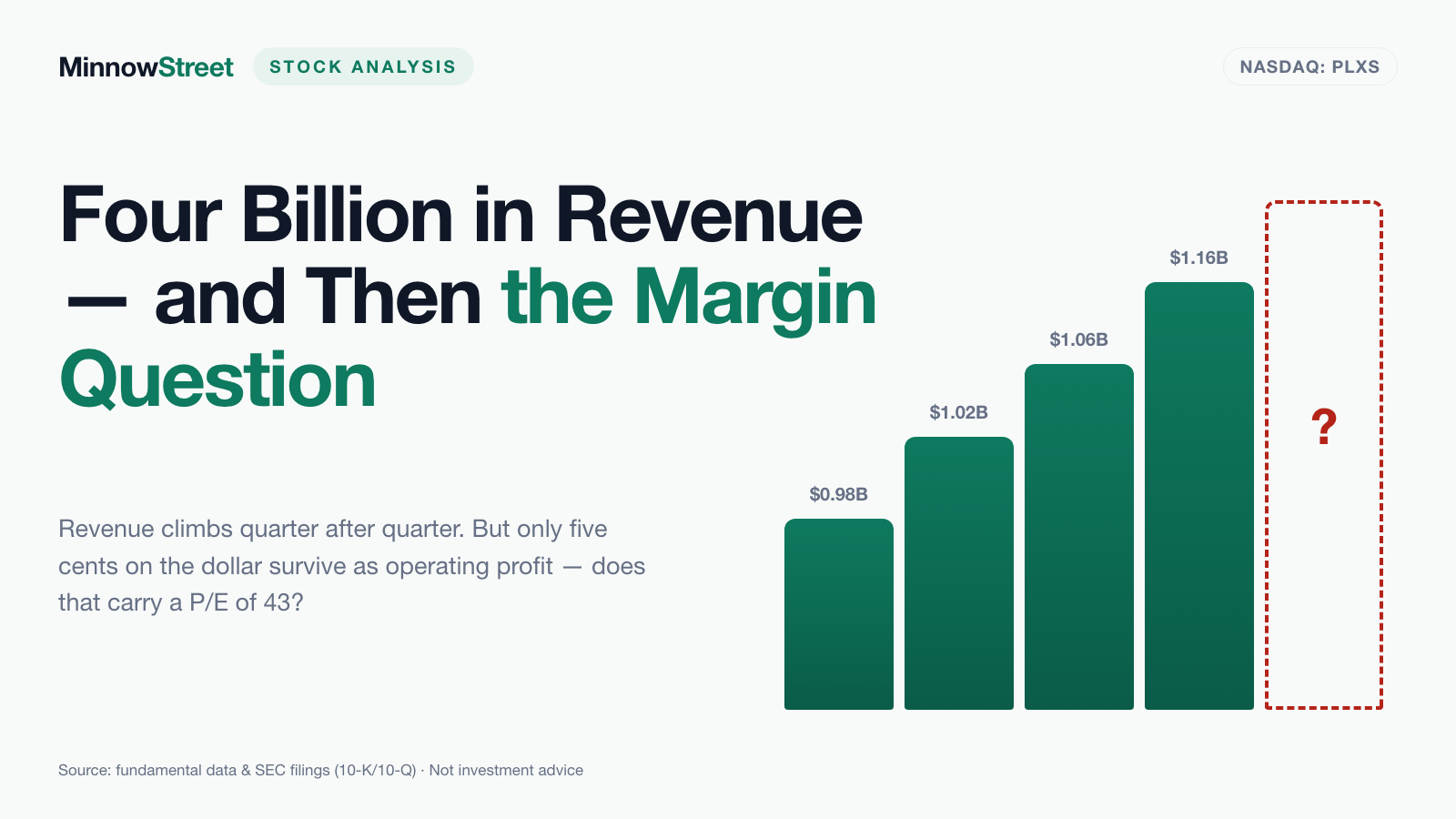
First, what genuinely impresses. Plexus is no loss story and no house of cards but a consistently profitable company with one of the better balance sheets in its industry. In fiscal year 2025 (ended September 27, 2025) the company booked $4.03 billion in revenue (up 1.8 percent), earned $202.4 million operating and $172.9 million net — a 54.6 percent jump from $111.8 million the year before. Diluted earnings per share leapt from $4.01 to $6.26. And growth has just picked up speed again: in the second quarter of fiscal year 2026 (January through early April 2026), revenue rose 18.7 percent to $1.16 billion, net income 27.5 percent to $49.8 million, and diluted earnings per share from $1.41 to $1.82. Over the first half of fiscal 2026 that adds up to plus 14.2 percent of revenue. The quarterly path shows a clean acceleration:
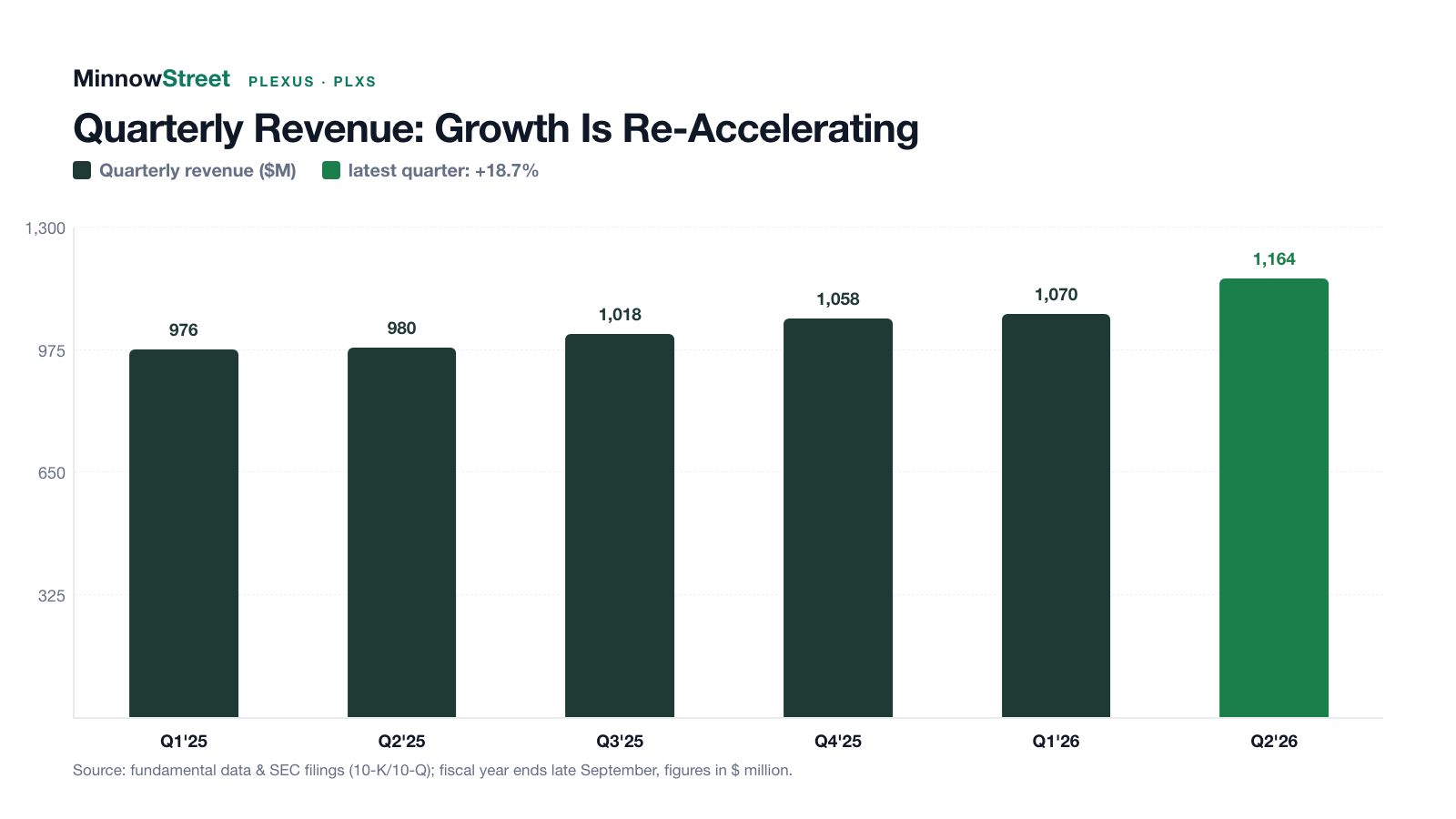
Where does the fresh pace come from? The quarterly report is refreshingly concrete — it is not just the market, it is new orders:
"The increase in net sales was driven by an increase of $87.2 million due to production ramps of new products for existing customers and an increase of $28.9 million due to production ramps for new customers."
— Plexus Corp., SEC quarterly report 10-Q as of April 4, 2026, Item 2 "Management’s Discussion and Analysis"

So much for the sunny side. It is real, and it is why the stock sits in a growth scanner. But now let’s flip the picture and see what actually survives from the big numbers.
What the filings say — the uncomfortable truths
Uncomfortable truth no. 1: Only five cents of operating profit survive from every revenue dollar
This is not a criticism of Plexus — it is the physics of the contract business. A contract manufacturer buys expensive components on behalf of its customers, assembles them and then bills for material plus its own labor. The purchased material value passes essentially straight through the books; the money is made on the manufacturing. That is exactly why the revenue is large and the margin thin. Look at the bare numbers of fiscal year 2025: of $4,032.97 million in revenue, $406.51 million remained as gross profit after materials — a gross margin of 10.1 percent. After selling and administrative costs, $202.37 million of operating income was on the books, an operating margin of 5.0 percent. And at the bottom, $172.89 million of net income remained — a net margin of 4.3 percent.
"Net sales $ 4,032,966 … Cost of sales 3,626,452 … Gross profit 406,514 … Operating income 202,371 … Net income $ 172,885" (in thousands)
— Plexus Corp., SEC annual report 10-K for fiscal year 2025, Consolidated Statements of Comprehensive Income
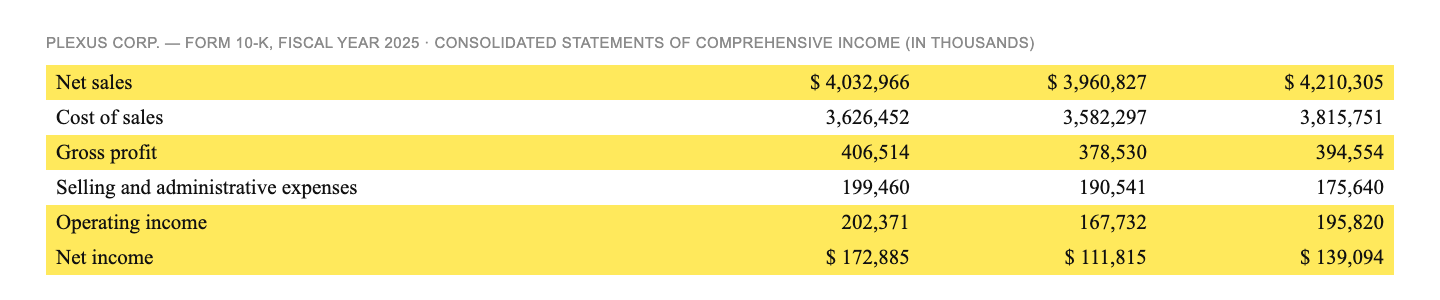
You see the dazzle best in a direct picture — the mountain of revenue next to the molehill of profit:
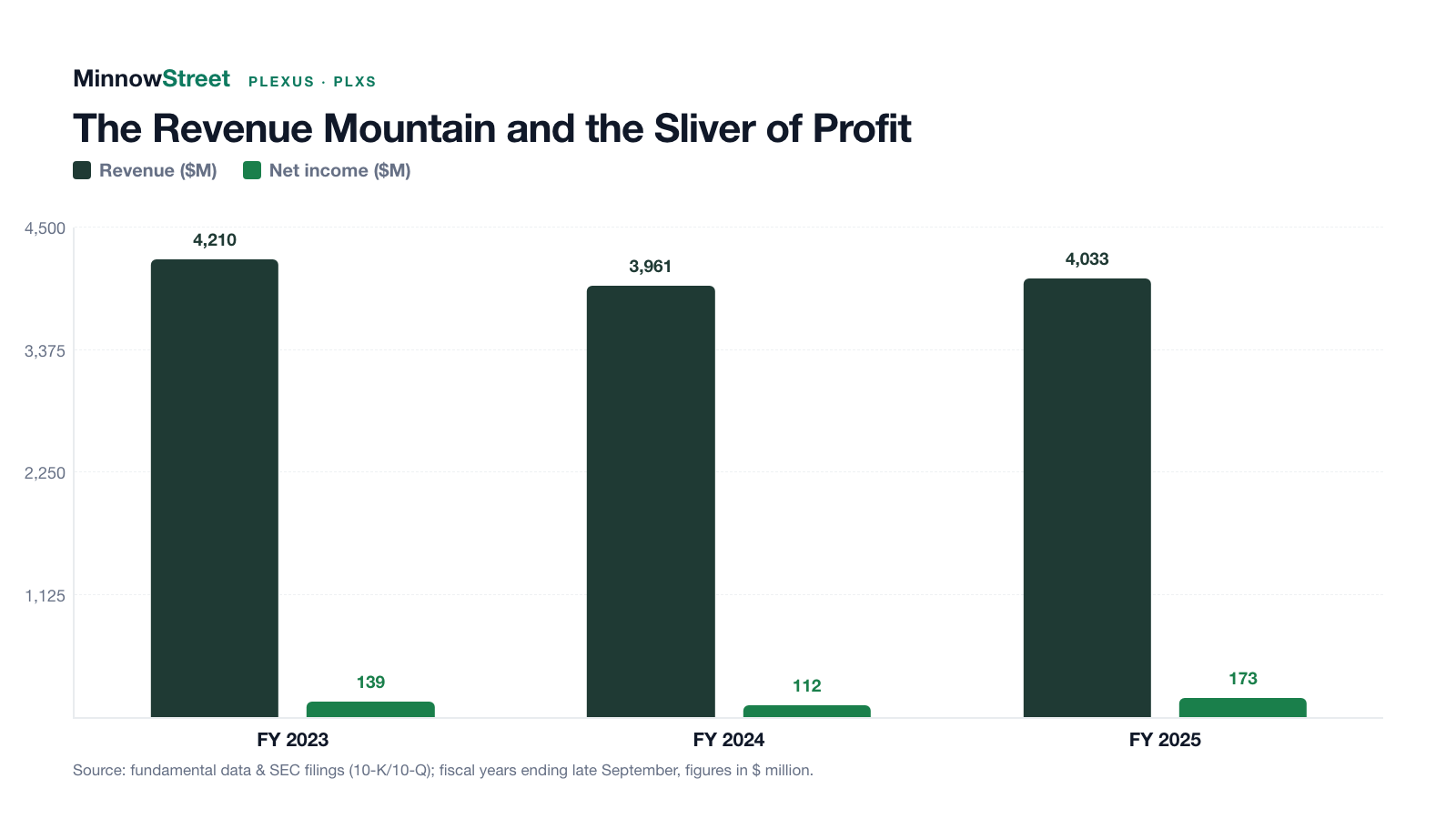
Remember this image: at a contract manufacturer, revenue is not size but throughput. A five-percent-margin business forgives little — if material gets more expensive, a large customer slips a production ramp, or a plant costs more than planned, the narrow strip quickly gets narrower. In fairness, the other side belongs here too: Plexus does not make throwaway electronics but regulated medical, defense and industrial devices with long product life-cycles and high barriers to entry — the higher-margin corner of the EMS business, and 10.1 percent gross margin is respectable for a contract manufacturer. But "respectable for a contract manufacturer" is something other than "profitable like a brand owner." That very confusion is the billion-dollar dazzle.
Uncomfortable truth no. 2: Half the revenue hangs on ten customers
At first glance Plexus looks broadly diversified — about 190 customers, not a single one over 10 percent of revenue. The annual report confirms it explicitly: "No customer accounted for over 10% of our sales in fiscal 2025 or 2024." Reassuring. One sentence later, the picture tilts:
"The majority of our net sales come from a relatively small number of customers and a limited number of market sectors; if we lose a major customer or program … then our net sales and operating results could decline significantly. Our 10 largest customers accounted for 49.1% and 47.8% of our net sales in fiscal 2025 and 2024, respectively."
— Plexus Corp., SEC annual report 10-K for fiscal year 2025, Item 1 "Business" / Item 1A "Risk Factors"

Picture a workshop that builds for many different clients — but half the revenue comes from ten regulars, and each order is a "program" with a long ramp-up and a limited life. If such a program falls away — because a customer brings manufacturing in-house, discontinues the end product or switches to a competitor — it tears a visible hole. The growth we just celebrated is the pretty side of this coin (new production ramps fill the plants); the flip side is that the same mechanism runs in reverse too. Remember the tension: contract manufacturing lives on programs — and programs come and go.
Uncomfortable truth no. 3: "Made in Wisconsin" is on the letterhead, the profit is made in Asia
Plexus is a Wisconsin corporation, its headquarters are in Neenah, and the name sounds American. Where the money is really made, the risk factors of the annual report say without makeup:
"Operations outside of the U.S. in the aggregate represent a majority of our net sales and operating income, with a particular concentration in Malaysia."
— Plexus Corp., SEC annual report 10-K for fiscal year 2025, Item 1A "Risk Factors"

The segment numbers prove it: of $4.03 billion in revenue in fiscal year 2025, $2.39 billion came from the Asia-Pacific region (APAC) and only $1.22 billion from the Americas; per the human-capital disclosure, 58.3 percent of the more than 20,000 employees sit in the APAC region. That is commercially smart — manufacturing costs are lower there and the electronics supply chains are at home. But it shifts the risk profile: whoever buys PLXS is buying a concentration in a single Southeast Asian country — with currency, trade and geopolitical question marks that a "U.S. stock" does not suggest at first glance. No scandal, but a label worth knowing before you buy it.
Valuation: $7.4 billion in market value for a five-percent margin
Now the price question. In mid-July 2026, Plexus carried roughly $7.4 billion in market value (price around $270, data as of July 17, 2026, after a 114 percent gain in twelve months). Measured against earnings, that is a trailing price-to-earnings ratio around 43 — a confident price for a business running a 5 percent operating margin. The price-to-sales ratio around 1.8 sounds low but is not: at a net margin of a good 4 percent, each revenue dollar is worth only a few cents of profit, and a P/S of 1.8 here means effectively the same expensive price tag as the P/E of 43. For a sense of scale: classic contract manufacturers have historically traded at single-digit to low-double-digit price-to-earnings ratios, because their business is capital-intensive, cyclical and low-margin. Plexus is being priced right now as if it had grown out of that category — investors are paying for the hope that the shift toward higher-margin medical, defense and industrial work, together with the fresh order growth, lifts the thin margin durably. In its favor stands the balance sheet, a genuine strength. As of April 4, 2026, $303.1 million sat in cash, against only about $137.8 million of financial debt; equity of $1.45 billion carries $3.14 billion in total assets (equity ratio around 46 percent). And earnings quality has improved — operating margin rose 80 basis points in fiscal 2025. Except: part of the record profit came not from the factory but from financing — interest expense fell from $31.5 million to $11.6 million in two years. Such one-time relief cannot be repeated at will. Buybacks, incidentally, stayed muted of late: in the first half of fiscal 2026 Plexus repurchased just $12.2 million of its own stock, even though $85.0 million of repurchase authorization remains open (as of September 27, 2025) — with a stock that has doubled, management is visibly holding back.
Opportunities and risks at a glance
What speaks for Plexus:
- Genuine, accelerating growth: revenue in the second quarter of fiscal 2026 up 18.7 percent to $1.16 billion, per the report on production ramps of new products for existing and new customers — not a mere market tailwind but won orders.
- Record profit with better quality: net income in fiscal 2025 up 54.6 percent to $172.9 million, operating margin up 80 basis points to 5.0 percent, diluted earnings per share from $4.01 to $6.26.
- The higher-margin corner of the contract business: regulated, long-lived devices from Healthcare/Life Sciences (40 percent), Industrial (43 percent) and Aerospace/Defense (17 percent) with high barriers to entry — not an interchangeable mass business.
- Solid balance sheet: $303.1 million in cash against roughly $137.8 million of financial debt, $1.45 billion in equity, equity ratio around 46 percent (April 4, 2026); return on equity 13.2 percent.
- Technicals and consensus behind it: a Stan Weinstein stage-2 uptrend, above the 50- and 200-day averages, an RS leader, plus 114 percent in twelve months; analyst consensus 1.4 of 5 (data as of July 17, 2026).
What speaks against it:
- The razor-thin margin as a system property: 5.0 percent operating, 4.3 percent net margin — of $4 billion in revenue only a narrow strip remains, which gets thinner fast on material, customer or plant trouble.
- Customer concentration: the ten largest customers account for 49.1 percent of revenue, the business runs through individual "programs" with a limited life — lose a big one and revenue drops noticeably (10-K FY 2025).
- Asia concentration: the majority of revenue and operating income is earned abroad, "with a particular concentration in Malaysia" — currency, trade and geopolitical risks for a supposed U.S. stock.
- Sporty valuation: trailing P/E around 43, P/S around 1.8 (data as of July 17, 2026) — historically expensive for a low-margin contract manufacturer; the price already bakes in a durable margin improvement.
- A quiet earnings helper: part of the 55 percent earnings jump came from interest expense falling from $28.9 million to $11.6 million — one-time relief that cannot repeat every year.
A human conclusion
Back to the billion-dollar dazzle from the opening. Its core is not that big revenues are worthless — Plexus is a rock-solid, profitable company with a clean balance sheet, genuine order growth and improved earnings. Its core is that the big number fools us into seeing a quality that is not there in the contract business: of every revenue dollar only a few cents survive after materials, half the business hangs on ten customers, and the profit is earned largely in Asia. None of this is a scandal — all of it is disclosed openly in the filings, and Plexus does its job above average in a low-margin industry. So the honest question for you is not "Is Plexus growing?" (it is growing strongly again), but: are you paying a contract-manufacturer price for a contract manufacturer — or the price of a high-margin growth company for a five-percent-margin business? At today’s P/E around 43, it is the latter. If Plexus really sustains the shift into higher-margin niches and the order pace year after year, the stock can grow into it. If not, you are paying a growth fantasy on a thin margin — and thin margins are unforgiving once the pace stalls. What you make of it is your decision. And that is exactly as it should be.
Sources
All original documents used in this analysis — to read for yourself:
- Plexus Corp. — SEC annual report 10-K for fiscal year 2025 (ended September 27, 2025; filed November 14, 2025)
- Plexus Corp. — SEC annual report 10-K for fiscal year 2024 (ended September 28, 2024; filed November 15, 2024)
- Plexus Corp. — SEC quarterly report 10-Q as of April 4, 2026 (second quarter of fiscal 2026; filed May 7, 2026)
- Plexus Corp. — SEC quarterly report 10-Q as of January 3, 2026 (first quarter of fiscal 2026; filed February 5, 2026)
- Plexus Corp. — SEC quarterly report 10-Q as of June 28, 2025 (third quarter of fiscal 2025; filed August 1, 2025)
- Plexus Corp. — SEC quarterly report 10-Q as of March 29, 2025 (second quarter of fiscal 2025; filed May 2, 2025)
- Plexus Corp.’s complete SEC filing history: EDGAR overview (sec.gov)
- Fundamental data (metrics, quarterly series, valuation; data as of July 17, 2026), reconciled with the SEC filings.
- Screener and rating data: in-house stock scanner, "Joshua" growth scanner (data as of July 17, 2026).
Transparency & disclaimer: This analysis is a journalistic contextualization of publicly available information and is not investment advice, not a financial analysis in the regulatory sense, and not a solicitation to buy or sell securities. Stock investments carry substantial risks up to total loss. All information without guarantee; the data cut-off is noted in the text in each case. The author holds no position in Plexus stock at the time of publication.
Our Bottom Line at a Glance
- Growth & order book positive
- Revenue in the second quarter of fiscal year 2026 (through April 4, 2026) up 18.7 percent to $1.16 billion, per the quarterly report on production ramps of new products for existing (+$87.2M) and new customers (+$28.9M); net income up 27.5 percent. Genuine, won order growth, not a mere market tailwind (10-Q as of 04/04/2026).
- Profitability & margin neutral
- Record net income of $172.9 million in fiscal 2025 (+54.6 percent), operating margin improved to 5.0 percent (+80 bps) — but at its core a five-percent-margin business: of $4 billion in revenue, only about four cents on the dollar remain. Part of the earnings jump also came from interest expense falling from $28.9 million to $11.6 million (10-K FY 2025).
- Concentration risks (customers & Malaysia) negative
- The ten largest customers account for 49.1 percent of revenue, the business runs through individual "programs" with a limited life; at the same time the majority of revenue and operating income is earned abroad, "with a particular concentration in Malaysia" (10-K FY 2025, Item 1/1A). Two concentration risks a supposed U.S. stock hides at first glance.
- Balance sheet & cash cushion positive
- $303.1 million in cash against roughly $137.8 million of financial debt, $1.45 billion in equity on $3.14 billion in total assets (equity ratio around 46 percent), return on equity 13.2 percent — one of the more solid balance sheets in the industry and a buffer for cyclical troughs (10-Q as of 04/04/2026).
- Valuation & technicals negative
- A trailing P/E around 43 and P/S around 1.8 (data as of July 17, 2026) are historically expensive for a low-margin contract manufacturer — the price (up 114 percent in twelve months) already bakes in a durable margin improvement. Growth and trend hits (Joshua, Stan Weinstein stage 2) meet a sporty price tag.
Plexus is a rock-solid, profitable company with a clean balance sheet, genuine order growth (plus 18.7 percent in the latest quarter) and a record profit. But it remains a contract manufacturer with a razor-thin margin: of $4 billion in revenue only about five cents of operating profit survive on the dollar, half the business hangs on ten customers, and the profit is earned mostly in Asia. At a trailing P/E around 43 the market is paying a growth price for a five-percent-margin business. Whoever invests here is betting the shift into higher-margin niches justifies the price tag. Not investment advice.
What Our Rating Means
- If you don't own the stock
- In our view, the documented risks clearly outweigh — we see no basis for an entry.
- If you hold it in your portfolio
- In our view, the findings carry enough weight to warrant a critical look at your own position.
A journalistic assessment by our editorial team at the time of the deep dive, based on public sources — not investment advice and not a solicitation to buy or sell. Your personal circumstances (investment goals, risk capacity, taxes) cannot be taken into account. What our categories mean, how verdicts are formed, and what conflicts of interest exist →
Worth Noting
- PLXS reached our research list via the "Joshua" growth scanner plus trend confluence in our in-house stock scanner (data as of July 17, 2026): Stan Weinstein stage 2, above the 50- and 200-day averages, RS leader ≥ 90, near 52-week high; analyst consensus 1.4 of 5.
- All fiscal-year and quarterly references carry the 52/53-week offset: fiscal 2025 ended September 27, 2025, and the second quarter of fiscal 2026 ended April 4, 2026. Segment and concentration figures from the 10-K for fiscal 2025 (Item 1/1A, Note 11).
- Price and valuation figures are dated to July 17, 2026 (price around $270, market value roughly $7.4 billion); analyses are evergreen, daily prices are not a buy argument. Interest expense fell from $31.5 million to $11.6 million in two years — part of the earnings increase is thus one-time relief.
Frequently Asked Questions
Plexus Corp. (Nasdaq: PLXS) of Neenah, Wisconsin, is a contract manufacturer of complex electronics (EMS). It designs, builds and delivers devices that other brands invented — mainly in Healthcare/Life Sciences (40 percent of fiscal 2025 revenue), Industrial (43 percent) and Aerospace/Defense (17 percent). Revenue in fiscal year 2025 (ended September 27, 2025): $4.03 billion, net income $172.9 million.
Because a contract manufacturer passes most of the expensive material input straight through: of $4.03 billion in fiscal 2025 revenue, $406.5 million remained as gross profit (gross margin 10.1 percent), $202.4 million as operating income (operating margin 5.0 percent) and $172.9 million net (net margin 4.3 percent). At Plexus, revenue is mostly throughput — the money is made on its own manufacturing, not on the pass-through material.
Plexus’ fiscal year ends on the Saturday nearest September 30 (a 52/53-week calendar). "Fiscal year 2025" ended September 27, 2025, and the "second quarter of fiscal year 2026" ended April 4, 2026. Anyone comparing Plexus figures with calendar-year numbers of other companies should keep that offset in mind.
Net income rose 54.6 percent to $172.9 million in fiscal 2025. It was carried by an 80-basis-point higher operating margin (5.0 percent) and by interest expense that nearly halved (from $28.9 million to $11.6 million) after debt reduction. The interest relief, however, is a one-time tailwind that cannot repeat every year.
No single customer accounted for over 10 percent of revenue in fiscal 2025 or 2024. Together, however, the ten largest customers accounted for 49.1 percent of revenue in fiscal 2025 (47.8 percent in fiscal 2024). The business runs through individual "programs" with a limited life — if Plexus loses a big program, revenue could decline significantly, per the annual report.
Although Plexus is a Wisconsin corporation, per the annual report the majority of revenue and operating income is earned outside the U.S. — "with a particular concentration in Malaysia." Of $4.03 billion in fiscal 2025 revenue, $2.39 billion came from the Asia-Pacific region; 58.3 percent of the more than 20,000 employees sit there. That brings currency, trade and geopolitical risks.
For a contract manufacturer, not really: at roughly $7.4 billion in market value, the trailing price-to-earnings ratio stands around 43 and price-to-sales around 1.8 (data as of July 17, 2026). For a business with a 5 percent operating margin that is historically expensive — the price already bakes in a durable margin improvement. The balance sheet, with $303 million in cash and an equity ratio around 46 percent, is solid, however.
Found an error?
Did you spot a factual error, an outdated number, or a typo in this deep dive? Let us know briefly — your report goes straight to the editorial team.