Materion Stock: A Record Top Line — and Value Creation That Has Fallen for Three Years
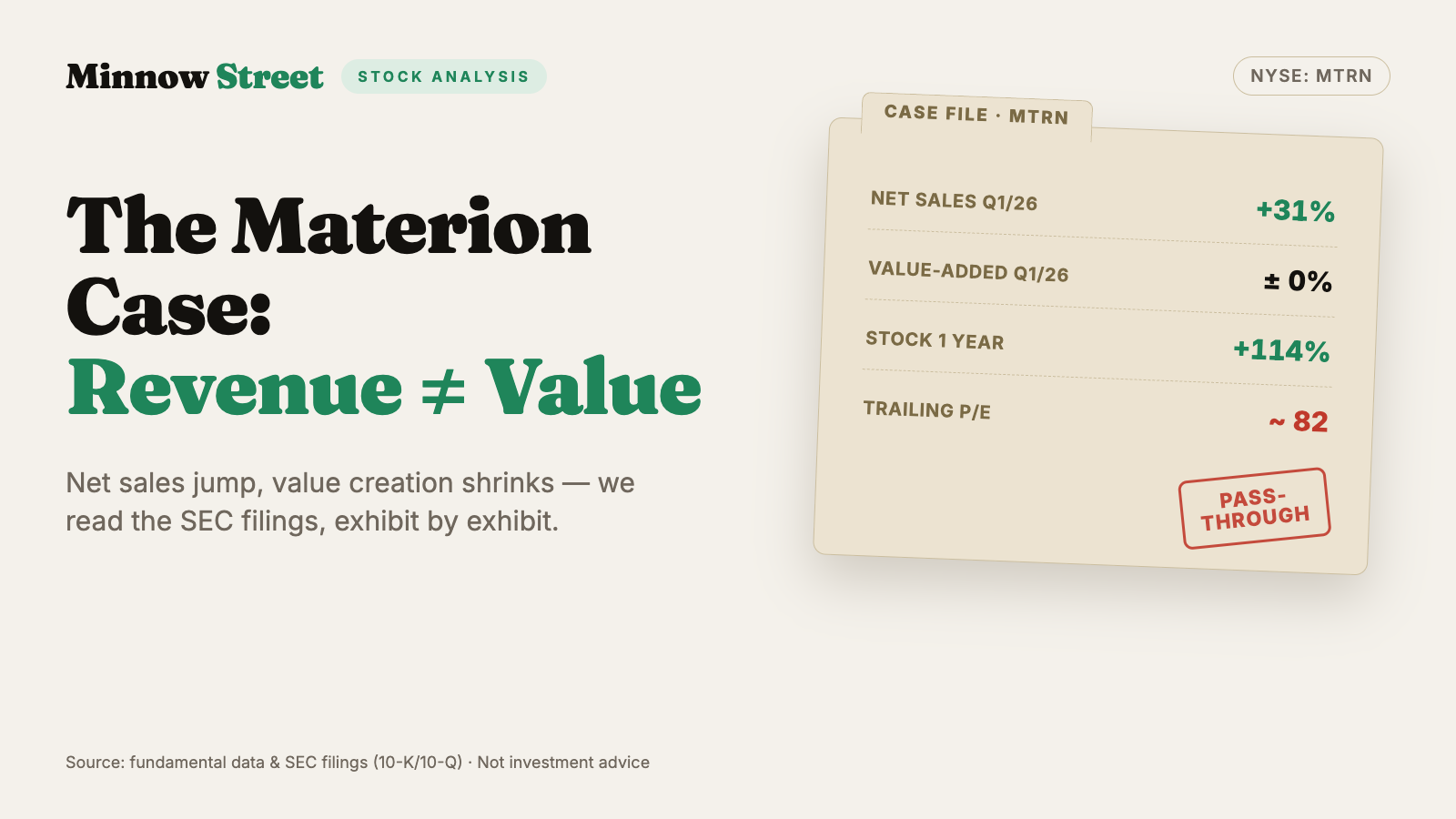
Materion (NYSE: MTRN) from Ohio reported record net sales of $1.79 billion for 2025 (+6 percent) and jumped another 31 percent in the first quarter of 2026 — the stock sits roughly 114 percent above a year ago, and it ranks third of 75 in our in-house Joshua growth scanner (as of July 17, 2026). We read the annual reports (10-K) for 2024 and 2025 and the quarterly report (10-Q) as of April 3, 2026 — and found an uncomfortable second number: value-added sales, which strip out pass-through metal costs, have fallen since 2023, from $1,127 to $1,046 million. Not investment advice — just the question of how much of a record top line belongs to the company, and how much merely flows through its books.
 Thomas Mücke
Founder & Publisher
Thomas Mücke
Founder & Publisher
Chart
Interactive price chart (TradingView).
Note: pure fact-based analysis, not investment advice and not a solicitation to buy or sell. All figures without guarantee.
There is an investor trap that snaps shut precisely when a number is big, round and rising: the pass-through trap. It works like this — you read "revenue $1.8 billion, up 31 percent in the quarter," your brain instantly stamps it "big, growing company," and from there the questions stop. A 114 percent stock gain and a third-place finish in a growth scanner confirm the feeling, and the story is done. Hardly any small cap feeds that trap in the summer of 2026 as textbook-perfectly as Materion Corporation (NYSE: MTRN) from Mayfield Heights, Ohio — a specialty materials maker that has just driven its net sales to a record high. So let's make a deal: before the big number carries you off, we separate the water that merely flows through the pipe from the water the company actually sells. Materion hands us the tools itself — in the annual reports (10-K) for 2024 and 2025 and the quarterly report (10-Q) as of April 3, 2026, which the company filed, under penalty of law, with the U.S. securities regulator, the SEC. In the end, you decide for yourself.
What Materion actually does — and for whom
Materion makes material you never see but need everywhere: alloys, metals, coating substances and optical filters that go into semiconductors, defense electronics, medical devices, data centers and aerospace. The company describes itself as "an integrated producer of high-performance advanced engineered materials." "Integrated" is meant literally: Materion sits on the world's largest bertrandite mine in Utah and processes the ore all the way to the finished component. If you want a picture: Materion is something like the supplier of ingredients for the high-tech kitchen — not the dish, not the stove, but the precisely specified raw materials from which others build their chips, sensors and engine parts. The company — formerly Brush Engineered Materials, renamed Materion in 2011 — employs roughly 2,880 people worldwide and is organized into three segments. One number belongs right at the start because it underpins the whole analysis: Materion's fiscal year matches the calendar year — there is no fiscal-year offset here, "fiscal 2025" is simply the year 2025.
The three segments differ radically in character — and that is the key to this analysis:
- Performance Materials (2025 net sales: $675.9 million) is the heart: beryllium, beryllium alloys, the famous precision clad strip and the Utah mine. This is where the company's highest value-added sits — customers pay for materials know-how, not for metal weight.
- Electronic Materials (2025 net sales: $1,010.0 million) is the largest segment by revenue — and the most deceiving: it turns precious metals (gold, silver, platinum) into coating and deposition materials for the chip industry. Because the metal value simply runs through the books, net sales here are huge while the company's own value-added is small.
- Precision Optics (2025 net sales: $100.7 million) is the smallest segment: optical coatings and filters. It handed Materion the most expensive bill of the decade in 2024 — more on that shortly.
Which brings us to the central tension of this analysis, and it runs through every chapter: Materion reports record net sales while its actual value creation has fallen for three years — and in two consecutive years a one-time event blew up the bottom line. How an optically splendid top line can hide shrinking substance is something we dissected at the precious-metals dealer TRX Gold, whose records belong to the gold price; and why Materion still hangs on the chip cycle shows in our look at pick-and-place-machine maker Kulicke & Soffa.
Where the stock shows up in our scanner
Every day we run about 3,500 stocks through our scanners. Materion reached the research list through our Joshua growth scanner — motto "let winners run, avoid losers" — where it ranks third of 75 hits (as of July 17, 2026). The Joshua scanner is strict: it demands an intact uptrend (price above the 50- and 200-day averages, no Weinstein downtrend), revenue and earnings growth over the past six quarters, a Piotroski F-score above 3, a price-to-earnings ratio below the industry median — and then ranks the survivors by relative cheapness within the industry. That Materion clears that filter says a lot: the stock has momentum and screens as not-too-expensive relative to peers. The in-house scanner also reports an RS value of 95 (stronger than 95 percent of the market), a Stan Weinstein stage-2 uptrend, roughly 114 percent year to date, and a very safe Altman Z-score around 8.4 (an insolvency early-warning gauge; the danger zone starts below 1.8). So much for the momentum lens.
But here is the catch, and it hides inside the growth criteria themselves. The scanner measures "revenue growth" on net sales — which grew 30.8 percent in the latest quarter. Remember this fingerprint: when a growth filter looks at net sales and net sales are loaded with metal prices, the filter rewards a move that is not the business but the gold price. The fundamental lens of the same scanner is accordingly cooler: an EPS rating of just 57 (earnings momentum is middling) and a Piotroski F-score of 5 of 9 — a nine-point balance-sheet test where 5 means "okay, not good"; a truly healthy company scores 8 or 9. The stock is a genuine trend leader — but we should peel off its growth label right away and look underneath.
The numbers over the years — honestly appraised
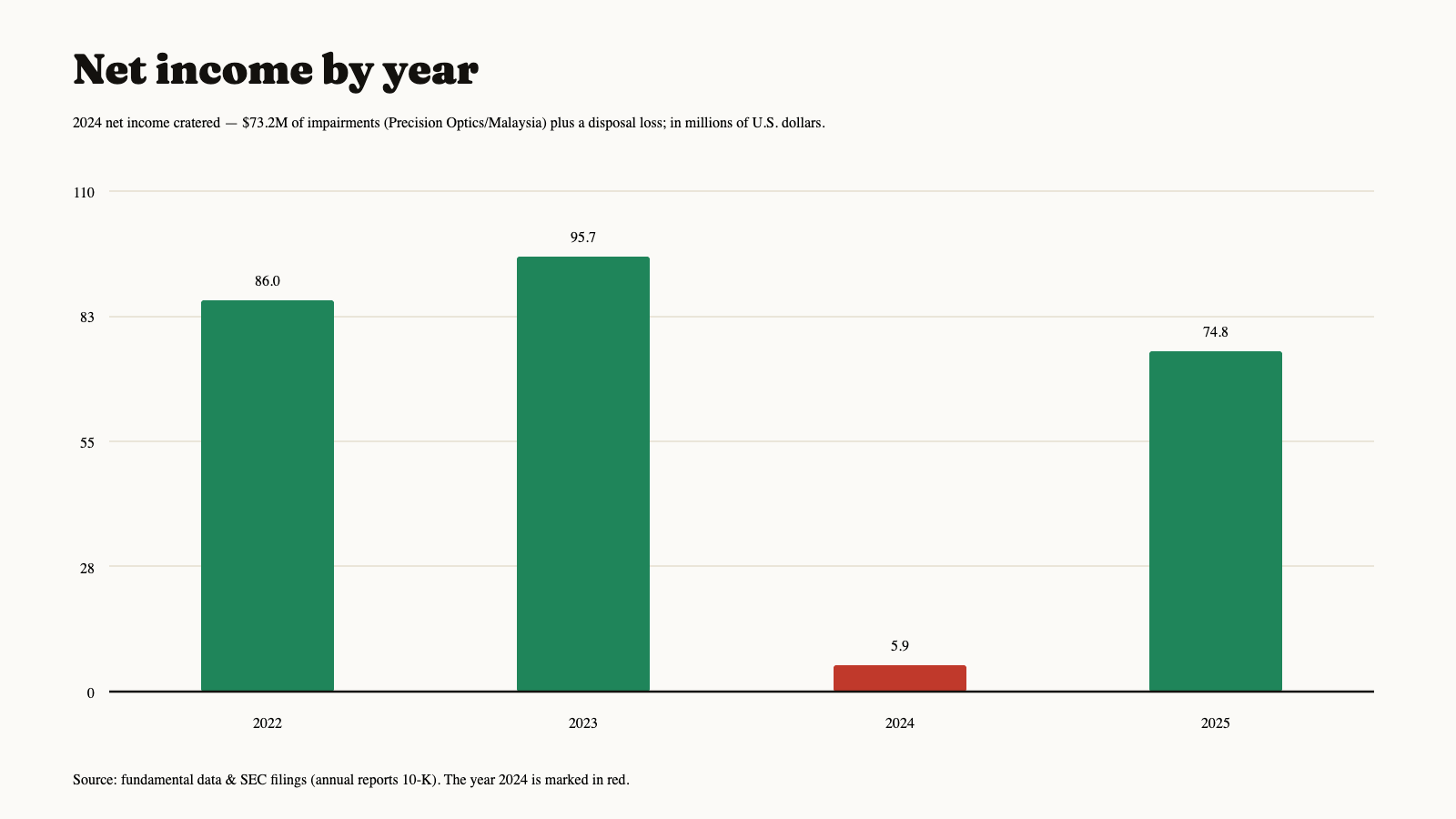
First, what genuinely earns respect. Materion is no loss-maker and no house of cards, but a profitable industrial company with a long history. Over the years it earned solidly: $86.0 million of net income in 2022, $95.7 million in 2023 — and after the 2024 collapse (more below) net income recovered in 2025 to $74.8 million, or $3.58 per share. Operating cash flow reached a solid $103.2 million in 2025, order backlog rose to $579.0 million (from $537.6 million a year earlier), and gross margin on a value-added basis climbed from 29 to 31 percent in the first quarter of 2026. The company has paid a dividend for years (raised from 13.5 to 14.0 cents per quarter in May 2025) and even began buying back stock in 2025 ($7.8 million). Read only these lines and you see a rock-solid quality name on the mend.
Now we peel off the label. Materion itself carries a second revenue figure in every report, because the first one misleads: value-added sales. It subtracts the pure, merely pass-through metal costs from net sales. And that second number tells the opposite story:
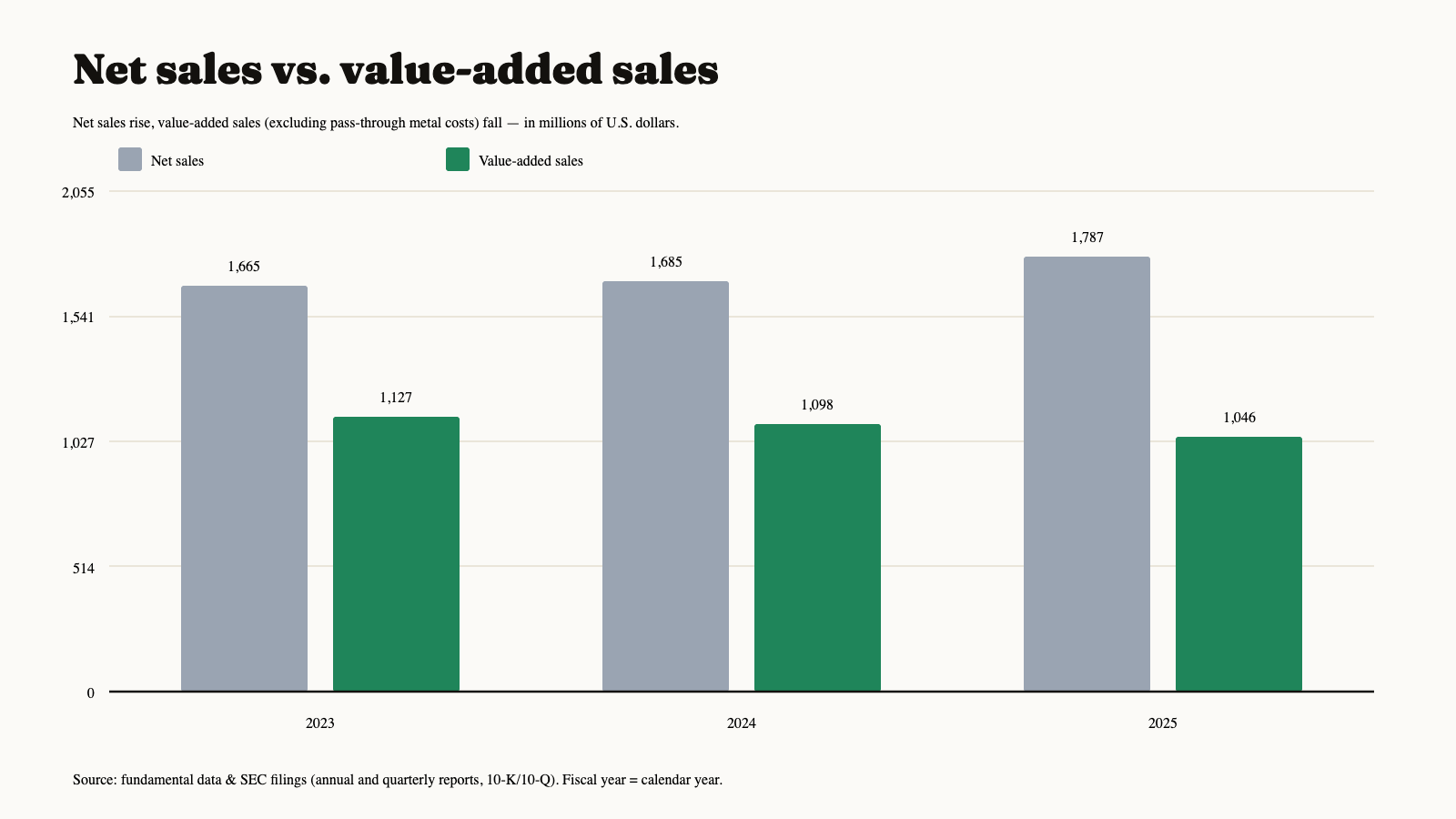
While net sales climbed from $1,665 (2023) through $1,685 (2024) to $1,786.6 million (2025), value-added sales fell from $1,127 through $1,098 to $1,046 million. Measured by its own yardstick, the company has been selling less, not more, for three years. Remember the rhythm: at Materion, the pace of revenue is set not by the company's own plant but by the world price of gold, silver and copper — and that runs through the books without leaving a cent of extra profit. Which brings us to the uncomfortable truths.
What the filings say — the uncomfortable truths
Uncomfortable truth no. 1: 41 percent of the record top line is merely pass-through metal
Materion defines value-added sales in its reports itself — and the definition is at once an admission that net sales distort:
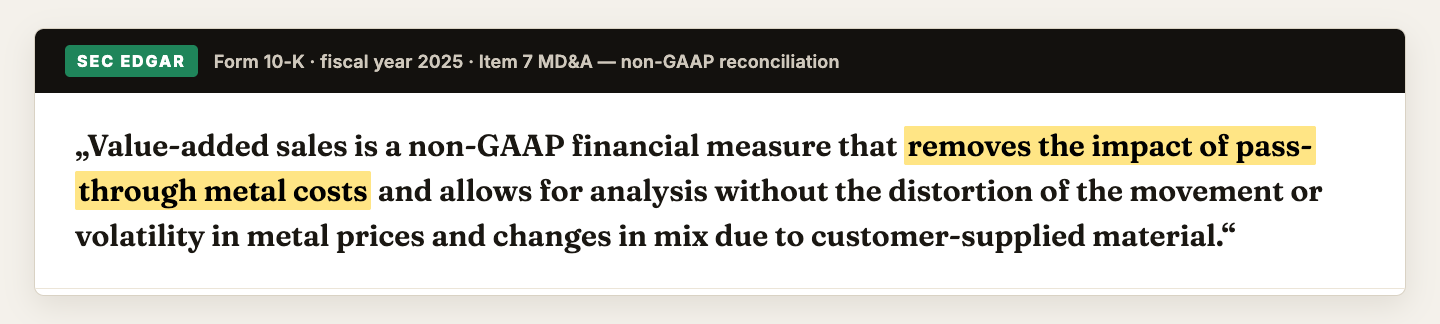
"Value-added sales is a non-GAAP financial measure that removes the impact of pass-through metal costs and allows for analysis without the distortion of the movement or volatility in metal prices and changes in mix due to customer-supplied material."
— Materion Corporation, SEC annual report 10-K for 2025, Item 7 "Management's Discussion and Analysis" (non-GAAP reconciliation)
The magnitude is striking: in 2025 pass-through metal costs amounted to $740.4 million — 41 percent of total net sales. Almost all of the Electronic Materials segment's growth was pure price pass-through: per the annual report, that segment's net sales rose "primarily due to higher precious metal pass-through costs, increasing net sales by approximately $208.2 million." In the first quarter of 2026 the pattern repeated in its purest form: net sales jumped 31 percent to $549.8 million — but $132.6 million of that was higher pass-through metal prices alone, and value-added across all segments, at roughly $262 million, was barely above the prior-year quarter ($259 million). In plain language: picture a jeweler who suddenly reports "50 percent more revenue" — only because the gold price rose and he resold the same bracelet dearer. His craft wage, the part that truly belongs to him, stayed the same. That is exactly Materion's Electronic Materials business. This is no accusation — Materion discloses the figure itself — but it is the refutation of the growth label.
Uncomfortable truth no. 2: In 2024 net income fell from $96 to $6 million — the optics unit cost a fortune
Between the solid years 2023 and 2025 a crater has wedged itself: in 2024 net income fell to $5.9 million (from $95.7 million the year before), earnings per share to a paltry 28 cents. The reason is in black and white in the annual report — and it lies almost entirely in the smallest segment, Precision Optics:
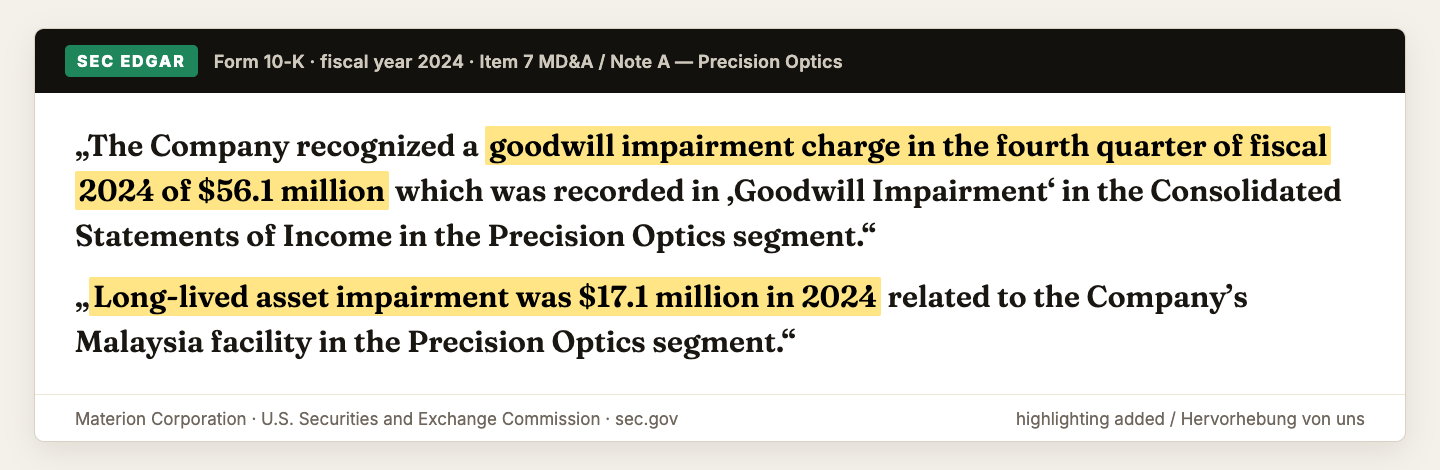
"The Company recognized a goodwill impairment charge in the fourth quarter of fiscal 2024 of $56.1 million which was recorded in 'Goodwill Impairment' … in the Precision Optics segment." … "Long-lived asset impairment was $17.1 million in 2024 related to the Company's Malaysia facility in the Precision Optics segment."
— Materion Corporation, SEC annual report 10-K for 2024, Item 7 "MD&A" / Note A
On top came a $6.4 million loss on the sale of the "Large Area Target" business at the Albuquerque, New Mexico site. To be fair: impairments are a one-time book entry, not a cash outflow, and management recognized the mistake, quantified it and ended it — more honest than years of window-dressing. But the episode belongs in any verdict on capital allocation: Precision Optics was assembled through expensive acquisitions, and a substantial part of that goodwill turned out to be air. The 2025 earnings recovery to $74.8 million looks so strong in part because the 2024 comparison base was artificially floored by these charges.
Uncomfortable truth no. 3: In 2025 a quality issue idled the flagship product
You might think that after the optics debacle, calm returned. It did not. In 2025 the heart of the company, Performance Materials, took the hit — and precisely at the strategic growth product precision clad strip (a precisely clad metal strip Materion had invested heavily in):
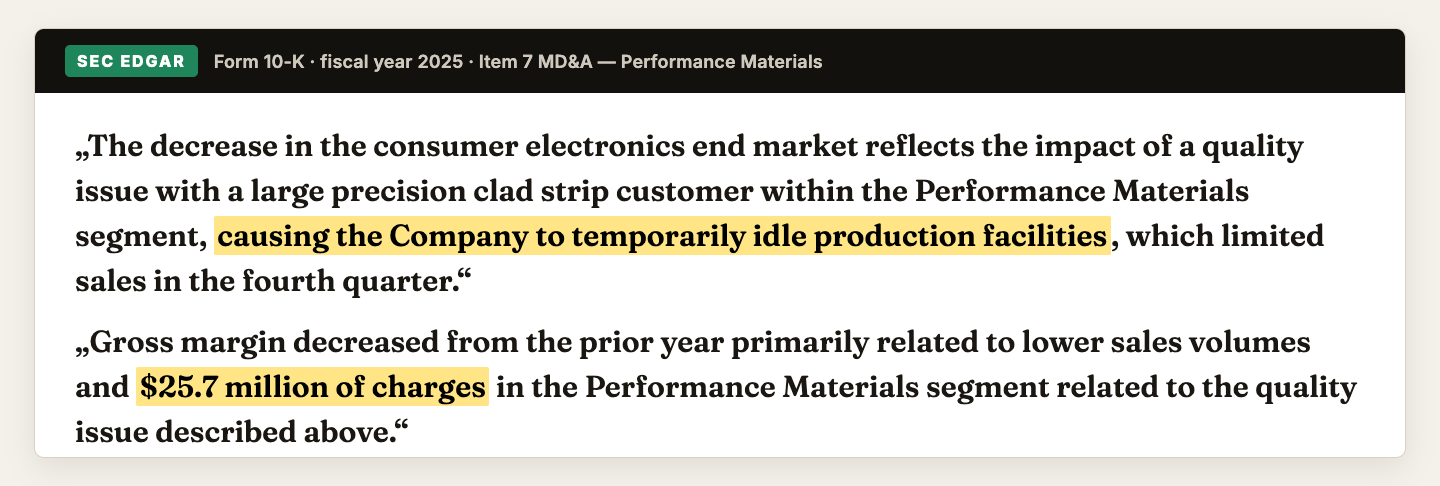
"The decrease in the consumer electronics end market reflects the impact of a quality issue with a large precision clad strip customer within the Performance Materials segment, causing the Company to temporarily idle production facilities, which limited sales in the fourth quarter." … "Gross margin decreased … related to lower sales volumes and $25.7 million of charges in the Performance Materials segment related to the quality issue described above."
— Materion Corporation, SEC annual report 10-K for 2025, Item 7 "MD&A" (Performance Materials)
The consequence: value-added sales at Performance Materials — the highest-margin segment — fell 10 percent in 2025, from $688.0 to $618.1 million, and the decline continued in the first quarter of 2026 (value-added down 13 percent to $139.5 million). That is the real worry behind the record top line: it is not the metal-price-inflated Electronic Materials business that is wobbling, but the high-margin core product. Two years in a row, an operational accident interrupted the story — 2024 in optics, 2025 in the beryllium strip. For a materials company whose entire promise is "precision," two consecutive years of quality and write-down trouble are more than bad luck.
Uncomfortable truth no. 4: Beryllium is both blessing and legacy — the incurable berylliosis
Materion's strategic treasure carries a dark flip side that few momentum buyers have on the radar. Beryllium is light, stiff and conductive — and its dust is dangerous:
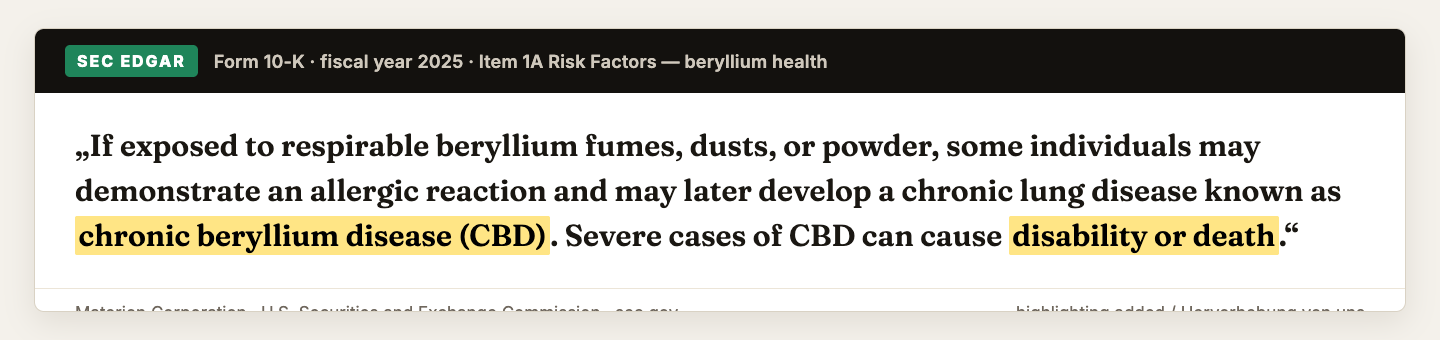
"If exposed to respirable beryllium fumes, dusts, or powder, some individuals may demonstrate an allergic reaction and may later develop a chronic lung disease known as chronic beryllium disease (CBD). Severe cases of CBD can cause disability or death."
— Materion Corporation, SEC annual report 10-K for 2025, Item 1A "Risk Factors"
Fairness requires the good news from the same report: "As of December 31, 2025 there were no pending beryllium cases" — at year-end 2025 not a single beryllium case was outstanding. The suits that shadowed Materion and predecessor Brush for decades are, for now, worked through. But the report also warns: concerns about CBD can "significantly reduce demand for our products," and an unfavorable proceeding or adverse media coverage could encourage new litigation. So the legacy is not gone; it is latent — it is sleeping. Whoever buys Materion for the beryllium moat buys this sleeping risk along with it.
Valuation: $6.1 billion in market value — 82 times an earnings figure that was half recovery
In mid-July 2026 the Materion stock cost about $281.80, putting the market value at roughly $6.1 billion on just under 21 million shares (data as of July 10–14, 2026). Measured against earnings, that is ambitious: the trailing price-to-earnings ratio stands around 82 — and that earnings figure ($74.8 million) was in good part merely the recovery from the artificially depressed 2024 base. On the proper yardstick, value-added sales of $1,046 million, the market pays almost six times; on inflated net sales "only" a bit over three times — so depending on which revenue number you believe, the stock looks expensive or moderate. That is exactly the point: the market has picked the friendlier number. The past year's doubling (roughly 114 percent year to date) is fueled by the story around critical minerals, domestic supply chains and the semiconductor/data-center boom — real, powerful themes for which Materion, with its Utah mine and U.S. manufacturing, is genuinely well positioned. But the present does not yet deliver that story: high-margin value-added is falling, and the latest growth is largely metal price.
The balance sheet lends support but no free pass: $943.3 million of equity, a very safe Altman Z-score around 8.4, long-term liabilities of $436.3 million — manageable. The flip side: cash is thin at $13.7 million, Materion works with a credit line ($450 million revolver plus a $225 million term loan) and with roughly $526 million of borrowed precious metals on consignment — an off-balance-sheet construct whose fees rise when metal prices rise. Roughly 97 percent of the shares sit with institutional investors (data around July 10, 2026); that explains part of the momentum, but it also makes the stock vulnerable if the professionals notice the growth-label sleight of hand.
Opportunities and risks at a glance
What speaks for Materion:
- A strategic raw-material asset that is hard to replace: the world's largest bertrandite mine in Utah, vertical integration from ore to component, U.S. manufacturing — weighty in an age of critical minerals and domestic supply chains (10-K for 2025, Item 1).
- Solid balance sheet and cash generation: $943.3 million of equity, Altman Z around 8.4, $103.2 million of operating cash flow, order backlog up to $579.0 million (2025); a dividend for years, and buybacks for the first time in 2025.
- Genuine end-market tailwind: 2025 volume gains in semiconductors (+21 percent), telecom/data center (+24 percent) and energy (+12 percent) — Materion supplies the materials into exactly those growth markets.
- The technicals are strong: a Stan Weinstein stage-2 uptrend, an RS value of 95, roughly 114 percent year to date, third place in the Joshua growth scanner (as of July 17, 2026).
- Legacy risks are currently defused: no pending beryllium case as of December 31, 2025; the 2024 optics impairments are booked and finished.
What speaks against it:
- The record top line is largely an illusion: $740.4 million (41 percent) of 2025 net sales was merely pass-through metal; value-added has fallen for three years ($1,127 → $1,098 → $1,046 million).
- The high-margin core is faltering: Performance Materials value-added down 10 percent in 2025 and another 13 percent in the first quarter of 2026 — a quality issue at the flagship precision clad strip cost $25.7 million.
- Two one-time-charge years in a row: in 2024 net income cratered to $5.9 million ($73.2 million of Precision Optics/Malaysia impairments plus a $6.4 million disposal loss) — the 2025 recovery started from an artificially depressed base.
- A sporty valuation: trailing P/E around 82, an EPS rating of just 57, Piotroski 5 of 9 — the market is paying for a raw-material story the present numbers (falling value-added) do not cover.
- Thin cash and metal on loan: $13.7 million of cash, roughly $526 million of precious metals only on consignment with fees that rise with the metal price — plus the latent berylliosis legacy.
A human conclusion
Back to the pass-through trap from the opening. Its core is not that Materion is a bad company — on the contrary, it is a profitable industrial with a raw-material asset many would envy. Its core is that a big, rising number ends the questioning, even though that is exactly where the interesting story lies. Whoever reads only "$1.8 billion revenue, up 31 percent, stock doubled" is buying growth that is 41 percent gold price — and missing that the number that truly belongs to the company has fallen for three years, with the highest-margin product just off two operational accidents. So the honest question for you is not "Does Materion have a great business?" (it does), but: are you paying 82 times earnings for the story of the critical mineral — or for the present, in which value creation is shrinking? If the raw-material and semiconductor themes fire and Materion ships its beryllium strip cleanly again, the story can indeed turn into substance — the mine, the plants and the balance sheet for it are all in place. Until then, the number worth watching in every quarterly report is the second one: not net sales, but value-added sales. If it turns up, the story becomes real. If it stays down, you are paying for a narrative. What you make of it is your decision. And that is exactly as it should be.
Sources
All original documents used in this analysis — to read for yourself:
- Materion Corporation — SEC annual report 10-K for 2025 (fiscal year ended December 31, 2025; filed February 12, 2026)
- Materion Corporation — SEC annual report 10-K for 2024 (ended December 31, 2024; filed February 19, 2025; Precision Optics impairments)
- Materion Corporation — SEC quarterly report 10-Q as of April 3, 2026 (first quarter 2026; filed April 29, 2026)
- Materion Corporation's complete SEC filing history: EDGAR overview (sec.gov)
- Fundamental data (metrics, segment and quarterly series, valuation; data as of July 10–14, 2026), reconciled with the SEC filings.
- Screener and rating data: in-house Joshua growth scanner (rank 3 of 75, as of July 17, 2026) and further trend and fundamental filters of the in-house stock scanner.
Transparency & disclaimer: This analysis is a journalistic contextualization of publicly available information and is not investment advice, not a financial analysis in the regulatory sense, and not a solicitation to buy or sell securities. Stock investments carry substantial risks up to total loss. All information without guarantee; the data cut-off is noted in the text in each case. The author holds no position in Materion stock at the time of publication.
Our Bottom Line at a Glance
- Revenue quality & value-added negative
- The record top line deceives: $740.4 million (41 percent) of 2025 net sales was merely pass-through metal cost, and value-added excluding those costs has fallen for three years ($1,127 → $1,098 → $1,046 million). In the first quarter of 2026 net sales jumped 31 percent, $132.6 million of it pure metal-price pass-through — while value-added stagnated (10-K 2025 / 10-Q Q1 2026).
- Core Performance Materials negative
- The highest-margin segment is faltering: value-added down 10 percent to $618.1 million in 2025, and down another 13 percent in Q1 2026 — triggered by a quality issue at the flagship precision clad strip that forced Materion to idle production lines ($25.7 million charge, 10-K 2025).
- Strategic asset (beryllium/Utah mine) positive
- Materion operates the world's largest bertrandite mine in Utah and is vertically integrated from ore to component for aerospace, defense and energy — a hard-to-replace asset in an age of critical minerals and domestic supply chains (10-K 2025, Item 1). The berylliosis (CBD) legacy is real but had no pending case as of 12/31/2025.
- Balance sheet & cash cushion neutral
- $943.3 million of equity, an Altman Z around 8.4, $103.2 million of operating cash flow, a dividend for years — solid. But cash is thin at $13.7 million, roughly $526 million of precious metals sits only on consignment (fees rise with the metal price), and in 2024 $73.2 million of impairments weighed on the capital-allocation record (10-K 2024/2025).
- Valuation & technicals neutral
- Strong momentum (Stan Weinstein stage-2, RS 95, roughly +114 percent year to date, Joshua rank 3) meets a trailing P/E around 82, an EPS rating of 57 and a Piotroski score of 5 of 9 (data as of July 10–14, 2026). The market is paying for a raw-material/semiconductor story that the falling value-added does not currently cover.
Materion is a profitable industrial company with a rare raw-material asset — the world's largest bertrandite mine in Utah — and a solid balance sheet. But the celebrated record top line was 41 percent merely pass-through metal in 2025, and the number that truly belongs to the company (value-added sales) has fallen for three years; on top, two consecutive operational accidents (the 2024 optics impairment, the 2025 beryllium-strip quality issue) weighed on results. At 82 times trailing earnings the market is paying for the raw-material story, not the shrinking present. Not investment advice.
What Our Rating Means
- If you don't own the stock
- As long as the question raised in the bottom line stays open, we see no basis for an entry.
- If you hold it in your portfolio
- Our findings offer no acute reason to sell — the checkpoints named remain decisive.
A journalistic assessment by our editorial team at the time of the deep dive, based on public sources — not investment advice and not a solicitation to buy or sell. Your personal circumstances (investment goals, risk capacity, taxes) cannot be taken into account. What our categories mean, how verdicts are formed, and what conflicts of interest exist →
Worth Noting
- MTRN reached our research list via rank 3 of 75 in the in-house Joshua growth scanner (as of July 17, 2026); its revenue-growth criterion measures net sales (Q1 2026: +30.8 percent) — which are largely made of pass-through metal prices. That is not a flaw of the scanner, but a reason to look under the growth label.
- Scanner metrics (P/E, EPS rating, Piotroski, Altman Z) are computed from trailing twelve-month figures; the 2024 earnings collapse (impairments) and the 2025 one-time charge ($25.7 million) are baked in, a potential raw-material/semiconductor surge naturally is not.
- Price and valuation figures are dated to July 10–14, 2026 (about $281.80, market value roughly $6.1 billion); analyses are evergreen, daily prices are not a buy argument. Materion's fiscal year matches the calendar year.
Frequently Asked Questions
Materion Corporation (NYSE: MTRN) of Mayfield Heights, Ohio, is an integrated producer of high-performance advanced engineered materials: beryllium and beryllium alloys (Performance Materials segment), precious-metal coating materials for the chip industry (Electronic Materials), and optical filters and coatings (Precision Optics). They go into semiconductors, defense electronics, data centers, medical devices and aerospace. Net sales in 2025: $1,786.6 million.
Because a large part of it is merely pass-through metal. In 2025 pass-through metal costs were $740.4 million — 41 percent of net sales. Materion therefore carries a second metric itself, value-added sales, which strips out those metal costs. And it fell in 2025 to $1,046.2 million — after $1,097.6 million (2024) and $1,127.1 million (2023). Net sales rise, value-added sales have fallen for three years.
Net income fell to $5.9 million in 2024 (from $95.7 million in 2023), mainly on $73.2 million of impairments in the Precision Optics segment: $56.1 million of goodwill plus $17.1 million on the Malaysia plant. On top came a $6.4 million loss on the sale of the Albuquerque business. The 2025 recovery to $74.8 million therefore started from an artificially depressed base.
Per the annual report (10-K) for 2025, there was a quality issue with a large precision clad strip customer in the Performance Materials segment that forced Materion to temporarily idle production facilities and limited fourth-quarter sales. It generated $25.7 million of charges, and the high-margin value-added of Performance Materials fell 10 percent in 2025.
Per the 10-K, Materion operates the world's largest bertrandite mine in Utah and is vertically integrated from ore to finished beryllium component for aerospace, defense and energy — a strategic asset. The flip side: beryllium dust can trigger the incurable chronic beryllium disease (CBD). As of December 31, 2025 no beryllium case was pending, yet the report warns that CBD concerns can depress demand and could encourage new litigation.
By classic yardsticks, not really: at roughly $6.1 billion in market value and a price around $281.80 (data as of July 10–14, 2026), the trailing price-to-earnings ratio is around 82, the EPS rating just 57 and the Piotroski F-score 5 of 9. The balance sheet is solid (Altman Z around 8.4), but the market is paying for a raw-material and semiconductor story that the current numbers — falling value-added — do not cover.
Solid, but with thin cash: as of December 31, 2025 the books showed $943.3 million of equity against $1,802.8 million in total assets and $436.3 million of long-term liabilities; cash was only $13.7 million. In addition, roughly $526 million of precious metals, copper and nickel sat in the plants only on loan (on consignment) — off the balance sheet, with fees that rise with the metal price.
Found an error?
Did you spot a factual error, an outdated number, or a typo in this deep dive? Let us know briefly — your report goes straight to the editorial team.