Twilio: The First Profit Since the IPO — and the Fee Hiding Inside the Revenue
Twilio sells businesses the pipes for text messages, phone calls and login codes. In 2025 it kept a profit for the first time since its 2016 IPO: $33.8 million on $5,067.2 million of revenue. Revenue then grew 20 percent in the first quarter of 2026 — but $46.1 million of the $234.4 million increase was simply fees newly charged by U.S. mobile carriers and passed straight through. We read the filings to the end and work out how much of that growth the company actually owns.
 Thomas Mücke
Founder & Publisher
Thomas Mücke
Founder & Publisher
Chart
Interactive price chart (TradingView).
Note: pure fact-based analysis, not investment advice and not a solicitation to buy or sell. All figures without guarantee.
There is a mental trap so quiet that almost nobody notices it: we confuse money that flows through a company with money that belongs to it. Call it the pass-through trap. A travel agency that sells you an $800 flight and hands $780 of it to the airline booked $800 of revenue — and earned $20. If ticket prices rise 10 percent, the agency’s "revenue" grows 10 percent without a single extra customer walking in. That exact mechanism sits inside the numbers of Twilio Inc. (NYSE: TWLO), the operator of the programming interfaces businesses worldwide use to send text messages and place calls. So let us make a deal: before celebrating 20 percent revenue growth, we read together what the company itself told the U.S. securities regulator, the SEC — the annual report (10-K) for 2025 filed February 24, 2026, and the quarterly report (10-Q) as of March 31, 2026, filed May 1, 2026. An SEC filing is honest under penalty of law. And this one puts a dollar figure on the pass-through.
Contents
- What Twilio actually does
- How the stock reached our desk
- The numbers over the years — fairly credited
- What the filings say — the uncomfortable truths
- Valuation — what the market is asking today
- Opportunities and risks at a glance
- A human conclusion
- Sources
What Twilio actually does — the wall socket for messages
You have probably used Twilio today without knowing it. The text message with your banking confirmation code, the note that says "your driver arrives in two minutes," the shipping email: behind those sits, more often than not, not the bank, the ride-hailing app or the retailer, but a supplier that keeps a line open to every mobile network on earth. Twilio is that line. A developer writes three lines of code, and Twilio makes sure the message lands in Nigeria as reliably as in Nebraska.
Payment is mostly by usage — per message, per call minute, per phone number. Only 26 percent of 2025 revenue was subscription-based. At year-end Twilio counted 402,000 active customer accounts, up from 325,000 (2024) and 305,000 (2023); the ten largest together made up just 9 percent of revenue. Concentration risk looks different. Headcount stood at 5,587 employees on December 31, 2025, of whom 2,738 worked outside the United States.
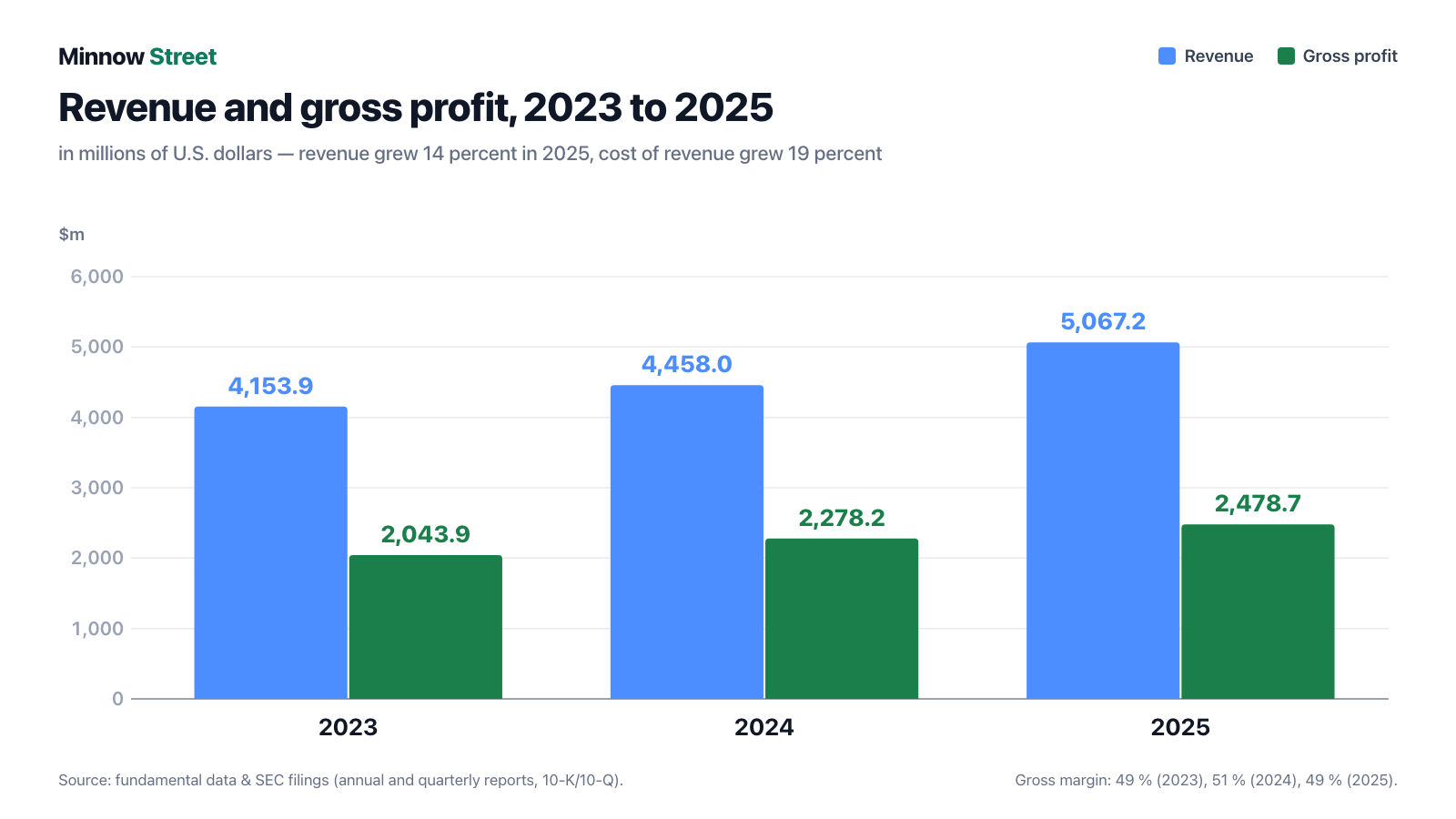
What Twilio lives on is quickly listed. Messaging generated $2,878.3 million of revenue in 2025 — 56.8 percent of the $5,067.2 million total. Behind it come Voice at $615.7 million, Email (the SendGrid brand acquired in 2019) at $523.5 million, the Segment customer data platform at $303.3 million and Other at $746.5 million. Remember that split: at its core Twilio is not a software house but a wholesale messaging business with a software department attached.
And that names the central tension of this analysis, which runs through every chapter that follows: a wholesaler that buys capacity and resells it earns on the spread, not on the volume. When the purchase price rises and gets passed on, revenue grows and margin shrinks. That is happening right now, and Twilio writes it into its own filings.
How the stock reached our desk
The hook is not a news story but a list. Our in-house stock scanner ranked Twilio 26th on the U.S. side of its turnaround list on July 25, 2026 — a list that showed 62 U.S. hits that day. The accompanying turnaround check stood at 6 of 8 points. You can reproduce it in three clicks: open Turnaround Candidates, set the market to the United States, sort by the "of 8" column.
How the list is built matters, or the rank gets misread. Two mandatory pillars must be met, or a stock never appears at all:
- Pillar 1 — the crash: the price must sit at least 50 percent below the all-time high. Twilio’s highest close was $443.49 on February 18, 2021; on July 24, 2026 the stock closed at $191.46, roughly 56.8 percent below it.
- Pillar 2 — survival: the Altman Z score must be at least 1.1. That measure weighs capitalization, earning power and leverage; below 1.1 a company counts statistically as distressed. Twilio sits at 8.66 (data as of July 24, 2026), far clear of it. Add no more than one balance-sheet warning flag and positive equity — both satisfied.
The remaining eight points measure movement: revenue stabilizing, margin turning, cash flow turning, balance sheet healing, price back above the 50-day line, relative strength, insider buying. Six of eight is decent, not outstanding — a spotless turnaround scores seven or eight.
And now the sentence that rarely accompanies scanner lists but ought to: this rank is a snapshot with an expiry date. Half the all-time high sits at roughly $221.75. Rise above it and Twilio breaks pillar 1 and drops off the list — not because the business got worse, but because it got better. How close that is shows in the 52-week high of $238.48: at that price the stock was only 46.2 percent below its all-time high, and the first mandatory pillar was already failing. Remember: a scanner rank is a date, not a state.
The numbers over the years — fairly credited
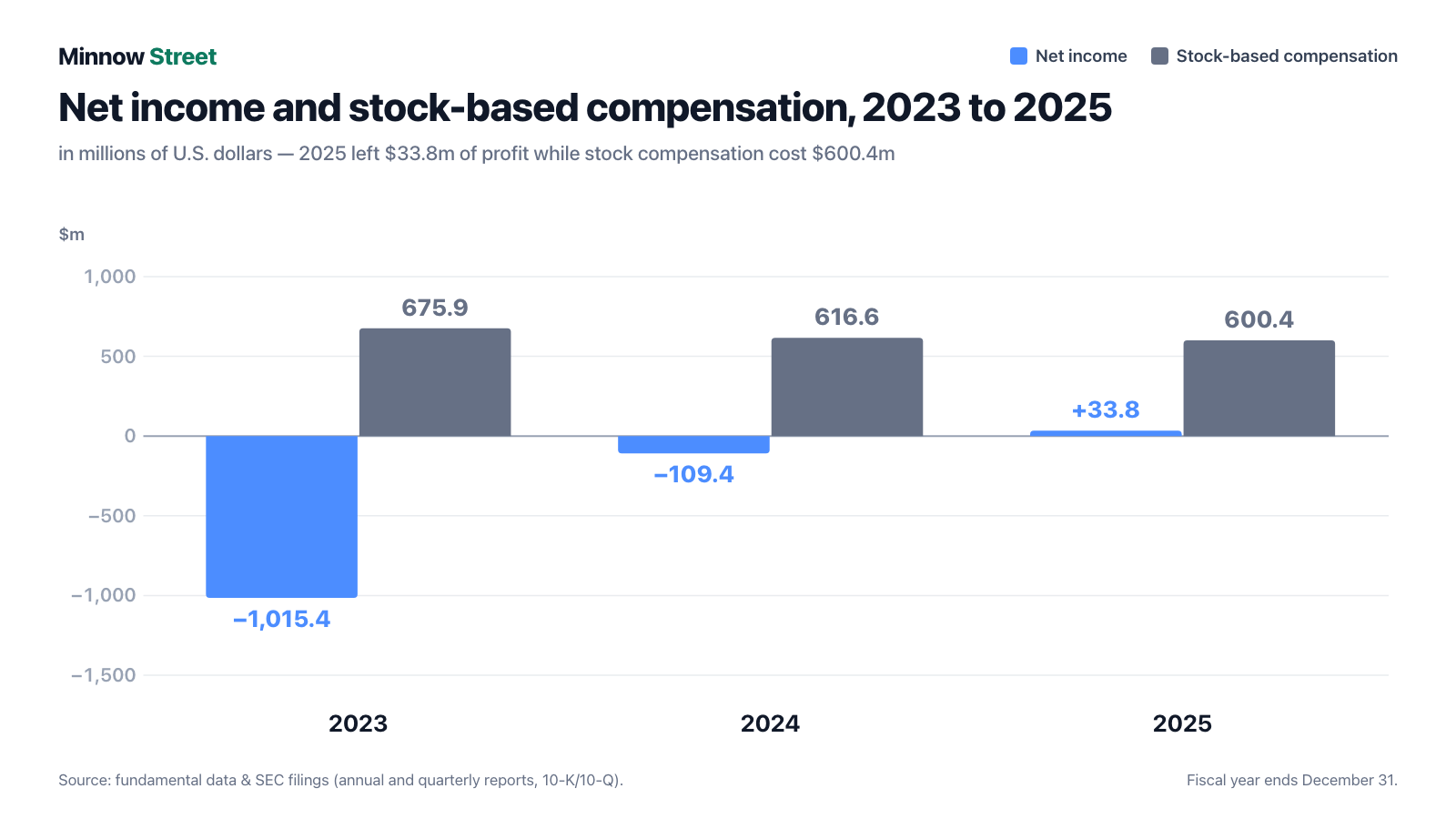
First, what genuinely impresses. In 2025 Twilio produced its first annual profit since the June 2016 IPO: $33.8 million, or $0.21 per diluted share. For a sense of how deep the hole was: 2023 closed with a loss of $1,015.4 million and 2024 with one of $109.4 million. And it was no better before that: in the annual figures filed with the SEC, Twilio reported a loss in every single year from 2014 through 2024, the deepest in 2022 at $1,256.1 million.
The break shows even more clearly in income from operations, the result of the running business before interest and taxes: from −$876.5 million (2023) through −$53.7 million (2024) to +$157.8 million (2025). The first quarter of 2026 followed up with $107.7 million of operating income and $90.1 million of net income on $1,406.9 million of revenue. That is no longer a fluke; it is a trend.
The strongest number in the whole report, though, sits neither in the income statement nor in the loss column but in the cash flow statement. Operating cash flow — the money the running business actually deposits — rose from $414.8 million (2023) through $716.2 million (2024) to $1,003.2 million (2025). After capitalized software development and asset purchases, free cash flow came to $945.4 million, or 19 percent of revenue. Remember: at software companies cash flow often arrives years before profit — because a large part of pay is settled in shares and customers pay up front.
The balance sheet is solid too. As of March 31, 2026, $542.0 million in cash and $1,804.3 million in marketable securities sat in the account, $2,346.3 million together. Against that stand two notes issued in March 2021 — $500.0 million of principal each at 3.625 percent (due 2029) and 3.875 percent (due 2031) — carried at $992.7 million. Net that is roughly $1.35 billion of cash. Stockholders’ equity of $7,784.1 million equals 81 percent of the $9,576.8 million balance sheet.
And customers are getting bigger again. Dollar-based net expansion — which measures whether the same customers pay more than a year ago — rose from 103 percent (2023) through 104 percent (2024) to 108 percent (2025) and 114 percent in the first quarter of 2026. In plain terms: the garden is growing on its own again, not just because new seedlings keep going in at the front. So much for the good half. Now the other one.
What the filings say — the uncomfortable truths
Uncomfortable truth No. 1: a fifth of the growth does not belong to Twilio
The headline of the first quarter of 2026 read: 20 percent revenue growth. The footnote sits in the quarterly report itself — and it quantifies how much of that Twilio merely hands on.
"In the three months ended March 31, 2026, revenue increased by $234.4 million, or 20%, compared to the same period last year. […] The increase also reflects $46.1 million in revenue related to the incremental A2P fees recently introduced by major U.S. carriers."
— Twilio Inc., Form 10-Q for the quarter ended March 31, 2026, Results of Operations (10-Q 2026)

A2P stands for application to person — messages a program sends to a human, which is precisely Twilio’s core business. U.S. mobile networks have been charging their own delivery fees for these for some time; in June 2025 one major carrier added another. Twilio pays it and rebills customers. So $46.1 million of a $234.4 million increase is 19.7 percent of growth flowing straight through the company. Across full-year 2025 the figure was $49.5 million — on the revenue line and in cost of revenue alike.
What that does to margin, Twilio spells out in its risk factors about as plainly as anyone could:
"Further, even when we do pass fee increases through to customers, it typically increases revenue and cost of revenue such that while gross profit dollars are not impacted, it has a negative impact on gross margins."
— Twilio Inc., Form 10-Q for the quarter ended March 31, 2026, Item 1A Risk Factors (10-Q 2026)

In figures: 2025 revenue rose 14 percent while cost of revenue rose 19 percent — $362.4 million of that alone went to network service providers. Gross margin fell from 51 percent (2024) to 49 percent (2025), and to 48.6 percent in the first quarter of 2026. Anyone curious what the same dependency looks like on a thinner spread will find it in our Bandwidth analysis.
Uncomfortable truth No. 2: the profit is one eighteenth of stock-based compensation
Against $33.8 million of 2025 net income stands $600.4 million of stock-based compensation. That is roughly eighteen times as much — and just under 12 percent of revenue. Stock-based compensation is the expense of paying part of employees’ salaries in shares instead of cash. In plain terms: the company settles its wage bill in freshly issued stock — your slice of the pie gets thinner without any money leaving the account. How quickly that turns into felt dilution is something we took apart in our Backblaze analysis.
Fairness demands the other half. Twilio is working on it, and the numbers show it. Stock compensation fell from $675.9 million (2023) through $616.6 million (2024) to $600.4 million. Newly granted shares dropped from 14,722,012 (2023) through 10,584,021 (2024) to 4,728,094 (2025), and the net burn rate from 5.3 percent to 1.5 percent. Meanwhile the company repurchased 8.0 million of its own shares for $854.6 million in 2025; the average share count fell from 183,327,844 (2023) to 152,986,390 (2025).
And yet: on June 16, 2026, holders of 30,250,610 shares voted against the new equity plan, with 88,949,992 in favor. That is 25.4 percent opposition — even though the new plan cuts the available reserve from 37,014,075 to 10,500,000 shares and removes the automatic annual increase. For comparison, the employee stock purchase plan at the very same meeting drew 398,239 votes against. Remember: when a quarter of shareholders decline to approve even a reduction, the argument is about trust, not arithmetic.
Uncomfortable truth No. 3: $750 million for Syniverse — $275 million left
In 2022 Twilio paid $750.0 million in cash for 44.6 percent of Syniverse Corporation, a specialist in routing bulk messages between providers and mobile networks. The strategic logic was obvious: own part of the pipe and you depend less on the carriers. Four years later the arithmetic looks like this:
"The Company engaged a third-party expert to assist in performing a fair value assessment of the investment and concluded that as of December 31, 2025, its equity method investment was impaired. The Company recorded an impairment of $80.6 million in the impairment of equity method investment line item in the accompanying consolidated statement of operations for the year ended December 31, 2025."
— Twilio Inc., Form 10-K for 2025, Note 12 Equity Method Investment (10-K 2025)

As of December 31, 2025, the stake was carried at $301.6 million, and at $275.1 million on March 31, 2026. So a good 63 percent of the $750 million is gone — partly through the impairment, mostly through running share-of-loss charges: $121.9 million (2023), $108.5 million (2024), $101.2 million (2025) and $27.2 million in the first quarter of 2026 alone. That impairment is also why the fourth quarter of 2025 turned red again: after $79.7 million of net income in the first nine months, the full year ended at $33.8 million — implying a $45.9 million loss in the closing quarter, even though operating income that quarter was a positive $56.8 million.
The second half of the story is the more interesting one. Twilio is not only a part owner of Syniverse but a customer: it paid $138.9 million there in 2025 for message routing, $145.0 million in 2024 and $143.7 million in 2023 — booked in cost of revenue. Syniverse itself reported $795.7 million of revenue and a $56.9 million net loss for the fiscal year ended November 30, 2025. Remember: buying into your supplier relocates the risk; it does not remove it.
Uncomfortable truth No. 4: $5.3 billion of goodwill inside $7.8 billion of equity
The largest item on Twilio’s balance sheet is neither a data center nor a patent but an accounting figure: $5,292.5 million of goodwill as of March 31, 2026. That is 55 percent of total assets and 68 percent of equity. Goodwill arises when a company pays more for an acquisition than the acquired assets are individually worth; it stands for the expectation that the whole will earn more than the parts. Strip it out along with intangible assets and roughly $2.4 billion of tangible equity remains.
Whether that expectation holds is best read off the largest acquisition. The Segment customer data platform, bought in 2020, generated $295.3 million of revenue in 2023, $297.7 million in 2024 and $303.3 million in 2025 — up 2.7 percent in two years, while group revenue rose 22 percent over the same span. At the end of 2023 Twilio had already written off $285.7 million of intangible assets in what was then the Segment reportable segment, $209.4 million of it developed technology.
One clarification belongs here, because it is easy to garble. Effective January 1, 2025, Twilio reorganized into a single functionally managed company and has reported one reportable segment since the third quarter of 2025. Nothing was sold — the Segment product group still belongs to the group; it is simply no longer disclosed separately. What that means for you: from 2026 the individual scorecard on the 2020 acquisition has disappeared from the filings.
Uncomfortable truth No. 5: AI is everywhere in the filing — and in no revenue line
Twilio describes itself in the annual report as a platform that brings communications, contextual data and artificial intelligence together. The voice interface integrates AI-based virtual agents, and of the customer data platform the filing says, word for word:
"It also provides privacy and compliance tools, unifies cross-channel data into trusted customer profiles for enrichment and machine learning ("ML"), enables real-time personalization and journey orchestration, and uses generative and predictive AI to build targeted audiences and deliver 1:1 experiences at scale."
— Twilio Inc., Form 10-K for 2025, Item 1 Business (10-K 2025)

That is why our AI classification lists Twilio as a company that sells AI rather than merely using it. The honest addendum: the revenue breakdown in the annual report contains no line called "AI." The five product groups are Messaging, Voice, Email, Segment and Other. How much revenue the AI features actually bring in cannot be derived from the filings — and anyone quoting a figure for it did not get it from an SEC report.
Valuation — what the market is asking today
As of the July 24, 2026 data date Twilio carries a market capitalization of roughly $29.1 billion. That follows from 151,773,860 shares outstanding (quarterly report cover page, April 17, 2026) and the $191.46 closing price that day.
Translated into orders of magnitude: about 5.5 times trailing twelve-month revenue and about 31 times the $945.4 million of free cash flow generated in 2025. The trailing price-to-earnings ratio sits near 295 — a number that mostly shows how small the first profit still is; against current-year expectations it is roughly 34. The price equals 3.7 times the $51.18 book value per share, two thirds of which is goodwill.
The professional view: 31 analysts cover the stock, with a mean target of $209.76. That is a modest premium to the July 24, 2026 price — Wall Street sees neither a bargain nor a cliff. 94.3 percent of the shares are held by institutions, and 3.6 percent of the float is sold short. Remember: a high P/E on a freshly turned profit says almost nothing — it measures a number that only just cleared zero. Cash flow is the more telling gauge here.
Opportunities and risks at a glance
What argues for Twilio:
- First annual profit since the IPO ($33.8 million in 2025), confirmed with $90.1 million in the first quarter of 2026.
- Free cash flow of $945.4 million (19 percent of revenue) — more than 28 times full-year net income.
- Roughly $1.35 billion of net cash, an 81 percent equity ratio, and no maturity before 2029.
- Dollar-based net expansion up from 103 to 108 percent, and 114 percent in the first quarter of 2026.
- A broad customer base: 402,000 active accounts, with the ten largest at only 9 percent of revenue.
- Dilution discipline: annual grants cut from 14.7 million to 4.7 million shares, net burn from 5.3 to 1.5 percent.
What argues against it:
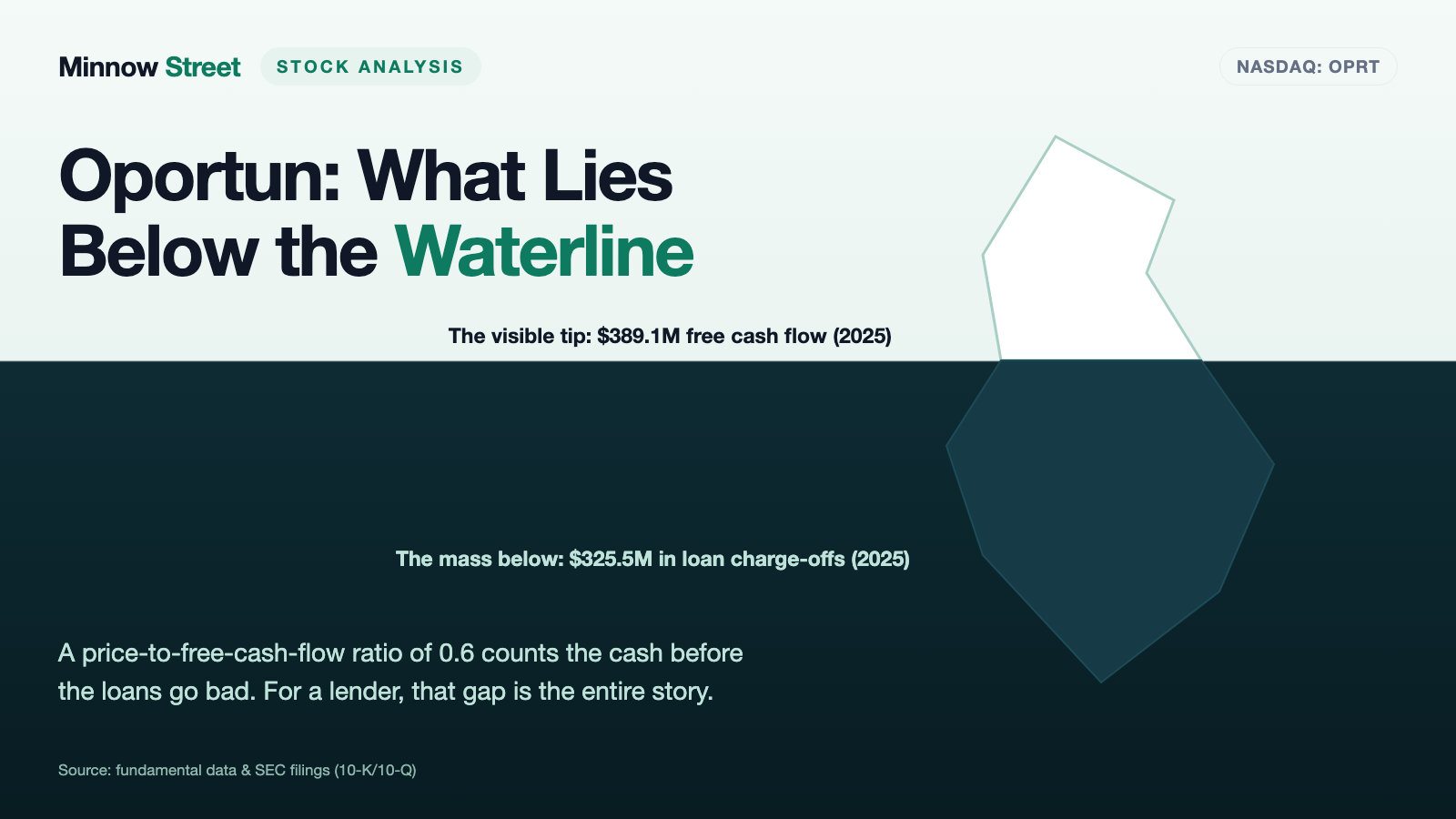
- A fifth of the latest growth is pass-through network fees carrying no added gross profit ($46.1 million of $234.4 million in Q1 2026).
- Gross margin down from 51 to 49 percent, and 48.6 percent in the first quarter of 2026 — carrier fees sit outside the company’s control.
- Stock-based compensation of $600.4 million — eighteen times full-year net income; a quarter of the votes cast opposed the new equity plan.
- Of $750 million paid for Syniverse, $275.1 million remains on the balance sheet; that is why the closing quarter of 2025 fell back to a $45.9 million loss.
- $5,292.5 million of goodwill against $7,784.1 million of equity; the largest acquisition (Segment) is growing 2.7 percent in two years, which is to say barely.
- Messaging accounts for 56.8 percent of revenue — one pricing decision by U.S. mobile carriers hits half the business.
A human conclusion
Back to the pass-through trap from the opening. At Twilio it is not an accusation but a line in the quarterly report: $46.1 million of a $234.4 million increase is fees the company collects and hands on. That is not dishonest — Twilio writes it down itself, with the same clarity it uses to explain that this very pass-through lowers gross margin. But it changes what "20 percent growth" means.
What remains is still a company to be taken seriously. A billion dollars of operating cash flow, $945 million of it free, $1.35 billion net in the bank, 402,000 customers and none of them large enough to hurt on the way out. The turnaround our scanner scored at six of eight on July 25, 2026 has genuinely reached the numbers — only narrowly: $33.8 million of profit on $5,067.2 million of revenue is 0.7 percent, and a single impairment pushed the closing quarter of 2025 back into the red.
So the question you have to answer for yourself is not whether Twilio works. It works. The question is how much of what flows through this wire ends up sticking to the owners — with a gross margin that has given ground for two years and stock compensation eighteen times the size of the profit. What you make of that is your decision. And that is exactly as it should be.
Sources
Every original document used in this analysis, for you to read yourself:
- Twilio Inc. — Form 10-Q for the quarter ended March 31, 2026 (filed May 1, 2026)
- Twilio Inc. — Form 10-K for 2025 (filed February 24, 2026)
- Twilio Inc. — Form 10-Q for the quarter ended September 30, 2025 (filed October 31, 2025), the basis for the nine-month figures
- Twilio Inc. — Form 8-K dated June 17, 2026 (annual meeting, voting results), together with the Form 8-K dated March 24, 2026 (board appointment)
- Twilio Inc. — Proxy statement DEF 14A dated April 28, 2026 (equity plan, dilution, overhang)
- Twilio Inc. — XBRL time series of annual results 2014 through 2025 from the consolidated statements (sec.gov)
- All filings including insider reports (Form 4): EDGAR overview for CIK 0001447669 (sec.gov)
- Fundamental data (metrics, valuation, analyst estimates; data as of July 24, 2026), reconciled against the SEC filings.
- Scanner lists: our in-house stock scanner, Turnaround Candidates, as of July 25, 2026; the lists are recomputed daily.
Transparency & disclaimer: this analysis is journalistic commentary on publicly available information. It is not investment advice, not a regulated financial analysis, and not a solicitation to buy or sell securities. Equity investments carry substantial risk up to total loss. All figures without warranty; the as-of date is noted in the text. The author holds no position in Twilio shares at the time of publication.
Our Bottom Line at a Glance
- Earnings turn positive
- After nine loss-making years since the IPO, 2025 finally showed a profit: $33.8 million, after −$109.4 million (2024) and −$1,015.4 million (2023). Income from operations swung from −$876.5 million through −$53.7 million to +$157.8 million. The first quarter of 2026 confirmed the trend with $90.1 million of net income on $1,406.9 million of revenue.
- Cash flow and balance sheet positive
- Operating cash flow climbed from $414.8 million (2023) through $716.2 million (2024) to $1,003.2 million (2025), with free cash flow at $945.4 million — 19 percent of revenue. As of March 31, 2026, $2,346.3 million of cash and securities stood against $992.7 million of notes, and the equity ratio was 81 percent.
- Quality of growth negative
- Of the $234.4 million revenue increase in the first quarter of 2026, $46.1 million came from A2P fees charged by major U.S. carriers and passed through; in 2025 the figure was $49.5 million. Twilio itself writes that such pass-throughs lift revenue and cost of revenue together while lowering gross margin. It fell from 51 percent (2024) to 49 percent (2025) and to 48.6 percent in the first quarter of 2026.
- Stock-based compensation negative
- At $600.4 million, stock compensation cost roughly eighteen times full-year net income in 2025 and just under 12 percent of revenue. The trend points down — $675.9 million (2023), $616.6 million (2024) — and net burn fell from 5.3 percent to 1.5 percent. Even so, better than 25 percent of the votes cast on June 16, 2026 opposed the new equity plan.
- Acquired substance negative
- The Syniverse stake, bought for $750.0 million in 2022, was carried at $275.1 million as of March 31, 2026, including an $80.6 million impairment taken in 2025. The Segment product group grew from $295.3 million (2023) to $303.3 million (2025), and $285.7 million of intangibles there were written off at the end of 2023. Goodwill of $5,292.5 million remains on the balance sheet.
- Customer base positive
- Dollar-based net expansion rose from 103 percent (2023) through 104 percent (2024) to 108 percent (2025) and 114 percent in the first quarter of 2026 — existing customers are spending meaningfully more again. The ten largest accounts made up 9 percent of 2025 revenue, so a single defection would be survivable.
Twilio turned profitable for the first time since its IPO in 2025, throws off $945.4 million of free cash flow and sits on roughly $1.35 billion of net cash — this is no longer a turnaround hope, it is a working business. The price is in the filings too: a fifth of the latest growth is pass-through carrier fees with no added gross profit, gross margin has slipped for two years, stock compensation costs eighteen times net income, and $275 million is what remains of $750 million paid for Syniverse. Buying here means buying infrastructure with real cash flow — and the open question of how much sticks at the end of the wire. Not investment advice.
What Our Rating Means
Open questions
The business works in principle, but one material question is open. As long as it stays open, our findings do not carry a quality verdict.
There is little to fault in Twilio's substance: an 81 percent equity ratio, roughly $1.35 billion of net cash, $945.4 million of free cash flow in 2025, 402,000 active customer accounts and dollar-based net expansion up from 103 to 108 percent. Existential questions do not arise here. What is missing for green is proof that the earning power holds: the first annual profit is razor thin at $33.8 million on $5,067.2 million of revenue, the fourth quarter of 2025 fell back to a $45.9 million loss after the $80.6 million Syniverse impairment, and gross margin keeps sliding because a growing share of revenue is pass-through network fees carrying no gross profit — $46.1 million of a $234.4 million increase in the first quarter of 2026 alone. On top of that sits $5,292.5 million of goodwill inside $7,784.1 million of equity, written by the same management that has already impaired $285.7 million of Segment assets and $80.6 million of Syniverse. That is an open operating question, not a broken balance sheet. Hence yellow. The decision is yours.
A journalistic assessment by our editorial team at the time of the deep dive, based on public sources — not investment advice and not a solicitation to buy or sell. Your personal circumstances (investment goals, risk capacity, taxes) cannot be taken into account. What our levels mean, how verdicts are formed, and what conflicts of interest exist →
Worth Noting
- Twilio reached our research list through our in-house stock scanner: on July 25, 2026 the stock ranked 26th on the U.S. side of the turnaround list — 62 hits, turnaround check 6 of 8. That is a dated snapshot: the lists are recomputed daily, and the rank rests on two mandatory pillars (at least 50 percent below the all-time high, Altman Z of at least 1.1). Should the price rise above roughly $221.75 — half the all-time closing high of $443.49 set on February 18, 2021 — the stock drops out of the list. At the 52-week high of $238.48 that had already happened.
- Currency of the filings: this analysis works from the annual report 10-K for 2025 (February 24, 2026), the quarterly report 10-Q as of March 31, 2026 (May 1, 2026), the quarterly report 10-Q as of September 30, 2025 (October 31, 2025) for the nine-month figures, and every filing made afterwards — notably the 8-K reports dated June 17, 2026 (annual meeting) and March 24, 2026 (board appointment) and the DEF 14A dated April 28, 2026. After May 1, 2026 only insider and sale notices (Form 4, Form 144) plus those 8-K reports were filed; nothing since changes the states described here. The next quarterly report was not available for this analysis.
- Valuation figures are dated and evergreen: the market capitalization of roughly $29.1 billion carries the July 24, 2026 data date and follows from 151,773,860 shares (quarterly report cover page, April 17, 2026) times the $191.46 closing price on July 24, 2026 — the cross-check ties out exactly. As an additional filing-documented anchor, buybacks in the first quarter of 2026 averaged roughly $120.70 per share; the gap to today is price action, not a data error. Analyses are evergreen; daily prices are not a reason to buy.
- No confusion: the Segment product group (the customer data platform acquired in 2020) is not the same thing as a reportable segment under accounting rules. Twilio had two reportable segments through the second quarter of 2025 and has reported a single one since the third quarter of 2025 — nothing was sold.
Frequently Asked Questions
Twilio Inc. (NYSE: TWLO), based in San Francisco, sells businesses the plumbing their software needs to send messages and place calls: text and WhatsApp messages, voice, email through SendGrid, two-factor login codes, and the Segment customer data platform. Most of it is billed by usage. Revenue reached $5,067.2 million in 2025.
Yes, measured by reported net income under U.S. accounting rules. 2025 left $33.8 million, after losses of $109.4 million (2024) and $1,015.4 million (2023). The accumulated deficit still stood at $8,506.3 million as of March 31, 2026 — that is what the company has burned through, net, since it was incorporated in 2008.
A2P stands for application to person — messages a program sends to a human. U.S. mobile carriers charge their own delivery fees for them. Twilio pays those fees and rebills customers, so revenue and cost of revenue rise together: $49.5 million of extra revenue in 2025 and $46.1 million in the first quarter of 2026 alone, with no extra gross profit.
Because a growing share of revenue is pass-through network fees. In 2025 cost of revenue rose 19 percent while revenue rose 14 percent, and gross margin fell from 51 percent to 49 percent. Twilio also points to product mix in its risk factors: international message termination carries a lower margin than U.S. termination.
$600.4 million in 2025, after $616.6 million (2024) and $675.9 million (2023) — just under 12 percent of revenue and roughly eighteen times full-year net income. The first quarter of 2026 booked $136.5 million. Net burn fell from 5.3 percent (2023) to 1.5 percent (2025), according to the proxy statement.
Yes, but not much. Two notes issued in March 2021 of $500.0 million each — 3.625 percent due 2029 and 3.875 percent due 2031 — carried at $992.7 million as of March 31, 2026. Against that stood $542.0 million of cash and $1,804.3 million of marketable securities, leaving roughly $1.35 billion of net cash.
The Segment product group generated $303.3 million of revenue in 2025, after $297.7 million (2024) and $295.3 million (2023) — essentially flat. At the end of 2023 Twilio wrote off $285.7 million of intangible assets in what was then the Segment reportable segment. Since the third quarter of 2025 the company reports a single operating segment.
No. As of the July 24, 2026 data date the stock carries no running dividend. Capital is returned solely through buybacks: $854.6 million for 8.0 million shares in 2025 and $253.4 million for 2.1 million shares in the first quarter of 2026. Of the $2.0 billion authorization, $892.0 million remained as of March 31, 2026.
Found an error?
Did you spot a factual error, an outdated number, or a typo in this deep dive? Let us know briefly — your report goes straight to the editorial team.