Bandwidth Stock: It Bought Back Its Own Shares at $15.93 — Then Borrowed $316 Million at Zero Percent Eleven Weeks Later
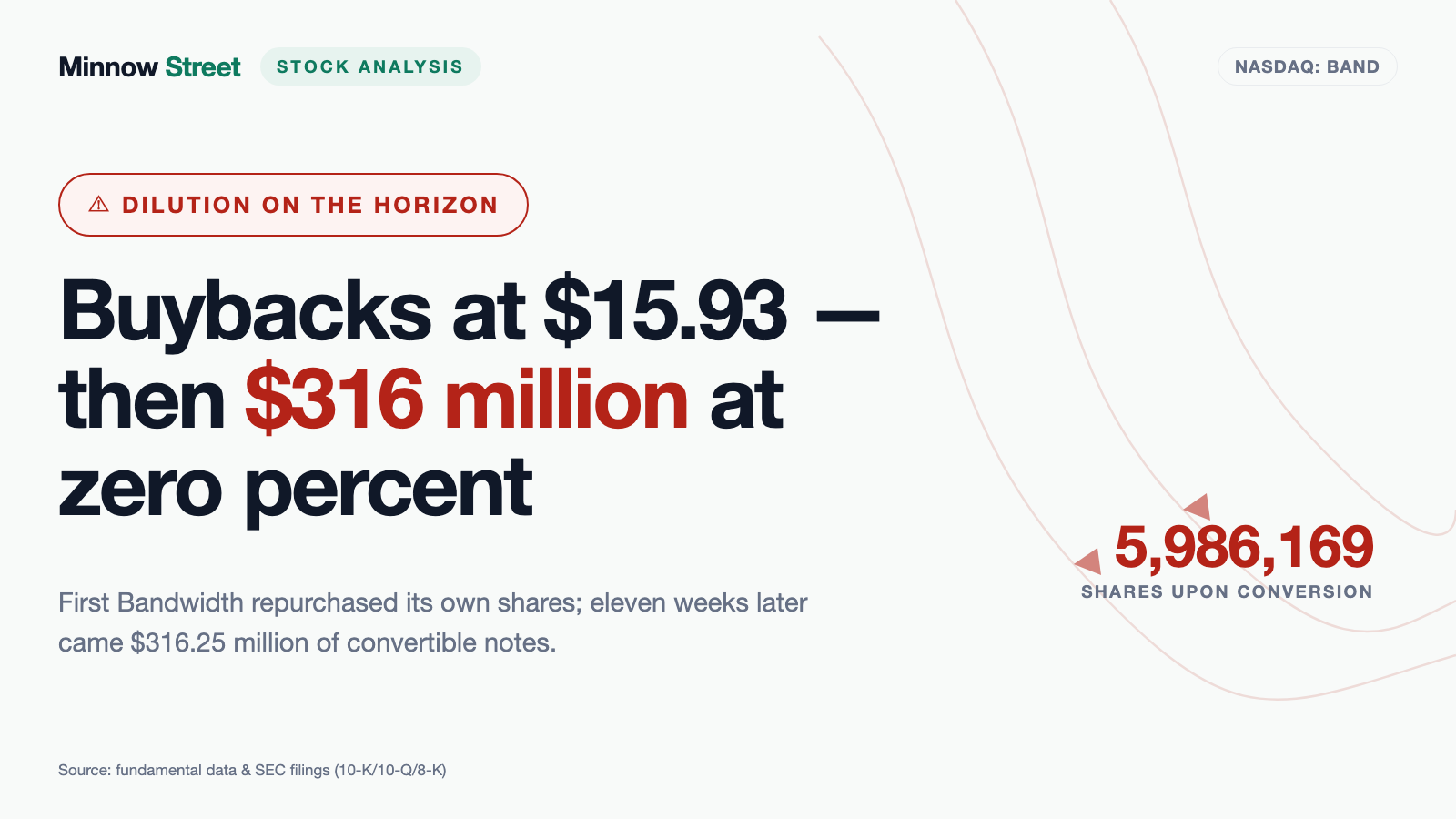
Bandwidth runs its own telephone network in more than 65 countries and sells it as an API — to Microsoft, Google, Zoom, Cisco, RingCentral, Genesys and Five9. Cash has come in every year since 2023 ($67.2 million of free cash flow in 2025), yet the operating line has been negative for five straight years. In the first quarter of 2026 the company repurchased 313,936 of its own shares at an average price of $15.93; on June 18, 2026 it issued $316.25 million of convertible notes bearing no interest, convertible only above roughly $72.64 — up to 5,986,169 new shares. We read the filings to see what the network earns and what the price already promises.
 Thomas Mücke
Founder & Publisher
Thomas Mücke
Founder & Publisher
Chart
Interactive price chart (TradingView).
Note: pure fact-based analysis, not investment advice and not a solicitation to buy or sell. All figures without guarantee.
There is an investor trap that spares nobody, because it looks so reasonable: the price-tag trap. It works like this. You see that a stock has multiplied within a year, and your brain fills in the rest: "Somebody must know something." The price becomes a verdict before you have read a single number. Bandwidth Inc. (NASDAQ: BAND) of Raleigh, North Carolina is the perfect test case — precisely because the company itself accepted two entirely different prices for the same share within eleven weeks. In the first quarter of 2026 Bandwidth repurchased 313,936 of its own shares at an average price of $15.93. On June 15, 2026 the same company launched a convertible note of $316.25 million bearing no interest, which turns into stock only above roughly $72.64 per share. Same network, same management, same customer base — two different worlds. So let us make a deal: before you trust the price tag, we read together what Bandwidth told the U.S. securities regulator, the SEC — the annual report (10-K) for 2025, the quarterly report (10-Q) as of March 31, 2026 and the current reports (8-K) filed in June 2026. An SEC filing is honest under penalty of law. And this one describes a network that reliably brings in cash, an operating line that has been negative for five straight years, and up to 5,986,169 shares that do not yet exist.
What Bandwidth Actually Does — a Phone Company With a Socket for Software
Bandwidth is not a software house, even though the market files it under "Software – Infrastructure." Bandwidth is a telephone company with one decisive difference: instead of selling lines to households, it sells its network to software. Picture it this way: somebody owns the lines, the switching gear and the number blocks in more than 65 countries — and bolts a socket onto them that any app in the world can plug into. That socket is called an API, a programming interface with which one program remotely controls another. When your banking app texts you a login code, when your doctor confirms an appointment by message, when you dial a real phone number inside a video meeting — odds are a network like this carries it. Bandwidth says it reaches more than 90 percent of global gross domestic product.
The business rests on three legs. First, Global Voice Plans: Bandwidth supplies voice, messaging and emergency services to the large communications platforms. The annual report names them — "Microsoft, Google, Zoom, Cisco, RingCentral, Genesys, and Five9." Second, Enterprise Voice: large corporations buy directly, with no platform in between, using the in-house software Maestro. Third, Programmable Messaging: high-volume text messaging for retail, financial services and healthcare. About 60 percent of consolidated 2025 revenue came from the voice domain. As of December 31, 2025 roughly 1,100 people worked for Bandwidth, the company held 38 U.S. patents, and the shares have traded on Nasdaq since November 10, 2017.
The narrative that carried the stock in 2026, however, is not "telephone network" but AI voice. Bandwidth positions Maestro as the control room for AI voice agents — computer voices that place and take calls on their own. The annual report puts it this way:
"Our Maestro platform is key to Bandwidth's AI innovation strategy. We believe it is the most open and flexible solution for enterprises to integrate conversational AI into cloud communications, through Native AI within CCaaS platforms, pre-built partner integrations, Bring Your Own AI with third-party apps, and Public APIs like OpenAI's Realtime interface."
— Bandwidth Inc., SEC annual report 10-K for 2025, Item 1 Business
An important qualifier: Bandwidth builds no AI models of its own. It sells the line over which somebody else's AI talks, and the software that conducts those conversations. That is a real product with real revenue — but it is not an AI lab. Which names the central tension of this analysis, and it runs through every chapter: the network earns money reliably, yet the share price is already paying for a story that appears nowhere in the income statement — and in June 2026 the company turned exactly that story into $316.25 million of fresh capital.
How the Stock Reached Our Desk — Rank 5 in the Weekly List
Bandwidth did not surface through a press release but through one ranking of our in-house stock scanner. In the list Richard Moglen: 1 Week Top Performers (U.S. selection) the stock sits at rank 5 of 28, with a relative strength rating of 98 out of 100, as of July 25, 2026. That list is recomputed daily, so the placement is a snapshot of that day, not a standing state. To repeat the exercise yourself: the screen is open in the scanner overview and sorts by the past week's price move.
The three conditions of that list, translated and judged. At least a 15 percent gain over four trading days — pure momentum; it says nothing about the company, only about demand for its shares that week. Average dollar volume of at least $10 million a day — this filter keeps out paper you cannot get out of in a hurry; Bandwidth clears it comfortably at roughly $79 million (data as of July 25, 2026), which is genuine liquidity. A relative strength rating of at least 70 — the metric measures how a price has fared against the broad market on a scale to 100. A reading of 98 means only two percent of tracked stocks did better. That is impressive — and it is also the only thing on this list that applies to Bandwidth without opening the books. Take this away right at the start: a momentum screen finds movement, not quality. So let us open the books.
The Numbers Over the Years — Fairly Credited
First the case in Bandwidth's favor, and it is stronger than the red operating lines suggest. Revenue has grown solidly over five years: from $490.9 million in 2021 to $753.8 million in 2025, better than half again. More importantly, free cash flow — the money actually left over after all running costs and after investment in the network — turned the corner in 2023 and has stayed firmly positive since.
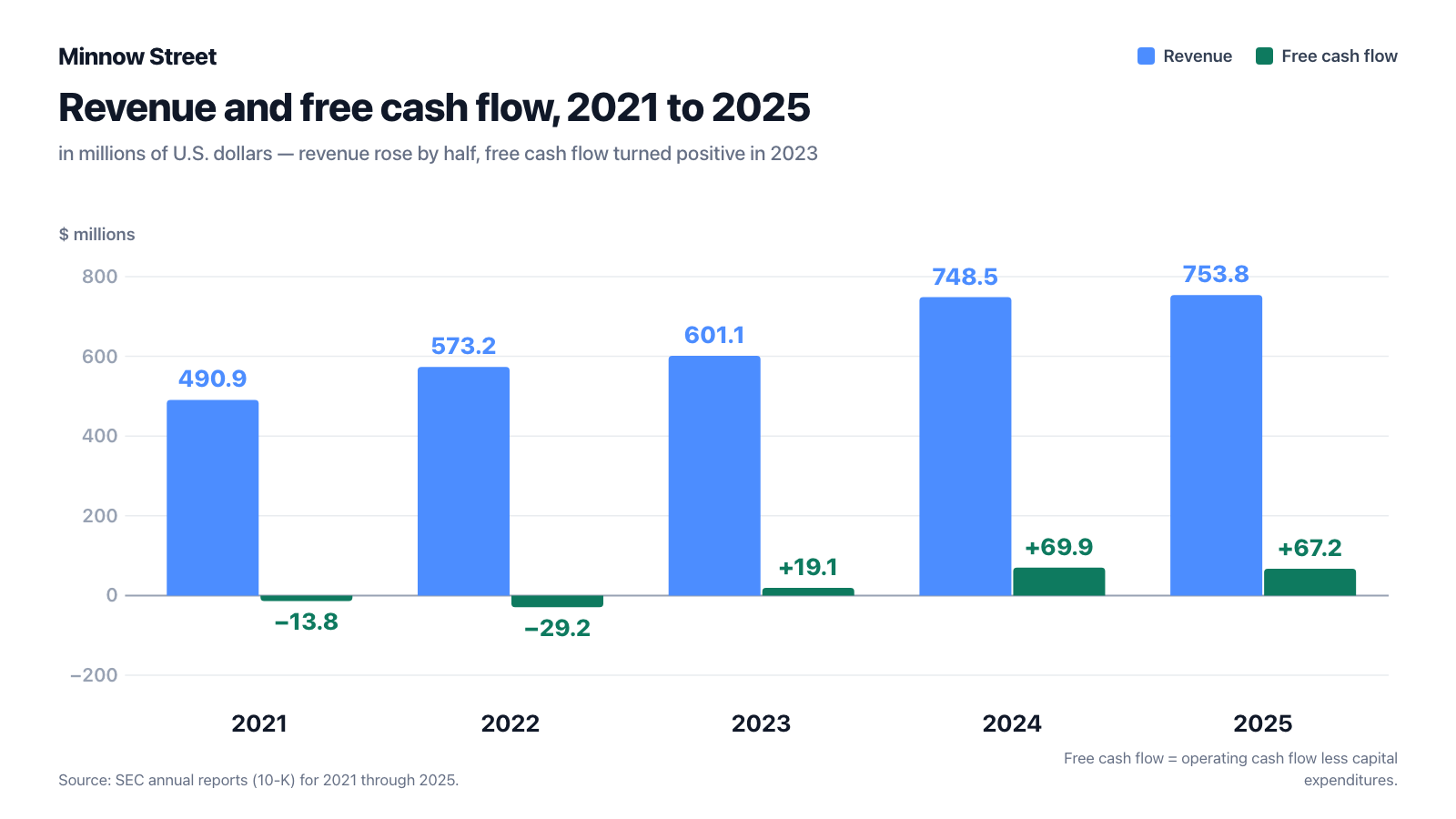
The customer side is strong too. The 2025 annual report cites a twelve-month customer retention rate above 98.8 percent and a satisfaction rate above 97 percent from its own post-interaction surveys; on the review platform G2, Bandwidth says it has been a category leader for 32 consecutive quarters. Once your phone numbers and emergency routing sit with one provider, you do not casually switch — that is real switching friction, not a marketing line. And the first quarter of 2026 was operationally the best in some time: revenue jumped 19.8 percent to $208.8 million, Enterprise Voice grew 14 percent and Global Voice Plans 12 percent.
One metric deserves particular attention because the company itself treats it as a lead indicator: the net retention rate. It measures how much revenue the same set of customers delivers a year later. Above 100 percent means existing customers are buying more than the year before. The series: 101 percent (2023), 122 percent (2024), 98 percent (2025) — and in the first quarter of 2026 back to 102 percent, against 116 percent in the year-earlier quarter. The 2024 spike and the 2025 relapse share one cause, and it has nothing to do with the business: political mass texting around the U.S. presidential election of November 2024. Remember this: Bandwidth's revenue curve has an election calendar built in. Anyone comparing two years must know whether an election sat between them.
What the Filings Say — the Uncomfortable Truths
Uncomfortable Truth No. 1: the Debt Pile Grew by a Third — and the Coupon Fell to Zero
On June 15, 2026 Bandwidth announced a convertible note; on June 16 it was priced, on June 18 issued. A convertible note is a loan with a stock voucher built in: the buyer lends money and may later swap it for shares once the price has risen far enough. The terms here are notable — the note pays no interest at all:
"The notes will not bear regular interest, and the principal amount of the notes will not accrete."
— Bandwidth Inc., SEC current report on Form 8-K, June 18, 2026, Item 1.01 "Indenture and Notes"
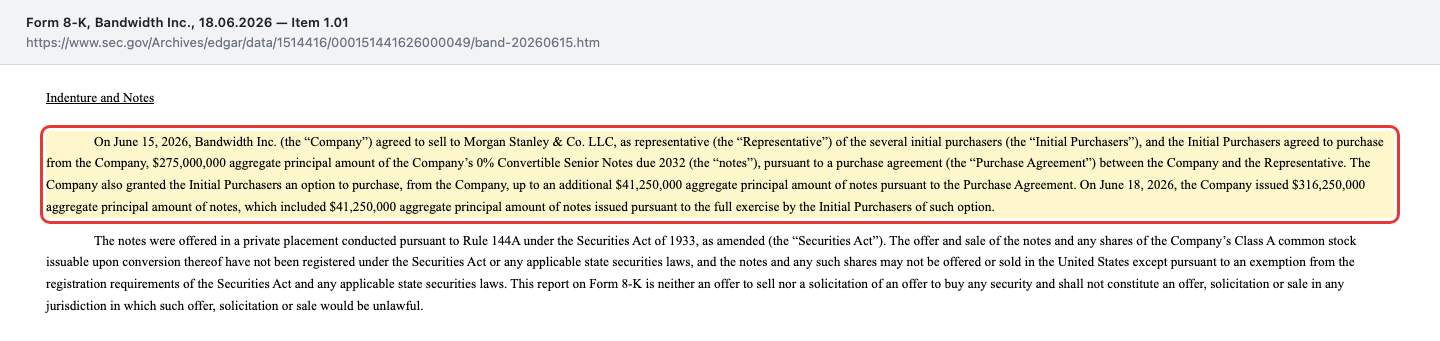
With the proceeds Bandwidth simultaneously bought back older debt: $122.5 million of the 2028 convertible notes (0.50 percent coupon) for roughly $116.5 million in cash, leaving about $27.5 million of that issue outstanding. Back in March 2026 the company had already repurchased $100 million of the same notes for $92 million and repaid the last $8 million of the 2026 notes. The net movement looks like this:
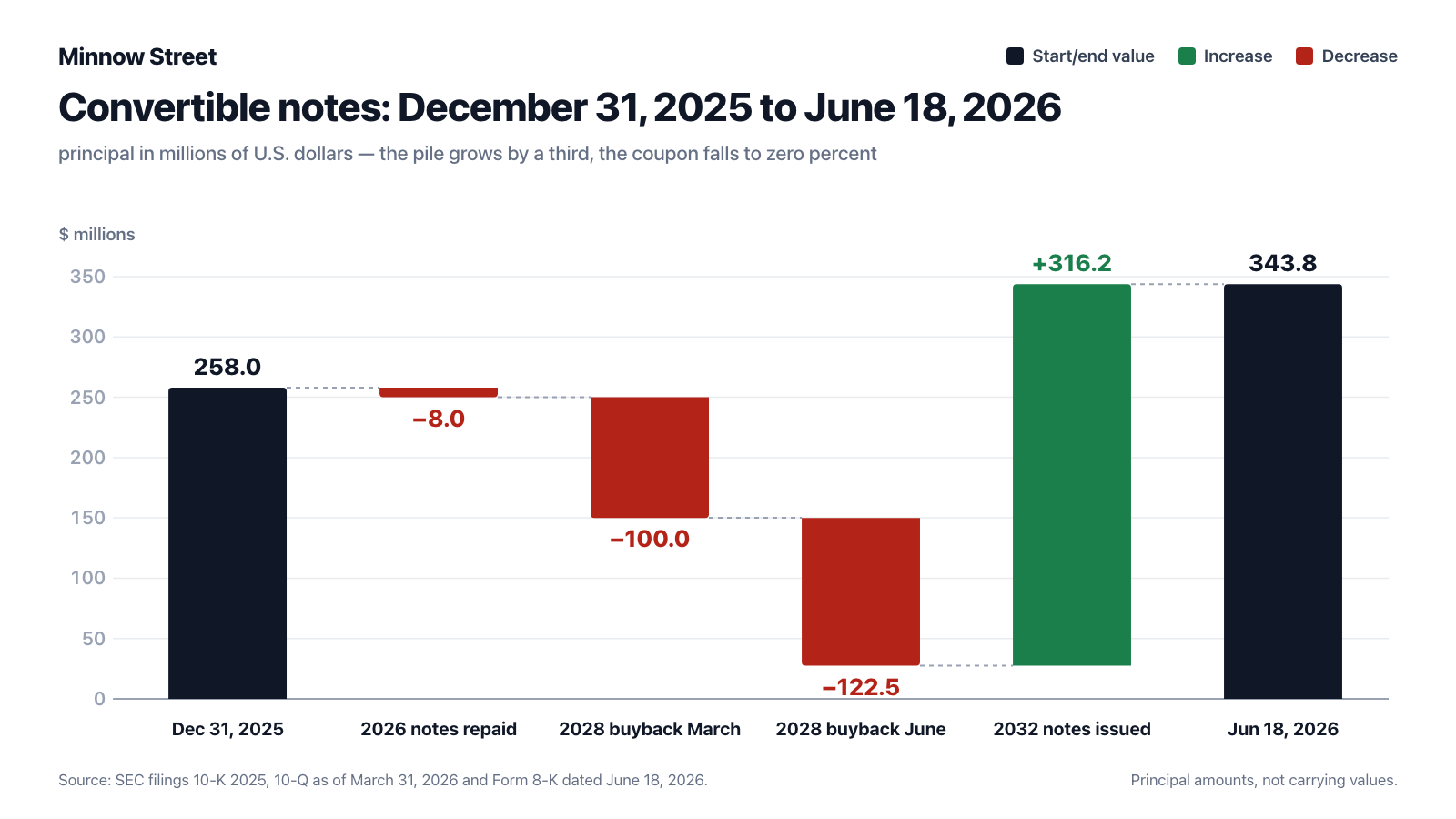
Fairly credited: this is well executed. The company swapped more expensive debt for cheaper debt, pushed maturity from 2028 to July 1, 2032 and bought its own notes back below par — which even produced a $7.3 million book gain in the first quarter of 2026. The price for it appears in the next truth.
Uncomfortable Truth No. 2: up to 5,986,169 Shares That Do Not Yet Exist
Dilution means your slice of the pie gets smaller because the pie is cut into more pieces. That is exactly what can happen here. The conversion price of the new note is roughly $72.64 per share (13.7663 shares per $1,000 of principal). If the price rises far enough, holders may swap — and the filing states the ceiling precisely:

And that is not the only source of new shares. As of March 31, 2026 there were an additional 5,045,797 unvested restricted stock units outstanding, carrying $69.2 million of unrecognized compensation cost to be amortized over 2.19 years. Stock-based compensation came to $52.3 million in 2025 — roughly 78 percent of that year's entire free cash flow. To cushion the dilution from the note, Bandwidth spent $21.8 million on option contracts that work up to a ceiling of $105.66 per share. Above that line they no longer help. Remember this: the share counter at this company knows three ways up — conversion, employee stock and, if needed, a new placement. Only one narrow path leads down so far: the $80 million repurchase program authorized February 19, 2026, of which all of $5.0 million was used in the first quarter.
Uncomfortable Truth No. 3: the Quarterly Profit Came From the Balance Sheet, Not the Business
The headline for the first quarter of 2026 reads: first net profit in a long while, $4.1 million, after a $3.7 million loss in the year-earlier quarter. One line above, however, sits the operating loss of $4.6 million. The profit therefore came not from the business but from two special items: a $7.3 million book gain on repurchasing its own notes below par and a $1.5 million tax benefit. How much that distorts the picture is shown by a number printed directly beneath it in the same report: diluted earnings per share were minus $0.08 while basic showed plus $0.13. The reason lies in the method: the diluted calculation assumes the convertible notes have already been swapped for shares — at which point the book gain from repurchasing them disappears, and the profit turns back into a loss.
This is no one-off but the pattern of recent years. The operating line came to minus $35.5 million in 2023, minus $20.1 million in 2024 and minus $14.4 million in 2025 — the direction is right, but zero has still not been reached. Net losses over the same span were $16.3 million, $6.5 million and $12.9 million. Anyone wanting to compare that with a coolly calculated software valuation will find the same conflict in purer form in our analysis of Rubrik: fast growth, rich valuation, earnings still pending.
Uncomfortable Truth No. 4: More Than a Quarter of Revenue Is Merely Money Passing Through
Bandwidth splits its revenue into two buckets itself. The first is cloud communications — the actual business, $561.4 million in 2025. The second is messaging surcharges: fees that mobile carriers charge for delivering bulk texts, which Bandwidth collects and immediately passes on. In 2025 that came to $192.4 million, better than a quarter of reported consolidated revenue — money that merely flows through the company and carries virtually no margin.
Why that matters is on display in the first quarter of 2026. Revenue rose $34.5 million to $208.8 million. Of that, $17.8 million came from higher pass-through surcharges — more than half of the increase. Gross margin duly fell from 41 to 37 percent, even though the company explicitly reports better unit economics in voice. In 2025 it worked the other way around: because surcharges dropped 8 percent after the U.S. election cycle ended, gross margin rose from 37 to 39 percent while total revenue grew all of 0.7 percent. Remember this: at Bandwidth, margin can rise because revenue stalls — and fall because revenue jumps. Anyone valuing the company is better served using the $561.4 million of cloud revenue than the $753.8 million headline.
Uncomfortable Truth No. 5: Two Sentences on Customer Concentration That Seem to Contradict Each Other
The notes to the 2025 annual report contain a reassuring line: "For the years ended December 31, 2025, 2024 and 2023, no individual customer represented more than 10% of the Company's revenue." Roughly a hundred pages earlier, in the risk section of the same document, it sounds rather different:
"A significant portion of our revenue is concentrated among a limited number of large customers. If we lost several of our top ten customers, or, if several of these major customers significantly decreased their usage of our services, our business would be materially and adversely affected."
— Bandwidth Inc., SEC annual report 10-K for 2025, Item 1A Risk Factors

Both are true, and together the two sentences give the actual picture: no single customer is large enough to sink Bandwidth — but the top ten combined are. And the annual report itself says who they are: Microsoft, Google, Zoom, Cisco, RingCentral, Genesys and Five9. Those are simultaneously the best-capitalized technology companies on earth and the firms most capable of building parts of this network themselves or squeezing the price. A similar pattern — strong product, very few very large buyers — is described in our analysis of Harmonic, which shows how quickly such revenue can tip. The counterargument worth knowing: Bandwidth expressly reports that several of these large customers have been on the platform for more than ten years, and the 98.8 percent retention rate supports that.
Uncomfortable Truth No. 6: Cash Halved in a Single Quarter
As of December 31, 2025 Bandwidth held $102.8 million of cash plus $8.5 million of marketable securities and had drawn not one dollar on its $150 million revolver. Three months later, as of March 31, 2026, it was $47.3 million of cash plus $3.0 million of securities — and $50.5 million drawn. The reason is traceable: $92 million for the March note buyback, $8 million of repayment, $5 million of share repurchases. But it is also the answer to the question of why the June note came. Operating cash flow for the quarter was only $8.8 million and free cash flow $1.7 million — both well below the annual run rate. One quarter is not a trend, and the first quarter was already the weakest in 2025 (minus $3.1 million operating back then). The point stands regardless: without the June capital raise, room to maneuver would have grown tight.
One more word on voting power, because it appears in no metric: Bandwidth has two share classes. Class A carries one vote per share, Class B carries ten. At the annual meeting on May 28, 2026, 23,928,067 Class A and 1,956,777 Class B shares were represented — Class B thus made up roughly 7.6 percent of the shares present but 45.0 percent of the votes cast. On executive compensation, 30.9 million votes were in favor and 10.0 million against, roughly 24 percent opposition — a clear signal for an advisory vote.
Valuation — What the Price Already Pays For
First the order of magnitude rather than the daily price: with roughly 32.0 million shares across both classes (30,059,279 Class A plus 1,958,028 Class B as of April 24, 2026) and a closing price of $59.80 on July 24, 2026, market capitalization stood at roughly $1.91 billion. Cross-checking against the last price documented in an SEC filing — $52.83 on June 15, 2026, cited in the note offering — gives roughly $1.69 billion; the 13 percent gap is within tolerance and the order of magnitude holds.
Three anchors follow. First, price to sales: roughly 2.4 times on trailing twelve-month revenue of $788.4 million. Strip out the pass-through messaging surcharges and use only cloud communications revenue of roughly $578.1 million, and it is about 3.3 times. For a network business with a 37 to 39 percent gross margin that is no bargain, but it is not a fantasy price either — software vendors with 70 percent margins routinely trade far higher. Second, price to earnings: it cannot be computed, because the company reports a loss over twelve months. Third, book value: roughly $12.67 per share, putting price to book at about 4.7 (data as of July 25, 2026).
The professionals' view, as context rather than verdict: six analyst firms cover the stock, the consensus target price is $67.25 (data as of July 25, 2026), and the recommendations split into one strong buy, two buys, two holds and one strong sell. That is not consensus; that is an argument. Two in-house anchors say more than any target: Bandwidth itself found $15.93 attractive enough in the first quarter of 2026 to buy back its own stock — and in June 2026 found $105.66 high enough to cap the dilution there. Everything plays out between those two numbers.
Opportunities and Risks at a Glance
What speaks for Bandwidth:
- An owned network rather than resale: an IP network in more than 65 countries that the company says reaches over 90 percent of global gross domestic product — competitors renting other people's networks do not have that cost base.
- Sticky customers: twelve-month retention above 98.8 percent (2025), several large customers on board for more than ten years, satisfaction above 97 percent.
- The cash flow is real: $69.9 million (2024) and $67.2 million (2025) of free cash flow after negative years in 2021 and 2022 — the business funds itself.
- Growth is back: revenue up 19.8 percent in the first quarter of 2026, Enterprise Voice up 14 percent, net retention back to 102 percent.
- The AI story has a product: Maestro is a shipped platform with an MCP interface for AI voice agents, not an announcement; the large-enterprise business grew 21 percent in 2025.
- Debt reorganized: maturity pushed from 2028 to 2032, coupon cut to zero, a $150 million revolver in place to 2029, no cash interest burden.
What speaks against it:
- Five years without an operating profit: every year from 2021 through 2025 showed an operating loss, most recently minus $14.4 million; the first quarter of 2026 also closed at minus $4.6 million.
- Dilution from two directions: up to 5,986,169 shares from the convertible note (about 20 percent of Class A shares) plus 5,045,797 unvested restricted stock units as of March 31, 2026.
- Inflated revenue: better than a quarter of reported revenue is pass-through carrier fees with no meaningful margin; gross margin swings with them between 37 and 41 percent.
- Concentration among the top ten customers, who are also the corporations most capable of building parts of this network themselves.
- Revenue with an election calendar: political mass texting lifted net retention to 122 percent in 2024 and let it fall to 98 percent in 2025.
- Long-term commitments beyond equity: $447.0 million of future minimum rent payments through July 2043 against $405.7 million of equity (March 31, 2026).
- Two voting classes: Class B with ten votes per share supplied roughly 45 percent of the votes at the 2026 annual meeting on 7.6 percent of the shares present.
A Human Conclusion
Back to the price-tag trap. At Bandwidth it snaps shut in both directions, and that is what makes this case fascinating. Anyone who had seen only the price in early 2026 would have written off a small, unremarkable phone company — even though it already owned the same network, served the same customers and produced the same cash flow. Anyone who sees only today's price may take it for an AI company — even though it has not reported a single operating profit in five years. The price tag says nothing about what is inside. It says only what other people are currently willing to pay.
What is inside can be stated soberly after this reading: a real, hard-to-replicate network with very loyal customers that has thrown off reliable cash for three years — and an income statement in which the black zero on the operating line is still missing, while the share count knows several ways up. Both at once. The decisive question sits in the next two or three quarterly reports and is refreshingly simple: will growth in voice and AI carry far enough to lift the operating line above zero before conversion raises the share count? If yes, the price move looks justified in hindsight. If no, it was a story. What you make of that is your decision. And that is exactly as it should be.
Sources
- Bandwidth Inc., SEC annual report 10-K for fiscal 2025 (filed February 19, 2026), CIK 0001514416 — Item 1 Business, Item 1A Risk Factors, Item 7 MD&A, Notes 6, 7 and 11.
- Bandwidth Inc., SEC quarterly report 10-Q as of March 31, 2026 (filed April 30, 2026) — balance sheet, statement of operations, Note 7 "Debt," Note 9 "Share Repurchase Program," Notes 10, 11 and 14.
- Bandwidth Inc., SEC current report on Form 8-K, June 18, 2026 — Item 1.01 (indenture, notes, capped call transactions), Item 2.03, Item 3.02 and Item 8.01 (repurchase of the 2028 notes).
- Bandwidth Inc., SEC Form 8-K, June 16, 2026 (pricing of the 0% convertible notes due 2032) and Form 8-K, March 2, 2026 (repurchase of $100 million of the 2028 notes).
- Bandwidth Inc., SEC Form 8-K, May 29, 2026 — Item 5.07, voting results of the annual meeting held May 28, 2026.
- Bandwidth Inc., SEC annual report 10-K for fiscal 2024 (filed February 20, 2025) — comparative figures for 2021 through 2024.
- Rankings of our in-house stock scanner: Richard Moglen: 1 Week Top Performers (U.S. selection, rank 5 of 28, relative strength rating 98), as of July 25, 2026; the lists are recomputed daily.
- Fundamental data (market capitalization, valuation metrics, analyst consensus, quarterly series), data as of July 25, 2026, closing price of July 24, 2026.
Note: This article is journalistic commentary on publicly available company data. It is not investment advice, not a recommendation to buy or sell, and not a solicitation to buy or sell securities. Share prices can fall substantially at any time; a total loss is possible. All figures come from the primary sources linked above and carry the reporting date stated there. The author holds no position in the security discussed at the time of publication.
Our Bottom Line at a Glance
- Business model and competitive position positive
- An owned IP network in more than 65 countries that the company says reaches over 90 percent of global gross domestic product is hard to replicate. Twelve-month customer retention was above 98.8 percent in 2025, several large customers have been on the platform for more than ten years, and the world's biggest communications platforms are customers rather than competitors.
- Earning power negative
- Five consecutive years of operating losses: minus $14.4 million in 2025, minus $20.1 million in 2024, minus $35.5 million in 2023; the first quarter of 2026 also closed at minus $4.6 million on the operating line. The reported quarterly profit of $4.1 million came from a book gain on the note buyback plus a tax benefit — diluted earnings per share still showed minus $0.08.
- Cash flow and balance sheet neutral
- Free cash flow has been positive since 2023 ($69.9 million in 2024, $67.2 million in 2025) and equity stood at $405.7 million as of March 31, 2026. At the same time cash halved in the first quarter of 2026 from $102.8 million to $47.3 million, $50.5 million of the revolver was drawn for the first time, and $447.0 million of future minimum rents through July 2043 exceed the equity base.
- Dilution negative
- The convertible note of June 18, 2026 can produce a maximum of 5,986,169 new Class A shares — about 20 percent of the 30,059,279 Class A shares outstanding as of April 24, 2026. Add 5,045,797 unvested restricted stock units as of March 31, 2026 and stock-based compensation of $52.3 million in 2025, roughly 78 percent of that year's free cash flow.
- Revenue quality neutral
- Better than a quarter of reported 2025 revenue ($192.4 million of $753.8 million) is pass-through carrier fees with no meaningful margin, and they swing with the U.S. election calendar; they lifted net retention to 122 percent in 2024 and let it fall to 98 percent in 2025. Cloud communications grew more steadily: up 4 percent in 2025 and up 13 percent in the first quarter of 2026.
- Governance neutral
- Class B shares carry ten votes each: at the annual meeting on May 28, 2026 they made up roughly 7.6 percent of the shares present but 45.0 percent of the votes cast. Executive compensation drew roughly 24 percent opposition (10.0 million against 30.9 million votes). Disclosure itself is transparent — customer concentration, dilution and lease commitments are all stated openly in the filings.
Bandwidth is the price-tag trap in pure form: the same company that repurchased its own shares at an average $15.93 in the first quarter of 2026 borrowed $316.25 million at zero percent eleven weeks later, with a conversion price of roughly $72.64. In between lay no new factory and no new mega-contract, but a new story: AI voice. What is documented: an owned network in more than 65 countries, customer retention above 98.8 percent and free cash flow around $67 million every year since 2023. What is missing: an operating profit — the line has been negative five years running, most recently minus $14.4 million in 2025 and minus $4.6 million in the first quarter of 2026. And what may still come: up to 5,986,169 new shares from conversion. Not investment advice.
What Our Rating Means
Open questions
The business works in principle, but one material question is open. As long as it stays open, our findings do not carry a quality verdict.
The business carries its own weight: an owned network, very loyal large customers, dependable free cash flow for three years, no cash interest on the convertible notes and no sign of a threat to the going concern. What is open is a clearly operational question, and a weighty one: Bandwidth has not reported an operating profit in a single year since 2021, and the profit posted in early 2026 came from the balance sheet rather than the business. Add potential dilution of roughly a fifth of the Class A shares. That is not a threat to substance, but it is not proven quality either — hence yellow. The decision is yours.
A journalistic assessment by our editorial team at the time of the deep dive, based on public sources — not investment advice and not a solicitation to buy or sell. Your personal circumstances (investment goals, risk capacity, taxes) cannot be taken into account. What our levels mean, how verdicts are formed, and what conflicts of interest exist →
Worth Noting
- Bandwidth landed on the research list through our in-house stock scanner: rank 5 of 28 in the list "Richard Moglen: 1 Week Top Performers" (U.S. selection) with a relative strength rating of 98, as of July 25, 2026. That list is recomputed daily; it measures price momentum over four trading days, liquidity and relative strength — demand for the shares, not quality of the company.
- Every figure carries its own reporting date: annual figures from the 10-K for 2025 (filed February 19, 2026), quarterly figures from the 10-Q as of March 31, 2026 (filed April 30, 2026), note and dilution data from the current reports on Form 8-K dated June 15, 16 and 18, 2026. Valuation metrics as of July 25, 2026 based on the closing price of July 24, 2026 — meant to be evergreen, with no daily price used as a buy argument.
- Easy to confuse: the ticker BAND belongs to Bandwidth Inc. of Raleigh (CIK 0001514416), not to any musical group or radio frequency band. The company was named Bandwidth.com, Inc. until 2017. The spun-off mobile provider Relay, Inc. (formerly Republic Wireless) is a related party and has leased part of the corporate headquarters since January 1, 2025.
Frequently Asked Questions
Bandwidth operates its own IP communications network in more than 65 countries and sells it as an API: software vendors and large corporations use it to embed telephony, text messaging, emergency services and the control of AI voice agents into their applications. About 60 percent of consolidated 2025 revenue came from the voice domain, the rest from bulk text messaging and the related pass-through fees.
Both swings come mainly from pass-through messaging surcharges. They fell 8 percent in 2025 because political mass texting disappeared after the U.S. presidential election of November 2024; in the first quarter of 2026 they rose 44 percent. The underlying cloud communications business grew more steadily: 4 percent in 2025 and 13 percent in the first quarter of 2026.
On June 18, 2026 Bandwidth borrowed money at no interest, maturing July 1, 2032. Holders may later swap it for shares once the price sits far enough above the conversion price of roughly $72.64. A maximum of 5,986,169 new Class A shares can result — about 20 percent of the 30,059,279 Class A shares outstanding as of April 24, 2026. A hedge cushions the dilution up to a price of $105.66.
Basic earnings per share of plus $0.13 include a $7.3 million book gain from repurchasing the company's own notes below par. The diluted calculation assumes the convertible notes have already been swapped for shares — at which point that gain disappears and a loss of $0.08 per share remains. On the operating line the first quarter of 2026 showed a loss of $4.6 million in any case.
The notes to the 2025 annual report state that no individual customer accounted for more than 10 percent of revenue in 2023 through 2025. The risk section of the same filing warns, however, that losing several of the top ten customers would materially and adversely affect the business. Those large customers include, per the annual report, Microsoft, Google, Zoom, Cisco, RingCentral, Genesys and Five9.
Indirectly, yes. Bandwidth develops no AI models of its own; it sells the Maestro platform, which orchestrates AI voice agents across its network, and an MCP server through which such agents control Bandwidth APIs in natural language. The company reports no separate AI revenue line; the large-enterprise business to which Maestro belongs grew 21 percent in 2025.
After the June 2026 refinancing, convertible notes with principal of roughly $343.75 million are outstanding: $316.25 million at zero percent maturing July 1, 2032 and roughly $27.5 million of the older 0.50 percent notes due 2028. On top of that sits a $150 million revolving credit facility, of which $50.5 million was drawn as of March 31, 2026. Equity stood at $405.7 million on that date.
Found an error?
Did you spot a factual error, an outdated number, or a typo in this deep dive? Let us know briefly — your report goes straight to the editorial team.