Backblaze Stock: A $335 Million CoreWeave Contract Lit the Curve — and the Company Has Never Closed a Profitable Year
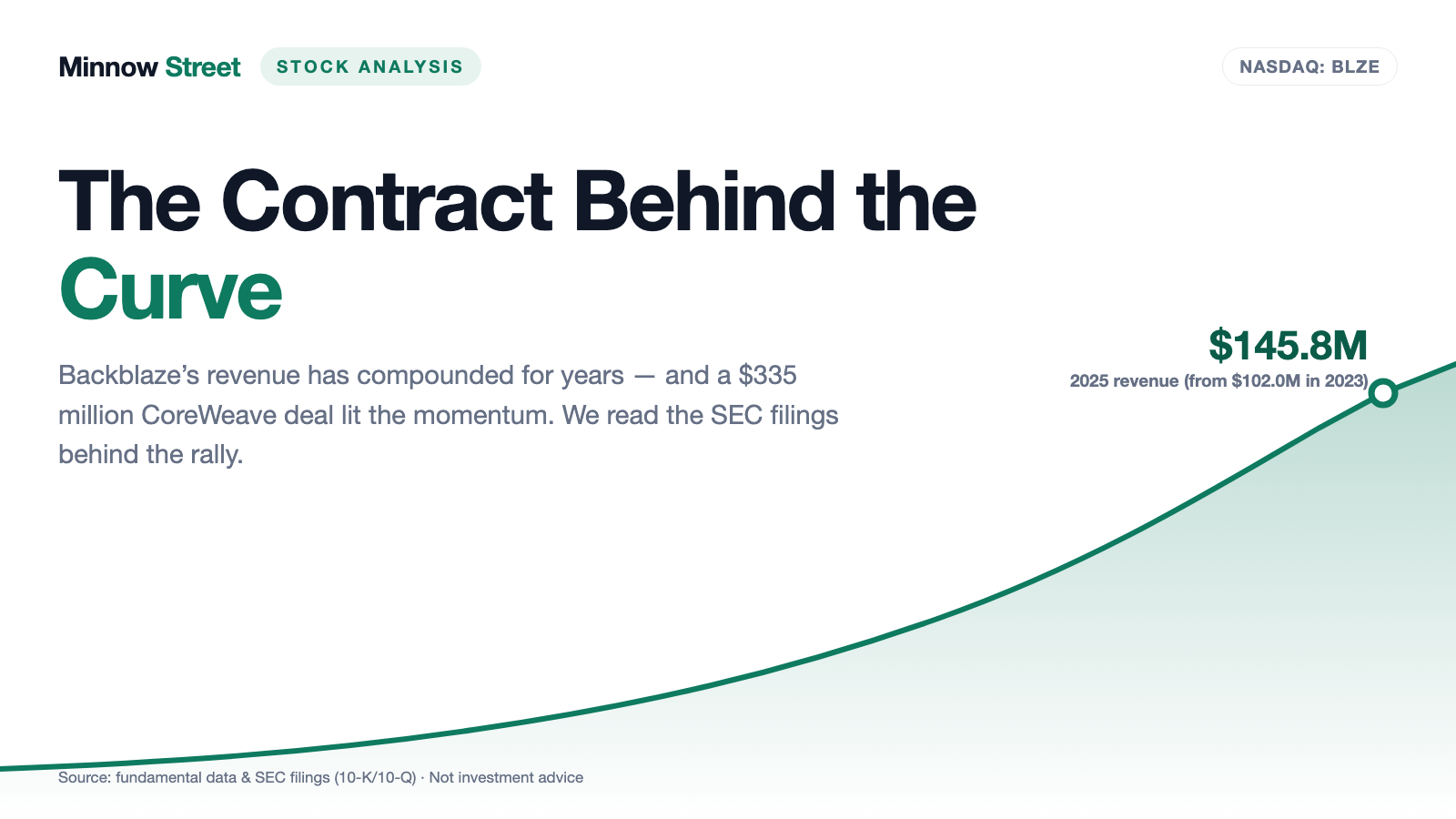
Backblaze runs one of the cheapest cloud storage platforms in the world — and sits at rank 8 of our in-house Qullamaggie Top Gainers 3M scanner (as of July 18, 2026) because a single contract lit the curve: CoreWeave booked storage worth an estimated $335 million over five to seven years. We read the annual report (10-K) for 2025, the quarterly report as of March 31, 2026, and the June and July filings: 26 percent growth in the cloud storage business, a 61 percent gross margin, a net loss more than cut in half since 2023 — but also more than 18 years without a profit, a second segment that is stalling, and a deal paid for with warrants on roughly 7 percent of the shares. Not investment advice — just the bill for what a momentum rank costs once you buy it as a company.
 Thomas Mücke
Founder & Publisher
Thomas Mücke
Founder & Publisher
Chart
Interactive price chart (TradingView).
Note: pure fact-based analysis, not investment advice and not a solicitation to buy or sell. All figures without guarantee.
There is a moment when an investor turns into a hunter: when a curve looks steep enough. Psychologists call it FOMO — the fear of missing the train — and its favorite tool is the momentum scanner, because a momentum scanner shows nothing but the steepest curves in the market. Backblaze, Inc. (Nasdaq: BLZE) sits at rank 8 of our Qullamaggie Top Gainers 3M scanner (U.S. selection, as of July 18, 2026) — the stock trades more than 300 percent above its 52-week low. Before the hunting instinct takes over, let\'s make a deal: we read together what is actually behind the curve — the annual report (10-K) for 2025, the quarterly report (10-Q) as of March 31, 2026, and two current reports (8-K) from June and July 2026 that explain the surge. What you find there is a real contract worth an estimated $335 million with AI cloud provider CoreWeave. And you also find what it is paid with: warrants on roughly 7 percent of the shares, up to $150 million in lease headroom for new hardware — and the patience of shareholders who have been waiting for the first profitable year since the November 2021 IPO. Remember this: whoever buys a curve gets a company.
What Backblaze actually does — the discount warehouse of the AI era
Backblaze, founded in 2007 and based in San Mateo, California, runs its own storage cloud with about 320 employees (December 31, 2025): hundreds of thousands of hard drives in leased data centers in California, Arizona, Virginia, Amsterdam and Toronto, where more than 500,000 customers in over 175 countries store roughly 5 billion gigabytes — 5 exabytes — spread across more than one trillion files. Put into an everyday image: Backblaze is the warehouse district of the internet — not a white-glove concierge like the big hyperscalers, but the provider where a square foot of shelf space costs radically little and moving goods in and out costs nothing extra. The business stands on two legs: B2 Cloud Storage, object storage for companies and developers (2025: $79.9 million in revenue), and Computer Backup, the flat-rate backup service for PCs and Macs ($65.9 million). Since 2025, new building blocks aim squarely at the AI wave: B2 Overdrive (since April 2025), a premium tier with up to 1 terabit per second of throughput for AI and machine learning data streams, and B2 Neo, a white-label storage product for so-called neoclouds — GPU landlords like CoreWeave that want to offer storage under their own brand.
The annual report now introduces the company explicitly as infrastructure for the AI era — more on that below. Which brings us to the central tension of this analysis, running through every chapter: the CoreWeave contract and the momentum are real — but they are paid for with dilution and lease debt, and the company underneath has not closed a single profitable year in more than 18 years of operations.
Where the stock shows up in our scanner
We run about 3,500 stocks through our scanners every day. As of July 18, 2026, Backblaze shows up exactly where traders hunt for price strength: at rank 8 of the Qullamaggie Top Gainers 3M scanner (U.S. selection, 9 hits). To reproduce it yourself: open the scanner, set the country filter to "US" — the list shows the strongest 3-month gainers, with Backblaze in slot 8. The scanner demands a 3-month relative strength above 98, an average daily range of at least 3.5 percent and sufficient dollar volume — Backblaze clears all three comfortably, with a 3-month relative strength of 99 (stronger than 99 percent of all stocks), a daily range around 8 percent and dollar volume around $32 million a day. The fundamental lens of the same scanner is more sobering: a Piotroski F-score of 5 out of 9 (a nine-point test of balance-sheet direction — 5 is mediocre; rock-solid starts at 8), a negative Altman Z-score (an insolvency early-warning metric that is structurally weak for loss-making software companies, but hardly a seal of quality either) and a return on equity around minus 28 percent. One more number to cool the blood: even after the rally, the stock still trades roughly 60 percent below its all-time high from the IPO euphoria of late 2021. Remember the principle: a momentum scanner measures the curve — it does not measure the company behind it. Which is exactly why we now read the filings.
The contract that lit the curve: CoreWeave books $335 million of storage
On June 23, 2026, Backblaze filed a current report (8-K) with the U.S. securities regulator, the SEC, that explains this stock\'s momentum rank: effective June 16, 2026, the company signed a "Master Strategic Agreement" with CoreWeave — the listed AI cloud provider that rents GPU compute to AI developers. Backblaze delivers two things: object storage capacity on its own B2 platform, and a managed storage solution inside CoreWeave\'s data centers. The size is right there in the filing:
"The Company estimates that the total contract value payable over the term of the initial order forms will be approximately $335 million, although actual amounts will depend on the storage capacity utilized and other factors and may differ from this estimate."
— Backblaze, Inc., SEC current report 8-K filed June 23, 2026, Item 1.01 (Master Strategic Agreement with CoreWeave)
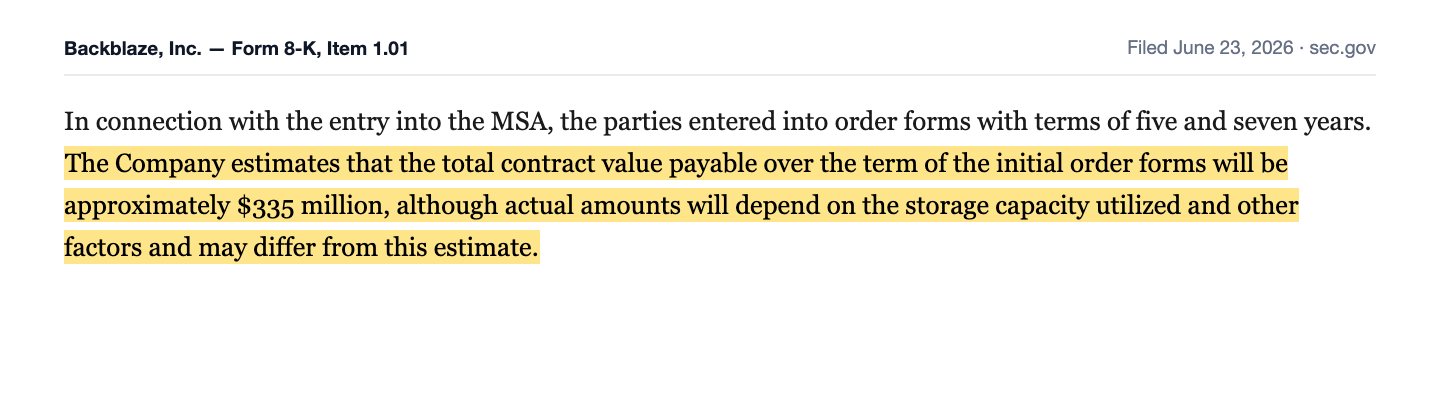
For scale: $335 million is more than double Backblaze\'s entire 2025 revenue ($145.8 million) — spread, however, across order forms running five and seven years, so roughly $50 to $60 million a year if CoreWeave draws capacity as estimated. The word "estimates" is not boilerplate here: the amount explicitly depends on the capacity actually utilized. And the contract carries a price that is not paid in dollars: simultaneously, Backblaze issued CoreWeave two warrants for a combined total of up to 4,194,876 shares — fixed-price purchase rights whose mechanics the filing describes precisely:
"The Warrants each have an exercise price per share of $7.60, which price was derived based upon a volume weighted average price formula. The Initial Warrant will vest and become exercisable in twenty equal quarterly installments (5% per quarter) over a five-year period, in each case so long as the MSA remains in effect."
— Backblaze, Inc., SEC current report 8-K filed June 23, 2026, Item 1.01 (Common Stock Purchase Warrants)
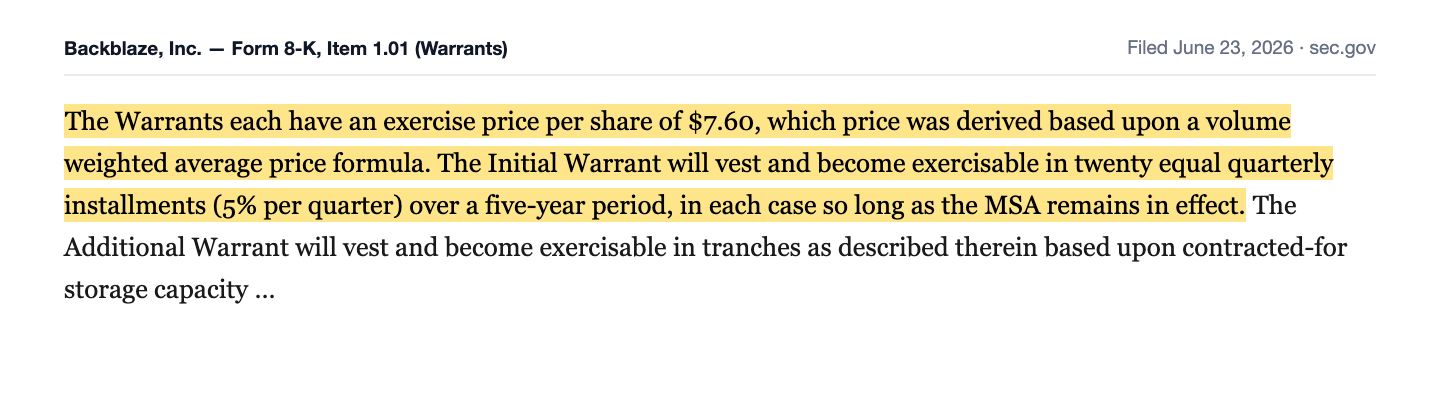
Put into an everyday image: the flagship customer gets not just storage but a key to the shareholders\' entrance — the longer it stays and the more it books, the more shares it may buy at the June 2026 price level. Against the roughly 60.0 million shares outstanding, full exercise means dilution of about 7 percent. And a third filing belongs to this deal: on June 30, 2026, Backblaze amended its credit agreement to expand its permitted capital lease volume to up to $150 million — because the hard drives for a customer of this size must be financed before the first dollar of revenue arrives. A mega-order with an obligation to invest up front is also a concentration risk in the making: what carries it is the creditworthiness and capacity appetite of a single customer.
The numbers over the years — honestly appreciated
First, what genuinely impresses — and it is more than a skeptic would expect. Revenue rose from $102.0 million (2023) via $127.6 million (2024, up 25 percent) to $145.8 million (2025, up 14 percent); the first quarter of 2026 added $38.7 million (up 12 percent). More important than the pace is the quality: gross margin climbed from 49 percent (2023) via 54 to 61 percent (2025) — the storage platform scales, and each additional customer costs less than it brings in. The engine is clearly the B2 business:
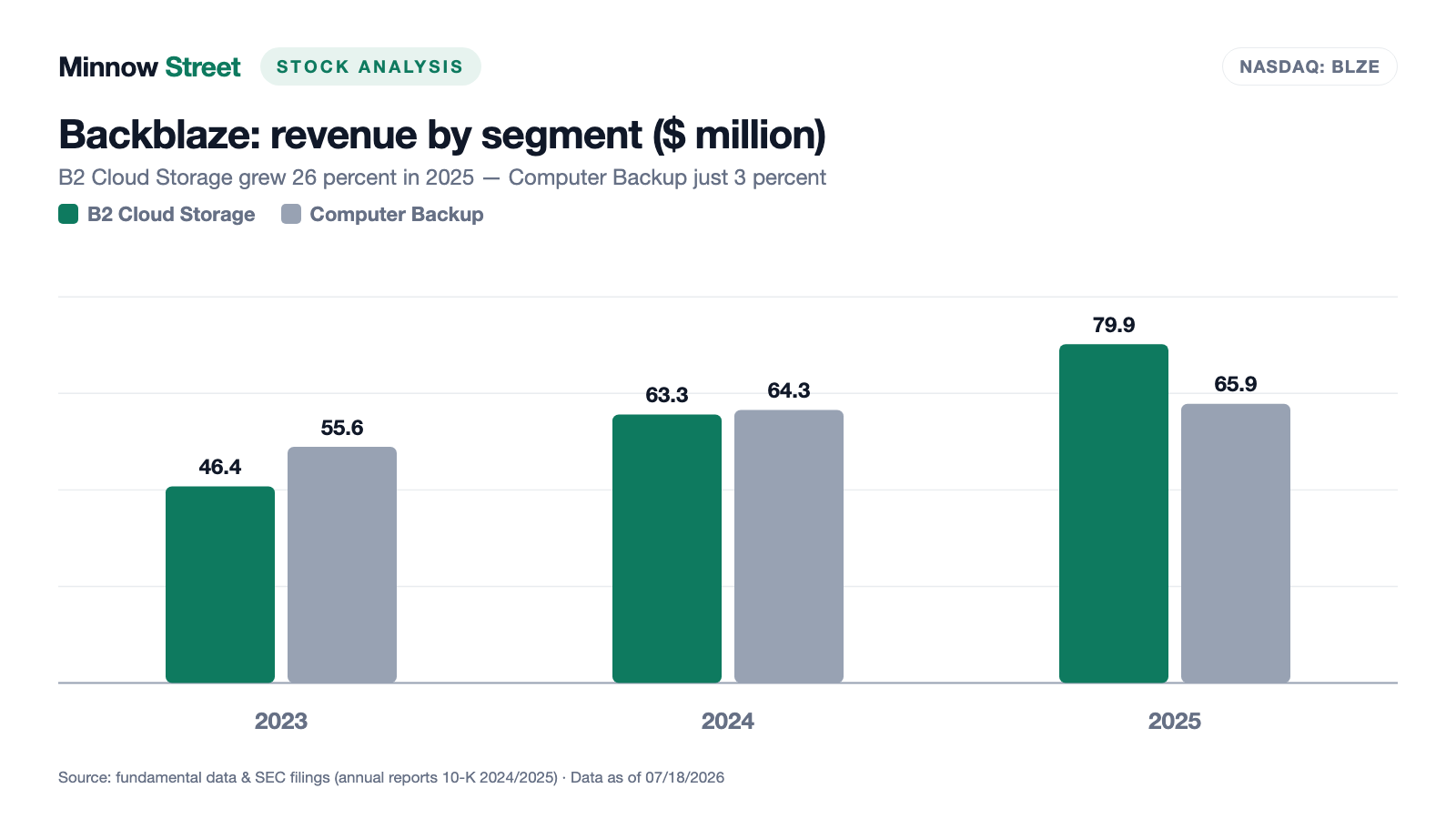
B2 Cloud Storage grew 26 percent to $79.9 million in 2025 and 24 percent to $22.4 million in the first quarter of 2026 — at a net revenue retention of 110 percent (existing customers spend 10 percent more than a year earlier; all Q1 2026, new single-quarter method). The loss curve points the right way, too: the net loss shrank from $59.7 million (2023) via $48.5 million (2024) to $25.6 million (2025), and to $6.1 million in the first quarter of 2026 (prior year: $9.3 million). Adjusted EBITDA swung from −$3.6 million via +$13.0 million to +$31.8 million (a 22 percent margin), operating cash flow from −$7.4 million to +$23.5 million. That is a genuine path toward breakeven — earned with storage, not accounting tricks:
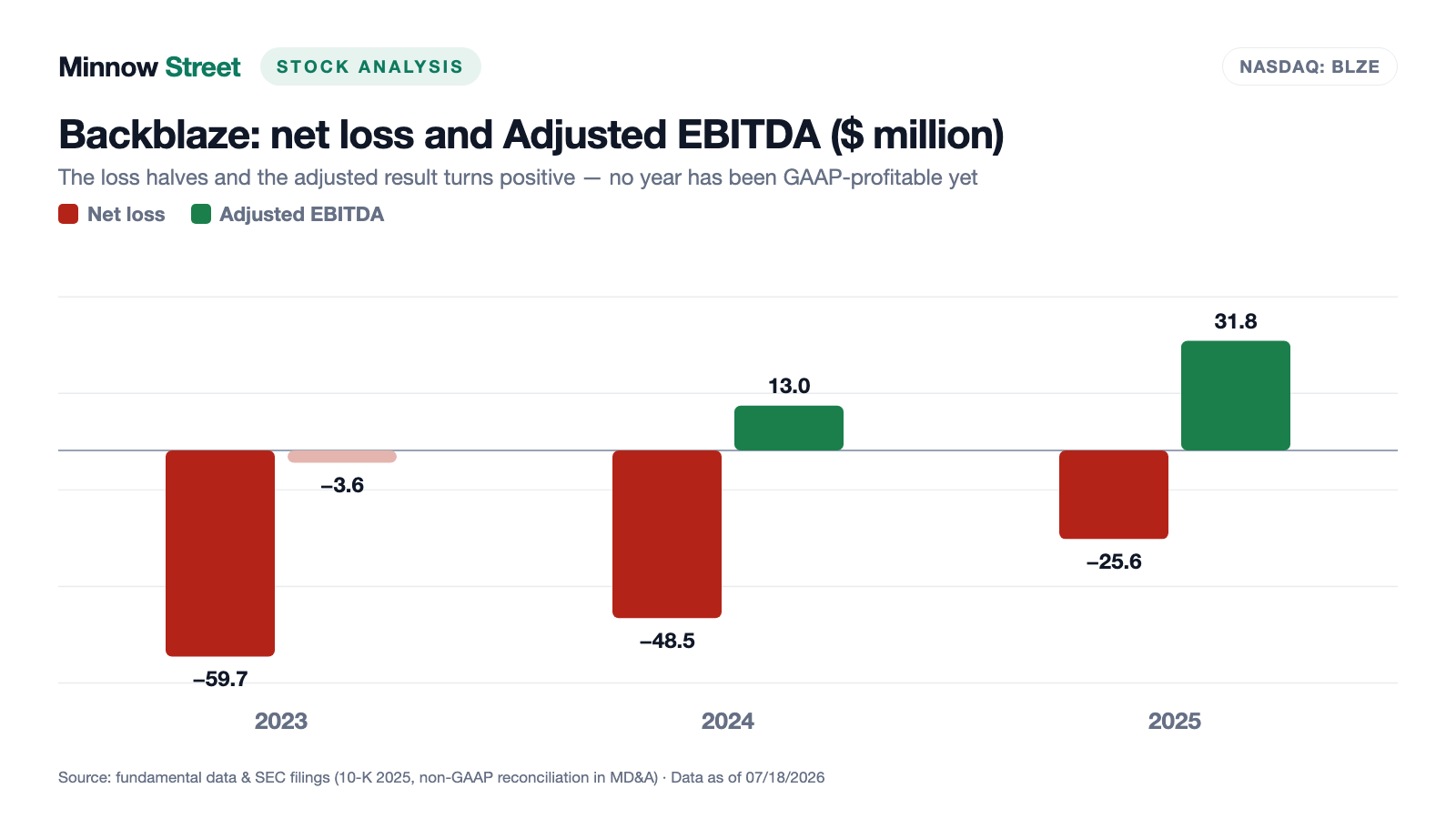
But pause before the number rush takes over — the fine print of Adjusted EBITDA is the bridge to the next chapter: the adjustments exclude, among other things, $26.4 million of stock-based compensation and restructuring charges that occurred in 2023, 2024 and 2025 — every single year. Under U.S. GAAP — that is, with all costs counted — Backblaze has never closed a profitable year. Keep the image: the curve keeps improving — but it has never been black.
What the filings say — the uncomfortable truths
Uncomfortable truth no. 1: more than 18 years, $221.6 million of losses — and no profit forecast
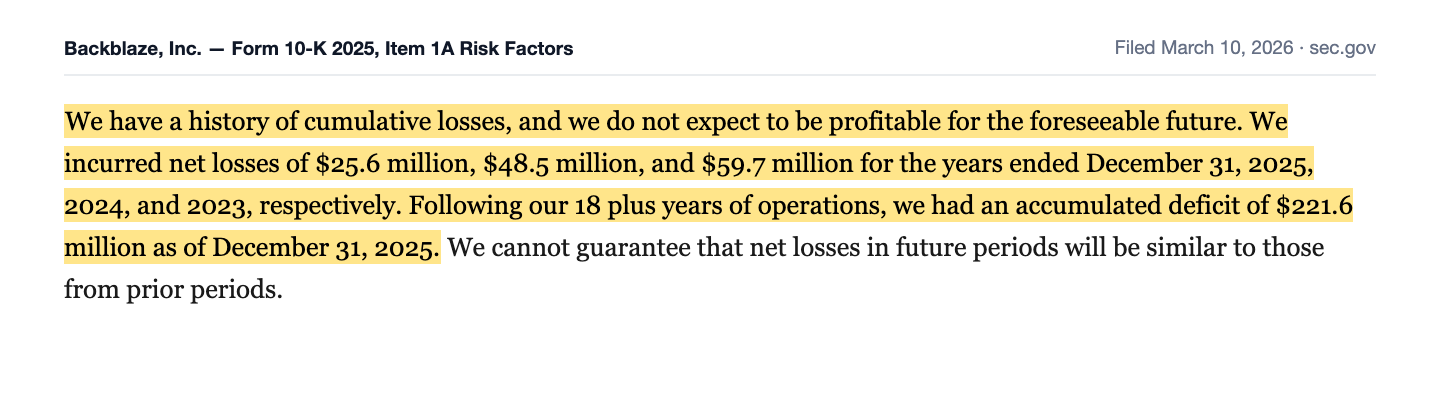
The most sobering passage of the annual report sits right at the front of the risk factors, and it deserves to be read verbatim:
"We have a history of cumulative losses, and we do not expect to be profitable for the foreseeable future. We incurred net losses of $25.6 million, $48.5 million, and $59.7 million for the years ended December 31, 2025, 2024, and 2023, respectively. Following our 18 plus years of operations, we had an accumulated deficit of $221.6 million as of December 31, 2025."
— Backblaze, Inc., SEC annual report 10-K for 2025, Item 1A "Risk Factors"
Standard cautionary language, sure — but it is not there without reason. The company no longer burns cash in operations (operating cash flow has been positive since 2024), yet between "cash-flow positive" and "profitable" sit two main items at Backblaze: about $25.5 million of depreciation on the storage hardware and $26.4 million of stock-based compensation (both 2025). On liquidity: $51.4 million in cash and marketable securities (December 31, 2025) plus an undrawn $20 million credit line — solid for the status quo, but not a cushion that funds a $150 million hardware build-out on its own. That is exactly what the expanded lease limit is for — and a lease is debt by another name.
Uncomfortable truth no. 2: the second leg is stalling — Computer Backup is already shrinking
Almost half of revenue (45 percent in 2025) does not come from the celebrated B2 business but from the flat-rate backup service Computer Backup — and its best years are behind it. In 2025 it grew just 3 percent to $65.9 million, and the annual report honestly itemizes what that mini-gain was made of: $4.5 million came from a price increase that took effect in October 2023, $0.7 million from higher usage — and $3.6 million were lost to declining license counts. In the first quarter of 2026 the segment tipped negative: down 2 percent to $16.2 million, at a net revenue retention of just 95 percent — existing customers now spend 5 percent less than a year ago. Translated: the second leg still holds the company up, but it gets a little shorter every quarter. That hangs the entire growth story — scanner rank, CoreWeave excitement, AI narrative — on the B2 segment, which produced just 55 percent of revenue in 2025. A rocket with one engine flies — but it has no spare.
Uncomfortable truth no. 3: dilution here is not a side effect — it is the financing model
The most important number in this analysis is not in the income statement but in the share count: the weighted average share count rose from 36.0 million (2023) via 43.5 million (2024) to 56.2 million (2025) — up 56 percent in two years; as of April 28, 2026, 60.0 million shares were outstanding. Where do the new shares come from? Three sources. First, in November 2024 Backblaze sold new shares in a follow-on offering at $5.60 apiece, raising $37.4 million net. Second, stock-based compensation costs roughly $26 million every year — in 2025 about 18 percent of revenue, one of the highest ratios we have seen in this series. Third, the CoreWeave warrants for up to 4.2 million shares now come on top. In the cake image: your slice keeps getting smaller while the bakery grows — whoever has held the stock since early 2023 owns roughly a third less of the company per share today. The $10 million repurchase program launched in August 2025 — per the annual report explicitly intended to "offset dilution resulting from stock-based compensation" — is a drop against that: it covers less than half of a single year\'s compensation round. Growth paid for with freshly printed shares is never entirely free.
The AI card: real business, not just a label — but with dependencies
That leaves the question of how sturdy the AI label is that hangs over the whole story. The annual report positions the company in the very first sentence of the business section as a "high-performance cloud storage platform for data-intensive use cases in the artificial intelligence era." It gets concrete at the product level:
"Businesses are increasingly incorporating B2 Cloud Storage, including our premium high-throughput offering, B2 Overdrive, into AI and machine learning (‚ML') workflows, ensuring data accessibility, scalability, and efficient network performance."
— Backblaze, Inc., SEC annual report 10-K for 2025, Item 1 "Business"
That is more substance than many AI labels of this market phase carry: B2 Overdrive (up to 1 terabit per second, free egress, private networking) has been a priced product for AI training data since April 2025; B2 Neo and the "Flamethrower" startup program explicitly target neoclouds and AI developers per the quarterly report; and with CoreWeave, exactly this strategy has delivered its first flagship win. We looked at how capital-hungry the data center side of this AI wave is from the seller\'s perspective in our Nvidia analysis — and at what the storage appetite means for the drive makers in our analysis of Western Digital, where Backblaze sits on the other side of the counter as a bulk buyer of hard drives. The flip side: Backblaze does not sell AI — it sells shelf space for AI\'s data. That is a commodity business in which Amazon, Microsoft and Google can push back with predatory pricing at any time, and in which the biggest new customer is simultaneously a warrant holder. AI demand is Backblaze\'s tailwind — but it is rented, not owned.
Valuation: what the market pays for the curve
Now for the price tag. In mid-July 2026, Backblaze\'s market value stood around $760 million at a share price around $13 to $14 (all valuation figures: data as of July 18, 2026). A price-to-earnings ratio does not exist for lack of earnings; against 2025 revenue the stock trades at a price-to-sales ratio around 5, and slightly below that against annualized recurring revenue ($158.2 million as of March 31, 2026). Two reference points help calibrate. First: as recently as November 2024, Backblaze placed new shares at $5.60, and the CoreWeave warrant strike of $7.60 marks — via the volume-weighted formula — the price level around the signing in mid-June 2026. Today\'s buyer therefore already pays a substantial premium over the level of just a few weeks ago, essentially for the deal and the AI narrative. Second: despite doubling within a year, the stock still sits roughly 60 percent below its all-time high from the IPO euphoria of late 2021 — back then, a fraction of today\'s revenue traded at a multiple of today\'s valuation. Whoever buys today pays about 5 times sales for a company growing 14 percent with a 61 percent gross margin and ongoing losses — neither absurdly expensive nor cheap, but a bet that CoreWeave revenue and B2 growth reach breakeven before dilution eats the gains.
Opportunities and risks at a glance
What speaks for Backblaze:
- The CoreWeave contract: an estimated $335 million over five to seven years (8-K filed June 23, 2026) — more than two years of revenue, plus a strategic anchor in the neocloud ecosystem via B2 Neo and Powered by Backblaze.
- An operational turnaround with receipts: gross margin from 49 to 61 percent (2023–2025), Adjusted EBITDA from −$3.6 million to +$31.8 million (22 percent margin), operating cash flow of +$23.5 million, net loss more than cut in half.
- B2 Cloud Storage as an intact growth engine: up 26 percent (2025) and 24 percent (Q1 2026), 110 percent net revenue retention, AI products (B2 Overdrive, B2 Neo) with real price tags instead of a mere label.
- A discounter\'s cost structure: more than 500,000 customers, 5 exabytes under management, leased data centers, no owned real estate — and a single share class since July 2023 (the IPO-era dual-class structure was ended).
What speaks against it:
- More than 18 years without a profitable year, $221.6 million in accumulated deficit — and the company\'s own forecast of no profitability "for the foreseeable future" (10-K 2025, risk factors).
- Dilution as a permanent condition: weighted share count up 56 percent in two years, stock-based compensation of $26.4 million (≈ 18 percent of 2025 revenue), plus CoreWeave warrants for up to 4.2 million shares (≈ 7 percent).
- Computer Backup (45 percent of 2025 revenue) is stagnating: up 3 percent only thanks to a price increase, already down 2 percent in Q1 2026 at 95 percent net revenue retention.
- The mega-order demands up-front investment: capital lease limit expanded to $150 million (8-K filed July 2, 2026), the contract value is explicitly a usage-dependent estimate, and expectations concentrate on a single neocloud customer.
- Competition against the largest companies on earth: Amazon, Microsoft and Google can cross-subsidize storage prices indefinitely; Backblaze\'s weapon is price — not a moat, but a cost edge that has to be defended.
A human bottom line
Back to the hunter from the opening. FOMO is dangerous because it reverses the order of operations: buy first, understand later. The Backblaze curve at rank 8 of the momentum scanner has — credit where due — a more honest core than most rally stories: a signed $335 million contract, a B2 business compounding around 25 percent for years, and a gross margin that is starting to look more like a software vendor than a hard-drive warehouse. But the same filings that document the contract document its price: purchase rights for the customer on 7 percent of the company, a $150 million lease frame for hardware that still has to earn its keep, a second segment in reverse, and a shareholder base whose slices have been cut thinner for years. The honest math looks like this: you get a genuine AI infrastructure beneficiary with a genuine flagship customer — and you pay with the risk that the estimate of "$335 million" must become booked reality while the dilution and the up-front investment are already certain. Whether the curve is ahead of the company or the company behind the curve — the next quarterly reports decide that, not the scanner: check B2 revenue there (does growth stay above 20 percent?), the first CoreWeave revenue, and the share count on the cover page. What you do with all this is your decision. And that is a good thing.
Sources
All original documents used in this analysis — for your own reading:
- Backblaze, Inc. — SEC annual report 10-K for 2025 (filed March 10, 2026)
- Backblaze, Inc. — SEC annual report 10-K for 2024 (filed March 11, 2025)
- Backblaze, Inc. — SEC quarterly report 10-Q as of March 31, 2026 (filed May 4, 2026)
- Backblaze, Inc. — SEC current report 8-K filed June 23, 2026 (Master Strategic Agreement with CoreWeave, warrants, registration rights agreement)
- Backblaze, Inc. — SEC current report 8-K filed July 2, 2026 (credit agreement amendment: capital leases up to $150 million)
- Backblaze\'s complete SEC filing history: EDGAR overview (sec.gov)
- Fundamental data (metrics, quarterly series, valuation; data as of July 18, 2026), reconciled with the SEC filings.
- Screener and rating data: our in-house stock scanner (data as of July 18, 2026), including the Qullamaggie Top Gainers 3M scanner (U.S. selection, rank 8).
Transparency & disclaimer: This analysis is a journalistic assessment of publicly available information and is not investment advice, not a financial analysis in the regulatory sense, and not a solicitation to buy or sell securities. Stock investments carry substantial risks up to and including total loss. All information without guarantee; the data cut-off is noted in the text. The author holds no position in Backblaze shares at the time of publication.
Our Bottom Line at a Glance
- CoreWeave contract & AI strategy positive
- Master Strategic Agreement with CoreWeave (effective June 16, 2026) worth an estimated $335 million over terms of five and seven years — more than two years of revenue; plus priced AI products (B2 Overdrive since 04/2025, B2 Neo for neoclouds) instead of a mere AI label (8-K filed 06/23/2026; 10-K 2025).
- B2 growth & margins positive
- B2 Cloud Storage up 26 percent (2025) and 24 percent (Q1 2026) at 110 percent net revenue retention; gross margin from 49 to 61 percent (2023–2025), Adjusted EBITDA from −$3.6 million to +$31.8 million (22 percent margin), operating cash flow of +$23.5 million (10-K 2025; 10-Q as of 03/31/2026).
- Profitability negative
- More than 18 years without a profitable year, an accumulated deficit of $221.6 million, a 2025 net loss of $25.6 million — and the company's own statement that it does not expect to be profitable for the foreseeable future (10-K 2025, Item 1A); between cash flow and profit sit mainly $25.5 million of depreciation and $26.4 million of stock-based compensation.
- Dilution negative
- Weighted share count up 56 percent in two years (36.0 to 56.2 million), SBC ≈ 18 percent of 2025 revenue, the November 2024 follow-on at $5.60, CoreWeave warrants for up to 4.2 million shares (≈ 7 percent) at $7.60 — the $10 million repurchase program offsets only a fraction of that.
- Second segment Computer Backup negative
- 45 percent of 2025 revenue grows only thanks to a price increase (+3 percent, of which $4.5 million price effect against $3.6 million of license losses) and turns negative in Q1 2026 (−2 percent, net revenue retention 95 percent) — the growth story hangs almost entirely on B2 (10-K 2025; 10-Q as of 03/31/2026).
- Balance sheet & capital needs neutral
- $51.4 million in cash and securities plus an undrawn $20 million credit line stand against a build-out for which the capital lease limit was expanded to $150 million (8-K dated 07/02/2026) — the CoreWeave order demands hardware investment before it delivers revenue, and it concentrates expectations on a single customer.
Backblaze is the rare momentum candidate whose rally rests on a signed document: a CoreWeave contract worth an estimated $335 million, flanked by 26 percent B2 growth, a 61 percent gross margin and operating cash flow that has been positive since 2024. Against that stand more than 18 years without a profit, 56 percent dilution in two years plus warrants for the new flagship customer, a shrinking second segment, and a hardware build-out that must be pre-financed through leases. Whoever invests here is not buying the scanner rank but the bet that the estimate becomes booked revenue and the revenue becomes a first-ever profit. Not investment advice.
What Our Rating Means
- If you don't own the stock
- As long as the question raised in the bottom line stays open, we see no basis for an entry.
- If you hold it in your portfolio
- Our findings offer no acute reason to sell — the checkpoints named remain decisive.
A journalistic assessment by our editorial team at the time of the deep dive, based on public sources — not investment advice and not a solicitation to buy or sell. Your personal circumstances (investment goals, risk capacity, taxes) cannot be taken into account. What our categories mean, how verdicts are formed, and what conflicts of interest exist →
Worth Noting
- BLZE made the research list as rank 8 of our in-house Qullamaggie Top Gainers 3M scanner (U.S. selection, 9 hits, as of July 18, 2026) — part of our series on the hits of this momentum scanner.
- Scanner metrics (3-month relative strength of 99, daily range ~8 percent, dollar volume ~$32 million, Piotroski 5 of 9, negative Altman-Z) use data as of July 18, 2026; the Altman Z-score is structurally weak for loss-making software companies and should be read as context here, not as an insolvency forecast.
- Price and market value figures (~$13–14, ~$760 million) from the July 18, 2026 feed, sanity-checked against 60.0 million shares outstanding per the cover page of the 10-Q as of March 31, 2026; analyses are evergreen, daily prices are not a buy argument.
Frequently Asked Questions
Backblaze, Inc. (Nasdaq: BLZE, San Mateo, California, about 320 employees as of December 31, 2025) runs its own storage cloud with more than 500,000 customers in over 175 countries and roughly 5 billion gigabytes under management. Two segments: B2 Cloud Storage, object storage for companies and developers (2025: $79.9 million, up 26 percent), and Computer Backup, the flat-rate backup service ($65.9 million, up 3 percent). Total 2025 revenue: $145.8 million.
Effective June 16, 2026, Backblaze signed a Master Strategic Agreement with AI cloud provider CoreWeave: storage capacity on the B2 platform plus a managed storage solution inside CoreWeave's data centers, order forms running five and seven years, an estimated total value of about $335 million (usage-dependent). In return, CoreWeave received warrants for up to 4,194,876 Backblaze shares at $7.60 each (8-K filed June 23, 2026).
No. After more than 18 years of operations, the balance sheet carries an accumulated deficit of $221.6 million; the 2025 net loss was $25.6 million (2024: $48.5 million; 2023: $59.7 million), and the annual report explicitly expects no profitability for the foreseeable future. The direction is right, though: 61 percent gross margin (2023: 49), Adjusted EBITDA of +$31.8 million (22 percent margin), operating cash flow of +$23.5 million (all 2025).
Backblaze positions itself in the annual report (10-K 2025) as a cloud storage platform for the AI era: B2 Overdrive (since April 2025) delivers up to 1 terabit per second of throughput for AI and machine learning workflows, B2 Neo is a white-label storage product for neocloud platforms, and the CoreWeave contract worth an estimated $335 million is the first flagship win of that strategy. Backblaze does not sell AI — it sells the storage for AI's data.
Substantially: the weighted share count rose from 36.0 million (2023) to 56.2 million (2025) — up 56 percent in two years; 60.0 million shares were outstanding as of April 28, 2026. The drivers are the November 2024 follow-on offering (shares at $5.60, $37.4 million net), roughly $26 million a year in stock-based compensation (≈ 18 percent of 2025 revenue), and now the CoreWeave warrants for up to 4.2 million shares.
It is stagnating: in 2025, Computer Backup grew just 3 percent to $65.9 million — $4.5 million of that came from a price increase effective October 2023, while declining license counts cost $3.6 million. In the first quarter of 2026 the segment shrank 2 percent to $16.2 million, at a net revenue retention of just 95 percent. The company's growth therefore hangs almost entirely on B2 Cloud Storage.
As of July 18, 2026, the market value stood around $760 million — roughly 5 times 2025 revenue ($145.8 million). A price-to-earnings ratio does not exist for lack of earnings. For calibration: in November 2024 Backblaze placed shares at $5.60, and the CoreWeave warrant strike of $7.60 marks the price level of mid-June 2026 — today's price around $13 to $14 already pays for a lot of CoreWeave and AI future.
Found an error?
Did you spot a factual error, an outdated number, or a typo in this deep dive? Let us know briefly — your report goes straight to the editorial team.