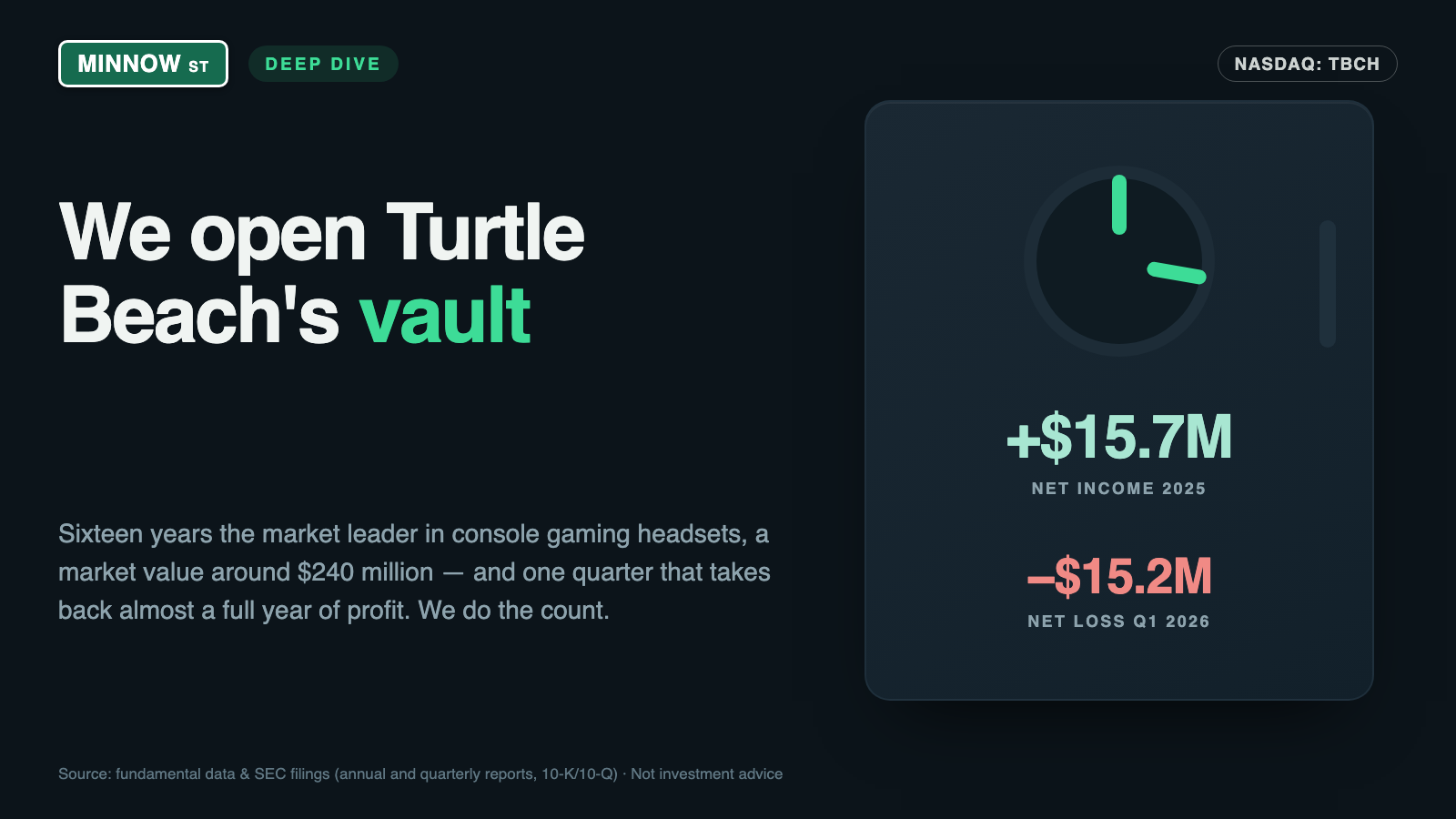
Turtle Beach Stock: One Quarter Eats a Year of Profit — and the Hope Is Called "Next Console" Again
Turtle Beach has been the market-share leader in console gaming headsets for 16 years — and the market has all but forgotten it: 2 Reddit mentions in 24 hours (as of July 15, 2026), a market value around $240 million (data as of July 10, 2026). We read the annual reports (10-K) for 2024 and 2025 and the quarterly report (10-Q) as of March 31, 2026: revenue down 34 percent in the first quarter of 2026, a net loss that takes back almost all of the 2025 profit, tariff whiplash up to the Supreme Court, $3.4 million of inventory stolen in transit along with an adverse opinion on internal controls — and an activist who now sits on the board himself. Not investment advice — just the question of what you are holding while you wait for the wave.
 Thomas Mücke
Founder & Publisher
Thomas Mücke
Founder & Publisher
Chart
Interactive price chart (TradingView).
Note: pure fact-based analysis, not investment advice and not a solicitation to buy or sell. All figures without guarantee.
There is a sentence that never dies in investor forums, no matter what the numbers say: "Just wait until … comes out." Until the new PlayStation arrives. Until the Switch 2 takes off. Until GTA VI pulls millions of new players onto the consoles. Psychologists would call it the catalyst trap: we do not buy the business that is — we buy an event that is supposed to come, and we blank out everything that happens until then. Hardly any stock invites this thinking like Turtle Beach (Nasdaq: TBCH): the market-share leader in console gaming headsets for 16 years running, a portfolio full of Xbox, PlayStation and Nintendo gear — and a share price that, as of the July 10, 2026 data cut-off, sat almost 30 percent below its 52-week high. On Reddit, meanwhile, it has gone quiet: our Reddit hype scanner counted all of 2 mentions in 24 hours on July 15, 2026. Exactly that silence makes us curious. So let’s make a deal: before you bet on the next console cycle, we read together what the company itself has filed with the U.S. securities regulator, the SEC — the annual report (10-K) for 2025, its predecessor and the quarterly report (10-Q) as of March 31, 2026. An SEC filing is honest under penalty of law. And this one packs a punch. In the end, you decide for yourself.
What Turtle Beach actually does — and what the company really depends on
Turtle Beach designs and markets gaming accessories: headsets, controllers, keyboards, mice, microphones, flight and racing simulation hardware. The heart of it is console headsets — per retail tracking data from The Circana Group, the brand has been the market-share leader for 16 years running, with price tiers from a $30 entry model to ultra-premium gear above $650. In 2024 the controller specialist PDP (Performance Designed Products) came aboard for $114.4 million, paid with roughly $78.9 million in cash and 3.45 million of the company’s own shares; ROCCAT (2019, PC accessories) and Neat Microphones (2021) had been swallowed earlier. Distribution runs through more than 475,000 points of sale in over 40 countries — Amazon, Best Buy, Walmart, Target and the like. Important for perspective: the listed company is nonetheless a minnow. 290 employees, no factories of its own — production sits with contract manufacturers, many products, per the risk section, in China. At its core Turtle Beach is a brand, design and distribution machine playing in a gaming peripherals market estimated at $11.2 billion. And here sits the central tension of this analysis, running through every chapter: a genuine market leader with disciplined share buybacks — whose revenue moves to the beat of other people’s consoles and other people’s blockbuster games. And that beat is currently on pause. How quickly attention waves at the market turn faster than business models is something we recently dissected at AMC Entertainment — and what a consumer slowdown does to a discretionary brand, at Wendy’s.
Where the stock shows up in our scanner
Every day we run about 3,500 stocks through our scanners. Turtle Beach lights up in 3 filters as of the July 10, 2026 data cut-off — and the list reads like a warning, not an invitation. The trend lens fires twice: "Stage 4 (downtrend)" and "Stan Weinstein: Stage 4" both place the stock in the declining phase of the price cycle — minus 12.5 percent year to date, minus 10.2 percent over twelve months, roughly 30 percent below the 52-week high and a staggering 86 percent below the all-time high from the 2021 meme era. The third hit, the "pros over 80 percent" filter, shows institutional ownership of about 71 percent most recently — the stock sits mostly in professional portfolios, not with retail investors. Add the diagnostic readings from the scanner row: a fundamental grade of D, a Piotroski F-Score of 4 of 9 (a nine-point test of balance-sheet quality; 4 is middling, genuinely healthy starts at 7), price-to-book of 2.2 — and a trailing price-to-earnings ratio of 612. That absurd number is not an euphoria valuation, it is arithmetic: over the twelve months through the end of March 2026 almost nothing was left on the bottom line, so the P/E explodes. Remember: a triple-digit P/E can tell two stories — sky-high expectations, or a profit that is vanishing. Here it is the second. Reassuring, at least: the Altman Z-score (a classic insolvency early-warning built from several balance-sheet ratios) sits around 5.2, far outside the danger zone that historically begins below 1.8.
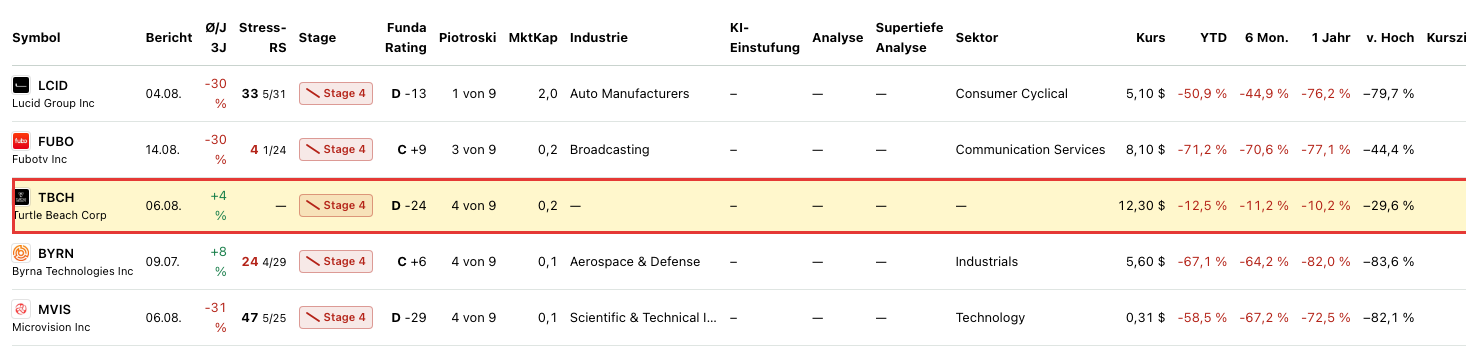
And the hook? This time the Reddit hype scanner flushed Turtle Beach onto our list not because of a wave but because of its absence: 2 mentions in 24 hours (ApeWisdom, as of July 15, 2026) — for a stock that was a meme darling above $30 in 2021, that is remarkably quiet. The market has taken this ticker off the stage. Whether rightly so is what the filings decide.
The numbers over the years — honestly appraised
First, what genuinely impresses. After the loss year 2023 (minus $17.7 million on $258.1 million of revenue), Turtle Beach pulled itself together operationally: in 2024 revenue jumped 44 percent to $372.8 million, carried by the PDP acquisition, and the bottom line showed a $16.2 million profit again. 2025 held on to profitability despite headwinds: gross margin rose from 34.6 to 37.3 percent (the prior year was depressed by acquisition accounting effects — and that despite higher tariffs in 2025), operating cash flow reached $35.5 million, and because a design company barely needs factories, roughly $34 million of free cash flow remained after just $1.4 million of capital expenditures — a free-cash-flow yield of about 14 percent on a market value of roughly $240 million (data as of July 10, 2026). Management hands that money back consistently: $27.8 million (2024) plus $19.0 million (2025) plus $2.2 million (Q1 2026) in share buybacks; in May 2025 a new $75 million program through May 2027 was authorized, with $57.8 million still open at the end of 2025. The share count fell from 19.96 to 19.61 million within five quarters — buybacks near book value while free cash flow is positive is the kind of capital allocation you wish on small caps. Now turn the page:
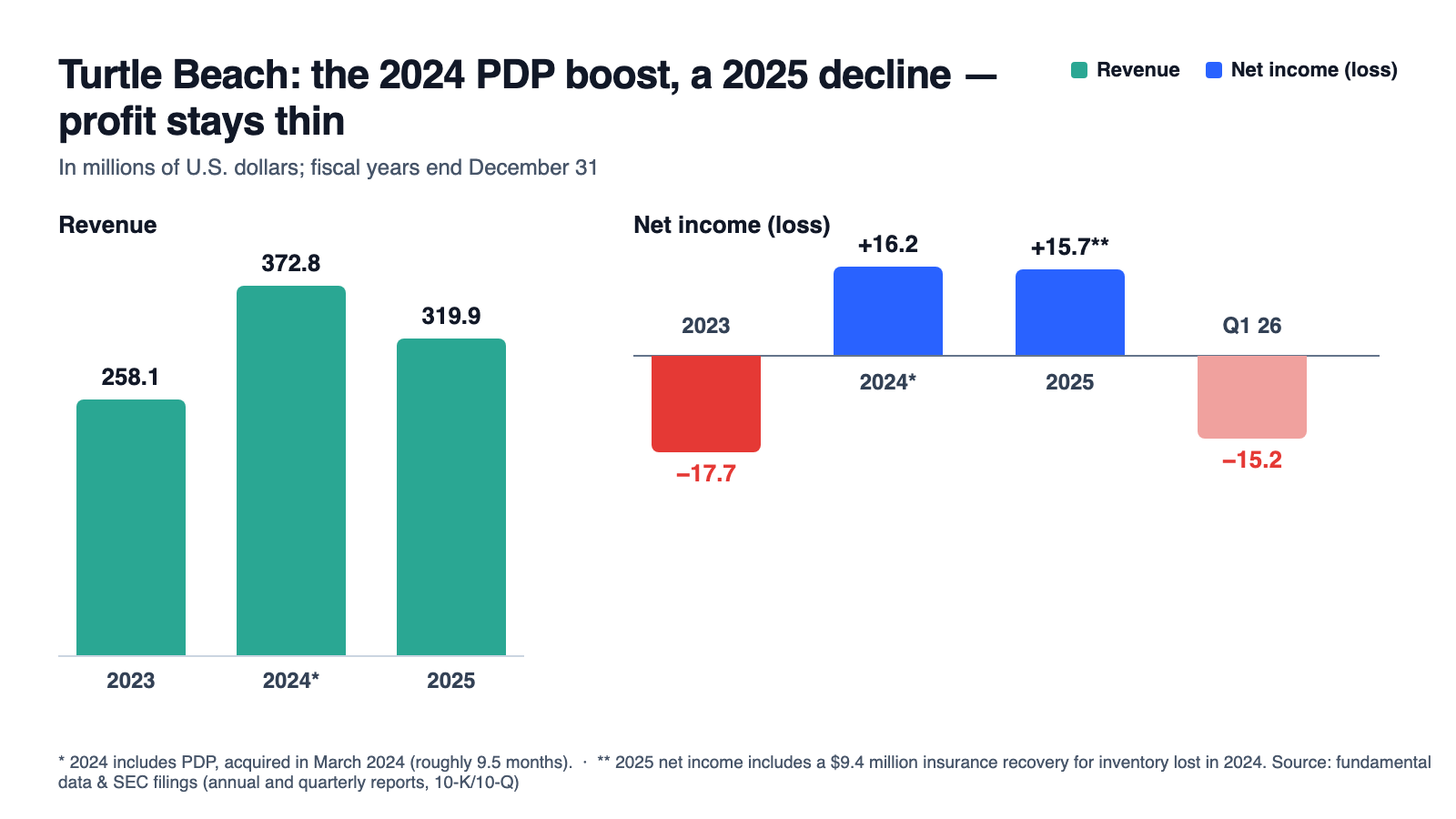
Because the counter-calculation sits in the same report: 2025 revenue fell 14.2 percent to $319.9 million — per the 10-K, simply because demand for gaming accessories declined. The $15.7 million net income looks stable but contains a $9.4 million insurance recovery for inventory lost in 2024 (more on that below) — without this one-off, the 2025 operating result would have landed well below the prior year. And the regional split shows how narrow the foundation is: 73.7 percent of revenue comes from the Americas, and the three largest customers — household-name retailers — together accounted for 58.8 percent of 2025 revenue (27.6, 17.6 and 13.6 percent). Translated: if two or three U.S. retailers trim their orders, the year tips over. Which brings us to the uncomfortable truths.
What the filings say — the uncomfortable truths
Uncomfortable truth no. 1: the first quarter of 2026 took back the year’s profit
One quarter does not normally make a funeral — for a holiday-season business like Turtle Beach, the first quarter is traditionally the weakest anyway. But this one has a different quality:
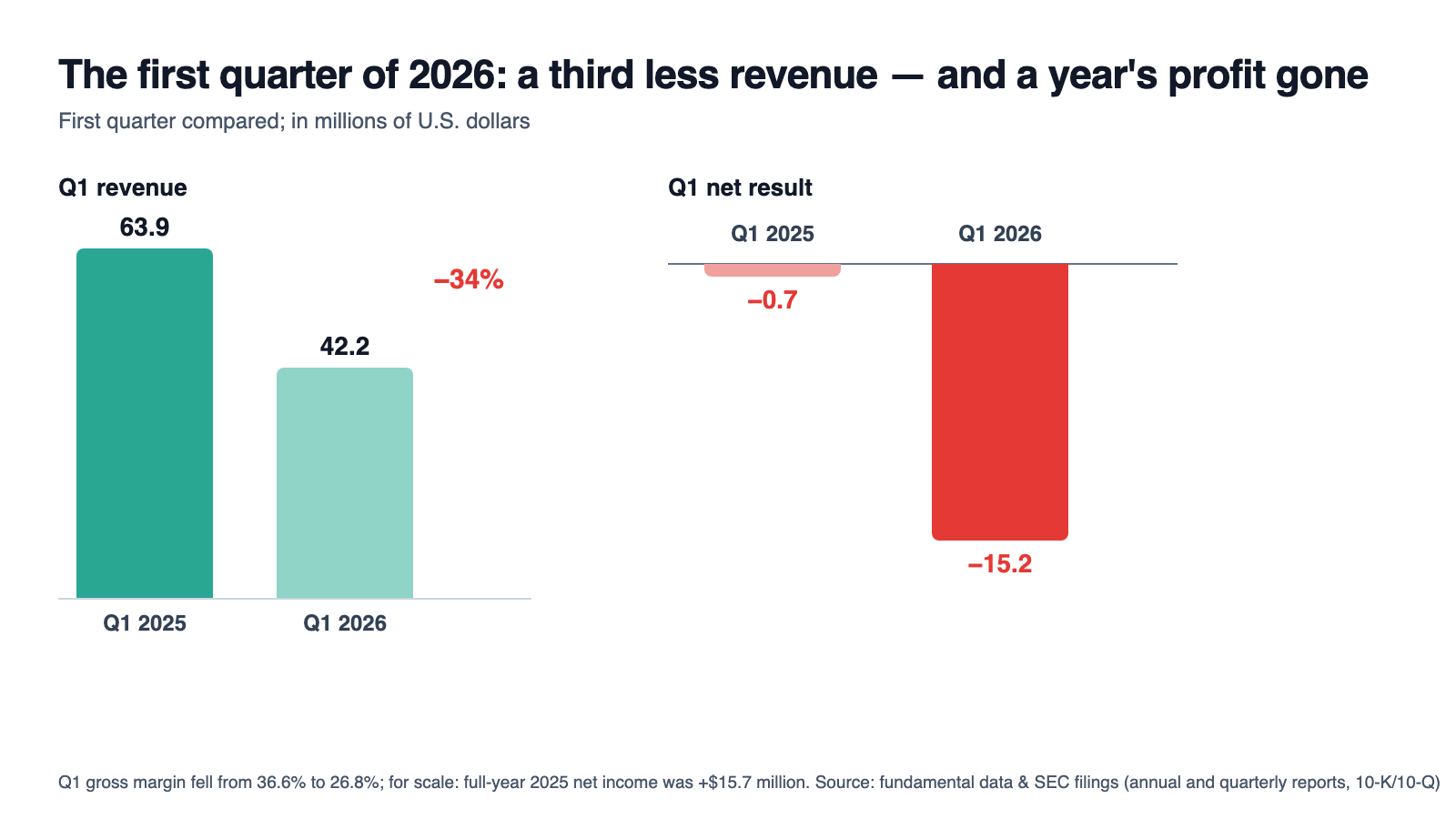
"Net revenue for the three months ended March 31, 2026 was $42.2 million, a $21.7 million decrease from $63.9 million for the three months ended March 31, 2025, reflecting softer market demand for gaming accessories driven primarily by macroeconomic challenges affecting consumer spending."
— Turtle Beach Corporation, SEC quarterly report 10-Q as of March 31, 2026, Item 2 "Results of Operations"

Minus 34 percent revenue is one half of the damage. The other sits in the margin: gross margin crashed from 36.6 to 26.8 percent — partly because fixed costs meet less revenue, partly because of transition costs from relocating the principal third-party logistics provider. The bottom line showed a net loss of $15.2 million after only $0.7 million a year earlier — and thus, bitter punchline, almost exactly the company’s entire 2025 net income ($15.7 million). A year of work, handed back in one quarter. In fairness: the prior-year quarter was itself flattered by a $3.4 million insurance recovery, and a single Q1 does not decide the year for a company that earns its money between October and December. But the direction and the speed are unmistakable — and they explain why two of our stage-4 scanners fire at once.
Uncomfortable truth no. 2: revenue moves to the beat of other people’s consoles — and the beat is on pause
Why does headset demand collapse? Part of the answer is the economy. The structural part sits in the risk section, and Turtle Beach names it with disarming clarity:
"We depend upon the success and availability of third-party gaming platforms and the release and availability of successful game titles to drive sales of our gaming accessories."
— Turtle Beach Corporation, SEC annual report 10-K for 2025, Item 1A "Risk Factors"
Translated into the calendar: Xbox Series X|S and PlayStation 5 have been on the market since late 2020 — the console base is saturated; whoever wanted a headset has long owned one. The annual report itself sets the clock for the hope: "The next Microsoft and Sony consoles are anticipated to launch within the next 2-3 years." Until then, the tailwind consists of the Nintendo Switch 2, launched in June 2025 and, per the quarterly report, the fastest-selling video game console launch of all time — plus the industry’s perennial hope for the next software blockbuster of the GTA VI variety to pull new players (and new headset buyers) onto the platforms. Except: the record-setting Switch 2 launch obviously could not prevent the 34 percent slide in the first quarter of 2026. Remember the image: Turtle Beach is a surfer waiting for other people’s waves — however well he surfs, without a wave he stands still. That is exactly the catalyst trap from the opening: the wave may come — but it is not your doing, not your schedule and not guaranteed.
Uncomfortable truth no. 3: China manufacturing caught in tariff whiplash
The second dependency sits on the cost side. Turtle Beach does not manufacture anything itself — and where the contract manufacturers sit is spelled out in the risk section:
"… trade restrictions, higher tariffs, currency fluctuations or the imposition of additional regulations relating to the import or export of our products, especially in China, where many of our Turtle Beach products are manufactured, which could force us to seek alternate manufacturing sources or increase our costs …"
— Turtle Beach Corporation, SEC annual report 10-K for 2025, Item 1A "Risk Factors"

How real this risk is was demonstrated in 2025/26: in 2025 the U.S. imposed broad tariffs on most imports, China answered with retaliatory tariffs — the 10-K explicitly names higher tariffs as a brake on the 2025 gross margin. Then the turn: on February 20, 2026 the Supreme Court held that the tariffs based on the IEEPA emergency statute were not authorized, a trade court ordered refunds, and since April 20, 2026 a portal of the customs authority CBP has been taking refund requests. Sounds like relief? Only half: in response, the U.S. introduced a new 10 percent tariff on all imports under Section 122 of the Trade Act of 1974, effective February 24, 2026 — limited to a maximum of 150 days unless Congress extends it. And as of the March 31, 2026 balance sheet, nothing of the tariff refunds had arrived. For a company with a 26.8 percent gross margin in its latest quarter, every tariff round is a direct reach into the income statement — and the predictability a holiday-peak accessories business needs is gone. Remember: whoever manufactures in China and sells in America has, next to the console clock, a second metronome beyond its control: Washington.
Uncomfortable truth no. 4: stolen goods, an adverse opinion — the controls trail the company
The most uncomfortable passage of the annual report has nothing to do with demand. It sits in the chapter on internal controls:
"These design deficiencies resulted in the failure to timely detect and prevent the misappropriation of $3.4 million of inventory that was in-transit to customers for the twelve months ended December 31, 2024."
— Turtle Beach Corporation, SEC annual report 10-K for 2025, Item 1A "Risk Factors"
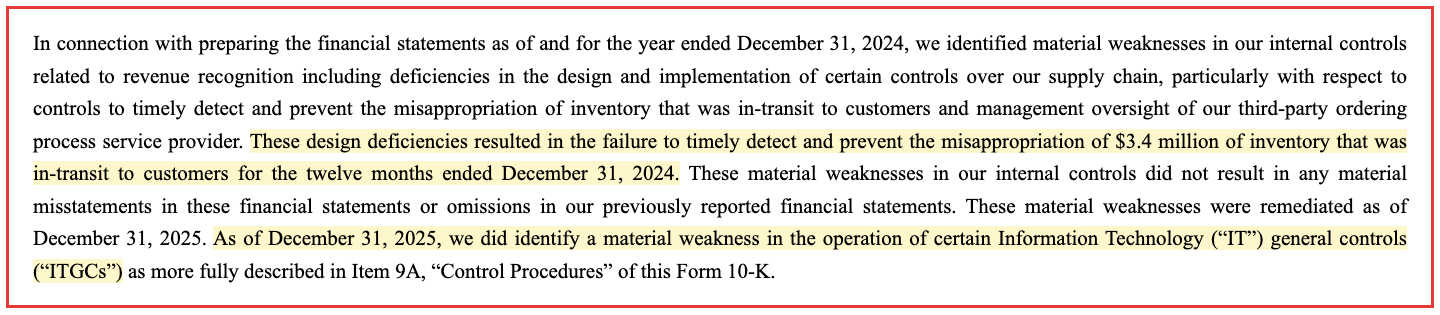
In plain language: in 2024, goods worth $3.4 million disappeared on the way to customers, and the controls — including oversight of the third-party ordering provider — did not catch it in time. A former financial-crimes investigator reads that twice. The insurer paid $9.4 million in recoveries in 2025 (the total inventory loss was evidently well above the quantified misappropriation), and these weaknesses are considered remediated as of the end of 2025. But the story does not end there: as of December 31, 2025 the company reported the next material weakness — this time in IT general controls — and the auditor issued an adverse opinion on internal control over financial reporting (report dated March 12, 2026). Important context: the numbers themselves are considered correct, no prior financial statements were restated, and the audit opinion on the financial statements is unqualified. But at a 290-person company that grew fast by acquisition (PDP), two control weaknesses in two years tell the same story: the administration is smaller than the business it is supposed to control.
Who calls the shots: an activist on board, a poison pill in the cabinet
Turtle Beach has a long activist history — the risk section words it carefully: activist stockholders have engaged "from time to time" and may do so again. The most prominent of them, William Wyatt of the hedge fund Donerail, who for years pushed the company toward a sale and shareholder returns, today sits on the board of directors himself. And in 2025 he created facts:
"In addition, Diversis agreed to sell 693,962 shares to TDG CP LLC, a Delaware limited liability company (‘Donerail') at a price of $14.41 per share of common stock for a total of $10.0 million. […] Donerail is an entity affiliated with William Wyatt, a member of the Company's Board of Directors …"
— Turtle Beach Corporation, SEC annual report 10-K for 2025, Item 5

The August 2025 constellation: PDP seller Diversis (represented on the board by Dave Muscatel) wanted to cash in the stock package from the acquisition. The company bought one half back (694,926 shares for $10.0 million), Wyatt’s Donerail the other (693,962 shares, likewise $10.0 million) — both at the 30-day average price of $14.41, approved by the independently staffed audit committee. You can read this two ways. Positive: an insider who knows the company like few others puts $10 million of his own money on the table — at $14.41, well above the July 2026 price level ($12.30, data as of July 10). Cautious: only weeks earlier, on June 9, 2025, the board had adopted a poison pill with an unusually low 10 percent trigger — a shield that drastically dilutes unapproved large acquirers. A board that approves insider purchases while barricading itself against outside buyers is sorting the question of control very deliberately. For you that means: in this small cap, a small circle decides where the journey goes — you ride along, you do not steer.
Valuation: a $240 million market value — cheap on cash flow, expensive on earnings
As of the July 10, 2026 data cut-off the stock cost about $12.30; with 19.6 million shares that is roughly a $240 million market value. Add the March 31, 2026 balance sheet — $52.8 million of term-loan debt, $12.3 million of cash, the seasonal credit line fully repaid — and you get an enterprise value around $280 million. Against that stand $319.9 million of revenue and roughly $34 million of 2025 free cash flow. That makes a price-to-sales ratio of about 0.75, a good 7 times free cash flow and, on the 2025 profit, a price-to-earnings ratio around 15 — optically everything from moderate to cheap. But the same arithmetic on the trailing twelve months tells the opposite story: after the Q1 loss, almost no profit remains over twelve months, and the trailing P/E in the scanner reads 612 (data as of July 10, 2026). Both numbers are true. The question that decides between them: was 2025 the exception (then the stock is cheap) — or is the first quarter of 2026 the new normal (then it is not)? The answer hangs exactly on truths no. 2 and no. 3: on the console clock and on tariffs. Turtle Beach controls neither. Honesty also demands the credit side: hardly any net debt relative to cash flow, an interest rate of about 7.3 percent on the term loan (end of 2025), a buyback program with $57.8 million remaining — and a management team that retired its own shares at $13 to $14 apiece. You can find the company profile with all metrics on our site; analyst coverage of a $240 million stock is naturally thin.
Opportunities and risks at a glance
What speaks for Turtle Beach:
- Genuine leadership in its niche: per the annual report, number one in console gaming headsets for 16 years running (Circana retail data), distribution through 475,000+ points of sale in over 40 countries, a portfolio broadened by PDP (controllers), ROCCAT (PC) and Neat (microphones).
- An asset-light model with cash discipline: only $1.4 million of capital expenditures against $35.5 million of operating cash flow in 2025 (roughly $34 million free, about 14 percent of the market value, data as of July 10, 2026); $49 million of buybacks since the start of 2024, a program with $57.8 million remaining through May 2027.
- The coming catalysts are real: the Switch 2 with a record launch since June 2025, the next Microsoft/Sony consoles per the 10-K "within the next 2-3 years", plus the game industry’s blockbuster pipeline — every new platform wave has historically lifted accessory demand.
- A solid balance sheet, not a bankruptcy candidate: $111.9 million of equity (March 31, 2026), net bank debt around $40 million, an Altman Z around 5.2 (data as of July 10, 2026); the Q1 loss is seasonally exaggerated in a holiday-heavy business.
- Insiders with skin in the game: board member William Wyatt (Donerail) privately bought $10 million of stock at $14.41 per share in August 2025 — above the July 2026 price level.
What speaks against it:
- Sales are breaking away: revenue down 14.2 percent in 2025, down 34 percent in the first quarter of 2026 with a $15.2 million net loss — almost the complete 2025 annual profit; Q1 gross margin down from 36.6 to 26.8 percent.
- Double outside control: revenue depends on third-party console cycles and blockbuster games (a named 10-K risk factor), costs on China manufacturing and U.S. tariff policy — 2025/26 including a Supreme Court ruling, refunds in limbo and a new 10 percent Section 122 tariff (since February 24, 2026).
- Concentration in the customer book: the three largest retail customers accounted for 58.8 percent of 2025 revenue (27.6/17.6/13.6 percent), the largest alone for 33.8 percent of receivables — bargaining power sits with the retailers.
- A controls history: $3.4 million of in-transit inventory misappropriated in 2024 (weaknesses remediated), a new IT control weakness as of 12/31/2025, an adverse auditor opinion on internal controls (March 12, 2026); the 2025 profit includes a $9.4 million insurance recovery.
- Market technicals and size: two stage-4 downtrend signals, fundamental grade D, Piotroski 4 of 9, a trailing P/E of 612 (data as of July 10, 2026), roughly 86 percent below the meme-era high — and with $3.7 million of daily dollar volume a narrow, swing-prone small cap.
A human conclusion
Back to the catalyst trap from the opening. It has a true core: the catalysts genuinely exist. The Switch 2 is selling at record speed, the next console generation from Microsoft and Sony is due in two to three years per the annual report, and when the wave comes, the market leader in console headsets sells more headsets — it has been that way in every cycle. But check what you would be holding until then: a company whose revenue just fell by a third, whose gross margin hangs on the tariff policy of two governments, whose three largest customers provide almost 60 percent of revenue, whose control systems showed material weaknesses two years in a row — and where a small circle of board, activist and poison pill settles the questions of power among themselves. None of this is a death sentence: the balance sheet is solid, 2025 free cash flow was ample, the buybacks are shareholder care instead of dilution, and an insider privately invested $10 million at prices above today’s. But "just wait until the next console arrives" is not an investment case — it is a promissory note drawn on other people’s calendars. If you want to make that bet, at least know precisely what it is: two to three lean years the company must bridge on its own strength before the wave carries it. What you make of it is your decision. And that is exactly as it should be.
Sources
All original documents used in this analysis — to read for yourself:
- Turtle Beach Corporation — SEC annual report 10-K for 2025 (filed March 12, 2026)
- Turtle Beach Corporation — SEC annual report 10-K for 2024 (filed March 17, 2025)
- Turtle Beach Corporation — SEC quarterly report 10-Q as of March 31, 2026 (filed May 7, 2026)
- Turtle Beach Corporation — SEC quarterly report 10-Q as of September 30, 2025 (filed November 6, 2025)
- Turtle Beach Corporation — SEC quarterly report 10-Q as of June 30, 2025 (filed August 7, 2025)
- Turtle Beach Corporation — SEC quarterly report 10-Q as of March 31, 2025 (filed May 8, 2025)
- Turtle Beach Corporation — 8-K dated January 6, 2025: ticker change from HEAR to TBCH (Exhibit 99.1)
- Turtle Beach’s complete SEC filing history (including former name Parametric Sound Corp): EDGAR overview (sec.gov)
- Fundamental data (metrics, quarterly series, valuation; data as of July 10, 2026), reconciled with the SEC filings.
- Screener and rating data: in-house stock scanner (data as of July 10, 2026); Reddit mentions: ApeWisdom (as of July 15, 2026).
Transparency & disclaimer: This analysis is a journalistic contextualization of publicly available information and is not investment advice, not a financial analysis in the regulatory sense, and not a solicitation to buy or sell securities. Stock investments carry substantial risks up to total loss; small caps like Turtle Beach are additionally thinly traded. All information without guarantee; the data cut-off is noted in the text in each case. The author holds no position in Turtle Beach stock at the time of publication.
Our Bottom Line at a Glance
- Market position & portfolio positive
- Per the annual report, the market-share leader in console gaming headsets for 16 years running (Circana retail data), built out into a broad accessories supplier via PDP (2024, $114.4 million), ROCCAT and Neat; more than 475,000 points of sale in over 40 countries (10-K for 2025).
- Demand & console cycle negative
- Revenue down 14.2 percent in 2025 and down 34 percent in Q1 2026 with a $15.2 million net loss — almost the complete 2025 annual profit; the 10-K names the dependence on third-party platforms and game titles as a risk factor, and the next Microsoft/Sony consoles are expected only in two to three years.
- Tariffs & China manufacturing negative
- Many products are manufactured in China per the 10-K; tariffs weighed on the 2025 gross margin, and 2026 brought the whiplash of the Supreme Court ruling (IEEPA tariffs not authorized, February 2026), an open refund process and a new 10 percent Section 122 tariff (since February 24, 2026) — predictability and margin suffer.
- Balance sheet & capital allocation positive
- Roughly $34 million of 2025 free cash flow on just $1.4 million of capex; $49 million of buybacks since the start of 2024, a $75 million program through May 2027 ($57.8 million remaining); $111.9 million of equity, net bank debt around $40 million (03/31/2026), Altman Z around 5.2 (data as of July 10, 2026).
- Controls & governance negative
- Misappropriation of $3.4 million of in-transit inventory in 2024 (control weaknesses, remediated), a new IT control weakness as of 12/31/2025 with an adverse auditor opinion on internal controls (March 12, 2026); a poison pill with a 10 percent trigger (June 2025) and insider transactions within a small circle (Donerail/Diversis, August 2025) — all disclosed, but a lot of concentrated power for 290 employees.
Turtle Beach is not a bankruptcy candidate but a cash-rich niche market leader in the lull between two console waves: $34 million of free cash flow and consistent buybacks stand against revenue down 34 percent in the first quarter of 2026, tariff whiplash, 58.8 percent of revenue with three customers and two control weaknesses in two years including an adverse opinion. On 2025 cash flow the stock is cheap, on trailing earnings expensive — which reading is right will be decided by other people's calendars: those of the console makers and of tariff policy. Not investment advice.
What Our Rating Means
- If you don't own the stock
- In our view, the documented risks clearly outweigh — we see no basis for an entry.
- If you hold it in your portfolio
- In our view, the findings carry enough weight to warrant a critical look at your own position.
A journalistic assessment by our editorial team at the time of the deep dive, based on public sources — not investment advice and not a solicitation to buy or sell. Your personal circumstances (investment goals, risk capacity, taxes) cannot be taken into account. What our categories mean, how verdicts are formed, and what conflicts of interest exist →
Worth Noting
- TBCH reached our research list via the Reddit hype scanner (ApeWisdom, just 2 mentions in 24 hours, as of July 15, 2026) — here the silence was the hook, not the hype. The 3 hits in our in-house stock scanner carry the July 10, 2026 data cut-off and rotate daily.
- Scanner metrics (P/E, P/B, Piotroski, Altman Z, relative strength) are computed from trailing twelve-month figures; the Q1 2026 loss pushes the trailing P/E to 612 — that is a vanishing-earnings effect, not a growth premium.
- Price and valuation figures are dated to July 10, 2026 (about $12.30, market value roughly $240 million); analyses are evergreen, daily prices are not a buy argument.
Frequently Asked Questions
Turtle Beach (Nasdaq: TBCH) designs and markets gaming accessories — above all headsets for Xbox, PlayStation, Nintendo and PC, since the 2024 PDP acquisition also controllers, plus keyboards, mice, microphones and simulation hardware. Production sits with contract manufacturers (many products in China); distribution runs through more than 475,000 points of sale in over 40 countries. Revenue in 2025: $319.9 million, 73.7 percent of it in the Americas.
Revenue fell 14.2 percent to $319.9 million in 2025 and 34 percent to $42.2 million in the first quarter of 2026. Per the quarterly report, the driver is softer demand for gaming accessories amid macroeconomic pressure on consumer spending; transition costs from relocating the logistics provider and tariffs added to it. Structurally, the console base (PS5/Xbox since 2020) is saturated — the 10-K expects the next consoles only "within the next 2-3 years".
Effective January 7, 2025, Turtle Beach changed its Nasdaq symbol from HEAR to TBCH. The reasoning per the 8-K dated January 6, 2025: after the PDP acquisition the company no longer sees itself as an audio maker only, but as a broad gaming accessories supplier. Historical price series and older discussions still run under HEAR; the SEC file (CIK 0001493761) also lists the former company name Parametric Sound Corp (until 2014).
Very: the annual report 10-K for 2025 explicitly names the dependence on the success of the Microsoft, Sony and Nintendo platforms and on successful game titles as a risk factor. The Nintendo Switch 2 (launched June 2025, per the 10-Q the fastest-selling console launch of all time) helped recently; the next Microsoft/Sony consoles are expected only within the next two to three years. Until then the most important demand driver is missing.
Many Turtle Beach products are manufactured in China; higher tariffs already weighed on the 2025 gross margin per the 10-K. In February 2026 the Supreme Court held the IEEPA tariffs were not authorized, and a customs refund portal has been live since April 2026 — at the same time a new 10 percent tariff on all imports under Section 122 has applied since February 24, 2026 (maximum 150 days without congressional extension). As of the March 31, 2026 balance sheet, no refunds had been recognized.
About 71 percent of the shares sat with institutional investors most recently (data as of July 10, 2026). Activist William Wyatt (hedge fund Donerail) sits on the board and in August 2025 privately bought 693,962 shares for $10 million ($14.41 per share) from PDP seller Diversis; in parallel the company itself repurchased a block of the same size. Since June 2025 a poison pill with a 10 percent trigger additionally protects against unapproved large stakes.
Depends on the yardstick: on 2025 numbers the stock costs about 15 times earnings and a good 7 times free cash flow (market value around $240 million, data as of July 10, 2026) — that is moderate. On the trailing twelve months, profit is nearly zero after the $15.2 million Q1 loss, and the trailing P/E reads 612. The stock is only cheap if 2025 was the normal case and not the first quarter of 2026.
Found an error?
Did you spot a factual error, an outdated number, or a typo in this deep dive? Let us know briefly — your report goes straight to the editorial team.