INNOVATE Stock: $1.25 Billion of Revenue, $114 Million of Market Cap — and Why That Is Still Not a Bargain
INNOVATE Corp. is a holding company with three very different segments and sits in our price-to-free-cash-flow ranking at 1.46 (data as of July 27, 2026). We read the 2025 annual report (10-K), the quarterly report (10-Q) for the period ended March 31, 2026 and every filing through July 2026, and computed the market capitalization ourselves. The result: 97 percent of revenue comes from structural steel, $89 million of interest buries $28.7 million of operating income, and shareholders' equity stands at minus $240 million. Here is why, at a holding company, the sum is never the whole.
 Thomas Mücke
Founder & Publisher
Thomas Mücke
Founder & Publisher
Chart
Interactive price chart (TradingView).
Note: pure fact-based analysis, not investment advice and not a solicitation to buy or sell. All figures without guarantee.
There is a thinking error that happens almost inevitably with holding companies: we mistake the sum for the whole. We see $1.25 billion of revenue, next to it a market capitalization of a hundred-odd million — and the mind immediately concludes: that cannot be right, this must be cheap. What it skips is the question of who actually owns that revenue and who stands in line ahead of the shareholders.
INNOVATE Corp. (NYSE: VATE) sits in our price-to-free-cash-flow ranking at 1.46 as of July 27, 2026. We read the annual report, took the cash flow statement apart and computed the market capitalization ourselves. What came out is a lesson in why, at a holding company, every consolidated figure has to be treated with care. Remember the sentence this turns on: at a holding company the revenue belongs to a subsidiary, the earnings to the creditors — and to the shareholders whatever is left.
What is in this analysis
- What INNOVATE really is — three companies under one roof
- How the stock reached our desk
- First correction: the market capitalization is wrong
- Uncomfortable truth no. 1: the cash flow is borrowed time
- Uncomfortable truth no. 2: one segment carries, interest takes it all back
- Uncomfortable truth no. 3: subsidiary cash barely reaches the holding company
- Uncomfortable truth no. 4: there is a wall in 2027
- What the stock costs — and what you get for it
- Opportunities and risks at a glance
- A human conclusion
- Sources
What INNOVATE really is — three companies under one roof
INNOVATE is not a company but a roof over three very different businesses. The annual report calls them Infrastructure, Life Sciences and Spectrum, plus a catch-all "Other" segment.
- Infrastructure is the subsidiary DBM Global of Phoenix, Arizona — a structural steel business that fabricates and erects frames for high-rises, hospitals, stadiums, bridges and power plants, with operations in the United States, Australia, Canada, India, New Zealand, the Philippines and the United Kingdom. This one subsidiary produced $1,210.3 million of revenue in 2025 — out of $1,246.0 million for the whole group. That is 97.1 percent.
- Life Sciences operates as Pansend and bundles stakes in medical technology ventures, most of them still in research and testing. The segment posted a $10.9 million operating loss in 2025.
- Spectrum runs local television stations and the associated broadcast licences. Operating result in 2025: minus $0.1 million.
How much the heavyweight shapes perception shows in the U.S. securities regulator's own classification: it files INNOVATE under industry code 3440 — Fabricated Structural Metal Products. Anyone finding the stock through an industry filter sees a steel fabricator and is in truth buying a leveraged holding company.
A second identity note that matters with this stock: the company has not always been called this. It was Primus Telecommunications Group (until 2013), PTGi Holding (2013 to 2014) and HC2 Holdings (2016 to 2021). The documents filed with the regulator still carry "hchc" in their file names. Anyone searching by company name rather than by the identifier CIK 0001006837 can easily pull the wrong documents — or none at all.
How the stock reached our desk
We run roughly 3,500 stocks through our scanners every day. As of July 27, 2026 INNOVATE meets the condition of the price-to-free-cash-flow ranking: positive free cash flow and a price-to-free-cash-flow ratio of no more than 10. The stored value is 1.46.
And the honesty right away: the scanner has 545 hits in the U.S. selection. Sorted by price-to-free-cash-flow, INNOVATE ranks 27th. Only the 25 strongest hits appear on the scanner page — the last visible row carries a value of 1.4. INNOVATE therefore sits two rows behind it and does not appear in the list. On the German brand the same scanner additionally covers European names and reaches 836 hits in total; that does not change its U.S. position.
To reproduce it, the route runs through the screener, where the same metric can be filtered without the 25-row cutoff. And as always: all lists are recomputed daily — a rank today is no promise for tomorrow.
First correction: the market capitalization is wrong
Before we talk about valuation, one number has to be put straight. The quarterly report states the number of shares outstanding on its cover page:
“As of May 11, 2026, 13,641,866 shares of common stock, par value $0.001, were outstanding.”
— INNOVATE Corp., SEC quarterly report 10-Q for the period ended March 31, 2026, cover page
13,641,866 shares times the July 24, 2026 closing price of $8.34 gives a market capitalization of $113.8 million. Our data set, by contrast, holds $256 million — more than double.
That gap explains the scanner value entirely. Free cash flow over the trailing four quarters is $175.3 million. Divide $256.0 million by $175.3 million and you get exactly 1.4604 — the stored value, to four decimal places. With the independently computed market capitalization it would be 0.65. So the error makes the stock look more expensive in the ranking, not cheaper; computed correctly it would sit even further forward.
That sounds like an argument for the stock at first. It is not — because the number being divided into does not hold up.
Uncomfortable truth no. 1: the cash flow is borrowed time
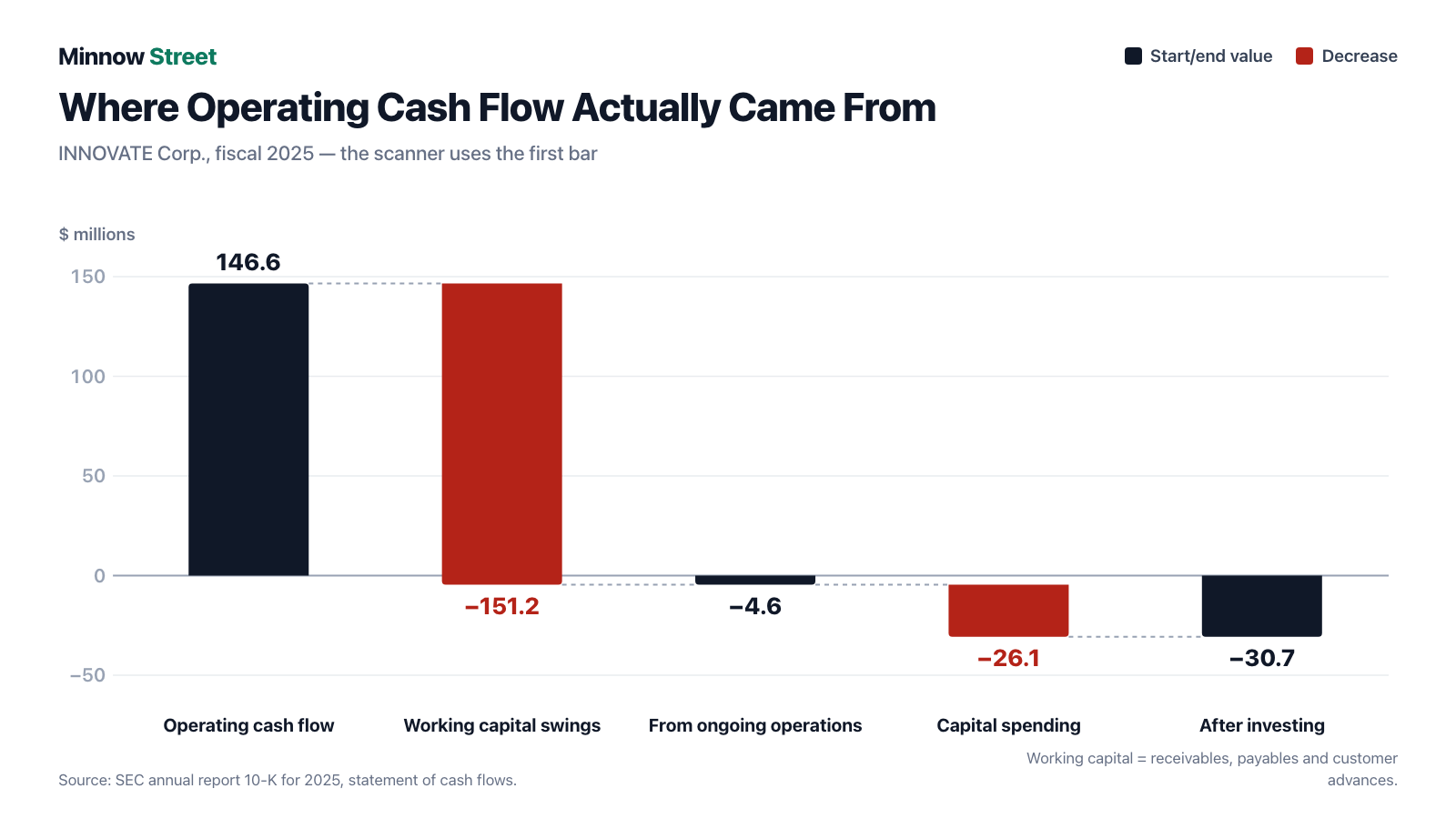
The 2025 cash flow statement reports operating cash flow of $146.6 million — after a meagre $9.1 million the year before. A sixteenfold jump. Read that line alone and you see a company that suddenly prints money.
Take the calculation apart and it looks different. It begins with the annual loss of $64.0 million. Then come the usual non-cash adjustments — depreciation and amortization of $30.4 million, amortization of financing costs of $23.7 million, share-based compensation of $2.7 million and a few smaller items. After all of that the running total stands at minus $4.6 million.
Only then come the changes in working capital — and those contribute plus $151.2 million. The three largest pieces: unpaid supplier invoices plus $57.1 million, higher accrued liabilities plus $37.6 million, and — the biggest item — customer advances plus $62.8 million.
Customer advances are money paid up front for work not yet performed. It sits in the bank account but economically belongs to the customer until the steel stands. Unpaid supplier invoices are money not yet transferred out. Both raise the bank balance — and both are borrowed time, not earning power.
After $26.1 million of capital spending, ongoing operations leave minus $30.7 million. And the annual report itself explains why this is normal for this business: it states expressly that DBM Global's cash flow depends on major construction contracts and can fluctuate significantly depending on when payment arrives — the company frequently has to fund engineering, materials and labour before the customer pays. A year with large advances looks wonderful. The following year, when those contracts are worked off, looks correspondingly different. The comparison shows exactly that: in 2024 the same line stood at $9.1 million.
Remember: cash flow that comes out of working capital is a snapshot, not earning power. How the same effect plays out in a completely different business model we described in our Xerox analysis.
Uncomfortable truth no. 2: one segment carries, interest takes it all back
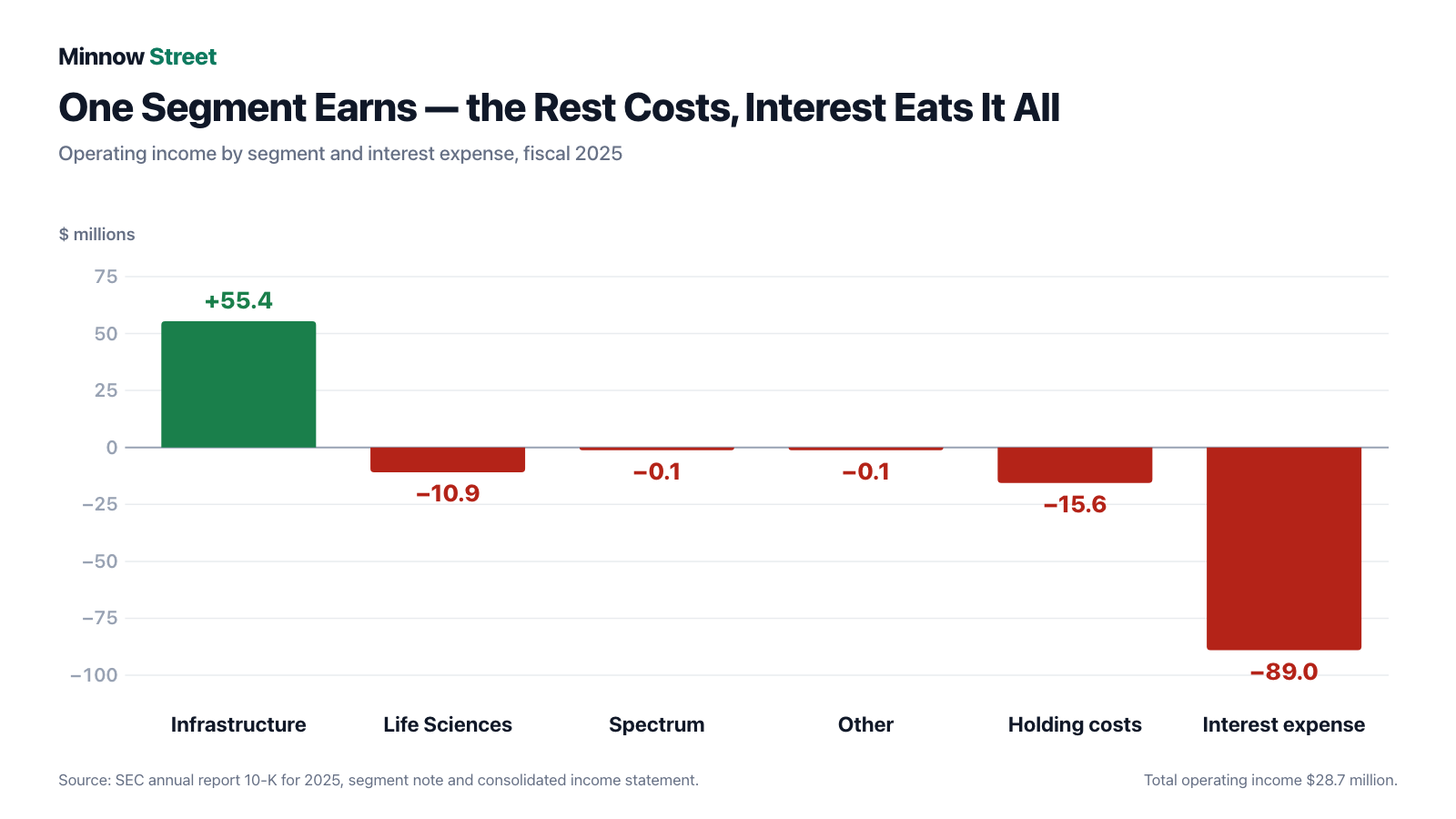
The 2025 segment accounts are quickly told. Infrastructure produced operating income of plus $55.4 million. Everything else cost money: Life Sciences minus $10.9 million, Spectrum minus $0.1 million, Other minus $0.1 million and the holding company's own costs minus $15.6 million. The bottom line is consolidated operating income of $28.7 million — after $40.0 million the year before.
Then comes interest expense: $89.0 million, after $74.5 million the prior year. That is more than three times what the entire group earned operationally. After interest, a $5.9 million loss from equity investees and $4.7 million of other income, the result is a pretax loss of $61.5 million. After tax: minus $64.0 million.
And now the step you must never skip at a holding company — separating out who owns what. Of the $64.0 million consolidated loss, $3.4 million fell to non-controlling interests, meaning co-owners inside the subsidiaries. That left minus $60.6 million for INNOVATE itself. From that a further $3.4 million of preferred dividends is deducted, which rank ahead of common shareholders. What remains for common shareholders is minus $64.0 million — a loss of $4.84 per share.
The first quarter of 2026 continued the pattern, if in milder form: revenue $364.8 million (up 33 percent), operating income $10.0 million — and interest expense $24.5 million. The bottom line was a quarterly loss of $17.1 million. The business is growing; the interest is growing with it.
Uncomfortable truth no. 3: subsidiary cash barely reaches the holding company
A holding company does not pay its own debts out of consolidated revenue but out of what its subsidiaries distribute upwards. So the decisive question at INNOVATE is not whether DBM Global earns money — it is how much of it arrives at the top.
In July 2026 there was a number for that:
“As the largest stockholder of DBMG, INNOVATE expects to receive approximately $11 million of the total $12 million dividend payout. INNOVATE’s individual stockholders are not eligible to receive the cash dividend.”
— INNOVATE Corp., press release of July 8, 2026, Exhibit 99.1 to the current report on Form 8-K
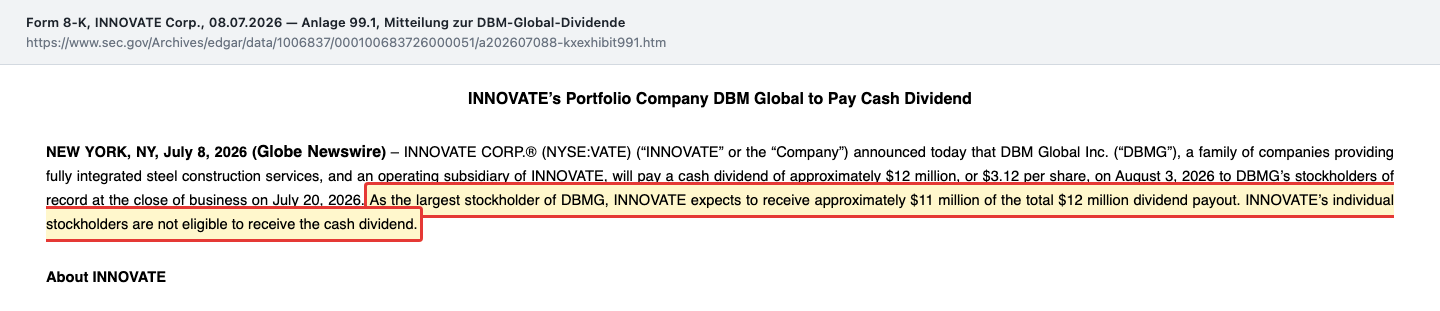
Eleven million dollars. That is the amount the holding company has to work with. Against it stands interest expense of $89.0 million a year.
The gap is not closed in cash — it is deferred. Debt at the parent level rose in the first quarter of 2026 alone from $481.9 million to $503.3 million, without any new money flowing. The reason is in the notes to the quarterly report:
“During the three months ended March 31, 2026, in accordance with the terms of the amended CGIC Note, $ 1.9 million of interest was capitalized into the principal balance.”
— INNOVATE Corp., SEC quarterly report 10-Q for the period ended March 31, 2026, notes
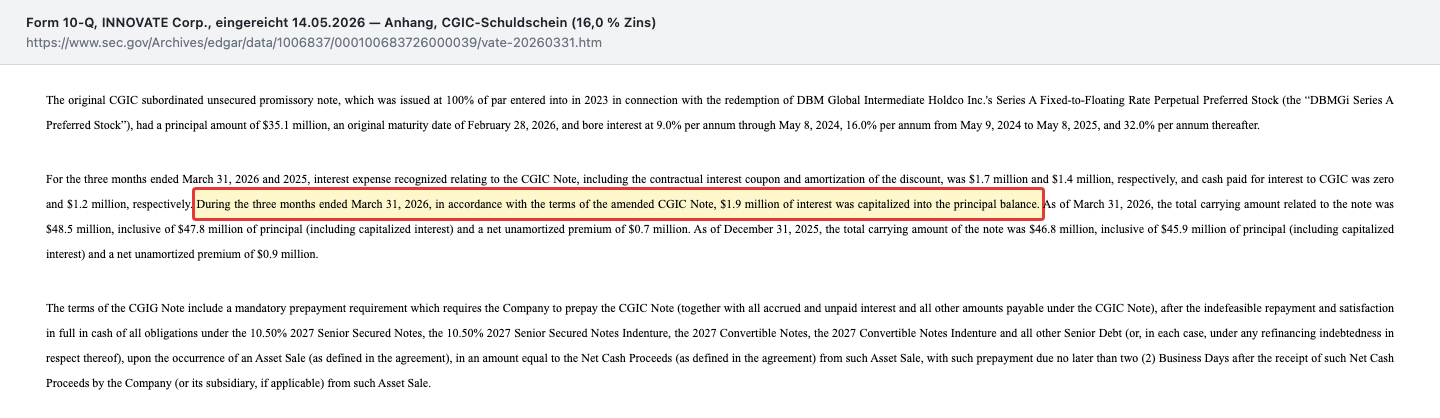
That note carries 16.0 percent interest, and the same paragraph states that cash paid to the lender during the quarter was zero. The same mechanism runs across the larger items: the 10.50 percent notes grew from $360.4 million to $379.3 million, the 9.50 percent convertible notes from $53.5 million to $56.0 million. A debt pile that grows by $21.4 million a quarter without any new borrowing — against $11 million of dividends a year.
Uncomfortable truth no. 4: there is a wall in 2027
Group debt stood at $699.0 million as of March 31, 2026. Of that, $503.3 million sits at the holding company itself, $76.6 million at the Infrastructure segment (not due until 2030), $69.7 million at Spectrum and $49.4 million at Life Sciences.
The maturity profile is unambiguous: $143.7 million falls due in the remainder of 2026, $489.4 million in 2027 — and then almost nothing. The reason: the three largest holding company instruments expire in quick succession. The 10.50 percent notes on February 1, 2027, the 9.50 percent convertible notes on March 1, 2027, the CGIC note on April 30, 2027.
More striking still is how the balance sheet classifies this debt:
“Certain debt instrument(s) with long-term maturity dates have been classified as current obligations as of March 31, 2026, due to contingent mandatory prepayment provisions contained in the agreements that could require repayment within one year of the balance sheet date if certain asset sales occur, resulting in uncertainty regarding the timing of repayment.”
— INNOVATE Corp., SEC quarterly report 10-Q for the period ended March 31, 2026, schedule of debt
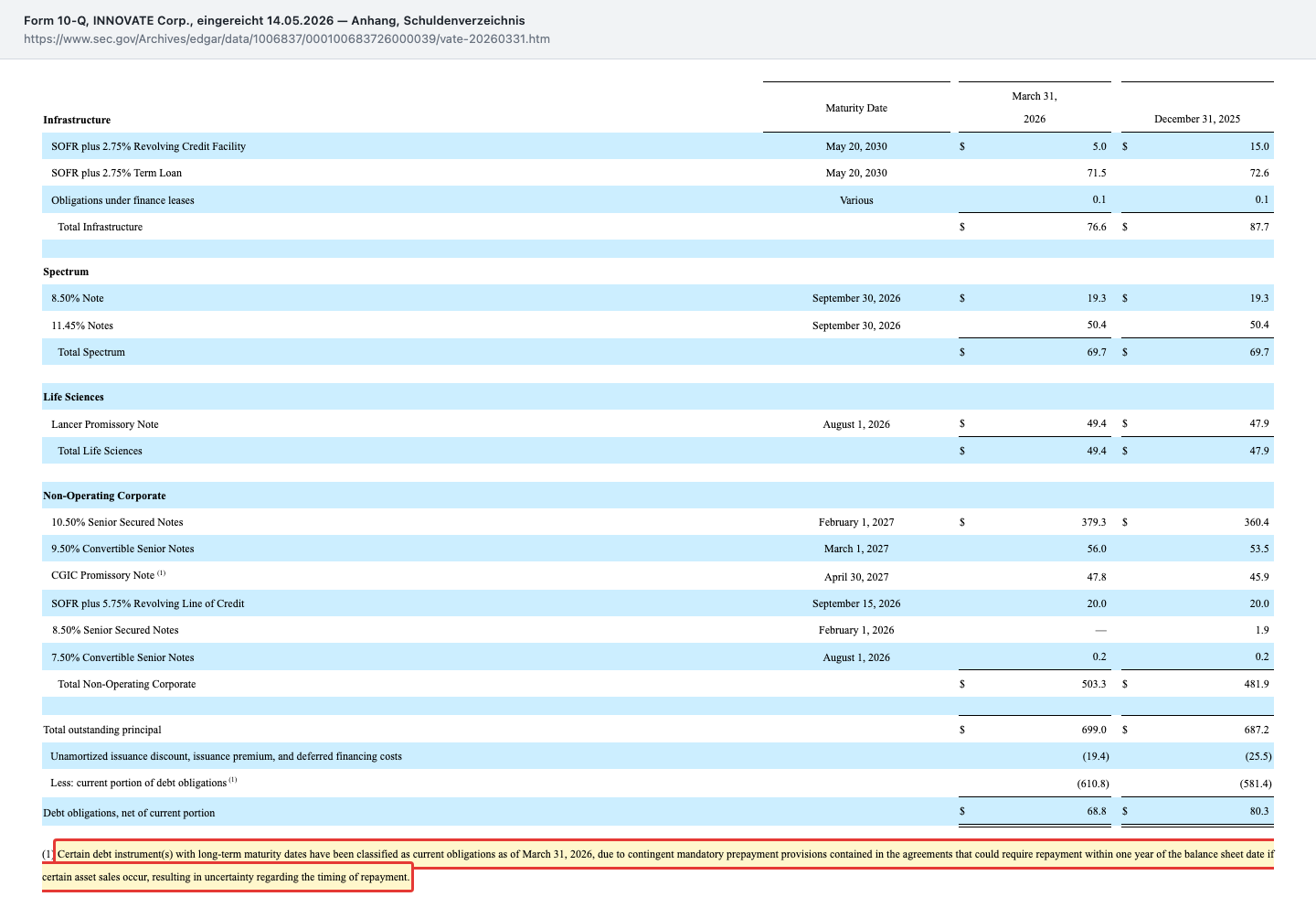
$610.8 million of $699.0 million therefore sits in the current bucket. Translated: the creditors have secured a promise that they get paid first if parts of the business are sold. Anyone hoping that INNOVATE sells a segment and the proceeds benefit shareholders should know about this clause.
Exactly such a sale is under way. On May 29, 2026 INNOVATE agreed to fold the broadcasting segment into CONX Corp. and to receive 25 percent of the surviving entity in return. The interim period is funded by a $105 million bridge facility at 8.00 percent, whose interest is likewise capitalized. And in case the merger fails, a remarkable clause sits in the contract:
“In the event of any early repayment or acceleration of the Loans, or the Loans reaching maturity without the occurrence of the consummation of the Merger, Broadcasting is required to repay in cash an amount sufficient to result in a minimum cash return on the original principal amount of the Loans, including all accrued and capitalized interest thereon, of 1.50:1.00.”
— INNOVATE Corp., SEC current report 8-K dated June 1, 2026, Item 2.03
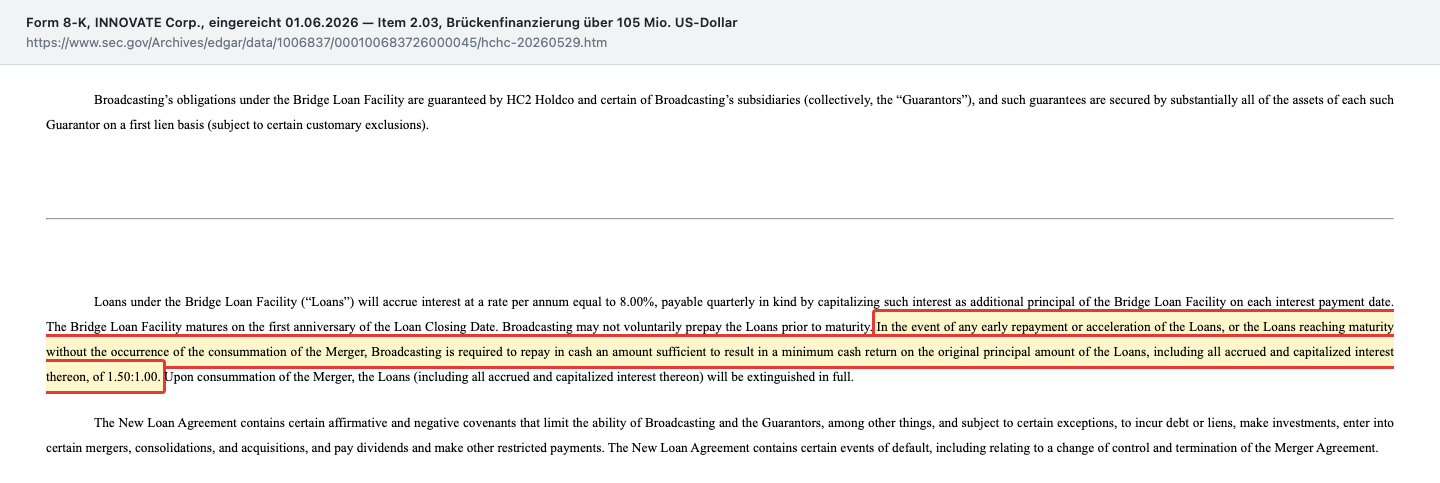
That would turn $105 million into roughly $158 million. Closing depends on approvals from the Federal Communications Commission and an antitrust waiting period; the end date is November 29, 2026, extendable to May 29, 2027 at the latest.
What the stock costs — and what you get for it
Let us add up what a share in this holding company covers. For $113.8 million of market capitalization (13,641,866 shares times $8.34, the July 24, 2026 close) you get:
- a stake in a structural steel business that produced $55.4 million of operating income in 2025 — though not all of it, because co-owners hold part of it,
- two segments that together lost $11.0 million at the operating level, one of them in a merger process with an uncertain outcome,
- debt of $699.0 million, of which $503.3 million sits at the holding company, with $489.4 million falling due in 2027 alone,
- and equity attributable to INNOVATE shareholders of minus $240.1 million (group total minus $226.2 million).
Classic valuation ratios do not work here. There is no price-to-earnings ratio because the group is loss-making (minus $4.84 per share in 2025). Price-to-book is meaningless because book value is negative. What remains is enterprise value — market capitalization plus net debt — and that stands at roughly $745 million. Put differently: the share price prices in about 15 percent of what the group as a whole would have to be worth; the other 85 percent belongs to the creditors.
On the Altman Z score, which our data set holds at -3.10 (we recompute -0.11): in the Z-double-prime variant we use, the distress zone lies below 1.1 and the safe zone above 2.6. Both readings sit far below. You should know what mainly drives the figure here, though: the negative equity. At a holding company with non-controlling interests and sharply separated financing levels, the metric is only a rough pointer. More informative are the three relationships derived above — interest expense against operating income (89.0 to 28.7), dividend inflow against debt growth ($11 million a year against $21.4 million a quarter) and the 2027 maturity wall.
A word on the share price, because it easily misleads: the stock traded between $3.98 and $20.06 in the twelve months to July 24, 2026 — it quintupled and then halved. Older price comparisons are unusable for this stock because INNOVATE consolidated its shares 1-for-10 in August 2024 and the price history available to us does not retroactively adjust for that. We therefore deliberately make no claim about all-time highs. How differently valuation and substance can drift apart is also visible in our Jackson Financial analysis from the same scanner series.
Opportunities and risks at a glance
What speaks for INNOVATE:
- The Infrastructure segment is growing and earning: consolidated revenue up 12.5 percent to $1,246.0 million in 2025, up 33 percent to $364.8 million in the first quarter of 2026; segment operating income $55.4 million.
- Consolidated operating income improved from $3.4 million to $10.0 million in the first quarter of 2026, and the quarterly loss narrowed from $25.8 million to $17.1 million.
- The CONX merger, if completed, brings extinguishment of the broadcasting loans, $75 million of equity commitments to the surviving entity and a 25 percent stake in it.
- The Infrastructure segment's debt ($76.6 million) does not mature until 2030 and therefore sits outside the maturity wall.
- A repurchase right allows up to 15 percent of the surviving entity to be bought back.
What speaks against it:
- The hook does not hold: operating cash flow of $146.6 million consists of $151.2 million of working capital swings; ongoing operations delivered minus $4.6 million.
- Interest expense of $89.0 million is more than three times consolidated operating income of $28.7 million — and it rose $14.5 million year over year.
- Equity attributable to INNOVATE shareholders stands at minus $240.1 million and deteriorated by nearly $60 million within a year.
- $489.4 million falls due in 2027; $610.8 million of $699.0 million of total debt already counts as current because of mandatory prepayment clauses.
- Interest is capitalized rather than paid in cash — holding company debt grew $21.4 million in the first quarter of 2026 alone, and one note carries 16.0 percent.
- If the CONX merger fails, the bridge facility must be repaid at a minimum return of 1.50 to 1.00 — turning $105 million into roughly $158 million.
- Dilution: the weighted average share count rose 23.6 percent in 2025; the 2027 convertible notes can create up to 1,543,174 further shares.
- Proceeds from asset sales flow contractually to creditors or into the exercise of the repurchase right first, not to shareholders.
A human conclusion
The thinking error from the opening — mistaking the sum for the whole — is especially expensive at holding companies, because the numbers sit so temptingly side by side. $1.25 billion of revenue, $114 million of market capitalization: that looks like a market error. But it is not an error, it is a calculation the market has already done. It is not pricing the revenue but what is left for shareholders after $699 million of debt — and in accounting terms that is currently less than nothing.
None of which means the story has to end badly. The Infrastructure segment is a real, growing business, the first quarter of 2026 was better than the prior-year quarter, and with the CONX agreement management is attempting exactly the right thing: handing off a loss-making segment together with its debt. If that works and the 2027 maturities are refinanced, the arithmetic looks different in two years.
It is simply not a bargain you buy because of one metric. It is a bet on two events — an approval by the broadcasting regulator and a refinancing of almost half a billion dollars — in which, if either fails, you stand behind creditors and preferred shareholders. So the question to ask at any holding company is: who owns what I am actually looking at here?
What you make of that is up to you. And that is exactly as it should be.
Sources
- INNOVATE Corp. — annual report 10-K for 2025 (filed March 26, 2026, CIK 0001006837)
- INNOVATE Corp. — quarterly report 10-Q for the period ended March 31, 2026 (filed May 14, 2026)
- INNOVATE Corp. — annual report 10-K for 2024 (filed March 31, 2025)
- INNOVATE Corp. — current report 8-K dated June 1, 2026 (merger agreement with CONX Corp., $105 million bridge facility, option and supplemental agreements)
- INNOVATE Corp. — press release of July 8, 2026 on the DBM Global cash dividend (Exhibit 99.1 to the current report on Form 8-K)
- Fundamental data & SEC filings (annual and quarterly reports, 10-K/10-Q) and our in-house stock scanner, data as of July 27, 2026; price history since 2009 (4,285 trading days) used to check the reverse split
Journalistic analysis, not investment advice and not a solicitation to buy or sell securities. Stocks can lose value at any time, and a total loss is possible. All figures are taken from the original documents linked above and carry the as-of date stated there. Metrics from our data set are labeled with their data date and are recomputed daily; discrepancies between the data set and our own calculations are disclosed in the text. The author holds no position in INNOVATE Corp. at the time of publication.
Our Bottom Line at a Glance
- Strength of the scanner hook negative
- The stored P/FCF of 1.4604 rests on a market capitalization of $256 million; computed independently it is $113.8 million (13,641,866 shares × $8.34). More importantly the cash flow figure does not hold: of $146.6 million of operating cash flow, $151.2 million came from working capital swings, ongoing operations delivered minus $4.6 million, and minus $30.7 million after capital spending.
- Operations of the Infrastructure segment positive
- DBM Global is a real, growing structural steel business: $1,210.3 million of segment revenue and $55.4 million of operating income in 2025, with consolidated revenue up 33 percent to $364.8 million in the first quarter of 2026 and operating income up from $3.4 million to $10.0 million. This segment's debt ($76.6 million) does not mature until 2030.
- Capital structure negative
- Interest expense of $89.0 million exceeds consolidated operating income of $28.7 million by more than three times and rose $14.5 million year over year. Equity attributable to INNOVATE shareholders stands at minus $240.1 million and deteriorated by nearly $60 million within a year. Of $699.0 million of total debt, $610.8 million counts as current.
- Cash reaching the holding company negative
- The holding company lives on distributions from its subsidiaries. The DBM Global dividend announced in July 2026 brings it roughly $11 million. Over the same period, parent-level debt grew from $481.9 million to $503.3 million purely through capitalized interest — $21.4 million in a single quarter. One note carries 16.0 percent, and nothing was paid on it in cash during the quarter.
- Refinancing in 2027 negative
- $489.4 million falls due in 2027 — the 10.50 percent notes on February 1, the 9.50 percent convertible notes on March 1, the CGIC note on April 30. Against that stands a market capitalization of $113.8 million and consolidated operating income of $28.7 million. Proceeds from asset sales flow contractually to creditors first.
- Portfolio restructuring neutral
- The merger agreement of May 29, 2026 hands the loss-making broadcasting segment to CONX Corp.; INNOVATE keeps 25 percent of the surviving entity and CONX commits $75 million of equity. That is strategically sound but depends on FCC approvals. If closing fails, the $105 million bridge facility must be repaid at a minimum return of 1.50 to 1.00 — roughly $158 million.
INNOVATE is a holding company whose consolidated figures say almost nothing about the value of the stock: 97 percent of revenue comes from structural steel, operating income of $28.7 million is buried under $89.0 million of interest expense, and shareholders' equity stands at minus $240.1 million. The scanner hook fails twice over — the underlying market capitalization is more than double the real one, and the cash flow comes almost entirely from working capital swings. $489.4 million falls due in 2027. Not investment advice.
What Our Rating Means
Substance risk
We found at least one documented issue that threatens the company itself — regardless of how the stock is currently valued.
Red here is about the capital structure, not the operating business. The Infrastructure segment is healthy and growing: $1,210.3 million of segment revenue, $55.4 million of operating income, and consolidated revenue up 33 percent in the first quarter of 2026. Above it, however, sits a holding company that consumes all of it. Interest expense of $89.0 million is more than three times consolidated operating income of $28.7 million and rose $14.5 million within a year. Equity attributable to INNOVATE shareholders stands at minus $240.1 million and has deteriorated by nearly $60 million. Interest is largely not paid in cash but capitalized — in the first quarter of 2026 alone that lifted holding company debt from $481.9 million to $503.3 million, while the main subsidiary's annual dividend amounts to roughly $11 million. In 2027, $489.4 million falls due, and $610.8 million of $699.0 million of total debt is already reported as current because mandatory prepayment clauses could be triggered by asset sales. The Altman Z score of -3.10 in our data set (recomputed -0.11) sits far below the Z-double-prime distress threshold of 1.1, but mainly reflects the negative equity and is only a rough pointer at a holding company with separated financing levels. What matters are the three documented relationships: interest against operating income, dividend inflow against debt growth, and the 2027 maturity wall against a market capitalization of $113.8 million.
A journalistic assessment by our editorial team at the time of the deep dive, based on public sources — not investment advice and not a solicitation to buy or sell. Your personal circumstances (investment goals, risk capacity, taxes) cannot be taken into account. What our levels mean, how verdicts are formed, and what conflicts of interest exist →
Worth Noting
- Hook: price-to-free-cash-flow ranking, stored P/FCF 1.4604 → rank 27 of 545 U.S. hits, data as of July 27, 2026. Only the 25 strongest hits are visible; the last displayed row carries 1.4, and INNOVATE sits two rows behind it, findable through the screener. On the German brand the same scanner additionally covers European names (836 hits in total), which does not change its U.S. position. No tie at the rank position. All lists are recomputed daily.
- Identity: verified through company_tickers.json and the 10-Q cover page, not through the company name. CIK 0001006837. Former names: Primus Telecommunications Group (until 2013), PTGi Holding (2013–2014), HC2 Holdings (2016–2021); filings still carry the "hchc" prefix. Our data set stores a different identifier (0001652226), which was not used for this research.
- Market capitalization computed independently rather than taken from the data set: 13,641,866 common shares (10-Q cover page, May 11, 2026) × $8.34 (close of July 24, 2026) = $113.8 million. The data set holds $256 million. Cross-check: $256.0 million divided by trailing four-quarter free cash flow ($175.3 million) gives exactly 1.4604 — the stored scanner value. With the independently computed market capitalization it would be 0.65; the data error therefore makes the stock look more expensive, not cheaper.
- Reverse split: 1-for-10 in August 2024 following the NYSE minimum price notice of February 26, 2024. The price history available to us is NOT adjusted (August 8, 2024: $0.53; August 9, 2024: $4.79). We therefore deliberately make no claim about all-time highs and quote only the 52-week range of $3.98 to $20.06, which lies entirely after the split.
- Further discrepancies against the data set: Piotroski 7 stored against 4 recomputed; Altman Z -3.10 against -0.11; equity ratio empty in the data set, recomputed at -24.3 percent; price-to-earnings, price-to-book, interest coverage and debt-to-equity likewise empty. All statements in this analysis rest on the original figures in the SEC filings.
- Recency gate: the most recent periodic report is the 10-Q for the period ended March 31, 2026 (filed May 14, 2026). All 3 filings after it were read in full — 8-K dated June 1, 2026 (CONX merger agreement, $105 million bridge facility, supplemental indentures, option agreements), 8-K dated June 11, 2026 (annual meeting) and 8-K dated July 8, 2026 (DBM Global dividend). No current Form 25, no Form 15, no NT 10-K; the 2013 to 2020 items concern predecessor entities.
Frequently Asked Questions
INNOVATE is a holding company with three segments: Infrastructure (structural steel subsidiary DBM Global of Phoenix, Arizona), Life Sciences (Pansend, mostly stakes in research-stage ventures) and Spectrum (local television stations). In 2025, $1,210.3 million of $1,246.0 million of consolidated revenue — 97.1 percent — came from the Infrastructure segment alone.
For two reasons. First, it rests on a market capitalization of $256 million, while 13,641,866 shares times $8.34 gives only $113.8 million. Second, the cash flow figure does not hold up: of $146.6 million of operating cash flow, $151.2 million came from working capital swings — mainly customer advances and unpaid supplier invoices. Ongoing operations delivered minus $4.6 million.
Roughly $113.8 million. That follows from 13,641,866 common shares outstanding per the quarterly report cover page (as of May 11, 2026) times the July 24, 2026 closing price of $8.34. Our data set holds $256 million — more than double. That discrepancy fully explains the scanner value.
Yes, several times. The company was Primus Telecommunications Group (until 2013), PTGi Holding (2013 to 2014) and HC2 Holdings (2016 to 2021). The documents filed with the regulator still carry the "hchc" prefix. When researching, go by the identifier CIK 0001006837 rather than the company name.
Yes. In August 2024 the shares were consolidated 1-for-10 after the NYSE notified the company on February 26, 2024 that the average closing price over 30 consecutive trading days had fallen below one dollar. Important for your own analysis: the price history available to us is not adjusted for that consolidation — it shows $0.53 on August 8, 2024 and $4.79 on August 9. Long-run comparisons from that series are misleading.
Only in small amounts. The DBM Global dividend announced in July 2026 totals $12 million, of which roughly $11 million goes to INNOVATE. Against that stands interest expense of $89.0 million a year. The gap is deferred: holding company debt rose from $481.9 million to $503.3 million in the first quarter of 2026 alone, because interest is capitalized rather than paid in cash.
$489.4 million falls due in 2027 — the 10.50 percent notes on February 1, the 9.50 percent convertible notes on March 1 and the CGIC note on April 30. Already now, $610.8 million of $699.0 million of total debt is reported as current because mandatory prepayment clauses could be triggered by asset sales.
Because only the 25 strongest hits are displayed. Among the 545 U.S. hits of the price-to-free-cash-flow ranking, INNOVATE ranks 27th (data as of July 27, 2026) and therefore sits two rows behind the visible cut; the last displayed row carries a value of 1.4. The screener lets you filter the same metric without that cutoff. All lists are recomputed daily.
Found an error?
Did you spot a factual error, an outdated number, or a typo in this deep dive? Let us know briefly — your report goes straight to the editorial team.