Playtika Stock: $567 Million of Cash Inflow — and Why a Deficit Is What Is Left
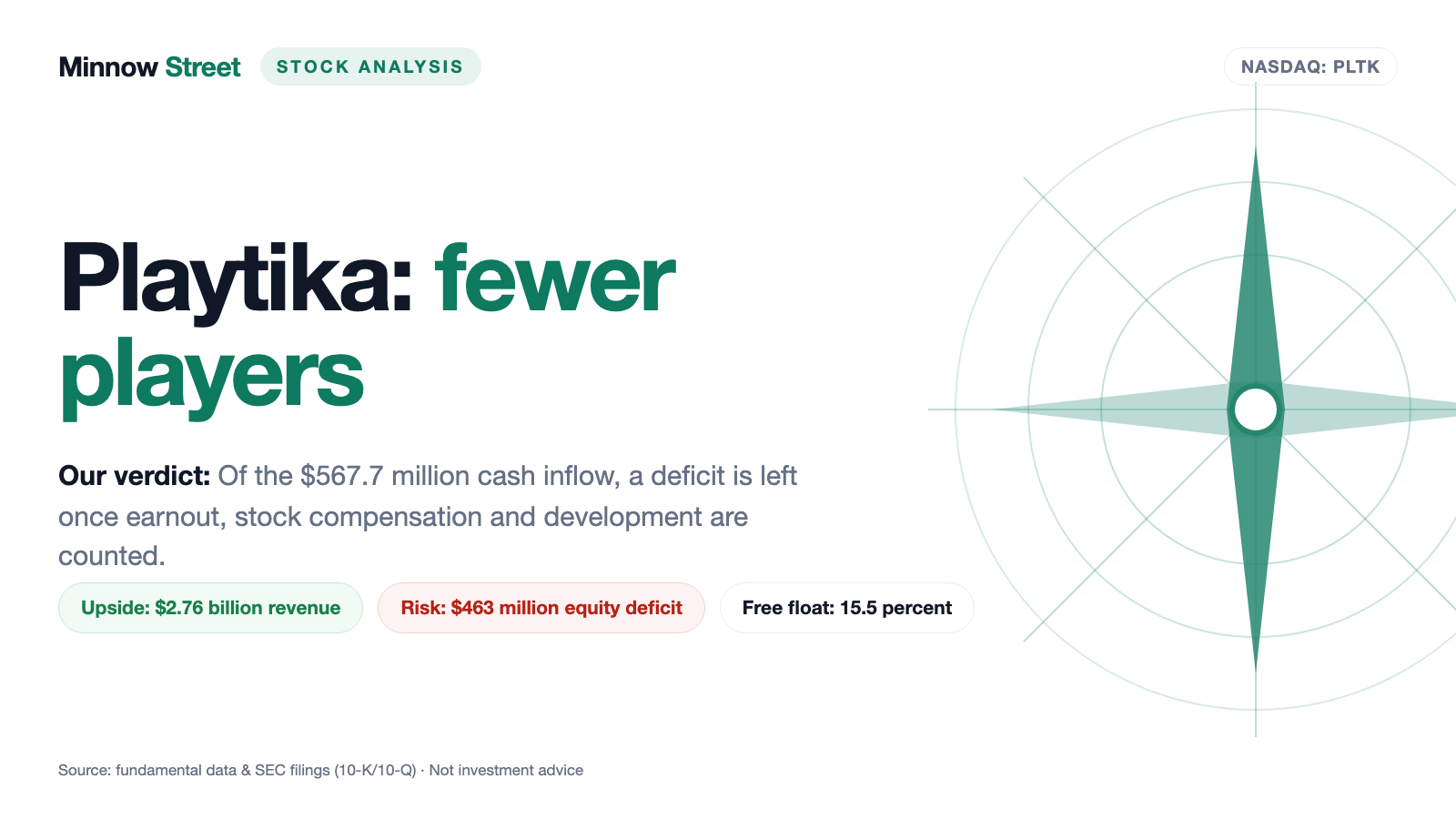
Playtika operates mobile games such as Bingo Blitz and Slotomania and sits in our price-to-free-cash-flow ranking at 2.20 (data as of July 27, 2026). We read the 2025 annual report (10-K) and the quarterly report (10-Q) for the period ended March 31, 2026 and took the cash flow statement apart item by item. The result: of the reported $567.7 million of cash inflow, a deficit of $37.1 million is left once the revaluation of an earnout, stock-based compensation and development spending are accounted for. Add an equity deficit of $463 million and a free float of just 15.5 percent.
 Thomas Mücke
Founder & Publisher
Thomas Mücke
Founder & Publisher
Chart
Interactive price chart (TradingView).
Note: pure fact-based analysis, not investment advice and not a solicitation to buy or sell. All figures without guarantee.
There is a confusion that regularly catches us out when reading annual reports: we mistake inflow for earnings. When a large number appears under "net cash provided by operating activities", it sounds like money the company earned. Sometimes it is. Sometimes it is something else entirely.
Playtika Holding Corp. (Nasdaq: PLTK) reports operating cash flow of $567.7 million for 2025 — against a market capitalization of roughly $1.4 billion. That very relationship puts the stock in our price-to-free-cash-flow ranking, at a stored ratio of 2.20 (data as of July 27, 2026). In the same year, however, the company posted a loss of $206.4 million. Those two numbers only fit together once you know what the cash flow statement actually contains. Remember the sentence this turns on: an expense added back is not money earned — it is a payment postponed.
What is in this analysis
- What Playtika does — 27 games, ten of which count
- How the stock reached our desk
- Uncomfortable truth no. 1: the cash inflow is made of postponed payments
- Uncomfortable truth no. 2: fewer players, bought more expensively
- Uncomfortable truth no. 3: a balance sheet without equity
- Uncomfortable truth no. 4: a 15.5 percent free float
- What the stock costs
- Opportunities and risks at a glance
- A human conclusion
- Sources
What Playtika does — 27 games, ten of which count
Playtika develops and operates mobile games that are free to download and in which players then spend money on in-game currency, extra rounds or shortcuts. The company is based operationally in Herzliya Pituach, Israel, is legally a Delaware corporation and employs roughly 3,175 people. Unlike many foreign companies, Playtika files with the U.S. securities regulator as a domestic filer with full quarterly reports — an advantage for investors, because the numbers arrive more often and in more detail.
The portfolio comprises 27 games, 15 of which are actively managed and promoted. The concentration is considerable:
“our top ten games collectively represented 90.2% of our revenues for the year ended December 31, 2025”
— Playtika Holding Corp., SEC annual report 10-K for 2025, Item 1
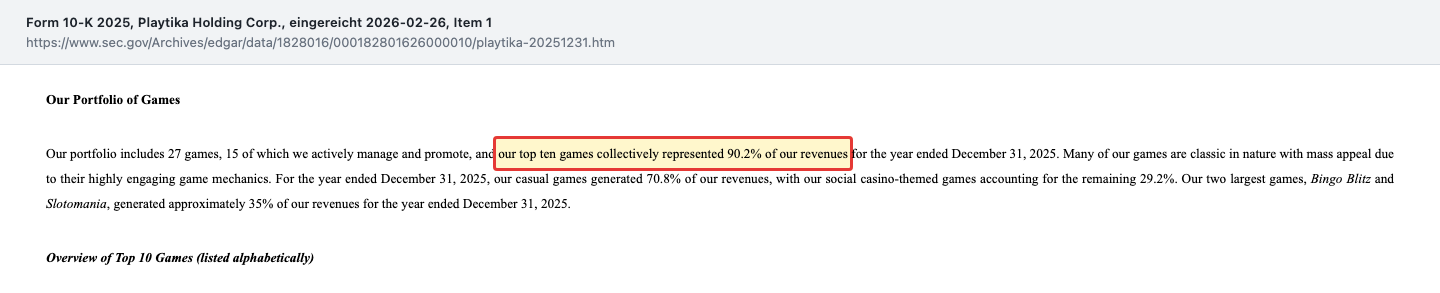
It gets tighter still at the top: the two largest titles, Bingo Blitz and Slotomania, together brought in roughly 35 percent of revenue. By category, 70.8 percent came from casual games and 29.2 percent from social casino-themed titles. Both categories depend on a manageable number of players paying regularly — and both depend on the distribution platforms of Apple and Google.
How the stock reached our desk
We run roughly 3,500 stocks through our scanners every day. As of July 27, 2026 Playtika meets the condition of the price-to-free-cash-flow ranking: positive free cash flow and a price-to-free-cash-flow ratio of no more than 10. The stored value is 2.20.
And the context right away: the scanner has 545 hits in the U.S. selection, of which only the 25 strongest are displayed. The last visible row carries a value of 1.4 — Playtika, at 2.20, sits well outside that cut and does not appear in the list. On the German brand the same scanner additionally covers European names and reaches 836 hits in total; that does not change the U.S. selection.
To reproduce it, the route runs through the screener: there you can filter by price-to-free-cash-flow and narrow by country without the display stopping at 25 rows. And as with all our lists: they are recomputed daily.
Uncomfortable truth no. 1: the cash inflow is made of postponed payments
Now to the metric that put this stock on our desk. The 2025 cash flow statement starts with the annual loss of $206.4 million. Then come the adjustments for items that hit profit without costing money — and by far the largest of them is unusual:
- Revaluation of the earnout: plus $398.6 million. When Playtika acquired the studio SuperPlay in 2024, part of the purchase price was tied to later performance. Because SuperPlay is beating its targets, the expected payment had to be revised sharply upward in 2025. In accounting terms that depresses profit but costs no cash yet — so it is added back in the cash flow statement. It still has to be paid, just later.
- Stock-based compensation: plus $82.5 million. Employees are partly paid in shares. That costs no cash — instead existing shareholders' stakes shrink.
- On top of that, depreciation and amortization of $234.8 million combined, plus smaller items.
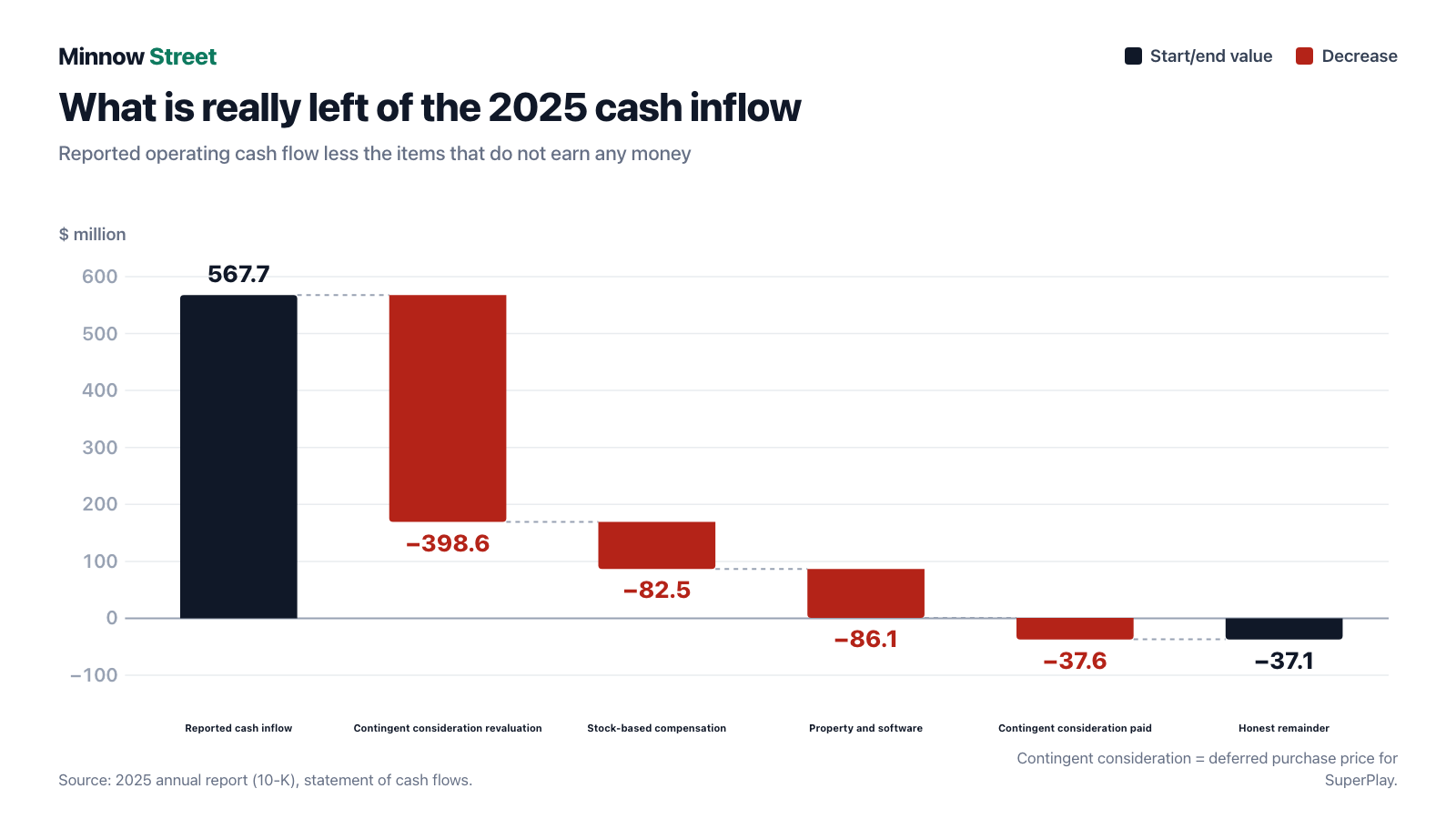
That is how the $567.7 million comes about. Now let us honestly work back to what remains as distributable cash:
- 567.7 less 398.6 (revaluation of the earnout — it falls due in cash) = 169.1
- less 82.5 (stock-based compensation — it costs shareholders their stake) = 86.6
- less 86.1 (property and software: 36.3 + 28.6 + 21.2 million — without that spending there are no games) = 0.5
- less 37.6 (earnout already paid in cash during 2025) = minus $37.1 million
An inflow of $567.7 million thus becomes a deficit of $37.1 million. This is no accounting sleight of hand — every single entry follows the rules. It is simply something other than "the company earned half a billion".
Uncomfortable truth no. 2: fewer players, bought more expensively
The operating picture is mixed, and we want to do it justice. Average monthly active users fell from 29.4 million (2023) through 29.0 to 28.3 million (2025). At the same time average revenue per daily active user rose from $0.81 through $0.86 to $0.89.
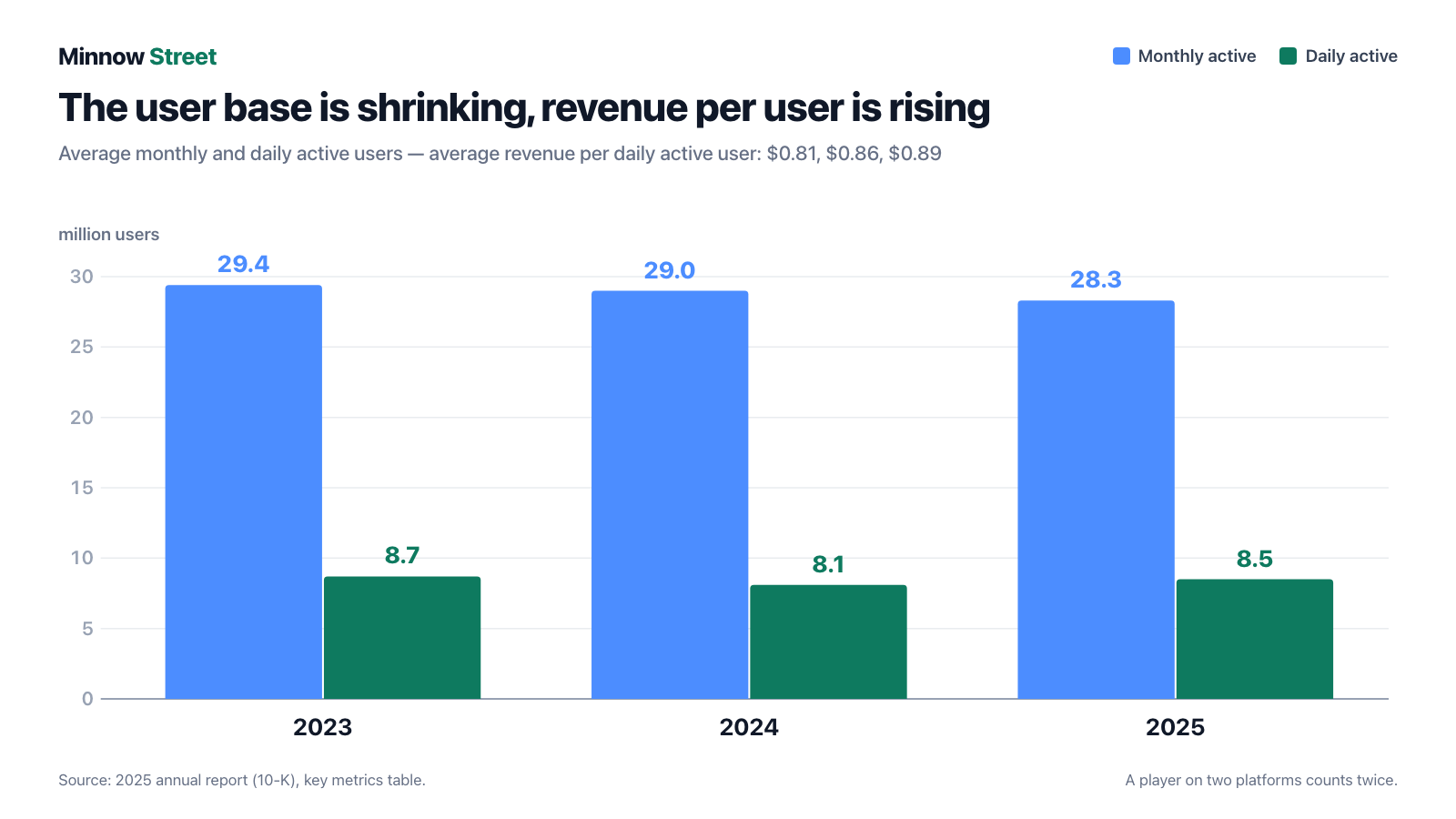
That is an achievement first of all, not merely a price increase. The number of paying users rose over the same period from 310,000 to 370,000, and the share of players who spend anything at all climbed from 3.6 to 4.4 percent. Playtika is losing casual players and gaining paying ones — in business terms exactly the right trade.
What that trade costs is in the quarterly report. In the first quarter of 2026 Playtika posted revenue of $744.7 million (up 5.5 percent) but spent $360.6 million on sales and marketing — after $271.8 million a year earlier. That is 48.4 percent of revenue: almost every second dollar taken in goes straight back out to win or win back players. Together with general and administrative expenses that more than doubled from $65.2 million to $143.5 million, the result tipped over: an operating profit of $67.8 million in the prior-year quarter became an operating loss of $49.6 million, and the bottom line a net loss of $57.5 million after a profit of $30.6 million.
One quarter is not a trend. But the direction is clear: revenue per user is rising more slowly than the cost of that user's attention.
Uncomfortable truth no. 3: a balance sheet without equity
The balance sheet as of March 31, 2026 is quickly told and still remarkable. On the asset side sit $3,686.9 million, of which $1,695.7 million is goodwill from earlier acquisitions — nearly half the balance sheet in a line that produces no earnings of its own but merely reflects expectations attached to businesses that were bought.
On the liability side: $2,375.4 million of long-term debt, plus the earnout at $459.0 million current and $370.0 million non-current — together $829.0 million. Total liabilities come to $4,150.0 million. Total assets less liabilities gives an equity deficit of $463.1 million, after $411.4 million at the end of 2025.
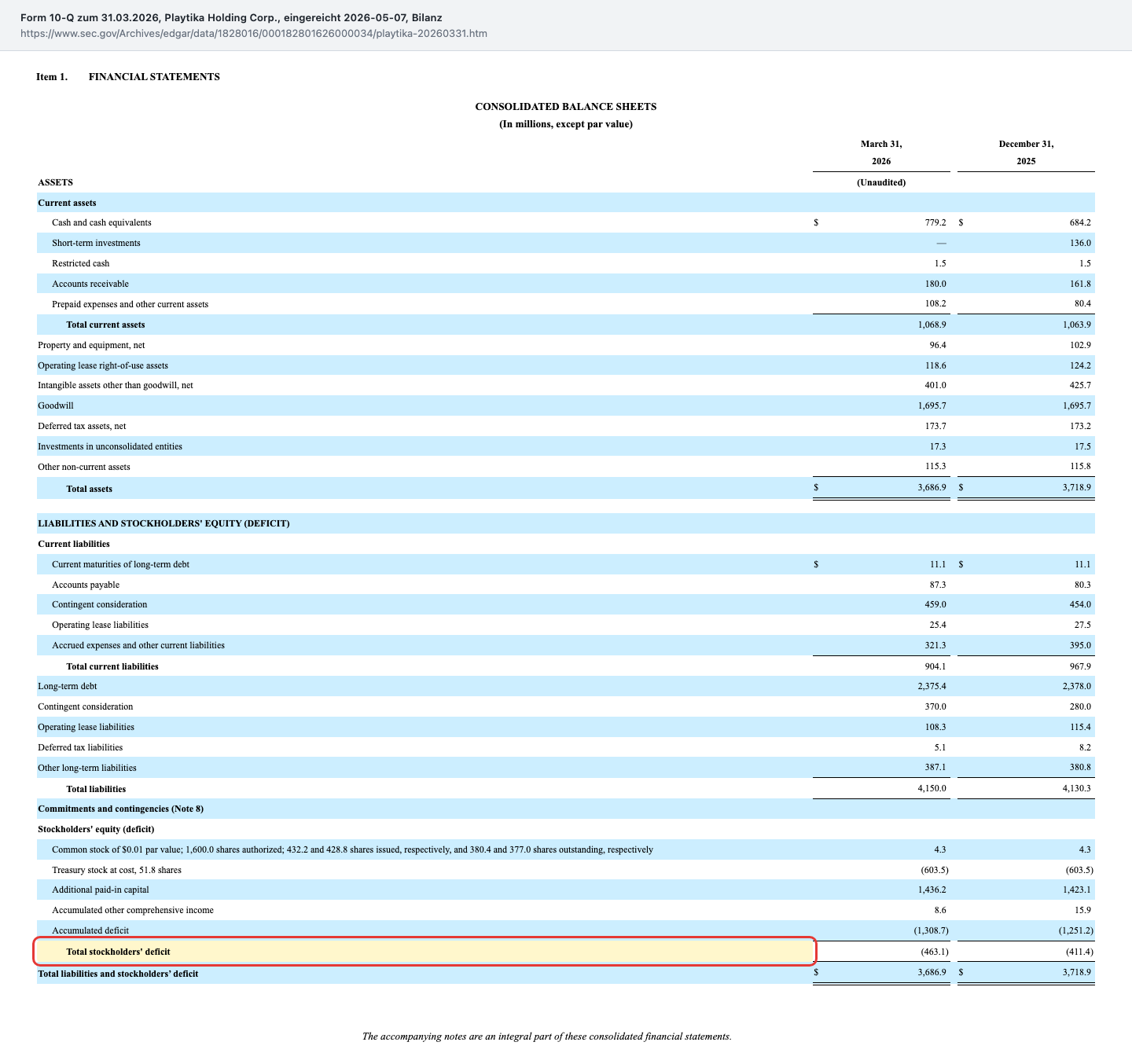
Negative equity is not a death sentence in itself at a company with steady cash inflow — here it arises mainly from earlier distributions and buybacks (51.8 million treasury shares for $603.5 million) plus an accumulated deficit of $1,308.7 million. What matters is when the debt falls due. The annual report names the dates: "the Term Loan matures in March 2028, the Revolving Credit Facility matures in March 2027 and the Notes mature in March 2029". And it warns itself that available cash may not suffice to fund the earnout obligations — particularly if the revolving credit facility maturing in March 2027 is not refinanced before then.
On the Altman Z score: our data set holds 2.01, and recomputing it ourselves we arrive at 0.51. In the Z-double-prime variant we use, the distress zone lies below 1.1 and the safe zone above 2.6. Both readings sit below the upper threshold, the recomputed one even below the lower — though the spread also shows how much such formulas swing when equity is negative. The figures themselves are more reliable: $829.0 million of earnout, $2,375.4 million of debt, refinancing due March 2027.
Uncomfortable truth no. 4: a 15.5 percent free float
Anyone buying Playtika shares should know what company they are in. Of 380.4 million common shares outstanding, only 59.0 million are freely tradable — a free float of 15.5 percent. The annual report spells out the ownership chain itself:
“Yuzhu Shi controls us through his indirect interest in Playtika Holding UK II Limited”
— Playtika Holding Corp., SEC annual report 10-K for 2025, Item 1A Risk Factors
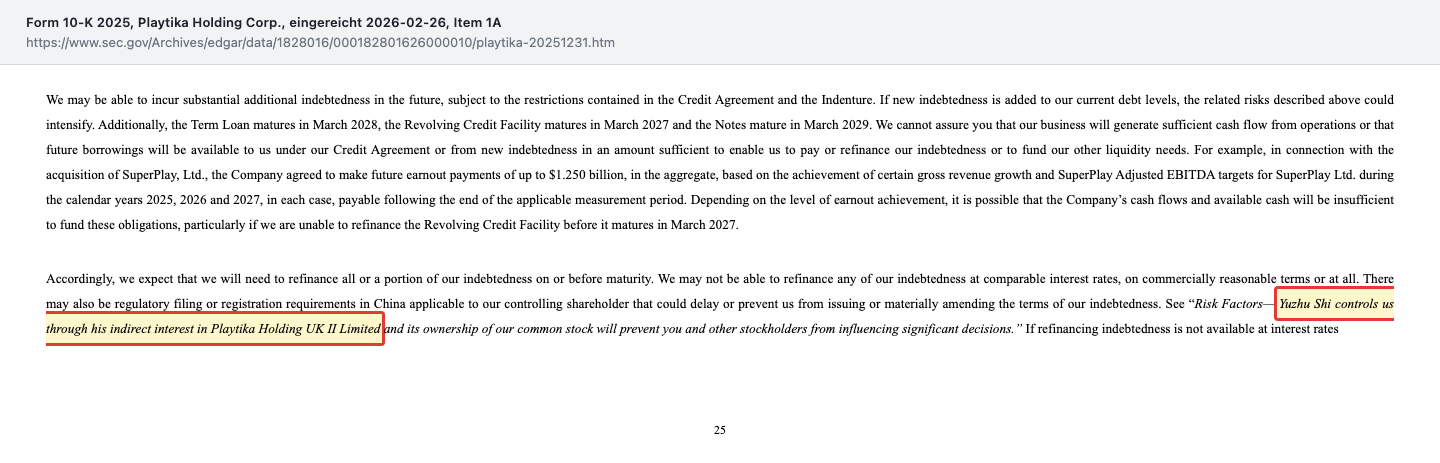
Playtika Holding UK II Limited is a company formed under the laws of England and Wales and is itself a wholly owned subsidiary of Alpha Frontier Limited in the Cayman Islands. From that structure follows the status of a "controlled company" under Nasdaq rules: Playtika may depart from corporate governance requirements that bind other listed companies. The report states the consequence for investors itself — shareholders then do not get the same protections as shareholders of fully regulated companies.
A second, often overlooked point from the same passage: the report notes that regulatory filing or registration requirements in China applicable to the controlling shareholder could delay or prevent the company from issuing or materially amending its debt. At a company that has to refinance a credit facility in March 2027, that is not a footnote.
What the stock costs
Let us calculate it ourselves. The quarterly report cover page states 380,379,545 common shares as of May 4, 2026. Times the July 24, 2026 closing price of $3.68 that gives a market capitalization of roughly $1.40 billion. A note on the data: our data set holds $1.23 billion; we use the independently computed figure.
- Price-to-sales: $1.40 billion against trailing four-quarter revenue of roughly $2.79 billion gives 0.50 — a very low figure for a software company.
- Price-to-free-cash-flow as the scanner reads it: 2.20.
- Price-to-free-cash-flow calculated honestly: not determinable, because after deducting the earnout, stock-based compensation and development spending a deficit of $37.1 million remains.
- Price-to-earnings: not determinable (a loss of $206.4 million in 2025 and $57.5 million in the first quarter of 2026).
- Price-to-book: not meaningful, because equity is negative.
- Enterprise value: roughly $3.14 billion — more than double the market capitalization, because the debt is added.
The price-to-sales ratio of 0.50 is why this stock keeps appearing on valuation lists. But it only measures how much revenue you get per dollar of market capitalization — not how much of it survives marketing, interest and the earnout. At a company that spends almost half its revenue on advertising and whose enterprise value is double its market capitalization, that is the wrong lens. How another stock with a similarly low sales valuation and a similarly difficult user picture looks, we described in our Bumble analysis.
Opportunities and risks at a glance
What speaks for Playtika:
- A real, large business: roughly $2.79 billion of revenue over the last four quarters, with first-quarter 2026 revenue up 5.5 percent to $744.7 million.
- Monetization is measurably improving: paying users up from 310,000 to 370,000, payer conversion from 3.6 to 4.4 percent, revenue per daily active user from $0.81 to $0.89.
- SuperPlay, acquired in 2024, is beating expectations — that is why the earnout obligation rose.
- A price-to-sales ratio of 0.50 leaves little growth optimism in the share price.
- Files as a U.S. domestic filer with full quarterly reports rather than as a foreign private issuer.
What speaks against it:
- The hook does not hold: of $567.7 million of cash inflow, a deficit of $37.1 million is left after the earnout, stock-based compensation and development spending.
- Loss instead of profit: minus $206.4 million in 2025 after plus $162.2 million the year before; an operating loss of $49.6 million in the first quarter of 2026.
- Marketing consumes 48.4 percent of quarterly revenue; general and administrative expenses have more than doubled.
- An equity deficit of $463.1 million against goodwill of $1,695.7 million and debt of $2,375.4 million.
- An earnout of $829.0 million on the balance sheet with a framework up to $1.250 billion through the end of 2027 — the company itself warns its cash may not suffice.
- The credit facility matures in March 2027; filing or registration requirements in China applicable to the controlling shareholder could complicate refinancing.
- Only 15.5 percent free float and "controlled company" status with exemptions from governance rules.
- Heavy dependence on few titles (ten games = 90.2 percent of revenue) and on the Apple and Google distribution platforms.
A human conclusion
The confusion from the opening — mistaking inflow for earnings — is so persistent because in most cases it works. At most companies, operating cash flow really is a good proxy for earning power. Playtika is one of the cases where it is not: the largest item inside it is the revaluation of a bill that still has to be paid.
What remains is a company with a real business that monetizes its players better than before, but pays ever more for their attention — while pushing ahead of it an earnout of up to $1.25 billion, debt of $2.4 billion and a refinancing date in March 2027. Whether that works out turns on two things: whether the marketing ratio falls again, and whether the credit facility is extended in time.
So the question to ask of any metric is: is the money shown here already earned — or merely not yet paid?
What you make of that is up to you. And that is exactly as it should be.
Sources
- Playtika Holding Corp. — annual report 10-K for 2025 (filed February 26, 2026, CIK 0001828016)
- Playtika Holding Corp. — quarterly report 10-Q for the period ended March 31, 2026 (filed May 7, 2026)
- Fundamental data & SEC filings (annual and quarterly reports, 10-K/10-Q) and our in-house stock scanner, data as of July 27, 2026
Journalistic analysis, not investment advice and not a solicitation to buy or sell securities. Stocks can lose value at any time, and a total loss is possible. All figures are taken from the original documents linked above and carry the as-of date stated there. Metrics from our data set are labeled with their data date and are recomputed daily; discrepancies between the data set and our own calculations are disclosed in the text. The author holds no position in Playtika Holding Corp. at the time of publication.
Our Bottom Line at a Glance
- Strength of the scanner hook negative
- Reported cash inflow of $567.7 million includes $398.6 million of SuperPlay earnout revaluation and $82.5 million of stock-based compensation. After deducting those items plus spending on property and software ($86.1 million) and the earnout paid in cash ($37.6 million), a deficit of $37.1 million is left.
- Monetization of the player base positive
- Playtika is losing casual players and gaining paying ones: paying users rose from 310,000 (2023) to 370,000 (2025), payer conversion from 3.6 to 4.4 percent, and revenue per daily active user from $0.81 to $0.89. In business terms that is the right trade, even though monthly active users fell from 29.4 to 28.3 million.
- Cost development negative
- In the first quarter of 2026 sales and marketing rose 32.7 percent to $360.6 million — 48.4 percent of quarterly revenue. General and administrative expenses doubled from $65.2 million to $143.5 million. An operating profit of $67.8 million in the prior-year quarter became an operating loss of $49.6 million.
- Balance sheet and obligations negative
- An equity deficit of $463.1 million against goodwill of $1,695.7 million, long-term debt of $2,375.4 million and an earnout obligation of $829.0 million. The framework for that earnout runs to $1.250 billion through the end of 2027; the company itself warns that available cash may not suffice.
- Refinancing negative
- The revolving credit facility matures in March 2027, the term loan in 2028 and the notes in 2029. The annual report names an additional obstacle: regulatory filing or registration requirements in China applicable to the controlling shareholder could delay or prevent the issuance or material amendment of debt.
- Ownership structure negative
- Only 15.5 percent of the 380.4 million shares are freely tradable. Yuzhu Shi controls the company through Playtika Holding UK II Limited and Alpha Frontier Limited in the Cayman Islands. As a "controlled company" under Nasdaq rules, Playtika may depart from individual governance requirements; the report itself notes that investors then do not enjoy the same protections.
Playtika runs a real games business with roughly $2.79 billion of revenue and is measurably improving its monetization — more paying users, a higher payer conversion rate, more revenue per user. But the reason the stock reached our desk does not survive scrutiny: of $567.7 million of cash inflow, a deficit of $37.1 million is left after the SuperPlay earnout revaluation, stock-based compensation and development spending. Add an equity deficit of $463.1 million, an earnout obligation of up to $1.25 billion and a refinancing date in March 2027. Not investment advice.
What Our Rating Means
Substance risk
We found at least one documented issue that threatens the company itself — regardless of how the stock is currently valued.
Red here stands for substance risk, not for a broken business. Playtika turns over roughly $2.79 billion, grew 5.5 percent in the first quarter of 2026 and monetizes its players measurably better: paying users up from 310,000 to 370,000, payer conversion from 3.6 to 4.4 percent, revenue per daily active user from $0.81 to $0.89. Against that stand four documented burdens. First, the reported cash inflow of $567.7 million is not money earned: after deducting the SuperPlay earnout revaluation ($398.6 million), stock-based compensation ($82.5 million), spending on property and software ($86.1 million) and the earnout paid in cash ($37.6 million), a deficit of $37.1 million is left. Second, the result tipped over: minus $206.4 million in 2025 after plus $162.2 million the year before, and an operating loss of $49.6 million in the first quarter of 2026, because marketing consumes 48.4 percent of revenue and general and administrative expenses have more than doubled. Third, the balance sheet shows an equity deficit of $463.1 million against goodwill of $1,695.7 million, debt of $2,375.4 million and an earnout obligation of $829.0 million within a framework up to $1.250 billion — the company itself warns its cash may not suffice. Fourth, the credit facility matures in March 2027, and the report names filing or registration requirements in China applicable to the controlling shareholder as a possible obstacle to refinancing. The Altman Z score sits between 0.51 (recomputed) and 2.01 (data set), below the upper Z-double-prime threshold of 2.6.
A journalistic assessment by our editorial team at the time of the deep dive, based on public sources — not investment advice and not a solicitation to buy or sell. Your personal circumstances (investment goals, risk capacity, taxes) cannot be taken into account. What our levels mean, how verdicts are formed, and what conflicts of interest exist →
Worth Noting
- Hook: price-to-free-cash-flow ranking, stored P/FCF 2.2012 (data as of July 27, 2026). The stock sits outside the 25 displayed rows — the last visible one carries 1.4. No rank number is claimed; the route through the screener is explained instead. Hit counts measured per brand: 545 U.S. hits on both brands, with the German brand additionally covering European names (836 in total). All lists are recomputed daily.
- Identity: CIK 0001828016, no former company names. A Delaware corporation with operations based in Herzliya Pituach, Israel, filing nonetheless as a U.S. domestic filer on Forms 10-K/10-Q rather than as a foreign private issuer on Form 20-F. Accelerated filer, fiscal year = calendar year.
- Market capitalization computed independently: 380,379,545 common shares (10-Q cover page, May 4, 2026) × $3.68 (close of July 24, 2026) = roughly $1.40 billion. The data set holds $1.23 billion; the gap is disclosed in the valuation chapter.
- Recency gate: the most recent periodic report is the 10-Q for the period ended March 31, 2026 (filed May 7, 2026). All 7 filings after it were reviewed — 8-K of May 8, 2026 (Item 2.02, quarterly results), 8-K of May 8, 2026 (Item 5.02, management change), 8-K of June 12, 2026 (Item 5.07, annual meeting), three Form 4 and one Form 144. No Form 25, no Form 15, no NT 10-K, no SC 14D9.
- Altman Z: stored 2.01, recomputed from the financial statements 0.51 (Z-double-prime thresholds 1.1 and 2.6). Both sit below the upper threshold; the wide spread shows how much the formula swings when equity is negative. The assessment therefore rests on the documented figures: equity deficit, debt level, earnout obligation and refinancing dates.
Frequently Asked Questions
Playtika develops and operates mobile games that are free to download and in which players then spend money on in-game currency or extras. The portfolio comprises 27 games, 15 of which are actively managed; the largest are Bingo Blitz and Slotomania. The company is based operationally in Herzliya Pituach, Israel, is legally a Delaware corporation and employs roughly 3,175 people.
Because the reported cash inflow of $567.7 million consists largely of items that earned no money. Deduct the revaluation of the SuperPlay earnout ($398.6 million), stock-based compensation ($82.5 million), spending on property and software ($86.1 million) and the earnout already paid in cash ($37.6 million), and a deficit of $37.1 million is left.
As of March 31, 2026, $459.0 million sat in current and $370.0 million in non-current liabilities — together $829.0 million. The annual report names an aggregate framework of up to $1.250 billion, depending on revenue growth and adjusted earnings at SuperPlay in 2025, 2026 and 2027. Cash payments of $37.6 million had already been made in 2025.
Yes, but with nuance. Average monthly active users fell from 29.4 million (2023) through 29.0 to 28.3 million (2025). At the same time the number of paying users rose from 310,000 to 370,000, the payer conversion rate from 3.6 to 4.4 percent and revenue per daily active user from $0.81 to $0.89. Playtika is losing casual players and gaining paying ones.
Only 15.5 percent — 59.0 of 380.4 million shares outstanding. The annual report names Yuzhu Shi as the controlling shareholder through a chain of Playtika Holding UK II Limited (England and Wales) and Alpha Frontier Limited (Cayman Islands). Playtika therefore counts as a "controlled company" under Nasdaq rules and may depart from individual corporate governance requirements.
As of March 31, 2026 the equity deficit stood at $463.1 million. It arises mainly from earlier share buybacks (51.8 million treasury shares for $603.5 million) and an accumulated deficit of $1,308.7 million. What matters is less the book value than when the debt falls due: the credit facility matures in March 2027, the term loan in 2028 and the notes in 2029.
Because only the 25 strongest hits are displayed and the last visible row carries a value of 1.4. Playtika, at 2.20, sits well behind it and therefore does not appear in the list, even though the stock meets the scanner condition. The screener lets you filter the same metric without that cutoff. All lists are recomputed daily.
No. Although its operations are based in Israel, Playtika is a Delaware corporation and files with the U.S. securities regulator as a domestic filer on Form 10-K and quarterly reports on Form 10-Q. For investors that means more frequent and more detailed reporting than from foreign private issuers, which file only an annual report on Form 20-F.
Found an error?
Did you spot a factual error, an outdated number, or a typo in this deep dive? Let us know briefly — your report goes straight to the editorial team.