Treace Medical Stock: The Founder Buys Over a Million Dollars of Shares — and His Flagship Is Losing Its Market
Treace Medical re-measured bunion surgery with its Lapiplasty system — and still trades almost 90 percent below its 2021 high (as of July 2026). Now the founder-CEO is buying roughly $1.1 million of his own shares, operating cash flow is turning positive — and at the same time quarterly revenue is shrinking for the second time in a row while a patent war runs against giants like Stryker and Zimmer Biomet. We read the annual report (10-K), the quarterly reports (10-Q) and the insider filings (Form 4). Not investment advice — just the documents the buyer himself had to sign.
 Thomas Mücke
Founder & Publisher
Thomas Mücke
Founder & Publisher
Chart
Interactive price chart (TradingView).
Note: pure fact-based analysis, not investment advice and not a solicitation to buy or sell. All figures without guarantee.
There is one signal even skeptical investors trust almost blindly: the boss is buying. Not some board member dutifully taking a few shares — no, the founder personally, with his own money, week after week, for more than a million dollars in total. "He must know," whispers the voice in your head. "He sees the order books. He knows every number." Psychologists call this reflex authority bias: we adopt the judgment of whoever is closer to the facts and spare ourselves our own. Exactly this reflex is having a boom right now at Treace Medical Concepts (Nasdaq: TMCI), because founder-CEO John T. Treace, per insider filings (Form 4), bought a serious amount of his own shares in May and June 2026 — and the price has multiplied since. So let's make a deal: before you buy after the boss, we read together what the same boss had filed with the U.S. securities regulator, the SEC — the annual report (10-K), the quarterly reports (10-Q) and the fine print around them. An SEC filing is honest under penalty of law. And at Treace it contains both: a cost turnaround that is actually happening. And a flagship product that is losing its market. In the end, you decide.
What Treace Medical actually does
Treace Medical is a medical-technology specialist for a single anatomical defect: the bunion, medically hallux valgus — the painful misalignment in which the big toe tilts inward and a "bunion" grows at the base of the foot. That sounds like a niche but is a mass affliction: per the annual report (10-K), roughly 67 million Americans have a bunion, about 1.1 million per year would qualify for surgery, and roughly 450,000 procedures are actually performed — a market Treace sizes at more than $5 billion. The company's insight: a bunion is not a bone bump you can "shave off" but a three-dimensional misalignment starting in the midfoot. Founded in 2013/2014, the company developed and patented the Lapiplasty 3D Bunion Correction System for exactly this — a kit of instruments, implants (titanium plates) and surgical technique that corrects the misalignment in all three planes and fixes the unstable joint. It sells directly to hospitals and ambulatory surgery centers through its own sales force; the company actively trains the roughly 8,000 podiatric surgeons and 2,600 specialized orthopedic surgeons in the U.S. on its procedures and even courts patients directly with a "Find a Doctor" portal. Treace went public in April 2021 — in the middle of the medtech boom, at prices the stock is far away from today: at mid-2026 it traded roughly 88 percent below its all-time high (data as of July 9, 2026). For everything that follows, remember the central tension of this analysis: the boss is buying and costs are falling — but the product almost everything depends on is losing its market.
Where the stock shows up in our scanner
Every day we run roughly 3,500 stocks through our in-house stock scanner. Treace fires in 12 scanners (data as of July 9, 2026) — and the list reads like an argument. On one side the momentum shelf: Qullamaggie: Top Gainers 1M and 3M (with roughly +250 percent in three months the stock belongs to the strongest roughly 2 percent of the market), RS Leader (≥ 90) with a one-month relative-strength rating of 98, above the 50- and 200-day averages, Power Trend, Pradeep Bonde: 4% Breakout Bullish, strong DCR (≥ 80) and tight weekly range (WCR ≥ 90) — plus high ADR (≥ 5%): daily swings around 9.6 percent, which is a roller coaster, not a savings account. And on the other side, two scanners you would not expect next to this much momentum: Stan Weinstein: Stage 3 — our system reads the chart after the steep rise as possible topping — and, far less comfortable, the bankruptcy-risk screen "Thomas Inso Kandidat", which hunts for weak balance sheets, interest bills not covered by profits and falling revenue. As at FuelCell Energy, the rule holds: when momentum scanners and warning scanners fire at the same time, that is precisely the work order — go and check which side the filings support. One hit still files itself neatly: Pros 80% — more than 80 percent of the shares sit with institutions and insiders; the management camp alone holds a good 25 percent (data as of July 9, 2026). The "smart money" has long been at this table — it did not prevent the roughly 88 percent fall below the all-time high either.
The numbers over the years — first the turnaround, then the crack
Let's start with what genuinely impresses — and at Treace that is not growth but the margin and the cost turnaround. The gross margin stood at 79.8 percent in 2025 (2024: 80.4 percent): of every revenue dollar, almost 80 cents remain after manufacturing costs — software territory, extraordinary for medical technology, and proof that the patents are worth their price. The problem always sat one floor below: sales, surgeon training and administration regularly ate up the gross profit; in 2025, $223.9 million of operating expenses stood against $169.8 million of gross profit — makes a $59.0 million net loss (2024: $55.7 million). But: the company has taken out the red pencil. Sales and marketing costs fell by $6.8 million in 2025 (among other things $8.2 million less direct-to-patient advertising), and per the current report (8-K) of April 2026 the departing chief commercial officer will not be replaced at all. You see the result best where nobody can fudge — in the cash:
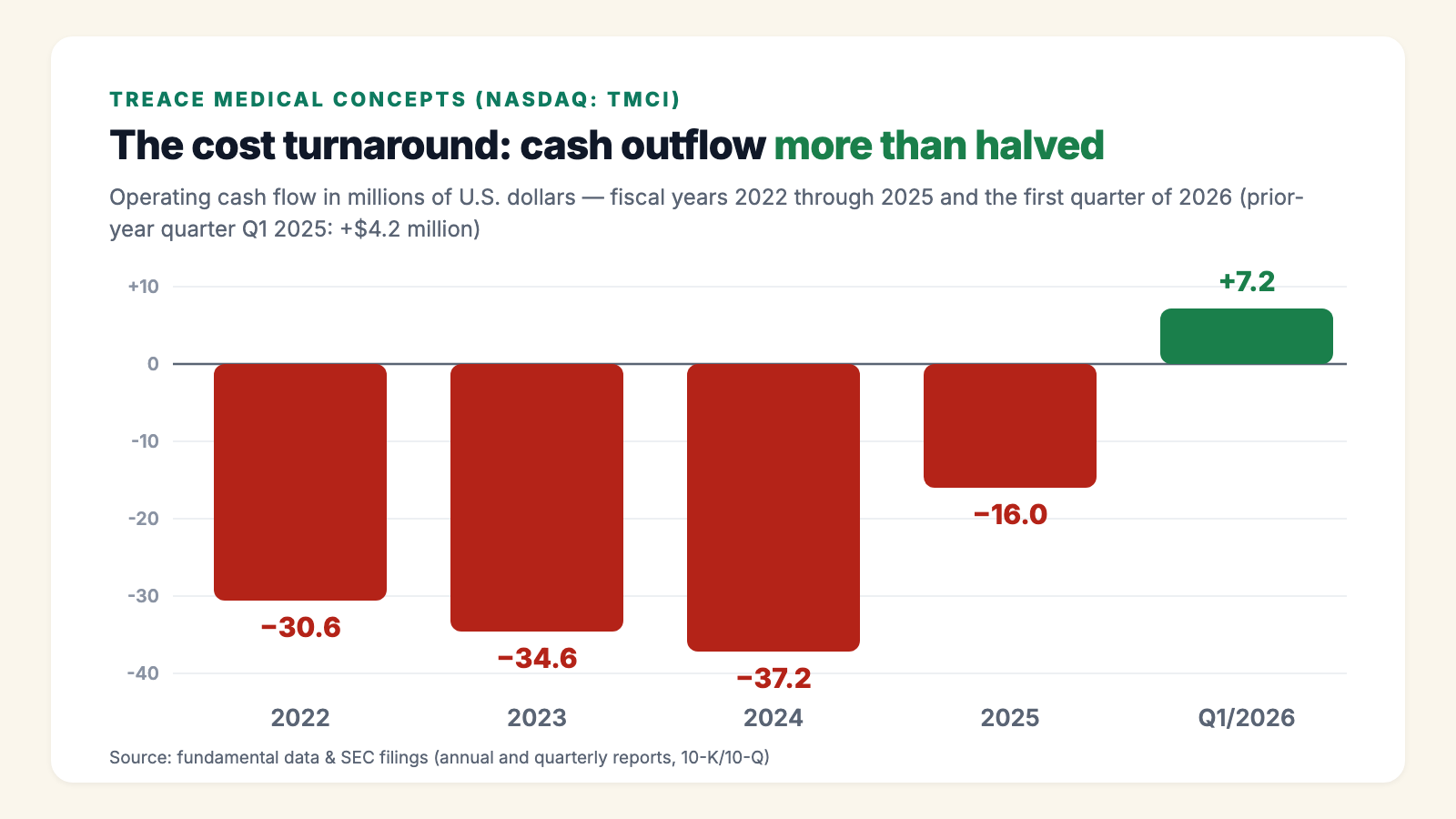
Operating cash outflow fell from $37.2 million (2024) to $16.0 million (2025); in the first quarter of 2026, $7.2 million flowed in (prior-year quarter: +$4.2 million), and liquidity grew by $3.5 million in the quarter to $51.9 million. And — remarkable for a loss-making company — all of it without the shareholder printing press: the share count rose only from 64.6 to 64.9 million between February and May 2026. Growth paid for with fresh shares is never quite free — Treace currently pays for its losses out of cash, cost cuts and a loan; more on that below. So much for the good half of the story. Now the other one:
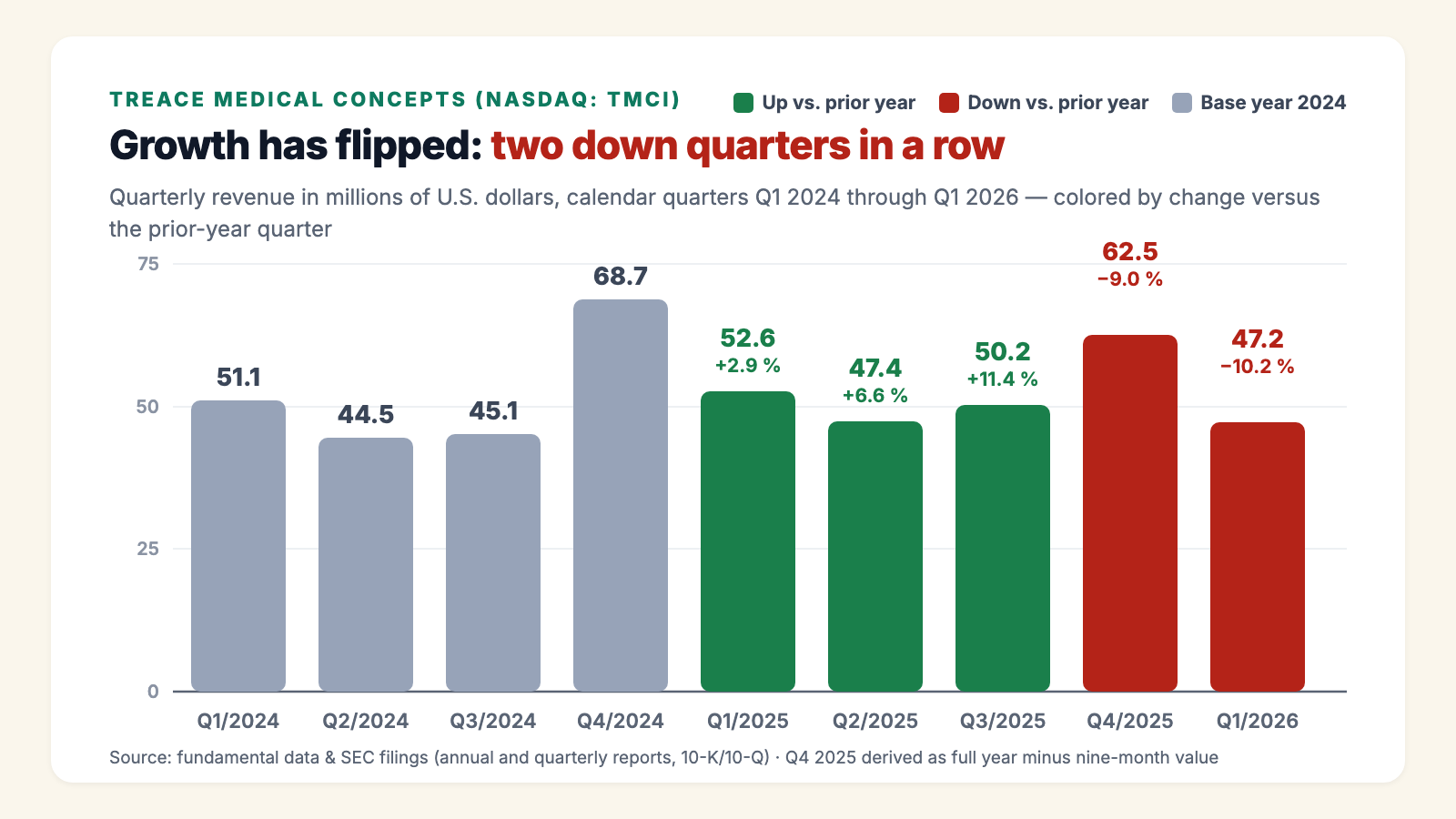
The full year 2025 looks like standstill at $212.7 million of revenue (+1.6 percent) — the quarters show the break: revenue fell roughly 9 percent in the fourth quarter of 2025 and 10.2 percent in the first quarter of 2026. And even the meager annual gain had a crutch: $13.0 million came in 2025 for the first time from stocking distributors — largely one-time initial stocking orders; in 2024 there was no such revenue at all. The company's own guidance for 2026 is $202 to $212 million (current report, 8-K of April 8, 2026): even the upper end would sit just below the 2025 figure. A company with an 80 percent gross margin whose revenue shrinks — how does that fit together? The answer stands in the filings, and it is the core of this analysis.
What the filings say — the uncomfortable truths
Uncomfortable truth no. 1: The flagship is losing its market — to the fashion of small incisions and its own cheaper sisters
Almost all of Treace's revenue hangs on one product family. The annual report (10-K) for 2025 says so — and in the same breath names the reason exactly this product is faltering:
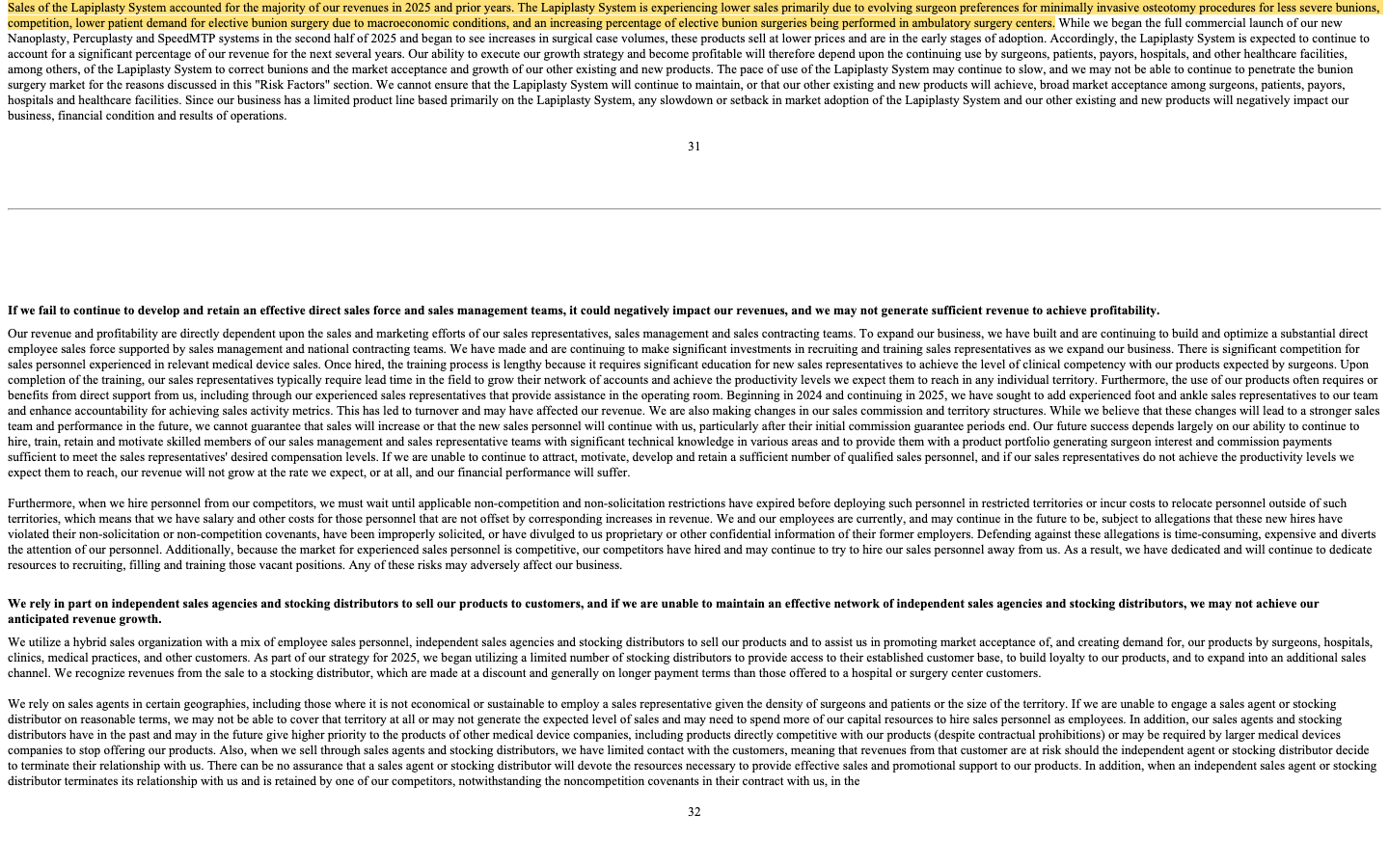
"Sales of the Lapiplasty System accounted for the majority of our revenues in 2025 and prior years. The Lapiplasty System is experiencing lower sales primarily due to evolving surgeon preferences for minimally invasive osteotomy procedures for less severe bunions, competition, lower patient demand for elective bunion surgery due to macroeconomic conditions, and an increasing percentage of elective bunion surgeries being performed in ambulatory surgery centers."
— Treace Medical, SEC annual report 10-K 2025, Item 1A "Risk Factors"
Translated into everyday language: surgical fashion has turned. Lapiplasty is a thorough but "open" procedure — for milder cases the trend runs toward minimally invasive operations with tiny incisions and faster healing. Treace reacted and fully launched its own mini systems in the second half of 2025 (Nanoplasty, Percuplasty, SpeedMTP). The catch: these new systems cost less than the flagship. The quarterly report (10-Q) as of March 31, 2026 states the consequence dryly: the revenue decline came "primarily from a shift in mix from the higher-priced Lapiplasty kits toward lower-priced minimally invasive kits and a lower volume of kits sold". So the company increasingly sells the cheaper product — and lately not even enough units of it to offset the price erosion. That is no catastrophe, but it is the opposite of the 2021 market story, when Treace was priced as a pure growth rocket.
Uncomfortable truth no. 2: The opponents are called Stryker, Zimmer Biomet and Johnson & Johnson — and they sell in bundles
Whoever sells into the operating room rarely negotiates over a single product. The giants of orthopedics supply hospitals with the complete range — and exactly there sits the lever a small specialist like Treace does not have. The annual report (10-K) describes the problem with rare clarity:
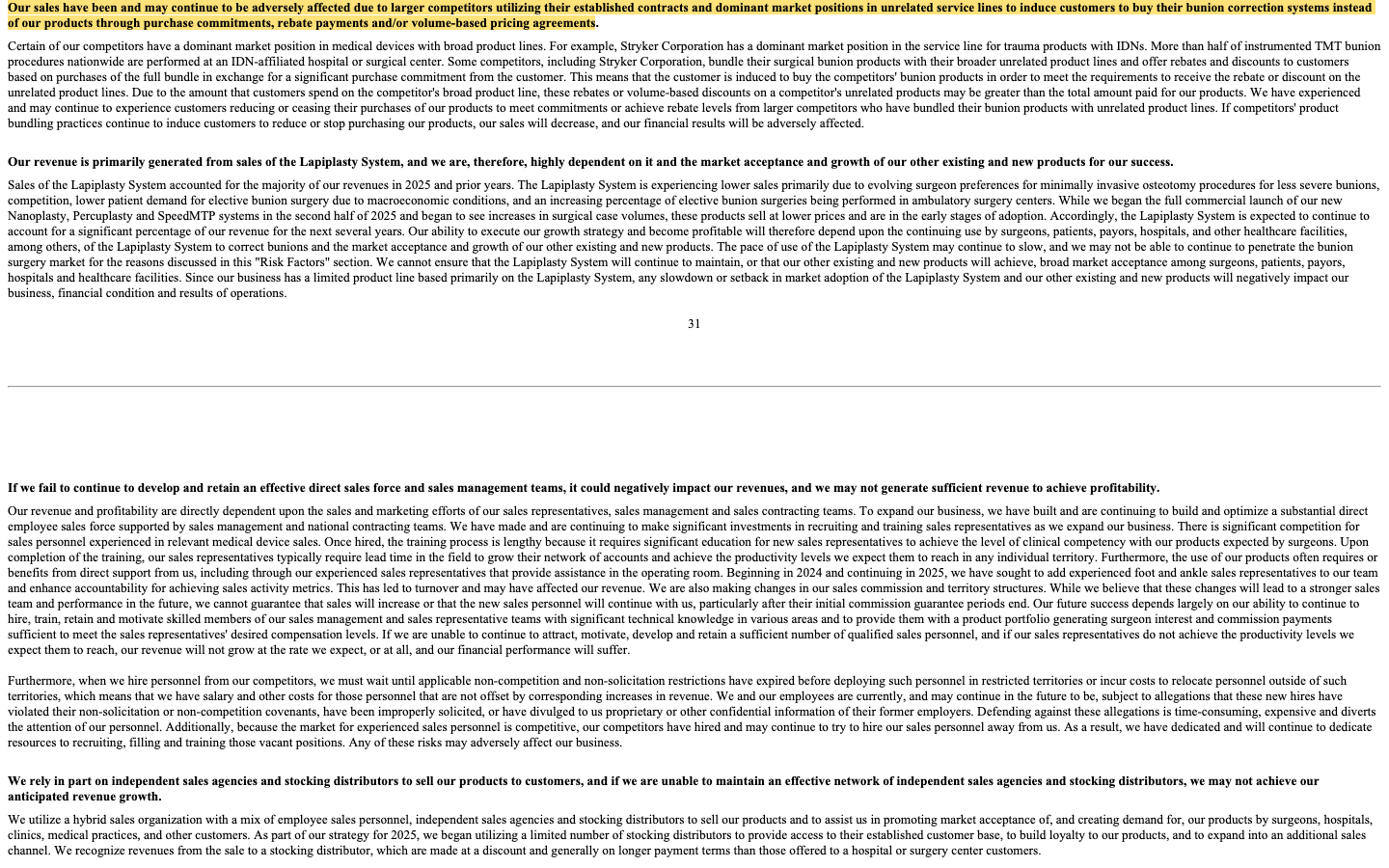
"Our sales have been and may continue to be adversely affected due to larger competitors utilizing their established contracts and dominant market positions in unrelated service lines to induce customers to buy their bunion correction systems instead of our products through purchase commitments, rebate payments and/or volume-based pricing agreements."
— Treace Medical, SEC annual report 10-K 2025, Item 1A "Risk Factors"
Picture a village baker whose bread is undisputedly the best — but the wholesaler delivers the cafeteria its flour, machines and coffee in one contract and throws the bread in "for free" on top. That is exactly how Treace describes its daily business: Stryker is, per the annual report, the market leader in the foot-and-ankle business; add Arthrex, Zimmer Biomet with Paragon 28, acquired in 2025, the Johnson & Johnson unit DePuy Synthes including CrossRoads, and further groups against which Treace lines up with roughly 450 employees. For your picture of the stock this means: the flagship weakness from truth no. 1 is not just a question of fashion but also the result of a turf war in which the other side holds structural advantages — purchasing contracts, bundle discounts, armies of sales reps.
Uncomfortable truth no. 3: The patent war — Treace sues giants, gets countersued and defers its legal bills at 10 percent interest
Treace fights back with the sharpest weapon a specialist has: its patents. In October 2024 the company sued Stryker for infringement of 9 Lapiplasty patents; in May 2025, Zimmer Biomet and Paragon 28 followed (by now 5 patents). That is consistent — and expensive and risky at once. First, the other side strikes back: Stryker countersued Treace in May 2025 over a hammertoe product, Paragon 28 filed suit over allegedly misappropriated software trade secrets, and at the U.S. patent office Paragon 28 requested administrative review of four of the five asserted patents — if that goes wrong, Treace loses exactly the property rights on which the 80 percent margin rests. Second, a shareholder class action has been running since April 2025, accusing management of disclosing the competitive damage of 2023/24 too late. And third, the multi-front war costs serious money: administrative costs rose $7.0 million in 2025, "driven primarily by $5.4 million of higher legal costs"; the first quarter of 2026 added another $2.1 million. How tight the budget for this is, a footnote in the quarterly report (10-Q) reveals — one you easily skip past:
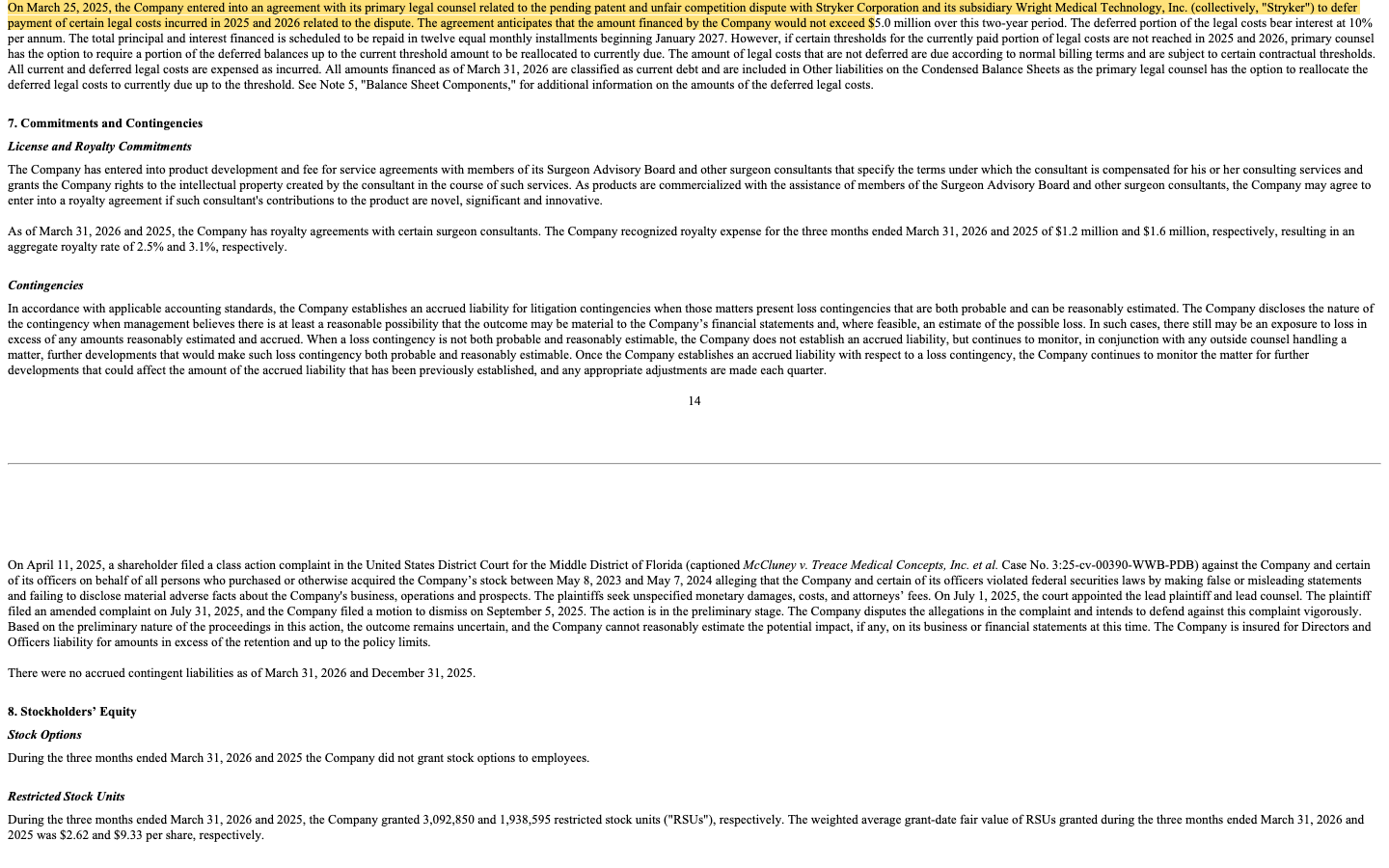
"On March 25, 2025, the Company entered into an agreement with its primary legal counsel related to the pending patent and unfair competition dispute with Stryker Corporation […] to defer payment of certain legal costs incurred in 2025 and 2026 related to the dispute. The agreement anticipates that the amount financed by the Company would not exceed $5.0 million over this two-year period. The deferred portion of the legal costs bear interest at 10% per annum."
— Treace Medical, SEC quarterly report 10-Q as of March 31, 2026, note 6 "Long-Term Debt"
A company that pays its legal bills on credit — at an interest rate you otherwise know from credit cards — is not fighting this war from a position of strength. If Treace wins, damages and a clean market for its patents beckon. If the company loses — or the patents fall in review — it was very expensive tuition. Both are open; per the quarterly report (10-Q), the proceedings are still in early stages.
Uncomfortable truth no. 4: $60 million of debt, a lien on everything — and the cash is smaller than the loan
That leaves the question of what pays for all this. In December 2025 Treace refinanced: away from previous lender MidCap, toward a package with SLR Investment — per the current report (8-K of December 18, 2025) a framework of up to $175 million, of which $60 million was drawn immediately as a term loan (maturing 2030, bearing interest at one-month SOFR, 3 percent floor, plus 5.05 percentage points — per the 10-K 2025). The switch cost a $2.7 million extinguishment loss. Against the loan stand $51.9 million of cash and securities as of March 31, 2026 — the company owes its lenders more than it holds liquid. The security is as hard as usual: in an event of default, per the annual report (10-K), SLR could reach "substantially all assets including intellectual property" — that is, also the patents over which the war from truth no. 3 is being fought. Add covenants: Treace must hold minimum liquidity of 60 percent of the drawn loan, otherwise minimum-revenue requirements kick in; as of March 31, 2026 the liquidity covenant was met. Honesty also requires the counter-calculation the company itself presents: cash, securities, unused credit lines and expected revenue suffice "for at least twelve months" — and unlike at many loss-making companies we have analyzed, the positive quarterly cash flow actually supports that statement. A going-concern warning, familiar to readers of our penny-stock cases, is not found at Treace. The risk here sits one step earlier: if revenue keeps falling, the cost turnaround tips first — and then the loan with a lien on the patents becomes a lever in someone else's hand.
The boss is buying — what the insider filings really show
Now to the trigger of the authority bias. The insider filings (Form 4) with the SEC show: founder and CEO John T. Treace bought roughly 371,600 shares on the open market in nine tranches between May 12 and June 11, 2026 — at prices between $2.17 and $4.04, together about $1.1 million. That is no symbolic signal purchase, and it comes from someone who per the proxy statement (DEF 14A of April 2026) already controls 18.7 percent of the company — his name is on the sign, his wealth sits in the business. Two qualifications still belong here. First: insider purchases are a sentiment indicator, not proof — founders have been wrong before, and per the proxy statement Mr. Treace earned $5.4 million in total 2025 compensation (mostly in stock), while his annual bonus lapsed for missed targets. Second: the buying window sat after the crash to near penny-stock territory and after the preliminary Q1 figures — the boss bought his own stock when the market was pricing it like a restructuring case. The mirror image also exists: at FuelCell Energy, whose analysis we just published, an executive sold near the rally high. Remember: insider sales have a thousand reasons, insider purchases really only one. But that one reason — "the boss thinks the stock is too cheap" — does not replace the question of whether the business is turning. And that is decided by truths no. 1 and 2.
And AI? Nothing — literally
Because in 2026 hardly any analysis gets by without an AI chapter, we systematically searched the last six filings (four quarterly reports 10-Q, two annual reports 10-K) for it. The finding is unambiguous: Treace sells no AI, uses no notable AI per its filings, and does not see itself concretely threatened by it either. Artificial intelligence appears only in boilerplate — as a tool of cyber attackers ("generative and other artificial intelligence") and as a future regulatory topic that could one day make "the incorporation of certain AI capabilities into our products" more expensive. Even the company's own digital surgical-planning tool IntelliGuide is not marketed as AI in the annual report (10-K). For you this means two things: there is no AI fantasy here to carry the price if the core business disappoints — but also no AI bubble that could burst. This stock stands and falls with feet, surgeons and patents.
Valuation: You pay one year of revenue — for an 80 percent margin with a crack
At mid-2026 (data as of July 9), the market valued Treace at roughly $260 million — about 1.2 times the revenue of the last four quarters. For scale: profitable medical-technology companies typically cost 4 to 8 times revenue; Treace itself traded at ten times and more at times during its growth years after the 2021 IPO. A price-to-earnings ratio does not exist for lack of profit; the price-to-book ratio recently sat around 3.5 (data as of July 9, 2026). Unlike with many fallen market darlings, this is not a valuation question but a trust question: for 1.2 times revenue you get a 79.8 percent gross margin, a patent portfolio with pending suits of uncertain outcome, a real cost turnaround — and a core business that has shrunk two quarters in a row, with company guidance promising at best stagnation for 2026. Next to the valuation, do not forget the fall speed: after roughly +250 percent in three months (data as of July 9, 2026), a hefty portion of turnaround advance already sits in the price; how much advance hope can sit in a multiplied price — and what happens when the filings say otherwise — is something we just dissected at Outlook Therapeutics, another name from the same top-gainers list. The next checkpoints are set: the quarterly report (10-Q) as of June 30, 2026 — in 2025 it appeared in early August — and after that the seasonally decisive fourth quarter, which at Treace historically brings 30 to 35 percent of annual revenue.
Opportunities and risks at a glance
What speaks for Treace Medical:
- Extraordinary product economics: a 79.8 percent gross margin in 2025, patented procedures, an addressed market of more than $5 billion per the annual report (10-K) with only roughly 450,000 procedures a year so far.
- The cost turnaround is measurable: operating cash outflow more than halved from $37.2 to $16.0 million (2024 → 2025), +$7.2 million of operating inflow in the first quarter of 2026, liquidity up $3.5 million in the quarter to $51.9 million.
- Insiders with skin in the game: the founder-CEO with an 18.7 percent stake bought roughly $1.1 million of shares on the open market in May/June 2026; barely any dilution (64.6 → 64.9 million shares from February to May 2026).
- The product range has followed the fashion: own minimally invasive systems (Nanoplasty, Percuplasty) and SpeedMTP fully in the market since the second half of 2025, case numbers rising per the annual report; the suits against Stryker and Zimmer Biomet/Paragon 28 could enforce the patents and bring damages.
- Strong price momentum with scanner tailwind: roughly +250 percent in three months, relative strength 98, eight momentum-scanner hits (data as of July 9, 2026) — the market is beginning to price the turnaround.
What speaks against it:
- The core business is shrinking: revenue −9.0 percent in the fourth quarter of 2025, −10.2 percent in the first quarter of 2026; company guidance for 2026 ($202–212 million) sits just below the 2025 figure even at the upper end; the mix shift to cheaper kits presses durably on revenue per procedure.
- Structurally superior competition: Stryker as market leader plus Zimmer Biomet/Paragon 28, Arthrex and DePuy Synthes (Johnson & Johnson) use bundle discounts and group contracts per the annual report (10-K), against which a 450-person specialist can set only product quality.
- A multi-front war in court: own patent suits against Stryker and Zimmer Biomet/Paragon 28, countersuits (hammertoe patent, trade secrets), administrative review of four of the five asserted patents, plus a shareholder class action; legal costs +$5.4 million in 2025, +$2.1 million in Q1 2026 — partly deferred with the company\'s own law firm at 10 percent interest.
- A levered balance sheet: the $60 million loan (maturing 2030, SOFR + 5.05 percentage points) exceeds liquid funds of $51.9 million (March 31, 2026); a lien on essentially all assets including the patents; a $59.0 million net loss in 2025 and $267.0 million of accumulated losses through March 31, 2026.
- Overheated market technicals: daily swings around 9.6 percent; besides the momentum, our scanner reports "Stan Weinstein: Stage 3" (possible topping) and the bankruptcy-risk screen "Thomas Inso Kandidat" (data as of July 9, 2026) — and despite the rally the stock still trades roughly 88 percent below its all-time high.
A human conclusion
Back to the voice whispering "the boss must know!". It has more substance than most market whisperings: a founder with an 18.7 percent stake who, after an 88 percent crash, buys another million dollars' worth while operating cash flow actually turns positive — that is a signal you may take seriously. But authority bias lives on us delegating the homework to the authority. Do it ourselves, and the same man's documents say: a flagship losing out to the fashion of small incisions and to corporate discount bundles; guidance promising at best stagnation for 2026; a patent war whose legal bills are deferred at credit-card interest; and a loan larger than the cash — with a lien on exactly the patents being fought over. The boss is buying a bet he knows better than anyone: that the cost turnaround holds, the new mini systems replace the flagship, and the courts protect his patents. It is his company and his risk — whether it should also be yours is told not by his purchases but by the next two quarterly reports: does the revenue decline stop before the cost turnaround has to catch it? Until then: an insider purchase is an argument, not a substitute for reading. What you make of it is your decision. And that is exactly as it should be.
Sources
All original documents used in this analysis — for reading yourself:
- Treace Medical Concepts, Inc. — SEC annual report 10-K for fiscal year 2025 (filed February 27, 2026)
- Treace Medical Concepts, Inc. — SEC quarterly report 10-Q as of March 31, 2026 (filed May 8, 2026)
- Treace Medical Concepts, Inc. — SEC current report (8-K) of April 9, 2026: preliminary Q1 figures, 2026 guidance, departure of the chief commercial officer
- Treace Medical Concepts, Inc. — SEC current report (8-K) of December 18, 2025: credit agreements with SLR Investment
- Treace Medical Concepts, Inc. — SEC proxy statement (DEF 14A) of April 6, 2026: executive compensation, shareholder structure
- Insider filings (Form 4) by John T. Treace, May/June 2026 — EDGAR overview of the Form 4 filings (sec.gov)
- Complete SEC filing history: EDGAR overview for Treace Medical (sec.gov)
- Fundamental data (metrics, valuation; data as of July 9, 2026), cross-checked against the SEC filings and the SEC's XBRL data interface.
- Screener and rating data: in-house stock scanner (data as of July 9, 2026).
Transparency & disclaimer: This analysis is a journalistic contextualization of publicly available information and is not investment advice, not a financial analysis in the regulatory sense, and not a solicitation to buy or sell securities. Stock investments carry substantial risks up to total loss. All information without guarantee; the data cut-off is noted in the text in each case. The author holds no position in Treace Medical stock at the time of publication.
Our Bottom Line at a Glance
- Product economics positive
- A 79.8 percent gross margin in 2025, patented surgical systems, an addressed market of more than $5 billion per the annual report (10-K) with only roughly 450,000 procedures per year so far — the substance of the business model is extraordinary.
- Cost turnaround & cash flow positive
- Operating cash outflow more than halved from $37.2 to $16.0 million (2024 → 2025), +$7.2 million of inflow in the first quarter of 2026, liquidity up $3.5 million in the quarter — and practically without dilution (64.6 → 64.9 million shares, February to May 2026).
- Insiders & owners positive
- The founder-CEO with an 18.7 percent stake bought roughly 371,600 shares for about $1.1 million on the open market in May/June 2026 per insider filings (Form 4); more than 80 percent of the shares sit with professionals and insiders (data as of July 9, 2026).
- Core business negative
- The Lapiplasty flagship carries the majority of revenue and is losing out to minimally invasive procedures; revenue −9.0 percent in the fourth quarter of 2025, −10.2 percent in the first quarter of 2026; company guidance for 2026 ($202–212 million) sits just below the 2025 figure even at the upper end.
- Competition & litigation negative
- Stryker, Zimmer Biomet/Paragon 28, Arthrex and DePuy Synthes counter with bundle discounts and group contracts; add a multi-front patent war including countersuits, administrative review of four of the five asserted patents and a shareholder class action — legal costs +$5.4 million in 2025, partly deferred with the company's own law firm at 10 percent interest.
- Balance sheet & technicals neutral
- A $60 million loan (maturing 2030, SOFR + 5.05 percentage points, lien on essentially all assets including the patents) stands against $51.9 million of liquid funds; the liquidity covenant was met as of March 31, 2026, no going-concern warning. Technically overheated after roughly +250 percent in three months: Weinstein Stage 3 and bankruptcy-risk-scanner hits next to the momentum shelf (data as of July 9, 2026).
Treace Medical is a specialist with a dream margin and a real cost turnaround whose flagship product is at the same time losing its market to minimally invasive procedures and discount-heavy giants. The founder is buying against it with his own money, the balance sheet holds — but two down quarters in a row and a patent war with an open outcome make the turnaround a question of proof. Not investment advice.
What Our Rating Means
- If you don't own the stock
- As long as the question raised in the bottom line stays open, we see no basis for an entry.
- If you hold it in your portfolio
- Our findings offer no acute reason to sell — the checkpoints named remain decisive.
A journalistic assessment by our editorial team at the time of the deep dive, based on public sources — not investment advice and not a solicitation to buy or sell. Your personal circumstances (investment goals, risk capacity, taxes) cannot be taken into account. What our categories mean, how verdicts are formed, and what conflicts of interest exist →
Worth Noting
- No going-concern warning in the annual report (10-K) for 2025; the company expects sufficient funds for at least twelve months. The hit in the bankruptcy-risk screen "Thomas Inso Kandidat" feeds on the weak balance-sheet history and falling revenue — it is a smoke detector, not an insolvency verdict.
- Fiscal year = calendar year; "2025" means January through December 2025. Q4 2025 revenue derived as full year minus nine-month value. The quarterly report (10-Q) as of June 30, 2026 has historically appeared in early August.
- A very volatile stock: daily swings around 9.6 percent, roughly 88 percent below the all-time high despite roughly +250 percent in three months (data as of July 9, 2026). Shareholder class action (McCluney v. Treace, class period May 2023 through May 2024) in an early procedural stage.
Frequently Asked Questions
Treace Medical of Ponte Vedra, Florida, develops and sells surgical systems for correcting bunions (hallux valgus) — above all the patented Lapiplasty 3D system, complemented by minimally invasive systems (Nanoplasty, Percuplasty), Adductoplasty and SpeedMTP. With roughly 450 employees it sells directly to U.S. hospitals and ambulatory surgery centers; the company has been listed since April 2021 (Nasdaq: TMCI).
The insider filings (Form 4) show: founder-CEO John T. Treace bought roughly 371,600 shares for about $1.1 million on the open market between May 12 and June 11, 2026 — at prices between $2.17 and $4.04, after the stock had crashed to roughly 88 percent below its all-time high. The filings do not state his motives; per the proxy statement (DEF 14A) he already holds 18.7 percent of the company. Insider purchases are an indication, not proof.
Per the annual report (10-K) and quarterly report (10-Q), surgeons are switching to minimally invasive procedures for milder bunions, giant competitors like Stryker lure hospitals with bundle discounts, and Treace's new, cheaper systems are replacing the higher-priced Lapiplasty flagship. The result: revenue down 9.0 percent in the fourth quarter of 2025 and down 10.2 percent in the first quarter of 2026; the 2026 guidance ($202–212 million) sits below the 2025 figure.
Split in two: 2025 brought a $59.0 million net loss, but operating cash outflow fell from $37.2 to $16.0 million, and the first quarter of 2026 was operationally positive at +$7.2 million. As of March 31, 2026, $51.9 million of cash and securities stood against $60 million of loan debt (maturing 2030), secured by essentially all assets including the patents. The annual report (10-K) contains no going-concern warning.
Treace is suing Stryker (9 patents, since October 2024) and Zimmer Biomet/Paragon 28 (5 patents, since May 2025) for infringing its Lapiplasty property rights. The other side is fighting back: Stryker is suing Treace over a hammertoe product, Paragon 28 over allegedly misappropriated software secrets, and it requested review of four of the five patents at the U.S. patent office. Treace defers part of the legal costs with its own law firm — at 10 percent interest.
Measured against revenue, yes: roughly $260 million of market value equals about 1.2 times the revenue of the last four quarters (data as of July 9, 2026) — profitable medical technology often costs 4 to 8 times. In exchange you get a 79.8 percent gross margin, but also a shrinking core business, ongoing losses and litigation risks. A P/E does not exist for lack of profit; after roughly +250 percent in three months, turnaround advance already sits in the price.
Found an error?
Did you spot a factual error, an outdated number, or a typo in this deep dive? Let us know briefly — your report goes straight to the editorial team.