FuelCell Energy Stock: 380 Megawatts of Fantasy, 30 Megawatts on Order — and No Profit Since 1997
FuelCell Energy builds fuel-cell power plants, and suddenly the AI world wants its electricity: a framework agreement covering up to 380 megawatts for data centers catapulted the stock up more than 350 percent in three months. We read the annual report (10-K), the quarterly reports (10-Q) and the fresh current reports (8-K): only 30 megawatts are firmly ordered so far, the customer was handed warrants on 12 million shares — and the company has been selling its products below manufacturing cost for years. Not investment advice — just the sonar ping before you leap after the echo.
 Thomas Mücke
Founder & Publisher
Thomas Mücke
Founder & Publisher
Chart
Interactive price chart (TradingView).
Note: pure fact-based analysis, not investment advice and not a solicitation to buy or sell. All figures without guarantee.
A rising price feels like an argument. That may be the most expensive illusion in the stock market: when a stock gains more than 350 percent in three months, your brain stops looking for counterarguments — surely that many buyers cannot all be wrong. Psychologists call it confirmation bias, traders call it herd instinct, and both mean the same thing: the price becomes the proof. The echo is loud beyond the exchange, too — on Reddit, the ticker keeps surfacing (3 mentions within 24 hours, data source ApeWisdom, as of July 18, 2026). Which is exactly why we make a deal at FuelCell Energy (Nasdaq: FCEL): we treat the price surge not as proof but as an echo — a loud signal from great depth whose source we locate together. Our echo sounder is the set of mandatory filings with the U.S. securities regulator, the SEC: the annual report (10-K), the quarterly reports (10-Q) and the current reports (8-K) of recent weeks. Such a filing is honest under penalty of law. And at FuelCell it reports two things at once: a real, signed order from the AI world. And a company that has not closed a single profitable year since 1997. In the end, you decide which weighs more.
What FuelCell Energy actually does
FuelCell Energy builds fuel-cell power plants — installations that do not burn natural gas, biogas or hydrogen but convert them directly into electricity through an electrochemical reaction. Picture a very large battery that never runs empty as long as you keep feeding it fuel: quieter than a power station, cleaner than a diesel generator, and it delivers around the clock — which sets it apart from wind and solar. The annual report sums it up like this:
"Founded in 1969 and headquartered in Danbury, Connecticut, we manufacture and sell our proprietary molten carbonate fuel cell systems, which deliver large-scale, continuous clean power and advanced emissions management."
— FuelCell Energy, SEC annual report 10-K for fiscal year 2025, Item 1 "Business"
Read that founding year twice: 1969, as Energy Research Corporation. This company is not a hydrogen bet from the last hype cycle but 57 years old — with real reference plants of 10 to 58.8 megawatts, a factory in Torrington, Connecticut, a plant in Taufkirchen near Munich, Germany, and most recently 424 employees (as of October 31, 2025). It sells through three channels: plants outright (product business), long-term maintenance contracts (service), and its own power plants whose electricity FuelCell sells under agreements running up to 20 years (generation). One quirk for reading the numbers right away: the fiscal year ends on October 31 — when this analysis says "fiscal year 2025", it means November 2024 through October 2025. And one more thing belongs to honesty: in 2024 and 2025 the company shrank hard through two rounds of restructuring, halted the expansion of its plant in Calgary, Canada, and discontinued the development of its second power-plant technology (solid oxide) — the bet now rides almost entirely on the old carbonate platform. Why none of that bothers the price has two letters: AI.
Where the stock shows up in our scanner
Every day we run about 3,500 stocks through our scanners. FuelCell fires in 15 of them (data as of July 9, 2026) — and the list reads like a shouting match. On one side, the complete momentum shelf: Stan Weinstein: Stage 2 (an established uptrend), stage-2 leader, RS leader (≥ 90) with a weekly relative strength of 98 — the stock recently outran 98 percent of the market —, Qullamaggie: Top Gainers 3M (+356 percent in three months), above the 50- and 200-day averages, 21-EMA trend, Gary Antonacci: Dual Momentum, plus the trend lists of Minervini, Webster and Moglen, and high ADR (≥ 5%) — the average daily range sits around 16 percent, which is a roller coaster, not a savings account. On the other side stand two scanners we built precisely for price rockets like this: "Thomas Inso Kandidat", our bankruptcy-risk sieve (it hunts for weak balance sheets, interest bills the profit cannot cover, and low insolvency early-warning scores), and Kathy Donnelly: Liquid Movers Down — which fires when a name gets sold off hard on heavy liquidity, exactly what happened to FuelCell around its latest share offering. Remember this tension, it is the thread of the whole analysis: the market is pricing a takeoff that the balance sheet has not yet met.
The numbers over the years — growth yes, profit never
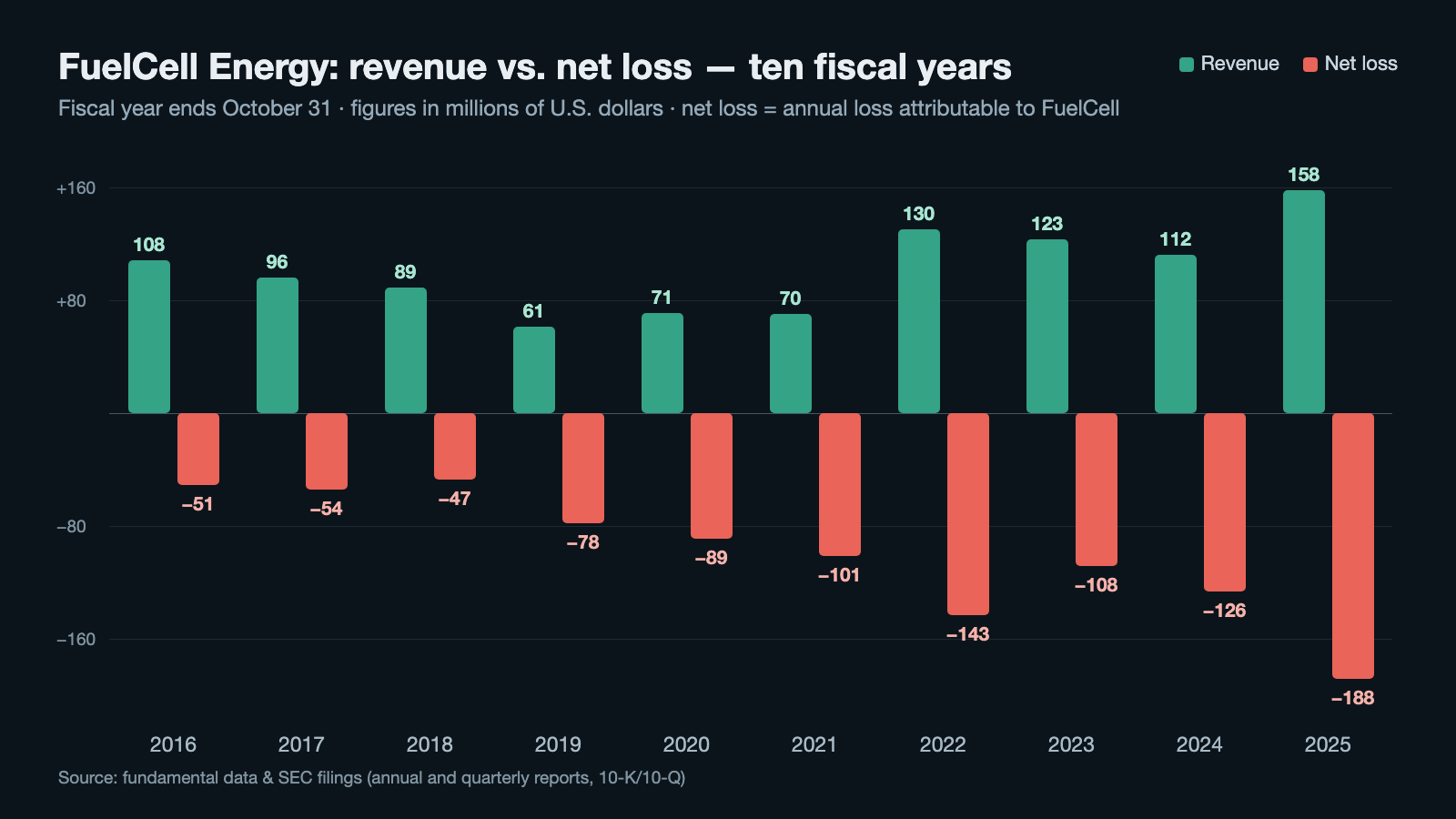
Let's start with what genuinely improved. Revenue for fiscal year 2025 (ended October 31, 2025) jumped 41 percent to $158.2 million — the highest level in a decade. The driver was the product business: $69.1 million (+169 percent), mostly because FuelCell fitted the 58.8-megawatt platform of customer Gyeonggi Green Energy ("GGE") in Hwaseong, South Korea, with new modules — 22 replacement modules in fiscal 2025 alone. The first half of fiscal 2026 (November 2025 through April 2026) grew as well: $66.1 million in revenue, up 17 percent. That is real, and it is right there in the filings.
Now lower the echo sounder. The same filings show: cost of revenues in fiscal 2025 came to $184.6 million — more than revenue itself. The gross margin was minus 16.7 percent; the year before, minus 32.0 percent. In plain words: FuelCell sells its products and its electricity, on average, below what production and operation cost — every delivery widens the loss before a single overhead dollar is counted. On top came $60.7 million in administrative and selling expenses, $34.1 million in research spending, $5.3 million in restructuring costs and $65.8 million of impairments on the discontinued solid-oxide business: a net loss of $187.9 million — the largest in company history. Operations burned roughly $125.3 million of cash in fiscal 2025 and another $61.2 million in the first half of fiscal 2026. How brutally a hardware business can bleed at the gross-margin line is something we dissected at Eos Energy — FuelCell has been living on that line for decades.
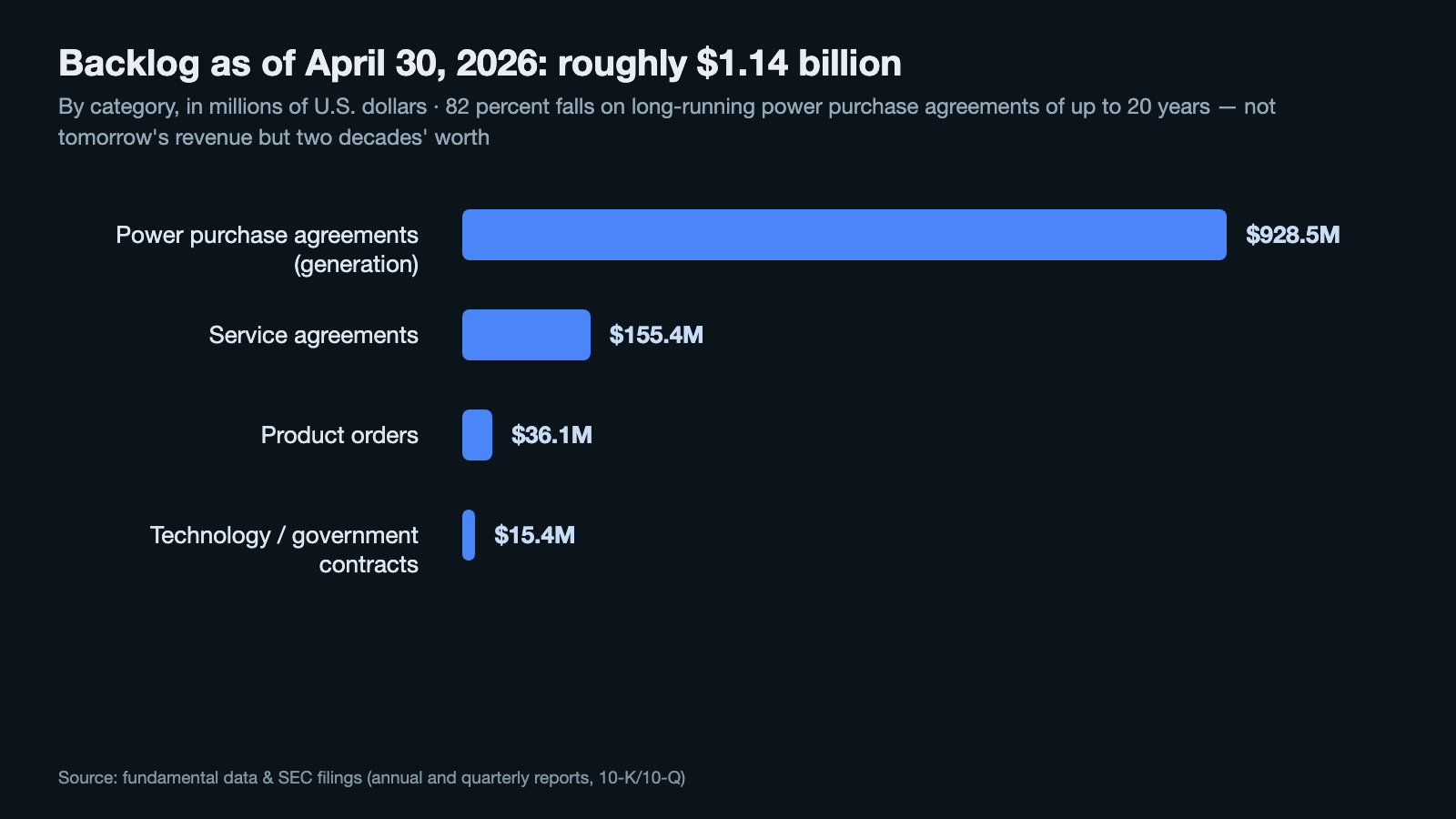
One more word on the backlog, because at roughly $1.14 billion (as of April 30, 2026) it sounds like salvation. Look closer: $928.5 million of it — 82 percent — is future electricity revenue from power purchase agreements running up to 20 years. That is not tomorrow's revenue but two decades' worth, and the generation business behind it most recently posted gross losses. The fast-turning product backlog, meanwhile, shrank from $98.2 million to $36.1 million within a year, because the GGE modules shipped and little new business followed — the Fit framework agreement of June 2026 (more on it below) was not yet included as of the reporting date.
What the filings say — the uncomfortable truths
Uncomfortable truth no. 1: No profitable year since 1997 — and the company writes it itself
The most important line of this whole analysis is not buried in fine print; it stands openly in the risk factors of the annual report:
"We have not been profitable since our year ended October 31, 1997. We expect to continue to incur net losses and generate negative cash flows until we can produce sufficient revenues and gross profit to cover our costs. We may never become profitable."
— FuelCell Energy, SEC annual report 10-K for fiscal year 2025, Item 1A "Risk Factors"
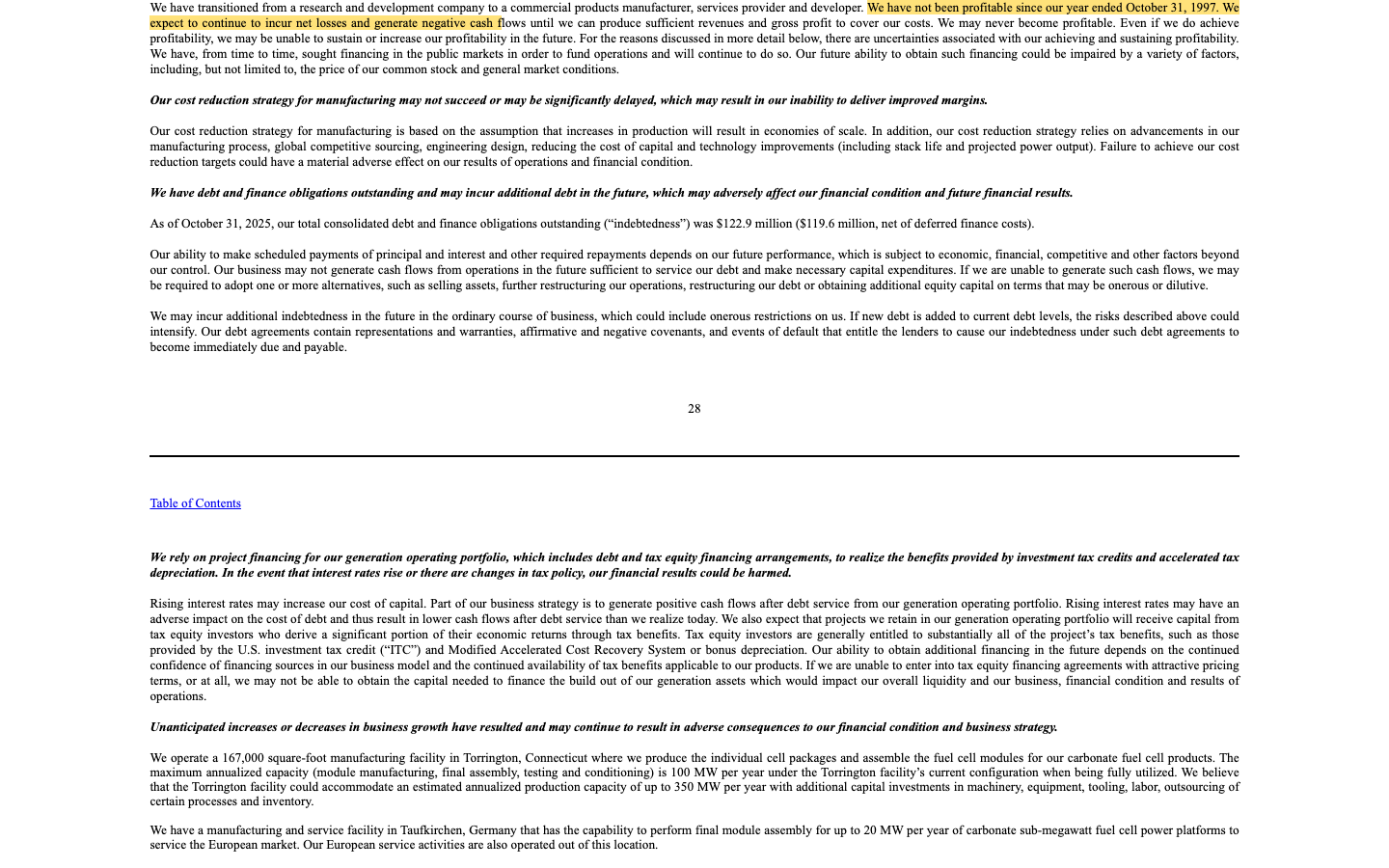
Twenty-eight consecutive fiscal years without a profit — through the dot-com boom, the first hydrogen hype, the second hydrogen hype, and up to today. The accumulated deficit — the sum of every loss ever booked — stood at $1.83 billion as of October 31, 2025. Fairness requires saying: unlike some other perennial loss-makers, FuelCell carries no going-concern warning, the auditor's formal doubt about survival. The company states expressly in the quarterly report (10-Q) as of April 30, 2026 that cash, expected collections from the backlog and released collateral cover the obligations of the next twelve months. $373.2 million sat in the till on April 30, 2026; after that came roughly $245 million net from the July offering and a first tranche of about $22 million from a $49 million financing package of the Export-Import Bank of the United States. The question at FuelCell is not whether the money lasts through next year. The question is where it comes from — which leads to the next truth.
Uncomfortable truth no. 2: The money source is you — dilution week after week
"Dilution" means your slice of the pie shrinks because new slices keep being cut. At FuelCell this is not a side effect but the financing model — for decades. The company's history counts several reverse splits; the latest came on November 8, 2024: 30 old shares were merged into one, turning 611,278,662 shares into 20,375,932. A reverse split changes nothing about the value of your holdings — it only papers over, optically, how far the price had fallen. A monument to that history stands in the current prospectus supplement: it lists employee stock options with a weighted-average exercise price of $574.67 per share — relics from an era when the (split-adjusted) price knew such heights. For scale: the July 2026 offering was priced at $21.00.
And the machine keeps running, right now: in the first half of fiscal 2026 alone (November 2025 through April 2026), FuelCell sold 17.2 million new shares at an average of $9.22 through its ongoing at-the-market program — $158.9 million gross. Barely had the data-center rally multiplied the price when the next round followed on July 7/8, 2026: 12.3 million shares at $21.00, roughly $245.4 million net, the overallotment option fully exercised. Smart treasury management? Absolutely — expensive equity is best sold into euphoria. But look at what it means for you as a part-owner:
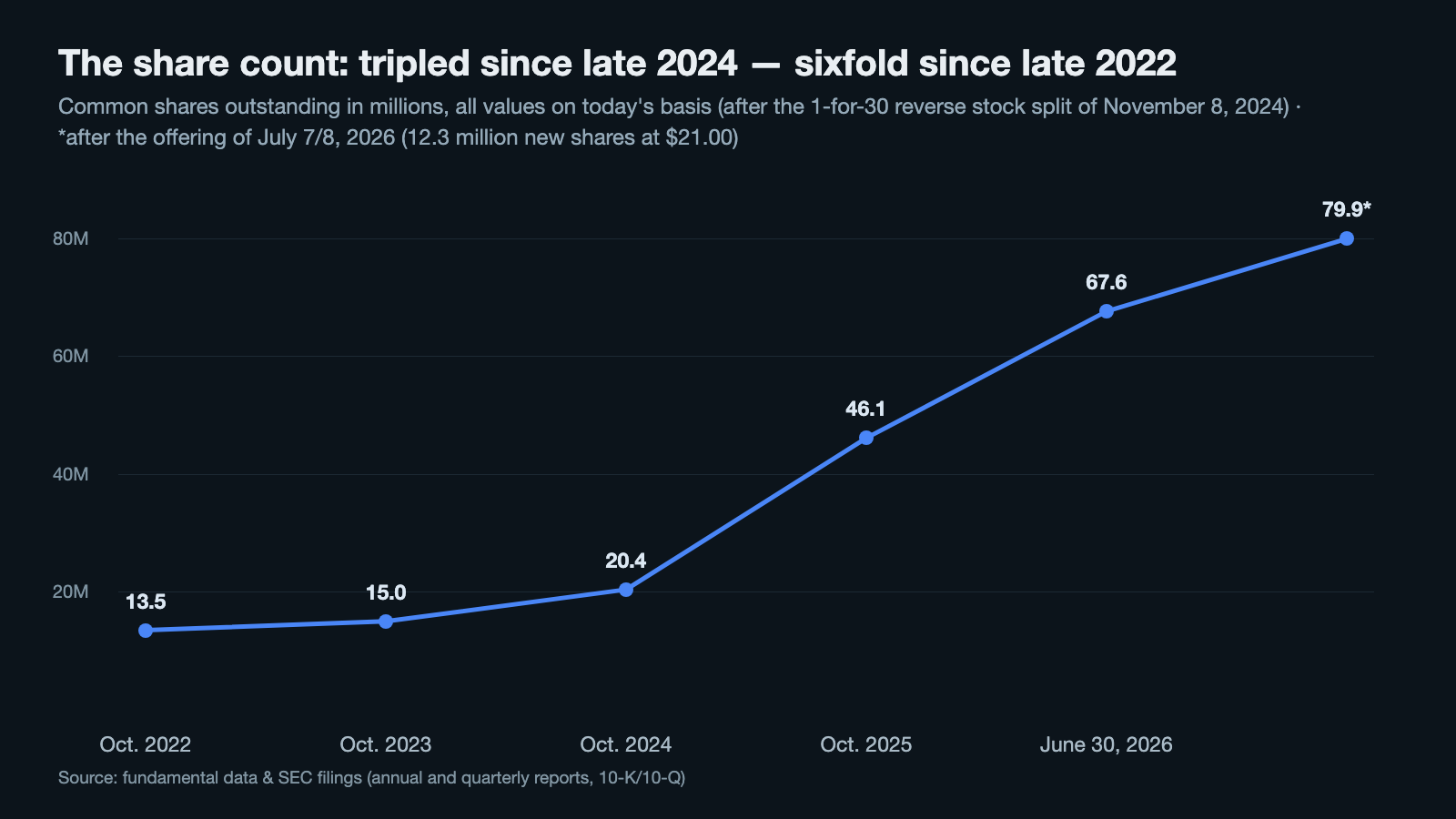
Growth paid for with fresh shares is never entirely free: whoever believes the FuelCell story has to buy into it with an ever-smaller share of that very story. The fundamental data closes this chapter: despite the rally, the stock traded in early July 2026 roughly 92 percent below its level of five years earlier — and practically 100 percent below the all-time high of the dot-com era. The price can multiply while your wealth melts over the long run: that is the arithmetic of perpetual dilution.
Uncomfortable truth no. 3: One customer in South Korea carried 46 percent of revenue
The fiscal 2025 revenue jump has an address — and essentially only one. The annual report does the math itself in the "Concentrations" note:
"For the years ended October 31, 2025, 2024 and 2023, our top customers accounted for 82%, 68% and 75%, respectively, of our total annual consolidated revenue."
— FuelCell Energy, SEC annual report 10-K for fiscal year 2025, Note 1 "Concentrations"
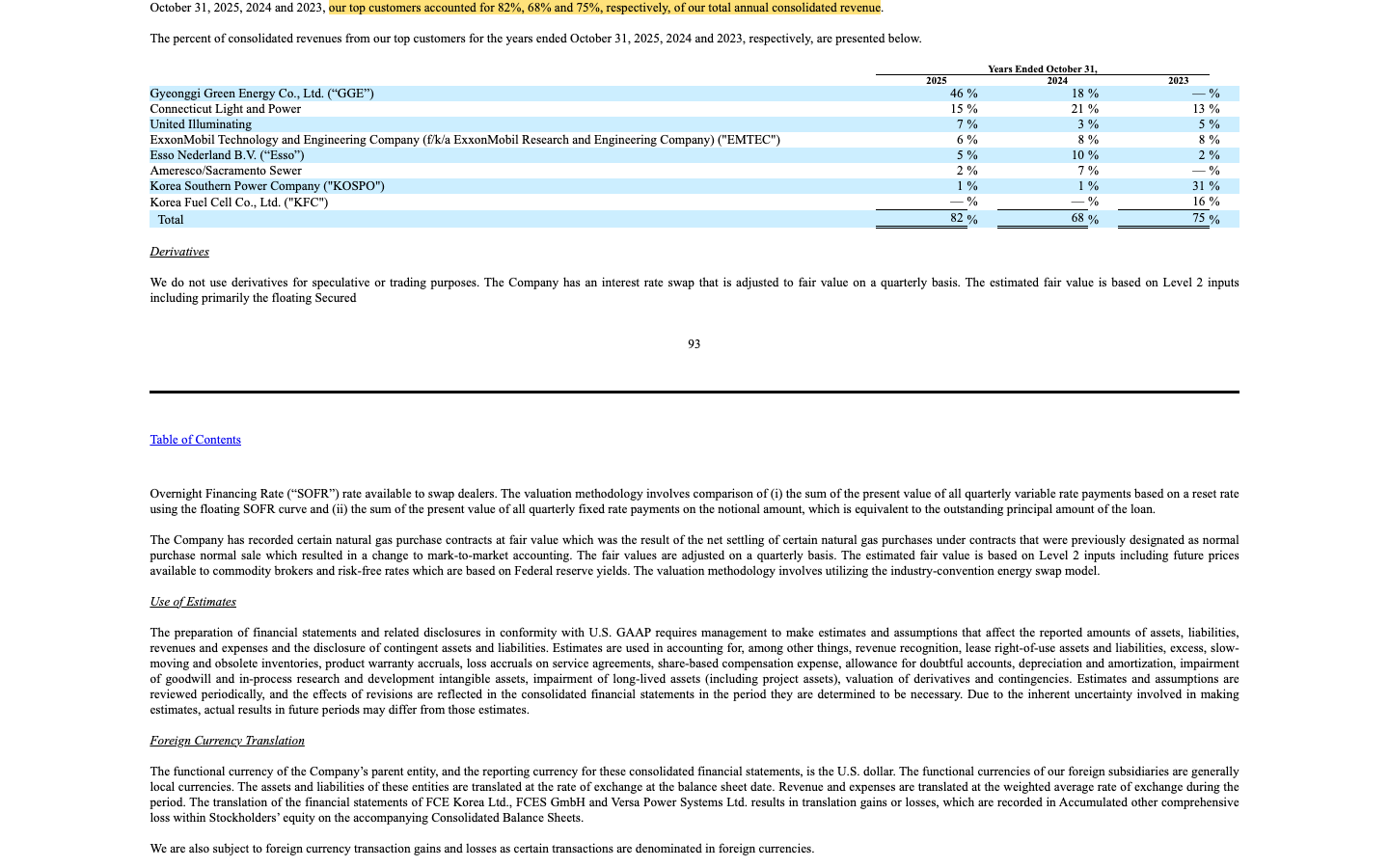
If your neighbor told you his shop was growing 41 percent, but a single buyer accounted for nearly half the takings — would you swallow for a second? Exactly. The 46-percent customer is Gyeonggi Green Energy, operator of the 58.8-megawatt platform in Hwaseong, South Korea. We looked at the contract behind it: a module replacement and service agreement from May 2024 worth roughly $159.6 million in total — 42 replacement modules at about $3 million each, paid out over the seven-year term per module. Six modules went into operation in fiscal 2024, 22 in fiscal 2025, and the final 14 follow in fiscal 2026. After that, this revenue block is worked off — which is why the product backlog shrank from $98.2 million to $36.1 million within a year. Precisely into that gap, the data-center story is now supposed to step.
Uncomfortable truth no. 4: The 380-megawatt deal is 92 percent option — and the customer received warrants on 12 million shares
Now to the echo itself. On June 22, 2026, FuelCell announced via current report (8-K) a framework agreement ("CEPA") with Fit Energy USA LP: fuel-cell blocks of 2.5 megawatts each for baseload power at data centers, up to 380 megawatts in four phases. That is the announcement that lit the rally — at last the tangible connection to the AI power boom. But read the contract mechanics in the original:
"Upon execution of the CEPA, the payment obligations with respect to the initial phase, representing a generating capacity of 30 MW in phase 0, will be effective. Thereafter, Fit will have the ability to elect, at its sole option, to proceed with the remaining phases […]"
— FuelCell Energy, SEC current report 8-K of June 24, 2026 (Fit Energy framework agreement)
Firm are 30 of 380 megawatts — the remaining 350, or 92 percent of the headline, are the customer's options. And to make sure Fit exercises those options, FuelCell did something remarkable: it issued its own customer warrants — rights to buy 12 million FuelCell shares at $26.44 apiece — whose vesting depends on Fit making non-refundable deposits for phases 1 through 3:
"[…] we issued warrants to purchase up to 12,000,000 shares of our common stock to Fit, comprised of three equal tranches […] The exercise price of these warrants is $26.44 per share, and the warrants are subject to performance-based vesting tied to non-refundable deposits by Fit pursuant to the CEPA in connection with phases 1, 2 and 3."
— FuelCell Energy, SEC prospectus supplement 424B5 of July 8, 2026, "Recent Events"
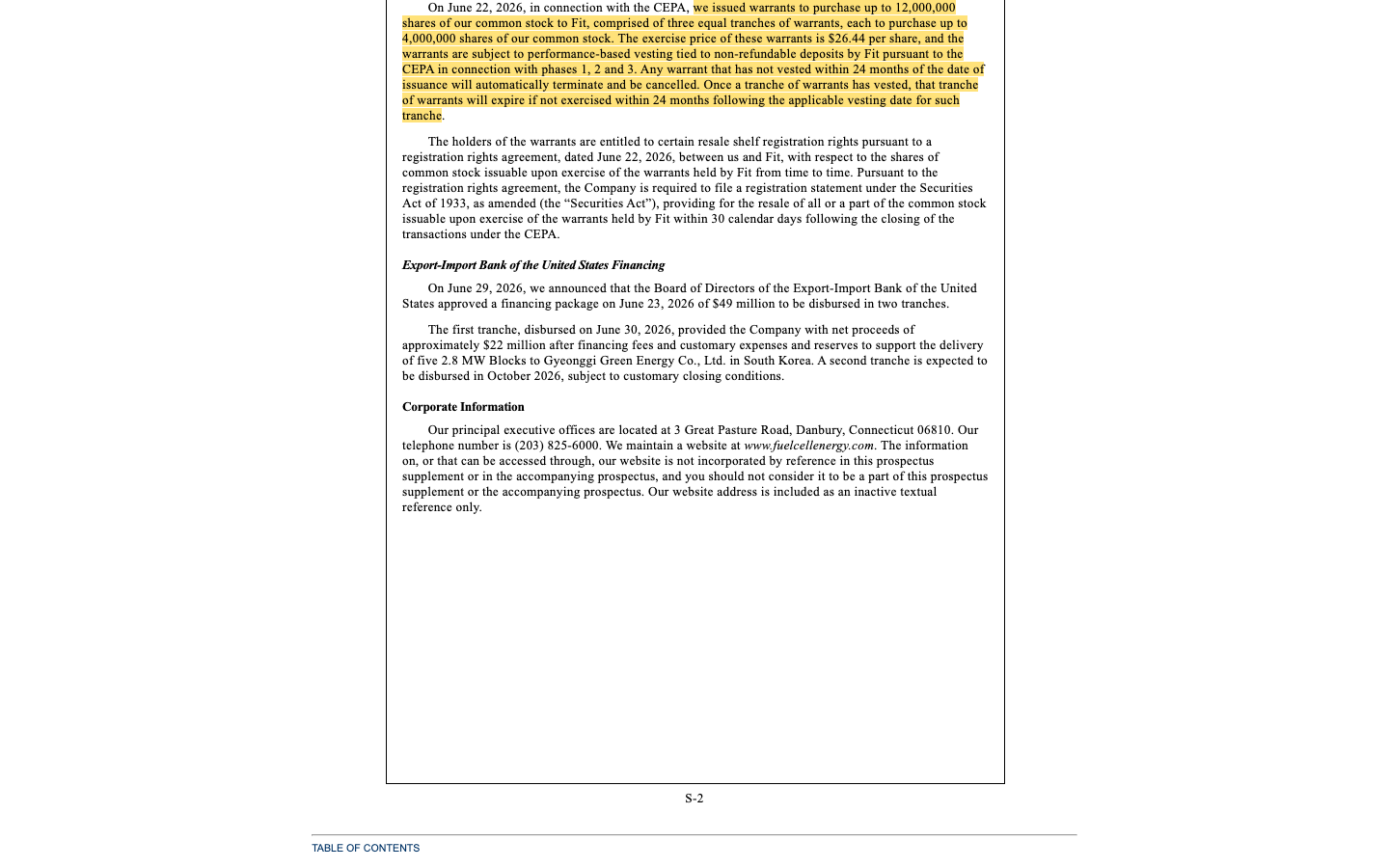
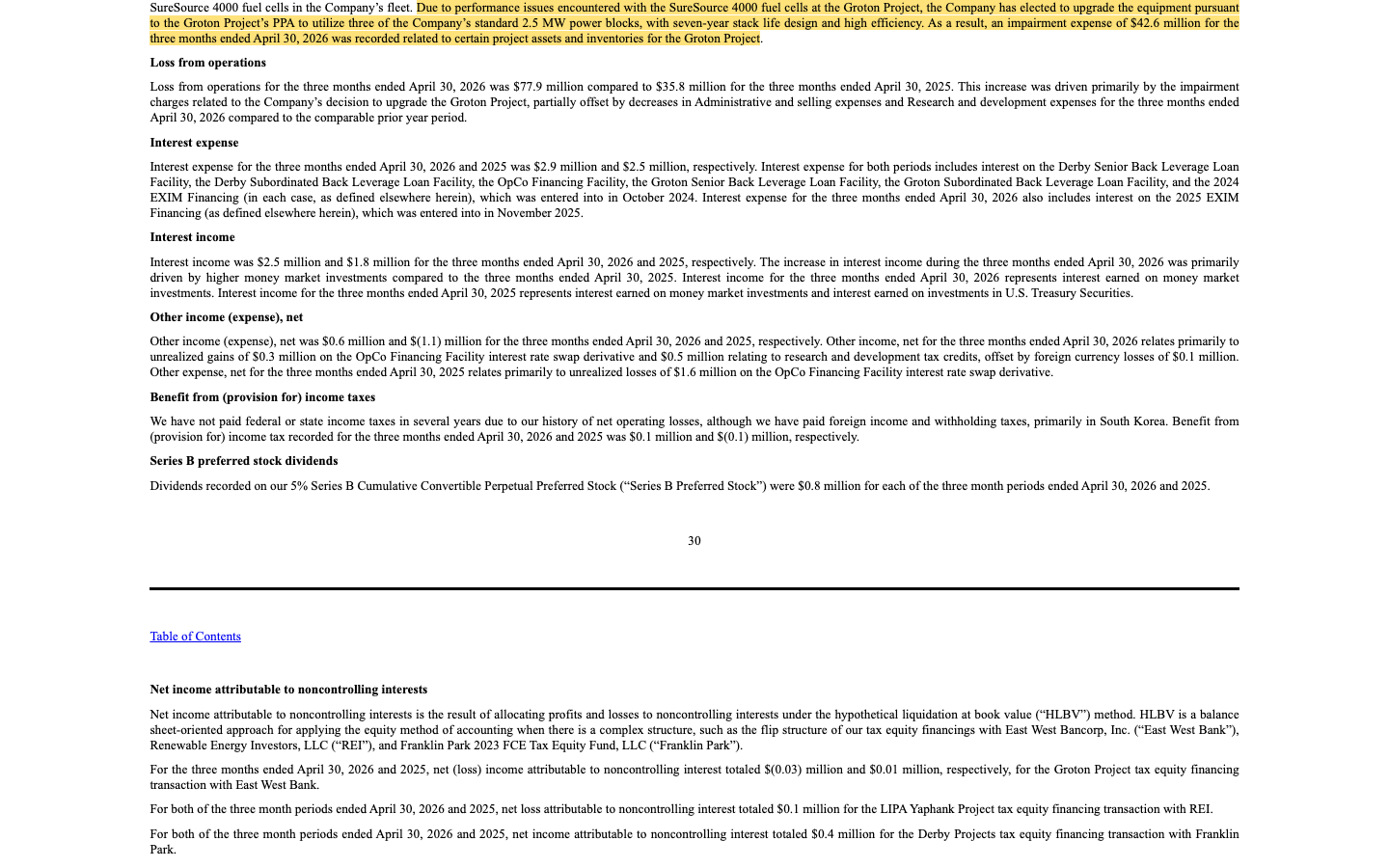
None of this is illegal, all of it is disclosed — and the incentive logic is even clever: the customer earns on the share price if it orders big. But hold on to the sequence: the customer holds options and warrants, you as a shareholder have already paid — with up to 12 million possible additional shares of dilution on top. And whether FuelCell can even deliver an order of this size without friction is not a rhetorical question: in April 2026 the company had to concede that the SureSource 4000 units at its showcase Groton project — the only ones of their kind in the fleet — have performance issues and will be swapped entirely for standard blocks; price tag: a $42.6 million impairment in a single quarter, with the retrofit not even starting before fiscal 2027.
And the AI? FuelCell sells no AI — it wants to sell AI its electricity
Because this rally is an AI rally, we combed the filings systematically for artificial intelligence. The finding: FuelCell sells no AI, by its own account uses none, and is not threatened by it either — AI appears in the filings exclusively as a demand driver for the company's actual product, electricity. The annual report cites the International Energy Agency, according to which data-center electricity demand is set to more than double to around 945 terawatt-hours by 2030 — with "AI-optimized workloads" as the main driver. The logic is real: data centers need baseload around the clock, grid connections take years, and modular fuel-cell blocks can fill that gap — exactly what the Fit agreement stands for. But keep the chain clean: FuelCell profits from AI only if options become orders, orders become deliveries, and deliveries become the first profits since 1997. How long the road from "power for AI" to a black zero can be is something we just measured at Solaris Energy — there the same demand is served with gas turbines, and there too, the capital market is footing the bill so far.
Valuation: The echo costs more than the find
What are you paying for this company in mid-2026? After the offering, roughly 79.9 million shares are outstanding; the fundamental data (as of July 9, 2026) shows a price-to-sales ratio around 9 — on roughly $168 million of trailing-twelve-month revenue that was earned below manufacturing cost. A price-to-earnings ratio does not exist for lack of earnings; the price-to-book ratio stood around 1.9 — with the book value freshly topped up by the very share sales just described. For scale: profitable industrial and energy-technology companies typically cost one to three times revenue. So you are not paying for the present (that would be far cheaper) but for the expectation that 30 firm megawatts become 380 and that a gross margin of minus 16.7 percent turns positive. Two dated observations belong next to that: an average daily range around 16 percent (data as of July 9, 2026) means entire weekly gains can vanish in a morning. And on July 6, 2026 — near the rally high — chief technology officer Shankar Achanta sold 2,500 shares at $28.71 per an insider filing (Form 4); a small amount, but it was a sale, not a purchase. The next reality check is already on the calendar: the quarterly report (10-Q) as of July 31, 2026, due in September.
Opportunities and risks at a glance
What speaks for FuelCell Energy:
- The data-center entry is signed, not just announced: a framework agreement with Fit Energy for up to 380 megawatts (June 22, 2026), phase 0 of 30 megawatts with immediately effective payment obligations — plus 57 years of engineering history and reference plants up to 58.8 megawatts with more than a decade of continuous operation.
- The till is as full as it has been in years: $373.2 million as of April 30, 2026, plus roughly $245 million net from the July offering, plus a $49 million package from the Export-Import Bank of the United States — and no going-concern warning in the annual report (10-K).
- Operational improvement is measurable: revenue up 41 percent in fiscal 2025 and 17 percent in the first half of fiscal 2026; gross margin improved from minus 32.0 to minus 16.7 percent; restructuring is cutting administrative and research costs by double digits.
- A backlog of roughly $1.14 billion (April 30, 2026) with service agreements of up to 20 years that, per the annual report (10-K), are expected to deliver positive margins over their term.
- Strong momentum: 12 momentum-scanner hits, a relative strength of 98 (weekly basis), +356 percent in three months (data as of July 9, 2026) — the market has embraced the story; the $21.00 offering was fully placed.
What speaks against it:
- No profitable year since fiscal 1997, a $1.83 billion accumulated deficit, a record net loss of $187.9 million in fiscal 2025 — and a gross margin that stayed negative even in the best year: the products sell below manufacturing cost.
- Perpetual dilution as the financing model: share count up from 13.5 million (October 2022, today's basis) to roughly 79.9 million (July 2026); a 1-for-30 reverse split in 2024; plus up to 12 million possible warrant shares for customer Fit at $26.44.
- Concentration risk: 82 percent of fiscal 2025 revenue from a few large customers, Gyeonggi Green Energy alone at 46 percent — and that module-replacement order (final 14 of 42 modules) runs out in fiscal 2026.
- The 380-megawatt headline is 92 percent option: only 30 megawatts are firm, and Fit calls phases 1–3 "at its sole option"; at the same time, the $42.6 million Groton impairment (performance issues of the SureSource 4000 units) shows that delivery and operation are no formality.
- A hot valuation and hot trading: a price-to-sales ratio around 9 for a business with a negative gross margin, an average daily range around 16 percent, a bankruptcy-risk-scanner hit, an insider sale near the high (data as of July 9, 2026) — and despite the rally, the stock sits roughly 92 percent below its level of five years earlier.
A human conclusion
Back to the echo sounder. The echo is real: a signed framework agreement from the AI world, a well-filled till, revenue that grows, cost curves bending the right way. Whoever filed FuelCell away years ago as an eternal promise should acknowledge that — there is more substance here than in some earlier hydrogen wave. But an echo is not yet a find. We also located: 28 fiscal years without a profit and a product that sells below manufacturing cost to this day. A key customer who carried nearly half the revenue and whose order is running out. A 380-megawatt headline of which 350 sit at the customer's sole discretion — a customer rewarded for its ordering loyalty with warrants on 12 million shares, while your stake dilutes week after week. And a price that treats all of this not as questions but as answered. A rising price is simply not an argument — it is only a price that others are currently willing to pay. The arguments arrive with the next quarterly reports (10-Q), at the latest when it becomes clear whether Fit actually calls phases 1 through 3 and whether the gross margin ever breaks through zero from below. Until then: you may follow the echo — but do it with open eyes, not because the herd is already on its way. What you make of it is your decision. And that is exactly as it should be.
Sources
All original documents used in this analysis — for reading yourself:
- FuelCell Energy, Inc. — SEC annual report 10-K for fiscal year 2025 (ended October 31, 2025; filed December 18, 2025)
- FuelCell Energy, Inc. — SEC quarterly report 10-Q as of April 30, 2026 (filed June 8, 2026)
- FuelCell Energy, Inc. — SEC quarterly report 10-Q as of January 31, 2026 (filed March 9, 2026)
- FuelCell Energy, Inc. — SEC current report 8-K of June 24, 2026: framework agreement with Fit Energy USA LP and warrant issuance
- FuelCell Energy, Inc. — SEC current report 8-K of July 9, 2026: offering of 12.3 million shares at $21.00
- FuelCell Energy, Inc. — SEC prospectus supplement 424B5 of July 8, 2026 (Fit warrants, Export-Import Bank financing, share count)
- FuelCell Energy, Inc. — SEC proxy statement DEF 14A of February 18, 2026 (executive compensation)
- FuelCell Energy, Inc. — SEC insider filing Form 4 of July 8, 2026 (sale by Shankar Achanta)
- Complete SEC filing history of FuelCell Energy: EDGAR overview (sec.gov)
- Fundamental data (metrics, price statistics, valuation; data as of July 9, 2026), cross-checked against the SEC filings and the SEC's XBRL database.
- Screener and rating data: in-house stock scanner (data as of July 9, 2026).
Transparency & disclaimer: This analysis is a journalistic contextualization of publicly available information and is not investment advice, not a financial analysis in the regulatory sense, and not a solicitation to buy or sell securities. Stock investments carry substantial risks up to total loss. All information without guarantee; the data cut-off is noted in the text in each case. The author holds no position in FuelCell Energy stock at the time of publication.
Our Bottom Line at a Glance
- Data-center opportunity positive
- A signed framework agreement with Fit Energy for up to 380 megawatts powering AI data centers (June 22, 2026), phase 0 of 30 megawatts with immediately effective payment obligations; plus 57 years of engineering history and reference plants up to 58.8 megawatts.
- Liquidity positive
- $373.2 million in cash (April 30, 2026) plus roughly $245 million net from the July offering plus a $49 million package from the Export-Import Bank of the United States; no going-concern warning — the quarterly report (10-Q) expressly confirms twelve-month coverage.
- Technicals positive
- Weinstein stage 2, a relative strength of 98 (weekly basis), 12 momentum-scanner hits, +356 percent in three months (data as of July 9, 2026) — the market has fully embraced the story.
- Profitability negative
- No profitable year since fiscal 1997, a $1.83 billion accumulated deficit, a record $187.9 million loss in fiscal 2025 — and the gross margin is negative at minus 16.7 percent even before any fixed costs.
- Dilution negative
- Share count up from 13.5 million (October 2022, today's basis) to roughly 79.9 million (July 2026); a 1-for-30 reverse split in November 2024; 17.2 million ATM shares at an average of $9.22 in the first half of fiscal 2026, 12.3 million shares at $21.00 in July — plus up to 12 million possible warrant shares for customer Fit.
- Order quality & concentration negative
- 82 percent of fiscal 2025 revenue from a few large customers (Gyeonggi Green Energy alone 46 percent, with the order running out in fiscal 2026); only 30 of the 380 framework megawatts are firm; the $42.6 million Groton impairment shows operational delivery risk.
FuelCell Energy is the bet that AI power demand hands a 57-year-old company its first profitable year since 1997. The till is full and the Fit agreement is real — but only 30 of 380 megawatts are firm, the customer was courted with warrants on 12 million shares, the products still sell below manufacturing cost, and all of it is paid for with a steady stream of new shares. Not investment advice.
What Our Rating Means
- If you don't own the stock
- In our view, the documented risks clearly outweigh — we see no basis for an entry.
- If you hold it in your portfolio
- In our view, the findings carry enough weight to warrant a critical look at your own position.
A journalistic assessment by our editorial team at the time of the deep dive, based on public sources — not investment advice and not a solicitation to buy or sell. Your personal circumstances (investment goals, risk capacity, taxes) cannot be taken into account. What our categories mean, how verdicts are formed, and what conflicts of interest exist →
Worth Noting
- The fiscal year ends October 31: "fiscal year 2025" = November 2024 through October 2025. The next quarterly report (10-Q, as of July 31, 2026) is due on schedule in September 2026.
- No insolvency verdict: despite the hit in the bankruptcy-risk scanner, there is no going-concern warning; per the quarterly report (10-Q), cash and the offering cover the next twelve months. The scanner measures balance-sheet patterns, not a prediction.
- A very volatile stock: an average daily range around 16 percent, +356 percent in three months and at the same time roughly 92 percent below its level of five years earlier (data as of July 9, 2026); an insider sale by the chief technology officer on July 6, 2026 (2,500 shares at $28.71, Form 4).
Frequently Asked Questions
FuelCell Energy builds and operates fuel-cell power plants based on its carbonate technology: installations that convert natural gas, biogas or hydrogen electrochemically into electricity — around the clock and with low emissions. The company was founded in 1969, is headquartered in Danbury, Connecticut, manufactures in Torrington and in Taufkirchen near Munich, Germany, and employed about 424 people as of October 31, 2025. Important: the fiscal year ends on October 31.
The main driver was the framework agreement with Fit Energy of June 22, 2026: fuel-cell blocks powering AI data centers, up to 380 megawatts in four phases. Add a $49 million financing package from the Export-Import Bank of the United States and the general expectation that data centers will need massive baseload power because of AI. Within three months, the stock gained more than 350 percent (data as of July 9, 2026).
Per the current report (8-K), only phase 0 with 30 megawatts is firm — its payment obligations became effective at signing. Fit can call phases 1 through 3, together 350 megawatts, "at its sole option". As an incentive, Fit received warrants on 12 million FuelCell shares at $26.44, which vest only upon non-refundable deposits for the further phases.
No — per its own annual report (10-K), not since fiscal 1997. In fiscal 2025 (ended October 31, 2025), $158.2 million in revenue faced a $187.9 million net loss; even the gross margin was negative at minus 16.7 percent, meaning products sold below manufacturing cost. The accumulated deficit stands at roughly $1.83 billion.
The till is full: $373.2 million as of April 30, 2026, followed by roughly $245 million net from the July 7/8, 2026 offering; there is no going-concern warning. It is paid for with new shares: the share count rose from 20.4 million (October 2024, after the 1-for-30 reverse split) to roughly 79.9 million in July 2026 — your stake per share keeps shrinking.
By classic yardsticks, no: the price-to-sales ratio stood around 9 in early July 2026 — for a business operating at a negative gross margin. A price-to-earnings ratio does not exist for lack of earnings. What is being paid for is the expectation that 30 firm megawatts become 380 and the margin turns positive for the first time in decades; despite the rally, the stock traded roughly 92 percent below its level of five years earlier.
Found an error?
Did you spot a factual error, an outdated number, or a typo in this deep dive? Let us know briefly — your report goes straight to the editorial team.