Outlook Therapeutics Stock: The FDA Answers on July 29 — and the Cash Covers About Two Months
Outlook Therapeutics has done what many biotechs only promise: LYTENAVA, its eye drug against wet macular degeneration, is approved in the EU and the UK. The stock multiplied within three months — while the same SEC filings document "substantial doubt" about the company's survival: $7.7 million of cash against roughly $11.8 million of operating outflow per quarter, plus three FDA rejections in a row. Then, in May 2026, the agency granted the company's appeal — and set a decision date for the U.S. application: July 29, 2026. Not investment advice — just a countdown read straight from the filings.
 Thomas Mücke
Founder & Publisher
Thomas Mücke
Founder & Publisher
Chart
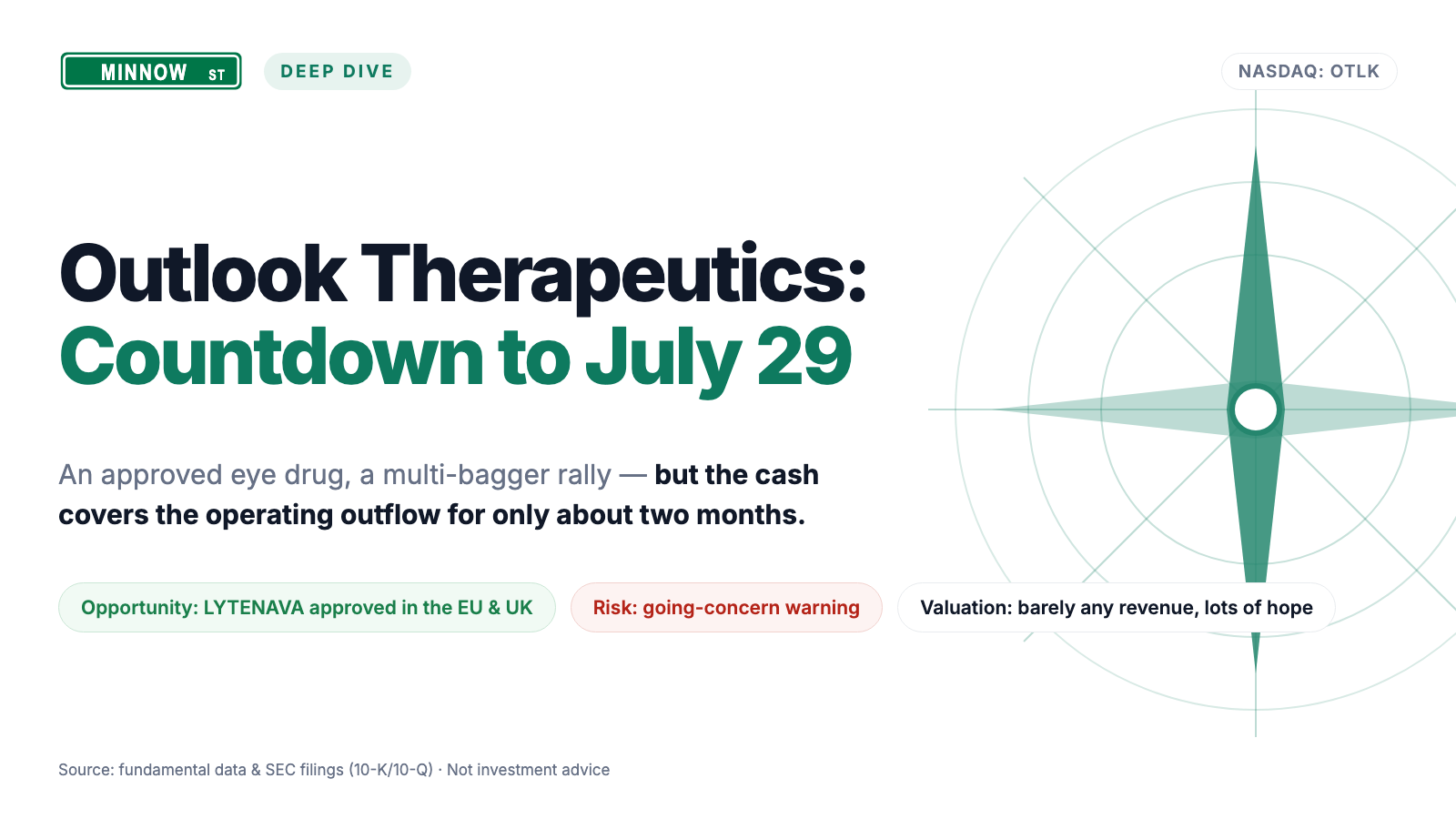
Interactive price chart (TradingView).
Note: pure fact-based analysis, not investment advice and not a solicitation to buy or sell. All figures without guarantee.
There is a sound that makes investors weak: the whistle of a departing train. A stock nobody cared about for months suddenly leaves the station — and a voice in your head shouts: "Jump on, or you will never see it again!" At Outlook Therapeutics (Nasdaq: OTLK) the whistle is loud: roughly plus 712 percent in three months (data as of July 8, 2026), a genuinely approved eye drug in Europe, an analyst price target near four times the price. And this time the platform has something few penny-stock stories offer: a printed timetable. The U.S. Food and Drug Administration (FDA) has set itself a decision date for the company's American application — July 29, 2026. Before you jump aboard, let's make a deal: we read together what this company itself reported, under penalty of law, to the U.S. securities regulator, the SEC. Because the same filings contain both a remarkable pioneering achievement and the most formal warning sentence accounting knows. In the end, you decide whether to take the train.
What Outlook Therapeutics actually does
Outlook Therapeutics is a biotech company from Iselin, New Jersey, with a single bet: ONS-5010, marketed as LYTENAVA (bevacizumab gamma) — an antibody against wet age-related macular degeneration (wet AMD). In everyday language: in this eye disease, leaky blood vessels sprout under the retina and the center of your vision blurs — one of the most common causes of blindness in old age. The curious thing about this market: for years, eye doctors have been injecting the cancer drug bevacizumab (known as Avastin) into the eye, because it works and costs little — but it was never officially approved for that use. Pharmacies have been repackaging the cancer drug into single syringes, with all the risks of such an improvised solution. That is exactly the gap Outlook fills: a bevacizumab version developed and approved specifically for the eye. And that is not a marketing claim — it is in the quarterly report:
"ONS-5010/LYTENAVA is the first and only authorized ophthalmic formulation of bevacizumab for use in treating wet AMD in the EU and UK."
— Outlook Therapeutics, SEC quarterly report 10-Q as of March 31, 2026, Note 1 "Organization and Description of Business"
The milestones are real and dated: approval by the European Commission in May 2024, by the UK regulator MHRA in July 2024, sales launch in the UK and Germany in June 2025. For a company with — hold on — 17 full-time employees (as of September 30, 2025, per the annual report), that is a genuine pioneering achievement. But remember the number 17: a company that wants to launch a drug in two markets and fight for U.S. approval in parallel is staffed roughly like a dental practice. The big prize would be FDA approval for the American market — and Outlook has been grinding away at it since 2022. How that has gone so far, and why the calendar now says July 29, belongs to the uncomfortable truths below.
Where the stock shows up in our scanner
Every day we run roughly 3,512 stocks through the 166 scanners of our in-house stock scanner. Outlook Therapeutics fires in 11 scanners (data as of July 8, 2026) — and the list reads like two different stocks. On one side, the momentum fireworks: Qullamaggie top gainers 1M and 3M, RS leader (≥90) (the stock recently beat 90 percent of the market), above the 50- and 200-day averages, up/down accumulation and high ADR (daily swings around 20 percent). On the other side, the small print no brochure shows: going concern (distress proxy), Altman-Z distress zone, Weinstein stage 3 (possible topping pattern after the run), an overheating signal — and the scanner whose name says it all: the "Insolvency Radar: cash running out". There, OTLK does not sit somewhere in the middle — it sits at rank 1: the shortest cash runway among all hits that are not borderline cases. In our roundup of the radar's top 10 we dissected the whole list; this analysis is the deep dive on the frontrunner. And in case you are wondering about the crowd: on Reddit this rocket is barely a whisper — just 2 mentions in 24 hours (ApeWisdom, as of July 17, 2026).
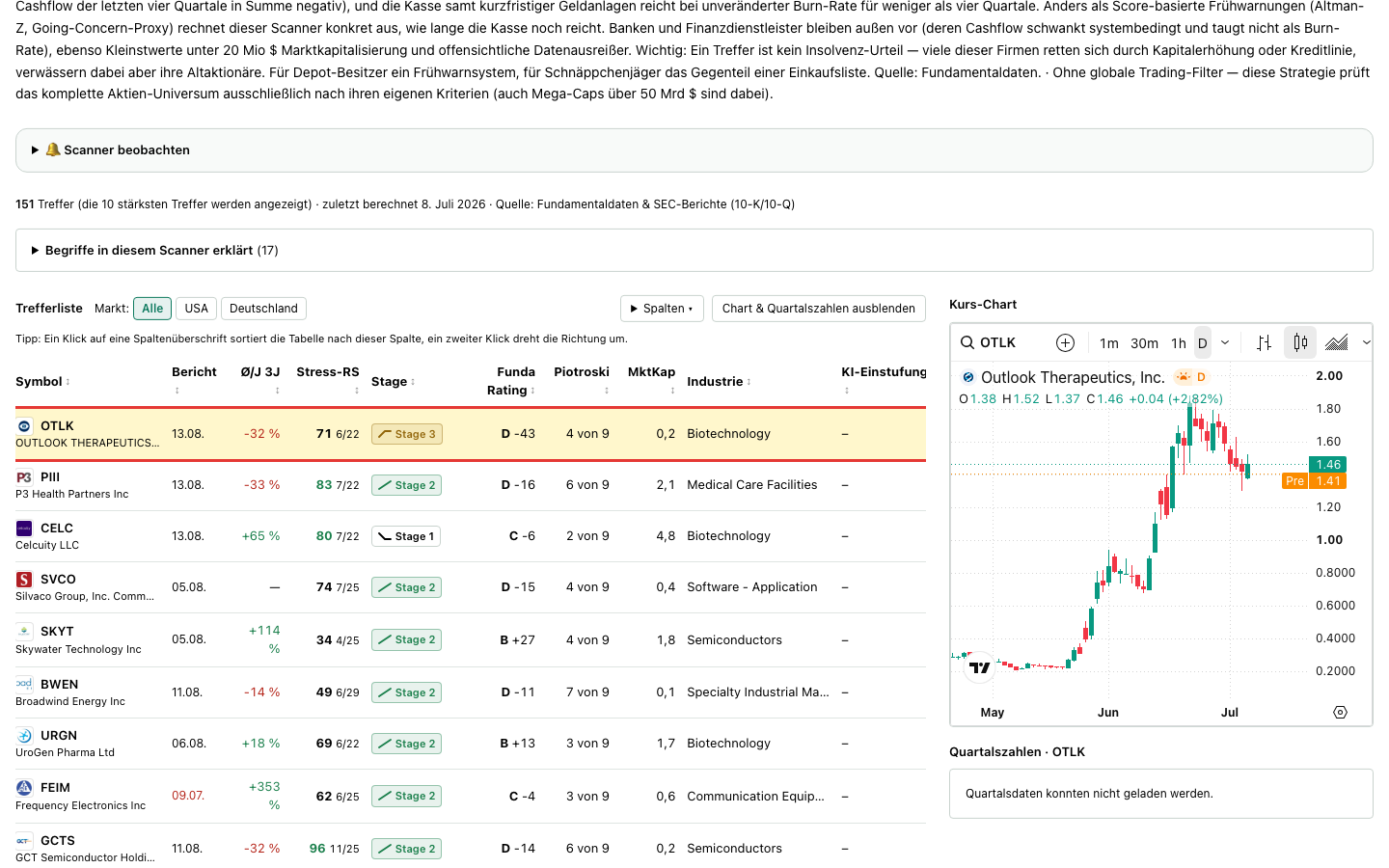
Quickly translated, what the scanner sees: the radar hunts for companies whose operating business burns money and whose cash covers the outflow for only a few more quarters — at Outlook, arithmetically 0.66 quarters, about two months (data as of July 8, 2026; the math follows below). As always with this scanner, one word of framing: it is a smoke detector, not an insolvency ruling. Many companies on this list save themselves — usually through capital raises that then dilute the existing shareholders. Add the quality numbers: the fundamental grade is D −43 (deep-red end of the scale), the Piotroski F-score stands at 4 of 9 — a nine-point test of the health of the books; a rock-solid company sits at 8 or 9. And because this looks like an AI-free zone, we checked: the AI-classification column for OTLK simply shows "–", and a full-text search of both current SEC reports confirms it — "artificial intelligence" appears zero times in the quarterly report and exactly once in the annual report, as a data-privacy risk factor about employees using generative AI tools internally. This rocket flies entirely without AI fuel. Remember the central tension of this analysis: the chart is celebrating a comeback — the cash box is counting the weeks, and both clocks run out in the same summer.
The numbers — what is really there and what is missing
Praise first, because it is deserved: as a tiny company, Outlook got something approved that the market long did not dare to touch. But an approved drug is not yet a sold drug — and this is where the numbers turn uncomfortable. Outlook's fiscal year ends September 30. In fiscal year 2025 (October 2024 through September 2025), the company reported $1.4 million of revenue from LYTENAVA sales in Germany and the UK — against a net loss of $62.4 million (prior year: $75.4 million). And in the first half of fiscal year 2026 (October 2025 through March 2026) something happened that you rarely see: reported net revenue was negative — minus $1.08 million, because an increased returns reserve and distributor fees arithmetically overtook the small sales. The January–March 2026 quarter then showed a meager $127,439 of net revenue. For comparison: research ($8.1 million) and selling, general and administrative costs ($18.1 million) together consumed a good $26 million in the half-year. So far, the European launch is not a revenue driver — it is a cost block.
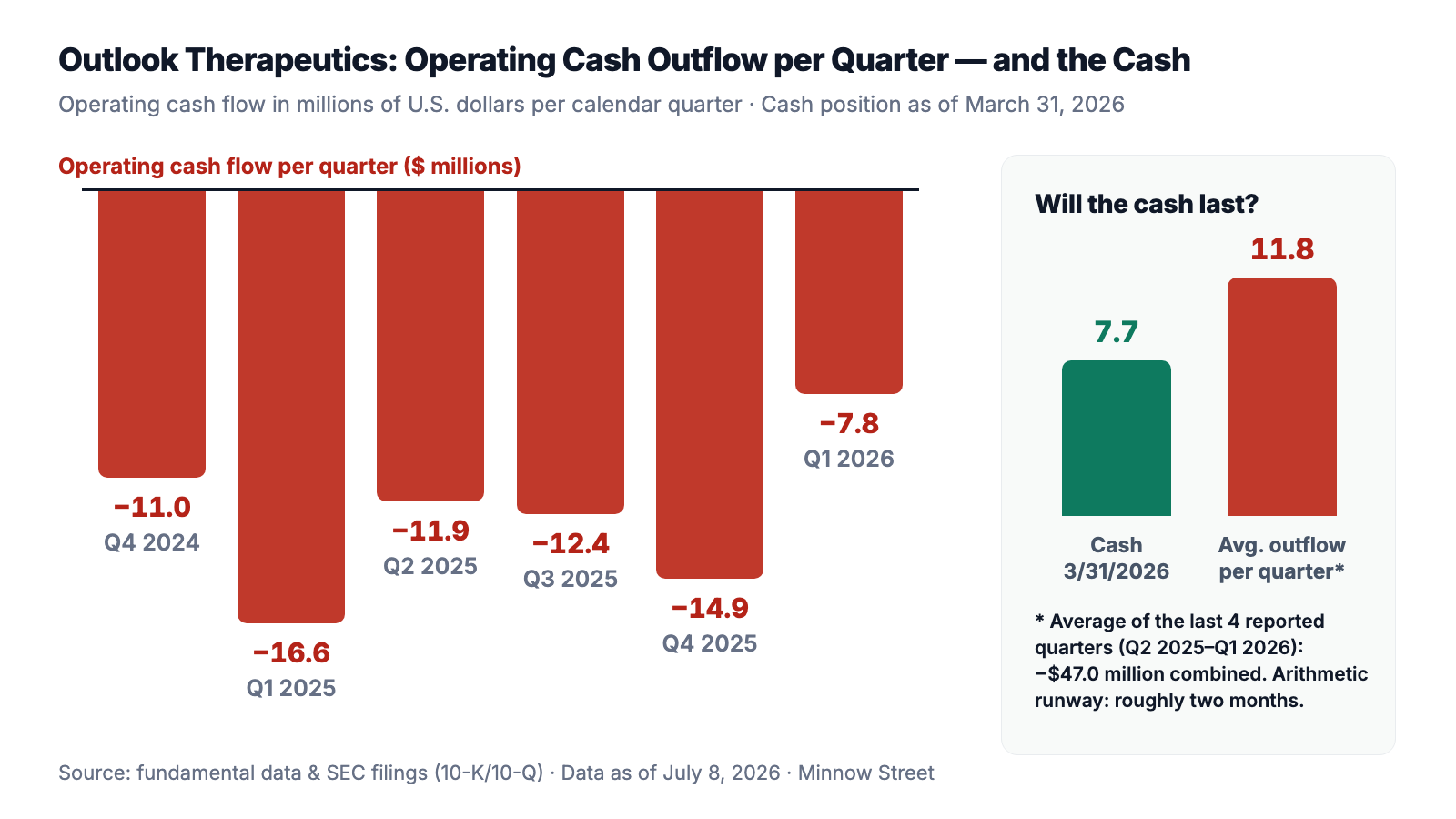
The math that puts OTLK at rank 1 of our radar fits in your head: over the last four reported quarters (April 2025 through March 2026), $47.0 million flowed out of operations — an average of $11.8 million per quarter. The balance sheet showed $7.7 million of cash as of March 31, 2026. Divide 7.7 by 11.8 and you get 0.66 quarters — roughly two months. Two honest qualifiers: first, the outflow has slowed ($7.8 million in the quarter through March 2026, after $14.9 million the quarter before). Second, fresh money has been arriving in slices — $4.5 million net from an equity offering in April 2026, about $5.0 million gross from a direct offering on May 28, 2026, plus a new at-the-market program of up to $100 million signed on May 13, 2026 (more on the price of all this below). Each slice extends the clock by weeks, not years — and that is exactly how the company's own report frames it. The next quarterly report is announced for August 13, 2026; the cash line in it is the most important number of this stock.
What the filings say — the uncomfortable truths
A filing with the U.S. securities regulator, the SEC, is honest under penalty of law — it also contains what no investor conference presents. I have pulled out and highlighted the decisive passages for you.
Uncomfortable truth no. 1: Management itself doubts the next twelve months
"Going concern" is the most formal warning signal in accounting: the financial statements are prepared only under the assumption that the company survives — while documenting that substantial doubt exists. The quarterly report as of March 31, 2026 says it verbatim: "As a result, there is substantial doubt about the Company's ability to continue as a going concern." And right after that, management runs the numbers itself:
"Management does not believe that the existing cash and cash equivalents as of March 31, 2026 are sufficient to fund the Company's operations through one year from the date of this Quarterly Report on Form 10-Q. As a result, additional financing will be needed by the Company to fund its operations in the future, fully commercialize ONS-5010/LYTENAVA and to develop any other product candidates."
— Outlook Therapeutics, SEC quarterly report 10-Q as of March 31, 2026, Note 2 "Liquidity"
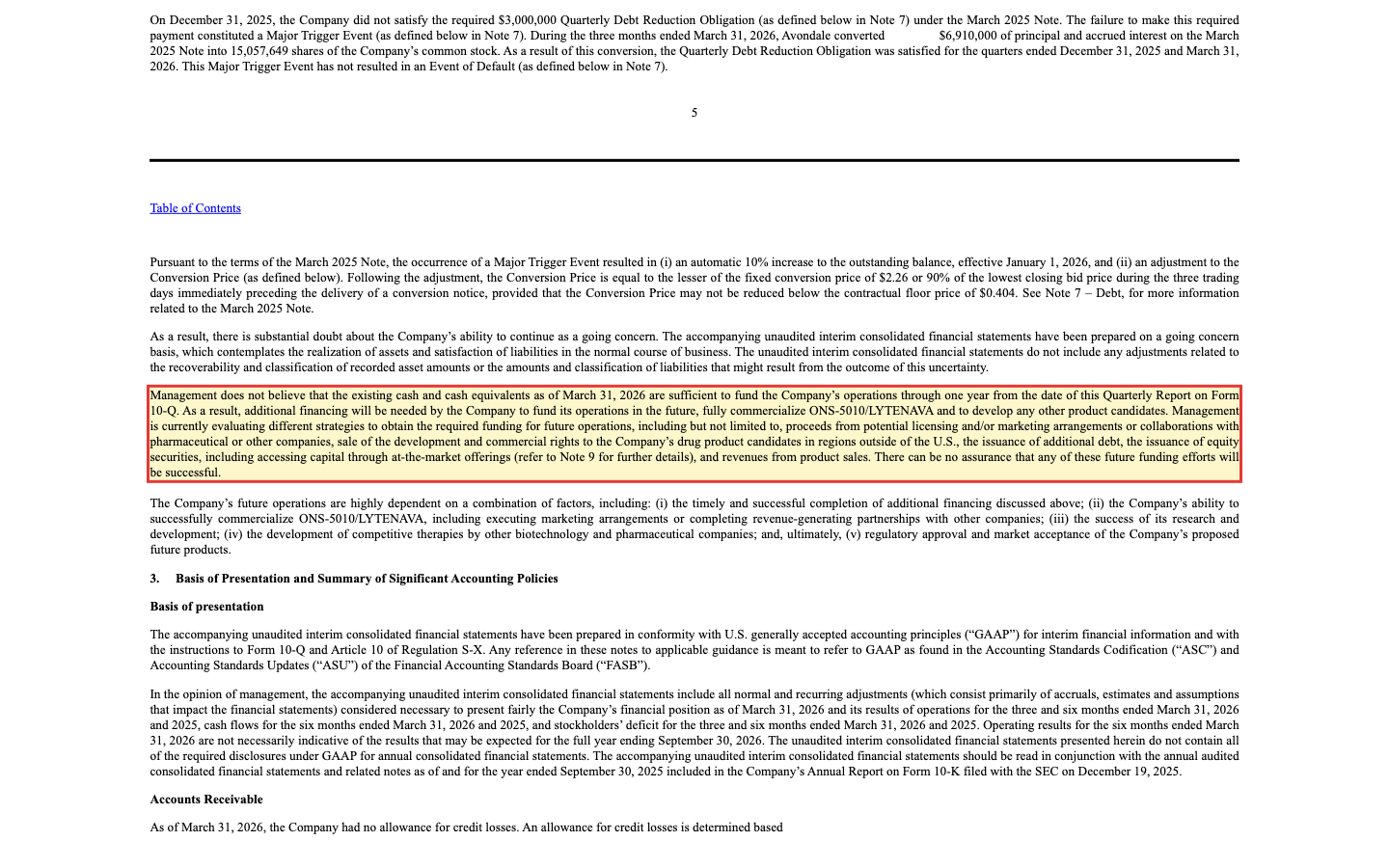
Translated into household terms: the checking account shows $7.7 million, and the house consumes an average of $11.8 million per quarter. That management is countering and lists options is also in the report — but the starting position is exactly what our smoke detector flagged.
Uncomfortable truth no. 2: The FDA said no three times — the fourth answer has a date
The real driver of this stock is the hope for U.S. approval — the American market for eye injections is many times larger than the European launch. The documented record of that attempt is sobering, and it is all in the filings: in August 2023 came the first Complete Response Letter (CRL) — the FDA's formal way of saying no. The follow-up study agreed with the agency, NORSE EIGHT, missed its pre-specified primary endpoint in November 2024 at week 8. Outlook refiled anyway — on August 27, 2025 came CRL number two, with exactly one criticism: insufficient evidence of effectiveness. After another refiling, CRL number three followed on December 30, 2025 with the same core message. Up to this point, the story reads like a stubbornness saga. But then came the plot twist that changes the calendar of this stock: Outlook took the December rejection into the FDA's formal appeal process — and won. On May 26, 2026, the company reported the outcome in a current report (8-K):
"The FDA concluded that substantial evidence of effectiveness has been established for LYTENAVA™ for the treatment of nAMD, and directed the Division of Ophthalmology and the Office of Specialty Medicine to work with the Company to reach an agreement on final labeling."
— Outlook Therapeutics, SEC current report 8-K of May 26, 2026, Item 8.01 "Other Events"
The mechanics moved fast from there: the application (Biologics License Application, BLA) was resubmitted on June 1, 2026, and on June 16, 2026 the FDA confirmed receipt — with a classification that sets the countdown:
"The FDA determined that the BLA is a Class 1 review, which results in a 60-day review period from the date of resubmission. The FDA set a Prescription Drug User Fee Act (PDUFA) goal date of July 29, 2026."
— Outlook Therapeutics, SEC current report 8-K of June 16, 2026, Item 8.01 "Other Events"
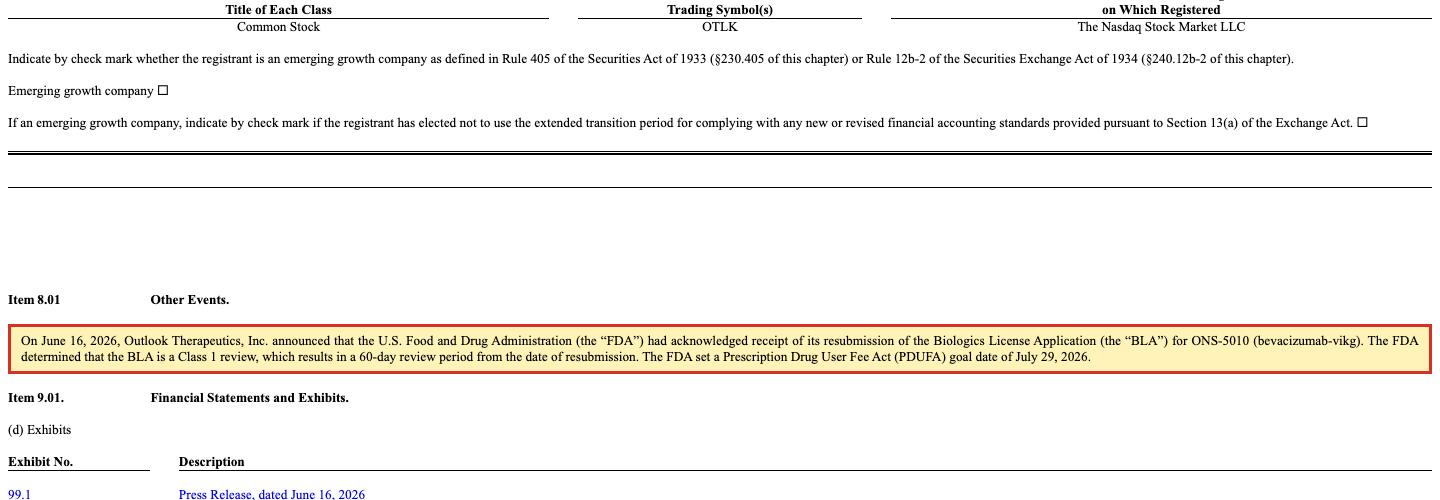
A "PDUFA goal date" is the deadline the FDA sets itself for a decision under the Prescription Drug User Fee Act — not a guarantee of approval, and occasionally the agency misses its own deadline. Honesty also requires the flip side of the euphoria: an appeal won on effectiveness is not yet an approval letter, the earlier study NORSE EIGHT still missed its primary endpoint (the FDA now weighs the totality of evidence, including the successful NORSE TWO study and the week-12 data), and the risk factors of the 10-Q — written before the appeal decision — still tie approval and financing into a single paragraph: "There is substantial doubt about our ability to continue as a going concern. We will continue to need to raise substantial additional funding …" (10-Q as of March 31, 2026, Item 1A). Remember the mechanism: the appeal victory moved the finish line into sight — it did not fill the fuel tank.
Uncomfortable truth no. 3: Survival is paid for with your slice of the pie
How does a company with two months of cash survive? Outlook's answer stands in Note 7 of the quarterly report, and it has teeth. In March 2025, the company borrowed $33.1 million via a convertible note from the financial investor Avondale Capital. Convertible means: the creditor may take repayment in shares. When Outlook could not make an agreed $3 million debt-reduction payment on December 31, 2025, a contractual "Major Trigger Event" fired — the outstanding balance automatically rose 10 percent, and the conversion price was redefined:
"Following the adjustment, the Conversion Price is equal to the lesser of the fixed conversion price of $2.26 or 90% of the lowest closing bid price during the three trading days immediately preceding the delivery of a conversion notice, provided that the Conversion Price may not be reduced below the contractual floor price of $0.404."
— Outlook Therapeutics, SEC quarterly report 10-Q as of March 31, 2026, MD&A / Note 7 "Debt"
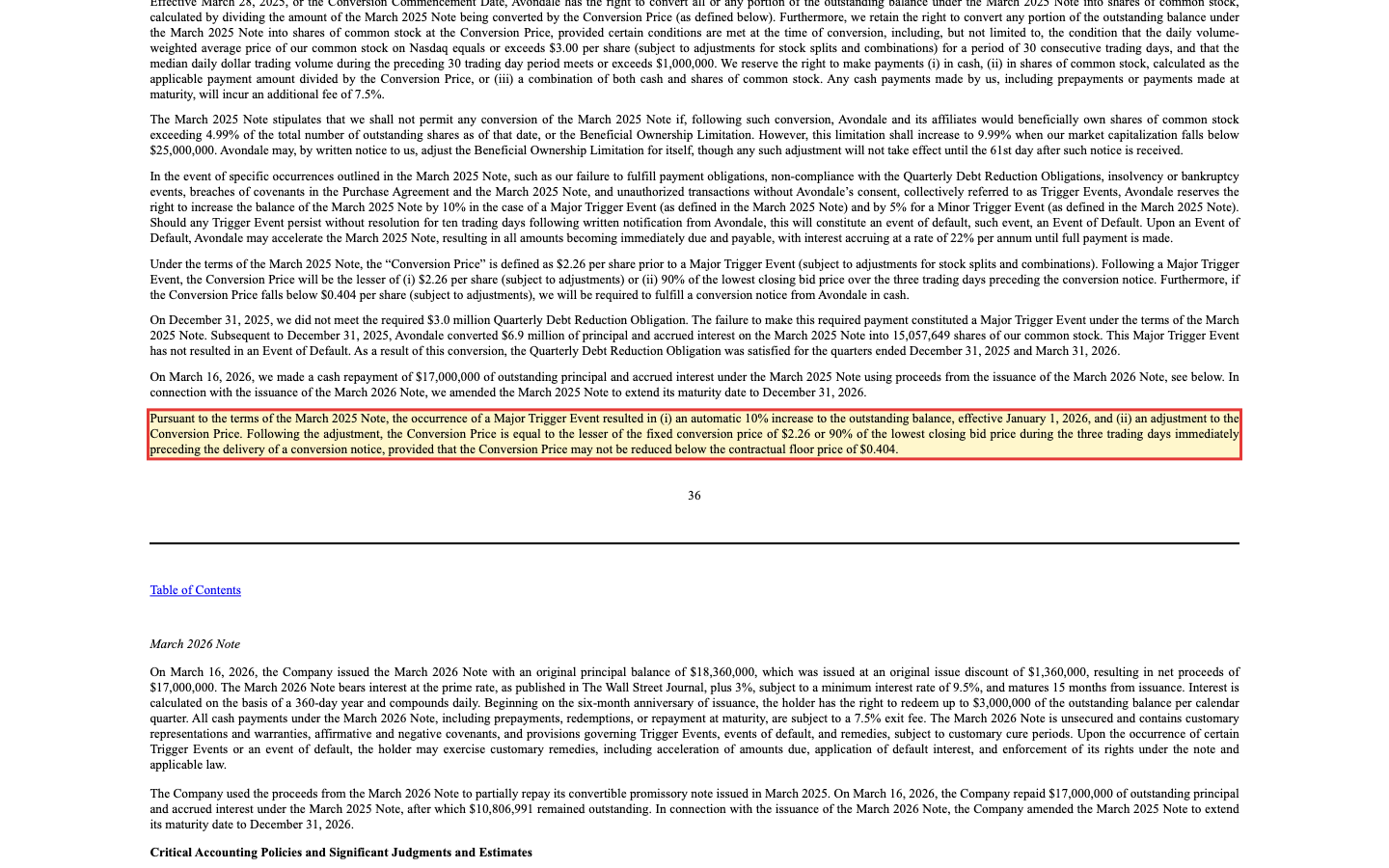
What that means in practice is in the same document: in the January–March 2026 quarter alone, Avondale converted $6.91 million of debt into 15,057,649 new shares. Dilution means your slice of the pie shrinks as new slices keep being cut — and here the pie machine runs around the clock. The weighted share count rose from 30.9 million (quarter through March 2025) to 81.8 million (quarter through March 2026); the cover page of the report already counted 120.9 million shares on May 12, 2026, and our fundamental data counted roughly 148.6 million as of July 8, 2026 — the share count roughly quadrupled in about 14 months. And the machinery has since been upgraded, documented step by step in the 8-K filings: an April 2026 offering sold shares at $0.31 apiece with warrants for another 16.1 million shares at $0.31; on May 28, 2026 the company sold 8.54 million shares at $0.5855 to GMS Ventures — an investor affiliated with two of its own directors — and simultaneously repriced 15.5 million of that investor's existing warrants from an average of $1.78 down to $0.5855; on May 13, 2026 it signed a new at-the-market program of up to $100 million. And on July 16, 2026 — one day before this analysis — a special meeting of stockholders approved the widest pipe yet:
"… the Company's stockholders approved an amendment to the Company's Restated Certificate of Incorporation to increase the authorized number of shares of the Company's common stock from 260,000,000 to 600,000,000 shares."
— Outlook Therapeutics, SEC current report 8-K of July 16, 2026, Item 5.03 "Amendments to Articles of Incorporation or Bylaws"
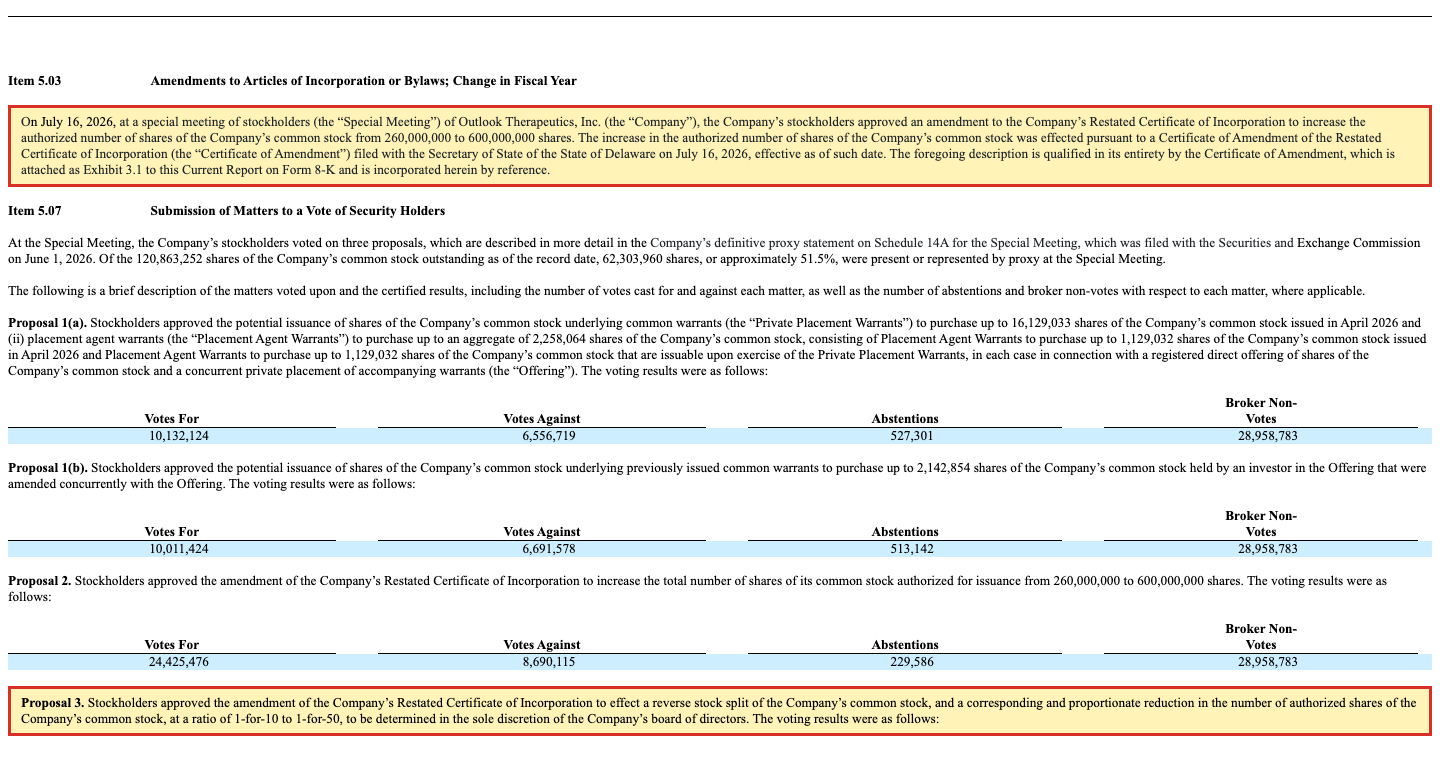
The same meeting also approved a reverse stock split of 1-for-10 to 1-for-50, to be triggered at the board's sole discretion — a standard tool of penny-stock balance sheets that changes nothing about a company's value, only the price per share. The report says the dilution part to your face, by the way: "If we raise additional capital through the sale of equity or convertible debt securities, your ownership will be diluted" (10-Q as of March 31, 2026). And the big picture: since inception, Outlook has raised $650.3 million net through shares and debt and piled up an accumulated deficit of $633.2 million (as of March 31, 2026) — while the whole company was valued at roughly $237 million on the stock market as of July 8, 2026.
Uncomfortable truth no. 4: Small print that is not small
- The sales launch is sputtering: negative half-year net revenue (minus $1.08 million, October 2025 through March 2026) because of increased returns reserves and trade fees — the approved product has not yet found its market. In the UK, a mandatory NHS discount scheme additionally presses on every carton sold.
- The Nasdaq chapter closed — for now: in February 2026, Nasdaq had notified the company that its stock had traded below the $1.00 minimum bid price for 30 consecutive business days. On June 26, 2026, the exchange confirmed that compliance was regained (closing bid at or above $1.00 from June 11 through June 25) and "this matter is now closed" (8-K of June 26, 2026). Mind the fine print of the recovery: the cure arrived via the rally — and the freshly approved reverse-split authority stays in the toolbox.
- Whiplash in the price: daily swings around 20 percent, and despite multiplying within three months the stock still sat roughly 99.8 percent below its all-time high (both data as of July 8, 2026) — for long-term holders, this stock has so far been a capital-destruction machine.
Valuation: what does hope cost?
Now to the price question — and back to the departing train. As of July 8, 2026, the market valued Outlook at roughly $237 million. Calculating a price-to-sales ratio on $0.3 million of trailing revenue is mathematically possible but meaningless — it would land in the high hundreds. A price-to-earnings ratio does not exist for lack of earnings. What you buy here is not a valuation; it is a bet with two levers and, now, a date: if the FDA says yes on (or around) July 29, 2026 and LYTENAVA then finds its U.S. market, today's market value may look small in hindsight. If financing fails first, the creditor decides — not the share price. The professionals' view: the average analyst price target recently stood at $5.50 — almost four times the early-July 2026 level (data as of July 8, 2026). Take that for what it is: the bet of a few optimists on a micro cap, not a safety net. How a going-concern paragraph reads when the money actually runs out is something you can study in our analysis of fellow radar resident TuHURA Biosciences — same warning sentence, same arithmetic, different calendar.
Opportunities and risks at a glance
What speaks for Outlook Therapeutics
- A real, approved product: per the 10-Q, LYTENAVA is the first and only authorized ophthalmic bevacizumab formulation for wet AMD in the EU and the UK (EU approval May 2024, UK July 2024, sales start June 2025).
- A large, real market: bevacizumab is already used off-label at scale in ophthalmology — an approved version replaces an improvised solution, not a need.
- The U.S. door swung open in May 2026: the FDA granted the formal appeal ("substantial evidence of effectiveness has been established"), the application was resubmitted on June 1, and the FDA set a PDUFA goal date of July 29, 2026 under a Class 1 review (8-K filings of May 26, June 1 and June 16, 2026).
- The cash outflow is slowing: $7.8 million of operating outflow in the quarter through March 2026 after $14.9 million the quarter before; since April 2026, roughly $9.5 million of fresh equity has arrived in two offerings, plus a $100 million at-the-market program as a standby pipe.
- The market is betting on the turn: hits in five momentum scanners of our system, relative strength above 90, roughly plus 712 percent in three months (data as of July 8, 2026), and Nasdaq minimum-bid compliance regained on June 26, 2026.
What speaks against it
- Going-concern warning in the 10-Q: $7.7 million of cash (March 31, 2026) against $47.0 million of operating outflow over the last four reported quarters — arithmetically about two months of runway; management itself does not consider the funds sufficient for twelve months.
- The FDA decision is a binary event with a history: three Complete Response Letters (August 2023, August 2025, December 2025) and a missed primary endpoint in NORSE EIGHT (November 2024) stand against the won appeal — a PDUFA goal date is a deadline, not a promised approval.
- Toxic financing: a convertible note with a conversion price down to $0.404, an automatic 10 percent balance increase after a missed payment, refinancing at a 9.5 percent minimum rate plus a 7.5 percent exit fee — and $6.91 million of debt became 15,057,649 new shares in a single quarter.
- Dilution has a freshly widened pipe: share count roughly quadrupled in about 14 months; authorized shares raised from 260 million to 600 million and a 1-for-10 to 1-for-50 reverse split approved at the board's discretion (special meeting, July 16, 2026); warrants over 16.1 million shares at $0.31 plus 15.5 million repriced to $0.5855.
- Barely any revenue despite approval (half-year net revenue actually negative), daily swings around 20 percent, three distress scanners and Weinstein stage 3 in our system (data as of July 8, 2026).
A human conclusion
Back to the platform. The train is really moving — you are not imagining the whistle. Outlook Therapeutics has achieved something real with 17 people: the first approved bevacizumab for the eye in Europe, and now a won appeal that puts a decision date on the U.S. market — July 29, 2026. That is the difference from most cash-burning rockets: this one has a printed timetable. But read the whole timetable: the same company documents substantial doubt about its own survival, the fare is being paid continuously in fresh shares, and the pipe for new shares was just widened from 260 million to 600 million — with a reverse split as the emergency lever. If the FDA says yes and the financing holds, boarding in the summer of 2026 will look early in hindsight. If the answer is another no — it would be the fourth — the going-concern arithmetic takes back the microphone within weeks. You will know more on two dates that are already printed: July 29 (the FDA's goal date) and August 13, 2026 (the next quarterly report — cash line first). Whoever stays on the platform may miss a profit; whoever jumps aboard should do it with money whose total loss would not knock them off their feet — that scenario has a documented ticket here. You now know both sides: the pioneering achievement and the warning sentence. What you make of it is your decision. And that is exactly as it should be.
Sources
All original documents used in this analysis — to read for yourself:
- SEC quarterly report (10-Q) as of March 31, 2026, filed May 15, 2026: otlk-20260331x10q.htm (sec.gov) — going-concern warning (Note 2), FDA chronology (Note 1), convertible note (Note 7), risk factors (Item 1A)
- SEC annual report (10-K) for the fiscal year ended September 30, 2025, filed December 19, 2025: otlk-20250930x10k.htm (sec.gov) — fiscal 2025 revenue, headcount, capital history
- SEC current report (8-K) of May 13, 2026: $100 million at-the-market program with H.C. Wainwright; preliminary cash figure (sec.gov)
- SEC current report (8-K) of May 26, 2026: FDA grants appeal — "substantial evidence of effectiveness has been established" (sec.gov)
- SEC current report (8-K) of May 28, 2026: registered direct offering to GMS Ventures at $0.5855; warrant repricing from $1.78 to $0.5855 (sec.gov)
- SEC current reports (8-K) of June 1 and June 16, 2026: BLA resubmission (sec.gov) and Class 1 review, PDUFA goal date July 29, 2026 (sec.gov)
- SEC current report (8-K) of June 26, 2026: Nasdaq minimum bid price compliance regained (sec.gov)
- SEC current report (8-K) of July 16, 2026: special meeting — authorized shares 260 million → 600 million, reverse split 1-for-10 to 1-for-50 approved (sec.gov)
- Outlook Therapeutics' complete SEC filing history: EDGAR overview (sec.gov)
- Fundamental data (quarterly cash-flow series, balance sheet, share count, analyst consensus): from our financial data, reconciled with the SEC filings (data as of July 8, 2026).
- Screener and rating data: in-house stock scanner (Russell 3000 universe, 166 scanners, data as of July 8, 2026); context on the top hits in the Insolvency Radar top-10 roundup; Reddit mentions: ApeWisdom (as of July 17, 2026).
Transparency & disclaimer: This analysis is a journalistic contextualization of publicly available information and is not investment advice, not a financial analysis in the regulatory sense, and not a solicitation to buy or sell securities. Stock investments carry substantial risks up to total loss. All information without guarantee; the data cut-off is noted in the text in each case. The author holds no position in Outlook Therapeutics stock at the time of publication.
Our Bottom Line at a Glance
- Product & approvals positive
- Per the quarterly report (10-Q), LYTENAVA is the first and only authorized ophthalmic bevacizumab formulation for wet AMD in the EU and the UK — sales started in the UK and Germany in June 2025.
- U.S. approval process neutral
- Three Complete Response Letters (August 2023, August 2025, December 2025) and a missed primary endpoint in NORSE EIGHT — but on May 26, 2026 the FDA granted the formal appeal ("substantial evidence of effectiveness has been established"); resubmission June 1, Class 1 review, PDUFA goal date July 29, 2026. A dated chance, not a certainty.
- Market technicals positive
- Roughly plus 712 percent over three months, relative strength above 90, hits in five momentum scanners of our system (data as of July 8, 2026); Nasdaq minimum-bid compliance regained on June 26, 2026 — the market is pricing a U.S. turnaround.
- Liquidity negative
- Going-concern warning: $7.7 million of cash (March 31, 2026) against $47.0 million of operating outflow over four quarters — arithmetically about two months of runway; rank 1 in our "Insolvency Radar: cash running out".
- Financing & dilution negative
- Convertible note with a conversion price down to $0.404 and an automatic 10 percent balance increase after a missed payment; $6.91 million of debt became 15,057,649 new shares in one quarter; share count roughly quadrupled in about 14 months; authorized shares raised to 600 million and a 1-for-10 to 1-for-50 reverse split approved (July 16, 2026); $100 million at-the-market program on standby.
- Revenue negative
- Barely any revenue despite approval: $1.4 million in fiscal year 2025, and in the first half of fiscal year 2026 net revenue was actually negative (−$1.08 million) because of returns reserves and trade fees.
Outlook Therapeutics is a genuine pioneer story — the first approved bevacizumab for the eye in Europe, and since May 2026 a won FDA appeal with a decision date of July 29, 2026 — sitting on the balance sheet of a company whose own quarterly report documents substantial doubt about its survival. Between the rally and the cash line lie roughly two months of runway, and survival is paid continuously in new shares through a toxic convertible, offerings and a freshly widened authorized-share pipe. Not investment advice.
What Our Rating Means
- If you don't own the stock
- In our view, the documented risks clearly outweigh — we see no basis for an entry.
- If you hold it in your portfolio
- In our view, the findings carry enough weight to warrant a critical look at your own position.
A journalistic assessment by our editorial team at the time of the deep dive, based on public sources — not investment advice and not a solicitation to buy or sell. Your personal circumstances (investment goals, risk capacity, taxes) cannot be taken into account. What our categories mean, how verdicts are formed, and what conflicts of interest exist →
Worth Noting
- Cash runway computed with the same formula as our scanner: $7.7 million of cash (March 31, 2026) divided by $11.8 million average quarterly operating outflow (last four reported quarters) = 0.66 quarters; the April 2026 offering ($4.5 million net), the May 28, 2026 offering (about $5.0 million gross) and the $100 million at-the-market program extend the clock by weeks and options, not by years — per management explicitly not sufficient for twelve months.
- A PDUFA goal date is the FDA's own deadline, not a promised approval — the agency can approve, reject or run late; the review of the resubmitted BLA is a 60-day Class 1 review (8-K of June 16, 2026).
- Very high volatility (daily swings around 20 percent, data as of July 8, 2026); a reverse stock split of 1-for-10 to 1-for-50 is approved and can be triggered at the board's sole discretion (8-K of July 16, 2026).
- OTLK reached our research list via the Reddit hype scanner — at just 2 mentions in 24 hours (ApeWisdom, as of July 17, 2026), attention is a whisper, not a wave; analyses are evergreen, daily prices are not a buy argument.
Frequently Asked Questions
Outlook Therapeutics (Nasdaq: OTLK) of Iselin, New Jersey, is a biotech company with a single product: ONS-5010/LYTENAVA (bevacizumab gamma), an antibody against wet age-related macular degeneration. Per the quarterly report (10-Q), LYTENAVA is the first and only authorized ophthalmic bevacizumab formulation in the EU and the UK; sales started in the UK and Germany in June 2025. The company had just 17 full-time employees as of September 30, 2025.
Because the quarterly report (10-Q) as of March 31, 2026 carries a going-concern warning: "substantial doubt" about the company's ability to continue. $7.7 million of cash stood against $47.0 million of operating outflow over the last four reported quarters — arithmetically about two months of runway. In our in-house stock scanner, OTLK ranks no. 1 in the "Insolvency Radar: cash running out" (data as of July 8, 2026).
Not yet. The FDA rejected the application three times (Complete Response Letters of August 2023, August 27, 2025 and December 30, 2025). But on May 26, 2026 the agency granted the company's formal appeal, concluding that "substantial evidence of effectiveness has been established"; the application was resubmitted on June 1, 2026 as a Class 1 review, and the FDA set a PDUFA goal date of July 29, 2026 (8-K filings of May 26, June 1 and June 16, 2026).
A PDUFA goal date is the deadline the FDA sets itself under the Prescription Drug User Fee Act for deciding on a drug application. For Outlook Therapeutics' resubmitted BLA, the FDA set July 29, 2026 as the goal date under a 60-day Class 1 review (8-K of June 16, 2026). It is a target date, not a guaranteed approval — the agency can approve, reject or, occasionally, run late.
As of March 31, 2026, the company held $7.7 million of cash; operating outflow averaged $11.8 million per quarter over the last four reported quarters — arithmetically 0.66 quarters, or roughly two months (data as of July 8, 2026). Since April 2026, roughly $9.5 million of fresh equity arrived in two offerings, plus a $100 million at-the-market program as a standby pipe — management explicitly does not consider the funds sufficient for the next twelve months.
The March 2025 convertible note allows the creditor, after a contractual "Major Trigger Event", to convert at the lesser of $2.26 or 90 percent of the lowest closing bid of three trading days, with a floor of $0.404. In the January–March 2026 quarter alone, $6.91 million of debt became 15,057,649 new shares — the share count roughly quadrupled within about 14 months (10-Q as of March 31, 2026).
Stockholders approved raising the authorized common shares from 260,000,000 to 600,000,000, the issuance of shares underlying the April 2026 warrants, and a reverse stock split at a ratio of 1-for-10 to 1-for-50, to be effected at the board's sole discretion (8-K of July 16, 2026). A reverse split changes the price per share, not the value of the company.
We do not give investment advice. Our findings show both sides: a genuinely approved product, a won FDA appeal and a decision date of July 29, 2026 — and at the same time a going-concern warning, about two months of cash and ongoing dilution through a convertible note, offerings and a widened authorized-share pipe. This is a bet on an FDA yes plus continued financing, with a documented total-loss scenario. The decision is yours.
Found an error?
Did you spot a factual error, an outdated number, or a typo in this deep dive? Let us know briefly — your report goes straight to the editorial team.