Travere Stock: One Drug Carries Everything — and the Turn Is Not Finished
Travere Therapeutics more than doubled its revenue in 2025 with the kidney drug FILSPARI, and the headline net loss shrank to $25.5 million — our scanner flags growth and relative strength. We read the annual report (10-K), the latest quarterly report (10-Q) and every filing since: behind the turn sit an operating loss of $62.8 million, an accumulated deficit of $1.5 billion, a revenue base that hangs almost entirely on one compound, and a $525.0 million convertible bond that only appeared after the last quarterly figures. Not investment advice — only the arithmetic underneath a pretty growth curve.
 Thomas Mücke
Founder & Publisher
Thomas Mücke
Founder & Publisher
Chart
Interactive price chart (TradingView).
Note: pure fact-based analysis, not investment advice and not a solicitation to buy or sell. All figures without guarantee.
There is a kind of stock that sets off a temptation all its own: the biotech just before the breakthrough. Years of losses, a single drug that decides everything — and then the curve tips over. Revenue doubles, the loss almost vanishes, the analysts trip over each other. A film starts running in your head: "the next blockbuster, and I was early." Call that the pretty-curve reflex. It is the anchoring effect dressed up as hope: we fasten onto the one beautiful growth number and stop reading the lines underneath it. With biotechs that reflex is unusually expensive, because a magnificent revenue curve and a fragile balance sheet can sit inside the very same stock. So let's make a deal. Before you touch a single share of Travere Therapeutics (Nasdaq: TVTX), we read together what the company actually reported, under penalty of law, to the U.S. securities regulator, the SEC. A filing is honest in a way a press release is not. At Travere it tells a genuine turn — and three uncomfortable truths that keep that turn from being settled. What you make of it at the end is your decision.
What Travere actually does
Travere is a biopharmaceutical company for rare kidney and metabolic diseases, based in San Diego. "Rare" here means: illnesses for which there is often no proper treatment at all — a niche market in which one genuinely effective drug can become the standard very quickly. By far the most important product is FILSPARI (active ingredient sparsentan), a tablet taken once a day against IgA nephropathy (IgAN for short) — an autoimmune disease in which the kidneys slowly destroy themselves. Picture FILSPARI as a brake pad on kidney decline: it does not stop the disease, but it measurably slows it down.
Alongside that, Travere sells the older tiopronin products (Thiola and Thiola EC) against the rare stone disease cystinuria. The annual report puts the core business in one line:
“Net Product sales consist of FILSPARI and tiopronin products (Thiola and Thiola EC).”
— Travere Therapeutics, Inc., SEC annual report 10-K for fiscal year 2025, note 3 “Revenue Recognition”
The decisive piece of news: FILSPARI is on its way from a single-indication niche drug to a double-indication one. After full U.S. approval for IgAN in September 2024, a second approval followed on April 13, 2026 — for FSGS (focal segmental glomerulosclerosis), another rare kidney disease with no approved therapy until then. That roughly doubles the addressable market. A real product in real demand, then — the catch does not sit in the pipeline. It sits in the income statement, in the balance sheet, and in the dependence on this one compound.
Where the stock shows up in our scanner
Every day we run roughly 3,500 stocks through our in-house stock scanner. Travere trips a whole series of them (data as of July 8, 2026), and the pattern is striking: the hits cluster in the momentum and relative-strength filters — "high revenue growth", "RS leader (90 or above)", "stage 2 leader" and "power trend". Translated: revenue is growing hard, and the stock is among the strongest names in the market — the relative-strength score (a comparison of the share price move against the market as a whole) stood at 93 out of 100.
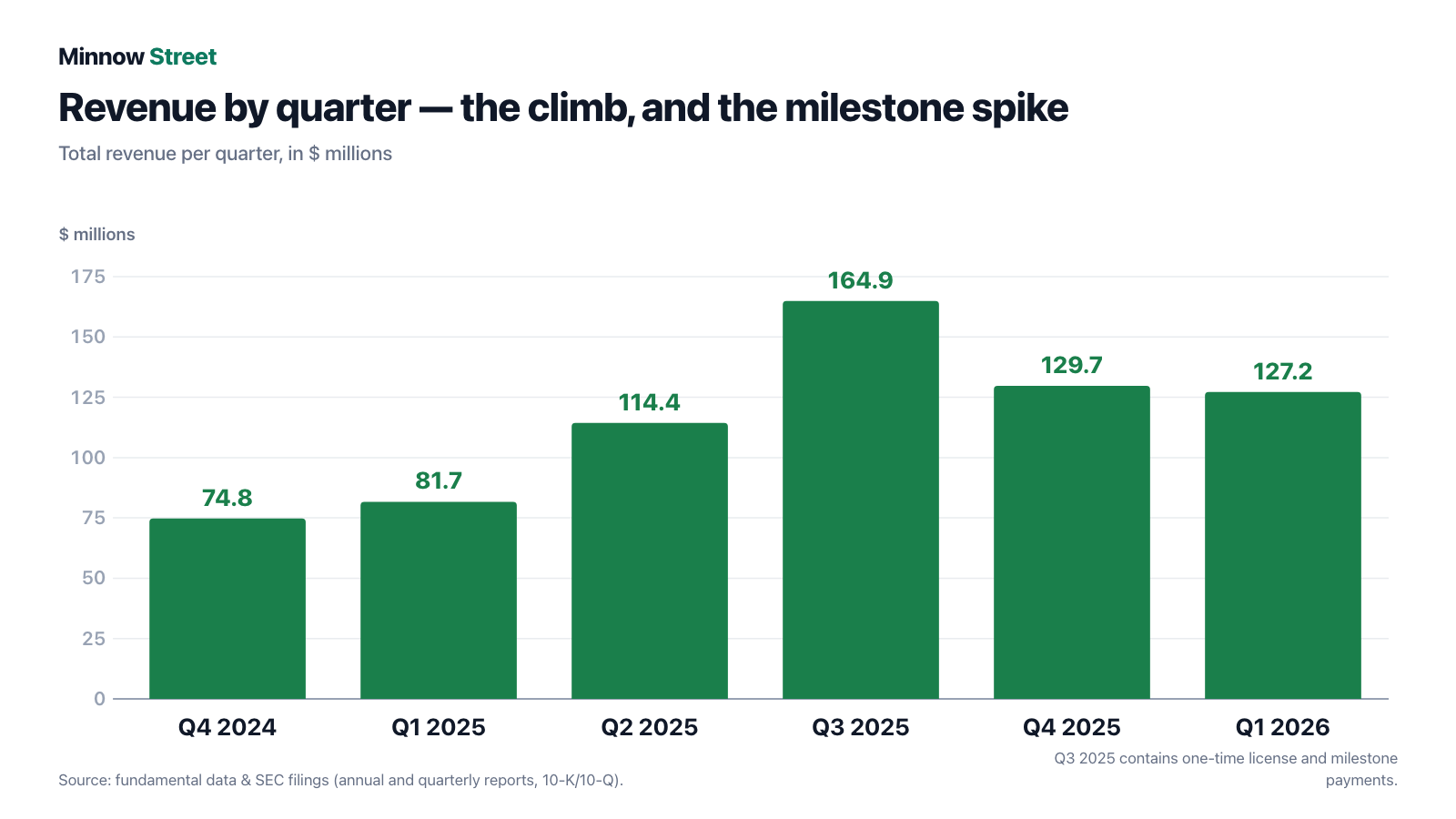
Unlike at some other companies in these scanners, the growth here is not an accounting trick: group revenue rose to $490.7 million in 2025 from $233.2 million the year before, and FILSPARI alone climbed to $322.0 million from $132.2 million. Quarter by quarter the path reads $74.8 million (fourth quarter of 2024), then $81.7 million, $114.4 million, $164.9 million and $129.7 million across the four quarters of 2025, and $127.2 million in the first quarter of 2026 — a strong climb, with the peak in the middle rather than at the end. But hold on to this tension — strong growth out of a single source. The scanner only measures that revenue is rising, not what it hangs on. Here is how to get there yourself: on minnowstreet.com, open the "Scanner" menu, pick the filter "high revenue growth" and look for the TVTX row.
The numbers over the years — honestly appraised
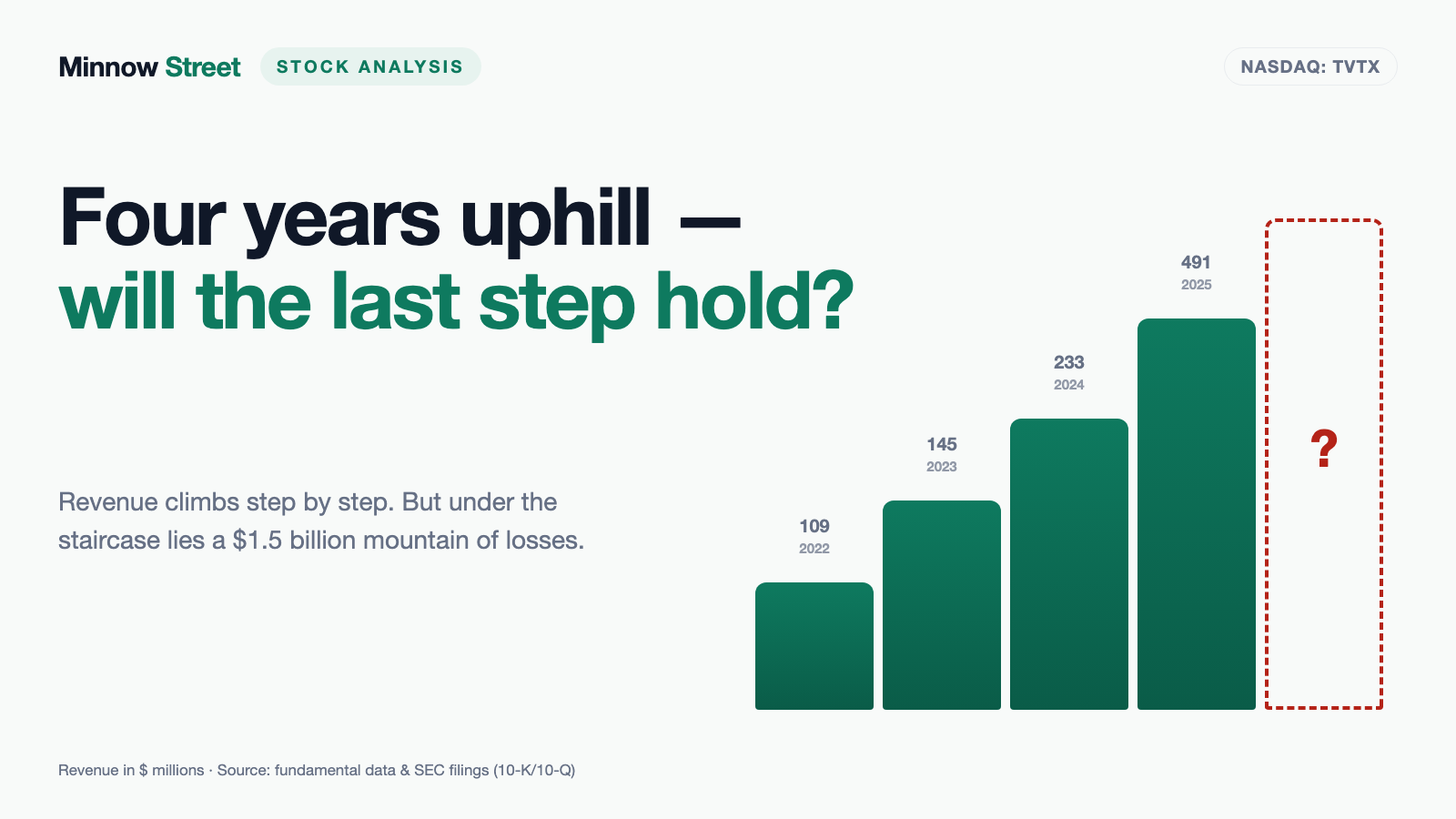
Start with what genuinely impresses. On a continuing-operations basis, the revenue ladder reads cleanly: $109.5 million (2022), $145.2 million (2023), $233.2 million (2024), $490.7 million (2025). Four steps up, and the last one is the biggest. FILSPARI carried it: $29.2 million (2023), $132.2 million (2024), $322.0 million (2025).
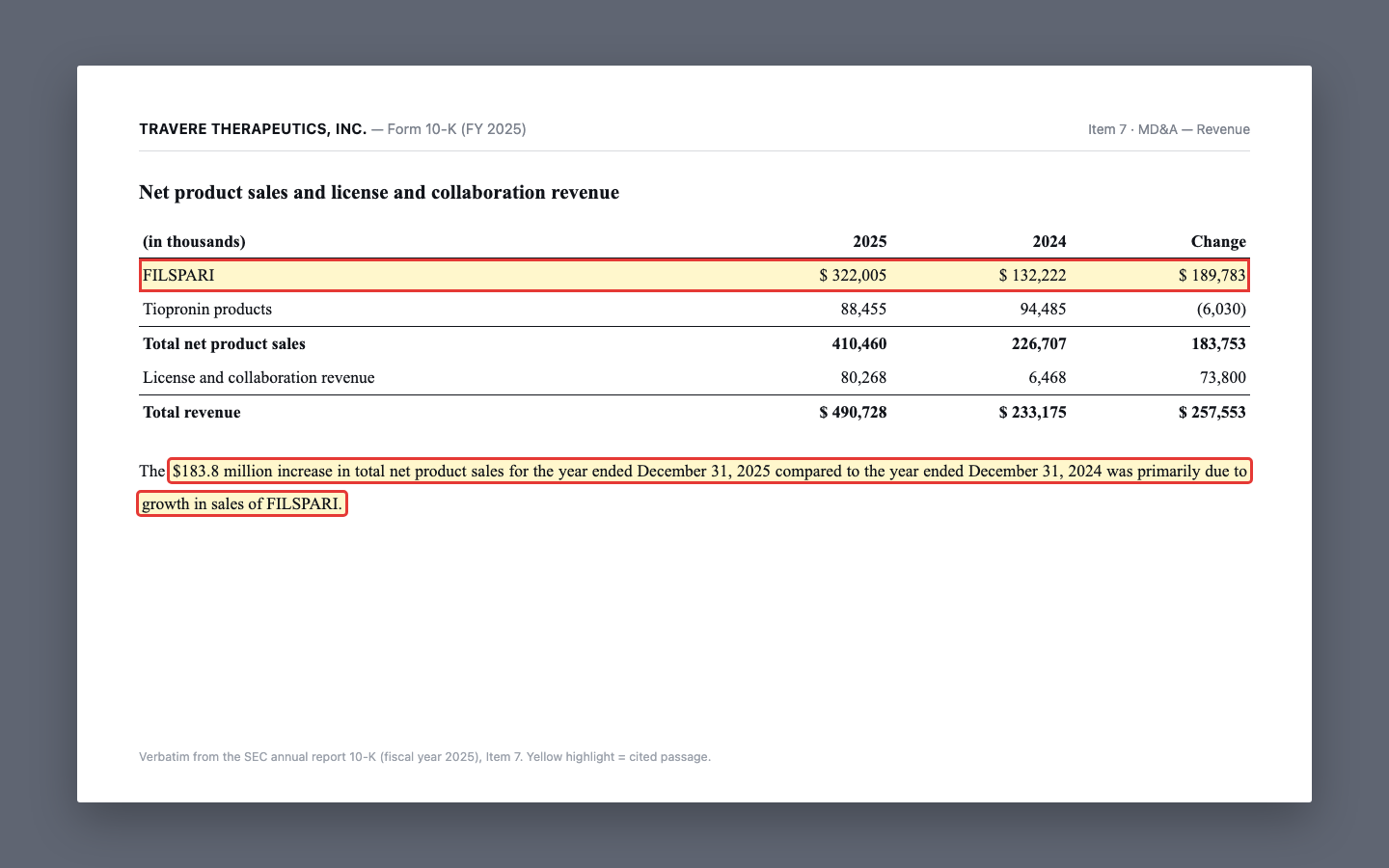
Two honest footnotes belong next to that curve. First: of the $490.7 million, $80.3 million was license and collaboration revenue, not product sales — and $57.5 million of that was one-time market-access and regulatory milestones from partner CSL Vifor (10-K 2025, Item 7). That is real money, but it does not repeat automatically. Second: the gross margin on product sales looks spectacular at about 98.6 percent — $410.5 million of product sales against $5.8 million of cost of goods sold — and the annual report explains exactly why, and why it will not last:
“For the year ended December 31, 2025, sales of FILSPARI primarily consisted of zero-cost inventories, and therefore cost of goods sold did not increase proportionally to the increase in product sales. As of December 31, 2025 the zero-cost inventory remaining was immaterial.”
— Travere Therapeutics, Inc., SEC annual report 10-K for fiscal year 2025, Item 7 “Cost of goods sold”
In plain language: before FILSPARI was approved, Travere booked the cost of producing the drug substance as research expense. Those already-paid-for batches were then sold at a book cost of zero — which flattered the margin. That inventory is now essentially used up. Picture a baker who spends a year baking bread on last year's flour budget: the bread looks wonderfully profitable until the flour has to be bought again. Remember this: the 98.6 percent is a starting figure, not a steady state.
The uncomfortable truths
Uncomfortable truth no. 1: almost the whole company hangs on a single drug
The finest growth story is worth little when it hangs by one thread. At Travere that thread is FILSPARI, and the company writes it into its own risk factors:
“Our ability to generate significant product revenues and to achieve commercial success in the near-term will depend almost entirely on our ability to successfully commercialize our products in the United States, including FILSPARI (sparsentan) to slow kidney function decline in adults with primary IgAN who are at risk of disease progression, which was granted full approval by the FDA in September 2024.”
— Travere Therapeutics, Inc., SEC annual report 10-K for fiscal year 2025, Item 1A “Risk Factors”
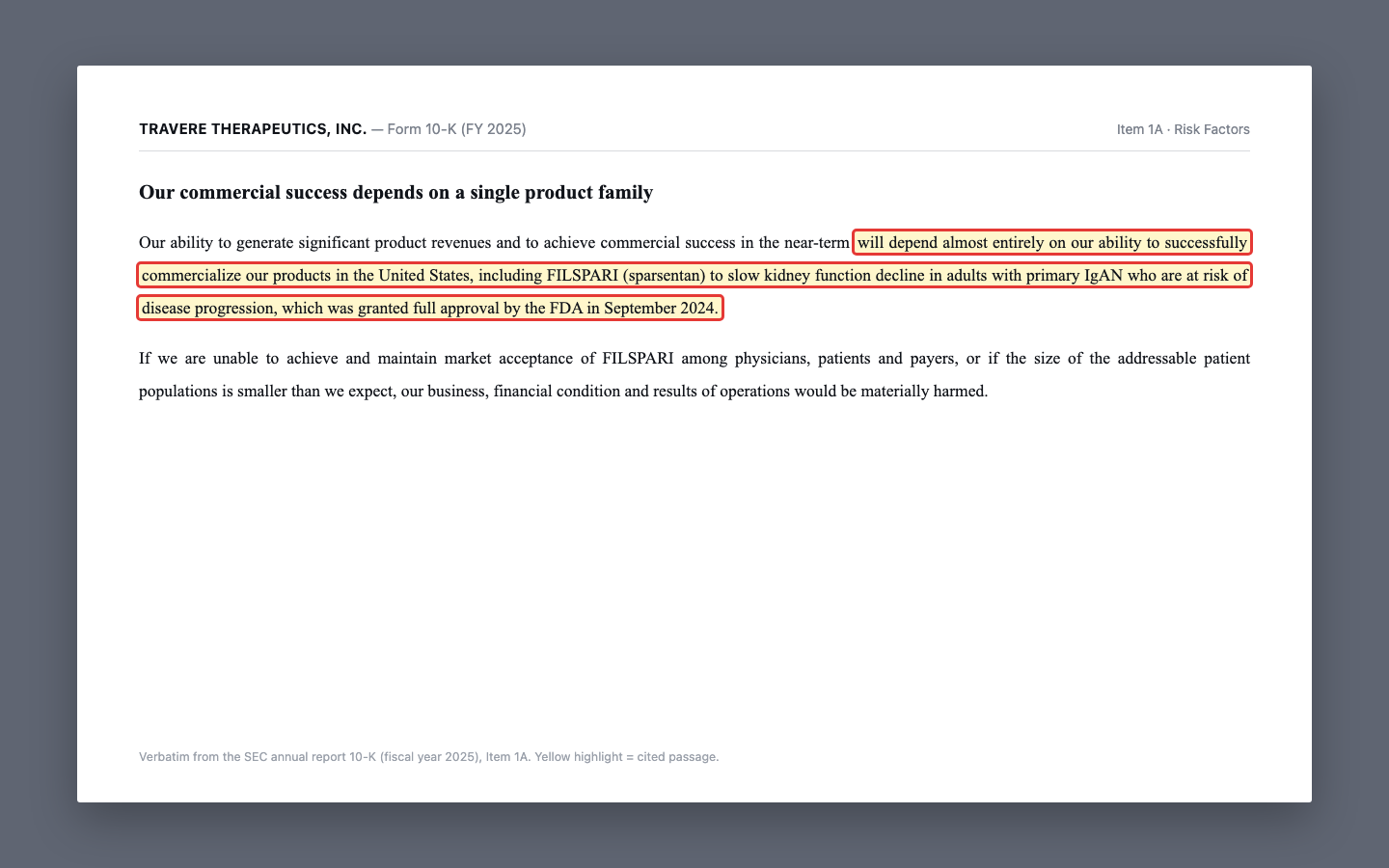
To see how narrow the base is: of $410.5 million in 2025 product sales, $322.0 million came from FILSPARI — about 78 percent. And the United States accounts for more than 98 percent of net product sales (10-K 2025, note 3). Imagine a neighbour telling you his business is going splendidly — and then learning that four of every five euros he earns come from one product in one country. You would swallow for a moment. That is the starting position at Travere. The second approval for FSGS in April 2026 softens the risk, because FILSPARI now addresses two diseases — but it is still one compound.
How brutally that arithmetic can bite is visible one street over. Aurinia Pharmaceuticals is the closest comparison you can find: also a kidney specialist, also a single approved drug — LUPKYNIS, which the company itself calls "our only approved product and our only source of net product sales", good for $271.3 million of revenue in 2025. Aurinia is even profitable. And yet its core patent protection runs only through October 2027, and eight generic manufacturers had already filed copycat applications by March 2025. A one-product business is a turbocharger while the product runs, and a single point of failure the moment it does not.
Uncomfortable truth no. 2: the headline loss is prettier than the business
Now to the price tag on this growth story. The number everybody quotes is the net loss: it fell from $321.5 million (2024) to just $25.5 million (2025). That reads like a company standing at the doorstep of profitability. Look one line higher in the same income statement, though, and the picture changes: the operating loss in 2025 was $62.8 million — total revenue of $490.7 million against total operating expenses of $553.6 million (research and development $206.0 million, selling, general and administrative $337.2 million, cost of goods sold $10.3 million). The gap between the two numbers is closed below the operating line, largely by interest and other income on the securities portfolio.
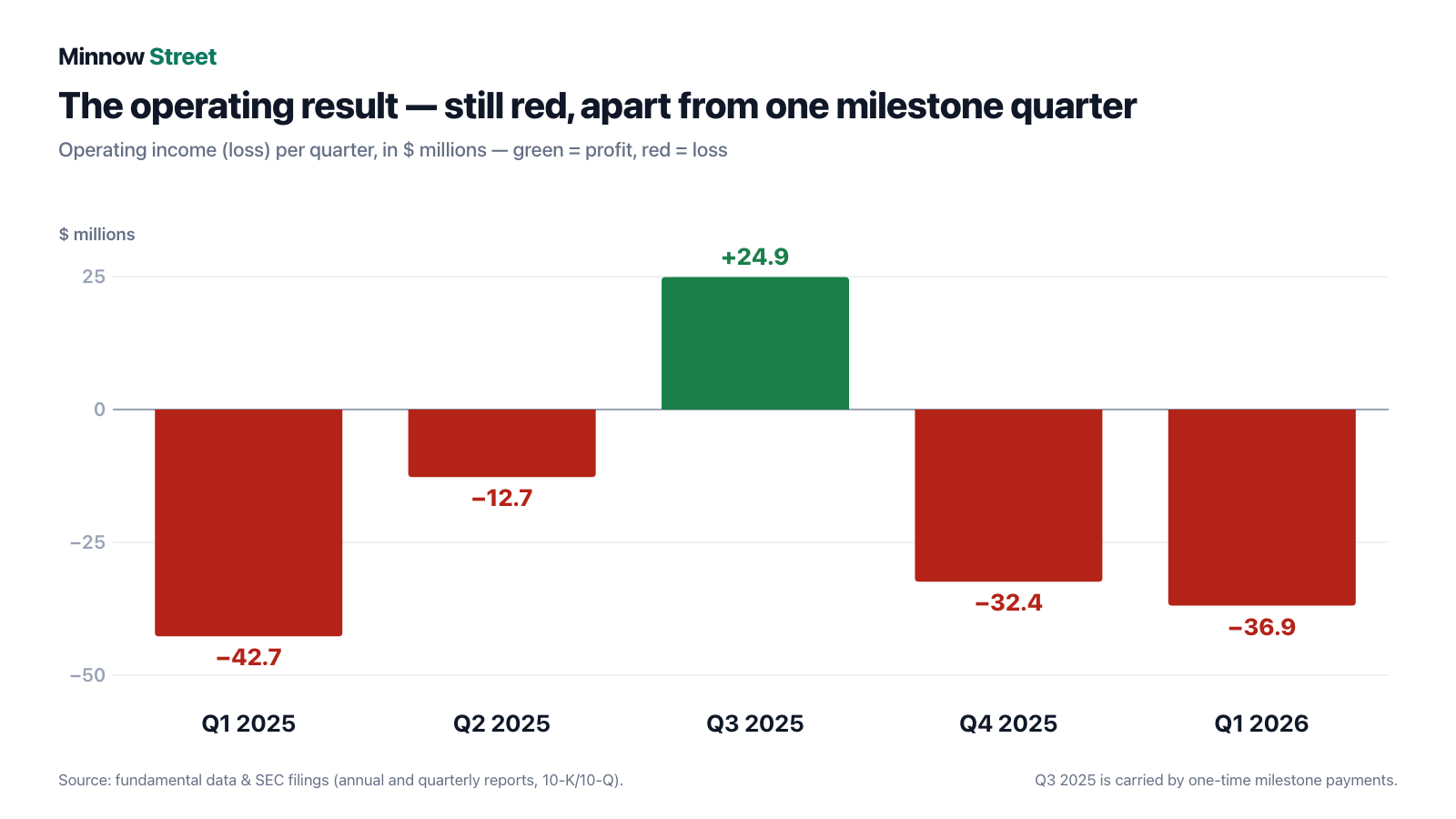
And the quarterly path is more sobering still. Across the last five reported quarters the operating result reads minus $42.7 million, minus $12.7 million, plus $24.9 million, minus $32.4 million and minus $36.9 million. Exactly one of them was operationally profitable — the third quarter of 2025, and that was the quarter carrying the CSL Vifor milestone payments. The first quarter of 2026 was back to an operating loss of $36.9 million, more than half of the entire 2025 operating loss in a single quarter.
Underneath all of it sits the hole the years have dug. At the end of 2025 the balance sheet showed an accumulated deficit of $1,472.7 million against stockholders' equity of $114.8 million; by March 31, 2026 the deficit had grown to $1,509.8 million and equity had fallen to $98.7 million.
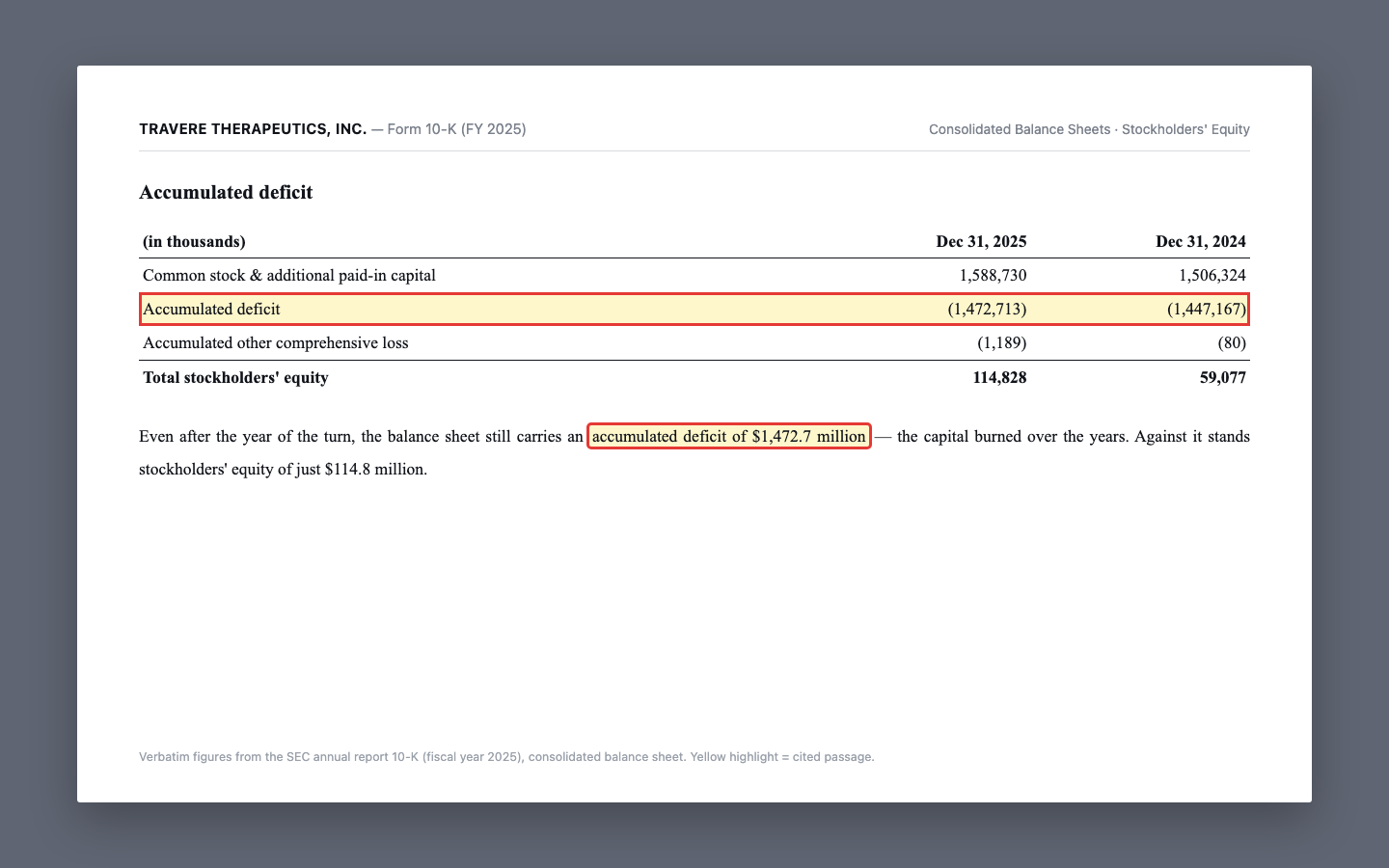
The accumulated deficit is the sum of every loss a company has piled up across its history. Think of it as a cellar of debt beneath the house: it says nothing about this year, but it shows how much capital the business has cost so far. There is genuine good news to set against it — operating cash flow turned positive in 2025, at plus $37.8 million, after minus $237.5 million in 2024 and minus $280.0 million in 2023. Cash stopped draining. But that year, too, was helped by the milestone payments. The direction is right; the destination is not reached.
Uncomfortable truth no. 3: the financing changed after the last quarterly report — in both directions
Anyone still making losses lives off the cash box. At the last reported date, March 31, 2026, Travere held $78.4 million in cash plus $186.3 million in marketable securities (of which $55.7 million was non-current) — about $264.7 million in total. That is not an emergency, but it is not a thick cushion either for a company simultaneously launching a second indication and expanding internationally.
Here is the part you will not find in that quarterly report, because it happened five weeks after the balance sheet date. On May 11, 2026, Travere completed a public offering of $525.0 million of 0.50 percent convertible senior notes due 2032, including the full $50.0 million over-allotment. The 8-K spells out the arithmetic:
“The Company estimates that net proceeds from the Offering will be approximately $508.5 million, after deducting the Underwriters’ discounts and commissions and estimated transaction expenses associated with the Offering payable by the Company. The Company intends to use a portion of the net proceeds from the offering to repurchase approximately $221.4 million aggregate principal amount of its outstanding 2.25% senior convertible notes due 2029 for cash, including accrued and unpaid interest, of approximately $350.9 million.”
— Travere Therapeutics, Inc., SEC current report 8-K, filed May 11, 2026, Item 8.01 “Other Events”
Unpack that, because it matters. Travere swapped expensive debt for cheap, long debt: the old 2.25 percent notes due 2029 shrink from $316.25 million of principal to roughly $94.9 million, while $525.0 million of 0.50 percent paper now runs to May 2032. The interest bill falls and the wall of maturities moves three years further out. On top of that, roughly $157.6 million of net cash stayed in the company — the $508.5 million of proceeds less the $350.9 million spent on the buyback. Measured against a $264.7 million cash position, that is a meaningful reinforcement, and it is the single most important thing to have happened to this balance sheet in the past year.
The price is on the other side of the ledger. A convertible bond is a loan that can turn into shares — and for you as a shareholder that means potential dilution: when new shares appear, your slice of the cake gets smaller even though you sold nothing. The new notes convert at an initial rate of 15.4078 shares per $1,000 of principal, an initial conversion price of about $64.90 per share, and the filing puts a ceiling on the damage: a maximum of 11,729,182 shares may be issued on conversion. Against roughly 93.0 million shares outstanding (10-Q cover page, as of April 30, 2026), that is up to about 13 percent more paper. Total convertible principal, meanwhile, rose from $316.25 million to roughly $619.9 million. More runway, more debt, and a dilution threshold that now has a number on it.
Three weeks later the company spent part of that runway. On June 1, 2026, Travere signed a license and collaboration agreement with Everest Medicines for civorebrutinib (EVER001), a BTK inhibitor, for all territories outside China and parts of East and Southeast Asia. The terms: an upfront payment of $112.5 million, up to approximately $1.03 billion in further milestone payments across up to five indications, plus tiered royalties from high single-digit to double-digit percentages of net sales. The agreement becomes effective once the U.S. antitrust waiting period expires. That is the first serious answer to the one-product problem — Travere is buying a second leg. It is also $112.5 million of cash leaving a company that only just topped up its account, for an asset that has not yet earned a cent.
How a magnificent revenue curve and a strained financing structure feel inside the same biotech stock, we have taken apart before at ImmunityBio — there the revenue grew 668 percent while $4.4 billion of accumulated losses, a going-concern warning and a founder acting as lender sat underneath it. Travere is a long way from that severity: no going-concern language, positive operating cash flow, a refinanced balance sheet. But the mechanism is the same one. The money that keeps the lights on does not yet come from the business alone.
Valuation — what the market is actually paying here
Evergreen analyses do not quote daily prices, so we anchor on a figure the company itself put on the record. In the prospectus supplement for the May offering, Travere states: "On May 6, 2026, the last reported sale price of our common stock was $44.76 per share." With about 93.0 million shares outstanding (10-Q cover page, as of April 30, 2026), that works out to a market value of roughly $4.2 billion as of May 6, 2026. Against group revenue of $490.7 million in 2025, that is a price-to-sales ratio of about 8.5.
Put that in its place. For a company just leaving the loss zone, eight and a half times revenue is not a value multiple — it is an outright growth valuation. The market is paying for FILSPARI roughly as if blockbuster status (more than a billion dollars of annual revenue from one drug) were already in hand; what has been delivered is $322.0 million. And the underwriters priced their own expectation into the deal: the notes convert at about $64.90 per share, some 45 percent above that May 6 price. That is the level at which the new paper starts turning into shares.
It can work out, if FILSPARI keeps taking share in IgAN and the new FSGS indication fires. It can also disappoint, if competitors such as Novartis (with atrasentan/Vanrafia) take slices, or if revenue growth flattens — in the first quarter of 2026 revenue came in at $127.2 million, slightly below the $129.7 million of the preceding quarter. Worth noting: the 15 analysts in consensus rated the stock a buy despite the valuation (data as of July 8, 2026). That is "the professionals' view", and a good deal of future is already in the price.
Opportunities and risks at a glance
What speaks for Travere:
- A real, documented turn: group revenue more than doubled in 2025 (to $490.7 million from $233.2 million), and operating cash flow swung positive at plus $37.8 million after minus $237.5 million the year before.
- A double approval as a growth lever: FILSPARI has been fully approved for IgAN since September 2024 and additionally for FSGS since April 13, 2026 — two rare kidney diseases with high unmet need and no real alternative therapies.
- Niche protection: rare diseases bring orphan-drug exclusivity and a manageable competitive field; FILSPARI was the first non-immunosuppressive therapy of its kind for IgAN.
- The balance sheet was reinforced after the last quarterly report: the May 2026 refinancing cut the coupon from 2.25 to 0.50 percent, pushed the maturity out to 2032 and left roughly $157.6 million of net cash in the company. The Everest license adds the first real second pipeline asset.
- Analyst consensus "buy" (15 analysts), strong relative strength (RS score 93) and a clear uptrend in the scanner (data as of July 8, 2026).
What speaks against it:
- One-product risk: by the company's own words, success depends "almost entirely" on FILSPARI; about 78 percent of product revenue and more than 98 percent of net product sales from a single country.
- The turn is less advanced than the headline suggests: an operating loss of $62.8 million in 2025 and another $36.9 million in the first quarter of 2026 alone; the only profitable quarter was carried by one-time milestone payments.
- A billion-dollar hole in the cellar: an accumulated deficit of $1,509.8 million as of March 31, 2026 against just $98.7 million of equity.
- The product margin will fall: the roughly 98.6 percent gross margin in 2025 rested on zero-cost inventories that the annual report describes as essentially used up at year-end.
- More debt and a named dilution threshold: convertible principal up from $316.25 million to roughly $619.9 million, with up to 11,729,182 new shares possible on conversion; $112.5 million of cash committed upfront for a licensed asset that has yet to earn anything.
- A pronounced growth valuation (price-to-sales about 8.5 as of May 6, 2026) and growing competition (among others Novartis/atrasentan) in the IgAN market; revenue eased slightly in the first quarter of 2026.
A human conclusion
Remember the film in your head from the opening — "the next blockbuster, and I was early"? After a look at the filings you know there is something to that story. Travere really has turned a corner: revenue has doubled, cash has stopped draining, the market got bigger with the second approval for FSGS, and since May the balance sheet carries cheaper, longer debt. This is not vapour. This is a company at a genuine inflection point.
But the pretty curve hides three things. Almost all the revenue hangs on a single compound. The headline loss of $25.5 million is a good deal friendlier than the $62.8 million operating loss underneath it — and the first quarter of 2026 went straight back into the red. And the cellar holds $1.5 billion of losses, against equity of less than $100 million. Buying Travere is not buying a comfortable profit machine; it is a bet on one drug: that FILSPARI becomes the standard in two indications, that the competition stays at arm's length, that the newly licensed BTK inhibitor arrives before the one-product risk turns into a one-product problem, and that operating cash flow turns durably positive without one-time payments propping it up. If the sums work, a loss-making biotech becomes a profitable niche champion. If they do not, a single product meets a thin capital buffer.
What you make of that is your decision. And that is exactly as it should be. What matters is only that you know what you are betting on — on the curve and on what lies underneath it.
Sources
- Travere Therapeutics, Inc. — SEC annual report 10-K, fiscal year 2025 (filed February 19, 2026)
- Travere Therapeutics, Inc. — SEC quarterly report 10-Q, first quarter of 2026 (as of March 31, 2026, filed May 4, 2026)
- Travere Therapeutics, Inc. — SEC prospectus supplement 424B5 on the 0.50% convertible senior notes due 2032 (dated May 6, 2026)
- Travere Therapeutics, Inc. — SEC current report 8-K on completion of the convertible offering and the buyback of the 2029 notes (filed May 11, 2026)
- Travere Therapeutics, Inc. — SEC current report 8-K on the license and collaboration agreement with Everest Medicines for civorebrutinib (filed June 2, 2026)
- Fundamental data (metrics, valuation, analyst consensus, quarterly series); in-house stock scanner, data as of July 8, 2026.
Disclaimer: This article is a journalistic analysis and not investment advice. It is not a solicitation to buy or sell securities. Share prices fluctuate; a total loss is possible. Make your investment decisions on your own responsibility and seek independent advice when in doubt.
Our Bottom Line at a Glance
- Business model & market positive
- A specialist in rare kidney diseases with genuine niche protection: FILSPARI has been fully approved for IgAN since September 2024 and additionally for FSGS since April 13, 2026 — two diseases with high unmet need and orphan-drug exclusivity. The addressable market grew with the second approval.
- Revenue growth positive
- A documented turn: group revenue more than doubled in 2025, to $490.7 million from $233.2 million, and FILSPARI alone rose to $322.0 million from $132.2 million. Operating cash flow swung to plus $37.8 million after minus $237.5 million the year before.
- Earnings quality negative
- The headline flatters the business. The net loss of $25.5 million (2025) sits against an operating loss of $62.8 million; the first quarter of 2026 alone brought another $36.9 million. The only operationally profitable quarter, the third of 2025, was carried by $57.5 million of one-time CSL Vifor milestones, and the roughly 98.6 percent product gross margin rested on zero-cost inventories the 10-K describes as essentially used up.
- Product concentration & competition negative
- One-product risk: commercial success depends, per the company's own annual report (10-K), "almost entirely" on FILSPARI; about 78 percent of product revenue and more than 98 percent of net product sales from a single country. And that one product is under attack — the IgAN market is drawing competitors, above all Novartis with atrasentan (Vanrafia), while revenue eased in the first quarter of 2026 to $127.2 million from $129.7 million. The Everest license for civorebrutinib (June 1, 2026) is the first answer to the concentration, but it is clinical, not commercial.
- Balance sheet & financing neutral
- An accumulated deficit of $1,509.8 million against just $98.7 million of equity (March 31, 2026) — but the financing improved markedly after that date. The May 2026 refinancing cut the coupon from 2.25 to 0.50 percent, moved the maturity to 2032 and left about $157.6 million of net cash in the company. The price: convertible principal up to roughly $619.9 million and up to 11,729,182 shares issuable on conversion.
- Valuation neutral
- On the last price documented in a filing ($44.76 on May 6, 2026) and about 93.0 million shares, the market value is roughly $4.2 billion — about 8.5 times the $490.7 million of 2025 revenue. The market is already paying for a future blockbuster. Analyst consensus nonetheless "buy" (15 analysts, data as of July 8, 2026).
Travere Therapeutics is a biotech at a genuine inflection point: the kidney drug FILSPARI more than doubled revenue in 2025, operating cash flow turned positive, the second approval for FSGS enlarged the market, and the May 2026 refinancing bought cheaper debt and three more years of time. But almost all the revenue hangs on that one compound, the operating loss of $62.8 million is far larger than the headline net loss, and the balance sheet carries $1.5 billion of accumulated losses against less than $100 million of equity. A bet on a single drug. Not investment advice.
What Our Rating Means
Open questions
The business works in principle, but one material question is open. As long as it stays open, our findings do not carry a quality verdict.
The open question here is operational, not existential. The company is not fighting for survival — operating cash flow turned positive in 2025, there is no going-concern language, and the May 2026 refinancing lowered the interest burden and pushed the maturity out to 2032. What is unproven is the turn itself: the operating loss was still $62.8 million in 2025 and $36.9 million in the first quarter of 2026, the only profitable quarter was carried by one-time milestone payments, and the product margin rested on zero-cost inventories that are now used up. On top of that, the business stands on a single compound. Only when revenue grows again after the first-quarter 2026 dip, the operating result turns positive without one-time payments, and the business spreads across more than one drug does the valuation earn trust. Until then, watch FILSPARI revenue, the FSGS ramp, the operating margin after the zero-cost inventories and the cash balance.
A journalistic assessment by our editorial team at the time of the deep dive, based on public sources — not investment advice and not a solicitation to buy or sell. Your personal circumstances (investment goals, risk capacity, taxes) cannot be taken into account. What our levels mean, how verdicts are formed, and what conflicts of interest exist →
Worth Noting
- FILSPARI first received accelerated approval for IgAN in February 2023 (on the surrogate marker proteinuria) and full FDA approval in September 2024; the FSGS approval followed on April 13, 2026.
- The revenue spike in the third quarter of 2025 ($164.9 million) contains one-time license and milestone payments — $57.5 million of CSL Vifor market-access and regulatory milestones among them — and should not be mistaken for run-rate product revenue.
- The figures in this analysis distinguish the weighted average share count (89.2 million for 2025, 91.9 million for the first quarter of 2026) from shares actually outstanding (about 93.0 million as of April 30, 2026, per the 10-Q cover page); the market value is calculated on the latter.
- Everything after the first-quarter 2026 report was reviewed: the convertible offering of May 11, 2026, the Everest Medicines license of June 1, 2026, and an 8-K of July 9, 2026 announcing the planned retirement of the chief accounting officer after the 10-K expected in February 2027 — the last of these does not change the picture.
- In our company-level AI classification, Travere is rated "uses AI": internal use of generative AI and machine learning, but no AI revenue stream.
Frequently Asked Questions
Travere is a biopharmaceutical company for rare kidney and metabolic diseases, based in San Diego, California. Its most important product is FILSPARI (active ingredient sparsentan), a tablet against the rare kidney disease IgA nephropathy (IgAN), fully approved in the United States since September 2024 and additionally approved for the indication FSGS since April 13, 2026. Alongside it, Travere sells the tiopronin products Thiola and Thiola EC against cystinuria.
Mainly because of FILSPARI: net sales of that drug jumped to $322.0 million in 2025 from $132.2 million, and group revenue to $490.7 million from $233.2 million. The drivers are rising prescriptions after the full U.S. approval for IgAN plus license and milestone payments — including $57.5 million of one-time CSL Vifor milestones in 2025. The growth is real, but it hangs almost entirely on this one compound.
Not yet, and less close than the headline suggests. The net loss shrank to $25.5 million in 2025 from $321.5 million in 2024, but the operating loss was still $62.8 million, and the first quarter of 2026 added another $36.9 million. Operating cash flow did turn positive in 2025, at plus $37.8 million. The balance sheet carries an accumulated deficit of $1,509.8 million as of March 31, 2026 against equity of $98.7 million.
The one-product risk. Travere writes in its annual report (10-K) that near-term commercial success will depend "almost entirely" on commercializing its products in the United States, above all FILSPARI. About 78 percent of product revenue comes from that one compound and more than 98 percent of net product sales from a single country. If demand for it falters, almost all the revenue goes with it.
On May 11, 2026 Travere issued $525.0 million of 0.50 percent convertible senior notes due 2032, with net proceeds of about $508.5 million, and used roughly $350.9 million of that to buy back about $221.4 million of principal of the old 2.25 percent notes due 2029. That cut the coupon, pushed the maturity to 2032 and left about $157.6 million of net cash in the company. On June 1, 2026 it committed $112.5 million upfront for a license to the BTK inhibitor civorebrutinib.
As a pronounced growth stock. Based on the last price documented in a filing — $44.76 per share on May 6, 2026, from the prospectus supplement — and about 93.0 million shares outstanding, the market value works out to roughly $4.2 billion, or about 8.5 times the $490.7 million of 2025 revenue. The new convertible notes convert at about $64.90 per share, some 45 percent above that price.
In our company-level AI classification, Travere is rated "uses AI". According to the annual report (10-K) and quarterly report (10-Q), employees use generative AI, machine learning and automated decision systems in their work; the company concedes that without AI it would become less efficient and risk competitive disadvantages. At Travere, though, AI is an internal tool, not a source of revenue — there are no AI products.
Found an error?
Did you spot a factual error, an outdated number, or a typo in this deep dive? Let us know briefly — your report goes straight to the editorial team.