Bladex: Rank 35 in the Bargain List — and the Ratio Only Measures How a Loan Book Breathes
Bladex has financed Latin America's foreign trade since 1979, and a sixth of it belongs to the region's central banks. Our price-to-free-cash-flow ranking carries the stock at 1.9, in 35th place — which sounds like two years of profit for the whole company. Except that in 2025 its operating cash flow swung between plus $874.8 million and minus $599.7 million, while quarterly profit sat quietly between $51.7 and $64.2 million. We do the arithmetic on what that ratio can really tell you about a trade finance bank — and on what it simply cannot.
 Thomas Mücke
Founder & Publisher
Thomas Mücke
Founder & Publisher
Chart
Interactive price chart (TradingView).
Note: pure fact-based analysis, not investment advice and not a solicitation to buy or sell. All figures without guarantee.
There is a trap for investors that springs precisely when a number looks unambiguous. Call it the label trap. It works like this: a ratio carries a name — “free cash flow” — and because we know what that name means, we stop asking what was actually measured underneath it. At Banco Latinoamericano de Comercio Exterior, S.A. (NYSE: BLX), which has officially called itself Bladex, Inc. since June 4, 2026, the label reads: a price-to-free-cash-flow ratio of 1.9. That would be the price of barely two years of cash inflow for an entire bank.
So let us make a deal: we will not celebrate the label, we will look underneath it. The sources are the filings Bladex makes to the U.S. securities regulator, the SEC. Because the bank sits in Panama and counts as a foreign private issuer, those filings are not called 10-K and 10-Q but annual report 20-F and interim report 6-K. We read the annual report for 2025 (filed April 20, 2026) and every filing after it, through to the interim statements as of March 31, 2026.
And what they describe is a bank whose cash statement swings by $1.47 billion inside a single year, while its profit lies as flat as a plank. What you make of that is your decision in the end.
What this analysis covers
- What Bladex actually does — a bank owned by central banks
- Where the stock landed on our desk — rank 35 and a price/FCF of 1.9
- The numbers over the years — given their honest due
- Uncomfortable truth no. 1: “free cash flow” measures the loan book breathing
- Uncomfortable truth no. 2: Altman Z and interest coverage are not warnings here — they are nothing
- Uncomfortable truth no. 3: five depositors, 48 days of maturity, no deposit insurance
- Uncomfortable truth no. 4: three share classes — and who has nothing to say
- Valuation: what you actually measure a bank with
- Opportunities and risks at a glance
- A human conclusion
- Sources
What Bladex actually does — a bank owned by central banks
Bladex is not a bank where you open a checking account. It takes no deposits from private individuals and runs no branch business. Its trade is foreign trade finance: when a Guatemalan sugar producer sells his harvest to Europe, when a Colombian bank needs letters of credit for its importers, when a Brazilian utility orders a plant from abroad — someone has to bridge the gap between delivery and payment. Bladex finances that gap.
The founding story explains why this bank exists at all. In May 1975 a proposal was put to the assembly of the region's central bank governors to create a multinational institution that would strengthen Latin American trade finance. Organized in 1977, incorporated under Panamanian law in 1978, operations began on January 2, 1979. A 1978 contract law between the Republic of Panama and the bank exempts it from Panamanian income tax to this day.
The apparatus has stayed small: 372 permanent employees as of December 31, 2025, of whom 335 sit at headquarters in Panama City, nine at the New York agency and the rest in representative offices in Argentina, Brazil, Colombia and Mexico. Twenty nationalities, 97 percent of them from Latin American countries. For scale: those 372 people manage total assets of $13.7 billion (March 31, 2026). That is roughly $37 million of balance sheet per employee.
The money is made on two things. First on the spread between what borrowers pay and what depositors receive — $271.2 million of net interest income in 2025. Second on fees for letters of credit, guarantees, loan commitments and the structuring of syndicated loans — $59.0 million in the same year, up 33 percent. Together that made $339.6 million of total revenues.
The unusual part sits in the shareholder register. Class A shares may be held only by central banks, majority state-owned banks and other government agencies of Latin American countries. Put differently: the institutions whose economies the bank finances are at the same time its co-owners and its largest funders. That is why Bladex claims a de facto preferred creditor status in its annual report — in past regional debt restructurings it was exempted from payment restrictions. The bank itself adds that it cannot guarantee this will hold.
One sentence to carry through the rest of this text: at a bank the balance sheet is not the accessory to the business — it is the business. Which is why ratios built for factories do not work here.
Where the stock landed on our desk — rank 35 and a price/FCF of 1.9
Every day we run some 3,500 stocks through our scanners. Bladex reached the research list through the price-to-free-cash-flow ranking. That ranking divides market value by the free cash flow of the trailing twelve months and sorts ascending: cheapest first. The guiding question is: how many years would the company have to carry on like this to earn its own market value?
Here is how to find the row yourself: open the scanner overview, pick the “valuation” section, choose the “price/FCF ranking” filter, set the market filter to the United States. On July 28, 2026 that list screened 837 U.S. stocks and displayed the 100 strongest hits. Bladex stood at rank 35 — with a displayed ratio of 1.9, a Piotroski score of 5 out of 9, a fundamental rating of C (52 out of 100) and a three-year return of 86 percent a year. The lists are recomputed daily; the run behind this measurement dates from July 27, 2026.
Bladex is no isolated hit, either. On its company page the stock passed twelve of our audited scanner strategies that same day, among them “Stan Weinstein: stage 2”, “power trend”, “Mark Minervini: trend criteria — 1 month”, “near the 52-week high”, “all-time high”, “pocket pivot”, “Chowder rule”, “U.S. dividend rockets” and “James O'Shaughnessy: trending value”. That is an unusually broad overlap of trend, dividend and value filters.
Translated, that means: the price is running (up 42.5 percent year to date, 1.9 percent below the 52-week high as of July 24, 2026), the payout is growing, and the valuation looks low. It is that last point that deserves the arithmetic — because the very ratio that produced the entry is the one that says least at a bank.
The numbers over the years — given their honest due
First what genuinely impresses. Profit has been rising for years, without zigzag: $166.2 million in 2023, $205.9 million in 2024, $226.9 million in 2025 — up 10 percent in the last year and 37 percent over two. Earnings per share followed: $4.55, then $5.60, then $6.11. The first quarter of 2026 added $56.4 million, 9 percent more than the year-earlier quarter.
Return on equity came to 15.43 percent in 2025, 16.20 in 2024, 14.68 in 2023. For a bank that is good; large commercial banks tend to sit nearer 10 to 12 percent. More remarkable still is the efficiency ratio of 26.5 percent in the first quarter of 2026: of every dollar of revenue, 26.5 cents pays for the entire operation. Plenty of European universal banks are at 60 to 70 cents. That is the advantage of a bank without a branch network.
And the business is not only growing on paper. The loan portfolio hit a record $13,487 million as of March 31, 2026 (up 13 percent year on year), deposits rose 25 percent to $7,307 million and now provide 63 percent of funding. On June 22, 2026, S&P Global Ratings lifted the long-term issuer rating from “BBB” to “BBB+”, with a stable outlook.
And credit quality? Strikingly clean. As of December 31, 2025, $39 million of loans were impaired — 0.42 percent of the loan book. For context: in this region, low tens of millions against total assets of $12.8 billion counts as unremarkable. Against those $39 million Bladex has set aside $29.0 million of specific provisions, 75 percent of the nominal amount. Across all provisioning buckets the stock of impaired loans was covered 2.9 times as of March 31, 2026.
Said honestly alongside: those $39 million are up sharply from $17 million (2024) and $10 million (2023). The reason is in the report — one new single exposure of $20.0 million from upstream gas and one of $1.7 million from iron and steel production. Both are provisioned, both are disclosed, and neither changes the order of magnitude.
Now to the hook. Because this is where what the bank earns parts company with what its cash statement reports.
Uncomfortable truth no. 1: “free cash flow” measures the loan book breathing
Bladex reports under the international accounting standards, IFRS. And there a rule applies to banks that makes all the difference: loan origination and deposit inflows sit in operating activities — not, as at an industrial company, in investing or financing activities. Whatever goes out as new loans and comes in as deposits each quarter therefore lands in the middle of “operating cash flow”.
Look at what that does.
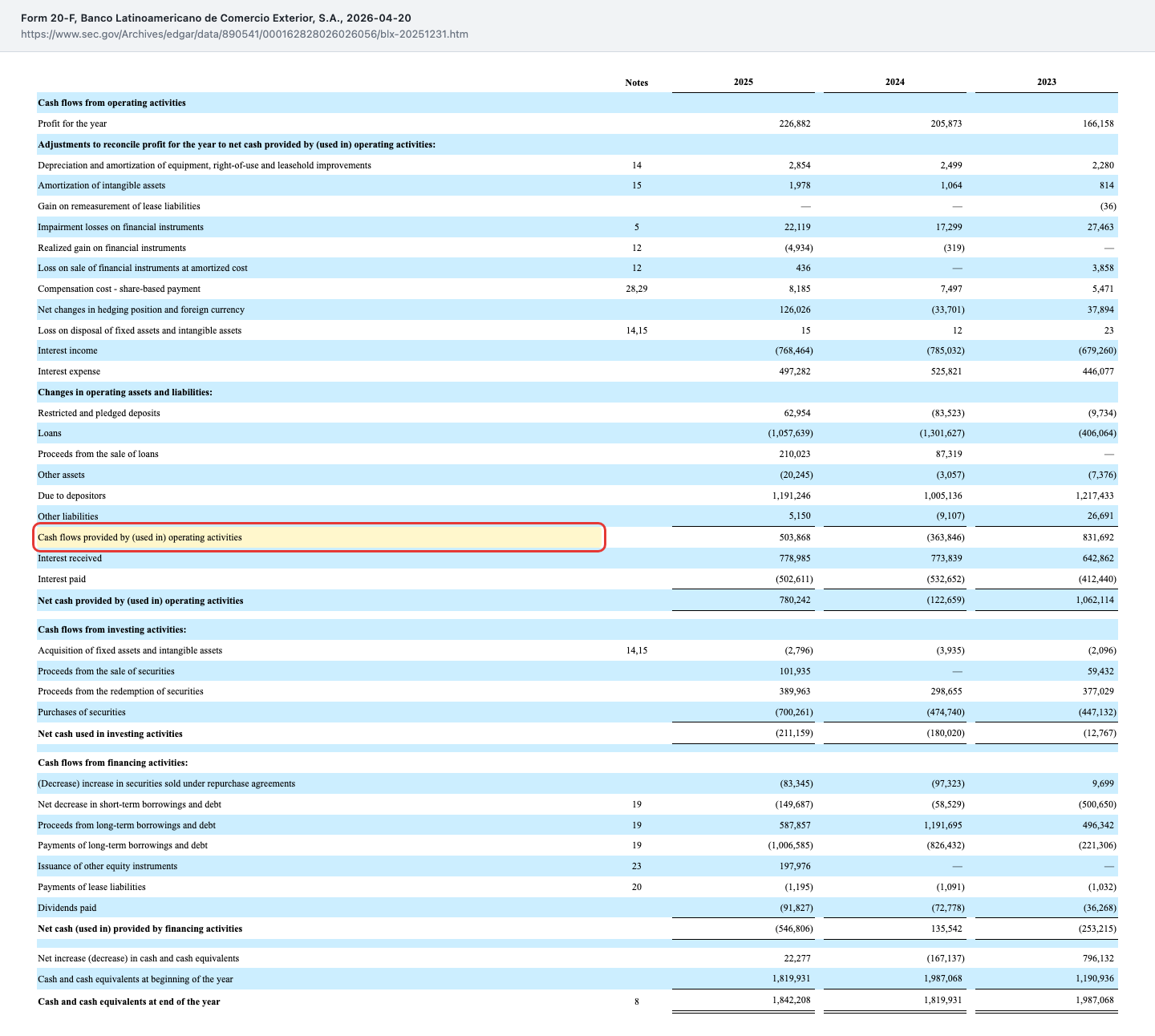
Three years, the same bank, a steadily rising profit — and net cash from operating activities of $1,062.1 million (2023), minus $122.7 million (2024) and $780.2 million (2025). In 2024, the year with the second-best profit in the firm's history, the cash flow statement reports an outflow. Not because anything went wrong, but because in that year the bank lent out $1,301.6 million more than came in as deposits.
Quarter by quarter it is more dramatic still.
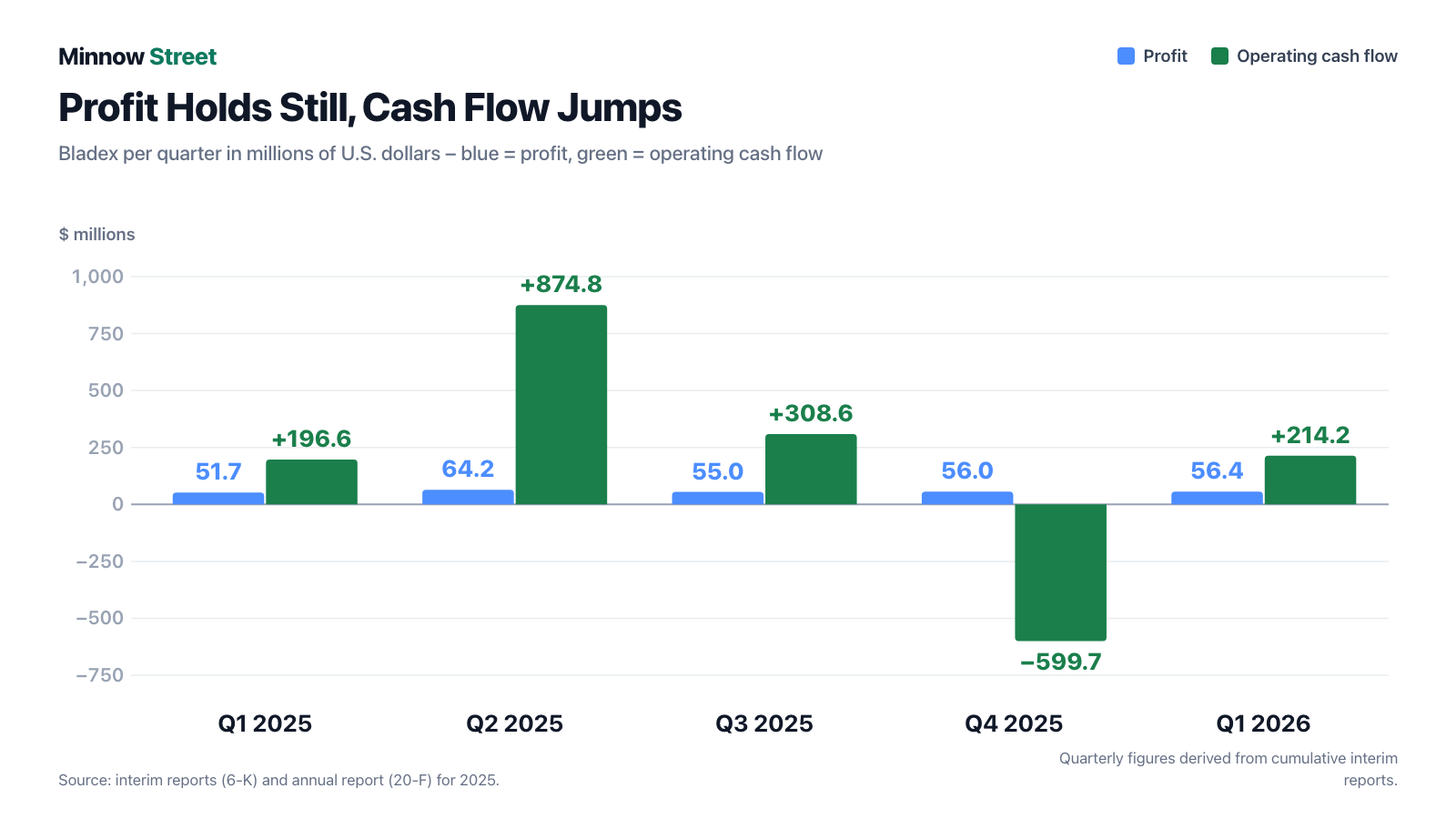
Put into an everyday picture: think of a money changer at a market. In the morning he puts 1,000 into the cash box, he changes money all day, and by evening there is 1,200 in it. What he earned is the difference — 200. Anyone who only counts the box and writes down “1,200 came in today” has confused turnover with earnings. That is exactly what happens here: at a trade financier, free cash flow measures how much money is running through the box, not how much stays in it.
And that this really is about turnover is there in black and white in the report.
“As of December 31, 2025, the Loan Portfolio had an average remaining maturity term of 504 days, and 65% of the Bank's Loan Portfolio was scheduled to mature within one year, compared to an average remaining maturity of 395 days, or 61% maturing within one year as of December 31, 2024, and 424 days, or 56% maturing within one year as of December 31, 2023.”
— Banco Latinoamericano de Comercio Exterior, S.A., SEC annual report 20-F for 2025, Item 4.B “Business Overview — Loan Portfolio”

Let us do the arithmetic properly. From the 2025 net cash inflow of $780.2 million we subtract every pure balance sheet movement that says nothing about earning power: loans originated (minus $1,057.6 million), proceeds from the sale of loans (plus $210.0 million), deposit inflows (plus $1,191.2 million), pledged deposits (plus $63.0 million) and other assets and liabilities (minus $20.2 million and plus $5.2 million). Together those items come to plus $391.5 million. What remains — profit, depreciation, credit provisions, interest payments — is $388.8 million.
That is the number to work with. Against a market value of roughly $2.3 billion (figures as of July 27, 2026) it produces a ratio in the order of 5.9 instead of 1.9. Still not expensive — but an entirely different league. And even that 5.9 is only a stopgap measure: at a bank the right question is not how much money flows through, but how much equity earns what return.
We described the same effect at an installment lender, only with different accounting mechanics: in our analysis of OneMain Holdings the apparently enormous cash inflow comes from the reversal of credit provisions, here it comes from the turnover of the loan book. The result is the same: at financial companies this ratio needs to be placed in context, not celebrated.
One trap we can at least rule out here. At XP Inc. we showed that a price-to-free-cash-flow ratio of 0.6 arises only because a market value in U.S. dollars is divided by a cash flow in Brazilian reais. At Bladex there is no such break:
“All amounts presented in the consolidated financial statements and notes are expressed in United States dollars (US dollars), which is the functional currency of the Bank.”
— Banco Latinoamericano de Comercio Exterior, S.A., SEC annual report 20-F for 2025, note 2.2 “Functional and presentation currency”
Balance sheet, income statement and listing all sit in the same currency. So the mistake this ratio makes here is not a currency mistake — it simply measures the wrong thing.
Uncomfortable truth no. 2: Altman Z and interest coverage are not warnings here — they are nothing
Anyone looking at the data sheet for BLX trips over two numbers that look like an alarm: an Altman Z" score of 1.07 — on that scale anything below 1.1 counts as the danger zone — and an interest coverage of 0.47, so less than one times over. At an industrial company that would be a reason to stop reading here.
At a bank it is not. Not because banks deserve more indulgence, but because both formulas were built for a different business model.
The Altman Z score was developed on industrial companies in the late 1960s. Two of its building blocks automatically punish a banking model. One sets revenue against total assets: a factory turns over one to two times its balance sheet a year, while Bladex made $339.6 million of revenues in 2025 on $12.8 billion of assets — roughly 2.7 percent. The other measures equity against liabilities: a bank is eightfold leveraged by construction (total assets divided by equity: 8.0 as of March 31, 2026), a factory rarely more than twofold. Neither is unhealthy at a bank; both are what a bank is by definition. Our own data sheet says as much in its explanatory text: for banks, insurers and real estate stocks the formula does not fit.
With interest coverage it is clearer still. It measures how many times operating profit covers interest expense — and assumes that interest is a financing burden. At a bank it is the cost of goods sold. In 2025 Bladex paid $497.3 million of interest to depositors and bondholders and took in $768.5 million. The difference is not what is left over after interest — it is the product. An interest coverage of 0.47 means nothing here beyond the fact that the bank is doing its business.
So what do you measure with instead? With these six numbers (all as of March 31, 2026 unless stated otherwise):
- Tier 1 capital ratio under Basel III: 17.9 percent — equity against risk-weighted assets. The regulatory minimum sits at 6 to 8.5 percent depending on the rule; solid European banks move between 13 and 16. 17.9 is comfortably more than enough. As of December 31, 2025 it was 17.4 percent, a year earlier 15.1.
- Regulatory capital ratio under Panamanian banking law: 14.7 percent (December 31, 2025: 15.5 percent).
- Equity ratio: 12.4 percent — $1,708 million of equity against $13,739 million of total assets. A high figure for a bank; many large banks sit at 5 to 8 percent.
- Impaired loans: 0.3 percent of the loan portfolio ($38.7 million), covered 2.9 times by loan loss allowances. 97.5 percent of the portfolio sits in the lowest risk stage.
- Net interest margin: 2.34 percent — and here the headwind is visible: 2.49 percent in 2023, 2.47 in 2024, an average of 2.36 in 2025. Falling policy rates and plentiful dollar liquidity are pressing on prices.
- Return on equity: 13.5 percent (14.2 percent adjusted for the new hybrid capital), after 15.4 percent in the year-earlier quarter.
Remember the sentence: a ratio computed for the wrong business model is not a weak signal — it is no signal at all. That cuts both ways: it may be read neither as a warning nor as an all-clear.
Uncomfortable truth no. 3: five depositors, 48 days of maturity, no deposit insurance
If this bank has a genuine concentration risk, it is not on the lending side but on the funding side. And the bank names it itself.
“As of December 31, 2025, deposits from the Bank's five largest depositors, all except three of which were central and state-owned banks in the Region, represented 35% of the Bank's total deposits, compared to 37% as of December 31, 2024. All of the Bank's deposits are uninsured.”
— Banco Latinoamericano de Comercio Exterior, S.A., SEC annual report 20-F for 2025, Item 4.B “Business Overview — Deposits”

Broken down, the deposit base as of December 31, 2025 looks like this: 35 percent from central banks or their designees (which is exactly the class A shareholders), 34 percent from private commercial banks, brokers and financial institutions, 25 percent from state-owned and private corporations plus international organizations, 6 percent from state-owned banks. Deposits now make up 63 percent of total funding (March 31, 2026) after 51 percent of liabilities at the end of 2024 — the bank has deliberately shifted toward deposits.
And one more sentence from the report that carries weight: Panama has no central bank, deposits are insured by no government body, and the Panamanian banking system has no lender of last resort in the event of a system-wide liquidity disruption. Bladex answers that with its own means: $1,988 million of liquid assets as of March 31, 2026 — 14.5 percent of total assets, of which 80 percent sits as balances at the Federal Reserve Bank of New York. Through its New York agency the bank also has access to the Fed's discount window and keeps a portfolio of high-quality securities ready for it.
How seriously you take that hangs on a judgment nobody can make for you: how likely is it that several Latin American central banks change their dollar liquidity strategy at the same time? In 47 years it has not happened — not even in the debt crisis of the 1980s, which the bank came through. But “it has never happened” is not a guarantee, it is an experience.
Uncomfortable truth no. 4: three share classes — and who has nothing to say
Bladex has four share classes, three of which are outstanding. Anyone buying BLX on the New York Stock Exchange is buying class E.
“Class A shares may be issued only as registered shares in the name of the following entities in Latin American countries: (i) central banks, (ii) banks in which the State is the majority shareholder or (iii) other government agencies. Class B shares may be issued only in the name of banks or financial institutions. Class E shares and preferred shares may be issued in the name of any person, whether a natural person or a legal entity.”
— Banco Latinoamericano de Comercio Exterior, S.A., SEC annual report 20-F for 2025, Item 10.B “Memorandum and Articles of Association”

As of December 31, 2025, 37,230,208 shares were outstanding: 6,342,189 of class A (17.0 percent), 827,573 of class B (2.2 percent) and 30,060,446 of class E (80.7 percent). Class F, reserved for government bodies outside Latin America and multilateral institutions, is unissued. There are no preferred shares.
It gets interesting at the allocation of board seats. Class A shareholders elect three directors although they hold only 17 percent of the capital. Class E shareholders — four fifths of the capital — elect five. Four fundamental resolutions, among them amending the articles and merging with another company, additionally require the consent of three quarters of the outstanding class A shares. Put differently: without the region's central banks this bank will not be sold and will not be rebuilt.
For you as an investor that has a double nature: the same construction that underpins the preferred creditor status and the stable funding also limits what can ever happen to this stock. There is no takeover fantasy here.
And one line in passing: a $50 million buyback program has been running since February 2024 — not a single share was repurchased under it in all of 2025. Instead the share count rose by 439,388 in 2025, essentially through compensation shares.
Valuation: what you actually measure a bank with
Forget the price-to-free-cash-flow ratio for a moment. At a bank you measure with two figures: the price per unit of profit and the price per unit of book value — and you place both against the return on equity.
At the valuation anchor of July 24, 2026 — a closing price of $59.60, a market value of roughly $2.3 billion — the picture is this (data sheet as of July 27, 2026):
- A price-earnings ratio of roughly 10.3, or roughly 8.4 on expected profit for the next twelve months.
- A price-to-book ratio of roughly 1.4 against a return on equity of 13.5 to 15.4 percent. Rule of thumb: a price-to-book of 1.4 is justified if the bank durably earns clearly more than its cost of equity — at a 13 to 15 percent return that is plausible.
- A dividend yield of roughly 4.4 percent on $2.63 per share paid out over the last twelve months and a payout ratio of 43.6 percent. For 2025 the bank declared $93.0 million in total, which is $2.56 per share after $2.00 in 2024. The dividend has not been cut in four years and has been raised in two consecutive years.
A word of caution on the price-to-sales ratio: we deliberately do not use it here. The reason is a definitional change in the data series. Through the third quarter of 2025 the data sheet reported gross revenues as “revenue” ($202.1 million in the first quarter of 2025, $216.7 million in the second, $209.0 million in the third); from the fourth quarter onward it reports total revenues after interest expense ($88.8 million, then $83.1 million in the first quarter of 2026). The apparent revenue collapse of 53 and 59 percent respectively is therefore a change of definition, not a collapse in business — net interest income actually rose 8 percent in the first quarter of 2026.
On the professionals' view: analyst coverage is thin. Two houses follow the stock, which explains part of the valuation discount against U.S. regional banks, as does country risk. Anyone buying a bank whose entire business hangs on Latin America gets a discount for it — and carries the risk they are being paid for.
Opportunities and risks at a glance
What speaks for it:
- A business model whose moat is its ownership: founded by the region's central banks, which still hold the class A shares and supply 35 percent of deposits — the source of the de facto preferred creditor status that has carried the bank through several regional crises.
- Reliably rising results: profit of $166.2 million (2023), $205.9 million (2024), $226.9 million (2025) and $56.4 million in the first quarter of 2026 — at a return on equity of 13.5 to 16.2 percent.
- An efficiency ratio of 26.5 percent (Q1 2026): this bank is structurally cheaper to run than practically any universal bank with a branch network.
- Capital with a buffer: a Basel III Tier 1 ratio of 17.9 percent, an equity ratio of 12.4 percent, equity up 25 percent within a year to $1,708 million (March 31, 2026).
- Credit quality with reserve: impaired loans at 0.3 percent of the portfolio, covered 2.9 times by allowances, 97.5 percent of the portfolio in the lowest risk stage.
- External confirmation: S&P Global Ratings lifted the bank to “BBB+” with a stable outlook on June 22, 2026; the 2025 accounts received an unqualified audit opinion, as did internal controls.
What speaks against it:
- The hook does not hold: the price-to-free-cash-flow ratio of 1.9 (measured July 28, 2026) captures the turnover of the loan book. Adjusted for those balance sheet movements, roughly $388.8 million was left in 2025 — which turns into an order of magnitude of 5.9.
- Funding concentration: five depositors provide 35 percent of all deposits, the deposits of the region's central and state-owned banks have an average remaining maturity of 48 days, all deposits are uninsured — and Panama has neither a central bank nor a lender of last resort.
- A falling net interest margin: 2.49 percent (2023), 2.47 (2024), 2.36 (2025), 2.34 in the first quarter of 2026. The average lending rate fell 0.82 percentage points within a year to 6.71 percent.
- Country risk with no way around it: the entire loan book hangs on Latin America and the Caribbean; only 34 percent of the commercial portfolio sits in investment-grade countries (March 31, 2026).
- Rising single cases: impaired loans grew from $10 million (2023) to $17 million (2024) to $39 million (2025) — driven by two single exposures from the gas and steel sectors.
- No takeover fantasy and little shareholder power: three quarters of the class A shares must approve every change to the articles and every merger; the $50 million buyback program went unused in 2025 while the share count rose by 439,388 through compensation shares.
A human conclusion
Back to the beginning, to the label trap. The ratio that led us to this stock carries the name “free cash flow” — and underneath it, at a trade finance bank, sits something entirely different: the movement of a loan book that turns over two thirds of itself within a year. Anyone who does not keep those apart reads plus $874.8 million in the second quarter of 2025 as a windfall and minus $599.7 million in the fourth as a collapse. In truth the bank earned roughly the same in both quarters: $64.2 million and $56.0 million.
The irony of it: the ratio was wrong — the company underneath is sound. A bank that has financed foreign trade for 47 years, earned more in each of the last three years, holds 17.9 percent Tier 1 capital, reports 0.3 percent of problem loans and has raised its dividend two years running is no illusion. It is a solid, small, highly specialized lender with clean accounts.
So the honest question is not “isn't a price/FCF of 1.9 dirt cheap?” but: do you trust yourself to judge the country risk of Latin America — and do you accept that five depositors supply a third of the funding, at 48 days of maturity and with no deposit insurance? Whoever can answer that has a thesis. Whoever only looked at the 1.9 had a label.
What you make of it is your decision. And that is exactly as it should be.
Sources
Every original document used in this analysis — to read for yourself:
- Banco Latinoamericano de Comercio Exterior, S.A. — SEC annual report 20-F for fiscal year 2025 (ended December 31, 2025; filed April 20, 2026)
- Banco Latinoamericano de Comercio Exterior, S.A. — SEC annual report 20-F for fiscal year 2024 (filed April 15, 2025)
- Banco Latinoamericano de Comercio Exterior, S.A. — SEC interim report 6-K as of March 31, 2026: first quarter 2026 results (filed April 30, 2026)
- Banco Latinoamericano de Comercio Exterior, S.A. — SEC interim financial statements 6-K as of March 31, 2026 (filed May 5, 2026)
- Banco Latinoamericano de Comercio Exterior, S.A. — SEC interim financial statements 6-K as of June 30, 2025 (filed August 7, 2025)
- Banco Latinoamericano de Comercio Exterior, S.A. — SEC interim financial statements 6-K as of September 30, 2025 (filed October 31, 2025)
- Banco Latinoamericano de Comercio Exterior, S.A. — SEC filing 6-K of September 12, 2025: inaugural issue of $200 million of additional tier 1 capital (AT1)
- Banco Latinoamericano de Comercio Exterior, S.A. — SEC filing 6-K of June 8, 2026: change of name to “Bladex, Inc.” effective June 4, 2026
- Banco Latinoamericano de Comercio Exterior, S.A. — SEC filing 6-K of June 23, 2026: upgrade by S&P Global Ratings to “BBB+”
- Fundamental data and our in-house stock scanner, scanner run July 27, 2026, hit list measured July 28, 2026 (price/FCF ranking, U.S. selection, rank 35 of 100 displayed hits out of 837 stocks screened); closing price $59.60 of July 24, 2026
Transparency & disclaimer: this analysis is a journalistic assessment of publicly available information. It is not investment advice, not a financial analysis in the regulatory sense and not a solicitation to buy or sell securities. Investing in equities carries substantial risk up to the total loss of the amount invested. All information without warranty; the date of each data point is noted in the text. At the time of publication the author holds no position in shares of Bladex.
Our Bottom Line at a Glance
- Business model & position positive
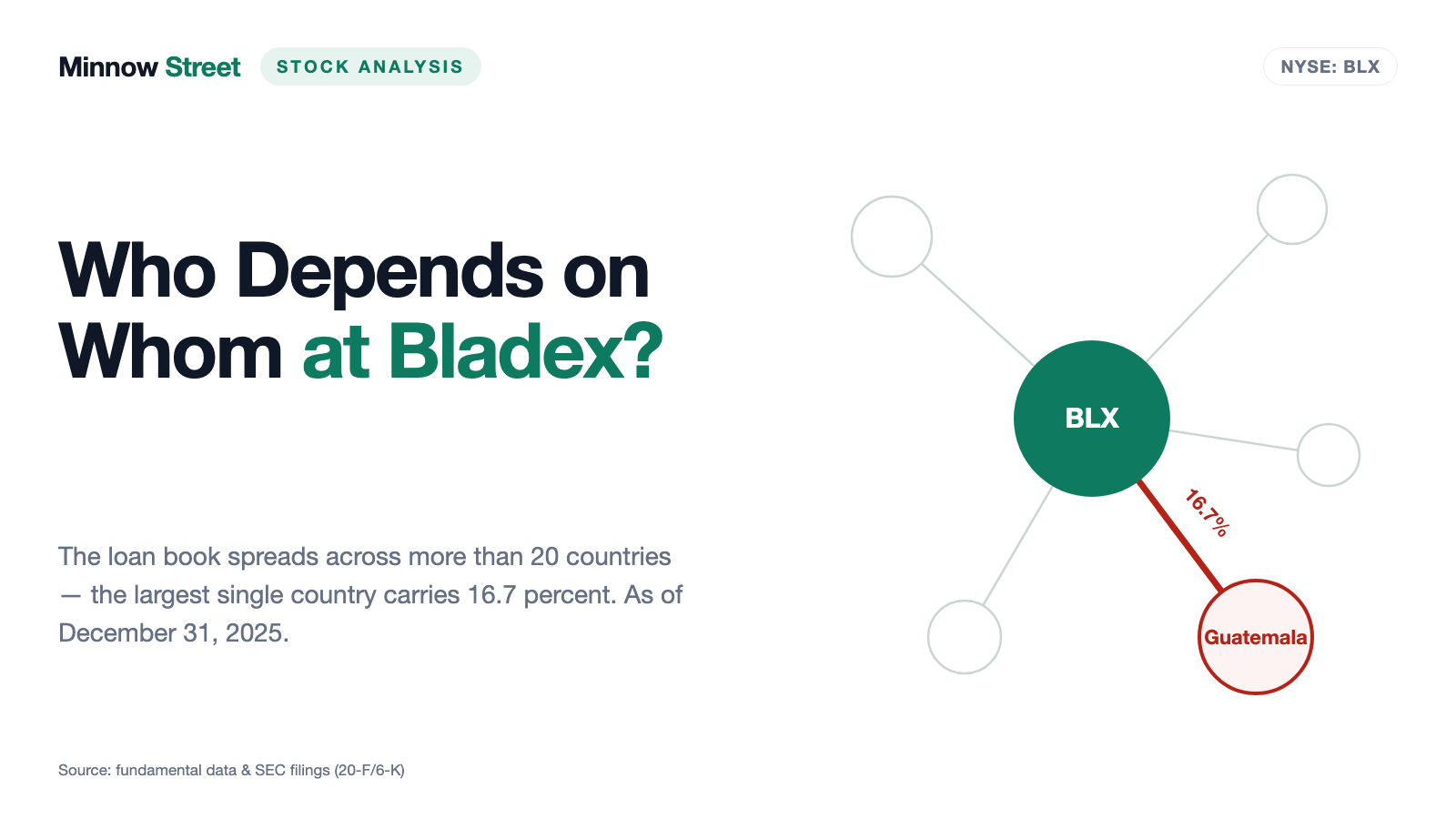
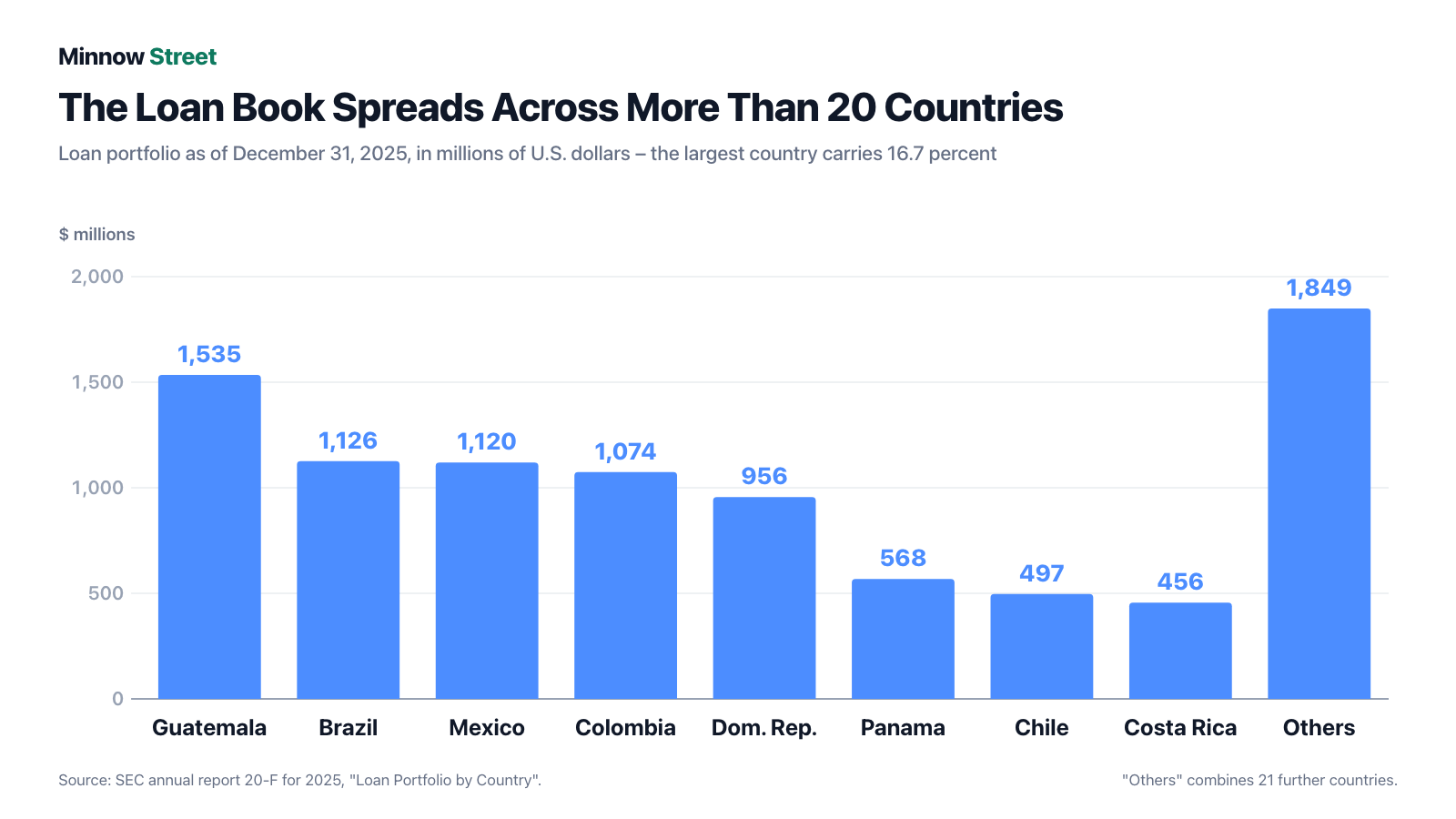
- A specialist trade finance bank founded in 1979 by Latin America's central banks, whose class A shareholders are to this day those same central and state-owned banks — the basis for the de facto preferred creditor status the bank claims and which has carried it through several regional crises. As of December 31, 2025 the loan book spread over more than 20 countries, the largest of them carrying 16.7 percent.
- Earning power positive
- Profit rose from $166.2 million through $205.9 million to $226.9 million between 2023 and 2025, and by a further 9 percent to $56.4 million in the first quarter of 2026. Return on equity was 15.43 percent in 2025 and the efficiency ratio 26.5 percent in the first quarter of 2026 — a level barely any bank with a branch network reaches.
- Balance sheet & capital positive
- A Basel III Tier 1 ratio of 17.9 percent, an equity ratio of 12.4 percent, impaired loans at 0.3 percent of the portfolio with 2.9 times coverage (all as of March 31, 2026). The 2025 accounts received an unqualified opinion from KPMG Cárdenas Dosal, as did internal controls; S&P Global Ratings upgraded the bank to "BBB+" on June 22, 2026.
- Funding negative
- As of December 31, 2025 five depositors together supplied 35 percent of all deposits, the deposits of the region's central and state-owned banks had an average remaining maturity of 48 days, and every deposit is uninsured. Panama has neither a central bank nor a lender of last resort — the bank buffers that with $1,988 million of liquidity, 80 percent of it at the Federal Reserve Bank of New York.
- Margin & country risk neutral
- The net interest margin has been falling for three years: 2.49 percent (2023), 2.47 (2024), 2.36 (2025), 2.34 in the first quarter of 2026; the average lending rate fell 0.82 points within a year to 6.71 percent. At the same time the entire book hangs on Latin America, with only 34 percent of the commercial portfolio in investment-grade countries. Volume growth of 13 percent has more than offset the margin pressure so far.
- The hook ratio negative
- The price-to-free-cash-flow ratio of 1.9 (rank 35, measured July 28, 2026) captures the turnover of the loan book at this bank, not cash actually earned: in 2025, $1,057.6 million flowed out into new loans and $1,191.2 million came in as deposits. Adjusted for those balance sheet movements, $388.8 million was left — which becomes an order of magnitude of 5.9. Altman Z" (1.07) and interest coverage (0.47) likewise carry no meaning at a bank.
Bladex is the test case for the label trap: the ratio that led to the stock measures something other than its name says — at a trade finance bank under IFRS the movement of the loan book sits in the middle of operating cash flow, and in 2025 that swung between plus $874.8 million and minus $599.7 million against quarterly profit between $51.7 and $64.2 million. The company behind it is sound: 47 years of trade finance, three years of rising profit, 17.9 percent Tier 1 capital, 0.3 percent problem loans, rated "BBB+" since June 22, 2026. The real risk sits on the funding side: five depositors, 35 percent of deposits, 48 days of maturity, no deposit insurance. Not investment advice.
What Our Rating Means
Quality confirmed
Business model, numbers and balance sheet hold up to our review. Whether the current price supports an entry is a separate question — it hangs on the price, not on the company.
Green stands here for documented company quality, not for a moment to buy. The evidence supports it: $226.9 million of profit in 2025 after $205.9 million and $166.2 million in the two preceding years, $56.4 million in the first quarter of 2026, a return on equity of 13.5 to 16.2 percent, a Tier 1 ratio of 17.9 percent, impaired loans at 0.3 percent of the portfolio with 2.9 times coverage, an efficiency ratio of 26.5 percent, an unqualified audit opinion on both the accounts and internal controls, and the upgrade by S&P Global Ratings to "BBB+" on June 22, 2026. No finding touches the substance: the Altman Z" score of 1.07 and the interest coverage of 0.47 are not ratios for a bank but formulas from a different business model. Two points stay open that we deliberately do not count as an open operating question, because they belong to the model and are fully disclosed: the concentration of funding on five depositors with 35 percent of deposits at 48 days of maturity and without deposit insurance, and the country risk of Latin America. Expressly not part of this verdict is the valuation: the hook, a price-to-free-cash-flow ratio of 1.9, does not hold — computed cleanly it sits in the order of 5.9.
A journalistic assessment by our editorial team at the time of the deep dive, based on public sources — not investment advice and not a solicitation to buy or sell. Your personal circumstances (investment goals, risk capacity, taxes) cannot be taken into account. What our levels mean, how verdicts are formed, and what conflicts of interest exist →
Worth Noting
- Hook: the price/FCF ranking of the U.S. selection, rank 35 of 100 displayed hits out of 837 stocks screened, displayed ratio 1.9 — hit list measured July 28, 2026, underlying scanner run of July 27, 2026. The lists are recomputed daily.
- Data status: the annual report 20-F for 2025 (filed April 20, 2026) is fully evaluated; every filing after it was reviewed — 6-K on the annual meeting (April 24, 2026), on the dividend (April 28, 2026), on first-quarter 2026 figures (April 30 and May 5, 2026), on the name change (June 8, 2026) and on the S&P upgrade (June 23, 2026), plus one insider Form 4 of June 9, 2026. No Form 15, no Form 25, no SC 13D. Prices through July 24, 2026, ratios as of July 27, 2026.
- A definitional break in the revenue series of the data sheet: through the third quarter of 2025 gross revenues were reported ($202.1 / $216.7 / $209.0 million), from the fourth quarter of 2025 total revenues after interest expense ($88.8 million and $83.1 million). The displayed revenue decline of 53 and 59 percent respectively is a change of definition, not a collapse in business. Price-to-sales ratios on that series are therefore not dependable and are not used here.
- Do not confuse: Banco Latinoamericano de Comercio Exterior, S.A. ("Bladex", NYSE: BLX) is neither the Brazilian Banco do Brasil nor the Inter-American Development Bank. The former name in the SEC register was "Latin American Export Bank" (until June 22, 2009); the English translation "Foreign Trade Bank of Latin America, Inc." still appears in many databases, although the bank has been called "Bladex, Inc." since June 4, 2026.
- AI rating: uses AI. The 20-F for 2025 states that the bank's use of generative AI is limited to authorized support activities and does not extend to decisions in financial reporting, credit, commercial or strategic processes, and that an AI governance framework has been established for it. The 2026 investor day presentation (6-K of March 24, 2026) makes "AI acceleration" one of four strategic efficiency levers through 2030. There is no AI revenue source, and no concrete AI risk to the business model itself.
- The quality light of this analysis judges the company, not the moment of entry.
Frequently Asked Questions
Bladex finances Latin America's foreign trade: letters of credit, guarantees, short- and medium-term loans for banks, corporations and government bodies of the region. There is no retail business. Until June 4, 2026 the bank was officially named "Banco Latinoamericano de Comercio Exterior, S.A."; the annual meeting of April 21, 2026 resolved the change of name to "Bladex, Inc.". It changes nothing about the business, the contracts or the outstanding securities.
Because a market value of roughly $2.3 billion is divided by a twelve-month cash inflow of roughly $1.2 billion. At a bank reporting under IFRS, however, loan origination and deposit inflows sit in operating activities: in 2025, $1,057.6 million went out into new loans and $1,191.2 million came in as deposits. Adjust for those balance sheet movements and roughly $388.8 million is left — which turns into an order of magnitude of 5.9 rather than 1.9.
No. The Altman Z score was developed on industrial companies and punishes a banking model twice over: a bank turns over only a fraction of its balance sheet (at Bladex roughly 2.7 percent in 2025) and is highly leveraged by construction (total assets divided by equity: 8.0 as of March 31, 2026). The fitting measures are the Tier 1 ratio (17.9 percent), impaired loans (0.3 percent) and the coverage ratio (2.9 times).
That is the real concentration risk. As of December 31, 2025 the five largest depositors supplied 35 percent of all deposits, predominantly central and state-owned banks of the region. Their deposits had an average remaining maturity of 48 days, and all deposits are uninsured; Panama has neither a central bank nor a lender of last resort. As a buffer Bladex holds $1,988 million of liquid assets, 80 percent of it at the Federal Reserve Bank of New York.
Because the bank sits in Panama and is treated by the U.S. securities regulator, the SEC, as a foreign private issuer. Such companies file an annual report on form 20-F once a year — for 2025 on April 20, 2026 — and report interim figures and material events on form 6-K. The most recent interim financial statements, as of March 31, 2026, were filed on May 5, 2026.
Class A shares may be held only by central banks, majority state-owned banks and other government agencies of Latin American countries (6,342,189 shares, 17.0 percent). Class B is reserved for banks and financial institutions (827,573 shares, 2.2 percent). Class E is freely tradable and is what runs under BLX on the NYSE (30,060,446 shares, 80.7 percent). Class A shareholders elect three directors, class E shareholders five; amendments to the articles and mergers need three quarters of the class A shares.
For 2025 the bank declared $93.0 million of dividends, which is $2.56 per share after $2.00 in 2024. Over the last twelve months $2.63 per share was paid out, which works out at roughly 4.4 percent on the closing price of July 24, 2026. The payout ratio is 43.6 percent, the dividend has not been cut in four years and has been raised in two consecutive years. Since September 2025 a 7.50 percent coupon on $200 million of hybrid capital is deducted on top.
As of March 31, 2026 impaired loans stood at $38.7 million or 0.3 percent of the loan portfolio, covered 2.9 times over by allowances; 97.5 percent of the portfolio sat in the lowest risk stage. The stock has risen, though: from $10 million (2023) to $17 million (2024) to $39 million (2025), caused by two single exposures from the gas and steel sectors, against which 75 percent of the nominal amount is provisioned.
Found an error?
Did you spot a factual error, an outdated number, or a typo in this deep dive? Let us know briefly — your report goes straight to the editorial team.