ImmunityBio Stock: 668 Percent Growth — and $4.4 Billion of Losses
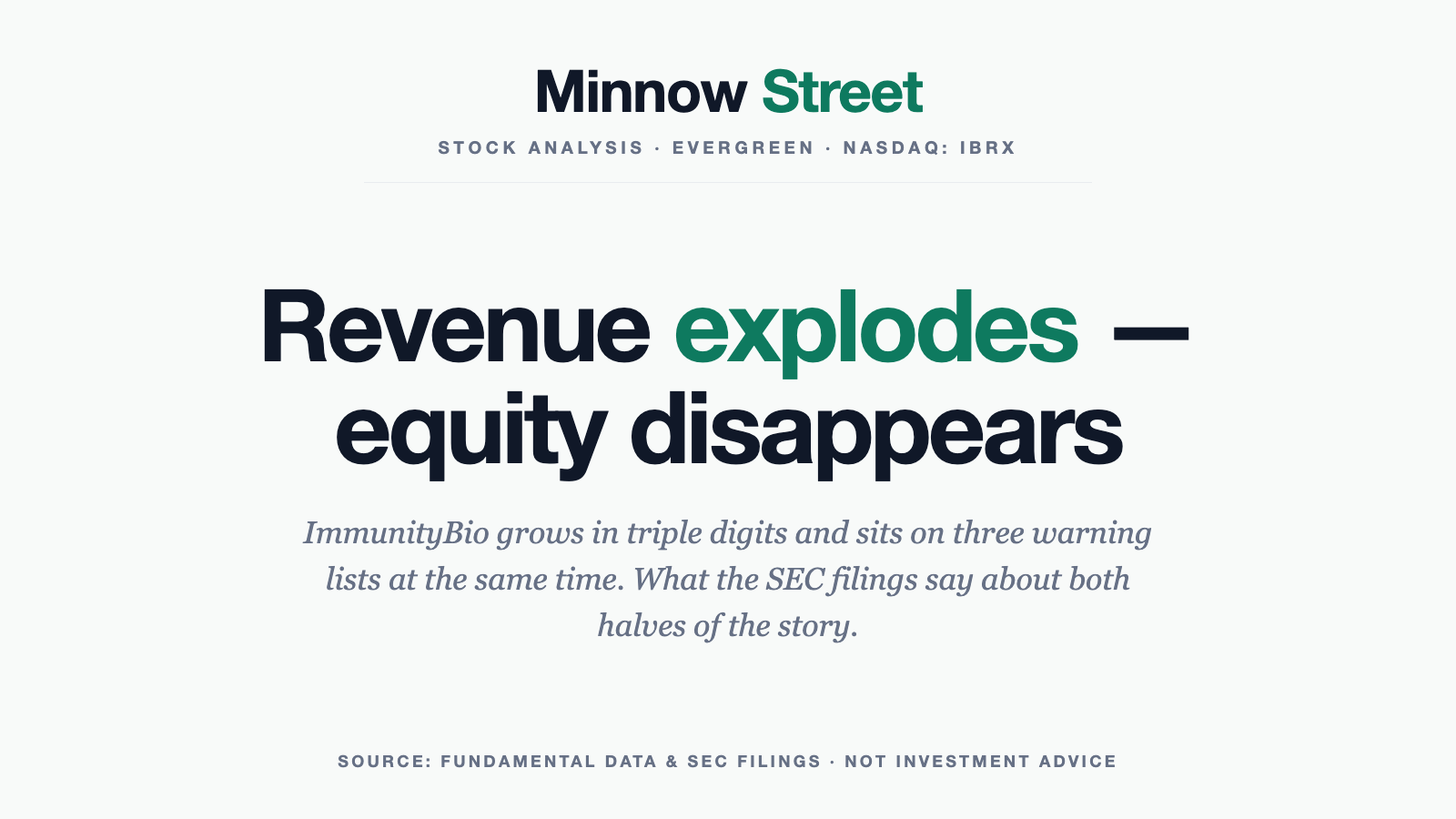
ImmunityBio is the rare stock that lands on our triple-digit revenue growth list AND on three warning lists in the same scanner run. ANKTIVA revenue rose 668 percent in 2025 to $113.3 million — and behind it sit $4.4 billion of accumulated losses, a going-concern warning and a billionaire who carries the company and lends it money at the same time. We read the annual report (10-K) and the latest quarterly report (10-Q). Not investment advice — just a sober look at a company that grows on its own product and survives on one man's money.
 Thomas Mücke
Founder & Publisher
Thomas Mücke
Founder & Publisher
Chart
Interactive price chart (TradingView).
Note: pure fact-based analysis, not investment advice and not a solicitation to buy or sell. All figures without guarantee.
There is one pull that even experienced investors find hard to resist: the rescue story with a big name behind it. A cancer immunotherapy, just cleared by the U.S. regulator. Revenue that has almost multiplied sevenfold in a single year. And a billionaire founder who, according to the press, puts "everything" into his company. The stock has more than tripled in half a year. The voice on your shoulder whispers: "this is the next big biotech bet — and a rich man is standing behind it with his own money, he will not let it fall." Call that thought the rescuer reflex. It is dangerous because it skips two questions: why does a billionaire have to keep putting money in at all? And what happens to your slice while he does it? So let's make a deal. Before you touch a single share of ImmunityBio (Nasdaq: IBRX), we read together what the filings to the U.S. securities regulator, the SEC, actually say. An SEC filing is honest under penalty of law. And at ImmunityBio it tells two stories at the same time. What you make of it at the end is your decision.
What ImmunityBio actually does
ImmunityBio is a biotech company from San Diego with exactly one product on the market: ANKTIVA. Behind the brand sits a compound called N-803, and you can picture it as a wake-up call for the body's own guard force. Your immune system keeps its own troop against degenerate cells — the "natural killer cells" and the T cells. ANKTIVA is a synthetic copy of a messenger substance that switches this troop on and multiplies it. It is given together with the ancient tuberculosis vaccine BCG, directly into the bladder, in an early form of bladder cancer (NMIBC with carcinoma in situ) in which BCG therapy alone no longer works. The promise: instead of removing the bladder surgically, the body is meant to beat the tumor itself. The FDA approved ANKTIVA in April 2024.
The market is real and the need is large. According to ImmunityBio's own annual report, bladder cancer is the sixth most common cancer in the United States; roughly 84,500 new cases are expected for 2026, and the early form NMIBC accounts for about three quarters of all cases. On top of that comes a structural tailwind: the standard compound BCG has been scarce in the U.S. for years — per the annual report (10-K), 57 percent of urologists therefore cannot treat patients as intended. ANKTIVA pushes into that gap. Sounds like a rounded growth story? It is one — until you open the balance sheet. And that is exactly where it gets interesting.
Where the stock shows up in our scanner
Every day we run roughly 3,500 stocks through our in-house stock scanner. ImmunityBio triggers 17 of them (data as of July 7, 2026) — and that list is the real reason for this analysis, because it contradicts itself. On one side the stock sits in the growth and momentum scanners: "triple-digit revenue growth", "high revenue growth", "RS leader (90 or above)", "Stan Weinstein: stage 2", "Qullamaggie top gainers 6M" and several trend filters. The stock recently ran better than 94 percent of the market and has more than tripled within six months.
On the other side — and this is rare — the very same stock sits simultaneously on three warning lists: the going-concern warning proxy, the Altman-Z distress zone (a statistical early-warning model for insolvency) and the Beneish M-Score list. It practically never happens that one name triggers the strictest growth scanner and the harshest balance-sheet warning filters in the same run. Remember this tension — the growth is real, the base is tiny, and the balance sheet is fragile. It is the thread through everything that follows. Here is how to get there yourself: on minnowstreet.com, open the "Scanner" menu, pick the filter "triple-digit revenue growth" and look for the IBRX row.
The numbers over the years — first what impresses
Let's start with what is genuinely strong. The revenue growth is not an accounting illusion but a real product ramp. ANKTIVA came to market in mid-2024, and since then revenue has risen quarter after quarter — six quarters in a row, without a single outlier: $7.6 million (fourth quarter of 2024), then $16.5 million, $26.4 million, $32.1 million and $38.3 million through the four quarters of 2025, and $44.2 million in the first quarter of 2026.
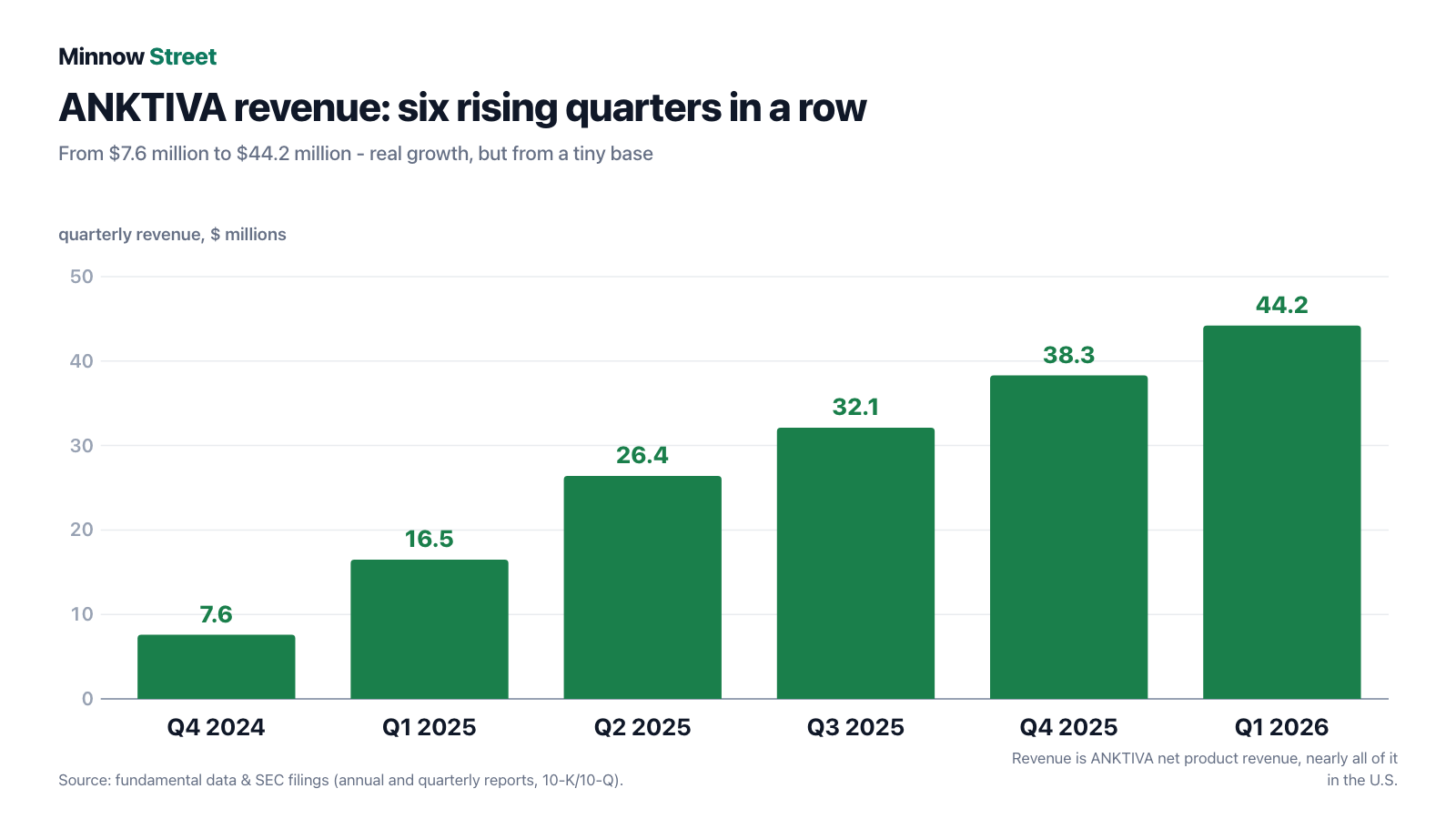
On an annual basis that means: $0.03 million (2023, before approval), $14.7 million (2024), $113.3 million (2025) — up 668 percent. And the growth continues: in the first quarter of 2026 revenue reached $44.2 million, 168 percent above the year-ago quarter. The gross margin, at roughly 99 percent, is a dream, as is usual with drugs — manufacturing costs almost nothing, the research behind it costs everything. That is one half of the story, and it is a good one. One quarter does not make a summer — but six rising quarters are a genuine trend.
What the filings say — the uncomfortable truths
Now we turn the page. Literally.
Uncomfortable truth no. 1: the company doubts its own survival
There is one sentence no company writes voluntarily, because it is a legal alarm button: the going-concern warning. "Going concern" is the accountant's term for a business that can be expected to keep operating — and when an auditor doubts that, it has to go into the report. At ImmunityBio it is in there:
“As a result of continuing anticipated operating cash outflows as we commercialize our approved product in the U.S. and globally and accelerate our development efforts, we believe that substantial doubt exists regarding our ability to continue as a going concern without additional funding or financial support.”
— ImmunityBio, Inc., SEC annual report 10-K for fiscal year 2025, MD&A “Liquidity”
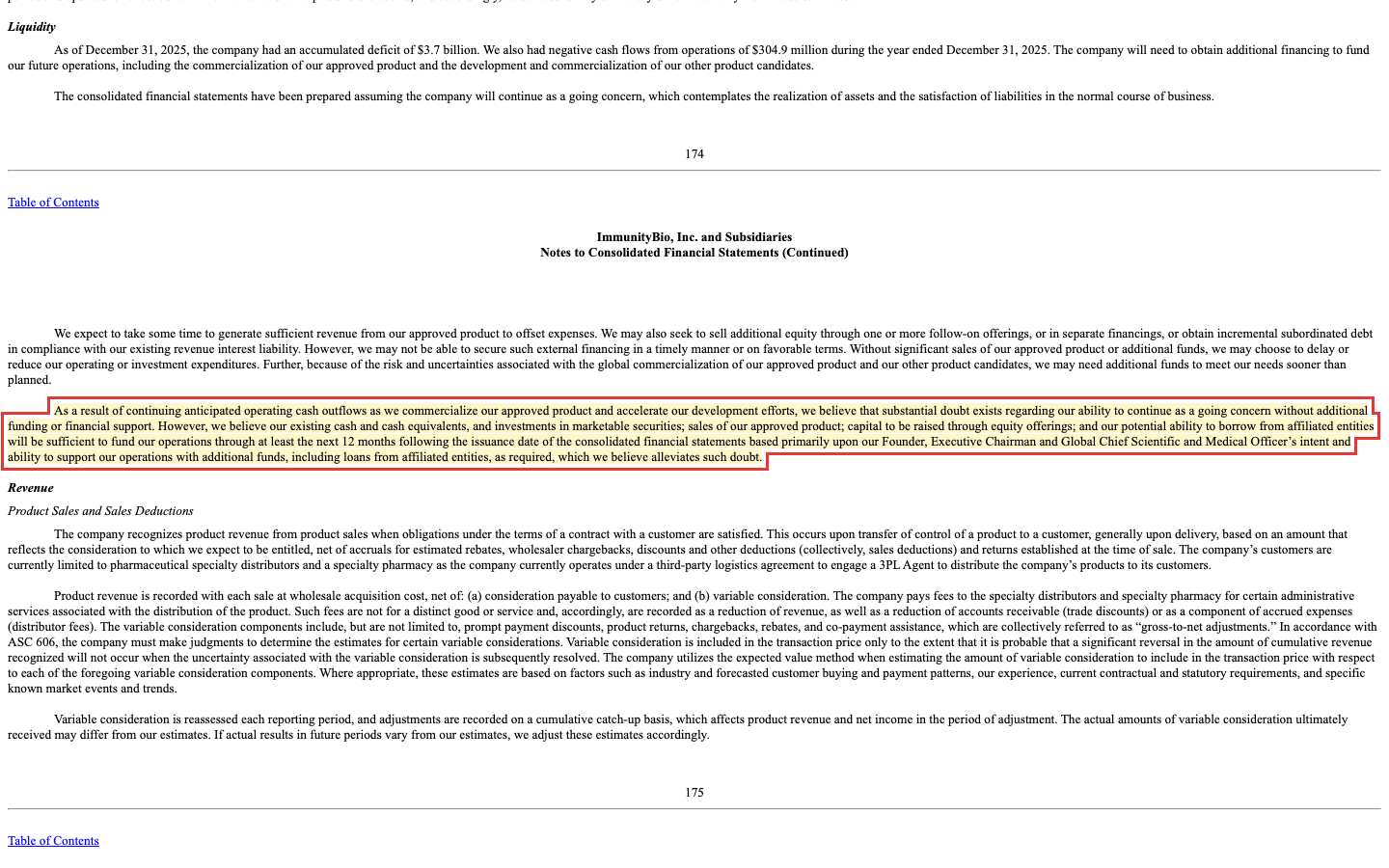
The reason for the doubt is one plain number: by December 31, 2025 ImmunityBio had piled up an accumulated deficit of $3.7 billion, and by March 31, 2026 it was already $4.4 billion. An accumulated deficit is the sum of every loss since the company was founded — it shows how much money the business has burned over the years. For comparison: against it stand $113.3 million of annual revenue. You have to put those magnitudes side by side once:
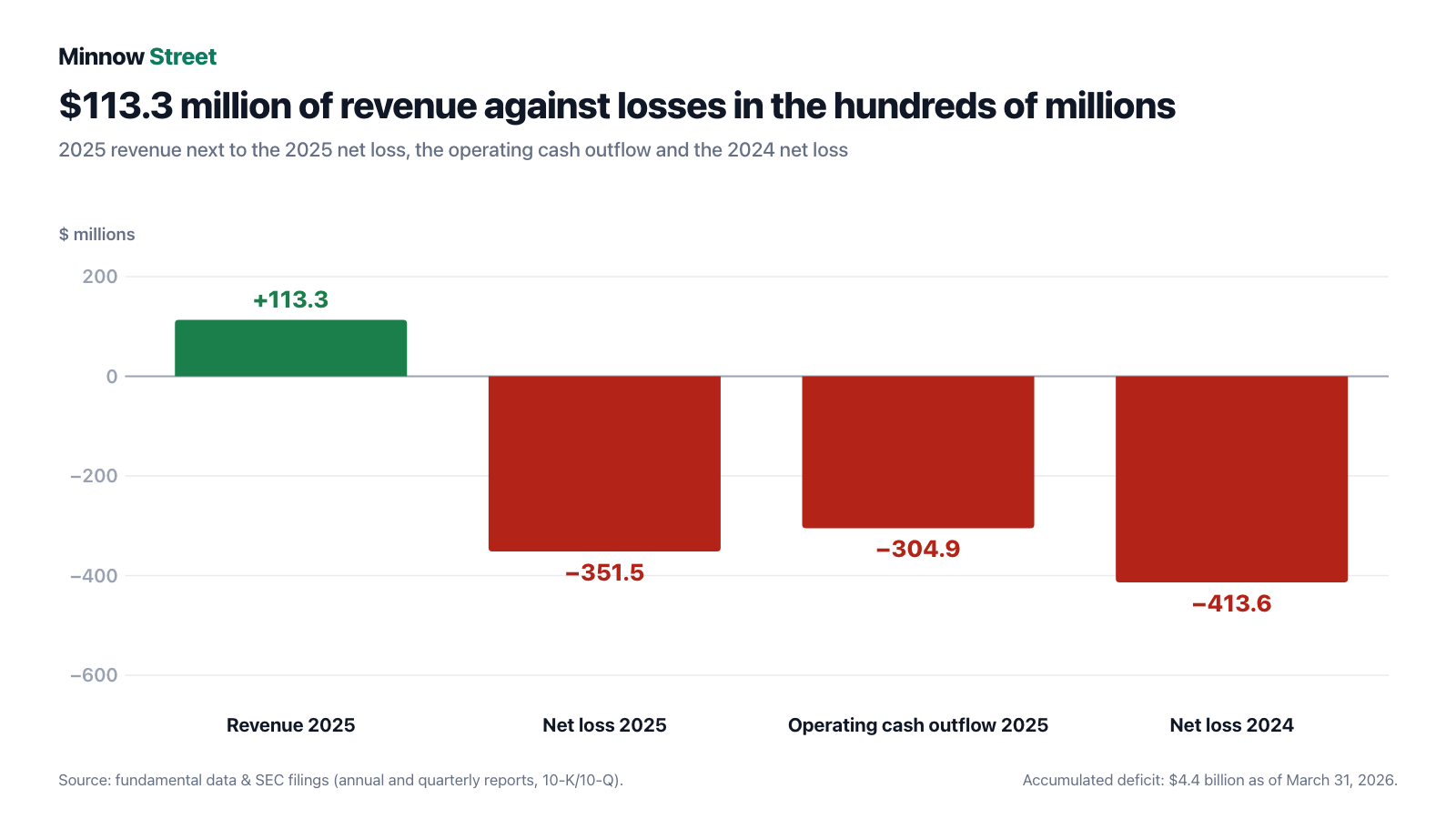
Uncomfortable truth no. 2: a billionaire carries the company — and is its creditor at the same time
Formally, the going-concern doubt counts as alleviated. But read carefully with what ImmunityBio alleviates it:
“…will be sufficient to fund our operations through at least the next 12 months following the issuance date of the consolidated financial statements based primarily upon our Founder, Executive Chairman and Global Chief Scientific and Medical Officer's intent and ability to support our operations with additional funds, including loans from affiliated entities, as required, which we believe alleviates such doubt.”
— ImmunityBio, Inc., SEC annual report 10-K for fiscal year 2025, MD&A “Liquidity”
So the company stands because one man promises to prop it up: Dr. Patrick Soon-Shiong, founder, chairman and billionaire (he once invented the cancer drug Abraxane). He controls more than 60 percent of the shares — which is why the 10-K formally classifies ImmunityBio as a "controlled company" under the Nasdaq rules. That sounds reassuring, but it has an uncomfortable flip side: Soon-Shiong is not only the owner, he is also the lender. The company owes an entity affiliated with him a loan whose terms the filing discloses:
“As of December 31, 2025, we have a $505.0 million variable-rate loan outstanding, which matures on December 31, 2027 and bears interest at Term SOFR plus 8.0% per annum. As of December 31, 2025, the interest rate on this loan was 11.66%.”
— ImmunityBio, Inc., SEC annual report 10-K for fiscal year 2025, Item 7A “Market Risk”
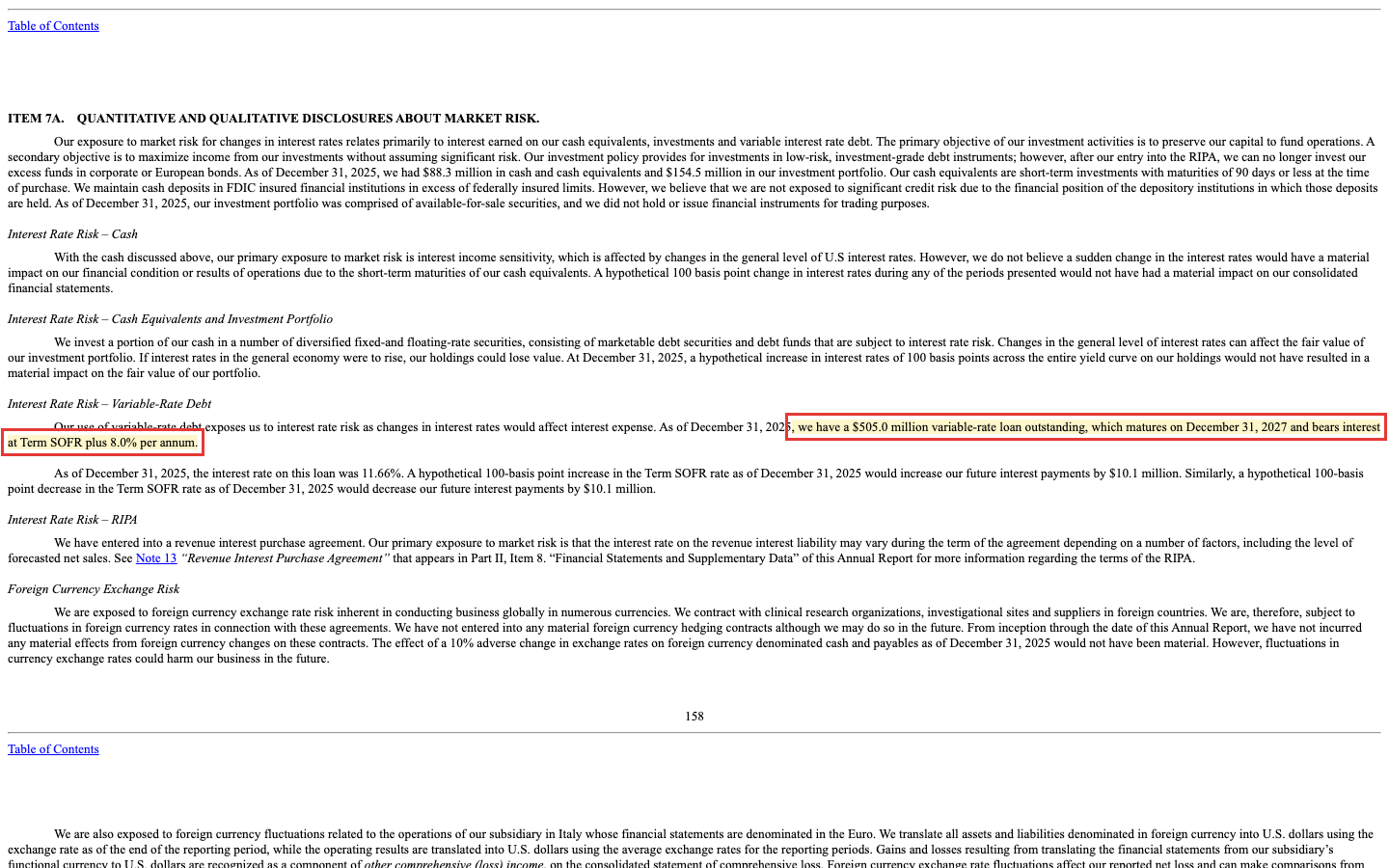
A founder who is majority owner and expensive creditor at the same time — that is a structural conflict of interest and a cluster risk concentrated in a single person. As long as he props the company up, it survives. But the loan is convertible at $5.43 per share: if Soon-Shiong one day swaps it for stock, his stake grows further — and yours shrinks.
Uncomfortable truth no. 3: the growing cash pile does not come from the business
At first glance the cash position looks healthy: $149.8 million at the end of 2024, $242.8 million at the end of 2025, $380.9 million as of March 31, 2026 — the balance is rising. Except it is not rising because ANKTIVA brings money in, but because ImmunityBio keeps raising fresh capital. The filing names the sources itself:
“During the year ended December 31, 2025, we received net proceeds totaling $250.1 million from the issuance of shares under the ATM.”
— ImmunityBio, Inc., SEC annual report 10-K for fiscal year 2025, MD&A “At-the-Market Offering”
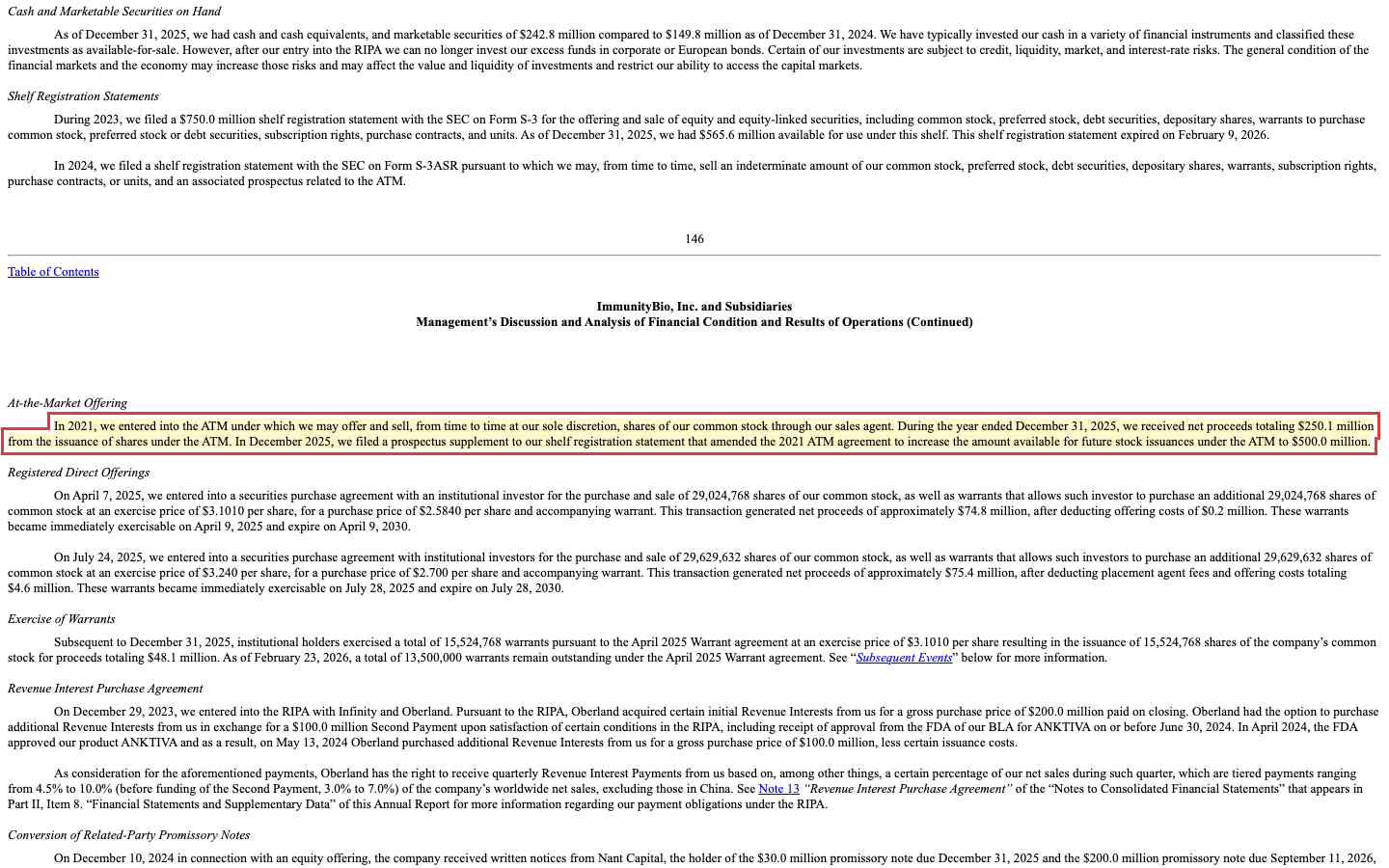
An "ATM" program (short for at-the-market) is a selling machine for fresh shares: the company continuously issues new paper straight into the market and pockets the money. For you as a shareholder that means dilution — picture a pizza that keeps getting cut into more slices: your slice gets smaller even though you sold nothing. The numbers are clear. The share count rose from 852.9 million (end of 2024) to 1,011.8 million (end of 2025, up 18.6 percent) and further to 1,047.3 million as of March 31, 2026. Shareholders also raised the authorized share count from 1.35 billion to 1.65 billion — plenty of room for more dilution. Remember the mechanism: growth paid for with fresh shares is never entirely free.
And the $632.8 million loss in the first quarter of 2026? Not as bad as it looks
Fairness demands the other direction too. The headline for the first quarter of 2026 was a net loss of $632.8 million — almost twice the loss of the whole of 2025. That sounds like a catastrophe, but it is mostly an accounting effect and, paradoxically, a consequence of the share price rally. The operating loss was only $69.8 million. The rest are non-cash revaluations: $295.4 million from remeasuring warrants and $236.6 million from remeasuring the convertible founder debt. Because the share price rose sharply, these items — carried as liabilities — became more expensive in the income statement. That inflates the book loss but costs not one cent of cash. Anyone taking this loss literally dramatizes it wrongly. What stays honest, though: the operating cash outflow of $75.4 million in that quarter and the dilution continue undiminished.
Valuation — what the market is actually paying for here
At a price around $9 and a good billion shares, ImmunityBio weighs in at roughly $8 to $9 billion. Against that market value stands annualized revenue of about $177 million (the first quarter of 2026 extrapolated). That works out to a price-to-sales ratio of roughly 45 to 70 — depending on whether you use the current or the prior-year revenue. For context: an established, profitable company is often valued at one to five times revenue. Here the market is paying forty-five to seventy times.
What does that mean? The price is not valuing today's business but a multi-billion blockbuster future: the hope that ANKTIVA grows into further bladder cancer stages, into lung cancer and into additional tumor types, and that the broad pipeline delivers. That can work out — every new approval would scale the same compound, and at a 99 percent gross margin the leverage would be enormous. It can also fail, and then a double-digit billion sum of expectation is air. The five analysts covering the stock are optimistic in consensus (rating "strong buy", price target around $13). That is "the professionals' view" — but it is few professionals, and price targets are snapshots, not certainties.
Opportunities and risks at a glance
What speaks for ImmunityBio:
- The first FDA approval is in hand — ANKTIVA is on the market, and revenue is growing for real and without outliers (six rising quarters).
- Every further approval (other bladder cancer stages, lung cancer, additional tumors) scales the same compound — potentially large leverage at a roughly 99 percent gross margin.
- Structural tailwind from the BCG shortage: a large share of urologists currently cannot treat patients as intended.
- A billionaire with deep pockets and skin in the game stands behind the company — that genuinely dampens the near-term insolvency risk.
What speaks against it:
- An explicit going-concern warning; $4.4 billion of accumulated losses against about $177 million of annualized revenue.
- Dependence on a single person who is owner and expensive creditor at once ($505.0 million at 11.66 percent) — conflict of interest and cluster risk.
- Ongoing dilution: up 18.6 percent in share count within a year, authorized shares raised to 1.65 billion.
- One product, one market (almost 100 percent U.S.), strong competition from Keytruda (Merck), Adstiladrin (Ferring) and Inlexzo (Johnson & Johnson); on top of that a very high short interest (roughly 35 percent) and insiders who have only sold, never bought.
A human conclusion
Do you remember the rescuer reflex from the opening — the voice saying "a billionaire is behind it, he will not let it fall"? After a look at the filings it sounds different. Yes, a billionaire is behind it. But he is behind it because the company cannot make it alone — the going-concern doubt counts as alleviated only for as long as he keeps injecting money. And that money costs you as a shareholder something: 11.66 percent interest on his loan, and ever more new shares that shrink your slice of the cake. ImmunityBio is therefore both at once — a real growth story with an approved drug and a fragile balance sheet propped up by a single human being. That is exactly why the stock appears on the growth list and on three warning lists in the same scanner run. It is not a contradiction you can argue away — it is the core of this stock.
What you make of it is your decision. And that is exactly as it should be. If you buy ImmunityBio, you are buying a bet on a drug's blockbuster future — and a trust in one individual man. If you avoid it, you may be passing up the next biotech rocket. Both are legitimate. What matters is only that you know what you are betting on — on both halves of the story, not just the pretty one.
The pattern is not unique to ImmunityBio. At Iovance, a commercial-stage cell therapy company, product revenue climbed to $263.5 million in 2025 — and shareholders financed that year almost to the dollar: 101,899,334 new shares brought in $306.3 million net against $302.4 million of operating cash burn. At Agenus, the going-concern sentence stands in the current quarterly report next to negative equity of $228.0 million (as of March 31, 2026) and warrants over 54.9 million shares — more than the company had outstanding on July 17, 2026. In all three cases the money that keeps the lights on comes from the capital market, not from the business. What sets ImmunityBio apart is only who writes the check: not an anonymous market alone, but one man who is also the lender.
Sources
- ImmunityBio, Inc. — SEC annual report 10-K, fiscal year 2025 (filed February 23, 2026)
- ImmunityBio, Inc. — SEC quarterly report 10-Q, first quarter of 2026 (as of March 31, 2026, filed May 7, 2026)
- Fundamental data (metrics, valuation, analyst consensus, quarterly series); in-house stock scanner, data as of July 7, 2026.
Disclaimer: This article is a journalistic analysis and not investment advice. It is not a solicitation to buy or sell securities. Share prices fluctuate; a total loss is possible. Make your investment decisions on your own responsibility and seek independent advice when in doubt.
Our Bottom Line at a Glance
- Product & market positive
- ANKTIVA is FDA-approved and addresses a real need: bladder cancer is the sixth most common cancer in the United States, and the BCG shortage leaves many patients undertreated. A gross margin of roughly 99 percent — if revenue scales, the leverage is enormous.
- Revenue growth positive
- A genuine product ramp rather than an accounting effect: from $14.7 million (2024) to $113.3 million (2025, up 668 percent), six rising quarters in a row, and $44.2 million already in the first quarter of 2026 (up 168 percent).
- Balance sheet & survival negative
- An explicit going-concern warning; $4.4 billion of accumulated losses, negative equity, $304.9 million of operating cash outflow in 2025. The rising cash balance comes from equity and loan measures, not from the business.
- Ownership & financing negative
- Founder Soon-Shiong controls more than 60 percent and is a lender at the same time ($505.0 million at 11.66 percent, convertible at $5.43). A structural conflict of interest and a cluster risk in one person; ongoing dilution (share count up 18.6 percent within a year).
- Valuation negative
- Roughly $8 to $9 billion of market value against about $177 million of annualized revenue = a price-to-sales ratio of 45 to 70. Practically the entire value is future expectation; one product, one market and strong competition.
ImmunityBio is both things at once: a real growth story with an approved drug, and a fragile balance sheet propped up by a single billionaire. The revenue growth is genuine, but from a tiny base; the valuation prices in a blockbuster future that is still unproven, while a going-concern warning, billions of accumulated losses and ongoing dilution form the foundation. Not investment advice.
What Our Rating Means
Substance risk
We found at least one documented issue that threatens the company itself — regardless of how the stock is currently valued.
The existential findings carry the verdict: an explicit going-concern warning, negative equity and $304.9 million of operating cash outflow in 2025 — survival hangs solely on the promise of further funding from majority shareholder Soon-Shiong, who controls more than 60 percent and is at the same time a lender at 11.66 percent. The genuine revenue growth changes nothing about that existential type. Only when the operating cash burn falls markedly and the company manages without the founder's support and without constant capital raises can this be reassessed.
A journalistic assessment by our editorial team at the time of the deep dive, based on public sources — not investment advice and not a solicitation to buy or sell. Your personal circumstances (investment goals, risk capacity, taxes) cannot be taken into account. What our levels mean, how verdicts are formed, and what conflicts of interest exist →
Worth Noting
- ANKTIVA (N-803) has been approved in the United States since April 2024 (the early bladder cancer form NMIBC with carcinoma in situ); in 2025 practically 100 percent of revenue came from the U.S.
- The first-quarter 2026 net loss of $632.8 million is largely non-cash (remeasurement of warrants and of the convertible founder debt following the share price rally); the operating loss was only about $69.8 million.
- Very high short interest (roughly 35 percent of the free float); insiders have only sold, never bought, over the past twelve months (as of July 7, 2026).
Frequently Asked Questions
ImmunityBio is a biotech company from San Diego with one approved product: ANKTIVA, an immunotherapy against an early form of bladder cancer (FDA approval in April 2024). The compound activates the body's own killer and T cells and is given together with the BCG vaccine directly into the bladder. Alongside that, the company is working on a broader cancer immunotherapy pipeline.
Because both are true. ANKTIVA revenue grew 668 percent in 2025 to $113.3 million, which triggers the growth scanners. At the same time the company sits on the warning lists — the going-concern proxy, Altman-Z distress and the Beneish M-Score — because of $4.4 billion of accumulated losses, negative equity and an explicit going-concern warning. Growth and balance-sheet stress in a single stock.
The company itself writes of "substantial doubt" about its ability to continue as a going concern. That doubt counts as alleviated only because founder and billionaire Patrick Soon-Shiong has committed to keep supporting operations with money as required. In the near term that dampens the risk; over the longer run, survival depends on his willingness and on fresh capital.
That headline loss is largely non-cash. The operating loss was only about $69.8 million; the rest are accounting revaluations of warrants and of the convertible founder debt, which became more expensive because the share price rose. That costs no cash. The operating cash outflow of $75.4 million in the quarter, however, continues.
Because the valuation is almost pure expectation: at $8 to $9 billion of market value against roughly $177 million of annualized revenue, the market is paying 45 to 70 times revenue. Add to that the ongoing dilution from new shares, the dependence on a single person and a one-product business facing strong competition.
Founder Dr. Patrick Soon-Shiong, a billionaire and the inventor of the cancer drug Abraxane, controls more than 60 percent of the shares; ImmunityBio therefore counts as a "controlled company". He is at the same time a lender: an entity affiliated with him has lent the company $505.0 million at 11.66 percent interest, convertible at $5.43 per share. That creates skin in the game, but also a conflict of interest.
Found an error?
Did you spot a factual error, an outdated number, or a typo in this deep dive? Let us know briefly — your report goes straight to the editorial team.