Transportadora de Gas del Sur: One Fiscal Year, Three Annual Reports, Three Different Revenue Figures
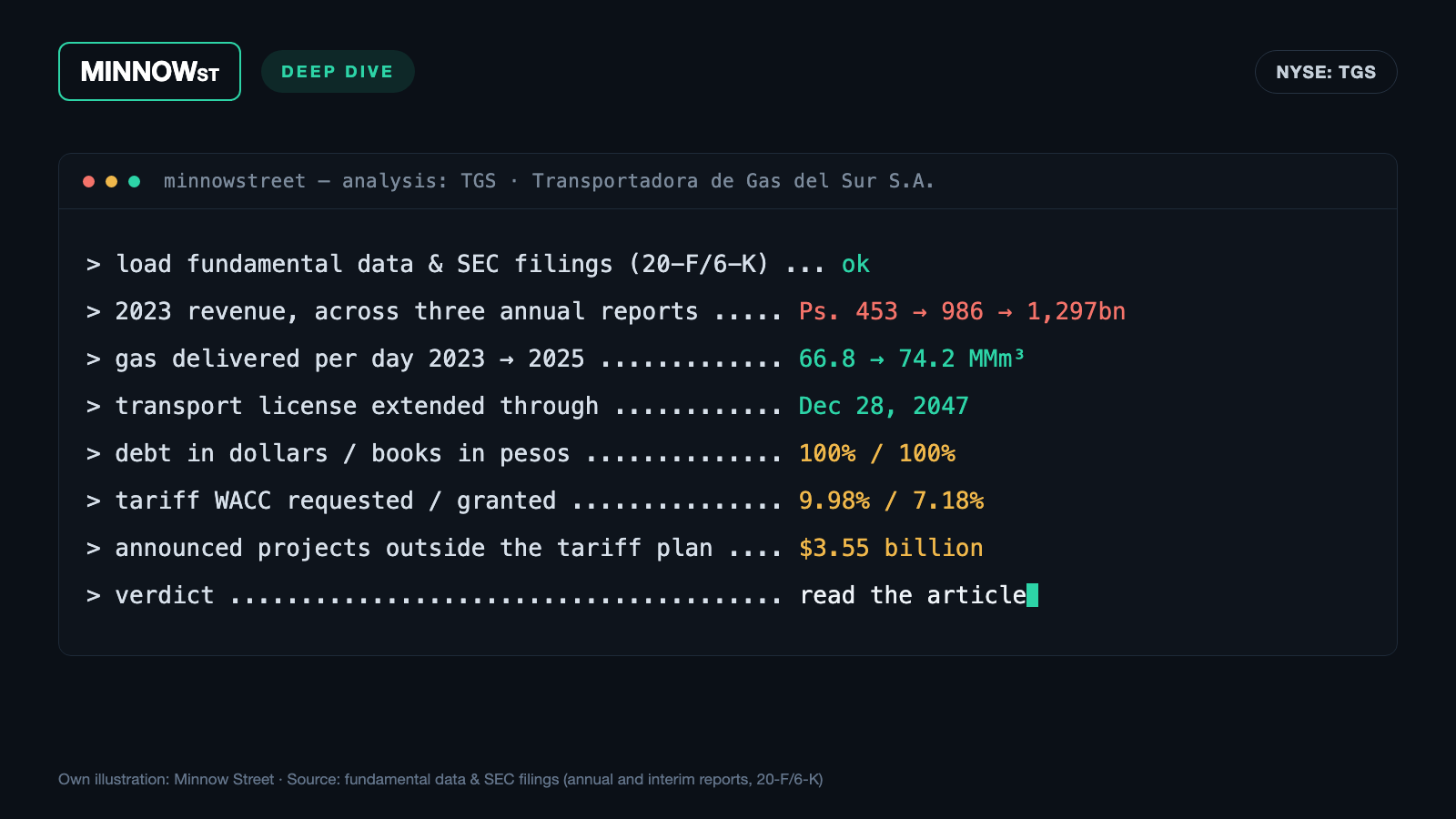
Transportadora de Gas del Sur moves more than 60 percent of the natural gas Argentina consumes, through 5,746 miles of pipeline. The business is real, the volumes are rising, and the license was extended in July 2025 by twenty years to the end of 2047. The numbers are the complicated part: because Argentina counts as a hyperinflationary economy, every old peso figure is restated in every new annual report. Revenue for 2023 therefore appears in three consecutive filings with three entirely different values — Ps. 452.8 billion, then Ps. 986.1 billion, then Ps. 1,297.1 billion. Add books in pesos against financial debt that is 100 percent dollar-denominated, and a price set by a regulator rather than a market. London fund Helikon cut its position by 28.5 percent in the first quarter of 2026 — and in the same quarter sold out entirely of the co-owner of TGS's controlling shareholder. Not investment advice — just the question of how you value a company whose measuring stick is recalibrated every single year.
 Thomas Mücke
Founder & Publisher
Thomas Mücke
Founder & Publisher
Chart
Interactive price chart (TradingView).
Note: pure fact-based analysis, not investment advice and not a solicitation to buy or sell. All figures without guarantee.
Picture yourself measuring your dining table with a folding ruler: 71 inches. A year later you measure again — 154 inches. Two years later: 203. The table is the same table; you never touched it. Only the ruler was different each time. That is exactly what happens in the books of Transportadora de Gas del Sur S.A. (NYSE: TGS), Argentina's largest natural gas transporter. Consolidated revenue for 2023 stands at Ps. 452.8 billion in the annual report for 2023, at Ps. 986.1 billion in the report for 2024, and at Ps. 1,297.1 billion in the report for 2025. Three times the same fiscal year, three different numbers, and not one of them is wrong. There is no accounting trick behind it, only a rule: Argentina counts as a hyperinflationary economy, so every prior-year figure has to be restated into today's purchasing power. The trap you fall into has a name — economists call it money illusion: we instinctively confuse the number with the value. So let's make a deal: before you look at a jump in revenue and think "growth", we read together what TGS reported, under penalty of law, to the U.S. securities regulator, the SEC — the annual report on Form 20-F for 2025 filed April 22, 2026, the interim figures as of March 31, 2026, and the mandatory disclosures through June 2026. What they describe is a network moving more gas than ever, a contract just extended by twenty years, debt in a currency the company does not keep its books in — and a growth story that is supposed to cost $3.5 billion. You decide what to make of it.
What Transportadora de Gas del Sur actually does — three businesses on one pipeline network
The company emerged in 1992 from the privatization of the state utility Gas del Estado and has since run the longest natural gas transportation system in Latin America: 5,746 miles of pipeline, of which 4,768 miles operate on an exclusive basis under a state license. The network links the gas fields of southern and western Argentina — Neuquén, San Jorge, Austral — to the greater Buenos Aires area. More than 60 percent of all natural gas transported in Argentina flows through these pipes. There are only 80 direct customers; indirectly, 5.8 million households and businesses hang off the system.
Money is made in three places, and it is worth keeping them apart, because they follow completely different rules:
- Gas transportation (regulated) — the core. Customers book capacity and pay for it whether they use it or not ("firm contracts", roughly 81 percent of segment revenue in 2025). The price is a tariff set by the state. Share of consolidated revenue in 2025: 41 percent.
- Liquids (unregulated) — at the Cerri Complex near Bahía Blanca, ethane, propane, butane and natural gasoline are stripped out of the gas flowing past and sold, a good share of it as exports. Share in 2025: 38 percent.
- Midstream and telecom (unregulated) — gathering lines and conditioning plants around the shale play Vaca Muerta, plus a small telecom business. Share in 2025: 21 percent.
Translated into an everyday image: gas transportation is the toll road whose toll the government sets. Liquids is the refinery at the exit ramp that pulls something valuable out of the traffic streaming past and sells it at the world price. And midstream is the new feeder road to a field where an oil boom is just starting. Only the toll is regulated — the other two are not. From that comes the central tension of this analysis: operationally TGS has rarely been in better shape — more volume, an extended license, a first dividend in years. At the same time, almost no number on this balance sheet means what it appears to mean at first glance.
How the stock landed on our desk
Not through a hit in our in-house stock scanner, but through a mandatory filing. On May 8, 2026, London-based Helikon Investments Ltd filed its Form 13F-HR for the quarter ended March 31, 2026 — the disclosure larger U.S. asset managers must file on their holdings. Of 17 positions worth $2,648,555,113 in total, TGS accounted for 2,347,333 ADRs worth $81,241,195. The path is the interesting part: zero shares (June 30, 2025) → 2,897,250 (September 30) → 3,283,265 (December 31) → 2,347,333 (March 31, 2026). In other words: bought in, added to — and then almost a third sold again, down 28.5 percent in a single quarter.
One detail makes that move readable. In the same quarter Helikon threw Pampa Energía out of the portfolio entirely — a $50.0 million position. Pampa Energía is not just any Argentine energy name: it holds 50 percent of CIESA, and CIESA in turn holds 53.83 percent of TGS. So in the first quarter of 2026 the fund sold out completely of the co-owner of the TGS controlling shareholder and cut the TGS position itself by more than a quarter — while holding or adding to two other Argentine names, IRSA and Edenor. That is not a flight from the country, it is a reshuffle inside it.
Before that turns into a buy idea, the limits of the form belong in the picture: a 13F shows only U.S.-listed long positions, it arrives with a 35- to 45-day delay, and it contains no short sales, no derivatives beyond reported options and no European holdings. It is a rear-view mirror, not a road map. Honesty also requires saying what our own data set does and does not hold on TGS. Eight quarters are covered, denominated in the reporting currency, the Argentine peso. The Piotroski F-Score, a nine-point test for the health of the books, stands at 7 out of 9 — a good reading; genuinely healthy starts at 8. The equity ratio is 0.578, which matches the audited accounts exactly (Ps. 3,127.9 billion of Ps. 5,414.2 billion). The price-to-earnings ratio is carried at 15.74 (data as of July 23, 2026). What is deliberately missing are the Altman Z-Score, NCAV and the cash line — not out of sloppiness, but as a safeguard: those metrics blend balance sheet items with market values, and here the balance sheet is in pesos while the listing is in dollars. Such a number would not be imprecise; it would be meaningless. Remember that for the rest of this piece: at TGS, the first question before any metric is which currency and which date it was calculated in.
The numbers over the years — starting with what cannot be restated away
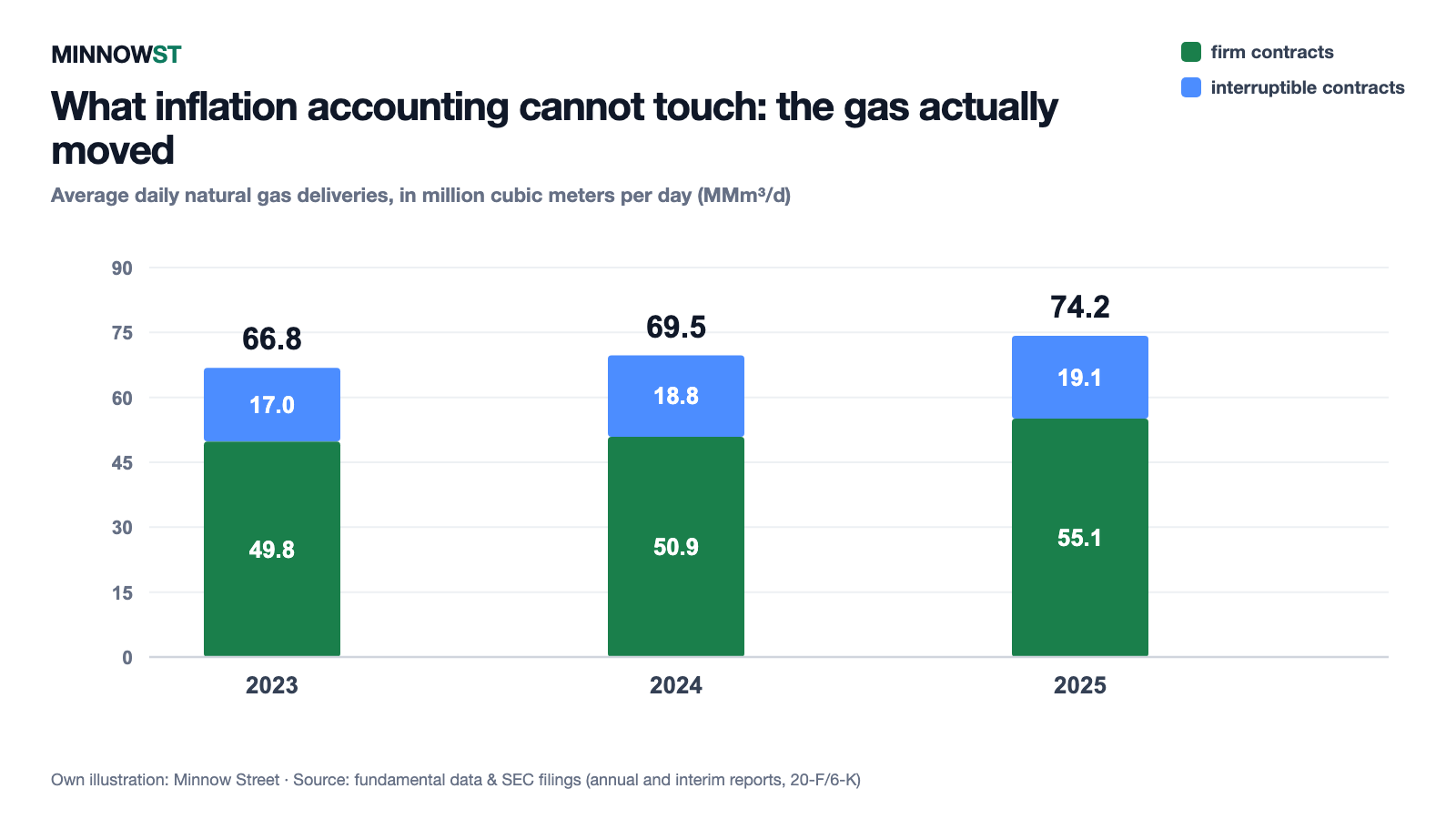
Let's begin with what no accounting rule can distort: volume. A cubic meter stays a cubic meter, even at 200 percent inflation. Average daily deliveries in gas transportation rose from 66.8 million cubic meters per day (2023) to 69.5 (2024) and 74.2 (2025). The firm, pay-regardless share grew from 49.8 to 55.1 million cubic meters — so the growth came out of the reliable part of the business. Average utilization of contracted capacity was 83 percent in 2025, and 86 percent through the winter heating season.
The second physical series is just as steady: in liquids, TGS sold 1,076,729 tons of ethane, propane, butane and natural gasoline in 2025 — practically the same as in 2024 (1,077,350 tons), even though the plant stood still for seven weeks. In 2023 it was 1,129,186 tons. Of the 2025 total, 438,327 tons, or 40.7 percent, went to export, worth Ps. 292.7 billion or 17 percent of consolidated revenue.
Now the peso figures, with the warning attached. For fiscal 2025 the company reports revenue of Ps. 1,720.6 billion (2024: 1,604.6; 2023: 1,297.1), operating profit of Ps. 703.5 billion (2024: 737.1; 2023: 333.6) and total comprehensive income of Ps. 420.9 billion (2024: 486.9; 2023: 67.4). All three years here are expressed in the same purchasing power, that of December 31, 2025 — within this one report they may be compared. Revenue rose 7.2 percent, operating profit fell 4.6 percent, comprehensive income fell 13.6 percent. By segment, gas transportation earned Ps. 321.7 billion of operating profit in 2025 (2024: 290.0; 2023: minus 35.0), liquids Ps. 217.0 billion (2024: 293.6) and midstream Ps. 165.2 billion (2024: 153.4). The first quarter of 2026 added to it: revenue of Ps. 484.2 billion against Ps. 427.6 billion a year earlier, operating profit of Ps. 249.3 billion after Ps. 187.1 billion, and comprehensive income of Ps. 160.0 billion after Ps. 142.4 billion.
Sounds clean? Then here is the part that explains why you still must not carry those series forward from one report to the next.
What the filings say — the uncomfortable truths
Uncomfortable truth no. 1: 2023 revenue sits in the books three times, with three different numbers
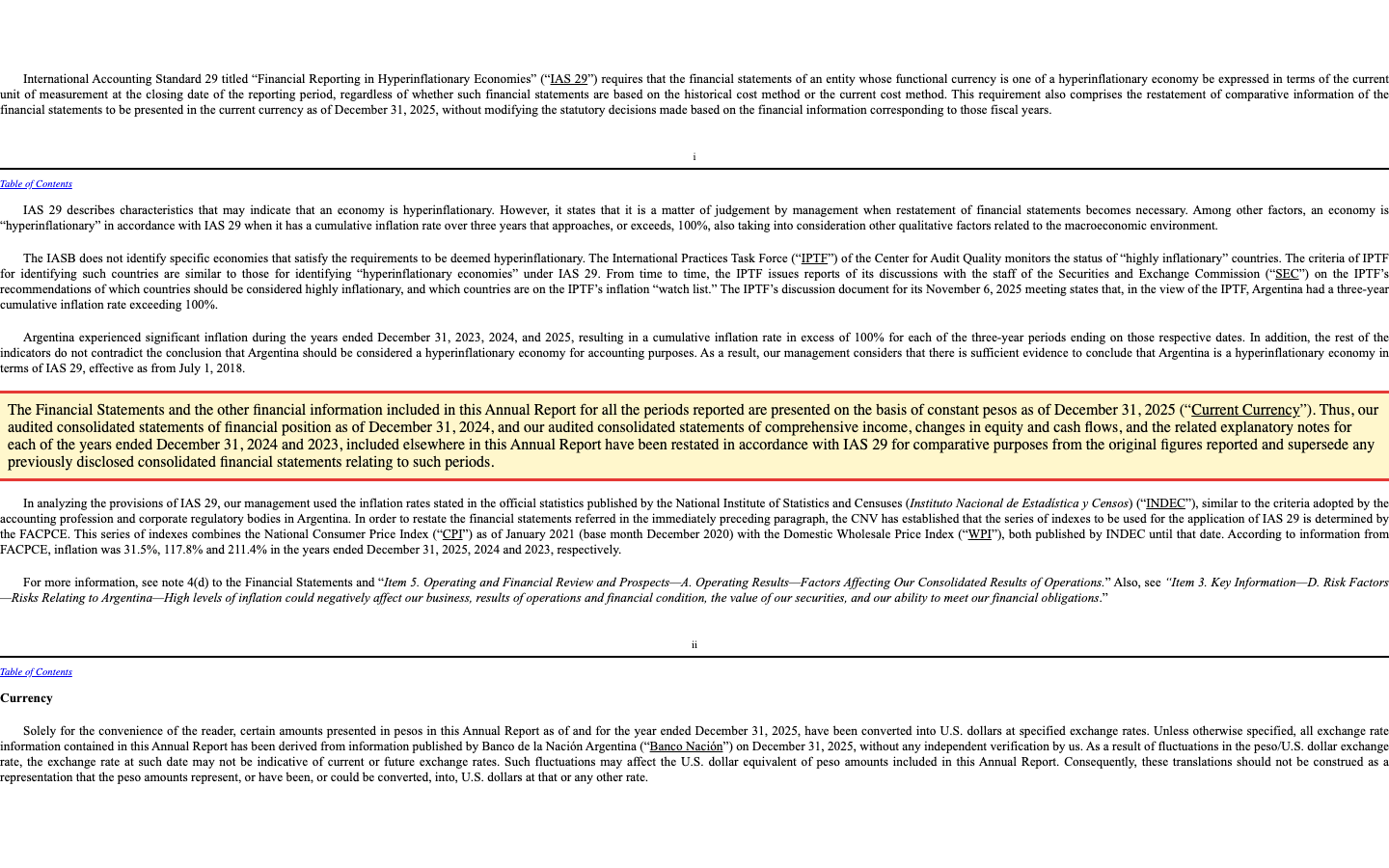
Argentina has counted as a hyperinflationary economy since July 1, 2018. That triggers accounting standard IAS 29, which demands something nobody does in daily life: every figure in a set of accounts — including the prior years — is indexed up into the purchasing power of the current balance sheet date. The company spells out the consequence in its annual report:
"The Financial Statements and the other financial information included in this Annual Report for all the periods reported are presented on the basis of constant pesos as of December 31, 2025 ('Current Currency'). Thus, our audited consolidated statements of financial position as of December 31, 2024, and our audited consolidated statements of comprehensive income, changes in equity and cash flows, and the related explanatory notes for each of the years ended December 31, 2024 and 2023, included elsewhere in this Annual Report have been restated in accordance with IAS 29 for comparative purposes from the original figures reported and supersede any previously disclosed consolidated financial statements relating to such periods."
— Transportadora de Gas del Sur S.A., SEC annual report on Form 20-F for 2025, "Presentation of Financial and Other Information"
What that means in practice is best seen in a single line you can look up in three consecutive annual reports — consolidated revenue for fiscal 2023:
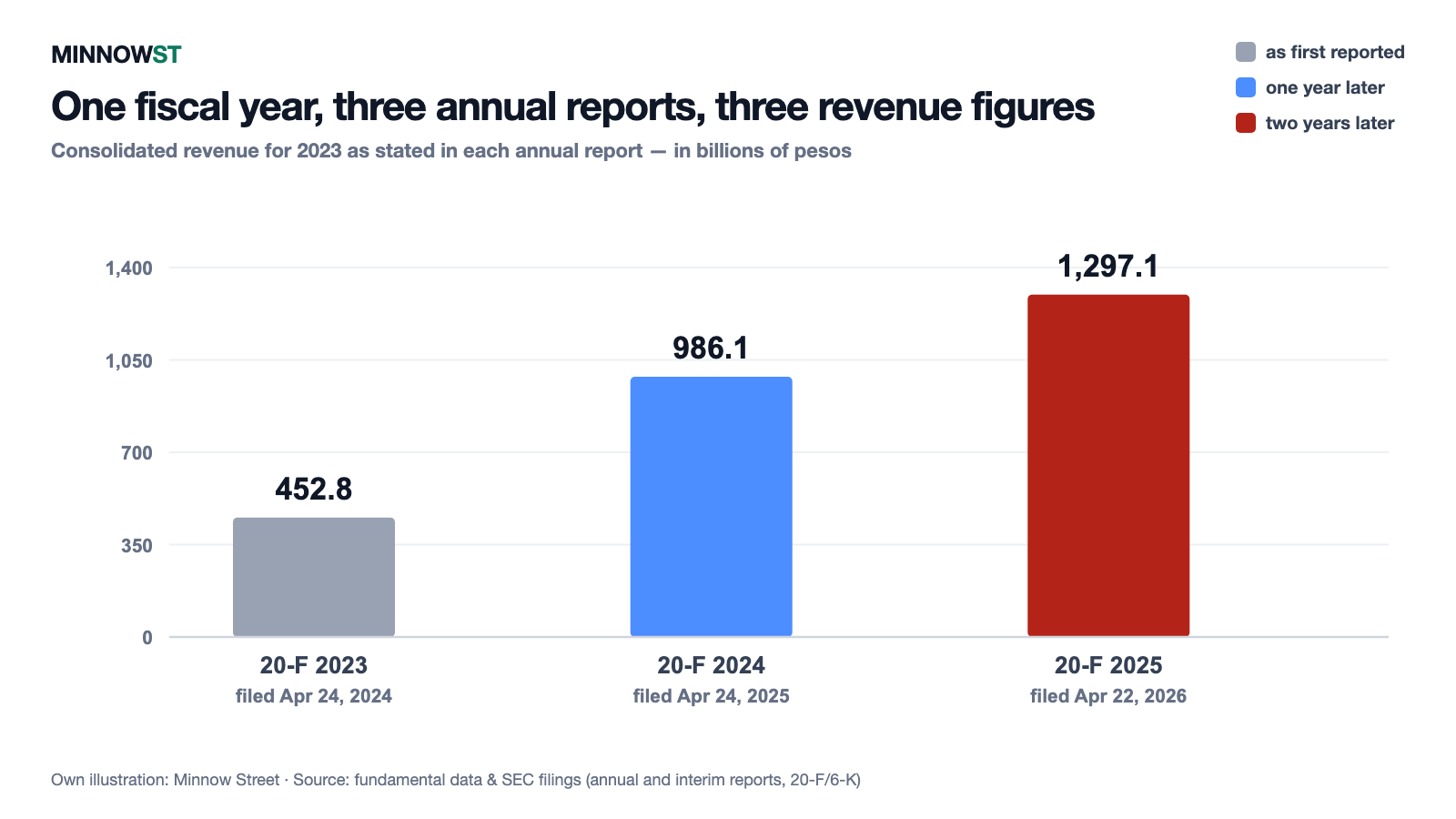
And here is the punchline that makes the rule click. In the 2024 annual report, 2024 revenue (Ps. 1,219.8 billion) came in 23.7 percent above 2023 revenue (Ps. 986.1 billion). In the 2025 annual report, that same 2024 revenue (now Ps. 1,604.6 billion) came in — 23.7 percent above that same 2023 revenue (now Ps. 1,297.1 billion). The absolute numbers change completely; the ratio survives. Remember the practical rule: in an Argentine set of accounts you may read percentages and ratios, but you must never line up absolute peso amounts taken from different reports. The effect also has its own line in the income statement: the loss on the net monetary position. It came to Ps. 36.0 billion in the first quarter of 2026 after Ps. 25.3 billion a year earlier — the purchasing power lost on the company's own cash, booked as a real expense.
Uncomfortable truth no. 2: the books are in pesos, the debt is 100 percent in dollars
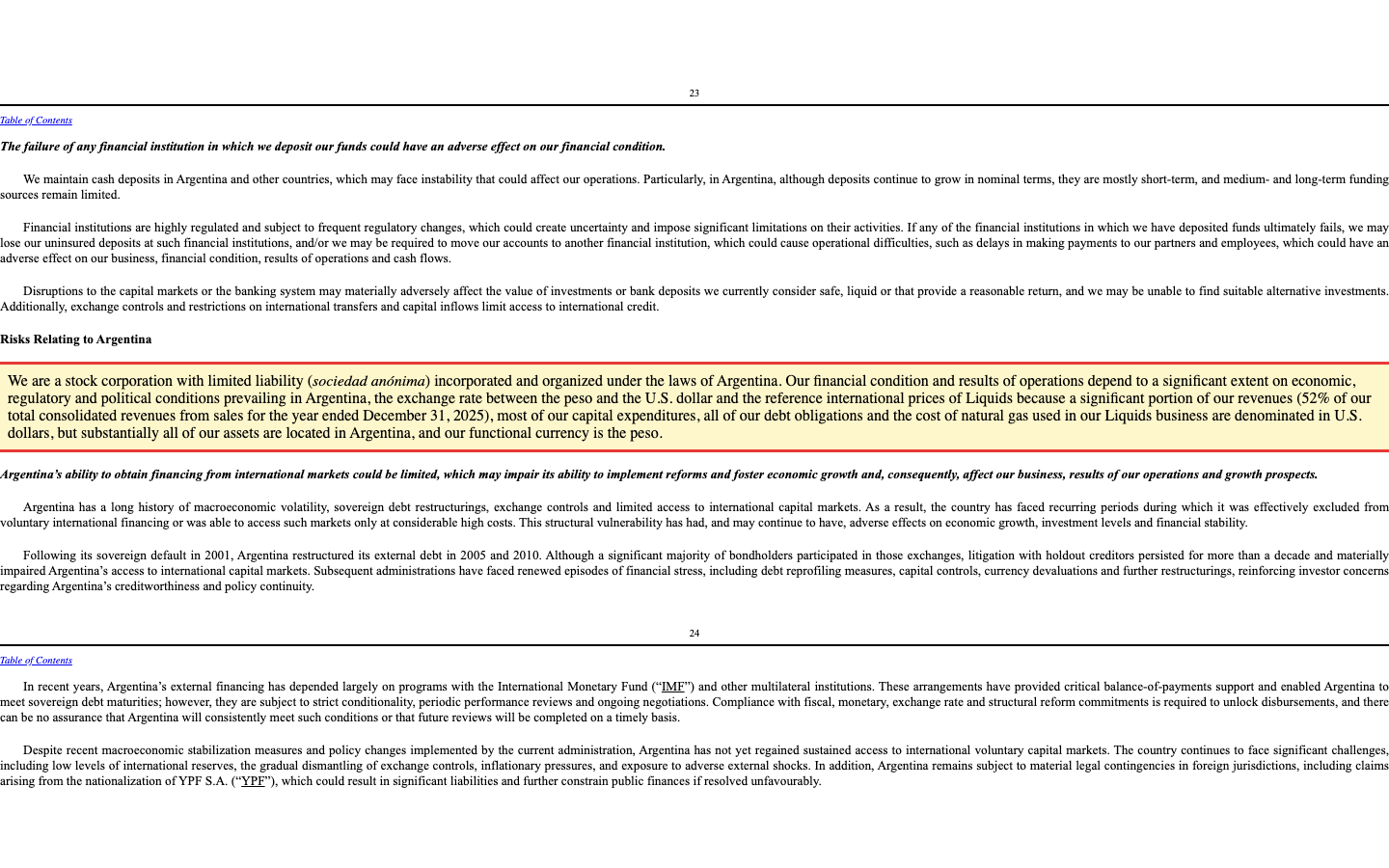
The second trap is the currency mismatch, and it is no footnote — it opens the Argentina risk section:
"Our financial condition and results of operations depend to a significant extent on economic, regulatory and political conditions prevailing in Argentina, the exchange rate between the peso and the U.S. dollar and the reference international prices of Liquids because a significant portion of our revenues (52% of our total consolidated revenues from sales for the year ended December 31, 2025), most of our capital expenditures, all of our debt obligations and the cost of natural gas used in our Liquids business are denominated in U.S. dollars, but substantially all of our assets are located in Argentina, and our functional currency is the peso."
— Transportadora de Gas del Sur S.A., SEC annual report on Form 20-F for 2025, Item 3.D "Risk Factors"
Concretely: as of December 31, 2025 TGS carried financial debt of Ps. 1,705.6 billion, or $1,172 million — by its own disclosure 100 percent denominated in U.S. dollars. At the core sit two bonds: $490 million at 8.50 percent maturing in 2031, and $500 million at 7.75 percent issued on November 20, 2025 and maturing in 2035. Against that stand cash and financial investments of Ps. 1,808.2 billion — on a net basis TGS is effectively debt-free, which in this country is worth noting. But the structure stays asymmetric: 41 percent of revenue comes from a tariff fixed in pesos, while every coupon and repayment falls due in dollars. For a sense of the speed involved: the peso depreciated against the dollar by roughly 356 percent in 2023, 27.7 percent in 2024 and roughly 41 percent in 2025. Converted at the December 31, 2025 closing rate (Ps. 1,455.00 per dollar), the Ps. 420.9 billion of annual profit equals roughly $289 million. That conversion is an approximation — the profit accrued over twelve months at constantly shifting rates but is translated at a single day's rate. Which is precisely why our data set omits the metrics that mix balance sheet and market values.
Uncomfortable truth no. 3: the most important price is set by a regulator, not a market
A gas transportation network is a natural monopoly — nobody builds a second one alongside. So in Argentina the regulator ENARGAS sets the tariffs. The annual report states the dependency without hedging:
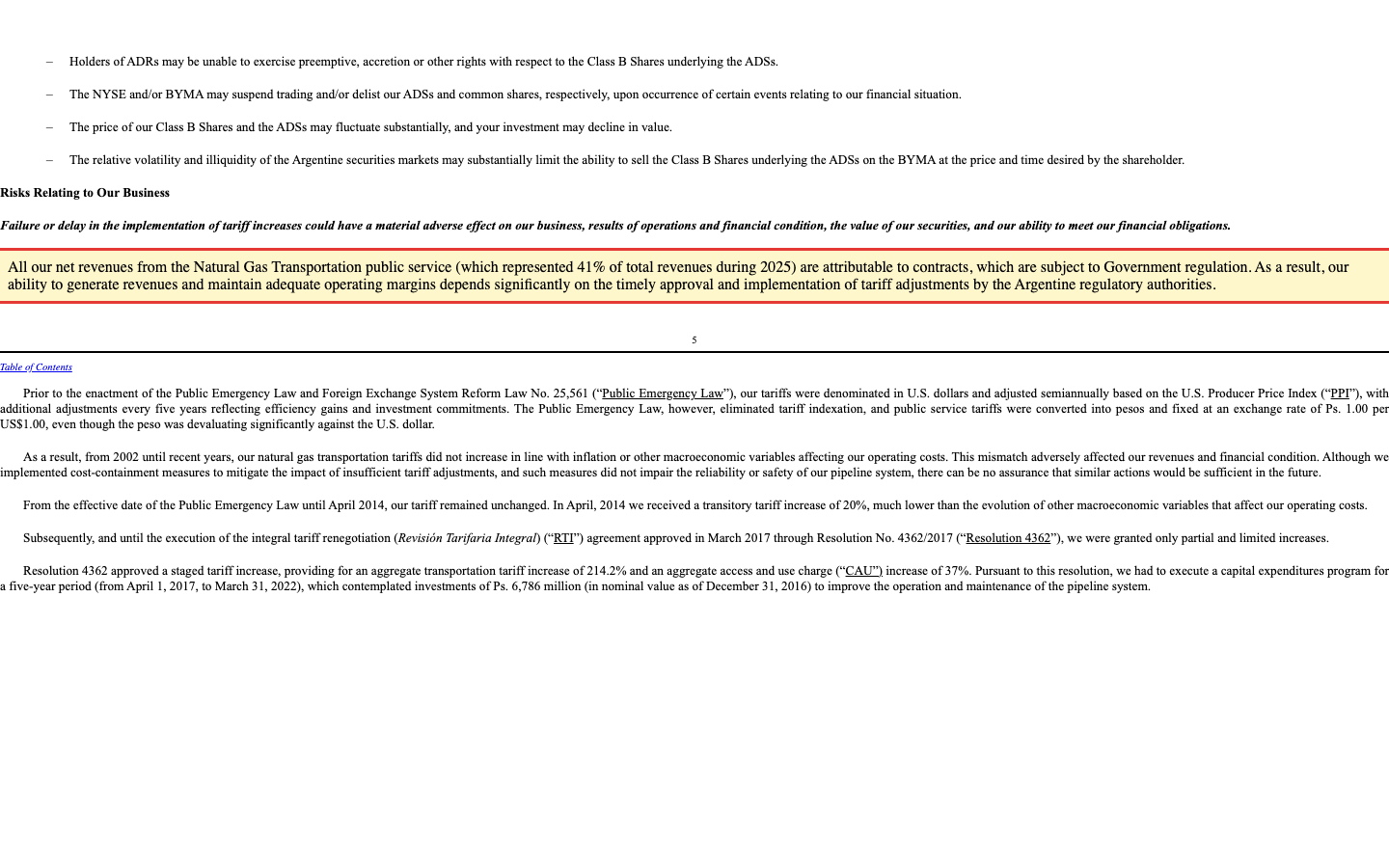
"All our net revenues from the Natural Gas Transportation public service (which represented 41% of total revenues during 2025) are attributable to contracts, which are subject to Government regulation. As a result, our ability to generate revenues and maintain adequate operating margins depends significantly on the timely approval and implementation of tariff adjustments by the Argentine regulatory authorities."
— Transportadora de Gas del Sur S.A., SEC annual report on Form 20-F for 2025, Item 3.D "Risk Factors"
What that looks like in practice shows up in the five-year tariff review. On April 30, 2025 ENARGAS published Resolution 256/2025 and set the rules for 2025 through 2030: a regulatory asset base as of December 31, 2024, an initial increase of 3.67 percent on a weighted average — later adjusted to 4.74 percent and spread across 31 equal monthly installments from May 2025 — and a five-year investment plan of $279.1 million. And here is the point where regulation really bites: TGS had asked for a weighted average cost of capital of 9.98 percent real after tax; ENARGAS set 7.18 percent. Translated into an everyday image: the landlord does not get to price the rent — the authority tells him what return on his building counts as fair, and hands him a renovation schedule while it is at it.
How much of such an increase survives inflation shows up in one line from the first quarter of 2026: transportation segment revenue fell by Ps. 7.1 billion to Ps. 194.5 billion. The company's explanation: the tariff increases were more than consumed by an IAS 29 restatement effect of Ps. 48.5 billion. Tariffs rose in nominal terms — in real terms it was not enough. Remember the mechanism: in a high-inflation country an approved tariff increase only becomes income once it arrives faster than prices rise. There is at least a monthly adjustment mechanism since 2025 instead of the earlier semi-annual round; and in March 2026 the Secretariat of Energy reordered the transportation segment's contractual framework via Resolution 66/2026, which ENARGAS concluded on April 14, 2026 with an "almost neutral" effect on revenue.
Uncomfortable truth no. 4: one day of rain shut down 38 percent of the business for seven weeks
On March 7, 2025 Bahía Blanca saw the heaviest rainfall in a hundred years. The Saladillo García stream burst its banks, flooding the Cerri Complex and its power supply. Gas transportation was soon running again with no material revenue impact — but liquids production stood completely still from March 7 until the end of April 2025. The reason it hurts: TGS makes all of its liquids in one place. Ethane, propane, butane and natural gasoline come exclusively out of the Cerri Complex, and that segment accounted for 38 percent of consolidated revenue in 2025. Translated into an everyday image: a baker with forty shops but only one bakery — when it floods, the day is over, however well the shops are trading.
To be fair, TGS absorbed it well: full-year output still reached 1,076,729 tons, only 621 tons below the prior year. The hit was measurable all the same — an impairment of Ps. 14.5 billion plus Ps. 15.0 billion of related costs in the first quarter of 2025, against which TGS booked an insurance advance of Ps. 11.9 billion in the first quarter of 2026. An advance, note, not a final settlement.
Uncomfortable truth no. 5: the state sits at both ends of the table
The ownership structure is quickly told and still unusual. CIESA holds 53.83 percent of the capital and all Class A shares; behind CIESA stand Pampa Energía with 50 percent and GIP (the Sielecki family) together with PCT with the other 50 percent. The second-largest holder is the FGS, the fund managed by Argentina's social security agency ANSES, with 25.33 percent. That leaves 20.84 percent for everyone else. Which means: the same state whose regulator fixes the tariff and the allowed return is also the second-largest co-owner of the regulated company. You can read that as an alignment of interests — an owner does want to see returns. You can also read it the other way: cutting tariffs relieves voters and costs the state only a quarter of the pain.
The second point bears directly on the ADRs. As of March 31, 2026 the depositary reported 18,052,759 ADRs outstanding; each ADR represents five ordinary shares, which is roughly 90.3 million shares or just under 12 percent of the 752,761,058 shares in issue. The state's 25.33 percent, by contrast, is roughly 190.7 million shares — more than 38 million ADR equivalents, and therefore more than twice the entire New York float. TGS itself names sales by existing shareholders, "such as the ANSES", as a price risk. One more number for scale: Helikon's 2,347,333 ADRs equalled roughly 13 percent of all ADRs outstanding at that same date — in a market that thin, a single seller moves the price.
Where the growth is — and what it is meant to cost
So far much of this has sounded like a brake. The reason professional investors look at all sits in the unregulated half. Under Argentina's desert lies Vaca Muerta, one of the world's largest shale formations, and production there is growing faster than the pipes can carry it away. TGS has already built a gathering system and the conditioning plant at Tratayén, whose latest expansion has been running since the end of February 2025.
The next steps are a size larger. For the expansion of the Perito Moreno gas pipeline by 14 million cubic meters of daily capacity, TGS won the award in October 2025; on May 12, 2026 the Ministry of Economy admitted the project, worth $550 million, into the large-investment incentive regime RIGI. How deep the demand runs showed in the tender at the start of 2026: requests came in for more than 32 million cubic meters per day — almost three times the capacity initially offered; on April 15, 2026 roughly 5.4 million cubic meters were awarded, with the rest to follow. And on June 10, 2026 TGS signed the agreements for an integrated natural gas liquids project with YPF, Pluspetrol and Chevron Argentina: roughly 100 kilometers of segregation pipeline and a processing plant with 43 million cubic meters of daily capacity for an estimated $1.1 billion, plus roughly 577 kilometers of liquids pipeline, a fractionation plant, storage and a marine terminal at Puerto Galván for an estimated $1.9 billion. Expected export volume according to the filing: about $1.2 billion per year — in the same league as the entire current top line.
That is the opportunity and the risk in one sentence: roughly $3.55 billion of announced projects stand against equity of roughly $2.15 billion — and the regulated five-year investment plan ENARGAS approved runs to $279.1 million, about one twelfth of it. In the first quarter of 2026, Ps. 605.6 billion already flowed into investments; the cash position shrank by a net Ps. 424.9 billion. How these projects get funded — from cash flow, from new notes under the $2.0 billion program, or with partners — is the decisive open question. There is at least one signal from outside: on June 11, 2026 S&P Global Ratings raised the credit rating from "B−" to "B" after reassessing Argentina's transfer and convertibility risk.
Valuation: when numerator and denominator sit in different currencies
For a dated anchor we need no daily price: Helikon's 13F puts the market value of 2,347,333 ADRs at $81,241,195 as of March 31, 2026 — roughly $34.61 per ADR, and therefore roughly $6.92 per share. Across 752,761,058 shares that is a market value of roughly $5.2 billion. Because cash and financial investments slightly exceed financial debt, enterprise value sits at practically the same level.
Now the instructive part. Convert the Ps. 420.9 billion of 2025 profit at the December 31, 2025 closing rate and you get roughly $289 million — implying a price-to-earnings ratio of about 18. Our own data set carries 15.74. Both figures are calculated cleanly, and they still differ by a sixth. The reason is exactly what this whole article is about: the numerator comes from a dollar price on one date, the denominator from a peso profit on another — and in between sits a currency that lost roughly 41 percent in a year. Valuing an Argentine stock to two decimal places means measuring with a rubber band. Sturdier are ratios drawn from one report: an operating margin of roughly 41 percent (Ps. 703.5 billion of Ps. 1,720.6 billion), an equity ratio of 57.8 percent, a gearing ratio of 0.35 after 0.21 a year earlier — and a price-to-book of about 2.4 against equity of roughly $2.15 billion. The 2025 dividend of $1.15 per ADR works out to a yield of about 3.3 percent on the anchor price — though that was the first distribution since at least 2021, and for 2026 the shareholders' meeting of April 15, 2026 first moved Ps. 437.6 billion into a reserve whose use the board decides.
How completely hyperinflation accounting can dominate a set of books we saw most recently in another Argentine name from the same portfolio — our Corporación América Airports analysis, where a $354 million swing in the financial result came purely from the peso devaluation. And how much contract structure decides the value of infrastructure shows in our Helios Towers analysis. More cases are collected in our research.
Opportunities and risks at a glance
What speaks for Transportadora de Gas del Sur:
- Volumes are growing in the reliable part of the business: average daily deliveries up from 66.8 to 74.2 million cubic meters between 2023 and 2025, the firm-contract share from 49.8 to 55.1, at 83 percent utilization.
- Two decades of planning certainty: on July 24, 2025 the Argentine executive ratified a twenty-year extension of the transport license; it now runs through December 28, 2047 instead of the end of 2027.
- Solid balance sheet: Ps. 3,127.9 billion of equity, an equity ratio of 57.8 percent, cash and financial investments of Ps. 1,808.2 billion against financial debt of Ps. 1,705.6 billion — effectively no net debt, with maturities not before 2031 and 2035.
- A first distribution since at least 2021: Ps. 231.2 billion, or $172.4 million, in 2025, equal to $1.15 per ADR. On June 11, 2026 S&P raised the credit rating from "B−" to "B".
- A genuine growth option outside regulation: the Perito Moreno expansion award ($550 million, RIGI admission on May 12, 2026), tender demand almost three times the capacity offered, and since June 10, 2026 the signed agreements for the liquids project with YPF, Pluspetrol and Chevron.
What speaks against it:
- Peso series are not comparable across filings: 2023 revenue appears as Ps. 452.8 billion, Ps. 986.1 billion and Ps. 1,297.1 billion in three consecutive annual reports. The purchasing power lost on the company's own cash cost Ps. 36.0 billion in the first quarter of 2026 alone.
- Currency mismatch: 100 percent of financial debt is denominated in U.S. dollars while the functional currency is the peso — which lost roughly 41 percent in 2025, 27.7 percent in 2024 and roughly 356 percent in 2023.
- The key price is political: in the five-year tariff review ENARGAS set an allowed return of 7.18 percent instead of the 9.98 percent requested. In the first quarter of 2026 transportation revenue fell by Ps. 7.1 billion despite tariff increases, because inflation restatement cost Ps. 48.5 billion.
- Concentration risk in several places: the entire liquids business (38 percent of revenue) runs through a single plant that stood still for seven weeks after the March 7, 2025 storm; in transportation, three customers — Metrogas, Camuzzi Pampeana and Naturgy — account for Ps. 408.6 billion of Ps. 705.1 billion in segment revenue.
- A tight register and a thin ADR market: 53.83 percent at CIESA, 25.33 percent at the state fund FGS, only 20.84 percent free float. The state's stake is more than twice the size of all 18,052,759 ADRs outstanding, and TGS itself names sales "such as the ANSES" as a price risk.
A human conclusion
Back to the folding ruler. Its problem is not that it lies — it measures correctly, just in a unit that keeps changing. That is money illusion: we see a bigger number and feel more value, even though nothing moved. At Transportadora de Gas del Sur, that reflex misleads in both directions. Read the peso jumps as growth and you overrate the company. Wave off the word "Argentina" and you overlook a network carrying more gas than ever, a license extended to 2047, a balance sheet with almost no net debt, and a multi-billion project with YPF and Chevron behind it.
So the honest question for you is not "is the stock cheap?" — that sentence presumes a reliable yardstick, and there is none here. It is: do you trust yourself to judge a company whose books are recalibrated every year, whose most important price is set inside a regulator, and whose growth project costs more than its entire equity? Whoever has a documented answer has a thesis. Whoever has none has a big number in their head. What you make of it is your decision. And that is exactly as it should be.
Sources
Every original document used in this analysis — to read for yourself:
- Transportadora de Gas del Sur S.A. — SEC annual report on Form 20-F for 2025 (filed April 22, 2026)
- Transportadora de Gas del Sur S.A. — SEC annual report on Form 20-F for 2024 (filed April 24, 2025)
- Transportadora de Gas del Sur S.A. — SEC annual report on Form 20-F for 2023 (filed April 24, 2024) — source for 2023 revenue as originally reported
- Transportadora de Gas del Sur S.A. — First-quarter 2026 earnings release, Form 6-K filed May 6, 2026
- Transportadora de Gas del Sur S.A. — Interim financial statements as of March 31, 2026, Form 6-K filed May 26, 2026
- Transportadora de Gas del Sur S.A. — RIGI approval for the Perito Moreno expansion, Form 6-K filed May 13, 2026
- Transportadora de Gas del Sur S.A. — Integrated NGL project agreements, Form 6-K filed June 11, 2026
- Transportadora de Gas del Sur S.A. — S&P credit rating upgrade, Form 6-K filed June 12, 2026
- Full SEC filing history: EDGAR overview, Transportadora de Gas del Sur S.A. (sec.gov)
- Helikon Investments Ltd — Form 13F-HR for the quarter ended March 31, 2026, filed May 8, 2026 (EDGAR overview, sec.gov)
- Fundamental data (metrics, valuation; data as of July 23, 2026), reconciled against the SEC filings and the SEC's XBRL financial series.
Transparency & disclaimer: This analysis is a journalistic contextualization of publicly available information and is not investment advice, not a financial analysis in the regulatory sense, and not a solicitation to buy or sell securities. Equity investments carry substantial risks up to and including total loss. All information without warranty; the data cut-off is noted in the text. The author holds no position in shares of Transportadora de Gas del Sur at the time of publication.
Our Bottom Line at a Glance
- Operating business positive
- Volumes are growing where it counts: average daily deliveries in gas transportation rose from 66.8 million cubic meters (2023) to 74.2 (2025), and the firm-contracted share from 49.8 to 55.1, at 83 percent utilization. Liquids still delivered 1,076,729 tons in 2025 despite a seven-week shutdown — practically the prior-year level.
- Meaning of the numbers negative
- Hyperinflation accounting under IAS 29 makes peso series unusable across filings: consolidated revenue for 2023 appears as Ps. 452.8 billion, Ps. 986.1 billion and Ps. 1,297.1 billion in three consecutive annual reports. The purchasing power lost on the company's own cash is a real expense — Ps. 36.0 billion in the first quarter of 2026 alone, after Ps. 25.3 billion a year earlier.
- Regulation & tariff negative
- The price of the core business is a political decision. In the five-year tariff review (Resolution 256/2025) ENARGAS set an allowed return of 7.18 percent real after tax against the 9.98 percent requested. How little of that arrives shows in the first quarter of 2026: segment revenue fell Ps. 7.1 billion despite tariff increases, because inflation restatement cost Ps. 48.5 billion.
- Balance sheet & funding positive
- As of December 31, 2025 the company holds Ps. 3,127.9 billion of equity (ratio 57.8 percent) plus cash and financial investments of Ps. 1,808.2 billion against financial debt of Ps. 1,705.6 billion — no net debt, with maturities not before 2031 and 2035. On June 11, 2026 S&P raised the rating from "B−" to "B". The catch: all debt is dollar-denominated while the books are in pesos.
- Growth outside regulation neutral
- Vaca Muerta supplies the demand: the tender in early 2026 drew requests for more than 32 million cubic meters per day, almost three times the capacity offered. Against that stand roughly $3.55 billion of announced projects — $550 million for the Perito Moreno expansion and $3.0 billion for the liquids project with YPF, Pluspetrol and Chevron — versus equity of roughly $2.15 billion. Funding is still open.
- Ownership & tradability negative
- 53.83 percent sits with CIESA, 25.33 percent with the state fund FGS, and only 20.84 percent with the broad public. The state stake is more than twice the size of all 18,052,759 ADRs outstanding; TGS itself names sales "such as the ANSES" as a price risk. The same state regulates the tariff. Helikon held roughly 13 percent of all ADRs as of March 31, 2026 — in a market that thin, a single seller moves the price.
Transportadora de Gas del Sur is money illusion in its purest form: a real, growing business — more gas than ever, a license extended to 2047, a balance sheet with almost no net debt, a first dividend in years — expressed in numbers that multiply from report to report without anything having moved. Revenue for 2023 sits in the books three times: Ps. 452.8 billion, Ps. 986.1 billion and Ps. 1,297.1 billion. Add debt that is 100 percent dollar-denominated against a peso balance sheet, a tariff set by a regulator, and a $3.55 billion growth program against $2.15 billion of equity. Whoever invests here buys a solid network and an open bill. Not investment advice.
What Our Rating Means
Open questions
The business works in principle, but one material question is open. As long as it stays open, our findings do not carry a quality verdict.
Holding the stock is a bet that ENARGAS delivers its monthly tariff adjustments faster than inflation eats them, and that the multi-billion Vaca Muerta projects get funded without tipping the balance sheet. Buying in adds a valuation problem: market value in dollars, profit in pesos, and in between a currency that lost roughly 41 percent in 2025 — our data set carries a P/E of 15.74, translation at the closing rate gives about 18, and both are calculated cleanly. Three things belong in every report you read: are transported volumes still growing (last 74.2 million cubic meters per day)? How is the $3.0 billion project with YPF and Chevron being financed? And does a second distribution follow the first $1.15 per ADR, or does the profit stay in the reserve? Until those answers exist, watching wins. The decision is yours.
A journalistic assessment by our editorial team at the time of the deep dive, based on public sources — not investment advice and not a solicitation to buy or sell. Your personal circumstances (investment goals, risk capacity, taxes) cannot be taken into account. What our levels mean, how verdicts are formed, and what conflicts of interest exist →
Worth Noting
- Transportadora de Gas del Sur reached our research list through the Form 13F-HR of London-based Helikon Investments Ltd for the quarter ended March 31, 2026 (filed May 8, 2026): 2,347,333 ADRs worth $81,241,195. The position was built in the third quarter of 2025, added to in the fourth and cut by 28.5 percent in the first quarter of 2026; in that same quarter the fund sold out entirely of Pampa Energía ($50.0 million) — the co-owner of TGS controlling shareholder CIESA. A 13F shows only U.S.-listed long positions, arrives with a 35- to 45-day delay and contains no short sales or derivatives — a rear-view mirror, not a road map.
- Transportadora de Gas del Sur is a foreign private issuer: there is no 10-K and no 10-Q. The evidence chain for this analysis is the annual reports on Form 20-F for 2025 (filed 04.22.2026) and 2024 (04.24.2025) plus the interim reports and mandatory disclosures on Form 6-K (earnings release 05.06.2026, interim financial statements 05.26.2026, RIGI approval 05.13.2026, NGL project 06.11.2026, credit rating 06.12.2026).
- Our in-house stock scanner carries eight quarters for TGS in the reporting currency peso: Piotroski F-Score 7 of 9, equity ratio 0.578, P/E 15.74 (data as of July 23, 2026). The Altman Z-Score, NCAV and the cash line are deliberately not carried, because those metrics would mix peso balance sheet items with dollar market values. Every peso amount in this analysis is stated in constant purchasing power under IAS 29 and is not comparable across annual reports; analyses are evergreen, daily prices are not a buy argument.
Stock Watch
This analysis is as of July 23, 2026. Stock Watch will tell you what's changed at TGS since then.
Later $1 a month per stock — signing up is free, and you'll be the first to know when it launches.
Frequently Asked Questions
Transportadora de Gas del Sur S.A. (NYSE: TGS) operates Argentina's largest natural gas transportation network: 5,746 miles of pipeline, 4,768 of them on an exclusive basis under a state license, carrying more than 60 percent of all natural gas transported in the country. It also produces liquids at the Cerri Complex and provides midstream services around Vaca Muerta. In 2025, 41 percent of revenue came from regulated transport, 38 percent from liquids and 21 percent from midstream and telecom.
Because Argentina has counted as a hyperinflationary economy since July 1, 2018, so the company reports under IAS 29. Every prior-year figure is restated into the purchasing power of the current balance sheet date and, per the annual report, expressly supersedes the previously published accounts. Revenue for 2023 therefore shows up as Ps. 452.8 billion (2023 report), Ps. 986.1 billion (2024 report) and Ps. 1,297.1 billion (2025 report) — one and the same year.
Through December 28, 2047. Under Natural Gas Law 24,076 the license would originally have expired on December 28, 2027. TGS applied for an extension on September 8, 2023; after an ENARGAS report and a public hearing in October 2024, the Argentine executive ratified the July 11, 2025 agreement with the Ministry of Economy on July 24, 2025 — extending the license by twenty years.
The Argentine regulator ENARGAS. With Resolution 256/2025 of April 30, 2025 it set the five-year tariff review for 2025 through 2030: a weighted average cost of capital of 7.18 percent real after tax instead of the 9.98 percent TGS requested, an initial increase of 4.74 percent spread over 31 monthly installments from May 2025, and a five-year investment plan of $279.1 million. Since 2025 tariffs have been adjusted monthly rather than semi-annually.
CIESA holds 53.83 percent of the capital and all Class A shares; CIESA itself is controlled in equal halves by Pampa Energía on one side and GIP (the Sielecki family) together with PCT on the other. The second-largest holder, with 25.33 percent, is the state fund FGS managed by Argentina's social security agency ANSES. That leaves 20.84 percent for all other investors out of 752,761,058 shares.
One ADR (American Depositary Receipt) represents five Class B ordinary shares. The depositary is Citibank N.A. and the ADR trades on the NYSE under the ticker TGS; in Buenos Aires the share trades on BYMA as TGSU2. As of March 31, 2026 the depositary reported 18,052,759 ADRs outstanding, equal to roughly 90.3 million shares or just under 12 percent of the share capital.
In 2025 yes, for years before that no. The annual report shows no distribution for 2021 through 2024; in 2025 the company paid Ps. 231.2 billion, or $172.4 million, equal to $0.23 per share or $1.15 per ADR. The shareholders' meeting of April 15, 2026 additionally moved Ps. 437.6 billion into a reserve whose use for investments, buybacks or dividends is decided by the board.
As of December 31, 2025 financial debt stood at Ps. 1,705.6 billion, or $1,172 million — 100 percent denominated in U.S. dollars. The core is two bonds: $490 million at 8.50 percent maturing in 2031 and $500 million at 7.75 percent maturing in 2035. Against that stood cash and financial investments of Ps. 1,808.2 billion; the gearing ratio was 0.35 after 0.21 a year earlier.
Found an error?
Did you spot a factual error, an outdated number, or a typo in this deep dive? Let us know briefly — your report goes straight to the editorial team.