Helios Towers Stock: The 12 Percent Investor Who Doesn't Own a Single Share
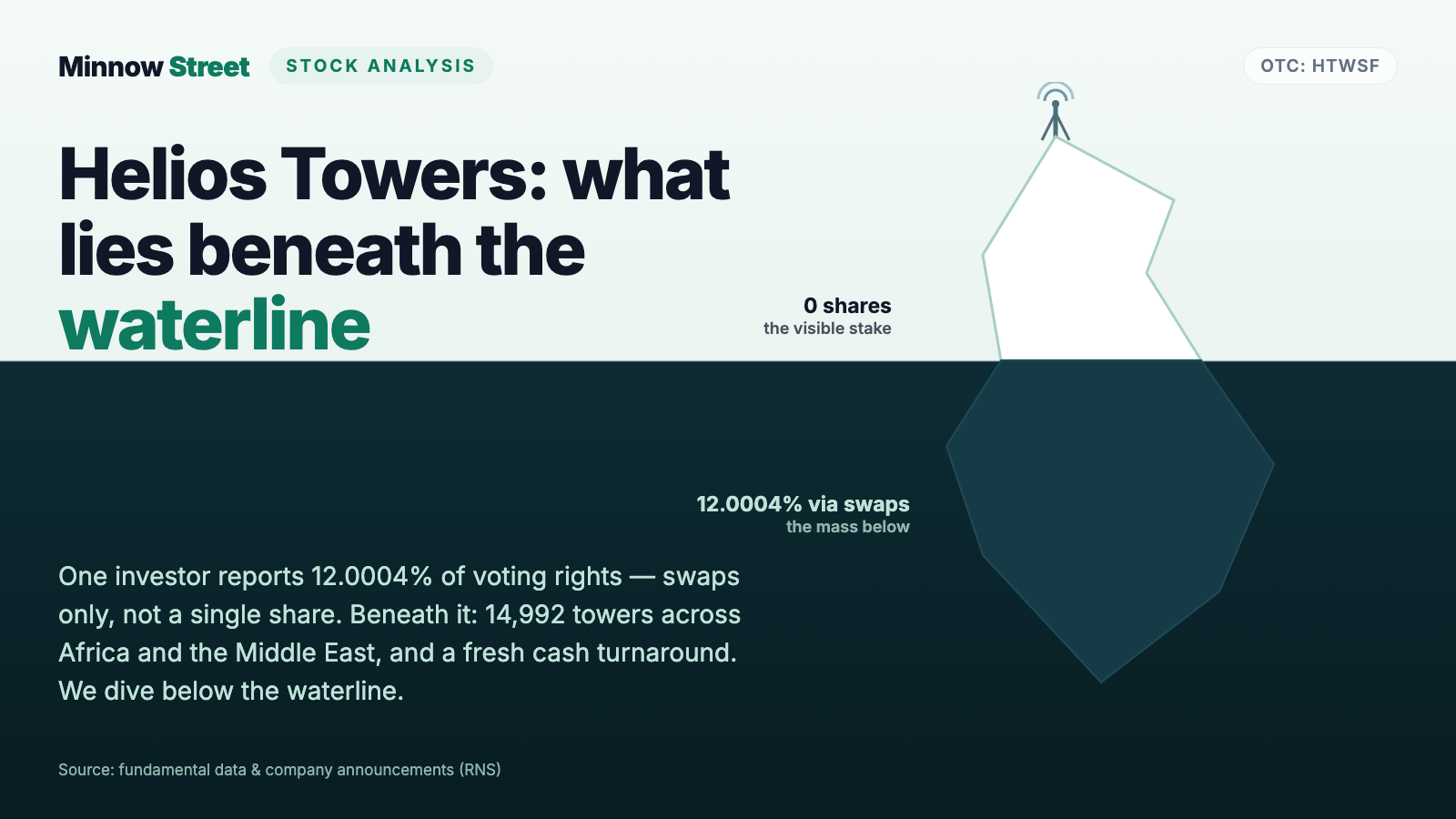
A London fund holds 12.0004 percent of Helios Towers — through five swap contracts, without a single share and without a single vote. It drifted above the 12 percent threshold passively, because the company keeps buying back its own stock; the notification came almost four months later. Since July 2026, an investment newsletter has been marketing exactly this position as a $149 insider tip. We read what sits in the public record for free instead: the regulatory filing, the audited annual report, the results announcements — and found ten years of EBITDA growth and a genuine cash turnaround, but also 3.5x leverage, nearly depleted equity, and two countries carrying two thirds of revenue. Not investment advice — just the public record behind a $149 stock tip.
 Thomas Mücke
Founder & Publisher
Thomas Mücke
Founder & Publisher
Chart
Interactive price chart (TradingView).
Note: pure fact-based analysis, not investment advice and not a solicitation to buy or sell. All figures without guarantee.
There is one lure that hooks investors more reliably than any metric: the feeling of being able to buy a head start. The email always reads the same way — a secretive fund "most investors have never heard of" has quietly built a 12 percent stake in a company; Bloomberg doesn't even list it among the major shareholders; and for $149 you get the 35-page report before "the wider market catches on." Exactly such a promotional email landed in our inbox in July 2026. The fund is Helikon Investments; the company is Helios Towers plc (London Stock Exchange: HTWS, US over-the-counter: HTWSF) — an operator of mobile-phone towers across Africa and the Middle East. So let's make a deal: we buy no report. We read, together, what anyone can access for free — the major-holdings filing in the London regulatory record, the audited annual report, the regulated results announcements (in the UK they run through the official news service, the RNS). That is where the "insider tip" has been sitting in black and white for weeks — including the parts that promotional emails never mention. What you make of it at the end is your call.
What Helios Towers actually does — a parking garage landlord for antennas
A telecom tower is, at its core, a parking garage for antennas: Helios builds or buys the tower, provides power, maintenance and security — and mobile network operators park their antennas on it and pay rent for decades. As of March 31, 2026, the company ran 14,992 towers carrying 33,350 tenancies across nine countries: Tanzania, the Democratic Republic of the Congo (DRC), Congo-Brazzaville, Ghana, Senegal, Madagascar, Malawi, South Africa and Oman. In seven of those nine markets, Helios says it is the number one by market share. The customers are no lightweights either — the region\'s big network operators: Airtel Africa (27.9 percent of 2025 revenue), Vodafone/Vodacom (23.0 percent), Orange (11.1 percent) and Axian (10.3 percent). The business model lives on a single metric: the tenancy ratio — how many paying tenants sit on an average tower. The first tenant pays for the garage; every additional one is almost pure profit: by the company\'s own numbers, a tower returns about 12 percent with one tenant, 25 percent with two, and 34 percent or more from the third onward. At the end of March 2026 the ratio stood at 2.22 tenants per tower — the self-imposed 2.2 target was hit a full year ahead of plan, and the new goal is above 2.5 by 2030. And these are not walk-in customers: initial contract terms run 10 to 15 years with automatic renewals and built-in inflation and power-price escalators. As of March 31, 2026, $5.3 billion of future revenue was already under contract — 6.7 years of average remaining life, without assuming a single new deal. Sounds like a money-printing machine? By now, it partly is. But remember the central tension of this analysis, because it runs through every chapter: the machine works — but it works to a large degree in Tanzanian shillings and in the eastern Congo, on 3.5 turns of EBITDA leverage, and its most prominent new investor doesn\'t own a single share.
How the stock landed on our desk — and what the record actually says
In order. On May 19, 2026, Helios Towers published a major-holdings notification — in the UK the form is called a TR-1; it is the official counterpart of a 13D/13G-style disclosure. In it, Helikon Investments Limited, a London fund, reports 12.0004 percent of the voting rights. Open the table and you find the real story: the line "% of voting rights attached to shares" reads 0.000000. The entire position sits in five cash-settled equity swaps expiring between November 12, 2026 and February 28, 2035. Such a swap is a bet with a bank on the share price: if the stock rises, the bank pays the difference in cash — the fund carries the full economic upside and downside, but holds no shares, no votes, no entry in the shareholder register. Which is precisely why Helikon does not show up in classic major-shareholder lists: those show the hedging counterparty bank instead. And one more detail deflates the "aggressive accumulation" narrative: as the reason for the notification, the form explicitly names a passive crossing —
"Passive disclosure driven by Helios Tower's ongoing share buyback programme which caused Helikon's total % of voting rights to passively cross above 12% due to issuer's share capital count reducing."
— Helios Towers plc, TR-1 major-holdings notification, May 19, 2026, section 2 (Investegate/RNS)
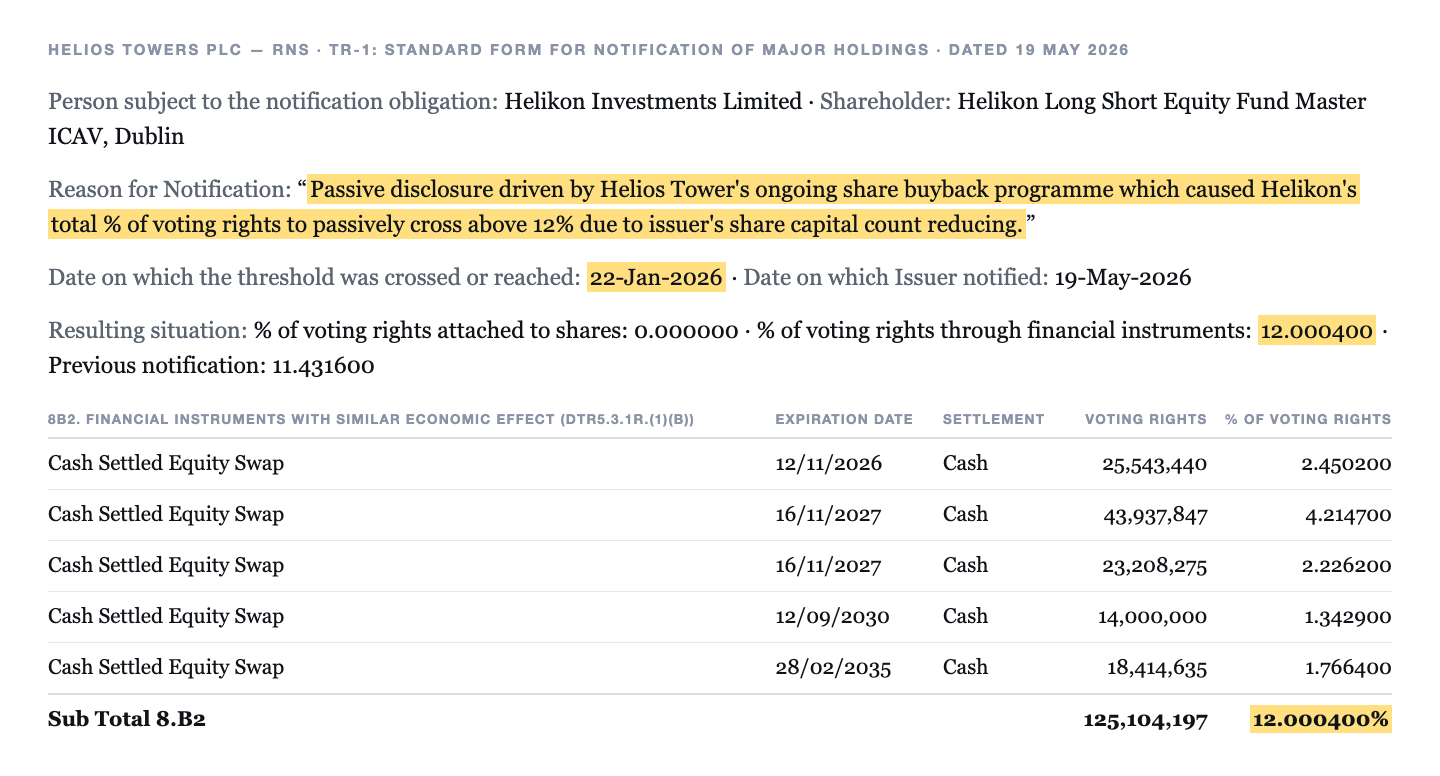
The threshold, by the way, was crossed on January 22, 2026 — the notification followed almost four months later. None of this makes the position small: whoever replicates 12 percent of a multi-billion-dollar company through swaps means it, and Helikon has a London reputation for sniffing out underrated balance sheets. But there is a difference between an "activist with a big stick" moving in — and a voteless swap holder whose stake grows even when he does nothing, because the company itself keeps retiring shares. We took the occasion to add Helios to our scanner universe (under the US OTC ticker HTWSF, since the company reports in US dollars anyway). Our in-house stock scanner\'s fundamental lens shows, as of July 23, 2026, a split picture that fits the central tension perfectly: an EBIT margin of 37.8 percent and a Piotroski F-Score of 6 out of 9 — a nine-point test of balance-sheet direction; 6 means solid improvement, not top of the class. Next to that, an Altman Z-Score of 1.46, formally "distress zone" — for capital-intensive, credit-financed infrastructure firms this metric is structurally harsh, but it should not be waved away either —, an optical P/E around 92 (the profits are simply only two years old) and an equity ratio of roughly 1.6 percent. See for yourself on the Helios Towers stock page. One practical note belongs here: OTC trading in HTWSF is thin; the liquid original trades in London as HTWS, in pence.
The numbers over the years — honestly appraised
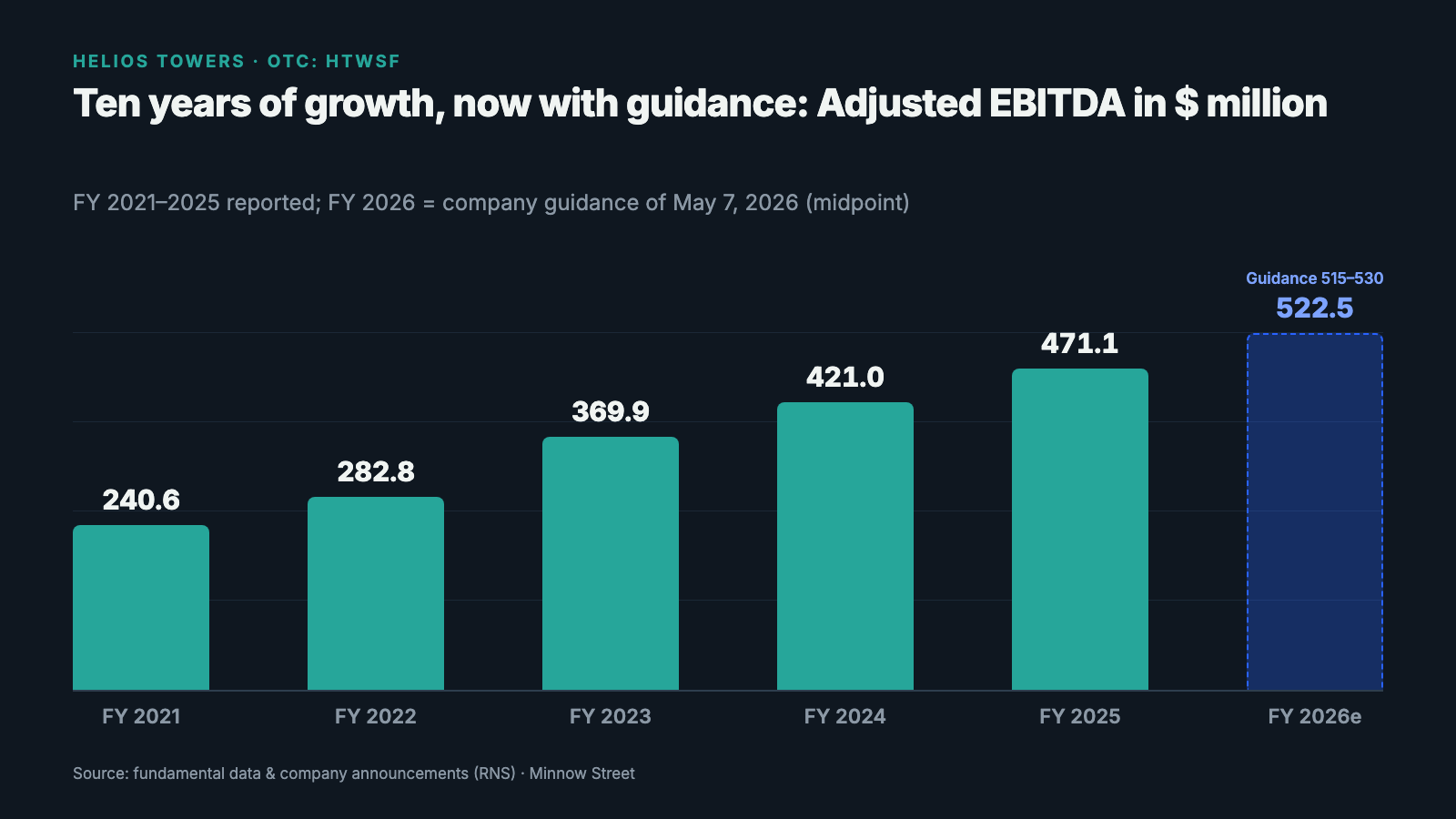
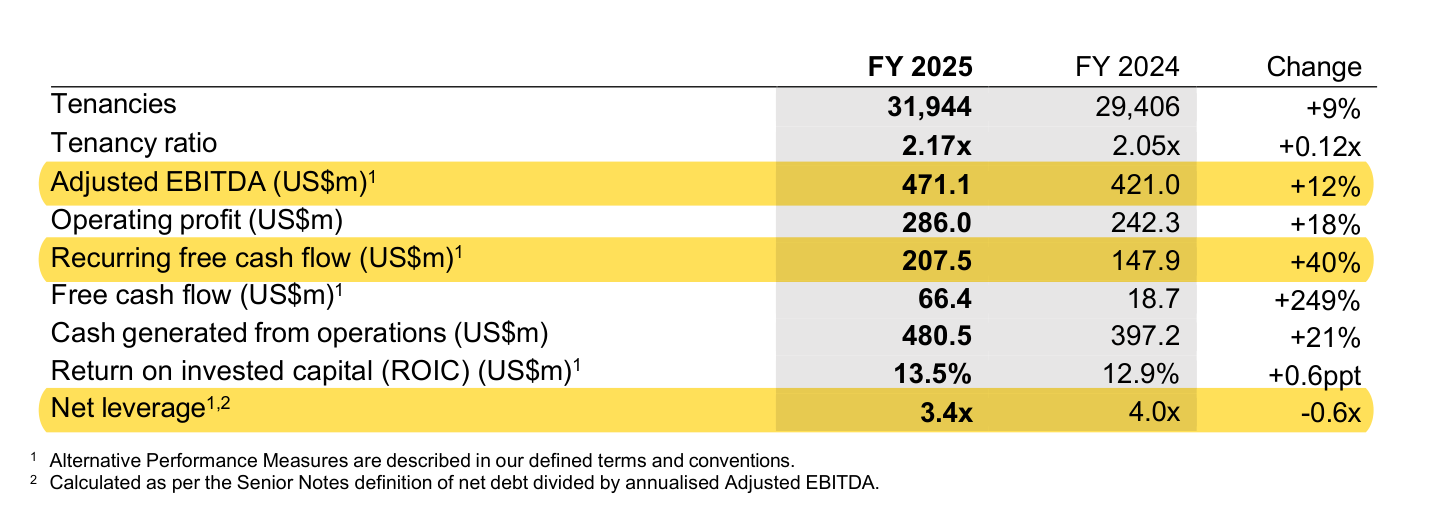
First, what genuinely impresses — and here it is the consistency. Revenue climbed from $449.1 million (2021) via $560.7 million (2022) and $721.0 million (2023) to $792.0 million (2024) and $854.1 million (2025, +8 percent). Adjusted EBITDA — operating profit before depreciation, the reserve currency of the tower industry — grew over the same span from $240.6 million to $471.1 million (+12 percent, at a 55 percent margin). The CEO frames it like this:
"2025 was not only our 10th consecutive year of unbroken Adj. EBITDA growth, rising from US$54m in 2015 to US$471m, it was also a pivotal year for the business in several other important ways."
— Tom Greenwood, CEO, full-year 2025 results announcement (RNS), March 12, 2026, CEO statement
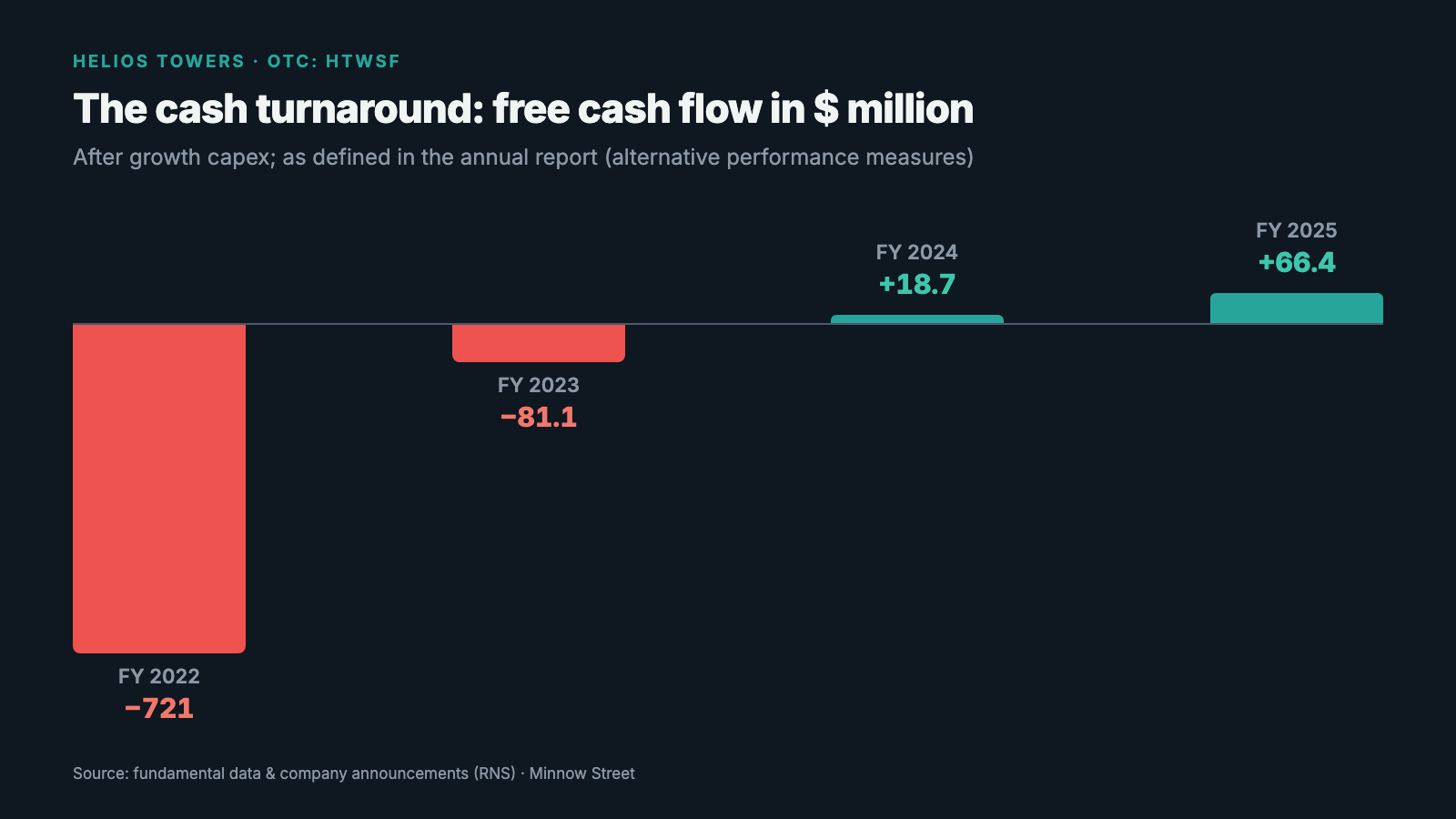
More important than the growth series is what turned underneath it. For years, Helios was a growth machine that burned cash: 2022 closed with free cash flow of minus $721 million after the Omantel tower acquisition, 2023 still at minus $81.1 million. Then the turn: plus $18.7 million (2024), plus $66.4 million (2025). Recurring free cash flow — before growth investments, the measure of the underlying engine — jumped 40 percent to $207.5 million in 2025. And for the first time since the 2019 IPO, something stuck to the bottom line: 2024 brought the first annual profit in company history ($27.0 million), followed by $39.4 million in 2025 — after losses of $156.2 million (2021), $171.4 million (2022) and $111.8 million (2023). Net leverage fell from 4.0x to 3.4x EBITDA (end-2025), and three rating agencies upgraded the company in 2025/26 (S&P and Fitch to BB-, Moody's to Ba3). The CFO\'s summary of the year:
"We achieved our 2.2x tenancy ratio target a full year ahead of plan, expanded Adjusted EBITDA to US$471 million, achieving 10 consecutive years of growth, more than tripled free cash flow and reduced net leverage to 3.4x."
— Manjit Dhillon, CFO, full-year 2025 results announcement (RNS), March 12, 2026, CFO statement
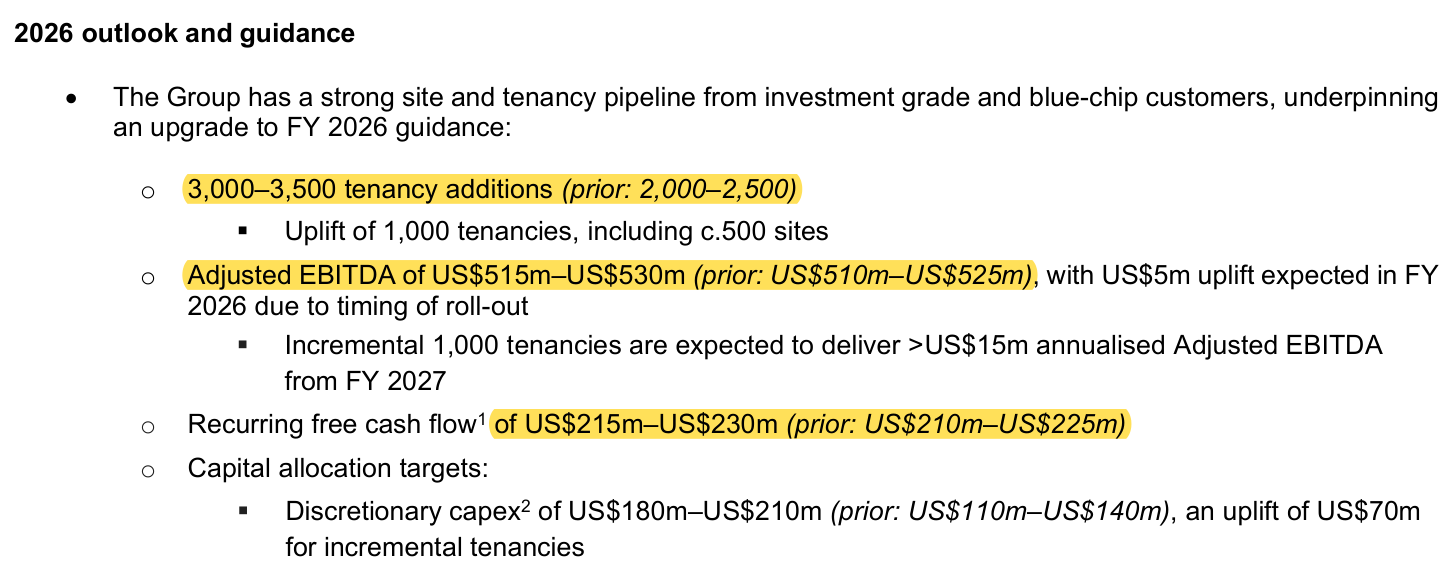
And the momentum carried into the new year: in the first quarter of 2026, revenue grew 12 percent to $229.2 million, Adjusted EBITDA 14 percent to $127.2 million (56 percent margin), with 1,406 tenancies added. On May 7, 2026, management raised full-year guidance — to 3,000–3,500 tenancy additions (from 2,000–2,500), Adjusted EBITDA of $515–530 million and recurring free cash flow of $215–230 million; growth capex was raised alongside ($180–210 million instead of $110–140 million). Keep both halves of that sentence: demand is real and accelerating — and it still gets fed with fresh capital.
What the filings say — the uncomfortable truths
Uncomfortable truth no. 1: Two countries carry two thirds of revenue — and 29 percent of earnings arise in soft currency
The promotional line ("number one in almost every market") is true — but it comes with a map. In 2025, $308.0 million of revenue came from the DRC (36.1 percent) and $254.9 million from Tanzania (29.8 percent): together, two thirds of the group. At the operating-company level, Tanzania is the single biggest earnings block at 36 percent — and there, only about 40 percent of EBITDA is hard-currency protected; the Tanzanian shilling lost roughly 9 percent in 2025. Group-wide, per the CFO, 71 percent of EBITDA is earned in or linked to hard currency:
"One of the key strengths of the business is our hard-currency earnings. In 2025, 71% of Adjusted EBITDA was generated in hard-currency, supported by our diversified presence across nine markets."
— Manjit Dhillon, CFO, full-year 2025 results announcement (RNS), March 12, 2026
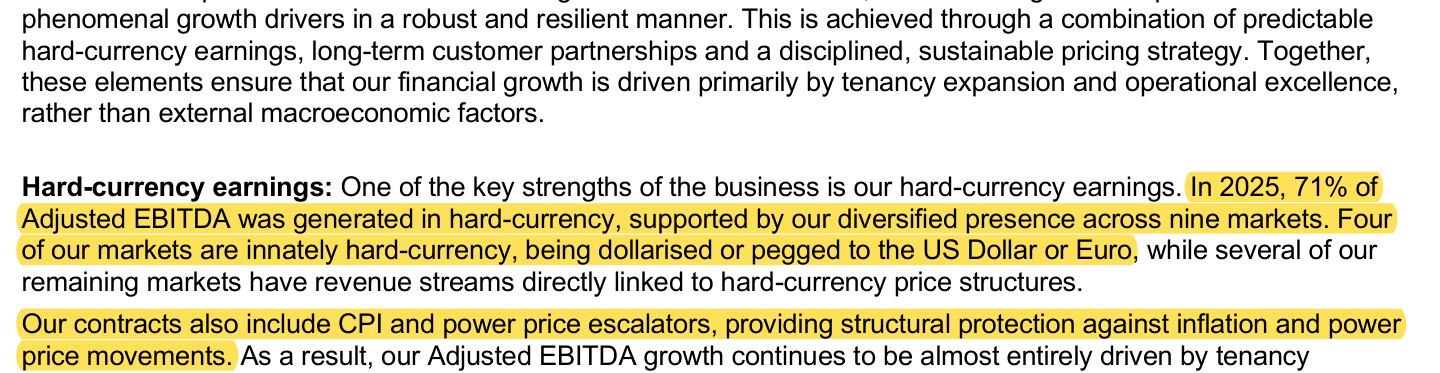
Seventy-one percent hard currency is strong for an Africa-focused company — but the number also means: 29 percent is not. And the map includes security. The 2025 annual report itself — not some critic — lists the situation in the eastern Congo as a monitored risk:
"Emerging risks related to ongoing instability in Eastern DRC, potential new geopolitical alliances, increasing uncertainty in the political, legal and regulatory environment, increasing cyber threats and advances in AI were discussed for ongoing monitoring and management."
— Helios Towers plc, Annual Report 2025, risk management chapter
To be fair: operationally, none of this has shown up so far — the DRC was the biggest growth driver in the first quarter of 2026 with 990 tenancies added year-on-year, and the company can show over ten years of data that its EBITDA tracks tenancy count almost exclusively, with minimal sensitivity to exchange rates or oil prices. But an investor should hold the complete picture: if your rental property stands in a storm zone, good property management is an argument — not a weather forecast.
Uncomfortable truth no. 2: Leveraged 3.5x at the top of its own corridor — and equity is nearly depleted
For now, the cash turnaround belongs to the creditors. As of March 31, 2026, net debt stood at $1,786.6 million — 3.5 times EBITDA, exactly at the top of the 2.5x–3.5x corridor management set for itself. The big pots: an $850 million bond at 7.5 percent (due 2029), a $500 million bond at 6.75 percent placed in spring 2026 (due 2031), and the remainder of a convertible bond (due March 2027). Average cost of debt was most recently 6.7 percent — 84 percent fixed, which is well managed, but at these rates the debt service eats a sizable share of what the towers earn. The 2025/26 rating upgrades changed the direction, not the class: BB- and Ba3 are still non-investment grade — "junk" in market slang, even if the word sounds harsher than the situation is. Add a number few have on their radar: after the loss years 2019 through 2023, book equity is nearly used up — the equity ratio sits at roughly 1.6 percent (fundamental data, as of July 23, 2026). That is also why the optically spectacular return on equity of about 70 percent is an illusion: when almost no equity is left, any profit produces dream returns on the remainder. None of this is hidden — it is all in the accounts. But it explains why this stock, money-machine story and all, trades at 8.7 times EBITDA and not at 20 times like its American peers.
Uncomfortable truth no. 3: The 100-percent-buyback fantasy — what the promo promises and what the company commits to
The promotional email calculates that the company "could theoretically buy back 100 percent of its share capital by 2030 based on current cash flow." The arithmetic can indeed be rebuilt: management targets more than $1.3 billion of cumulative recurring free cash flow for 2026 through 2030 — genuinely about half the mid-2026 market value, and with extra borrowing capacity you can compute any headline you like. Except: what is committed is something else. The company itself allocates that $1.3 billion as follows:
"Over 2026–30, we are targeting over >US$1.3 billion of recurring free cash flow. We will deploy over US$0.5 billion into high-returning organic growth to drive at least 9% average annual Adj. EBITDA growth, return over US$0.4 billion to shareholders, and retain the remaining c. US$0.4 billion of capital flexibility for the most value-accretive opportunities across the cycle."
— Tom Greenwood, CEO, full-year 2025 results announcement (RNS), March 12, 2026, CEO statement
What is actually on the books: a buyback programme of up to $75 million through end-2026 (repurchased shares are cancelled; $24 million was already executed in 2025), a buyback target of at least $250 million through 2030, and a first dividend of $25 million for 2026, intended to grow by more than 10 percent per year (target: over $150 million cumulatively). Together that is a good $400 million — roughly 15 percent of the market value over five years, not 100. For a company that burned $721 million three years ago, that is a remarkable turn — but between "remarkable" and "buying itself off the market" lies exactly the distance between a regulatory filing and a marketing text. Remember the principle: a calculation that only works with "theoretically" is a scenario — not a commitment. We saw a cousin of this recently at XPeng, where a celebrated "turning point" turned out, on inspection, to be built from one-off effects: reading the filings pays on every continent.
Valuation: what the market pays as of mid-2026
As of July 23, 2026, the stock traded around 200 pence in London — after a 69 percent gain over twelve months, versus an IPO price of 115 pence in October 2019 and a low of about 57 pence in October 2023. That put the market value at about £2.0 billion (roughly $2.7–2.8 billion) and the enterprise value, including net debt, near $4.5 billion. Against the midpoint of the raised EBITDA guidance, that works out to about 8.7 times expected operating earnings — for context: US tower companies American Tower and SBA traded around 20 times in mid-2026, Europe\'s Cellnex around 12 times. And the sector is delivering a live benchmark: South African telecom giant MTN is taking over IHS Towers, the largest African rival — valued at roughly 5.8 times annualized EBITDA. Helios thus sits almost exactly between "Africa discount at fire-sale prices" and "Wall Street premium": cheaper than any Western peer, richer than the most recent takeover print on its own continent. Recurring free cash flow at the guidance midpoint equals about 8 percent of the market value; the new dividend starts below a 1 percent yield. The seven analyst houses the company lists see fair value around 278 pence in consensus — "the professionals\' view," though after a 69 percent one-year run, a good deal of turnaround is already in the price. To bargain-hunting eyes, 8.7 times for double-digit growth is little — to risk-focused eyes, it is the price of the eastern Congo, soft currency and 3.5 turns of leverage. Both are reading the same filings.
Opportunities and risks at a glance
What speaks for Helios Towers:
- Ten consecutive years of Adjusted EBITDA growth ($54 million in 2015 to $471.1 million in 2025), a 55 percent margin and a 2.22x tenancy ratio — the 2.2 target hit a year early (RNS of March 12, 2026; Q1 announcement of May 7, 2026).
- A documented cash turnaround: free cash flow from -$721 million (2022) to +$66.4 million (2025), recurring free cash flow up 40 percent to $207.5 million; first annual profit in 2024, plus three rating upgrades in 2025/26.
- Contractually cemented revenue: a $5.3 billion backlog with 6.7 years of average remaining life, 10–15-year contracts with CPI and power-price escalators; about 70 percent of revenue from investment-grade customers (Q1 RNS of May 7, 2026).
- Structural tailwind: data consumption in Africa and the Middle East is projected in the company\'s deck to roughly quadruple from 2024 to 2030; guidance raised on May 7, 2026 (3,000–3,500 tenancy additions, EBITDA of $515–530 million).
- First-ever capital returns: a $75 million buyback through end-2026 (shares cancelled), a target of at least $250 million by 2030 plus a growing dividend (starting at $25 million); sector consolidation as a kicker — largest rival IHS is being taken over by MTN.
What speaks against it:
- Country and currency risk: DRC + Tanzania = 66 percent of 2025 revenue; 29 percent of EBITDA in soft currency; Eastern-DRC instability flagged as an "emerging risk" in the company\'s own 2025 annual report; the Tanzanian shilling lost about 9 percent in 2025.
- Balance sheet: net debt of $1,786.6 million = 3.5x EBITDA (March 31, 2026) at the top of the self-imposed corridor; coupons up to 7.5 percent; non-investment-grade ratings; an equity ratio of only about 1.6 percent (fundamental data, July 23, 2026).
- Customer concentration: the four largest customers account for 72.3 percent of 2025 revenue — one lapsed renewal or a network-sharing wave would shake many towers at once (RNS of March 12, 2026, customer note).
- The prominent 12 percent investor holds only swaps: no votes, no anchor block of shares — the position can shrink silently between disclosure thresholds; the first swap tranche expires as soon as November 12, 2026 (TR-1 of May 19, 2026).
- Expectation risk: a 69 percent share-price gain in twelve months and an optical P/E around 92 — part of the turnaround is already paid for; a US listing or takeover, which promotional texts like to play with, is nowhere announced by the company (as of July 23, 2026).
A human conclusion
Back to the lure. Its trick is not the lie — the 12 percent is real, the cash turnaround is real, even the buyback arithmetic can be reproduced. Its trick is the feeling that all of this is exclusive. Yet every number in this analysis sat in the public record, free of charge: the swap table in the TR-1 filing, the 71 percent hard-currency ratio in the CFO statement, the Eastern-DRC passage in the risk chapter, the $400 million of committed returns — not $2.7 billion — in the capital framework. Helios Towers is a serious company in its strongest phase since going public: genuine market leadership, genuine contract quality, a genuine cash turnaround — and at the same time an investment whose risks carry names that never appear in promotional emails: Goma, Dar es Salaam, a 7.5 percent coupon. If you hold or buy the stock, you don\'t need a $149 report — you need four free checkpoints: the half-year results on July 30, 2026 (is recurring free cash flow tracking toward $215–230 million, and does the first interim dividend arrive?), the direction of leverage (down from the top of the corridor?), the Tanzanian shilling — and the next TR-1 filing, at the latest around the first swap expiry on November 12, 2026, which will show whether the silent 12 percent investor stays or leaves without a sound. The insider tip was in the register all along. What you make of it is your decision. And that is exactly as it should be.
Sources
All original documents used in this analysis — for your own reading, free of charge:
- Helios Towers plc — TR-1 major-holdings notification of May 19, 2026 (Helikon Investments, 12.0004 percent through cash-settled equity swaps; Investegate/RNS)
- Helios Towers plc — full-year 2025 results announcement (RNS) of March 12, 2026 (PDF)
- Helios Towers plc — Q1 2026 announcement (RNS) of May 7, 2026 with raised full-year guidance (PDF)
- Helios Towers plc — Annual Report 2025 (PDF)
- Helios Towers plc — announcement launching the $75 million share buyback, November 6, 2025 (PDF)
- Helios Towers plc — investor presentation "Company Overview" (Q3 2025, PDF) and "Company Overview" (Q1 2026, PDF)
- Helios Towers plc — financial calendar (half-year results on July 30, 2026)
- MTN Group — announcement of the proposed acquisition of IHS Towers (February 2026)
- GSMA — The Mobile Economy Africa 2025 (industry projections for African mobile markets)
- Fundamental data (metrics, valuation; data as of July 23, 2026, price references of July 22/23, 2026), cross-checked against the company announcements.
- Screener and rating data: in-house stock scanner (data as of July 23, 2026), stock page Helios Towers (HTWSF).
Transparency & disclaimer: This analysis is a journalistic contextualization of publicly available information and is not investment advice, not a financial analysis in the regulatory sense, and not a solicitation to buy or sell securities. Equity investments carry substantial risks up to and including total loss; issuers focused on emerging markets add currency, country and liquidity risks — OTC trading in HTWSF is thin, and the primary listing is London (HTWS). Helios Towers is a UK company with no SEC reporting obligation; this analysis is based on the regulated RNS announcements, the audited Annual Report 2025 and the presentations named above. All information without guarantee; the data cut-off is stated throughout the text. The author holds no position in Helios Towers securities at the time of publication.
Our Bottom Line at a Glance
- Market position & contracts positive
- #1 by market share in 7 of 9 markets, 14,992 towers with 33,350 tenancies (March 31, 2026); 10–15-year contracts with CPI and power-price escalators secure $5.3 billion of future revenue over 6.7 years — about 70 percent of it from investment-grade customers (RNS of March 12 and May 7, 2026).
- Growth & cash turnaround positive
- Tenth consecutive year of Adjusted EBITDA growth ($471.1 million, +12 percent, 55 percent margin); free cash flow from -$721 million (2022) to +$66.4 million (2025), recurring free cash flow up 40 percent; first annual profit in 2024; guidance raised on May 7, 2026 (RNS; investor deck).
- Balance sheet & interest burden negative
- Net debt of $1,786.6 million = 3.5x EBITDA (March 31, 2026) at the top of the self-imposed corridor; coupons up to 7.5 percent, average cost of debt 6.7 percent, ratings BB-/Ba3 = non-investment grade; equity ratio of only ~1.6 percent — the reported ~70 percent return on equity is a product of the minimal equity base, not proof of quality (fundamental data, July 23, 2026).
- Currency & country risk negative
- The DRC ($308.0 million) and Tanzania ($254.9 million) together carried 66 percent of 2025 revenue; 29 percent of EBITDA arises in soft currency, and only ~40 percent is protected in Tanzania; the company's own 2025 annual report lists Eastern-DRC instability as an "emerging risk" — operationally without visible drag so far (Q1 2026: DRC was the biggest growth driver).
- Customers & concentration neutral
- Nearly 100 percent of revenue from multinational operators, ~70 percent investment grade — but the top four (Airtel, Vodafone/Vodacom, Orange, Axian) account for 72.3 percent of 2025 revenue; network consolidation or one stumbling major customer would hit many towers at once (RNS of March 12, 2026, customer note).
- Ownership & capital returns neutral
- The first buyback ($75 million through end-2026, shares cancelled) and first dividend ($25 million for 2026) mark a culture change; the prominent 12 percent investor Helikon, however, holds only cash-settled swaps — zero votes, silent unwinding between thresholds possible, first swap expiry on November 12, 2026 (TR-1 of May 19, 2026; buyback announcement of November 6, 2025).
Helios Towers is the rare case where the promotional story and the regulatory filings carry the same base numbers — and still tell two different stories. On the record: ten years of EBITDA growth, market leadership in seven of nine countries, $5.3 billion of contracted revenue, a genuine cash turnaround (free cash flow from -$721 million to +$66.4 million) and the start of buybacks plus a dividend. Equally on the record: 3.5x leverage at the top of the corridor with coupons up to 7.5 percent, nearly depleted book equity, two thirds of revenue from the DRC and Tanzania, 29 percent of EBITDA in soft currency — and a 12 percent investor who owns not a single share and whose stake only crossed the threshold because the company keeps cancelling stock. At 8.7 times expected EBITDA, the market as of mid-2026 pays neither fire-sale nor Wall Street prices. Not investment advice.
What Our Rating Means
Open questions
The business works in principle, but one material question is open. As long as it stays open, our findings do not carry a quality verdict.
Whoever holds or buys is betting on three things at once: that the cash turnaround becomes routine (recurring free cash flow of $215–230 million per the May 7, 2026 guidance), that the eastern Congo and the Tanzanian shilling stay quiet — and that leverage moves from the top of the corridor (3.5x) toward the middle, so that buyback targets can become buyback reality. Free checkpoints: the half-year results on July 30, 2026 (including the first interim dividend), the leverage and currency disclosures in them, and the next TR-1 filing around the first Helikon swap expiry on November 12, 2026. No $149 report is needed for any of this — every source in this analysis is free. The decision is yours.
A journalistic assessment by our editorial team at the time of the deep dive, based on public sources — not investment advice and not a solicitation to buy or sell. Your personal circumstances (investment goals, risk capacity, taxes) cannot be taken into account. What our levels mean, how verdicts are formed, and what conflicts of interest exist →
Worth Noting
- HTWSF did not surface through a scanner hit but through the TR-1 major-holdings filing of May 19, 2026 (Helikon Investments, 12.0004 percent via swaps) and its marketing by an English-language stock newsletter from July 23, 2026; the stock was added to the in-house scanner universe on July 23, 2026.
- Helios Towers is a UK plc with no SEC reporting obligation (EDGAR negative finding documented on July 23, 2026): the evidence base consists of RNS regulatory announcements, the audited Annual Report 2025 and investor presentations. The US OTC ticker HTWSF tracks the London original (HTWS) in US dollars but trades thinly.
- Price and market-value references (about 200 pence, ~£2.0 billion) are dated July 22/23, 2026 and serve only as a dated valuation anchor; analyses are evergreen, daily prices are not a buy argument. The half-year 2026 results appear on July 30, 2026 — after this analysis' editorial deadline.
Frequently Asked Questions
Helios Towers plc (London) builds, buys and operates telecom towers and rents out the space — including power supply — to mobile network operators such as Airtel Africa, Vodafone/Vodacom, Orange and Axian. As of March 31, 2026, it ran 14,992 towers with 33,350 tenancies across nine countries in Africa and the Middle East. Contracts run 10 to 15 years initially, carry CPI and power-price escalators, and had already locked in $5.3 billion of future revenue with 6.7 years of average remaining life as of March 31, 2026. Revenue in 2025: $854.1 million (+8 percent).
Helikon Investments is a London fund that, per the TR-1 filing of May 19, 2026, controls 12.0004 percent of Helios Towers' voting rights — but entirely through five cash-settled equity swaps expiring between November 2026 and February 2035. Swaps are price bets with a bank: full economic exposure, but zero shares and zero votes. Shareholder registers therefore show, at most, the hedging counterparty bank. Helikon drifted above the 12 percent threshold passively on January 22, 2026, because Helios' buyback programme keeps reducing the share count.
As of recently, yes: 2024 brought the first annual profit in company history at $27.0 million, followed by $39.4 million in 2025 (3.7 cents per share) — after losses of $156.2 million (2021), $171.4 million (2022) and $111.8 million (2023). Free cash flow swung from -$721 million (2022, Oman acquisition) to +$66.4 million (2025), and recurring free cash flow rose 40 percent to $207.5 million. Adjusted EBITDA grew in 2025 for the tenth consecutive year — to $471.1 million at a 55 percent margin.
The tenancy ratio counts how many paying mobile-operator tenants sit on an average tower. It is the profit lever of the model: the first tenant pays for the tower (about a 12 percent return on capital at Helios), the second lifts it to 25 percent per company disclosures, and from the third onward it is 34 percent or more — the incremental cost per additional tenant is minimal. Helios stood at 2.22 tenants per tower as of March 31, 2026 (end-2024: 2.05; end-2022: 1.81) and targets more than 2.5 by 2030.
As of March 31, 2026, net debt stood at $1,786.6 million — 3.5 times Adjusted EBITDA and thus at the top of the self-imposed 2.5x–3.5x corridor. The largest pieces: an $850 million bond at 7.5 percent (due 2029), a $500 million bond at 6.75 percent (due 2031, placed in spring 2026) and the remainder of a convertible bond (due March 2027); 84 percent of the debt is fixed-rate, with an average cost of 6.7 percent most recently. Ratings were upgraded in 2025/26 to BB-/Ba3 — still non-investment grade.
Starting with fiscal 2026, for the first time: $25 million is declared for 2026, paid semi-annually (one third interim, two thirds final), with planned growth of more than 10 percent per year — over $150 million cumulatively by 2030. In addition, the first buyback programme in company history has been running since November 6, 2025: up to $75 million through end-2026, with all repurchased shares cancelled. Measured against the mid-2026 market value, the starting dividend equals a yield of under 1 percent.
The primary listing is the London Stock Exchange: ticker HTWS, quoted in pence (ISIN GB00BJVQC708), a FTSE 250 member with correspondingly liquid trading. The US over-the-counter ticker HTWSF tracks the same share in US dollars but trades thinly — limit orders are a must there. Helios Towers reports in US dollars anyway. There is no SEC reporting obligation: the information sources are the RNS announcements and the annual report (heliostowers.com).
Found an error?
Did you spot a factual error, an outdated number, or a typo in this deep dive? Let us know briefly — your report goes straight to the editorial team.