Toast Stock: From a $246 Million Loss to a $342 Million Profit — Only the Price Won't Believe the Turnaround
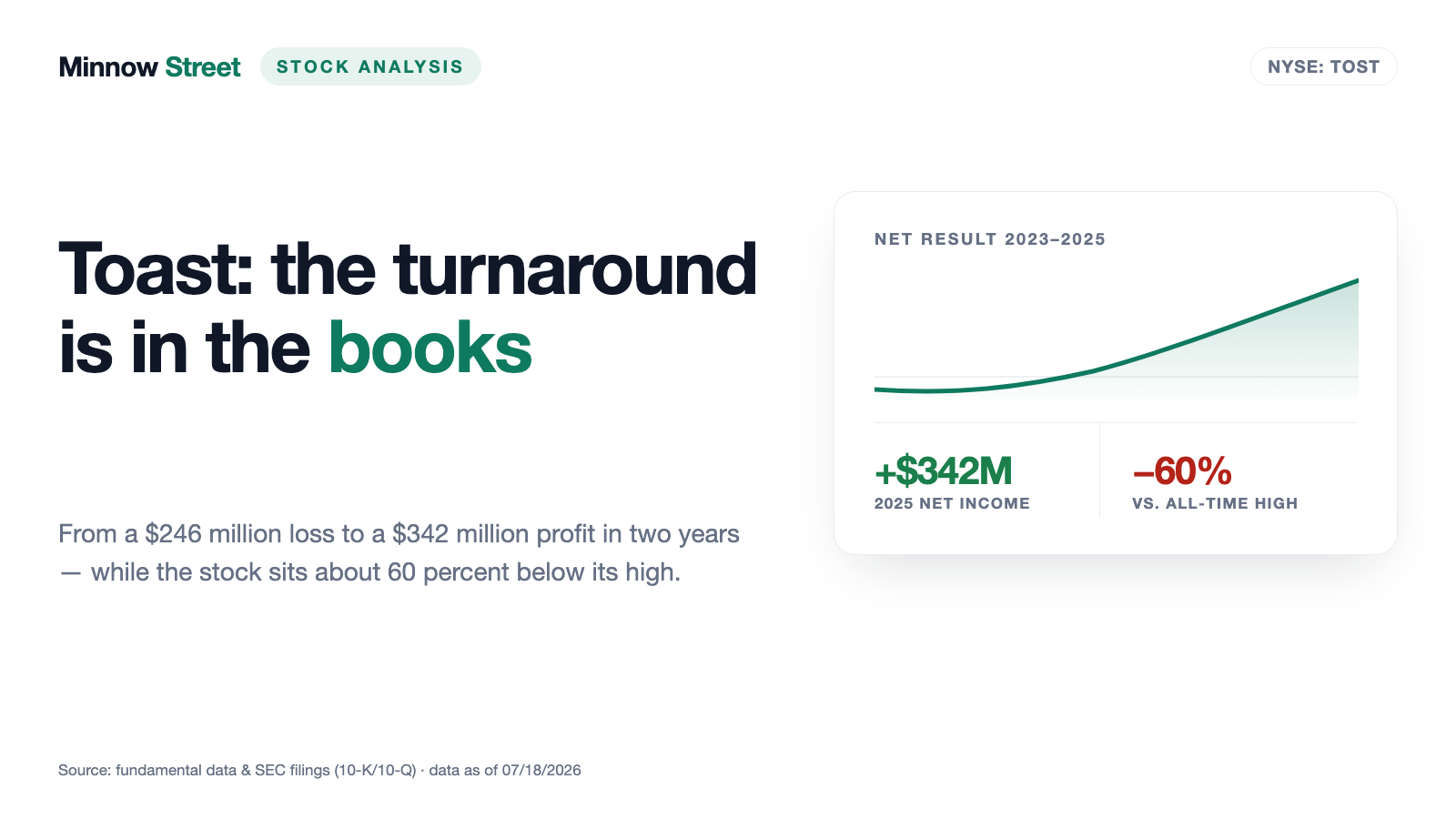
Toast runs the point of sale, software and payment rails of roughly 171,000 restaurants — and has just delivered a textbook operational turnaround: a $246 million loss (2023) became a $342 million profit (2025), and the first quarter of 2026 added another 125 percent. Yet the stock sits about 60 percent below its high, and in our in-house turnaround scanner exactly one box on the checklist stays unticked: insiders are not buying — they are selling. We read the annual report (10-K) for 2025 and the quarterly report (10-Q) as of March 31, 2026: the thin spread behind the six-billion-dollar revenue line, hardware sold at a planned loss, and a share class that bundles 55 percent of the votes. Not investment advice — just the question why the people who know Toast best keep landing on the sell side.
 Thomas Mücke
Founder & Publisher
Thomas Mücke
Founder & Publisher
Chart
Interactive price chart (TradingView).
Note: pure fact-based analysis, not investment advice and not a solicitation to buy or sell. All figures without guarantee.
There is a number your brain processes faster than any business model: minus 60 percent. Psychologists call the mechanism behind it anchoring — your mind stores the old high as the "true value," and everything below it automatically feels like a bargain. At Toast, Inc. (NYSE: TOST), that anchor is fully deployed: the restaurant platform\'s stock trades about 60 percent below its all-time high from 2021, the year it went public, and about 40 percent below its level of twelve months ago (data as of July 18, 2026) — while the company is earning real money for the first time. Sounds like the classic opportunity the market has overlooked. So let\'s make a deal: before the anchor decides for you, we read together what Toast itself filed, under penalty of law, with the U.S. securities regulator, the SEC — the annual report (10-K) for 2025 and the quarterly report (10-Q) as of March 31, 2026. What\'s in there is a turnaround about as clean as they come. And one detail that does not fit the bargain picture: the only people not buying right now are the company\'s own insiders. In the end, you decide which side weighs more.
What Toast actually does — the operating system for 171,000 restaurants
Toast, listed on the NYSE since its 2021 IPO and headquartered in Boston with about 6,500 employees (December 31, 2025), builds the complete technical fit-out of a restaurant: the register at the counter, ordering terminals and kitchen displays, plus software subscriptions for reservations, scheduling, payroll and marketing — and, as the true core of the business, payment processing: every card payment in the restaurant runs across the Toast platform, and Toast keeps a small cut. On top sits Toast Capital, which arranges loans for restaurants through a partner bank, repaid through a portion of daily card sales. In everyday terms: Toast is not the shop that sells a restaurant a register — Toast is the landlord of the entire shopping street who earns on every order. As of March 31, 2026, roughly 171,000 restaurant locations used the platform, 22 percent more than a year earlier; so far Toast earns meaningful revenue essentially only in the United States, with development sites in Ireland and India.
Since 2025, an AI assistant has been part of the toolkit. The annual report describes it like this:
"Toast IQ is a conversational artificial intelligence, or AI, assistant built into our platform that uses real-time and historical data from our customers’ operations to help surface actionable business insights and enable operators to ask questions in natural language and take actions directly within the Toast system."
— Toast, Inc., SEC annual report 10-K for 2025, Item 1 "Business" (Toast IQ product description)
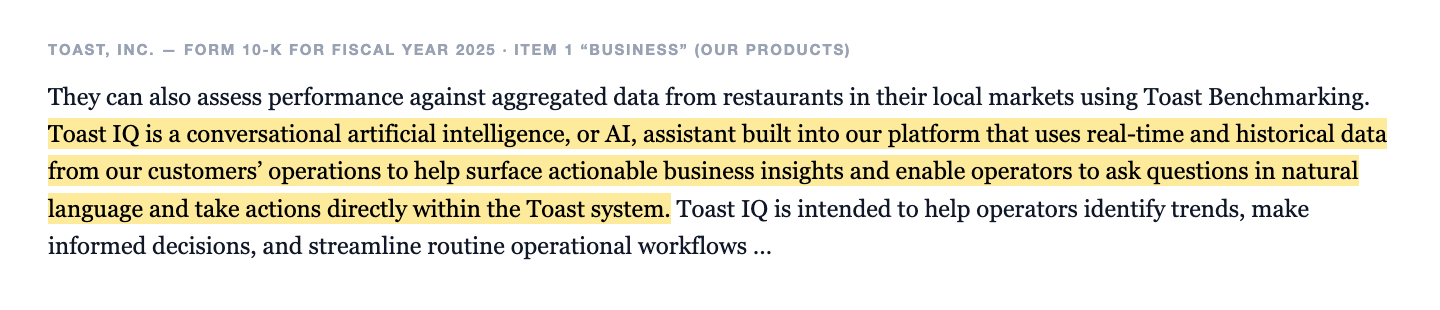
Sounds like the standard AI garnish every company pins on itself these days? Partly, yes — Toast sells registers, subscriptions and payment processing, not AI. But the data trove behind it is real: whoever runs the registers of 171,000 restaurants sees every order, every rush hour, every staffing plan — and can build tools from it that no single restaurateur ever could. Which brings us to the central tension of this analysis, running through every chapter: Toast\'s operational turnaround is documented in the SEC filings about as cleanly as an investor could wish — but the stock sits 60 percent below its high, and the people with the best view inside the company are selling.
Where the stock shows up in our scanner
We run roughly 3,500 stocks through our scanners every day. As of July 18, 2026, Toast has exactly one hit: rank 5 in the U.S. selection of the turnaround scanner, with 7 of 8 points on the turnaround checklist. To replicate it yourself: open the scanner, set the country filter to "US" — the list sorts by checklist points, and Toast sits in the top group. The scanner first demands two mandatory conditions (a real crash: at least 50 percent below the all-time high — Toast: about 60 percent; and survival secured: an Altman Z-Score near 8, where the danger zone starts below 1.1) and then checks eight turnaround criteria. Toast passes seven: revenue is growing (up 22 percent in the latest quarter), the net margin is rising (7.7 percent after 5.2 percent three quarters earlier), operating cash flow is positive ($132 million in the first quarter of 2026), the balance sheet is getting stronger rather than weaker, the price has reclaimed its 50-day line, three-month relative strength has moved above twelve-month, and the fund professionals are adding on balance (14 institutional buyers versus 4 reducers). The eighth point is missing: insiders buying on balance — over twelve months there are 20 insider sales against zero purchases, the CEO among the sellers (source: fundamental data, as of July 18, 2026). Meanwhile the fundamental lens sparkles: the Piotroski F-Score, a nine-point test of the direction of the books, stands at 9 out of 9 for the first quarter of 2026 — the test does not go higher. Remember the principle: a scanner measures the turnaround in the numbers — whether the people who live in those numbers every day trust it, it measures in exactly one point. And that is the one that\'s missing.
The numbers over the years — honestly appraised
First, what genuinely impresses — and here that is a lot. Revenue climbed from $3,865 million (2023) via $4,960 million (2024) to $6,153 million in 2025 — up 24 percent in the latest step, in just the fourth year after the IPO. What happened on the bottom line matters more: a net loss of $246 million (2023) became a paper-thin $19 million profit in 2024 — and a net profit of $342 million, or $0.59 per share, in 2025. The first quarter of 2026 kept going: revenue of $1,630 million (up 22 percent), net income of $126 million (up 125 percent year over year), an operating margin of 6.7 percent after 3.2 percent. The quality of the profit holds up too: 2025 brought $661 million in operating cash flow, $608 million of it free after capital expenditures — and cash plus securities grew to $1,991 million, with essentially no debt.
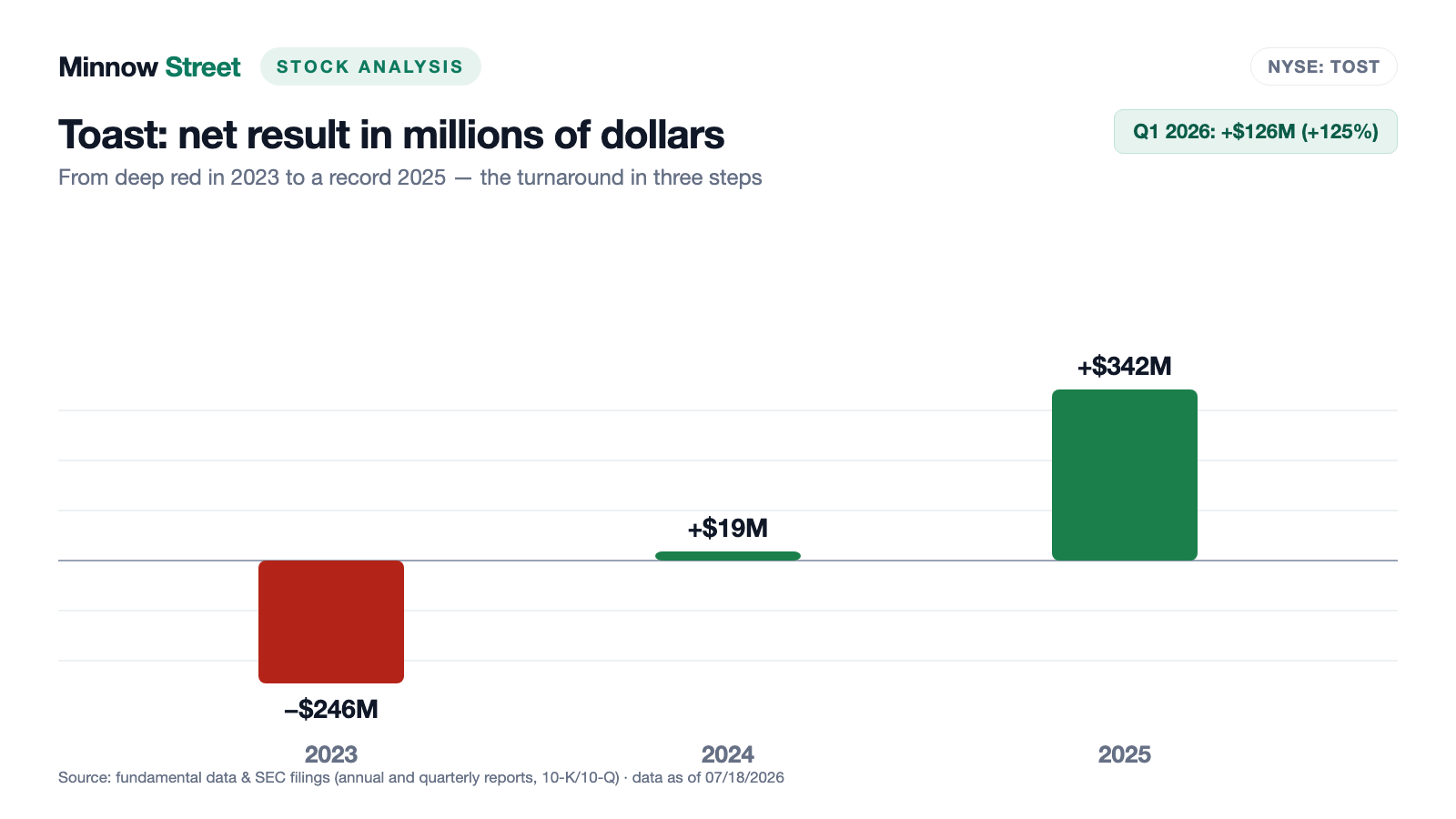
Behind the group numbers sits an engine room still set to growth. The quarterly report sums it up in one sentence:
"As of March 31, 2026, Toast served approximately 171,000 Locations, up 22% compared to one year ago, and processed $204 billion in gross payment volume over the trailing 12 months."
— Toast, Inc., SEC quarterly report 10-Q as of March 31, 2026, Item 2 "Management's Discussion and Analysis"

Add the metric Toast itself uses as the yardstick of its subscription and payments base: Annualized Recurring Run-Rate (ARR) — simplified, twelve times what the latest month brought in from subscriptions and processing fees. It stood at $2,151 million as of March 31, 2026, up 26 percent. And now the other side of the same story — the stock:
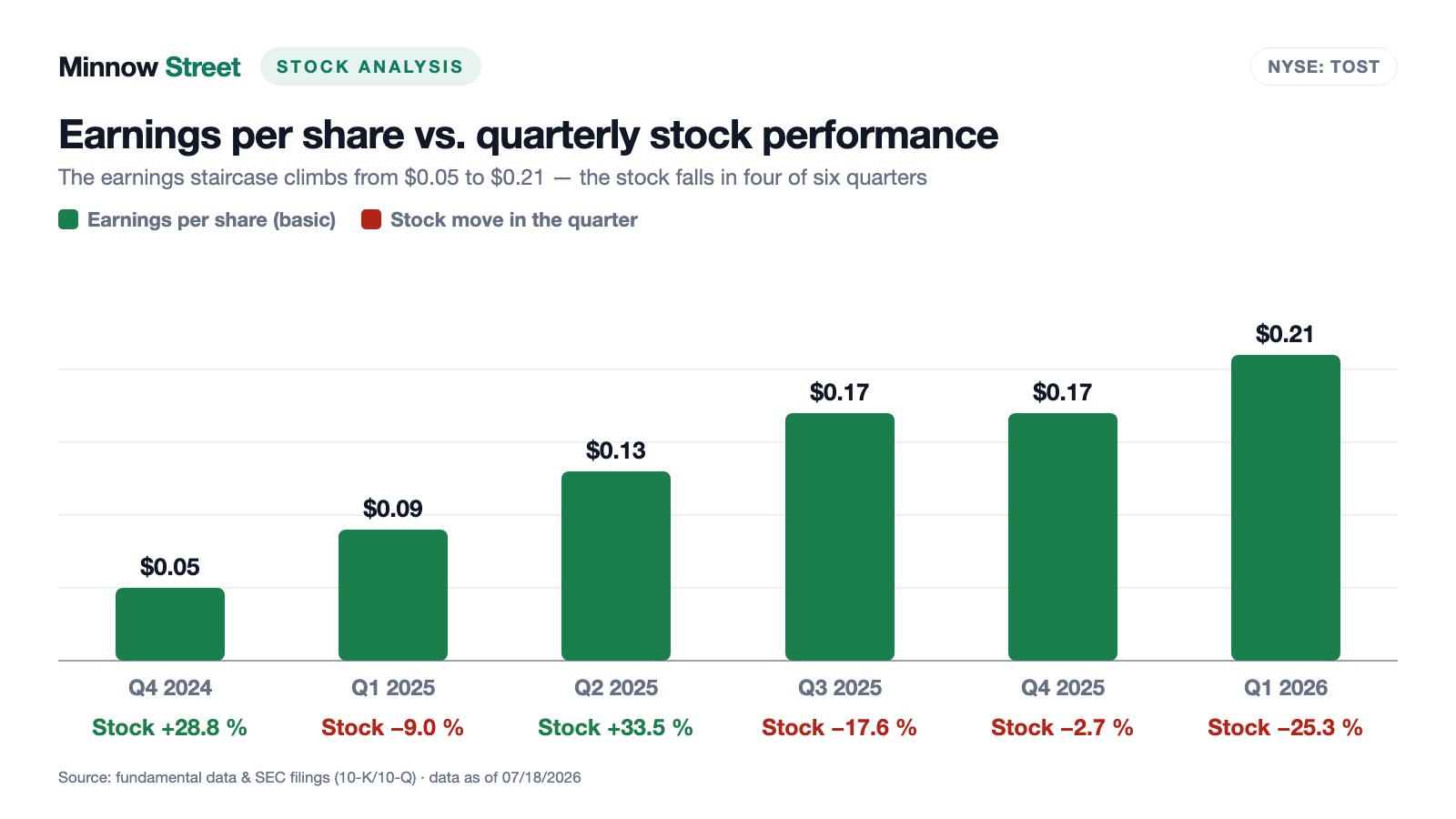
Earnings per share more than quadrupled within six quarters — $0.05, $0.09, $0.13, $0.17, $0.17, $0.21. The stock answered with four losing quarters over the same stretch, including minus 25.3 percent in the first quarter of 2026 alone. One quarter does not make a summer, and a falling price by itself is not a verdict against the market — sometimes it knows something. What it might know is the subject of the next chapter.
What the filings say — the uncomfortable truths
Uncomfortable truth no. 1: the six-billion-dollar revenue line is smaller than it looks
If you read "$6.2 billion in revenue, up 24 percent," you picture a software company of that size. The income statement shows something else: $5,037 million of the $6,153 million — a good 80 percent — comes from "Financial technology solutions," which is essentially fees on the payment volume passing through. Of those $5,037 million, $3,891 million went right back out as direct costs, mostly to card networks and processors; $1,146 million remained. Measured against roughly $195 billion of payment volume (2025), Toast keeps a bit more than half a cent gross of every dollar it processes. The software subscriptions carry fatter margins ($936 million in revenue, $672 million in gross profit) — but they are the smaller piece. And the hardware line deliberately sells below cost: $180 million of revenue stood against $400 million of direct costs in 2025 — the terminals are the bait that ties locations to the subscription and the payment stream. The bottom line was a group gross profit of $1,593 million, about 26 percent of revenue — respectable for a payments processor, but nothing like a software margin. How thin such fintech spreads are, and how much they hang on volume, is something we dissected at length in our Affirm analysis. Remember the image: Toast reports the revenue of a bank branch — and earns the margin of a corner kiosk on it. The business works, but it lives on volume.
Uncomfortable truth no. 2: 11 percent of the shares hold 55 percent of the votes
If you buy the Toast stock, you buy Class A shares with one vote each. The power sits elsewhere, and the annual report says so without hedging:
"Our Class B common stock has ten votes per share, and our Class A common stock has one vote per share. As of December 31, 2025, we had 66 million shares of Class B common stock outstanding, representing approximately 55% of the voting power of our outstanding capital stock; our 5% stockholders, directors, executive officers, and their affiliates beneficially owned in the aggregate approximately 55% of the voting power of our outstanding capital stock."
— Toast, Inc., SEC annual report 10-K for 2025, Item 1A "Risk Factors"
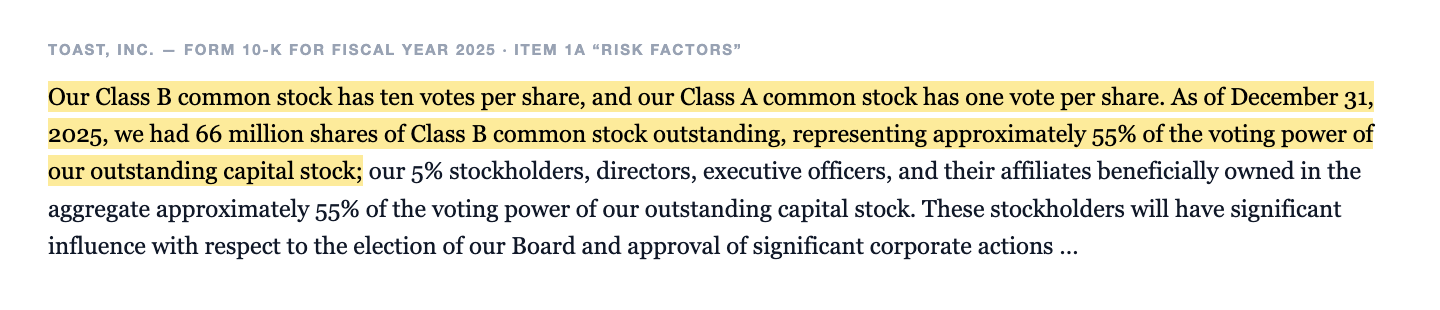
For scale: the 66 million Class B shares are only a good tenth of all shares — but they vote with tenfold weight. In everyday terms: in this homeowners\' meeting, some neighbors have ten doorbells on a single apartment. The construction is common in tech IPOs and perfectly legal, but the consequence is hard: in board elections, takeover questions and every matter of principle, founders, executives and early investors decide — per the filing, explicitly even after they no longer work for Toast. As a Class A holder you ride along economically; the steering happens up front.
Uncomfortable truth no. 3: the company buys its shares — the insiders sell theirs
Now to the missing eighth point of the turnaround checklist. On one side, Toast evidently considers its own stock worth buying: in February 2024, the board authorized a $250 million repurchase program and on February 10, 2026, topped it up by $500 million. The quarterly report documents the pace:
"During the three months ended March 31, 2026, the Company repurchased $327 million of Class A common stock. As of March 31, 2026, approximately $259 million remained authorized for repurchase under the share repurchase program."
— Toast, Inc., SEC quarterly report 10-Q as of March 31, 2026, Note 7 "Stockholders' Equity" (Share Repurchase Program)

By May 6, 2026, the same report adds, another $51 million had followed. On the other side stand the people who know Toast from the inside: over twelve months, the fundamental data registers 20 insider sales and not a single purchase, the CEO among the sellers (as of July 18, 2026); the EDGAR docket shows a dense sequence of sale notices (Forms 4 and 144) in June and July 2026 alone. Fairness requires a footnote: a large share of this is scheduled trading plans and the cashing-in of stock compensation — at a company that booked $255 million of stock-based compensation in 2025, that is routine, not scandal. But the difference from a genuine signal of confidence remains: not one insider bought at the supposed bargain price in the past year. The company buys with its shareholders\' money — the insiders sell their own. Exactly this asymmetry is the point the scanner deducts from an otherwise immaculate turnaround.
Valuation: what the market charges for half a turnaround
Now to the price tag. In mid-July 2026, the Toast stock cost about $26 and the market value stood near $15 billion (all valuation figures: data as of July 18, 2026). That works out to: a price-to-earnings ratio near 39 on trailing twelve-month profit, a price-to-sales ratio near 2.3, a price-to-book ratio near 7.6 and roughly 23 times free cash flow. A P/E of 39 sounds rich — but a second look pays here, because profit is growing faster than the price is falling: on the analyst estimates (source: fundamental data) of about $1.35 per share for 2026 and about $1.70 for 2027, the multiple shrinks to roughly 19 and 15. Put differently: the market no longer prices Toast as a growth story but almost as a mature company — even though revenue and location count are compounding at a good 20 percent. That is the flip side of the 60-percent anchor from the opening: measured against its own high, the stock looks cheap; measured against current profit, it only becomes cheap if the estimates actually arrive. In between sit the known risks: a take rate of half a cent per dollar that hangs on the spending mood of American diners, and an industry in which even established restaurant chains fight for their margins.
Opportunities and risks at a glance
What speaks for Toast:
- The turnaround is delivered, not promised: net result of −$246M → +$19M → +$342M (2023–2025), Q1 2026 at +$126 million (up 125 percent); operating cash flow of $661 million and free cash flow of $608 million (2025).
- Growth with visibility: 171,000 locations (up 22 percent), $204 billion in payment volume (TTM as of March 31, 2026), a recurring run-rate of $2,151 million (up 26 percent) — whoever provides the register, the subscription and the payment rail is rarely swapped out overnight.
- A balance sheet without ballast: $1,991 million in cash and securities, essentially no debt, an Altman Z-Score near 8, a Piotroski F-Score of 9 out of 9 (Q1 2026).
- Capital returns instead of a dilution spiral: the repurchase program was raised to $750 million (February 2026), $327 million of it deployed in the first quarter of 2026 alone.
- A data advantage as a moat in the making: register, staffing and payment data from 171,000 locations feed tools like the AI assistant Toast IQ and the Toast Capital lending arm.
What speaks against it:
- The insider signal: 20 sales, 0 purchases within twelve months (source: fundamental data, as of July 18, 2026) — the only missing point on the turnaround checklist, and of all points the one that says most about the view from inside.
- A thin spread with high volume dependence: a good 80 percent of revenue is payment processing keeping just over half a cent gross per dollar; a consumer slump in U.S. dining hits revenue and the Toast Capital loan book at the same time.
- Hardware as a permanent subsidy: a $220 million gross loss in 2025 — intentional, but it pins the group gross margin near 26 percent.
- Two share classes: 66 million Class B shares control about 55 percent of the votes; Class A holders have structurally limited say.
- Stock-based compensation of $255 million (2025) keeps diluting — the buybacks first have to work against the company\'s own issuance of new shares.
- An essentially U.S.-only business: meaningful revenue so far comes only from the United States — the growth story hangs on a single market and its restaurant economy.
A human conclusion
Back to the anchor from the opening. It whispered: 60 percent below the high — that must be cheap. Having read the filings, you can answer it more precisely: the turnaround is real. It sits not in press releases but in audited SEC numbers — from a $246 million loss to a $342 million profit in two years, with growing cash flow, a full treasury and a customer base compounding at a fifth per year. But "cheap" is a statement about the price, not about the stock\'s past: on current profit you pay 39 times, on the hoped-for 2027 earnings 15 times — fair for a company growing at 20 percent, a giveaway it is not. And then there is the one observation the anchor cannot explain: the company is buying back hundreds of millions of dollars of its own shares while twenty insider filings in twelve months point in the same direction — out. That may be harmless routine; it just is not the behavior of people who see a bargain in front of them. If you put the stock on your watchlist, watch three things in the coming quarterly reports (10-Q): location growth (does it stay above 20 percent?), the net margin (does the staircase continue past 7.7 percent?) — and the Forms 4 on EDGAR: the first substantial insider purchase would be the signal this scanner point is waiting for. What you make of it is your decision. And that is exactly as it should be.
Sources
All original documents used in this analysis — for your own reading:
- Toast, Inc. — SEC annual report 10-K for 2025 (filed February 18, 2026)
- Toast, Inc. — SEC annual report 10-K for 2024 (filed February 26, 2025)
- Toast, Inc. — SEC quarterly report 10-Q as of March 31, 2026 (filed May 8, 2026)
- Toast\'s complete SEC filing history (including the insider Forms 4 and 144): EDGAR overview (sec.gov)
- Fundamental data (metrics, quarterly series, valuation, insider and institutional data; data as of July 18, 2026), cross-checked against the SEC filings.
- Screener and rating data: in-house stock scanner (data as of July 18, 2026), including the turnaround scanner (U.S. selection, rank 5, checklist 7 of 8).
Transparency & disclaimer: This analysis is a journalistic contextualization of publicly available information and is not investment advice, not a financial analysis in the regulatory sense, and not a solicitation to buy or sell securities. Stock investments carry substantial risks up to and including total loss. All information without guarantee; the data cut-off is noted in the text. The author holds no position in Toast shares at the time of publication.
Our Bottom Line at a Glance
- Operational turnaround positive
- Net result turned from −$246 million (2023) via +$19 million (2024) to +$342 million (2025); Q1 2026 added +$126 million (up 125 percent) at a 7.7 percent net margin; operating cash flow of $661 million and free cash flow of $608 million (10-K 2025, 10-Q as of 03/31/2026).
- Growth & market position positive
- 171,000 locations (up 22 percent), $204 billion in payment volume (TTM) and a $2,151 million recurring run-rate (up 26 percent) as of March 31, 2026 — the bundle of register, subscription and payment rail carries high switching costs for customers.
- Balance sheet & capital returns positive
- $1,991 million in cash and securities against essentially no debt (12/31/2025), an Altman Z-Score near 8, a Piotroski F-Score of 9 out of 9 (Q1 2026); the buyback program was raised by $500 million in February 2026, with $327 million deployed in the first quarter alone.
- Business model quality neutral
- A good 80 percent of revenue is payment processing keeping just over half a cent gross per processed dollar; hardware is subsidized as customer acquisition at a $220 million gross loss (2025) — group gross margin near 26 percent, volume- and cycle-dependent, essentially a U.S.-only business.
- Insiders & governance negative
- 20 insider sales, 0 purchases within twelve months, the CEO included (fundamental data, as of July 18, 2026) — the missing eighth point of the turnaround checklist; in addition, 66 million Class B shares (10 votes each) bundle about 55 percent of the voting power (10-K 2025).
- Valuation neutral
- P/E near 39 trailing, near 19 on 2026 and near 15 on 2027 estimates, price/FCF near 23, P/S near 2.3 (data as of July 18, 2026) — no bargain, but no growth premium either for a business compounding at a good 20 percent; the stock sits about 60 percent below its all-time high.
Toast is the rare turnaround that is not hoped for but audited: three earnings steps from −$246 million to +$342 million, growing cash flow, a full treasury, 22 percent location growth — and a scanner result of 7 of 8 turnaround points (rank 5 of the U.S. selection, as of July 18, 2026). Against that stand a structurally thin payments spread that hangs on the U.S. restaurant economy, a voting majority held by the Class B insiders — and the observation that precisely these insiders have done nothing but sell for twelve months while the company buys back. Whoever invests buys a real turnaround at the price of the doubt the best-informed are sowing themselves. Not investment advice.
What Our Rating Means
- If you don't own the stock
- As long as the question raised in the bottom line stays open, we see no basis for an entry.
- If you hold it in your portfolio
- Our findings offer no acute reason to sell — the checkpoints named remain decisive.
A journalistic assessment by our editorial team at the time of the deep dive, based on public sources — not investment advice and not a solicitation to buy or sell. Your personal circumstances (investment goals, risk capacity, taxes) cannot be taken into account. What our categories mean, how verdicts are formed, and what conflicts of interest exist →
Worth Noting
- TOST entered the research list as rank 5 of our in-house turnaround scanner (U.S. selection, checklist 7 of 8, as of July 18, 2026) — part of our series on the top 20 of that selection.
- Scanner metrics (P/E, P/S, P/B, Piotroski, Altman Z, relative strength, insider and institutional data) use trailing twelve-month figures as of July 18, 2026; the 2026/2027 earnings estimates come from the analyst consensus in the fundamental data (29 estimators).
- Price and market value figures (about $26, about $15 billion) are from the July 18, 2026 feed, sanity-checked against 524 million Class A plus 65 million Class B shares per the annual report 10-K for 2025 (record date February 12, 2026); analyses are evergreen, daily prices are not a buy argument.
Frequently Asked Questions
Toast, Inc. (NYSE: TOST, Boston, about 6,500 employees) equips restaurants with a point-of-sale system, software subscriptions, payment processing and loans (Toast Capital). In 2025 the company generated $6,153 million in revenue (up 24 percent) — $5,037 million from payment processing ("Financial technology solutions"), $936 million from software subscriptions and $180 million from hardware and services, which are deliberately handed over below cost.
Yes — per the SEC filings the turn is done: a net loss of $246 million (2023) was followed by a $19 million profit (2024) and a $342 million profit (2025, $0.59 per share); the first quarter of 2026 added $126 million (up 125 percent). Operating cash flow reached $661 million in 2025, free cash flow $608 million.
As of July 18, 2026, Toast passes both mandatory conditions of our in-house turnaround scanner (a price at least 50 percent below the all-time high — about 60 percent for Toast — and survival secured, with an Altman Z-Score near 8) and 7 of 8 turnaround criteria: growing revenue, a rising margin, positive cash flow, a healing balance sheet, a price above its 50-day line, turning relative strength and institutions adding on balance. That makes rank 5 of the U.S. selection.
The insider point: the checklist requires insiders to be net buyers of their own stock over twelve months. At Toast, 20 insider sales stand against zero purchases, the CEO among the sellers (source: fundamental data, as of July 18, 2026). Much of it is scheduled selling of stock compensation — but a buy signal from the people with the best view inside is still absent.
The listed share is the Class A stock with one vote each. Alongside it, per the annual report (10-K), 66 million Class B shares with ten votes each were outstanding as of December 31, 2025 — a good tenth of all shares, but about 55 percent of the voting power. Founders, executives and large holders thereby control board elections and matters of principle, even after leaving the company.
Measured against the crash it looks cheap, measured against profit only conditionally: as of July 18, 2026, the stock costs about $26 — roughly 39 times trailing earnings, 2.3 times revenue and about 23 times free cash flow. On the earnings estimates (source: fundamental data) of about $1.35 per share for 2026 and $1.70 for 2027, the price-to-earnings ratio drops to roughly 19 and 15, respectively.
Per the annual report (10-K) for 2025, Toast IQ is a conversational AI assistant built into the Toast platform: it uses real-time and historical operating data of the restaurants, surfaces business insights, and lets operators ask questions in natural language and trigger actions directly in the system. Toast does not sell AI separately — the assistant is part of the subscription offering, fed by data from roughly 171,000 locations.
Found an error?
Did you spot a factual error, an outdated number, or a typo in this deep dive? Let us know briefly — your report goes straight to the editorial team.