Titan Machinery Stock: $137 Million of Cash Flow — From the Lot, Not From Trading
Titan Machinery sells tractors and excavators, and in fiscal 2026 the till looked excellent: $137.5 million of operating cash flow, the best figure in company history. The same year brought a $54.2 million net loss and a 10.2 percent drop in revenue. We read the annual and quarterly reports and stripped the inventory cycle out of the cash flow statement. Read a dealer's cash flow without reading its lot and you will mistake shrinking for strength.
 Thomas Mücke
Founder & Publisher
Thomas Mücke
Founder & Publisher
Chart
Interactive price chart (TradingView).
Note: pure fact-based analysis, not investment advice and not a solicitation to buy or sell. All figures without guarantee.
There is one number that works on investors like a warm bath: free cash flow. Earnings can be dressed up, the saying goes, but cash does not lie. That sentence is exactly the trap this analysis is about. Cash really does not lie — it simply never says on its own where it came from.
Titan Machinery reported $137.5 million of operating cash flow in fiscal 2026, the highest figure in company history. In the very same year it posted a $54.2 million net loss, and revenue fell 10.2 percent. The deal for the next few minutes: we read the cash flow statement line by line together and work out which of those two numbers describes the business.
What this covers
- What Titan Machinery actually does
- How the stock reached our desk
- The numbers over the years — fairly appraised
- Uncomfortable truth no. 1: the cash flow is an inventory level
- Uncomfortable truth no. 2: half the lot belongs to the lender
- Uncomfortable truth no. 3: the goodwill rests on 8.5 percent growth
- Valuation — what the market pays
- Opportunities and risks at a glance
- A human verdict
- Sources
What Titan Machinery actually does
Picture a car dealership — except the vehicles are combine harvesters and cost $800,000 apiece. That is Titan Machinery: a network of 144 stores as of January 31, 2026, of which 90 sit in the United States, 39 in Europe and 15 in Australia. It sells, services and rents agricultural machinery and construction equipment, overwhelmingly the Case IH, New Holland and Case Construction brands of manufacturer CNH Industrial.
The company is based in West Fargo, North Dakota, was founded in 1980 and has been a CNH dealer ever since. According to CNH, Titan is the largest retail dealer of Case IH agriculture equipment in the world. As of January 31, 2026 it employed 3,114 people full time plus 245 part time.
Revenue splits into four very different buckets, and that difference carries the entire analysis. In fiscal 2026, 73.1 percent came from equipment sales, 17.6 percent from parts, 7.3 percent from service work and 2.0 percent from rental. Add the gross margins and the picture inverts: equipment carried a gross margin of just 7.3 percent in fiscal 2026, parts 30.9 percent and service 61.5 percent.
A word on the calendar, because it otherwise ruins every comparison: Titan\'s fiscal year ends on January 31. Fiscal 2026 therefore ran from February 1, 2025 through January 31, 2026 and covers essentially calendar 2025. The first quarter of fiscal 2027 ended April 30, 2026.
That names the central tension of this analysis, and it runs through every chapter: Titan earns its money on parts and service — but its balance sheet, its cash flow and its stock market story all hang on machines parked on a lot.
How the stock reached our desk
We run roughly 3,500 stocks through our scanners every day. Titan Machinery surfaced in the P/FCF ranking, which lists every stock with positive free cash flow and a ratio of no more than 10, sorted ascending — cheapest first.
And here the honest disclosure belongs right away: on July 27, 2026 Titan sat at rank 50 of 545 hits in the U.S. selection of that list, with a displayed ratio of 2.31. The page shows only the 25 strongest rows — so Titan does not appear in the visible list at all. To reproduce it: open the scanner, set the country filter to "US", sort the P/FCF column ascending and use the search to jump to the name. The last visible row carried a ratio of 1.4 that day. Remember the principle: a rank is a photograph, not a state — the lists are recalculated daily.
Two further valuation scanners flagged the same name: the P/S ranking and the P/CF ranking. Three valuation filters, one shared cause — all three divide market value by a figure that, at an equipment dealer, depends on the inventory level.
The quality side of the same data set judges far more coolly: a fundamental grade of D, a Piotroski F-score of 2 out of 9 (a nine-point test of the direction of the books — a genuinely healthy company scores 8 or 9; a 2 means almost everything is deteriorating) and an Altman Z reading of 5.6. That last number has to be read on the right scale: we carry the book-value variant Altman Z″, on which the distress zone starts below 1.1 and a balance sheet counts as safe from 2.6 up. Titan sits comfortably above — although the formula rewards current assets, and an equipment dealer has those in abundance by construction. (All scanner values: data as of July 27, 2026.)
The numbers over the years — fairly appraised
First what genuinely impresses. In fiscal 2024 Titan booked $2,758.4 million of revenue and earned $112.4 million net — $4.93 per share. That was no fluke but the tail end of an agricultural boom: high grain prices, full farm balance sheets, long lead times on new machines.
Then the cycle turned. Revenue fell to $2,702.1 million in fiscal 2025 and to $2,427.1 million in fiscal 2026 — down 10.2 percent. Net income flipped to minus $36.9 million and then to minus $54.2 million (−$2.38 per share). Gross margin slid from 19.3 percent in fiscal 2024 to 15.8 percent, because machines only left the lot at a discount.
The segments show where it hurts. Agriculture lost 17.5 percent of revenue in fiscal 2026 and posted a $28.9 million pre-tax loss. Construction lost 6.2 percent and $8.1 million. Australia lost 18.4 percent and $3.9 million. Only Europe grew — and grew hard: up 44.7 percent to $377.7 million of revenue with $15.2 million of pre-tax income after a loss the year before. The filing names the reason: a strong response to European Union stimulus programs in Romania. So the only segment making money hangs on a subsidy program — and the same segment operates stores in Ukraine.
And now the part that really matters here: the cash flow.
Uncomfortable truth no. 1: the cash flow is an inventory level
In fiscal 2024, the record year with $112.4 million of profit, operating cash flow was negative: minus $32.3 million. In fiscal 2026, the loss year at minus $54.2 million, it was the most positive ever: plus $137.5 million. Earnings and cash flow therefore point in opposite directions. That is not an accounting trick; it is the mechanics of the business.
An equipment dealer buys expensively before it sells. When the business grows, money moves into the lot and cash flow falls. When the business shrinks, the lot turns into cash and cash flow rises. Inventories rose by $476.4 million in fiscal 2024; they fell by $235.7 million in fiscal 2026. The company says so itself:
"The change in cash from operating activities was primarily attributable to inventory reductions, timing of payment in our accounts payable and accrued liabilities, which was partially offset by the changing mix in floorplan financing compared to the prior year period."
— Titan Machinery, Form 10-K for fiscal 2026, Item 7, filed with the U.S. securities regulator, the SEC, on March 31, 2026

Let us do the arithmetic. The cash flow statement carries two lines that represent the inventory cycle: the change in inventories and the change in manufacturer floorplan payable (Titan books the manufacturer-financed part of the lot inside operating activities). Remove both and what remains is the part that came out of trading:
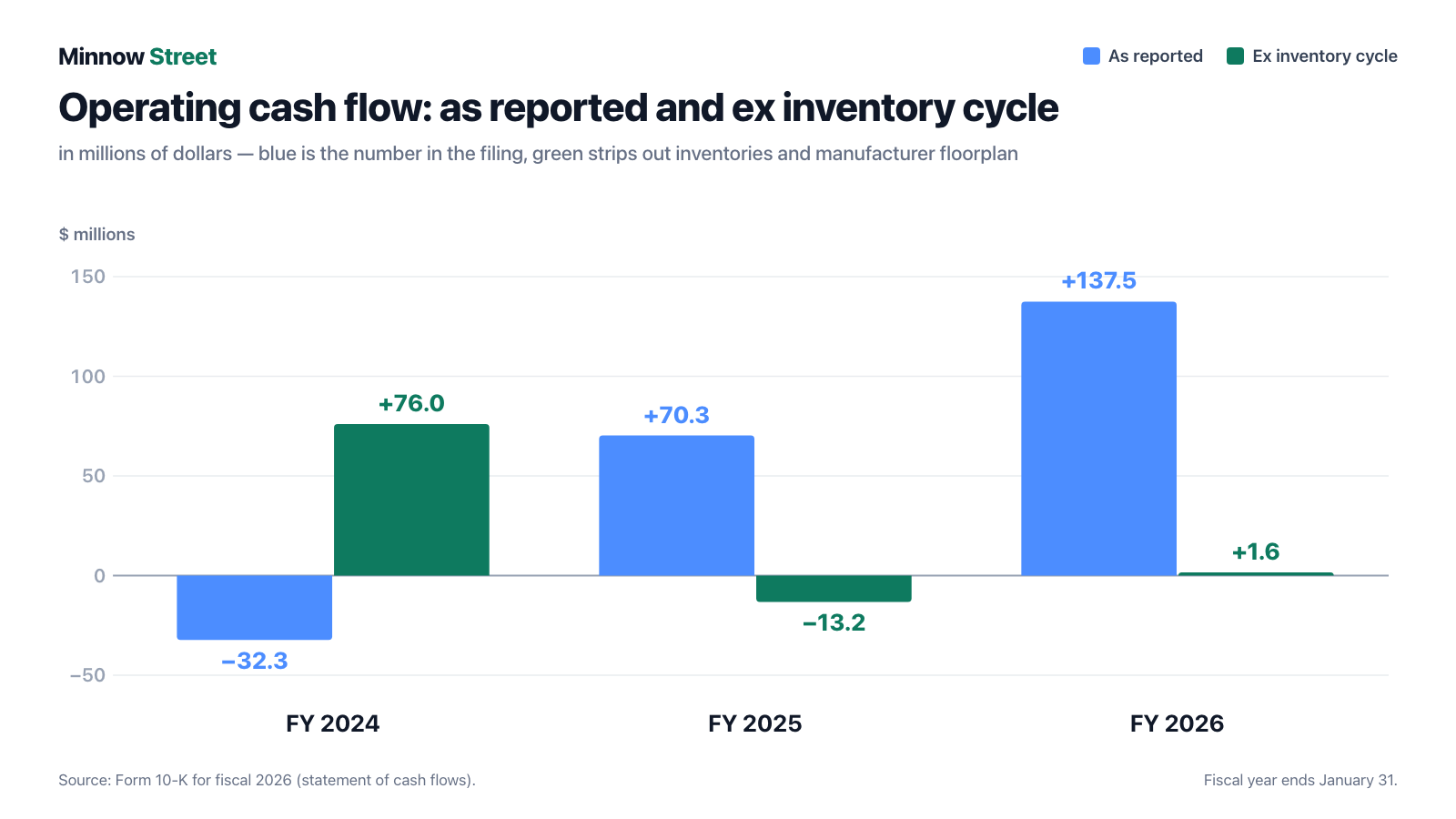
$137.5 million becomes $1.6 million. Minus $32.3 million becomes plus $76.0 million. Translated: in the record year 2024 Titan earned real cash from trading and put it into the lot. In the loss year 2026 it earned almost nothing from trading and pulled the cash back out of the lot.
The cross-check arrives with the first quarter of fiscal 2027. There the lot grew again — by $11.7 million to $914.8 million — and reported operating cash flow promptly flipped to minus $23.1 million. On the same adjusted basis it was minus $12.5 million, against minus $29.0 million in the prior-year quarter. So the adjusted figure improved while the reported one collapsed. That is precisely why the calculation is worth doing.
One more number makes it tangible: despite $137.5 million of "cash flow", the cash balance fell in fiscal 2026, from $35.9 million to $28.2 million. The money did not stay. Almost all of it went into repaying floorplan financing.
Uncomfortable truth no. 2: half the lot belongs to the lender
Whenever you read "inventories" at an equipment dealer, you have to read the other side of the balance sheet too. The term is floorplan financing, and the everyday picture is simple: the dealer pays for the combine only once it is sold. Until then it economically belongs to the lender financing the lot — usually the manufacturer\'s own finance arm.
At Titan those lines totaled $1.5 billion as of April 30, 2026: $875.0 million with CNH Industrial, a $390.0 million floorplan line plus a $110.0 million working capital line with a bank syndicate, and $67.5 million with DLL Finance. Drawn against them was $589.0 million.
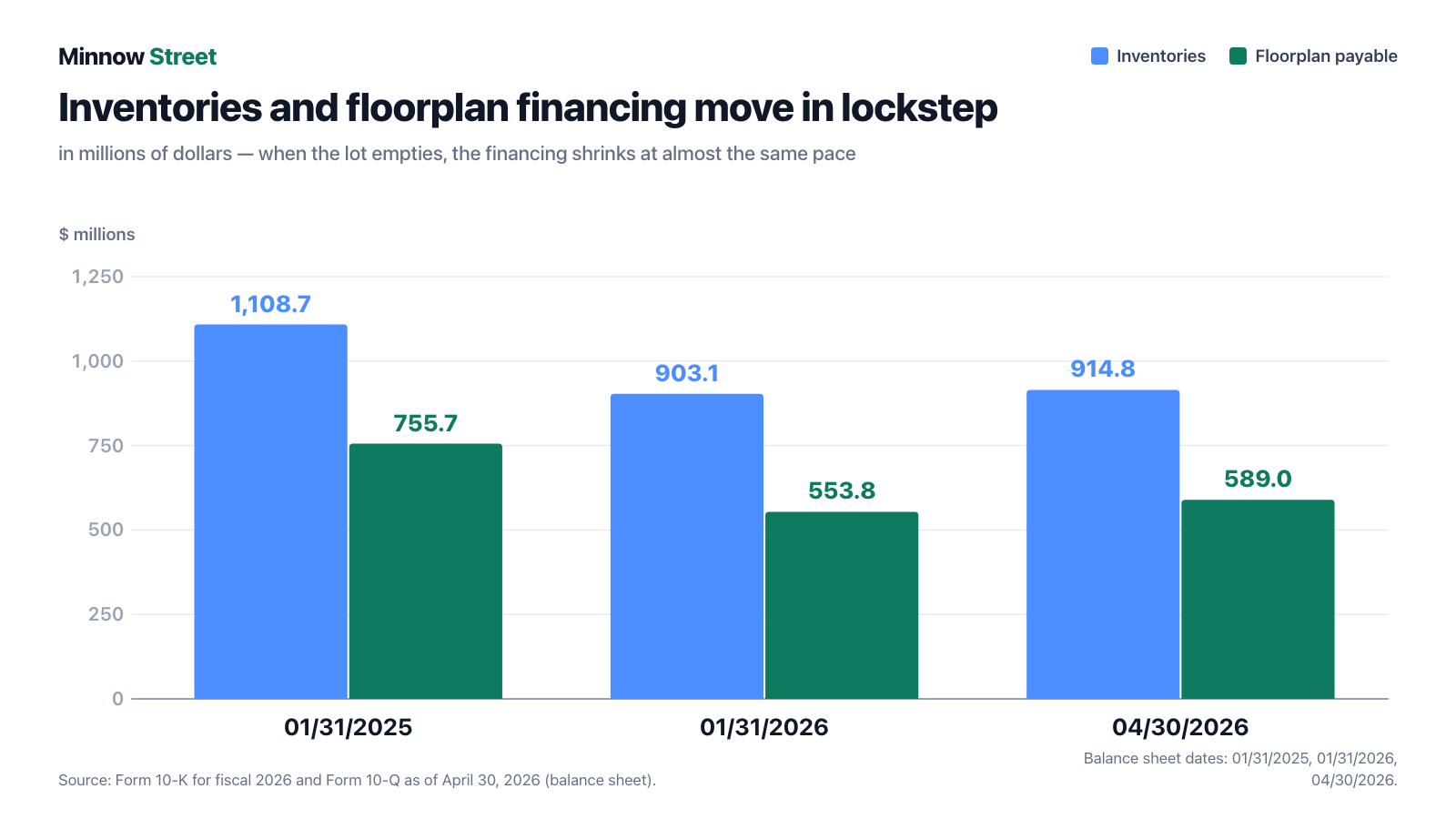
The two series move almost on top of each other, and that is the point: an inventory drawdown is not a windfall, it is a pass-through. What the sale brings in goes back to the lender that financed it. The cash flow statement simply shows it in two different places — the manufacturer arm inside operating activities, every other line inside financing activities. In fiscal 2026, $126.8 million flowed out there.
One detail deserves particular attention because it touches earnings directly: of the $589.0 million of floorplan financing outstanding on April 30, 2026, $332.4 million carried no interest at all — up from $266.8 million at the end of January 2026. The interest-bearing remainder cost between 3.52 and 8.50 percent.
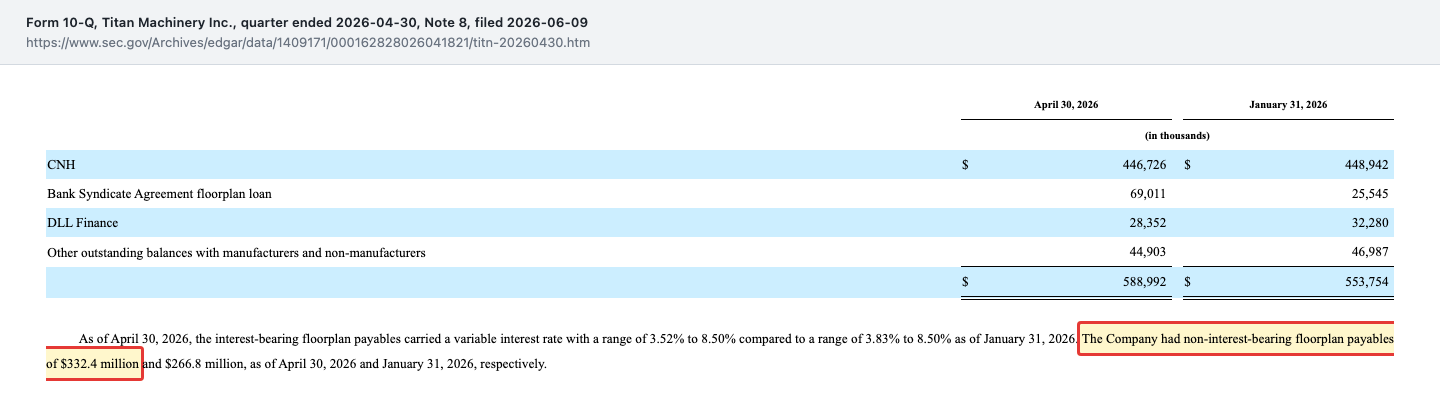
That is a real advantage — and a real dependency. The interest-free portion equals roughly 59 percent of equity as of April 30, 2026. It is not a contractual given but a sales instrument of the manufacturer. The good news is that floorplan interest expense fell to $3.6 million in the first quarter of fiscal 2027 from $6.5 million a year earlier. The other side sits in the dealer agreement.
"Under our CNH Dealer Agreements, we are obligated to actively promote the sale of CNH equipment within our designated geographic areas of responsibility, fulfill the product warranty obligations of CNH …, maintain adequate facilities and workforce to service the needs of our customers, stock equipment and parts inventories at the level deemed necessary by CNH to meet sales goals as stated in the annual business plan mutually agreed upon by us and CNH, maintain adequate working capital, and maintain stores only in authorized locations."
— Titan Machinery, Form 10-K for fiscal 2026, Item 1A (Risk Factors)
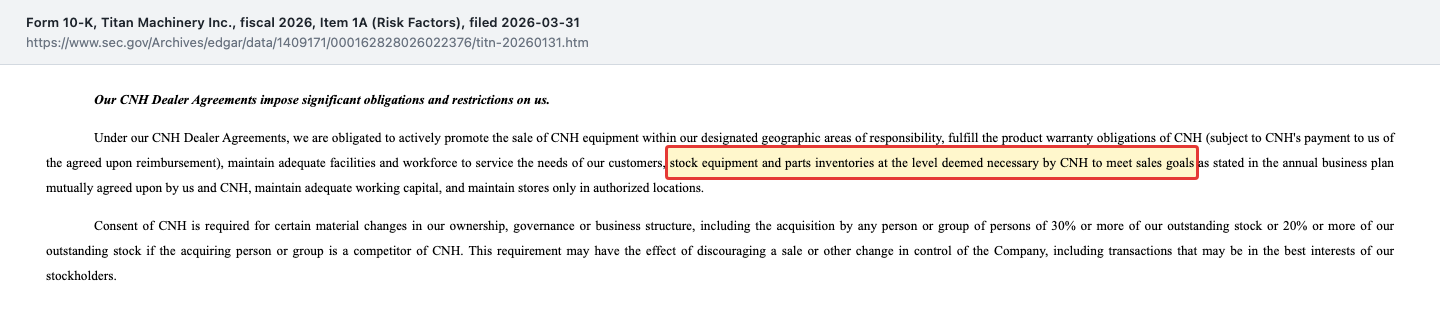
Remember the sentence, it applies to every franchised dealer: if you do not set your own inventory level, you do not set your own cash flow either. How hard such dependencies bite in a cyclical industry is something we described at the manufacturer end of the same chain in our Caterpillar analysis.
Uncomfortable truth no. 3: the goodwill rests on 8.5 percent growth
The balance sheet carries $65.6 million of goodwill as of January 31, 2026 — the premium paid in earlier acquisitions, allocated to the Agriculture and Australia reporting units. Goodwill is not an asset you can sell; it is a promise of future earnings. Once a year the company has to test whether that promise still holds.
The result of that test sits in the annual report — and it is tight.
"the estimated fair value of the Agriculture and Australia reporting units exceeded their carrying amount by approximately 9.2% and 8.6%, respectively."
— Titan Machinery, Form 10-K for fiscal 2026, Item 7 (Critical Accounting Policies)

Less than ten percent of headroom is not an alarm in itself. It becomes interesting once you read what the cushion rests on. The filing states the assumptions openly: five-year average annual revenue growth of 8.5 percent for Agriculture and 13.2 percent for Australia, gross margins between 16.5 and 18.1 percent, discount rates of 11.5 and 14.0 percent.
In that same fiscal year Agriculture revenue fell 17.5 percent and Australia revenue fell 18.4 percent. The gap between assumption and actual is therefore around 26 and 32 percentage points. That does not make the valuation wrong — impairment tests deliberately look across the cycle. It makes it sensitive: if the cycle stays down longer, the cushion is consumed quickly, and the consequence would be a write-down that costs no cash but reduces equity.
Valuation — what the market pays
First a note on honesty in the measurement. Our data set carries a market value of roughly $498 million for Titan. The cover page of the quarterly report, however, states 23,302,180 shares outstanding as of May 31, 2026. At an anchor price of $20.00 (data as of July 24, 2026) that gives roughly $466 million — a good seven percent less. Every metric below rests on that own calculation.
Measured against revenue the stock looks optically cheap: a price-to-sales ratio of about 0.20 means the market pays 20 cents for every dollar of annual revenue. Price-to-book is about 0.82 — book value per share was roughly $24.31 as of April 30, 2026. A price-to-earnings ratio does not exist for lack of earnings.
That leaves the free cash flow that put Titan into the scanner in the first place. On fiscal 2026 ($137.5 million operating less $22.4 million of capital spending = $115.1 million) the ratio works out at about 4.0. On the last four reported quarters through April 30, 2026 ($108.2 million less $16.9 million = $91.3 million) it is about 5.1. The scanner displays a markedly lower 2.31 because it rests on a broader cash flow definition; the filings do not reproduce it. We therefore quote both of our own calculations — and in all three cases the reading is the same: the ratio is worth exactly as much as the repeatability of its numerator.
The most honest arithmetic runs through enterprise value (market value plus debt less cash). Anyone buying Titan outright would take on, alongside the $466 million of equity value, $589.0 million of floorplan financing, $176.6 million of long-term debt and $41.6 million of finance leases, less $29.6 million of cash — roughly $1.24 billion in total, or about two and a half times the equity value. Put differently: economically, the larger part of this company belongs to its lenders. Part of that, however, is interest-free floorplan money rather than bank debt in the usual sense.
Professional coverage is thin for a name this size, and the free float stands at roughly 18.9 million of the 23.3 million shares. For a comparison with another name from the same valuation scanner, see our FIS analysis — there a completely different balance sheet carries the same low ratio.
Opportunities and risks at a glance
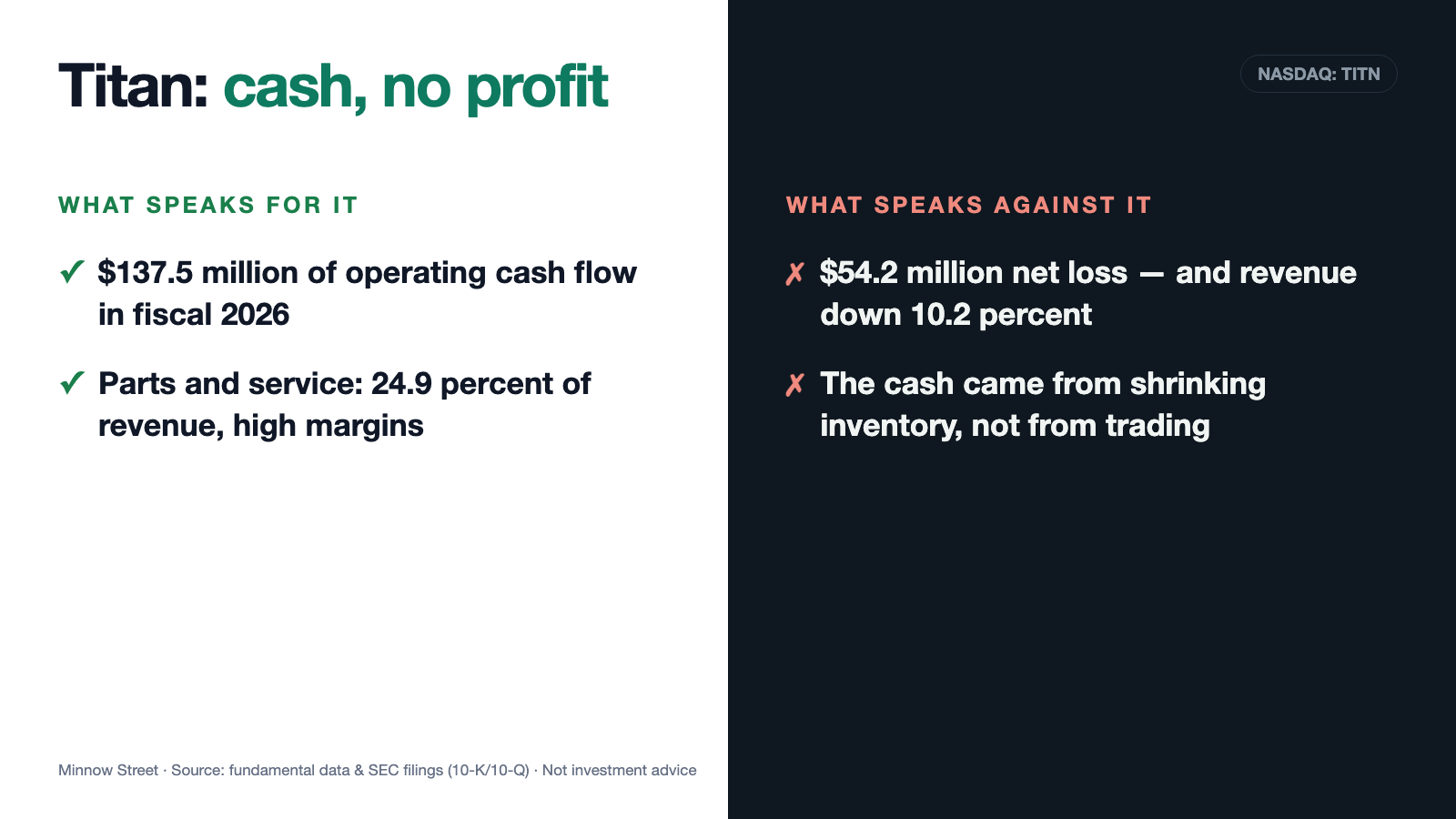
What speaks for Titan Machinery:
- The cycle-resistant part keeps gaining share. Parts and service reached 24.9 percent of revenue in fiscal 2026, up from 20.6 percent in fiscal 2024, at gross margins of 30.9 and 61.5 percent. Group gross margin rose to 17.1 percent in the first quarter of fiscal 2027 from 15.3 percent a year earlier.
- The balance sheet can absorb the cycle. A 35.1 percent equity ratio as of April 30, 2026, an Altman Z″ of 5.6 (safe zone from 2.6 up) and a $110.0 million working capital line entirely undrawn as of January 31, 2026. The annual report considers liquidity adequate beyond the next twelve months.
- Europe delivers. Revenue up 44.7 percent and $15.2 million of pre-tax income in fiscal 2026 — the only segment in the black, carried by European Union stimulus programs in Romania.
- Capital spending has been throttled. $22.4 million in fiscal 2026 after $51.8 million the year before; for fiscal 2027 the company plans roughly $15.0 million. That protects the till while the cycle is down.
- The adjusted cash flow points up. In the first quarter of fiscal 2027 it stood at minus $12.5 million against minus $29.0 million in the prior-year quarter — the direction is right, even though the reported figure suggests the opposite.
What speaks against Titan Machinery:
- Two consecutive loss years with a widening deficit. Minus $36.9 million in fiscal 2025, minus $54.2 million in fiscal 2026, plus another minus $12.6 million in the first quarter of fiscal 2027 on a further 12.1 percent revenue decline.
- The cash flow is not repeatable. Adjusted for the inventory cycle, only $1.6 million is left of fiscal 2026. A lot can only be emptied once.
- Interest eats the operating result. In fiscal 2026 a $6.7 million operating loss faced $43.1 million of combined interest expense ($24.1 million floorplan, $19.0 million other).
- One supplier sets the terms. CNH supplies the brands, approves acquisitions, can terminate the dealer agreement, dictates the inventory level and, at $875.0 million, provides the largest financing line.
- The goodwill cushion is thin. Headroom of 9.2 and 8.6 percent, resting on assumed revenue growth of 8.5 and 13.2 percent — against actual declines of 17.5 and 18.4 percent in the same year.
- Geopolitics inside the only profitable segment. The Europe segment includes stores in Ukraine; its growth driver is a Romanian EU stimulus program whose duration the company does not control. German operations were wound down during fiscal 2026.
A human verdict
Remember the warm bath from the opening? The line that cash does not lie? It still holds. It is just that an equipment dealer\'s cash flow does not describe its earning power — it describes the direction of its lot. At Titan Machinery the lot pointed down through fiscal 2026, and that is precisely why the till looked so good.
What remains is a solid, unglamorous dealership business with a balance sheet that can take the cycle, a parts and service operation that gets a little more important every year, and a principal supplier holding the decisive levers. What is missing is evidence that cash can come out of trading again without a lot having to shrink for it.
No scanner will deliver that evidence and no ratio will either. It sits in the next quarterly report, in exactly two lines of the cash flow statement. We will be reading along.
What you make of it is your decision. And that is exactly as it should be.
Sources
- Titan Machinery Inc., Annual Report (Form 10-K) for the fiscal year ended January 31, 2026, filed March 31, 2026 (SEC EDGAR, CIK 0001409171)
- Titan Machinery Inc., Quarterly Report (Form 10-Q) for the quarter ended April 30, 2026, filed June 9, 2026 (SEC EDGAR)
- Complete filing history of Titan Machinery with the U.S. securities regulator, the SEC
- Fundamental data (metrics and valuation, data as of July 24, 2026) and our in-house stock scanner (data as of July 27, 2026)
This analysis is journalism and explicitly not investment advice and not a solicitation to buy or sell securities. Stocks can fall to a total loss; that is especially true of cyclical single names carrying heavy debt. All figures come from the primary documents linked above and carry their respective reporting dates. The author holds no position in Titan Machinery at the time of publication.
Our Bottom Line at a Glance
- Cash flow negative
- The $137.5 million reported for fiscal 2026 was, in the company's own words, "primarily attributable to inventory reductions". Adjusted for the inventory cycle and its manufacturer financing, $1.6 million is left. In the first quarter of fiscal 2027 the reported figure flipped to minus $23.1 million because the lot grew again.
- Trading negative
- Fiscal 2026 revenue fell 10.2 percent to $2,427.1 million — a second consecutive loss year with a widening deficit (−$36.9 million, then −$54.2 million). In the first quarter of fiscal 2027 revenue fell another 12.1 percent to $522.4 million.
- Balance sheet neutral
- A 35.1 percent equity ratio as of April 30, 2026, an Altman Z″ of 5.6 and a $110.0 million working capital line left undrawn as of January 31, 2026. Against that stand $589.0 million of floorplan financing and $176.6 million of long-term debt; the Piotroski score of 2 out of 9 points down in almost every component.
- Parts and service positive
- The cycle-resistant part is gaining share: 24.9 percent of revenue in fiscal 2026, up from 20.6 percent in fiscal 2024, at gross margins of 30.9 percent (parts) and 61.5 percent (service) against 7.3 percent on equipment. Group gross margin rose to 17.1 percent in the first quarter of fiscal 2027 from 15.3 percent.
- Dependence on CNH negative
- The dealer agreement obliges Titan to stock inventory at the level CNH deems necessary (fiscal 2026 Form 10-K, Item 1A). CNH can terminate the agreement, must consent to acquisitions, and at $875.0 million provides the largest floorplan line.
- Goodwill negative
- Fair value exceeds carrying amount by 9.2 percent (Agriculture) and 8.6 percent (Australia) — on assumed five-year revenue growth of 8.5 and 13.2 percent, while both segments shrank by double digits in fiscal 2026 (fiscal 2026 Form 10-K).
Titan Machinery is neither a bankruptcy candidate nor a growth story. It is a cyclical dealer at the bottom of its cycle. The most striking number of fiscal 2026 — $137.5 million of operating cash flow — measures the inventory drawdown, not earning power. Buying the stock means betting that the agricultural cycle turns before the goodwill cushion runs out. Not investment advice.
What Our Rating Means
Open questions
The business works in principle, but one material question is open. As long as it stays open, our findings do not carry a quality verdict.
A sound balance sheet structure and a growing parts and service share stand against two consecutive loss years, a 10.2 percent revenue decline, a Piotroski score of 2 out of 9 and a goodwill cushion below 10 percent resting on optimistic growth assumptions. Open questions, not a substance risk.
A journalistic assessment by our editorial team at the time of the deep dive, based on public sources — not investment advice and not a solicitation to buy or sell. Your personal circumstances (investment goals, risk capacity, taxes) cannot be taken into account. What our levels mean, how verdicts are formed, and what conflicts of interest exist →
Worth Noting
- The hook was our in-house stock scanner: P/FCF ranking, U.S. selection, rank 50 of 545 hits with a displayed ratio of 2.31 (as of July 27, 2026). The page shows only the 25 strongest rows; Titan sits below them. The lists are recalculated daily.
- Our data set carries a market value of roughly $498 million for Titan. We instead use the 23,302,180 shares from the 10-Q cover page (as of May 31, 2026) and arrive at roughly $466 million — every valuation metric in this article rests on that own calculation.
- Do not confuse Titan Machinery Inc. (TITN) with Titan International Inc. (TWI), the maker of wheels and tires for agricultural equipment.
- Mind the fiscal year: fiscal 2026 ended January 31, 2026 and covers essentially calendar 2025.
Frequently Asked Questions
Because the money came out of the lot, not out of trading. Inventories fell by $235.7 million in fiscal 2026; machines sold turn into cash without producing a profit. Strip out the inventory cycle together with its manufacturer financing and $1.6 million is left of the reported $137.5 million.
The dealer pays for a machine only once it is sold; until then a lender finances the lot, usually the manufacturer's own finance arm. At Titan Machinery those lines totaled $1.5 billion as of April 30, 2026, of which $589.0 million was drawn. The lot therefore sits on both sides of the balance sheet — as inventory and as debt.
On January 31. Fiscal 2026 ran from February 1, 2025 through January 31, 2026 and therefore covers essentially calendar 2025. The first quarter of fiscal 2027 ended April 30, 2026. Compare Titan with calendar-year filers and you are comparing shifted periods.
Very. Titan has been a CNH Industrial dealer since its founding in 1980 and sells the Case IH, New Holland and Case Construction brands. The dealer agreement obliges Titan to stock equipment and parts at the level CNH deems necessary. CNH can terminate the agreement under specified circumstances.
In fiscal 2026, only Europe: $15.2 million of pre-tax income on a 44.7 percent revenue increase, driven by European Union stimulus programs in Romania. Agriculture lost $28.9 million, Construction $8.1 million, Australia $3.9 million, and shared functions cost another $19.7 million.
The Altman Z reading is around 5.6 (data as of July 27, 2026). We carry the book-value variant Altman Z″: on that scale the distress zone starts below 1.1 and a balance sheet counts as safe from 2.6 up. Titan sits comfortably above — though the formula rewards exactly what a dealer has plenty of: sellable inventory.
Because the scanner divides market value by free cash flow over the last four quarters and never asks where that cash flow came from. On July 27, 2026 Titan sat at rank 50 of 545 hits in the U.S. selection, with a displayed ratio of 2.31. The lists are recalculated daily.
No. The cash flow statements for fiscal 2024 through 2026 show no dividend payment, and no buyback program is running. Of the fiscal 2026 cash flow, $126.8 million went into repaying floorplan lines outside the manufacturer finance arms.
Found an error?
Did you spot a factual error, an outdated number, or a typo in this deep dive? Let us know briefly — your report goes straight to the editorial team.