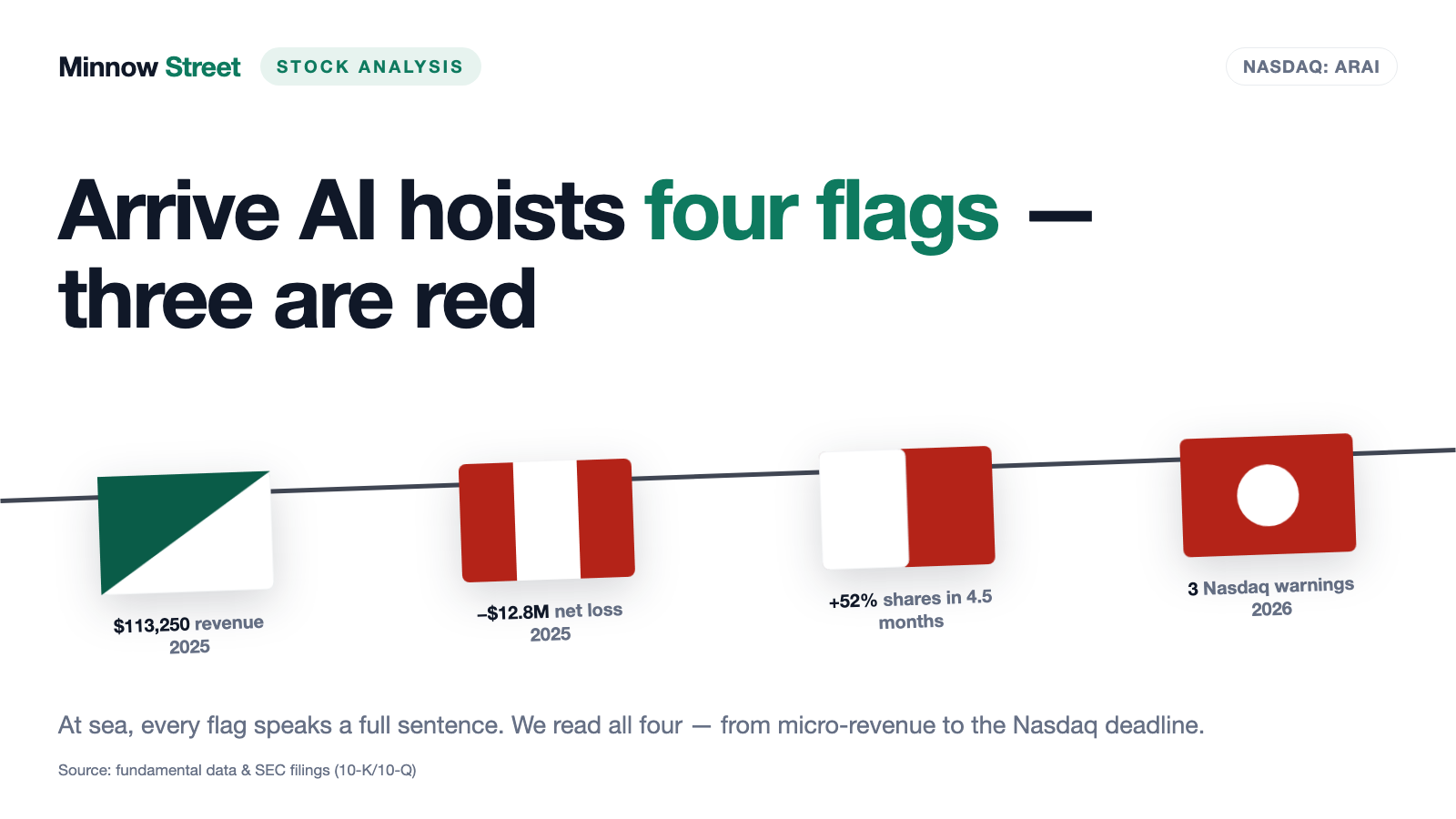
Arrive AI: "AI" in the Name, $113,250 in Revenue — and Financing That Eats the Stock
A smart mailbox for drones and delivery robots, renamed three times — most recently to "Arrive AI" — and listed on Nasdaq in May 2025 through a direct listing. The annual report behind it: $113,250 in revenue, more than 90 percent of it from a single customer, a $12.8 million net loss and a going-concern warning from the auditor. It is all financed through convertible pre-paid purchases from Streeterville Capital that turn into ever more shares at ever lower prices: 34.2 million shares at the end of 2025, 51.9 million just four and a half months later. Add three Nasdaq deficiency notices within four months. Not investment advice — just the question of what is left of the name once you read the filings.
 Thomas Mücke
Founder & Publisher
Thomas Mücke
Founder & Publisher
Chart
Interactive price chart (TradingView).
Note: pure fact-based analysis, not investment advice and not a solicitation to buy or sell. All figures without guarantee.
There is an investor trap that needs no numbers at all: the label trap. It works like this: two letters in a company name — "AI" — and your head does the rest. It fills in growth, the future, a seat near the big AI winners, and suddenly buying feels like getting in early on the next big thing. No chart, no report, just a name tag. Arrive AI Inc. (Nasdaq: ARAI) of Fishers, Indiana has worn that tag since September 27, 2024 — before that, the same company was called Arrive Technology, and before that, since its founding in 2020, DRONEDEK. Three names in a little over four years, the last one carrying the two most expensive letters on the stock market. So let's make a deal: before the label does your thinking, we read together what the company itself reported, under penalty of law, to the U.S. securities regulator, the SEC — the annual report (10-K) for 2025, the quarterly report (10-Q) as of March 31, 2026, and the current reports (8-K) through July 24, 2026. And this record tells of $113,250 in annual revenue, of a going-concern warning, of financing that increased the share count by half in four and a half months — and of an exchange that has sent three warnings. In the end, you decide.
What Arrive AI actually builds — a mailbox for the age of delivery robots
The idea is more serious than the name changes suggest. Arrive AI builds "Arrive Points" — in everyday terms: climate-controlled, lockable high-tech mailboxes where drones, delivery robots and human couriers can securely drop off and pick up packages, medications or food, with nobody home. The plan is to rent them out as a subscription ("Network-as-a-Service"), plus a software platform that brokers delivery slots like an exchange. The annual report describes three revenue pillars — the station network, a marketplace for delivery slots, and "AI Services":
“Our integrated ALM Platform combines a physical Arrive Point™ Network (delivered as Network-as-a-Service), an ALM Marketplace for dynamic scheduling and transactional optimization and AI Services for data-driven insights and automation.”
— Arrive AI Inc., SEC annual report 10-K for 2025, Item 1 “Business” (ALM stands for “Autonomous Last Mile”)
Important for the label: the AI here is mostly future tense. Machine learning is "expected" to arrive with the AP4 and AP5 station generations; what has been installed since late 2024 is the third generation, AP3, which began revenue operation in 2025 — at pilot customers, among them a regional hospital and a specialty pharmaceutical delivery company. To be fair: the patent base is real. Founder and CEO Daniel O'Toole patented the drone docking station concept back in 2017; by the end of 2025 that had grown into nine granted U.S. patents plus international filings. And the self-image is — let's say — roomy:
“We believe, much like the original iPhone and App Store catalyzed the smartphone and mobile app revolutions, Arrive AI’s platform provides the “Highest Common Denominator” infrastructure to support and accelerate rapid innovation across the entire automated last-mile industry, serving medical, pharmaceutical, retail, e-commerce, and logistics stakeholders.”
— Arrive AI Inc., SEC annual report 10-K for 2025, Item 1 “Business”
The five-year plan in the same report targets 100,000 installed Arrive Points. The present the same report describes: 41 full-time employees, pilot installations, $113,250 in annual revenue. That names the central tension of this analysis, and it runs through every chapter: the name and the plan sell an AI infrastructure future — the filings show a company in a fight for survival that pays its bills with ever more, ever cheaper shares. How seriously to take the autonomous-delivery market itself is something we have sorted elsewhere — in our analysis of sidewalk-robot operator Serve Robotics, which attacks the same last mile from the robot side.
How the stock landed on our desk — via Nasdaq's deficiency list
Honesty first: until this research, Arrive AI was in none of our databases — no metrics scanner could flag the stock, because we simply did not carry the company. It landed on our desk through the SEC's fresh filings: on July 24, 2026, Arrive AI filed an 8-K — the third Nasdaq deficiency notice within four months. When a company that listed only in May 2025 and carries "AI" in its name is fighting for its listing spot barely a year later, that is exactly the kind of story worth reading the original documents for. There is no price-to-earnings ratio for lack of earnings, and a price-to-sales ratio would be a caricature at this revenue level — only the magnifying glass on the notes helps here. So we pick up the magnifying glass.
The numbers over the years — honestly appraised
First, what deserves recognition. Arrive AI has raised real money in a difficult capital market: in 2025, roughly $11.0 million net flowed in from the first Streeterville tranches ($11.89 million in principal) plus $387,007 from a crowdfunding offering, and January 2026 brought another $9.6 million net. The company has paying pilot customers — a regional hospital, a specialty pharmaceutical delivery company —, a patent portfolio grown since 2017, and with the direct listing of May 15, 2025 it reached Nasdaq without an underwriter and without a classic IPO. For a 41-person startup out of Indiana, that is no small feat. But a listing is not a business model. The revenue reality looks like this:
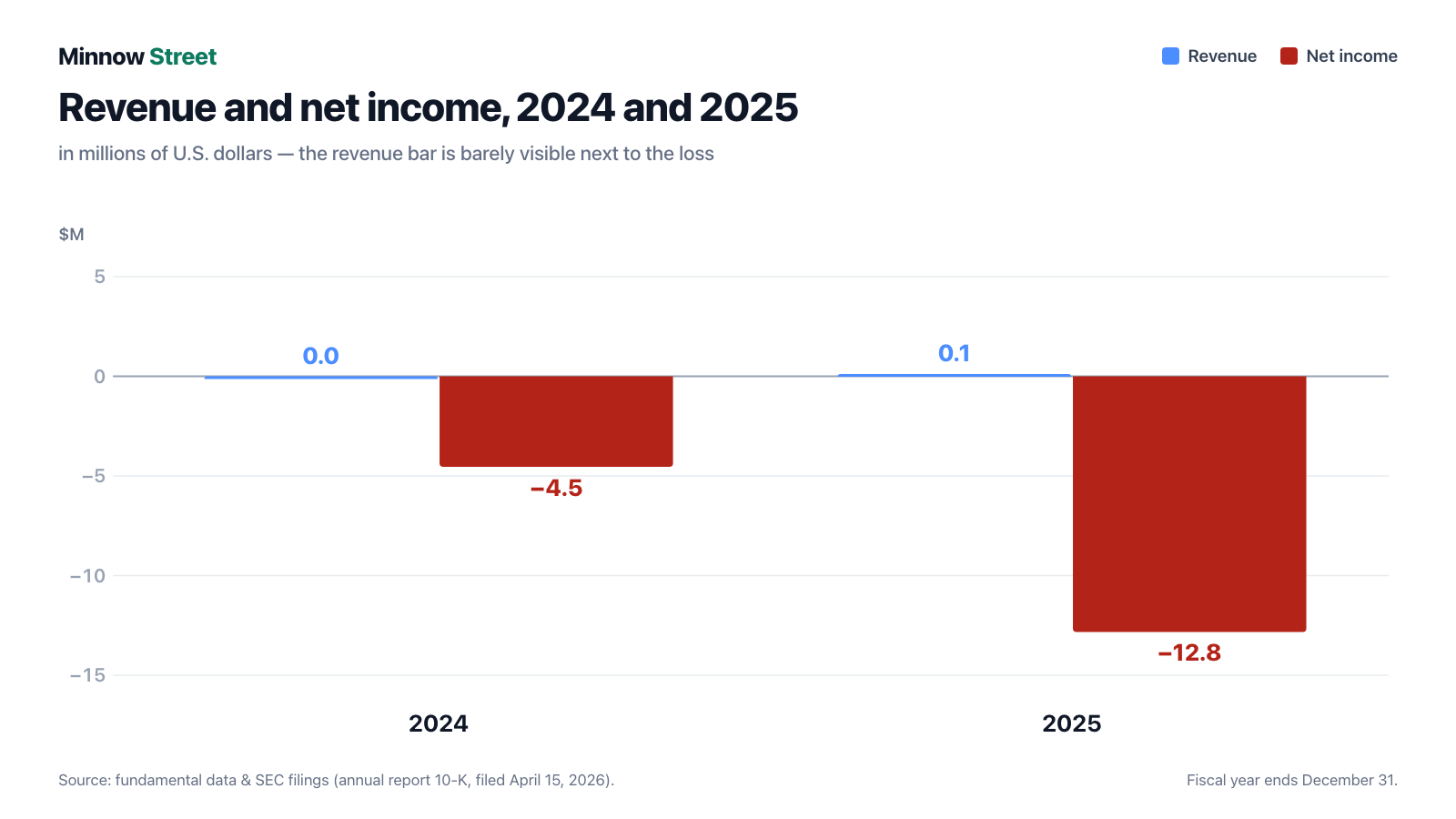
In numbers: $113,250 in total revenue for 2025 — $89,000 of it for design and consulting services, $20,575 for monthly subscriptions, $3,675 for installations. The core product, the station subscription, brought in about the price of a single compact car in 2025; the first quarter of 2026 added $14,925 in subscription revenue. Against that stand operating expenses of $10.5 million (2025) and $4.7 million (Q1 2026), the lion's share in general and administrative costs. The net loss: $4.5 million (2024), $12.8 million (2025), $6.4 million in the first quarter of 2026 alone — the latter more than tripled versus the prior-year quarter ($2.0 million), though a good $2.3 million of it is a non-cash accounting loss on note conversions from the Streeterville financing. The real cash outflow from operations in the first quarter of 2026 was $2.9 million; the annual report itself cites "an average cash burn rate of approximately $1,000,000 per month" for 2025. Remember the order of magnitude: this company spends a multiple of its entire lifetime revenue every single quarter.
What the filings say — the uncomfortable truths
Uncomfortable truth no. 1: The auditor doubts the company's survival — and the plans do not remove the doubt
"Going concern" is the driest alarm phrase in accounting language: it means there is substantial doubt about whether a company can survive the next twelve months on its own. At Arrive AI, the warning is not between the lines — it is stated twice in black and white: in the audit opinion of Stephano Slack LLC on the 2025 financial statements and, more sharply still, in the quarterly report as of March 31, 2026:
“Accordingly, substantial doubt about the Company’s ability to continue as a going concern is not alleviated by management’s plans.”
— Arrive AI Inc., SEC quarterly report 10-Q as of March 31, 2026, Note 4 “Liquidity and Going Concern”
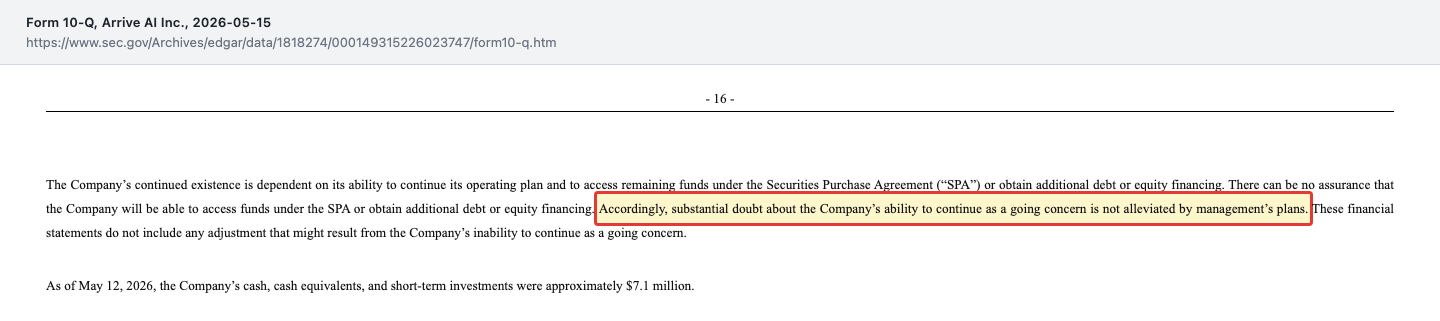
The liquidity picture behind it: $2,104,004 in cash on December 31, 2025 — at roughly $1 million of outflow per month, the cushion had shrunk to about two months by year-end. The rescue came on January 26, 2026 with $9.6 million net from the fourth Streeterville tranche; as of March 31, 2026 there were $5.7 million in cash plus $2.8 million in short-term investments, and roughly $7.1 million combined as of May 12. Depending on the spending pace, that buys time into some point in 2027 — no more. And the plan for afterwards has a catch that leads to the second half of this story: the remaining roughly $19 million under the Streeterville facility requires, among other things, a market capitalization of at least $100 million — more than three times what the company was last worth. A life ring that is only within reach when you do not need it.
Uncomfortable truth no. 2: Revenue is tiny — and hangs on a single customer
$113,250 in annual revenue is not an accusation in itself — every infrastructure company starts small. But the composition deserves a second look: $89,000 of the $113,250 was design and consulting services — services, not product. The actual business model — station subscriptions — accounted for $20,575 in 2025. And almost all of it came from one source:
“In the year ended December 31, 2025, more than 90% of our total revenue came from a single customer, Hancock Health.”
— Arrive AI Inc., SEC annual report 10-K for 2025, Item 7 MD&A “Outlook and Challenges”

In an everyday image: picture a baker planning a revolutionary bakery line for the whole town — who so far has exactly one regular customer, and that customer mostly orders baking advice, not bread. Hancock Health is a regional hospital in Indiana, the pilot partner of the first hour. If this one customer walks, revenue drops to practically zero. The concentration risk is openly named in the report — it is not an accusation, it is a self-disclosure. For judging the "AI" label it means: the "AI Services," the third revenue pillar from the prospectus, have no recognizable revenue so far — the data machine is to be monetized only once the network exists.
Uncomfortable truth no. 3: The financing is a dilution machine with a built-in downshift
Now to the core. Since March 2025, Arrive AI has financed itself through an agreement with Streeterville Capital, a Utah investor specializing in small listed companies: up to $40 million via so-called "pre-paid purchases" — advances that run as unsecured convertible notes. The fourth tranche of January 26, 2026 shows the mechanics: $10.0 million paid out, $10.8 million of debt ($800,000 "original issue discount"), bearing 8 percent interest, compounded daily. Repayment, at the investor's election, comes in shares — at the lesser of the listing reference price and 90 percent of the lowest 10-day volume-weighted average price, with a floor at $0.25. Translated: the lower the stock falls, the more shares the lender receives for the same dollar of debt — your slice of the pie shrinks faster with every price decline. On top, Streeterville received 2,937,500 so-called pre-delivery shares at closing — at par value of $0.0002, a combined $588 for a block of stock worth roughly $1.6 million at the filing anchor of June 11, 2026. What this mechanism does is stated dryly in the quarterly report:
“In aggregate, $7,514,662 of principal was converted into 14,127,956 shares of common stock since March 31, 2026.”
— Arrive AI Inc., SEC quarterly report 10-Q as of March 31, 2026, “Recent Developments”
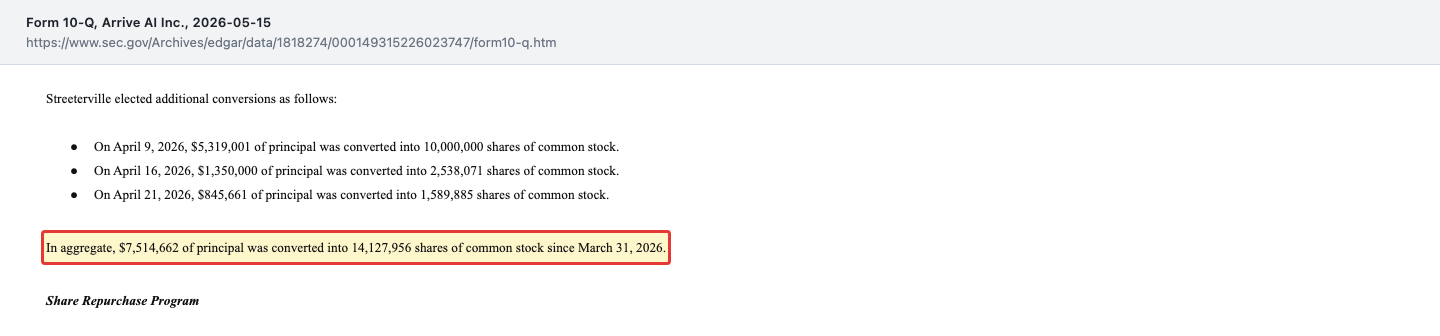
The conversion series reads like a staircase heading down: January 26 at $2.25 per share, February 18 at $1.01, March 3 at $0.96, March 18 at $0.86 — and in April, three times at roughly $0.53. The result in one picture:
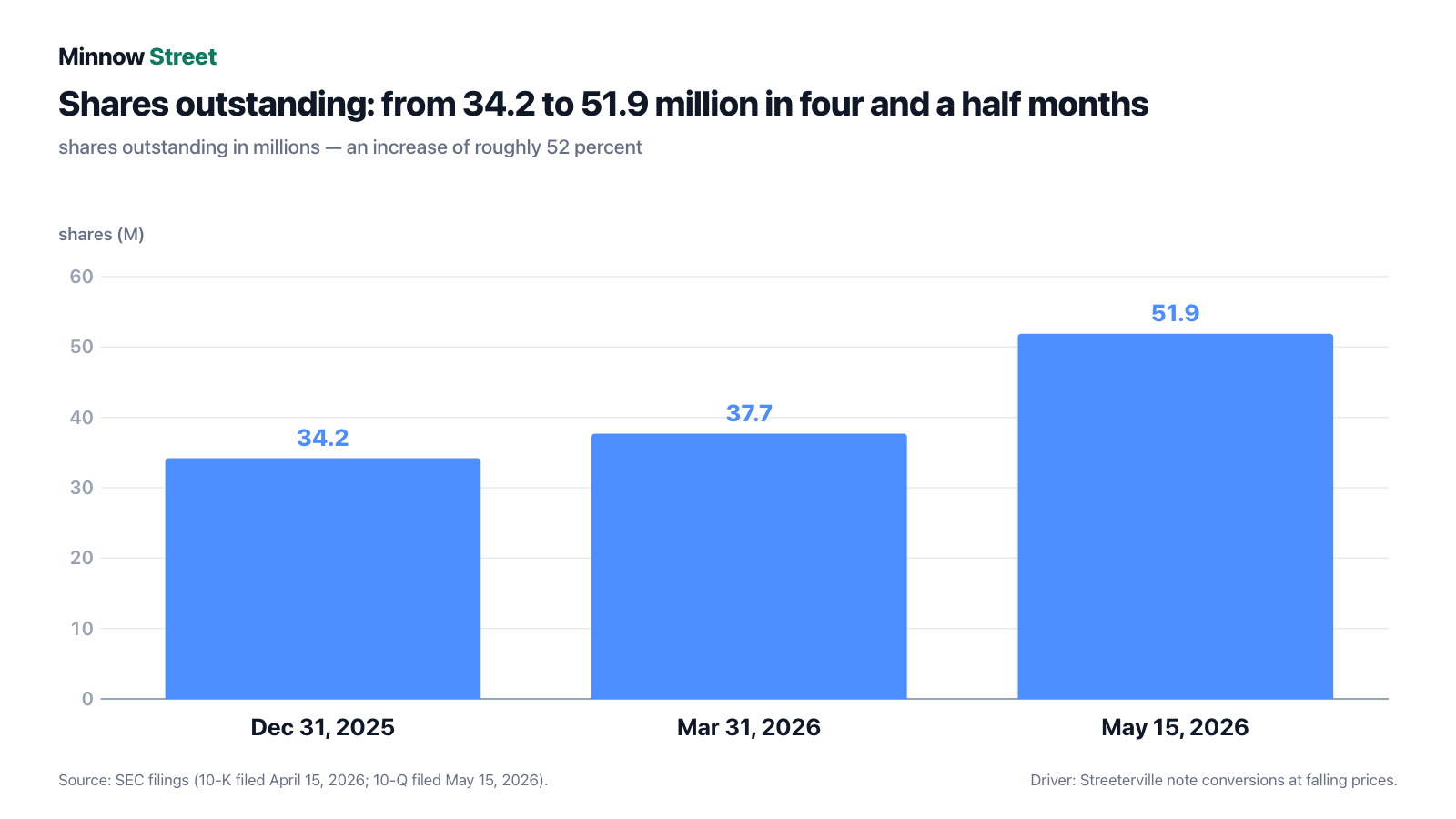
And it can continue: the quarterly report calculates that converting the remaining Streeterville balance as of March 31, 2026 could raise the share count by another 63 percent — roughly 19.1 million additional shares, at a discount to the market price. The report says so itself: "These potential issuances could materially dilute existing stockholders, particularly if conversion occurs at depressed share prices." Two developments after the quarterly report belong in an honest picture: on May 14, 2026, the company agreed a standstill with Streeterville through December 31, 2026 — the investor pauses further conversion notices, except on trading days when the stock trades at least 15 percent above the Nasdaq Minimum Price. And on June 12, 2026, the company set up an at-the-market program of up to $14,967,247: it can now sell new shares directly into the market on an ongoing basis (2.5 percent commission to Maxim Group), expressly including to repay Streeterville. That eases the pressure — but it replaces one source of dilution with another. Remember the mechanism: this company pays for its present with stakes in its future — and the price of those stakes falls with every draw.
Uncomfortable truth no. 4: Three Nasdaq notices in four months — and a restatement
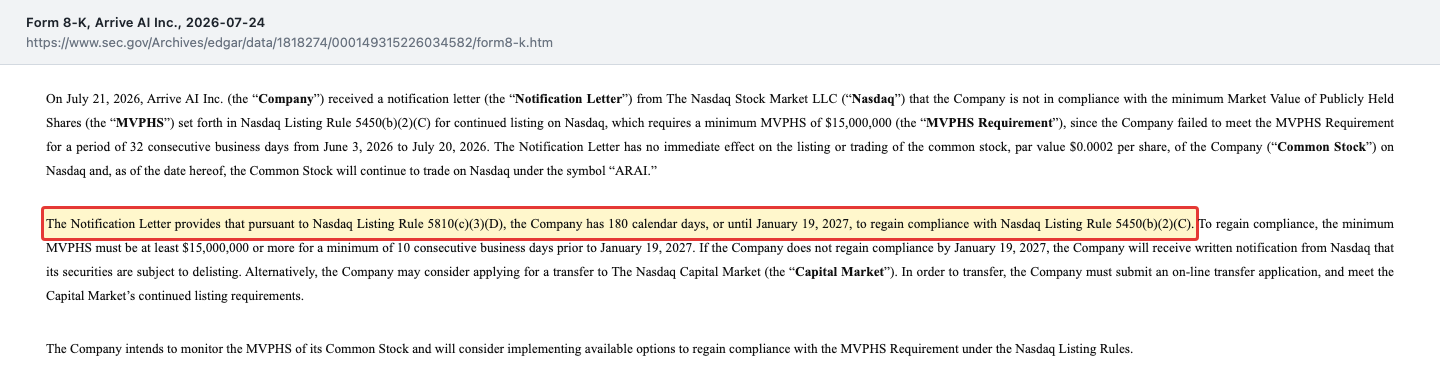
Since spring 2026, Arrive AI has been filling the 8-K Item 3.01 category — the disclosure line for listing problems — at a steady clip. The chronicle: on March 31, 2026, Nasdaq flagged that the market value of publicly held shares (MVPHS) was below the required $15 million; this first notice was cured in April. On June 2 came the notice for the minimum bid price of one dollar, which the stock had missed for 30 consecutive trading days — deadline to cure: November 30, 2026. And on July 21, the public-float value failed again:
“The Notification Letter provides that pursuant to Nasdaq Listing Rule 5810(c)(3)(D), the Company has 180 calendar days, or until January 19, 2027, to regain compliance with Nasdaq Listing Rule 5450(b)(2)(C).”
— Arrive AI Inc., SEC current report 8-K of July 24, 2026, Item 3.01
For perspective: a deficiency notice is not an eviction — the deadlines are running, a move to the less demanding Nasdaq Capital Market segment is possible, and the stock keeps trading normally. But the notices are symptoms of the same disease: the price falls because new shares keep being created at discount prices — and the lower the price, the more new shares every further dollar of financing requires. Add a finding about the reliability of the numbers themselves: on April 14, 2026, the company declared in an 8-K (Item 4.02) that its quarterly reports for Q2 and Q3 2025 should no longer be relied upon — the conversion feature of the Streeterville note contained an embedded derivative (ASC 815-40) that had been booked incorrectly; both reports were refiled on April 15, 2026. In the same annual report, management admits material weaknesses in internal control over financial reporting — weaknesses serious enough that errors in the accounts might not be caught in time. None of this is fraud; all of it is disclosed. But at a company whose survival hangs on its financing machine, the message "our own numbers about the financing machine had to be corrected" is not a footnote.
Uncomfortable truth no. 5: The chief earns on the patents — and the cash plays the market
Two footnotes round out the governance picture. First: the patents the business is built on belong not to the company but to CEO Daniel O'Toole personally — the company licenses them exclusively, and since the second amendment of March 2025, in perpetuity. The price: a fixed fee of $10,000 per month that runs until the patents expire — roughly $1.72 million of remaining commitment as of the end of 2025 — plus a $25 per-unit royalty once monthly revenue exceeds $10,000; the company also bears the patent costs. $120,000 a year in license fees to the company's own chief — against $113,250 in annual revenue, that means: in 2025, more money went to the CEO for the patent license than the entire company generated in revenue. Management pegs the license agreement's eventual value at roughly $17 million over ten years — based on internal sales projections of about 675,000 units in that period, against a present of pilot installations at a handful of customers. Second — and this is our side-find of this research: the scarce cash does not just sit in the bank. In the first quarter of 2026, Arrive AI booked a realized net gain of $576,970 from options trading — 39 times the product revenue of the same quarter — alongside a realized net loss of $130,646 and an unrealized net loss of $502,112 on marketable securities. A company under a going-concern warning that trades options carries a second, silent risk on its balance sheet. Both are disclosed and legal — and both belong on the table when you weigh the label "AI infrastructure."
Valuation: what are you actually paying here — and for what?
Classic metrics fail at Arrive AI. A price-to-earnings ratio does not exist for lack of earnings; a price-to-sales ratio on $128,175 of revenue in the twelve months through March 2026 would be in the hundreds and therefore meaningless. What remains is the order of magnitude, cleanly dated from the filings: as of June 11, 2026, the prospectus supplement cites $0.56 as the last reported sale price — at 51,859,347 shares (as of June 1, 2026), a market value of roughly $29 million. The drop behind it: before the listing, the company itself put the fair value of its stock at $13.00 (January to May 2025); its own reports then document $2.63 at year-end 2025 and $0.797 on March 31, 2026. Whoever buys today pays roughly $29 million — documented as of June 11, 2026 — for $7.1 million of liquidity (May 12, 2026), a patent portfolio, two pilot customers and the hope that $113,250 of revenue becomes a network of 100,000 stations before the cash, the public-float value or Nasdaq's patience runs out. That is not a valuation in the classic sense — it is an option on survival, with the peculiarity that every further financing round dilutes the option itself. For the counterpoint, look at Nvidia: there, the same two letters sit on top of $215.9 billion in annual revenue — at Arrive AI, they sit on top of $113,250. The label is identical; the substance differs by six orders of magnitude.
Opportunities and risks at a glance
What speaks for Arrive AI:
- A real patent portfolio around drone docking stations, built since 2017 (nine granted U.S. patents plus international filings as of December 31, 2025), in a market — autonomous delivery — that FAA rules on beyond-visual-line-of-sight flying (BVLOS) are only now opening up.
- Paying pilot customers with real-world weight: a regional hospital (Hancock Health) and a specialty pharmaceutical delivery company — medical logistics is one of the most plausible first markets for drone delivery.
- Time bought: $9.6 million net in January 2026, roughly $7.1 million of liquidity as of May 12, 2026, a standstill agreement with Streeterville through December 31, 2026, and an at-the-market program of up to $15 million as a more flexible funding source.
- The Nasdaq deadlines (November 30, 2026 and January 19, 2027) are dates, not verdicts — the first MVPHS notice was already cured once in April 2026, and a move to the Nasdaq Capital Market remains an escape route.
- At roughly $29 million of documented market value (June 11, 2026), expectations are low: a single credible network rollout contract would measurably change the picture.
What speaks against it:
- A going-concern warning in both the audit opinion and the quarterly report — the doubt is "not alleviated by management's plans"; roughly $1 million of monthly cash outflow (2025) stands against $14,925 of quarterly revenue.
- Miniature revenue with concentration risk: $113,250 in 2025, $89,000 of it consulting, and more than 90 percent from a single customer (Hancock Health); the "AI Services" in the name are so far future tense without revenue.
- A dilution machine: conversion at 90 percent of the lowest 10-day price ($0.25 floor), share count +52 percent in four and a half months, another +63 percent possible; the remaining $19 million of the facility requires a $100 million market capitalization — three times the current state.
- Three Nasdaq notices within four months (MVPHS twice, minimum bid price), deadlines November 30, 2026 and January 19, 2027; if the cures fail, downgrade or delisting proceedings loom.
- Reliability of the numbers: restatement of the Q2 and Q3 2025 quarterly reports (misbooked conversion derivative), admitted material weaknesses; plus governance footnotes — the CEO patent license ($10,000 per month, in perpetuity) and options trading with the scarce cash.
A human conclusion
Back to the label trap from the opening. It lives on a name replacing an examination: "AI" in the ticker, and your head fills the gaps with other companies' growth curves. The filings of Arrive AI tell a different, more human story — that of an inventor from Indiana who has worked on a genuinely clever idea since 2014, changed the company's name three times along the way, and is now in a race that will be decided not by the technology but by the cash: against his own burn rate, against two Nasdaq deadlines, and against a financing arrangement that signs over more of the company to the lender with every price decline. Maybe he wins it — pilot customers exist, the patents are real, the deadlines are still running, and low expectations are their own raw material on the stock market. But that would then be a turnaround bet on a micro cap under a going-concern warning — one of the riskiest wagers the market offers — and not an "AI investment," whatever the name tag says. The honest question for you is therefore not "Is autonomous delivery the future?" but: Would you still give this company your money if it were still called DRONEDEK? If yes, you have a thesis. If no, you had a label. What you make of it is your decision. And that is exactly as it should be.
Sources
All original documents used in this analysis — for your own reading:
- Arrive AI Inc. — SEC annual report 10-K for 2025 (filed April 15, 2026)
- Arrive AI Inc. — SEC quarterly report 10-Q as of March 31, 2026 (filed May 15, 2026)
- Arrive AI Inc. — 8-K of April 14, 2026 (Item 4.02: restatement of the Q2+Q3 2025 10-Qs)
- Arrive AI Inc. — 8-K of April 28, 2026 (Item 3.01: first MVPHS notice cured)
- Arrive AI Inc. — 8-K of May 18, 2026 (standstill agreement with Streeterville Capital)
- Arrive AI Inc. — 8-K of June 5, 2026 (Item 3.01: minimum bid price notice, deadline November 30, 2026)
- Arrive AI Inc. — 8-K of June 12, 2026 (at-the-market program of up to $14,967,247) and prospectus supplement 424B5 of June 12, 2026
- Arrive AI Inc. — 8-K of July 24, 2026 (Item 3.01: second MVPHS notice, deadline January 19, 2027)
- Complete SEC filing history of Arrive AI Inc.: EDGAR overview (sec.gov)
- Fundamental data (metrics; data as of July 27, 2026), reconciled with the SEC filings; the market value was cross-checked against the price documented in the prospectus supplement of June 11, 2026.
Transparency & disclaimer: This analysis is a journalistic contextualization of publicly available information and is not investment advice, not a financial analysis in the regulatory sense, and not a solicitation to buy or sell securities. Stock investments carry substantial risks up to total loss; with micro caps under a going-concern warning, the risk of total loss is real. All information without guarantee; the data cut-off is noted in the text for each figure. The author holds no position in Arrive AI shares at the time of publication.
Our Bottom Line at a Glance
- Product & patents neutral
- The idea is serious: smart delivery stations for the autonomous last mile, a patent portfolio granted since 2017 (nine U.S. patents plus international filings) and paying pilot customers from medical logistics (including Hancock Health). But the AI features are only planned for the AP4/AP5 station generations; in operation are pilot installations of the 3rd generation (per the 10-K, April 15, 2026).
- Cash cushion & time bought neutral
- The company has bought itself time: $9.6 million net in January 2026, roughly $7.1 million of liquidity as of May 12, 2026, a standstill with Streeterville through December 31, 2026 and an at-the-market program of up to $15 million (June 12, 2026). At roughly $1 million of monthly burn (2025), that lasts into 2027 depending on the pace — then new money is needed at whatever prices prevail.
- Revenue reality negative
- $113,250 of revenue in 2025, $89,000 of it consulting and more than 90 percent from a single customer (Hancock Health, per the 10-K); Q1 2026: $14,925. The "AI Services" in the company name are so far future tense without revenue. Operating expenses 2025: $10.5 million — that mismatch is the core number of this stock.
- Liquidity & going concern negative
- Going-concern opinion from the auditor on the 2025 accounts; the 10-Q as of March 31, 2026 declares the doubt "not alleviated." Cash of $2.1 million at year-end 2025 against ~$1 million of monthly burn; the remaining ~$19 million of the facility requires a $100 million market capitalization — more than three times the filing anchor of ~$29 million (June 11, 2026).
- Dilution & financing structure negative
- Conversion at min(reference price; 90 percent of the lowest 10-day VWAP, $0.25 floor): share count up from 34.2 million (December 31, 2025) to 51.9 million (May 15, 2026), +52 percent; per the 10-Q, another +63 percent possible. Add 2,937,500 pre-delivery shares for $588 and an ATM program that opens the next dilution source. The stock fell along the conversion staircase from $2.25 (January 26) to ~$0.53 (April).
- Listing & reporting quality negative
- Three Nasdaq notices within four months (MVPHS March 31, cured; minimum bid price, deadline November 30, 2026; MVPHS again, deadline January 19, 2027). Restatement of the Q2+Q3 2025 10-Qs over a misbooked conversion derivative (8-K Item 4.02, April 14, 2026) and admitted material weaknesses — of all places, in the accounting for the financing the company depends on.
Arrive AI is the label trap in its purest form: "AI" in the name, a serious product idea with a real patent portfolio — and underneath, filings that document a fight for survival: $113,250 of annual revenue (more than 90 percent from one customer) against a $12.8 million loss, a going-concern warning that the quarterly report calls "not alleviated," financing that raised the share count by 52 percent in four and a half months, and three Nasdaq notices with deadlines of November 30, 2026 and January 19, 2027. Whoever buys is buying an option on survival — not AI infrastructure with substance. Not investment advice.
Worth Noting
- The stock landed on our desk via the SEC's fresh filings (8-K of July 24, 2026, second MVPHS notice from Nasdaq) — not via a metrics scanner: the company was not in our database before this research. No meaningful P/E or P/S; classic multiples mislead at this revenue level.
- The market capitalization from the market-data feed deviated by more than 20 percent from the filing anchor and was not used; all price and valuation figures come from the filings ($13.00 fair value 01–05/2025; $2.63 on December 31, 2025; $0.797 on March 31, 2026; $0.56 on June 11, 2026 per the 424B5; market value ~$29 million = 51,859,347 × $0.56). Analyses are evergreen; daily prices are not a buy argument.
- Not to be confused: Arrive AI (ARAI, delivery infrastructure out of Indiana) has nothing to do with Atai Life Sciences (ATAI, biotech). The name history DRONEDEK → Arrive Technology → Arrive AI is documented in the 10-K; the 1-for-4 reverse split of November 25, 2024 predates the listing, and all share counts are retroactively adjusted.
Frequently Asked Questions
Arrive AI Inc. (Nasdaq: ARAI) of Fishers, Indiana develops "Arrive Points" — smart, lockable delivery stations where drones, delivery robots and couriers can hand over packages and medications securely. It is marketed as a subscription model (Network-as-a-Service) with a planned delivery marketplace and "AI Services." As of December 31, 2025, the company had 41 full-time employees; in operation are pilot installations of the third station generation, among others at the regional hospital Hancock Health.
In fiscal year 2025, $113,250 in total: $89,000 in design and consulting services, $20,575 in monthly subscriptions and $3,675 in installations; more than 90 percent came from a single customer, Hancock Health. In the first quarter of 2026, revenue was $14,925 (subscriptions only). Against that stood a net loss of $12.8 million in 2025 and $6.4 million in the first quarter of 2026.
The filings document the staircase: $13.00 fair value before the listing (January to May 2025), $2.63 on December 31, 2025, $0.797 on March 31, 2026, $0.56 on June 11, 2026. The main driver is the Streeterville financing, which converts debt into shares at 90 percent of the lowest 10-day price: the share count rose from 34.2 million (December 31, 2025) to 51.9 million (May 15, 2026). Add multimillion-dollar losses on mini revenue and the going-concern warning.
Auditor Stephano Slack LLC attached a going-concern warning to the 2025 financial statements — substantial doubt about whether the company can survive the next twelve months on its own. The quarterly report as of March 31, 2026 sharpens it: the doubt is "not alleviated by management's plans." As of May 12, 2026, cash and short-term investments stood at roughly $7.1 million, after roughly $1 million of monthly cash outflow in 2025.
Two deadlines are running: by November 30, 2026 the stock must close above $1 for at least ten consecutive trading days (minimum bid price rule), and by January 19, 2027 the market value of publicly held shares must again hold above $15 million for at least ten consecutive trading days (MVPHS rule). A notice is not an eviction: the first MVPHS notice was cured in April 2026, and a move to the Nasdaq Capital Market is an escape route. If both cures fail, delisting proceedings loom.
An agreement dated March 21, 2025 with Streeterville Capital for up to $40 million in convertible pre-paid purchases. The fourth tranche (January 26, 2026) delivered $10.0 million in cash against $10.8 million of debt, bearing 8 percent interest. Repayment, at the investor's election, comes in shares at the lesser of the listing reference price and 90 percent of the lowest 10-day volume-weighted average price ($0.25 floor). A further roughly $19 million requires, among other things, a $100 million market capitalization; since May 14, 2026 a standstill runs through year-end 2026.
Yes. The company was incorporated in Delaware on April 30, 2020 as Dronedek Corporation, renamed itself Arrive Technology Inc. on July 27, 2023 and has been Arrive AI Inc. since September 27, 2024. It reached Nasdaq on May 15, 2025 through a direct listing — without a classic IPO and without offering proceeds. The patent base goes back to 2014: CEO Daniel O'Toole holds the patents personally and licenses them exclusively to the company.
Found an error?
Did you spot a factual error, an outdated number, or a typo in this deep dive? Let us know briefly — your report goes straight to the editorial team.