BRC Group (formerly B. Riley): Audited Numbers From a Faulted Machine
The company still trading as RILY now files with the U.S. securities regulator as BRC Group Holdings. It sits at rank 22 in our in-house stock scanner because of a number that appears in none of its filings. And its auditor signed off on the accounts while expressly finding internal control on the same date to be ineffective. We separate the two — and look at what the business underneath actually earned.
 Thomas Mücke
Founder & Publisher
Thomas Mücke
Founder & Publisher

Chart
Interactive price chart (TradingView).
Note: pure fact-based analysis, not investment advice and not a solicitation to buy or sell. All figures without guarantee.
There is a trap that catches experienced investors most reliably of all, and it is called trusting your own source. You built a tool, it has led you to good finds before, and at some point you stop questioning its output. Then a number appears on the screen — and you read it as a fact rather than as a claim.
This analysis is the second case within days where we have to demonstrate exactly that on our own list. The stock trades as RILY, but files with the U.S. securities regulator, the SEC, as BRC Group Holdings, Inc. It sits at rank 22 of our U.S. selection because of a number that appears in none of its filings. And once you follow the filings, you find something far more interesting: an audit opinion that splits in two.
First the name: who is BRC Group Holdings?
Anyone searching for this company needs three names. At the SEC it is now BRC Group Holdings, Inc. Before that it filed as B. Riley Financial, Inc. — the name most people know it by — and before that as Great American Group, Inc. The Nasdaq ticker stayed RILY through every rename.
The business is a mix of investment bank, asset manager and holding company: corporate finance and consulting, wealth management for private clients, plus operating stakes in telecommunications and consumer products businesses. As of December 31, 2025 the group employed roughly 1,380 people, with headquarters in Los Angeles.
And one clarification the filing register otherwise invites you to get wrong. Eight Forms 25 sit against this company at the SEC — the notice that a security is being removed from listing. The most recent is dated March 30, 2026. Seeing that, it is easy to assume the stock itself is about to be delisted. It is not: the notice covers, in so many words, the "5.50% Senior Notes Due 2026" — a bond that simply matured. The quarterly report confirms the company fully redeemed those $96.0 million on the day before their maturity date. The common stock is unaffected and continues to trade on Nasdaq.
Where the stock came across our desk
Every day we run about 3,500 stocks through our in-house stock scanner. One of those lists is the price-to-free-cash-flow ranking, which sorts by market capitalization over free cash flow, cheapest first.
The finding, measured on July 27, 2026: 545 stocks in the U.S. selection meet the criteria. RILY sits at a displayed ratio of 1.2 in rank 22 — inside the 25 rows the detail page shows. Measured identically on both of our brands; the lists are recalculated daily.
Uncomfortable truth no. 1: the number in the denominator is in no filing
A price-to-free-cash-flow ratio has two parts. Market capitalization on top, free cash flow over the last twelve months underneath. The denominator is where this gets interesting.
The data set feeding our list carries operating cash flow of $224.1 million for the first quarter of 2026. Because that single quarter dominates the twelve-month total, it almost single-handedly produces the low reading of 1.2.
The company's own quarterly report says something else — twice. Once as a line in the cash flow statement, and once spelled out in the management discussion:
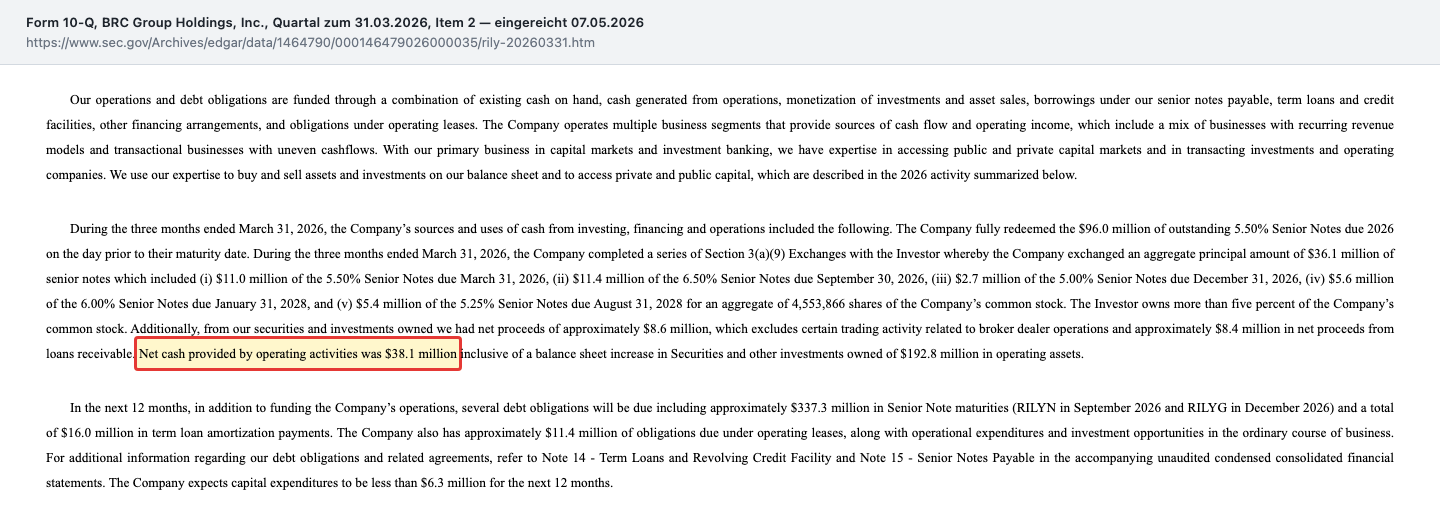
„Net cash provided by operating activities was $38.1 million inclusive of a balance sheet increase in Securities and other investments owned of $192.8 million in operating assets.“
— BRC Group Holdings, SEC quarterly report on Form 10-Q for March 31, 2026, Item 2
The check against cash. A cash flow statement has to reconcile: what flows in at the top and out at the bottom must explain the change in the cash balance. It does — with $38.1 million, not $224.1 million:
- operating activities: +$38.1 million
- investing activities: +$8.3 million
- financing activities: −$96.8 million
- total: −$50.4 million change in cash
- cash at January 1 of $229.3 million, cash at March 31 of $178.0 million — the arithmetic closes.
With $224.1 million in the first line, that reconciliation would miss by roughly $186 million. The data-set figure is therefore not merely different — it is incompatible with the rest of the filing.
One observation about how it arose. Net income for the quarter was $222.2 million. At $224.1 million, the data-set figure sits conspicuously close to that — far closer to earnings than to actual cash flow. That suggests profit was fed in where cash flow belonged. We cannot prove it; it is striking nonetheless.
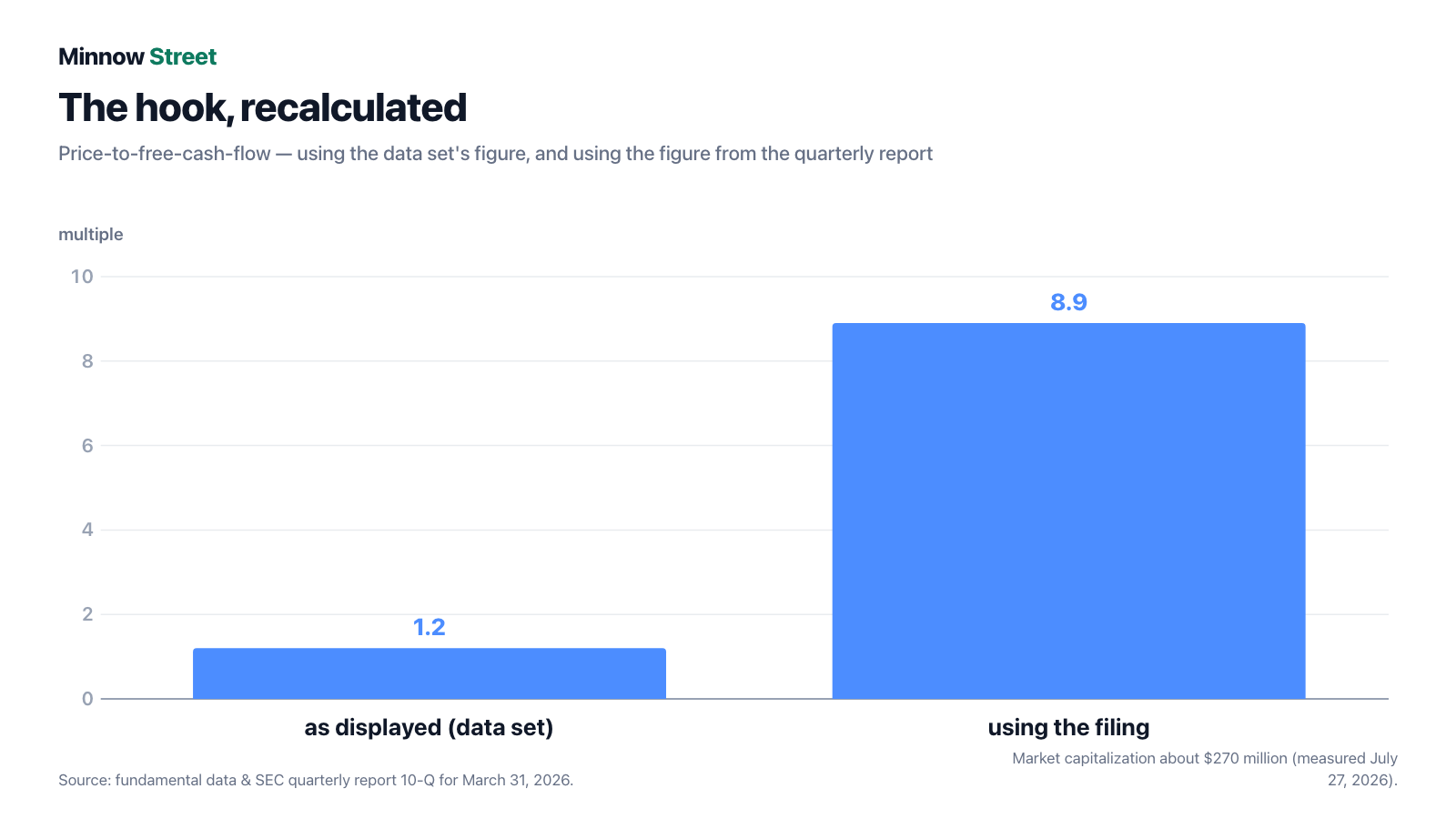
What that does to the rank. Rebuild the twelve-month total using the filing's figure and roughly $30.3 million of free cash flow remains. Against a market capitalization of about $270 million that gives:
A price-to-free-cash-flow ratio of about 8.9 — not 1.2.
Second case, different cause. We recently had to dismantle another ranking position: at XP Inc. the stock also sits too high in this same list — but there because a market capitalization in U.S. dollars was divided by a cash flow in Brazilian reais. That is a currency mismatch. This is something else: a plainly wrong figure. Two different mechanisms, one shared result — a position that does not survive checking.
Uncomfortable truth no. 2: the accounts are audited, the machine behind them is not
If a figure from the data set does not hold, the next question follows naturally: how reliable are the numbers in the filing itself? The annual report answers that — and the answer splits in two.
For a U.S. company of this size an auditor issues two separate opinions: one on the financial statements and one on internal control over financial reporting, meaning the apparatus of processes and controls that produces the numbers. Both here come from BDO USA, P.C., both are dated March 31, 2026 — and they do not agree.
The accounts: clean opinion.
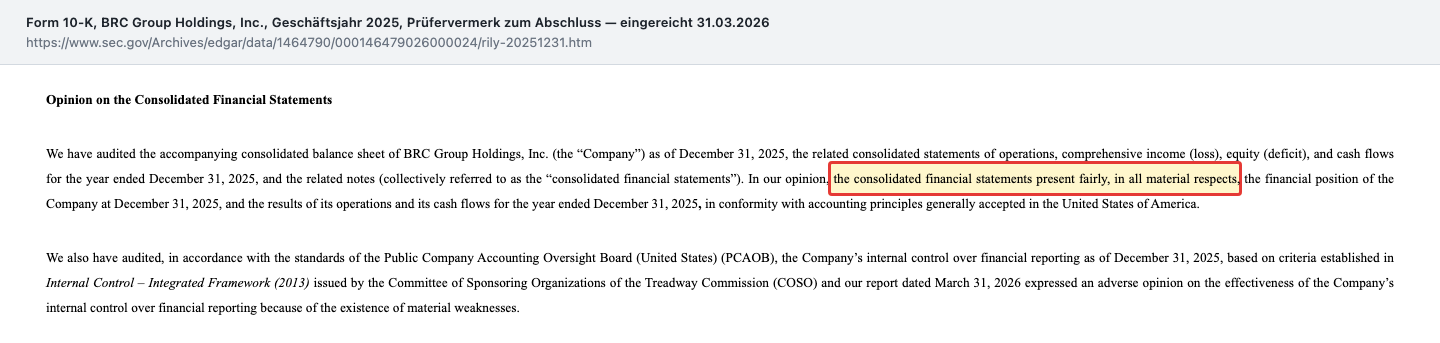
„In our opinion, the consolidated financial statements present fairly, in all material respects, the financial position of the Company at December 31, 2025, and the results of its operations and its cash flows for the year ended December 31, 2025, in conformity with accounting principles generally accepted in the United States of America.“
— BDO USA, P.C., SEC annual report on Form 10-K for 2025, report of independent registered public accounting firm
Internal control: expressly found ineffective.

„In our opinion, the Company did not maintain, in all material respects, effective internal control over financial reporting as of December 31, 2025, based on the COSO criteria.“
— BDO USA, P.C., SEC annual report on Form 10-K for 2025, opinion on internal control over financial reporting
How do those fit together? Like this: the auditor tested the accounts thoroughly enough to stand behind them, while stating that the machine producing them offers no assurance of accuracy on its own. The company itself acknowledges material weaknesses in its risk factors. The auditor's critical audit matter is the accounting for the new senior notes and related warrants arising from five private exchange transactions during 2025.
The filing backlog belongs in the same picture — as a fact, not an accusation. The annual report for 2024 was not filed until September 19, 2025, and the third-quarter 2025 report not until January 14, 2026. That backlog is now cleared: the 2025 annual report arrived on March 31, 2026 and the quarterly report for March 31, 2026 on May 7, 2026, both on time. What this analysis relies on: the audited 2025 accounts and the unaudited but complete quarterly report for March 31, 2026. Unaudited is the norm for quarterly reports.
What the business actually earned
Now to the question underneath both findings: how does this company make money? The answer sits in the first-quarter statement of operations — and it is uncomfortable.
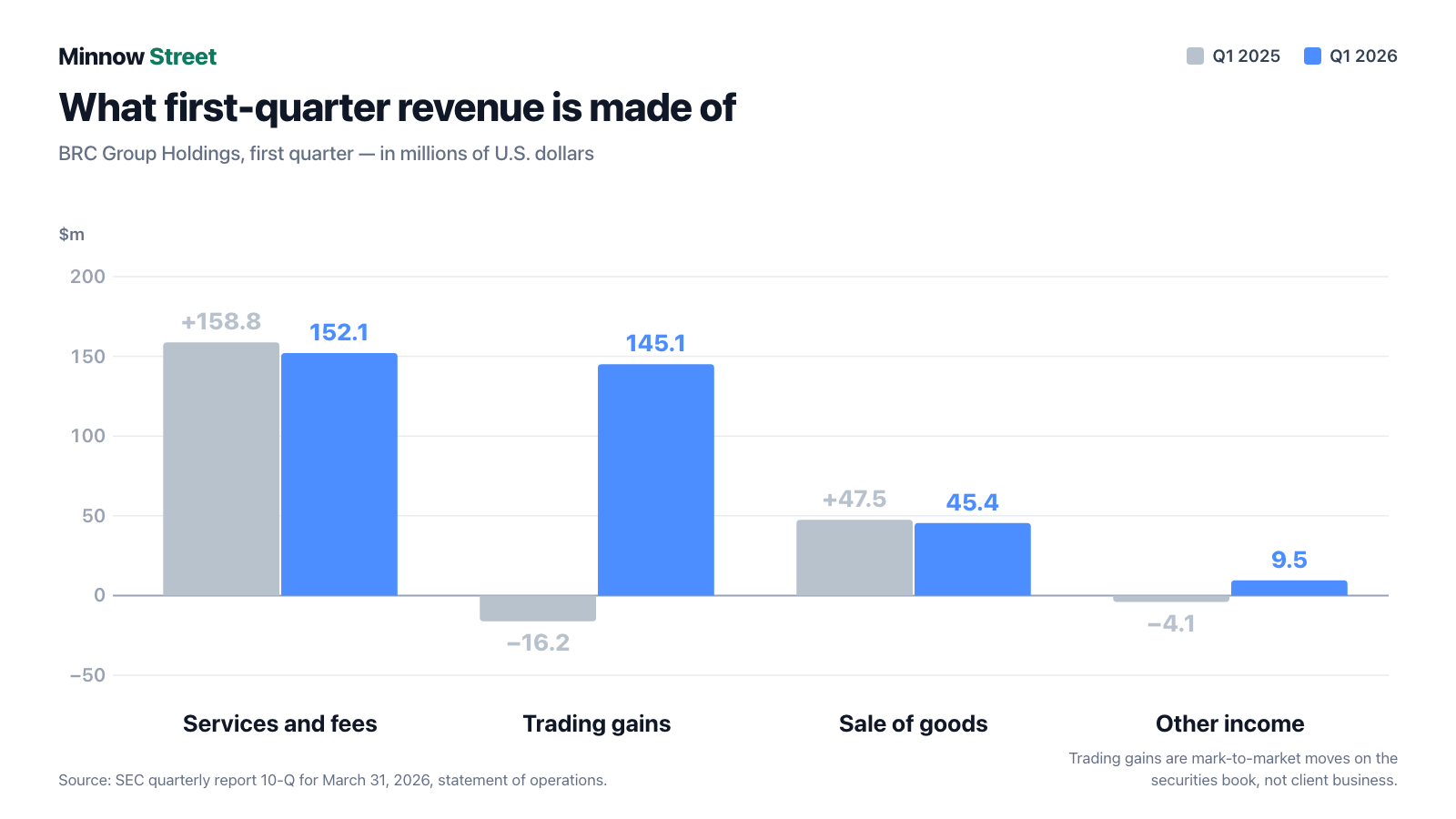
First-quarter 2026 revenue was $352.1 million against $186.1 million a year earlier — close to a doubling. Except the actual client business slightly shrank. Services and fees fell from $158.8 million to $152.1 million, sale of goods from $47.5 million to $45.4 million.
The entire increase sits in one line: trading gains of $145.1 million, after a loss of $16.2 million in the prior-year quarter. That is 41 percent of reported revenue — and it is not revenue in any everyday sense, but the change in value of the firm's own securities book.
Below the revenue line it continues: another $105.1 million of realized and unrealized gains on investments. Together that is roughly $250 million of paper gains carrying quarterly net income of $222.2 million — against $38.1 million of actual cash flow.
A rule of thumb: when profit is six times larger than the cash coming in, it is measuring valuations, not payments.
We have met this pattern in this series before — at OneMain Holdings, where operating cash flow measures the interest margin before credit losses. At an investment bank with a trading and investment book the same applies in sharper form: cash flow tracks the movement of the book, not distributable money.
Uncomfortable truth no. 3: the equity did not come from earning it
As of December 31, 2025 the company's equity was negative: minus $171.5 million. Three months later it shows a positive $77.3 million. A swing of roughly $249 million in a single quarter.
It did not come from the business. It came from swapping notes for shares: during the first quarter of 2026 the company exchanged $36.1 million of note principal for 4,553,866 of its own shares. Debt leaves the balance sheet, new shares appear — equity rises without a dollar being earned.
For you as a shareholder that means your slice of the pie gets smaller. The share count rose from 30,597,066 at the start of the year to 37,130,592 by May 5, 2026 — roughly 21 percent more shares in four months.
And then there is the queue. Alongside the common stock sit preferred shares: 4,563 of them, claiming $124.2 million ahead of everyone else in a wind-up.

Set those against each other: total equity is $136.3 million. Of that, $124.2 million is spoken for by the preferred before a common shareholder sees anything. Anyone thinking about book value here has to deduct that preference — otherwise they are counting money that would not reach them.
Valuation: what you get for your money
For orders of magnitude, all figures as of July 24 to 27, 2026 and without daily prices: we calculate the market capitalization ourselves, using the share count on the quarterly report cover — 37,130,592 common shares as of May 5, 2026. That puts common market capitalization in the region of $255 million. The preferred shares are deliberately excluded; they are a separate instrument with a separate claim.
On leverage. Against those $255 million stand liabilities of $1,717.9 million as of March 31, 2026, of which $1,171.5 million are senior notes, $116.7 million term loans and $10.7 million a revolving facility. Total assets are $1,854.2 million. Put differently: each dollar of equity carries about $12.60 of debt. At a company whose earnings consist largely of valuation moves, that is the central risk.
Then the maturities: in the twelve months after the quarter-end roughly $337.3 million of notes come due, against $178.0 million of cash.
Why we quote no Altman Z here. The Altman Z score estimates distress risk and was developed for industrial companies. It sets working capital, retained earnings and sales against total assets — at an investment bank with a trading book those quantities mean something different, and an accumulated deficit of $550.0 million distorts the formula further. Our data set carries a value of 3.92 for RILY, which on the relevant scale with thresholds of 1.1 and 2.6 would look unremarkable. We deliberately do not use it. Anyone judging this balance sheet should look at equity after the preferred claim, leverage, maturities and cash.
Opportunities and risks at a glance
What speaks for BRC Group:
- The filing backlog is cleared: 2025 annual report on March 31, 2026 and the quarterly report on May 7, 2026, both on time.
- The 2025 accounts carry a clean audit opinion; the auditor was able to verify them despite the control deficiencies.
- Debt is coming down: senior notes fell from $1,301.8 million to $1,171.5 million within a quarter, and equity turned positive.
- The client business provides a base load: $152.1 million of services and fees and $45.4 million of goods sold in the first quarter of 2026.
What speaks against it:
- The hook does not hold: the displayed ratio of 1.2 rests on a figure of $224.1 million that the filing contradicts with $38.1 million — recalculated it is about 8.9.
- The auditor found internal control over financial reporting ineffective as of December 31, 2025; the company acknowledges material weaknesses.
- 41 percent of quarterly revenue is trading gains; together with investment gains, roughly $250 million of paper gains carry the quarterly profit.
- Dilution: roughly 21 percent more shares in four months, because notes were swapped into equity.
- Queue and leverage: a $124.2 million preferred claim on $136.3 million of equity, about $12.60 of debt per dollar of equity, and $337.3 million of maturities within twelve months against $178.0 million of cash.
A human conclusion
We started with trusting your own source. This is the second case within days where our own list pushed a stock to the front that does not belong there — the first was a currency mismatch, this one a wrong figure. Both times only reading the original filing settled it.
What is left once the 1.2 is cleared away? A heavily indebted investment bank that has just climbed out of negative equity — not by earning, but by converting debt into shares. A quarterly profit that consists of valuation moves well beyond 100 percent. An auditor who signs the accounts and faults the apparatus behind them. And $337 million of maturities in the coming year.
This is not a company you can judge in two sentences. It is very much a company where you should look at your own metric twice before mistaking it for a price.
What you make of it is your decision. And that is exactly as it should be.
Sources
- BRC Group Holdings, SEC annual report on Form 10-K for 2025 (filed March 31, 2026) — auditor reports on the financial statements and on internal control, risk factors, cover page (public float, share count); plus amendment 10-K/A filed April 1, 2026
- SEC quarterly report on Form 10-Q for March 31, 2026 (filed May 7, 2026) — statement of operations, balance sheet, cash flow statement, Item 2 (cash flow, maturities, exchange transactions)
- Form 25-NSE dated March 30, 2026, removing the "5.50% Senior Notes Due 2026" from listing
- Source: fundamental data & SEC filings (annual and quarterly reports, 10-K/10-Q), data as of July 24 to 27, 2026
- In-house stock scanner, price-to-free-cash-flow ranking, U.S. selection, measured July 27, 2026
This analysis is journalism and editorial context, not investment advice. It contains no buy or sell recommendation and is not a solicitation to buy or sell securities. Equity investments carry the risk of total loss. All figures come from the sources named above and carry the stated cut-off dates; metrics drawn from data sets can contain errors — this article demonstrates exactly that on one example. The author holds no position in the stock discussed at the time of publication.
Our Bottom Line at a Glance
- The hook does not hold negative
- The displayed price-to-free-cash-flow ratio of 1.2 rests on operating cash flow of $224.1m for the first quarter of 2026. The quarterly report states $38.1m — in the cash flow statement and in the management discussion; the cash reconciliation supports it. Recalculated the ratio is about 8.9, making rank 22 of the U.S. selection an artifact (measured July 27, 2026).
- Internal control faulted negative
- BDO USA issued a clean opinion on the 2025 financial statements but found internal control over financial reporting ineffective as of December 31, 2025; the company acknowledges material weaknesses. The critical audit matter is the accounting for the new senior notes and related warrants from five exchange transactions.
- Earnings from valuations negative
- 41 percent of quarterly revenue is trading gains ($145.1m of $352.1m; prior year −$16.2m). Together with $105.1m of investment gains, roughly $250m of paper gains carry quarterly net income of $222.2m — against $38.1m of actual cash flow.
- Leverage and maturities negative
- Liabilities of $1,717.9m against equity of $136.3m — roughly $12.60 of debt per dollar of equity. In the twelve months after March 31, 2026 about $337.3m of notes come due, against $178.0m of cash.
- Backlog cleared, debt reduced neutral
- The filing backlog is over: 2025 annual report on March 31, 2026 and the quarterly report on May 7, 2026. Senior notes fell within one quarter from $1,301.8m to $1,171.5m and equity swung from −$171.5m to +$77.3m — though through conversion into shares, at roughly 21 percent more common shares in four months.
BRC Group Holdings — still trading as RILY — sits at rank 22 on our list because a data-set figure contradicts the company's own quarterly report: $224.1m against $38.1m of cash flow. Recalculated, the stock is not cheap but ordinarily valued. Underneath sits a heavily indebted investment bank whose quarterly profit consists of valuation moves well beyond 100 percent, whose equity turned positive through debt-for-equity exchanges, and whose internal control the auditor found ineffective. Not investment advice.
What Our Rating Means
Substance risk
We found at least one documented issue that threatens the company itself — regardless of how the stock is currently valued.
Four documented substance findings work together. First the balance sheet: $1,717.9m of liabilities against $136.3m of equity, of which $124.2m is claimed ahead of common shareholders by the preferred — arithmetically almost nothing remains for common holders. Second the maturities: roughly $337.3m of notes due within twelve months against $178.0m of cash and $38.1m of quarterly cash flow. Third the quality of earnings: 41 percent of revenue is trading gains, roughly $250m of paper gains carry a quarterly profit of $222.2m, and equity turned positive not through earning but through swapping notes into shares at 21 percent dilution in four months. Fourth the audit verdict: internal control over financial reporting was expressly found ineffective as of December 31, 2025, with acknowledged material weaknesses and a preceding filing backlog of several months. Any one of these four layers would be survivable; together they describe substance risk. The scanner hook itself was not used to justify red — that the 1.2 rests on a wrong figure is a data error, not a finding about the company.
A journalistic assessment by our editorial team at the time of the deep dive, based on public sources — not investment advice and not a solicitation to buy or sell. Your personal circumstances (investment goals, risk capacity, taxes) cannot be taken into account. What our levels mean, how verdicts are formed, and what conflicts of interest exist →
Worth Noting
- Hook: in-house stock scanner, price-to-free-cash-flow ranking, U.S. selection (545 hits), rank 22 at a displayed value of 1.2 — measured July 27, 2026, identically on both brands. The lists are recalculated daily.
- Market capitalization is calculated from the share count on the quarterly report cover page (37,130,592 shares as of May 5, 2026) rather than taken from the data set, which carries 40.19 million shares. Preferred shares are excluded.
- No Altman Z as a solvency verdict: the formula is built for industrial companies and says nothing meaningful about an investment bank with a trading book and a $550.0m accumulated deficit. Our data set carries 3.92; the value is deliberately not used.
- Risk of confusion: BRC Group Holdings, Inc. previously filed as B. Riley Financial, Inc. and before that as Great American Group, Inc. Alongside the common stock RILY, several preferred and note series are listed (RILYG, RILYL, RILYN, RILYP, RILYT, RILYZ); they are not part of the common market capitalization.
Frequently Asked Questions
The company renamed itself. At the U.S. securities regulator, the SEC, it now files as BRC Group Holdings, Inc., previously as B. Riley Financial, Inc. and originally as Great American Group, Inc. The Nasdaq ticker stayed RILY through every rename, which is why both names still appear side by side.
No. The most recent notice, dated March 30, 2026, covers the "5.50% Senior Notes Due 2026" — a bond that matured and which, per the quarterly report, the company fully redeemed on the day before its maturity date. The common stock is unaffected and continues to trade on Nasdaq.
Because the denominator rests on a figure of $224.1 million in operating cash flow for the first quarter of 2026. The quarterly report states $38.1 million — in the cash flow statement and in the management discussion. Using the filing's figure the ratio is about 8.9 rather than 1.2.
The 2025 financial statements carry a clean opinion from BDO USA. For internal control over financial reporting the same auditor issued an adverse opinion on the same date; the company acknowledges material weaknesses. So the accounts are considered fairly stated while the apparatus behind them was found ineffective.
In the first quarter of 2026, of $352.1 million in revenue, $152.1 million came from services and fees, $45.4 million from the sale of goods and $145.1 million from trading gains. The increase over the prior-year quarter came almost entirely from trading gains — a year earlier that line showed a $16.2 million loss.
The common share count rose from 30,597,066 on January 1, 2026 to 37,130,592 by May 5, 2026 — roughly 21 percent in four months. The cause is exchange transactions in which $36.1 million of note principal was swapped for 4,553,866 new shares.
The 4,563 preferred shares claim $124.2 million ahead of common shareholders in a wind-up. Total equity was $136.3 million as of March 31, 2026. Anyone computing book value per common share has to deduct that preference, otherwise they are counting assets that common holders would not receive.
Because the formula was developed for industrial companies. At an investment bank with a trading book, working capital and sales mean something different, and an accumulated deficit of $550.0 million distorts the result further. Leverage, maturities, cash and equity after the preferred claim are far more informative.
Found an error?
Did you spot a factual error, an outdated number, or a typo in this deep dive? Let us know briefly — your report goes straight to the editorial team.