FIS: The Record Profit Came From the Swap, Not From the Business
On January 9, 2026 FIS traded its Worldpay stake for the Issuer Solutions business of Global Payments and paid 7.7 billion dollars in cash on top. The quarter that followed carries the highest earnings per share in company history: $4.58. The company's own comparison table in the very same filing puts that quarter at $187 million instead of $2,366 million. We read the quarterly report, the annual report and the filings covering the swap and the new notes. Anyone reading the headline here is reading the wrong page.
 Thomas Mücke
Founder & Publisher
Thomas Mücke
Founder & Publisher
Chart
Interactive price chart (TradingView).
Note: pure fact-based analysis, not investment advice and not a solicitation to buy or sell. All figures without guarantee.
There is an investor trap that springs shut whenever two large companies trade business units with each other: the swap trap. It works like this. Two groups hand each other divisions, and because old book values are marked up to today's fair values in the process, both sides look better afterwards. A gain appears on both income statements. Nobody paid it. That is exactly what happened at Fidelity National Information Services, Inc. (NYSE: FIS): the first quarter of 2026 carries the highest earnings per share in company history at $4.58 — and three pages later, in the very same filing, the company puts that same quarter at $187 million instead of $2,366 million. So let us make a deal. Before forming an opinion, we read together what FIS itself has filed with the U.S. securities regulator, the SEC: the quarterly report (10-Q) for the period ended March 31, 2026, the annual report (10-K) for 2025, and the current reports (8-K) covering the swap and the new notes. An SEC filing is honest under threat of prosecution. And this one tells a story about $7.7 billion in cash, about debt that grew by eight billion in a single quarter, and about a newly acquired business that earned $35 million before taxes in its first eleven weeks.
What this analysis covers
- What FIS actually does — software nobody sees
- The swap of January 9, 2026 — who got what
- How the stock reached our desk
- The numbers across the years — what genuinely impresses
- What the filings say — five uncomfortable truths
- Valuation — why the price-earnings ratio lies here
- Opportunities and risks at a glance
- A human conclusion
- Sources
What FIS actually does — software nobody sees
When your bank tells you at the ATM how much money is in your account, it asks a core banking system. That is the software which keeps accounts, processes entries, calculates interest and carries balances forward — the backbone of a bank that no customer ever sees. FIS builds and runs systems like that. Founded in 1968, headquartered in Jacksonville, Florida, more than 44,000 employees, over 27,000 of them outside the United States (as of December 31, 2025).
The business stands on two legs. Banking Solutions is the large one: core banking systems, online and mobile banking, fraud prevention, card and payment processing, payment networks. Fiscal 2025 revenue: $7,285 million at an adjusted EBITDA margin of 43.4 percent. Capital Market Solutions is smaller but richer: applications for asset managers, brokers, insurers and corporate treasuries. Revenue $3,196 million, margin 51.8 percent. The remainder — $196 million — sits in Corporate and Other.
The reason for those margins is glue. Core banking contracts run for several years and generate recurring revenue; a bank replaces its core system about as often as a person replaces a skeleton. FIS describes this in its own annual report as "multi-year processing contracts that generate recurring revenue." That is also where the reliability of the cash flow comes from: $2,608 million of operating cash flow in 2025.
Remember this: a boring business with high switching costs is rarely exciting on the stock market — but it pays every month. If you want to see the same pattern at a pure data vendor, it is in our FactSet analysis: same scanner, same subscription logic, a different customer base.
The swap of January 9, 2026 — who got what
To understand FIS today you need a story that began in 2019 and ended in 2026. In 2019 FIS bought the payment processor Worldpay for roughly $43 billion. In 2023 the group had to write down so much of it that the year closed with a net loss of $6,655 million — $11.26 per share. In early 2024 FIS sold 55 percent of Worldpay to private equity firm GTCR and kept 45 percent.
On April 17, 2025, FIS, Global Payments, GTCR and Worldpay signed the agreements for the final act. It closed on January 9, 2026. The filing puts the swap in a single sentence:
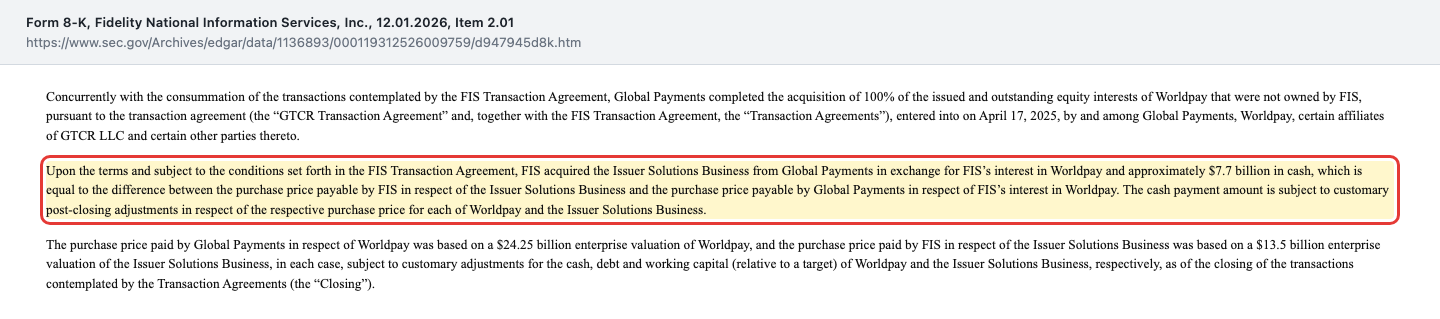
"Upon the terms and subject to the conditions set forth in the FIS Transaction Agreement, FIS acquired the Issuer Solutions Business from Global Payments in exchange for FIS’s interest in Worldpay and approximately $7.7 billion in cash, which is equal to the difference between the purchase price payable by FIS in respect of the Issuer Solutions Business and the purchase price payable by Global Payments in respect of FIS’s interest in Worldpay."
— Fidelity National Information Services, Form 8-K, January 12, 2026, Item 2.01
In numbers: Worldpay was valued at a $24.25 billion enterprise value, the Issuer Solutions business at $13.5 billion. FIS's own Worldpay stake was worth $5,762 million net of taxes and costs; on top came $7,695 million in cash and $16 million in converted employee equity awards. Total purchase price: $13,473 million. The acquired unit now trades as "FIS Total Issuing Solutions" and processes cards for financial institutions; it reports inside the Banking Solutions segment.
The cash came from a $7.7 billion bridge loan. On March 10, 2026, FIS refinanced that loan with notes: $2.0 billion at 4.450 percent due 2028, $2.3 billion at 4.550 percent due 2029, $0.5 billion floating rate due 2029, $2.0 billion at 4.800 percent due 2031, plus 500 million euros floating rate due 2028 and 500 million euros at 3.450 percent due 2030. Those coupons are the price of the swap — and they are locked in for years.
For the takeover question: this transaction is done. There is no takeover of FIS pending, no take-private and no further combination. Anyone checking the SEC record after May 8, 2026 finds nothing but routine through July 26, 2026: annual meeting results (June 12, 2026), a chief legal officer transition effective July 1, 2026, and insider filings.
How the stock reached our desk
We run roughly 3,500 stocks through our scanners every day. FIS reached the research list through our in-house stock scanner "Turnaround Candidates": rank 29 of 60 U.S. hits, turn check 6 of 8, as of July 26, 2026. To reproduce it: open the scanner, set the country filter to "US", sort by the turn check column. These lists are recalculated daily — rank and score are a dated snapshot, not a permanent state.
The scanner works in two stages. First come two mandatory pillars that no stock can bypass:
- Pillar 1 — the crash: the stock must trade at least 50 percent below its all-time high. Without a real crash there is no turnaround; otherwise the list catches ordinary growth stocks. We recalculated the figure ourselves: the highest closing price for FIS is $157.44 on February 14, 2020; adjusted for dividends and corporate actions it is $135.98 on April 29, 2021. Against the closing price of $41.51 on July 24, 2026, that is 73.6 percent and 69.5 percent below, respectively. The pillar is not marginally met — it is met with room to spare.
- Pillar 2 — survival: the Altman Z-score, a bankruptcy early-warning value built from several balance sheet ratios, must be at least 1.1; below that lies the distress zone. On top of that, no more than one balance sheet warning flag and positive equity. The scanner carries FIS at 2.4 as of July 26, 2026. That passes, but it is no pillow: a genuinely healthy reading sits above 3.
A note on honesty in the measurement. Roughly 60 stocks in our data set carry an all-time high that a legacy data defect at the vendor shifted by a factor of 1,000; such values land near minus 99.9 percent and are cut out by the scanner's minus 95 percent floor. That is not the case for FIS: our own recalculation from the price history lands between minus 69.5 and minus 73.6 percent, squarely inside the permitted minus 50 to minus 95 percent window. The stored value is plausible.
What matters is where the edge sits: if the price climbs above roughly $68 (adjusted basis) or $79 (unadjusted), the gap is smaller than 50 percent and FIS drops off this list — with nothing whatsoever having changed in the business. From $41.51 that would take a doubling. Remember this: a turnaround scanner rewards the crash. Leaving it usually means nothing went wrong.
Only after both mandatory pillars does the actual turn check count: eight points, four from the quarterly numbers (revenue direction, net margin, operating cash flow, balance sheet healing) and four from market behavior (price back above the 50-day line, three-month relative strength ahead of twelve-month, net insider buying, institutional accumulation). The list shows anyone scoring at least 6 of 8 — FIS stood at exactly 6 on July 26, 2026. That is the display floor, not the top. For comparison, the top-ranked name on the same list scored 8 of 8 that day. And part of the FIS score comes from numbers the swap flattered — which is what the next chapters are about. For another company on the same list where the numbers and the narrative sit far apart, see our Moody's analysis.
The numbers across the years — what genuinely impresses
Let us start with what is good, because there is more of it than the headlines suggest.
Revenue grows quietly but steadily. $9,831 million (2023), $10,127 million (2024), $10,677 million (2025) — roughly 4 percent a year on average, carried by recurring revenue in both segments. In the first quarter of 2026 revenue jumped to $3,295 million (prior-year quarter: $2,532 million). That is the acquisition. But FIS strips the effect out itself: excluding the new business, revenue grew 7 percent, and banking grew 9 percent. That is markedly faster than in the years before.
Cash flow grew with it. Operating cash flow: $2,078 million (2023), $2,175 million (2024), $2,608 million (2025). After $989 million of investment in software and equipment, roughly $1,619 million was free in 2025 — against $1,358 million the year before and $1,298 million in 2023. That is the yardstick for a software company, and it points the right way.
Margins are holding. In the first quarter of 2026, the adjusted EBITDA margin was 43.7 percent in Banking Solutions (prior-year quarter 40.7) and 51.6 percent in Capital Market Solutions (49.9). Both segments have grown not only larger but more profitable.
And shareholders get more again. The quarterly dividend rose from $0.40 to $0.44 per share effective with the first quarter of 2026. In 2025 FIS also repurchased 18 million shares for roughly $1.3 billion.
Now the part that deserves attention. Look at what happened at the bottom line:
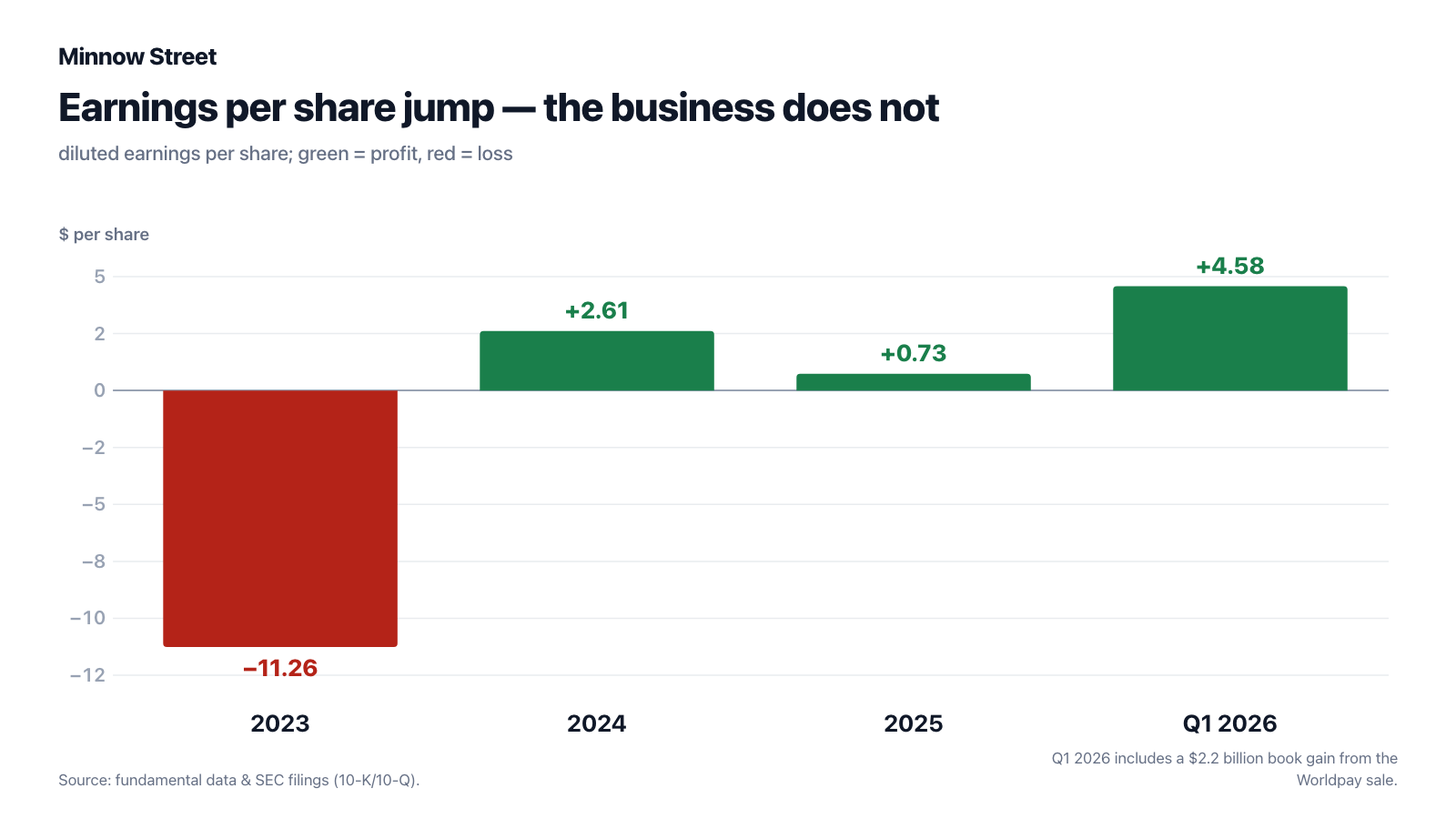
2023 brought a loss of $11.26 per share — the Worldpay write-down. 2024 brought a profit of $2.61, 2025 only $0.73, and the first quarter of 2026 delivered $4.58 in a single three-month stretch. Four numbers, four stories, and none of them describes how many banks FIS served in the respective period. The reason for the 2025 slump: the 45 percent Worldpay stake was accounted for under the equity method and produced a loss contribution of $526 million (2024: $145 million). The very same stake then produced a $2.2 billion gain on sale in 2026. This is not manipulation, it is accounting — but it means: at FIS, the bottom line has not measured the business for years.
What the filings say — five uncomfortable truths
Uncomfortable truth no. 1: the record profit is an entry, not a cash receipt
The first quarter of 2026 shows $2,366 million of net earnings. Of that, $2,214 million comes from the line "Equity method investment earnings" — that is, from the remeasurement and disposal of the Worldpay stake. Strip it out and roughly $152 million remains. FIS supplies the cleaner calculation itself in the notes: had the acquisition happened on January 1, 2025, the first quarter of 2026 would have shown revenue of $3,350 million and net earnings of $187 million.
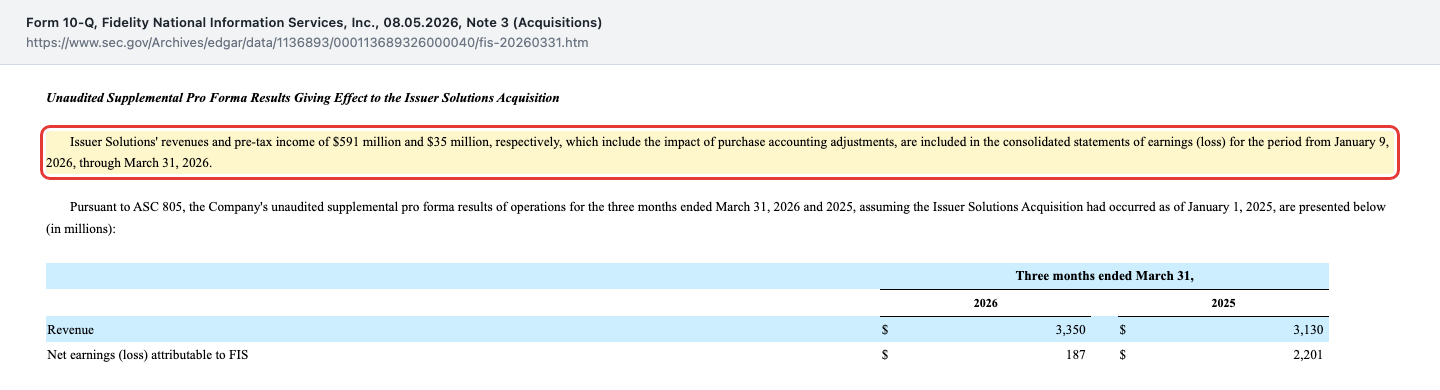
$187 million against $2,366 million. That is the gap between what the company earned and what the headline says. Anyone annualizing the quarterly result without adjusting for that item arrives at a profit FIS will never make again.
Uncomfortable truth no. 2: the new business earns almost nothing so far
The same note states what the acquired unit contributed in its first eleven weeks under FIS ownership: $591 million of revenue and $35 million of pre-tax income, both already after purchase accounting effects. That is a 5.9 percent pre-tax margin against a purchase price of $13,473 million.
Fairness requires a caveat: that figure carries freshly recognized amortization on software and customer relationships that did not exist at the seller — group purchase accounting amortization rose in the quarter from $169 million to $290 million. Judging the deal therefore means looking at the years ahead, not at the first quarter. But that is precisely the point: the proof that $13.5 billion was well spent is still outstanding. Until then it is a bet that has already been paid for.
Uncomfortable truth no. 3: four-fifths of the balance sheet cannot be touched
As of March 31, 2026, FIS had total assets of $43,484 million. Of that, $24,585 million is goodwill, $4,450 million intangible assets and $5,220 million capitalized software — together $34,255 million, or 78.8 percent. Goodwill, in plain terms, is the amount a buyer paid above the value of the individual assets because it believed in synergies and the future. It collects no rent, it is not amortized — and in bad years it is destroyed in a single entry. That is exactly what happened to FIS in 2023.
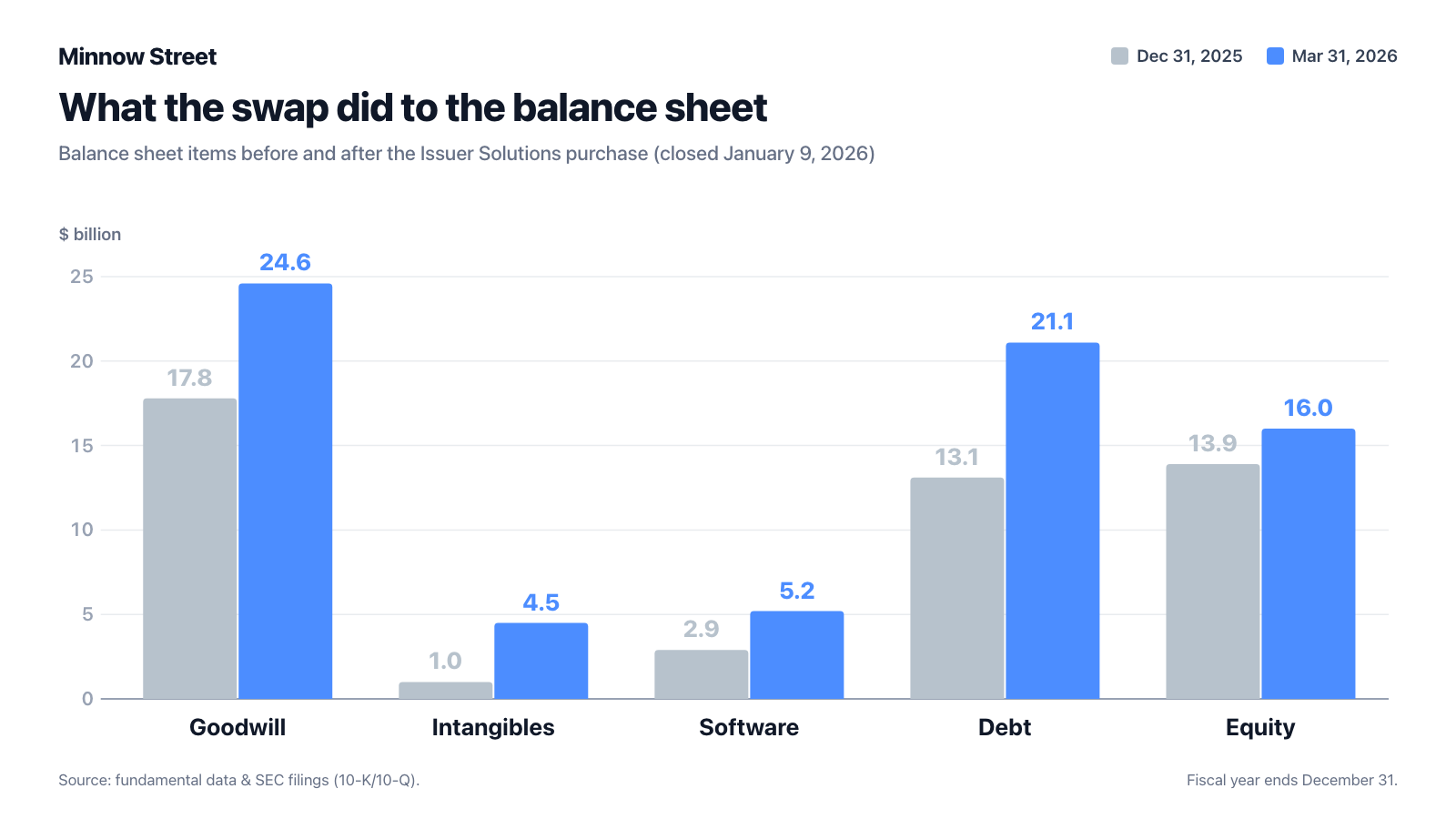
Three months earlier, on December 31, 2025, the same lines read $17,762 million of goodwill, $959 million of intangibles, $2,876 million of software and $13,902 million of equity — against total assets of $33,488 million. A single quarter rebuilt this balance sheet.
Run the arithmetic: $15,980 million of equity minus $24,585 million of goodwill minus $4,450 million of intangibles equals minus $13,055 million of tangible equity. For a software company that is not unusual — software is not a factory building — but it explains why the balance sheet reacts sensitively to any write-down. And equity still carries an accumulated deficit of $20,581 million, the scar of the Worldpay years.
Uncomfortable truth no. 4: debt grew by eight billion — in one quarter
On December 31, 2025, FIS carried $13.1 billion of debt at an average 3.0 percent. On March 31, 2026 it was $21.1 billion at 3.7 percent:
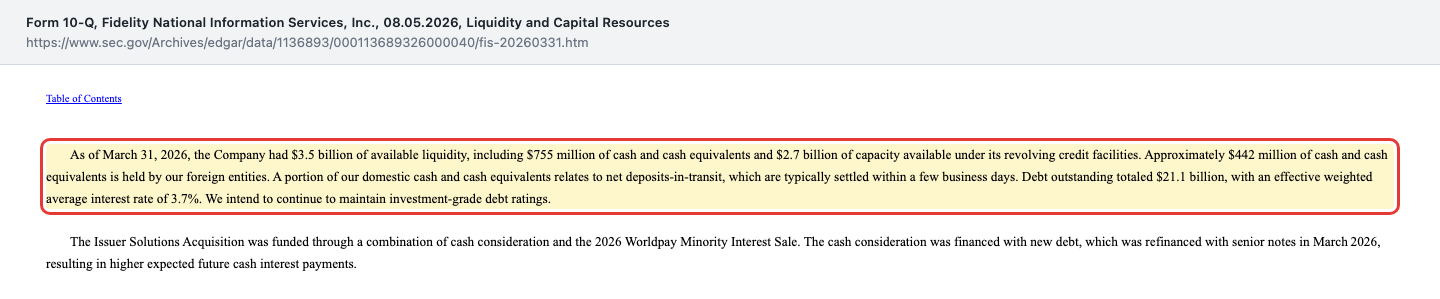
"Debt outstanding totaled $21.1 billion, with an effective weighted average interest rate of 3.7%. We intend to continue to maintain investment-grade debt ratings."
— Fidelity National Information Services, Form 10-Q for the quarter ended March 31, 2026, Liquidity and Capital Resources
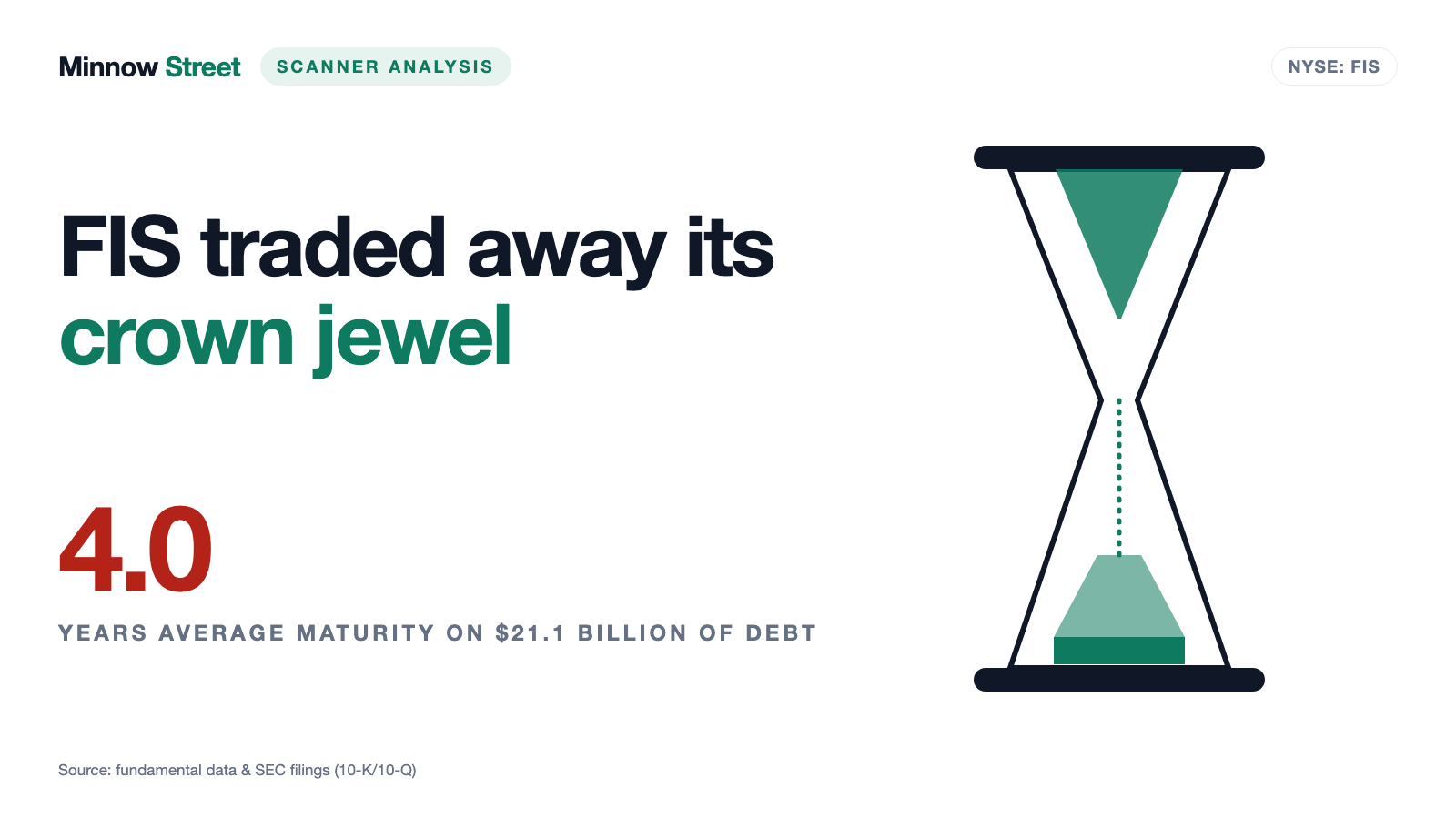
The price shows up in the income statement: net interest expense rose in the quarter from $80 million to $197 million, up 146 percent. Annualized, that points to something in the order of $800 million — against operating income of $1,741 million in 2025. And the rate bet is live: 23 percent of the debt floats; one percentage point more costs $48 million a year by the company's own calculation. A year earlier the same sensitivity read $13 million. The weighted average maturity is 4.0 years — that is roughly how long the bill stays as it is.
Uncomfortable truth no. 5: the buyback was halted and acquisitions throttled
When a company stops buying its own shares, that says more about its priorities than any press release. In the first quarter of 2025 FIS spent $537 million on repurchases; in the first quarter of 2026, $30 million. The filing states the reason openly:

"Following the closing of the Issuer Solutions Acquisition, the Company has temporarily curtailed repurchases under this program and may resume at management’s discretion, taking into account our target leverage ratio."
— Fidelity National Information Services, Form 10-Q for the quarter ended March 31, 2026, Liquidity and Capital Resources
Of the $3.0 billion authorization, $1.8 billion remains untouched. In the same filing FIS also says it expects to limit further acquisitions in order to deleverage faster. Financially that is sensible — and it also means the lever FIS used in recent years to support earnings per share is switched off for now.
Valuation — why the price-earnings ratio lies here
At a closing price of $41.51 on July 24, 2026 and roughly 516.9 million shares outstanding, the market capitalization is about $21.5 billion. Cross-check: 516.9 × $41.51 = $21.46 billion — identical to the figure in the fundamental data. Adding net debt gives an enterprise value of roughly $41.8 billion.
Here is where many screeners mislead. The reported price-earnings ratio is about 8. That looks dirt cheap — but the denominator is trailing twelve-month earnings, and those contain the $2.2 billion book gain from the Worldpay disposal. Use the 2025 result of $0.73 per share instead and the ratio becomes roughly 57. Both are correctly calculated, and both are useless.
Three other measures carry more weight:
- Free cash flow: $1,619 million in 2025 against $21.5 billion of market value — roughly 13 times. For a software company with recurring revenue, that is not expensive.
- Enterprise value to adjusted EBITDA: roughly 11 (data as of July 26, 2026). Also at the lower end for the sector.
- Sales and book multiples: roughly 1.9 and 1.3 — both low, though the book value deserves caution given the goodwill share.
Then the dividend: $1.68 per share per year gives a yield of roughly 4.0 percent at $41.51, with a payout ratio of 28.4 percent of earnings. That is covered.
How the professionals see it: 26 analysts arrive at an average target price of $56.64 (data as of July 26, 2026), roughly 36 percent above the July 24 close. Target prices are opinions with an expiry date, not measurements; we carry them as sentiment, not as an argument. The spread is more interesting: 16 of the 26 rate the stock a buy, 9 a hold, one a sell. The market does not agree with itself — which, for a company that just swapped half its portfolio, is honestly the most sensible reaction available.
Opportunities and risks at a glance
Opportunities
- The core business is growing faster than before: excluding the acquisition, up 7 percent in the first quarter of 2026 and up 9 percent in banking — against roughly 4 percent a year on average from 2023 to 2025.
- High switching costs: core banking contracts run for years, and recurring revenue carries both segments. That produced roughly $1,619 million of free cash flow in 2025.
- The acquired business is a volume operation with scale effects. If the synergies FIS expects materialize, its earnings contribution grows beyond the $35 million of pre-tax income from its first eleven weeks.
- The valuation already prices in skepticism: roughly 13 times free cash flow, roughly 11 times adjusted EBITDA, a 4.0 percent dividend yield at a 28.4 percent payout ratio.
- Roughly $6.0 billion of the newly created goodwill is deductible for U.S. federal income tax purposes — a real, if slowly realized, cash benefit.
Risks
- $21.1 billion of debt at 3.7 percent, 23 percent of it floating; one percentage point more costs $48 million a year. Quarterly interest expense has already more than doubled to $197 million.
- 78.8 percent of total assets are goodwill, intangibles and software. The purchase price allocation stays provisional until January 9, 2027 at the latest; the first quarter of 2026 already carried $104 million of software impairments.
- The integration proof is missing: $13,473 million of purchase price against $35 million of pre-tax income in eleven weeks. Whether the price was justified shows up in 2027 at the earliest.
- No more tailwind from buybacks: $30 million instead of $537 million per quarter, $1.8 billion of authorization idle, further acquisitions deliberately limited.
- Up to $834 million of contingent consideration from two smaller acquisitions may fall due through the second quarter of 2033; only $122 million is currently recognized.
- The past still echoes: the $20,581 million accumulated deficit and the securities class action over the former Merchant Solutions segment both come from the same Worldpay story. As of the reporting date the settlement had been reached and preliminarily approved, with the final approval hearing scheduled for July 9, 2026; the payment is expected to be substantially covered by insurance.
A human conclusion
Back to the swap trap from the opening. It is so effective precisely because it does not lie. The $4.58 of earnings per share in the first quarter of 2026 are correctly booked, audited and filed in a document for which people are personally liable. They simply are not an answer to the question you are actually asking: does this company make money doing what it does?
The honest answer sits three pages later in the same filing, and it reads: yes, but less than the headline suggests — $187 million in the quarter, roughly $1.6 billion of free cash flow a year, and all of it carrying a debt pile that just grew by eight billion. FIS traded a stake in a payment processor for a card processing business it can steer itself. That may have been smart. It may also have been the second expensive acquisition in seven years. The difference will not show up in this analysis but in the quarterly filings of 2027 and 2028 — exactly where purchase accounting amortization bites in full and the goodwill faces its first real impairment test.
What you do with that is your decision. And that is exactly as it should be.
Sources
- Form 10-Q for the quarter ended March 31, 2026 (filed May 8, 2026) — balance sheet, income statement, cash flow statement, Notes 3 (acquisitions), 7 (debt) and 11 (segments), Liquidity and Capital Resources, Item 3 (market risk)
- Form 10-K for 2025 (filed February 24, 2026) — business model, segments, employees, multi-year comparison, liquidity, repurchase program
- Form 8-K of January 12, 2026, Items 2.01 and 7.01 — closing of the swap on January 9, 2026
- Form 8-K of March 9, 2026, Item 8.01 — underwriting agreements for the new notes
- Form 8-K of March 10, 2026, Items 1.01 and 8.01 — issuance of the U.S. dollar and euro notes
- Form 8-K of June 18, 2026, Item 5.02 — chief legal officer transition effective July 1, 2026
- Fundamental data (metrics, price history, analyst estimates), data as of July 24 to 26, 2026
- Our in-house stock scanner, list Turnaround Candidates — rank 29 of 60 U.S. hits, turn check 6 of 8, as of July 26, 2026; the lists are recalculated daily
Journalistic analysis, not investment advice and not a solicitation to buy or sell securities. Stocks can lose their entire value; a total loss is possible. All figures come from the primary sources linked above and carry their respective as-of dates. The author holds no position in Fidelity National Information Services, Inc. at the time of publication.
Our Bottom Line at a Glance
- Core business and customer lock-in positive
- Core banking systems are sold for years and rarely replaced. It shows in the margins: an adjusted EBITDA margin of 43.7 percent in Banking Solutions in the first quarter of 2026 (prior-year quarter 40.7) and 51.6 percent in Capital Market Solutions (49.9). Excluding the acquisition, revenue grew 7 percent in the quarter and 9 percent in banking — noticeably more than the roughly 4 percent annual average between 2023 and 2025.
- Cash generation positive
- Operating cash flow rose from $2,078 million (2023) to $2,175 million (2024) to $2,608 million (2025). After $989 million of capital spending, $1,619 million was free — against $1,358 million and $1,298 million in the two prior years. In the first quarter of 2026 operating cash flow of $713 million also beat the prior-year figure of $457 million.
- Earnings quality negative
- Of $2,366 million of net earnings in the first quarter of 2026, $2,214 million comes from the book gain on the Worldpay disposal. The company's own pro forma table in the 10-Q filed May 8, 2026 puts the same quarter at $187 million. Prior years are barely more useful as a yardstick: minus $6,655 million (2023), plus $1,450 million (2024), plus $382 million (2025) — each heavily shaped by Worldpay effects.
- Leverage and interest burden negative
- Debt rose between December 31, 2025 and March 31, 2026 from $13.1 billion to $21.1 billion, and the average rate from 3.0 to 3.7 percent. Quarterly net interest expense grew from $80 million to $197 million. Twenty-three percent of the debt floats; one percentage point more costs $48 million a year by the company's own calculation — against $13 million a year earlier.
- Balance sheet substance neutral
- As of March 31, 2026, goodwill ($24,585 million), intangible assets ($4,450 million) and software ($5,220 million) together make up 78.8 percent of total assets of $43,484 million. The equity ratio stands at 36.7 percent and tangible equity is arithmetically negative. The purchase price allocation is provisional and must be final by January 9, 2027 at the latest; the quarter already carried $104 million of software impairments.
- Valuation and capital returns neutral
- Roughly $21.5 billion of market value (516,879,151 shares at a closing price of $41.51 on July 24, 2026) equals about 13 times 2025 free cash flow and about 11 times adjusted EBITDA. The $1.68 annual dividend yields roughly 4.0 percent at a 28.4 percent payout ratio. The buyback, by contrast, is idle: $30 million in the first quarter of 2026 after $537 million in the prior-year quarter, with $1.8 billion of authorization untouched.
FIS sells software that banks cannot easily walk away from — which is where 43 to 52 percent adjusted segment margins and roughly $1.6 billion of free cash flow in 2025 come from. On January 9, 2026 the company traded its Worldpay stake for the Issuer Solutions business and paid $7.7 billion in cash on top. The resulting $2.2 billion book gain makes the first quarter of 2026 look like the best in company history, while the company's own comparison table shows $187 million. What remains open is whether $13.5 billion was a fair price for a business that earned $35 million before taxes in its first eleven weeks — with debt up to $21.1 billion and the buyback standing still. Not investment advice.
What Our Rating Means
Open questions
The business works in principle, but one material question is open. As long as it stays open, our findings do not carry a quality verdict.
The business demonstrably works: $10,677 million of revenue in 2025 built on recurring contracts, adjusted segment margins of 43.7 and 51.6 percent in the first quarter of 2026, $2,608 million of operating cash flow and $1,619 million free after capital spending. What is open is a genuine operating question: whether the swap of January 9, 2026 was worth its price is unproven — the acquired business delivered $591 million of revenue and $35 million of pre-tax income in eleven weeks against a $13,473 million purchase price, and 91.8 percent of that price sits as goodwill, intangibles and software in a provisional balance sheet. Nothing supports red: equity is clearly positive at $15,980 million, interest coverage sits above two, liquidity is $3.5 billion, ratings remain investment grade, and the business throws off cash every quarter. Green is out of reach until the integration is proven — especially with debt up eight billion in a single quarter. The decision is yours.
A journalistic assessment by our editorial team at the time of the deep dive, based on public sources — not investment advice and not a solicitation to buy or sell. Your personal circumstances (investment goals, risk capacity, taxes) cannot be taken into account. What our levels mean, how verdicts are formed, and what conflicts of interest exist →
Worth Noting
- FIS reached the research list through our in-house stock scanner "Turnaround-Kandidaten": rank 29 of 60 U.S. hits, turn check 6 of 8, as of July 26, 2026 (counted on the live page). These lists are recalculated daily — rank and score are a dated snapshot, not a permanent state. Six of eight is also the display floor.
- The scanner's two mandatory pillars: at least 50 percent below the all-time high, and an Altman Z-score of at least 1.1. FIS clears both with room to spare — the gap to the highest closing price of $157.44 (Feb 14, 2020) is 73.6 percent, and 69.5 percent against the adjusted high of $135.98 (Apr 29, 2021), both measured against $41.51 on July 24, 2026; the Altman Z reads 2.4. Only above roughly $68 (adjusted) or $79 (unadjusted) does pillar 1 break and the stock leaves the list, with nothing having changed in the business.
- Plausibility check on the stored all-time-high gap: roughly 60 stocks in the data set carry an all-time high shifted by a factor of 1,000 through a legacy vendor defect; such values land near minus 99.9 percent and are cut out by the minus 95 percent floor. That does not apply to FIS: our own recalculation from the price history gives minus 69.5 to minus 73.6 percent, squarely inside the permitted window.
- Takeover check: there is no tender offer, no take-private and no merger agreement pending on FIS. The swap with Global Payments (agreements dated April 17, 2025) closed on January 9, 2026 and is therefore complete. Between the most recent quarterly report of May 8, 2026 and the data date of July 26, 2026, the SEC record contains only annual meeting results (8-K of June 12, 2026), a chief legal officer transition (8-K of June 18, 2026) and insider filings.
- Risk of confusion: Fidelity National Information Services, Inc. (FIS, CIK 1136893) is not the same company as Fidelity National Financial, Inc. (FNF, CIK 1331875), a title insurer. Former names of the same CIK per SEC records: Certegy Inc. (until February 1, 2006) and Equifax PS Inc. (2001).
- Price figures are dated valuation anchors, not buy arguments: closing price $41.51 on July 24, 2026, 52-week high $81.94 (July 25, 2025), 52-week low $37.72 (June 22, 2026). Market capitalization cross-check: 516,879,151 shares × $41.51 equals $21.46 billion — identical to the fundamental data figure. The most recent periodic filing is the 10-Q for the quarter ended March 31, 2026.
Frequently Asked Questions
FIS gave up its 45 percent stake in Worldpay and received the Issuer Solutions business from Global Payments. Worldpay was valued at a $24.25 billion enterprise value and Issuer Solutions at $13.5 billion. FIS settled the difference with $7,695 million in cash. The total purchase price was $13,473 million (Form 8-K of January 12, 2026; Form 10-Q for the quarter ended March 31, 2026).
Because $2,214 million of the $2,366 million net result came from the book gain on the Worldpay disposal — the difference between the sale value and the carrying amount of the stake. FIS supplies a comparison in the same filing: had the acquisition happened on January 1, 2025, the quarter would have delivered $187 million of net earnings. The book gain does not repeat.
As of March 31, 2026, $21.1 billion was outstanding at an effective weighted average interest rate of 3.7 percent and a weighted average maturity of 4.0 years. Three months earlier it was $13.1 billion at 3.0 percent. Seventy-seven percent of the debt is fixed rate and 23 percent floating; a one percentage point rise in rates would cost $48 million a year.
No. The swap with Global Payments was the last major structural move and closed on January 9, 2026. Between the most recent quarterly report of May 8, 2026 and July 26, 2026, the SEC record contains only routine items: annual meeting results, a chief legal officer transition and insider filings. There is no tender offer and no merger agreement.
No. Fidelity National Information Services (NYSE: FIS, CIK 1136893) sells software to banks and capital markets firms. Fidelity National Financial (NYSE: FNF, CIK 1331875) is a title insurer for real estate transactions. Both trace back to the same origin and therefore carry similar names, but they have been separate, independently listed companies for years.
Because the stock meets both mandatory conditions. It trades roughly 70 to 74 percent below its all-time high of $157.44 (February 14, 2020), or $135.98 on an adjusted basis (April 29, 2021), and the Altman Z bankruptcy early-warning score of 2.4 sits above the 1.1 distress threshold. On the turn check FIS scored exactly 6 of 8 points on July 26, 2026 — the display floor. Rank 29 of 60.
Yes. The quarterly dividend was raised from $0.40 to $0.44 per share effective with the first quarter of 2026, or $1.68 on an annual basis. At a closing price of $41.51 on July 24, 2026 that equals roughly a 4.0 percent yield at a payout ratio of 28.4 percent. FIS ties future increases to growth in adjusted earnings per share.
Second-quarter 2026 results are announced for August 4, 2026. Four lines matter there: the revenue contribution of the Issuer Solutions business against $591 million in the prior quarter, its pre-tax income against $35 million, the buyback volume against $30 million, and the debt line against $21.1 billion.
Found an error?
Did you spot a factual error, an outdated number, or a typo in this deep dive? Let us know briefly — your report goes straight to the editorial team.