Teladoc Health: 101 Million Members, $2.5 Billion in Revenue — and $14.3 Billion of Goodwill That Was Never There
Teladoc Health is the largest virtual care company in the world: 101.2 million U.S. members as of March 31, 2026, 17.1 million visits in 2025 alone, roughly 5,600 employees and $2,530.0 million of revenue. The business pays its own way in cash — $294.4 million of operating cash flow in 2025. And yet the same filings with the U.S. securities regulator, the SEC, disclose $14.3 billion of goodwill already written off, every acquisition inside the Integrated Care segment impaired on the day it closed, and $1.0 billion of convertible notes falling due on June 1, 2027 — against $750.7 million of cash. Not investment advice — just the question of what a dollar of revenue is worth after $14.3 billion of it was once paid for by mistake.
 Thomas Mücke
Founder & Publisher
Thomas Mücke
Founder & Publisher
Chart
Interactive price chart (TradingView).
Note: pure fact-based analysis, not investment advice and not a solicitation to buy or sell. All figures without guarantee.
The purchase-price reflex
There is an arithmetic trap that catches the careful ones precisely because it sounds so solid. Call it the purchase-price reflex: spend eighteen billion dollars and you believe you own eighteen billion dollars. In daily life the error corrects itself — pay $30,000 for a new kitchen and what you have afterwards is a kitchen, not $30,000, and everyone knows it. In a stock market the mistake is far more stubborn — and few companies demonstrate it as brutally as Teladoc Health, Inc. (NYSE: TDOC).
Both halves of the story sit in the same documents. On one side: the largest virtual care provider in the world, 101.2 million U.S. members as of March 31, 2026, 17.1 million visits in 2025 alone, roughly 5,600 employees and $2,530.0 million of revenue. On the other: $14.3 billion of goodwill written off, an accumulated deficit of $16,494.1 million, and a billion dollars of convertible notes coming due in less than a year.
So here is the deal. Before the purchase-price reflex tells you that a stock trading roughly 97 percent below its all-time high (data as of July 28, 2026) simply has to come back one day, let us read what the company itself told the U.S. securities regulator, the SEC: the annual report on Form 10-K for 2025, filed February 26, 2026, and the quarterly report on Form 10-Q for the period ended March 31, 2026, filed April 30, 2026. An SEC filing is honest under penalty of law. And this one contains five sentences that never appear in a telehealth presentation. What you do with them is up to you.
What Teladoc Health actually does — a doctor's visit without a waiting room, and a marketplace for therapy
At its core Teladoc Health sells something very simple: access to a doctor without anyone having to get up. Video, phone, app. The company was founded in Texas in 2002, reincorporated in Delaware in 2008 and has carried the Teladoc Health name since August 10, 2018 — before that it was simply “Teladoc, Inc.” In June 2025 the head office moved from Purchase, New York, to New York City. As of December 31, 2025 the company employed roughly 5,600 people, 83 percent of them full time; 58 percent work in the United States and 42 percent abroad. Care itself is delivered largely through networks of independent clinicians organized in affiliated professional associations.
The company reports in two segments. The first is Integrated Care, the institutional business: employers, health plans, hospitals and financial services firms buy access for their employees or members and pay a monthly per-member fee. In everyday terms Teladoc here is less a medical practice than a subscription provider — like a gym membership a company buys for its staff, whether or not everyone shows up. That segment produced $1,579.6 million of revenue in 2025. It also contains the chronic care programs (1.197 million enrollees as of March 31, 2026, up 4 percent) and connected devices such as cellular blood glucose meters. For a look at how the same principle — health benefits purchased by the employer — plays out at a specialized provider with very different economics, see our analysis of Progyny.
The second segment, BetterHelp, works in a completely different way: an online therapy marketplace that individuals pay for themselves or, increasingly, through insurance. No employer in between, no annual contracts — customers who have to be bought back every single month. BetterHelp generated $950.4 million of revenue in 2025, 38 percent of the consolidated total. Hold on to that distinction, because it carries half of this analysis: one segment sells subscriptions to institutions, the other buys its customers through advertising.
That also names the central tension of this analysis, and it runs through every chapter that follows: Teladoc Health operates a large, functioning business that pays its own way in cash — and sits inside a balance sheet whose own impairment tests have said for years that the parts are worth less than what was paid for them. Both are true. The only question is which of the two truths controls the cash register over the next two years.
How the stock reached our desk — through the forums, not through a quality screen
Honesty first: Teladoc Health did not arrive through any of our momentum, quality or valuation screens. On July 29, 2026 the stock appeared on the list of most-discussed Reddit tickers that we maintain in our scanner area — nothing more. Those lists are recalculated daily, so the mention explicitly carries that date and may read differently tomorrow.
More interesting than the trigger is the data sheet behind it (data as of July 28, 2026). The share price stood at $9.40 and market capitalization at $1.711 billion — broadly consistent with the 180,513,087 shares outstanding shown on the cover of the quarterly report (as of April 23, 2026), which at $9.40 work out to $1.70 billion. That puts the price-to-sales ratio at roughly 0.68: the market pays about two thirds of one year of revenue for the entire company. The Piotroski F-Score — a nine-point health check of the books where genuinely sound companies score 8 or 9 — comes to 6 out of 9: acceptable, not good. The equity ratio of 47.6 percent is surprisingly solid for a company with this history, and the gross margin of 69.3 percent belongs to a software business, not a service provider. Meanwhile 16.4 percent of the float was sold short — a high figure showing that a meaningful part of the market is positioned against this stock.
Read together, none of these numbers argues on its own for buying or selling. Taken as a whole they describe a company that looks cheap because the market doubts its value, not because nobody has noticed it. Anyone who wants to check the work can open the company page in our stocks section and read the balance sheet and valuation sections; every figure above carries the July 28, 2026 data date. Source: our in-house stock scanner and fundamental data.
The numbers over the years — fairly credited
Start with what genuinely impresses, because it deserves to be said first and most commentary on this stock leaves it out: the business earns money — every year, in cash. Operating cash flow came to $350.0 million (2023), $293.7 million (2024) and $294.4 million (2025). That is not an accounting figure, it is money arriving in the bank. It allowed Teladoc to repay maturing convertible notes totalling $550.6 million in 2025 with no outside help — no equity raise, no fire sale, no new bond. Not many companies trading roughly 97 percent below their all-time high (data as of July 28, 2026) can say that.
The scale is real too. 101.8 million U.S. members in Integrated Care as of December 31, 2025 (up 8.0 million, or 9 percent, year over year), 17.1 million visits during 2025, and a distribution network of employers, insurers and hospitals that cannot be rebuilt in two years. Integrated Care grew 2025 revenue to $1,579.6 million and segment adjusted EBITDA to $239.2 million; in the first quarter of 2026 it kept growing, from $50.4 million to $56.3 million. Anyone who still thinks virtual medicine was a 2020 fad should know these figures.
Honesty also requires saying how fresh those growth numbers are. The quarterly report for the period ended March 31, 2026 records that U.S. membership fell by 1.3 million, or 1 percent, to 101.2 million against the prior-year quarter — the high-water mark is behind the company. And the 2 percent revenue gain in Integrated Care came, according to the same filing, from roughly 2 percentage points of acquisition contribution (Catapult Health and Telecare); organically the segment is roughly flat. For full-year 2026 the company\'s own outlook of April 29, 2026 calls for only 97 to 100 million U.S. members.
Now the other half of the same table. Revenue has fallen for two consecutive years since the 2023 peak: $2,602.4 million (2023), $2,569.6 million (2024), $2,530.0 million (2025). And each of those three years ended in a loss — $220.4 million, $1,001.2 million and $200.3 million, or $1.34, $5.87 and $1.14 per share. In the first quarter of 2026 revenue fell 2 percent to $613.8 million and the loss came to $63.8 million.
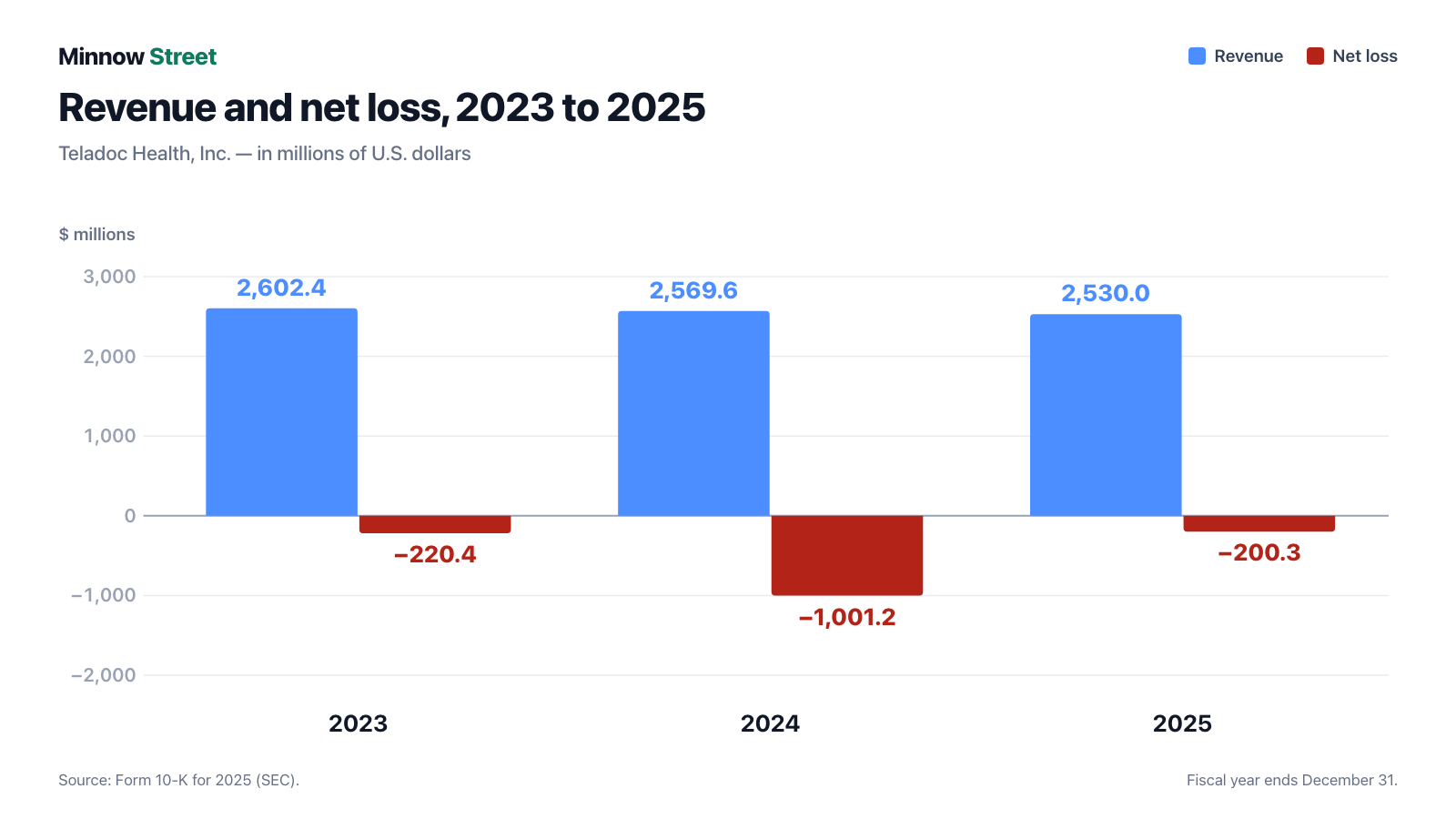
The enormous 2024 loss is not an operating one: it contains $790.0 million of goodwill impairment on BetterHelp, not a cent of which left the bank. That is the fair objection to the headline number — and it is also the bridge to the next chapter. A non-cash write-down is not a bill, but it is a verdict: the company\'s own auditors ruling on what was bought.
What the filings say — the uncomfortable truths
Uncomfortable truth No. 1: $14.3 billion of goodwill is gone
When a company buys another and pays more than the individual assets are worth, the difference goes onto the balance sheet as goodwill — in plain terms, the premium for reputation, customers and future hope. It stays there until an annual impairment test decides the hope no longer holds. Teladoc acquired aggressively during the boom years, most notably Livongo in 2020. What survives of that is captured in one sentence in the 2025 annual report:
“Goodwill as of December 31, 2025 is net of accumulated impairment charges of $14.3 billion, of which $12.3 billion was recognized prior to the Company reorganizing its reporting structure to include two reportable segments, $1.2 billion was recognized on the goodwill assigned to the Integrated Care segment, and $0.8 billion was recognized on the goodwill assigned to the BetterHelp segment.”
— Teladoc Health, Inc., Form 10-K for 2025, Note 7 “Goodwill”

What survives is $283.2 million of goodwill, all of it assigned to BetterHelp. The equity section of the March 31, 2026 balance sheet tells the same story: $17,865.6 million of additional paid-in capital against an accumulated deficit of $16,494.1 million; after deducting a $35.4 million accumulated other comprehensive loss and adding the $0.2 million par value of the shares, $1,336.3 million of book equity remains. Of roughly $17.9 billion that shareholders paid in or delivered as stock consideration, $1.3 billion remains on the books. That is the purchase-price reflex in its purest form: the price was always certain, the value never was.
Uncomfortable truth No. 2: every acquisition is written off on the day it closes
This is the real find of the research, and it appears in no press release. Goodwill in the Integrated Care segment is so far under water that the impairment test destroys every acquisition on arrival:
“Concurrent with the closing of its acquisitions of Telecare and Catapult Health, the Company performed goodwill impairment tests on its Integrated Care reporting unit and determined that the carrying value of the reporting unit continued to exceed its fair value.”
— Teladoc Health, Inc., Form 10-K for 2025, Note 7 “Goodwill”

Translated into one memorable sentence: Teladoc cannot buy anything inside its larger segment without booking the purchase price as a loss in the same quarter. This is not a one-off entry but a state of affairs — the filing expressly warns that future business combinations in that unit could trigger further impairment charges. For a company whose growth story long rested on acquisitions, that is a strategic shackle: the usual remedy for falling revenue costs book equity here on day one.
Uncomfortable truth No. 3: BetterHelp spends every second dollar on advertising and still loses users
BetterHelp was the growth engine for years. Today it is the segment carrying the last of the goodwill. And it is shrinking:
“BetterHelp Paying Users decreased by 9% to 0.361 million for the three months ended March 31, 2026, compared to 0.397 million for the three months ended March 31, 2025.”
— Teladoc Health, Inc., Form 10-Q for the quarter ended March 31, 2026, Item 2 (MD&A)

Now the arithmetic. In the first quarter of 2026 BetterHelp booked $218.4 million of revenue and spent $116.8 million on advertising and marketing — 53 percent of its own revenue. For full-year 2025 the same calculation reads $518.5 million against $950.4 million, or 55 percent. In everyday terms: of every two dollars a therapy customer pays, roughly one goes straight back out to Google, Meta and podcast advertising before a single therapist is paid. And because customers can cancel monthly, the spending never stops — it is not an investment, it is rent.
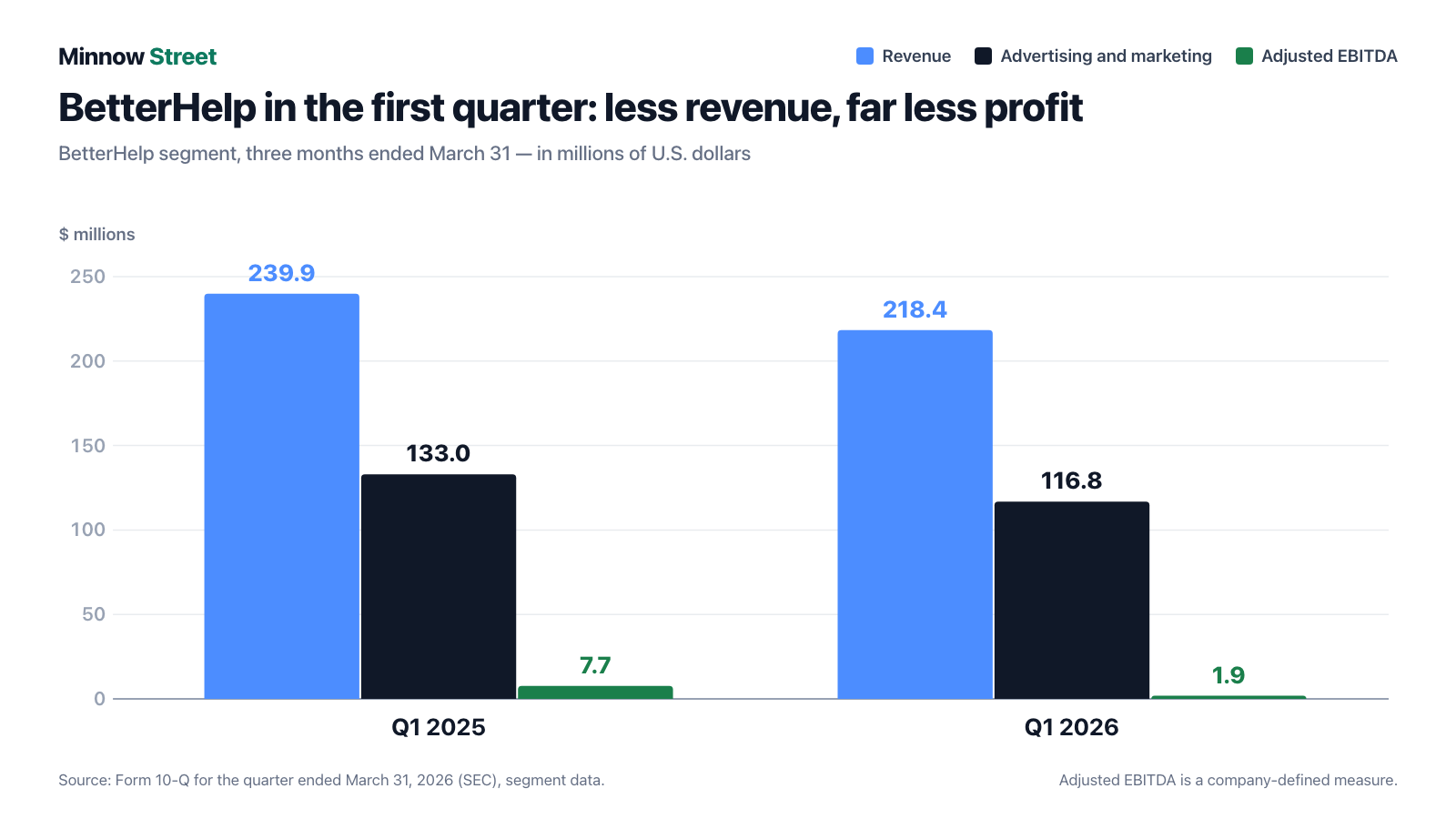
Segment adjusted EBITDA — a company-defined measure of earnings before interest, taxes, depreciation and amortization — fell from $7.7 million to $1.9 million, down 75 percent on a 9 percent revenue decline. On an annual basis it went from $77.8 million (2024) to $41.9 million (2025). In fairness: the first quarter is seasonally the weakest for BetterHelp because advertising restarts in January before the customers pay, and the filing says so itself. The prior-year quarter confirms the seasonality but not the decline: the loss of users is real.
Uncomfortable truth No. 4: a billion dollars comes due on June 1, 2027
In 2020, at the peak of telehealth enthusiasm, Teladoc could borrow money almost for free. The result is still on the balance sheet:
“At March 31, 2026, the Company’s outstanding senior notes consisted of $1.0 billion aggregate principal amount of 1.25% convertible senior notes due 2027 (the “2027 Notes”), issued on May 19, 2020 for net proceeds to the Company of $975.9 million after deducting offering costs of approximately $24.1 million.”
— Teladoc Health, Inc., Form 10-Q for the quarter ended March 31, 2026, Note 10 “Debt”

The decisive detail is in the table below it: the conversion rate is 4.1258 shares per $1,000 of principal, a conversion price of roughly $242 per share. At $9.40 (data as of July 28, 2026) no creditor on earth will swap into stock. In everyday terms: the coupon that would let holders convert into shares is worthless — the convertible has quietly become ordinary debt, and it has to be repaid in cash. The flip side is real too: dilution from this instrument is a non-issue, since only 4.1 million shares are reserved against it.
Now the coverage math. Cash at March 31, 2026: $750.7 million. Alongside it a secured revolving credit facility of $300.0 million in place since July 17, 2025, of which $296.6 million is available and none has been drawn. Free cash flow in 2025 was roughly $166.9 million, and the company\'s own outlook of April 29, 2026 calls for $130 million to $170 million in 2026, so another $200 million or so should accumulate before the June 2027 maturity if the business runs on unchanged. The arithmetic works, but only just, and only with the revolver as backstop. That is why every quarterly report between now and then is a progress check on a payment question, not only on a growth question.
And that is exactly why one personnel item stands out, even though it shows up in no ratio. Chief Financial Officer Mala Murthy told the company on October 17, 2025 that she would resign effective November 21, 2025; Teladoc Health told the SEC it had begun a search for a successor. That search is still running. The Form 10-K for 2025 (February 26, 2026) and the Form 10-Q for the quarter ended March 31, 2026 (April 30, 2026) carry the same single signature — chief executive Charles Divita, III, signing as “Chief Executive Officer and Principal Financial Officer”. The proxy statement of April 7, 2026 lists “Interim Principal Financial Officer (2025 to present)” in his biography. Through July 29, 2026 the company had filed no 8-K under Item 5.02 announcing a successor.
In context: this is not an accounting error and not a warning sign in itself. The books are audited by Ernst & Young, shareholders ratified that appointment on May 21, 2026, and a chief accounting officer (Joseph Catapano) is in place. But it does mean that for more than eight months the same person has run the business and certified its numbers — during the very period in which the repayment or refinancing of a billion dollars has to be arranged. Anyone following this stock should treat the filling of the finance seat like a scheduled quarterly event.
Uncomfortable truth No. 5: market capitalization sits below book value — and the last goodwill hangs on the weakest segment
One sentence in the quarterly report deserves a second reading because it passes by so casually: the company records that its market capitalization remained below its carrying or book value during the first quarter of 2026. In other words, the market values the business at less than its own balance sheet does. Under U.S. accounting rules that is an indicator that can trigger an additional impairment test. The company saw no reason for an interim test at the reporting date but says expressly that it will keep monitoring the situation, in particular a sustained decline in the share price. At stake would be the remaining $283.2 million of goodwill, all of it assigned to BetterHelp — 21 percent of the $1,336.3 million of book equity.
A second item is considerably larger and gets discussed far less: $1,235.2 million of intangible assets (customer relationships, trademarks, software, technology), or 44 percent of total assets. They are amortized on schedule — $350.8 million in 2025 and $89.8 million in the first quarter of 2026 alone. That is the main reason a company with $294.4 million of operating cash flow still reports a loss. It is also the reason the reported bottom line will improve almost mechanically over the coming years, as that amortization runs off. Anyone measuring the turnaround by the net income line will then be measuring something that is not the business.
Valuation — $1.71 billion for $2.53 billion of revenue
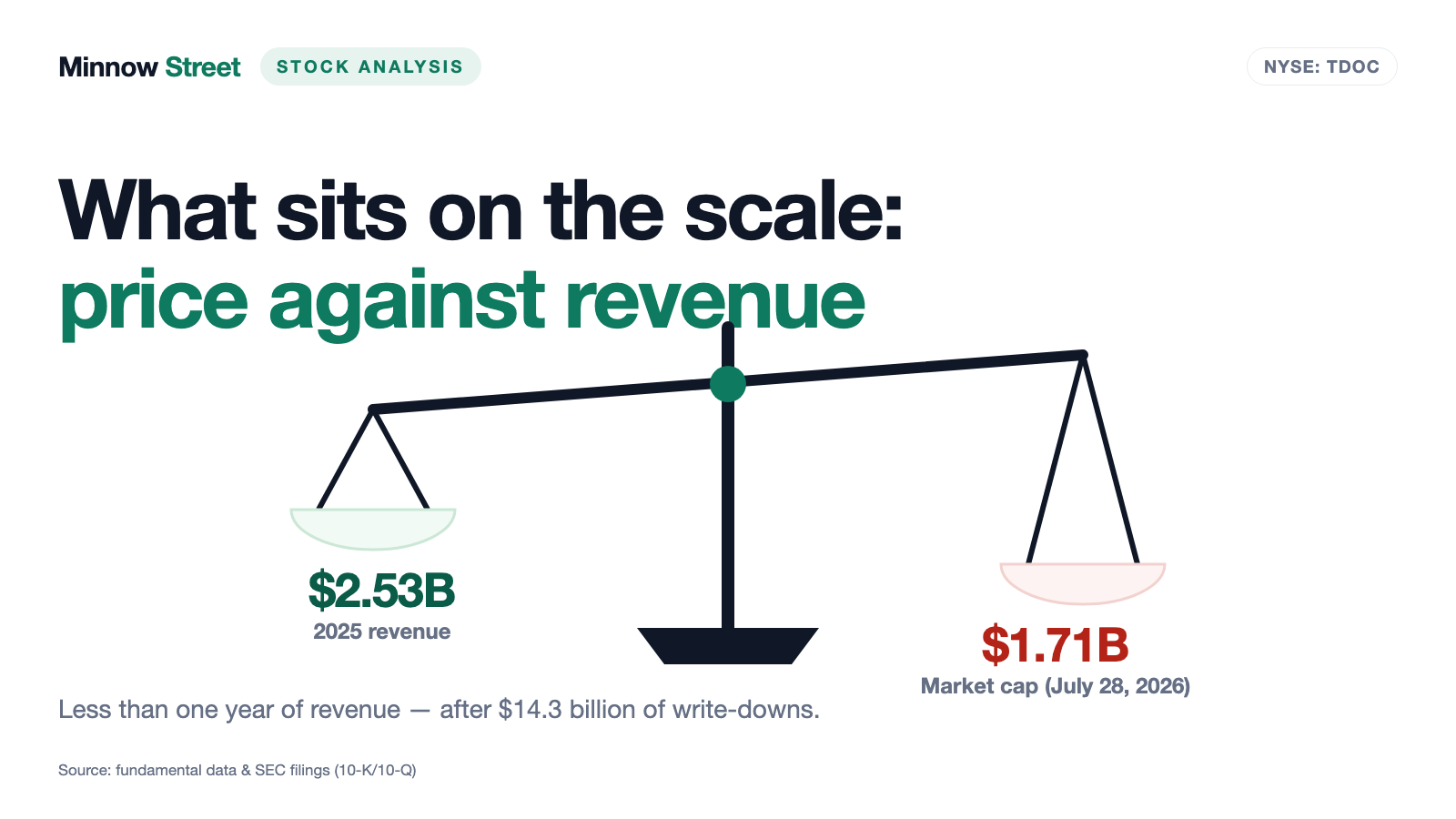
There is no price-to-earnings ratio because there are no earnings. That leaves three defensible orders of magnitude, all as of July 28, 2026. First, a price-to-sales ratio of roughly 0.68 — $1.711 billion of market capitalization against $2,530.0 million of 2025 revenue. Second, enterprise value, meaning market capitalization plus debt minus cash: 1.711 + 1.000 − 0.751 = roughly $1.96 billion, or 0.77 times annual revenue. Third, a price-to-book ratio of about 1.3 — $1.711 billion against $1,336.3 million of book equity.
Translated: the market pays about 68 cents for a dollar of Teladoc revenue. For a provider with a 69.3 percent gross margin, recurring subscription income and 101 million members, that would be dirt cheap — if you trust the revenue. That is exactly what the market doubts: revenue is falling for a second consecutive year, membership has started to shrink as well, the lower-margin BetterHelp segment is shrinking by 9 percent — by double digits without the Uplift acquisition — and the June 2027 payment date hangs over everything. The discount is not an oversight. It is the market\'s answer to those questions.
The professional view fits the picture and is unusual: 24 analysts carried an average price target of $7.40 as of July 28, 2026 — below the $9.40 share price at the time. That is rare, and it has an obvious cause: the stock had run ahead of the estimates in the preceding months. It should not be read as a forecast, but it does support one observation: the summer 2026 price sat above what the professionals credited the company with — the opposite of an overlooked stock. For a useful comparison, see how margin, growth and valuation interact at another provider selling benefits through the employer in our analysis of Alight.
Opportunities and risks at a glance
What speaks for Teladoc Health:
- Real, large reach: 101.2 million U.S. members in Integrated Care (March 31, 2026) and 17.1 million visits in 2025, delivered through a distribution network of employers, insurers and hospitals that no start-up rebuilds in a few years.
- The core business earns: Integrated Care lifted 2025 revenue to $1,579.6 million and segment adjusted EBITDA to $239.2 million, and segment profit rose further from $50.4 million to $56.3 million in the first quarter of 2026.
- Operations produce cash: $294.4 million of operating cash flow in 2025, after $293.7 million and $350.0 million in the two prior years — enough to retire $550.6 million of maturing notes in 2025 without outside help.
- Balance sheet reserve: $750.7 million of cash and an undrawn $300.0 million revolver (March 31, 2026), with an equity ratio of 47.6 percent (data as of July 28, 2026).
- Cheap on the numbers: price-to-sales of roughly 0.68, enterprise value of 0.77 times revenue and a 69.3 percent gross margin (data as of July 28, 2026).
- The bottom line improves mechanically: amortization of intangible assets ($350.8 million in 2025) runs off over time.
What speaks against it:
- Revenue is falling for a second consecutive year: $2,602.4 million to $2,569.6 million to $2,530.0 million, and down another 2 percent to $613.8 million in the first quarter of 2026.
- Membership is falling too: down 1.3 million, or 1 percent, to 101.2 million in the first quarter of 2026; the company\'s own full-year 2026 outlook (April 29, 2026) calls for only 97 to 100 million.
- BetterHelp is shrinking twice over: paying users down 9 percent and revenue down 9 percent in the first quarter of 2026, with segment profit down from $7.7 million to $1.9 million while advertising absorbs 53 percent of segment revenue.
- June 1, 2027 payment date: $1,000.0 million in cash against $750.7 million of cash on hand, with the roughly $242 conversion price making a share conversion effectively impossible.
- The balance sheet distrusts the business: $14.3 billion of goodwill written off, Integrated Care goodwill at zero, and every acquisition there impaired on arrival.
- Further impairment possible: market capitalization stayed below book value during the first quarter of 2026; $283.2 million of BetterHelp goodwill would be at stake.
- Open litigation: putative class actions against BetterHelp connected to the July 2023 consent order with the U.S. Federal Trade Commission, plus a securities class action in which the court granted the motion to dismiss only in part on March 31, 2026.
- The finance seat is vacant: since the chief financial officer left on November 21, 2025, chief executive Charles Divita, III, has held the role as well; no successor had been announced through July 29, 2026 — right ahead of the 2027 billion-dollar maturity.
- Heavy short interest: 16.4 percent of the float was sold short as of July 28, 2026 — a market that is mostly skeptical.
A human conclusion
Back to the purchase-price reflex. It is stubborn precisely because the purchase price is genuine. Teladoc Health really did pay billions for Livongo and BetterHelp, it really did take in or issue roughly $17.9 billion of shareholder capital, and anyone who bought in 2021 really did pay that price. None of that proves what the company is worth today. The company itself answered that question long ago — it has written $14.3 billion of it back off through its own impairment tests.
Even so, it would be too easy to see only a ruin here. Underneath the written-off goodwill sits a business that reaches 101 million people, handles 17 million visits a year and pushes roughly $300 million into the bank annually. It used that cash to repay half a billion dollars of debt without asking a single investor for money. That is more than most fallen growth stocks of 2021 can show.
So the honest finding is neither “bargain” nor “bankruptcy candidate.” It is this: a solidly paying core business sits next to a shrinking advertising-fed business, and a payment date sits between them. Whoever buys today is not betting on telehealth — that argument was settled long ago, virtual visits are here to stay. They are betting on three very concrete things: that the revenue decline ends in year three, that BetterHelp turns its user curve before advertising eats the segment result entirely, and that the billion due in June 2027 is covered by cash and the revolver without new shares.
Three questions, three dates, three quarterly reports in which they will be answered. That is a testable bet — and that is more than most turnaround stories can offer. Whether the price is right for you is not something any ratio can decide. What you do with it is your decision. And that is exactly as it should be.
Sources
Every primary document used in this analysis — to read for yourself:
- Teladoc Health, Inc. — SEC Form 10-K for 2025 (filed February 26, 2026)
- Teladoc Health, Inc. — SEC Form 10-Q for the quarter ended March 31, 2026 (filed April 30, 2026) — the most recent periodic report at the time of writing
- Teladoc Health, Inc. — SEC Form 10-K for 2024 (filed February 27, 2025)
- Teladoc Health, Inc. — SEC Form 8-K dated April 29, 2026, Items 2.02 and 9.01 (first quarter 2026 results) — including Exhibit 99.1 with the 2026 outlook
- Teladoc Health, Inc. — SEC proxy statement on Schedule DEF 14A dated April 7, 2026 — the chief executive\'s biography carries the note “Interim Principal Financial Officer”
- Teladoc Health, Inc. — SEC Form 8-K dated October 23, 2025, Item 5.02 (CFO resignation effective November 21, 2025)
- Teladoc Health, Inc. — SEC Form 8-K dated May 21, 2026, Item 5.07 (annual meeting results) — the most recent substantive filing after the quarterly report
- Complete SEC filing history for Teladoc Health, Inc. (CIK 0001477449): EDGAR overview (sec.gov)
- Fundamental data (price, market capitalization, valuation and market metrics; data as of July 28, 2026), reconciled against the SEC filings.
- Screening and valuation data: our in-house stock scanner (data as of July 28, 2026); Reddit mentions: ApeWisdom (as of July 29, 2026).
Transparency & disclaimer: This analysis is journalistic commentary on publicly available information. It is not investment advice, not a regulated financial analysis and not a solicitation to buy or sell securities. Equity investments carry substantial risk up to total loss. All information is provided without warranty; the relevant as-of date is stated in the text. The author holds no position in Teladoc Health shares at the time of publication.
Our Bottom Line at a Glance
- Market position and reach positive
- The world's largest virtual care provider: 101.2 million U.S. members in Integrated Care (March 31, 2026), 17.1 million visits in 2025, roughly 5,600 employees and a distribution network of employers, insurers and hospitals that cannot be recreated quickly.
- Integrated Care core business positive
- The larger segment grows and earns: $1,579.6 million of revenue and $239.2 million of segment adjusted EBITDA in 2025, rising from $50.4 million to $56.3 million in the first quarter of 2026. Consolidated gross margin stood at 69.3 percent as of July 28, 2026.
- Revenue trend negative
- Revenue has fallen for two straight years since the 2023 peak: $2,602.4 million (2023), $2,569.6 million (2024), $2,530.0 million (2025), plus another 2 percent decline to $613.8 million in the first quarter of 2026. The decline comes from BetterHelp, whose paying user count fell 9 percent to 0.361 million in that quarter; U.S. membership fell by 1.3 million to 101.2 million at the same time.
- Balance sheet quality and goodwill negative
- The 2025 annual report discloses $14.3 billion of cumulative goodwill impairment charges; Integrated Care goodwill stands at zero, which is why the Catapult Health ($59.1 million) and Telecare ($12.6 million) acquisitions were written off in the quarter they closed. The remaining $283.2 million hangs entirely on BetterHelp, and market capitalization stayed below book value during the first quarter of 2026.
- Funding and the 2027 maturity neutral
- On June 1, 2027, $1,000.0 million of convertible notes fall due in cash — the roughly $242 conversion price makes a share conversion effectively impossible. Against that sit $750.7 million of cash (March 31, 2026), an undrawn $300.0 million revolver and roughly $166.9 million of annual free cash flow: covered on paper, but without a cushion.
- Earnings quality neutral
- The $200.3 million net loss for 2025 sits against $294.4 million of operating cash flow; the gap comes mainly from $350.8 million of scheduled amortization of intangible assets. From that operating figure, however, $118.6 million of capitalized software development also has to come off — leaving roughly $166.9 million free.
Teladoc Health is the purchase-price reflex in its purest form: of roughly $17.9 billion of shareholder capital paid in, $16,494.1 million now sits on the balance sheet as accumulated deficit, $14.3 billion of goodwill has been written back off by the company's own impairment tests, and inside the Integrated Care segment every acquisition is impaired on the day it closes. Underneath all of it, though, sits a real business: 101.2 million members, $2,530.0 million of revenue and $294.4 million of operating cash flow in 2025, out of which $550.6 million of maturing notes was retired without outside help. Three testable questions remain: a third year of revenue decline, the BetterHelp user curve, and the billion dollars due on June 1, 2027. Not investment advice.
What Our Rating Means
Open questions
The business works in principle, but one material question is open. As long as it stays open, our findings do not carry a quality verdict.
Yellow because a material operating question is open, not because the substance is failing. The business pays its own way in cash ($294.4 million of operating cash flow in 2025, a 47.6 percent equity ratio as of July 28, 2026, no maturity before June 2027 and an undrawn revolver), and the $1,000.0 million of convertible notes can be covered on paper from cash, ongoing cash flow and the $300.0 million facility — the documented substance finding that red would require is absent. What is missing for green is proof that the revenue decline ends in 2026 and that BetterHelp turns its user curve: paying users down 9 percent, U.S. membership down 1.3 million and segment profit down from $7.7 million to $1.9 million in the first quarter of 2026 describe an open turnaround, not a proven one. That the stock looks cheap on revenue changes nothing here — price is not a quality attribute. The decision is yours.
A journalistic assessment by our editorial team at the time of the deep dive, based on public sources — not investment advice and not a solicitation to buy or sell. Your personal circumstances (investment goals, risk capacity, taxes) cannot be taken into account. What our levels mean, how verdicts are formed, and what conflicts of interest exist →
Worth Noting
- Teladoc Health reached our research list through the list of most-discussed Reddit tickers in our scanner area (as of July 29, 2026), not through a momentum, quality or valuation screen. Those lists are recalculated daily.
- Recency status: the most recent periodic report is the Form 10-Q for the quarter ended March 31, 2026, filed April 30, 2026. No further periodic report and no earnings release (8-K Item 2.02) followed through July 29, 2026; the only substantive filing after it was the Form 8-K of May 21, 2026 reporting the annual meeting results — all nine nominees elected, say-on-pay approved, Ernst & Young ratified as auditor for 2026. The most recent filing of any kind was a Form 4 insider report dated July 6, 2026. All market and valuation figures carry the July 28, 2026 data date.
- Open personnel item: the finance seat has been vacant since Mala Murthy left on November 21, 2025; chief executive Charles Divita, III, signs both the Form 10-K for 2025 and the Form 10-Q for the quarter ended March 31, 2026 as principal financial officer. No 8-K under Item 5.02 announcing a successor had been filed through July 29, 2026.
- Do not confuse the terms: “adjusted EBITDA” at Teladoc is a company-defined measure and is not comparable with similarly named metrics at other companies — the filing says so explicitly. Nor is operating cash flow the amount actually available: capitalized software development costs come off it ($118.6 million in 2025).
Frequently Asked Questions
Teladoc Health delivers medical care by video, phone and app. Its Integrated Care segment sells monthly per-member access fees to employers, health plans and hospitals; 101.2 million U.S. members had access as of March 31, 2026. Its BetterHelp segment is an online therapy marketplace paid for by individuals directly or through insurance. Consolidated revenue for 2025 was $2,530.0 million.
For acquisitions such as Livongo in 2020, Teladoc paid far more than the acquired assets were worth on their own, and the difference sat on the balance sheet as goodwill. When growth and the share price collapsed, the annual impairment tests found that premium was no longer supported. The 2025 annual report puts cumulative impairment charges at $14.3 billion; $283.2 million remains, all of it at BetterHelp.
June 1, 2027. The instrument is $1,000.0 million of principal at a 1.25 percent coupon, issued May 19, 2020. The conversion rate of 4.1258 shares per $1,000 equals roughly $242 per share — at $9.40 (data as of July 28, 2026) nobody converts, so repayment will be in cash. Cash on hand was $750.7 million at March 31, 2026, plus an undrawn $300.0 million revolving credit facility.
On revenue measures, yes. As of July 28, 2026 the price-to-sales ratio was roughly 0.68, enterprise value stood at 0.77 times annual revenue and price-to-book at about 1.3. There is no price-to-earnings ratio because there are no earnings. The discount is not an oversight, though: revenue is falling for a second consecutive year, BetterHelp revenue is down 9 percent (down double digits excluding the Uplift acquisition) and a billion dollars falls due in June 2027.
BetterHelp has to buy its customers continuously through advertising because it sells no annual contracts. In the first quarter of 2026 the segment spent $116.8 million on advertising — 53 percent of its $218.4 million of revenue — and still lost 9 percent of its paying users, from 0.397 million to 0.361 million. Segment adjusted EBITDA fell from $7.7 million to $1.9 million in the process.
No, but the reason sits largely outside the cash register. The 2025 net loss was $200.3 million, after $1,001.2 million in 2024 and $220.4 million in 2023. In the same year, operating cash flow came to $294.4 million. The gap comes mainly from $350.8 million of scheduled amortization of intangible assets plus $71.8 million of goodwill impairment charges.
The company was founded in Texas in 2002 as Teladoc, Inc. and reincorporated in Delaware in 2008. Effective August 10, 2018 it became Teladoc Health, Inc., reflecting the shift from a telephone doctor service to a broader offering covering chronic care, specialty medicine and mental health. The large Livongo merger followed in 2020, under the current name.
Yes, as a tool rather than as a product. The 2025 annual report describes AI-driven nudges, patient risk stratification, AI-enabled clinical documentation and the Pulse analytics platform. In its risk factors the company states in plain terms that it uses AI to support internal operations and improve efficiency for care delivery teams. It discloses no AI revenue anywhere.
Found an error?
Did you spot a factual error, an outdated number, or a typo in this deep dive? Let us know briefly — your report goes straight to the editorial team.