Progyny Stock: 61 Percent More Profit — and Operating Cash Flow Still Went Down
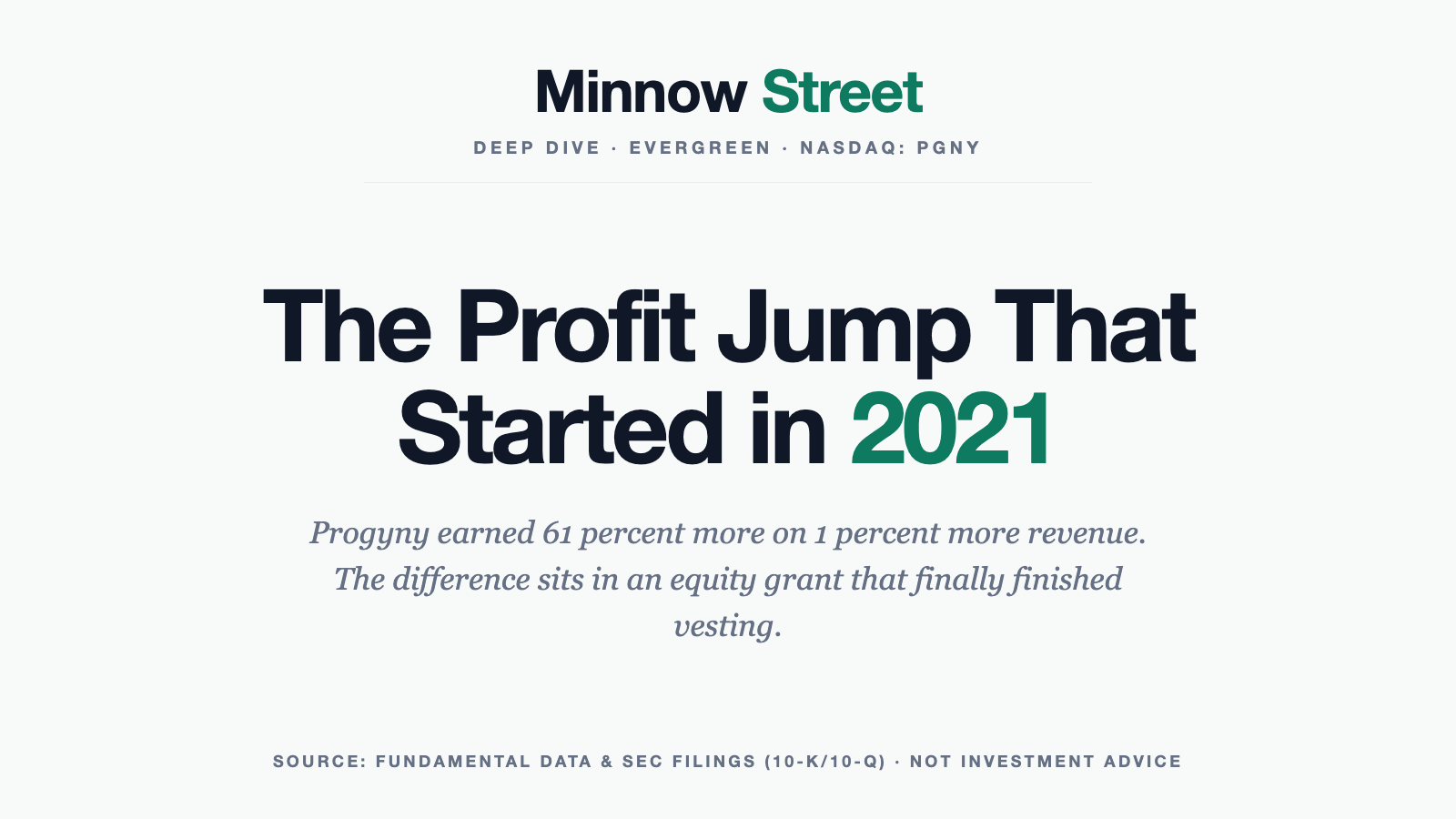
Progyny sells employers a fertility benefit for their workforce, and it shows up in our turnaround candidates scanner (U.S. selection, 60 hits, as of July 27, 2026). The trigger looks convincing: first-quarter 2026 net income jumped 61 percent. We read the 2025 annual report (10-K), the quarterly report (10-Q) for the period ended March 31, 2026 and every filing since — and found that the jump comes almost entirely from a November 2021 equity grant whose expense ran out at the end of 2025. Revenue grew 1 percent in the same quarter, and operating cash flow actually fell. Here is how to tell the accounting part of a profit jump from the business part.
 Thomas Mücke
Founder & Publisher
Thomas Mücke
Founder & Publisher
Chart
Interactive price chart (TradingView).
Note: pure fact-based analysis, not investment advice and not a solicitation to buy or sell. All figures without guarantee.
There is a reflex that costs investors money on a regular basis: the comeback reflex. When a stock has been cut in half and then delivers one green number, our brain does not read it as a number but as a story — “the turn is here.” Our turnaround candidates scanner is built on exactly that idea, and Progyny, Inc. (Nasdaq: PGNY) sits in it among 60 U.S. hits as of July 27, 2026. The trigger looks like a textbook case: first-quarter 2026 net income rose 61 percent. Before the reflex takes over, let us make a deal: we read the 2025 annual report (10-K), the quarterly report (10-Q) for the period ended March 31, 2026 and every filing since — and check where those 61 percent came from. The answer is in the filing itself, and it carries a date: November 2021. Remember the sentence everything below turns on: a profit that rises while cash flow falls has its cause in the accounting, not in the business.
What is in this analysis
- What Progyny actually does
- How the stock reached our desk
- The numbers over the years — credit where it is due
- Uncomfortable truth no. 1: the profit jump has an expiry date
- Uncomfortable truth no. 2: no order book, and one client already walked
- Uncomfortable truth no. 3: the buyback ran down to the last dollar
- Uncomfortable truth no. 4: the scanner’s mandatory pillar is wobbling
- What the stock costs
- Opportunities and risks at a glance
- A human conclusion
- Sources
What Progyny actually does — the fertility benefit written into the job offer
Progyny sits on Broadway in New York, employed 856 people as of December 31, 2025 (835 of them full time) and sells nothing to private individuals. The customer is always the employer. Large U.S. companies mostly self-insure their health coverage — they do not buy a policy, they pay their employees’ medical bills out of their own funds and hire specialists to run the program. That is where Progyny comes in: the employer buys a fertility and family building package, and Progyny handles everything that follows.
The core is called Smart Cycle. Instead of a dollar cap — “$5,000 for fertility treatment, and that is it” — the member receives a defined number of complete treatment cycles. The practical difference is large: a dollar pot can run dry in the middle of a treatment; a cycle cannot. On top of that comes a dedicated human guide (the company calls the role a Patient Care Advocate), a selective network of fertility clinics and, as an add-on, Progyny Rx, the matching drug benefit delivered through specialty pharmacies. Since 2025 adjacent offerings have been added: pregnancy and postpartum, menopause and midlife, leave navigation (via the January 2025 acquisition of Benefit Bump for $10.5 million) and services around parenting and child wellbeing.
The scale as of December 31, 2025: 555 corporate clients covering 6.689 million members (2024: 473 clients, 6.472 million), with contracts in place for more than 590 employers and roughly 7.2 million covered lives. In 2025 the company recorded 65,006 treatment cycles (2024: 61,114). The utilization rate — the share of members who actually use the benefit in a year — was 1.32 percent (2024: 1.31 percent). That is the real mechanics of this business: Progyny does not live on premiums, it lives on treatments. If nobody is treated, there is almost no revenue.
Which names the central tension of this analysis, and it runs through every chapter below: the business model is clean, debt-free and cash-generative — but it has barely grown for a year and a half, and the celebrated profit jump comes from a cost line that was always scheduled to expire.
How the stock reached our desk — and what the scanner really says
We run roughly 3,500 stocks through our scanners every day. As of July 27, 2026 Progyny shows up in the turnaround candidates scanner (U.S. selection, 60 hits). To reproduce it: open the scanner, set the country filter to “US” — the turnaround check column shows each stock’s score. One caveat up front: all lists are recomputed daily, and tomorrow’s composition can be a different one.
The scanner works with four pillars. Two are mandatory — the stock must trade at least 50 percent below its all-time high (pillar one), and survival must be secured (pillar two: Altman Z score outside the distress zone, no more than one balance sheet warning flag, positive equity). The other two pillars form an eight-point checklist; a stock appears in the list from six points up.
Progyny scores 6 out of 8. And this is exactly where honesty pays: of the 60 U.S. hits, 44 have precisely those 6 points, 15 have 7 and one has 8. Progyny therefore belongs to the largest and weakest group on the list — 16 names measurably rank higher. And one more piece of honesty: only the 25 strongest hits are visible on the scanner page — as of July 27, 2026 Progyny is not among them on either brand. The stock meets the criteria but sits too far back inside that 44-strong group, and the ordering moves with every daily recomputation. Naming an exact rank would be a number that stops being true tomorrow. Remember: a scanner hit is an invitation to research, not a league table position.
The two missing points are instructive. In pillar four — market confirmation — Progyny takes three of four: the price is back above its 50-day line, three-month relative strength (88) beats twelve-month relative strength (58), and the large funds have been net buyers. The missing point is the insider point: the data set shows one purchase against ten sales over the past twelve months. The filing history backs that up — between the quarterly report of May 8, 2026 and July 24, 2026 alone, 20 insider reports (Form 4) and 12 notices of proposed sale (Form 144) were filed with the U.S. securities regulator, the SEC. The people inside the house were not adding to their holdings.
One curiosity on the side that says a great deal about turnaround lists: Progyny sits in the turnaround scanner — among stocks far below their all-time high — and in the scanner for stocks near their 52-week high. Both are true. The stock is a long way from its all-time high and close to its one-year high at the same time. That vise is the whole story.
The numbers over the years — credit where it is due
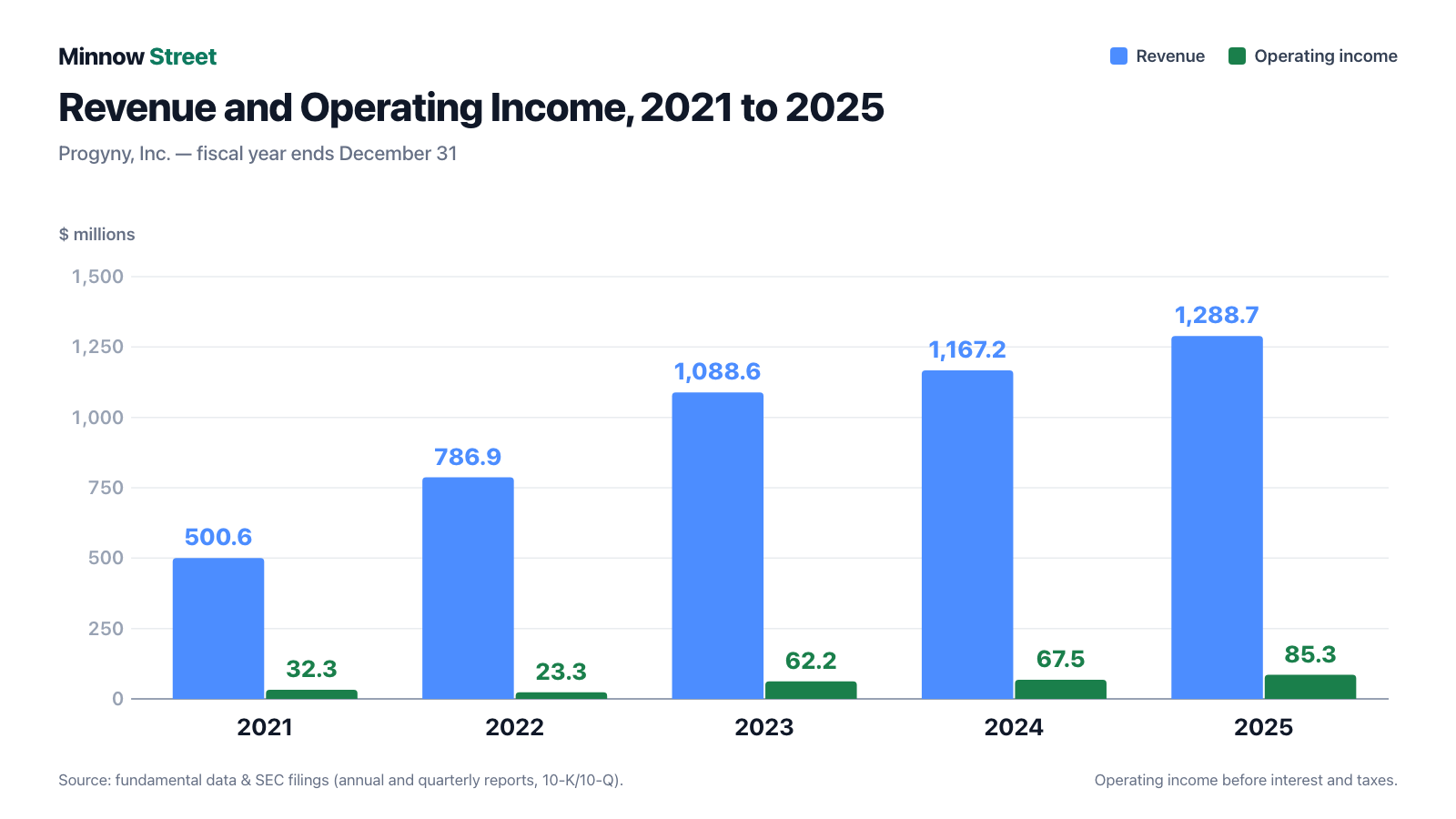
Start with what deserves respect. Progyny grew revenue from $500.6 million in 2021 to $1,288.7 million in 2025 — two and a half times in four years. Operating income over the same period rose from $32.3 million to $85.3 million, and it rose in each of the last three years. Operating cash flow reached $210.2 million in 2025, leaving $191.8 million after capital spending. This is not a cash-burning startup; this is a company that makes money.
The balance sheet is pleasantly plain as well. As of March 31, 2026, $132.6 million of cash and $93.5 million of marketable securities — $226.1 million together — stood against equity of $439.3 million on total assets of $698.3 million. That is an equity ratio of 62.9 percent. Progyny has drawn no debt at all: the $27.3 million that appears as “debt” in the data set are lease liabilities for office space in New York. Since July 1, 2025 there has also been a $200 million revolving credit facility with JPMorgan Chase maturing July 1, 2030 — and as of the filing date not a single dollar was drawn. Interest coverage cannot be calculated meaningfully for this company, because it pays no material interest; it collects it, taking in $10.2 million of interest income in 2025.
And the customers stay: Progyny states that it has retained substantially all clients since launching the fertility benefit in 2016, and reports a Net Promoter Score of +81 for the fertility benefit and +79 for Progyny Rx (December 31, 2025) — numbers rarely seen in U.S. health care. An NPS measures how many users would recommend an offering minus those who would warn against it; anything above +50 counts as very strong.
Now the other side of the same series: growth has braked hard. Revenue rose 38 percent in 2023, 7 percent in 2024, 10 percent in 2025 — and just 1 percent in the first quarter of 2026 ($324.0 million to $328.5 million). The fertility benefit grew 1.5 percent in the quarter to $209.4 million, the pharmacy segment 1.2 percent to $119.1 million. A company that grew 157 percent in four years is currently growing by one point.
Uncomfortable truth no. 1: the profit jump has an expiry date, and it lies in the past
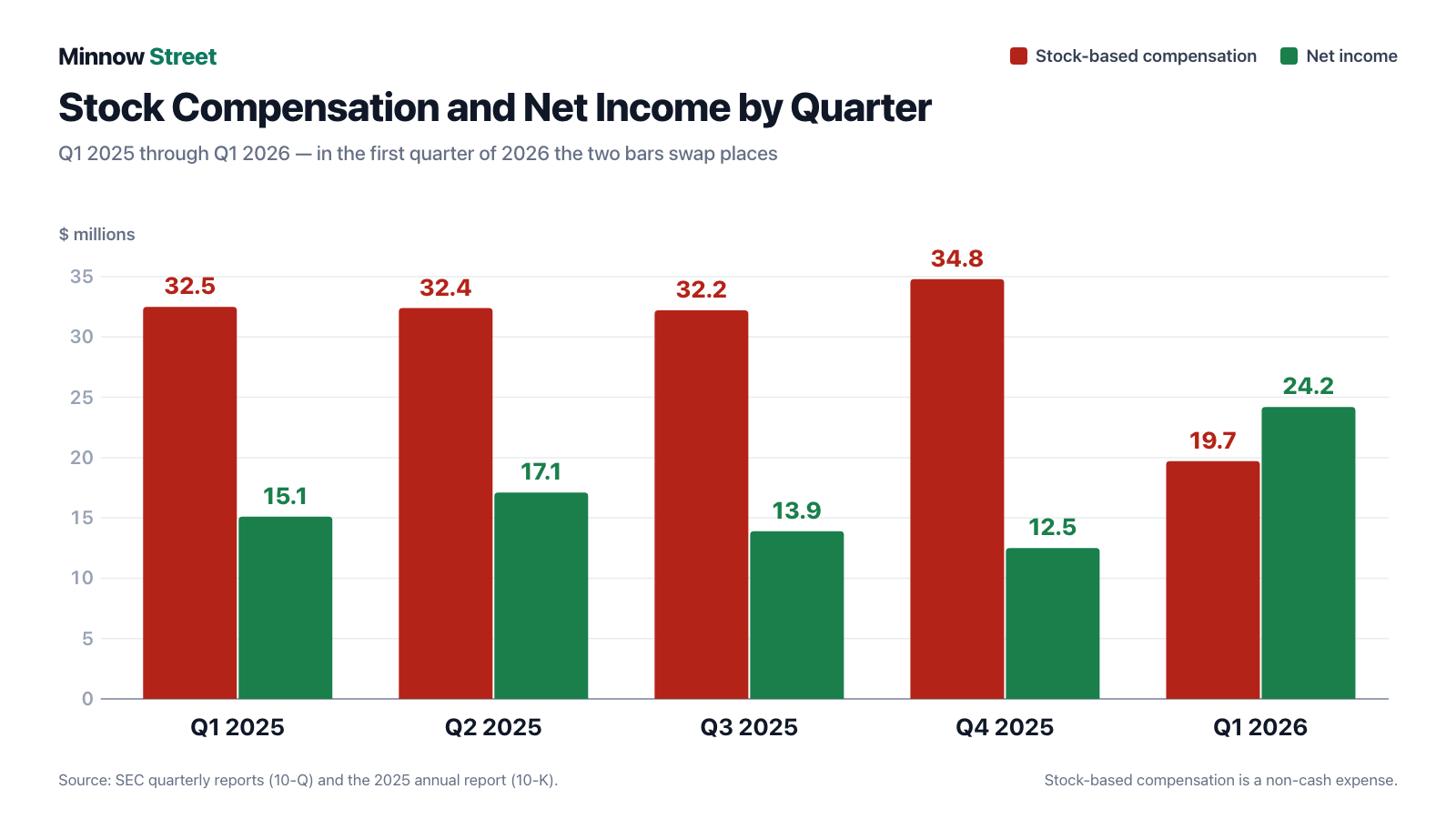
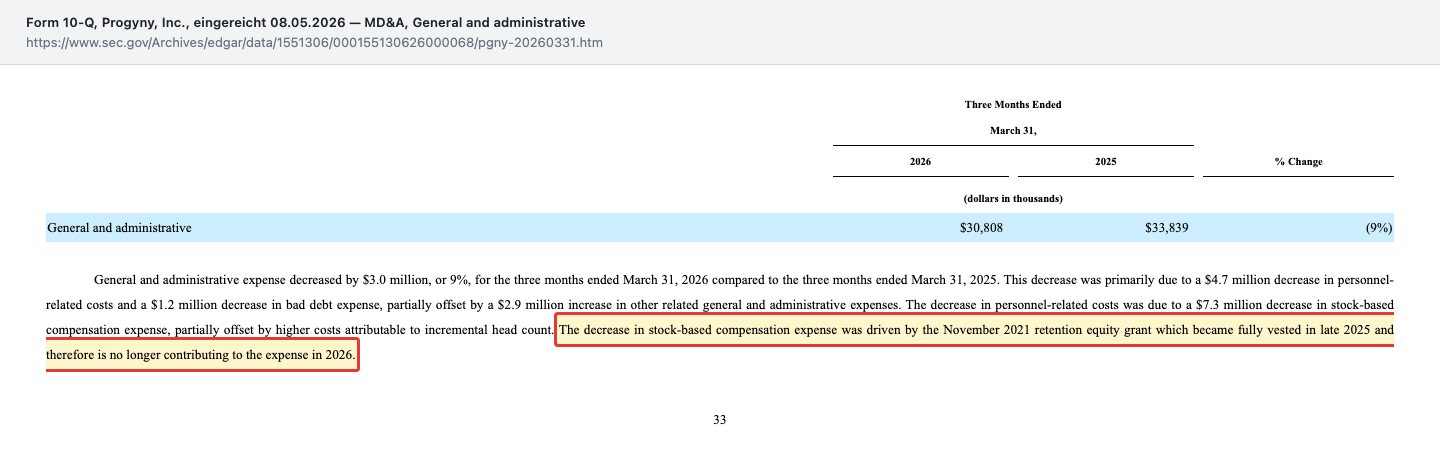
Net income rose in the first quarter of 2026 from $15.1 million to $24.2 million. That is 61 percent more — on 1 percent more revenue. Put those two numbers side by side and you have to ask where the difference comes from. The quarterly report answers the question itself, in a single sentence:
“The decrease in stock-based compensation expense was driven by the November 2021 retention equity grant which became fully vested in late 2025 and therefore is no longer contributing to the expense in 2026.”
— Progyny, Inc., SEC quarterly report 10-Q for the period ended March 31, 2026, MD&A, “General and administrative”
The arithmetic: stock-based compensation — the value of the equity packages employees receive instead of cash — fell from $32.5 million to $19.7 million. That is $12.8 million less expense. Additional revenue was $4.5 million. In other words, the compensation saved is almost three times the entire revenue growth. Broken out by line, it fell $3.1 million in cost of services, $2.3 million in sales and marketing and $7.3 million in general and administrative.
Stock-based compensation is a non-cash expense — no money leaves the company; instead, existing shareholders own a smaller slice of it. Put in everyday terms: your piece of the cake does not shrink because someone cuts it off, it shrinks because the cake is divided into more pieces. And because this expense costs no cash, its disappearance is no evidence of a better business either.
The cross-check sits in the cash flow statement of the same report — and it is the real news: operating cash flow fell in the first quarter of 2026 from $49.8 million to $45.9 million. After $6.3 million of capital spending, $39.6 million was left, down from $47.0 million a year earlier. Profit rose 61 percent, cash went down 8 percent. Both can be true at once, because one is an entry and the other is a bank balance.
Across the full year 2025 the scale is starker still: stock-based compensation cost $131.9 million — 2.3 times the $58.5 million of net income and 10.2 percent of revenue. Anyone using the $191.8 million of free cash flow as a measure of value has to mentally subtract those $131.9 million, because they were added back as a non-cash expense in getting there. What remains is roughly $60 million — strikingly close to reported net income. That is the honest order of magnitude of what Progyny earned for its owners in 2025.
To stay fair: the grant really has expired, and without a new one of the same size the expense stays permanently lower. But it is a one-time step change, not a trend. Multiplying $24.2 million of quarterly profit by four and calling it a growth story means extrapolating the end of an amortization schedule into the future.
Uncomfortable truth no. 2: there is no order book — and a 12 percent client has already walked
At a company with multi-year contracts you expect a backlog. Progyny has none — and says so explicitly:
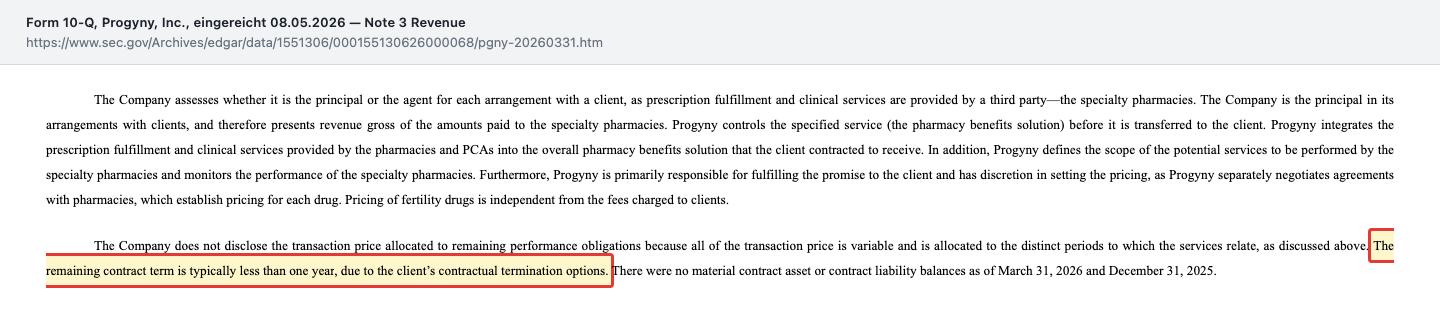
“The Company does not disclose the transaction price allocated to remaining performance obligations because all of the transaction price is variable and is allocated to the distinct periods to which the services relate, as discussed above. The remaining contract term is typically less than one year, due to the client’s contractual termination options.”
— Progyny, Inc., SEC quarterly report 10-Q for the period ended March 31, 2026, Note 3 “Revenue”
This is not a formality; it is a description of the business risk. And Progyny has already been shown what happens when a large client exercises that right:
“For the year ended December 31, 2025, none of our clients accounted for more than 10% of our total revenue. For the year ended December 31, 2024, one client accounted for 12% of our total revenue (the “Client”). The Client terminated its services agreement effective January 1, 2025.”
— Progyny, Inc., SEC annual report 10-K for 2025, Item 1A Risk Factors
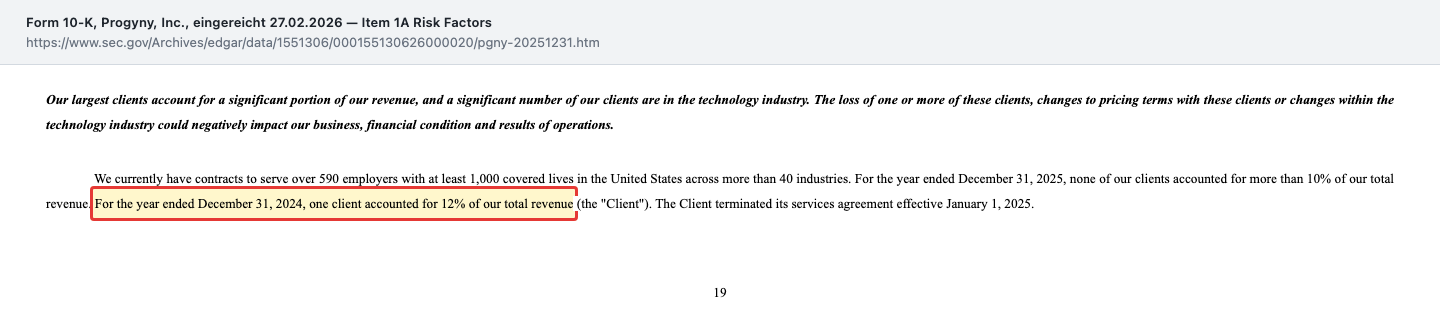
What followed is remarkable — in both directions. Progyny lost a client worth roughly $140 million of annual revenue (12 percent of $1,167.2 million in 2024) — and still grew 10 percent the following year, to $1,288.7 million. New business more than replaced the loss; the client count rose from 473 to 555. That is a genuine achievement, and it explains why the company never wobbled financially.
The flip side: the departing client received a transition-of-care arrangement under which selected members continued to be treated until June 30, 2025. That wind-down distorts every year-over-year comparison for the first half — which is precisely why revenue grew only 1 percent in the first quarter of 2026: it is measured against a prior-year quarter that still contained revenue from a client who had already given notice. Reading that as “Progyny’s growth is dead” goes too far; calling it “just a base effect” does not go far enough. Both facts are in the filing.
What remains is the structural risk Progyny names in the same passage: a significant number of its clients come from the technology industry. Layoffs, mergers or trimmed benefit budgets in that one sector therefore hit disproportionately hard. Buying Progyny means buying a piece of U.S. tech headcount planning. How much a customer structure can define a business we worked through elsewhere — in our Encompass Health analysis, where a single payer covers 82 percent of the bills.
Uncomfortable truth no. 3: the buyback ran down to the last dollar — the next one came eight weeks later
Progyny buys back its own shares, and at a notable pace. In the first quarter of 2026 it repurchased 5,511,824 shares at an average price of $21.13 — $116.6 million plus $1.1 million of U.S. excise tax on repurchases, a total outflow of $118.6 million. Shares outstanding fell within a single quarter from 83,365,696 to 78,270,386 — down 6.1 percent. The cover page of the quarterly report lists 78,332,370 shares as of April 30, 2026.
The catch is in the same note: that fully exhausted the $200 million program authorized in November 2025 as of March 31, 2026, with no capacity left. A new program — again $200 million, roughly 8 percent of the market capitalization — was only authorized by the board on May 26, 2026:
“Progyny, Inc. (the “Company”) announced today that its Board of Directors has approved a share repurchase program to repurchase up to $200 million of its common stock. The program will be funded through available cash balances.”
— Progyny, Inc., SEC current report 8-K dated May 26, 2026, Item 8.01

Why this is more than housekeeping: at Progyny a buyback is not a bonus, it is the counterweight to stock compensation. In 2025, $131.9 million of compensation faced only $81.7 million of repurchases — dilution was not offset that year. In 2024 it was the other way around: $300.3 million of buybacks against $128.1 million of compensation. Across the three years 2023 through 2025 combined, roughly $399 million of buybacks stand against $383 million of compensation — plus the $118.6 million from the first quarter of 2026. On balance the share count really has fallen, and substantially: from around 100 million at the end of 2022 to 78.3 million as of April 30, 2026.
But the mechanism is fragile. It depends on individual board decisions, on the cash balance and on the price — and the higher the price, the fewer shares $200 million buys. The average price in the first quarter of 2026 was $21.13; the closing price on July 24, 2026 was $31.19. The same sum now buys roughly a third fewer shares. What was left of a celebrated cash inflow at the end of the year we recalculated in our Bumble analysis — same question, different business.
Uncomfortable truth no. 4: the scanner’s mandatory pillar is wobbling — and the stored metrics are older than the price
This gets uncomfortable for our own hook, so we put it on the table. Pillar one of the turnaround scanner requires a distance of at least 50 percent from the all-time high. The data set stores -59.66 percent for Progyny. That number, however, comes from an older price level — it corresponds to a price of roughly $26.89.
We recalculated. Progyny’s highest closing price ever is $66.66, set on November 8, 2021 (checked across 1,694 trading days since the October 2019 IPO). Measured against the July 24, 2026 close of $31.19, that is -53.2 percent. The mandatory pillar therefore holds — but narrowly. The 50 percent threshold sits at a price of $33.33. The highest close of the past 52 weeks was $32.36 on July 14, 2026, three percent below it. If the stock climbs past $33.33 it falls out of the turnaround scanner — not because the business got worse, but because it is no longer a turnaround candidate.
The same caution applies to two more stored metrics:
- Piotroski F-score: the stored value is 7. The Piotroski is a nine-point test measuring the direction of a balance sheet — is return on assets rising, is cash flow outrunning profit, is liquidity improving? Recomputed against the 2025 annual report we get 5 out of 9: positive are profit, cash flow, cash flow ahead of profit, the reduced share count and the improved gross margin (21.7 to 23.6 percent). Negative are the lower return on assets (8.9 to 7.9 percent), the lower current ratio (2.80 to 2.73) and the lower asset turnover (1.92 to 1.74). We use our 5 in the text — that is middling; genuinely healthy starts at 8.
- Altman Z score: we arrive at 9.54 from the 2025 annual report — far outside any distress zone. But honesty applies here too: 6.48 of those 9.54 points come from a single input, the ratio of market value to liabilities. For a debt-free company with a high market valuation the Altman Z is structurally high. The balance sheet answers the survival question more directly: $226.1 million of cash and securities, no drawn debt, a $200 million untouched credit facility. Progyny is not going bankrupt.
- Market capitalization: the data set holds $2.118 billion — but at 78,332,370 shares and the $31.19 price from the same row it is $2.44 billion. That figure too comes from an older pull; the gap is roughly 13 percent. We use our own calculation in the valuation chapter.
And one more cross-check we run on every U.S. company: does the data set count all share classes? For Progyny the answer is yes — there is only one class (common stock, $0.0001 par value). The 78,332,370 shares in the fundamental data set are exactly the figure from the quarterly report cover page (as of April 30, 2026); the balance sheet as of March 31, 2026 shows 99,465,999 shares issued less 21,811,593 treasury shares. The share count is right — only the price it was multiplied by in the data set was stale.
What the stock costs — orders of magnitude, not daily quotes
Let us do the arithmetic ourselves, with the verified building blocks. 78,332,370 shares (10-Q cover page, April 30, 2026) times the July 24, 2026 closing price of $31.19 gives a market capitalization of roughly $2.44 billion. Against that:
- Revenue over the last four quarters: $1,293.1 million → price-to-sales of roughly 1.9.
- Net income over the last four quarters: $67.7 million → 36 times. Measured against diluted earnings per share for the same four quarters ($0.77), it is 40 times. The spread comes from the rapidly falling share count.
- Net cash: $226.1 million with no financial debt → enterprise value of roughly $2.22 billion, or 1.7 times annual revenue.
- Book value: $439.3 million of equity, or $5.61 per share → price-to-book of roughly 5.6.
Thirty-six to forty times earnings is not a bargain price. It is the price you pay for a growing company — and Progyny is growing by one percent. Conversely: 1.9 times revenue for a debt-free business generating $190 million of free cash flow is no bubble either.
The professionals’ view, with an important footnote: ten research houses cover the stock (as of July 24, 2026) — four with a buy rating, six with hold, none with sell. The average price target is $32.45. The earnings estimate for the current year is $2.06 per share, which would imply a price-to-earnings ratio of roughly 15. That estimate is an adjusted figure — it excludes stock-based compensation, among other items. Under generally accepted accounting rules Progyny earned $0.77 per share over the last four quarters. The distance between $2.06 and $0.77 is essentially the very line this analysis is about. Comparing one price-to-earnings ratio with the other means comparing two different companies.
Opportunities and risks at a glance
What speaks for Progyny:
- A debt-free balance sheet: $226.1 million of cash and securities, a 62.9 percent equity ratio, an untouched $200 million credit facility running to 2030 (as of March 31, 2026).
- Real free cash flow: $191.8 million in 2025 — buybacks and acquisitions are funded from the company’s own resources.
- The loss of the largest client was more than offset within a year: 473 to 555 clients, with revenue still up 10 percent.
- Stickiness: Net Promoter Scores of +81 and +79 (December 31, 2025); Progyny states it has retained substantially all clients since 2016.
- Room in the market: roughly 7.2 million covered lives under contract out of an estimated 106 million addressable — by the company’s own math, a mid-single-digit share of its target market.
- Buybacks genuinely shrink the share count: from around 100 million at the end of 2022 to 78.3 million as of April 30, 2026.
What speaks against it:
- Growth has nearly stopped: 1 percent revenue growth in the first quarter of 2026 after 38 percent in 2023.
- The profit jump is a step change from a 2021 equity grant, not from the business — operating cash flow fell in the same quarter.
- Stock-based compensation of $131.9 million in 2025 — 2.3 times net income and 10.2 percent of revenue.
- No order book: contracts are terminable, and the company puts the remaining term at typically under one year.
- Sector concentration: a significant number of clients come from the technology industry, so layoffs there feed straight through.
- $56.3 million of allowances against receivables (March 31, 2026) — 17.6 percent of gross receivables and 96 percent of 2025 net income.
- Insiders are selling: 20 insider reports and 12 notices of proposed sale between May 8 and July 24, 2026 alone.
- Regulatory background noise: Progyny explicitly names laws and rulings on reproductive rights as an uncertainty for its own business.
A human conclusion
The comeback reflex from the opening is not stupidity, it is economics inside the skull: we want to build a story from few signals, because stories are cheaper than arithmetic. For Progyny the fast story reads: “halved stock, profit up 61 percent, turnaround scanner — this is working.” The slow story reads: “a solid, debt-free company with a good product whose growth has stalled and whose profit jump comes from a 2021 equity grant, while cash flow went down.”
Both stories are in the same filings. The second one takes an hour longer. What really matters here is not the verdict but the question you will ask next time a profit jumps: did the bank balance jump with it? For Progyny in the first quarter of 2026 the answer is no. That does not make the stock bad — it makes it something other than the scanner headline suggests.
What you make of that is up to you. And that is exactly as it should be.
Sources
- Progyny, Inc. — annual report 10-K for 2025 (filed February 27, 2026, CIK 0001551306)
- Progyny, Inc. — quarterly report 10-Q for the period ended March 31, 2026 (filed May 8, 2026)
- Progyny, Inc. — annual report 10-K for 2024 (filed March 3, 2025)
- Progyny, Inc. — current report 8-K dated May 26, 2026 (Item 8.01, new $200 million share repurchase program)
- Progyny, Inc. — current report 8-K dated March 13, 2026 (Item 8.01, settlement of a shareholder derivative action over historical non-employee director compensation)
- Insider reports (Form 4) and notices of proposed sale (Form 144) at SEC EDGAR
- Fundamental data & SEC filings (annual and quarterly reports, 10-K/10-Q) and our in-house stock scanner, data as of July 27, 2026; price history since the IPO (1,694 trading days) for the all-time-high recalculation
Journalistic analysis, not investment advice and not a solicitation to buy or sell securities. Stocks can lose value at any time, and a total loss is possible. All figures are taken from the original documents linked above and carry the as-of date stated there; metrics from our data set are labeled with their data date and are recomputed daily. The author holds no position in Progyny, Inc. at the time of publication.
Our Bottom Line at a Glance
- Balance sheet and survival positive
- As of March 31, 2026, $226.1 million of cash and marketable securities stood against $439.3 million of equity on $698.3 million of total assets (a 62.9 percent ratio). No debt is drawn, the $200 million facility running to July 2030 is untouched, and Progyny collected $10.2 million of interest income in 2025 rather than paying interest. Survival is not the question here.
- Quality of the profit jump negative
- Net income rose 61 percent in the first quarter of 2026 to $24.2 million, while revenue rose 1 percent to $328.5 million. The filing itself explains the gap with the expiry of a November 2021 retention equity grant (stock-based compensation $32.5 million to $19.7 million). Operating cash flow fell in the same quarter from $49.8 million to $45.9 million — profit rose, cash did not.
- Growth negative
- After 38 percent in 2023, 7 percent in 2024 and 10 percent in 2025, revenue grew just 1 percent in the first quarter of 2026. Part of that is a base effect: the prior-year quarter still contained revenue from a departing large client whose transition arrangement ran until June 30, 2025. The rest is a client count that rose from 473 to 555 in 2025 but converts into revenue only slowly at a 1.32 percent utilization rate.
- Client structure and contract security neutral
- On the plus side: no client exceeded 10 percent of revenue in 2025, and the loss of a 12 percent client effective January 1, 2025 was more than offset within a year. On the minus side: there is no order book — Progyny discloses no remaining performance obligations and puts the remaining contract term at typically under one year because of client termination rights. A significant number of clients come from the technology industry.
- Capital returns neutral
- The share count fell in real terms from around 100 million (end of 2022) to 78.3 million (April 30, 2026); in the first quarter of 2026 alone 5,511,824 shares were bought back at an average $21.13. But in 2025, $131.9 million of stock compensation faced only $81.7 million of repurchases, the November program was fully exhausted by March 31, 2026, and its $200 million successor arrived only on May 26, 2026 — at a materially higher share price.
- Strength of the scanner hook negative
- Progyny scores 6 out of 8 in the turnaround check — like 44 of the 60 U.S. hits (data as of July 27, 2026); 16 names rank higher. The mandatory pillar “at least 50 percent below the all-time high” holds only narrowly at our recomputed 53.2 percent (July 24, 2026 close of $31.19 against $66.66 on November 8, 2021); the stored value of -59.66 percent comes from an older price level. The stored Piotroski of 7 also fails to hold against the 2025 annual report — we arrive at 5 out of 9.
Progyny is a debt-free, cash-generating company with a clear product and satisfied clients — but the trigger that put the stock into our turnaround scanner only partly survives scrutiny. The 61 percent profit jump in the first quarter of 2026 comes almost entirely from the expiry of a November 2021 equity grant, while revenue grew 1 percent and operating cash flow went down. Investing here means buying a solid balance sheet and stalled growth at 36 to 40 times earnings. Not investment advice.
What Our Rating Means
Open questions
The business works in principle, but one material question is open. As long as it stays open, our findings do not carry a quality verdict.
Yellow here is not about an existential question — the balance sheet is genuinely healthy, with a 62.9 percent equity ratio, $226.1 million of cash and marketable securities, no drawn financial debt and an untouched $200 million credit facility running to July 2030; there is no governance or accounting breach, and the auditor raises no objection. Yellow stands because three operating questions are open. First, growth has effectively stalled — after 38 percent in 2023 and 10 percent in 2025, only 1 percent was left in the first quarter of 2026. Second, the celebrated 61 percent profit jump comes not from the business but from the scheduled expiry of a November 2021 retention equity grant (stock-based compensation from $32.5 million to $19.7 million), while operating cash flow in the same quarter fell from $49.8 million to $45.9 million. Third, there is no order book: Progyny discloses no remaining performance obligations and puts the remaining contract term at typically under one year because of client termination rights — a concentration risk that already materialized once, when a 12 percent client terminated effective January 1, 2025. The business model itself clearly carries (555 corporate clients, 6.689 million members, a Net Promoter Score of +81, substantially all clients retained since 2016). Whether the accounting effect turns into a real earnings improvement will show at the earliest in the next quarterly report.
A journalistic assessment by our editorial team at the time of the deep dive, based on public sources — not investment advice and not a solicitation to buy or sell. Your personal circumstances (investment goals, risk capacity, taxes) cannot be taken into account. What our levels mean, how verdicts are formed, and what conflicts of interest exist →
Worth Noting
- Hook: turnaround candidates scanner (U.S. selection, 60 hits, turnaround check 6 of 8), data as of July 27, 2026. All scanner lists are recomputed daily; no exact rank is given on purpose, because 44 of the 60 hits share the same score and the ordering inside that group moves.
- As-of dates: operating figures from the 2025 annual report on Form 10-K (filed February 27, 2026) and the quarterly report on Form 10-Q for the period ended March 31, 2026 (filed May 8, 2026); share count from the quarterly report cover page (April 30, 2026); price and market data from the July 24, 2026 close. All filings after May 8, 2026 were reviewed — no Form 25, no Form 15, no tender offer or merger document.
- Own recalculations against the data set: distance from the all-time high 53.2 percent instead of the stored 59.66 percent; Piotroski 5 of 9 instead of the stored 7; market capitalization $2.44 billion instead of the stored $2.118 billion. In all three cases the cause is an older price or data pull, not an error in the share count — that matches the 10-Q cover page exactly.
- Possible confusion: Progyny was named Auxogyn, Inc. until 2015. Analyst earnings estimates ($2.06 per share for the current year) are adjusted figures that exclude stock-based compensation, among other items; under generally accepted accounting rules diluted earnings over the last four quarters were $0.77 per share.
Frequently Asked Questions
Progyny sells employers a fertility and family building package for their workforce. At its core is the Smart Cycle model: members receive a defined number of complete treatment cycles instead of a dollar cap that can run dry mid-treatment. Add to that a dedicated patient guide, a clinic network and the Progyny Rx drug benefit. As of December 31, 2025 it served 555 corporate clients covering 6.689 million members.
Because a cost line disappeared. Stock-based compensation fell in the first quarter of 2026 from $32.5 million to $19.7 million. The quarterly report names the reason itself: a November 2021 retention equity grant that became fully vested in late 2025 and no longer burdens 2026. Revenue over the same period rose just $4.5 million, to $328.5 million.
No. Operating cash flow fell in the first quarter of 2026 from $49.8 million to $45.9 million, leaving $39.6 million after capital spending instead of $47.0 million. Stock-based compensation is a non-cash expense — removing it raises reported profit but does not change the bank balance. Across 2025 it cost $131.9 million, or 2.3 times net income.
In 2025 no client exceeded 10 percent of revenue. In 2024 a single client still accounted for 12 percent, and in 2023 for 13 percent — that client terminated effective January 1, 2025. Progyny absorbed the loss with new business and still grew 10 percent in 2025. A concentration risk remains at the sector level: a significant number of clients come from the technology industry.
No, and the company says so explicitly. The quarterly report states that it discloses no remaining performance obligations because the entire transaction price is variable. It adds that the remaining contract term is typically less than one year because of client termination rights. Multi-year contracts therefore do not mean multi-year revenue security.
Because the scanner measures the distance from the all-time high, not from the 52-week high. The highest closing price was $66.66 on November 8, 2021; measured against the July 24, 2026 close of $31.19 that is 53.2 percent below. The mandatory threshold is 50 percent, which corresponds to a price of $33.33. Above that level the stock drops out of the scanner.
Only partly. Progyny scores 6 out of 8 in the turnaround check — exactly like 44 of the 60 U.S. hits as of July 27, 2026. Fifteen names sit at 7 points and one at 8. Inside that 44-strong group the ordering moves with every daily recomputation, and only the 25 strongest hits are visible. An exact rank would therefore be a number with no shelf life.
Solid. As of March 31, 2026 the balance sheet held $132.6 million of cash and $93.5 million of marketable securities, with equity of $439.3 million against $698.3 million of total assets — a 62.9 percent equity ratio. No debt is drawn; a $200 million credit facility runs to July 2030 and was untouched at the reporting date. Progyny pays no material interest and collected $10.2 million of interest income in 2025.
Found an error?
Did you spot a factual error, an outdated number, or a typo in this deep dive? Let us know briefly — your report goes straight to the editorial team.